Pacific

Islands
Monthly
dfdsfdsfdsfds
American Samoa US$l.75 Australia *A$l.5O Cook Islands NZ$l.5O Fiji F 51.50 Hawaii US$l.95 Kiribati A 51.75 Nauru A 51.75 New Caledonia CFPI9O New Zealand NZ$2.OO Niue NZ$l.5O Norfolk Island A 51.50 Papua New Guinea K 1.50 Solomons 551.50 Tahiti CFPI9O Tonga P 1.50 Tuvalu A 51.75
Usa U 552.25
USTT & Guam US$l.95 Vanuatu A 51.50 Western Samoa T 1.95 •Recommended retail price only.
Registered by Australia Post Publication No. NBPI2IO
rai
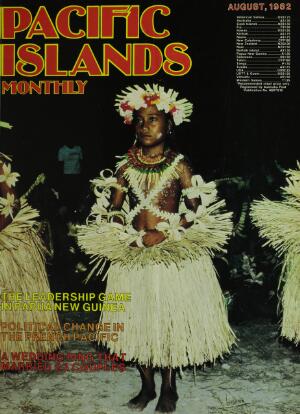
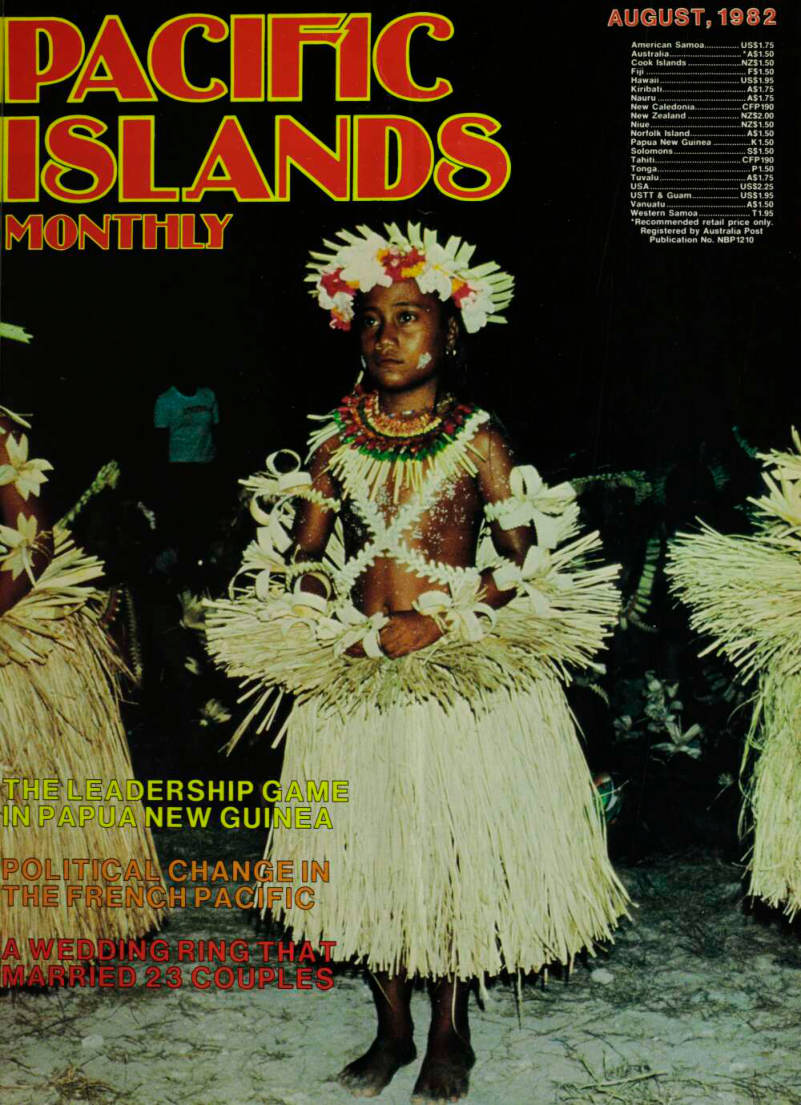
Cover picture: A young Gilbertese dancer spreads her talents around at a performance in Tarawa, capital of her homeland Kiribati. Jimmy Cornell picture.
Advertisements & other items, p. 2 (1 item)
Thump!
Making The World An Exciting Place
ii m. r mm ■ PStroKe OHC ’4-valve 24ftcftV -22.5PS 2-3HS-» GDI Air fork Pro-L.nk XL. The world’s best selling 4-stroke trail bikes.
The brute force that sets the pace. XL. From those who build perfection. To those who demand it.
WORLD’S LARGEST MOTORCYCLE MANUFACTURER
HONDA MOTOR CO., LTD. TOKYO, JAPAN
c> to /
XL500R
XL185S
XL125S
XL100S
PAPUA NEW GUINEA; S.ea.sPIps Tradln, £ «X to.
SAMOA.Holiday Motors, Paris and Ud S pO°B^676 , ’Apia?SOL^MON
Pacific Islands Monthly
Vol 53 No. 8
August 1982
[Usps 952480]
Representatives
AUSTRALIA: Distribution: NSW & ACT: Allan Rodney Wright (Circulation) Pty Ltd, PO Box 907, Darlmghurst, NSW 2010 Elsewhere: Gordon & Gotch (A/asia) Ltd, Box 40, PO, Rosebery, NSW 2018. Advertising Reps - Brisbane D. Wood, Anday Agency, Box 1918, GPO, Brisbane 4001, telephone 44 3485, 44 1546 Adelaide Hastwell Media, PO Box 30, Glen Osmond, SA 5064, 23 Avenue Road, Frew ville, SA 5063, telephone 79 9271.
FIJI: Distribution and subscriptions Desai Bookshops.
PO Box 160, Suva, Fiji, telephone Suva 23036 Advertising Fiji Times & Herald Ltd, 20 Gordon St, Suva, telephone 312 111, telex FJ2124 FRENCH POLYNESIA: Distribution - Hachette Pacifique, 10 Ave Bruat, Papeete, telephone 25610.
HAWAII, UNITED STATES: Distribution PIM, Hawaii, PO Box 22250, Honolulu, Hawaii 96822 Advertising - Roger Brookes, PO Box 10217, Honolulu, Hawaii 96816, telephone 808 536 6677 JAPAN: Advertising and subscriptions Universal Media Corporation, GPO Box 1762, Tokyo, telephone 666 3036.
NEW CALEDONIA: Distribution Depot Centre de Presse Michel Pentecost, CBP2, Noumea, telephone 27 2434 27 4729.
NEW ZEALAND: Distribution - Gordon & Gotch, PO Box 584, 2 Carr Road, Mt, Roskill, Auckland 4 Advertising International Media Representatives Ltd, PO Box 2313, Auckland, telephone 795 487; 493 389, cables Intereps, Auckland. Subscriptions Ross Haines & Son Ltd, PO Box 1289, Auckland, telephone 769 042 PAPUA NEW GUINEA: Distribution - Gordon & Gotch, PO Box 3395, Port Moresby, telephone 254551, 254855 Advertising PNG Post-Courier, PO Box 85, Port Moresby, telephone 21 2577.
UNITED KINGDOM; The Herald & Weekly Times Ltd, No 1 Maltravers Street, London WC2R 3DZ, England, telephone 01 836 5162, telex London 21989 UNITED STATES MAINLAND: Advertising - Joshua B Powers Jr, Powers International Inc , 551 Fifth Ave, New York, New York 10 01 7, telephone 867 9580, telex 236514 Subscriptions - PIM. Hawaii, PO Box 22250, Honolulu Hawaii 96822
Subscriptions
PIM is airfreighted to most subscribers and agents in the Pacific Islands and the United States, but not the UK or the Continent.
Payments by personal cheque are only acceptable in Aus tralian (from a branch in Australia). US and New Zealand currency For all other remittances please send an inter national bank draft in Australian dollars Published monthly by Pacific Publications (Aust.) Pty Ltd and printed in Australia by Paramac, Alexandria, NSW, Aus tralian cover price is recommended retail only Registered by Australia Post, publication No NBPI2IO Second class postage paid at Honolulu, Hawaii, Copyright © Pacific
Publications (Aust.) Pty Ltd.
Postmaster Honolulu: Send address changes to PIM Hawaii, PO Box 22250, Honolulu Hawaii 96822
Local Aust American Samoa
Sus21
$18 Australia $A18 $18 Canada $US27 $25 Cook Islands $19 Fiji $18 French Polynesia $22 Guam
Sus23
$20 Hawaii
Sus23
$20 Japan $20 Kiribati $19 Micronesia $US23 $20 Nauru $21 New Caledonia $22 New Zealand
Snz24
$18 Niue Norfolk Island $19 $15 Northern Mananas $US23 $20 Papua New Guinea $23 Solomon Islands $19 Tonga $19 Tuvalu $19 United Kingdom Stg 15 $25 US Mainland Vanuatu $US27 $25 $19 $18 $A25 Western Samoa Elsewhere
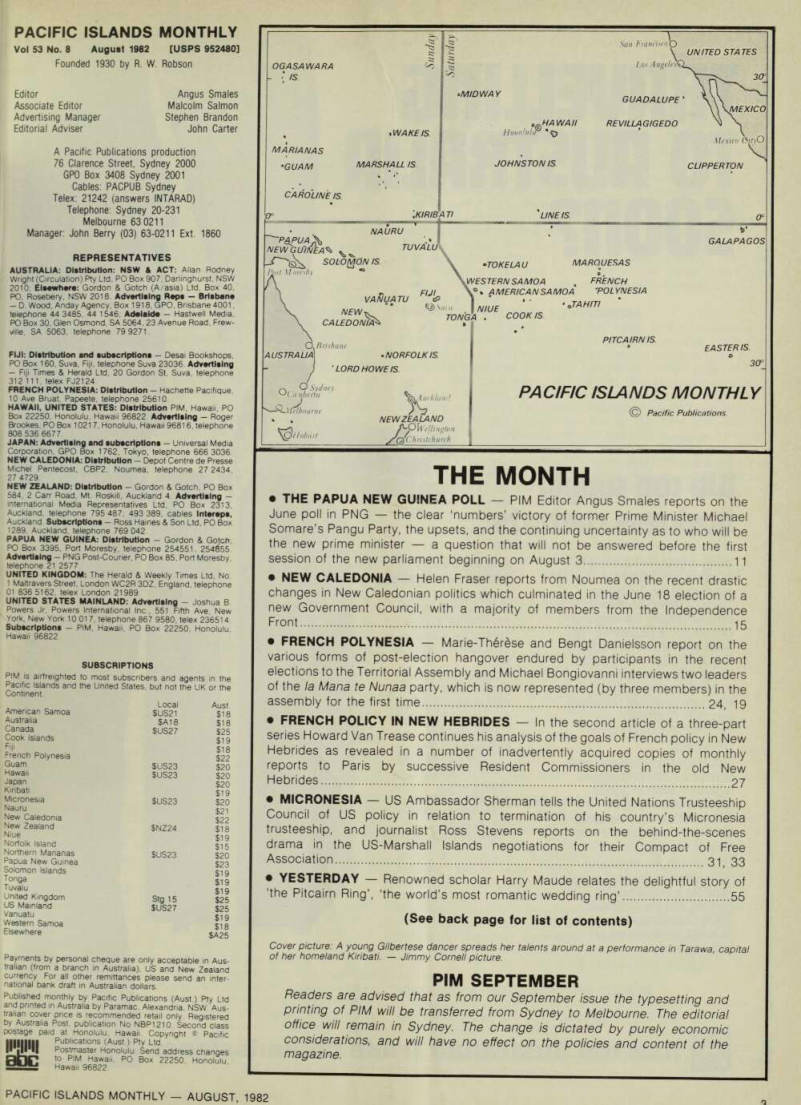
The Month
• THE PAPUA NEW GUINEA POLL PIM Editor Angus Smales reports on the June poll in PNG the clear ‘numbers’ victory of former Prime Minister Michael Somare’s Pangu Party, the upsets, and the continuing uncertainty as to who will be the new prime minister a question that will not be answered before the first session of the new parliament beginning on August 3 11 • NEW CALEDONIA Helen Fraser reports from Noumea on the recent drastic changes in New Caledonian politics which culminated in the June 18 election of a new Government Council, with a majority of members from the Independence Front -1 5 • FRENCH POLYNESIA Marie-Th6rdse and Bengt Danielsson report on the various forms of post-election hangover endured by participants in the recent elections to the Territorial Assembly and Michael Bongiovanni interviews two leaders of the la Mana te Nunaa party, which is now represented (by three members) in the assembly for the first time 24, 19 • FRENCH POLICY IN NEW HEBRIDES In the second article of a three-part series Howard Van Trease continues his analysis of the goals of French policy in New Hebrides as revealed in a number of inadvertently acquired copies of monthly reports to Paris by successive Resident Commissioners in the old New Hebrides 27 • MICRONESIA US Ambassador Sherman tells the United Nations Trusteeship Council of US policy in relation to termination of his country’s Micronesia trusteeship, and journalist Ross Stevens reports on the behind-the-scenes drama in the US-Marshall Islands negotiations for their Compact of Free Association 31, 33 • YESTERDAY Renowned scholar Harry Maude relates the delightful story of ‘the Pitcairn Ring’, ‘the world’s most romantic wedding ring’ 55 (See back page for list of contents)
Pim September
Readers are advised that as from our September issue the typesetting and printing of PIM will be transferred from Sydney to Melbourne. The editorial office will remain in Sydney. The change is dictated by purely economic considerations, and will have no effect on the policies and content of the magazine.
Advertisements & other items, pp. 3-4 (2 items)
3
PACIFIC ISLANDS MONTHLY AUGUST, 1982
Founded 1930 by R. W. Robson Editor Angus Smales Associate Editor Malcolm Salmon Advertising Manager Stephen Brandon Editorial Adviser John Carter A Pacific Publications production 76 Clarence Street, Sydney 2000 GPO Box 3408 Sydney 2001 Cables: PACPUB Sydney Telex: 21242 (answers INTARAD) Telephone; Sydney 20-231 Melbourne 63 0211 Manager. John Berry (03) 63-0211 Ext. 1860
io nusißnun
TRfIUEUinC
soon?
Ule can supply
business contacts
Businesspeople travelling to Australia can call on the services of the Australian Trade Commissioner for introductions to the Regional Offices of the Department of Trade and Resources located in all Australian state capitals.
These offices have been established to directly introduce overseas businesspeople to Australian manufacturers and trading companies.
The Trade Commissioner aiso maintains a comprehensive register system of goods and services available.
If it is available from Australia the Trade Commissioner can tell you who supplies it.
Easy communications and rapid shipping services make Australia a logical trading partner, and the Australian Trade Commissioner is here to assist development of two way trade.
Ask the expert who knows Australia The Australian Trade Commissioner can give you details of suppliers Contact the Australian Trade Commissioner at:
FIJI
P.O. Box 1252, Suva Phone: 31 2844
PAPUA NEW GUINEA
P.O. Box 9129, Hohola Phone: 259333
NEW CALEDONIA
P.O. Box 22, Noumea Phone: 27 2414
HAWAII
Australian Consulate 1000 Bishop Street, Hawaii, 96813 Phone: (808)5245050
RSI Ask the Australian Trade Commissioner
Pacific Report
Elections In Png, Fiji
July 10-17 was polling week in Fiji’s fourth general election since the country became independent in 1970. A total of 136 candidates were contesting the 51 seats for the House of Representatives. (One member of the 52-seat House was already elected unopposed.) A Radio Australia correspondent in Fiji said that most contests were straight two-way affairs between the ruling Alliance Party and the National Federation Party-Western United Front coalition. A total of almost 300 000 voters were registered. Observers generally agreed that the result of the election would be close. PIM editor Angus Smales reports in detail on Papua New Guinea’s June election (p 11).
Reagan Acts On Kwajalein Dispute
US President Ronald Reagan in July despatched his personal representative Fred Zeder to the Marshall Islands to try to settle a dispute involving the Kwajalein Atoll missile testing range. More than 800 Marshallese landowners had set up tent camps on the base. Protest leaders said they intended to prevent operation of the base, which is the only facility in the Pacific for testing intercontinental ballistic missiles, if their demands for higher rental payments and other changes were not met. Leases on Kwajalein land for US military use expired on September 30, 1981. Pending the conclusion of leases the base had been operated under an interim agreement with the Marshall Islands Government, with the landowners receiving about SUSB million a year in cash and services. The demonstrators had settled in on the main island at the heart of the base, and on several other smaller islands in an area that the US Army considered hazardous when the missiles pass overhead and plunge into the shallow lagoon. Meanwhile, the Marshall Islands Government had announced in June that it would go ahead with an August 17 plebiscite on the proposed Compact of Free Association (PIM Jul p 5) with the USA, despite American requests for a postponement. The Marshalls Foreign Secretary Tony deßrum questioned US suggestions that the August date did not allow enough time for public education about the proposal. Mr deßrum referred to persistent rumours of ‘under-cover American activity’ aimed at influencing the outcome of the plebiscite. He said the US appeared to want to change the wording on the ballot paper so that American trusteeship would continue if the Compact were defeated. Mr deßrum said the US Defence Department was feaiful of losing the Kwajalein missile testing range if the Marshalls became independent.
Us Will Not Sign L.O.S. Convention
The US decision not to sign the Law of the Sea convention was described as ‘disappointing’ by Australian Foreign Affairs Minister Tony Street in a July statement. ‘lt is a setback to those many countries that had worked so hard to try to ensure that the new Law of the Sea was supported by global consensus,’ he said.
According to an Australian press report, Mr Street’s statement ‘reflected the damage the Reagan Administration had done to years of painstaking work’. The report added: The decision means that the country that would have been most significant in the development of the seabed is excluding itself from its obligations under the convention . . . The position of the US Government has now radically undermined the relevance of the agreement and has led other countries, like the Soviet Union and Britain, to abstain.’
Peace Corps Man In South Pacific
Deputy Director of the US Peace Corps Everett Alvarez has been visiting South Pacific Island countries where the corps is active.
In Tonga he met King Taufa’ahau Tupou IV, and was guest at a dinner hosted by Crown Prince Tupouto’a.
W.Samoa Government Loses Its Majority
A Supreme Court ruling in Western Samoa in late June deprived the government of Prime Minister Vaai Kolone of its parliamentary majority. The court decision stripped Education Minister Fuataga of his seat after he had been found guilty of electoral malpractice by making gifts of food and fruit to voters on polling day in February. After supplying the Speaker, the government was left with 22 seats to the opposition’s 23. Parliament was in recess at the time of the court ruling, and it was unclear what the next move
would be. More than 20 petitions have been filed against other MPs elected in February. Complicating matters still further is the fact that parts of the country’s Electoral Act have been declared unconstitutional by Chief Justice St John (PIM Jun p2O).
Vanuaaku Party In Congress
The 12th annual congress’of Vanuatu’s ruling Vanuaaku Party late in June requested the government to declare Vanuatu a nuclear-free state, and accused ‘outside’ interests of sponsoring motions of no-confidence in Prime Minister Fr Walter Uni in parliament as a means of toppling the government (PIM Jun p 5).
The congress said certain power-hungry politicians were being manipulated and used as ‘tools of foreign interests’. It also urged the government to reconsider some of the political compromises and favours it had offered to opposition political groups in the interest of promoting national unity and stability. Fr Lini was re elected president. Meanwhile the two dismissed VP ministers, Thomas Reuben Seru and George Worek, have announced the formation of a new party, the Vanuatu Alliance Party. They have been joined in the move by the MP for the Santo Urban seat, Kalmar Voccor. The new grouping held its first meeting in Santo from June 28-July 3.
Sharp Png Protest To Indonesia
A stiff diplomatic protest note has been sent to Indonesia by Papua New Guinea’s Minister for Foreign Affairs and Trade Noel Levi over a June 26 incursion by an armed Indonesian patrol. The minister alleged that the patrol had taken 19 Irian Jaya refugees back across the border. He said that the refugees had been in PNG for five years, and that the crossing was a contradiction of assurances given by Indonesia’s Foreign Minister Dr Mochtarthat his country would respect the border. Mr Levi predicted ‘an almost certain degeneration’ of relations between the two countries if the incursions did not stop. Shortly before the incursion PNG had returned 18 Indonesians held hostage by Irian Jaya rebels on its territory. They were believed to be the last of the group of 57 people seized by Irian Jaya rebels last October from a sawmill near Jayapura.
New N-Test At Moruroa
France exploded a nuclear device at Moruroa in July, the second this year. New Zealand scientists reported from their monitoring centre in the Cook Islands that the blast was in the 20-kilotonne range. The earlier test, detected in March, was of a 15-kilotonne bomb.
Ratu Mara Blasts Australian Tv Crew
Fiji Prime Minister Ratu Sir Kamisese Mara in June protested to the Australian Government over the conduct of an Australian Broadcasting Commission television crew in Fiji. Ratu Mara accused the crew of active interference in the campaign for Fiji’s July election, of having supplied information to Opposition Leader Jai Ram Reddy about a confidential report prepared for his Alliance Party, and of offensive behaviour during an interview he had accorded them. Ratu Mara said he had walked out of the interview in protest. He said the Fiji Government regarded the affair as ‘a blatant act of political sabotage against a sovereign nation’. Acknowledging the protest had been received, Austra lia’s Department of Foreign Affairs said that the ABC was an independent body, and that it was up to it to decide what to do about the protest.
NAURU BACKS TAKEOVER BID FOR OZ AIRLINE The Australian Treasurer John Howard said in July that the efforts of a company to take over East-West Airlines, Australia’s third biggest domestic airline, using funds from Nauru, did not come within the scope of Australia’s Foreign Takeovers Act. The takeover bid is being made by a newly formed Australian company, East-West Developments Ltd. The company is financed by an SAB.S million loan from the Nauru Phosphate Royalties Trust. Mr Howard said the government would act only if the Nauruan trust sought to take up its option in case of a default on the loan. East-West Developments was formed by Duke Minks, a former executive of Citicorp Australia, and Bryan Grey, a former executive of Air Niugini and Australia’s Ansett Airlines.
Micronesia: Investigators Pour In
A delegation from the World Council of Churches in June began an extensive visit to the US Trust Territory of the Pacific Islands.
A spokesman for the WCC said that among other things, the mission was expected to raise issues related to proposals for a nuclear-free Pacific, and to examine the role the US has played as trustee of the Micronesian islands since World War 11. The
Carter Administration had planned to wind up the trusteeship by 1981, but the incoming Reagan Administration announced that the programme would be delayed for further review of the terms of association of the Micronesian people with the US. A mission from the United Nations Trusteeship Council, headed by incum bent Council president Paul Poudade of France, also visited Micronesia from July 4-31.
‘Economic Outlook Grim’ Siwatibau
The General Manager of Fiji’s Central Monetary Authoritory, Mr Siwatibau, has warned of poor export markets, low commodity prices, and rising unemployment for South Pacific Island countries over the next two years. Speaking at a June meeting in Suva of Pacific development planners, he said that all South Pacific countries were facing rising deficits in their current account. Some countries had gone to the European money markets, incurring greater external debts. Others, he said, had sought the help of the International Monetary Fund. Mr Siwatibau urged planners to keep a close eye on external cash flow into their countries.
Src’S ‘P&E’ Committee Meets
The Planning and Evaluation Committee of the South Pacific Commission, meeting in Noumea in June, assessed the commission’s work over the past year, and set plans for a work programme for the coming three years. Among items listed for discussion were the establishment of a Pacific Islands agricultural stabilisation scheme, and a regional development fund.
Australia Offered As N-Test Monitor Site
Australia has been offered as the site of one of a chain of United Nations data centres which would be used to monitor whether nuclear tests were being conducted in the region. The offer was made to the United Nations General Assembly special session on disarmament in June by Australian Foreign Minister Tony Street.
He said that his government attached the highest importance to conclusion of a comprehensive and fully verifiable nuclear test ban treaty. He strongly criticised nuclear testing and warned of the spread of nuclear technology. Mr Street condemned the dumping of nuclear waste in the Pacific, criticised countries that are working towards a nuclear capability, and also countries that are providing them with the technology to do so. The US newsagency Associated Press noted that Mr Street’s criticism of nuclear testing clearly applied to France, but that his remarks about the storing or dumping of nuclear materials applied also to the USA (which stores nuclear wastes at Runit in the Marshall Islands), and Japan (which has plans to dump nuclear wastes in the Pacific). Representatives of Fiji and Papua New Guinea, in their addresses to the session, both called for a nuclear-free zone in the South Pacific.
‘New Chapter’ In Malaysia-Pacific Ties
Malaysia’s Prime Minister Mahathir has described his recent visit to a number of South Pacific countries (PIM Jul p 6) as ‘opening a new chapter’ in his country’s relations with the region. He said that Malaysia’s new-found interest in the South Pacific reflected its new foreign policy directions, which stressed bilateral co operation with developing countries. Dr Mahathir visited Fiji, Tonga and Western Samoa, and made brief stop-overs in Port Moresby and Honiara. During his talks with South Pacific leaders Dr Mahathir offered to help in their countries’ development by opening training facilities in broadcasting, defence, adminis tration, and land development to people from the region.
Malaysia would also encourage private companies to explore agricultural opportunities in the South Pacific.
MORE OZ AID TO COUNTER SOVIET MOVES Australia’s Minister for Foreign Affairs Tony Street has said Australia’s aid programmes in the Pacific will be stepped up to counter growing Soviet activity in the region. Speaking on Singapore television, Mr Street said Soviet attempts to gam influence among small, isolated and vulnerable Pacific countries would increase. Australia was concerned about Soviet offers of aid in the region such as hydrographic surveys or fisheries research. Mr Street described them as ‘a new development.
Soviets And Mr Suzuki’S Pacific Age’
The Soviet Union can participate in the new ‘Pacific Age but only if it makes concrete contributions to peace and economic stability, according to Japan’s Prime Minister Zenko Suzuki.
Speaking in Hawaii in June, Mr Suzuki unveiled a new plan for peace and economic co-operation in the Pacific. He said the linchpins of the plan were an easing of military tensions, and the free flow of people and goods between nations. He said it was a
matter of serious concern that the Soviet Union had continued to build up its military forces in Asia and the Far East in what he called the ‘Pacific Age’. Mr Suzuki called for economic co operation, warning against what he called ‘vindictive’ trade practices. Protectionist tendencies were emerging in the region but free trade was necessary if the vitality of the Pacific Basin was to be strengthened. He also urged the further development of regional organisations, citing the Association of Southeast Asian Nations (ASEAN) as an example of the spirit of self-help.
Cooks Can Sign L.O.S. Convention
The Cooks Islands will be able to sign the Law of the Sea convention when it is ratified. There had been doubts held on this score in the Cooks because of the country’s ‘special relationship’ status with New Zealand. This has been clarified in the draft convention adopted at the United Nations. The Cooks see the LOS Convention as strengthening its hold on an exclusive economic zone covering almost 200 000 square kilometres.
Oil, Gas And Minerals Survey Completed
The joint Australian/New Zealand/US survey of offshore oil, gas and mineral prospects in the southwest Pacific was completed in June. It involved more than 50 scientists working on two vessels over a period of two months. Scientific personnel from Tonga, Fiji, Vanuatu, Solomon Islands and Papua New Guinea took part in the project, which tested petroleum prospects around Tonga, Vanuatu and Solomon Islands, and mineral deposits off Fiji and Solomon Islands. An Australian scientist with the project, Dr Neville Exon, said the tests confirmed that some parts of the area have the geological potential of oil, gas and valuable minerals, but that it was too early to say there were any economically viable deposits. He said the data collected would take about 18 months to collate. The three countries concerned undertook the project after the Soviet Union had responded favourably to an appeal from a United Nations agency for a UN member country to carry it out (PIM Aug ’Bl p 5). The tripartite offer was welcomed by the Island governments concerned.
Moruroa: Scientists Urge Further Study
A French Defence Ministry team investigating the problems created by nuclear testing at Moruroa, French Polynesia, has recommended that a longer, independent study should be carried out. Headed by vulcanologist Harouf Tazieff, the team reported in July that the tests are being carried out with satisfactory safety measures and concern for the environment. Mr Tazieff empha sised that initial investigations had shown no special risks justifying new emergency measures. But, he added, further study was needed of possible geological changes in the atoll caused by the tests, of the possible disturbance of fall-out from earlier atmospheric tests, and the development of an improved alarm system. For these reasons, he would be recommending the longer study.
Fiji Denies ‘Collaboration’ In Lebanon
Fiji’s Ministry of Foreign Affairs has sharply rejected reports that its troops in the Lebanon peace-keeping force had ‘collaborated with Israeli forces during their June invasion of Lebanon. The same charge had been levelled at the Dutch component of the force The ministry said its lightly armed forces could not have been expected to stop the advance into Lebanon of the heavily armoured Israeli forces. It added that Fiji’s forces will be withdrawn if Israeli aggression continues.
Death Sentence On Three In Tonga
Three Tongan men, Haloti Sole, his brother Livmgi Sole, and hli ’Esau, all of Lapaha village, were sentenced to death by Mr Justice H. Hill in the Tonga Supreme Court in June for the murder of a youth last March. The three accused, who were travelling in a van with others, became involved in a fight with three youths after stones were thrown at the van. The court was told that the three accused, said to be under the influence of alcohol, had attacked the youth, Haloti with an axe, Living! a cane knife, and Fili a weeding hoe. The death sentence is subject to confirmation by the king in Privy Council. The last person to die by hanging in Tonga was ’Otenili Fisilau, 31, on December 27, 1977.
Lively Old Bombs Close Rabaul Airport
Rabaul airport on the Papua New Guinea island of New Britain was closed in June after World War II bombs exploded on the outskirts of the airfield. The airfield had been closed on two occasions in May when bombs exploded beneath the aircraft flightpath. Rabaul and its airfield suffered heavy Japanese and Allied bombardment during campaigns in 1942-43 for c °nlrol of New Britain. It is understood that at the end of the war bombs were collected and left on a rubbish dump.
Strait pearl

Letters
The Torres Strait pearl conspiracy
I find it strange that in all their discussion of Torres Strait Islands affairs Messrs Singe and Jones, and Ms Sharp (PIM Jun, Sep, and Dec ’81) did not see fit to elaborate a little on the key circumstance which has caused the massive unemployment, and the social and economic prob lems, faced by Torres Strait Islanders over the past 25 years.
This circumstance was the sharp downturn in 1958 of their pearling industry their tra ditional and only means of support.
Just at the moment the pearl ing industry suddenly collapsed great hopes were abroad for the future of the industry: pearl cultivation on a 50/50 joint venture basis with the Japanese in association with US, English, Chinese and Australian inves tors ventures approved by the Japanese Government, but excluding the participation of the Torres Strait Islanders who, nevertheless, possessed traditional rights as producers of the pearlshell.
The big question is: Were the inroads made by the cultivated pearl designed as a means of counteracting the sharp downturn in pearling, or on the contrary, was the sharp downturn deliberately created to pave the way for the inroads of the cultivated pearl?
To push along the new pros pect of economic recovery in the pearling industry, represen tations were made to influence the then reluctant Australian Government to help the estab lishment of these new joint ventures. As part of their lobby ing, the joint-venture promoters gave the Australian Govern ment undertakings that they would train Torres Strait
Islanders in the techniques and methods of pearl cultivation so that they would become as well established in this method as they had been in the pro duction of their own pearls.
But, now that 25 years have passed, it is quite obvious that this new pearl development has totally failed to deliver the promised goods, and to help the economic recovery of the Torres Strait people. None has been trained in the techniques of cultivated pearl production, or become established in the pro duction of his own pearls.
True, some labouring jobs were given to the Islanders, and two or three pearling boats survivors of the Islanders’ 18-boat pearling fleet con tinued for a while to dispose of their shells to the pearl com panies.
But, in general, these benefits meant precious little in view of the large number of unem ployed divers and crews and, more particularly, in view of the millions of dollars being made from their traditional pearlshell resource. Nor should we forget the infrastructure and services provided by the Australian tax payer, the Islanders’ cheap labour, the stable Australian political-economic conditions, and the ideal ecological con ditions of the Torres Strait for pearl cultivation.
In fact, after all is said and done, the waters and natural resources of the Torres Strait have become a major extension of the Japanese pearl farms, managed and controlled by Japanese for their own benefit and under the rules and regu lations of a Japanese law. They are taking out annually pearls valued conservatively at SASOO million. This is the correct evaluation, and not the one given in export declarations.
According to many ‘authori tative’ explanations of the 19605, the downturn in the pearling industry was caused by a whim of fashion a growing public preference for the cheap plastic button. This case has never, absolutely never, been proven.
In September 1960, I in formed the Queensland Gov ernment that the Australian pearling industry had been the victim of a grand manipulation, and that the downturn in the pearling industry was purposely created and executed according
to a master plan aimed at tfte elimination of Australians as possible competitors in the pro duction of cultivated pearls.
The plan has worked.
It must be said that the Torres Strait Islanders have themselves been partly to blame, for they were and still are placid and indifferent to the cause of their plight. But this is understandable as they were under the guidance of ‘protectors’ and a government who themselves could not see the real motivations of the Japanese and other inter national operators, and them selves fell victim to their con spiracy of intrigue, secrecy and silence.
I was forced to leave Thurs day Island in 1964, but have always kept myself informed of developments in the Torres Strait.
So far, despite the many efforts to establish some kind of alternative industry, and the $6 500 000 spent by the Austra lian Government on experimen tal turtle and crocodile farming, the past, present and future of the Torres Strait Islanders always was and always will be their fabulous resource of mother-of-pearl shell: the Great Australian Pearl Oyster.
It is now time they gave practical consideration to a return to pearling and becoming part of the pearling industry themselves, by adopting a con structive and positive approach.
All the essentials are there except one. That is the determi nation to do it, the will to work for it and not keep depending on the dope. It is their country and the future of their children and their children’s children.
In the past the Islanders have demonstrated the desire to stand on their own feet, and their demand for recognition.
They had one bright and glori ous moment when in August, 1971, they kicked the Japanese pearlers out of the Kuri Bay pearl farm, fed to the back teeth with being treated as inferiors.
This, in the circumstances, was an act of heroism and of great significance in the history of the pearl. It must never be forgot ten despite the fact that at the time it was treated as a riotous act, and the culprits were duly punished under Aus tralian law.
There is still time for these
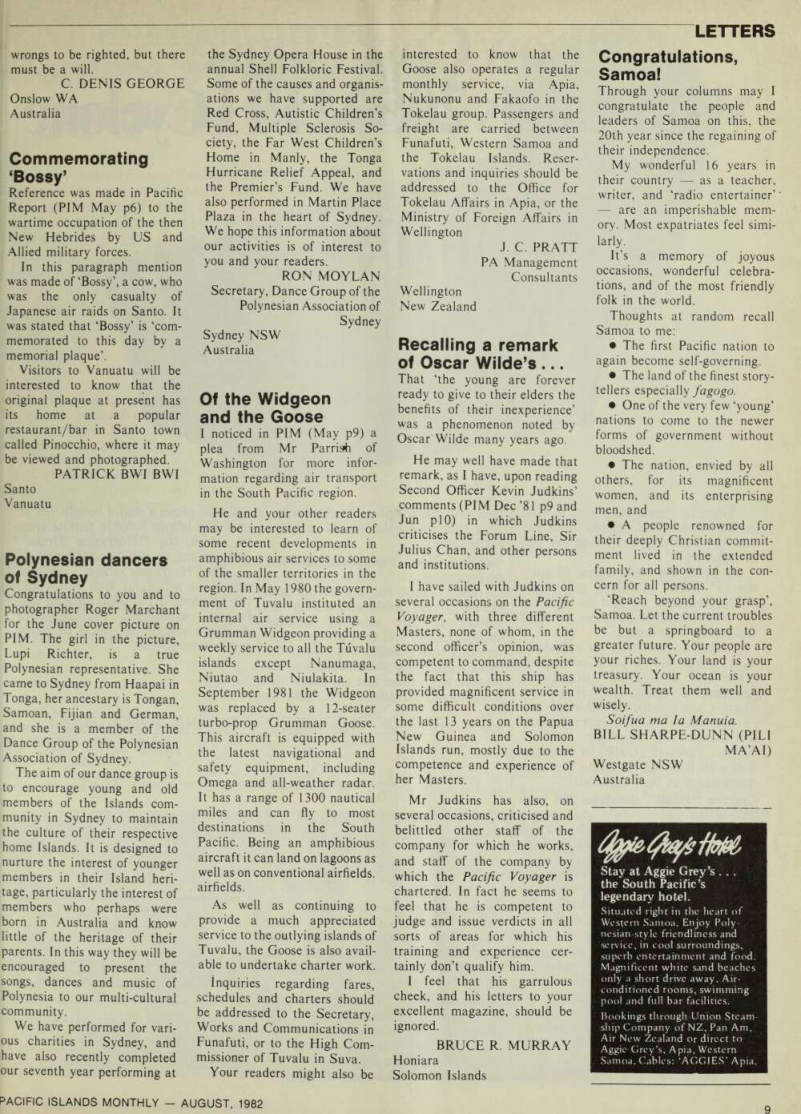
The new divers of the deep In the Torres Strait Islands - wet suits and scuba gear, but what future exists for them? Much of the live shell they recover today is raw material for the cultured pearl farms - Picture from Roderick Hulsbergin’s The Last Paradise, published by Eyes and Hands.
wrongs to be righted, but there must be a will.
C. Denis George
Onslow WA Australia
Commemorating
‘Bossy’
Reference was made in Pacific Report (PIM May p 6) to the wartime occupation of the then New Hebrides by US and Allied military forces.
In this paragraph mention was made of ‘Bossy’, a cow, who was the only casualty of Japanese air raids on Santo. It was stated that ‘Bossy’ is ‘com memorated to this day by a memorial plaque’.
Visitors to Vanuatu will be interested to know that the original plaque at present has its home at a popular restaurant/bar in Santo town called Pinocchio, where it may be viewed and photographed.
Patrick Bwi Bwi
Santo Vanuatu
Polynesian dancers
of Sydney
Congratulations to you and to photographer Roger Marchant for the June cover picture on PIM. The girl in the picture, Lupi Richter, is a true Polynesian representative. She came to Sydney from Haapai in Tonga, her ancestary is Tongan, Samoan, Fijian and German, and she is a member of the Dance Group of the Polynesian Association of Sydney.
The aim of our dance group is to encourage young and old members of the Islands com munity in Sydney to maintain the culture of their respective home Islands. It is designed to nurture the interest of younger members in their Island heri tage, particularly the interest of members who perhaps were born in Australia and know little of the heritage of their parents. In this way they will be encouraged to present the songs, dances and music of Polynesia to our multi-cultural community.
We have performed for vari ous charities in Sydney, and have also recently completed our seventh year performing at
the Sydney Opera House in the annual Shell Folkloric Festival.
Some of the causes and organis ations we have supported are Red Cross, Autistic Children’s Fund, Multiple Sclerosis So ciety, the Far West Children’s Home in Manly, the Tonga Hurricane Relief Appeal, and the Premier’s Fund. We have also performed in Martin Place Plaza in the heart of Sydney.
We hope this information about our activities is of interest to you and your readers.
Ron Moylan
Secretary, Dance Group of the Polynesian Association of Sydney Sydney NSW Australia Of the Widgeon and the Goose I noticed in PIM (May p 9) a plea from Mr Parrish of Washington for more infor mation regarding air transport in the South Pacific region.
He and your other readers may be interested to learn of some recent developments in amphibious air services to some of the smaller territories in the region. In May 1980 the govern ment of Tuvalu instituted an internal air service using a Grumman Widgeon providing a weekly service to all the Tuvalu islands except Nanumaga, Niutao and Niulakita. In September 1981 the Widgeon was replaced by a 12-seater turbo-prop Grumman Goose.
This aircraft is equipped with the latest navigational and safety equipment, including Omega and all-weather radar.
It has a range of 1300 nautical miles and can fly to most destinations in the South Pacific. Being an amphibious aircraft it can land on lagoons as well as on conventional airfields, airfields.
As well as continuing to provide a much appreciated service to the outlying islands of Tuvalu, the Goose is also avail able to undertake charter work. inquiries regarding fares, schedules and charters should be addressed to the Secretary, Works and Communications in Funafuti, or to the High Com missioner of Tuvalu in Suva.
Your readers might also be
interested to know that the Goose also operates a regular monthly service, via Apia, Nukunonu and Fakaofo in the Tokelau group. Passengers and freight are carried between Funafuti, Western Samoa and the Tokelau Islands. Reser vations and inquiries should be addressed to the Office for Tokelau Affairs in Apia, or the Ministry of Foreign Affairs in Wellington
J. C. Pratt
PA Management Consultants Wellington New Zealand Recalling a remark of Oscar Wilde’s ...
That ‘the young are forever ready to give to their elders the benefits of their inexperience’ was a phenomenon noted by Oscar Wilde many years ago.
He may well have made that remark, as I have, upon reading Second Officer Kevin Judkins’ comments (PIM Dec ’Bl p 9 and Jun plO) in which Judkins criticises the Forum Line, Sir Julius Chan, and other persons and institutions.
I have sailed with Judkins on several occasions on the Pacific Voyager, with three different Masters, none of whom, in the second officer’s opinion, was competent to command, despite the fact that this ship has provided magnificent service in some difficult conditions over the last 13 years on the Papua New Guinea and Solomon Islands run, mostly due to the competence and experience of her Masters.
Mr Judkins has also, on several occasions, criticised and belittled other staff of the company for which he works, and staff of the company by which the Pacific Voyager is chartered. In fact he seems to feel that he is competent to judge and issue verdicts in all sorts of areas for which his training and experience cer tainly don’t qualify him.
I feel that his garrulous cheek, and his letters to your excellent magazine, should be ignored.
Bruce R. Murray
Honiara Solomon Islands
Congratulations,
Samoa!
Through your columns may I congratulate the people and leaders of Samoa on this, the 20th year since the regaining of their independence.
My wonderful 16 years in their country as a teacher, writer, and ‘radio entertainer’ are an imperishable mem ory. Most expatriates feel simi larly.
It’s a memory of joyous occasions, wonderful celebra tions, and of the most friendly folk in the world.
Thoughts at random recall Samoa to me: • The first Pacific nation to again become self-governing. • The land of the finest story tellers especially fagogo. • One of the very few ‘young’ nations to come to the newer forms of government without bloodshed. • The nation, envied by all others, for its magnificent women, and its enterprising men, and • A people renowned for their deeply Christian commit ment lived in the extended family, and shown in the con cern for all persons. ‘Reach beyond your grasp’, Samoa. Let the current troubles be but a springboard to a greater future. Your people are your riches. Your land is your treasury. Your ocean is your wealth. Treat them well and wisely.
Soifua ma la Manuia.
Bill Sharpe-DuÑ (Pili
Ma'ai)
Westgate NSW Australia
Advertisements & other items, pp. 8-10 (1 item)
Or Leave It
At home, our RX-FBO is a sleek AM/FM stereo cassette radio with metal tape play, twelve watts music power and ambience stereo effect for room-filling musical pleasure.
Snap out the central cassette radio (it has its own lightweight stereo headphones) and you can enjoy your favourite radio and taped music wherever you go.
The central unit, by the way, tips the scales at less than half a kg. And needs no more space in your case than a paperback book.
Trust National to come up with a twosome to double your musical pleasure!
S 3 National
National, Panasonic and Technics are the brandnames of Matsushita Electric.
The RX-FBO comes in Pearl Silver (shown) or Metallic Silve
Stay at Aggie Grey’s . . . the South Pacific’s
legendary hotel.
Situated right in the heart of Western Samoa. Enjoy Polynesian-stylc friendliness and service, in cool surroundings, superb entertainment and food.
Magnificent white sand beaches only a short drive away. Airconditioned rooms, swimming pool and full bar facilities.
Bookings through Union Steamship Company ofNZ, Pan Am, Air New Zealand or direct to Aggie Grey’s, Apia, Western Samoa. Cables: ‘AGGIES’ Apia.
Low Cost House
Withstands2osMPH Cyclone
tm There has never been such a wind in the Pacific, but, should there be, this tough little timber house will still be standing.
Dubbed the “Hurricane House’’ the 16' x 16' prototype underwent destruction tests devised to simulate the worst possible extremes of wind and earthquake forces.
This test specifically on wall structures, which is the latest in a comprehensive evaluation programme designed by consulting engineer Brian Marino, was conducted and supervised by the New Zealand government’s Department of Scientific and Industrial Research (DSIR) in consultation with BRANZ (Building Research Association of New Zealand).
Cyclone “DSIR” simulates 205 mph (335 kph) Using a 23 ton bulldozer, a hydraulic jack and steel bars reaching right through the structure to a massive laminated beam, DSIR scientists and engineers subjected the house to repeated and prolonged loading increasing by the ton until the' pull exceeded nine tons.
At this stage, when the theoretical cyclone was blowing 205 miles an hour, the concrete floor and foundation (which is an integral part of the design) began to lift . . . and with it, the building itself, all intact.
Remarkably there was no damage or outward sign of stress.
It’s interesting to note that where 9 tons equals 205 mph of wind velocity . . 2 tons equals the biggest recorded earthquake.
Simple design ... no special materials or fastenings.
The concept for the “Hurricane House” was developed during investigations into ways of building cheaper homes and there are many interesting side benefits. For a start the radiata pine plywood and timbers are all standard grades and the fastenings are ordinary galvanised nails. Nothing will also prove a major benefit for an unskilled labour force in remote areas to which the “Hurricane House” package can be easily transported.
The “Hurricane House”, designed simply to withstand high winds and earthquakes, is the breakthrough that brings permanent, cyclone-proof dwellings within the reach of many more communities. test of proposed hurricane proof house
LOAD CELL
JACK
APPLIED
LOAD
HARNESS
HYDRAULIC PUMP
special and no excessive bracing. In fact it’s a house with a lot less timber than usual. Its ability to withstand high loads relies on even distribution through a lot of little fixings rather than a few big ones.
Pre-assembled . . . IV2 hours to erect.
A practised team of four will put up our house in an hour and a half which means immense savings in labour costs. But the simplicity of the design and the pre-assembled panels
The
Woodyard
For further information, contact: David Jonkers, The Woodyard, P.O.
Box 81-033, Whenuapai, Auckland, New Zealand. Phone 416-8142.
Somare’s Pangu Party
Png General Election
Somare’s Pangu Party heads for top again
The newly-elected Papua New Guinea parliament will meet for the first time on August 3 with Michael Somare confident his Pangu Party will form the government.
Somare prime minister at independence in 1975 and in opposition since 1980 had a numbers victory in the general election just ended. But because of fluid political affiliations and because parliament itself elects the prime minister, the shape of government depends heavily on the lobbying which follows the elections. ANGUS SMALES describes here how July became a month of intense political activity with the parties jockeying for position as they prepared for the first sitting of the new parliament.
With good communications be tween tally rooms across the country and with a first-past the-post voting system, Papua New Guinea was not long in doubt about the personal for tunes of its politicians and aspiring politicians once count ing night came round late in June in the 1982 general elec tion. But setting up the new government was another story altogether, and nearly a month after counting night the games of power were still being played out in preparation for the in auguration of parliament on August 3.
There were four months of obvious campaigning and four
weeks of voting, but it took a mere four hours of counting to substantially establish the pos itions of 1122 candidates who stood for 108 seats in the PNG National Parliament. (There are actually 109 seats, but one has yet to be decided in a by election because of the death of one of the candidates.) Despite the quickly-known results from the electorates, the formation of a government was delayed during a period of intense political lobbying.
Leaders lobbied and members traded personal opportunities on the road to forming PNG’s third government since inde pendence in 1975. This was not unexpected, and is a facet of PNG national politics. Al though party affiliations are often declared before election, many members leave their op tions open or even change their affiliation if they can see im-
proved personal opportunities.
Except for hard-core leaders this attitude is widespread and adds to the uncertainty of political party strengths. The situation is encouraged by the practice under the PNG consti tution in which parliament itself elects its prime minister. This leaves an element of uncer tainty about party strengths right up to the time parliament sits, and brings a high degree of post-election negotiation into the process of selecting a prime
minister and establishing a gov ernment.
Towards the end of July the man in the strongest position appeared to be Michael Somare, the independence Prime Minister who has been in opposition since 1980. He was being hard-pushed by the nego tiations of the Chan coalition government, which broke up for the election but came together again for the pre-parliament lobby campaigns.
Seven major groups went into
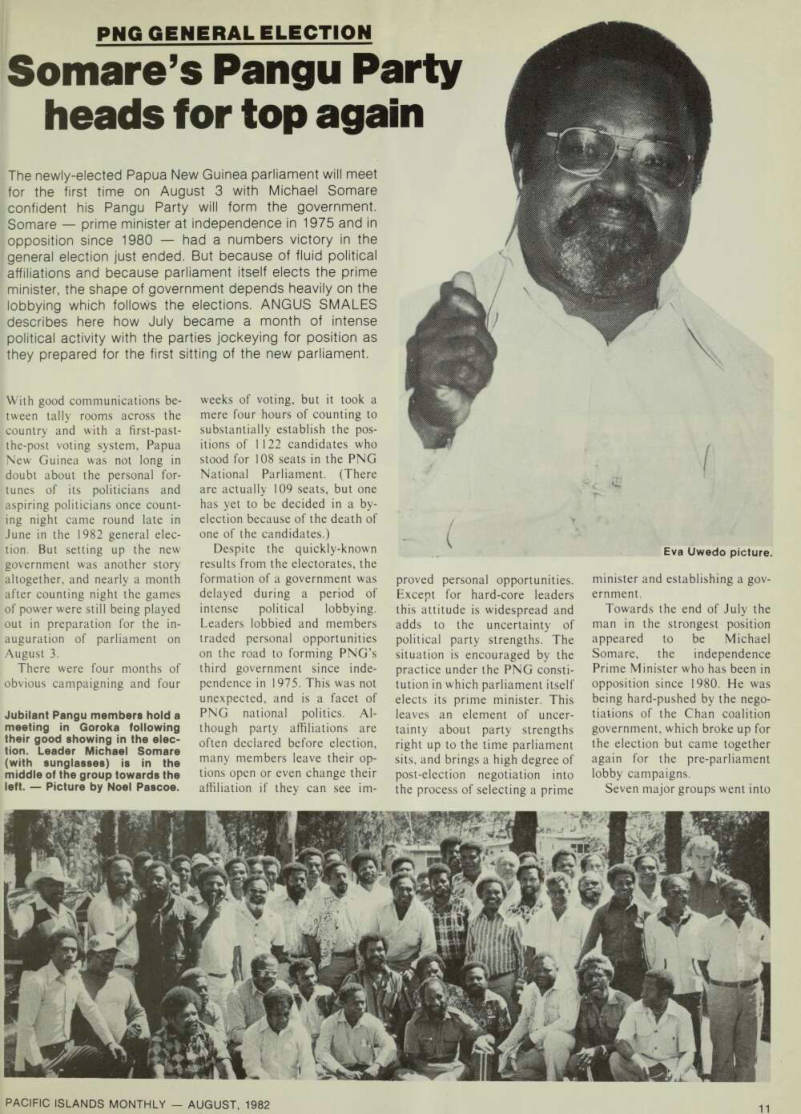
Jubilant Pangu members hold a meeting in Goroka following their good showing in the elec tion. Leader Michael Somare (with sunglasses) is in the middle of the group towards the left. - Picture by Noel Pascoe.
Eva Uwedo picture.
the elections. Five of them had made up the Chan coalition government. They were the Peoples Progress Party, led by Sir Julius Chan, 21 seats; the National Party, Deputy Prime Minister lambakey Okuk, 19; United Party, Roy Evara, 16; Papua Besena, Galeva Kwarara, 9; Melanesian Al liance, Father John Momis, 7.
Mr Somare’s Pangu Party with 33 seats was the biggest single faction to face the voters. The
remaining faction was a group of linked independents led by Mr Ted Diro, who as a Brigadier-General had been Commander of the Papua New Guinea Defence Force until retiring last year.
Within a few days of count ing night, here are the main developments in the election: • Mr Somare’s confirmed candidates easily won the elec tion, but they needed a small measure of extra support to obtain the numbers necessary to form government. • The flamboyant and con troversial lambakey Okuk, Deputy Prime Minister and leader of the National Party, was out of parliament. He had set his heart on being Prime Minister and had not hesitated to say so. ‘Things won’t be the same without me around,’ he said when he conceded defeat. • Ebia Olewale, a Pangu Party founder and strong man, a former Deputy Prime Minis ter, and always a part of Michael Somare’s strength, lost his seat despite the success of the party. • Twelve ministers nearly half the cabinet lost their seats, and more than a third of the total membership of parlia ment went the same way. The Speaker, MrSevese Morea, was one of the defeated candidates. • Ted Diro himself and his carefully-selected team of inde pendents achieved outstanding
success and made an early entry into the power lobbying with the intention of seeing Diro as Prime Minister despite his lack of parliamentary experience.
Based on known or likely affiliations, and before the period of intense power-broking began, the electorate results were: Pangu Party 41 National Party 14 Diro Independents 11 Peoples Progress Party 10 Melanesian Alliance 8 United Parly 6
Independent/uncommilted... 5
Papua Besena 3 Deferred election 1 Total membership 109 A series of swift develop ments followed the counting.
The first major one was when the defeated National Party leader, lambakey Okuk, handed over leadership to Ted Diro. There was initial criticism of what was seen as a high handed action, but party officials later claimed there had been consultation, and the re sult was that Diro, before even being sworn into parliament, found himself at the head of a significant faction of 25 mem bers his own supporters and the National Party. ■ Somare, who could see gov ernment just in his grasp particularly if he exercised his persuasive ‘compromise’ strate gies made an attempt to call an early meeting of parliament.
He hoped to tie the whole thing up while enthusiasm continued high and before there was too much regrouping and analysis.
He could well have succeeded, but the constitution prevented an early silting of parliament.
Diro meanwhile was surpris ing many people with the strength in which he pursued the goal of becoming Prime Minister, relying heavily on the previous coalition government factions. Many observers fell he would have been better situated if he had refused the National Party affiliation and had offered his numbers to Somare in exchange for the possible pos ition of Deputy Prime Minister.
Throughout the lobbying Prime Minister Sir Julius Chan kept up a low key image, never conceding defeat and claiming that ultimately he would have the support for government.
Eventually his coalition came together again as the nucleus of a new bid for government, and strengthened by the Diro inde pendents. The sensitive issue of whether Diro or Chan would lead the group was unresolved at the time the alliance was announced.
As the first sitting of parlia ment approached the members were polarising into two camps one supporting Somare and one supporting Chan and Diro. •Somare claimed that his return to government was merely a formality and that he had been
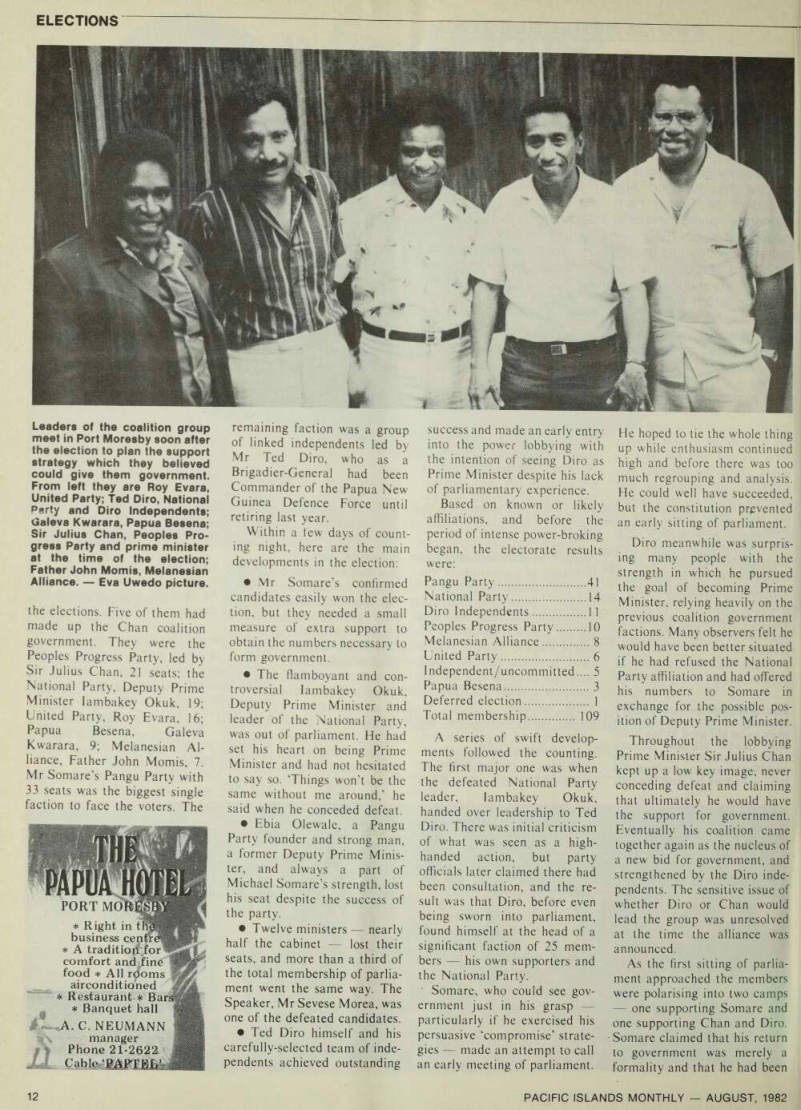
Leaders of the coalition group meet in Port Moresby soon after the election to plan the support strategy which they believed could give them government.
From left they are Roy Evara, United Party; Ted Diro, National Party and Diro Independents; Galeva Kwarara, Papua Besena; Sir Julius Chan, Peoples Pro gress Party and prime minister at the time of the election; Father John Momis, Melanesian
Alliance. - Eva Uwedo picture.
able to muster 60 confirmed supporters. He issued a list of the 60 names to support his claim. The coalition group re sponded with a claim that some names on the Somare list were not committed. They claimed to have ‘55 or more supporters’, sufficient to form the new gov ernment.
There was an outbreak of rioting in parts of the PNG Highlands after the election ended. Some of it was blamed on the lifting of alcohol restric tions which had applied during the election. Several groups however said they were protest ing at the defeat of lambakey Okuk, a Highlander they re garded as their champion. No Highlander has yet held the position of Prime Minister. Mr
Okuk commented drily Tf they had wanted me to stay in parliament, they should have voted for me’.
The heavy turnover of candi dates is partly due to the notorious fickleness of PNG politics, but there is also some concern that first-past-the-post voting is distorting the results.
In some electorates, with large numbers of candidates, as little as seven percent of the total vote has been sufficient to return a candidate.
The election also gave rise to claims of electoral malpractice in 30 electorates, and com plaints have been made formally to the Court of Dis puted Returns. Normally one judge would be responsible for conducting the Court of Dis puted Returns, but the large number of applications has ex ceeded the capacity of the legal system. The Chief Justice, Sir Buri Kidu, is investigating the possibility of referring the ap plications to circuit courts. In the 1977 election in PNG nine results were challenged in court, and five by-elections were ordered.
Confident in his belief that he has the support to form the new government, Mr Somare told journalists that he saw his first task as ‘pulling the economy back into gear’. He accused the Chan government of having allowed the economy to slip and of wasting government funds.
He believed it would take him 18 months to re-establish sound policies.
Mr Somare said he planned to sell the Grumman Gulfstream aircraft which the previous government had bought for VIP transport. He said he would get rid of other wasteful spending which had developed in Cabinet and at the top levels of administration. He conceded that the low current value of commodity crops pro duced by PNG, particularly cocoa and coffee, was a major ingredient in the country’s pres ent financial trouble. He be lieved however that better financial management by the government and greater empha sis on rural stabilisation schemes would minimise the problems.
Commenting on the events
which led to his losing office early in 1980, Mr Somare said he realised now that he had isolated himself excessively from people who should have been his partners in decision making. The degree of consul tation he had extended had not been as great as it should have been. He said his realisation of this situation should now make him a more efficient national leader. There will be plenty of consultation from now on’ he said.
The 12 members of Cabinet who lost their seats made up nearly half the total member ship of Cabinet. The jubilant Pangu Party claimed this showed the extreme depth of dissatisfaction which the gov ernment coalition had gener ated. But impartial observers were more inclined to see the result as yet another demonstra tion of the extreme electoral fickleness which has marked PNG national politics since their inception. The fickleness is seen as a symptom of political immaturity which is fast disap pearing, but which is still a significant factor. A member of parliament who becomes promi nently involved in national man agement, particularly as a Cabi net minister, runs a real risk of alienating his own electorate on the grounds that he is not totally involved in local issues. Despite the increasing sophistication of political practice in PNG there is still a widespread belief among voters in remote rural areas that parliament automati cally implements electorate re quests submitted by members.
This means that if an electorate doesn’t get what it wants from parliament, there is an assump tion that the local member isn’t doing his job.
Another factor in the defeat of many members was the first past-the-post voting system which has replaced PNG’s earlier system of ‘opional pref erential’.
The biggest Cabinet name to fall this time was that of lambakey Okuk. In addition to his leadership of the National Party and his position as Deputy Prime Minister, he also held the portfolio of Transport and Civil Aviation. The National Party’s deputy leader, Thomas Kavali, was also a
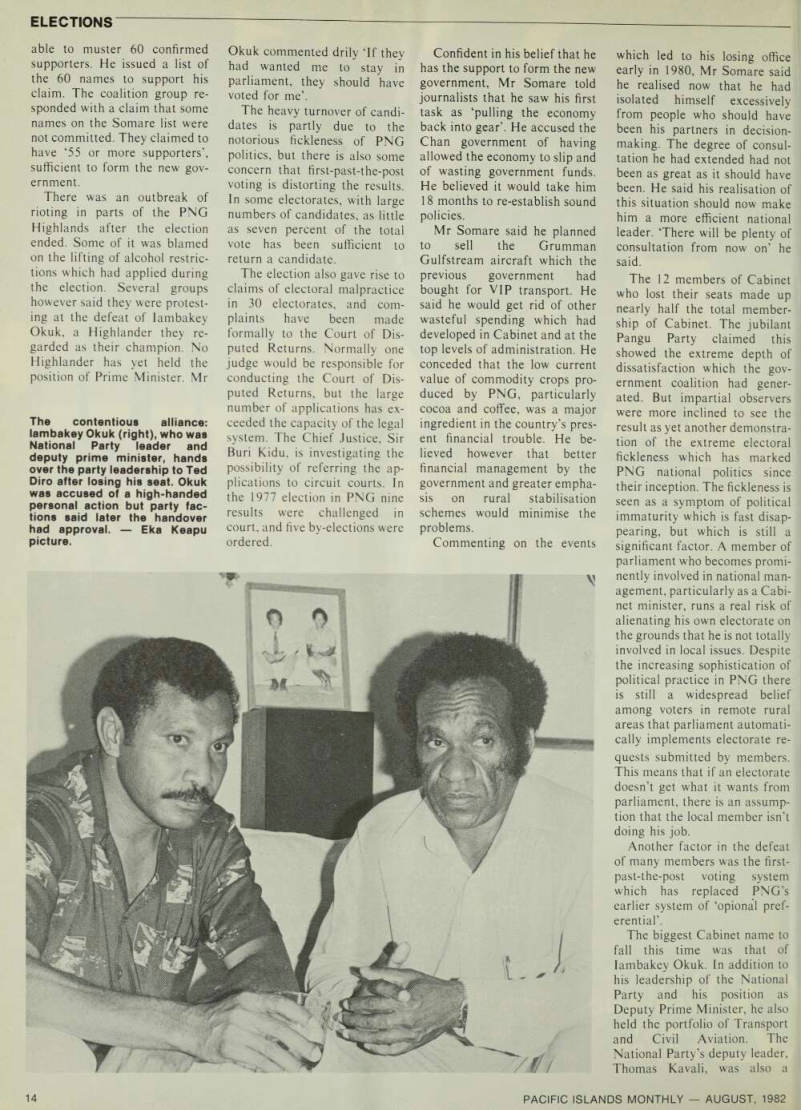
The contentious alliance: lambakey Okuk (right), who was National Party leader and deputy prime minister, hands over the party leadership to Ted Diro after losing his seat. Okuk was accused of a high-handed personal action but party fac tions said later the handover
had approval. - Eka Keapu
picture.
Cabinet casualty. He had been Lands Minister. The ten other ministers who were not returned by their electorates were Silas Atopare (Goroka), Works and Supply; Yano Belo (Erave- Kagua), Environment and Con servation; Angmai Bilas (Madang Province), Public Utilities; Goasa Damena (Jimi), Urban Development; Wesani Iwoksim (Telefomin), Youth and Recreation; Wiwa Korowi (Southern Highlands), Min erals and Energy; Akepa Miakwe (Unggai-Bena), Cor rective Institutions and Liquor Licensing; Gerega Pepena (Abau), Defence; Clement Poye (Sinasina), Media; Zibang Zurenuoc (Finschhafen), Home Affairs.
The defeated Cabinet minis ters were from the National Party, the PPP and Papua Besena.
More than ever before in a PNG election the members who are entering parliament for the first time include men who have already made names for them selves in fields outside politics.
The obvious man in this category is Ted Diro, the newly named parliamentary leader of the National Party who was Commander of the PNG De fence Force until last year.
Others include: Tony Siaguru (Moresby Northeast), a Pangu man who is a close associate of Michael Somare and who became one of the most influential of the younger PNG public servants during the first Somare govern ment. He is 35, educated in Australia and USA and was Secretary for Foreign Affairs for six years during which time he represented PNG on many overseas missions.
Phillip Bouraga (National Capital), another Pangu man who had a prominent and im portant career in the public service, but who resigned as Police Commissioner earlier this year after a controversy involving the Police Minister, Warren Dutton of the PPP.
Before that Bouraga had been a district commissioner and Sec retary of the Department of the Priifie Minister.
John Nilkare (Chimbu Prov ince) is the man who unseated Deputy Prime Minister Okuk.
Nilkare, Pangu, has been oper-
ating a business advisory ser vice in Port Moresby and has associations with investment in terests. Earlier he was a public servant who had been a magis trate and who became the PNG Liquor Licensing Com missioner.
Tony Ferapo (Gulf), a Diro Independent who served for three years as PNG Ambassa dor to Japan before entering private enterprise as a real estate developer.
Rabbie Namaliu (Kokopo) Pangu, is a former private secretary to Michael Somare.
He held the position during the important formative period im mediately before independence.
He was a lecturer at the Univer sity of PNG and later became the Public Services Com mission Chairman.
Jack Genia (Abau), a Diro Independent who was formerly PNG Secretary for Lands.
There are six whites in the new parliament two more than in the outgoing parlia ment. Their backgrounds are
Australian, English and North American, but all six are natu ralised PNG citizens as re quired under the constitution.
They include the veteran poli tician Barry Holloway who served a term as Speaker and who was one of the Pangu strong men associated with the early moves towards home rule in PNG. He had an overwhelm ing victory for Pangu against 13 other candidates in the Eastern Highlands electorate. Three of the other whites voted into the parliament are also Pangu sup porters: Karl Stack (West Sepik), a former Mines Minis ter under Michael Somare; English-born Dennis Young (Milne Bay), making a come back; and Harry Humphreys (Talasea), also making a come back. Humphreys was also born in England, but came to PNG 30 years ago on the delivery voyage of a coastal ship and has lived since then on the island of New Britain.
The two other naturalised citizens who won seats are Warren Dutton (North Fly) who has long been a central figure in the PPP and was Police Minister in the Chan Govern ment, and Neville Bourne (Menyamya) who is a National Party backbencher.
Seventeen women stood for election, but all were defeated.
For the first time since indepen dence and earlier there are now no women in the PNG parliament. Three of the de feated women were sitting members, and they included the Papua separatist leader Josephine Abaijah, founder of the Papua Besena party. Miss Abaijah had been in parliament for 10 years and was a highly controversial politican during the move to independence. She created wide interest in 1975 when she held a dawn ceremony outside Port Moresby in which she purported to declare the independence of Papua from Australia and from New Guinea. A few days later formal independence came to a unified Papua New Guinea, against the wishes of Papua Besena. The two other women who lost their seats were Mrs Nahau Rooney (Manus) and Mrs Walyato Clowes (Middle Fly). In 1979 Mrs Rooney, then Justice Min ister in the Somare government, was gaoled for allegedly inter fering with the impartiality of the courts. Somare released her from gaol, triggering a controversy which became one of the ingredients in his 1980 fall from office in a parliamen tary no-confidence vote.
One of the women who con tested the election was an Aus tralian who became naturalised in PNG after many years of residence. She is Mrs Laura Martin of Wewak who was making her second attempt to enter parliament but finished third from among ten candi dates.
Sir John Guise, who in 1977 stepped down from the position of Governor-General to re-enter politics, will not be a member of the new parliament but it’s by his own choice. Sir John, now the longest-serving politician in PNG, decided not to recontest his Milne Bay electorate.
Another veteran member, Sir Tei Abal, lost the seat of Wabang which he had held since well before independence.
He was once the leader of the old United Party when it was the biggest party in parliament, but was the victim of increasing dissent in the party and in his electorate. A total of 22 candi dates stood for the seat, and Albert Kipilan won it for the
Ppp.
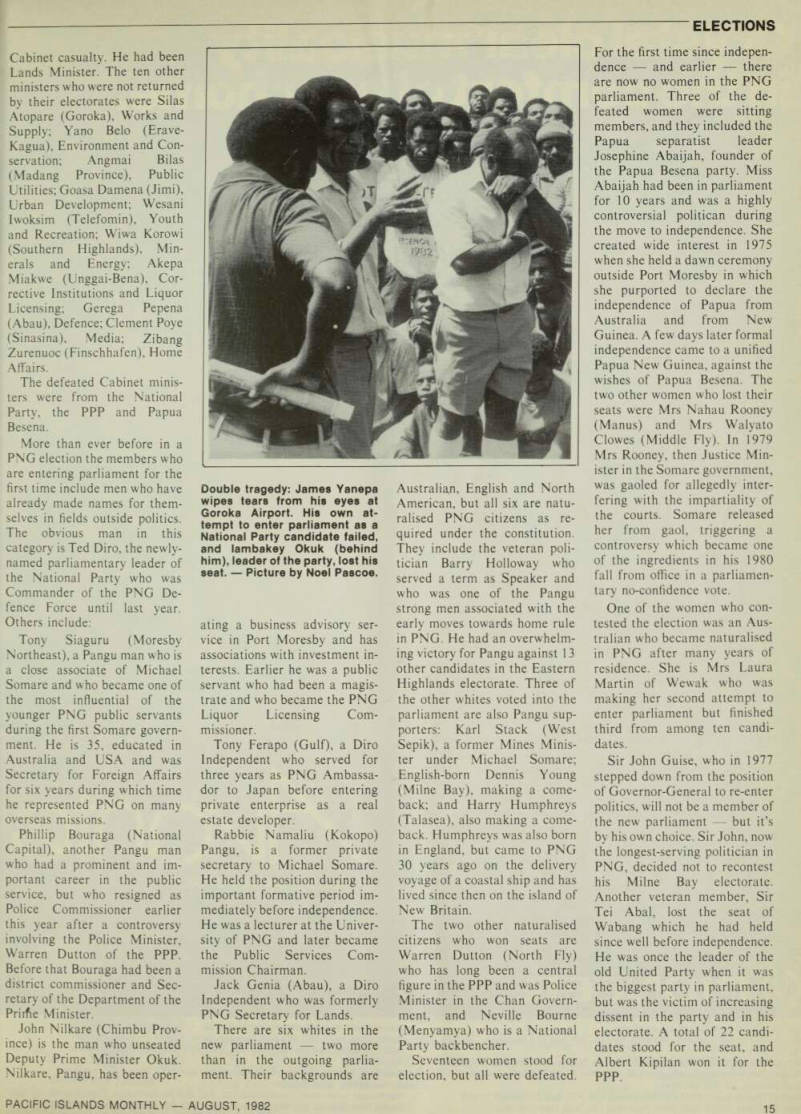
Double tragedy; James Yanepa wipes tears from his eyes at Goroka Airport. His own at tempt to enter parliament as a National Party candidate failed, and lambakey Okuk (behind him), leader of the party, lost his seat. - Picture by Noel Pascoe.
Advertisements & other items, pp. 12-16 (2 items)
Elections
Port
or * Right in business cept * A traditiopTc comfort food ♦ All rdoms airconditioned * Restaurant * Bai * Banquet hall
C. NEUMANN
v\ manager Phone 21-2622
ciior
Instant ■iii j^| I* tt(r. Ijt I \
iCHOR
ilLlillil
M hJU. CREAM
mm 'AMIN ENRICHED f
nm rnilk k «
KM ■°OWDli
POWDF p
Anchi HTl* •Anchor
>KIM MILK
OWDER
longufe
ANCHOI
; HflTO / 1 t- * . - * r , .Vj.- JB : I -* * j I jmm ■
NEW
ZEALAND
DAIRY
BOARD
Anchor - premium quality dairy produce, packed with all the goodness of the finest pasture in the world.
Fresh to you from the world’s number one dairy
producer, New Zealand Dairy Board.
Enquiries to: PO Box 417 Wellington, New Zealand
Telex: NZ3348 DAPMARK
Telephone: 724-399
Crystal clear musicality
in the comfort of your home.
vr ▼wi vr bs V' Hi Breathtaking stereo performance from components matched and perfectly balanced for carefree listening enjoyment. The new Avante 990 hi-fi system component from Pioneer. A showcase of Pioneer's advanced electronic technology and mastery of design craftsmanship.
Included in the top-of-the-line Avante 990 is an auto-reverse cassette deck boasting 3 DD motors with computer aided conveniences (C.A.C.). A quartz-PLL direct-drive turntable with Pioneer's exclusive low-mass Polymer Graphite™ tone arm and Moving-Coil (MC) cartridge. A synthesized tuner with auto and presettable FM/AM tuning. A full-powered amp (65W + 65W), and solid 3-way Avante speaker systems. Options range from Pioneer's graphic equalizer to a digital clock/timer.
In addition to sharing the benefits of Pioneer's vast technical expertise, all five Avante systems (990/770/550/330/110) feature beautiful styling to complement the decor of your home and your musical tastes.
So indulge yourself. With Avante from Pioneer. The convenience of system design...the clear choice in hi-fi enjoyment.
!fi PIONEER
System convenience through technology.
Avante systems are displayed only at stores showing this emblem. 3r further information, please contact: ustralia: Pioneer Marketing Services Pty. Ltd., P.O. Box 317, Mordialloc, Victoria, 3195 il: 90-9011 ji Islands: Brijlal & Company, G.P.O. Box No. 362, Suva, Fiji Islands Tel: 22258 bw Zealand; Monaco Distributors Ltd., 2 Poland Road, Glenfield, Auckland, bw Zealand Tel: (09) 444-9144 orfolk Island: Burns Philp (Norfolk Island) Ltd., P.O. Box 21, Norfolk Island, bw Hebrides: Burns Philp (New Hebrides) Ltd., Vila, New Hebrides Nauru Island: Jacob Enterprises, P.O. Box No. 4, Republic of Nauru Tahiti: Tahiti Hi-Fi, P.O. Box 848, Papeete, Tahiti New Caledonia: Menard Pacifique Sari, B.P. 3899, Noumea, New Caledonia Tel: 48-24.36 American Samoa: Transpac Corporation, P.O. Box 1477, Pago Pago, American Samoa 96799 Tel: 633-5224 Rarotonga: South Seas International Ltd., P.O. Box 49, Rarotonga, Cook Islands Tel: 2327 Papua New Guinea: Bali Merchants Pty. Ltd., P.O. Box 6103, Boroko Tel: 254887
drama and change
New Caledonia’s season of drama and change
New Caledonia moved into a new phase of its history on June 18 with the formation of a government council with a majority of members belonging to the Front Independantiste (FI). Despite repeated calls from Rightwing groups for a show of force against the new government, this dramatic change has largely been ac cepted.
With a charge of ‘resistance to evolution and progress in New Caledonia’, the Centrist Federation pour une Nouvelle Societe Caledonienne (FNSC) teamed up with the independentists to censure the Ralliement Pour la Caledonie dans la Republique (RPCR) government of Dick Ukeiwe.
Three days later, on June 18, the new ‘government of reform and development’ led by independentist Jean-Marie Tjibaou was quietly voted in.
With the exception of hard-liner Justin Guillemard, who voted against, the RPCR boycotted the vote in the Territorial As sembly, saying that the co alition between the FI and the FNSC did not represent the wishes of the majority, and was thus undemocratic.
Following the election, the FI reaffirmed its commitment to Kanak Socialist Independence.
The contract for the new gov ernment, signed by all parties, only restricts the FI from using the government council as a vehicle for pushing the indepen dence issue. Political figures are still free to campaign with their parties for independence.
RPCR then issued a call for
the dissolution of the Territorial Assembly and for new elections.
They argued that in coalition with the FNSC they received an overwhelming majority in the 1979 elections, and that the FNSC’s defection to the independentists had no popular support.
In a desperate move, Jacques Lafleur, the RPCR president, then resigned his seat as a deputy in France’s National Assembly so as to create an election in New Caledonia, and ‘find out whether majority opinion has changed’. Mr Lafleur will re-contest his seat.
He also said that if the by election, which he would regard as a referendum on indepen dence, ‘gave proof that things have changed, I’ll accept that’.
At time of writing the FI has yet to discuss possible candidates for the by-election.
June 26 saw 6000 people, mostly Europeans, march on the High Commissioner’s resi dence to deliver a motion call ing for new elections. The demonstration was organised by the newly formed Committee for the Defence of Institutions, and was made up of members of the RPCR, of Rurale (a farm ers’ organisation), the Domi nique Canon Support Com mittee (Canon is being held in custody in connection with the assassination last September of Pierre Declercq, a leader of the pro-independence Union Cale donienne party), and the organ isation known as Fraternity.
The demonstrators were pro testing against the new govern
ment, and also the French Government reforms which were due to be debated in the Territorial Assembly in the following week.
When the demonstrators reached the High Commission they encountered a cordon of about 100 riot police. Scuffles broke out and six tear gas canisters were fired as the demonstrators tried to break the police cordon. High Com missioner Christian Nucci then received a delegation of RPCR politicians, and promised to send the election demand to President Mitterrand.
In comparison with last November’s ‘Peace March’, in which 17 000 participated, the June 26 demonstration was small, and certainly drew fewer participants than the organisers had expected. Whether this can be interpreted as acceptance by the majority of Caledonians of a change of direction it is too early to tell. But the overtly political character of the demonstration is believed to have deterred many.
One of the first dignitaries to be received by the new govern ment councillors was Chiang
Cheng Tsung, first secretary of the Chinese Embassy in Fiji.
Mr Chiang had been in Noumea for the South Pacific Commission’s Planning and Evaluation Committee meet ing, and stayed on to complete arrangements for the Noumea visit of the Hunan Acrobatic Troupe. The troupe, which is on a goodwill visit through the Pacific Western Samoa, Tahiti, Fiji, Solomons, Nauru, Vanuatu, Papua New Guinea, and New Caledonia, was due to visit Noumea from July 12-21.
New Caledonia is to host the second congress of the Pacific Trade Union Forum. More than 80 delegates from Australia, New Zealand, Hawaii, Japan, Fiji, Kiribati, Belau, PNG, Solomons, Vanuatu, Guam and New Caledonia will attend the Noumea meeting from September 26-28.
The French administration in Noumea has agreed to provide the conference facilities of ORSTOM (the French overseas scientific and technical organis ation) for the venue. Observers from New Caledonia’s FI par ties will also attend, and for the first time there will be delegates from the STKE (Union of Exploited Kanak Workers).
The conference themes will be regional solidarity, a nuclear free Pacific, and independence
for French territories.
Helen
Fraser in Noumea.
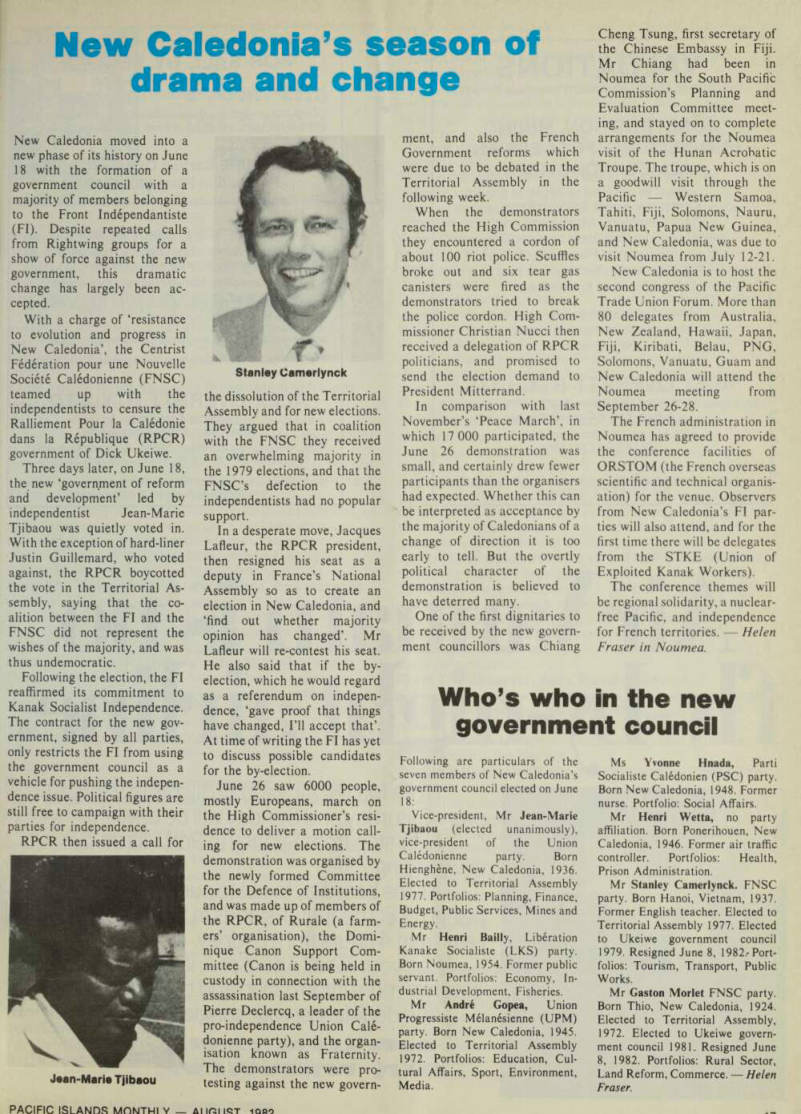
Jean-Marie Tjibaou
Stanley Camerlynck
government council
Who’s who in the new government council
Following are particulars of the seven members of New Caledonia’s government council elected on June 18: Vice-president, Mr Jean-Marie Tjibaou (elected unanimously), vice-president of the Union Caledonienne party. Born Hienghene, New Caledonia, 1936.
Elected to Territorial Assembly 1977. Portfolios: Planning, Finance, Budget, Public Services, Mines and Energy.
Mr Henri Bailly, Liberation Kanake Socialiste (LKS) party.
Born Noumea, 1954. Former public servant. Portfolios: Economy, In dustrial Development, Fisheries.
Mr Andre Gopea, Union Progressiste Melanesienne (UPM) party. Born New Caledonia, 1945.
Elected to Territorial Assembly 1972. Portfolios: Education, Cul tural Affairs, Sport, Environment, Media.
Ms Yvonne Hnada, Parti Socialiste Caledonien (PSC) party.
Born New Caledonia, 1948. Former nurse. Portfolio: Social Affairs.
Mr Henri Wetta, no party affiliation. Born Ponerihouen, New Caledonia, 1946. Former air traffic controller. Portfolios: Health, Prison Administration.
Mr Stanley Camerlynck. FNSC party. Born Hanoi, Vietnam, 1937.
Former English teacher. Elected to Territorial Assembly 1977. Elected to Ukeiwe government council 1979. Resigned June 8, 1982.-Port folios: Tourism, Transport, Public Works.
Mr Gaston Morlet FNSC party.
Born Thio, New Caledonia, 1924.
Elected to Territorial Assembly, 1972. Elected to Ukeiwe govern ment council 1981. Resigned June 8, 1982. Portfolios: Rural Sector,
Land Reform, Commerce.
Helen
Fraser.
Advertisements & other items, pp. 17-18 (2 items)
17
PACIFIC ISLANDS MONTHI Y Alinii.QT iqao
airline.
VALUATIONS
(INDUSTRIAL PLANT, MACHINERY AND REAL ESTATE)
CONSTRUCTION, MINING,
ENGINEERING, PROCESS AND
ALLIED INDUSTRIES
Company Asset Revaluations, Plant Registers, Machinery and Vehicles, Insurance Purposes, Real Property Resumption and Compulsory Acquisition Specialised in litigation and to evaluate the more intricate assignments
ALEX OVERETT PTY. LTD.
Registered Valuers Auctioneers & Real Estate Consultants URL House, 99 Leichhardt Street,
BRISBANE Old, 4000
MEMBER FOWLES-OVERETT GROUP - VALUATION SERVICES
THROUGHOUT AUSTRALASIA
FOR SALE BY TENDER
Under instructions from Messrs. Australian Guarantee Corporation Limited Offers are invited for the purchase and removal of the following plant, which is offered for sale on an “as is where is” basis.
CARBONAIRE Carbon Dioxide (CO 2 ) Gas
Production Plant (20KG/HR)
with Carbonaire 10 tonne bulk liquid C0 2 storage tank, and Carbonaire Dry Ice Pelletizer • Basically modular and skid mounted construction, oil fired with electric controls and ancillaries. • Presently installed: Maroochydore, Queensland.
Tenders close: 12.00 noon Monday 30th August, 1982, at the office of the vendor’s agents.
Neither the highest nor any tender necessarily accepted.
Pictorial brochure, inspection arrangements and further details from:
ALEX OVERETT PTY. LTD.
Industrial Auctioneers & Valuers, Real Estate Consultants UPL House, 99 Leichhardt Street, Brisbane Old. 4000 Telephone (07) 221 3577, after hours (07) 381979 MEMBER FOWLES-OVERETT GROUP - AUCTIONEERS & VALUERS
SERVICES THROUGHOUT AUSTRALASIA
AiiAannaln is no
airline.
wm mmm m SK From May 8, Air Vanuatu flights to Vanuatu every Saturday and Sunday will be daylight.
Non-stop from Sydney to Port Vila on our new Boeing 737.
It's the best way to get to our jewelled archipelago of 80 beautiful islands in the South Pacific.
Less than 4 hours from Sydney.
See your Travel Agent or Ansett International Travel for more information and bookings.
And don’t forget your sunglasses!
n.n 6S3 GNSAWS
Islands
From the
Press
From the Samoa Times, Apia Mr Hadley (general manager of the Pacific Commercial Bank) explained that the bank has a lot of money to lend but needs to lend to people who could pay the loans back.
From the Arawa Bulletin, Papua New Guinea No Labour Day for Bougainville. The Provincial Executive Council yesterday resolved not to have Labour Day as a public holiday this year. The legal advice received by the council was that the proclamation of Labour Day as a Public Holiday in the province is illegal.
From Tuvalu News Sheet, on the problem of freight levies between the islands He (Mr Sione) suggested that there should be one flat rate for all bags of coconuts from the outer-islands. He sees the present system as discriminatory although he said he is aware of the distance between the islands. Even in spite of this fact, Mr Sione repeatedly argued that a bag of coconuts ‘does not eat like a normal passenger’.
From a letter in the Tonga Chronicle I have many honey bees at my place and many times I have sprayed and put smoke to remove or destroy them. But I have never succeeded. So, I am making a request to the authority concerned or the public in general who may be interested in honey or bee keeping. Please come at any time to remove or destroy them.
From The Times of Papua New Guinea, Port Moresby One of the policeman said that people in the Chimbu Province seemed to prefer fighting to talking. For them the elections in Papua New Guinea were merely the continuation of tribal warfare by other means.
From a letter by ‘Not Hungry’ in the Norfolk Islander The Chamber of Commerce is to be commended on organising activities surrounding Anniversary Day but, surely, someone with a little more feeling could have arranged something else except a ‘Pie Eating and Soft Drinks’ competition. In these days of starvation, poverty and need, the sight of children(?) stuffing their mouth with unneeded food and drink surely comes under the heading of‘gluttony’.
From the Fiji Times, Suva, commenting on a report that Fiji has one of the world’s highest rates of death
by drowning
About 230 adults have learned to swim under the Red Cross scheme. Most of them have been Indian. The Fijians? You hardly ever see them. Can they all swim? That’s a myth. The statistics show that the Fijians drown the most. They’re not afraid. They fool around. They just jump in, thinking they can swim. They can’t and they don’t come and learn how.
From the Cook Islands News ... the citrus growers on Aitutaki are very annoyed in the fact that people are just going into the orchards and picking fruit at will without any thought whatsoever on the poor grower who has to face up to the bank at the end of each year to pay off the money he borrowed for his fertiliser and chemicals.
From Uni Tavur, magazine of the Univerisity of Papua
New Guinea, Port Moresby
The university mess was able to change its menu last week with a deer for dinner. . . the catering manager said it was good that something different was added to the menu for students. ‘If
anybody wants to bring a deer, I will buy it off them. I can even take crocodiles or turtles’, he said.
From a parliamentary report in the Tuvalu News Sheet, Funafuti The member for Nanumea, Mr Maheu Naniseni, moved the second motion which requested the Government that deck passengers travelling on Nivaga (the government-owned ship) within Tuvalu should not travel together with pigs or benzine and that separate trips be made for the people of Tuvalu alone and separate ones for pigs and benzine.
From an article in the Fiji Times, Suva, warning joggers running at night to beware of traffic The same message should go for people who like sitting on sealed roads after dark.
From Coconut Gossip in the Cook Islands News SSOOO for a bride? You’re kidding! Apparently, in some Pacific countries like the Cook Islands bride price is a way of life. The price is given in the form of materials useful for the couple’s married life.
Such things as pigs, cows, goats, fowls, mats, cooking pots etc are common bride price commodities. Recently money has entered the bride circle. In this respect, it is the tourists who come ‘buying’ women with their ‘useful’ money. Ironically, the bride can’t cook in a two dollar note nor have coffee in a hundred dollar note. Still, some tourists are persistent in buying ‘brides’. Such people are known to frequent ‘pick-me-up’ spots on the island.
From a report in The Observer, Apia, on the long-boat race during the Western Samoa independence celebrations Nervousness was the lot of many people who had obviously put money in the race. Clearly, most Western Samoans, who bet did so on Western Samoan boats while visiting American Samoans staked their money on the two boats from American Samoa, the ‘Aeto’ and the ‘Faasaulala’. And the outcome of the race proved a staggering blow to Western Samoans who were said to have gambled up to ten grand plus sections of land on the race.
A caption to a picture of a cow in The Fiji Times, Suva Strange but true. Mrs Brijpati, of Nacilau Point, Teidam, milks Kamadhenu, the family super cow. Kamadhenu looks ordinary enough but she has been supplying the family, located halfway between Lautoka and Ba, with milk daily for 16 years. She has never given birth. The farming family regard Kamadhenu as something sacred and many people have braved even bad weather to get a glimpse of her.
From The Observer, Apia, Western Samoa Shoes and at least one empty bottle were thrown on the stage where the Miss Universe contest was held Wednesday night last week when the contest’s winner was announced. It is believed that the shoes and bottle were thrown by sponsors and others who did not agree with the judges’ decision.
From a letter in Our News, Port Moreseby, Papua New Guinea I would like to complain about prostitutes in PNG especially from the Highlands regions. I think they are the cause of so many tribal fights in the Highlands. Men get killed because the women’s relatives do not agree with them going around with them. This leads to payback killing when compensation demands are not met.
From the Fiji Times, Suva Sending Fiji troops to Lebanon had served the twin purposes of helping many unemployed people get jobs and enhancing the reputation of Fiji soldiers. The Minister of State for Lands, Mr Sakiasi Waqanivavalagi, told the meeting the arrangement allowed 600 youths to leave for peacekeeping duties every six months.
From a Radio Vanuatu news bulletin The National Council of Chiefs meeting at Epau on North Efate has agreed to impose a three-month term during which people in the islands could go and live in the towns with friends or relatives.
The chiefs are discussing this subject following increases in problems related to urban-drift. The chiefs have agreed that people who come to towns and can’t find work in three months have to return to their islands.
Advertisements & other items, p. 20 (1 item)
Fly the Pacific’s Number One
■ - - ■# % m. \ •* r.
V— ■e* w *
to more of the world.
You can fly Air New Zealand to more and more of the great destinations of the world, like Tokyo, Honolulu and Los Angeles, Singapore and Hong Kong, Sydney, Melbourne, Brisbane and Perth as well as throughout New Zealand. And now, you can catch our “London Express”, the fast comfortable way to London from Auckland, Nadi, Papeete or Honolulu.
On every flight you’ll enjoy the careful attentive service that made Air New Zealand, the pioneer airline of the Pacific routes, so famous; a reputation we’re proud to maintain today wherever we fly you to.
See your travel agent or Air New Zealand.
The Pacific's
Number One
air new zeatano
W ANZ 82/13
la Malta Te Nunaa, a new political
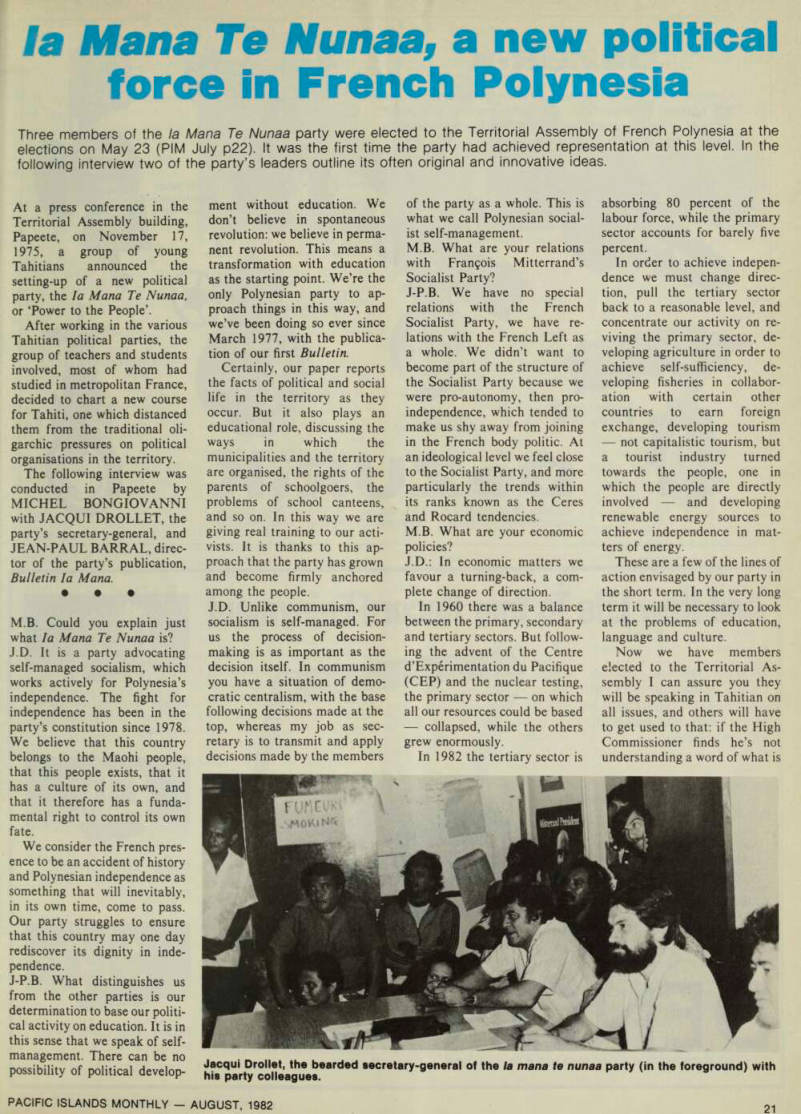

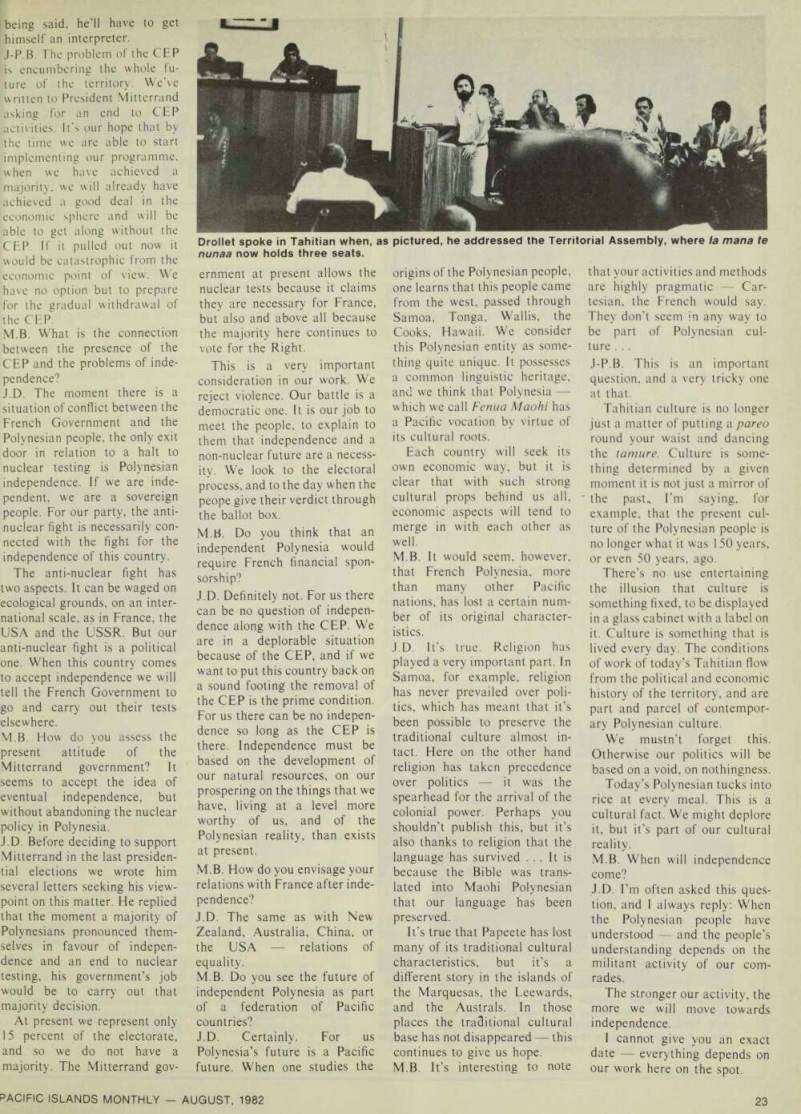
force in French Polynesia
Three members of the la Mana Te Nunaa party were elected to the Territorial Assembly of French Polynesia at the elections on May 23 (PIM July p 22). It was the first time the party had achieved representation at this level. In the following interview two of the party’s leaders outline its often original and innovative ideas.
At a press conference in the Territorial Assembly building, Papeete, on November 17, 1975, a group of young Tahitians announced the setting-up of a new political party, the la Mana Te Nunaa, or ‘Power to the People’.
After working in the various Tahitian political parties, the group of teachers and students involved, most of whom had studied in metropolitan France, decided to chart a new course for Tahiti, one which distanced them from the traditional oli garchic pressures on political organisations in the territory.
The following interview was conducted in Papeete by
Michel Bongiovanni
with JACQUI DROLLET, the party’s secretary-general, and
Jean-Paul Barral, Direc
tor of the party’s publication, Bulletin la Mana. • • • M.B. Could you explain just what la Mana Te Nunaa is?
J.D. It is a party advocating self-managed socialism, which works actively for Polynesia’s independence. The fight for independence has been in the party’s constitution since 1978.
We believe that this country belongs to the Maohi people, that this people exists, that it has a culture of its own, and that it therefore has a funda mental right to control its own fate.
We consider the French pres ence to be an accident of history and Polynesian independence as something that will inevitably, in its own time, come to pass.
Our party struggles to ensure that this country may one day rediscover its dignity in inde pendence.
J-P.B. What distinguishes us from the other parties is our determination to base our politi cal activity on education. It is in this sense that we speak of self management. There can be no possibility of political develop
ment without education. We don’t believe in spontaneous revolution: we believe in perma nent revolution. This means a transformation with education as the starting point. We’re the only Polynesian party to ap proach things in this way, and we’ve been doing so ever since March 1977, with the publica tion of our first Bulletin.
Certainly, our paper reports the facts of political and social life in the territory as they occur. But it also plays an educational role, discussing the ways in which the municipalities and the territory are organised, the rights of the parents of schoolgoers, the problems of school canteens, and so on. In this way we are giving real training to our acti vists. It is thanks to this ap proach that the party has grown and become firmly anchored among the people.
J.D. Unlike communism, our socialism is self-managed. For us the process of decision making is as important as the decision itself. In communism you have a situation of demo cratic centralism, with the base following decisions made at the top, whereas my job as sec retary is to transmit and apply decisions made by the members
of the party as a whole. This is what we call Polynesian social ist self-management.
M.B. What are your relations with Francis Mitterrand’s Socialist Party?
J-P.B. We have no special relations with the French Socialist Party, we have re lations with the French Left as a whole. We didn’t want to become part of the structure of the Socialist Party because we were pro-autonomy, then pro independence, which tended to make us shy away from joining in the French body politic. At an ideological level we feel close to the Socialist Party, and more particularly the trends within its ranks known as the Ceres and Rocard tendencies.
M.B. What are your economic policies?
J.D.: In economic matters we favour a turning-back, a com plete change of direction.
In 1960 there was a balance between the primary, secondary and tertiary sectors. But follow ing the advent of the Centre d’Experimentation du Pacifique (CEP) and the nuclear testing, the primary sector on which all our resources could be based collapsed, while the others grew enormously.
In 1982 the tertiary sector is
absorbing 80 percent of the labour force, while the primary sector accounts for barely five percent.
In order to achieve indepen dence we must change direc tion, pull the tertiary sector back to a reasonable level, and concentrate our activity on re viving the primary sector, de veloping agriculture in order to achieve self-sufficiency, de veloping fisheries in collabor ation with certain other countries to earn foreign exchange, developing tourism not capitalistic tourism, but a tourist industry turned towards the people, one in which the people are directly involved and developing renewable energy sources to achieve independence in mat ters of energy.
These are a few of the lines of action envisaged by our party in the short term. In the very long term it will be necessary to look at the problems of education, language and culture.
Now we have members elected to the Territorial As sembly I can assure you they will be speaking in Tahitian on all issues, and others will have to get used to that: if the High Commissioner finds he’s not understanding a word of what is
Jacqui Drollet, the bearded secretary-general of the la mana te nunaa party (in the foreground) with his party colleagues.
being said, he’ll have to get himself an interpreter.
J-P.B. The problem of the CEP is encumbering the whole fu ture of the territory. We've written to President Mitterrand asking for an end to CEP activities. It's our hope that by the time we are able to start implementing our programme, when we have achieved a majority, we will already have achieved a good deal in the economic sphere and will be able to get along without the CEP. If it pulled out now it would be catastrophic from the economic point of view. We have no option but to prepare for the gradual withdrawal of the CEP.
M.B. What is the connection between the presence of the CEP and the problems of inde pendence?
J.D. The moment there is a situation of conflict between the French Government and the Polynesian people, the only exit door in relation to a halt to nuclear testing is Polynesian independence. If we are inde pendent, we are a sovereign people. For our party, the anti nuclear fight is necessarily con nected with the fight for the independence of this country.
The anti-nuclear fight has two aspects. It can be waged on ecological grounds, on an inter national scale, as in France, the USA and the USSR. But our anti-nuclear fight is a political one. When this country comes to accept independence we will tell the French Government to go and carry out their tests elsewhere.
M.B. How do you assess the present attitude of the Mitterrand government? It seems to accept the idea of eventual independence, but without abandoning the nuclear policy in Polynesia.
J.D. Before deciding to support Mitterrand in the last presiden tial elections we wrote him several letters seeking his view point on this matter. He replied that the moment a majority of Polynesians pronounced them selves in favour of indepen dence and an end to nuclear testing, his government’s job would be to carry out that majority decision.
At present we represent only 15 percent of the electorate, and so we do not have a majority. The Mitterrand gov-
ernment at present allows the nuclear tests because it claims they are necessary for France, but also and above all because the majority here continues to vote for the Right.
This is a very important consideration in our work. We reject violence. Our battle is a democratic one. It is our job to meet the people, to explain to them that independence and a non-nuclear future are a necess ity. We look to the electoral process, and to the day when the peope give their verdict through the ballot box.
M.B. Do you think that an independent Polynesia would require French financial spon sorship?
J.D. Definitely not. For us there can be no question of indepen dence along with the CEP. We are in a deplorable situation because of the CEP, and if we want to put this country back on a sound fooling the removal of the CEP is the prime condition.
For us there can be no indepen dence so long as the CEP is there. Independence must be based on the development of our natural resources, on our prospering on the things that we have, living at a level more worthy of us, and of the Polynesian reality, than exists at present.
M.B. How do you envisage your relations with France after inde pendence?
J.D. The same as with New Zealand, Australia, China, or the USA relations of
equality.
M.B. Do you see the future of independent Polynesia as part of a federation of Pacific countries?
J.D. Certainly. For us Polynesia’s future is a Pacific future. When one studies the
origins of the Polynesian people, one learns that this people came from the west, passed through Samoa, Tonga, Wallis, the Cooks, Hawaii. We consider this Polynesian entity as some thing quite unique. It possesses a common linguistic heritage, and we think that Polynesia which we call Fenua Maohi has a Pacific vocation by virtue of its cultural roots.
Each country will seek its own economic way, but it is clear that with such strong cultural props behind us all, economic aspects will tend to merge in with each other as well.
M.B. It would seem, however, that French Polynesia, more than many other Pacific nations, has lost a certain num ber of its original character istics.
J.D. It's true. Religion has played a very important part. In Samoa, for example, religion has never prevailed over poli tics, which has meant that it’s been possible to preserve the traditional culture almost in tact. Here on the other hand religion has taken precedence over politics it was the spearhead for the arrival of the colonial power. Perhaps you shouldn’t publish this, but it’s also thanks to religion that the language has survived ... It is because the Bible was trans lated into Maohi Polynesian that our language has been preserved.
It’s true that Papeete has lost many of its traditional cultural characteristics, but it’s a different story in the islands of the Marquesas, the Leewards, and the Australs. In those places the traditional cultural base has not disappeared this continues to give us hope.
M.B. It’s interesting to note
that your activities and methods are highly pragmatic - Car tesian, the French would say.
They don’t seem in any way to be part of Polynesian cul ture . . .
J-P.B. This is an important question, and a very tricky one at that.
Tahitian culture is no longer just a matter of putting a pareo round your waist and dancing the tamure. Culture is some thing determined by a given moment it is not just a mirror of " the past. I'm saying, for example, that the present cul ture of the Polynesian people is no longer what it was 150 years, or even 50 years, ago.
There’s no use entertaining the illusion that culture is something fixed, to be displayed in a glass cabinet with a label on it. Culture is something that is lived every day. The conditions of work of today’s Tahitian flow from the political and economic history of the territory, and are part and parcel of contempor ary Polynesian culture.
We mustn’t forget this.
Otherwise our politics will be based on a void, on nothingness.
Today’s Polynesian tucks into rice at every meal. This is a cultural fact. We might deplore it, but it’s part of our cultural reality.
M.B. When will independence come?
J.D. I’m often asked this ques tion, and I always reply: When the Polynesian people have understood and the people’s understanding depends on the militant activity of our com rades.
The stronger our activity, the more we will move towards independence. 1 cannot give you an exact date everything depends on our work here on the spot.
Drollet spoke in Tahitian when, as pictured, he addressed the Territorial Assembly, where la mana te nunaa now holds three seats.
Advertisements & other items, p. 22 (1 item)
Demon.
DeZURiK
A complete valve range in a multitude of material and specification options in sizes 1 / 2 ” - 72” with manual, pneumatic, hydraulic or electric actuators. Proven worldwide in municipal, industrial and process applications.
Electric Control Valves V-port Ball Valves Resilient Seated Butterfly Valves High Pressure Butterfly Valves
DeZURiK
DeZURIK OF AUSTRALIA PTY. LTD., P.O. Box 204, Vineyard Road, Sunbury, Victoria 3429, Australia. Telephone: 03-744-2244, Telex: AA33732.
Paper Stock Consistency Transmitters Eccentric Plug Valves Knife Gate Valves y.
A UNfT OF GENERAL. SIGNAL
DZ - AUS. 020 - A
Add New Life To Your Record Enjoyment DEMON has supplied the
broadcasting industry with
professional equipment for
many years and met with
highest acclaim.
DP-60L: “DEMON Quartz”
“Auto Lift” D.D. Turntable.
The straight and the S-shaped type tonearm are compatible, equipped also.
Mirrorfinish, laminated cabinet exhibits clean lines and luxury looks
DEMON.
70 years experience in sound research & development
NIPPON COLUMBIA CO LTD
No. 14-14, AKASAKA 4-CHOME, MINATO-KU,
TOKYO 107, JAPAN
DL-305: “Amorophous boron cantilever” MC type phono cartridge.
I DL-303: “Lightest Weight Vibration System” MC type phono cartridge.
DL-301: “High Complicance MC type phono cartridge.
hangovers in
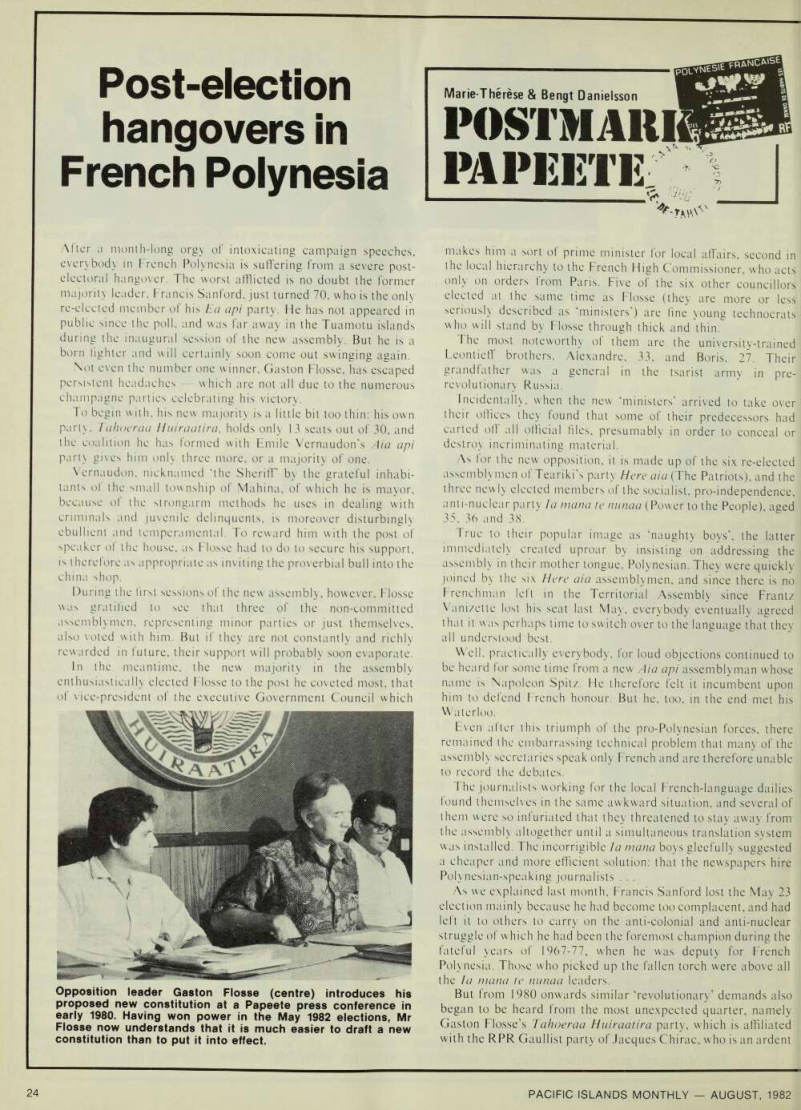
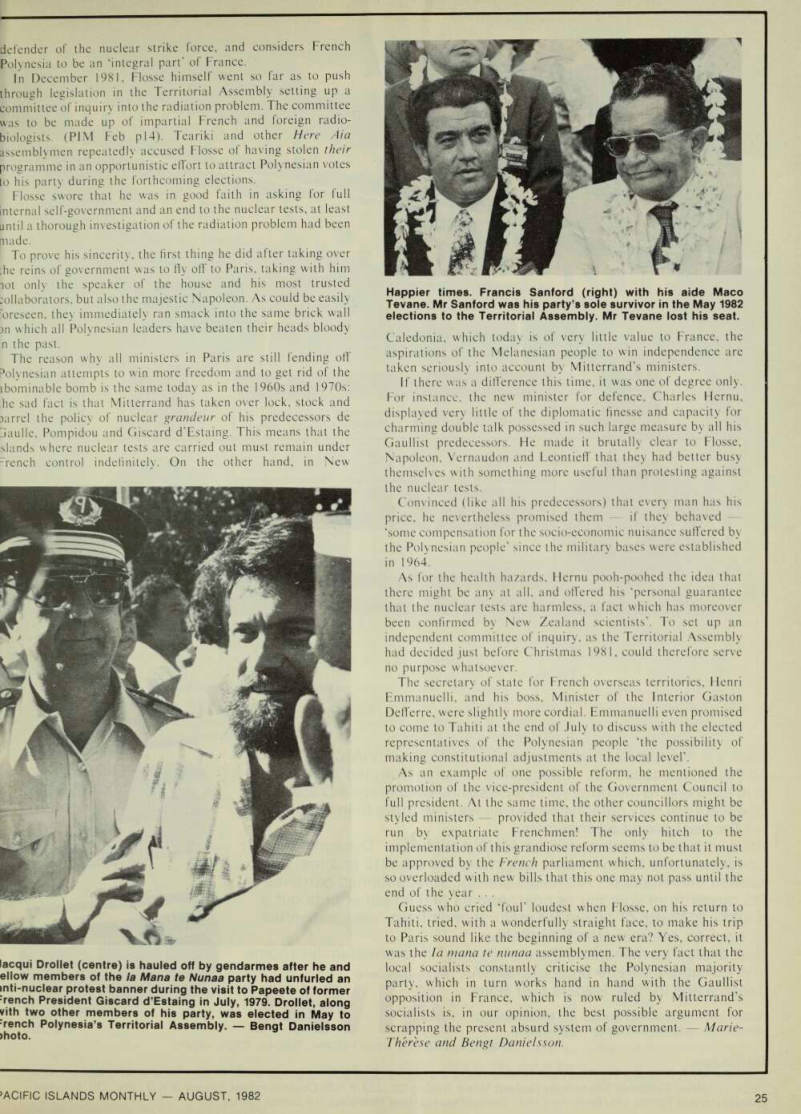
Post-election hangovers in French Polynesia
Alter a month-long orgy of intoxicating campaign speeches, everybody in French Polynesia is suffering from a severe post electoral hangover. The worst afflicted is no doubt the former majority leader. Francis Sanford, just turned 70. who is the only re-elccled member of his Ha api parly. He has not appeared in public since the poll, and was far away in the Tuamolu islands during the inaugural session of the new assembly. But he is a born lighter and will certainly soon come out swinging again.
Not even the number one winner, Gaston Flosse, has escaped persistent headaches which arc not all due to the numerous champagne parlies celebrating his victory.
To begin with, his new majority is a little bit too thin: his own parly, Tahoeraa Huiraatira. holds only I 3 seats out of 30, and the coalition he has formed with Emile Vernaudon’s Aia api parly gives him only three more, or a majority of one.
Vcrnaudon, nicknamed “the Sheriff by the grateful inhabi tants of the small township of Mahina, of which he is mayor, because of the slrongarm methods he uses in dealing with criminals and juvenile delinquents, is moreover disturbingly ebullient and temperamental. To reward him with the post of speaker ol the house, as Flosse had to do to secure his support, is therefore as appropriate as inviting the proverbial bull into the china shop.
During the first sessions of the new assembly, however, Flosse was gratified to see that three of the non-committed assemblymen, representing minor parties or just themselves, also voted with him. But if they are not constantly and richly rewarded in future, their support will probably soon evaporate.
In the meantime, the new majority in the assembly enthusiastically elected Flosse to the post he coveted most, that of vice-president of the executive Government Council which
makes him a son of prime minister for local affairs, second in the local hierarchy to the French High Commissioner, who acts onl\ on orders from Paris. Five of the six other councillors elected at the same lime as Flosse (they are more or less seriously described as ‘ministers’) are fine young technocrats who will stand by Flosse through thick and thin.
The most noteworthy of them are the university-trained Leonlicff brothers, Alexandre, 33, and Boris, 27. Their grandfather was a general in the tsarist army in pre revolutionary Russia.
Incidentally, when the new ‘ministers’ arrived to take over their offices they found that some of their predecessors had carted off all official files, presumably in order to conceal or destroy incriminating material.
As lor the new opposition, it is made up of the six re-elected assemblymen of Teariki’s party Here aia (The Patriots), and the three newly elected members of the socialist, pro-independence, anti-nuclear parly la mana te nunaa (Power to the People), aged 35, 36 and 38.
True to their popular image as ‘naughty boys’, the latter immediately created uproar by insisting on addressing the assembly in their mother longue. Polynesian. They were quickly joined by the six Here aia assemblymen, and since there is no Frenchman left in the Territorial Assembly since Frantz Vanizelte lost his seal last May, everybody eventually agreed that it was perhaps time to switch over to the language that they all understood best.
Well, practically everybody, for loud objections continued to be heard for some time from a new Aia api assemblyman whose name is Napoleon Spitz. He therefore fell it incumbent upon him to defend French honour. But he, too, in the end met his Waterloo.
Even after this triumph of the pro-Polynesian forces, there remained the embarrassing technical problem that many of the assembly secretaries speak only French and are therefore unable to record the debates.
The journalists working for the local French-language dailies lound themselves in the same awkward situation, and several of them were so infuriated that they threatened to slay away from the assembly altogether until a simultaneous translation system was installed. The incorrigible la mana boys gleefully suggested a cheaper and more efficient solution: that the newspapers hire Polynesian-speaking journalists . . .
As we explained last month, Francis Sanford lost the May 23 election mainly because he had become too complacent, and had left it to others to carry on the anti-colonial and anti-nuclear struggle of which he had been the foremost champion during the fateful years of 1967-77, when he was deputy for French Polynesia. Those who picked up the fallen torch were above all the la mana re nunaa leaders.
But from 1980 onwards similar ‘revolutionary’ demands also began to be heard from the most unexpected quarter, namely Gaston Flosse’s Tahoeraa Huiraatira party, which is affiliated with the RPR Gaullist party of Jacques Chirac, who is an ardent
Opposition leader Gaston Flosse (centre) introduces his proposed new constitution at a Papeete press conference in early 1980. Having won power in the May 1982 elections, Mr Flosse now understands that it is much easier to draft a new constitution than to put it into effect.
defender of the nuclear strike force, and considers French Polynesia to be an ‘integral part' of France.
In December 1981, Flosse himself went so far as to push through legislation in the Territorial Assembly setting up a committee of inquiry into the radiation problem. The committee was to be made up of impartial French and foreign radio biologists. (PIM Feb pl 4). Teariki and other Here Aia assemblymen repeatedly accused Flosse of having stolen their programme in an opportunistic effort to attract Polynesian votes to his party during the forthcoming elections.
Flosse swore that he was in good faith in asking for full internal self-government and an end to the nuclear tests, at least until a thorough investigation of the radiation problem had been made.
I To prove his sincerity, the first thing he did after taking over Te reins of government was to fly off to Paris, taking with him lot only the speaker of the house and his most trusted ;ollaborators. but also the majestic Napoleon. As could be easily Treseen, they immediately ran smack into the same brick wall in which all Polynesian leaders have beaten their heads bloody n the past.
The reason why all ministers in Paris are still fending off Polynesian attempts to win more freedom and to gel rid of the ibominable bomb is the same today as in the 1960 s and 19705: he sad fact is that Mitterrand has taken over lock, stock and barrel the policy of nuclear grandeur of his predecessors de jaulle, Pompidou and Giscard d’Eslaing. This means that the slands where nuclear tests are carried out must remain under Yench control indefinitely. On the other hand, in New
Caledonia, which today is of very little value to France, the aspirations of the Melanesian people to win independence are taken seriously into account by Mitterrand’s ministers.
If there was a difference this time, it was one of degree only.
For instance, the new minister for defence, Charles Hernu, displayed very little of the diplomatic finesse and capacity for charming double talk possessed in such large measure by all his Gaullist predecessors. He made it brutally clear to Flosse, Napoleon. Vernaudon and Leontieff that they had better busy themselves with something more useful than protesting against the nuclear tests.
Convinced (like all his predecessors) that every man has his price, he nevertheless promised them if they behaved - ‘some compensation for the socio-economic nuisance suffered by the Polynesian people' since the military bases were established in 1964.
As for the health hazards, Hernu pooh-poohed the idea that there might be any at all, and offered his ‘personal guarantee that the nuclear tests are harmless, a fact which has moreover been confirmed by New Zealand scientists'. To set up an independent committee of inquiry, as the Territorial Assembly had decided just before Christmas 1981, could therefore serve no purpose whatsoever.
The secretary of state for French overseas territories, Henri Emmanuelli, and his boss. Minister of the Interior Gaston DetTerre, were slightly more cordial. Emmanuelli even promised to come to Tahiti at the end of July to discuss with the elected representatives of the Polynesian people ‘the possibility of making constitutional adjustments at the local level’.
As an example of one possible reform, he mentioned the promotion of the vice-president of the Government Council to full president. At the same time, the other councillors might be styled ministers provided that their services continue to be run by expatriate Frenchmen! The only hitch to the implementation of this grandiose reform seems to be that it must be approved by the French parliament which, unfortunately, is so overloaded with new bills that this one may not pass until the end of the year . . .
Guess who cried ‘foul’ loudest when Flosse, on his return to Tahiti, tried, with a wonderfully straight face, to make his trip to Paris sound like the beginning of a new era? Yes, correct, it was the la mana te nunaa assemblymen. The very fact that the local socialists constantly criticise the Polynesian majority parly, which in turn works hand in hand with the Gaullist opposition in France, which is now ruled by Mitterrand’s socialists is, in our opinion, the best possible argument for
scrapping the present absurd system of government.
Marie-
Therese and Bengt Danielsson
acqui Drollet (centre) is hauled off by gendarmes after he and [?]ellow members of the la Mana te Nunaa party had unfurled an [?]nti-nuclear protest banner during the visit to Papeete of former French President Giscard d’Estaing in July, 1979. Drollet, along with two other members of his party, was elected in May to Fench Polynesia’s Territorial Assembly. - Bengt Danielsson [?]hoto.
Happier times. Francis Sanford (right) with his aide Maco Tevane. Mr Sanford was his party’s sole survivor in the May 1982 elections to the Territorial Assembly. Mr Tevane lost his seat.
Advertisements & other items, pp. 25-26 (2 items)
25
•ACIFIC ISLANDS MONTHLY AUGUST, 1982
Aiwa
r* o
• • signal riririO
jHSS -‘*9
CA-WlO
Here’s a formula for real listening fun: with the AIWA CA-WlO, you can play two cassettes in sequence (for uninterrupted listening) or dub from one to the other (with time-saving double-speed recording).
Speakers are fully detachable too, so you can move them high or low for the best sound arrangement.
Built with such top features as AlWA’s exclusive “Dynamic Super Loudness” and Dolby* noise reduction, the CA-WlO is a real audio system that works off AC house current, self-contained batteries or DC power from your car or boat. And its hi-fi amplifier puts out a mighty 40 Watts of power for great sounds from radio, cassettes or even an external stereo turntable.
Best of all, it’s a member of the world’s most innovative family of home and portable cassette products: AIWA, aiwa for craftsmanship Japan’s first in 1964, leaders ever since.
AIWA
CS-300 * Dolby and the double-D symbol are trademarks of Dolby Laboratories Licensing Corporation. W W W W W CS-200 AIWA CO., LTD. 11-9, Ueno 1-chome, Taito-ku, Tokyo, Japan.
Distributors: Australia AIWA Australia Pty., Ltd./Cook Islands Island Merchants Ltd./Fiji P. Hargovind & Co., D. Ranchhod & Co./Guam Micropac Audio, Inc./New Caledonia hifivox/New Zealand Milaw Trading Co., Ltd./P.N.G. Oceania Indent Agency (P.N.G.) Pty., Ltd./Solomon Islands Harvest Pacific Ltd ./Tahiti Fare Hi-Fi Stereo/Vanuatu (New Hebrides) The Sound Centre Ltd.
to ‘guide’ the unguidable
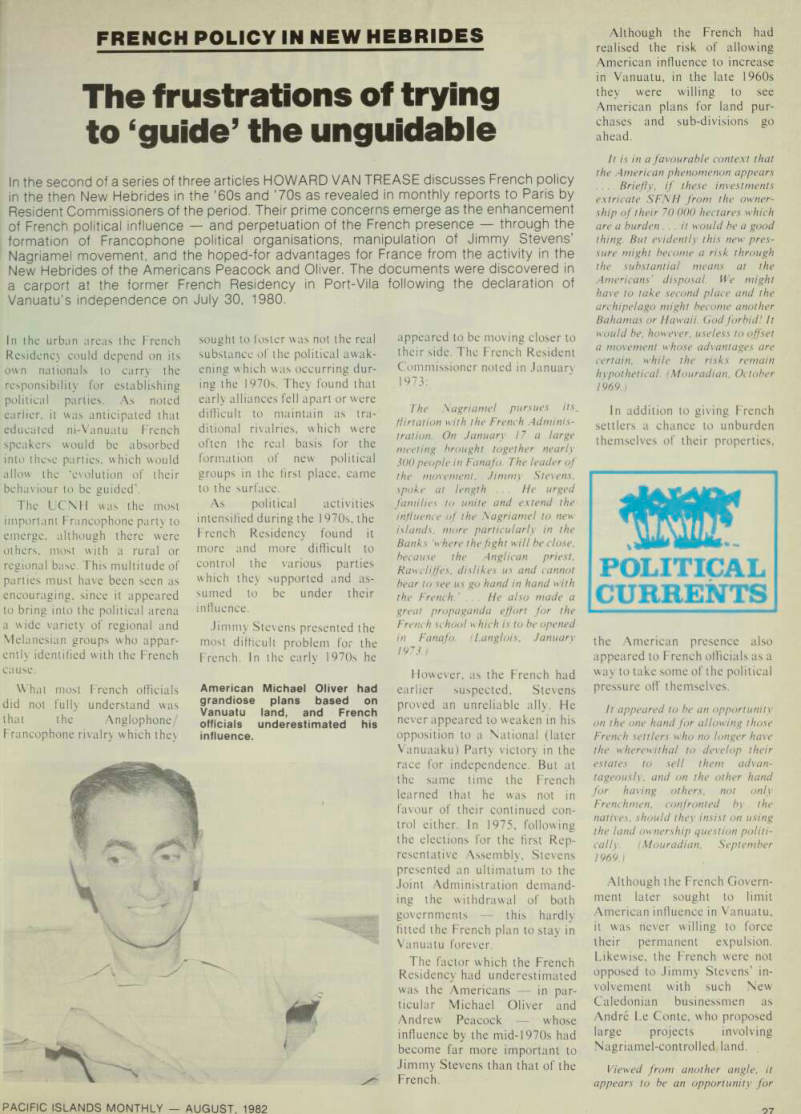

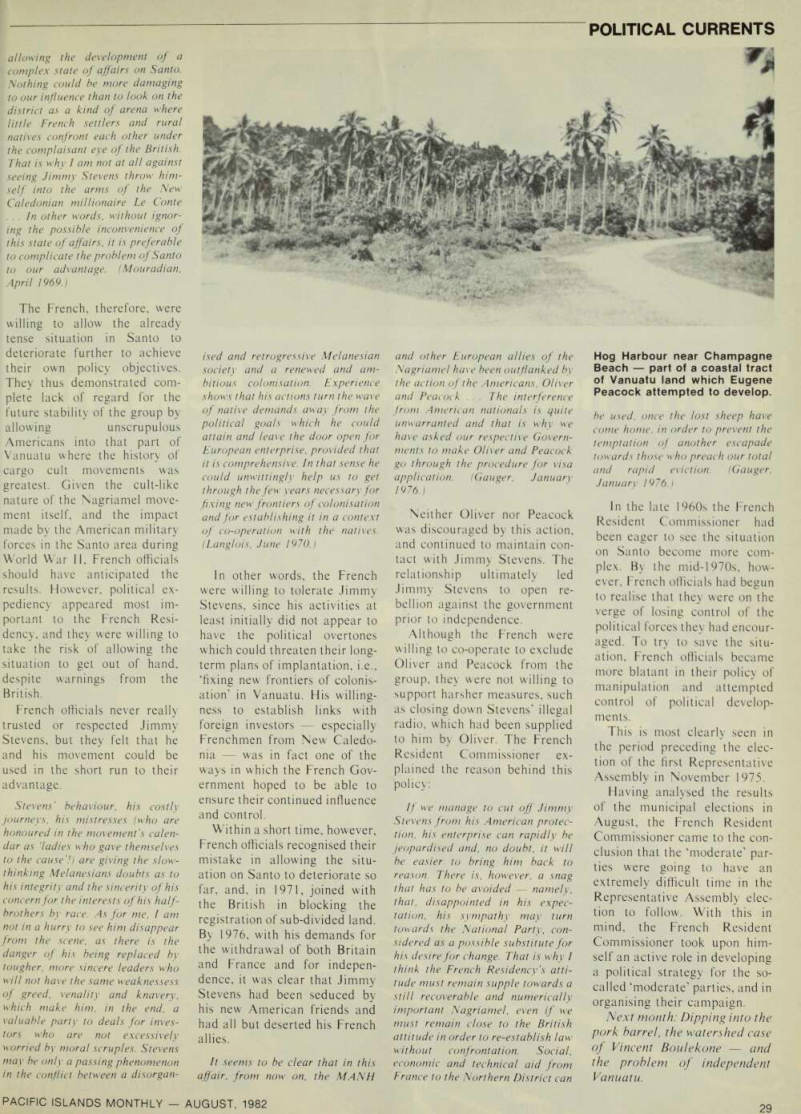
Political
Currents
French Policy In New Hebrides
The frustrations of trying to ‘guide’ the unguidable
In the second of a series of three articles HOWARD VAN TREASE discusses French policy in the then New Hebrides in the ’6os and ’7os as revealed in monthly reports to Paris by Resident Commissioners of the period. Their prime concerns emerge as the enhancement of French political influence and perpetuation of the French presence through the formation of Francophone political organisations, manipulation of Jimmy Stevens’
Nagriamel movement, and the hoped-for advantages for France from the activity in the New Hebrides of the Americans Peacock and Oliver. The documents were discovered in a carport at the former French Residency in Port-Vila following the declaration of Vanuatu’s independence on July 30, 1980.
In the urban areas the French Residency could depend on its own nationals to carry the responsibility for establishing political parties. As noted earlier, it was anticipated that educated ni-Vanuatu French speakers would be absorbed into these parties, which would allow the ‘evolution of their behaviour to be guided'.
The LCNH was the most important Francophone party to emerge, although there were others, most with a rural or regional base. This multitude of parties must have been seen as encouraging, since it appeared to bring into the political arena a wide variety of regional and Melanesian groups who appar ently identified with the French cause.
What most French officials did not fully understand was that the Anglophone/ Francophone rivalry which they
sought to foster was not the real substance of the political awak ening which was occurring dur ing the 19705. They found that early alliances fell apart or were difficult to maintain as tra ditional rivalries, which were often the real basis for the formation of new political groups in the first place, came to the surface.
As political activities intensified during the 19705, the French Residency found it more and more difficult to control the various parlies which they supported and as sumed to be under their influence.
Jimmy Stevens presented the most difficult problem for the French. In the early 1970 s he
appeared to be moving closer to their side. The French Resident Commissioner noted in January 1973; The Nagriamel pursues its_ flirtation with the French Adminis tration. On January 17 a large meeting brought together nearly 300 people in Fanafo. The leader of the movement, Jimmy Stevens, spoke at length .. . He urged families to unite and extend the influence of the Nagriamel to new islands, more particularly in the Banks where the fight will be close, because the Anglican priest, Rawcliffes. dislikes us and cannot hear to see us go hand in hand with the French.' . . . He also made a great propaganda effort for the French school which is to be opened in Fanafo. (Langlois, January 1973.) However, as the French had earlier suspected, Stevens proved an unreliable ally. He never appeared to weaken in his opposition to a National (later Vanuaaku) Parly victory in the race for independence. But at the same time the French learned that he was not in favour of their continued con trol either. In 1975, following the elections for the first Rep resentative Assembly, Stevens presented an ultimatum to the Joint Administration demand ing the withdrawal of both governments this hardly fitted the French plan to stay in Vanuatu forever.
The factor which the French Residency had underestimated was the Americans in par ticular Michael Oliver and Andrew Peacock whose influence by the mid-1970s had become far more important to Jimmy Stevens than that of the French.
Although the French had realised the risk of allowing American influence to increase in Vanuatu, in the late 1960 s they were willing to see American plans for land pur chases and sub-divisions go ahead.
It is in a favourable context that the American phenomenon appears . . . Briefly, if these investments extricate SFNH from the owner ship of their 70 000 hectares which are a burden ... it would be a good thing. But evidently this new pres sure might become a risk through the substantial means at the Americans' disposal. We might have to take second place and the archipelago might become another Bahamas or Hawaii. God forbid! It would be, however, useless to offset a movement whose advantages are certain, while the risks remain hypothetical. (Mouradian. October 1969.) In addition to giving French settlers a chance to unburden themselves of their properties.
the American presence also appeared to French officials as a way to lake some of the political pressure off themselves.
It appeared to be an opportunity on the one hand for allowing those French settlers who no longer have the wherewithal to develop their estates to sell them advan tageously. and on the other hand for having others, not only Frenchmen, confronted by the natives, should they insist on using the land ownership question politi cally. (Mouradian, September 1969.) Although the French Govern ment later sought to limit American influence in Vanuatu, it was never willing to force their permanent expulsion.
Likewise, the French were not opposed to Jimmy Stevens’ in volvement with such New Caledonian businessmen as Andre Le Conte, who proposed large projects involving Nagriamel-controlled land.
Viewed from another angle, it appears to be an opportunity for
American Michael Oliver had grandiose plans based on Vanuatu land, and French officials underestimated his influence.
allowing the development of a complex state of affairs on Santo.
Nothing could be more damaging to our influence than to look on the district as a kind of arena where little French settlers and rural natives confront each other under the complaisant eye of the British.
That is why I am not at all against ■ seeing Jimmy Stevens throw him self into the arms of the New Caledonian millionaire Le Conte ... In other words, without ignor ing the possible inconvenience of ; this state of affairs, it is preferable ' to complicate the problem of Santo to our advantage. (Mouradian, April 1969.) The French, therefore, were willing to allow the already tense situation in Santo to deteriorate further to achieve their own policy objectives.
They thus demonstrated com plete lack of regard for the future stability of the group by allowing unscrupulous Americans into that part of Vanuatu where the history of cargo cult movements was greatest. Given the cult-like nature of the Nagriamel move ment itself, and the impact made by the American military forces in the Santo area during World War 11, French officials should have anticipated the results. However, political ex pediency appeared most im portant to the French Resi dency, and they were willing to take the risk of allowing the situation to gel out of hand, despite warnings from the British.
French officials never really trusted or respected Jimmy Stevens, but they felt that he and his movement could be used in the short run to their advantage.
Stevens’ behaviour, his costly journeys, his mistresses (who are honoured in the movement’s calen dar as 'ladies who gave themselves to the cause’!) are giving the slow thinking Melanesians doubts as to his integrity and the sincerity of his concern for the interests of his half brothers by race. As for me, I am not in a hurry to see him disappear from the scene, as there is the danger of his being replaced by tougher, more sincere leaders who will not have the same weaknessess of greed, venality and knavery, which make him. in the end, a valuable party to deals for inves tors who are not excessively worried by moral scruples. Stevens may be only a passing phenomenon in the conflict between a disorgan-
ised and retrogressive Melanesian society and a renewed and am bitious colonisation. Experience shows that his actions turn the wave of native demands away from the political goals which he could attain and leave the door open for European enterprise, provided that it is comprehensive. In that sense he could unwittingly help us to get through the few years necessary for fixing new frontiers of colonisation and for establishing it in a context of co-operation with the natives. (Langlois. June 1970.) In other words, the French were willing to tolerate Jimmy Stevens, since his activities at least initially did not appear to have the political overtones which could threaten their long term plans of implantation, i.e., ‘fixing new frontiers of colonis ation’ in Vanuatu. His willing ness to establish links with foreign investors especially Frenchmen from New Caledo nia was in fact one of the ways in which the French Gov ernment hoped to be able to ensure their continued influence and control.
Within a short time, however, French officials recognised their mistake in allowing the situ ation on Santo to deteriorate so far, and, in 1971, joined with the British in blocking the registration of sub-divided land.
By 1976, with his demands for the withdrawal of both Britain and France and for indepen dence, it was clear that Jimmy Stevens had been seduced by his new American friends and had all but deserted his French allies.
It seems to be clear that in this affair, from now on, the MANH
and other European allies of the Nagriamel have been outflanked by the action of the Americans, Oliver and Peacock ... The interference from American nationals is quite unwarranted and that is why we have asked our respective Govern ments to make Oliver and Peacock go through the procedure for visa application. (Gauger, January 1976.) Neither Oliver nor Peacock was discouraged by this action, and continued to maintain con tact with Jimmy Stevens. The
relationship ultimately led
Jimmy Stevens to open re bellion against the government
prior to independence.
Although the French were willing to co-operate to exclude Oliver and Peacock from the group, they were not willing to support harsher measures, such as closing down Stevens' illegal radio, which had been supplied to him by Oliver. The French Resident Commissioner ex plained the reason behind this
policy:
If we manage to cut off Jimmy Stevens from his American protec tion. his enterprise can rapidly be jeopardised and, no doubt, it will be easier to bring him back to reason. There is. however, a snag that has to be avoided namely, that, disappointed in his expec tation. his sympathy may turn towards the National Party, con sidered as a possible substitute for his desire for change. That is why I think the French Residency’s atti tude must remain supple towards a still recoverable and numerically important Nagriamel, even if we must remain close to the British attitude in order to re-establish law without confrontation. Social, economic and technical aid from France to the Northern District can
he used, once the lost sheep have come home, in order to prevent the temptation of another escapade towards those who preach our total and rapid eviction. (Gauger.
January 1976.) In the late 1960 s the French Resident Commissioner had been eager to see the situation on Santo become more com plex. By the mid-19705, how ever, French officials had begun to realise that they were on the verge of losing control of the political forces they had encour aged. To try to save the situ ation, French officials became more blatant in their policy of manipulation and attempted control of political develop ments.
This is most clearly seen in the period preceding the elec tion of the first Representative Assembly in November 1975.
Having analysed the results of the municipal elections in August, the French Resident Commissioner came to the con clusion that the ‘moderate' par ties were going to have an extremely difficult time in the Representative Assembly elec tion to follow. With this in mind, the French Resident Commissioner took upon him self an active role in developing a political strategy for the so called ‘moderate’ parties, and in organising their campaign.
Next month: Dipping into the pork barrel, the watershed case of Vincent Boulekone and the problem of independent Vanuatu.
Hog Harbour near Champagne Beach - part of a coastal tract of Vanuatu land which Eugene Peacock attempted to develop.
Advertisements & other items, pp. 28-30 (1 item)
The Big Mover
Handicart Work Trolley
A 350 MOBILE LIFT TRUCK
LOAD: 300 kg DECK SIZE: 3’ x 2’ (approx)
LIFT SPAN: 1’ to 3’
4ir
MODEL HMBT2
LOAD: 80kg DECK SIZE: 28” x 18”( approx)
MODEL HGLS 450
LOAD: 450 kg DECK SIZE: 4-x2'6”(approx)
SMALL
HABW MOBILE CAGE UNIT
LOAD: 250 kg DECK SIZE: 3’ x 2’ (approx)
HEIGHT: 34”
LARGE
HABWH MOBILE CAGE UNIT
LOAD: 250 kg
DECK SIZE: 3' x 2’
HEIGHT: 5’
MODEL HA-Lp 250
LOAD: 250 kg DECK SIZE: 3’ x 2* (approx) -
MODEL HALS 250
LOAD: 250 kg DECK SIZE: 3’ x 2’ (approx)
MODEL HALSO 200
LOAD: 200 kg DECK SIZE: 3’x2’ (approx)
Distributors:
Handicart Trolley Centre.
P.O. Box 54.,
Lutwyche 4030.,
Brisbane Australia.
Phone: (07) 577600
Telex: AA 41239
Please Forward information on Model No:
Name: —
Address:
Vanity Shelf Adjustable Mirror Towel Ring L
Dorf
m Towel Rail Guest Towel Holder Toothbrush/Tumbler Holder Toilet Roll Holder Soap Dish
III 1
III
- The Tapware - Dorf’s‘EI Toro/Traditional styling updated The Accessories - Dorfs ‘Designer’ Collection The Accessories - Dorfs ‘Designer’ Collection.
The Colour Range - always‘in vogue’.
The Total Effect - just beautiful! - O Polar Lemon Royal Carmine Shannon Mission Chrome Gold White Twist Blue Green Brown Dorf 'El Toro’ vanity basin set in 'Mission Brown’ finish.
I f / 9° / / ew ✓ / X x X *** <4*
jmy
&x*x*x*
X x 0
Dorf Industries Pty Ltd
Manufacturers of Taps, Showers and Plumbing Products Telenhone 03 544 1011. Telex: AA 34449
Trusteeship Council hears

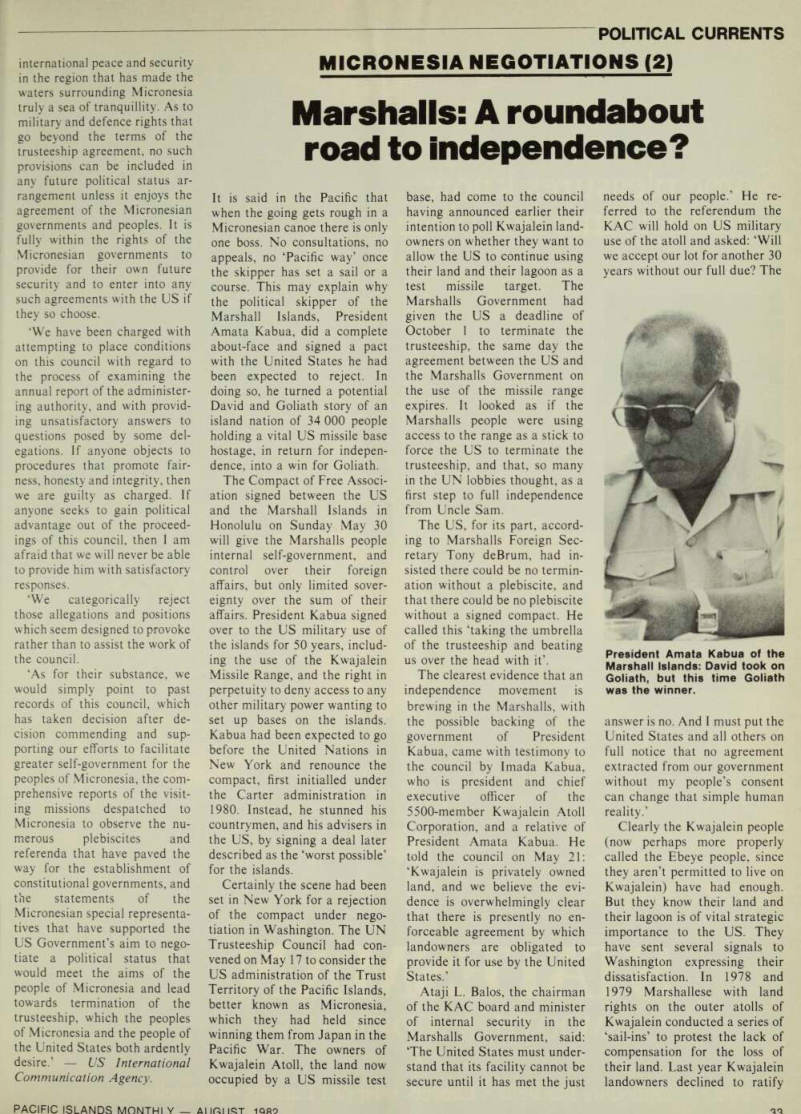
Micronesia Negotiations (1)
Trusteeship Council hears it from the USA
The two reports below offer contrasting viewpoints on aspects of the negotiations between the United States and Micronesian governments on the proposed Compacts of Free Association between the US on the one hand and the governments on the other. The first document is the final statement on the negotiations to the June meeting of the United Nations Trusteeship Council by the US Ambassador to the council, WILLIAM SHERMAN. The second is a report by ROSS STEVENS on reactions of various Marshallese groups to the signing the compact of May 30 by President Amata Kabua (PIM July p 5), and the possible consequences of the signing. Ross Stevens is a freelance journalist specialising in North-South issues at the United Nations, and edits a monthly newsletter on the North-South dialogue. From 1975 to 1981 he taught journalism at the University of Papua New Guinea.
The United States has sought to ‘negotiate a political status’ for the Pacific Islands under its trusteeship which would ‘meet the aims of the people of Micronesia and lead towards termination of the trusteeship,’ a high-ranking US official told the United Nations in June.
US Ambassador William Sherman, the American rep resentative to the UN Trusteeship Council, told the council just before its adjourn ment after a month-long session that ‘the peoples of Micronesia and the people of the United Stales both ardently desire' this termination.
In remarks to the council, without direct reference to the Soviet Union whose representa tive had charged that the US is trying to ‘fragment’ the Islands, Sherman declared that ‘just the opposite is true’. The Island governments, he added, are being established in accordance with the wishes of the Island people.
Before the 49th session of the council adjourned, it adopted a report to the Security Council on the conditions in the territory and its decision, suggested by the US, to send a mission to the area in July.
The Compact of Free Associ ation, being entered into be tween the US and the Island governments, provides for self government by Palau, the Marshall Islands, and the Fed erated States of Micronesia.
It recognises their authority in internal and foreign affairs, accords defence and security responsibility to the US, and provides for US economic as sistance. The compact can be ended by any government at
any time, but the US defence responsibility and economic as sistance would continue for at least 15 years.
Micronesia is classified in the United Nations Charter as a ‘strategic area’, and for this reason the Trusteeship Council reports to the Security Council on conditions there. Micronesia is the only remaining trust territory since the accession to independence of Papua New Guinea in September 1975. The other 10 territories, which at one time came under the inter national trusteeship system, have since achieved indepen dence or self-government either as separate states or as parts of stales.
Following is the text of Am bassador Sherman’s statement refuting charges made against the US during the session;
‘President: . . . Throughout our
deliberations we have heard views expressed by the Micronesian special representa tives and advisers on conditions in their respective jurisdictions within the Trust Territory.
They have explained the extent to which they govern their affairs and are assuming greater responsibility for the functions of their own governments. They are the authentic voices of the people of Micronesia, who have in past elections chosen the special representatives and their colleagues to play essen tial roles in assisting this council in its work. We owe a great debt of gratitude to them for their dedication and contributions to this council, ‘We have also heard during our days of deliberations many unfounded, sometimes wild, charges levied against my gov
ernment for alleged violations of the UN Charter and Trusteeship agreement, and a host of other purported sins. ‘We have been charged with fragmenting Micronesia, when just the opposite is true. My government resisted appeals by the people of the Northern Marianas for separate status for many years until it became apparent that we would other wise be denying them their right to self-determination if we failed to heed their request for Commonwealth status. Simi larly, the peoples of Micronesia were given every opportunity to remain a unified entity in the 1978 referendum on the consti tution, establishing the Feder ated States of Micronesia. The peoples of Palau and the Marshalls chose otherwise, in a referendum observed by a visit ing mission of the Trusteeship Council. Those who claim that the administering authority is “fragmenting" the region in essence deny the right of every Micronesian to decide his own political future. My govern ment has heeded the clearly stated wishes of the various Micronesian peoples as enunci ated in free, open and fair referenda. The fundamental premise of self-determination is free choice and the choice of the various Micronesian entities has been obviously free and certified by this council. ‘We have been charged with forcing the Micronesian govern ments to accept free associ ation. Perhaps those who make this charge have been attending different meetings of the Trusteeship Council in the past month, but I can recall hearing, and seeing in the record, absol
utely clear statements by rep resentatives of the governments of Micronesia that their govern ments believe free association to be the political status which best meets their needs, and that they have embraced free associ ation of their own volition. ‘We have been charged with denying independence to the peoples of Micronesia. Nothing could be further from the truth.
My predecessors in this council and I have stated that, should the peoples of Micronesia reject free association as negotiated, the US would be prepared to begin negotiations with the Micronesians consistent with the political status of indepen dence if they so desire. My Soviet colleague is wrong in asserting that independence is the only acceptable political status option that should be made available to the peoples of Micronesia. If we are to respect the concept of self determination, which we do and some governments profess to do, then we must leave it to the people of the region themselves to decide, ‘We have been charged with attempting to secure military and defence rights in Micronesia that would extend beyond the trusteeship period, and with having failed to promote international peace and security in the Trust Terri tory as called for in the trusteeship agreement. These are specious arguments. The region of the Trust Territory has been free from external threat during the period of the trusteeship because my govern ment has maintained a strong defensive posture. The peoples of Micronesia have made im portant contributions to their own defence. With their co operation we have promoted
international peace and security in the region that has made the waters surrounding Micronesia truly a sea of tranquillity. As to military and defence rights that go beyond the terms of the trusteeship agreement, no such provisions can be included in any future political status ar rangement unless it enjoys the agreement of the Micronesian governments and peoples. It is fully within the rights of the Micronesian governments to provide for their own future security and to enter into any such agreements with the US if they so choose. ‘We have been charged with attempting to place conditions on this council with regard to the process of examining the annual report of the administer ing authority, and with provid ing unsatisfactory answers to questions posed by some del egations. If anyone objects to procedures that promote fair ness, honesty and integrity, then we are guilty as charged. If anyone seeks to gain political advantage out of the proceed ings of this council, then I am afraid that we will never be able to provide him with satisfactory responses. ‘We categorically reject those allegations and positions which seem designed to provoke rather than to assist the work of the council. ‘As for their substance, we would simply point to past records of this council, which has taken decision after de cision commending and sup porting our efforts to facilitate greater self-government for the peoples of Micronesia, the com prehensive reports of the visit ing missions despatched to Micronesia to observe the nu merous plebiscites and referenda that have paved the way for the establishment of constitutional governments, and the statements of the Micronesian special representa tives that have supported the US Government’s aim to nego tiate a political status that would meet the aims of the people of Micronesia and lead towards termination of the trusteeship, which the peoples of Micronesia and the people of the United States both ardently desire.’ US International Communication Agency.
Advertisements & other items, p. 32 (1 item)
The best of the big wide-cabin jetliners
mgm
■ mm.
W £ I ■I -!-i o o o 1 o O ■fe, M C-‘ ' Wk ■ ISi2fci IB The best of the big wide-cabin jetliners
is the DC-10.
But being big is only part of being better.
The DC-10 is the crowning achievement of more than 40 years of continuous airliner production by McDonnell Douglas engineers.
Thoroughly tested through 18 million hours before it went into service, it has now carried passengers throughout the world for more than four million hours; that’s more than 500 years in the air, demonstrating its dependability.
Wide-cabin jetliners bring comfort benefits to airline passengers and new quiet to airport communities. The DC-10 has superior comfort with better air conditioning, noticeably quieter cabin interiors, larger windows, and has been acclaimed for its quiet flight into and out of the 170 cities it serves around the globe.
Operating efficiency is important to airlines and passengers alike, for the fuel saved helps the airline bring better service at the same price and saves the fuel for other uses in our lives. The three-engine DC-10 is unmatched for fuel efficiency on almost any route length you can imagine, from Manila to Hong Kong or Rome to Rio.
The big wide-cabin jets have become popular with travellers and airlines all over the world. More airlines - 44 - are flying the DC-10 than are flying any other wide-cabin trijet, and they fly them to 90 countries on six continents, carrying travellers to more places, more often than any other wide-cabin jetliner.
The DC-10 was designed for the 1980 s, to meet changing travel habits and ecology demands for the years ahead. No other aircraft can match the DC-10. It is ideally suited to the growing needs of growing airlines preparing to offer superior air service at home and abroad.
/wcpo/v/vellO
DOUGLAS
Marshalls: A roundabout
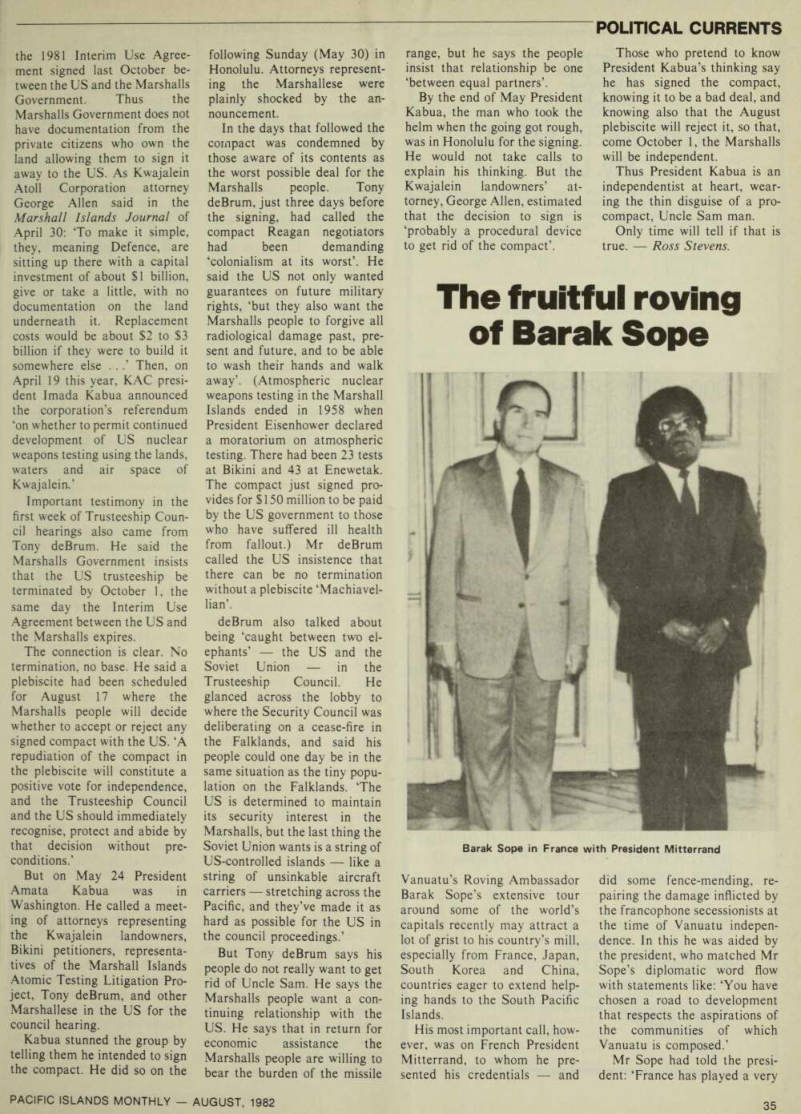
Micronesia Negotiations (2)
Marshalls: A roundabout road to independence?
It is said in the Pacific that when the going gets rough in a Micronesian canoe there is only one boss. No consultations, no appeals, no ‘Pacific way’ once the skipper has set a sail or a course. This may explain why the political skipper of the Marshall Islands, President Amata Kabua, did a complete about-face and signed a pact with the United States he had been expected to reject. In doing so, he turned a potential David and Goliath story of an island nation of 34 000 people holding a vital US missile base hostage, in return for indepen dence, into a win for Goliath.
The Compact of Free Associ ation signed between the US and the Marshall Islands in Honolulu on Sunday May 30 will give the Marshalls people internal self-government, and control over their foreign affairs, but only limited sover eignty over the sum of their affairs. President Kabua signed over to the US military use of the islands for 50 years, includ ing the use of the Kwajalein Missile Range, and the right in perpetuity to deny access to any other military power wanting to set up bases on the islands.
Kabua had been expected to go before the United Nations in New York and renounce the compact, first initialled under the Carter administration in 1980. Instead, he stunned his countrymen, and his advisers in the US, by signing a deal later described as the ‘worst possible’ for the islands.
Certainly the scene had been set in New York for a rejection of the compact under nego tiation in Washington. The UN Trusteeship Council had con vened on May 17 to consider the US administration of the Trust Territory of the Pacific Islands, better known as Micronesia, which they had held since winning them from Japan in the Pacific War. The owners of Kwajalein Atoll, the land now occupied by a US missile test
base, had come to the council having announced earlier their intention to poll Kwajalein land owners on whether they want to allow the US to continue using their land and their lagoon as a test missile target. The Marshalls Government had given the US a deadline of October 1 to terminate the trusteeship, the same day the agreement between the US and the Marshalls Government on the use of the missile range expires. It looked as if the Marshalls people were using access to the range as a stick to force the US to terminate the trusteeship, and that, so many in the UN lobbies thought, as a first step to full independence from Uncle Sam.
The US, for its part, accord ing to Marshalls Foreign Sec retary Tony deßrum, had in sisted there could be no termin ation without a plebiscite, and that there could be no plebiscite without a signed compact. He called this ‘taking the umbrella of the trusteeship and beating us over the head with it’.
The clearest evidence that an independence movement is brewing in the Marshalls, with the possible backing of the government of President Kabua, came with testimony to the council by Imada Kabua, who is president and chief executive officer of the 5500-member Kwajalein Atoll Corporation, and a relative of President Amata Kabua. He told the council on May 21: ‘Kwajalein is privately owned land, and we believe the evi dence is overwhelmingly clear that there is presently no en forceable agreement by which landowners are obligated to provide it for use by the United States.’
Ataji L. Bales, the chairman of the KAC board and minister of internal security in the Marshalls Government, said: ‘The United States must under stand that its facility cannot be secure until it has met the just
needs of our people.’ He re ferred to the referendum the KAC will hold on US military use of the atoll and asked: ‘Will we accept our lot for another 30 years without our full due? The
answer is no. And I must put the United States and all others on full notice that no agreement extracted from our government without my people’s consent can change that simple human reality.’
Clearly the Kwajalein people (now perhaps more properly called the Ebeye people, since they aren’t permitted to live on Kwajalein) have had enough.
But they know their land and their lagoon is of vital strategic importance to the US. They have sent several signals to Washington expressing their dissatisfaction. In 1978 and 1979 Marshallese with land rights on the outer atolls of Kwajalein conducted a series of ‘sail-ins’ to protest the lack of compensation for the loss of their land. Last year Kwajalein landowners declined to ratify
President Amata Kabua of the Marshall Islands: David took on Goliath, but this time Goliath was the winner.
the 1981 Interim Use Agree ment signed last October be tween the US and the Marshalls Government. Thus the Marshalls Government does not have documentation from the private citizens who own the land allowing them to sign it away to the US. As Kwajalein Atoll Corporation attorney George Allen said in the Marshall Islands Journal of April 30: ‘To make it simple, they, meaning Defence, are sitting up there with a capital investment of about $1 billion, give or take a little, with no documentation on the land underneath it. Replacement costs would be about $2 to $3 billion if they were to build it somewhere else ...’ Then, on April 19 this year, KAC presi dent Imada Kabua announced the corporation’s referendum ‘on whether to permit continued development of US nuclear weapons testing using the lands, waters and air space of Kwajalein,’
Important testimony in the first week of Trusteeship Coun cil hearings also came from Tony deßrum. He said the Marshalls Government insists that the US trusteeship be terminated by October 1, the same day the Interim Use Agreement between the US and the Marshalls expires.
The connection is clear. No termination, no base. He said a plebiscite had been scheduled for August 17 where the Marshalls people will decide whether to accept or reject any signed compact with the US. ‘A repudiation of the compact in the plebiscite will constitute a positive vote for independence, and the Trusteeship Council and the US should immediately recognise, protect and abide by that decision without pre conditions.’
But on May 24 President Amata Kabua was in Washington. He called a meet ing of attorneys representing the Kwajalein landowners, Bikini petitioners, representa tives of the Marshall Islands Atomic Testing Litigation Pro ject, Tony deßrum, and other Marshallese in the US for the council hearing.
Kabua stunned the group by telling them he intended to sign the compact. He did so on the
following Sunday (May 30) in Honolulu. Attorneys represent ing the Marshallese were plainly shocked by the an nouncement.
In the days that followed the compact was condemned by those aware of its contents as the worst possible deal for the Marshalls people. Tony deßrum, just three days before the signing, had called the compact Reagan negotiators had been demanding ‘colonialism at its worst’. He said the US not only wanted guarantees on future military rights, ‘but they also want the Marshalls people to forgive all radiological damage past, pre sent and future, and to be able to wash their hands and walk away’. (Atmospheric nuclear weapons testing in the Marshall Islands ended in 1958 when President Eisenhower declared a moratorium on atmospheric testing. There had been 23 tests at Bikini and 43 at Enewetak.
The compact just signed pro vides for $ 150 million to be paid by the US government to those who have suffered ill health from fallout.) Mr deßrum called the US insistence that there can be no termination without a plebiscite ‘Machiavel lian’. deßrum also talked about being ‘caught between two el ephants’ the US and the Soviet Union in the Trusteeship Council. He glanced across the lobby to where the Security Council was deliberating on a cease-fire in the Falklands, and said his people could one day be in the same situation as the tiny popu lation on the Falklands. The US is determined to maintain its security interest in the Marshalls, but the last thing the Soviet Union wants is a string of US-controlled islands like a string of unsinkable aircraft carriers stretching across the Pacific, and they’ve made it as hard as possible for the US in the council proceedings.’
But Tony deßrum says his people do not really want to get rid of Uncle Sam. He says the Marshalls people want a con tinuing relationship with the US. He says that in return for economic assistance the Marshalls people are willing to bear the burden of the missile
range, but he says the people insist that relationship be one ‘between equal partners’.
By the end of May President Kabua, the man who took the helm when the going got rough, was in Honolulu for the signing.
He would not take calls to explain his thinking. But the Kwajalein landowners’ at torney, George Allen, estimated that the decision to sign is ‘probably a procedural device to get rid of the compact’.
Those who pretend to know President Kabua’s thinking say he has signed the compact, knowing it to be a bad deal, and knowing also that the August plebiscite will reject it, so that, come October 1, the Marshalls will be independent.
Thus President Kabua is an independentist at heart, wear ing the thin disguise of a pro compact, Uncle Sam man.
Only time will tell if that is
true.
Ross Stevens.
Advertisements & other items, pp. 33-34 (2 items)
33
POLITICAL CURRENTS
PACIFIC ISLANDS MONTHI Y AUGUST IQfto
Some pleasures know
neither time nor place...
X M * r > *r
spswr; I -
■ • V * $S ■ ; > '•*!
Z s / : / C *G*F=ts
SMOOTH, MILD CIGARS
/ Corona • Commodore Panatella • Lancers • Tipped Lancers • Panatella W 754
The fruitful roving

of Barak Sope
Vanuatu’s Roving Ambassador Barak Sope’s extensive tour around some of the world’s capitals recently may attract a lot of grist to his country’s mill, especially from France, Japan, South Korea and China, countries eager to extend help ing hands to the South Pacific Islands.
His most important call, how ever, was on French President Mitterrand, to whom he pre sented his credentials and
did some fence-mending, re pairing the damage inflicted by the francophone secessionists at the time of Vanuatu indepen dence. In this he was aided by the president, who matched Mr Sope’s diplomatic word flow with statements like: ‘You have chosen a road to development that respects the aspirations of the communities of which Vanuatu is composed.’
Mr Sope had told the presi dent: ‘France has played a very
Barak Sope in France with President Mitterrand
important role in creating the new nation of Vanuatu. My people are grateful for this and have accepted the era before independence as part of our history.’ Which is another way of saying ‘Let bygones be by gones’.
His final words were real fence-menders. ‘Vanuatu has the will and strong desire to develop closer and deeper re lations with France,’ said the ambassador. ‘ln the years to come, my government and people will continue to look to France for support and co operation in the fields of edu cation, health and economic development. With deeper understanding, co-operation and friendship between our two peoples, France will always be assured that, far away in the South Pacific, Vanuatu is a friend and partner.’
President Mitterrand assured Mr Sope that ‘the difficulties which surrounded your ac cession to independence and strained the relations between our two countries have been overcome’. He added: ‘France and Vanuatu now know that, henceforth, they may agree with each other, understand each other and work together as demonstrated by the co operation agreements recently signed between our two countries.’
The president also stressed that Vanuatu was acquiring (through membership of the Agency for Cultural and Tech nical Co-operation and ac cession to the Lome Conven tion) the ‘means necessary to enable itself to develop and conduct a foreign policy free from all forms of influence, whether imposed or endured, in the fulfilment of your difficult but challenging goals, goals calling for all the courage and vision of your young nation.
France is ready to lend a hand and it has the resources in the Pacific to do this’.
During his stay in Paris Mr Sope had talks with government officials about the new co operation agreement between France and Vanuatu, and the need for a ‘genuine’ pension scheme for Ni-Vanuatu living in New Caledonia. If they return to Vanuatu they forfeit the pension.
Mr Sope asked that such funds should be transferred to Vanuatu for those who had forfeited them. This will be discussed by the French govern ment’s aid negotiation team due in Vanuatu in October.
Another subject for dis cussion by the joint committee in November will be the ques tion of the agreement by France and Britain to pay for damage caused by the 1980 rebellion.
At the headquarters of the European Economic Com munity in Brussels, Mr Sope discussed aid to Vanuatu, and was told that the EEC will open an office in Port-Vila by the end of the year.
In Peking the ambassador was told the Chinese would welcome a cultural exchange programme. And China was also interested in Vanuatu’s timber.
On his return home in early June Mr Sope said that China was so short of timber that the government was discouraging people from using wooden coffins.
Mr Sope pushed in Tokyo for an improvement in the balance of trade, pointing out that the balance was very much in Japan’s favour. The reply was that Japan was interested in Vanuatu’s meat and fish ex ports. He was given two assur ances aid would be given when Vanuatu asked for it and specified what the aid was for, and that Japan supported Vanuatu’s nuclear-free Pacific policy.
South Korea promised to strengthen trading relations and expressed interest in Vanuatu’s timber, fish and minerals.
On his way through Europe Mr Sope visited Switzerland and paved the way for future diplomatic links. He also visited Cameroun in Africa and dis covered a fellow-feeling that both countries were bilingual, and that Cameroun was the sole link in Africa between the French-speaking and English speaking nations.
Back in Port-Vila, Mr Sope commented: ‘On the same basis, we in Vanuatu have the same advantage over our other Pacific neighbours. We will be the link between Tahiti and New Caledonia, when they are independent.’
Advertisements & other items, p. 36 (1 item)
Pty. Ltd.
£ % m
WATER WHEEL EXPORTS
493 Bourke Street.
Melbourne. 3000, Australia Cables: Watermill - Melbourne.
Telex: AA 32165 Telephone: 602 1433
THE WATER WHEEL GROUPOF COMPANIES
Winners of Australia's Top Export Award and Flour Millers for over TOO years.
BEST AUSTRALIAN
WHEATEN FLOUR
(High Protein, Bakers. Stone ground Wholemeal, Donut).
COOLROOMS REFRIGERATED
CABINETS ETC.
INCLUDING SALT WATER
ICE MAKERS
STOCK & POULTRY FEEDS
(Pellets or Mash form)
YELLOW SPLIT PEAS &
WHOLE PEAS
(Machine-Dressed)
COMPLETE RANGE OF FROZEN
AND GENERAL FOOD ITEMS
QUALITY AUSTRALIAN
WINES
WOOD FUEL STOVES
AND WATER HEATERS
FOR FURTHER INFORMATION
Return this coupon to:
WATER WHEEL EXPORTS PTY. LTD.
Please forward me: Name Address Phone: More information on your above products/ product.
Export Manager Water Wheel Exports Pty. Ltd. 53 Market Street, (P.O. Box 38) South Melbourne 3205 Australia Telex: AA 32165 (same) Telephone: 699 1722
drug-runners’
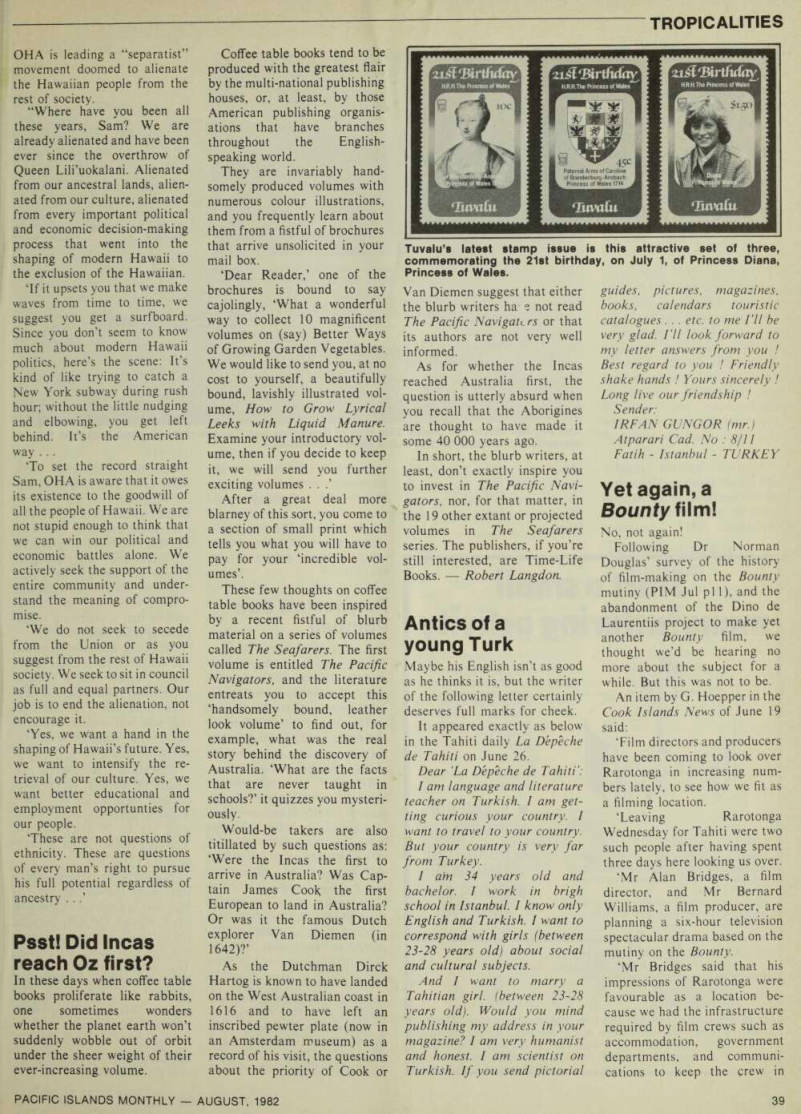
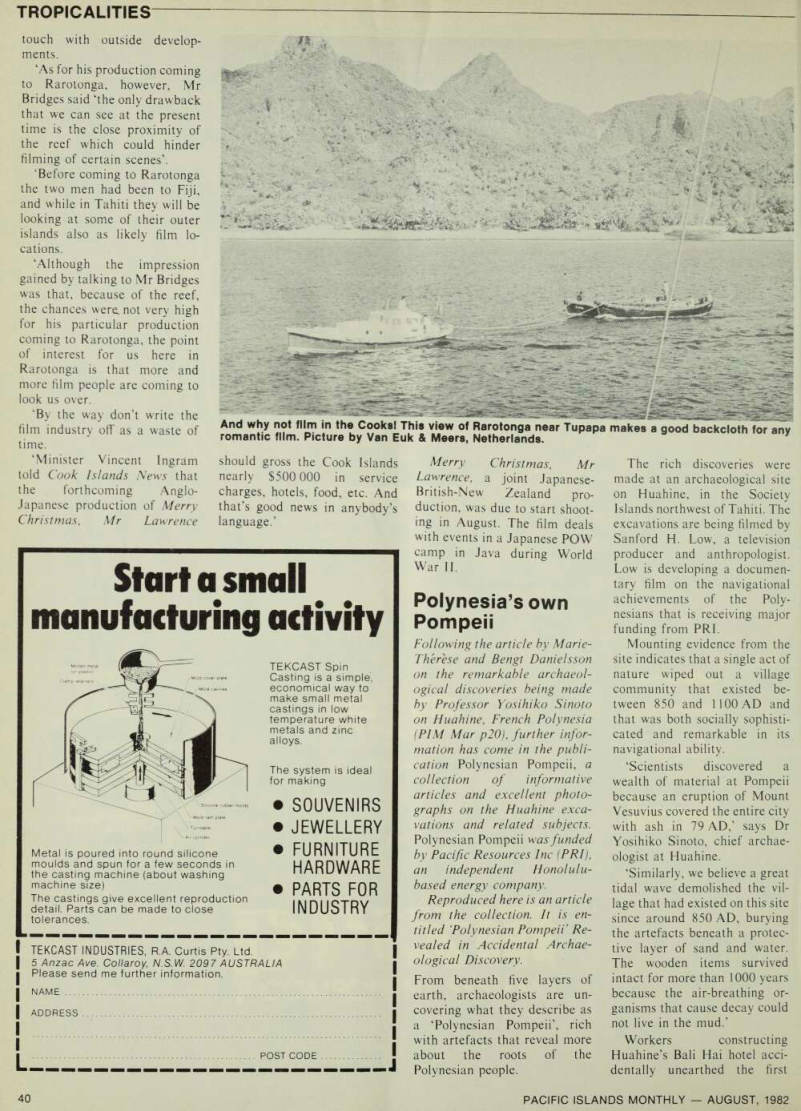
Tropicalities
Islands as
staging posts
There is increasing evidence of small Pacific islands being used as ‘staging posts’ by traffickers sending drugs to Australia and New Zealand from Asia, ac cording to a South Pacific Commission expert.
The SPC’s adviser on en vironmental health and food hygiene, Eric Dunn, said in creased control and surveillance of illicit drugs in the Western industrialised nations had en couraged the growth of traffick ing in populous regions of the South Pacific.
In an article in the SPC Monthly News of Activities, Mr Dunn claims traffickers were opening up new drug routes via the islands.
He repeated his warning in a June telephone interview from Noumea with The Sydney Morning Herald. ‘There is no doubt that some South Pacific countries are be ing used as transit points,’ he said.
An increasingly competitive international airline network made most of the islands access ible by air, and the resulting tourist trade had simplified drug trafficking.
Criminals were travelling easily through the Pacific by posing as tourists, said Mr Dunn.
By using a system of forged passports and overlapping cour iers, they gave no indication that they had visited drug producing areas of Asia particularly the ‘Golden Tri angle’ where most of the illegal drugs originated. ‘ln addition to traffic in drugs by air, consignments are often shipped by roundabout routes though the islands on small vessels,’ he said.
Although there is at present very little drug abuse on the islands, Mr Dunn said increas
ing two-way tourism meant more Pacific Islanders were visiting metropolitan areas of New Zealand and Australia where the level of abuse was rising.
Criminals were also taking advantage of the lack of exper tise amongst customs officials on the islands. ‘They know that the enforce ment officers of some Pacific island countries lack training and experience in the specialist field of drug identification and concealment, and they take advantage of this,’ said Mr Dunn. ‘lt is clear that such illegal activities can only be success fully combated if the prevent ative authorities remain one jump ahead of the traffickers. ‘This requires sound up-to date knowledge of drug identification, the techniques used to avoid detection and, above all, constant vigilance by the officers responsible for sur veillance of our sea and air ports. ‘Over the past couple of years, customs officers have seized drugs and couriers in places such as Fiji and the Solomon Islands and even here in Noumea.’
Mr Dunn said the difficulties had been highlighted at the 1977 regional seminar for heads of customs.
The seminar strongly rec ommended that the SPC ar range expert technical training on drug surveillance for police and customs officers in the region.
Three such courses have already been held, with funds from the UN division of nar cotic drugs, the UN fund for drug abuse and control, the Commonwealth fund for techni cal co-operation and the Gov ernments of Australia and New Zealand.
A fourth course, planned for late this year, is in jeopardy however, because of a lack of funds.
Each course cost about $35 000 to run.
But Mr Dunn said he had difficulty raising the money because the courses were financed externally not through the SPC’s annual budget provisions.
Although the costs were shared jointly by the organis ations and governments listed
above, Mr Dunn agreed that Australia and New Zealand benefited most in the long run. ‘Australia and New Zealand, I suppose are the main beneficiaries because they are the targets for the drugs, but the islands also worry because of the possibility of drugs get ting into their societies.’
Caroline and
Guillermo...
An unidentified ‘South Pacific island’ was the scene of a secret June holiday for Princess Caroline of Monaco and Argen tine tennis star Guillermo Vilas.
Their whirlwind affair began when Caroline saw the 29-year old Vilas play in the Monaco tennis tournament, according to Paris Match magazine. She was smitten and they rendezvoused in his Paris flat two days later.
Vilas, who reportedly gave up sex for a year to improve his tennis, and Caroline flew by private plane to the island hideaway.
Photographs in Paris Match show the couple swimming together and embracing on the beach.
The 25-year-old princess has emerged into public life only recently following her divorce from French playboy Philippe Junot, 42, in 1980.
She has been seen regularly with 32-year-old Robertino Rossellini, son of the famous Italian movie director.
Vilas, who quit Wimbledon because of the Falklands war, is engaged to French beauty Gabriela Blondeau.
She is said to have moved out of his house.
Question: Can any PIM reader tell us which islarid it was?
Arguing hotly
in Hawaii...
Arguments about the merits of traditional societies and cul tures as against ‘modernisation’ are common throughout the Pacific. But seldom are they carried on with such vigour as happened recently in Hawaii.
In his column in Honolulu’s Sunday Star-Bulletin & Adver tiser Sammy Amalu wrote: ‘Well, we Hawaiians are get ting all stirred up and restless of late, doing all sorts of weird things like publishing outrage
ously expensive books and devoting tons of government paper to outline our own cul tural needs as if we were the only ones in the world with cultural needs.
The only trouble is that the only culture the Hawaiian ever had was a neolithic one, far better dead than revived, you can believe me. I do not mean to disparage the ancient life of my Hawaiian forefathers, but aside from feather making and poetry with a smidgen or two of the terpsichorean art, it did not have too much and was cer tainly not one of man’s highest attainments. ‘I, of course, have always been an advocate of human sacrifice as a means of control ing population, but it does have its social drawbacks and never was really too popular a pastime among my ancestors, especially not among those who were being sacrificed. ‘And no matter what you may think of the American missionaries and what they did here in Hawaii, you must admit that they did free the ordinary Hawaiian from what was little more than plain old slavery. The chiefs and princes had every thing going for them in the old culture, but Joe Blow had a hard time of it. The missionaries gave him back his manhood and freed him from his bondage to his superiors. ‘Anyway, that is the culture that some would now have us revive and recall. And the Office of Hawaiian Affairs has written a whole report of its plans to bring back all that bosh and nonsense.’
He returned to the attack in his next column, arguing that the Office of Hawaiian Affairs (OHA) had achieved nothing, was divisive, and was ‘trying to secede from the island com munity’.
But the newspaper’s editors were not letting Sammy Amalu have it all his own way. In a counter-blast in the same issue, Peter K. Apo, an OHA trustee, wrote: ‘The only claim that Sam Amalu has to Hawaiian ances try is that he is very good at throwing spears. Without fan fare, his latest poison-tipped missiles came hurling through the front doors of the Office of Hawaiian Affairs . . . ‘Mr Amalu charges that
OHA is leading a “separatist” movement doomed to alienate the Hawaiian people from the rest of society.
“Where have you been all these years, Sam? We are already alienated and have been ever since the overthrow of Queen Lili’uokalani. Alienated from our ancestral lands, alien ated from our culture, alienated from every important political and economic decision-making process that went into the shaping of modern Hawaii to the exclusion of the Hawaiian. ‘lf it upsets you that we make waves from time to time, we suggest you get a surfboard.
Since you don’t seem to know much about modern Hawaii politics, here’s the scene: It’s kind of like trying to catch a New York subway during rush hour; without the little nudging and elbowing, you get left behind. It’s the American way . .. ‘To set the record straight Sam, OHA is aware that it owes its existence to the goodwill of all the people of Hawaii. We are not stupid enough to think that we can win our political and economic battles alone. We actively seek the support of the entire community and under stand the meaning of compro mise. ‘We do not seek to secede from the Union or as you suggest from the rest of Hawaii society. We seek to sit in council as full and equal partners. Our job is to end the alienation, not encourage it. ‘Yes, we Want a hand in the shaping of Hawaii’s future. Yes, we want to intensify the re trieval of our culture. Yes, we want better educational and employment opportunties for our people. ‘These are not questions of ethnicity. These are questions of every man’s right to pursue his full potential regardless of ancestry . ..’
Psst! Did Incas
reach Oz first?
In these days when coffee table books proliferate like rabbits, one sometimes wonders whether the planet earth won’t suddenly wobble out of orbit under the sheer weight of their ever-increasing volume.
Coffee table books tend to be produced with the greatest flair by the multi-national publishing houses, or, at least, by those American publishing organis ations that have branches throughout the English speaking world.
They are invariably hand somely produced volumes with numerous colour illustrations, and you frequently learn about them from a fistful of brochures that arrive unsolicited in your mail box. ‘Dear Reader,’ one of the brochures is bound to say cajolingly, ‘What a wonderful way to collect 10 magnificent volumes on (say) Better Ways of Growing Garden Vegetables.
We would like to send you, at no cost to yourself, a beautifully bound, lavishly illustrated vol ume, How to Grow Lyrical Leeks with Liquid Manure.
Examine your introductory vol ume, then if you decide to keep it, we will send you further exciting volumes . . .’
After a great deal more blarney of this sort, you come to a section of small print which tells you what you will have to pay for your ‘incredible vol umes’.
These few thoughts on coffee table books have been inspired by a recent fistful of blurb material on a series of volumes called The Seafarers. The first volume is entitled The Pacific Navigators, and the literature entreats you to accept this ‘handsomely bound, leather look volume’ to find out, for example, what was the real story behind the discovery of Australia. ‘What are the facts that are never taught in schools?’ it quizzes you mysteri ously.
Would-be takers are also titillated by such questions as: ‘Were the Incas the first to arrive in Australia? Was Cap tain James Cook the first European to land in Australia?
Or was it the famous Dutch explorer Van Diemen (in 1642)?’
As the Dutchman Dirck Hartog is known to have landed on the West Australian coast in 1616 and to have left an inscribed pewter plate (now in an Amsterdam museum) as a record of his visit, the questions about the priority of Cook or
Van Diemen suggest that either the blurb writers ha e not read The Pacific Navigate rs or that its authors are not very well informed.
As for whether the Incas reached Australia first, the question is utterly absurd when you recall that the Aborigines are thought to have made it some 40 000 years ago.
In short, the blurb writers, at least, don’t exactly inspire you to invest in The Pacific Navi gators, nor, for that matter, in the 19 other extant or projected volumes in The Seafarers series. The publishers, if you’re still interested, are Time-Life
Books.
Robert Langdon.
Antics of a
young Turk
Maybe his English isn’t as good as he thinks it is, but the writer of the following letter certainly deserves full marks for cheek.
It appeared exactly as below in the Tahiti daily La Depeche de Tahiti on June 26.
Dear La Depeche de Tahiti': I am language and literature teacher on Turkish. I am get ting curious your country. I want to travel to your country.
But your country is very far from Turkey.
I am 34 years old and bachelor. I work in brigh school in Istanbul. I know only English and Turkish. I want to correspond with girls (between 23-28 years old) about social and cultural subjects.
And I want to marry a Tahitian girl. (between 23-28 years old). Would you mind publishing my address in your magazine? I am very humanist and honest. I am scientist on Turkish. If you send pictorial
guides, pictures, magazines, books, calendars touristic catalogues. .. etc. to me I’ll be very glad. I’ll look forward to my letter answers from you !
Best regard to you ! Friendly shake hands ! Yours sincerely !
Long live our friendship !
Sender:
Irfan Gungor (Mr.)
Atparari Cad. No : 8/11 Fatih - Istanbul - TURKEY
Yet again, a
Bounty film!
No, not again!
Following Dr Norman Douglas’ survey of the history of film-making on the Bounty mutiny (PIM Jul pi 1), and the abandonment of the Dino de Laurentiis project to make yet another Bounty film, we thought we’d be hearing no more about the subject for a while. But this was not to be.
An item by G. Hoepper in the Cook Islands News of June 19 said: ‘Film directors and producers have been coming to look over Rarotonga in increasing num bers lately, to see how we fit as a filming location. ‘Leaving Rarotonga Wednesday for Tahiti were two such people after having spent three days here looking us over. ‘Mr Alan Bridges, a film director, and Mr Bernard Williams, a film producer, are planning a six-hour television spectacular drama based on the mutiny on the Bounty. ‘Mr Bridges said that his impressions of Rarotonga were favourable as a location be cause we had the infrastructure required by film crews such as accommodation, government departments, and communi cations to keep the crew in
Tuvalu’s latest stamp issue is this attractive set of three, commemorating the 21st birthday, on July 1, of Princess Diana, Princess of Wales.
touch with outside develop ments. ‘As for his production coming to Rarotonga, however, Mr Bridges said ‘the only drawback that we can see at the present time is the close proximity of the reef which could hinder filming of certain scenes’. ‘Before coming to Rarotonga the two men had been to Fiji, and while in Tahiti they will be looking at some of their outer islands also as likely film lo cations. ‘Although the impression gained by talking to Mr Bridges was that, because of the reef, the chances were, not very high for his particular production coming to Rarotonga, the point of interest for us here in Rarotonga is that more and more film people are coming to look us over. ‘By the way don’t write the film industry oflf as a waste of time. ‘Minister Vincent Ingram told Cook Islands News that the forthcoming Anglo- Japanese production of Merry Christmas, Mr Lawrence
should gross the Cook Islands nearly $5OO 000 in service charges, hotels, food, etc. And that’s good news in anybody’s language.’
Merry Christmas, Mr Lawrence, a joint Japanese- British-New Zealand pro duction, was due to start shoot ing in August. The film deals with events in a Japanese POW camp in Java during World War 11.
Polynesia’s own
Pompeii
Following the article by Marie- Therese and Bengt Danielsson on the remarkable archaeol ogical discoveries being made by Professor Yosihiko Sinoto on Huahine, French Polynesia (PIM Mar p2oj, further infor mation has come in the publi cation Polynesian Pompeii, a collection of informative articles and excellent photo graphs on the Huahine exca vations and related subjects.
Polynesian Pompeii was funded by Pacific Resources Inc (PRI), an independent Honolulu based energy company.
Reproduced here is an article from the collection. It is en titled Polynesian Pompeii’ Re vealed in Accidental Archae ological Discovery.
From beneath five layers of earth, archaeologists are un covering what they describe as a ‘Polynesian Pompeii’, rich with artefacts that reveal more about the roots of the Polynesian people.
The rich discoveries were made at an archaeological site on Huahine, in the Society Islands northwest of Tahiti. The excavations are being filmed by Sanford H. Low, a television producer and anthropologist.
Low is developing a documen tary film on the navigational achievements of the Poly nesians that is receiving major funding from PRI.
Mounting evidence from the site indicates that a single act of nature wiped out a village community that existed be tween 850 and 1100 AD and that was both socially sophisti cated and remarkable in its navigational ability. ‘Scientists discovered a wealth of material at Pompeii because an eruption of Mount Vesuvius covered the entire city with ash in 79 AD,’ says Dr Yosihiko Sinoto, chief archae ologist at Huahine. ‘Similarly, we believe a great tidal wave demolished the vil lage that had existed on this site since around 850 AD, burying the artefacts beneath a protec tive layer of sand and water.
The wooden items survived intact for more than 1000 years because the air-breathing or ganisms that cause decay could not live in the mud.’
Workers constructing Huahine’s Bali Hai hotel acci dentally unearthed the first
And why not film in the Cooksl This view of Rarotonga near Tupapa makes a good backcloth for any romantic film. Picture by Van Euk & Meers, Netherlands.
artefacts in 1972. It was not until late in 1981, however, that the most significant find two planks from an ancient voyag ing canoe were removed. ‘These planks are the oldest parts of this type of vessel discovered,’ says Sinoto. ‘lt is increasingly apparent that long before Columbus embarked for America, skilful sailors used stars, winds and currents in navigation. They explored, settled and regularly travelled a part of the Pacific larger than Europe and North America combined.’
The material culture rep resented in the Huahine exca vations gives further support to a hypothesis of the sequential settlement of Polynesia. Early Polynesians migrated from Tonga and Samoa in Western Polynesia, east to the Marquesas and the Society Islands, and subsequently to Hawaii and New Zealand.
There was possibly an initial contact with Hawaii from the Marquesas, with the major con tact later from the Society Islands.
The excavations have been supported by funds from a number of sources, including the Ben and Jim Deane families of California, the Association pour les Fouilles Archeologiques Nationales, Paris, the territorial govern ment of French Polynesia, the National Geographic Society, and the Bernice P. Bishop Museum in Honolulu.
Low, who produced and wrote several programmes for the Odyssey series on US public television, is seeking additional funding for the film documen tary, tentatively titled The Navigators. He is researching and writing a script and plans to complete the film by early 1983.
Sinoto, head of the Depart ment of Anthropology at the Bishop Museum, and a recog nised expert on Polynesian ar chaeology, has supervised the recovery of wooden bowls, hand clubs, adze handles, house posts and a variety of other perish able wooden items that nor mally do not survive in archae ological sites.
Canoe bailers, spreaders, paddles, outriggers and a mast accompanied the discovery of the broad planks, which Sinoto
says indicate a voyaging canoe 18 to 24 metres long, similar in design to a catamaran.
First uncovered in 1977, the planks were reburied until Sinoto was able to prepare a method of conservation to pro tect them from rapid disinte gration in the air. The boards, measuring about seven metres in length, are now submerged in a special liquid that will restore them from their current sponge like consistency. The process will lake 12 to 18 months.
The excavations are also re vealing the foundations for stor age houses, work areas, fire pits and an ancient marae, or temple site. Each element adds to the historical picture Sinoto and his team are piecing together.
The storage buildings, for instance, reveal that an abun dance of food enabled certain villagers to specialise in non food-producing tasks, leading to development of crafts and other activities beyond those required for survival.
Tn order for such a flowering of culture to occur,’ says Sinoto, ‘the ancient Tahitians first had to develop the technical skill to extract a surplus of food from their environment. This pro vided time and wherewithal for some to become skilled craftsmen, artists and poli ticians.’
In addition, the quantity of certain types of artefacts, par ticularly graters and scrapers made of pearl shell, indicates a society involved in manufactur ing for trade.
This sophistication, coupled with the growing legend of their navigational prowess, indicates significant accomplishments by a people whose true capabilities
continue to be revealed by the Huahine expeditions.
Art foundation
in Port-Viia
The Michoutouchkine Pilioko Foundation established in Port- Vila aims ‘to restore among the people of the islands of the South Pacific an interest in traditional art forms, and to reinstate their original import ance within the context of their culture’.
Greeting the event, Vanuatu Prime Minister Walter Lini wrote: ‘For many years we have been fortunate to have in Vanuatu Aloi Pilioko and Nicolai Michoutouchkine, both having done much for the preservation and promotion of Melanesian artistic tradition. ‘Consequently, I take not a little pleasure in confirming that my Government, and I personally, give the Michoutouchkine Pilioko Foun dation entire support and patronage in its endeavour.’
Aims of the foundations in detail are:
1) To restore among the people of the islands of the South Pacific an interest in traditional art forms and to reinstate their original import ance within the context of their culture. 2) To create a centre where inspiration can be discovered from South Pacific traditions and to translate this inspiration into living arts and crafts. 3) To enlarge and enrich the original collection of 700 artefacts donated by Nicolai Michoutouchkine and Aloi Pilioko. This collection has been exhibited in Sweden, France USSR and Poland. 4) To establish links in tra ditional art between Vanuatu and other South Pacific islands. 5) To complement existing institutions presenting tra ditional art and custom and to work jointly with those fostering the development of Pacific art and culture. 6) To develop facilities to accommodate working crafts men, scholars or guests of the foundation.
Tonga-Japan
friendship
A Japan-Tonga Friendship As sociation was founded at a ceremony in Tokyo earlier this year. Tonga’s King Taufa’ahau Tupou IV was present at the founding ceremony.
Professor Shinya Amemiya of Komozawa University is chief director of the association.
He said such an association should have been established long ago since Tonga is one of the most pro-Japanese countries in the South Pacific.
Huahine, where archaeologists have unearthed Polynesia’s own Pompeii. - Picture by Ken McGregor.
Nicolai Michoutouchkine (left) and Aloi Pilioko (right) at the Kabuki Gallery in Sydney a few years ago when they held a joint exhibition of their work. Here gallery manager Robert Hall displays a tapestry which reflects Pilioko’s kinship with the Islands. - Australian Information Service picture.
Advertisements & other items, pp. 38-42 (1 item)
Teac
Jiscover a world ot ultimate sonic clarity.
Incredibly refined
music reproduction performance lets you relive every detail and subtle sonic nuance
of the original performance.
Another taste of truly advanced technology
from TEAC.
EM * Sc . I I
PRISM 30
PRISM 50
Q O
PRISM 70
r r
COMPONENT SYSTEMS'^
TEAC
Australia: TEAC Australia Pty., Ltd. 115 Whiteman Street South Melbourne, Victoria 3205 New Zealand; Direct Imports (N. 2.) Ltd. P 0 Box 72 Hastings Fuji: D. Jeevan & Sons P.O, Box 148, Suva New Caledonia: HIFIVOX 79. Rue de Sebastopol B P 1458. Noumea
Start a small
manufacturing activity
ti Metal is poured into round silicone moulds and spun for a few seconds in the casting machine (about washing machine size) The castings give excellent reproduction detail. Parts can be made to close tolerances.
TEKCAST Spin
Casting is a simple, economical way to make small metal castings in low temperature white metals and zinc alloys.
The system is ideal for making
• SOUVENIRS
• JEWELLERY
• FURNITURE
HARDWARE
• PARTS FOR
INDUSTRY
TEKCAST INDUSTRIES, R.A. Curtis Pty. Ltd.
5 Anzac Ave. Cotlaroy, N.S.W.
Please send me further information.
NAME
ADDRESS
L
POSTCODE
J
CITIZE
Om t jt, i mn ■•h u’M «? w as** ■Sir M 'l.', ■ V ?,l r
ill
wm s i \ I IfcS.Vi* Mi I •K » 1I*7» W k Wm^- : ; . ii *.d r*w-- Water-resistant quartz watches from Citizen.
Under a dear blue sky or die deep blue sea, these slim quartz watches from Citizen are always at home. Accurate to within seconds a month, the Water Resist 100 series keeps time at 100 metres below the, surface as well as it does on dry land. All models, analog and : , digital, feature day and~dg|e and all are made to Citizen's high 'Standards qf jiiggedness and^precisiqn.
(ft CITIZEN QUARTZ l/'V/’N T
WATER RESIST ILHJ
People
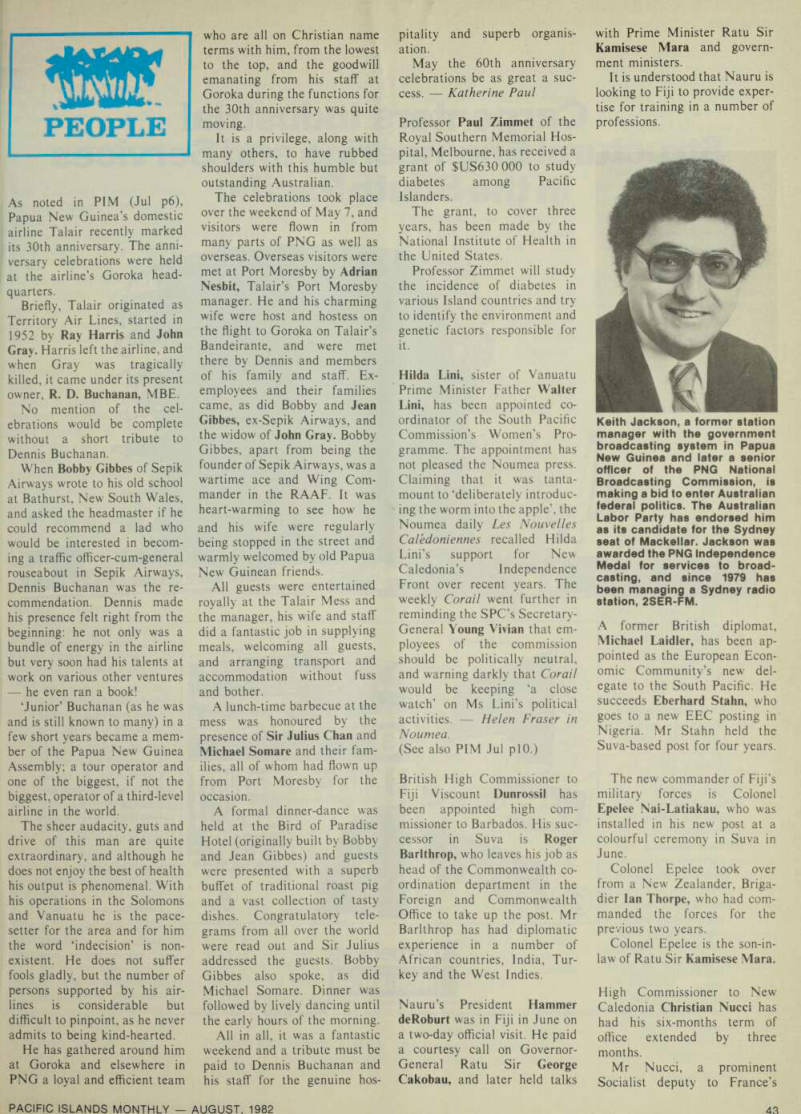
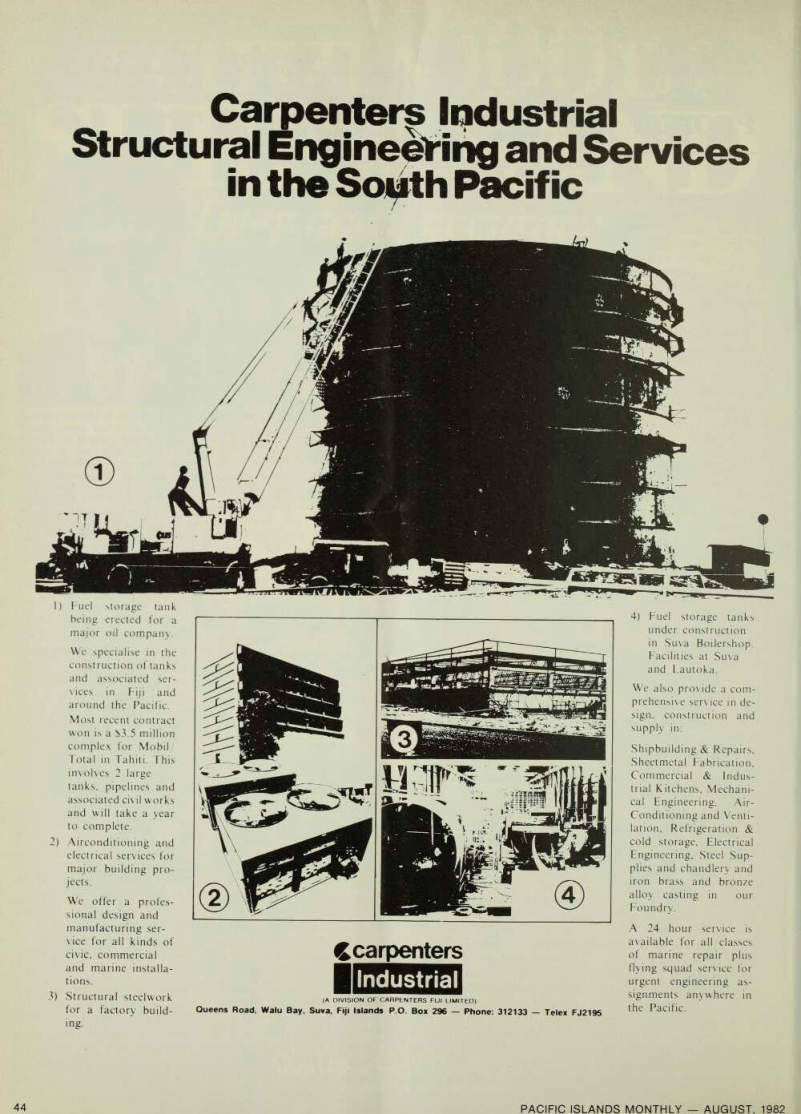
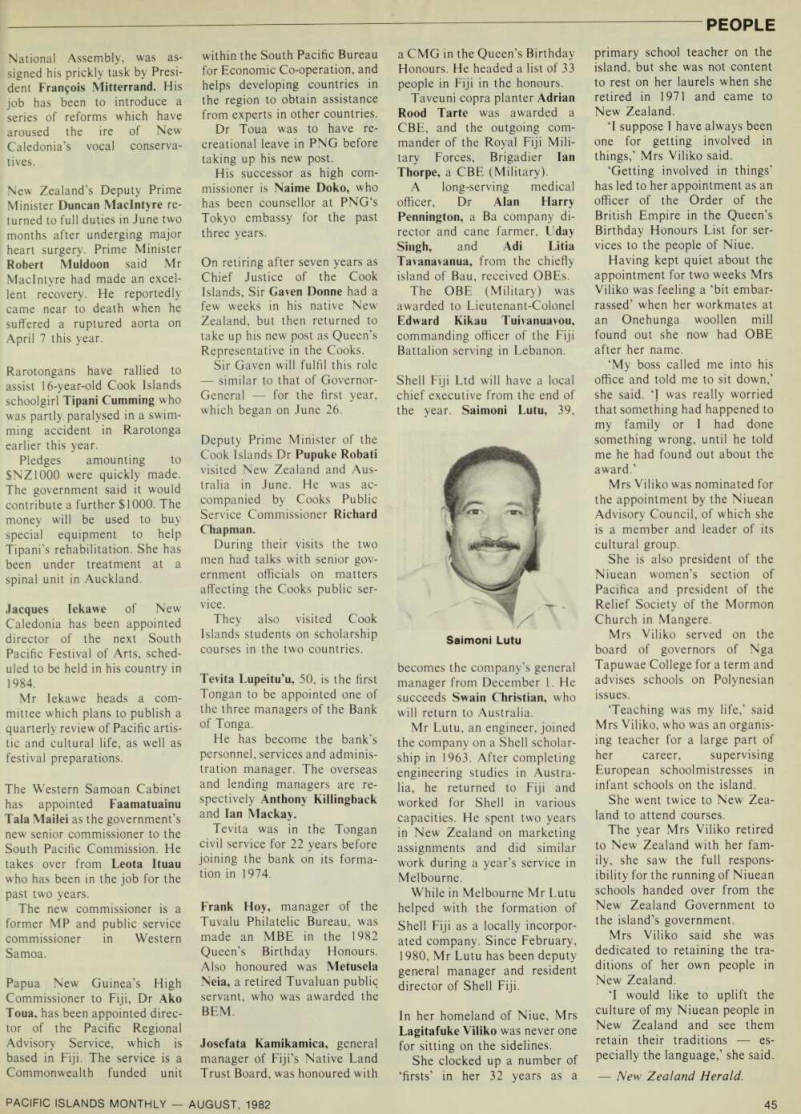
As noted in PIM (Jul p 6), Papua New Guinea’s domestic airline Talair recently marked its 30th anniversary. The anni versary celebrations were held at the airline’s Goroka head quarters.
Briefly, Talair originated as Territory Air Lines, started in 1952 by Ray Harris and John Gray. Harris left the airline, and when Gray was tragically killed, it came under its present owner, R. D. Buchanan, MBE.
No mention of the cel ebrations would be complete without a short tribute to Dennis Buchanan.
When Bobby Gibbes of Sepik Airways wrote to his old school at Bathurst, New South Wales, and asked the headmaster if he could recommend a lad who would be interested in becom ing a traffic officer-cum-general rouseabout in Sepik Airways, Dennis Buchanan was the re commendation. Dennis made his presence felt right from the beginning: he not only was a bundle of energy in the airline but very soon had his talents at work on various other ventures he even ran a book! ‘Junior’ Buchanan (as he was and is still known to many) in a few short years became a mem ber of the Papua New Guinea Assembly; a tour operator and one of the biggest, if not the biggest, operator of a third-level airline in the world.
The sheer audacity, guts and drive of this man are quite extraordinary, and although he does not enjoy the best of health his output is phenomenal. With his operations in the Solomons and Vanuatu he is the pace setter for the area and for him the word ‘indecision’ is non existent. He does not suffer fools gladly, but the number of persons supported by his air lines is considerable but difficult to pinpoint, as he never admits to being kind-hearted.
He has gathered around him at Goroka and elsewhere in PNG a loyal and efficient team
who are all on Christian name terms with him, from the lowest to the top, and the goodwill emanating from his staff at Goroka during the functions for the 30th anniversary was quite moving.
It is a privilege, along with many others, to have rubbed shoulders with this humble but outstanding Australian.
The celebrations took place over the weekend of May 7, and visitors were flown in from many parts of PNG as well as overseas. Overseas visitors were met at Port Moresby by Adrian Nesbit, Talair’s Port Moresby manager. He and his charming wife were host and hostess on the flight to Goroka on Talair’s Bandeirante, and were met there by Dennis and members of his family and staff. Ex employees and their families came, as did Bobby and Jean Gibbes, ex-Sepik Airways, and the widow of John Gray. Bobby Gibbes, apart from being the founder of Sepik Airways, was a wartime ace and Wing Com mander in the RAAF. It was heart-warming to see how he and his wife were regularly being stopped in the street and warmly welcomed by old Papua New Guinean friends.
All guests were entertained royally at the Talair Mess and the manager, his wife and staff did a fantastic job in supplying meals, welcoming all guests, and arranging transport and accommodation without fuss and bother.
A lunch-time barbecue at the mess was honoured by the presence of Sir Julius Chan and Michael Somare and their fam ilies, all of whom had flown up from Port Moresby for the occasion.
A formal dinner-dance was held at the Bird of Paradise Hotel (originally built by Bobby and Jean Gibbes) and guests were presented with a superb buffet of traditional roast pig and a vast collection of tasty dishes. Congratulatory tele grams from all over the world were read out and Sir Julius addressed the guests. Bobby Gibbes also spoke, as did Michael Somare. Dinner was followed by lively dancing until the early hours of the morning.
All in all, it was a fantastic weekend and a tribute must be paid to Dennis Buchanan and his staff for the genuine hos
pitality and superb organis ation.
May the 60th anniversary celebrations be as great a suc cess. Katherine Paul Professor Paul Zimmet of the Royal Southern Memorial Hos pital, Melbourne, has received a grant of SUS63O 000 to study diabetes among Pacific Islanders.
The grant, to cover three years, has been made by the National Institute of Health in the United States.
Professor Zimmet will study the incidence of diabetes in various Island countries and try to identify the environment and genetic factors responsible for it.
Hilda Lini, sister of Vanuatu Prime Minister Father Walter Lini, has been appointed co ordinator of the South Pacific Commission’s Women’s Pro gramme. The appointment has not pleased the Noumea press.
Claiming that it was tanta mount to ‘deliberately introduc ing the worm into the apple’, the Noumea daily Les Nouvelles Caledoniennes recalled Hilda Lini’s support for New Caledonia’s Independence Front over recent years. The weekly Corail went further in reminding the SPC’s Secretary- General Young Vivian that em ployees of the commission should be politically neutral, and warning darkly that Corail would be keeping ‘a close watch’ on Ms Lini’s political activities. Helen Fraser in Noumea. (See also PIM Jul plO.) British High Commissioner to Fiji Viscount Dunrossil has been appointed high com missioner to Barbados. His suc cessor in Suva is Roger Barlthrop, who leaves his job as head of the Commonwealth co ordination department in the Foreign and Commonwealth Office to take up the post. Mr Barlthrop has had diplomatic experience in a number of African countries, India, Tur key and the West Indies.
Nauru’s President Hammer deßoburt was in Fiji in June on a two-day official visit. He paid a courtesy call on Governor- General Ratu Sir George Cakobau, and later held talks
with Prime Minister Ratu Sir Kamisese Mara and govern ment ministers.
It is understood that Nauru is looking to Fiji to provide exper tise for training in a number of professions.
A former British diplomat, Michael Laidler, has been ap pointed as the European Econ omic Community’s new del egate to the South Pacific. He succeeds Eberhard Stahn, who goes to a new EEC posting in Nigeria. Mr Stahn held the Suva-based post for four years.
The new commander of Fiji’s military forces is Colonel Epelee Nai-Latiakau, who was installed in his new post at a colourful ceremony in Suva in June.
Colonel Epelee took over from a New Zealander, Briga dier lan Thorpe, who had com manded the forces for the previous two years.
Colonel Epelee is the son-in law of Ratu Sir Kamisese Mara.
High Commissioner to New Caledonia Christian Nucci has had his six-months term of office extended by three months.
Mr Nucci, a prominent Socialist deputy to France’s
Keith Jackson, a former station manager with the government broadcasting system in Papua New Guinea and later a senior officer of the PNG National Broadcasting Commission, is making a bid to enter Australian federal politics. The Australian Labor Party has endorsed him as its candidate for the Sydney seat of Mackellar. Jackson was awarded the PNG Independence Medal for services to broad casting, and since 1979 has been managing a Sydney radio station, 2SER-FM.
National Assembly, was as signed his prickly task by Presi dent Francois Mitterrand. His job has been to introduce a series of reforms which have aroused the ire of New Caledonia’s vocal conserva tives.
New Zealand’s Deputy Prime Minister Duncan Maclntyre re turned to full duties in June two months after underging major heart surgery. Prime Minister Robert Muldoon said Mr Maclntyre had made an excel lent recovery. He reportedly came near to death when he suffered a ruptured aorta on April 7 this year.
Rarotongans have rallied to assist 16-year-old Cook Islands schoolgirl Tipani Camming who was partly, paralysed in a swim ming accident in Rarotonga earlier this year.
Pledges amounting to SNZIOOO were quickly made.
The government said it would contribute a further $lOOO. The money will be used to buy special equipment to help Tipani’s rehabilitation. She has been under treatment at a spinal unit in Auckland.
Jacques lekawe of New Caledonia has been appointed director of the next South Pacific Festival of Arts, sched uled to be held in his country in 1984.
Mr lekawe heads a com mittee which plans to publish a quarterly review of Pacific artis tic and cultural life, as well as festival preparations.
The Western Samoan Cabinet has appointed Faamatuainu Tala Mallei as the government’s new senior commissioner to the South Pacific Commission. He takes over from Leota Ituau who has been in the job for the past two years.
The new commissioner is a former MP and public service commissioner in Western Samoa.
Papua New Guinea’s High Commissioner to Fiji, Dr Ako Toua, has been appointed direc tor of the Pacific Regional Advisory Service, which is based in Fiji. The service is a Commonwealth funded unit
within the South Pacific Bureau for Economic Co-operation, and helps developing countries in the region to obtain assistance from experts in other countries.
Dr Toua was to have re creational leave in PNG before taking up his new post.
His successor as high com missioner is Naime Doko, who has been counsellor at PNG‘s Tokyo embassy for the past three years.
On retiring after seven years as Chief Justice of the Cook Islands, Sir Gaven Donne had a few weeks in his native New Zealand, but then returned to take up his new post as Queen’s Representative in the Cooks.
Sir Gaven will fulfil this role similar to that of Governor- General for the first year, which began on June 26.
Deputy Prime Minister of the Cook Islands Dr Pupuke Robati visited New Zealand and Aus tralia in June. He was ac companied by Cooks Public Service Commissioner Richard Chapman.
During their visits the two men had talks with senior gov ernment officials on matters affecting the Cooks public ser vice.
They also visited Cook Islands students on scholarship courses in the two countries.
Tevita Lupeitu’u, 50, is the first Tongan to be appointed one of the three managers of the Bank of Tonga.
He has become the bank’s personnel, services and adminis tration manager. The overseas and lending managers are re spectively Anthony Killingback and lan Mackay.
Tevita was in the Tongan civil service for 22 years before joining the bank on its forma tion in 1974.
Frank Hoy, manager of the Tuvalu Philatelic Bureau, was made an MBE in the 1982 Queen’s Birthday Honours.
Also honoured was Metusela Neia, a retired Tuvaluan public servant, who was awarded the
Bem.
Josefata Kamikamica, general manager of Fiji’s Native Land Trust Board, was honoured with
a CMG in the Queen’s Birthday Honours. He headed a list of 33 people in Fiji in the honours.
Taveuni copra planter Adrian Rood Tarte was awarded a CBE, and the outgoing com mander of the Royal Fiji Mili tary Forces, Brigadier lan Thorpe, a CBE (Military).
A long-serving medical officer, Dr Alan Harry Pennington, a Ba company di rector and cane farmer, LJday Singh, and Adi Litia Tavanavanua, from the chiefly island of Bau, received OBEs.
The OBE (Military) was awarded to Lieutenant-Colonel Edward Kikau Tuivanuavou, commanding officer of the Fiji Battalion serving in Lebanon.
Shell Fiji Ltd will have a local chief executive from the end of the year. Saimoni Lutu, 39,
becomes the company’s general manager from December 1. He succeeds Swain Christian, who will return to Australia.
Mr Lutu, an engineer, joined the company on a Shell scholar ship in 1963. After completing engineering studies in Austra lia, he returned to Fiji and worked for Shell in various capacities. He spent two years in New Zealand on marketing assignments and did similar work during a year’s service in Melbourne.
While in Melbourne Mr Lutu helped with the formation of Shell Fiji as a locally incorpor ated company. Since February, 1980, Mr Lutu has been deputy general manager and resident director of Shell Fiji.
In her homeland of Niue, Mrs Lagitafuke Viliko was never one for sitting on the sidelines.
She clocked up a number of ‘firsts’ in her 32 years as a
primary school teacher on the island, but she was not content to rest on her laurels when she retired in 1971 and came to New Zealand. ‘I suppose I have always been one for getting involved in things,’ Mrs Viliko said. ‘Getting involved in things’ has led to her appointment as an officer of the Order of the British Empire in the Queen’s Birthday Honours List for ser vices to the people of Niue.
Having kept quiet about the appointment for two weeks Mrs Viliko was feeling a ‘bit embar rassed’ when her workmates at an Onehunga woollen mill found out she now had OBE after her name. ‘My boss called me into his office and told me to sit down,’ she said. ‘} was really worried that something had happened to my family or I had done something wrong, until he told me he had found out about the award.’
Mrs Viliko was nominated for the appointment by the Niuean Advisory Council, of which she is a member and leader of its cultural group.
She is also president of the Niuean women’s section of Pacifica and president of the Relief Society of the Mormon Church in Mangere.
Mrs Viliko served on the board of governors of Nga Tapuwae College for a term and advises schools on Polynesian issues. ‘Teaching was my life,’ said Mrs Viliko, who was an organis ing teacher for a large part of her career, supervising European schoolmistresses in infant schools on the island.
She went twice to New Zea land to attend courses.
The year Mrs Viliko retired to New Zealand with her fam ily, she saw the full respons ibility for the running of Niuean schools handed over from the New Zealand Government to the island’s government.
Mrs Viliko said she was dedicated to retaining the tra ditions of her own people in New Zealand. ‘1 would like to uplift the culture of my Niuean people in New Zealand and see them retain their traditions es pecially the language,’ she said.
New Zealand Herald.
Saimoni Lutu
Advertisements & other items, pp. 44-46 (1 item)
Carpenters Industrial
Structural Engineering and Services
in the South Pacific
IB T H*
ss^i
m rmn ■m 1) Fuel storage tank being erected for a major oil company.
We specialise in the construction of tanks and associated services in Fiji and around the Pacific.
Most recent contract won is a 53.5 million complex for Mobil Total in Tahiti. This involves 2 large tanks, pipelines and associated civil works and will take a year to complete. 2) Airconditioning and electrical services for major building projects.
We offer a professional design and
manufacturing ser-
vice for all kinds of civic, commercial and marine installations. 3) Structural steelwork for a factory build-
C carpenters
Industrial
(A DIVISION OF CARPENTERS FIJI LIMITED)
Queens Road, Walu Bay, Suva, Fiji Islands P.O. Box 296 Phone: 312133 Telex FJ2195 4) Fuel storage tanks under construction in Suva Boilershop.
Facilities at Suva and Lautoka.
We also provide a comprehensive service in design. construction and supply in; Shipbuilding & Repairs, Sheetmetal Fabrication, Commercial & Industrial Kitchens, Mechanical Engineering, Air- Conditioning and Ventilation, Refrigeration & cold storage. Electrical Engineering, Steel Supplies and chandlery and iron brass and bronze alloy casting in our Foundry.
A 24 hour service is available for all classes of marine repair plus flying squad service for urgent engineering assignments anywhere in the Pacific. mg.
In our 87th Year Selling ‘Service’ to the Pacific Islands
Nelson & Robertson
Ltd.
(Established 1895)
i> *b* t tt Plantation House, •K.AJ4AUL 197 Clarence Street, Sydney.
Cables: ‘IVAN’, Sydney, Brisbane.
Telex: AA22381, Sydney.
Phone: 29 2871
KIETA
roßEftg
O cP
Pty
A/ t.\
MADANG
LAE
••• • ••• r • .. • • •• • • ••f • • *
BRISBANE
SYDNEY
LAUTOKA
• /; ; For Indents ■
from Australia,
New Zealand and Overseas Foodstuffs
Softgoods
Hardware
Machinery
Travel Insurance Canned Fish
Jute Goods
Real Estate
zmvA
v. •^rr*
BRANCH OFFICES:
Nelson & Robertson Pty. Ltd., P.O. Box 575, Brisbane, Qld., Australia. 2216966 P.O. Box 2092, Govt, Bldg., Suva, Fiji. 22430 P.O. Box 258, Lautoka, Fiji, 62101 P.O. Box 2420, CPO Auckland 1, New Zealand. 774141 uc ND
.”.;:;PAPUA NEW GUINEA REPRESENTATIVES:
hi Pty, Ltd., Rabaul, P.N.G. 922911 Box 1406, Lae, P.N.G. 422366 0. Box 711, Madang, P.N.G. 822066 P.O. Box 253, Kieta, P.N.G. 956185
Sukuna biography: 'Fitting
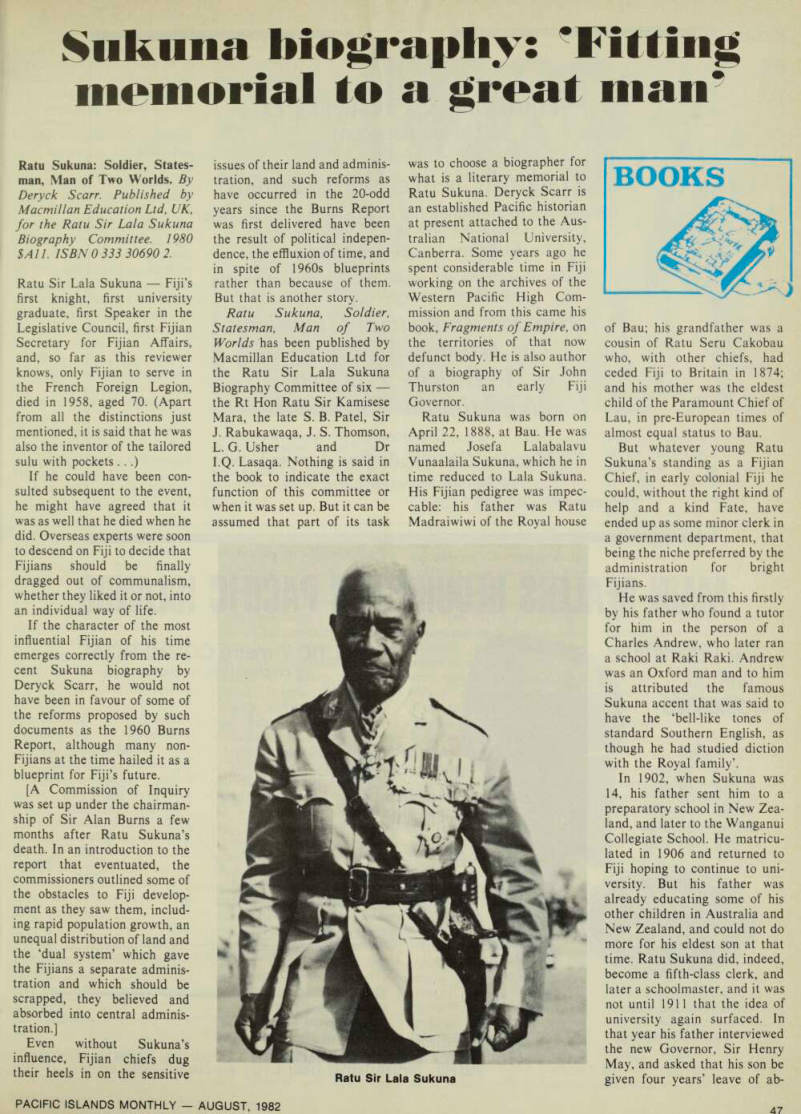
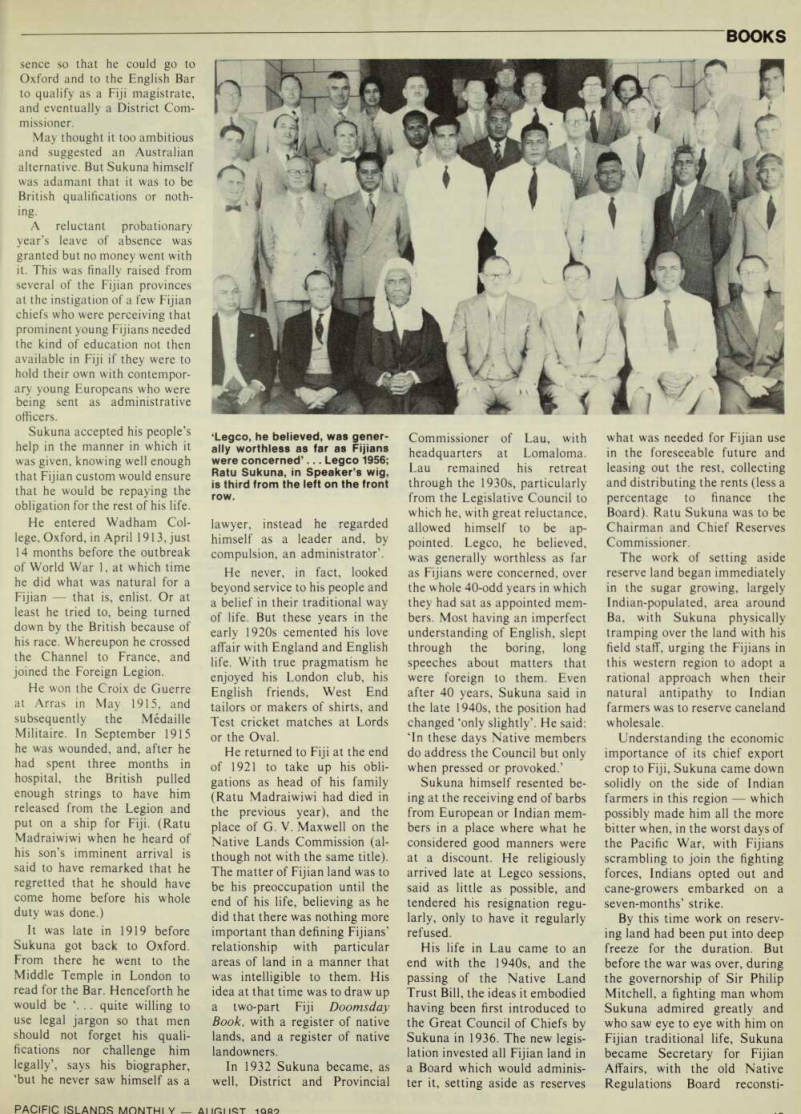
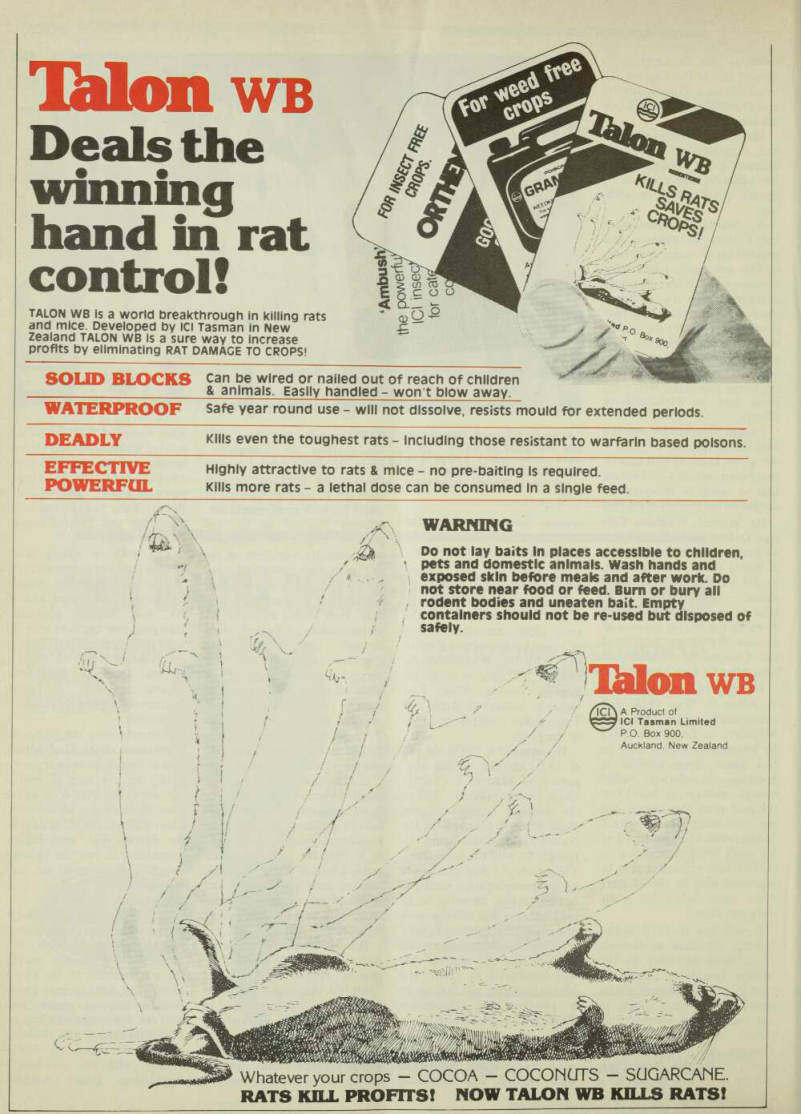
Books
Sukuna biography: 'Fitting memorial to a great man'
Ratu Sukuna: Soldier, States man, Man of Two Worlds. By Deryck Scarr. Published by Macmillan Education Ltd. UK, for the Ratu Sir Lala Sukuna Biography Committee. 1980
Sail Isbno 333 30690 2.
Ratu Sir Lala Sukuna Fiji’s first knight, first university graduate, first Speaker in the Legislative Council, first Fijian Secretary for Fijian Affairs, and, so far as this reviewer knows, only Fijian to serve in the French Foreign Legion, died in 1958, aged 70. (Apart from all the distinctions just mentioned, it is said that he was also the inventor of the tailored sulu with pockets ...) If he could have been con sulted subsequent to the event, he might have agreed that it was as well that he died when he did. Overseas experts were soon to descend on Fiji to decide that Fijians should be finally dragged out of communalism, whether they liked it or not, into an individual way of life.
If the character of the most influential Fijian of his time emerges correctly from the re cent Sukuna biography by Deryck Scarr, he would not have been in favour of some of the reforms proposed by such documents as the 1960 Burns Report, although many non- Fijians at the time hailed it as a blueprint for Fiji’s future. [A Commission of Inquiry was set up under the chairman ship of Sir Alan Burns a few months after Ratu Sukuna’s death. In an introduction to the report that eventuated, the commissioners outlined some of the obstacles to Fiji develop ment as they saw them, includ ing rapid population growth, an unequal distribution of land and the ‘dual system’ which gave the Fijians a separate adminis tration and which should be scrapped, they believed and absorbed into central adminis tration.] Even without Sukuna’s influence, Fijian chiefs dug their heels in on the sensitive
issues of their land and adminis tration, and such reforms as have occurred in the 20-odd years since the Burns Report was first delivered have been the result of political indepen dence, the effluxion of time, and
in spite of 1960 s blueprints
rather than because of them.
But that is another story.
Ratu Sukuna, Soldier, Statesman, Man of Two Worlds has been published by Macmillan Education Ltd for the Ratu Sir Lala Sukuna Biography Committee of six the Rt Hon Ratu Sir Kamisese Mara, the late S. B. Patel, Sir J. Rabukawaqa, J. S. Thomson, L. G. Usher and Dr I.Q. Lasaqa. Nothing is said in the book to indicate the exact function of this committee or when it was set up. But it can be assumed that part of its task
was to choose a biographer for what is a literary memorial to Ratu Sukuna. Deryck Scarr is an established Pacific historian at present attached to the Aus tralian National University, Canberra. Some years ago he spent considerable time in Fiji working on the archives of the Western Pacific High Com mission and from this came his book, Fragments of Empire, on the territories of that now defunct body. He is also author of a biography of Sir John Thurston an early Fiji Governor.
Ratu Sukuna was born on April 22, 1888, at Bau. He was named Josefa Lalabalavu Vunaalaila Sukuna, which he in time reduced to Lala Sukuna.
His Fijian pedigree was impec cable; his father was Ratu Madraiwiwi of the Royal house
of Bau; his grandfather was a cousin of Ratu Seru Cakobau who, with other chiefs, had ceded Fiji to Britain in 1874; and his mother was the eldest child of the Paramount Chief of Lau, in pre-European times of almost equal status to Bau.
But whatever young Ratu Sukuna’s standing as a Fijian Chief, in early colonial Fiji he could, without the right kind of help and a kind Fate, have ended up as some minor clerk in a government department, that being the niche preferred by the administration for bright Fijians.
He was saved from this firstly by his father who found a tutor for him in the person of a Charles Andrew, who later ran a school at Raki Raki. Andrew was an Oxford man and to him is attributed the famous Sukuna accent that was said to have the ‘bell-like tones of standard Southern English, as though he had studied diction with the Royal family’.
In 1902, when Sukuna was 14, his father sent him to a preparatory school in New Zea land, and later to the Wanganui Collegiate School. He matricu lated in 1906 and returned to Fiji hoping to continue to uni versity. But his father was already educating some of his other children in Australia and New Zealand, and could not do more for his eldest son at that time. Ratu Sukuna did, indeed, become a fifth-class clerk, and later a schoolmaster, and it was not until 1911 that the idea of university again surfaced. In that year his father interviewed the new Governor, Sir Henry May, and asked that his son be given four years’ leave of ab
Ratu Sir Lala Sukuna
sence so that he could go to Oxford and to the English Bar to qualify as a Fiji magistrate, and eventually a District Com missioner.
May thought it too ambitious and suggested an Australian alternative. But Sukuna himself was adamant that it was to be British qualifications or noth ing.
A reluctant probationary year’s leave of absence was granted but no money went with it. This was finally raised from several of the Fijian provinces at the instigation of a few Fijian chiefs who were perceiving that prominent young Fijians needed the kind of education not then available in Fiji if they were to hold their own with contempor ary young Europeans who were being sent as administrative officers.
Sukuna accepted his people’s help in the manner in which it was given, knowing well enough that Fijian custom would ensure that he would be repaying the obligation for the rest of his life.
He entered Wadham Col lege, Oxford, in April 1913, just 14 months before the outbreak of World War 1, at which time he did what was natural for a Fijian that is, enlist. Or at least he tried to, being turned down by the British because of his race. Whereupon he crossed the Channel to France, and joined the Foreign Legion.
He won the Croix de Guerre at Arras in May 1915, and subsequently the Medaille Militaire. In September 1915 he was wounded, and, after he had spent three months in hospital, the British pulled enough strings to have him released from the Legion and put on a ship for Fiji. (Ratu Madraiwiwi when he heard of his son’s imminent arrival is said to have remarked that he regretted that he should have come home before his whole duty was done.) It was late in 1919 before Sukuna got back to Oxford.
From there he went to the Middle Temple in London to read for the Bar. Henceforth he would be ‘. . . quite willing to use legal jargon so that men should not forget his quali fications nor challenge him legally’, says his biographer, ‘but he never saw himself as a
lawyer, instead he regarded himself as a leader and, by compulsion, an administrator’.
He never, in fact, looked beyond service to his people and a belief in their traditional way of life. But these years in the
early 1920 s cemented his love
affair with England and English life. With true pragmatism he enjoyed his London club, his English friends, West End tailors or makers of shirts, and Test cricket matches at Lords or the Oval.
He returned to Fiji at the end of 1921 to take up his obli gations as head of his family (Ratu Madraiwiwi had died in the previous year), and the place of G. V. Maxwell on the Native Lands Commission (al though not with the same title).
The matter of Fijian land was to be his preoccupation until the end of his life, believing as he did that there was nothing more important than defining Fijians’ relationship with particular areas of land in a manner that was intelligible to them. His idea at that time was to draw up a two-part Fiji Doomsday Book, with a register of native lands, and a register of native landowners.
In 1932 Sukuna became, as well, District and Provincial
Commissioner of Lau, with headquarters at Lomaloma.
Lau remained his retreat through the 19305, particularly from the Legislative Council to which he, with great reluctance, allowed himself to be ap pointed. Legco, he believed, was generally worthless as far as Fijians were concerned, over the whole 40-odd years in which they had sat as appointed mem bers. Most having an imperfect understanding of English, slept through the boring, long speeches about matters that were foreign to them. Even after 40 years, Sukuna said in the late 19405, the position had changed ‘only slightly’. He said: Tn these days Native members do address the Council but only when pressed or provoked.’
Sukuna himself resented be ing at the receiving end of barbs from European or Indian mem bers in a place where what he considered good manners were at a discount. He religiously arrived late at Legco sessions, said as little as possible, and tendered his resignation regu larly, only to have it regularly refused.
His life in Lau came to an end with the 19405, and the passing of the Native Land Trust Bill, the ideas it embodied having been first introduced to the Great Council of Chiefs by Sukuna in 1936. The new legis lation invested all Fijian land in a Board which would adminis ter it, setting aside as reserves
what was needed for Fijian use in the foreseeable future and leasing out the rest, collecting and distributing the rents (less a percentage to finance the Board). Ratu Sukuna was to be Chairman and Chief Reserves Commissioner.
The work of setting aside reserve land began immediately in the sugar growing, largely Indian-populated, area around Ba, with Sukuna physically tramping over the land with his field staff, urging the Fijians in this western region to adopt a rational approach when their natural antipathy to Indian farmers was to reserve caneland wholesale.
Understanding the economic importance of its chief export crop to Fiji, Sukuna came down solidly on the side of Indian farmers in this region which possibly made him all the more bitter when, in the worst days of the Pacific War, with Fijians scrambling to join the fighting forces, Indians opted out and cane-growers embarked on a seven-months’ strike.
By this time work on reserv ing land had been put into deep freeze for the duration. But before the war was over, during the governorship of Sir Philip Mitchell, a fighting man whom Sukuna admired greatly and who saw eye to eye with him on Fijian traditional life, Sukuna became Secretary for Fijian Affairs, with the old Native Regulations Board reconsti
Legco, he believed, was gener ally worthless as far as Fijians were concerned’... Legco 1956; Ratu Sukuna, in Speaker’s wig, is third from the left on the front row.
tuted as the Fijian Affairs Board, the members of which were the Fijian members of Legco, plus Sir Henry Milne Scott as legal adviser. Each province also regained a Roko at its head, and European district officers were told to leave Fijian affairs alone.
Ratu Sukuna believed more than ever that the village communal system was the way for Fijians to continue to go; that there was nothing that Fijians acting individually could achieve that could not be achieved by communities prop erly led. Perhaps even he would have conceded, however, that “properly led’’ were the operat ive words in each case.
Unusually for a Fijian chief, Ratu Sukuna was 40 before he married although according to his biographer there were plenty of cross-cousins, Tongans as well as Fijians, to testify to his virility. In 1928 he had chosen as a wife Maraia Vosawale Tataweqa who, in the Fijian social order, was re garded as an unsuitable choice, being merely the daughter of a Native Stipendiary Magistrate and niece of a Roko Tui. Lady Maraia, as she became when Ratu Sukuna was knighted, died in 1956, and, near the end of his own life, he chose a successor from ‘the maidens sent up to (his house) for inspection’.
The Ratu Sir Lala Sukuna that emerges for this reviewer from this book is not so much a man of two worlds although he enjoyed playing in many European backyards, and num bered his friends among them in scores but rather a Fijian high chief with the natural dignity and manners capable of carrying him into any society.
In spite of his European friendships, he nevertheless re served the right to stand off and regard with amused cynicism many of the sacred cows of colonial Fiji, including the CSR Co, Big Business, and knighted merchants although the author’s own prejudices might have contributed to this im pression. Above all, he had the Fijian chiefly gift, when it suited him, of pulling down and retiring behind a metaphorical shutter, and thus presenting to the world a blank, impenetrable
face. This faculty was one that drove more than one governor to impotent, if unexpressed, fury.
In the last decade of his life land matters were still proceed ing slowly, often at the pace at which Sukuna himself could tramp over the land. This, and the reluctance with which he welcomed change in the Fijian communal system, provided fer tile ground for the reforming experts sent by the UK when the rush was on to rid itself of its last colonies.
During the 19505, Ratu Sukuna was increasingly in ill health and old for a Fijian still in office. On medical grounds he was persuaded to retire on his 70th birthday, and the follow ing month, May 1958, he set off
with his second wife for a last look at England, and to renew ties with old friends there. He did not make it — he died at sea when the ship was off Ceylon.
His body was flown back to Fiji, and buried at Tubou in Lau.
This book about a very com plex man must have been difficult to write. Certainly it is one that is difficult to review by someone not steeped in Fijian cultural history — of whom this reviewer is unfortunately an example.
But for those who are part of that esoteric Fiji circle, it is a fitting memorial to a great man — leader, scholar, soldier, hero, statesman — who had only one purpose in life, the ultimate
good of his people.
Judy
T udor.
Advertisements & other items, pp. 48-50 (2 items)
Main Dealers Required In Pacific Islands
Harrisons & Crosfield PLC, United Kingdom through Harcros Chemicals Pty. Limited is pleased to announce the purchase of the four major chemicals divisions in Australia of Steetley Industries Limited These operations will retain their individual trading identities and now operate as; Harcros Industrial Chemicals Harcros Colours Velvalene Products
Nightingale Chemicals
Divisions of Harcros Chemicals Pty. Limited 44 Market Street, Sydney, 2000 Telephone: (02) 290 1355 Telex: 22351
MAIN DEALERS REQUIRED IN PACIFIC ISLANDS
NEW GENERATION
TOHATSU
OUTBOARDS
Prop Rated:
3.5 hp IS.Ohp
s.ohp
8 Ohp
9.Bhp
12.0 hp
IS.Ohp
25.0 hp 33.0 hp 55.0 hp
2 year
warranty
46 years of Product Development and years of experience with Commercial Operations
CELTIC 7 metre COMMERCIAL
(Fibreglass Hulls Available)
ALL SPARES
AND PRODUCTS
AVAILABLE EX
AUCKLAND, N.Z
Tohatsu Kerosene 18hp & 30hp outboards also available.
Hull & Decks of Completed Units Length: 7 metres Beam: 2.49 Draught: 7 Drop Keel or Fixed Keel Powered by 10hp or 20hp Diesel
FURTHER INQUIRIES CONTACT:
AOTEA MARKETING (NZ) LTD, 5
.0. BOX 17105, GREENLANE, AUCKLAND.
NEW ZEALAND. PHONE: 503244
Tdon wb
Deals the
winning
hand in rat
control!
TALON WB is a world breakthrough in killing rats and mice. Developed by ICI Tasman in New Zealand TALON wb is a sure way to increase profits by eliminating rat damage to crops! & £• BS
Kin
Sr So
(/) CO C 7
coo SOLID BLOCKS Can be wired or nailed out of reach of children & animals. Easily handled - won t blow away.
WATERPROOF Safe year round use - will not dissolve, resists mould for extended periods.
DEADLY
Kills even the toughest rats - including those resistant to warfarin based poisons.
EFFECTIVE
POWERFUL
Highly attractive to rats & mice - no pre-baiting is required.
Kills more rats - a lethal dose can be consumed In a single feed.
Do not lay baits In places accessible to children, pets and domestic animals. Wash hands and exposed skin before meals and after work. Do not store near food or feed. Burn or bury all rodent bodies and uneaten bait. Empty containers should not be re-used but disposed of safely.
ffvi
Tkhm wb
icr\ A Product of ICI Tasman Limited P.O Box 900, Auckland, New Zealand
WARNING
Whatever your crops COCOA COCOMCITS SUGARCANE.
RATS KILL PROFITS! NOW TALON WB KILLS RATS!
Books
49
PACIFIC ISLANDS MONTHI Y Aiinii.QT -iQfio
Individualism and community

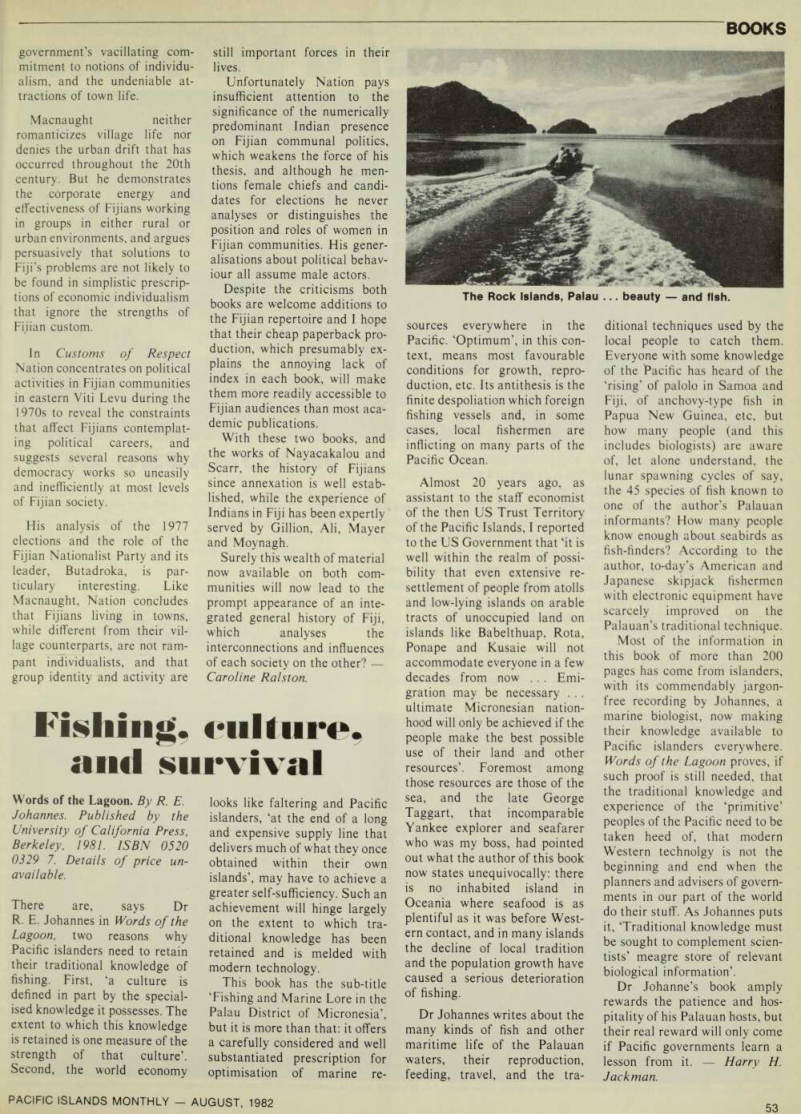
community: The Fijian dilemma
The Fijian Colonial Experience.
A study of the neo-traditional order under British colonial rule prior to World War 11. By Timothy J. Macnaught. Pacific Research Mongraph No. 7, Australian National Univer sity, Canberra, 1982. $lO.OO {paperback) ISBN 0 909150 49 4. Customs of Respect: the traditional basis of Fijian communal politics. By John Nation. Development Studies Centre, Monograph No. 14, Australian National Univer sity, Canberra, 1978. $B.OO {paperback) ISBN 0 7081 0494 0.
Timothy Macnaught’s recently published book, The Fijian Colonial Experience, makes a useful and timely companion volume to John Nation’s book, Customs of Respect, published in 1978. Together these two books greatly expand the pub lished knowledge available about 20th-century Fijian so ciety and history.
The bulk of Macnaught’s book covers the lives and experi ences of Fijians throughout the archipelago from the turn of the century to the beginning of the World War 11. However, in the final chapter (Epilogue:
rendezvous with the modern world) Macnaught cogently points out the links between the past history and the present-day dilemmas Fiji, and especially the Fijians, face. Nation studies a number of political incidents amongst Fijian communities in the 19705, culminating in the double elections of 1977, and through these illuminates the cultural and historical forces which influence Fijian political behaviour. Although the scope is not Fiji-wide the book concentrates on the eastern half of Viti Levu Nation has the confidence from this basis to make a number of generalis ations about the influence of traditional values on rural and national-level politics.
Both authors offer a strikingly similar perspective on Fijian experience: one that is sympathetic to the chiefly sys tem and the strengths of com munity amongst Fijians, and critical of the blind faith of certain analysts of Fijian so ciety in the virtues of economic individualism and capitalist oriented modernisation. Read ing between the lines of the authors’ acknowledgments and other statements it appears that each man, after extended
periods of residence in Fiji, came to his conclusions inde pendently and was then greatly encouraged and reassured to find that another specialist working in a different period had developed a very similar judgement. By the late 1970 s the Western world was becom ing increasingly ambivalent about modernisation pro grammes in Third World countries which unthinkingly imposed capitalist modes of development, but, it still takes a good deal of courage to dispute the accepted wisdom of Spate, Burns, Belshaw and Watters, who had trenchantly criticised the Fijian administration in the late 1950 s and 19605, and to question in the Fijian context the supposed virtues of Western notions off liberalism and Westminster democracy.
Macnaught confronts these issues more directly and per suasively than Nation. With reference to other Pacific societies, he argues strongly that the full rights of British citizenship, which white planters from 1875 to the 1920 s insisted the indigenes should enjoy, would have left the Fijians free to sell their lands and become a pool of free floating labour, while a system of individualised land tenure was the surest way of turning native land into alien land (cf.
New Zealand and Hawaii).
By the 1920 s Macnaught acknowledges the role that the increasingly threatening pres ence of the Indians played in welding an alliance between British administrators and col onists and the Fijians. In this period the Indians became more insistent in their demands for political representation, which prompted the colonial rulers to stress the predominant rights of the Fijians and the govern ment’s primary concern for Fijian welfare.
Macnaught suggests that racial division became such an entrenched part of national life that Fiji’s divided people have had little opportunity to under stand the economic and politi cal forces that have controlled and exploited them all. But this is not central to Macnaught’s analysis of the history of village life and politics, which have been undermined by a colonial
government’s vacillating commitment to notions of individualism, and the undeniable attractions of town life. w , . , Macnaught neither romanticizes village life nor denies the urban drift that has occurred throughout the 20th century. But he demonstrates the corporate energy and effectiveness of Fijians working in groups in either rural or urban environments, and argues persuasively that solutions to F.j. s problems are not likely to be found in simplistic prescrip- . e ■ ■ a- -a itions oi economic individualism r that ignore the strengths of r ... & & Fman custom.
In Customs of Respect Nation concentrates on political activities in Fijian communities in eastern Viti Levu during the 1970 s to reveal the constraints that affect Fijians contemplating political careers, and suggests several reasons why democracy works so uneasily and inefficiently at most levels of Fijian society.
His analysis of the 1977 elections and the role of the Fijian Nationalist Party and its leader, Butadroka, is particulary interesting. Like Macnaught, Nation concludes that Fijians living in towns, while different from their village counterparts, are not rampant individualists, and that group identity and activity are
still important forces in their lives.
Unfortunately Nation pays insufficient attention to the significance of the numerically dominant Indian ce Qn Fjjian communa , Htics> which weakens , he force of hjs thesj an(j a|th h he men . tjons fema|e chiefs candi . dates for e|ections he never ana| Qr disti ishes the jtjon and ro|es of women jn Fijian communities His a , isations about po i itical b ß ehav . jour a| , assume ma|e actors r>. .. .. ... . .
Despite the criticisms both , , , books are welcome additions to .•, T , the Fijian repertoire and I hope ..3 • , . i that their cheap paperback pro- Auction, which presumably ex- P^ ns the annoying lack of i n( * ex in eac h book, will make em more readily accessible to Fijian audiences than most aca em*c publications.
With these two books, and wor^s °f Nayacakalou and Scarr, the history of Fijians s .* nce annexation is well estab lished, while the experience of Indians in Fiji has been expertly served by Gillion, AH, Mayer and Moynagh.
Surely this wealth of material now available on both com munities will now lead to the prompt appearance of an inte grated general history of Fiji, which analyses the interconnections and influences of each society on the other?
Caroline Ralston.
Advertisements & other items, p. 52 (1 item)
Expert
Insurance Service
throughout the islands
Queensland Insurance (Fiji) Limited
Head Office, 34 Usher St., SUVA . General Manager L. G. Liddell A.A.1.1. Assistant Managers: R. Jackson, Vijay Lai. Phone; 23851 LAUTOKA OFFICE; Burns Philp Bldg., Naviti St. District Manager; J, Dalton. Phone: 60642.
LABASA OFFICE: Burns Philp Bldg. District Manager: R. SHARMA. Phone: 8 2139
Queensland Insurance (PNG) Limited
PAPUA NEW GUINEA
Head Office, B.N.G. Building, Musgrave St.PORT MORESBY. General Manager: J. M. Dawe.
Phone: 212144, LAE. 4th St. & Coronation Drive. District Manager: C. D. Hillier Phone: 423873.
MOUNT HAGEN: Hagen Drive. District Manager: G. W. Jack Phone: 521002.
ARAWA: Chebu St. District Manager: J. Longbut. Phone: 951555.
MADANG: Kasagten St. District Manager: N. D. Ramage. Phone: 822020.
RABAUL. Wirraway St. District Manager: W. F Tinker. Phone: 921014,
QBE Insurance (International) Limited
VANUATU, PORT VILA: Rue de Paris, Suite 19, Oceania Bldg. Manager: I. R. Martin.
Phone; 2299.
SANTO: Burns Philp (Vanuatu) Ltd. Phone: 230.
PACIFIC AGENCIES
NEW CALEDONIA: Ste. W. A. Johnston, S.A.R.L. 5 Rue Anatole France, NOUMEA.
Phone: 272083.
TAHITI: Arthur Chung. Immeuble BIS.. Front de Mer, PAPEETE . Phone: 2.86.19 NIUE: Burns Philp (South Sea) Company Ltd.
NORFOLK ISLAND: Burns Philp ('N I ) Company Ltd. Phone: 2191.
SAMOA: APIA, Burns Philp (South Sea) Company Ltd. Phone: 22611.
TONGA Burns Philp (South Sea) Company Ltd. NUKUALOFA. Phone 21500 HAAPAI, VAVAU.
AX MEMBERSOFTHE:
INSURANCE GROUP UMITED
Fishing, culture,
and survival
Words of the Lagoon. By R. E.
Johannes. Published by the University of California Press, Berkeley, 1981. ISBN 0520 0329 7. Details of price un available.
There are, says Dr R. E. Johannes in Words of the Lagoon, two reasons why Pacific islanders need to retain their traditional knowledge of fishing. First, ‘a culture is defined in part by the special ised knowledge it possesses. The extent to which this knowledge is retained is one measure of the strength of that culture’.
Second, the world economy
looks like faltering and Pacific islanders, ‘at the end of a long and expensive supply line that delivers much of what they once obtained within their own islands’, may have to achieve a greater self-sufficiency. Such an achievement will hinge largely on the extent to which tra ditional knowledge has been retained and is melded with modern technology.
This book has the sub-title ‘Fishing and Marine Lore in the Palau District of Micronesia’, but it is more than that: it offers a carefully considered and well substantiated prescription for optimisation of marine re-
sources everywhere in the Pacific. ‘Optimum’, in this con text, means most favourable conditions for growth, repro duction, etc. Its antithesis is the finite despoliation which foreign fishing vessels and, in some cases, local fishermen are inflicting on many parts of the Pacific Ocean.
Almost 20 years ago, as assistant to the staff economist of the then US Trust Territory of the Pacific Islands, I reported to the US Government that ‘it is well within the realm of possi bility that even extensive re settlement of people from atolls and low-lying islands on arable tracts of unoccupied land on islands like Babelthuap, Rota, Ponape and Kusaie will not accommodate everyone in a few decades from now .. . Emi gration may be necessary . . . ultimate Micronesian nation hood will only be achieved if the people make the best possible use of their land and other resources’. Foremost among those resources are those of the sea, and the late George Taggart, that incomparable Yankee explorer and seafarer who was my boss, had pointed out what the author of this book now states unequivocally: there is no inhabited island in Oceania where seafood is as plentiful as it was before West ern contact, and in many islands the decline of local tradition and the population growth have caused a serious deterioration of fishing.
Dr Johannes writes about the many kinds of fish and other maritime life of the Palauan waters, their reproduction, feeding, travel, and the tra
ditional techniques used by the local people to catch them.
Everyone with some knowledge of the Pacific has heard of the ‘rising’ of palolo in Samoa and Fiji, of anchovy-type fish in Papua New Guinea, etc, but how many people (and this includes biologists) are aware of, let alone understand, the lunar spawning cycles of say, the 45 species of fish known to one of the author’s Palauan informants? How many people know enough about seabirds as fish-finders? According to the author, to-day’s American and Japanese skipjack fishermen with electronic equipment have scarcely improved on the Palauan’s traditional technique.
Most of the information in this book of more than 200 pages has come from islanders, with its commendably jargon free recording by Johannes, a marine biologist, now making their knowledge available to Pacific islanders everywhere.
Words of the Lagoon proves, if such proof is still needed, that the traditional knowledge and experience of the ‘primitive’ peoples of the Pacific need to be taken heed of, that modern Western technolgy is not the beginning and end when the planners and advisers of govern ments in our part of the world do their stuff. As Johannes puts it, ‘Traditional knowledge must be sought to complement scien tists’ meagre store of relevant biological information’.
Dr Johanne’s book amply rewards the patience and hos pitality of his Palauan hosts, but their real reward will only come if Pacific governments learn a
lesson from it.
Harry H.
Jackman.
The Rock Islands, Palau ... beauty - and fish.
Advertisements & other items, p. 54 (1 item)
Komatsu flakes a Difference
m k* U ■ BN m A "%'■ In critical areas like reliability and performance, Komatsu products and systems are making a significant difference at mining and construction sites around the world.
In the GSA, for example, Komatsu’s largest and most powerful work machine the D455A bulldozer is establishing a superior record of reliability and productivity at mining sites that virtually no other machine in its class can match.
And in another critical area, technology, Komatsu is also making a difference in responding to market demands for improved product quality, and for new and original product innovations.
Consider our new computerized seabed robot system: Operating on the ocean floor, it can relay TV pictures of the seabed to a mother ship, or perform man-like boring, drilling and piling operations down to planned depths of 500 meters* Discover the Komatsu difference above sea level, or down to depths of 500 meters. Komatsu a name you can build on.
•H KOMATSU LTD.
Tokyo, Japan Komatsu offices: Tokyo, Sydney, Singapore, Jakarta, Manila, Bangkok, Bangalore, Karachi, Beijing, Istanbul, Cairo, Alger, Dubai, Tehran, Baghdad, Jeddah, Riyadh, Damman, Nairobi, Abidjan, Lagos, Johannesburg, Moscow, Warsaw, Brussels, Paris, Madrid, Frankfurt, Stuttgart, London, Habana, Buenos Aires, Panama, Caracas, Sao Paulo, Bogota, Mexico City, San Francisco, Oakland, Philadelphia, Detroit, Dallas, Atlanta, Chicago, Toronto, Vancouver, and distributors in over 100 countries around the world. ? * *The Komatsu seabed robot system is currently operating in the Japan Inland Sea at depths down to a maximum of 70 meters, in a government-sponsored bridge works program
The true story of the most
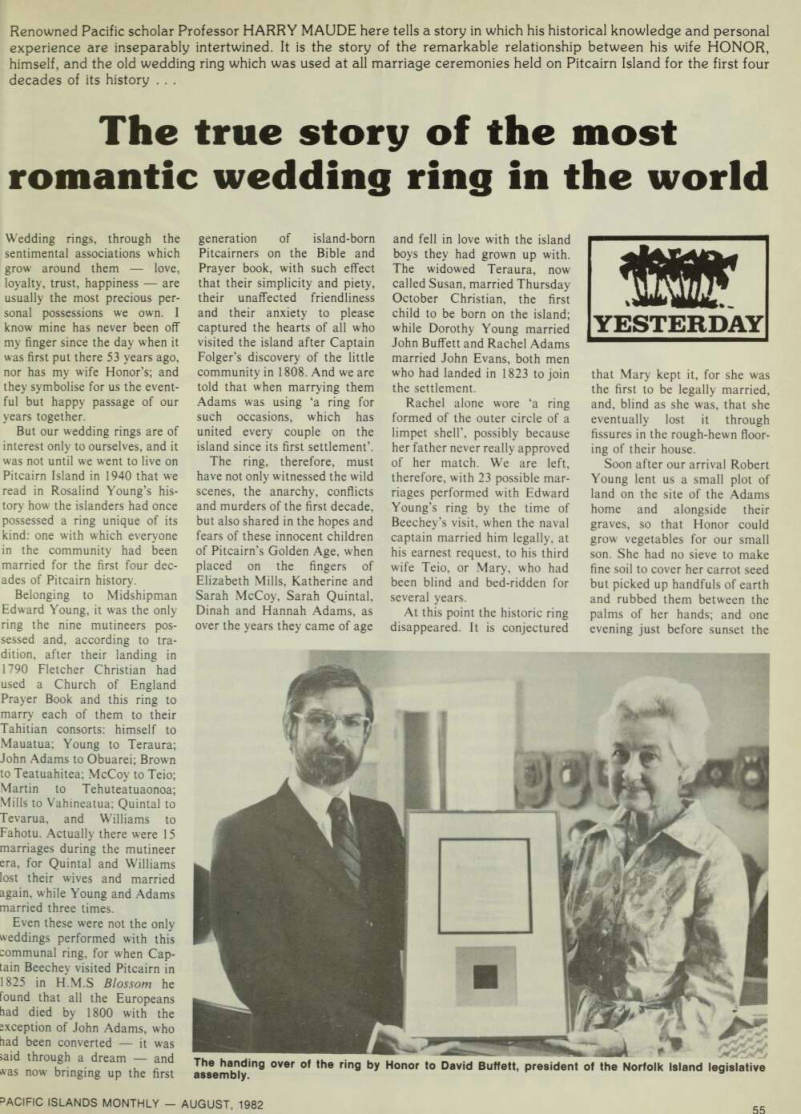

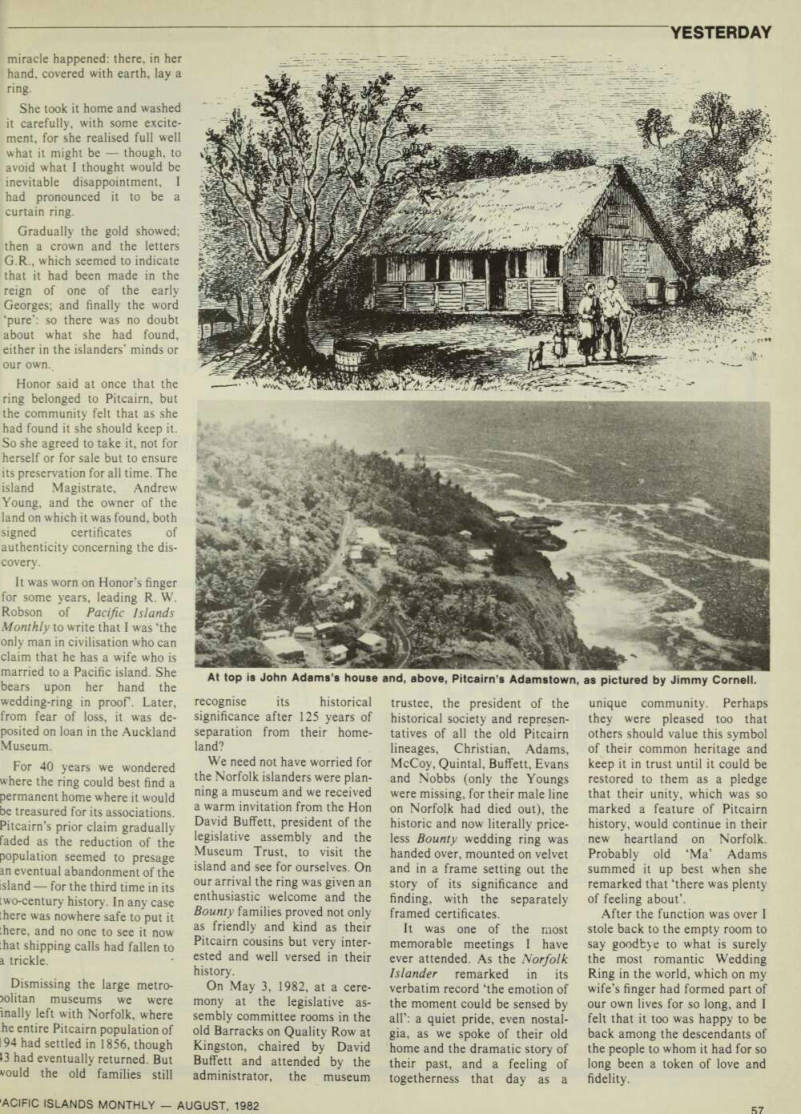
Yesterday
The true story of the most romantic wedding ring in the world
Renowned Pacific scholar Professor HARRY MAUDE here tells a story in which his historical knowledge and personal experience are inseparably intertwined. It is the story of the remarkable relationship between his wife HONOR, himself, and the old wedding ring which was used at all marriage ceremonies held on Pitcairn Island for the first four decades of its history . . .
Wedding rings, through the sentimental associations which grow around them love, loyalty, trust, happiness are usually the most precious per sonal possessions we own. I know mine has never been off my finger since the day when it was first put there 53 years ago, nor has my wife Honor’s; and they symbolise for us the event ful but happy passage of our years together.
But our wedding rings are of interest only to ourselves, and it was not until we went to live on Pitcairn Island in 1940 that we read in Rosalind Young’s his tory how the islanders had once possessed a ring unique of its kind: one with which everyone in the community had been married for the first four dec ades of Pitcairn history.
Belonging to Midshipman Edward Young, it was the only ring the nine mutineers pos sessed and, according to tra dition, after their landing in 1790 Fletcher Christian had used a Church of England Prayer Book and this ring to marry each of them to their Tahitian consorts: himself to Mauatua; Young to Teraura; John Adams to Obuarei; Brown to Teatuahitea; McCoy to Teio; Martin to Tehuteatuaonoa; Mills to Vahineatua; Quintal to Tevarua, and Williams to Fahotu. Actually there were 15 marriages during the mutineer era, for Quintal and Williams lost their wives and married again, while Young and Adams married three times.
Even these were not the only weddings performed with this communal ring, for when Cap tain Beechey visited Pitcairn in 1825 in H.M.S Blossom he found that all the Europeans bad died by 1800 with the exception of John Adams, who bad been converted it was »aid through a dream and was now bringing up the first
generation of island-born Pitcairners on the Bible and Prayer book, with such effect that their simplicity and piety, their unaffected friendliness and their anxiety to please captured the hearts of all who visited the island after Captain Folger’s discovery of the little community in 1808. And we are told that when marrying them Adams was using ‘a ring for such occasions, which has united every couple on the island since its first settlement’.
The ring, therefore, must have not only witnessed the wild scenes, the anarchy, conflicts and murders of the first decade, but also shared in the hopes and fears of these innocent children of Pitcairn’s Golden Age, when placed on the fingers of Elizabeth Mills, Katherine and Sarah McCoy, Sarah Quintal, Dinah and Hannah Adams, as over the years they came of age
and fell in love with the island boys they had grown up with.
The widowed Teraura, now called Susan, married Thursday October Christian, the first child to be born on the island; while Dorothy Young married John Buffett and Rachel Adams married John Evans, both men who had landed in 1823 to join the settlement.
Rachel alone wore ‘a ring formed of the outer circle of a limpet shell’, possibly because her father never really approved of her match. We are left, therefore, with 23 possible mar riages performed with Edward Young’s ring by the time of Beechey’s visit, when the naval captain married him legally, at his earnest request, to his third wife Teio, or Mary, who had been blind and bed-ridden for several years.
At this point the historic ring disappeared. It is conjectured
that Mary kept it, for she was the first to be legally married, and, blind as she was, that she eventually lost it through fissures in the rough-hewn floor ing of their house.
Soon after our arrival Robert Young lent us a small plot of land on the site of the Adams home and alongside their graves, so that Honor could grow vegetables for our small son. She had no sieve to make fine soil to cover her carrot seed but picked up handfuls of earth and rubbed them between the palms of her hands; and one evening just before sunset the
The handing over of the ring by Honor to David Buffett, president of the Norfolk Island legislative assembly.
miracle happened: there, in her hand, covered with earth, lay a ring.
She took it home and washed it carefully, with some excite ment, for she realised full well what it might be though, to avoid what I thought would be inevitable disappointment, I had pronounced it to be a curtain ring.
Gradually the gold showed; then a crown and the letters G.R., which seemed to indicate that it had been made in the reign of one of the early Georges; and finally the word ‘pure’: so there was no doubt about what she had found, either in the islanders’ minds or our own..
Honor said at once that the ring belonged to Pitcairn, but the community felt that as she had found it she should keep it.
So she agreed to take it, not for herself or for sale but to ensure its preservation for all time. The island Magistrate, Andrew Young, and the owner of the land on which it was found, both signed certificates of authenticity concerning the dis covery.
It was worn on Honor’s finger for some years, leading R. W.
Robson of Pacific Islands Monthly to write that I was ‘the only man in civilisation who can claim that he has a wife who is married to a Pacific island. She bears upon her hand the wedding-ring in proof. Later, from fear of loss, it was de posited on loan in the Auckland Museum.
For 40 years we wondered where the ring could best find a permanent home where it would be treasured for its associations.
Pitcairn’s prior claim gradually faded as the reduction of the population seemed to presage an eventual abandonment of the island for the third time in its two-century history. In any case there was nowhere safe to put it there, and no one to see it now that shipping calls had fallen to a trickle.
Dismissing the large metro politan museums we were inally left with Norfolk, where he entire Pitcairn population of i 94 had settled in 1856, though 13 had eventually returned. But vould the old families still
recognise its historical significance after 125 years of separation from their home land?
We need not have worried for the Norfolk islanders were plan ning a museum and we received a warm invitation from the Hon David Buffett, president of the legislative assembly and the Museum Trust, to visit the island and see for ourselves. On our arrival the ring was given an enthusiastic welcome and the Bounty families proved not only as friendly and kind as their Pitcairn cousins but very inter ested and well versed in their history.
On May 3, 1982, at a cere mony at the legislative as sembly committee rooms in the old Barracks on Quality Row at Kingston, chaired by David Buffett and attended by the administrator, the museum
trustee, the president of the historical society and represen tatives of all the old Pitcairn lineages, Christian, Adams, McCoy, Quintal, Buffett, Evans and Nobbs (only the Youngs were missing, for their male line on Norfolk had died out), the historic and now literally price less Bounty wedding ring was handed over, mounted on velvet and in a frame setting out the story of its significance and finding, with the separately framed certificates.
It was one of the most memorable meetings I have ever attended. As the Norfolk Islander remarked in its verbatim record ‘the emotion of the moment could be sensed by all’: a quiet pride, even nostal gia, as we spoke of their old home and the dramatic story of their past, and a feeling of togetherness that day as a
unique community. Perhaps they were pleased too that others should value this symbol of their common heritage and keep it in trust until it could be restored to them as a pledge that their unity, which was so marked a feature of Pitcairn history, would continue in their new heartland on Norfolk.
Probably old ‘Ma’ Adams summed it up best when she remarked that ‘there was plenty of feeling about’.
After the function was over 1 stole back to the empty room to say goodbye to what is surely the most romantic Wedding Ring in the world, which on my wife’s finger had formed part of our own lives for so long, and I felt that it too was happy to be back among the descendants of the people to whom it had for so long been a token of love and fidelity.
At top is John Adams’s house and, above, Pitcairn’s Adamstown, as pictured by Jimmy Cornell.
Advertisements & other items, pp. 56-58 (2 items)
Timken
o
PUTYOUR
FOOT DOWN.
DEMAND
TIMKEN
BEARINGS!
TIMKEN
If you’re hard headed about the bearings you use ... put your foot down!
Demand Timken" tapered roller bearings, and you’ll get the brand with proven quality, durability and performance.
The brand that’s given you a long run for your money, wherever it’s used.
On top of all this, you’ll benefit from our consistent supply, delivery, and sales and service engineering assistance available from Australian Timken and Authorized Timken" Bearing Distributors throughout the Pacific.
Another way of looking at it is that you’re not going to put your foot in it when you put your foot down and demand Timken bearings.
TIMKEN
REGISTERED TRADEMARK
TAPERED ROLLER BEARINGS
Authorised Timken" Bearing Distributors in the Pacific are: O F. Nelson and Co. Ltd., APIA; Kidd Garrett Ltd., AUCKLAND; Motor Specialties Ltd., AUCKLAND; Precision Bearings Ltd., AUCKLAND: United Enterprises Ltd., HONIARA; Sunbeam Transport Ltd., LAUTOKA; Nelle Cie SATMA, NOUMEA; Pacific Distributions, PAPEETE; P N G. Bearing Service, PORT MORESBY; Socametra, PORT VILLA; Burns Philp (South Sea) Company Ltd.,
HOLT 0922ATX
deHavilland Marine ►- A Division of Hawker de Havilland Australia Pty. Limited M HR ■ Si--:;.-
TITAN Mk 3 LANDING CRAFT
FAST, VERSATILE WATER TRANSPORT
For vehicles, personnel, general cargo, diving, work platform.
Proven performance and seaworthiness.
Shallow draught, good manoeuvrability.
Rugged, low maintenance, aluminium hull. DE HAVILLAND MARINE Dimensions: 12.2 X 3.5 metres. P-O. Box 43, Cargo capacity: 8 X 2.8 metres, 5000 kg. Homebush, Tel. (02) 647 1922 Speeds: 12 to 30 knots maximum.
NSW, 2140. Australia.
Telex: AA23938.
A HAWKER SIDDELEY GROUP COMPANY
THE FACTS
WITHOUT
FRILLS
The trends in a few words. The significant news.
Mailed direct to you every second Friday.
The South Seas Digest is designed for busy people who have to know what's happening in the Pacific Islands , but in a hurry.
FOR SUBSCRIPTION DETAILS SEE INSERT.
f Hie South Sea Digest
THE NEWSLETTER ON ISLANDS AFFAIRS • EVERY OTHER FRIDAY
i* file So
uth Sea Di 9&st
FRIDAY *
Yesterday
57
'ACIFIC ISLANDS MONTHLY AUGUST, 1982
A meeting on ‘Pacific Resources’
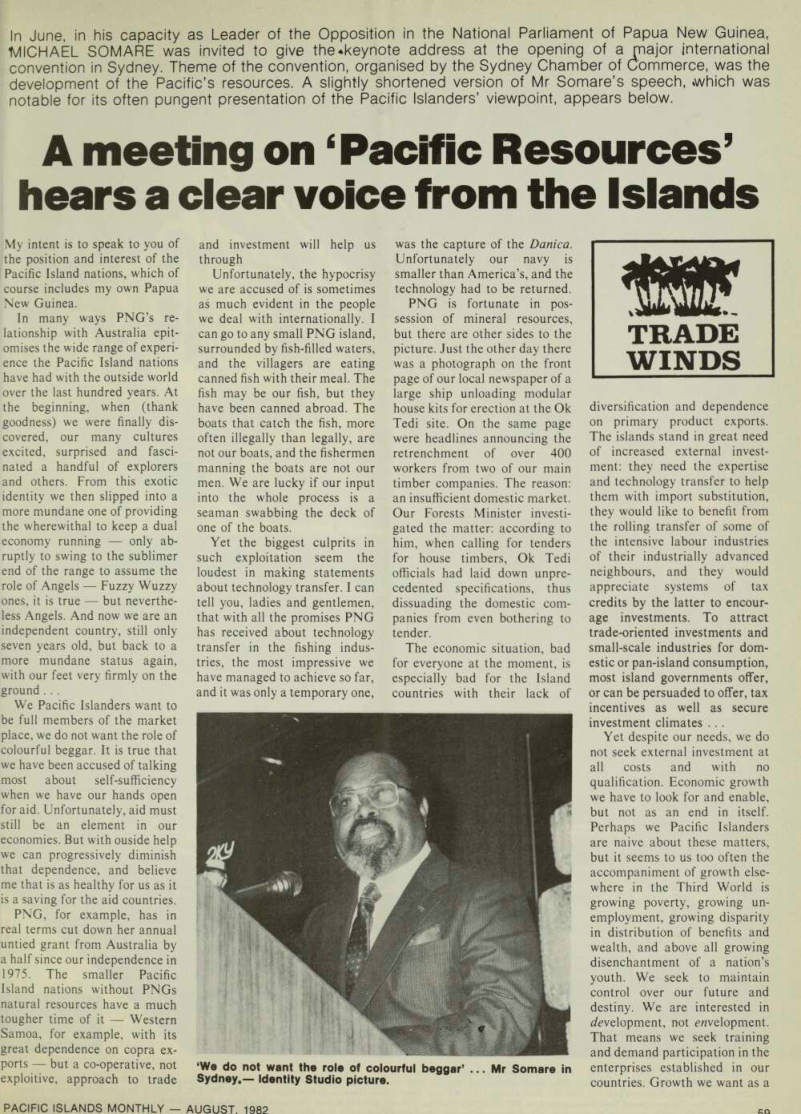

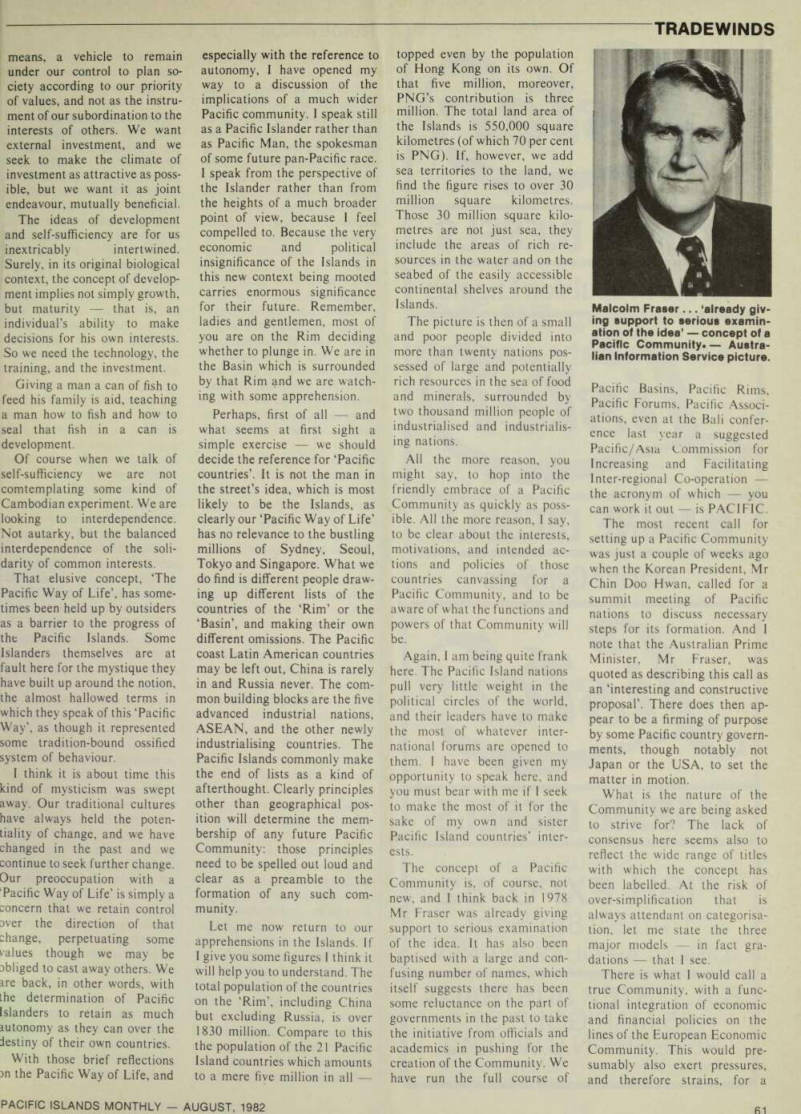
Trade
Winds
A meeting on ‘Pacific Resources’ hears a clear voice from the Islands
In June, in his capacity as Leader of the Opposition in the National Parliament of Papua New Guinea, MICHAEL SOMARE was invited to give the*keynote address at the opening of a major international convention in Sydney. Theme of the convention, organised by the Sydney Chamber of Commerce, was the development of the Pacific’s resources. A slightly shortened version of Mr Somare’s speech, which was notable for its often pungent presentation of the Pacific Islanders’ viewpoint, appears below.
My intent is to speak to you of the position and interest of the Pacific Island nations, which of course includes my own Papua New Guinea.
In many ways PNG’s re lationship with Australia epit omises the wide range of experi ence the Pacific Island nations have had with the outside world over the last hundred years. At the beginning, when (thank goodness) we were finally dis covered, our many cultures excited, surprised and fasci nated a handful of explorers and others. From this exotic identity we then slipped into a more mundane one of providing the wherewithal to keep a dual economy running only ab ruptly to swing to the sublimer end of the range to assume the role of Angels Fuzzy Wuzzy ones, it is true but neverthe less Angels. And now we are an independent country, still only seven years old, but back to a more mundane status again, with our feet very firmly on the ground . . .
We Pacific Islanders want to be full members of the market place, we do not want the role of colourful beggar. It is true that we have been accused of talking most about self-sufficiency when we have our hands open for aid. Unfortunately, aid must still be an element in our economies. But with ouside help we can progressively diminish that dependence, and believe me that is as healthy for us as it is a saving for the aid countries.
PNG, for example, has in real terms cut down her annual untied grant from Australia by a half since our independence in 1975. The smaller Pacific Island nations without PNGs natural resources have a much tougher time of it Western Samoa, for example, with its great dependence on copra ex ports but a co-operative, not exploitive, approach to trade
and investment will help us through Unfortunately, the hypocrisy we are accused of is sometimes as much evident in the people we deal with internationally. I can go to any small PNG island, surrounded by fish-filled waters, and the villagers are eating canned fish with their meal. The fish may be our fish, but they have been canned abroad. The boats that catch the fish, more often illegally than legally, are not our boats, and the fishermen manning the boats are not our men. We are lucky if our input into the whole process is a seaman swabbing the deck of one of the boats.
Yet the biggest culprits in such exploitation seem the loudest in making statements about technology transfer. I can tell you, ladies and gentlemen, that with all the promises PNG has received about technology transfer in the fishing indus tries, the most impressive we have managed to achieve so far, and it was only a temporary one,
was the capture of the Danica.
Unfortunately our navy is smaller than America’s, and the technology had to be returned.
PNG is fortunate in pos session of mineral resources, but there are other sides to the picture. Just the other day there was a photograph on the front page of our local newspaper of a large ship unloading modular house kits for erection at the Ok Tedi site. On the same page were headlines announcing the retrenchment of over 400 workers from two of our main timber companies. The reason: an insufficient domestic market.
Our Forests Minister investi gated the matter: according to him, when calling for tenders for house timbers, Ok Tedi officials had laid down unpre cedented specifications, thus dissuading the domestic com panies from even bothering to tender.
The economic situation, bad for everyone at the moment, is especially bad for the Island countries with their lack of
diversification and dependence on primary product exports.
The islands stand in great need of increased external invest ment: they need the expertise and technology transfer to help them with import substitution, they would like to benefit from the rolling transfer of some of the intensive labour industries of their industrially advanced neighbours, and they would appreciate systems of tax credits by the latter to encour age investments. To attract trade-oriented investments and small-scale industries for dom estic or pan-island consumption, most island governments offer, or can be persuaded to offer, tax incentives as well as secure investment climates .. .
Yet despite our needs, we do not seek external investment at all costs and with no qualification. Economic growth we have to look for and enable, but not as an end in itself.
Perhaps we Pacific Islanders are naive about these matters, but it seems to us too often the accompaniment of growth else where in the Third World is growing poverty, growing un employment, growing disparity in distribution of benefits and wealth, and above all growing disenchantment of a nation’s youth. We seek to maintain control over our future and destiny. We are interested in development, not envelopment.
That means we seek training and demand participation in the enterprises established in our countries. Growth we want as a
‘We do not want the role of colourful beggar’ ... Mr Somare in Sydney,— Identity Studio picture.
means, a vehicle to remain under our control to plan so ciety according to our priority of values, and not as the instru ment of our subordination to the interests of others. We want external investment, and we seek to make the climate of investment as attractive as poss ible, but we want it as joint endeavour, mutually beneficial.
The ideas of development and self-sufficiency are for us inextricably intertwined.
Surely, in its original biological context, the concept of develop ment implies not simply growth, but maturity that is, an individual’s ability to make decisions for his own interests.
So we need the technology, the training, and the investment.
Giving a man a can of fish to feed his family is aid, teaching a man how to fish and how to seal that fish in a can is development.
Of course when we talk of self-sufficiency we are not comtemplating some kind of Cambodian experiment. We are looking to interdependence.
Not autarky, but the balanced interdependence of the soli darity of common interests.
That elusive concept, ‘The Pacific Way of Life’, has some times been held up by outsiders as a barrier to the progress of the Pacific Islands. Some Islanders themselves are at fault here for the mystique they have built up around the notion, the almost hallowed terms in which they speak of this ‘Pacific Way’, as though it represented some tradition-bound ossified system of behaviour.
I think it is about time this kind of mysticism was swept away. Our traditional cultures have always held the poten tiality of change, and we have changed in the past and we continue to seek further change.
Our preoccupation with a Pacific Way of Life’ is simply a concern that we retain control aver the direction of that change, perpetuating some values though we may be abliged to cast away others. We are back, in other words, with the determination of Pacific Islanders to retain as much autonomy as they can over the destiny of their own countries.
With those brief reflections an the Pacific Way of Life, and
especially with the reference to autonomy, I have opened my way to a discussion of the implications of a much wider Pacific community. I speak still as a Pacific Islander rather than as Pacific Man, the spokesman of some future pan-Pacific race.
I speak from the perspective of the Islander rather than from the heights of a much broader point of view, because I feel compelled to. Because the very economic and political insignificance of the Islands in this new context being mooted carries enormous significance for their future. Remember, ladies and gentlemen, most of you are on the Rim deciding whether to plunge in. We are in the Basin which is surrounded by that Rim and we are watch ing with some apprehension.
Perhaps, first of all and what seems at first sight a simple exercise we should decide the reference for ‘Pacific countries’. It is not the man in the street’s idea, which is most likely to be the Islands, as clearly our ‘Pacific Way of Life’ has no relevance to the bustling millions of Sydney, Seoul, Tokyo and Singapore. What we do find is different people draw ing up different lists of the countries of the ‘Rim’ or the ‘Basin’, and making their own different omissions. The Pacific coast Latin American countries may be left out, China is rarely in and Russia never. The com mon building blocks are the five advanced industrial nations, ASEAN, and the other newly industrialising countries. The Pacific Islands commonly make the end of lists as a kind of
afterthought. Clearly principles
other than geographical pos ition will determine the mem bership of any future Pacific Community: those principles need to be spelled out loud and clear as a preamble to the formation of any such com munity.
Let me now return to our apprehensions in the Islands. If I give you some figures I think it will help you to understand. The total population of the countries on the ‘Rim’, including China but excluding Russia, is over 1830 million. Compare to this the population of the 21 Pacific Island countries which amounts to a mere five million in all
topped even by the population of Hong Kong on its own. Of that five million, moreover, PNG’s contribution is three million. The total land area of the Islands is 550,000 square kilometres (of which 70 per cent is PNG). If, however, we add sea territories to the land, we find the figure rises to over 30 million square kilometres.
Those 30 million square kilo metres are not just sea, they include the areas of rich re sources in the water and on the seabed of the easily accessible continental shelves around the Islands.
The picture is then of a small and poor people divided into more than twenty nations pos sessed of large and potentially rich resources in the sea of food and minerals, surrounded by two thousand million people of industrialised and industrialis ing nations.
All the more reason, you might say, to hop into the friendly embrace of a Pacific Community as quickly as poss ible. All the more reason, I say, to be clear about the interests, motivations, and intended ac tions and policies of those countries canvassing for a Pacific Community, and to be aware of what the functions and powers of that Community will be.
Again, I am being quite frank here. The Pacific Island nations pull very little weight in the political circles of the world, and their leaders have to make the most of whatever inter national forums are opened to them. I have been given my opportunity to speak here, and you must bear with me if I seek to make the most of it for the sake of my own and sister Pacific Island countries’ inter ests.
The concept of a Pacific Community is, of course, not new, and I think back in 1978 Mr Fraser was already giving support to serious examination of the idea. It has also been baptised with a large and con fusing number of names, which itself suggests there has been some reluctance on the part of governments in the past to take the initiative from officials and academics in pushing for the creation of the Community. We have run the full course of
Pacific Basins, Pacific Rims, Pacific Forums, Pacific Associ ations, even at the Bali confer ence last year a suggested Pacific/Asia Commission for Increasing and Facilitating
Inter-regional Co-operation
the acronym of which you can work it out is PACIFIC.
The most recent call for setting up a Pacific Community was just a couple of weeks ago when the Korean President, Mr Chin Doo Hwan, called for a summit meeting of Pacific nations to discuss necessary steps for its formation. And I note that the Australian Prime Minister, Mr Fraser, was quoted as describing this call as an ‘interesting and constructive proposal’. There does then ap pear to be a firming of purpose by some Pacific country govern ments, though notably not Japan or the USA, to set the matter in motion.
What is the nature of the Community we are being asked to strive for? The lack of consensus here seems also to reflect the wide range of titles with which the concept has been labelled. At the risk of over-simplification that is always attendant on categorisa tion, let me state the three major models in fact gra dations that 1 see.
There is what I would call a true Community, with a func tional integration of economic and financial policies on the lines of the European Economic Community. This would pre sumably also exert pressures, and therefore strains, for a
Malcolm Fraser... ‘already giv ing support to serious examin ation of the idea’ - concept of a Pacific Community. - Austra lian Information Service picture.
common front in political mat ters.
There is secondly a looser agglomeration, an association much more of the order of an Organisation for Economic Co operation and Development than an EEC, with fewer pres sures for a fine functional inte gration of policies, but with overall agreement to establish common strategies for a re gional co-operation that will foster the economic develop ment of the Pacific for the benefit of all or rather of the member nations.
Finally there is a forum type of body providing for consul tation and co-ordination of views, rather than of policies as such. This is more akin to an ASEAN structure, though ASEAN, perhaps because it is fairly corfipact and localised, is certainly a well developed ver sion of it.
These three models are not mutually exclusive possibilities.
Indeed if progress is to be made towards some alignment of poli cies for the more effective development of the Pacific, then I would strongly favour commencing with the least inte grated version, a forum type of body, with clear objectives of a gradual institutionalisation of co-operation.
Certainly there seems little point in attempting to start at the other end. Mr Fraser’s recent publicised comments show him to be but the latest of several Pacific leaders who have questioned the feasibility of setting up in the near future a Pacific economic community of the EEC type. Perhaps I am being too much of a Melanesian, but it seems to me that a continuing and increasing co-operation between Pacific nations stands a far better chance of success if we start with finding out what we agree upon and working from that foundation, rather than setting the stage for confrontations over what we disagree about, or, more importantly perhaps, over what we are not yet sure about.
A forum type of body, more over, could be given a greater chance of success and of evol ution into a more integrated association, by a two-tier system with forums also operating at a sub-regional level. During the
forum stage it would be at the sub-regions that the dynamics of higher levels of integration would become most apparent.
Such a system would be fairly easy to set up since there are a considerable number of sub-regional international bodies already in existence. As far as the Southwest Pacific is concerned, at any rate, I would hope this would be used as an opportunity to reduce and rationalise all such bodies and agreements within a single framework.
This, furthermore, would constitute an excellent step forward in the rationalisation of development within the Pacific Islands themselves. Our small scale industries, for example, would be made more viable by the creation of an expanding market through non duplication, and by more appro priate transport and communi cation systems. This would cer tainly require a more effective co-ordination and implemen tation of our aid and develop ment strategies than has been evident up to now.
These kinds of ideas, I am sure, will be receiving concerted attention in the task force sessions and I await with great interest, and optimism, the re sults of your labours.
But you are the architects.
And unfortunately architects, while noted for producing im maculate blueprints and el egant structures, too often for get that people have to live within their walls. Co operation, ladies and gentlemen, is the name of the game.
For us mini-states, as we are sometimes condescendingly called, there are big brothers and bigger brothers. In the Southwest Pacific our particu lar big brother is Australia an enlightened big brother, I might add, though sometimes patronising and sometimes in sensitive, but one we seek to understand and trust and whose friendship and help we greatly value.
But if we take the entire Pacific as our arena, there are other big brothers growing up rapidly in Southeast Asia. To the Northeast and East, there are highly active giants, Japan and America, with the world’s
largest economies. And there are giants, threatening and un fathomable, Russia and China, to the North.
In being invited into such a community of these advanced industrialised and industrialis ing countries of the Pacific Rim, I sometimes cannot help won dering whether, in the language of The Godfather , we are not being made an offer we can’t refuse. We certainly cannot afford to be left out of co operation because we are small enough to be ignored if we don’t co-operate.
So we ‘mini-states’ have to give hard thought to how real are these concepts of co operative endeavours. You can not blame us for our suspicions, for some of our experiences, with, for example, aggressive marauding foreign fishing fleets, threats to dump nuclear wastes in our waters, nuclear bomb testing, and widespread transfer-pricing by multi national corporations, hardly put our fears to rest. So while we welcome Pacific co operation and being part of it, we also wonder whether some of our big colleagues in the Community-to-be are not simply girding themselves up for a 21 st-century ‘Scramble for the Pacific’ in this case for maritime resources not land.
Nor should you forget that, traditionally, weak countries surrounded by powerful ones survive by playing their big neighbours off against each other. Poland is not the only country in the past to have disappeared through lack of finesse in such a strategy.
We could argue that the 30 million square kilometres of Pacific Ocean and seabed re sources to which we Pacific Island nations possess an unde niable right are more likely to be successfully denied us by the industrial nations in co operation for a carve-up, than if they were squabbling amongst themselves and endeavouring to utilise our friendship and inter ests to boost the ethical content of their own stands.
That I agree, ladies and gentlemen, is a fairly frank statement of one position we could take. But I do have a responsibility to act in the interests of a younger gener
ation of Islands people who will seek to reap their heritage when, for example, the state of Fiji is 40 years old, not 12, and when PNG is 27 years old and not 7.
I am not being unrealistic I do fully recognise that co operation does not mean sacrificing self-interest. But it does mean stating your self interest so that fair accommo dation and compromise can be made between those who are co operating.
We have a fine relationship with Australia though we want a better one. We look to her leadership irt many areas.
But Australia too has her big brother America. Not that Australia is always ready to dance to America’s tune, as for example in the public support the Australian Government gave PNG over the Danica affair.
Yet we are not blind to the fact that Australia’s wider econ omic and strategic interests are served by identifying with much of America’s policy. We therefore become worried when, in the context of a call for a Pacific Community of Nations, we read such a docu ment as that proposing an Organisation for Pacific Trade and Development, or OPTAD.
This document was co authored by an Australian pro fessor under contract to the US committee on foreign relations.
The OPTAD proposal was en dorsed in the official Crawford- Okita report Australia, Japan and Western Pacific Economic Relations pres ented to the Australian and Japanese Governments.
What are we mini-states to make of such statements as the following? ‘lf such an organisation de velops, the United States has a strong interest in playing a leading role in specifying the purpose and shape of any new regional economic association in order that it encompasses US economic and political interests in the future of the region and is consistent with American glo bal economic commitments and responsibilities.’
And again: ‘The conclusion is that there may well be consider able merit in these proposals from the viewpoint of advanc
ing United States global econ omic interests and responsi bilities and political-military in terest in Asia. The general shape of the new regional econ omic organisation is defined more carefully with those objec tives in mind.’
These I assure you are only representative of numerous other like statements of US self interest.
As I have said, self-interest must be a recognised motiv ation in co-operation. But if a ‘Community of the Pacific’ is to
be brought into being, are such self-interests to be made fully evident? Or are we Pacific Islands states simply to receive an offer we can’t refuse? When all the artificial cream of rhet oric, conferences and cocktails in coconuts is removed, what we want to know is: 1. Will there be any cake; and, 2. If there is, how is the cake to be divided up?
The realities of co-operation lie not in designing such a cake, but in determining the mixture and the share-out. ..
Advertisements & other items, pp. 60-65 (1 item)
Let Your Imagination Run Wild
ar / I# d 1 ' JW m ■ I a f s 0 » * I I D \
Imagine the dynamic sound of a quality stereo system. And imagine how nice it would be if you could take this sound along with you wherever you go. A fairy tale’?’ Not at Sansui.
We let our imagination run wild and developed Portable Component Systems, the newest Sansui Hi-Tech Compo sound idea The creative folks at Sansui borrowed many advanced features from full-size home components. Next, we packed them all into tiny mini-component-sized packages. And as a final touch, we snapped them together and attached a convenient carrying handle.
The result? Dynamic sounding portables that disassemble to form full-feature mini component systems.
Sansui. Imagine what we'll do next. o nat we 11 do sxt. tf 1 & o^ e n S° x e* 1 s
PORTABLE COMPONENT SYSTEM CP-7
SANSUI ELECTRIC CO., LTD. 14-1 Izumi 2-chome, Suginami-ku, Tokyo 168, Japan. • Australia VANFI (Aust.) Pty. Ltd. 297, City Road, South Melbourne, Victoria 3205, Australia Phone: 690-6200/283 Alfred Street, North Sydney, N.S.W. 2060, Australia Phone 929-0293 • Fiji Prabhu Brothers Ltd. PO. Box 183, Nadi Phone: 71122 9Papua New Guinea Oceania Indent Agency (P.N.G.) Pty. Ltd. Box 5518, Boroko, Port Moresby Phone: PM 256406 • New Zealand David Reid Electronics Ltd. PO. Box 2630, Auckland, Phone: 488-049 9 New Caledonia Ets Michel MERCIER B P. 1123, Noumea Phone: 27.59.11 m Tahiti SIMEL PO Box 3338 Phone: 26979
MARINE DIESELS
Marine Propulsion Engines
MARINE DIESELS
Marine Gen Sets
'isten
MARINE DIESELS
SEE US AT
FISH EXPO ’B2
14th - 18th Sept
CIRCULAR QUAY SYDNEY
R.A. LISTER AUSTRALIA
85 MARIGOLD ST
REVESBY N.S.W. 2212
Phone (02) 771 4911 TELEX: AA25852 i" 1
Consult the leading lights FREE.
Thorn EMI Lighting offer a free advisory service.
We provide lighting for all applications so you can benefit from our expertise and experience no matter what your specific requirements are.
Thorn have a system that meets your needs and your budget.
We even supply photographic,vehicle and domestic lamps.
We'll throw some light on your question . . . absolutely free.
If it’s got anything to do with lights or lighting give us a call. We are in your hands.
THORN EM
om Lighting (N.Z.) Ltd
P.O. Box 15150 New Lynn. Auckland. New Zealand.
Telephone 887-155 Auckland. Telex NZ 2648.
Fluorescent tubes and fittings for domestic, industrial and special purpose applications. Incandescent lamps and fittings, emergency lighting, floodlighting (including lamps, poles and columns), streetlighting. Marine lighting, airfield lighting, ' lighting for the food processing industry. Vehicle, miniature or photographic lamps.
Bearing us in mind will save
you a Int nf trouble
when it comes to those hard to get bearings and associated products you can rely on our expertise IMPORT and EXPORT enquiries to Head Office
nCAAIAA 113 MITCHELL STREET, BENDIGO,
I>CIII/l\l\/ VICTORIA, AUSTRALIA.
DEARIIUSf TELEX NO. 35105
(AUST) PTY LTD with branches in
SUVA, SYDNEY, BALLARAT ,
MILDURA and SHEPPARTON
OZ, NZ goods into Europe via Islands?

Europe via Islands?
Australian and New Zealand manufacturers can win access to markets in the European Economic Community by means of tripartite joint-venture industries established in certain Pacific Island countries. It may also be possible to attract European countries to invest in Island countries for the purpose of obtaining markets in Austra lia and New Zealand.
The Centre for Industrial Development in Brussels, Belgium, an agency of the EEC, exists to assist potential indus trial enterprises in the Pacific Islands.
Companies in Australia and New Zealand may find that the expansion of their product ranges is discouraged by such factors as the smallness of their local market, lack of technical expertise and high start-up costs. Many will also have products they would like to export to Europe but for such barriers as trade quotas, import duties or possibly high labour costs.
The Lome Convention be tween the EEC and eight Pacific Island countries may solve some of these problems.
All goods manufactured in Fiji, Kiribati, Papua New Guinea, Solomon Islands, Vanuatu, Tonga, Tuvalu and Western Samoa having a minimum of 50 percent of their value added locally can be exported to Europe duty-free.
As agreements between Aus tralia and New Zealand and these Island states also permit
unrestricted or lightly restricted imports into Australia and New Zealand, it may now be possible to attract European companies to invest in the Islands to complement the production of Australian and New Zealand manufacturers on a joint venture basis.
With sufficient information, CID will help in finding inter esting European partners for tripartite joint ventures in the Pacific.
The South Pacific Bureau for Economic Co-operation (SPEC) and other organisations in the Islands may try to identify local partners.
Interested industrialists should write directly to CID, with a copy to SPEC, outlining the type of products they are prepared to manufacture in the Islands for export to Europe, and outlining products of European origin they would be prepared to import into Austra lia or New Zealand to comp lement their sales.
Adresses: Centre for Indus trial Development, Rue de ITndustrie 28, B 1040 Brussels, Belgium. Tel. (02) 513 41 00.
Telex CDI 61427.
South Pacific Bureau for Economic Co-operation, GPO Box 856, Suva, Fiji. Tel 312-600, Telex 2229
Specsuva Fj.
South Pacific Trade Com mission, 9th Floor, PNG House, 225 Clarence Street, Sydney 2000. Tel. 290 2833, 90 2713, Telex AA70342. South Pacific Bureau for Economic Co-operation.
Oz rag trader
goes to Fiji
Givoni (Australia) Pty Ltd, of Melbourne, one of Australia’s largest garment makers, has signed an agreement for the production by a Fiji company, Lotus Garments Ltd, of 20 000 dresses and housegowns for the Australian market.
It is the first deal under which an Australian garment manu facturer has placed offshore orders in Fiji to take advantage of tariff concessions allowed to Fiji by Australia under the SPARTECA trade agreement.
A Givoni spokesman said cheaper labour costs in Fiji would permit Givoni compete with Asian-made garments be ing sold in Australia.
The garments would be de livered by December, with Givoni supplying materials.
There would be follow r -up or ders if the pilot order was successful.
Padam Lala, managing direc tor of Lotus Garments, said the company was negotiating simi lar deals with three other Aus tralian companies, and was planning a major expansion of its factory. Robert Keith- Reid in Suva.
Tuvalu checks
shopping list
Tuvalu has been looking at the prices of goods in New Zealand compared to prices charged for the same items in Australia.
David Kinon, manager of the Tuvalu Business Development Advisory Bureau, who rep resented Tuvalu at the 1982 New Zealand Exporters’ Fair in Auckland, reported that New
Zealand prices seemed to be lower than Australian. Tuvalu is seriously considering extend ing its New Zealand shopping list to the detriment of Austra lian exporters, especially as there is a possibility of a direct shipping service from Auckland to Funafuti.
Safety seminar
in Vanuatu
A seminar on safety at work and in the home was held in Port- Vila in June. Opening the conference Vanuatu’s Minister for Home Affairs Fred Timakata said it was only in recent years that many South Pacific countries had begun to set up industries, and they were only now realising the need for adequate precautions against accidental injuries, maimings and even fatalities at work and in the home. Taking part in the seminar were representatives of Vanuatu, Australia, New Zea land, Papua New Guinea, Fiji, Kiribati, Solomon Islands, Tonga and Western Samoa.
10 in Tourism
Council
Ten Pacific Island countries have joined to form the Tourism Council of the South Pacific.
The new body, to be headquartered in Pago Pago, American Samoa, replaces the Tourism Council of Polynesia.
Malakai Gucake, general man ager of the Fiji Visitors Bureau, has been appointed the new' council’s president. High among the council’s priorities, according to Mr Gucake, will be exertion of pressure in the appropriate places for improved
air services to, and within, the South Pacific. Countries and territories making up the coun cil are; American Samoa, West ern Samoa, Papua New Guinea.
French Polynesia, New Caledonia, Tonga, Niue, Fiji, Vanuatu and the Cook Islands.
Big cocoa plan
for Malakula
A 1700-hectare site on Vanuatu’s island of Malakula has been set aside for a major cocoa project funded by the Commonwealth Development Corporation. The corporation’s Suva office says the project will allow for involvement by local landowners. Work on prep aration of the site is to begin immediately, and planting ex pected to start by mid-1983.
Air Pacific to
fly the coop?
The chairman of Fiji’s Tourism Convention Mr Vunibobo urged Air Pacific to fly to destinations beyond the Pacific region. He told the convention in June that unless Fiji’s airline gained land ing rights beyond Australia and New Zealand, its tourist indus try could become a victim of over-flights. Acquisition of new destinations would enable the Fiji Visitors Bureau to tap new tourist markets.
Industry estate
for Lautoka
A drive to boost exports is an important pan of Fiji's strategy for economic growth.
Sugar still accounts for over two-thirds of export earnings, and its growth prospects are
good. Timber and canned tuna arc also fast becoming significant resource-based ex ports.
But the Fiji Government, in its efforts to diversify exports and also broaden the country’s manufacturing base, has an nounced plans to develop a 60-hectare industrial estate just outside Lautoka main port on the western side of Viti Lev; specifically for export oriented industries.
Fiji’s Economic Development Board (EDB) has engaged an Adelaide-based consulting firm.
Pak-Poy and Kneebonc, through the Australian Govern ment’s Development Import Grants Scheme (DIGS), to study the selected site and identify industries likely to be attracted to it. The firm will make recommendations for the development of the estate, with cost and revenue projections.
Fiji’s existing system of ex port incentives will be reviewed and detailed recommendations made to make it more effective.
From a Special Correspon dent.
Imports fiddle
in Apia?
Private firms in Western Samoa have been importing millions of dollars worth of goods without the required government per mission. Two firms, with import allocations of SWSI.2 million dollars for 1981, are said to have imported 51.5 million dol lars worth of goods in the last quarter of the year alone. It is reported that there could be prosecutions following com pletion of a Treasury inquiry.
racing for 1983-84
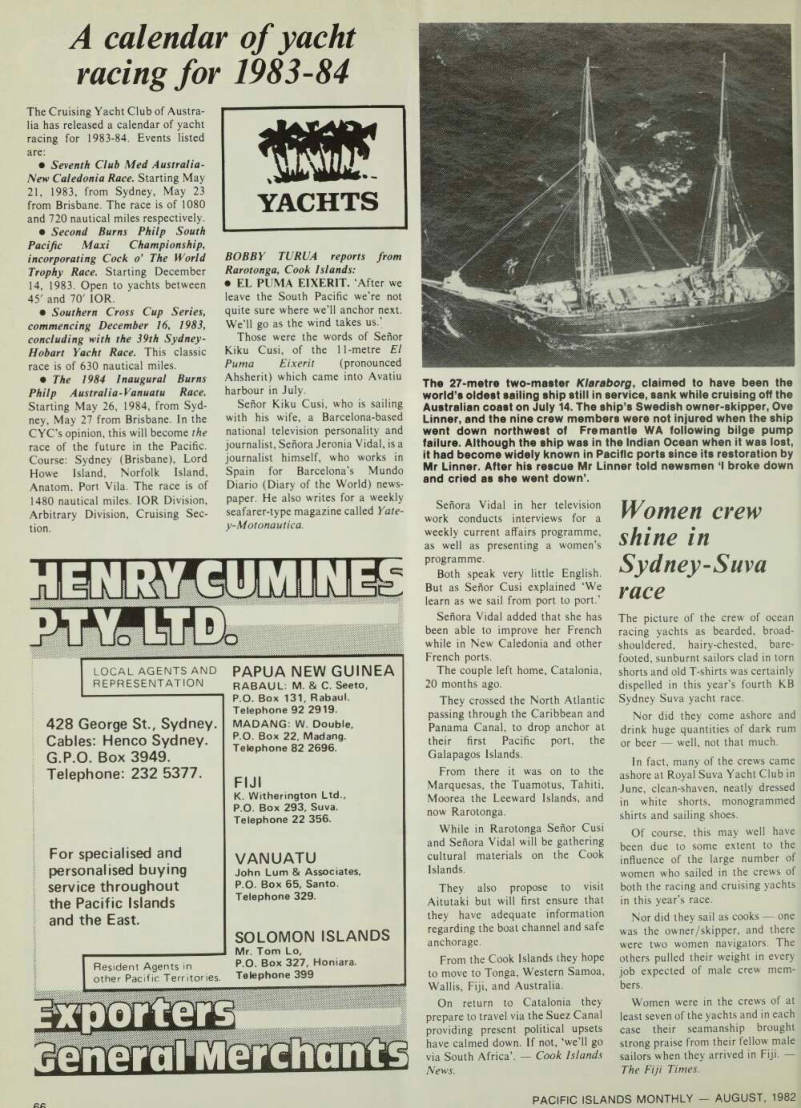
A calendar of yacht racing for 1983-84
Yachts
The Cruising Yacht Club of Austra lia has released a calendar of yacht racing for 1983-84. Events listed are: • Seventh Club Med Australia- New Caledonia Race. Starting May 21, 1983, from Sydney, May 23 from Brisbane. The race is of 1080 and 720 nautical miles respectively. • Second Burns Philp South
Pacific Maxi Championship,
incorporating Cock o' The World Trophy Race. Starting December 14, 1983. Open to yachts between 45' and 70' lOR. • Southern Cross Cup Series, commencing December 16, 1983, concluding with the 39th Sydney- Hobart Yacht Race. This classic race is of 630 nautical miles. • The 1984 Inaugural Burns Philp Australia-Vanuatu Race.
Starting May 26, 1984, from Syd ney, May 27 from Brisbane. In the CYC’s opinion, this will become the race of the future in the Pacific.
Course: Sydney (Brisbane), Lord Howe Island, Norfolk Island, Anatom. Port Vila. The race is of 1480 nautical miles. lOR Division, Arbitrary Division, Cruising Sec tion.
BOBBY TURUA reports from Rarotonga, Cook Islands:
• El Puma Eixerit. After We
leave the South Pacific we’re not quite sure where we’ll anchor next.
We’ll go as the wind takes us.’
Those were the words of Senor Kiku Cusi, of the 11-metre El Puma Eixerit (pronounced Ahsherit) which came into Avatiu harbour in July.
Senor Kiku Cusi, who is sailing with his wife, a Barcelona-based national television personality and journalist, Senora Jeronia Vidal, is a journalist himself, who works in Spain for Barcelona’s Mundo Diario (Diary of the World) news paper. He also writes for a weekly
seafarer-type magazine called Yate
y-Motonautica.
Senora Vidal in her television work conducts interviews for a weekly current affairs programme, as well as presenting a women’s programme.
Both speak very little English.
But as Senor Cusi explained ‘We learn as we sail from port to port.’
Senora Vidal added that she has been able to improve her French while in New Caledonia and other French ports.
The couple left home, Catalonia, 20 months ago.
They crossed the North Atlantic passing through the Caribbean and Panama Canal, to drop anchor at their first Pacific port, the Galapagos Islands.
From there it was on to the Marquesas, the Tuamotus, Tahiti, Moorea the Leeward Islands, and now Rarotonga.
While in Rarotonga Senor Cusi and Senora Vidal will be gathering cultural materials on the Cook Islands.
They also propose to visit Aitutaki but will first ensure that they have adequate information regarding the boat channel and safe anchorage.
From the Cook Islands they hope to move to Tonga, Western Samoa, Wallis, Fiji, and Australia.
On return to Catalonia they prepare to travel via the Suez Canal
providing present political upsets
have calmed down. If not, ‘we’ll go via South Africa’. Cook Islands News.
Women crew
shine in
Sydney-Suva
race
The picture of the crew of ocean racing yachts as bearded, broad shouldered, hairy-chested, bare footed, sunburnt sailors clad in torn shorts and old T-shirts was certainly dispelled in this year’s fourth KB Sydney Suva yacht race.
Nor did they come ashore and drink huge quantities of dark rum or beer well, not that much.
In fact, many of the crews came ashore at Royal Suva Yacht Club in June, clean-shaven, neatly dressed in white shorts, monogrammed shirts and sailing shoes.
Of course, this may well have been due to some extent to the influence of the large number of women who sailed in the crews of both the racing and cruising yachts in this year’s race.
Nor did they sail as cooks one was the owner/skipper, and there were two women navigators. The others pulled their weight in every job expected of male crew mem bers.
Women were in the crews of at least seven of the yachts and in each case their seamanship brought strong praise from their fellow male sailors when they arrived in Fiji.
The Fiji Times.
The 27-metre two-master Klaraborg, claimed to have been the world’s oldest sailing ship still in service, sank while cruising off the Australian coast on July 14. The ship’s Swedish owner-skipper, Ove Linner, and the nine crew members were not injured when the ship went down northwest of Fremantle WA following bilge pump failure. Although the ship was in the Indian Ocean when it was lost, it had become widely known in Pacific ports since its restoration by Mr Linner. After his rescue Mr Linner told newsmen ‘I broke down and cried as she went down’.
Advertisements & other items, p. 66 (1 item)
personalised buying
LOCAL AGENTS AND
REPRESENTATION
428 George St., Sydney.
Cables: Henco Sydney.
G.P.O. Box 3949.
Telephone: 232 5377.
For specialised and
personalised buying
service throughout
the Pacific Islands and the East.
PAPUA NEW GUINEA
RABAUL: M. & C. Seeto, P.O. Box 131, Rabaul.
Telephone 92 2919.
MADANG; W. Double, P.O. Box 22, Madang.
Telephone 82 2696.
FIJI
K. Witherington Ltd., P.O. Box 293, Suva.
Telephone 22 356.
VANUATU
John Lum & Associates, P.O. Box 65, Santo.
Telephone 329.
SOLOMON ISLANDS
Mr. Tom Lo, P.O. Box 327, Honiara.
Telephone 399 Resident Agents in other Pacific Territories.
I I i me
Shipping
Services
Shipping
Should any shipping company wish to have its services cargo and passenger included in these list ings they should contact PIM
Australia - Fiji
Karlander (Aust) Pty Ltd operates monthly cargo services from Sydney to Suva and Lautoka.
Details from Karlander (Aust) Pty Ltd, 19-31 Pitt Street, Sydney (232-1011), Dalgety Shipping, 460 Bourke Street, Melbourne (616-6700), Burns Philp (SS) Co Ltd, Suva and Lautoka.
Sofrana-Unilines (Fiji Express Line) operates to Suva and Lautoka every two weeks from the main ports on the east coast of Australia and monthly to Lautoka from Melbourne and Sydney.
Details from Sofrana-Unilines, 19 Pitt Street, Sydney, (27-2031), Trans- Austral Shipping Pty Ltd, 570 Bourke Street. Melbourne (67-9162); ACTA Pty Ltd, Brisbane (221-3116); Elders-ANL Pty Ltd, Port Adelaide (47-5688); ANL, Newcastle (049-24364); Clements & Marshall, Burnie, Tasmania (31-1833);
Carpenters Shipping, 100 Thomson St, Suva, Fiji (312 244), Tlx 2199 FJ.
Australia - Samoas - Tonga
Warner Pacific Lines operates a regular cargo service from Sydney to Nukualofa, Pago Pago, Apia and Asau.
Details from Hetherington Wes farmers Shipping Agency, 37-49 Pitt Street, Sydney, (27-1671).
Australia - New Caledonia -
Fiji - Samoas - Tonga
Pacific Forum Line operates a fully containerised service (Gen/Reefer) from Sydney to Noumea, Lautoka, Suva, Apia, Pago Pago and Nukualofa Details from Pacific Forum Line, Syd ney: Union Bulkships, Sydney and Mel bourne; SATO, Noumea: Australian National Line, Brisbane; Burns Philp (SS) Co, Lautoka, Suva and Apia; Union Co, Nuku'alofa; Polynesia Shipping Services, Pago Pago or Pacific Forum Line Head Office, Apia.
Australia - Lord Howe Is -
Norfolk Is
Compagnie des Chargeurs Caledoniens operates four-weekly cargo service Sydney - Lord Howe Island and Norfolk Island.
Details: Hetherington Wesfarmers Shipping Agency, 37-49 Pitt Street, Sydney (27-1671).
Australia - Kiribati
Karlander operates a 5'6 weekly ser vice from Melbourne and Sydney to Kiribati (Tarawa).
Details: Karlander (Aust) Pty Ltd, 19-31 Pitt Street, Sydney (232-1011).
Australia - Nauru -
Kiribati
Nauru Pacific Line operates regular cargo/passenger service from Mel bourne to Nauru and Tarawa.
Details: Nauru Corporation (Vic) Inc (Shipping Division), Nauru House, 80
Collins Street, Melbourne (653-5709), Nedlloyd Swire, 8 Spring Street, Sydney (2-0522).
Australia - New Caledonia
(And/Or) Vanuatu
Sofrana-Unilines ships serve Noumea every two weeks from the main ports along the east Australian coast.
Details from Sofrana-Unilines, 19 Pitt Street, Sydney (27-9851), Trans- Austral Shipping Pty Ltd, 570 Bourke Street, Melbourne (67-9162), ACTA Pty Ltd, Brisbane (221-3116), Elders-ANL Pty Ltd, Port Adelaide (47-5688), ANL, Newcastle (049-24364), Clements & Marshall, Burnie, Tasmania (31-1833).
Compagnie des Chargeurs Cale donians operates a three-weekly con tainerised cargo service from Sydney to Noumea.
Details Hetherington Wesfarmers Shipping Agency, 37-49 Pitt Street, Sydney (27-1671).
Compagnie Generale Maritime operates a monthly service from Syd ney to Noumea, Port Vila and Santo, for containerised and break bulk cargo Details Compagnie Generale Mari time, 12 Castlereagh Street, Sydney (231-3700).
Australia - Nz - Fiji -
Hawaii - Us
P & O liners call at Auckland, Suva, Pago Pago and Honolulu on eastbound and westbound voyages between Syd ney and the US.
Details from P & O Booking Centre, World Travel Headquarters Pty Ltd, 33 Bligh Street, Sydney (231-6655).
AUSTRALIA - NZ - FIJI - TONGA -
Vanuatu-Noumea-Solomons -
Samoas - Tahiti - South East
Asia - Japan
Sitmar Cruises operates a year-round cruise programme to include most of the above countries Details from Sitmar Cruises, 47
Elizabeth Street, Sydney (232-7511).
AUSTRALIA - NZ - FIJI - TONGA
Vanuatu - Noumea- Solomons -
Samoas - Tahiti
P & O liners call at Auckland, Bay of Islands, Honiara, Lautoka, Noumea, Nukualofa, Pago Pago, Papeete, Port Moresby, Santo, Savusavu, Suva, Vavau and Vila on cruises from Aus tralia.
Details from P & O Booking Centre, World Travel Headquarters Pty Ltd, 33 Bligh Street, Sydney (231-6655).
Pacific Forum Line operates con tainerized and general cargo service from Australia and NZ to Fiji, Apia, Pago Pago, Tonga and other South Pacific ports.
Details from Polynesia Shipping Ser vices Inc, PO Box 1478, Pago Pago 96799.
Australia - New Zealand -
Pacific Islands - South East
Asia - China
Mmghua Cruises operates regular cruise services from Sydney to Hawaii and most Pacific ports, with several cruises to South East Asia, including Japan, China and Hong Kong.
Details Minghua Cruises, 7 Bridge Street, Sydney, NSW 2000, Burns Philp Travel offices in Melbourne (62-0151), Brisbane (31-0391), Darwin (81 -2871), Auckland NZ (31544); National Bank Travel in Adelaide (51-0321) and Perth (320-9365).
Australia - Micronesia
Nauru Pacific Line operates a regular container service from Melbourne to Majuro, Kosrae, Ponape, Truk, Guam and Saipan.
Details Nauru Corporation (Vic) Inc (Shipping Division), Nauru House, 80 Collins Street, Melbourne. (653-5709), Nedlloyd Swire, 8 Spring Street, Sydney (2-0522).
Australia - Tuvalu
Karlander operates a three monthly
service from Sydney and Melbourne to Tuvalu (Funafuti).
Details from Karlander (Aust) Pty Ltd, 19-31 Pitt Street. Sydney (232-1011).
Australia - Png
Karlander New Guinea Line’s cargo vessels call at Melbourne, Sydney, Port Moresby, Lae, Madang, Wewak, Manus, Kimbe, Rabaul, Popondetta.
Details from Karlander (Aust) Pty Ltd, 19-31 Pitt Street, Sydney (232-1011), Dalgety Shipping. 460 Bourke Street, Melbourne (616-6700).
Australia - Png - Solomons
A consortium of Conpac, NGAL/PNGL have three container ves sels operating on a 28 day turn-around from Melbourne, Sydney and Brisbane to Port Moresby, Lae. Rabaul, Kavieng, Wewak, Madang, Kieta and Honiara.
Details from Burns, Philp & Co. Ltd. 51 Pitt Street, Sydney (2-0547) and Interocean Swire, 8 Spring Street, Syd ney. (2-0522).
New Guinea Express Lines operates a fortnightly container service from Mel bourne, Sydney, Brisbane to Port Moresby, Lae, Alotau, Rabaul, Honiara.
Details from New Guinea Express Lines, PO Box R 73, Royal Exchange, Sydney (241-3991) MacArthur Ship ping Agency Co, 39 Creek Street. Bris bane (229-3777), New Guinea Express Lines, 327 Collins Street, Melbourne (61-3053), Niugini Express Lines, Port Moresby (21-4572), Lae (42-1536), Rabtrad Niugini Pty Ltd, Rabaul (92-2911), Alotau Stevedoring & Trans port, Alotau (61-1318) and Island Co operative Shipping Federation, Honiara (808).
Sofrana-Unilines (PNG Line) operates a monthly service to Port Moresby, Lae, Rabaul, Kieta, Honiara from main ports on the east coast of Australia.
Details from Sofrana-Unilines, 19 Pitt Street, Sydney (27-9851); Trans- Austral Shipping Pty Ltd, 570 Bourke Street, Melbourne (67-9162); ACTA Pty Ltd, Brisbane (221-3116); Elders ANL Pty Ltd, Port Adelaide (47-5688).
Australia - Tahiti
Compagnie Generate Maritime operates a monthly service from Syd ney to Papeete for containerised and break-bulk cargo.
Details Compagnie Generate Mari time, 12 Castlereagh Street, Sydney (231-3700)
Australia - Tahiti - Us
Karlander operates a monthly cargo service from Melbourne and Sydney to Papeete, US west coast.
Details: Karlander (Aust) Pty Ltd, 19-31 Pitt Street, Sydney (232-1011).
Australia - W. Samoa
Compagnie Generate Maritime operates a monthly service from Syd ney to Apia.
Details Compagnie Generate Mari time, 12 Castlereagh Street, Sydney (231-3700).
AUSTRALIA - NZ - TAHITI - CHILE Kapal Pacifico (KP) Pty Ltd offers a bi-monthly service from Geelong, East Australia to New Zealand ports Tauranga and Whangarei, Papeete and ports on the west coast of South America.
Details: Kapal Pacifco (KP) Pty Ltd 4th Floor, 36 York Street, Sydney (233-8515) Tlx 71875; Beaufort Ship ping Agency Co. 2 Castlereagh Street, Sydney (239-1022); Universal Shipping Agency, 85 Fort Street, Auckland, NZ (30-930) Tlx 21517; I B Taylor Y Cia Ltd in Chile.
Far East - Fiji - New
Zealand
New Zealand Unit Express (NZUE) operates a monthly palletised cargo service from Manila, Keelung, Kaoshiung and Hong Kong to Lautoka Suva and thence to NZ.
Details from Carpenters Shipping, 100 Thomson Street, Suva (312-244)!
Tlx FJ2199, Burns Philp, Suva (311-777), P & O S.N. Co, Wellington (736-477) or Nedlloyd Swire Pty Ltd, Sydney (20-522).
Nedlloyd operates bi-weekly cargo service with four ships from Sourabaya, Jakarta, Bangkok, Port Kelang and Singapore to Suva and NZ ports.
Details from Nedlloyd (Aust) Pty Ltd, 8 Spring St, Sydney (27 3801), Burns Philp (SS) Co Ltd, Suva and Lautoka.
Far East - Mid-S. Pacific
China Navigation's New Guinea Pacific Line operates a regular con tainer service from Hong Kong, Taiwan, Manila, Port Kelang and Singapore to Port Moresby. Lae, Rabauland Honiara monthly and to Wewak, Madang and Kieta every three months. Cargo from the same Far Eastern ports to the South Pacific ports of Noumea, Santo, Vila, Papeete, Pago Pago, Apia, Rarotonga and Tarawa will be shipped via Japan on the monthly Bali Hai service.
Details from Steamships Trading Co., Port Moresby (21-2000).
Kyowa Shipping Ltd, operates monthly services from Japan to Guam, Saipan, Solomons, New Caledonia, Fiji, Western and American Samoa, Tahiti!
Cook Is., Tonga and Vanuatu.
Details. Hetherington Wesfarmers Shipping Agency, 37-49 Pitt Street.
Sydney (27-1671); Carpenters Ship ping, Suva (312-2441. Tlx FJ2199.
Japan - Fiji - New Zealand
Kyowa Shipping Co Ltd operates a monthly service from main ports of Japan to Suva and Lautoka and thence to island ports and NZ.
Details from Carpenters Shipping, 100 Thompson St, Suva (312-244), Tlx FJ2199.
Japan - Micronesia
The NYK Shipping Line operates a monthly cargo service from Japan to Micronesia, calling at Kobe, Nagoya, Yokohama, Saipan, Guam, Truk, Ponape and Majuro, returning via Kobe, Nagoya and Yokohama.
Details from Burns, Philp & Co Ltd, 7 Bridge Street, Sydney (2-0547).
Japan - Png
Mitsui O.S.K. Lines operates a monthly service from main ports Japan and Port Moresby, Rabaul, Lae, Madang, Kieta and Kimbe.
Details from Robert-Laurie (PNG) Pty Ltd, Port Moresby (21-2466/ 21-1898).
New Caledonia - Fiji - West
Coast North America
PAD Line operates an approx. 3weekly ro-ro service from Noumea and Suva to Honolulu and West Coast USA and Canadian ports.
Details from Sofrana-Unilines SA, BP 1602, Noumea (27-51-91). Tlx NMO4B; Carpenters Shipping, 100 Thomson St., Suva (312-244), Tlx FJ2199.
Png - Inter - Mainport
Papua New Guinea Line offers scheduled 10/20-day coastal liner ser vices linking all PNG major ports with containerisation, reefer, heavy lift and transhipment facilities.
Details from PNG Line, Box 543, Port Moresby, PNG, (21-1174), Tlx 22269.
Png - Uk/Continent
The Bank Line operates regular cargo service from Port Moresby, Oro Bay, Kieta, Rabaul, Kimbe, Madang and Lae to Hull, Hamburg, Rotterdam, Antwerp and Le Havre.
Details from The Bank Line (A’asia) Pty Ltd. 51 Pitt Street, Sydney (27-2041); Burns Philp (PNG) Ltd, PNG ports.
Solomons - Uk/Continent
The Bank Line operates regular cargo service from Honiara to Hull, Hamburg, Rotterdam, Antwerp and Le Havre.
Details from The Bank Line (A’asia) Pty Ltd, 51 Pitt Street, Sydney (27-2041); Tradco Shipping (588).
NZ - COOK IS - NIUE -
Tahiti
Shipping Corporation of NZ Ltd (operates cargo services based on pallets and similar units from Auckland [to Niue, Cook Islands and Tahiti.
Details from the Shipping Corp of NZ Ltd, PO Box 3420, Auckland (797-210), Waterfront Commission, PO Box 61, Rarotonga; Cook Islands; Niue Govt Offices. Niue Island Compagnie Maritime Polynesienne, B‘P’ 368, Papeete, Tahiti.
Nz - Fiji
Reef operates a regular 18-day ser vice from Auckland to Suva and Lau toka Details from Reef Shipping Agencies, PO Box 3382, Auckland, NZ (77-1221-3); M.V. Fijian Shipping Agencies Ltd, Private Bag, Suva, Fiji (31 1056).
Pacific Line with one ship operates fortnightly ro-ro cargo service New Zealand, Lautoka, Suva.
Details: Sofrana Unilines, 18 Cus toms Street, Auckland (773-279) PO Box 3614, Telex: NZ2313; Carpenters Shipping, 100 Thomson Street, Suva '312244), Tlx. 2199 FJ.
NZ - FIJI - NORTH AMERICA (WC) Blue Star Line Ltd Pacific Coast con ainer services. Only direct service to and from New Zealand. Blue Star ves sels call at Suva and Honolulu on NZ JS-West Coast voyages.
Details from Blueport ACT (NZ) Ltd, 3 0 Box 192, Wellington (739-029) , Burns Philp (SS) Co Ltd, GPO Box 355, Buva, Fiji (311-777). Tlx. FJ2168 Burship.
NZ - FIJI - SAMOAS - TONGA Pacific Forum Line operates a fully containerised three-weekly service Gen/Reefer) from Auckland to Lau oka, Suva, Apia, Pago Pago and 'Juku’alofa.
Details from Pacific Forum Line, Auckland; Union Co, Auckland, Lau oka, Suva, Apia and Nuku’alofa; ’olynesia Shipping Services, Pago ’ago or Pacific Forum Line Head Office, Apia.
Nz - Tonga - Samoas
Warner Pacific Line operates a egular cargo service from Timaru, )nehunga and Westport to Nukualofa 'avau and Apia with regular calls to laapai and Pago Pago.
Details from McKay Shipping Ltd, PO lox 1372, Auckland, NZ; Warner Paci c Line, Box 93, Nukualofa, Tonga and Jeiafu, Vavau. Tonga; Polynesia Slop ing Services, Box 1478, Pago Pago, American Samoa 96799, and Mealelei Western Samoa) Ltd, Box 4171, Apia, i/. Samoa.
NZ - N. CALEDONIA - FIJI -
Solomons - Png
Pacific Forum Line operates a fully Dntainerised service (Gen/Reefer) om Lyttelton, Napier. Auckland to jva, Lautoka, Honiara, Kieta, Lae and Drt Moresby.
Details from Pacific Forum Line, uckland; Shipping Corporation of NZ, jckland, Lyttelton, Napier; Union Co! jckland, Suva, Lautoka; Steamships ading Co, Kieta, Lae, Port Moresby Jllivans (SI) Ltd, Honiara or Pacific )rum Line Head Office, Apia Z - N. CALEDONIA - VANUATU -
Png - Solomons
Sofrana Unilines with three ships aerates to Vila and Santo, to Honiara id Papua New Guinea and to Norfolk land and Noumea.
Details from Sofrana Unilines, 18 ustoms Street, Auckland (773-279), D Box 3614, Telex NZ2313.
Nz - Tahiti
Compagnie Tahitienne Maritime SA th one ship operates monthly service 3w Zealand - Papeete.
Details from Sofrana Unilines, PO dx 3614, 18 Customs St, Auckland 73-279), Tlx NZ2313.
Nz - Tonga - Samoas
Warner Pacific Line services Auck land, Nuku’alofa, Vavau, Apia, Pago Pago fortnightly carrying general and freezer cargoes.
Details from McKay Shipping Ltd, Downtown House, 21 Queen St, Auckland. PO Box 1372 (30-299), Cables MACSHIP, Telex NZ2554; Warner Pacific Line, Box 93, Nukualofa, Tonga; Mealelei (Western Samoa) Ltd, Box 4171, Apia, Western Samoa; Polynesia Shipping Services, Box 1478, Pago Pago, American Samoa, 96799.
Nz - Central Pacific
Kyowa Shipping Ltd operates a monthly cargo service from Auckland and Mt Maunganui to Noumea, Vila, Santo, Guam, Majuro, Nauru and Tarawa.
Details from McKay Shipping Ltd, PO Box 1372, Auckland (9-30229); Tlx 2554 NZ.
Europe - Tahiti -
New Caledonia
Compagnie Generate Maritime operates services from Europe and Mediterranean ports to Papeete and Noumea using three ro-ro and multi purpose vessels thus ensuring a bi monthly sailing to and from.
Details Compagnie Generate Mari time, 12 Castlereagh Street, Sydney (231-3700).
Europe-Tahiti-New
Caledonia - New Zealand -
Solomons - Png - Europe
Polish Ocean Lines offers regular monthly sailings for containerised and breakbulk cargo from Hamburg, Ant werp, Dunkirk and Rouen to Papeete, Noumea, New Zealand, Honiara, Lae, returning to Europe via Suez. Other ports in the South Pacific can be served with inducement.
Details from Sotama, BP 9170, Papeete (27805), Tlx. 296; SATO, BP C 2, Noumea (272094), Tlx. 163 NM SATO; Union Steamship Co of NZ, PO Box 50, Apia, Tlx. 25; Williams and Gosling, PO Box 79, Suva (312633), Tlx. 2163; Warner Pacific Line, PO Box 93, Nukualofa (21089), Tlx. 66219; Universal Shipping Agencies, PO Box 2282, Auckland (30930), Tlx. 21517.
EUROPE - TAHITI - W. SAMOA -
Fiji - N. Caledonia
Nedlloyd offers regular cargo ser vices from Northern Europe and UK to Papeete, Apia, Fiji and New Caledonia.
Details Nedlloyd (Aust) Pty Ltd, 8 Spring Street, Sydney (27-3801); Car penters Shipping, 100 Thomson St, Suva (312 244), Tlx 2199 FJ.
EUROPE - TAHITI - W. SAMOA - TONGA - FIJI - SOLOMONS - PNG -
Vanuatu
Columbus Line Reederei GMBH operates regular services from Ham burg, Hull, Rotterdam, Antwerp, Dunkirk, Le Havre, to Papeete, Apia, Suva, Lautoka, Noumea, Port Moresby, Lae, Honiara, Kieta, Rabaul, Lae, and return to Europe.
Details from Columbus Overseas Services Pty Ltd, 333 George Street, Sydney (290-2966), Columbus Mari time Services, 17 Albert Street, Auckland (77-3460); Carpenters Ship ping, 100 Thomson St, Suva (312 244) Tlx 2199 FJ.
Uk - N. Continent - Fiji
The Bank Line operates a regular cargo service from Hull, Hamburg, Bremen, Antwerp, Rotterdam and Le Havre to Suva and Lautoka.
Details from The Bank Line (A’asia) Pty Ltd, 51 Pitt Street, Sydney (27-2041); Burns Philp (South Sea) Co Ltd, Suva and Lautoka.
Uk/N. Continent - Png -
Solomons
The Bank Line operates a regular cargo service from Hull, Hamburg.
Bremen, Antwerp, Rotterdam and Le Havre to Port Moresby, Lae, Madang, Kimbe, Rabaul, Kieta and Honiara and on inducement to Yandina.
Details from The Bank Line (A’asia) Pty Ltd, 51 Pitt Street, Sydney (27-2041); Burns Philp (PNG) Ltd, PNG ports; Tradco Shipping (588).
Uk/N. Continent - Tahiti -
N. Caledonia
The Bank Line operates a regular cargo service from Hull, Hamburg, Bremen, Antwerp, Rotterdam and Le Havre to Papeete and Noumea, Details from The Bank Line (A’asia) Pty Ltd, 51 Pitt Street, Sydney (27-2041); Ets A M Fare UTE, Papeete; Ets Ballande, Noumea.
US - FIJI - TAHITI - NZ -
Australia
The Bank Savill Line Ltd, operates regular cargo services from US Gulf ports to Australia and NZ. Calls at Suva, Lautoka and Papeete on demand.
Details from The Bank and Savill Line Ltd, 51 Pitt Street, Sydney (27-2041) or Orient Shipping Services, 32 Bridge Street, Sydney (241-2753).
Us - Hawaii - Kiribati -
Micronesia
Philippines, Micronesia & Orient Navigation Co (PM&O Lines) operates regular container service on self sustained ship with ro-ro capabilities from Oakland, Portland and Honolulu to Tarawa, Ebeye, Majuro, Kosrae, Ponape, Truk, Saipan, Yap and Koror.
Details for Micronesia can be obtained from Larry Guerrero, PM&O Owners Rep, PO Box 803, Saipan, Ml 96950, Cable COMMONTIME, Tlx 783605; PM80; PM&O Lines, 181
Fremont St, San Francisco, California 94105, Cable PMONAV.
Us - Hawaii - Nauru -
Micronesia
Nauru Pacific Line operates regular conventional/container and passenger service from San Francisco and Honolulu to Majuro, Ponape, Truk and Saipan. Cargo is accepted for Nauru and Kosrai with transhipment at Majuro and Ponape.
Details from Nauru Corporation (Vic) Inc (Shipping Division), Nauru House, 80 Collins Street, Melbourne (653-5709); North American Maritime Agencies, 100 California St., San Fran cisco, California 9411.
Us - Noumea - Fiji
PAD Line operates an approx 3-weekly roro service from West Coast USA and Canada to Noumea and Suva.
Details from Sofrana-Unilines SA. BP 1602, Noumea (27-51 -91), Tlx NMO4B; Carpenters Shipping, 100 Thomson St, Suva (31-2244), Tlx FJ2199; Trans- Austral Shipping, Box R 232 PC. Royal Exchange, NSW (27-2441), Tlx AA21204.
Us - Tahiti - Samoa
Pacific Islands Transport operates a five weekly cargo service from North America west coast ports to Papeete, Pago Pago, Apia.
Details from Polynesia Shipping Ser vices Inc, PO Box 1478 Pago Pago 96799 Polynesia Line operates container and general cargo service from US west coast ports to Papeete and Pago Pago.
Details from Polynesia Shipping Ser vices Inc., PO Box 1478, Pago Pago 96799.
Advertisements & other items, pp. 67-72 (2 items)
Forum Line
< w :% : l
PACIFIC
Regular and Reliable Container and Roll - On - Off Services
owned by the people
of the Forum Nations
MV FUA KAVENGA
MV FORUM SAMOA
MV FORUM NEW ZEALAND
With our head office in Auckland, our regional offices in Agents in: Australia, New Zealand, Fiji, Suva, Apia and Sydney, and our network of agents, we Tonga, Western Samoa, cover the South Pacific to ensure your goods get to you American Samoa or to your buyer on time. New Caledonia, ' We also tranship to or from almost anywhere in the world. Papua New Guinea, Solomon Is, Kiribati, BE SPECIFIC : SHIP PACIFIC Tuvalu, Vanuatu.
SUZUKI— npD fOR MASCE
The name of perform® -
sazwfl
5& \1 j
suSSS
gk yi- -4 ■ fF *. -
SUZUKI 1
SUZUKI MOTOR CO, LTD Hamamatsu, Japan SUZUKI GENERATOR SEIBOO • NEW ZEALAND SOUTH PACIFIC SUZUKI DISTRIBUTORS LTD. PHONE: 58-599 • PAPUA NEW GUINEA HI SPEED DIESEL SERVICE PTY. LTD. PHONE: 42-2679 • FIJI NIRANJANS AUTOPORT LTD. PHONE: 381555 •TAHITI NIPPON AUTOMOTO PHONE: 2-98-L • SOLOMON SOLOMON ISLAND PHONE: 565 • VANUATU HENRI LEROUX • NEW CALENDONIA STE. SUPERCAL PHONE: 272068 • AMERIAN SAMOA PACIFIC PRODUCTS, INC. PHONE: 639-9140 • WESTERN SAMOA VATCO LTD. #GUAM ISLAND CYCLERY, INC. 3 HONE: 565-2298 • NIUE BURNS PHILP CO.,LTD. • NAURU EQUIPAC MOTORS PHONE: 4019 #TONGATONGA EQUIPMENT • YAP AMBROSE • KOROR BECHESRRAK T COMPANY PHONE: 338 • TRUK KIOMASA STORE PHONE: 470
< n
Only our Dragon Boat
visits more ports,
more often,
in the South Pacific.
The New Guinea Pacific Line offers the quality handling you're used to, through its exclusive containerised service to Papua New Guinea and the Solomon Islands.
Rely on us all the way. • Fast transit times to all ports. • A guaranteed schedule every 30 days, thanks to berths in Papua New Guinea and Honiara reserved for N.G.P.L. use. • Safe, secure transport of goods in containers both L.C.L., and F.C.L. no more damage or pilferage of cargo. • A wide coverage of all ports with the monthly container service from Hong Kong, Singapore, Taiwan, the Philippines, Malaysia and Bangkok to all Papua New Guinea ports and Honiara.
For further details on our reliable Dragon Boat service contact:
PAPUA NEW GUINEA
Steamship Trading Co., Ltd.
Port Moresby Telephone: 212000
NEW GUINEA
PACIFIC UNE
HONG KONG
Swire Shipping (Agencies) Ltd.
Telephone: 5-264311
SINGAPORE {§
Straits Shipping Pte. Ltd.
Telephone: 436071
TATHAM
LIMITEI
Bringing the world’s
best to your door.
Tatham Limited have a long history of dependable service to the islands. From all over the world we bring the goods and products you need, right to your door Full service and prompt documentation are assured. We can procure specific products to suit your special requirements and if urgently needed will air freight them to you without delay For imports or exports, see us!
Tatham Limited are exclusive distnbutors of Red Tulip Fine Chocolates, in many areas within the Pacific Islands, Asia and Indian Ocean.
Fine Milk Chocolate Selections Continental Chocolate Selections Milk & Dark Chocolate Selections Fruit Jellies Tropical Fruit Jellies After Dinner Mints Orange Thins Molly Bushell Toffee Tatham Limited brings you the world’s best... as well as a wide variety of confectionery manufactured by leading Australian companies which include: Starks Confectionery Europe Strength Food Company, James Chocolates and Fresha Biscuit Company.
TATHAM LIMITED
176 Queen Street Melbourne Telephone 67 5601. Telex AA36992 (Tatham) A Subsidiary of H.C. Sleigh Industries Limited Melbourne t. m T r t ®r I
PACIFIC ISLANDS
C TRANSPORT LINE
M.V. SIRIUS
EXPRESS
CONTAINER
•REEFER
SERVICE
between U.S.
West Coast ports and
TAHm SAMOA =••
xot Qeqeral Steanjship General Agents 400 California Street, San Francisco, CA, USA PAPEETE: Agence Maritime Internationale, Tahiti PAGO PAGO: Polynesia Shipping Services, Inc.
APIA: Burns Philp (South Sea) Company, Ltd.
s
GLOBAL SERVICE FOR SHIPPERS
LINE
THE
28 Day Service
United Kingdom and Continent to:
PAPEETE • NOUMEA
PAPUA NEW GUINEA and SOLOMON ISLANDS
PORT VI LA & SANTO BY TRANSHIPMENT United Kingdom and Continent to: SUVA AND LAUTOKA (FCL LCL & UNITISED ONLY) ■X* Papua New Guinea and Solomon Islands to:
UNITED KINGDOM and CONTINENT
For particulars apply:
THE BANK LINE (AUSTRALASIA) PTY. LTD.
Suite 801, 51 Pitt Street, Sydney 2000. Australia. Tel: 272041. Tlx: 24063.
71
ACIFIC ISLANDS MONTHLY AUGUST, 1982
Deaths
of Islands People
Stan Breusch In Sydney on May 6 of a heart attack, aged 74.
Born in Maryborough, Queensland, Stan Breusch in 1932 was on his way to New Zealand in the Burns Philp vessel Morinda when it called at the island of Aoba, in the then New Hebrides.
Aoba was to be his home for the next 48 years. With his wife Olive, a sister of the well-known New Hebrides figure Oscar Newman, he became a legend in the eyes of the Aoba people.
As a trader, he was known for his scrupulous fairness. Work ing with a bush knife, he personally, together with local people, created the first roads on Aoba. He also introduced the first motor vehicle to the island, as well as to Tanna.
He was among the first people invited to join the New Hebrides Advisory Council when it was set up in 1957.
He retired to Sydney in 1980.
When news of his death reached Aoba, a 10-day mourn ing feast was organised. A further feast is planned for 100 days after his death.
Pita Fanene Maivia In Hawaii on June 13 of cancer, aged 46.
Born in Lalomanu, Aleipata, Western Samoa, Pita Maivia was a well-known professional wrestler, his career spanning 22 years. He held a number of wrestling titles and, at the time of his death, he was involved in a company formed by him to bring live wrestling to the islands. Pita Maivia spent most of his life in the USA.
Henry Pipe Nicholas
In Rarotonga, in June, aged 62.
Henry Nicholas spent over 40 years in the Cooks as a teacher, and was engaged in training teachers before the Teachers Training College was estab lished. His last teaching pos ition was at the college, from
which he retired in 1979. He was active in the affairs of Takuvaine village, being sec retary of the Co-operative So ciety in the 19505. Henry Nicholas was also a keen tennis player, being one of the top players for Takuvaine in the 1940 s and ’sos.
Classic Arumaki Strickland In Rarotonga on May 27 from a heart attack, aged 57.
Born in Rarotonga in 1925, Classic Strickland was edu cated in the Cook Islands and New Zealand. He joined the Royal New Zealand Air Force in 1942, serving in the Pacific and Japan. He returned to the Cook Islands and worked as an accountant, taking a degree in accountancy and eventually opening his own business. He joined the Department of Internal Affairs in 1970, becom ing Financial Chief Adminis tration Officer, and was active in the Cook Islands Party, serving as its president from 1977 to 1980. Earlier this year he was chosen to represent the Tupapa branch of the CIP in the next general elections. He
was an enthusiastic rugby player, playing with the Tupapa senior rugby team as centre three-quarters. He suffered his fatal cardiac arrest while at a training session.
Susana Akesi Faapoi In Apia on June 9, from injuries received in a traffic accident.
Susana Faapoi was Western Samoa’s leading female tennis player. She represented West ern Samoa at the last South Pacific Games in Fiji, and at the Mini-Games in the Solomons. It is believed she fell off the back of a pick-up truck.
Audrey Grace Stanfield In Sydney on April 13 from a stroke.
Audrey Stanfield (nee Rolston) was born in India in 1898, marrying and coming to Australia with her husband in 1922. In 1927, they bought Boligila Plantation, in New Ireland, and moved to New Guinea.
During World War 11, Mrs Stanfield took over the manage ment of the plantation when her husband returned to military service, until she was evacuated
to Australia at the end of 1941.
She returned to New Guinea in 1946, continuing to live on the plantation after her husband’s death in 1960. Finally, due to increasing ill-health, Mrs Stanfield came to Australia in March 1982, dying in the Lady Davidson Hospital in Sydney.
Charles Raymond
Christoffersen At Waihi, New Zealand, aged 74.
New Zealand-born Ray Christoffersen worked in Fiji’s Customs Service from the early 1930 s to 1953 when he was transferred to Cyprus as Collec tor of Customs and Excise.
Roger Matthews
In Brisbane in April.
Mr Matthews was taken ill shortly after he and his family left Norfolk Island to live in Queensland. A carpenter and a long-standing member of the Norfolk Island Lions Club, he was much respected in the Norfolk Island community.
Kevin Olsson On Norfold Island in May aged 27.
Mr Olsson suffered a cardiac arrest while undergoing surgery to his nose. An excellent sports man, he represented Norfolk Island in the Mini Games in 1981 and South Pacific Games in 1979. He was working in the Norfolk Island administration at the time of his death.
Gladys Ashburner
On Norfolk Island in April aged 84.
Originally from England, Mrs Ashburner came to Norfolk Island in the 1960 s after an interesting and varied life: She had spent many years
in East Africa on a cattle ranch with her husband, who pre deceased her. They also spent time in Ethiopia, and pros pected for gold along the Ama zon in South America.
Advertisements & other items, pp. 73-74 (2 items)
73
ACIFIC ISLANDS MONTHLY AUGUST. 1982
We’ve just made
the ocean smaller!
Polynesia Line's new MS Polynesia 550-container ship provides regular monthly cargo service between Papeete, Pago Pago and Apia in the South Pacific, and Long Beach and Oakland on the US Pacific Coast.
POLYNESIA LINE
Interocean Steamship Corporation General Agent Port Agents Morgan-Vemex Boil© Postal© 449 Papeete. Tahiti Cable “MOREX"
Pago Pago Polynesia Shipping Services. Inc.
PO Box 1478 Pago Pago, American Samoa 96799 Cable “POLYSHIP"
Apia Union Steam Slip Co of New Zealand
POBoxSO
Apia. Western Samoa Cable UNION"
San Francisco Interocean Steamship Corporation 465 California Street Suit© 1001 San Francisco, CA 94104 (415)398-2000 Cable TNTERCO"
Long Beach inter Ocean Steamship Corporation 6621 E Pacific Coast Highway. Suite 100 V Long Beach. CA 90803
tSSi
\2 & D.s tong Beach Q Sh aS > * & V Page Pago (213)493-1450 , Cable ‘INTERCO"
USD _r—^Pap**t*
Serving Polynesia
is all we do—and we do it better!
: " rerf
i
BECHEDE-ME
FISH MAW,
SHARK FINS, etc.
For details please write to
ASIA SEAFOOD Co.
353 A Circuit Rd., Block 64, Republic of Singapore 1337 Cable Seawave •■v.
' .M-
REQUIRE
DRIED SHARK FINS
FOR PRICES AND
INFORMATION ETC.,
PLEASE WRITE TO:
S. DADDOW,
ASIA TONGA TRADING,
7 KASAI ROAD,
REPUBLIC OF SINGAPORE,
2880.
CABLE: "ASIATONGA"
Freely
Given
A true understanding of God's Word.
If you have been searching for the true meaning, of the Scriptures this free monthly booklet is for you.
Write to God's Way P.O. Box 41, North Ryde, Australia 2113
NEW GUINEA
EXPEDITIONS
ADVENTURE
HOLIDAYS
trekking • rafting diving • caving 4-wheel drive sea plane adventure Sepik expeditions PNG specialists For our 20-page fullcolour brochure contact —
NEW GUINEA
EXPEDITIONS
3rd Floor, 28 O’Connell St.
Sydney 2000 Phone (02) 2316066 Telex AA22179 Licence 8950
IE
CITIZEN WATCHES
AUSTRALIA PTY. LTD
122 Old Pittwater Road,
Brookvale,NS 2/00jl
Telephone: 939 7077 J
P.O. Box 218, Brookvale
NSW. 2100.
11 Cables: CITIZEN,
Sydney.
Telex: AA26633
80' Steel Fishing Vessel 25 Ton Cap. $550 000 195' Steel Tanker
1071.36 K/L $256 000 US
120' Steel Passenger Cargo Vessel $3OO 000 90' Steel Twin Screw Landing Barge $3OO 000 80' Steel Trawler $225 000 52' Alloy Racer Cruiser Yacht Ex Siska 111 $lO7 000
Sonar Ships Brokerage
BOX 1811 CAIRNS, OLD.
AUSTRALIA
PH: (070) 515371
URGENT PRIVATE SALE
DRASTICALLY REDUCED
“GUMBYA”
Four Brand New Luxury Large Town Houses Situated Heart of
MOOLOOLABA, SUNSHINE COAST, QUEENSLAND
One 3-bedroom and three 2-bedroom Town Houses.
Internal staircases. Two units have en-suite and additional bathrooms. All units have an extra downstairs toilet and laundry.
Modern Cedar finished Kitchens, plush carpets etc. All units have Private Landscaped Gardens.
TOTAL PRICE FOR QUICK SALE; $265,000 0.N.0.
Capital appreciation Min. 30% p.a. Rental Min. $4OO p.w.
Further Details and Photographs PC Box 13, Mooloolaba, Old. 4557, Australia.
Ring (071) 44 4862
Advertising Index
Alex Overett 38 Aiwa ... 26 Amatil ' 34 Asia Tonga Trading 74 Australian Timken 56 Asia Seafood 74 Air Vanuatu 18 Aggie Grey 9 Aotea Marketing 48 Air New Zealand 20 Bendigo Bearings 65 Bank Line 72 Citizen Watches 42 China Navigation 69 Carpenter Industrial 44 Dorf Industries 30 Denon Hitachi 22 Dezurik Australia 22 De Havilland Marine 58 Dept, of Trade 4 Farrell 74 Fastair 28 General Steamship Corp ... 71 GEO Insert Honda 2 Henry Cumines 66 Harcros Chemicals 48 1.C.1 50 Komatsu 54 R. A. Lister 62 Matsushita 8 McDonnell Douglas 32 N.Z. Dairy Board 13 New Guinea Exp 74 Nelson and Robertson 46 Pioneer 16 Pacific Forum Line 67 Papua Hotel 12 Polynesia Line 73 QBE Insurance 52 Old Subnormal Children Insert Sonar Ships 74 Sansui Electric 60 Suzuki Motor 75 Suzuki Marine 68 S. E. Tatham 70 Toyota 76 Thorn N.Z 64 Teac Corporation 38 Tekcast 40 Water Wheel Exports 36 Woombye Newsagent 74 Woody ard 10
Contents
Australia in the Pacific 65 Books 47 Deaths of Island people ... 73 Drug running 37 Fiji 47,65,51 France in the Pacific ... 24,27 French Polynesia . . 21,24,39,40 Hawaii 37 Islands Press 19 Japan in the Pacific 41 Letters 7 Marshall Islands 33 Micronesia 31 New Caledonia 17 Pacific exploration 39 Pacific Report 5 Papua New Guinea 11,43 People 43 Pitcairn Island 55 Palau 53 Political Currents 27 Postmark Papeete 24 Shipping services 67 Tonga 41 Tradewinds 59 Tropicalities 37 U.S. in the Pacific 31 Vanuatu 27,35,41,65 Western Samoa 65 Yachts 66 Yesterday 55
Advertisements & other items, pp. 75-76 (1 item)
SUIUKI the name of performance.
The Progressive Automobile Manujacturer for The 80)
SUZUKI MOTOR CO, LTD
SOOTakatsuka. Hamamatsu. Japan
SUZUKI
SUZUKI
a « * > A □ iOTO: Canadian version V.' 3*S.\ iff SUZUKI Vehicles are shipped to approximately 100 countries throughout the world and are well received by users in those countries. Behind the high-quality of SUZUKI 4wheelers is the in-depth research carried out from all aspects, rigorous tests and an extensive after-sales service net-work. Vehicles that are ready when you need them and which you can trust when driving. SUZUKI Vehicles.
SUIUKI the name of performance.
SOLOMON ISLANDS SOLOMON ISLAND SERVICE STATION LTD. NEW CALEDONIA STE. SUPERCAL PAPUA NEW GUINEA 'ACIFIC AMI VANUATU HENRI LEROUX NIUE ISLAND BURNS PHILP (SOUTH SEA) CO., LTD. PONAPE LEO ETSCHEIT fAHITI NIPPON AUTOMOTO GUAM & SAIPAN ISLAND CYCLERY, INC. NORFOLK MARTIN’S AGENCIES LTD SAMOA
to V
TOYOTA
f,
LfcJMHiR
m
PAPUA NEW GUINEA:
ELA MOTORS,
Scratchley Rd., Badili, P.O. Box 675, Port Moresby.
NORTHERN MARIANAS
& U.S.T.T.: MICROL
CORPORATION,
P.O. Box 267, Saipan.
FIJI:
AUTOMOTIVE
SUPPLIES COMPANY,
G.P.O. Box 355, Suva.
AMERICAN SAMOA:
BURNS PHILP
(SOUTHSEA) CO., LTD.,
P.O. Box 129, Pago Pago.
WESTERN SAMOA:
BURNS PHILP
(SOUTHSEA) CO., LTD.,
P.O. Box 188, Apia.
TONGA: BURNS PHILP
(SOUTHSEA) CO., LTD.,
P.O. Box 55, Nuku’alofa.
GUAM: ATKINS, KROLL
(GUAM) LTD., P.O. Box
6428, Tamuning.
VANUATU;
VANUATU MOTORS,
P.O. Box 18, Port Vila.
SOLOMON:
MENDANA
ENTERPRISES (5.1.) LTD.,
G.P.O. Box 174, Honiara.
TAHITI: NIPPON
AUTOMOTO, B.P. 342,
Papeete.
COOK ISLANDS:
COOK ISLANDS
TRADING
CORPORATION LTD.,
P.O. Box 92, Rarotonga.
NAURU:
NAURU COOPERATIVE
SOCIETY.
KIRIBATI;
TARAWA MOTORS, Box 36,
Bairiki, Tarawa, Kiribati. '*•
NORFOLK ISLAND:
BORRY’S RENTAL CARS,
MOUNT PITT
(ENTERPRISES) LTD.,
P.O. Box 169.
NEW CALEDONIA:
SERVICE IMPORTATION
AUTOMOBILE DU
PACIFIQUE, Rond-Point du Pacifique (Station Total) B.P. 438, Noumea.
TOYOTA
SERVICE
TOYOTA
The Toyota range includes: COROLLA, STARLET. CORONA, CRESSIDA, HI-LUX, STOUT, HI ACE. DYNA, COASTER and LAND CRUISER