Monthlly


Pacific
Islands
JULY-, -ms 2
j. • r American Samoa Australia!. ,S>..
CooK (stands NCfflX#* A..^iwacJ Hawaii. U961.9*) KinbatHy.
New £umea ..„j|K9kl.so '
Wlomons.-M X.Z^lsUiOi tahiti M Cjyoli
Tonga £ #KO 1
TuvaUl M.
USff’i Guam
Vanuatu ...frf**..y., ASI.SO Western SamoP ■... T 1.95 . ‘ Rccoif/mendmi rel*price
Ly ffijhha Posyfl
Pnhiir-ainn iA Urpioin^V
I n siy ■ gH
A C ;*
o} i,-Jl 1 oTi i |«S»TiTTVT^E||TTTTT^S
■y unil k ■1 1 m ■ -.131 ri
inEiAnrJU|iLJ3L ** ”♦>- rvt
~S)7R V\ Zzini '/• ■
DTvUj Zj, fv 1 1 *" ri IV■ HI u
Cover picture: The Mudmen, traditional dancers from the Asaro Valley in central Papua New Guinea, portray a legend of wading men imprisoned in a swamp. Robert Damon, who took the photograph, said: ‘You turn, and an Asaro Mudman confronts you, like an arthritic giant walking in a swamp, face a grotesque mask of moulded clay, body scaly with mud, talons for fingers. A bogeyman out to terrorise the holiday crowd who have come to watch.'
Advertisements & other items, p. 2 (1 item)
New Gemini stereo!
The new Hitachi TRK-W1 is really two portable stereos In one.
Slide them apart and you have a headphone cassette player in one hand and a 4-band stereo radlo/cassette recorder in the other.
Or use them together to dub your favorite songs.
Or to double your uninterrupted cassette listening time with its Continuous Playback feature.
Apart or together, you'll enjoy Hitachi's new TRK-W1 Gemini Stereo.
Audition one today! he new Hitachi TRK-W1 also includes tape-to-tape dubbing, metal tape capability, phono jacks, and 25-watts peak music powe DTE: Availability of Dolby * NR, Dynamic Noise Suppression System, D.R.P.S., and additional radio bands vary according to market area. *Dolby is a trademark of Dolby Laboratories Licensing Corporatio AUSTRALIA; Hitachi Sales Australia Pty., Ltd., 153 Keys Road, Moorabbin, Victoria 3189 Phone: (555) 8722 • PAPUA new GUINEA; S.O. Svensson (N.C.) Ltd., P.O. Box 705, Port Moresb lone: 21-2111 • FIJI ISLANDS: Burns Philp (South Sea) Company Ltd. C.P.O. Box 355, Suva, Phone. 311777 • NEW CALEDONIA: caldis, B.P. Ml, Noumea Phone; 26. 23. 50 • TAHITI: Et lene Alain, P.O. Box 272, Papeete Phone. 2. 88. 68. • SOLOMON ISLANDS: Technique Radios Centre Ltd., P.O. Box 465, Honiara Phone; 416
Pacific Islands Monthly
Vol 53 No 7
July 1982
[Dsps 952480]
Representatives
AUSTRALIA: Distribution: NSW A ACT: Allan Rodney Wright (Circulation) Pty Ltd, PO Box 907, Darlinghurst, NSW 2010, Elsewhere: Gordon & Gotch (A/asia) Ltd, Box 40, PO, Rosebery, NSW 2018 Advertising Reps - Brisbane D. Wood, Anday Agency, Box 1918, GPO, Brisbane 4001, telephone 44 3485, 44 1546; Adelaide - Hastwell Media, PO Box 30, Glen Osmond, SA 5064, 23 Avenue Road, Frew ville, SA 5063, telephone 79 9271.
FIJI: Distribution and subscriptions - Desai Bookshops, PO Box 160, Suva, Fiji, telephone Suva 23036. Advertising - Fiji Times & Herald Ltd, 20 Gordon St, Suva, telephone 312 111, telex FJ2124 FRENCH POLYNESIA: Distribution - Hachette Pacifique, 10 Ave Bruat, Papeete, telephone 25610.
HAWAII, UNITED STATES: Distribution PIM, Hawaii, PO Box 22250, Honolulu, Hawaii 96822 Advertising - Roger Brookes PO Box 10217, Honolulu, Hawaii 96816, telephone 808 536 6677 JAPAN: Advertising and subscriptions - Universal Media Corporation, GPO Box 1762, Tokyo, telephone 666 3036, NEW CALEDONIA: Distribution - Depot Centre de Presse Michel Pentecost, CBP2, Noumea, telephone 27 2434, 27 4729.
NEW ZEALAND: Distribution - Gordon & Gotch, PO Box 584, 2 Carr Road, Ml. Roskill, Auckland 4 Advertising - International Media Representatives Ltd, PO Box 2313, Auckland, telephone 795 487; 493 389, cables Intereps, Auckland. Subscriptions Ross Haines & Son Ltd, PO Box 1289, Auckland, telephone 769 042.
PAPUA NEW GUINEA: Distribution - Gordon & Gotch, PO Box 3395, Port Moresby, telephone 254551, 254855.
Advertising PNG Post-Courier, PO Box 85, Port Moresby, telephone 21 2577.
UNITED KINGDOM: The Herald & Weekly Times Ltd, No. 1 Maltravers Street, London WC2R 3DZ, England, telephone 01 836 5162, telex London 21989.
UNITED STATES MAINLAND: Advertising - Joshua B Powers Jr, Powers International Inc , 551 Fifth Ave, New York, New York 10 017, telephone 867 9580, telex 236514 Subscriptions PIM, Hawaii, PO Box 22250, Honolulu, Hawaii 96822.
Subscriptions
PIM is airfreighted to most subscribers and agents in the Pacific Islands and the United Stales, but not the UK or the Continent.
Payments by personal cheque are only acceptable in Aus tralian (from a branch in Australia), US and New Zealand currency. For all other remittances please send an inter national bank draft in Australian dollars.
Published monthly by Pacific Publications (Aust.) Pty Ltd and printed in Australia by Paramac, Alexandria, NSW. Aus tralian cover price is recommended retail only. Registered by Australia Post, publication No NBPI2IO. Second class postage paid at Honolulu, Hawaii. Copyright ® Pacific
Publications (Aust.) Pty Ltd.
Postmaster Honolulu: Send address changes to PIM Hawaii, PO Box 22250, Honolulu, Hawaii 96822
j Local Aust.
American Samoa
Sus21
$18 Australia $A18 $18 Canada $US27 $25 Cook Islands $19 Fiji $18 French Polynesia $22 Guam
Sus23
$20 Hawaii
Sus23
$20 Japan $20 Kiribati $19 Micronesia $US23 $20 Nauru $21 New Caledonia $22 New Zealand $NZ24 $18 Niue $19 Norfolk Island $15 Northern Mananas
Sus23
$20 Papua New Guinea $23 Solomon Islands $19 Tonga $19 Tuvalu $19 United Kingdom Stg 15 $25 US Mainland
Sus27
$25 Vanuatu $19 Western Samoa $18 Elsewhere $A25
The Month
• THE BOUNTY FILMS Dr Norman Douglas surveys the history of films on the theme of the Bounty mutiny, and finds that the whole business started in Australia as far back as 1916 11 • SOLOMONS HISTORY Jonathon Fifi’i, a prominent Solomon Islands figure for many years, talks to Barry Shineberg about the significance of the much misunderstood post-World War II ‘Marching Rule’ movement in the Solomons, and throws new light on the background to the murder in 1927 of a British official in that country 15 • FRENCH POLYNESIA’S ELECTION Marie-ThSrdse and Bengt Danielsson report in detail on the upset result in the May 23 poll in French Polynesia, and the reasons why such a revered leader as Francis Sanford suffered a defeat 22 • BEFORE VANUATU Secret French official documents reveal how Paris planned to arrange things so that the French presence in the New Hebrides would last forever 31 • BELAU’S PRESIDENT INTERVIEWED President Haruo Remeliik of Belau discusses his country’s future with Michel Bongiovanni and Dasha Ross 37 • CHANGE IN NEW CALDEDONIA Helen Fraser reports from Noumea on the dramatic political developments which culminated in the election of a new Council of Government ‘of Reform and Development’ in New Caledonia on June 18 40 • YESTERDAY E. A. Harvey completes his four-part series on a 1938 voyage around the New Hebrides archipelago in an inter-island trading vessel 47
Australia in the Pacific 51 Belau 37 Books 51 Bounty mutiny films 11 Deaths 73 Early sailing contact 27 Fiji 51, 59 France in the Pacific 22, 31, 51 French Polynesia 22, 25 Islands Press 19 Japan in the Pacific 61 Letters 7 Maori Voice 55 Mariana Islands 29 Micronesia 41 New Caledonia 40, 51
Pacific languages 30 Pacific Report 5 Papua New Guinea 53, 58, 59 People 41 Political Currents 31 Postmark Papeete 22 Shipping Services 70 Solomon Islands 15 Tonga 57 Tradewinds 57 Tropicalities <25 Tuvalu 61 Vanuatu 31, 35, 47 Western Samoa 28, 59 Yachts 65 Yesterday 47
Advertisements & other items, pp. 3-4 (2 items)
3
PACIFIC ISLANDS MONTHLY JULY, 1982
Founded 1930 by R. W. Robson Editor Angus Smales Associate Editor Malcolm Salmon Advertising Manager Stephen Brandon Editorial Adviser John Carter A Pacific Publications production 76 Clarence Street, Sydney 2000 GPO Box 3408 Sydney 2001 Cables: PACPUB Sydney Telex: 21242 (answers INTARAD) Telephone: Sydney 20-231 Melbourne 63 0211 Manager; John Berry (03) 63-0211 Ext. 1860
The All Terrain, All Season Radial
Goodyear Wrangler:
m wm
m JK
m ■ ms
Iml
t 8* > 4 ■ J B %/ X iM MB Combining the best features of mud and rib tires, the Wrangler Radial range is a resilient 4-ply polyester cord tire for light trucks and recreational vehicles. You can’t find a tougher, more dependable tire. Its big tire-print features open, self-cleaning tread lugs and husky shoulder bars. Everything about this tire is geared for strong and effective service, long wear, smooth
ride and good grip.
Available in light and medium truck sizes, the Wrangler Radial provides excellent traction in all weather and ground conditions. No wonder it’s the first choice among all terrain, all season
drivers.
GOODYEAR
See the complete line of high performance tires by Goodyear.
GOODYEAR INTERNATIONAL CORPORATION
ROOM 1603, WING ON CENTER. 11l CONNAUGHT ROAD CENTRAL, HONG KONG TEL: 5 433320.5-433331 TELEX: 75606 GODYR HX GOODYEAR DISTRIBUTORS IN S.E. ASIA AND PACIFIC BASIN Richard Pieris & Co., Ltd.
Colombo, Sri Lanka Nepal Motor Company (P) Ltd.
Biratnagar, Nepal Navana Ltd.
Dacca, Bangladesh.
Diethelm & Co., Ltd.
Bangkok, Thailand Landis Brothers & Co., Ltd.
Hong Kong Guam Tire & Supply Co.
Agana, Guam Susupe Enterprises Saipan, Mariana Is.
Micro! Corporation Saipan, Mariana Is, Truk Trading Co.
Truk E. Caroline Is.
P.A.M.I.
Kolonia, Ponape Island Transport Service Co.
Majuro Marshall Is.
Yap Cooperative Ass.
Yap. W. Carolone Is.
Cook Islands Motor Centre Ltd.
Rarotonga, Cook Is.
Ngiratkel Etpison Co., Ltd.
Koror, Palau Boroko Motors Ltd.
Port Moresby, Papua New Guinea Solomon Motors Ltd.
Honiara, Solomon Is.
Santo Engineers Santo, New Hebrides Pacific Motors Vila, New Hebrides
S.G.A.
Noumea, New Caledonia Duncombe Bay Garage Norfolk Is.
Coral Island Motors Suva, Fiji Morris Hadstrom Ltd.
Nuku'alofa, Tonga Morris Hedstrom Ltd.
Apia, Western Samoa Western Samoa Transport Cooperative Society Ltd.
Apia, Western Samoa Samoa Motors Inc.
Pago Pago, American Samoa Service Mobil Papeete, Tahiti In Shun Company Ltd.
Taipei, Taiwan GOODYEAR manufacturing locations in Asia: Philippines, Taiwan, Malaysia, Indonesia, Australia, India, Thailand.
Pacific Report
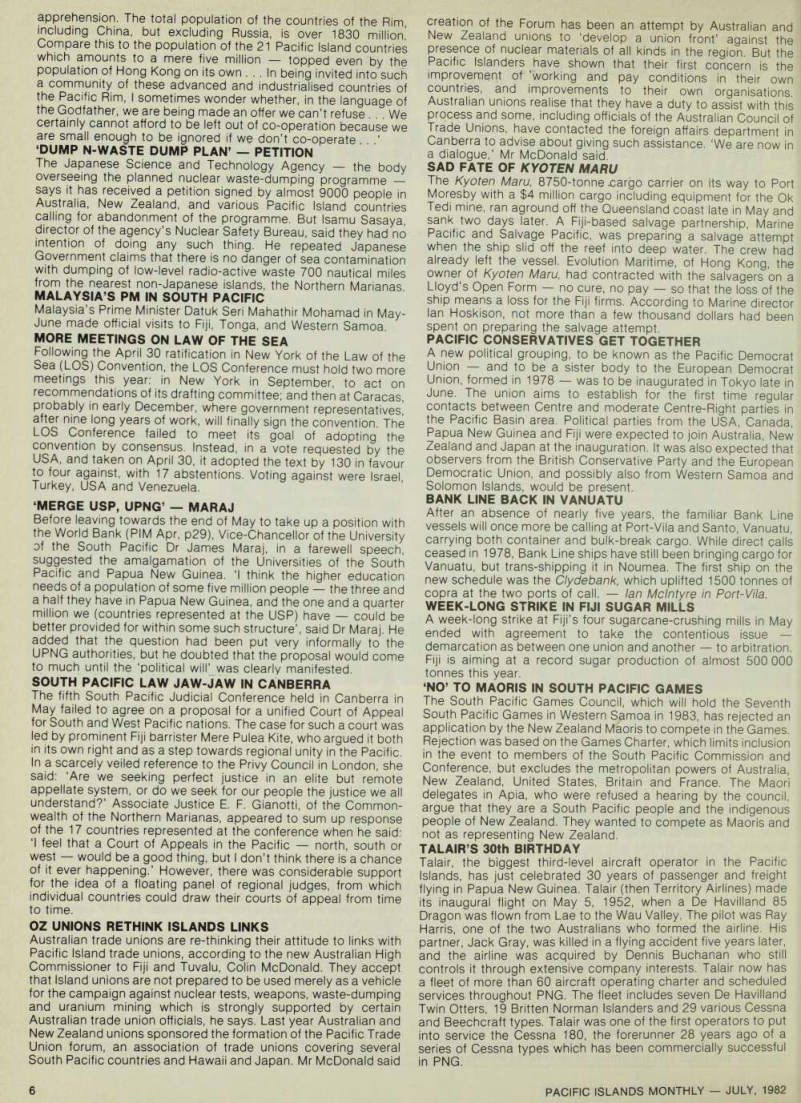
BIG THREE’ ALL CONFIDENT IN PNG POLL Papua New Guineans on June 5 began their three weeks of voting in the country’s second general election since independence in 1975. As voting began, leaders of all three major parties expressed confidence as to the outcome. Prime Minister Sir Julius Chan said he believed he would be able to form another coalition government if his Peoples Progress Party managed to win 30 of the Parliament’s 109 seats, lambakey Okuk, deputy prime minister and leader of the National Party, predicted his party would win 35 to 45 seats. Leader of the Opposition, and Pangu Party leader, Michael Somare, was the only one of the trio to predict that his party would win sufficient seats to govern alone.
In all, nine parties and more than 1100 candidates are contesting the election.
20Th Birthday Feted In Western Samoa
Week-long celebrations of the 20th anniversary of independence took place in Western Samoa from June 1. Among foreign guests were Cook Islands Prime Minister Sir Thomas Davis and Lady Davis, and Papua New Guinea’s Chief Justice Sir Buri Kidu. PNG Prime Minister Sir Julius Chan said he was sorry election commitments prevented him from attending, but was delighted Sir Buri could go to represent PNG. Western Samoa was the first Pacific Island country to achieve independence, in 1962.
Usa, Marshalls, Agree On Compact
The USA and the Marshall Islands have ended more than 13 years of negotiations with an agreement to allow the Marshalls to become a free republic. A United Press International report stated that the first ‘Compact of Free Association’ between the two nations calls for about SUS2OOO million in American aid to be given to the Marshalls over a 15-year period. The agreement, negotiated in Honolulu, can be extended for a further 15 years.
Under the compact the islands will continue to be defended by the USA, and America will continue to use atolls in the group for missile tests.
Charge, Countercharge, In Border Row
Indonesia has officially denied Papua New Guinea claims of incursions across the Irian Jaya border by its forces on May 14, 15 and 21. The row, coinciding with PNG’s election campaign, has thrown severe strain on relations between the two countries, a strain exacerbated by the outspoken anti-Indonesian stand taken by Deputy Prime Minister lambakey Okuk in his election campaigning. Indonesia, in a stiff diplomatic statement issued on June 10 in Jakarta in reply to a PNG protest, said that Free Papua Movement (OPM) rebels had captured 58 employees at an Indonesian sawmill last October and taken them to PNG as hostages. The PNG Government had done nothing to return them to Irian Jaya. It said that 30 of the 58 were Selus people, and were finally released by Selus people crossing the border, not Indonesian soldiers. Port Moresby sources say there is absolutely no doubt that there was an Indonesian incursion on May 14. It is also widely believed in the PNG capital that a helicopter landing seven kilometres inside PNG territory by Irian Jaya commander Brigadier-General Santoso was an attempt to find the where abouts of the remaining hostages, and was not ‘caused by bad weather’ as claimed by the Indonesians.
Big New Shift In Noumea Politics
Two members of the Centrist F6d6ration pour une Nouvelle Soctete Caledonienne (FNSC) have resigned from New Caledonia’s council of government, saying they can no longer work with their former coalition partners on the council, the representatives of the conservative Ralliement Pour la Caledonie dans la Republique (RPCR). They said the RPCR had been rigid in blocking any reformist or progressive moves. A Radio Australia correspondent in Noumea reported on June 9 that it was now expected that the FNSC would form a coalition in the Territorial Assembly with the Front Independantiste (FI), ensuring a majority for a censure motion against the remaining government councillors. (See earlier report from Helen Fraser, Political Currents, this issue.) As the above developments were occurring,
it was announced that the expired six-month term of France’s High Commissioner Christian Nucci was to be renewed for at least another three months.
Fiji Candidate S Tactical Retreat’
The withdrawal of an Alliance Party candidate, Bua farmer Shiu Prasad, from the Fiji general election contest in July, gave the National Federation Party candidate, Senator Subarmarni Basawaiya, the Savusavu/Macuatu East Indian Communal seat in the House of Representatives without a fight. First impressions were that Shiu Prasad, an ex-NFP man, had double-crossed the Alliance. But Alliance members later claimed that their loss of the seat was a tactical victory. Councillor Parbhu Prasad of the Alliance called it a ‘calculated gamble’. The NFP would have won the seat, anyway, he said. But, now that there was no election for that seat, many NFP supporters would not bother turning up to vote in the election for the two National seats in the Vanua Levu North and West constituencies, giving the Alliance a much better chance of winning the two National seats.
Sentences On Tahiti Eight Reduced
A court of appeal in Versailles has reduced the sentences on eight Tahitians convicted of the murder of a prison warder in Papeete’s Nuutnia gaol on January 14, 1978 (PIM Jul ’79 p 27). The chief accused, Imanuela Tauhiro, 42, had his sentence reduced from life to 10 years, and his seven companions, who had been given terms at their original Papeete trial of between 12 and 20 years, had theirs cut back to four years. In view of the time they have served so far both before and since their first trial they were released shortly after the Versailles hearing closed. All men joined in an appeal in court for forgiveness from the widow of the slain warder, Pierre Hoatua, saying they had never intended to kill him.
All have insisted all along that they were not common criminals, but fighters for the independence of their country, and against France’s nuclear testing programme at Moruroa. The reductions won in their sentences indicate that since the Mitterrand government came to power, the French courts are willing to give some credence to such a claim.
Two Ministers Resign In Solomons
Two cabinet ministers in the Solomon Islands government have resigned. They are the minister for foreign affairs and international trade, Mr Ezekiel Alebua, and the minister for Guadalcanal provincial affairs, Mr Waeta Ben. The two ministers have been ministers in the government of prime minister Mr Solomon Mamaloni since the fall of the Kenilorea government last year.
Both Mr Alebua and Mr Ben said they resigned for a number of reasons including not being able to work well with other members of the cabinet.
Spec, Src: No Merger Yet
The long-running debate about a merger of the South Pacific Bureau for Economic Co-operation (SPEC) and the South Pacific Commission (SPC) has reached a new staging-point: a working party of the South Pacific Forum, SPEC’s parent body, after long deliberations, is reported to have recommended that the time is not ripe for a merger. Since membership of the forum is limited to independent countries, a merger at present would prevent French Pacific territories from belonging.
PARIS TAKES NEW LOOK AT ASIA, PACIFIC An unprecedented five-day conference in Paris in May brought together 18 French ambassadors and consuls-general to Pacific countries and Pacific Rim states such as the US, Canada, China and the Soviet Union. It was also attended by France’s high commissioners to New Caledonia and French Polynesia. Official French sources said the conference represented just a beginning of new French approaches to a region ‘which is extremely under estimated in France’. The conference studied three themes: the industrial Pacific, the military Pacific, and the South Pacific. The latter is of particular interest to France because of its territories in the region and its Moruroa nuclear tests. An AFP report said the conference saw the South Pacific as a zone ‘devoid of people’ where, ‘thanks particularly to the vigilance of Australia, Western influence is not contested’.
Michael Somare Among The Godfathers
Former Papua New Guinea Prime Minister Michael Somare was the only speaker from the Pacific Island countries at a slap-up June convention it cost each person there $A345 to attend at Sydney’s Hilton Hotel. The subject was: Development of Pacific Resources. He told the convention: ‘Most of you are on the Rim, deciding whether to plunge in. We are in the Basin which is surrounded by that Rim, and we are watching with some
apprehension. The total population of the countries of the Rim including China, but excluding Russia, is over 1830 million’
Compare this to the population of the 21 Pacific Island countries which amounts to a mere five million topped even by the population of Hong Kong on its own ... In being invited into such a community of these advanced and industrialised countries of the Pacific Rim, I sometimes wonder whether, in the language of the Godfather, we are being made an offer we can’t refuse... We certainly cannot afford to be left out of co-operation because we are small enough to be ignored if we don’t co-operate
‘Dump N-Waste Dump Plan’ Petition
The Japanese Science and Technology Agency the body overseeing the planned nuclear waste-dumping programme says it has received a petition signed by almost 9000 people in Australia, New Zealand, and various Pacific Island countries calling for abandonment of the programme. But Isamu Sasaya, director of the agency’s Nuclear Safety Bureau, said they had no intention of doing any such thing. He repeated Japanese Government claims that there is no danger of sea contamination with dumping of low-level radio-active waste 700 nautical miles from the nearest non-Japanese islands, the Northern Marianas
Malaysia’S Pm In South Pacific
Malaysia’s Prime Minister Datuk Seri Mahathir Mohamad in May- June made official visits to Fiji, Tonga, and Western Samoa.
MORE MEETINGS ON LAW OF THE SEA Following the April 30 ratification in New York of the Law of the Sea (LOS) Convention, the LOS Conference must hold two more meetings this year: in New York in September, to act on recommendations of its drafting committee; and then at Caracas, probably in early December, where government representatives! after nine long years of work, will finally sign the convention. The LOS Conference failed to meet its goal of adopting the convention by consensus. Instead, in a vote requested by the USA, and taken on April 30, it adopted the text by 130 in favour to four against, with 17 abstentions. Voting against were Israel Turkey, USA and Venezuela.
‘Merge Usp, Upng’ Maraj
Before leaving towards the end of May to take up a position with the World Bank (PIM Apr, p 29), Vice-Chancellor of the University of the South Pacific Dr James Maraj, in a farewell speech, suggested the amalgamation of the Universities of the South Pacific and Papua New Guinea. ‘I think the higher education needs of a population of some five million people the three and a half they have in Papua New Guinea, and the one and a quarter million we (countries represented at the USP) have could be better provided for within some such structure’, said Dr Maraj. He added that the question had been put very informally to the UPNG authorities, but he doubted that the proposal would come to much until the ‘political will’_was clearly manifested.
South Pacific Law Jaw-Jaw In Canberra
The fifth South Pacific Judicial Conference held in Canberra in May failed to agree on a proposal for a unified Court of Appeal for South and West Pacific nations. The case for such a court was led by prominent Fiji barrister Mere Pulea Kite, who argued it both in its own right and as a step towards regional unity in the Pacific.
In a scarcely veiled reference to the Privy Council in London, she said: ‘Are we seeking perfect justice in an elite but remote appellate system, or do we seek for our people the justice we all understand?’ Associate Justice E. F. Gianotti, of the Common wealth of the Northern Marianas, appeared to sum up response of the 17 countries represented at the conference when he said: ‘I feel that a Court of Appeals in the Pacific north, south or west would be a good thing, but I don’t think there is a chance of it ever happening.’ However, there was considerable support for the idea of a floating panel of regional judges, from which individual countries could draw their courts of appeal from time to time.
Oz Unions Rethink Islands Links
Australian trade unions are re-thinking their attitude to links with Pacific Island trade unions, according to the new Australian High Commissioner to Fiji and Tuvalu, Colin McDonald. They accept that Island unions are not prepared to be used merely as a vehicle for the campaign against nuclear tests, weapons, waste-dumping and uranium mining which is strongly supported by certain Australian trade union officials, he says. Last year Australian and New Zealand unions sponsored the formation of the Pacific Trade Union forum, an association of trade unions covering several South Pacific countries and Hawaii and Japan. Mr McDonald said
creation of the Forum has been an attempt by Australian and New Zealand unions to ‘develop a union front’ against the presence of nuclear materials of all kinds in the region. But the Pacific Islanders have shown that their first concern is the improvement of 'working and pay conditions in their own countries, and improvements to their own organisations.
Australian unions realise that they have a duty to assist with this process and some, including officials of the Australian Council of Trade Unions, have contacted the foreign affairs department in Canberra to advise about giving such assistance. ‘We are now in a dialogue,’ Mr McDonald said.
Sad Fate Of Kyoten Maru
The Kyoten Maru, 8750-tonne .cargo carrier on its way to Port Moresby with a $4 million cargo including equipment for the Ok Tedi mine, ran aground off the Queensland coast late in May and sank two days later, A Fiji-based salvage partnership, Marine Pacific and Salvage Pacific, was preparing a salvage attempt when the ship slid off the reef into deep water. The crew had already left the vessel. Evolution Maritime, of Hong Kong, the owner of Kyoten Maru, had contracted with the salvagers on a Lloyd’s Open Form no cure, no pay so that the loss of the ship means a loss for the Fiji firms. According to Marine director lan Hoskison, not more than a few thousand dollars had been spent on preparing the salvage attempt.
Pacific Conservatives Get Together
A new political grouping, to be known as the Pacific Democrat Union and to be a sister body to the European Democrat Union, formed in 1978 was to be inaugurated in Tokyo late in June. The union aims to establish for the first time regular contacts between Centre and moderate Centre-Right parties in the Pacific Basin area. Political parties from the USA, Canada, Papua New Guinea and Fiji were expected to join Australia, New Zealand and Japan at the inauguration. It was also expected that observers from the British Conservative Party and the European Democratic Union, and possibly also from Western Samoa and Solomon Islands, would be present.
Bank Line Back In Vanuatu
After an absence of nearly five years, the familiar Bank Line vessels will once more be calling at Port-Vila and Santo, Vanuatu, carrying both container and bulk-break cargo. While direct calls ceased in 1978, Bank Line ships have still been bringing cargo for Vanuatu, but trans-shipping it in Noumea. The first ship on the new schedule was the Clydebank, which uplifted 1500 tonnes of copra at the two ports of call. lan Mclntyre in Port-Vila.
Week-Long Strike In Fiji Sugar Mills
A week-long strike at Fiji’s four sugarcane-crushing mills in May ended with agreement to take the contentious issue demarcation as between one union and another to arbitration.
Fiji is aiming at a record sugar production of almost 500 000 tonnes this year. ‘NO’ TO MAORIS IN SOUTH PACIFIC GAMES The South Pacific Games Council, which will hold the Seventh South Pacific Games in Western Samoa in 1983, has rejected an application by the New Zealand Maoris to compete in the Games.
Rejection was based on the Games Charter, which limits inclusion in the event to members of the South Pacific Commission and Conference, but excludes the metropolitan powers of Australia, New Zealand, United States, Britain and France. The Maori delegates in Apia, who were refused a hearing by the council, argue that they are a South Pacific people and the indigenous people of New Zealand. They wanted to compete as Maoris and not as representing New Zealand.
Talair’S 30Th Birthday
Talair, the biggest third-level aircraft operator in the Pacific Islands, has just celebrated 30 years of passenger and freight flying in Papua New Guinea. Talair (then Territory Airlines) made its inaugural flight on May 5, 1952, when a De Havilland 85 Dragon was flown from Lae to the Wau Valley. The pilot was Ray Harris, one of the two Australians who formed the airline. His partner, Jack Gray, was killed in a flying accident five years later, and the airline was acquired by Dennis Buchanan who still controls it through extensive company interests. Talair now has a fleet of more than 60 aircraft operating charter and scheduled services throughout PNG. The fleet includes seven De Havilland Twin Otters, 19 Britten Norman Islanders and 29 various Cessna and Beechcraft types. Talair was one of the first operators to put into service the Cessna 180, the forerunner 28 years ago of a series of Cessna types which has been commercially successful in PNG.
Letters

The 30 lies of 30 Jours
PIM (Oct ’81 p5) reported the imminent launching of 30 Jours, a French/English lang uage magazine directed at the Pacific. After some delays, the magazine finally made its ap pearance in February 1982, and has appeared regularly since.
It should be noted first of all that 30 Jours has signally failed to deliver on its promise of bilingualism. The magazine is to all intents and purposes French. The only ‘bilingual’ thing about it is that its major articles are accompanied by small panels carrying short summaries of their content in ‘English’ of unfailing quaintness.
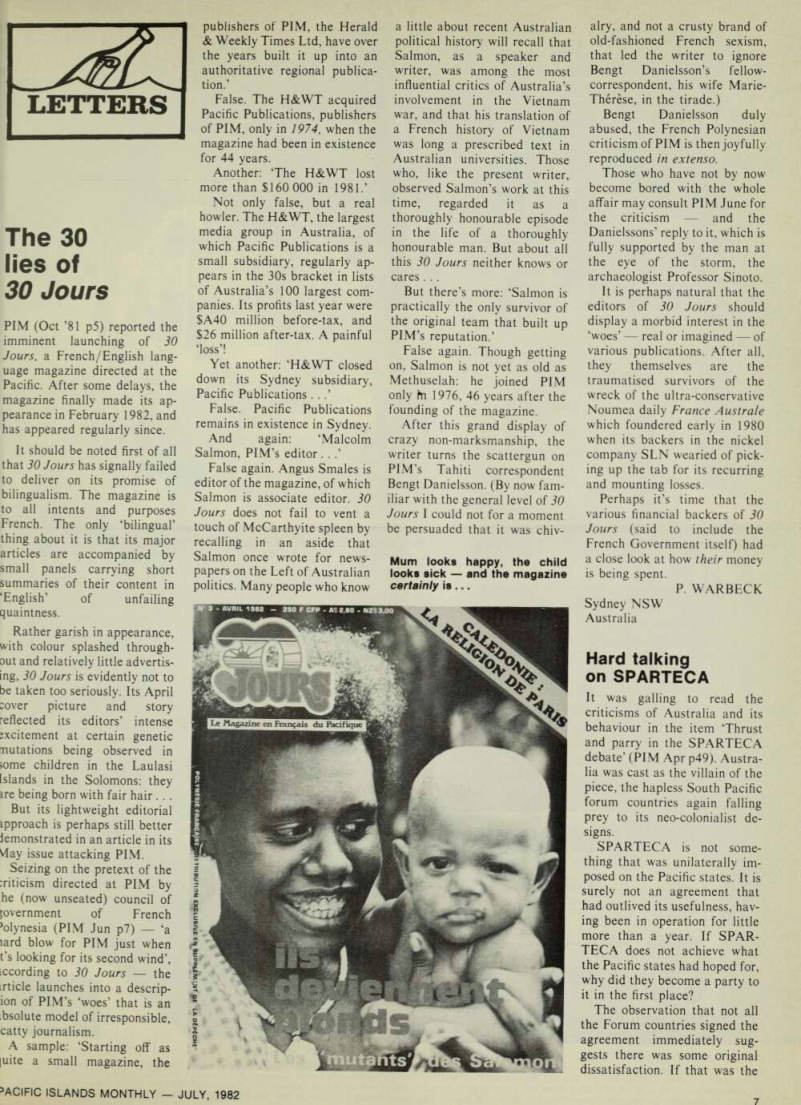
Rather garish in appearance, with colour splashed through out and relatively little advertis ing, 30 Jours is evidently not to be taken too seriously. Its April :over picture and story reflected its editors’ intense ;xcitement at certain genetic nutations being observed in •ome children in the Laulasi islands in the Solomons: they ire being born with fair hair . . .
But its lightweight editorial ipproach is perhaps still better lemonstrated in an article in its Vlay issue attacking PIM.
Seizing on the pretext of the criticism directed at PIM by he (now unseated) council of government of French (PIM Jun p7) — ‘a lard blow for PIM just when t’s looking for its second wind’, iccording to 30 Jours — the irticle launches into a descrip ion of PIM’s ‘woes’ that is an bsolute model of irresponsible, catty journalism.
A sample: ‘Starting off as [uite a small magazine, the
publishers of PIM, the Herald & Weekly Times Ltd, have over the years built it up into an authoritative regional publica tion.’
False. The H&WT acquired Pacific Publications, publishers of PIM, only in 1974, when the magazine had been in existence for 44 years.
Another: ‘The H&WT lost more than $l6O 000 in 1981.’
Not only false, but a real howler. The H&WT, the largest media group in Australia, of which Pacific Publications is a small subsidiary, regularly ap pears in the 30s bracket in lists of Australia’s 100 largest com panies. Its profits last year were SA4O million before-tax, and $26 million after-tax. A painful ‘loss’!
Yet another: ‘H&WT closed down its Sydney subsidiary, Pacific Publications ...’
False. Pacific Publications remains in existence in Sydney.
And again; ‘Malcolm Salmon, PlM’s editor . ..’
False again. Angus Smales is editor of the magazine, of which Salmon is associate editor. 30 Jours does not fail to vent a touch of McCarthyite spleen by recalling in an aside that Salmon once wrote for news papers on the Left of Australian politics. Many people who know
a little about recent Australian political history will recall that Salmon, as a speaker and writer, was among the most influential critics of Australia’s involvement in the Vietnam war, and that his translation of a French history of Vietnam was long a prescribed text in Australian universities. Those who, like the present writer, observed Salmon’s work at this time, regarded it as a thoroughly honourable episode in the life of a thoroughly honourable man. But about all this 30 Jours neither knows or cares. ..
But there’s more: ‘Salmon is practically the only survivor of the original team that built up PlM’s reputation.’
False again. Though getting on, Salmon is not yet as old as Methuselah: he joined PIM only m 1976, 46 years after the founding of the magazine.
After this grand display of crazy non-marksmanship, the writer turns the scattergun on PlM’s Tahiti correspondent Bengt Danielsson. (By now fam iliar with the general level of 30 Jours I could not for a moment be persuaded that it was chiv-
airy, and not a crusty brand of old-fashioned French sexism, that led the writer to ignore Bengt Danielsson’s fellow correspondent, his wife Marie- Therese, in the tirade.) Bengt Danielsson duly abused, the French Polynesian criticism of PIM is then joyfully reproduced in extenso.
Those who have not by now become bored with the whole affair may consult PIM June for the criticism and the Danielssons’ reply to it, which is fully supported by the man at the eye of the storm, the archaeologist Professor Sinoto.
It is perhaps natural that the editors of 30 Jours should display a morbid interest in the ‘woes’ real or imagined of various publications. After all, they themselves are the traumatised survivors of the wreck of the ultra-conservative Noumea daily France Australe which foundered early in 1980 when its backers in the nickel company SEN wearied of pick ing up the tab for its recurring and mounting losses.
Perhaps it’s time that the various financial backers of 30 Jours (said to include the French Government itself) had a close look at how their money is being spent.
P. Warbeck
Sydney NSW Australia
Hard talking
On Sparteca
It was galling to read the criticisms of Australia and its behaviour in the item Thrust and parry in the SPARTECA debate’ (PIM Apr p 49). Austra lia was cast as the villain of the piece, the hapless South Pacific forum countries again falling prey to its neo-colonialist de signs.
SPARTECA is not some thing that was unilaterally im posed on the Pacific states. It is surely not an agreement that had outlived its usefulness, hav ing been in operation for little more than a year. If SPAR TECA does not achieve what the Pacific states had hoped for, why did they become a party to it in the first place?
The observation that not all the Forum countries signed the agreement immediately sug gests there was some original dissatisfaction. If that was the
Mum looks happy, the child looks sick and the magazine certainly is ...
case, it is surely up to those states to adopt a more united and harder bargaining position.
They cannot realistically expect Australia to do this for them.
The comment which con cerned me most was the one attributed to Dr William Sutherland to the effect that ‘the Australian Government (must) confront Australian domestic interests with what SPARTECA must achieve’.
Confront them with what?
With an agreement whereby a small group of Pacific business men prosper, possibly at the expense of their Australian counterparts? With an agree ment that will help to ensure that the elites in these countries have sufficient foreign exchange to continue living in the manner to which they have become accustomed?
Before waxing lyrical about the importance of SPARTECA to the Pacific countries one would do well to remember that these are predominantly rural societies where linkages be tween industrial growth and general improvements in the welfare of the people do not necessarily go hand in hand.
Having got this far, and before I lose too many readers, I must now confess that I am not totally serious in all of this.
But too often, and in all serious ness, a ‘good guys and villains’ dichotomy is drawn in discuss ing relations between the more and less developed countries that is both inappropriate and counter-productive. Above I have not told the whole story.
Nor does the Sutherland argu ment, as reported, tell the whole story.
An old and basic premise to the understanding of the inter national behaviour of any country is to look at the dom estic political constraints on that country’s foreign policy. In the case of Australia there are real domestic constraints on what any government can do by way of liberalising trade.
Australian Prime Minister Malcolm Fraser, for example, earnestly supports the cause of developing countries. Yet in the more limited confines of Austra lian economic debate he can be seen as a protectionist. There are real powers at work here that cannot be easily pushed
aside or circumvented. To suggest otherwise is like suggesting gravity should go away so man can fly.
If SPARTECA is not fulfill ing the expectations of the Pacific states this may well be because those expectations are not solidly enough grounded. A realistic evaluation of what SPARTECA is, or might be come, should similarly be cogni sant of what is possible. Black and white pictures of good guys and villains do not help.
My prognosis should not how ever be mistaken as a conserva tive one. Man learnt to fly, but not by wishing gravity away.
T. Cressing
Millswood SA Australia
Protecting marine
life in Vanuatu
I wish to express my concern about the gradual disappear ance of the rare species of underwater life from the waters of Vanuatu. The red and black corals are becoming increas ingly scarce round Vanuatu as expatriates pick it all up in order partly to decorate their homes, and partly to sell it to jewellers at high prices.
Another very serious concern is the killing of turtles for their shells which is a current occu pation of expatriate citizens, who ought to be best prepared to respect the natural environ ment of their host country.
Allen Power, the author of a book on the Great Barrier Reef and the leader of dive ex
peditions in Santo, can recall the days when, not very long ago, there used to be red coral growing all along the main wharf in Luganville, until a diving team came and picked it all up in one day it never grew again.
The wreck of the President Coolidge is also currently ran sacked and the coral gardens above the Coolidge are often used as a free souvenir shop. As there is no legislation in Vanuatu at present, the people concerned with the rapid disap pearance of rare corals, shells and turtles are left helpless and can only watch with increasing anxiety the chain of life based on those corals gradually disin tegrating.
Let us hope legislation will soon be established so we can all still enjoy the rare beauty of the underwater life round Vanuatu.
In the meantime I hope this letter will encourage people to be more considerate.
Francoise Brindle
Santo Vanuatu
Dry eye over an
untended tomb
I have nothing against white people I happen to be one.
But I’ll leave it to Stu Inder (PIM May p 25) to express remorse that the racist Christopher Robinson lies in an untended grave in Port
Moresby.
Inder reported that Robinson, while acting adminis trator of Papua in 1904, was involved in a clash in which ‘a
number of natives were killed’.
When the Australian Govern ment pointed out to Robinson that killing ‘natives’ was not proper, poor Robinson shot him self.
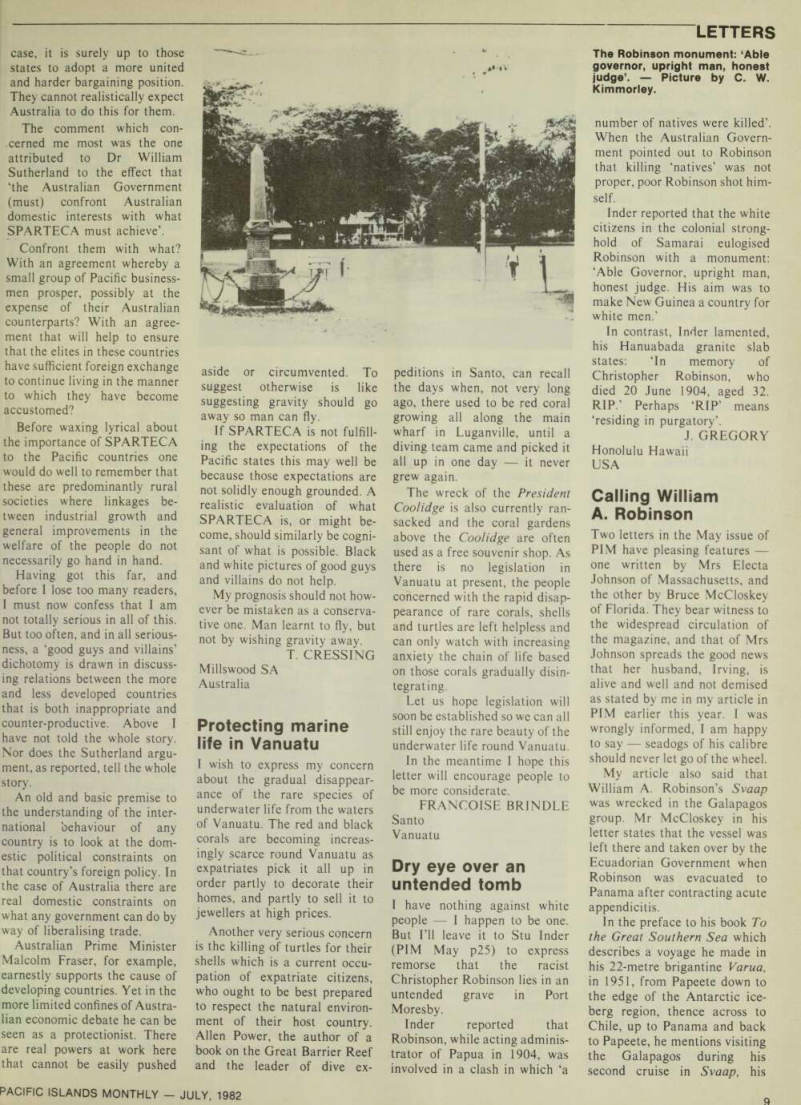
Inder reported that the white citizens in the colonial strong hold of Samarai eulogised Robinson with a monument: ‘Able Governor, upright man, honest judge. His aim was to make New Guinea a country for white men.’
In contrast, Inder lamented, his Hanuabada granite slab states: ‘ln memory of Christopher Robinson, who died 20 June 1904, aged 32.
RIP.’ Perhaps ‘RIP’ means ‘residing in purgatory’.
J. Gregory
Honolulu Hawaii
Usa
Calling William
A. Robinson
Two letters in the May issue of PIM have pleasing features one written by Mrs Electa Johnson of Massachusetts, and the other by Bruce McCloskey of Florida. They bear witness to the widespread circulation of the magazine, and that of Mrs Johnson spreads the good news that her husband, Irving, is alive and well and not demised as stated by me in my article in PIM earlier this year. I was wrongly informed, I am happy to say seadogs of his calibre should never let go of the wheel.
My article also said that William A. Robinson’s Svaap was wrecked in the Galapagos group. Mr McCloskey in his letter states that the vessel was left there and taken over by the Ecuadorian Government when Robinson was evacuated to Panama after contracting acute appendicitis.
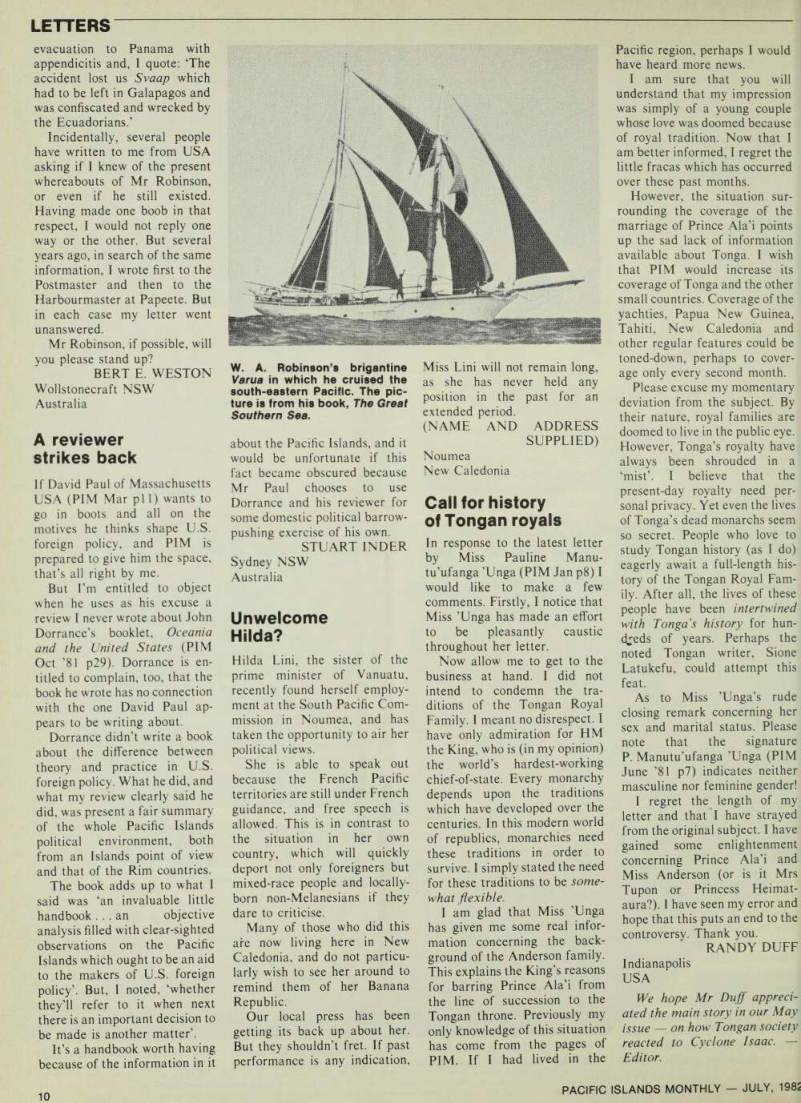
In the preface to his book To the Great Southern Sea which describes a voyage he made in his 22-metre brigantine Varua, in 1951, from Papeete down to the edge of the Antarctic ice berg region, thence across to Chile, up to Panama and back to Papeete, he mentions visiting the Galapagos during his second cruise in Svaap, his
The Robinson monument: ‘Able governor, upright man, honest judge’. Picture by C. W.
Kimmorley.
evacuation to Panama with appendicitis and, I quote: The accident lost us Svaap which had to be left in Galapagos and was confiscated and wrecked by the Ecuadorians.’
Incidentally, several people have written to me from USA asking if I knew of the present whereabouts of Mr Robinson, or even if he still existed.
Having made one boob in that respect, I would not reply one way or the other. But several years ago, in search of the same information, I wrote first to the Postmaster and then to the Harbourmaster at Papeete. But in each case my letter went unanswered.
Mr Robinson, if possible, will you please stand up?
Bert E. Weston
Wollstonecraft NSW Australia
A reviewer
strikes back
If David Paul of Massachusetts USA (PIM Mar p 11) wants to go in boots and all on the motives he thinks shape U.S. foreign policy, and PIM is prepared to give him the space, that’s all right by me.
But I’m entitled to object when he uses as his excuse a review I never wrote about John Dorrance’s booklet, Oceania and the United States (PIM Oct ’Bl p 29). Dorrance is en titled to complain, too, that the book he wrote has no connection with the one David Paul ap pears to be writing about.
Dorrance didn’t write a book about the difference between theory and practice in U.S. foreign policy. What he did, and what my review clearly said he did, was present a fair summary of the whole Pacific Islands political environment, both from an Islands point of view and that of the Rim countries.
The book adds up to what I said was ‘an invaluable little handbook ... an objective analysis filled with clear-sighted observations on the Pacific Islands which ought to be an aid to the makers of U.S. foreign policy’. But, 1 noted, ‘whether they’ll refer to it when next there is an important decision to be made is another matter’.
It’s a handbook worth having because of the information in it
about the Pacific Islands, and it would be unfortunate if this fact became obscured because Mr Paul chooses to use Dorrance and his reviewer for some domestic political barrow pushing exercise of his own.
Stuart Inder
Sydney NSW Australia
Unwelcome
Hilda?
Hilda Lini, the sister of the prime minister of Vanuatu, recently found herself employ ment at the South Pacific Com mission in Noumea, and has taken the opportunity to air her political views.
She is able to speak out because the French Pacific territories are still under French guidance, and free speech is allowed. This is in contrast to the situation in her own country, which will quickly deport not only foreigners but mixed-race people and locally born non-Melanesians if they dare to criticise.
Many of those who did this are now living here in New Caledonia, and do not particu larly wish to see her around to remind them of her Banana Republic.
Our local press has been getting its back up about her.
But they shouldn’t fret. If past performance is any indication,
Miss Lini will not remain long, as she has never held any position in the past for an extended period.
(Name And Address
Supplied)
Noumea New Caledonia
Call for history
of Tongan royals
In response to the latest letter by Miss Pauline Manu tu’ufanga ’Unga (PIM Jan p 8) I would like to make a few comments. Firstly, I notice that Miss ’Unga has made an effort to be pleasantly caustic throughout her letter.
Now allow me to get to the business at hand. I did not intend to condemn the tra ditions of the Tongan Royal Family. I meant no disrespect. I have only admiration for HM the King, who is (in my opinion) the world’s hardest-working chief-of-state. Every monarchy depends upon the traditions which have developed over the centuries. In this modern world of republics, monarchies need these traditions in order to survive. I simply stated the need for these traditions to be some
what flexible.
I am glad that Miss ’Unga has given me some real infor mation concerning the back ground of the Anderson family.
This explains the King’s reasons for barring Prince Ala’i from the line of succession to the Tongan throne. Previously my only knowledge of this situation has come from the pages of PIM. If I had lived in the
Pacific region, perhaps I would have heard more news.
I am sure that you will understand that my impression was simply of a young couple whose love was doomed because of royal tradition. Now that I am better informed, I regret the little fracas which has occurred over these past months.
However, the situation sur rounding the coverage of the marriage of Prince Ala’i points up the sad lack of information available about Tonga. I wish that PIM would increase its coverage of Tonga and the other small countries. Coverage of the yachties, Papua New Guinea, Tahiti, New Caledonia and other regular features could be toned-down, perhaps to cover age only every second month.
Please excuse my momentary deviation from the subject. By their nature, royal families are doomed to live in the public eye.
However, Tonga’s royalty have always been shrouded in a ‘mist’. I believe that the present-day royalty need per sonal privacy. Yet even the lives of Tonga’s dead monarchs seem so secret. People who love to study Tongan history (as I do) eagerly await a full-length his tory of the Tongan Royal Fam ily. After all, the lives of these people have been intertwined with Tonga’s history for hun dreds of years. Perhaps the noted Tongan writer, Sione Latukefu, could attempt this feat.
As to Miss ’Unga’s rude closing remark concerning her sex and marital status. Please note that the signature P. Manutu’ufanga ’Unga (PIM June ’Bl p 7) indicates neither masculine nor feminine gender!
I regret the length of my letter and that I have strayed from the original subject. I have gained some enlightenment concerning Prince Ala’i and Miss Anderson (or is it Mrs Tupon or Princess Heimat aura?). I have seen my error and hope that this puts an end to the controversy. Thank you.
Randy Duff
Indianapolis
Usa
We hope Mr Duff appreci ated the main story in our May issue on how Tongan society reacted to Cyclone Isaac.
Editor.
W. A. Robinson’s brigantine Varua in which he cruised the south-eastern Pacific. The pic ture is from his book, The Great Southern Sea.
Advertisements & other items, p. 8 (1 item)
Let Your Imagination Run Wild
■ ♦ «# I ■ ¥ 4 ■ Wm ■ 9 \
Imagine the dynamic sound of a quality stereo system. And imagine how nice it would be if you could take this sound along with you wherever you go. A fairy tale? Not at Sansui.
We let our imagination run wild and developed Portable Component Systems, the newest Sansui Hi-Tech Compo sound idea.
The creative folks at Sansui borrowed many advanced features from full-size home components. Next, we packed them all into tiny mini-component-sized packages. And as a final touch, we snapped them together and attached a convenient carrying handle.
The result? Dynamic sounding portables that disassemble to form full-feature mini component systems.
Sansui. Imagine what we'll do next. o cO'
PORTABLE COMPONENT SYSTEM CP-7
S rut S lit SANSUI ELECTRIC CO., LTD. 14-1 .Izumi 2-chome, Suginami-ku, Tokyo 168, Japan. ncn , P u nno . % Australia VANFI (Aust ) Pty. Ltd. 297, City Road, South Melbourne, Victoria 3205, Australia Phone: 690-6200/283 Alfred Street, North Sydney, NSW 2060, Australia Phone. o293.Fp iPrabhu Brothers Ltd. PO. Box 183, Nadi Phone: 71122 .Papua Ne W Guinea Oceanra Indent Agency (P.ILGd Box 5518 PM 256406 • New Zealand David R ei d Electronics Ltd. PO. Box 2630, Auckland, Phone: 488-049 .TVeiv Caledonia Ets Michel MERCIER B R 1123 1 2759^ • Central Pacific Nauru Co-operative Society Republic of Nauru • Vanuatu The Sound Centre PO. Box 434, Port Villa Phone: 2035 • Tahiti SIMEL PO. Box 3338 Phone. 26979
Bligh, Christian, and HMS Bounty
The perennial cinematic voyage of Bligh, Christian, and HMS Bounty
Dr NORMAN DOUGLAS, a lecturer in Pacific Studies at the University of New South Wales, Sydney, Australia, has been studying the history of the various films made over the past 60-odd years telling the story of the Bounty mutiny. He turns up evidence that Australian film-makers were easily the earliest in the field, producing the first film on the subject in 1916.
British film director David Lean and his producer Dino de Laurentiis have finally aban doned plans for a two-part remake of the story of the Bounty mutiny (PIM Jun p 24).
Film buffs who have been following the details of this production in the pages of PIM and elsewhere were doubtless able to recall two previous versions of the Bligh-Christian confrontation: the classic 1935 version with Charles Laughton and Clark Gable, and the 1962 version with Trevor Howard and Marlon Brando. The latter, while giving a huge boost to Tahiti’s pre-nuclear economy, also came unintentionally close to self-parody. The American films, both inspired by the novels of Charles Nordhoff and James Norman Hall, are well known. Less well known is the fact that the story of the Pacific’s best-known mutiny has been filmed five times twice by Australians.
In 1916, 20 years before MGM re-created Captain William Bligh in the image of Charles Laughton, an Austra lian film-maker produced the first film of the Bounty story. It had the double distinction of being the first cinematic version of the mutiny and the first Australian dramatic film in which extensive Pacific Islands locations were used.
Without so much as Nordhoff and Hall’s novel to guide him,
producer-director Raymond
Longford began his work like most good students of Pacific history at Sydney’s Mitchell Library. There, in the interests Df historical accuracy, he exam ined records which dealt with the mutiny and the subsequent developments on Pitcairn Island.
Longford’s output until that time had not been particularly impressive, consisting as it did }f routine melodrama and mock ;xotica such as A Maori Maid’s Love. Clearly, the film of the
Bounty mutiny was conceived on a far grander scale. Indeed, the Melbourne Argus of December 2, 1916, announced it to be ‘probably the most costly production yet made in Australia’.
But such an ambitious work could not be based solely on library research and filmed en tirely in Sydney, for, however attractive the beaches at Bondi and Cronulla may have been, they paled in comparison with the settings against which the drama had been originally en acted.
Consequently, Longford, whose later work was to win him deserved praise for its attention to authenticity and detail, de spatched an expedition to
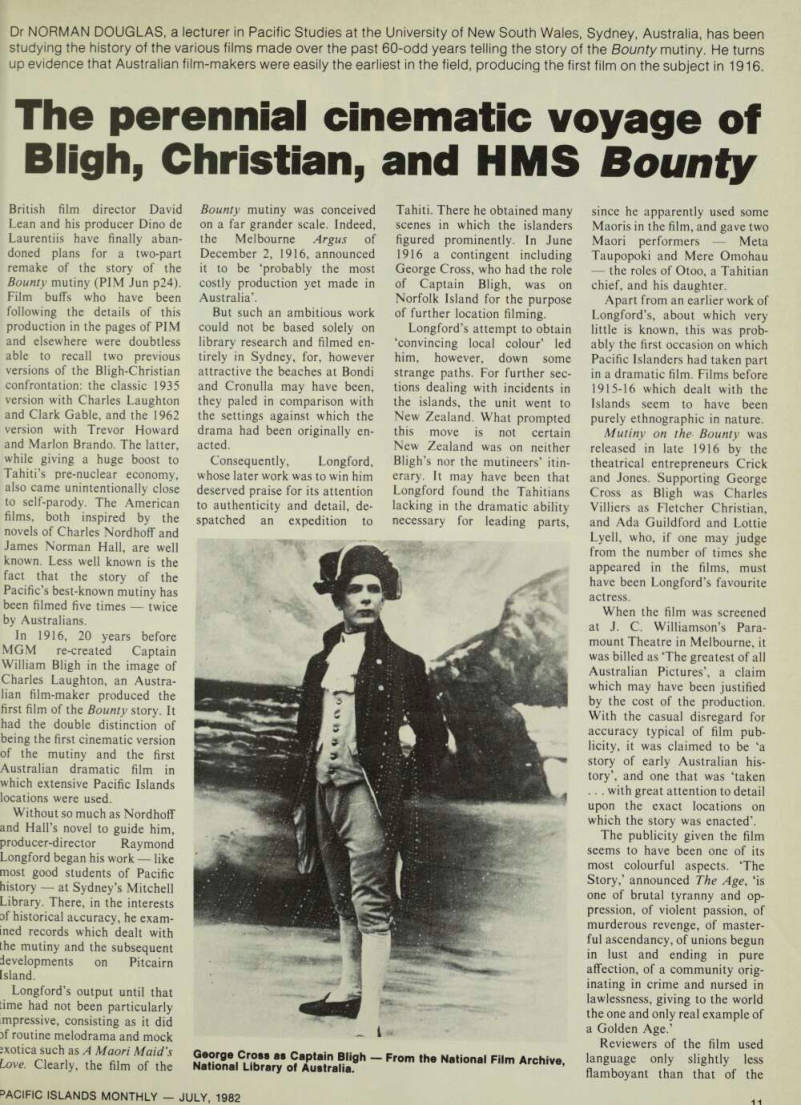
Tahiti. There he obtained many scenes in which the islanders figured prominently. In June 1916 a contingent including George Cross, who had the role of Captain Bligh, was on Norfolk Island for the purpose of further location filming.
Longford’s attempt to obtain ‘convincing local colour’ led him, however, down some strange paths. For further sec tions dealing with incidents in the islands, the unit went to New Zealand. What prompted this move is not certain New Zealand was on neither Bligh’s nor the mutineers’ itin erary. It may have been that Longford found the Tahitians lacking in the dramatic ability necessary for leading parts,
since he apparently used some Maoris in the film, and gave two Maori performers Meta Taupopoki and Mere Omohau the roles of Otoo, a Tahitian chief, and his daughter.
Apart from an earlier work of Longford’s, about which very little is known, this was prob ably the first occasion on which Pacific Islanders had taken part in a dramatic film. Films before 1915-16 which dealt with the Islands seem to have been purely ethnographic in nature.
Mutiny on the Bounty was released in late 1916 by the theatrical entrepreneurs Crick and Jones. Supporting George Cross as Bligh was Charles Villiers as Fletcher Christian, and Ada Guildford and Lottie Lyell, who, if one may judge from the number of times she appeared in the films, must have been Longford’s favourite actress.
When the film was screened at J. C. Williamson’s Para mount Theatre in Melbourne, it was billed as The greatest of all Australian Pictures’, a claim which may have been justified by the cost of the production.
With the casual disregard for accuracy typical of film pub licity, it was claimed to be ‘a story of early Australian his tory’, and one that was ‘taken .. . with great attention to detail upon the exact locations on which the story was enacted’.
The publicity given the film seems to have been one of its most colourful aspects. ‘The Story,’ announced The Age, ‘is one of brutal tyranny and op pression, of violent passion, of murderous revenge, of master ful ascendancy, of unions begun in lust and ending in pure affection, of a community orig inating in crime and nursed in lawlessness, giving to the world the one and only real example of a Golden Age.’
Reviewers of the film used language only slightly less flamboyant than that of the
George Cross as Captain Bligh -From the National Film Archive, National Library of Australia.
publicity men. The Winner as sured its readers that, in its ‘arresting presentment of an historic happening,’ the film would appeal ‘to those who look beyond the meretricious sparkle of screen sensation allied to mawkish sentimentalism’.
In the manner of all works aspiring to epic qualities, Mu tiny of The Bounty provided a moral. Tagged on to the film was a scene showing descend ants of Fletcher Christian en listing in Sydney to fight for King and Country in the Great War, presumably as atonement for the sins of their forefather.
Despite the expense of pro duction, the excesses of the publicity writers and the gener ally favourable reviews, the film was apparently something less than a success. By the fourth day of its one-week run at the Paramount the billing had changed, and Mutiny was being advertised as the support to an American melodrama called The Love Mask.
Raymond Longford eventu ally gained a place in the Australian cinema’s sparsely populated Hall of Fame with his versions of those classic Austra lian ‘folk’ pieces, The Senti mental Bloke and On Our Selection. The merits of his Mutiny of The Bounty can no longer be assessed, since there is
evidently no print of the film extant. In the early years of film production in Australia, the requirements of posterity were not seriously considered, and many pioneer works were lost or destroyed through negligence or sheer indifference.
The adventures of Bligh and his recalcitrant crew were for gotten, so far as film men were concerned, for 16 years. In 1932 another Australian producer, Charles Chauvel, revived the Bounty story. Nordhoff and Hall had already begun the research for their fictionalised account, but its publication lay a year in the future. If Chauvel was aware either of their labours or Longford’s earlier work, he gave no indication of it. Indeed, he wrote as though his discovery had been acciden tal: ‘With a globe-trotting com panion I was tracing through the map of the world in an attempt to discover a place where a movie camera had never been and where a story was perhaps lying untouched.’
Chauvel’s attempts to find an out-of-the-way locale for a film led him to consider Tristan da Cunha, Juan Fernandez and Easter Island. Finally, he ‘stumbled upon Pitcairn Island’. His first serious intro duction to the Bounty story took place when he came across
Bligh’s log of the Providence on a Queensland cattle station owned by the Bligh-Nuttings, descendants of the long suffering captain.
The log of the Providence contained references to the Bounty mutiny. Chauvel, with an eye for the exotic and dramatic, found his interest aroused. Like his predecessor, Longford, he headed for the Mitchell Library and spent a year’s research going through Bligh’s log of the Bounty , the Journal of James Morrison and other relevant documents.
A new production company, Expeditionary Films, was formed, and under its auspices Chauvel and his crew left for the Islands on April 14, 1932.
Chauvel attempted to keep his exact motives and destination as secret as possible, apparently fearing that an American com pany would rush in before him.
He had shortly before spent some time in the United States and had first-hand knowledge of the facilities and throat-cutting techniques of Hollywood film producers. When he departed for the Islands, even his camera man, Tasman Higgins, was al legedly unaware of the scene of their operation.
In New Zealand, a few months later, with a sizeable amount of exposed film in the
can, Chauvel was less reticent about disclosing information.
He had been, he informed the press, at Pitcairn Island, and had nothing but praise for the islanders’ magnificent seaman ship and the great assistance they had given him. Chauvel’s own experience on Pitcairn had been dramatic enough. A severe earthquake had rocked the island during his stay, and members of the film crew had been nearly drowned when at tempting to land in a whaleboat.
Having given the newsmen a taste of his activities, Chauvel announced his departure for Tahiti and further filming there.
When he returned to Sydney late in August 1932, after having travelled some 24 000 kilometres in ‘little known parts of the Pacific Ocean’, Chauvel’s bashfulness about his travels of the previous months had disap peared. It was the belief of his company, he said, that Austra lian history was too much neglected and attempts would be made to fill in the gaps.
Every effort had been made to present a faithful picture of the wanderings of the Bounty mu tineers before they reached Pitcairn Island. He had fol lowed the route of the Bounty and had seen the remains lying in the clear water at Pitcairn.
At Tahiti, he had filmed native dances with natives specially chosen for the occasion, as a knowledge of primitive dances was rapidly dying out.
But Chauvel, in his enthusi asm, had reckoned without the eternal bugbear of film pro ducers both foreign and dom estic the Australian censor.
While he filmed interiors at Cinesound’s studios, and a few other scenes on a ship in Sydney Harbour, the film censor, W.
Cresswell O’Reilly, inspected the Tahitian footage and found it not to his taste. He, therefore, denied it right of entry, almost in its entirety.
Claiming that the decision was unfair, Chauvel pointed out that the sequences had been viewed out of context, and in any event some of the material would be discarded during the editing of the completed film.
Moreover, he argued, a recently released American film had shown African natives in a similar state of nudity. While in Tahiti, his company had been warmly congratulated by both
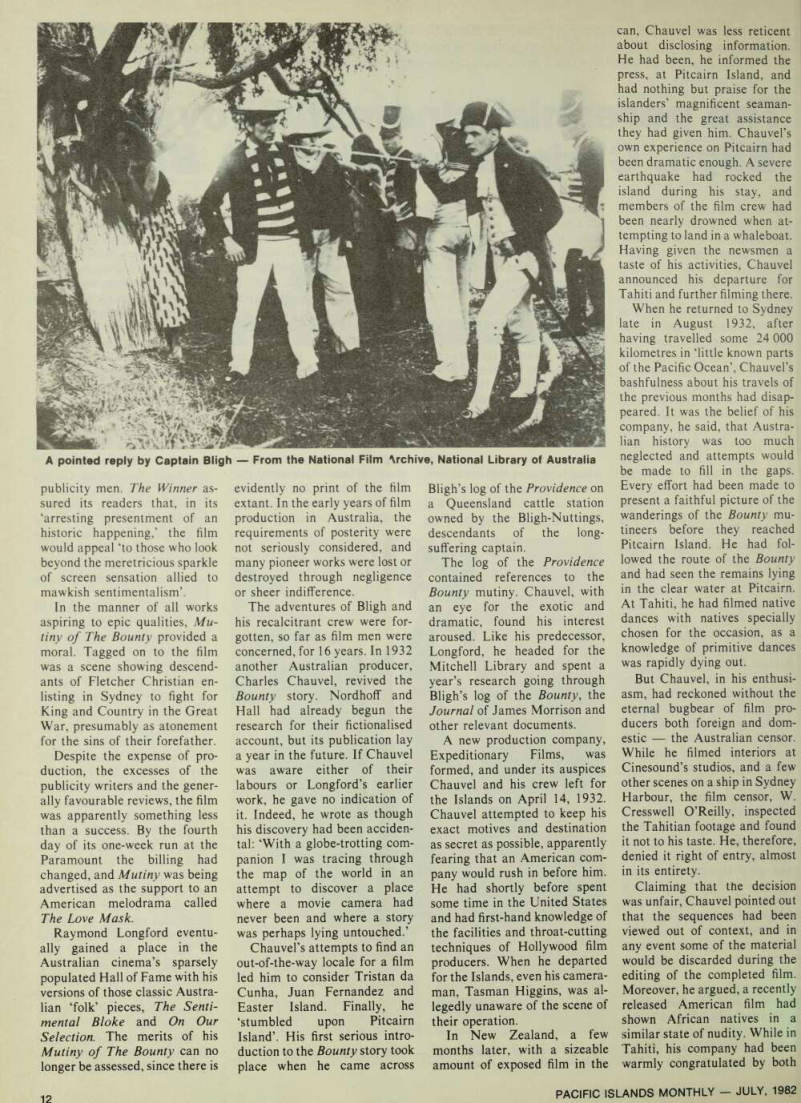
A pointed reply by Captain Bligh From the National Film Archive, National Library of Australia
the administration and the missionaries for attempting to reproduce the Tahitian dances faithfully, instead of making up travesties of them. The film, tentatively entitled The Mutiny of the Bounty, would, Chauvel claimed, have ‘a strong histori cal and ethnographical inter est’. It was not his intention to ‘introduce any suggestion of an improper element’.
The censor, apparently less concerned with the merits of history and ethnography than with the possible titillation of the cinema public by the sight of bouncing, brown breasts, was unimpressed by these claims.
To add to Chauvel’s dismay, he also ordered a cut in one of the episodes filmed in Sydney be fore allowing the film to be exported.
Chauvel carried his protest to the Commonwealth Appeal Board, which passed everything in the completed film save one sequence of native dancing.
Still dissatisfied with the de cision, Chauvel threatened to take the matter before the Minister for Customs and, if necessary, distribute the film for export only, thereby denying Australians the opportunity to witness the filling of the gaps in their history .. .
He had previously argued that the removal of the scenes of Tahitian dancing would ‘seriously affect the dramatic value of the story’. He now insisted that the sequence was ‘the pivot of the whole film’, and, if deleted, the film would
be spoilt. Finally, in March 1933, after some months of pleading, protesting and threat ening, the film was passed in a form acceptable to both Chauvel and the censor.
A press conference and luncheon to launch the film, which now bore the title In the Wake of the Bounty, was held and attended by various digni taries, including the imperial apologist and writer on Pacific affairs, C. Brunsdon Fletcher.
Fletcher spoke with his charac teristic irrelevance on the ‘es sential soundness and solidarity of the British Empire’ and concluded with the observation that the film’s producers ‘had done something decisive and valuable to make their country known elsewhere’.
Once again the publicity men trotted out their purplest prose.
The film, said its advertising, offered definite proof that ‘truth is stranger than fiction’, and audiences were invited to wit ness ‘the charm of the exotic when the sirens of the islands woo these sea-faring adven turers with the beauty of their native dances that will set your pulses tingling too. And then the dreadful aftermath of all their revelry!’
Viewed ioaay, In the Wake of the Bounty seems a curious mixture of documentary and melodrama, travelogue and tedious romance. Excellently photographed scenes of the islands are in complete contrast with static interiors, the unaffected behaviour of the Tahitians and Pitcairn Islanders with the generally stiff perform ances of the principals, and the adequate dialogue with an in congruous musical score.
Reviewers of the time were not slow to point out the incongruities in the work, while admitting that the film ‘indi cates what a fruitful field there is for film production in the Pacific’. Unfortunately, few Australian producers seem to have heeded the indication.
Most of the critics paid scant attention to what may ulti mately have been Chauvel’s most important contribution to the film world.
In the role of Bligh’s antagon ist, Fletcher Christian, Chauvel had cast a young ex-New Guinea patrol officer named Errol Flynn. It was Flynn’s first screen part and in the light of
his subsequent career it shows up poorly. Flynn, however, was later to win a Hollywood con tract where, under the auspices of Warner Brothers, he gained a series of impressive victories over the Sheriff of Nottingham (in Robin Hood), the Spaniards (in The Sea Hawk), the Nazis (in Desperate Journey) and the Japanese (in Objective Burma), but suffered defeat by the Sioux Indians (in They Died With Their Boots On).
It is an odd coincidence that two of Australia’s most import ant film men should have chosen the Bounty story as a screen vehicle and, in doing so, anticipated Hollywood’s inter est in it.
But Australia’s early film makers deserve more credit than is generally given them.
Australian movies are said to be passing through a ‘Golden Age’, one that coincides with a grow ing Australian interest and in volvement in the Pacific. With any luck we may also see a revival of interest in Pacific stories and subjects. Histori cally, Australian film-men seem to have a valid claim on the Islands.
As for Chauvel, his fears of Hollywood’s cut-throat tactics seemed well founded. Metro- Goldwyn-Mayer acquired the United States distribution rights to In the Wake of the Bounty and suppressed its re lease, preferring to bowdlerise and re-edit the Pitcairn ma terial into two short films to promote their own 1935 version.
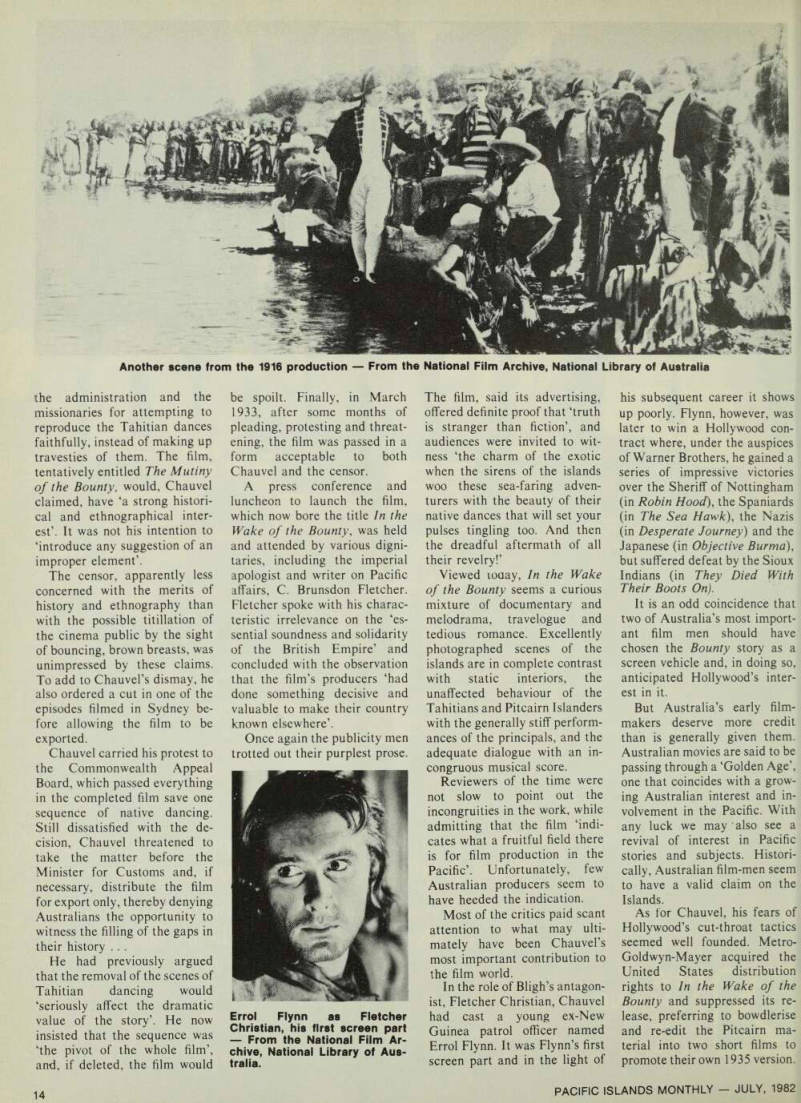
Another scene from the 1916 production From the National Film Archive, National Library of Australia
Errol Flynn as Fletcher Christian, his first screen part - From the National Film Ar chive, National Library of Aus tralia.
Advertisements & other items, pp. 11-13 (2 items)
11
°ACIFIC ISLANDS MONTHLY JULY, 1982
JKirtiDfi milk ik3
cnor
10R m. 11l
• DLL CREAM
IAWN ENRICH®
JKirtiDfi milk ik3
“ ►nr* §Anchor a ■IM Mill raasw; r
mJMmkm
m i-i n ■ * V l^L mm -
NEW
ZEALAND
DAIRY
BOARD
Anchor - premium quality dairy produce, packed with all the goodness of the finest pasture in the world.
Fresh to you from the world’s number one dairy
producer, New Zealand Dairy Board.
Enquiries to: PO Box 417 Wellington, New Zealand
Telex: NZ3348 DAPMARK
Telephone: 724-399
Setting the record straight on
Interview With Jonathon Fifi'i
Setting the record straight on ‘Marching Rule’ and a 1927 murder
JONATHON FIFI’I, veteran Solomon Islands patriot and politician from the Kwaio hill country of central Malaita, was recently in Canberra where he spoke with BARRY SHINEBERG about his role in Solomon Islands independence movements. Since 1962 Mr Fifi’i has worked with anthropologist, ROGER KEESING, now at the Australian National University, on studies of the customs of the Kwaio people. Mr Fifi’i has just finished compiling a Kwaio language dictionary, and is now writing his autobiography. His interview with Barry Shineberg, which appears below, sheds fascinating new light on the (misnamed) ‘Marching Rule’ movement, and the 1927 killing of British District Commissioner
W.R. Bell
Barry Shineberg: You were a small boy of six when the punitive expedition of 1927 in central Malatia avenged the death of District Officer W.R.
Belli and firmly established Pax Britannica in Solomon Islands.
You were educated in a Seventh-day Adventist mission in Malaita. You witnessed the flight of the British administra tor and teachers in the face of the Japanese invasion in 1942.
You came to know and work with the Americans during the war in the Pacific. You were a key figure in Maasina Rule, which set up its own adminis tration in Malaita in 1946 in opposition to the British admin istration. You were charged, together with eight other Maasina Rule leaders, with sedition and sentenced to six years imprisonment. After three years you were pardoned and served in a newly estab lished regional council of Malaita. In the ’7os, you served as a member of the Governing and Legislative Councils of the Solomon Islands, participated in constitutional discussions in London prior to independence in 1978, and served as a mem ber of parliament until 1980.
Since that time you have been working on questions of land, language and education.
Which of these events stand out for you as being the most important?
Jonathon Fifi’i: Most of the things you have mentioned were important for me. Perhaps I could pick out two things. First, the war which came to us in 1942. Before then, my people worked on plantations. There were rules that we couldn’t
enter the houses of white men.
We were treated as if we were nothing at all. People were whipped around their backs. If a white man killed a Melanesian we felt he would not go to court, but if a Melanesian killed a white man he’d be taken to court and he’d be sentenced perhaps to five years. We worked hard in plantations for only five or 10 shillings a month.
Then there was the war. I was at school then and all my teachers went back to Austra lia. A lot of Americans came, and Australians too. Most of the blacks who came were really better than us. They wore long pants, shirts, neck-ties and so on. Before that, we never wore long trousers, shirts, or anything like that. So we saw something different between ourselves and other black people.
We said what we were going to do then. We were treated like this because we were frightened of the white man. When a white man came we had to carry him from the ship to the shore and if he went back to the ship we’d have to carry him there. And we couldn’t take part in any white man’s discussion— sit down in a chair with him as we are doing now. So that’s what it was like and we just hated it.
With the American army and the marines it was different. We sat down with them, ate and talked with them, and then in 1944 and 1945 we came back home. 8.5.: Was there any difference between the black and white Americans?
J.F.: No, no difference be tween white and black. They had the same jobs, they sat
down together, they were equal. 8.5.: Your work for the Americans how was it organ ised?
J.F.: I worked in a gang of 24 people from Kwaio. The district constable recruited us and he called us in front of him to decide who was going to be in charge of the gang. Anything the Americans wanted they talked to me. I interpreted for them. The Americans didn’t know any pidgin at all. That’s why the constable chose me to be in charge of the gang
because I could speak English. 8.5.: Where did you work? In Honiara?
J.F.: No, in Lungga and Tenaru. 8.5.: What work did you do?
J.F.: We carried dead people to the cemetery. Second, we had to make small paths through the bush for the scouts.
We carried ammunition and equipment for the army. Some times we unloaded ships. 8.5.: The second point that you wish to comment on?
J.F.: Now I’d like to say one thing about Maasina Rule. The white man didn’t understand it
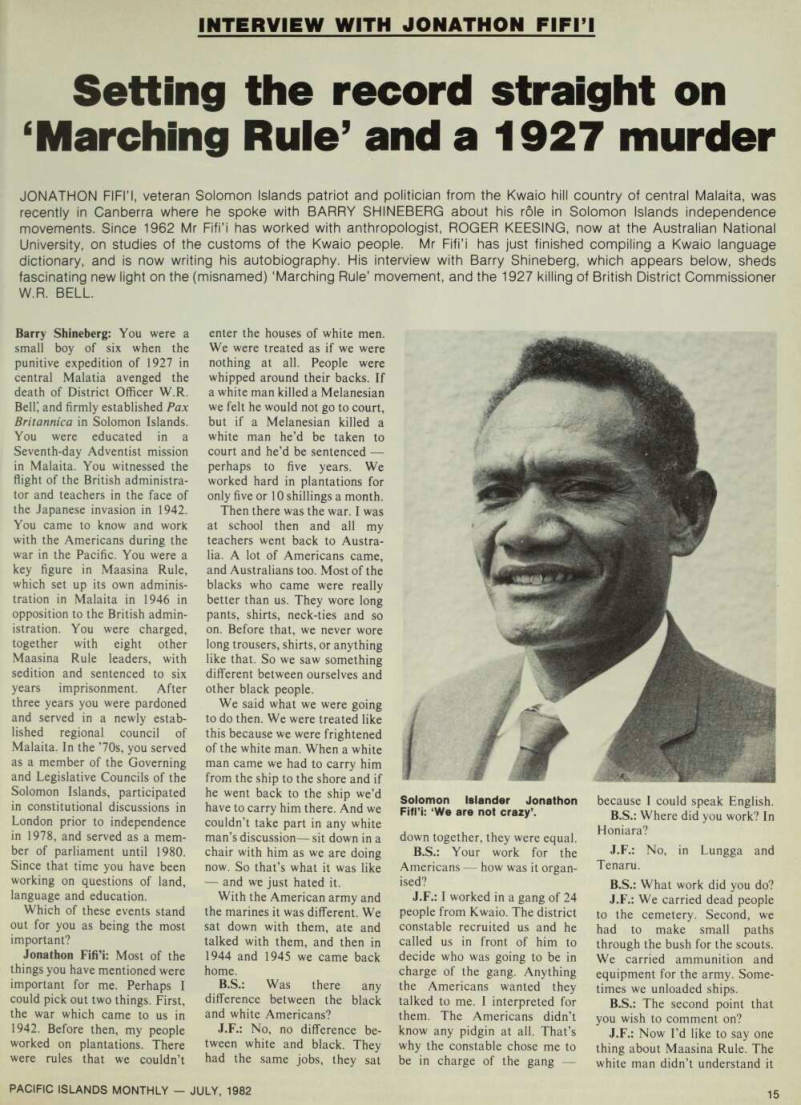
Solomon Islander Jonathon Fifl’i: ‘We are not crazy’.
and used different words to talk about it. I was very angry when I heard a district officer calling it Marching Rule. We say Maasina. It means brother hood. It’s a word from the Are- Are language (in southern Malaita).
We didn’t use the word Marching Rule. You know, it’s not useful for us to have this word Marching. It can’t be used for an idea to be introduced to others. What are we going to do by marching? Nothing at all.
We are not crazy. Our idea was that we should work together like brothers sit down and talk with the government like other black people from other countries. 8.5.: I have here a report from PIM, November 1947, quoting the Secretary of the Melanesian Mission, Major H.S. Robinson, after his return to Australia from a tour of the Solomon Islands. He said: ‘When we steamed ... along the northwest coast of Malaita, we were interested to see a line of 43 native houses (we counted them) all sited and completed with military precision a very neat and workmanlike job and all empty. They had been erected by followers of the Marching Rule cult in the belief that cargoes of goods were coming to them from across the sea, and these were to be the store-houses for the goods.’ Would you like to com ment on that report?
J.F.: Most of the people who talked and wrote about March ing Rule didn’t ask us what we were doing. It’s true we came down to the coast, cleared ground and built houses. We wanted to show the government what we could do. The houses were there for people to come down to and stay there, and to hold meetings in. We’d stay there for two or three days until our food was finished and the we’d go home. We’d arrange to come back eight days later to talk and discuss at other meet ings. 8.5.: The question of cargo?
J.F.: I get very angry when I hear about this cargo. The only cargo we know is the cargo that’s imported by ship from Australia. The Malaita was one of them. The cargo would be unloaded at Makabo, Gavuto and Tulagi. I was there and saw it being unloaded. People said
we were coming down to the coast to wait for cargo? What kind of cargo? This is something we can’t make any sense of. We are not a crazy, lunatic people.
You can’t expect the whole of Malaitian people to be lunatics.
We didn’t expect other people to feed us. This is not our way.
We have our own gardens. Our idea in Maasina Rule was to show that we could do some thing ourselves, that we can organise our own lives, that we are prepared to govern our selves. 8.5.: Maasina wasn’t the first organised movement of the Solomons Island people to ex press their dissatisfaction with the Administration, was it? I’m thinking of the Chair and Rule movement in Ysabel, in 1939, formed with the aid of the Anglican priest, the Rev R.P. Fallows. People came and joined in from other islands too.
What is meant by Rule?
J.F.: Rule is the meeting of people to discuss the work to be done. At the time, I was a cook
boy in Tulagi. I could see that Mr Fallows was treating people very well. He was talking about the same thing as them the government was treating the Melanesian people very badly.
His name was Mama Fellows.
They didn’t organise it well and it failed, and also it was based on the white man. All the government had to do was to send him out of the country. It wasn’t people from the country trying things. 8.5.: The Administration commented favourably on cer tain aspects of Maasina Rule.
But what caused them to bring charges against you?
J.F.: We didn’t pay taxes to the government. We didn’t know what the British were doing with the money we paid them. We collected the taxes and kept the money to use ourselves. We stopped people working in the plantations where the work was terrible.
The government said to let them go. We said we are the boss now. We must approve their going to work on plan tations. 8.5.: You were charged with sedition. Did that surprise you?
J.F.: Yes, we were very sur prised. We did not intend to overthrow the government. So we wondered why we were charged with sedition. We ex pected the government to sit down with us and ask us what we wanted.
8.5.: How many of you were charged?
J.F.: There were nine of us six of us are still alive. 8.5.: One for each of the nine regions of Malaita involved in Maasina Rule?
J.F.: We should have been 10.
But the other headman he was an ex-government headman became frightened when the government started to arrest us. 8.5.: What happened to Maasina Rule when you people were arrested?
J.F.: Other people took over our jobs. They worked in different ways. They stayed in the bush and never saw the government officers. 8.5.: What kind of legal defence did you have at your trial? Did you have good law yers?
J.F.: We said we wanted to hire a lawyer. They said no. We only had one lawyer appointed by the government. 8.5.: You were sentenced to six years imprisonment, but only served three years. What was it like in gaol? Why were you freed?
J.F.: We were in Honiara first, then we went to Gizo in western Solomon Islands. We dug drains, built houses. Mr Gregory Smith came from Eng land to see us. He had been a Resident Commissioner in Nigeria and Kenya and asked us what we wanted. We said we wanted self-government and in-
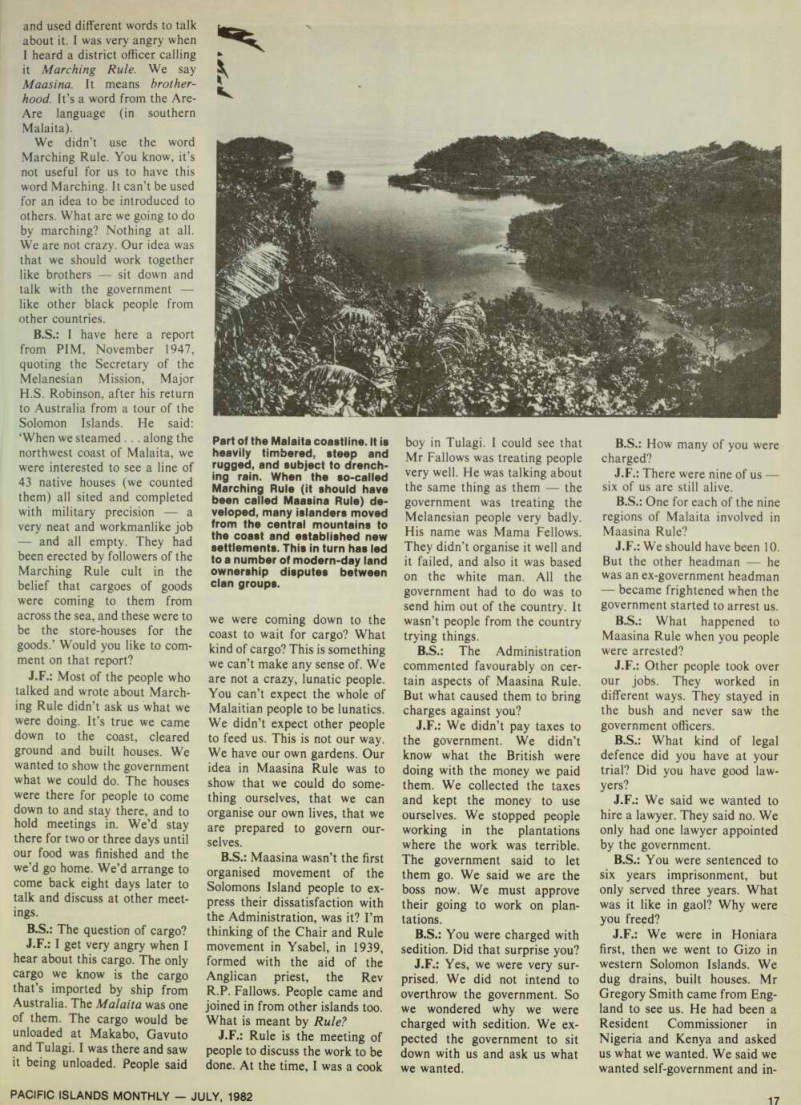
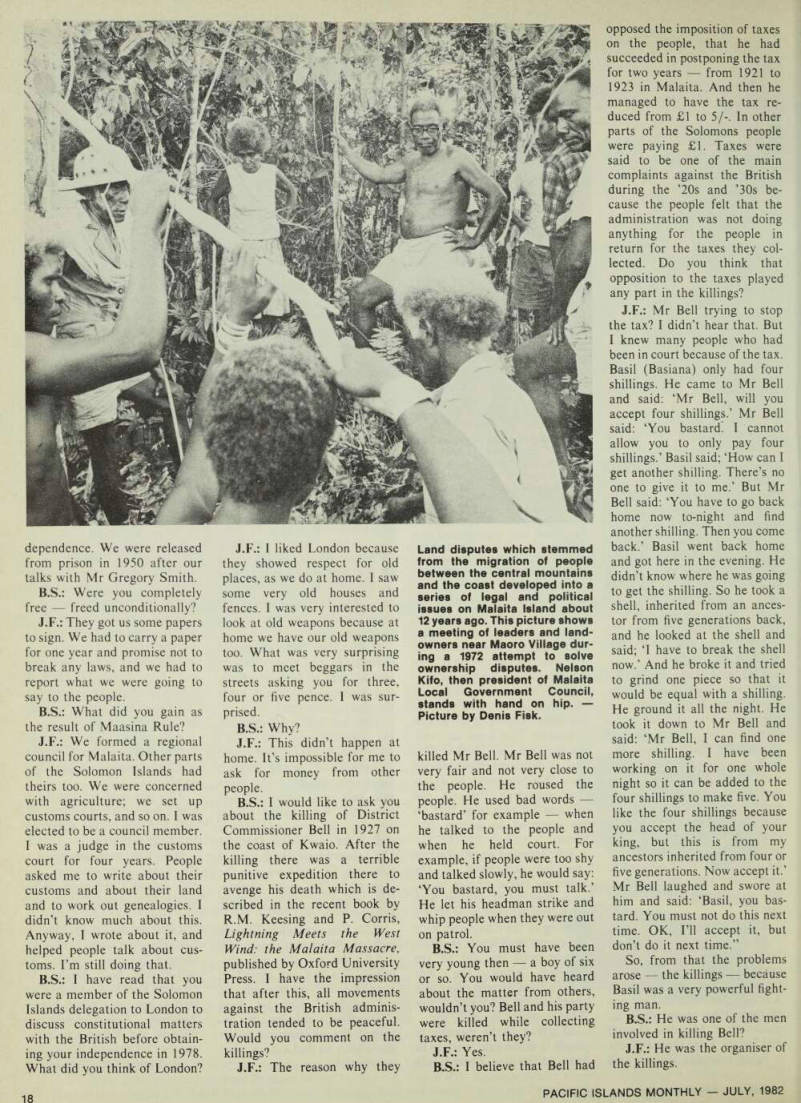
Part of the Malaita coastline. It is heavily timbered, steep and rugged, and subject to drench ing rain. When the so-called Marching Rule (it should have been called Maasina Rule) de veloped, many islanders moved from the central mountains to the coast and established new settlements. This in turn has led to a number of modern-day land
ownership disputes between
clan groups.
dependence. We were released from prison in 1950 after our talks with Mr Gregory Smith. 8.5.: Were you completely free freed unconditionally?
J.F.: They got us some papers to sign. We had to carry a paper for one year and promise not to break any laws, and we had to report what we were going to say to the people. 8.5.: What did you gain as the result of Maasina Rule?
J.F.: We formed a regional council for Malaita. Other parts of the Solomon Islands had theirs too. We were concerned with agriculture; we set up customs courts, and so on. I was elected to be a council member.
I was a judge in the customs court for four years. People asked me to write about their customs and about their land and to work out genealogies. I didn’t know much about this.
Anyway, I wrote about it, and helped people talk about cus toms. I’m still doing that. 8.5.: I have read that you were a member of the Solomon Islands delegation to London to discuss constitutional matters with the British before obtain ing your independence in 1978.
What did you think of London?
J.F.: I liked London because they showed respect for old places, as we do at home. I saw some very old houses and fences. I was very interested to look at old weapons because at home we have our old weapons too. What was very surprising was to meet beggars in the streets asking you for three, four or five pence. I was sur
prised.
8.5.: Why?
J.F.: This didn’t happen at home. It’s impossible for me to ask for money from other people. 8.5.: I would like to ask you about the killing of District Commissioner Bell in 1927 on the coast of Kwaio. After the killing there was a terrible punitive expedition there to avenge his death which is de scribed in the recent book by R.M. Keesing and P. Corris, Lightning Meets the West Wind: the Malaita Massacre, published by Oxford University Press. I have the impression that after this, all movements against the British adminis tration tended to be peaceful.
Would you comment on the killings?
J.F.: The reason why they
killed Mr Bell. Mr Bell was not very fair and not very close to the people. He roused the people. He used bad words ‘bastard’ for example when he talked to the people and when he held court. For example, if people were too shy and talked slowly, he would say: ‘You bastard, you must talk.’
He let his headman strike and whip people when they were out on patrol. 8.5.: You must have been very young then a boy of six or so. You would have heard about the matter from others, wouldn’t you? Bell and his party were killed while collecting taxes, weren’t they?
J.F.: Yes. 8.5.: 1 believe that Bell had
opposed the imposition of taxes on the people, that he had succeeded in postponing the tax for two years from 1921 to 1923 in Malaita. And then he managed to have the tax re duced from £1 to 5/-. In other parts of the Solomons people were paying £l. Taxes were said to be one of the main complaints against the British during the ’2os and ’3os be cause the people felt that the administration was not doing anything for the people in return for the taxes they col lected. Do you think that opposition to the taxes played any part in the killings?
J.F.; Mr Bell trying to stop the tax? I didn’t hear that. But I knew many people who had been in court because of the tax.
Basil (Basiana) only had four shillings. He came to Mr Bell and said: ‘Mr Bell, will you accept four shillings.’ Mr Bell said: ‘You bastard. I cannot allow you to only pay four shillings.’ Basil said; ‘How can I get another shilling. There’s no one to give it to me.' But Mr Bell said: ‘You have to go back home now to-night and find another shilling. Then you come back.’ Basil went back home and got here in the evening. He didn’t know where he was going to get the shilling. So he took a shell, inherited from an ances tor from five generations back, and he looked at the shell and said; ‘I have to break the shell now.’ And he broke it and tried to grind one piece so that it would be equal with a shilling.
He ground it all the night. He took it down to Mr Bell and said; ‘Mr Bell, I can find one more shilling. I have been working on it for one whole night so it can be added to the four shillings to make five. You like the four shillings because you accept the head of your king, but this is from my ancestors inherited from four or five generations. Now accept it.’
Mr Bell laughed and swore at him and said: ‘Basil, you bas tard. You must not do this next time. OK, I’ll accept it, but don’t do it next time.”
So, from that the problems arose the killings because Basil was a very powerful fight ing man. 8.5.: He was one of the men involved in killing Bell?
J.F.: He was the organiser of the killings.
Land disputes which stemmed from the migration of people between the central mountains and the coast developed into a series of legal and political issues on Malaita Island about 12 years ago. This picture shows a meeting of leaders and land owners near Maoro Village dur ing a 1972 attempt to solve
ownership disputes. Nelson
Kifo, then president of Malaita Local Government Council, stands with hand on hip.
Picture by Denis Fisk.
Advertisements & other items, p. 16 (1 item)
Aiwa
—moon 6 5
fi gr ft IT
Jd I • •
CA-WlO
Here’s a formula for real listening fun: with the AIWA CA-WlO, you can play two cassettes in sequence (for uninterrupted listening) or dub from one to the other (with time-saving double-speed recording).
Speakers are fully detachable too, so you can move them high or low for the best sound arrangement.
Built with such top features as AlWA’s exclusive “Dynamic Super Loudness” and Dolby* noise reduction, the CA-WlO is a real audio system that works off AC house current, self-contained batteries or DC power from your car or boat. And its hi-fi amplifier puts out a mighty 40 Watts of power for great sounds from radio, cassettes or even an external stereo turntable.
Best of all, it’s a member of the world’s most innovative family of home and portable cassette products: AIWA, aiwa for craftsmanship Japan’s first in 1964, leaders ever since.
Dolby and the double-D symbol are trademarks of Dolby Laboratories Licensing Corporation.
AIWA CO.
AIWA
, LTD. 11-9, Ueno 1-chome, Taito-ku, Tokyo, Japan.
CS-200 Australia AIWA Australia Pty., Ltd./Cook Islands Island Merchants Ltd./Fiji P. Hargovind & Co., D. Ranchhod & Co./Guam Micropac Audio, Inc./New Caledonia hifivox/New Zealand Milaw Trading Co., Ltd./P.N.G. Oceania Indent Agency (P.N.G.) Pty., Ltd./Solomon Islands Harvest Pacific Ltd. /Tahiti Fare Hi-Fi Stereo/Vanuatu (New Hebrides) The Sound Centre Ltd.
Islands
From the
Press
From the Tonga Chronicle, Nukualofa Three men who caused a nuisance by begging in a public place ended up in jail. They are Finau Mapa, 30, and Taitusi Taulongo, both of Kolofo’ou, and Pimi Tupou, 28, of Kolomotu’a. The three accused, the first to appear in Court for begging, committed the offence on April 19 and appeared before the Nuku’alofa Magistrates’ Court last Tuesday... In passing sentence, Magistrate Helu condemned begging, which he described as an “annoying act”. He said that it was a comparatively recent introduction into Tonga, but it has increased at such an alarming rate that Parliament in 1975 passed a bill to attempt to cut begging by half.
From the Marshall Islands Journal ... the Islanders, who were once (and very well may still be) among the world’s best fishermen, have all (according to the American plans for future development) left their outrigger canoes to rot on the outer atolls and come into the centers to eat canned tuna and mackerel and rice and drive about in taxi cabs.
From the Cook Islands News, Rarotonga The English and the countries of the old empire call it cricket; the Tongans call it kilikiti, but in Samoa it is keriketi.. . still the King of Games but with no other semblance to the international matches of Lords and the Oval.
From Tohi Tala Niue, Niue Island Talaia Makaia of Namukulu was charged with unlawful possession of a firearm. He pleaded guilty but his case was related to spiritual belief. Defended by Kapaga, Talaia pleaded that he had shot at a gravestone in retaliation as the said ‘deceased’ is reported to have haunted his sister. He was duly convicted and given a suspended sentence of two months and the firearm confiscated.
From an editorial in The Observer, Apia, on the decision of the Chief Justice that the matai system of
voting infringes the Constitution
.. . Former Clerk of House, Feesago Fepuleai, who is now High Commissioner in New Zealand is of the opinion that the decision and its ramifications would wreck the so-called “Faa-Samoa” (Samoan custom) to which the matai suffrage is linked. He says that this is unacceptable. The question is: To Whom? If the Faa Samoa, no matter how sacred, discriminates against people and allows one part of the multitudes to rule supreme ignoring the other three parts, then it is the Faa-Samoa which is unacceptable.
From a report in the News Drum, Honiara, of the launching of the first series of books in Pijiruby the
Pijin Literary Project
The Adult Education Officer of the Ministry of Education, Training and Cultural Affairs, Mr David Lilimae, said that politicians and senior officials of his Ministry do not support the idea of introducing Pijin language within the Primary School curriculum. He said national leaders would rather see English and children’s mother tongues be encouraged in schools.
From an article in the Tonga Chronicle on repopulating Tonga with poultry after Cyclone Isaac Consideration was given to importing modern poultry flocks to bolster the depleted Tongan flocks. But this was ruled impractical
and expensive. Such large birds have lost their ability to fly and find their own food, and they are not disease-resistant. Most importantly, Mr Murray said, these birds have almost lost the instinct to sit and hatch their young.
From a report by the Niue Consular Office in New Zealand to the Tohi Tala Niue of Niue Island I have often been asked about job prospects in Niue and so on. One guy in fact came up and said “What do you honestly think? Will Niue still be there in five years time?” He had apparently been given the impression by some of the Niueans here that there will be nothing in Niue and never will be in five years. Disturbing thought? No? Well, I guess as you want to call yourself a “Niuean” here or on Niue, the place will survive. Personally, my stock answer to that type of question is that as long as there are a few old diehards like you or I, as long as we’re prepared to stay and give meaning to our heritage and name as Niueans and carry the rest on your shoulders, Niue shall continue and will continue to survive well beyond the most pessimistic predictions.
From the classified advertisements in The Fiji Times Housing Authority requires a temporary competent carpenter.
From the Marshall Islands Journal, Majuro Hordes of Japanese newsmen have invaded Guam to join the search for a possible WWII straggler. Footprints and rope in a cave are the primary evidence.
From the Cook Islands News Nearly 30% of all deaths in the Cook Islands within the last 5-8 years have been due to diseases of the heart and circulation. The Health Department, when releasing these figures, added that the Cook Islands rate of high blood pressure, obesity, diabetes and gout have increased greatly over the last 10 years. The department attributes this decline in our health standards to the fact that our nation has changed from the “simple traditional life” to the “money-oriented society”.
From The Samoa Times, Apia Professor Murphy, of McGill University, Canada, who has been studying suicide patterns in 50 countries has confirmed that “the international statistics on suicides during the 1970 s do not show any other country to have a suicide rate in males aged 15-24 which is as high as the Western Samoa one”. Since 1966, there have been 245 suicides in Western Samoa. In 1980, there were 40 suicides, in 1981,42.
From an editorial in the Samoa Times on The Suicide Problem .. . The problem is how can we make our young people see themselves as if in a mirror. The promises of materialism (fostered by a highly materialistic educational system) and rising expectations inflamed in large part by the media especially television and the movies have in large measure distorted the values of our young people made worse by the cultural lag of our elders and our society. What we need is for an educational system to reflect the basics of Samoan society; respect for authority and tradition and the family.
About us from the Cook Islands News, Rarotonga We’re still the Cook Islands. That’s what a CIBNC reporter told a reporter from the Sydney-based Pacific Islands Monthly magazine who phoned to ask if it was true the Cook Islands has been renamed. Someone from a Brisbane publishing company phoned the PIM and told them the Cook Islands had been renamed.
The Brisbane caller could not tell the Pacific Islands Monthly what the new name was, but did say it would enable the Cook Islands to get more aid. When contacted for comment, the Prime Minister, Sir Thomas Davis, said we definitely haven’t changed our name and aren’t contemplating doing so. He said he doesn’t know how a new name can get more aid, adding: “The rose by any name smells as sweet.”
From a letter in The Norfolk Islander Sir: I do hope that whoever ate the 5 beef tails and the 4 packets of sausages that I lost from my carton of meat on this last ship, enjoyed their repast. I was looking forward to doing the same.
Yours etc, Jackie Ryan.
Advertisements & other items, pp. 20-21 (1 item)
What’s replacing these?
<d *Q •B*a> McDonnell Douglas DC*9 □_ □ □ DHC Twin Otter
cfl
□ o •TTrrm • • FokkerF.27 N 22 Nomad
<ZISiSI^3
Hawker Siddeky 748 yn Beechcraft 800
What’s replacing these?
4*- 0"-^ZBS""-o
NAMCYS-11
Bandelrante Vickers Viscount 800 Mohawk 298 ED Douglas DCS
We oiler no criticism ol the eleven aircraft represented opposite.
But we’re rather proud ol the lact that in recent years our profit-conscious customers in the competitive short-haul market have decided to replace them with the Shorts 330, operating on identical routes.
We don’t find this surprising.
The wide-body 330 is purpose-built lor regional and commuter operations.
It’s high-comlort, 30 seat layout and remarkably low noise-levels combine to create positive, business-generating passenger appeal.
Add to this its highly fuel-efficient engines.
Add proven reliability with 30 operators worldwide, who have carried over 7 million passengers to date.
Add the ability to make sound economics lor many carriers with load factors as low as 40%. And it becomes apparent why an increasing number of merely good air craft are moving over to give way to this superb 30-seat profit maker.
ort*
The Shorts 330~
that’s what.
Short»33o
The Tough Competitor*
SHORT BROTHERS LIMITED, Airport Road, Belfast BT3 9DZ, Northern Ireland Short Bros (Australia) Pty Ltd., 20 Loftus Street. Sydney 2000 Short Brothers (USA) Inc., 1725 Jefferson Davis Highway, Suite 510, Arlington, VA 22202 Short Brothers (USA) Inc, 2222 Martin Drive, Suite 255, Irvine, California 92715
May 23 poll
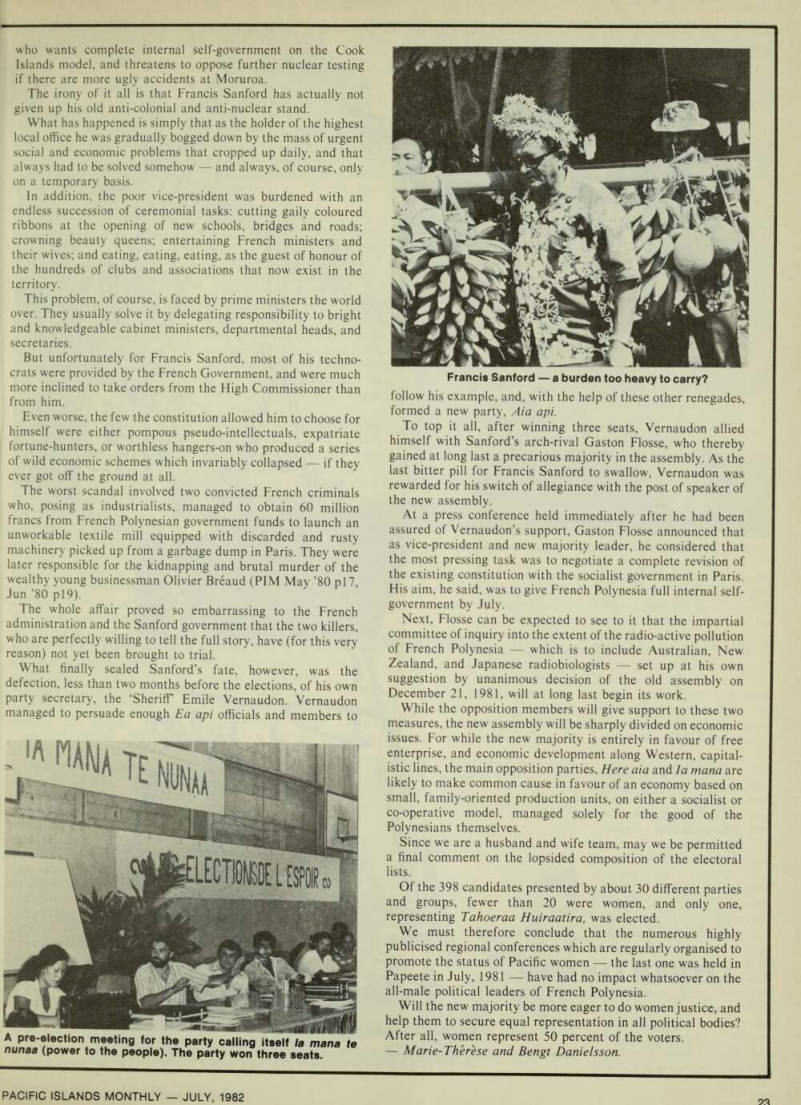
Wrecks, safe returns in May 23 poll
‘Our canoe is caught in a raging storm. But we have faced other tempests in the past, and we shall pull through this one too, and eventually reach our destination.’
This was how French Polynesia’s Vice-President of the Council of Government Francis Sanford (who can best be described as a prime minister for local affairs, kept on a leash by the French High Commissioner) described the position of his coalition government in a campaign speech a few weeks before the May 23 territorial elections.
It was an apt metaphor from the leader of a seafaring people.
But perhaps it should be explained, for the benefit of the uninitiated, that the canoe that Francis Sanford has been steering for the past five years, like the ancient taurua canoes, has two hulls. One represents his own Ea api party, mostly favoured by part-Europeans, and the other John Teariki’s Here aia party, supported by a basically Polynesian electorate.
It is with some sadness that we record in similar allegorical Polynesian vein that instead of reaching harbour safely, the coalition canoe broke asunder in the pre-electoral storms.
While Teariki and his crew managed to stabilise their hull and sail to safety, the Ea api hull proved rotten and worm-eaten, and eventually limped into harbour totally swamped and with only one man on board Francis Sanford himself. On his arrival ashore he found his first lieutenant Emile Vernaudon, who had abandoned his captain at the height of the storm, together with several former members of his crew.
Expressed in the officially sanctioned European language of figures and statistics, all this means that the 60 000 of the 85 000 registered voters in French Polynesia who went to the polls on May 23 to elect the 30 members of the Territorial Assembly (there were 398 candidates!) from five constituencies cast enough votes 15.8 percent of the total for Teariki’s party to return him and his five companions.
But the voters showed their strong disapproval of Francis Sanford’s leadership by giving his party only a pitiful 2929 votes. The magnitude of the defeat is clearly demonstrated if the Ea api vote is expressed as a percentage of the total votes cast: 4.4 percent! This gave a seat in the assembly to only the bearer of the first name on the Ea api list, none other than Francis Sanford. In the previous assembly, his party had controlled seven seats.
Another notable victim of the various electoral shipwrecks was the long-time speaker of the Territorial Assembly, Frantz Vanizette, whom we should perhaps call a ‘stowaway’ on the Autonomist double-canoe, since he had been regularly elected with the help of his friends Teariki and Sanford. Up to election day he had been the only Frenchman to sit in the assembly. He was accepted there as more or less a permanent fixture because of his fine grasp of parliamentary procedure, and his excellent contacts in the ministries in Paris.
But, with a notable lack of appreciation of what his status really was, he decided for the purposes of this election to form a new party, together with a part-Polynesian government employee Maco (Marc) Tevane, whom Francis Sanford had made his trusted councillor for cultural affairs back in 1977. For reasons that are quite unfathomable, Vanizette and Tevane
chose to call themselves Social Democrats, and stood candidates in several constituencies. They polled a wretched 2.8 percent of the vote, leaving Vanizette without a seat in the assembly.
We only mention this minor disaster at all because it tellingly gives the lie to the shining image of Maco Tevane assiduously cultivated by French officialdom. This highly unrepresentative figure has been the perennial representative of French Polynesia at international conferences and seminars throughout the Pacific. His function was to serve as living proof that the Polynesians run the show in the territory ...
So much for the losers. Let us now move on to the winners.
Foremost among them is Gaston Flosse and his Tahoeraa Huiraatira party, which can best be described as a sleek, high powered, cabin cruiser, manned by a crew of smart young men dedicated to various forms of free enterprise. This party, which is affiliated with the French RPR Gaullist party of Jacques Chirac and therefore appeals strongly to the 10 000-odd French expatriate voters, won 13 seats. This was four more than it held in the previous assembly, but still three short of an absolute majority. It secured 17 787 votes, 29.3 percent of the total.
The most brilliant performance, however, was turned on by the small la mana te nunaa outrigger canoe. Its achievement in winning three seats in the assembly in which it has never before been represented crowned years of hard, slogging work by its young and dedicated members among the most destitute and miserable Polynesians. The party is socialist (but has no affiliation with the party of President Mitterrand), pro independence, and anti-nuclear.
They would have won a fourth seat if the Polynesians who favour independence had all voted for la mana instead of wasting about 2000 votes on the eight other pro-independence candidates, some of whom are pure mavericks.
As usual, the French authorities found the necessary legalistic means to disqualify the number one activist and freedom fighter, Charlie Ching, and his place at the head of his party’s list was taken at the last minute by his wife.
The total number of votes cast in favour of pro-independence candidates la mana, plus the eight smaller groups was 9202, which corresponds to 15 percent of the total.
We should also note that four other small craft, among them a junk Arthur Chung’s Taatira party, backed by an overwhelmingly Chinese electorate also crossed the finishing line.
Francis Sanford’s crushing defeat was easy to predict as we ourselves did in our letter in PIM (Jun p 7).
It must in the first place be ascribed to his meek acceptance, while in power, of French colonial rule and the abominable nuclear tests.
It must be stressed that during the previous 15 years he had gained the status of a national hero in the freedom struggle, almost on a par with Pouvanaa a Oopa, who was honoured two weeks before the elections by a huge monument erected in the park outside the Territorial Assembly building. (See our separate account in Tropicalities, this issue.) But Francis Sanford has lately been outflanked both on his Left by the la Mana party, and on his Right by Gaston Flosse,
who wants complete internal self-government on the Cook Islands model, and threatens to oppose further nuclear testing if there are more ugly accidents at Moruroa.
The irony of it all is that Francis Sanford has actually not given up his old anti-colonial and anti-nuclear stand.
What has happened is simply that as the holder of the highest local office he was gradually bogged down by the mass of urgent social and economic problems that cropped up daily, and that always had to be solved somehow and always, of course, only on a temporary basis.
In addition, the poor vice-president was burdened with an endless succession of ceremonial tasks; cutting gaily coloured ribbons at the opening of new schools, bridges and roads; crowning beauty queens; entertaining French ministers and their wives; and eating, eating, eating, as the guest of honour of the hundreds of clubs and associations that now exist in the territory.
This problem, of course, is faced by prime ministers the world over. They usually solve it by delegating responsibility to bright and knowledgeable cabinet ministers, departmental heads, and secretaries.
But unfortunately for Francis Sanford, most of his techno crats were provided by the French Government, and were much more inclined to take orders from the High Commissioner than from him.
Even worse, the few the constitution allowed him to choose for himself were either pompous pseudo-intellectuals, expatriate fortune-hunters, or worthless hangers-on who produced a series of wild economic schemes which invariably collapsed if they ever got off the ground at all.
The worst scandal involved two convicted French criminals who, posing as industrialists, managed to obtain 60 million francs from French Polynesian government funds to launch an unworkable textile mill equipped with discarded and rusty machinery picked up from a garbage dump in Paris. They were later responsible for the kidnapping and brutal murder of the wealthy young businessman Olivier Breaud (PIM May ’BO pi 7, Jun ’BO p!9).
The whole affair proved so embarrassing to the French administration and the Sanford government that the two killers, who are perfectly willing to tell the full story, have (for this very reason) not yet been brought to trial.
What finally sealed Sanford’s fate, however, was the defection, less than two months before the elections, of his own party secretary, the ‘Sherilf Emile Vernaudon. Vernaudon managed to persuade enough Ea api officials and members to
follow his example, and, with the help of these other renegades, formed a new party, Aia api.
To top it all, after winning three seats, Vernaudon allied himself with Sanford’s arch-rival Gaston Flosse, who thereby gained at long last a precarious majority in the assembly. As the last bitter pill for Francis Sanford to swallow, Vernaudon was rewarded for his switch of allegiance with the post of speaker of the new assembly.
At a press conference held immediately after he had been assured of Vernaudon’s support, Gaston Flosse announced that as vice-president and new majority leader, he considered that the most pressing task was to negotiate a complete revision of the existing constitution with the socialist government in Paris.
His aim, he said, was to give French Polynesia full internal self government by July.
Next, Flosse can be expected to see to it that the impartial committee of inquiry into the extent of the radio-active pollution of French Polynesia which is to include Australian, New Zealand, and Japanese radiobiologists set up at his own suggestion by unanimous decision of the old assembly on December 21, 1981, will at long last begin its work.
While the opposition members will give support to these two measures, the new assembly will be sharply divided on economic issues. For while the new majority is entirely in favour of free enterprise, and economic development along Western, capital istic lines, the main opposition parties. Here aia and la mana are likely to make common cause in favour of an economy based on small, family-oriented production units, on either a socialist or co-operative model, managed solely for the good of the Polynesians themselves.
Since we are a husband and wife team, may we be permitted a final comment on the lopsided composition of the electoral lists.
Of the 398 candidates presented by about 30 different parties and groups, fewer than 20 were women, and only one, representing Tahoeraa Huiraatira, was elected.
We must therefore conclude that the numerous highly publicised regional conferences which are regularly organised to promote the status of Pacific women the last one was held in Papeete in July, 1981 have had no impact whatsoever on the all-male political leaders of French Polynesia.
Will the new majority be more eager to do women justice, and help them to secure equal representation in all political bodies?
After all, women represent 50 percent of the voters.
Marie-Therese and Bengt Danielsson.
A pre-election meeting for the party calling itself la mana te nunaa (power to the people). The party won three seats.
Francis Sanford a burden too heavy to carry?
Advertisements & other items, p. 24 (1 item)
Taihaj
- '*-:-:-.x' ’ “ " JIM
LIN U FA
Bringing the world’s
best to your door.
' ; #|||pp Tatham Limited have a long history of dependable service " to the islands. From all over the world we bring the goods and products you need, right to your door Full service and prompt documentation are assured. We can procure specific products to suit your special requirements and if urgently needed will air freight them to you without delay. For imports or exports, see us! ■ • ■ - • •. - - ■ A V. &yy. ?
Tatham Limited are exclusive distributors of Red Tulip Fine Chocolates, in many areas within the Pacific- Islands, Asia and Indian Ocean.
Fine Milk Chocolate Selections Continental Chocolate Selections Milk & Dark Chocolate Selections Fruit Jellies Tropical Fruit Jellies After Dinner Mints Orange Thins Molly Bushell Toffee Tatham Limited brings you the world’s best... as well as a wide variety of confectionery manufactured by leading Australian companies which include: Starks Confectionery Europe Strength Food Company, James Chocolates and Fresha Biscuit Company.
TATHAM LIMITED
176 Queen Street Melbourne Telephone 67 5601. Telex AA36992 (Tatham) A Subsidiary of H.C. Sleigh Industries Limited Melbourne t Tm m I TL 007
A monumental
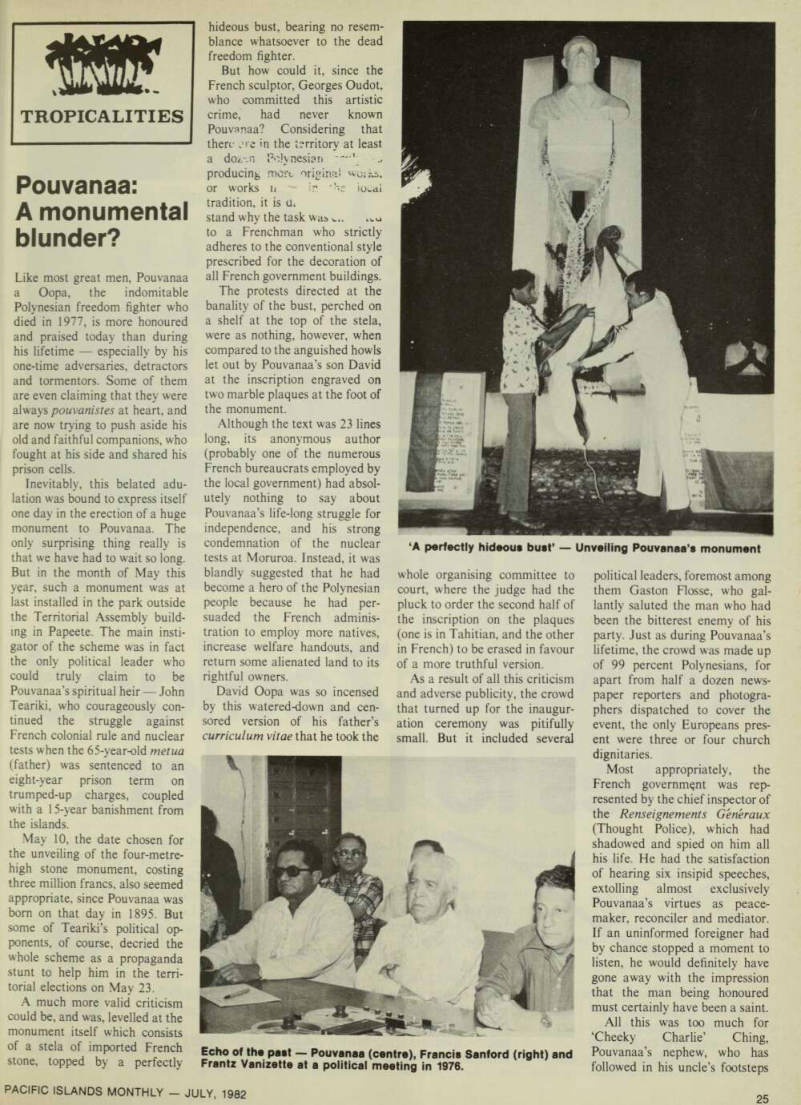

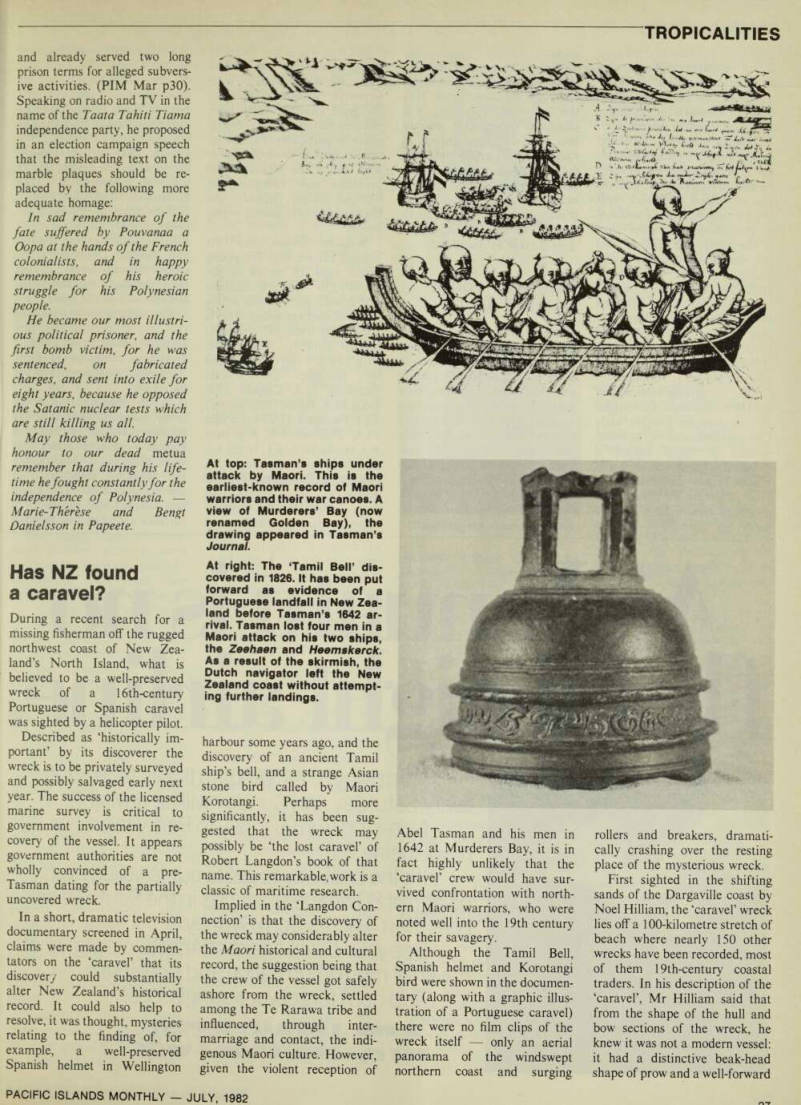
Tropicalities
Pouvanaa: A monumental blunder?
Like most great men, Pouvanaa a Oopa, the indomitable Polynesian freedom fighter who died in 1977, is more honoured and praised today than during his lifetime especially by his one-time adversaries, detractors and tormentors. Some of them are even claiming that they were always pouvanistes at heart, and are now trying to push aside his old and faithful companions, who fought at his side and shared his prison cells.
Inevitably, this belated adu lation was bound to express itself one day in the erection of a huge monument to Pouvanaa. The only surprising thing really is that we have had to wait so long.
But in the month of May this year, such a monument was at last installed in the park outside the Territorial Assembly build ing in Papeete. The main insti gator of the scheme was in fact the only political leader who could truly claim to be Pouvanaa’s spiritual heir John Teariki, who courageously con tinued the struggle against French colonial rule and nuclear tests when the 65-year-old metua (father) was sentenced to an eight-year prison term on trumped-up charges, coupled with a 15-year banishment from the islands.
May 10, the date chosen for the unveiling of the four-metre high stone monument, costing three million francs, also seemed appropriate, since Pouvanaa was bom on that day in 1895. But some of Teariki’s political op ponents, of course, decried the whole scheme as a propaganda stunt to help him in the terri torial elections on May 23.
A much more valid criticism could be, and was, levelled at the monument itself which consists of a stela of imported French stone, topped by a perfectly
hideous bust, bearing no resem blance whatsoever to the dead freedom fighter.
But how could it, since the French sculptor, Georges Oudot, who committed this artistic crime, had never known Pouvanaa? Considering that there ere in the territory at least a doznn Polynesian — 1 producing mcix original woiks. or works n ir * v «e local tradition, it is a* stand why the task wa:> u. to a Frenchman who strictly adheres to the conventional style prescribed for the decoration of all French government buildings.
The protests directed at the banality of the bust, perched on a shelf at the top of the stela, were as nothing, however, when compared to the anguished howls let out by Pouvanaa’s son David at the inscription engraved on two marble plaques at the foot of the monument.
Although the text was 23 lines long, its anonymous author (probably one of the numerous French bureaucrats employed by the local government) had absol utely nothing to say about Pouvanaa’s life-long struggle for independence, and his strong condemnation of the nuclear tests at Moruroa. Instead, it was blandly suggested that he had become a hero of the Polynesian people because he had per suaded the French adminis tration to employ more natives, increase welfare handouts, and return some alienated land to its rightful owners.
David Oopa was so incensed by this watered-down and cen sored version of his father’s curriculum vitae that he took the
whole organising committee to court, where the judge had the pluck to order the second half of the inscription on the plaques (one is in Tahitian, and the other in French) to be erased in favour of a more truthful version.
As a result of all this criticism and adverse publicity, the crowd that turned up for the inaugur ation ceremony was pitifully small. But it included several
political leaders, foremost among them Gaston Flosse, who gal lantly saluted the man who had been the bitterest enemy of his party. Just as during Pouvanaa’s lifetime, the crowd was made up of 99 percent Polynesians, for apart from half a dozen news paper reporters and photogra phers dispatched to cover the event, the only Europeans pres ent were three or four church dignitaries.
Most appropriately, the French government was rep resented by the chief inspector of the Renseignements Generaux (Thought Police), which had shadowed and spied on him all his life. He had the satisfaction of hearing six insipid speeches, extolling almost exclusively Pouvanaa’s virtues as peace maker, reconciler and mediator.
If an uninformed foreigner had by chance stopped a moment to listen, he would definitely have gone away with the impression that the man being honoured must certainly have been a saint.
All this was too much for ‘Cheeky Charlie’ Ching, Pouvanaa’s nephew, who has followed in his uncle’s footsteps
Echo of the past Pouvanaa (centre), Francis Sanford (right) and Frantz Vanizette at a political meeting in 1976.
‘A perfectly hideout butt’ Unveiling Pouvanaa’s monument
and already served two long prison terms for alleged subvers ive activities. (PIM Mar p3O).
Speaking on radio and TV in the name of the Taata Tahiti Tiama independence party, he proposed in an election campaign speech that the misleading text on the marble plaques should be re placed by the following more adequate homage; In sad remembrance of the fate suffered by Pouvanaa a Oopa at the hands of the French colonialists, and in happy remembrance of his heroic struggle for his Polynesian people.
He became our most illustri ous political prisoner, and the first bomb victim, for he was sentenced, on fabricated charges, and sent into exile for eight years, because he opposed the Satanic nuclear tests which are still killing us all.
May those who today pay honour to our dead metua remember that during his life time he fought constantly for the independence of Polynesia.
Marie-Therese and Bengt Danielsson in Papeete.
Has NZ found
a caravel?
During a recent search for a missing fisherman off the rugged northwest coast of New Zea land’s North Island, what is believed to be a well-preserved wreck of a 16th-century Portuguese or Spanish caravel was sighted by a helicopter pilot.
Described as ‘historically im portant’ by its discoverer the wreck is to be privately surveyed and possibly salvaged early next year. The success of the licensed marine survey is critical to government involvement in re covery of the vessel. It appears government authorities are not wholly convinced of a pre- Tasman dating for the partially uncovered wreck.
In a short, dramatic television documentary screened in April, claims were made by commen tators on the ‘caravel’ that its discovery could substantially alter New Zealand’s historical record. It could also help to resolve, it was thought, mysteries relating to the finding of, for example, a well-preserved Spanish helmet in Wellington
harbour some years ago, and the discovery of an ancient Tamil ship’s bell, and a strange Asian stone bird called by Maori Korotangi. Perhaps more significantly, it has been sug gested that the wreck may possibly be ‘the lost caravel’ of Robert Langdon’s book of that name. This remarkable, work is a classic of maritime research.
Implied in the ‘Langdon Con nection’ is that the discovery of the wreck may considerably alter the Maori historical and cultural record, the suggestion being that the crew of the vessel got safely ashore from the wreck, settled among the Te Rarawa tribe and influenced, through inter marriage and contact, the indi genous Maori culture. However, given the violent reception of
Abel Tasman and his men in 1642 at Murderers Bay, it is in fact highly unlikely that the ‘caravel’ crew would have sur vived confrontation with north ern Maori warriors, who were noted well into the 19th century for their savagery.
Although the Tamil Bell, Spanish helmet and Korotangi bird were shown in the documen tary (along with a graphic illus tration of a Portuguese caravel) there were no film clips of the wreck itself only an aerial panorama of the windswept northern coast and surging
rollers and breakers, dramati cally crashing over the resting place of the mysterious wreck.
First sighted in the shifting sands of the Dargaville coast by Noel Hilliam, the ‘caravel’ wreck lies off a 100-kilometre stretch of beach where nearly 150 other wrecks have been recorded, most of them 19th-century coastal traders. In his description of the ‘caravel’, Mr Hilliam said that from the shape of the hull and bow sections of the wreck, he knew it was not a modern vessel: it had a distinctive beak-head shape of prow and a well-forward
At top: Tasman’s ships under attack by Maori. This is the earliest-known record of Maori warriors and their war canoes. A view of Murderers’ Bay (now renamed Golden Bay), the drawing appeared in Tasman’s Journal.
At right: The ‘Tamil Bell’ dis covered in 1826. It has been put forward as evidence of a Portuguese landfall in New Zea land before Tasman’s 1642 ar rival. Tasman lost four men in a Maori attack on his two ships, the Zeehaen and Heemskerck.
As a result of the skirmish, the Dutch navigator left the New Zealand coast without attempt ing further landings.
mast stub. Additionally, the ship had a stepdown and what ap pears to be a square stem. He estimated that the wreck has a beam of about 10 metres and a length of about 30 metres.
Relating the possibility of the wreck being a Portuguese cara vel to several theories on early Pacific navigation, Mr Hilliam also connected the wreck with Maori myth, and the discovery of an unusual ring and stone caim in the region. Mr Hilliam, and the members of the Dargaville museum trust, anticipate difficulties in recovery of the ‘caravel’. The coast is wild and treacherous, with a driving four knot rip that slants a powerful swell into a towering sandstone cliff line. Beyond the breakers, rips run at nine to 10 knots.
Like the driving tidal rips of the Dargaville coast, the impulse to speculate on possible early European influence on the devel opment of Maori culture is powerful and well known in research into the cultures of other Polynesians. Should any advanced knowledge of navi gation for example be dis
covered among Tongans or Tahitians, there is inevitably a claim to alien or European contact in the distant past. That the indigenous Polynesian was capable of independent observa tion and discovery seems, to some ‘experts’, unrealistic, even naive. Whether or not this initial cultural arrogance will escalate or diminish in the salvaging and preservation of New Zealand’s ‘caravel’ remains to be seen
Alan Taylor in Auckland.
Samoa’s youth
suicide wave
In the 1920 s the famous anthro pologist Margaret Mead, in her classic Coming of Age in Samoa, painted a rosy picture of young Samoans who were carefree and devoid of problems associated with growing up. She painted a picture of a sexually permissive society (since con tradicted by many Samoans) whose value-free attitudes towards sex produced healthy, mentally robust Samoan young sters.
But that was in the 19205. If Margaret Mead were alive today, she would probably have to rewrite her book to allow for the great changes which have affected Samoan society, and its youth in particular. Especially, she would have to come to grips with one of the biggest social problems now characterising Samoan society, namely, the high suicide rate among young people.
Western Samoa has the highest suicide rate for young males aged 15 to 24 in the world. The Western Samoan rate is 94.8 per 100 000 young males of that age group. This is triple the rate of the next highest country, Switzerland, with 32.6 per 100 000, followed by Hungary 29.3, West Germany 23.8, Canada 22.5, USA 21.8, Japan 19.2, Norway 18.1, Denmark 12.2, Venezuela 11.6, Thailand 9.9, Argentina 9.3, Netherlands 8.1, Israel 6.3, Italy 4.8, Peru 4.4, Greece 3.4, Spain 2.2, Philippines 2.1 and Egypt 0.2. These figures come from World Health Organis ation statistics for 1980.
Yet the trend continues, with no end in sight. The persistence of the problem led to the establishment in June 1981 of a Suicide Study Group made up of representatives from the Fel lowship of Churches, the Health and Justice Depart ments and the Young Men’s Christian Association. The group, chaired by Chief Justice R.B. St John, immediately de cided to carry out a survey of suicides utilising both Health and Justice Department re cords. Approximately a year later, the study was completed and released to the press.
The group is now carrying out the second part of its pro gramme consisting of a public awareness campaign to bring the problem to the notice of the public.
In its research, the study group searched back into the suicide records of the 19605. No records were kept before that time, perhaps an indication of the negligible significance of the problem then. The group was satisfied that before 1970 suicides averaged five or six a
year. There were also six suicides in 1970. But from then on, the number grew progress ively greater. There were nine suicides in 1971, 10 in 1972 and 1973 and nine again in 1974.
In 1975, the key year to the Study Group, suicides jumped to 11 and then doubled to 23 in 1976 continuing ever upwards: 27 in 1977, 19 in 1978, 31 in 1979, 40 in 1980 and 42 in 1981. A member of the group, Dennis Oliver, thinks the 1978 figure would probably be higher, but for inefficient record-keeping. In the space of seven years, the suicide rate has increased 400 percent, exclud ing failed attempts.
What has puzzled the group is why the suicide rate suddenly jumped beginning in 1975.
Also, why is it that most of the suicides are occurring not in urban areas but in the villages?
Further, of the 243 suicides recorded by the Coroner’s Court for the period 1966 to 1981, only 99 villages were affected. The other 261 villages in Western Samoa had no suicides.
The study found that the most suicides occurred, since 1975, in the male age group 15 to 24. In most years they comprise 50 percent or more of all suicides. They are closely followed by males in the 25 to 34 age bracket and since 1979 there has been an upswing in the number of female suicides.
For the period 1970 to 1981, the events which precipitated the suicide were scolding (40 percent of all suicides), argu ment 18 percent, under influence of alcohol 13 percent, refused request seven, escape from prison six, relief from illness five, felt unloved four, mental patient three, ashamed of sexual adventure, and suicide pact, two percent each.
Fifty-five percent of the suicides followed conflict with parents, 20 percent with spouses, 11 percent with sib lings, five percent with other relatives, three percent boy/girl friend, and other, smaller per centages followed conflict with others.
Since 1970, the most com mon means of suicide was paraquat poison (111), followed by hanging (49), shooting (48)
and other methods. The in creased use of paraquat has led to much public concern here about the easy availability of the poison and moves are under way to restrict its sale and use.
Why the high suicide rate?
The study group is most careful not to give a position, preferring that the problem be given a public airing, and encouraging public participation in reducing it. But probably it is a reflection of the rapid technological pro gress resulting in rapid econ omic development. Cultural values, however, are slow in adapting, leading to a clash between the future-oriented young people, and past-oriented older folk. Young people are taking out their dissatisfaction through suicide, and until old and young are prepared to compromise suicide is likely to remain a grave social problem.
Felise Va’a in Apia.
Marianas’ German
days recalled
Elfriede Craddock has created a little masterpiece on Saipan. Her exhibition of the German years (1899-1914) in the Marianas at the Commonwealth Insular Arts Council is just right. She has combined the photograph and artefact with the written word to catch the spirit of the times.
Her exhibition depicts the daily round of activities on the islands, the buildings (govern ment offices, schools, and houses), the stamps, the coins, the ships, and the German officials. One special feature was the presentation of the dress styles of the time lavalava (Carolinian), mestiza (Cham orro), and dirndl (German).
Artefacts from daily life in clude a pot, pounder, and the wheel of a carabao cart.
Craddock directed the effort to seek documentation and photo graphic information from sources in Spain, Finland, Germany, the Philippines, Guam and Saipan. A number of inter views were conducted with resi dents who had lived through the German years.
To better remember ‘The German Interlude’ and the exhi bition itself, Craddock prepared a booklet Life in the Northern
Mariana Islands during the German Administration (1899-1914). This is a factual account of the German years with reproductions of many of the photographs found in the exhibition. It contains a short chronology of the Marianas, one of world events during the German administration, and a bibliography of sources. The booklet is a fine complement to the exhibition.
Today Elfriede Craddock is living in New York. She will be missed, but the exhibition and the booklet remain to remind us of her dedication to the people of
the Commonwealth.
(Fr)
Thomas B. McGrath, SJ, in Guam.
Vavau: Help for
handicapped
Disabled persons around the world were the focus of the United Nations in 1981, but in Vavau, Tonga, this is the year for the handicapped.
Children suffering from such problems as deafness, cerebral palsy, blindness, epilepsy and cretinism, who have tradition
ally been kept at home, now have an opportunity to attend classes for the first time in Vavau.
Students ranging in age from three to 31 years receive in struction four days a week through the efforts of the Tonga Red Cross of Vavau in class rooms donated by the Sacred Heart Convent in Neiafu.
The ’Ofa. Tui. ’Amanaki.
Centre (0.T.A.) is based on a school for the handicapped which was established in Nukualofa six years ago. (The English translation of the name is ‘Love. Faith. Hope.’) The Nukualofa centre has developed rapidly and has a paid staff of nine instructors and a fulltime salaried adminis trator, Nanasi Vaea. The Vavau school has just begun and no staff members receive salaries.
Yet according to Donna Lu’isa Score, Tongan Red Cross field representative and a United States Peace Corps vol unteer, support for the school from members of the com munity has been tremendous. ‘Our head teacher Palu Tu’i’onetoa lives 13 miles from Neiafu, and she leaves her family for four days a week to live in town so she can run the school,’ Lu’isa said.
One of the biggest problems faced by the O.T.A governing board is transport for the students, but bus drivers have taken the youngsters as passen gers without charge. ‘Ma’afu Tupou, the governor of Vavau, wrote a letter to owners of public transport ask ing for this donation,’ Lu’isa said.
O.T.A. students and staff received a boost the week after Cyclone Isaac when Her Maj esty Halaevalu Mata’aho, Queen of the Kingdom of Tonga and President of Tonga Red Cross, visited the school and sang and joked with the children. Lu’isa said Her Maj esty is keenly interested in the programme and pleased to see it has become a community effort at the village level.
The O.T.A. centre began on a shoestring and continues to op erate in that way. Standing beside a large Red Cross banner on the days cruise ships called at Neiafu, Lu’isa collected $260 for the programme. From
Recalling the German times
this amount, $6O went for supplies and $5O was placed into a petty cash fund to buy snacks for the children.
A fund-raising dance at the Paradise International Hotel, Neiafu, in February brought in $4BO and was the first time the O.T.A. students had a chance to demonstrate their singing ability when they performed a song written especially for the Centre.
Whereas the classroom space, most transport, baked goods and some supplies have been donated, the needs of the children are numerous, and Lu’isa sees this as the critical problem. ‘We have several students with partial hearing who are deaf-mutes, but with hearing aids they could be taught to speak and they could hear,’ she said. ‘Right now we have one aid on loan from Nukualofa. The first day I tried it on one of the deaf teenage girls she was angry because she did not like the noises she heard, but now she is beginning to talk for the first
time,’ she added.
The cost of hearing aids and necessary batteries cannot be covered by the current budget.
Neither can the expense of wheelchairs which according to Lu’isa are desperately needed. ‘We have a number of poten tial students who can’t make it to the school because they are unable to walk and are too large to be physically carried,’ Lu’isa said.
In addition to the head teacher Palu Tu’i’onetoa, three other teachers (Malia Lutu Vai, Lamona Fenukitau and Fatafehi Moala’eua) have been donating their services since the school opened in January 11.
Hinemoa Lolohea, ’Elati Finau, Latu Veleika, Seini Ngase’eata and Sanilaiti ’Ala are now fulltime volunteers also. ‘The program couldn’t exist without the donation of time by these people,’ Lu’isa said. ‘lt’s a sacrifice on their part, and it’s sacrifices such as this which keep the Centre going,’ she added. ‘We’re still working at a base level,’ Lu’isa explained. ‘We
need such things as blunt edged scissors, paper, pencils, crayons many things which can’t be bought here in Neiafu,’ she said.
In assessing priority needs for handicapped persons in Vavau, Lu’isa listed; hearing aids and batteries, wheelchairs, special wheelchairs for victims of cer ebral palsy, durable educational toys, recreational equipment for developing co-ordination, and musical instruments.
Donations to the ’Ofa. Tui. ’Amanaki. Centre of Vavau can be sent to: Tonga Red Cross Vavau, Neiafu, Vavau, Tonga, South Pacific. All contributions should be marked ‘gift’ and ‘O.T.A.’ should be written on
the envelope or inside.
Joan
D. Pease in Neiafu.
Pacific languages
mapped
Part one of a two-volume atlas mapping the more than 2000 languages and dialects of the Pacific area has been completed in Australia.
The atlas is a joint project
involving the Australian Acad emy of Humanities, the Japan Academy and the Australian National University (ANU), Canberra. The first part of the Language Atlas of the Pacific Area comprises 24 multi coloured plates plus text cover ing Papua New Guinea and its surrounding region.
Part two to have 23 plates will cover the Japan area, Taiwan, the Philippines, and mainland and insular Southeast Asia.
According to the ANU Re porter the atlas project grew out of 25 years of extensive re search in the area. Much of the work was carried out through the Department of Linguistics in the Research School of Pacific Studies at the ANU with results published through its Pacific Linguistics publica tion. Professor Stephen Wurm, professor of linguistics at the ANU, and joint general editor of the atlas, said the volume was the only up-to-date, complete publication mapping the languages of the area.
Continued on Page 68
Lord Howe has
a centenary
A re-enactment of the April 1882 landing of the New South Wales Government team who conducted the first government survey of Lord Howe Island was staged by the islanders to com memorate the centenary of this event. Representatives from the various government depart ments involved in the original survey were on hand to mark the centenary. Represented were: the Department of Mines, the Department of Trigonometrical Survey, the Botanic Gardens, and the Aus tralian Museum. The chief pho tographer from the Govern ment Printing Office was pres ent. Also there was the historian of the Burns Philp company.
Descendants of the 46 1882 inhabitants of Lord Howe Island greeted the landing party. Their parts were played by longtime residents. All tak ing part in the re-enactment wore period costumes. The parts of Nathan Chase Thompson and family to whom
so many of the present-day inhabitants are related were acted by Nathan’s grandson Paul Thompson and his wife and children. A Channel 9 television team was on hand to make a documentary of the centenary festivities which in cluded a picnic, 1882-style, a concert, and a retaking of the 19 views contained in the 1882 report by the government print ing office photographer.
Jim Dorman, curator of the Lord Howe Island Museum and his committee arranged to re publish the 1882 report. The “Report of the Present and Future Prospects of Lord Howe Island” by the Honourable J.
Bowie Wilson (Thomas Richard, Government Printer, 1882) is on sale for SAIS. In addition, as a collector’s item, a limited red leather-bound edition of the report signed by Premier Neville Wran, and the ex-governor of NSW, Sir Roden Cutler, is being sold at $lOO a copy. Proceeds of its sale will go to the Lord Howe Island Mu seum. The original 19 glass plates were used to reproduce the photographs.
It was following the Honour able J. Bowie Wilson’s far sighted recommendations ac companying the 1882 report that the present government policy of preservation and re straint was instigated, the result of which has been the retention of Lord Howe Island’s unique
and unspoiled character.
Jane
DeRidder.
NZ radio to cut
Islands service?
New Zealand’s Minister of Foreign Affairs Warren Cooper favours ending his country’s shortwave broadcasts to the Pacific as a cost-cutting exer cise.
The government has called on all its departments to cut costs by three percent and Mr Cooper has apparently eyed the SNZ2OO 000 spent annually on keeping the South Pacific abreast of events in New Zea land. He pointed to that sum when talking to journalists and to ‘a couple of archaic transmit ters’ that might need to be replaced for $6 million.
According to Mr Cooper,
who became foreign minister late last year: ‘We haven’t had many reports coming back say ing that the radio programmes going up (from New Zealand) are putting New Zealand as a nation in the best possible light.’
When journalists asked him whether he was criticising Radio New Zealand’s news services, Mr Cooper said: ‘lt’s a logical response to some of the programmes coming out which are pretty pessimistic and don’t show New Zealand in the best light possible.’
Reaction to that news was prompt.
Mr Cooper preferred propa ganda, said The Star in Christchurch in an editorial. ‘ln other words, don’t tell the Pacific about New Zealand the way it is but rather the way the Government wants people to believe it is.’
The Auckland Star also weighed in with adverse edi torial comment.
The opposition Labour Party’s shadow minister on broadcasting Jonathan Hunt said it would be disastrous to cut the air link with the South Pacific people.
Australian-sourced pro grammes were giving Australia a high profile with the right type of news so the area would not go without a service, he said.
So are a lot of other countries giving the Pacific islanders a variety of services and these range from the Russians, Germans, French and Japanese to the Chinese and Latin Americans.
Amidst that cacophony of sound on the radio waves, New Zealand’s voice from its two US-made World War II 7.5 kilo Watt transmitters is puny.
William Gas son in
Wellington.
Five years to a
malaria vaccine?
Two British scientists believe they may be within five years of a commercially available vac cine against malaria.
Researchers in different parts of the world have for years been working to produce a vaccine for this disease which causes a million deaths a year and is at present overcoming attempts to control it.
Two scientists from the Wellcome Research Laboratories at Beckenham, near London, recently reported to Nature magazine that they had identified two proteins as sociated with malaria in mice and had successfully purified them. They had then been used to immunise mice against ma laria.
In tests, groups of mice immunised with one of the two proteins all survived after being injected with the malaria para site. But the untreated control groups were wiped out by the disease.
One of the two men involved, Dr Anthony Holder, has confirmed that since their re port, published last November, they had succeeded in identify ing a protein from the malaria parasite. Following this major development, they were now in the process of purifying the protein in order to produce sufficient for tests on monkeys.
It is hoped the first tests will be carried out within the next 12 months.
Monkeys are in many ways good models of the human and for obvious reasons it is not possible at this stage to try a possible vaccine on volunteer humans.
If the protein just identified proves to be successful in trig gering the body’s natural de fences against the human ma laria parasite, efforts will be made to use genetic-engineering techniques to produce it in bulk for use as a vaccine. Genes coating this particular protein will be isolated and transferred to bacteria which will produce the protein in volume.
Dr Holder is quietly optimis tic that he and his colleague, Dr Robert Freeman, are on the road to a malaria vaccine. He said: ‘Assuming there are no snags then one can consider a time scale of five years before a commercially available vaccine will be produced.’
At least 500 million people in some 60 countries are at risk each year from the anopheles mosquito and its deadly malaria parasites. There is alarm at the resurgence of malaria in many countries where eradication programmes have taken place.
John F. Webb, Science
Correspondent, LPS.
Advertisements & other items, pp. 26-30 (1 item)
flies to London.
% air new zeatano
From August 25th
Air New Zealand
flies to London.
LONDON
SOLOMONS
VANUATU
NADI
SAMOA
Z '•v
NEW
PAPEETE
AUCKLAND
Now Air New Zealand can fly you all the way to London! Board our 747 flight from Nadi to Los Angeles any Wednesday or Saturday. Then join our non-stop 747 “London Express” service. It’s the fast comfortable way, all the way to Britain. And of course if you’re going on to Europe, our “London Express” gives you superb connections.
This service is brand new, but the in-cabin care and attention you’ll enjoy is traditional: we’ll do everything we can to make every moment you fly with us
relaxed, interesting and gif' ZEc &HD
entertaining, with good ANZ 82/2 food, fine wines, and the latest movies. At Air New Zealand we’ll be very proud to count you among the first to fly our new “London Express”, so see your travel agent soon.
The Pacific’s Number One
AirViniiatu is no
fW-by-night airline.
From May 8, Air Vanuatu flights to Vanuatu every Saturday and Sunday will be daylight.
Non-stop from Sydney to Port Vila on our new Boeing 737.
It’s the best way to get to ourjewelled archipelago of 80 beautiful islands in the South Pacific.
Less than 4 hours from Sydney.
SeeyourTravel Agent or Ansett International Travel for more information and bookings.
And don’t forget your sunglasses! ■
r ♦ * Timeless islands where you won't find smog or traffic lights, just nature - pure, simple and unspoiled. A holiday here and you'll feel part of the human race again.
From Honiara, the gateway to our beautiful Solomon Islands, we can fly you to 24 airports throughout the Solomons, to Kieta in P.N.G., to Espiritiu Santo and Vila in Vanuatu and to Brisbane, Australia (in conjunction with Air Pacific).
See your travel agent now for a holiday with a difference.
SOLOMON ISLANDS AIRWAYS LIMITED
Jrl 1 P.O. Box 23, Honiara, Solomon Islands. Phone 707, 747.
III V Bris. (07) 229 6441. Syd. (02) 241 3081. Melb. (03) 671 652.
French plan to hang around forever

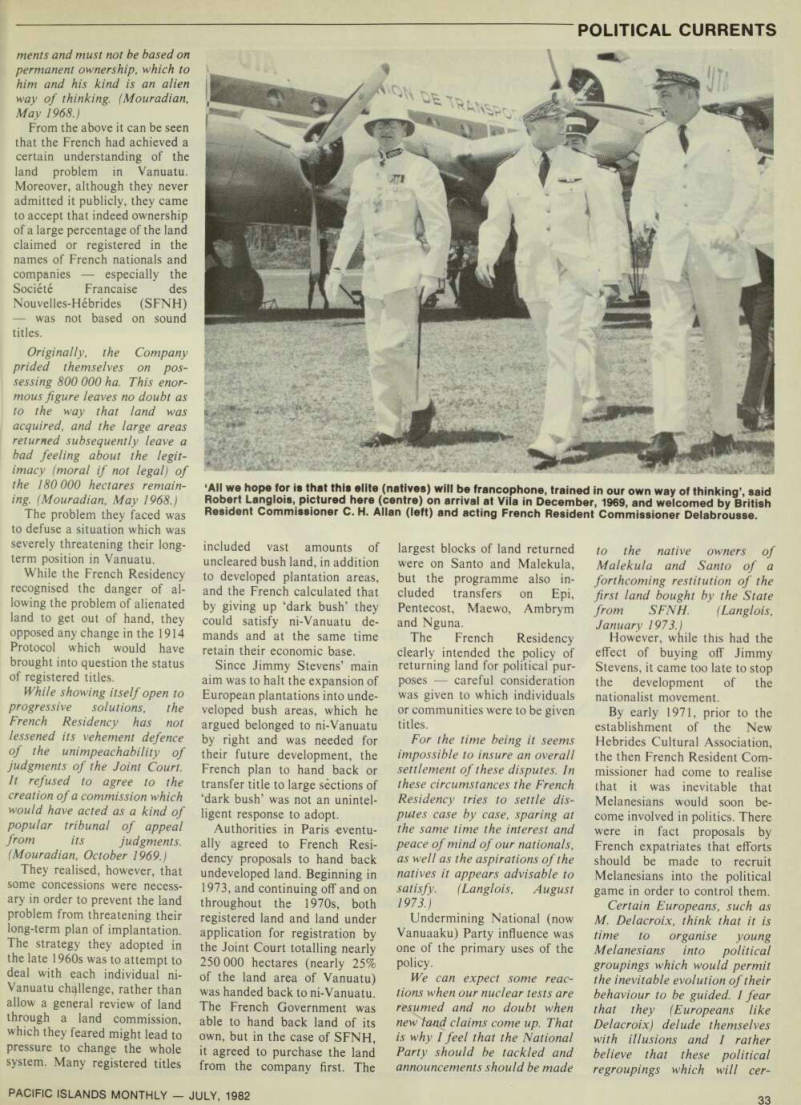
Political
Currents
Political Dynamite In A Vila Carport
Before Vanuatu: Anatomy of the French plan to hang around forever
PIM May (p 33) carried ex tracts from a confidential report to Paris made in October 1969 by the then French Resident Commissioner in the New Hebrides, Jacques Mouradian.
In it Mr Mouradian made clear France’s intention to ‘stay’ in the New Hebrides, acting on the express instructions of Gen eral de Gaulle.
He also described the con trary intentions of France’s British partners in the condo minium, who wanted to lead the country to independence, and the means being employed by France to foil this British plan.
These included vigorous ex pansion of the French schools system to build ‘our new clien tele of New Hebrideans undergoing Gallicisation by way of education’; rapid and generous expansion of French health services; payment of very high salaries to New Hebrideans in French employ; strong opposition to any inte gration (as desired by the British) of the various separate French and British administrat ive services in the country; and efforts by all means to delay the participation of New Hebrideans in local political life.
Mr Mouradian also described French mistrust of the activity of international organisations such as the United Nations in the New Hebrides, and their consequent grudging accept ance of the South Pacific Com mission as a ‘lesser evil’ in this connection.
Finally, the Resident Com missioner outlined what he called a ‘fallback’ French pos ition in the event that indepen dence could not, despite the very best efforts of the French, be prevented: the French would agree to it, but on condition that it would be ‘tempered inescapably by co-operation agreements with France’.
Now Howard Van
TREASE, director of the Uni versity of the South Pacific
Centre in Port-Vila, carries the story further with more analysis of other similar confidential French reports.
In the first of three articles he examines French official atti tudes to the land problem in the New Hebrides, and the relation ship of this problem to that of political independence. • • • Perhaps the only positive thing to come out of the French government’s attempt to block the independence of Vanuatu in July 1980 was that when the decision was finally made to leave in the last days before July 30, the staff in the French Residency were ill-prepared to make their exit. As a result, chaos reigned as staff furiously burned mountains of paper and documents (PIM Apr pi 3).
When time ran out they dumped a large pile of seem ingly unimportant files in the Residency carport.
Among the rubbish, however, was a small collection of monthly confidential reports of the French Resident Com missioner to the Ministry of Overseas Departments and Territories in Paris concerning the state of affairs in the New Hebrides (now Vanuatu).
Each month the French Resi dent Commissioner provided his superiors with a synthesis of the events and developments in the archipelago under the head ings: etat d’esprit des popu lations (state of mind of the population), vie politique (pol itical life), vie economique (economic life), vie sociale (social life) and vie adminis trative (administrative life).
While not a complete set, the reports provide an illuminating insight into the attitudes and policies of the French Govern ment prior to independence, a knowledge of which makes it easier to understand the basis of some of the problems Vanuatu faces today, and the policy the
French Government is at pres ent following.
The italicised quotations which follow are at times rather long. It was felt, however, that it was better simply to allow the French Resident Com missioners to speak for them selves. Copies of these reports are now held in many countries.
Given the principle embodied in the Protocol of 1914, which required the agreements of both metropolitan governments in order to make any change in the system, the French indeed might eventually have suc ceeded in their plan to implant themselves permanently in Vanuatu. They were prepared to spend more money than the British on building up their system of education and social services, and in the end this would have had the desired effect of creating the depen dence on and loyalty to France which could have enabled them to stay.
What they didn’t expect, but what soon came to be a far greater threat to their plans than British attempts to keep pace, was opposition by ni- Vanuatu to the condominium system itself. The focal point of this opposition was the land problem, which began to itensify in the mid-1960s in the form of a semi-cult movement called Nagriamel, led by Jimmy Moli Stevens, but later evolved into a nationalist move ment with the clear goal of achieving full independence.
French officials were ex tremely frightened of Jimmy Stevens when confrontations between his followers and European (primarily French) plantation owners first began in the late 19605.
Whatever the future of the movement shall be, a string of claims has emerged and we have to consider it. It is urgent to find a solution to the land litigations if we want to prevent them from growing into dis putes which would diminish
our influence just at the mo ment when it is increasing. (Mouradian, August 1968.) French officials realised that since the vast majority of alien ated land in Vanuatu was held or claimed by French nationals and companies, they were in deed the most vulnerable to attacks from ni-Vanuatu push ing for reform.
The French pressed their British partners to join them in taking firm action against Stevens, which led eventually to his arrest and imprisonment in 1968. During his period in prison, however, French Resi dency officials were able to have regular contact and discussions with him, which led them to the conclusion that he and his movement could be contained.
His theme is as follows: Melanesians never sold land to Europeans. Owing to this he categorically refuses to recog nise any registration of unde veloped land which might have been approved by the Joint Court... He accepts only the old agreements valid for the right to use the land which according to Melanesian cus tom are the only rights recog nised; the ownership rights re main theirs... He abstains from claiming developed par cels since, in this case, the occupation rights have been used... He does not at all intend to prevent the economic development of this country by the settlers or the companies, but when he refers to occu pation of undeveloped land or the cultivation of fallow par cels, the right to use the land must be subjected to new agree
ments and must not be based on permanent ownership, which to him and his kind is an alien way of thinking. (Mouradian, May 1968.) From the above it can be seen that the French had achieved a certain understanding of the land problem in Vanuatu.
Moreover, although they never admitted it publicly, they came to accept that indeed ownership of a large percentage of the land claimed or registered in the names of French nationals and companies especially the Societe Francaise des Nouvelles-Hebrides (SFNH) was not based on sound titles.
Originally, the Company prided themselves on pos sessing 800 000 ha. This enor mous figure leaves no doubt as to the way that land was acquired, and the large areas returned subsequently leave a bad feeling about the legit imacy (moral if not legal) of the 180 000 hectares remain ing. (Mouradian, May 1968.) The problem they faced was to defuse a situation which was severely threatening their long term position in Vanuatu.
While the French Residency recognised the danger of al lowing the problem of alienated land to get out of hand, they opposed any change in the 1914 Protocol which would have brought into question the status of registered titles.
While showing itself open to progressive solutions, the French Residency has not lessened its vehement defence of the unimpeachability of judgments of the Joint Court.
It refused to agree to the creation of a commission which would have acted as a kind of popular tribunal of appeal from its judgments. (Mouradian, October 1969.) They realised, however, that some concessions were necess ary in order to prevent the land problem from threatening their long-term plan of implantation.
The strategy they adopted in the late 1960 s was to attempt to deal with each individual ni- Vanuatu challenge, rather than allow a general review of land through a land commission, which they feared might lead to pressure to change the whole system. Many registered titles
included vast amounts of uncleared bush land, in addition to developed plantation areas, and the French calculated that by giving up ‘dark bush’ they could satisfy ni-Vanuatu de mands and at the same time retain their economic base.
Since Jimmy Stevens’ main aim was to halt the expansion of European plantations into unde veloped bush areas, which he argued belonged to ni-Vanuatu by right and was needed for their future development, the French plan to hand back or transfer title to large sections of ‘dark bush’ was not an unintel ligent response to adopt.
Authorities in Paris -eventu ally agreed to French Resi dency proposals to hand back undeveloped land. Beginning in 1973, and continuing off and on throughout the 19705, both registered land and land under application for registration by the Joint Court totalling nearly 250 000 hectares (nearly 25% of the land area of Vanuatu) was handed back to ni-Vanuatu.
The French Government was able to hand back land of its own, but in the case of SFNH, it agreed to purchase the land from the company first. The
largest blocks of land returned were on Santo and Malekula, but the programme also in cluded transfers on Epi, Pentecost, Maewo, Ambrym and Nguna.
The French Residency clearly intended the policy of returning land for political pur poses careful consideration was given to which individuals or communities were to be given titles.
For the time being it seems impossible to insure an overall settlement of these disputes. In these circumstances the French Residency tries to settle dis putes case by case, sparing at the same time the interest and peace of mind of our nationals, as well as the aspirations of the natives it appears advisable to satisfy. (Langlois, August 1973.) Undermining National (now Vanuaaku) Party influence was one of the primary uses of the policy.
We can expect some reac tions when our nuclear tests are resumed and no doubt when newkmd claims come up. That is why I feel that the National Party should be tackled and announcements should be made
to the native owners of Malekula and Santo of a forthcoming restitution of the first land bought by the State from SFNH. (Langlois, January 1973.) However, wnile this had the effect of buying off Jimmy Stevens, it came too late to stop the development of the nationalist movement.
By early 1971, prior to the establishment of the New Hebrides Cultural Association, the then French Resident Com missioner had come to realise that it was inevitable that Melanesians would soon be come involved in politics. There were in fact proposals by French expatriates that efforts should be made to recruit Melanesians into the political game in order to control them.
Certain Europeans, such as M. Delacroix, think that it is time to organise young Melanesians into political groupings which would permit the inevitable evolution of their behaviour to be guided. I fear that they (Europeans like Delacroix) delude themselves with illusions and I rather believe that these political regroupings which will cer-
‘All we hope for is that this elite (natives) will be francophone, trained in our own way of thinking’, said Robert Langlois, pictured here (centre) on arrival at Vila in December, 1969, and welcomed by British Resident Commissioner C. H. Allan (left) and acting French Resident Commissioner Delabrousse.
tainly take place will be undertaken by the natives themselves, as soon as a small thinking elite, capable of rep resenting the masses, will have been formed. All we hope for is that this elite will be francophone, trained in our own way of thinking. (Langlois, January 1971.) The above comment by the then French Resident Com missioner, R. Langlois, recog nised the inevitable awakening of Melanesians to the reality of life in the condominium, and that they would in the long run want to develop their own political strategies.
Following the demonstration in August 1971 of primarily anglophone Melanesians linked to the New Hebrides Cultural Association in support of a joint regulation to limit land sub division in the group, Langlois noted: Although the demonstration held for about two hours by just a few dozen natives was absolutely calm, its impact on the Europeans was gripping.
Unable to believe that natives could adopt an attitude that had not been dictated to them, the European population pinned this fear down to the activity of the British Resi dency. the Presbyterian Mission, the Anglicans, etc.. .
It is evident that the British were delighted to see an awak ening of civic consciousness in the natives, who wished to have their say in the settlement of affairs bearing on general inter ests. It is nonetheless certain that this awakening has been spontaneous, its occurrence
having been hastened by the attitudes of the Europeans, yet it had been lying in wait for a coherent and organised move ment. (Langlois, August 1971.) This realistic attitude on the part of Langlois, however, was not adopted by subsequent French Resident Com missioners, who found it difficult to attribute the politi cal activities in the 1970 s of the New Hebrides National Party, and later the Vanuaaku Party, to a Melanesian desire for reform.
Their inability to accept the notion that ni-Vanuatu them selves possessed a desire for political change and indepen dence which had not been planted by outsiders, reveals the disdain in which French officials held Melanesians, and the ex tent to which they were willing to disregard the feelings of colonised people in the pursuit of their own national interests.
French officials possessed an outdated 19th-century belief in the ‘superiority’ of French cul ture, and believed that Melanesians could be enticed into a state of perpetual colonial domination and subservience.
All that was needed, they be lieved, was time for their poli cies to take effect.
The discontent is undeniable, tensions between groups are a threat which must be con trolled as much as possible.
The success of our policy being first and foremost a question of time, time to train our elite, to
rally various sectors of the population around us, to estab lish the local structures we propose. To have our position damaged by movements against which we are unpre pared or could not contain, would be unfortunate. (Langlois, July 1972).
By the mid-19705, however, French officials were learning under the impact of political developments that their pos ition was not as secure as they had hoped. Despite the fact that hundreds of thousands of hec tares of formerly French-held land had been transferred to ni-Vanuatu ownership, Mela nesian discontent and protest was increasing. What they had failed to recognise was that land was not the key issue, but merely the catalyst for the nationalist movement. The real issue was political power independence.
The constant theme running throughout the French Resi dent Commissioners’ reports is that political agitation by pri marily English-speaking Mela nesians was planned and orches trated by the British Residency, and that the notion of indepen dence was the result of radical ideas implanted in the minds of young ni-Vanuatu studying abroad. The French Resident Commissioner noted in 1972 that: From correspondence re ceived in Port-Vila, it would appear that Anglophone students from outside and es pecially in Suva find sympath etic ears and precise advice for their complaints which accord
ing to some should result in violent action. Out of all these young natives’ claims, the one concerning political status is evidently most energetically brandished, but without a doubt, the restitution of land is a firmer claim and it upholds the whole objection to the condominium regime . . . The return of these young men will be spread over a period of a few years only, after which a reg ular influx of them will swell their ranks. We have enough time left for manoeuvring wherever possible, and we must speed up the settlement of pending lawsuits involving the French State and the SFNH. (Langlois, August 1972.) The French Government used the argument of British Residency plotting and foreign influence throughout the 1970 s to rationalise their own actions.
They blatantly attempted to manipulate and control political developments and the Melanesians involved on the pretext that the British and others were doing the same. It is significant to note, however, that the French Resident Com missioners’ reports never specify incidents in which the British Residency was supposed to have taken an active role.
One can only assume that it was impossible for French officials to imagine that the British were not involved in manipulation of the situation to the same intense degree as they were .. .
Next month: Political ma nipulation, and the politics of land: Stevens, Oliver, Peacock.
The ‘absolutely calm’ demon stration led by Anglican Father John Bani (centre) in August, 1971.
Advertisements & other items, pp. 32-34 (1 item)
Expert
Insurance Service
throughout the islands
*i *
Queensland Insurance (Fiji) Limited
Head Office, 34 Usher St., SUVA . General Manager: L. G. Liddell A.A.1.1. Assistant Managers : R. Jackson, Vijay Lai. Phone: 23851.
LAUTOKA OFFICE; Burns Philp Bldg., Naviti St. District Manager: J. Dalton. Phone: 60642.
LABASA OFFICE: Burns Philp Bldg. District Manager; R. SHARMA, Phone: 82139
Queensland Insurance (PNG) Limited
PAPUA NEW GUINEA
Head Office, B.N.G. Building, Musgrave St.PORT MORESBY. General Manager: J. M. Dawe.
Phone: 21 2144.
LAE: 4th St. & Coronation Drive. District Manager: C. D. Hillier Phone: 423873.
MOUNT HAGEN: Hagen Drive. District Manager: G. W. Jack Phone: 521002.
ARAWA: Chebu St. District Manager: J. Longbut. Phone: 951555.
MADANG: Kasagten St. District Manager: N. D. Ramage. Phone: 822020.
RABAUL: Wirraway St. District Manager: W. F Tinker. Phone: 921014.
QBE Insurance (International) Limited
VANUATU, PORT VILA: Rue de Paris, Suite 19, Oceania Bldg. Manager; I. R. Martin.
Phone: 2299.
SANTO: Burns Philp (Vanuatu) Ltd. Phone: 230.
PACIFIC AGENCIES
NEW CALEDONIA Ste. W. A. Johnston, S.A.R.L. 5 Rue Anatole France, NOUMEA.
Phone: 272083.
TAHITI- Arthur Chung. Immeuble 8.1.5., Front de Mer, PAPEETE . Phone: 2.86.19.
NIUE: Burns Philp (South Sea) Company Ltd, NORFOLK ISLAND: Burns Philp ('N I ) Company Ltd. Phone: 2191.
SAMOA: APIA, Burns Philp (South Sea) Company Ltd. Phone; 22611 TONGA Burns Philp (South Sea) Company Ltd. NUKU’ALOFA. Phone 21500 HAAPAI, VAVAU.
MEMBERS OF THE:
INSURANCE GROUP LIMITED
In our 87th Year Selling ‘Service’ to the Pacific Islands
Nelson & Robertson
o * "O o > m V & G
RABAUL
MADANG
LAE
;;:VW*
KIETA
, • V * . k:*: •v.-.
W: >.v.
BRISBANE
SYDNEY
•*. •• iV* P.O
Pty. Ltd.
(Established 1895)
Plantation House, 197 Clarence Street, Sydney.
Cables: ‘IVAN’, Sydney, Brisbane.
Telex: AA22381, Sydney.
Phone: 29 2871 ~v
LAUTOKA
For Indents
from Australia,
New Zealand and Overseas
Foodstuffs
Softgoods
Hardware
Machinery
Travel
Insurance
Canned Fish
Jute Goods
Real Estate
SUVA
BRANCH OFFICES:
Nelson & Robertson Pty. Ltd., P.O. Box 575, Brisbane, Qld., Australia. 2216966 P.O. Box 2092, Govt. Bldg., Suva, Fiji. 22430 P.O. Box 258, Lautoka, Fiji. 62101 P.O. Box 2420, CPO Auckland 1, New Zealand. 774141 :•?.
;.>:‘::PAPUA NEW GUINEA REPRESENTATIVES
rii Pty. Ltd., , Rabaul, P.N.G. 922911 Lae, P.N.G. 422366 . Box 711, Madang, P.N.G. 822066 ’P.O. Box 253, Kieta, P.N.G. 956185 ■
Vanuatu lays
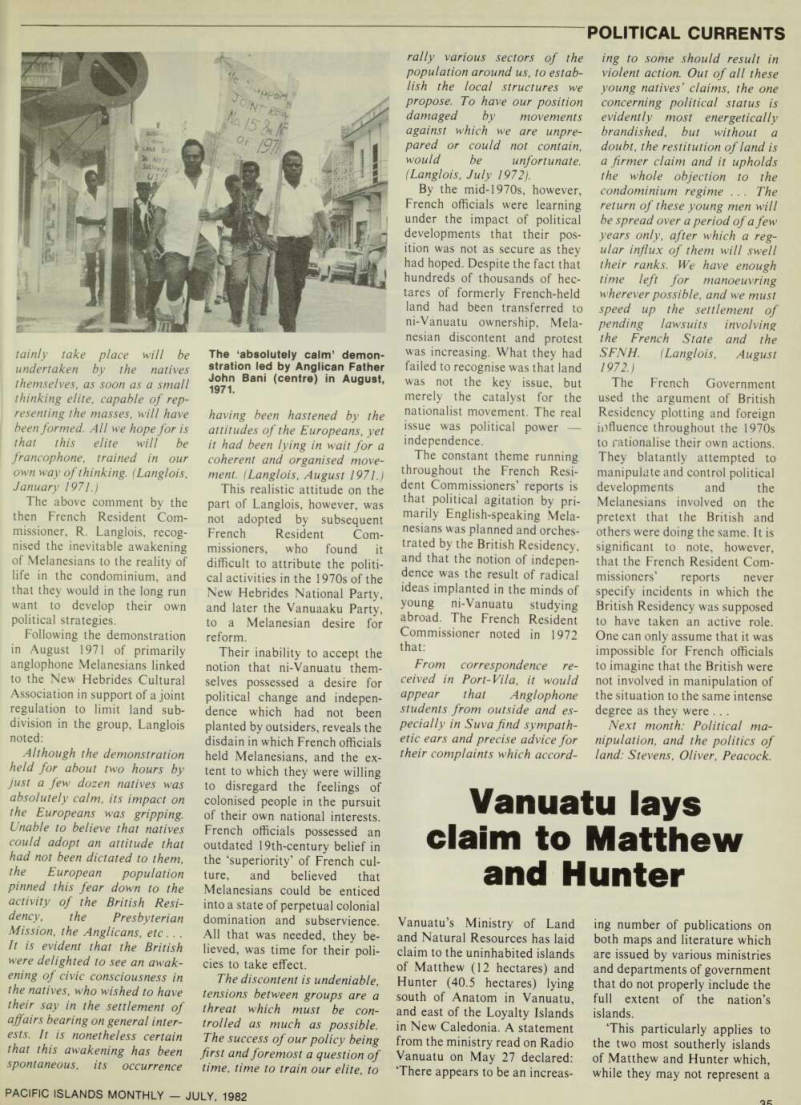
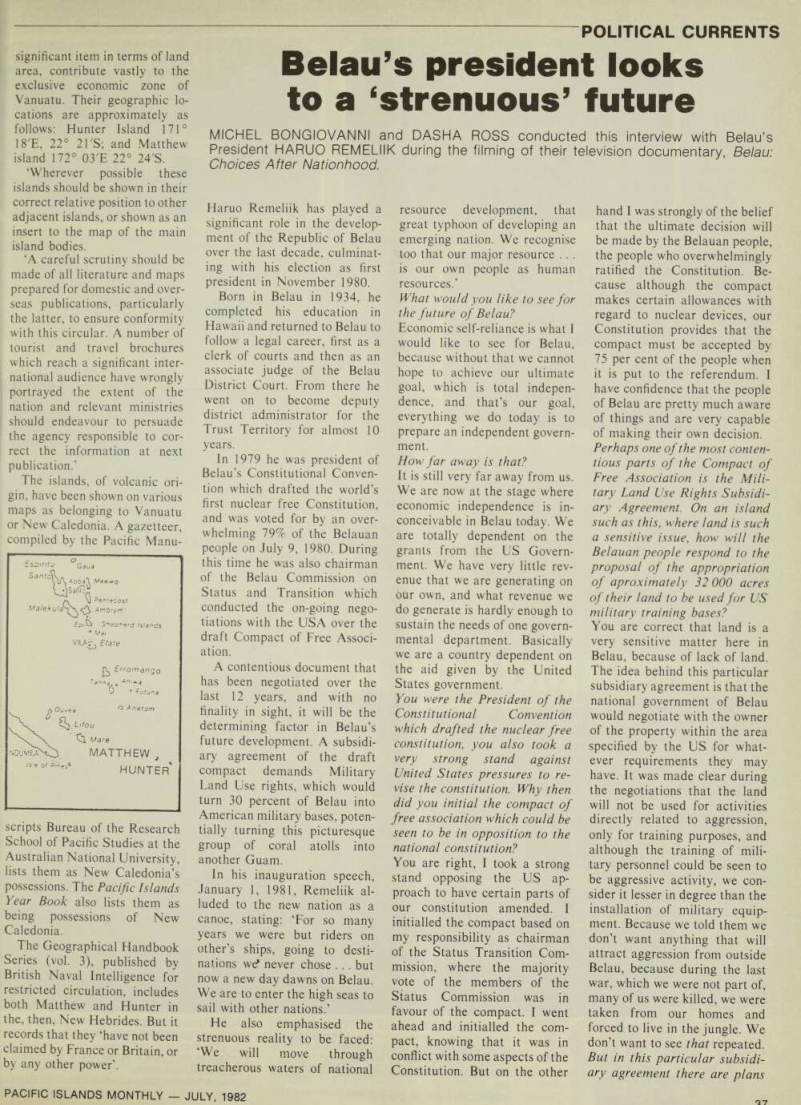
claim to Matthew and Hunter
Vanuatu’s Ministry of Land and Natural Resources has laid claim to the uninhabited islands of Matthew (12 hectares) and Hunter (40.5 hectares) lying south of Anatom in Vanuatu, and east of the Loyalty Islands in New Caledonia. A statement from the ministry read on Radio Vanuatu on May 27 declared: ‘There appears to be an increas
ing number of publications on both maps and literature which are issued by various ministries and departments of government that do not properly include the full extent of the nation’s islands. ‘This particularly applies to the two most southerly islands of Matthew and Hunter which, while they may not represent a
significant item in terms of land area, contribute vastly to the exclusive economic zone of Vanuatu. Their geographic lo cations are approximately as follows; Hunter Island 171° 18'E, 22° 21'S; and Matthew island 172° 03'E 22° 24'S. ‘Wherever possible these islands should be shown in their correct relative position to other adjacent islands, or shown as an insert to the map of the main island bodies. ‘A careful scrutiny should be made of all literature and maps prepared for domestic and over seas publications, particularly the latter, to ensure conformity with this circular. A number of tourist and travel brochures which reach a significant inter national audience have wrongly portrayed the extent of the nation and relevant ministries should endeavour to persuade the agency responsible to cor rect the information at next publication.’
The islands, of volcanic ori gin, have been shown on various maps as belonging to Vanuatu or New Caledonia. A gazetteer, compiled by the Pacific Manu-
scripts Bureau of the Research School of Pacific Studies at the Australian National University, lists them as New Caledonia’s possessions. The Pacific Islands Year Book also lists them as being possessions of New Caledonia.
The Geographical Handbook Series (vol. 3), published by British Naval Intelligence for restricted circulation, includes both Matthew and Hunter in the, then, New Hebrides. But it records that they ‘have not been claimed by France or Britain, or by any other power’.
Advertisements & other items, pp. 36-39 (1 item)
Demon
Add New Life To Your Record Enjoyment DEMON has supplied the broadcasting industry with
professional equipment for
many years and met with highest acclaim.
DP-60L: “DEMON Quartz”
“Auto Lift” D.D. Turntable.
The straight and the S-shaped type tonearm are compatible, equipped also.
Mirrorfinish, laminated cabinet exhibits clean lines and luxury looks.
DEMON
70 years experience in sound research & development
NIPPON COLUMBIA CO LTD
No. 14-14, AKASAKA 4-CHOME, MINATO-KU,
TOKYO 107, JAPAN
DL-305: “Amorophous boron cantilever” MC type phono cartridge.
DL-303: “Lightest Weight Vibration System” MC type phono cartridge.
DL-301; “High Complicance’
MC type phono cartridge.
“ALMARCO III”
ALUMINIUM ALLOY HIGH SPEED DYNAPLANE MULTI PURPOSE 40059 LENGTH OA-34FT. BEAM O.A. 11 FT. DRAUGHT 2FT. DISPLACEMENT 6.5 T.
General: Designed and built by ALI MARINE LTD. Raglan, New Zealand. N.Z. M.O.T. Survey. Applications - Off shore professional fishing and charter - Fisheries Patrol and Management - Customs Patrol - High speed personal carrier (oil & survey) Etc.. Two insulated fish and freight holds of 2 ton cap. .. .. ~, no Propulsion System: Twin Isuzu 6BDIT. Intercooled Diesels rated to 220 HP each, through Borg Warner gear boxes to M.D.S. Sternpowr Model 103 1.6-1 stern drives. Power trim/lift and hydraulic steering. 100 gal. fuel capacity. .
Electronics: Furuno PPI Sonar FHIOS, Furuno Radar FR24O MK2., Furuno Sounder F.E.500, Teleradio 110 SSB Marine Tranceiver, H.F.
Tranceiver, B.C. Radio. Electronic Sea Temp. etc...
Hydraulics: Variable speed high torque supply to capstan and auto line hauler.
Facilities: Spacious accommodation forward, pressurised fresh water system, gas stove cooking, full inboard and out board lighting, sink, cupboards with ample general stowage etc. etc. etc. ._ . . ... , .. .. .
Performance: Maximum speed capabilities 40 mph. Cruise 30 mph. Displacement speed for extreme long range 12 knots. Ultimate diesel fuel economy and reliability. x PRICE: This vessel is available for immediate shipment ex Auckland N.Z. at A 5163,000 F. 0.8. Auckland.
ALL
ENQUIRIES TO ALI MARINE LIMITED P.O. BOX 31 RAGLAN NEW ZEALAND
LAND CRUISER
STATION WAGON
« £
HI ACE
nn m nun n n f
ii I
TOYOTA
PAPUA NEW GUINEA: ELA MOTORS, (SOUTHSEA) CO., LTD., P.O. Box 129, Pago Pago.
Scratchley Rd„ Badili, P.O. Box 675, Port Moresby. WESTERN SAMOA: BURNS PHILP (SOUTHSEA)
SERVICE
NORTHERN MARIANAS & U.S.T.T.:
MICROL CORPORATION, P.O. Box 267, Saipan.
FIJI: AUTOMOTIVE SUPPLIES COMPANY, G.P.O.
Box 355, Suva.
AMERICAN SAMOA; BURNS PHILP
CO., LTD., P.O. Box 188, Apia.
TONGA: BURNS PHILP (SOUTHSEA) CO., LTD.,
P.O. Box 55, Nuku’alofa.
GUAM: ATKINS, KROLL (GUAM) LTD., P.O. Box 6421 Tamuning.
HI-LUX
DOUBLE CAB
DYNA
or l B *•*
TRUCK
HEAVY DUTY
READY TO TAKE
ON THE TOUGHEST OOBS
Meet Toyota’s hard working commercial vehicles.
Tough. Durable. Ready to meet the challenge of the worst roads and climates. Ready to do the Job called for with ease.
Rugged veterans, each one specifically designed to meet the different demands of the world’s businesses.
One of them is just right for you.
There are no vehicles more reliable. And if you need it, Toyota is ready with fast backup servicftraß
Toyota’s roadmasters, they’re a winning team.
/ANUATU: VANUATU MOTORS, P.O. Box 18, Port Vila. KIRIBATI: TARAWA MOTORS, Box 36, Bairiki,
SOLOMON; MENDANA ENTERPRISES (5.1.) LTD.,
3.P.0. Box 174, Honiara.
TAHITI: NIPPON AUTOMOTO, B P. 342, Papeete.
COOK ISLANDS: COOK ISLANDS TRADING
CORPORATION LTD., P.O. Box 92, Rarotonga.
*JAURU: NAURU COOPERATIVE SOCIETY.
Tarawa, Kiribati.
NORFOLK ISLAND: BORRY’S RENTAL CARS,
MOUNT PITT (ENTERPRISES) LTD., P.O. Box 169.
NEW CALEDONIA: SERVICE IMPORTATION
AUTOMOBILE DU PACIFIQUE, Rond-Point
du Pacifique (Station Total) B.P. 438, Noumea.
TOYOTA
The Toyota range includes:
COROLLA, STARLET, CORONA, CRESSIDA, HI-LUX,
STOUT, HI ACE, DYNA, COASTER and LAND CRUISER
Belau’s president looks


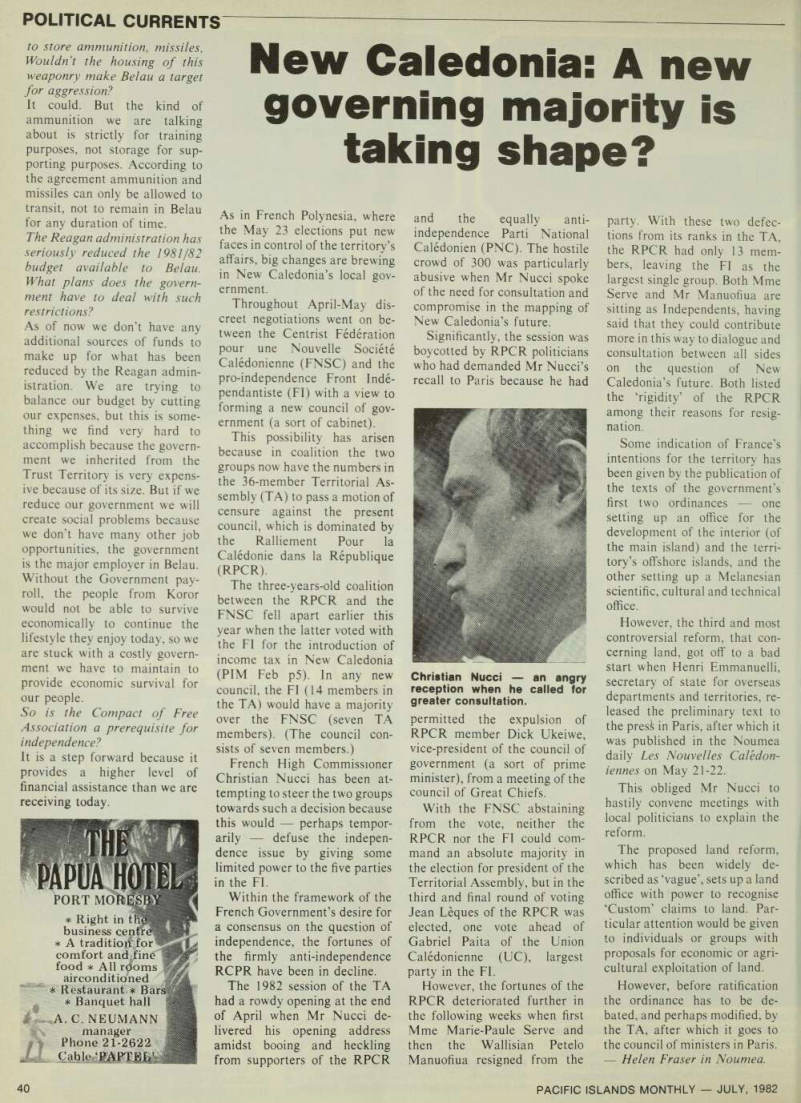
to a ‘strenuous’ future
MICHEL BONGIOVANNI and DASHA ROSS conducted this interview with Belau’s President HARUO REMELIIK during the filming of their television documentary, Belau: Choices After Nationhood.
Haruo Remeliik has played a significant role in the develop ment of the Republic of Belau over the last decade, culminat ing with his election as first president in November 1980.
Born in Belau in 1934, he completed his education in Hawaii and returned to Belau to follow a legal career, first as a clerk of courts and then as an associate judge of the Belau District Court. From there he went on to become deputy district administrator for the Trust Territory for almost 10 years.
In 1979 he was president of Belau’s Constitutional Conven tion which drafted the world’s first nuclear free Constitution, and was voted for by an over whelming 79% of the Belauan people on July 9, 1980. During this time he was also chairman of the Belau Commission on Status and Transition which conducted the on-going nego tiations with the USA over the draft Compact of Free Associ ation.
A contentious document that has been negotiated over the last 12 years, and with no finality in sight, it will be the determining factor in Belau’s future development. A subsidi ary agreement of the draft compact demands Military Land Use rights, which would turn 30 percent of Belau into American military bases, poten tially turning this picturesque group of coral atolls into another Guam.
In his inauguration speech, January 1, 1981, Remeliik al luded to the new nation as a canoe, stating: ‘For so many years we were but riders on other’s ships, going to desti nations we* never chose . . . but now a new day dawns on Belau.
We are to enter the high seas to sail with other nations.’
He also emphasised the strenuous reality to be faced: ‘We will move through treacherous waters of national
resource development, that great typhoon of developing an emerging nation. We recognise too that our major resource .. . is our own people as human resources.’
What would you like to see for the future of Belau?
Economic self-reliance is what I would like to see for Belau, because without that we cannot hope to achieve our ultimate goal, which is total indepen dence, and that’s our goal, everything we do today is to prepare an independent govern ment.
How far away is that?
It is still very far away from us.
We are now at the stage where economic independence is in conceivable in Belau today. We are totally dependent on the grants from the US Govern ment. We have very little rev enue that we are generating on our own, and what revenue we do generate is hardly enough to sustain the needs of one govern mental department. Basically we are a country dependent on the aid given by the United States government.
You were the President of the Constitutional Convention which drafted the nuclear free constitution, you also took a very strong stand against United States pressures to re vise the constitution. Why then did you initial the compact of free association which could be seen to be in opposition to the national constitution?
You are right, I took a strong stand opposing the US ap proach to have certain parts of our constitution amended. I initialled the compact based on my responsibility as chairman of the Status Transition Com mission, where the majority vote of the members of the Status Commission was in favour of the compact. I went ahead and initialled the com pact, knowing that it was in conflict with some aspects of the Constitution. But on the other
hand I was strongly of the belief that the ultimate decision will be made by the Belauan people, the people who overwhelmingly ratified the Constitution. Be cause although the compact makes certain allowances with regard to nuclear devices, our Constitution provides that the compact must be accepted by 75 per cent of the people when it is put to the referendum. I have confidence that the people of Belau are pretty much aware of things and are very capable of making their own decision.
Perhaps one of the most conten tious parts of the Compact of Free Association is the Mili tary Land Use Rights Subsidi ary Agreement. On an island such as this, where land is such a sensitive issue, how will the Belauan people respond to the proposal of the appropriation of aproximately 32 000 acres of their land to be used for US military training bases?
You are correct that land is a very sensitive matter here in Belau, because of lack of land.
The idea behind this particular subsidiary agreement is that the national government of Belau would negotiate with the owner of the property within the area specified by the US for what ever requirements they may have. It was made clear during the negotiations that the land will not be used for activities directly related to aggression, only for training purposes, and although the training of mili tary personnel could be seen to be aggressive activity, we con sider it lesser in degree than the installation of military equip ment. Because we told them we don’t want anything that will attract aggression from outside Belau, because during the last war, which we were not part of, many of us were killed, we were taken from our homes and forced to live in the jungle. We don’t want to see that repeated.
But in this particular subsidi ary agreement there are plans
to store ammunition, missiles.
Wouldn’t the housing of this weaponry make Belau a target for aggression?
It could. But the kind of ammunition we are talking about is strictly for training purposes, not storage for sup porting purposes. According to the agreement ammunition and missiles can only be allowed to transit, not to remain in Belau for any duration of time.
The Reagan administration has seriously reduced the 1981/82 budget available to Belau.
What plans does the govern ment have to deal with such restrictions?
As of now we don’t have any additional sources of funds to make up for what has been reduced by the Reagan admin istration. We are trying to balance our budget by cutting our expenses, but this is some thing we find very hard to accomplish because the govern ment we inherited from the Trust Territory is very expens ive because of its size. But if we reduce our government we will create social problems because we don’t have many other job opportunities, the government is the major employer in Belau.
Without the Government pay roll, the people from Koror would not be able to survive economically to continue the lifestyle they enjoy today, so we are stuck with a costly govern ment we have to maintain to provide economic survival for our people.
So is the Compact of Free Association a prerequisite for independence?
It is a step forward because it provides a higher level of financial assistance than we are receiving today.
taking shape?
New Caledonia: A new governing majority is taking shape?
As in French Polynesia, where the May 23 elections put new faces in control of the territory’s affairs, big changes are brewing in New Caledonia’s local gov ernment.
Throughout April-May dis creet negotiations went on be tween the Centrist Federation pour une Nouvelle Societe Caledonienne (FNSC) and the pro-independence Front Inde pendantiste (FI) with a view to forming a new council of gov ernment (a sort of cabinet).
This possibility has arisen because in coalition the two groups now have the numbers in the 36-member Territorial As sembly (TA) to pass a motion of censure against the present council, which is dominated by the Ralliement Pour la Caledonie dans la Republique
(Rpcr).
The three-years-old coalition between the RPCR and the FNSC fell apart earlier this year when the latter voted with the FI for the introduction of income tax in New Caledonia (PIM Feb p 5). In any new council, the FI (14 members in the TA) would have a majority over the FNSC (seven TA members). (The council con sists of seven members.) French High Commissioner Christian Nucci has been at tempting to steer the two groups towards such a decision because this would perhaps tempor arily defuse the indepen dence issue by giving some limited power to the five parties in the FI.
Within the framework of the French Government’s desire for a consensus on the question of independence, the fortunes of the firmly anti-independence RCPR have been in decline.
The 1982 session of the TA had a rowdy opening at the end of April when Mr Nucci de livered his opening address amidst booing and heckling from supporters of the RPCR
and the equally anti independence Parti National Caledonien (PNC). The hostile crowd of 300 was particularly abusive when Mr Nucci spoke of the need for consultation and compromise in the mapping of New Caledonia’s future.
Significantly, the session was boycotted by RPCR politicians who had demanded Mr Nucci’s recall to Paris because he had
permitted the expulsion of RPCR member Dick Ukeiwe, vice-president of the council of government (a sort of prime minister), from a meeting of the council of Great Chiefs.
With the FNSC abstaining from the vote, neither the RPCR nor the FI could com mand an absolute majority in the election for president of the Territorial Assembly, but in the third and final round of voting Jean Leques of the RPCR was elected, one vote ahead of Gabriel Paita of the Union Caledonienne (UC), largest party in the FI.
However, the fortunes of the RPCR deteriorated further in the following weeks when first Mme Marie-Paule Serve and then the Wallisian Petelo Manuofiua resigned from the
party. With these two defec tions from its ranks in the TA, the RPCR had only 13 mem bers, leaving the FI as the largest single group. Both Mme Serve and Mr Manuofiua are sitting as Independents, having said that they could contribute more in this way to dialogue and consultation between all sides on the question of New Caledonia’s future. Both listed the ‘rigidity’ of the RPCR among their reasons for resig nation.
Some indication of France’s intentions for the territory has been given by the publication of the texts of the government’s first two ordinances one setting up an office for the development of the interior (of the main island) and the terri tory’s offshore islands, and the other setting up a Melanesian scientific, cultural and technical office.
However, the third and most controversial reform, that con cerning land, got off to a bad start when Henri Emmanuelli, secretary of state for overseas departments and territories, re leased the preliminary text to the presk in Paris, after which it was published in the Noumea daily Les Nouvelles Caledon iennes on May 21-22.
This obliged Mr Nucci to hastily convene meetings with local politicians to explain the reform.
The proposed land reform, which has been widely de scribed as ‘vague’, sets up a land office with power to recognise ‘Custom’ claims to land. Par ticular attention would be given to individuals or groups with proposals for economic or agri cultural exploitation of land.
However, before ratification the ordinance has to be de bated, and perhaps modified, by the TA, after which it goes to the council of ministers in Paris.
Helen Fraser in Noumea.
Christian Nucci an angry reception when he called for greater consultation.
Advertisements & other items, p. 40 (1 item)
business ceptfj
M()R or
PORT
* Right in
business ceptfj
* A traditiopvh comfort food * All rdoms airconditkmed * Restaurant * Ba * Banquet hall
L«A. C. NEUMANN
manager > Phone 21-2622 cable
People
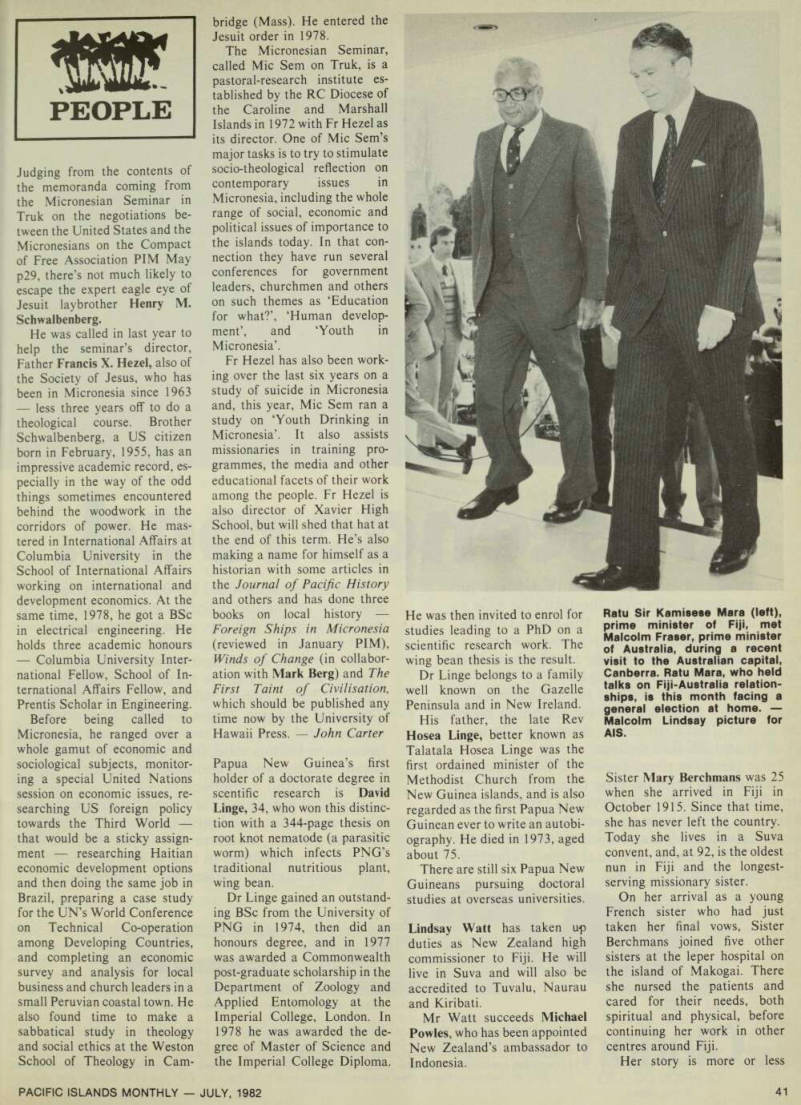
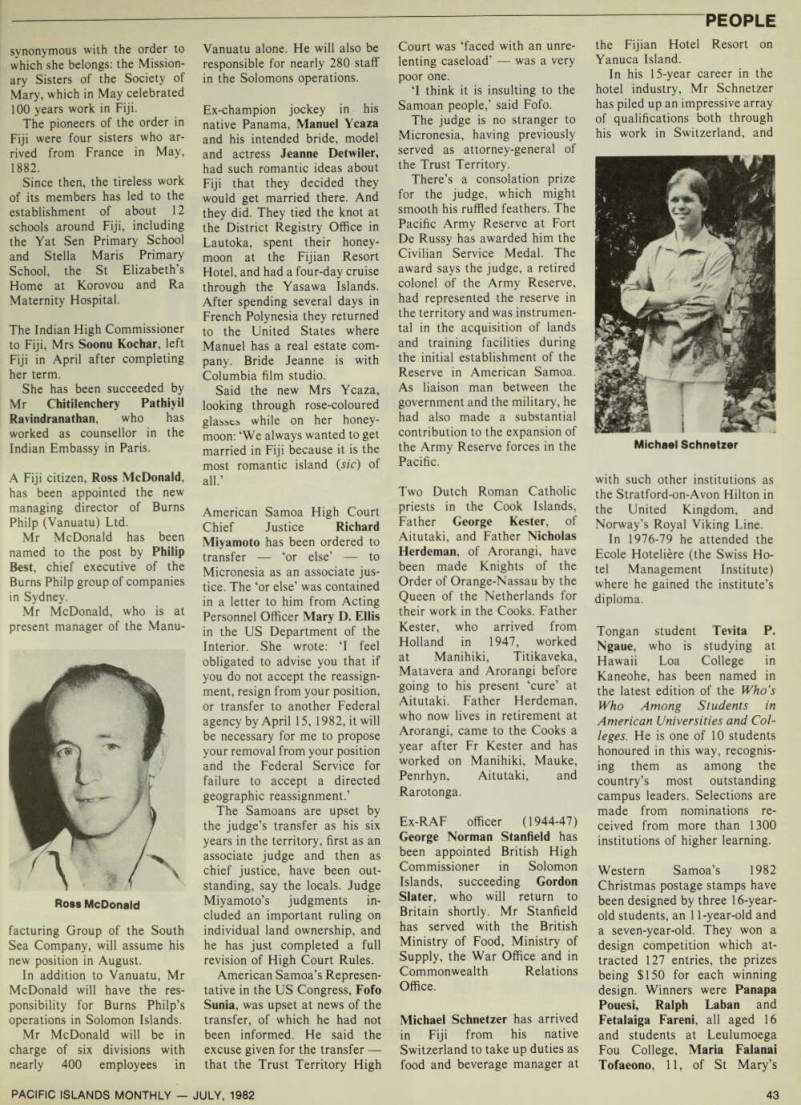

Judging from the contents of the memoranda coming from the Micronesian Seminar in Truk on the negotiations be tween the United States and the Micronesians on the Compact of Free Association PIM May p 29, there’s not much likely to escape the expert eagle eye of Jesuit laybrother Henry M.
Schwalbenberg.
He was called in last year to help the seminar’s director, Father Francis X. Hezel, also of the Society of Jesus, who has been in Micronesia since 1963 less three years off to do a theological course. Brother Schwalbenberg, a US citizen born in February, 1955, has an impressive academic record, es pecially in the way of the odd things sometimes encountered behind the woodwork in the corridors of power. He mas tered in International Affairs at Columbia University in the School of International Affairs working on international and development economics. At the same time, 1978, he got a BSc in electrical engineering. He holds three academic honours Columbia University Inter national Fellow, School of In ternational Affairs Fellow, and Prentis Scholar in Engineering.
Before being called to Micronesia, he ranged over a whole gamut of economic and sociological subjects, monitor ing a special United Nations session on economic issues, re searching US foreign policy towards the Third World that would be a sticky assign ment researching Haitian economic development options and then doing the same job in Brazil, preparing a case study for the UN’s World Conference on Technical Co-operation among Developing Countries, and completing an economic survey and analysis for local business and church leaders in a small Peruvian coastal town. He also found time to make a sabbatical study in theology and social ethics at the Weston School of Theology in Cam
bridge (Mass). He entered the Jesuit order in 1978.
The Micronesian Seminar, called Mic Sem on Truk, is a pastoral-research institute es tablished by the RC Diocese of the Caroline and Marshall Islands in 1972 with Fr Hezel as its director. One of Mic Sem’s major tasks is to try to stimulate socio-theological reflection on contemporary issues in Micronesia, including the whole range of social, economic and political issues of importance to the islands today. In that con nection they have run several conferences for government leaders, churchmen and others on such themes as ‘Education for what?’, ‘Human develop ment’, and ‘Youth in Micronesia’.
Fr Hezel has also been work ing over the last six years on a study of suicide in Micronesia and, this year, Mic Sem ran a study on ‘Youth Drinking in Micronesia’. It also assists missionaries in training pro grammes, the media and other educational facets of their work among the people. Fr Hezel is also director of Xavier High School, but will shed that hat at the end of this term. He’s also making a name for himself as a historian with some articles in the Journal of Pacific History and others and has done three books on local history Foreign Ships in Micronesia (reviewed in January PIM), Winds of Change (in collabor ation with Mark Berg) and The First Taint of Civilisation, which should be published any time now by the University of Hawaii Press. John Carter Papua New Guinea’s first holder of a doctorate degree in scentific research is David Linge, 34, who won this distinc tion with a 344-page thesis on root knot nematode (a parasitic worm) which infects PNG’s traditional nutritious plant, wing bean.
Dr Linge gained an outstand ing BSc from the University of PNG in 1974, then did an honours degree, and in 1977 was awarded a Commonwealth post-graduate scholarship in the Department of Zoology and Applied Entomology at the Imperial College, London. In 1978 he was awarded the de gree of Master of Science and the Imperial College Diploma.
He was then invited to enrol for studies leading to a PhD on a scientific research work. The wing bean thesis is the result.
Dr Linge belongs to a family well known on the Gazelle Peninsula and in New Ireland.
His father, the late Rev Hosea Linge, better known as Talatala Hosea Linge was the first ordained minister of the Methodist Church from the New Guinea islands, and is also regarded as the first Papua New Guinean ever to write an autobi ography. He died in 1973, aged about 75.
There are still six Papua New Guineans pursuing doctoral studies at overseas universities.
Lindsay Watt has taken up duties as New Zealand high commissioner to Fiji. He will live in Suva and will also be accredited to Tuvalu, Naurau and Kiribati.
Mr Watt succeeds Michael Powles, who has been appointed New Zealand’s ambassador to Indonesia.
Sister Mary Berchmans was 25 when she arrived in Fiji in October 1915. Since that time, she has never left the country.
Today she lives in a Suva convent, and, at 92, is the oldest nun in Fiji and the longest serving missionary sister.
On her arrival as a young French sister who had just taken her final vows, Sister Berchmans joined five other sisters at the leper hospital on the island of Makogai. There she nursed the patients and cared for their needs, both spiritual and physical, before continuing her work in other centres around Fiji.
Her story is more or less
Ratu Sir Kamisese Mara (left), prime minister of Fiji, met Malcolm Fraser, prime minister of Australia, during a recent visit to the Australian capital, Canberra. Ratu Mara, who held talks on Fiji-Australia relation ships, is this month facing a general election at home.
Malcolm Lindsay picture for
Ais.
synonymous with the order to which she belongs: the Mission ary Sisters of the Society of Mary, which in May celebrated 100 years work in Fiji.
The pioneers of the order in Fiji were four sisters who ar rived from France in May, 1882.
Since then, the tireless work of its members has led to the establishment of about 12 schools around Fiji, including the Yat Sen Primary School and Stella Maris Primary School, the St Elizabeth’s Home at Korovou and Ra Maternity Hospital.
The Indian High Commissioner to Fiji, Mrs Soonu Kochar, left Fiji in April after completing her term.
She has been succeeded by Mr Chitilenchery Pathiyil Ravindranathan. who has worked as counsellor in the Indian Embassy in Paris.
A Fiji citizen, Ross McDonald, has been appointed the new managing director of Burns Philp (Vanuatu) Ltd.
Mr McDonald has been named to the post by Philip Best, chief executive of the Burns Philp group of companies in Sydney.
Mr McDonald, who is at present manager of the Manu-
facturing Group of the South Sea Company, will assume his new position in August.
In addition to Vanuatu, Mr McDonald will have the res ponsibility for Burns Philp’s operations in Solomon Islands.
Mr McDonald will be in charge of six divisions with nearly 400 employees in
Vanuatu alone. He will also be responsible for nearly 280 staff in the Solomons operations.
Ex-champion jockey in his native Panama, Manuel Ycaza and his intended bride, model and actress Jeanne Detwiler, had such romantic ideas about Fiji that they decided they would get married there. And they did. They tied the knot at the District Registry Office in Lautoka, spent their honey moon at the Fijian Resort Hotel, and had a four-day cruise through the Yasawa Islands.
After spending several days in French Polynesia they returned to the United States where Manuel has a real estate com pany. Bride Jeanne is with Columbia film studio.
Said the new Mrs Ycaza, looking through rose-coloured glasses while on her honey moon: ‘We always wanted to get married in Fiji because it is the most romantic island (sic) of all’
American Samoa High Court Chief Justice Richard Miyamoto has been ordered to transfer ‘or else’ to Micronesia as an associate jus tice. The ‘or else’ was contained in a letter to him from Acting Personnel Officer Mary D. Ellis in the US Department of the Interior. She wrote: T feel obligated to advise you that if you do not accept the reassign ment, resign from your position, or transfer to another Federal agency by April 15, 1982, it will be necessary for me to propose your removal from your position and the Federal Service for failure to accept a directed geographic reassignment.’
The Samoans are upset by the judge’s transfer as his six years in the territory, first as an associate judge and then as chief justice, have been out standing, say the locals. Judge Miyamoto’s judgments in cluded an important ruling on individual land ownership, and he has just completed a full revision of High Court Rules.
American Samoa’s Represen tative in the US Congress, Fofo Sunia, was upset at news of the transfer, of which he had not been informed. He said the excuse given for the transfer that the Trust Territory High
Court was ‘faced with an unre lenting caseload’ was a very poor one.
T think it is insulting to the Samoan people,’ said Fofo.
The judge is no stranger to Micronesia, having previously served as attorney-general of the Trust Territory.
There’s a consolation prize for the judge, which might smooth his ruffled feathers. The Pacific Army Reserve at Fort De Russy has awarded him the Civilian Service Medal. The award says the judge, a retired colonel of the Army Reserve, had represented the reserve in the territory and was instrumen tal in the acquisition of lands and training facilities during the initial establishment of the Reserve in American Samoa.
As liaison man between the government and the military, he had also made a substantial contribution to the expansion of the Army Reserve forces in the Pacific.
Two Dutch Roman Catholic priests in the Cook Islands, Father George Kester, of Aitutaki, and Father Nicholas Herdeman, of Arorangi, have been made Knights of the Order of Orange-Nassau by the Queen of the Netherlands for their work in the Cooks. Father Kester, who arrived from Holland in 1947, worked at Manihiki, Titikaveka, Matavera and Arorangi before going to his present ‘cure’ at Aitutaki. Father Herdeman, who now lives in retirement at Arorangi, came to the Cooks a year after Fr Kester and has worked on Manihiki, Mauke, Penrhyn, Aitutaki, and Rarotonga.
Ex-RAF officer (1944-47) George Norman Stanfield has been appointed British High Commissioner in Solomon Islands, succeeding Gordon Slater, who will return to Britain shortly. Mr Stanfield has served with the British Ministry of Food, Ministry of Supply, the War Office and in Commonwealth Relations Office.
Michael Schnetzer has arrived in Fiji from his native Switzerland to take up duties as food and beverage manager at
the Fijian Hotel Resort on Yanuca Island.
In his 15-year career in the hotel industry, Mr Schnetzer has piled up an impressive array of qualifications both through his work in Switzerland, and
with such other institutions as the Stratford-on-Avon Hilton in the United Kingdom, and Norway’s Royal Viking Line.
In 1976-79 he attended the Ecole Hoteliere (the Swiss Ho tel Management Institute) where he gained the institute’s diploma.
Tongan student Tevita P.
Ngaue, who is studying at Hawaii Loa College in Kaneohe, has been named in the latest edition of the Who's Who Among Students in American Universities and Col leges. He is one of 10 students honoured in this way, recognis ing them as among the country’s most outstanding campus leaders. Selections are made from nominations re ceived from more than 1300 institutions of higher learning.
Western Samoa’s 1982 Christmas postage stamps have been designed by three 16-year old students, an 11-year-old and a seven-year-old. They won a design competition which at tracted 127 entries, the prizes being $l5O for each winning design. Winners were Panapa Pouesi, Ralph Laban and Fetalaiga Fareni, all aged 16 and students at Leulumoega Fou College, Maria Falanai Tofaeono, 11, of St Mary’s
Ross McDonald
Michael Schnetzer
Savalalo, and Emma Dunlop, seven, of Apia Infants’ School, Malifa.
Dr Esika Macu Salato of Fiji, who has had a distinguished career as a medical doctor,
elected official, diplomat and international civil servant, has been selected to join the new
Diplomat-in-Residence pro
gramme at the East-West Center in Honolulu.
The programme, which be gan earlier this year, brings diplomats from Asia, the Pacific and Western countries to work with East-West Center institutes and to conduct sem inars and research.
Dr Salato will join Ambassa dor William Bodde Jr, the Center’s first diplomat-in residence, who served most recently as US ambassador to Fiji, Tonga and Tuvalu and as minister to Kiribati.
A graduate of the Fiji School of Medicine, Dr Salato did pioneer work in the eradication of tuberculosis in Fiji and Solomon Islands. During World War II he was medical officer in the Fiji Royal Navy Volunteer Reserve. In 1960 he received the coveted Commonwealth Award for outstanding contri butions to the tuberculosis ser vice.
Dr Salato in 1970 became the first elected non-European mayor of Suva. He retired in 1972 as director of curative medical services after 36 years as a medical officer. He was
made a Commander of the British Empire (CBE) in the Queen’s New Year Honours List in 1973.
From 1972 to 1973 he was Fiji’s acting high commissioner in London and ambassador to the European Economic Com munity in Brussels. In 1975 he became secretary-general of the South Pacific Commission, the most comprehensive regional organisation in the South Pacific. East-West Center News.
George Chand has been promoted to divisional market ing manager of Burns Philp manufacturing group, by div ision manager John Potts.
Mr Chand will be responsible for formulating and instituting overall sales policies for the
division which includes Wisco Furniture, Pacific Cabin Crackers, Union Soaps, Viti Plastics, Sunshine Products, and Righted Fiji Ltd.
In announcing the appoint ment, Mr Potts said that Mr Chand has shown a clear grasp of the scope of the job that includes exports of a wide range of products. ‘He has recently completed a tour of the South Pacific and the west coast of the United States and has returned with a clear understanding of the ex port potential in these markets.
He will make a major contri bution in his position,’ said Mr Potts.
Before his promotion, Mr Chand was sales manager for the division. He began work in the food and manufacturing industry in 1972 for Arnott’s Biscuits out of Australia. He left Arnott’s in 1975 to join the then Cope Allman Company as market development manager.
He stayed with the company in its changeover when Burns Philp purchased Cope Allman in 1978.
An Auckland-born New Zealander of Fiji Indian origin, Anand Satyanand, has taken up an appointment as a New Zea land District Court Judge. Mr Satyanand, 37, qualified in 1970 and worked for five years as a Crown Prosecutor before turning to private law practice with the Auckland law firm of Shieff Angland Dew & Co. In those years a number of legal matters took him for appear ances before courts in Fiji, the Cook Islands and Western Somoa. He took up duties in Palmerston North in June.
President Haruo Remeliik of the Republic of Palau has announced the confirmation by the country’s Senate of Lazarus E. Salii as the republic’s first ambassador.
Ambassador Salii’s mission will include Compact of Free Association negotiations with the US, and establishing diplo matic and trade relations with the various nations of the world.
The official proclamation said that Ambassador Salii ‘will be the sole official conduit for the republic’s international re lations, and will in the immedi
ate future be conducting Palau’s Pacific neighbours on the republic’s behalf’.
The appointment of the Most Rev George Bernarding as first Catholic Archbishop of the Papua New Guinea Highlands was warmly welcomed by the Deputy Prime Minister, lambakey Okuk.
Mr Okuk said the new arch bishop had served the people of Papua New Guinea well for 40 years, and his new appointment was a recognition by the church of his outststanding leadership during that long period.
Mr Okuk said that as one
who knew Archbishop Bernard ing personally, he regarded the appointment as not only added recognition for the new arch bishop, but for the Highlands as well. ‘Under the strong leadership of Archbishop Bernarding, the Catholic Church in the Hagen Diocese has contributed much to the development of the re gion in education and health services, as well as in Christian life,’ he said. ‘On behalf of all Highlanders I thank the Pope for the added recognition he has given to our region, and I congratulate the new archbishop on a well deserved honour,’ Mr Okuk
said.
The Times of Papua
New Guinea.
Robert Pfeiffer, radio broad caster and writer, who until his retirement last year worked in the communications section of the United Nations, has arrived in the Cook Islands as new manager of the Cook Islands
Dr Esika Macu Salato
William Bodde Jr
George Chand
Anand Satyanand
Newspaper and Broadcasting Corporation. A native of Detroit and a BA in political science and journalism, Mr Pfeiffer has been connected with radio for 38 years, begin ning with Columbia Broadcast ing System and ending with the United Nations. Between times, he travelled widely on radio news stories, ran his own com munications company, and, at the time of his retirement, he was Chief of the UN News and Central Programmes Section.
A two-hour visit to Aitutaki in 1955, while flying from Tahiti to Samoa on a TEAL seaplane, probably placed the Cooks in his files on ‘Places to return to when retired’.
Fiji’s High Commissoner in London, Ratu Josua Toganivalu, is now a double barrelled ambassador am bassador to Israel, a post he has held for some time, and am bassador to Egypt. Meanwhile, he still holds his post as high commissioner in London. Re cently, Ratu Josua presented his credentials to Egyptian
President Mubarak, who told him that he appreciated the Fiji Government’s decision to send peace-keeping troops to the Sinai.
Roger Barlthrop, much travelled career diplomat in the British service, is the successor to Viscount Dunrossil as British high commissioner to Fiji. Ex- Oxford University, ex-Royal Naval Volunteer Reserve, he has served in missions in India, Nigeria, Zimbabwe, Turkey, the West Indies, Ethiopia and, since 1978 to date, in the Foreign and Commonwealth Office as head of the Common wealth co-ordination depart ment.
Lawrie Wickham, MP for Gizo and Kolombangara in the Solomons since 1976, has re signed for personal reasons. In the last government, he was minister of law and information, a ministry which is now abol ished.
The director of the Australian Development Assistance Bu
reau, James Ingram, has been appointed executive director of the Rome-based World Food Program (WFP). Australian Minister for Foreign Affairs Tony Street, and Minister for Primary Industry Peter Nixon, said this was the first time an Australian has been appointed to head a major United Nations body and reflected recognition within the UN of the strong support Australia had given to that organisation over many years.
Mr Ingram was appointed director of ADAS in 1976.
The current level of contri butions from national govern ments to WFP is about $740 million for 1981 and 1982, of which the Australian Govern ment’s contribution is $24 million. The contributions are in the form of food grains, other food commodities, and cash and services to support rural devel opment and to relieve emerg ency food situations in the Third World.
Mr Ingram said he believed his appointment was also a reflection of ADAB’s high inter
national standing which was due to the tremendous dedi cation of the bureau’s staff.
Former Cook Islands Chief Justice Sir Gaven Donne has become the first Queen’s Rep resentative in the Cooks. The new post, replacing the old one of Governor-General, was cre ated in the framework of the recent constitutional changes in the Cooks.
His successor as chief justice is Mr Justice Speight, who retired from the New Zealand High Court at the end of May.
Mr Justice Speight will be the senior of two High Court judges in the Cooks. In addition to this work he will join a Court of Appeal in Fiji which already comprises three New Zealanders, Sir Trevor Gould, Sir Trevor Henry, and Mr B.C.
Spring.
In his capacity as Cook Islands chief justice, Sir Gaven unseated the government of the late Sir Albert Henry when he upheld opposition complaints of bribery of voters.
Advertisements & other items, pp. 42-46 (2 items)
Crescendo rood.
In-car acoustics may be less than ideal. But hat's no reason why you shouldn't be able to mjoy home-quality hi-fi on the road. Thanks o Clarion technology there's now a stereo system designed exclusively for the road that ivals the one in your living room.
Imagine! 20W + 20W of car-filling stereo to oothe away those long lonesome hours behind he wheel. That's precisely what the Clarion >E-868 and PE-875 deliver.
Take the new silver-faced PE-868. This autoeverse model is metal-tape compatible. It will Lutomatically play your favorite tape side after ide until you choose to eject it. And with eparate volume/balance, tone, loudness and )olby* NR controls, personal sound tailoring acilities are right at hand.
The champagne-gold PE-875 offers you 8selection automatic program control (APC) with digital program display, auto engine shut-off eject and power level indication.
For watts of awe-inspiring sound, these two Clarion beauties can be matched up with a pair of high-power (30W max.) GS-528 2-way, 2-speaker systems. These feature 12cm cone woofers and scm cone tweeters housed in resonance-killing solid, hghtweight compound plastic cabinets with acoustic lenses for excellent sound dispersion.
If you're searching for a new driving experience, travel crescendo road with Clarion. Any one of these exciting cassette stereo players will keep you fully entertained in fine hi-fi style. Ask your local Clarion dealers for a test drive. a*** O Clarion [cfofMEUL LOUD * OOLBVW [ § * c=) a ol 1 <. r C; r I—l1 —I 111 L J Dolby and the double-D symbol are trademarks of Dolby Laboratories Licensing Corporation.
CLARION CO., LTD.
Tokyo, Japan Australia; Amalgamated Wireless (Australasia) Ltd., 554 Parramatta Road, Ashfield, N.S.W., 2131/New Zealand.AWA New Zealand Limited, P.O. Box 50-248, Porirua/Fiji Islands: Brijlal & Co., Ltd., G.P.O. Box 362, Suva/Tahiti; HI-FI Shangrila, B.P. 200, Papeete/New Caledonia: Caldis,B.P.Ml, Noumea Cedex/Guam: Micropac Audio Inc, P.O. Box 3478, Agana, Guam 96910/Vanuatu; The Sound Centre, P.O. Box 434, Vila/Cook Islands: South Seas International Ltd, P.O. Box 49, Rarotonga/Papua New Guinea: Hagemeyer (P.N.G.) Pty. Ltd., P.O. Box 1428, Boroko, Port Moresby.
House kits (up to 150 square metres in size) fit into a 6 metre container and are currently being exported to Pacific Islands.
mill
eas*
Jt
It arrives
by container
and you build it
with a Spanner in a
matter of weeks.
m n 1 5 The "Logan Unit" kits consist of galvanised steel framed-insulated-asbestor cement sheeted modules 1 metre wide. Each kit contains all modules including windows and doors, roof members, roof sheets, ceilings and fixing to complete a lock-up unit.
Erection of a kit on an established floor is about 8 days for 2 men.
A Marlin Modular Home.
Marlin Modular Constructions supply (and construct where required) cyclone rated modular homes and buildings The system is adaptable for use as housing, schools, offices etc.
MARLIN MODULAR CONSTRUCTIONS
P.O. Box 149, Archerfield, Old. 4108, Australia. Ph: 345 4539, Tlx: "Marniod" AA44636
TRADE ENQUIRIES WELCOME.
CESSNA 206 AMPHIBIOUS FLOATPLANE.
This aircraft can be genuinely described as being in near new condition. It has been cared for by its owner and flown only by its owner from the day he bought it. It has only 100 hours of water operation and has been washed and hangared after every flight. It is on the private category register of Fiji.
IMPORTANT SPECIFICATIONS AND FEATURES.
Model: 1980 C-206#Reg No: DQ-FDJ# White-blue-tan exterior#Total hours: Airframe 226, engine 226, propeller 226.
Avionics: Fully equipped with the latest digital King navigational and communications systems.
Autopilot#Long range fuel tanks#Short take-off and landing conversion #Additional equipment and accessories.
Price $A117,00.0 as is, where is. The aircraft can be inspected at Tarawa, Kiribati,
ALL ENQUIRIES.
Soren Lunoe, Suite 16,40 Yeo Street, Neutral Bay Sydney. NSW Australia Tel: Sydney 909 3669. Telex THOMCO AA70689,
People
To the far north, for the stories of Corlette
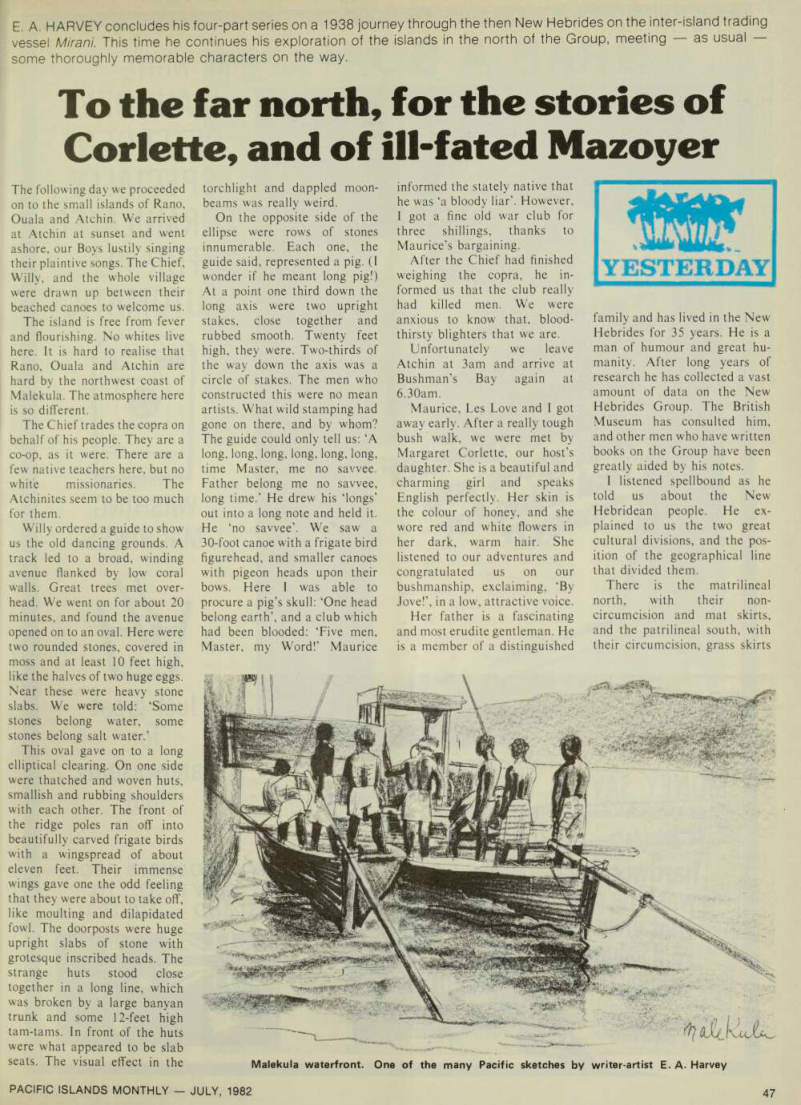

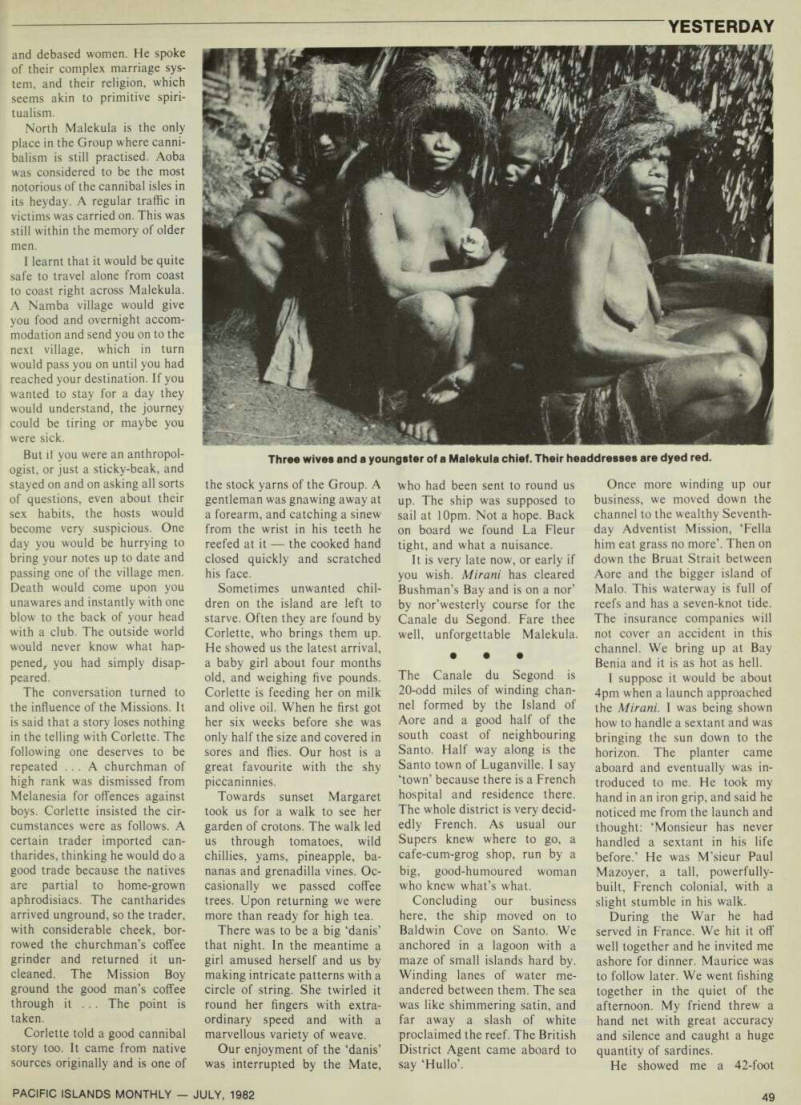
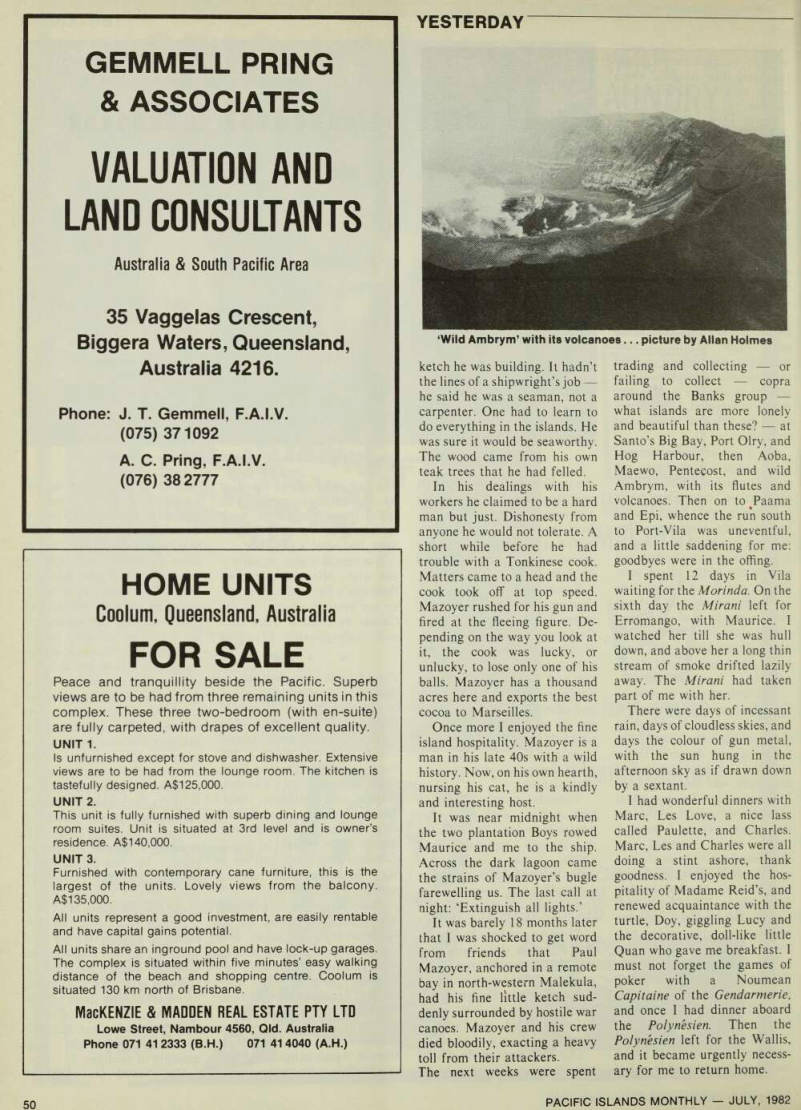
Corlette, and of ill-fated Mazoyer
Yesterday
E. A. HARVEY concludes his four-part series on a 1938 journey through the then New Hebrides on the inter-island trading vessel Mirani. This time he continues his exploration of the islands in the north of the Group, meeting as usual some thoroughly memorable characters on the way.
The following day we proceeded on to the small islands of Rano, Ouala and Atchin. We arrived at Atchin at sunset and went ashore, our Boys lustily singing their plaintive songs. The Chief, Willy, and the whole village were drawn up between their beached canoes to welcome us.
The island is free from fever and flourishing. No whites live here. It is hard to realise that Rano, Ouala and Atchin are hard by the northwest coast of Malekula. The atmosphere here is so different.
The Chief trades the copra on behalf of his people. They are a co-op, as it were. There are a few native teachers here, but no white missionaries. The Atchinites seem to be too much for them.
Willy ordered a guide to show us the old dancing grounds. A track led to a broad, winding avenue flanked by low coral walls. Great trees met over head. We went on for about 20 minutes, and found the avenue opened on to an oval. Here were two rounded stones, covered in moss and at least 10 feet high, like the halves of two huge eggs.
Near these were heavy stone slabs. We were told: ‘Some stones belong water, some stones belong salt water.’
This oval gave on to a long elliptical clearing. On one side were thatched and woven huts, smallish and rubbing shoulders with each other. The front of the ridge poles ran off into beautifully carved frigate birds with a wingspread of about eleven feet. Their immense wings gave one the odd feeling that they were about to take off, like moulting and dilapidated fowl. The doorposts were huge upright slabs of stone with grotesque inscribed heads. The strange huts stood close together in a long line, which was broken by a large banyan trunk and some 12-feet high tam-tams. In front of the huts were what appeared to be slab seats. The visual effect in the
torchlight and dappled moon beams was really weird.
On the opposite side of the ellipse were rows of stones innumerable. Each one, the guide said, represented a pig. (I wonder if he meant long pig!) At a point one third down the long axis were two upright stakes, close together and rubbed smooth. Twenty feet high, they were. Two-thirds of the way down the axis was a circle of stakes. The men who constructed this were no mean artists. What wild stamping had gone on there, and by whom?
The guide could only tell us: ‘A long, long, long, long, long, long, time Master, me no savvee.
Father belong me no savvee, long time.’ He drew his ‘longs’ out into a long note and held it.
He ‘no savvee’. We saw a 30-foot canoe with a frigate bird figurehead, and smaller canoes with pigeon heads upon their bows. Here I was able to procure a pig’s skull: ‘One head belong earth’, and a club which had been blooded: ‘Five men, Master, my Word!’ Maurice
informed the stately native that he was ‘a bloody liar’. However, I got a fine old war club for three shillings, thanks to Maurice’s bargaining.
After the Chief had finished weighing the copra, he in formed us that the club really had killed men. We were anxious to know that, blood thirsty blighters that we are.
Unfortunately we leave Atchin at 3am and arrive at Bushman’s Bay again at 6.30 am.
Maurice, Les Love and I got away early. After a really tough bush walk, we were met by Margaret Corlette, our host’s daughter. She is a beautiful and charming girl and speaks English perfectly. Her skin is the colour of honey, and she wore red and white flowers in her dark, warm hair. She listened to our adventures and congratulated us on our bushmanship, exclaiming, ‘By Jove!’, in a low, attractive voice.
Her father is a fascinating and most erudite gentleman. He is a member of a distinguished
family and has lived in the New Hebrides for 35 years. He is a man of humour and great hu manity. After long years of research he has collected a vast amount of data on the New Hebrides Group. The British Museum has consulted him, and other men who have written books on the Group have been greatly aided by his notes.
I listened spellbound as he told us about the New Hebridean people. He ex plained to us the two great cultural divisions, and the pos ition of the geographical line that divided them.
There is the matrilineal north, with their non circumcision and mat skirts, and the patrilineal south, with their circumcision, grass skirts
Malekula waterfront. One of the many Pacific sketches by writer-artist E. A. Harvey
and debased women. He spoke of their complex marriage sys tem, and their religion, which seems akin to primitive spiri tualism.
North Malekula is the only place in the Group where canni balism is still practised. Aoba was considered to be the most notorious of the cannibal isles in its heyday. A regular traffic in victims was carried on. This was still within the memory of older men.
I learnt that it would be quite safe to travel alone from coast to coast right across Malekula.
A Namba village would give you food and overnight accom modation and send you on to the next village, which in turn would pass you on until you had reached your destination. If you wanted to stay for a day they would understand, the journey could be tiring or maybe you were sick.
But if you were an anthropol ogist, or just a sticky-beak, and stayed on and on asking all sorts of questions, even about their sex habits, the hosts would become very suspicious. One day you would be hurrying to bring your notes up to date and passing one of the village men.
Death would come upon you unawares and instantly with one blow to the back of your head with a club. The outside world would never know what hap pened,, you had simply disap peared.
The conversation turned to the influence of the Missions. It is said that a story loses nothing in the telling with Corlette. The following one deserves to be repeated ... A churchman of high rank was dismissed from Melanesia for offences against boys. Corlette insisted the cir cumstances were as follows. A certain trader imported can tharides, thinking he would do a good trade because the natives are partial to home-grown aphrodisiacs. The cantharides arrived unground, so the trader, with considerable cheek, bor rowed the churchman’s coffee grinder and returned it un cleaned. The Mission Boy ground the good man’s coffee through it ... The point is taken.
Corlette told a good cannibal story too. It came from native sources originally and is one of
the stock yarns of the Group. A gentleman was gnawing away at a forearm, and catching a sinew from the wrist in his teeth he reefed at it the cooked hand closed quickly and scratched his face.
Sometimes unwanted chil dren on the island are left to starve. Often they are found by Corlette, who brings them up.
He showed us the latest arrival, a baby girl about four months old, and weighing five pounds.
Corlette is feeding her on milk and olive oil. When he first got her six weeks before she was only half the size and covered in sores and flies. Our host is a great favourite with the shy piccaninnies.
Towards sunset Margaret took us for a walk to see her garden of crotons. The walk led us through tomatoes, wild chillies, yams, pineapple, ba nanas and grenadilla vines. Oc casionally we passed coffee trees. Upon returning we were more than ready for high tea.
There was to be a big ‘danis’ that night. In the meantime a girl amused herself and us by making intricate patterns with a circle of string. She twirled it round her fingers with extra ordinary speed and with a marvellous variety of weave.
Our enjoyment of the ‘danis’ was interrupted by the Mate,
who had been sent to round us up. The ship was supposed to sail at 10pm. Not a hope. Back on board we found La Fleur tight, and what a nuisance.
It is very late now, or early if you wish. Mirani has cleared Bushman’s Bay and is on a nor’ by nor’westerly course for the Canale du Segond. Fare thee well, unforgettable Malekula. • • • The Canale du Segond is 20-odd miles of winding chan nel formed by the Island of Acre and a good half of the south coast of neighbouring Santo. Half way along is the Santo town of Luganville. I say ‘town’ because there is a French hospital and residence there.
The whole district is very decid edly French. As usual our Supers knew where to go, a cafe-cum-grog shop, run by a big, good-humoured woman who knew what’s what.
Concluding our business here, the ship moved on to Baldwin Cove on Santo. We anchored in a lagoon with a maze of small islands hard by.
Winding lanes of water me andered between them. The sea was like shimmering satin, and far away a slash of white proclaimed the reef. The British District Agent came aboard to say ‘Hullo’.
Once more winding up our business, we moved down the channel to the wealthy Seventh day Adventist Mission, ‘Fella him eat grass no more’. Then on down the Bruat Strait between Acre and the bigger island of Malo. This waterway is full of reefs and has a seven-knot tide.
The insurance companies will not cover an accident in this channel. We bring up at Bay Benia and it is as hot as hell.
I suppose it would be about 4pm when a launch approached the Mirani. I was being shown how to handle a sextant and was bringing the sun down to the horizon. The planter came aboard and eventually was in troduced to me. He took my hand in an iron grip, and said he noticed me from the launch and thought: ‘Monsieur has never handled a sextant in his life before.’ He was M’sieur Paul Mazoyer, a tall, powerfully built, French colonial, with a slight stumble in his walk.
During the War he had served in France. We hit it off well together and he invited me ashore for dinner. Maurice was to follow later. We went fishing together in the quiet of the afternoon. My friend threw a hand net with great accuracy and silence and caught a huge quantity of sardines.
He showed me a 42-foot
Three wives and a youngster of a Malekula chief. Their headdresses are dyed red.
ketch he was building. It hadn’t the lines of a shipwright’s job he said he was a seaman, not a carpenter. One had to learn to do everything in the islands. He was sure it would be seaworthy.
The wood came from his own teak trees that he had felled.
In his dealings with his workers he claimed to be a hard man but just. Dishonesty from anyone he would not tolerate. A short while before he had trouble with a Tonkinese cook.
Matters came to a head and the cook took off at top speed.
Mazoyer rushed for his gun and fired at the fleeing figure. De pending on the way you look at it, the cook was lucky, or unlucky, to lose only one of his balls. Mazoyer has a thousand acres here and exports the best cocoa to Marseilles.
Once more I enjoyed the fine island hospitality. Mazoyer is a man in his late 40s with a wild history. Now, on his own hearth, nursing his cat, he is a kindly and interesting host.
It was near midnight when the two plantation Boys rowed Maurice and me to the ship.
Across the dark lagoon came the strains of Mazoyer’s bugle farewelling us. The last call at night: ‘Extinguish all lights.’
It was barely 18 months later that I was shocked to get word from friends that Paul Mazoyer, anchored in a remote bay in north-western Malekula, had his fine little ketch sud denly surrounded by hostile war canoes. Mazoyer and his crew died bloodily, exacting a heavy toll from their attackers.
The next weeks were spent
trading and collecting or failing to collect copra around the Banks group what islands are more lonely and beautiful than these? at Santo’s Big Bay, Port Olry, and Hog Harbour, then Aoba, Maewo, Pentecost, and wild Ambrym, with its flutes and volcanoes. Then on to and Epi, whence the run south to Port-Vila was uneventful, and a little saddening for me: goodbyes were in the offing.
I spent 12 days in Vila waiting for the Morinda. On the sixth day the Mirani left for Erromango, with Maurice. I watched her till she was hull down, and above her a long thin stream of smoke drifted lazily away. The Mirani had taken part of me with her.
There were days of incessant rain, days of cloudless skies, and days the colour of gun metal, with the sun hung in the afternoon sky as if drawn down by a sextant.
I had wonderful dinners with Marc, Les Love, a nice lass called Paulette, and Charles.
Marc, Les and Charles were all doing a stint ashore, thank goodness. I enjoyed the hos pitality of Madame Reid’s, and renewed acquaintance with the turtle, Doy, giggling Lucy and the decorative, doll-like little Quan who gave me breakfast. I must not forget the games of poker with a Noumean Capitaine of the Gendarmerie, and once I had dinner aboard the Polyn'esien. Then the Polyn'esien left for the Wallis, and it became urgently necess ary for me to return home.
‘Wild Ambrym' with its volcanoes... picture by Allan Holmes
Advertisements & other items, pp. 48-50 (1 item)
Grab A Box!
m % p * ***o. **&JK
PO^ER
<SSC
*** c **v ** *k E
MONEY SAVING
R-M-GOWS LAUNDRY detergent srful
, hardworking,
powder
|e that gives vou
•’'real value for money.”
of PURE WHITE
LAUNDRY
DETERGENT
SPECIALLY
FORMULATED
FOR ALL
AUTOMATIC
• Elective in not o< i • Gentle on jour 0
WASHING
MACHINES
/ ««/N
HOI
COLD
WTCR
water clothes Just great for handwashing too!
QUALITY PRODUCTS FROM
R. M. GOW & CO. LTD.
QUEENSLAND AUSTRALIA
GEMMELL PRING
& ASSOCIATES
VALUATION AND
LAND CONSULTANTS
Australia & South Pacific Area 35 Vaggelas Crescent, Biggera Waters, Queensland, Australia 4216.
Phone: J. T. Gemmell, F.A.I.V. (075) 371092 A. C. Pring, F.A.I.V. (076) 38 2777
HOME UNITS
Mum. Queensland. Australia
FOR SALE
Peace and tranquillity beside the Pacific. Superb views are to be had from three remaining units in this
complex. These three two-bedroom (with en-suite)
are fully carpeted, with drapes of excellent quality.
UNIT 1.
Is unfurnished except for stove and dishwasher. Extensive views are to be had from the lounge room. The kitchen is tastefully designed. A 5125,000.
UNIT 2.
This unit is fully furnished with superb dining and lounge room suites. Unit is situated at 3rd level and is owner’s residence. A 5140,000.
UNIT 3.
Furnished with contemporary cane furniture, this is the largest of the units. Lovely views from the balcony.
A 5135,000.
All units represent a good investment, are easily rentable and have capital gains potential.
All units share an inground pool and have lock-up garages.
The complex is situated within five minutes’ easy walking distance of the beach and shopping centre. Coolum is situated 130 km north of Brisbane.
MacKENZIE & MADDEN REAL ESTATE PTY LTD Lowe Street, Nambour 4560, Old. Australia Phone 071 41 2333 (8.H.) 071 41 4040 (A.H.)
Australia and the Free French:
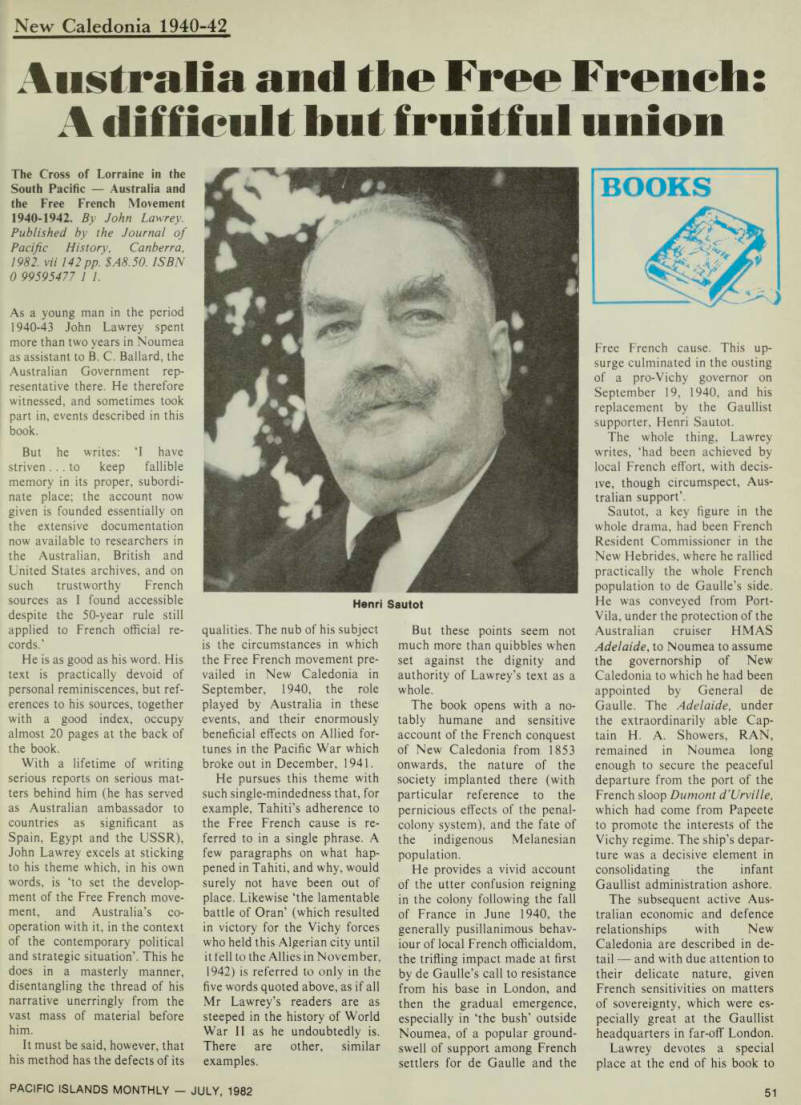

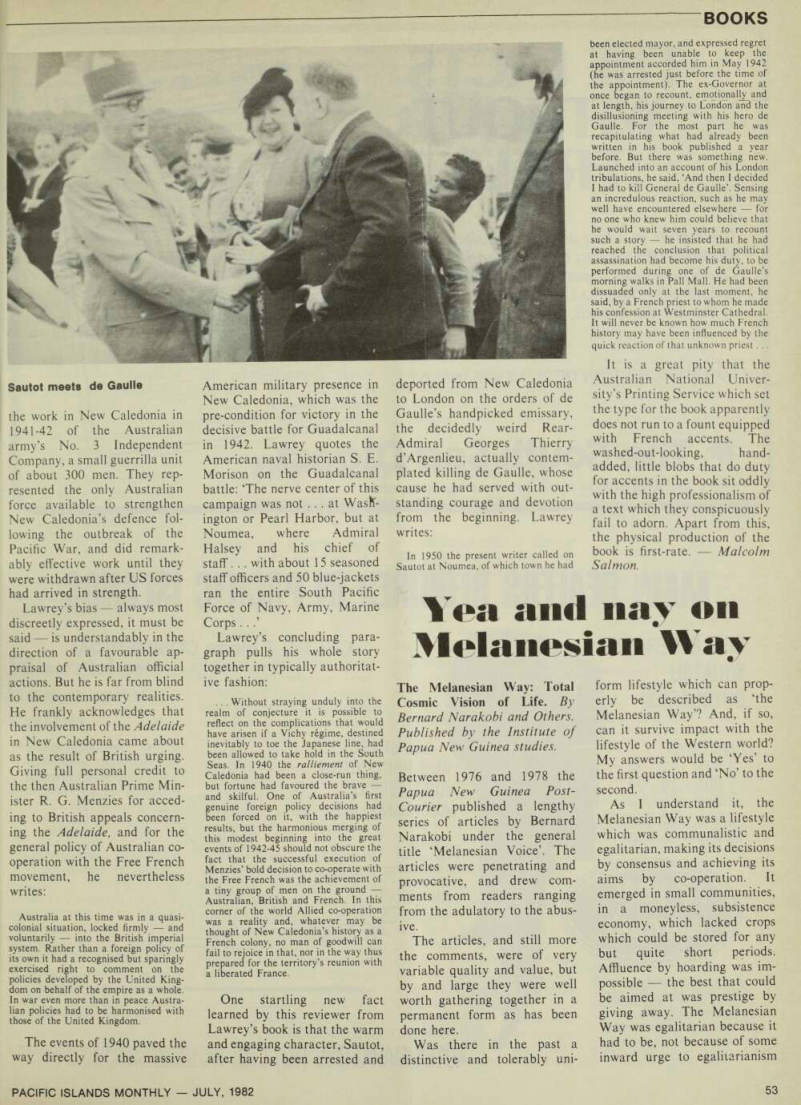
Books
New Caledonia 1940-42
Australia and the Free French: A difficult but fruitful union
The Cross of Lorraine in the South Pacific Australia and the Free French Movement 1940-1942. By John Lawrey.
Published by the Journal of Pacific History, Canberra, 1982. vii 142 pp. 5A8.50. ISBN 0 99595477 1 I.
As a young man in the period 1940-43 John Lawrey spent more than two years in Noumea as assistant to B. C. Ballard, the Australian Government rep resentative there. He therefore witnessed, and sometimes took part in, events described in this book.
But he writes: T have striven... to keep fallible memory in its proper, subordi nate place; the account now given is founded essentially on the extensive documentation now available to researchers in the Australian, British and United States archives, and on such trustworthy French sources as I found accessible despite the 50-year rule still applied to French official re cords.’
He is as good as his word. His text is practically devoid of personal reminiscences, but ref erences to his sources, together with a good index, occupy almost 20 pages at the back of the book.
With a lifetime of writing serious reports on serious mat ters behind him (he has served as Australian ambassador to countries as significant as Spain, Egypt and the USSR), John Lawrey excels at sticking to his theme which, in his own words, is ‘to set the develop ment of the Free French move ment, and Australia’s co operation with it, in the context of the contemporary political and strategic situation’. This he does in a masterly manner, disentangling the thread of his narrative unerringly from the vast mass of material before him.
It must be said, however, that his method has the defects of its
qualities. The nub of his subject is the circumstances in which the Free French movement pre vailed in New Caledonia in September, 1940, the role played by Australia in these events, and their enormously beneficial effects on Allied for tunes in the Pacific War which broke out in December, 1941.
He pursues this theme with such single-mindedness that, for example, Tahiti’s adherence to the Free French cause is re ferred to in a single phrase. A few paragraphs on what hap pened in Tahiti, and why, would surely not have been out of place. Likewise ‘the lamentable battle of Oran’ (which resulted in victory for the Vichy forces who held this Algerian city until it fell to the Allies in November, 1942) is referred to only in the five words quoted above, as if all Mr Lawrey’s readers are as steeped in the history of World War II as he undoubtedly is.
There are other, similar examples.
But these points seem not much more than quibbles when set against the dignity and authority of Lawrey’s text as a whole.
The book opens with a no tably humane and sensitive account of the French conquest of New Caledonia from 1853 onwards, the nature of the society implanted there (with particular reference to the pernicious effects of the penal colony system), and the fate of the indigenous Melanesian population.
He provides a vivid account of the utter confusion reigning in the colony following the fall of France in June 1940, the generally pusillanimous behav iour of local French officialdom, the trifling impact made at first by de Gaulle’s call to resistance from his base in London, and then the gradual emergence, especially in ‘the bush’ outside Noumea, of a popular ground swell of support among French settlers for de Gaulle and the
Free French cause. This up surge culminated in the ousting of a pro-Vichy governor on September 19, 1940, and his replacement by the Gaullist supporter, Henri Sautot.
The whole thing, Lawrey writes, ‘had been achieved by local French effort, with decis ive, though circumspect, Aus
tralian support’.
Sautot, a key figure in the whole drama, had been French Resident Commissioner in the New Hebrides, where he rallied practically the whole French population to de Gaulle’s side.
He was conveyed from Port- Vila, under the protection of the Australian cruiser HMAS Adelaide , to Noumea to assume the governorship of New Caledonia to which he had been appointed by General de Gaulle. The Adelaide, under the extraordinarily able Cap tain H. A. Showers, RAN, remained in Noumea long enough to secure the peaceful departure from the port of the French sloop Dumont d’Urville, which had come from Papeete to promote the interests of the Vichy regime. The ship’s depar ture was a decisive element in consolidating the infant Gaullist administration ashore.
The subsequent active Aus tralian economic and defence relationships with New Caledonia are described in de tail and with due attention to their delicate nature, given French sensitivities on matters of sovereignty, which were es pecially great at the Gaullist headquarters in far-off London.
Lawrey devotes a special place at the end of his book to
Henri Sautot
the work in New Caledonia in 1941-42 of the Australian army’s No. 3 Independent Company, a small guerrilla unit of about 300 men. They rep resented the only Australian force available to strengthen New Caledonia’s defence fol lowing the outbreak of the Pacific War, and did remark ably effective work until they were withdrawn after US forces had arrived in strength.
Lawrey’s bias always most discreetly expressed, it must be said is understandably in the direction of a favourable ap praisal of Australian official actions. But he is far from blind to the contemporary realities.
He frankly acknowledges that the involvement of the Adelaide in New Caledonia came about as the result of British urging.
Giving full personal credit to the then Australian Prime Min ister R. G. Menzies for acced ing to British appeals concern ing the Adelaide, and for the general policy of Australian co operation with the Free French movement, he nevertheless writes: Australia at this time was in a quasi colonial situation, locked firmly and voluntarily into the British imperial system. Rather than a foreign policy of its own it had a recognised but sparingly exercised right to comment on the policies developed by the United King dom on behalf of the empire as a whole.
In war even more than in peace Austra lian policies had to be harmonised with those of the United Kingdom.
The events of 1940 paved the way directly for the massive
American military presence in New Caledonia, which was the pre-condition for victory in the decisive battle for Guadalcanal in 1942. Lawrey quotes the American naval historian S. E.
Morison on the Guadalcanal battle; ‘The nerve center of this campaign was not ... at Wash ington or Pearl Harbor, but at Noumea, where Admiral Halsey and his chief of staff. .. with about 15 seasoned staff officers and 50 blue-jackets ran the entire South Pacific Force of Navy, Army, Marine Corps. .
Lawrey’s concluding para graph pulls his whole story together in typically authoritat ive fashion; . . . Without straying unduly into the realm of conjecture it is possible to reflect on the complications that would have arisen if a Vichy regime, destined inevitably to toe the Japanese line, had been allowed to take hold in the South Seas. In 1940 the ralliement of New Caledonia had been a close-run thing, but fortune had favoured the brave and skilful. One of Australia’s first genuine foreign policy decisions had been forced on it, with the happiest results, but the harmonious merging of this modest beginning into the great events of 1942-45 should not obscure the fact that the successful execution of Menzies’ bold decision to co-operate with the Free French was the achievement of a tiny group of men on the ground Australian, British and French. In this corner of the world Allied co-operation was a reality and, whatever may be thought of New Caledonia’s history as a French colony, no man of goodwill can fail to rejoice in that, nor in the way thus prepared for the territory’s reunion with a liberated France.
One startling new fact learned by this reviewer from Lawrey’s book is that the warm and engaging character, Sautot, after having been arrested and
deported from New Caledonia to London on the orders of de Gaulle’s handpicked emissary, the decidedly weird Rear- Admiral Georges Thierry d’Argenlieu, actually contem plated killing de Gaulle, whose cause he had served with out standing courage and devotion from the beginning. Lawrey writes: In 1950 the present writer called on Sautot at Noumea, of which town he had
been elected mayor, and expressed regret at having been unable to keep the appointment accorded him in May 1942 (he was arrested just before the time of the appointment). The ex-Governor at once began to recount, emotionally and at length, his journey to London and the disillusioning meeting with his hero de Gaulle. For the most part he was recapitulating what had already been written in his book published a year before. But there was something new.
Launched into an account of his London tribulations, he said, ‘And then I decided I had to kill General de Gaulle’. Sensing an incredulous reaction, such as he may well have encountered elsewhere for no one who knew him could believe that he would wait seven years to recount such a story he insisted that he had reached the conclusion that political assassination had become his duty, to be performed during one of de Gaulle’s morning walks in Pall Mall. He had been dissuaded only at the last moment, he said, by a French priest to whom he made his confession at Westminster Cathedral.
It will never be known how much French history may have been influenced by the quick reaction of that unknown priest. . .
It is a great pity that the
Australian National Univer
sity’s Printing Service which set
the type for the book apparently
does not run to a fount equipped with French accents. The
washed-out-looking, hand
added, little blobs that do duty for accents in the book sit oddly
with the high professionalism of
a text which they conspicuously
fail to adorn. Apart from this,
the physical production of the
book is first-rate.
Malcolm
Salmon.
Sautot meets de Gaulle
Advertisements & other items, p. 52 (1 item)
Planes
MINDS OVER MATTER
that circle Earth
40 times a day.
Here at McDonnell Douglas, highly-trained minds working together have created new standards of excellence in air travel. The DC-10 fleet spans oceans, countries and continents, flying a million miles a day to more places more often than any other widecabin jetliner. si.
N. «» ■ 4 ■'Ml.
From drawing
to drill press five times faster.
UNIGRAPHICS,™ a computer-aided design and manufacturing system that cuts costs and speeds production, is just one of hundreds of computer systems and programs our MCAUTO R Division provides for 2,700 clients worldwide.
Quietest plane of its size.
Our new Super 80 is half as loud on takeoff as any other jet in its class. It carries more passengers more comfortably on 30% less fuel than today’s most widely-flown airliner.
For more information, write: McDonnell Douglas, Box 14526. St. Louis, MO 63178 U SA oo oo
Melanesian Way
Yea and nay on Melanesian Way
The Melanesian Way: Total Cosmic Vision of Life. By Bernard Narakobi and Others.
Published by the Institute of Papua New Guinea studies.
Between 1976 and 1978 the Papua New Guinea Post- Courier published a lengthy series of articles by Bernard Narakobi under the general title ‘Melanesian Voice’. The articles were penetrating and provocative, and drew com ments from readers ranging from the adulatory to the abus ive.
The articles, and still more the comments, were of very variable quality and value, but by and large they were well worth gathering together in a permanent form as has been done here.
Was there in the past a distinctive and tolerably uni
form lifestyle which can prop erly be described as ‘the Melanesian Way’? And, if so, can it survive impact with the lifestyle of the Western world?
My answers would be ‘Yes’ to the first question and ‘No’ to the second.
As I understand it, the Melanesian Way was a lifestyle which was communalistic and egalitarian, making its decisions by consensus and achieving its aims by co-operation. It emerged in small communities, in a moneyless, subsistence economy, which lacked crops which could be stored for any but quite short periods.
Affluence by hoarding was im possible the best that could be aimed at was prestige by giving away. The Melanesian Way was egalitarian because it had to be, not because of some inward urge to egalitarianism
deeply implanted in the Melanesian soul. The course of events in Papua New Guinea in the years since independence has made it clear that, given the chance, Melanesians can be just as individualistic, just as selfish and just as grasping as the rest of us no more and no less.
Here, as all over the world, the rich are getting richer and the poor are getting poorer.
This doesn’t mean, of course, that there aren’t some aspects of the Melanesian Way which could be incorporated into the Papua New Guinean life-style.
There are notably the use of consultation and consensus to a far greater extent than at pres ent. But even here I notice an increasing tendency for Papua New Guineans in the seats of power to say, ‘Don’t argue, I’m the boss, do as I tell you’.
I knew and admired the Melanesian Way, in a still relatively unpolluted form, be fore Bernard Narakobi was born. It gives me no pleasure to write its epitaph. But sorry Bernard, there’s no way back to
the Garden of Eden.
(Sir)
Percy Chatterton.
(The above review was orig inally broadcast by the Papua New Guinea National Broad casting Commission.)
Maoridom
lias a new
voire
Whaanga. Published by the New Zealand Department of Maori Affairs, Private Bag, Wellington. Subscription SNZS for six issues a year, available from the department.
Overseas subscribers, $7.50.
The New Zealand Department of Maori Affairs has taken a praiseworthy initiative in pub lishing Tu Tangata , a magazine featuring news and views on Maoridom. The editor, Philip Whaanga, says that the maga zine will carry ‘regular features on politics, community happen ings, health, people and arts’, and that ‘Tu Tangata wants to promote discussion especially on contentious issues, but it should be noted that opinions expressed are those of individ
ual contributors and not the Department of Maori Affairs’.
The magazine is produced to the highest professional stan dards and is printed by the New Zealand Government Printer.
The range of articles included in the issue I received would be of interest to a wide range of readers, both Maori and non- Maori. The editor appears to have been allowed to operate even-handedly, as equal cover age has been given to the views of the main Maori political groupings and their attitudes towards Maori political rep resentation.
However, I have an uneasy feeling that perhaps the maga zine is adopting a rather ethno centric attitude. I hope that it will not establish a narrow approach: New Zealand is home to the world’s largest Polynesian population, New
Zealand Maoris, Cook Islanders, Samoans, Niueans, Tokelauans, and others. But the only reference in the issue I read to the existence in New Zealand of the island Polynesians was that Dorice Read, a Rarotongan, is a National Party candidate for the Auckland Central Parlia mentary seat. Interestingly enough, Mrs Read is listed together with National Party Maori candidates.
Tu Tangata needs to be nurtured and given the chance to establish its credentials as a respected vehicle for the ex pression of opinions generated from Maoridom. It is to be hoped that it will continue to reflect all shades of the political spectrum and that it will reveal the strengths of Maoridom to all sections of the New Zealand
populance.
W. G. Coppell.
Advertisements & other items, p. 54 (1 item)
The Facts
WITHOUT
FRILLS
The trends in a few words. The significant news.
Mailed direct to you every second Friday.
The South Seas Digest is designed for busy people who have to know what's happening in the Pacific Islands, but in a hurry.
FOR SUBSCRIPTION DETAILS SEE INSERT.
Di 9est
Mill l tin It '***- ,l > (hi- v V\ f .
ZrOr mK -
' Jn,l ' •* ll Mr, m „i .h, - z " --•‘•z.
“ K»'n«f j/| v rorH «f«.o„
—* ..rir
''-.'fliv . 1 K "vilr 1 „„ v ’ r.»/h ,| u 'llnr lu;l ,„ , *•»!. , 'l'r 111.-,, ■■ r "HI, p J'lun k-„, 11 "I -ik I..*,**■■* "I-.
' ,,lf,n *«»» rh»., J ‘lurfilj, i.
HKl.*, '•"“lirlii.. ml " Un,l "**n lh " "'■lf '"'"•'l... ,h, ' .v:: ::: ,v /*"< rv u.. u,n -inti * *" V, k *N IdM fWw " r< ‘ f K ,n K fh,.
“wimijn,,. , ,ovr * A .
.r - *-^rc
rn,, i'-n," vV"" •>- o.^r- I *-£■r* ■ ik. ' " "«"<* unit, ,r -*nttl , ” kni " ,h »* 'Wiu-rnk ' 0, ‘ * 1 *■* :;r-- ~' —c, ; r,/h' h ' - „ ,nv '-Mm, „, . '■■■•" ~, m 'n il Al( u ,„ nHi 1,,, j,„| '“I '' ■■ ■ I umon "'"•P’lUm.
I , *’ *'■ *--1 Z; 'Jli ,v ** r in las I „ "»■ 1^,0,v'7 ,h " - hj ,l u ,Wfv j/v> pij '■•lt-ahn S
£r- r s
; ih -
f The South Sea Digest
" the NEWSLETTER ON ISLANDS AFFAIRS* EVERY OTHER FRIDAY
MAIN DEALBIS REQUIRED IN PACIFIC ISLANDS
NEW GENERATION
TOHATSU
OUTBOARDS
Prop Rated;
3.5 hp IS.Ohp
s.ohp
S.Ohp
9,Bhp
12.0 hp
IS.Ohp
25.0 hp 33.0 hp 55.0 hp
r 2 yea
v warranty
46 years of Product Development and years of experience with Commercial Operations
CELTIC 7 metre COMMERCIAL
(Fibreglass Hulls Available)
ALL SPARES
AND PRODUCTS
AVAILABLE EX
AUCKLAND, N.Z
Tohatsu Kerosene 18hp & 30hp outboards also available Hull & Decks of Completed Units Length: 7 metres Beam: 2.49 Draught: 7 Drop Keel or Fixed Keel Powered by 10hp or 20hp Diesel
FURTHER INQUIRIES CONTACT:
AOTEA MARKETING (NZ) LTD,
P.O. BOX 17105, GREENLANE, AUCKLAND
NEW ZEALAND. PHONE: 503244
'How' of easing
women's load
Knowing and Knowing How.
Edited and compiled by Vanessa Griffen. Published by the Centre for Applied Studies in Development, University of the South Pacific Women’s Programme.
Women the world over receive less help than men from devel opment and funding agencies, and often their own authorities.
They have less education, less training, credit, equipment, seeds, technical assistance, than men. This is also true in the South Pacific, in total disregard of women’s vital role in subsistence agriculture and vil lage support, especially in Melanesia.
Women are child-bearers, and responsible for family wel fare. They are often heads of families (husbands being else where), they are food producers and processers, food storers and marketers. Figures from Solomon Islands at a South Pacific Commission Women’s Workshop gave a much lower life expectancy for women than men this is against all world trends, and clearly the result of heavy subsistence labour, and too frequent child-bearing.
A concerted effort to ‘lighten the load’ is indicated, and technologies can be one method the provision of tools. Ad ditionally, technologies have status (which is why they are largely in the hands of men).
Technologies bridge the muscle-power gap between the sexes, and reduce powerlessness in many areas.
The Centre for Applied Studies in Development, Vanessa Griffen, and the Women’s Programme Director, Claire Slatter, are to be com mended therefore for their book, a milestone in the process of meeting the above problems.
These are stated clearly in an excellent introduction. The book assembles immensely valuable material in the fields which most affect women’s daily lives: cooking and the energy required for it, water and sanitation, household im provements, food preservation, housing. Throughout the book the ‘how to make’ directions are simple and clear, with good supporting diagrams.
This writer has worked with groups in many of the techno logies described, and feels confident that field workers will
be able to use the manual in most situations, give the sup port often needed in tools and material by the authorities.
The real problem will be dissemination a continuing worry in the South Pacific.
More books will follow in the series, on health, nutrition, food production, and income-earning activities for women. They are
eagerly awaited.
Ruth E.
Lechte.
Hooks received
Papua New Guinea’s Prehistory: An Introduction. Prepared by Pamela Swadling. Published by the National Museum & Art Gallery, PO Box 5560, Boroko, PNG, in association with Gordon & Gotch (PNG) Pty Ltd. ISBN 0 7247 0869 3. Price $l.OO.
At Dawn We Slept: The Untold Story of Pearl Harbor. By Gordon W. Prange.
Published by Michael Joseph Ltd, Lon don, distributed by Thomas Nelson Australia, 480 La Trobe Street, Mel bourne 3000. ISBN 0 7181 20906. Pub 1982. Recommended price $25.80.
Air Raid: Pearl Harbor Recollections of a Day of Infamy. Edited by Paul Stillwell. Published by Naval Institute Press, Annapolis, Maryland. ISBN 0 87021 086 6. No price available.
Losing Control ... Towards an Under standing of Transnational Corporations in the Pacific Islands Context. By James E Winkler. Published by the Pacific Conference of Churches, PO Box 208, Suva, Fiji. Price SF2.
Building a Pacific Community: The Addresses and Papers of the Pacific Community Lecture Series. Edited and Introduced by Paul Hooper. Published by the University Press of Hawaii, 2840 Kolowalu Street, Honolulu, Hawaii 96822. ISBN 0 8248 0790 1. Price $9.95. Pub. 1982.
Anuta: Social Structure of a Polynesian Island. By Richard Fineberg. Published by the Institute for Polynesian Studies, Brigham Young University-Hawaii Campus. Laie, Hawaii 96792. Price $8.50. ISBN 0 939154 24 2 (hard cover) ISBN 0 939154 23 4 (soft cover).
Oral Tradition in Melanesia. Edited by Donald Denoon and Roderick Lacey.
Published by the University of Papua New Guinea and the Institute of Papua New Guinea Studies, Port Moresby. No ISBN or price given.
Millstones and Milestones: The Career of B.F. Dillingham. By Paul Yardley. Pub lished by the University Press of Hawaii, 2840 Kolowalu Street, Honolulu, Hawaii 96822. ISBN 0 8248 0761 8. Price $17.50. Pub. 1982.
Eruera: The Teachings of a Maori Elder.
Eruera Stirling as told to Anne Salmond.
Published by Oxford University Press, 222-236 Willis Street, Wellington, New Zealand. ISBN 0 19 558070 2 paper, ISBN 0 19 558069 9 cloth. Price $24.
Pub. 1980.
Words of The Lagoon: Fishing and Marine Lore in the Palau District of Micronesia, by R.E. Johannes. Published by University of California Press, distrib uted by Australia & New Zealand Book Co Pty Ltd, PO Box 459, Brookvale,
Nsw 2100. Pub. 1981. Isbn
0 520 03929 7. Price: $23.50.
Advertisements & other items, pp. 55-56 (2 items)
Books
Some pleasures know
neither time nor place...
E Vm w* Mr * /
SMOOTH, MILD CIGARS
Corona • Commodore Panatella • Lancers • Tipped Lancers • Panatella
in Tongatapu, Vavau, 8 in Haapai?
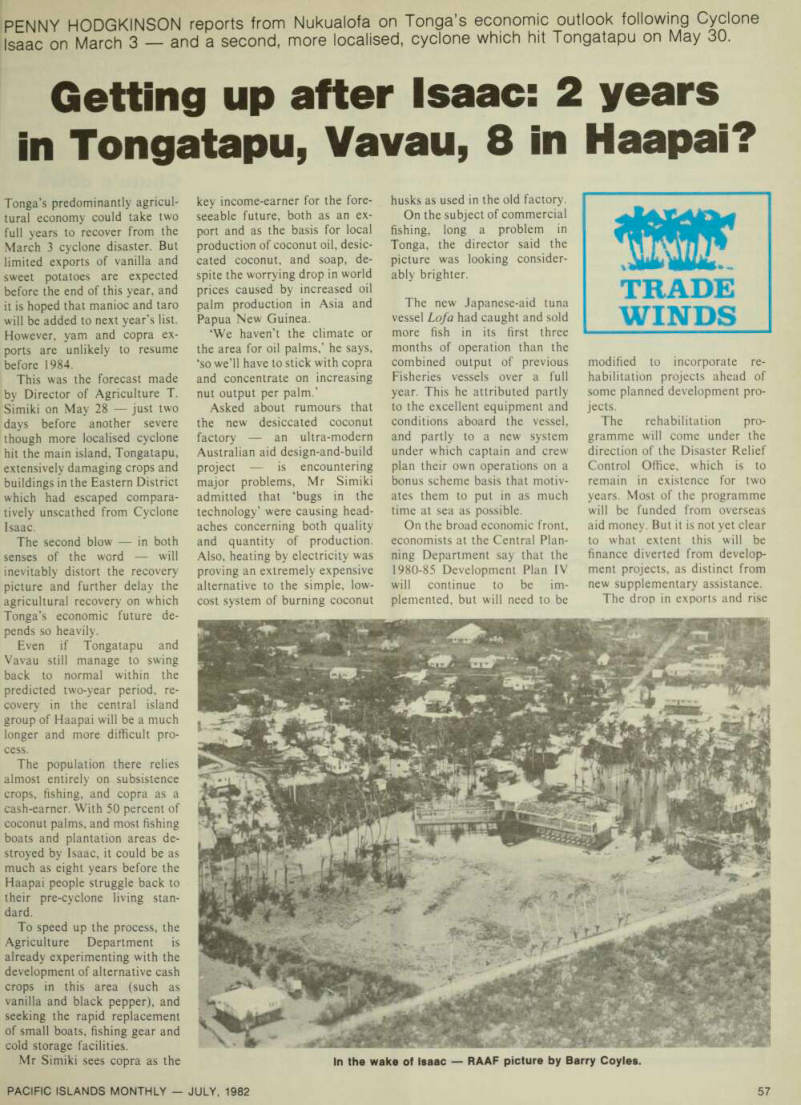
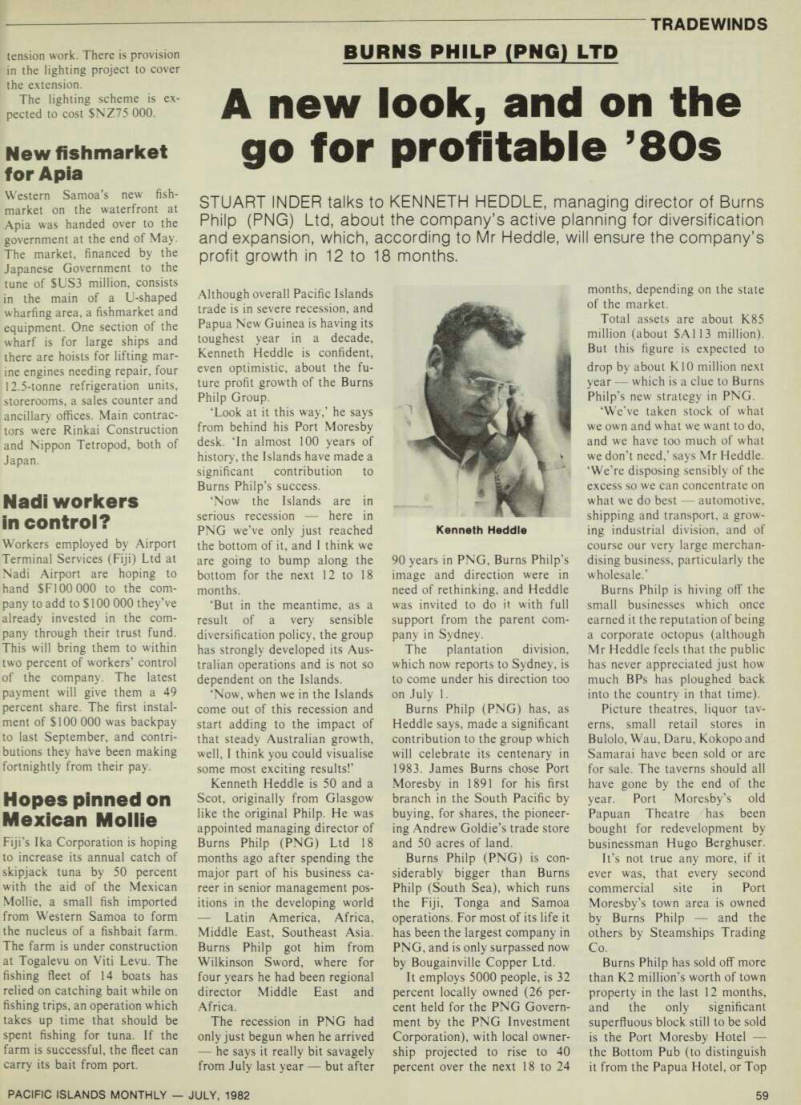
Trade
Winds
Getting up after Isaac: 2 years in Tongatapu, Vavau, 8 in Haapai?
PENNY HODGKINSON reports from Nukualofa on Tonga’s economic outlook following Cyclone Isaac on March 3 and a second, more localised, cyclone which hit Tongatapu on May 30.
Tonga’s predominantly agricul tural economy could take two full years to recover from the March 3 cyclone disaster. But limited exports of vanilla and sweet potatoes are expected before the end of this year, and it is hoped that manioc and taro will be added to next year’s list.
However, yam and copra ex ports are unlikely to resume before 1984.
This was the forecast made by Director of Agriculture T.
Simiki on May 28 just two days before another severe though more localised cyclone hit the main island, Tongatapu, extensively damaging crops and buildings in the Eastern District which had escaped compara tively unscathed from Cyclone Isaac.
The second blow in both senses of the word will inevitably distort the recovery picture and further delay the agricultural recovery on which Tonga’s economic future de pends so heavily.
Even if Tongatapu and Vavau still manage to swing back to normal within the predicted two-year period, re covery in the central island group of Haapai will be a much longer and more difficult pro cess.
The population there relies almost entirely on subsistence crops, fishing, and copra as a cash-earner. With 50 percent of coconut palms, and most fishing boats and plantation areas de stroyed by Isaac, it could be as much as eight years before the Haapai people struggle back to their pre-cyclone living stan dard.
To speed up the process, the Agriculture Department is already experimenting with the development of alternative cash crops in this area (such as vanilla and black pepper), and seeking the rapid replacement of small boats, fishing gear and cold storage facilities.
Mr Simiki sees copra as the
key income-earner for the fore seeable future, both as an ex port and as the basis for local production of coconut oil, desic cated coconut, and soap, de spite the worrying drop in world prices caused by increased oil palm production in Asia and Papua New Guinea. ‘We haven’t the climate or the area for oil palms,’ he says, ‘so we’ll have to stick with copra and concentrate on increasing nut output per palm.’
Asked about rumours that the new desiccated coconut factory an ultra-modern Australian aid design-and-build project is encountering major problems, Mr Simiki admitted that ‘bugs in the technology’ were causing head aches concerning both quality and quantity of production.
Also, heating by electricity was proving an extremely expensive alternative to the simple, low cost system of burning coconut
husks as used in the old factory.
On the subject of commercial fishing, long a problem in Tonga, the director said the picture was looking consider ably brighter.
The new Japanese-aid tuna vessel Lofa had caught and sold more fish in its first three months of operation than the combined output of previous Fisheries vessels over a full year. This he attributed partly to the excellent equipment and conditions aboard the vessel, and partly to a new system under which captain and crew plan their own operations on a bonus scheme basis that motiv ates them to put in as much time at sea as possible.
On the broad economic front, economists at the Central Plan ning Department say that the 1980-85 Development Plan IV will continue to be im plemented, but will need to be
modified to incorporate re habilitation projects ahead of some planned development pro jects.
The rehabilitation pro gramme will come under the direction of the Disaster Relief Control Office, which is to remain in existence for two years. Most of the programme will be funded from overseas aid money. But it is not yet clear to what extent this will be finance diverted from develop ment projects, as distinct from new supplementary assistance.
The drop in exports and rise
In the wake of Isaac - RAAF picture by Barry Coyles.
in imports as a direct result of Cyclone Isaac will almost certainly exacerbate the kingdom’s already massive visible trade deficit problem, and there are other cyclone-linked factors which are bound to depress the 1982 revenue flow.
For example, all relief supplies coming into Tonga (and to some degree replacing normal imports) are free of the usual port and customs charges.
Again, agricultural extension services to farmers, the supply of tractors and other equipment from the Government machinery pool, etc, are being provided free or at cost, instead of at normal rates. Likewise, fees, at all government schools have been waived for two terms to assist family rehabilitation.
Remittances from Tongans working overseas, always a significant economic factor, swelled dramatically immediately after Isaac, but have since fallen back. At this stage it looks as if the 1982 total will be no higher than average.
Broadly speaking, the private sector does not appear to have
been badly affected. Numerous small Tongan corner-stores were demolished. Very few were insured. However, the larger retail outlets have prob ably received a boost. What damage they suffered was fully insured against, and business has boomed since March 3 as householders flock to purchase what they need to get going again.
Both the private and govern ment building sectors are, of course, hyper-active. The gov ernment construction firm and the handful of private building contractors are flat out coping with the post-cyclone demand for repair and replacement work, and the Ministry of Works’ prefabrication line for manufacturing 2000 cyclone resistant‘core houses’is already in full production, The sharp increase in build ing and agricultural activity in cyclone-ravaged areas has had the incidental benefit of gener ating more jobs, but full em ployment is still a pipe dream in Tonga, particularly for those who leave school with School
Certificate or UE qualifications and search in vain for appropri ate job openings.
The number of families still living in the post-Isaac tent towns is gradually decreasing but a large question mark still hangs over the heads of the hard-core remainder of home less and helpless.
The official attitude, in this Non-Welfare State, is ‘No more help for those who do not help themselves’. This rugged insist ence on the self-help principle is admirable in theory. But it does not solve the problem of where to begin, if one has no land, no home, no money, no job and little or no chance of finding one.
The consensus seems to be that the March 3 kick-in-the teeth was a ST2S million one.
The second cyclone on May 30 has added to the bill, and the problems. But Tonga is still determined to pick herself up again within two years.
‘Business talk’
risk in PNG
Tourists in Papua New Guinea on a 30-day visa are liable to fines or expulsion if they ‘talk business’ with locals. The threat came from Foreign Affairs and Trade Secretary Paulias Matane, who said foreign busi nessmen were entering the country as tourists and then attempting to do business with PNG firms. The National In vestment and Development Authority, which was the legit imate avenue for business nego tiations, would be given daily lists of new arrivals entering on tourist visas. It is understood that the measures are directed, largely, at some Asian business men, particularly from the Philippines, who have proposed ‘get rich quick’ schemes to some of the provincial governments.
Tourism men
honoured
Bartholomew Buchanan, man ager of the Solomon Islands Tourist Authority, and Marae Irata, an administrative officer in the Kiribati Department of Tourism, have been awarded the 1982 scholarships offered by the Pacific Area Travel Association, and sponsored by
the Avis Corporation and Panell Kerr Forster Ltd. Each scholar ship is worth SUS22SO and will cover the cost of attending a six weeks specialised course at the University of Hawaii’s School of Travel Industry Manage ment.
Chute’s down
takeover chute
The New Zealand company.
General Foods, has taken over Fiji’s biggest poultry meat firm, Chute’s Chicken Ltd of Tamavua, but the purchase price has not been disclosed.
Chute’s Chicken has more than 100 staff including farming and process workers. Bob Fyfe, managing director of General Foods, said he plans to open a fried chicken takeaway shop in Suva in July.
Bonuses at
Monasavu
Nearly 500 Fiji construction workers, who will lose their jobs by August when the Monasavu hydro-electric project is com pleted, will be given more than $BOO each as a bonus. It will cost the Fiji Electricity Auth ority more than $142 000 in redundancy pay and bonus.
According to an FEA spokes man, the payment to each man includes a ‘generous completion bonus’ averaging $292 in recog nition of the high quality of the work and completion ahead of schedule resulting in an esti mated saving to the FEA of $1.2 million.
Fuaamotu to
light up
Runway lighting is to be in stalled at Tonga’s international airport this year.
A New Zealand bilateral aid project, the work will enable Fuaamotu airport, situated on the main island of Tongatapu, to handle regular night services by jet aircraft. It will also make the airport safer for emergency flights during the hours of dark ness.
Although the equipment has all been ordered, installation is affected by a proposal to extend the runway by 120 metres. The United Nations Development Programme is funding the ex
tension work. There is provision in the lighting project to cover the extension.
The lighting scheme is ex pected to cost SNZ7S 000.
New fishmarket
for Apia
Western Samoa’s new fish market on the waterfront at Apia was handed over to the government at the end of May.
The market, financed by the Japanese Government to the tune of SUS 3 million, consists in the main of a U-shaped wharfing area, a fishmarket and equipment. One section of the wharf is for large ships and there are hoists for lifting mar ine engines needing repair, four 12.5-tonne refrigeration units, storerooms, a sales counter and ancillary offices. Main contrac tors were Rinkai Construction and Nippon Tetropod, both of Japan.
Nadi workers
in control?
Workers employed by Airport Terminal Services (Fiji) Ltd at Nadi Airport are hoping to hand SFIOOOOO to the com pany to add to $lOO 000 they’ve already invested in the com pany through their trust fund.
This will bring them to within two percent of workers’ control of the company. The latest payment will give them a 49 percent share. The first instal ment of $lOO 000 was backpay to last September, and contri butions they have been making fortnightly from their pay.
Hopes pinned on
Mexican Mollie
Fiji’s Ika Corporation is hoping to increase its annual catch of skipjack tuna by 50 percent with the aid of the Mexican Mollie, a small fish imported from Western Samoa to form the nucleus of a fishbait farm.
The farm is under construction at Togalevu on Viti Levu. The fishing fleet of 14 boats has relied on catching bait while on fishing trips, an operation which takes up time that should be spent fishing for tuna. If the farm is successful, the fleet can carry its bait from port.
Advertisements & other items, p. 58 (1 item)
JOJOBA (r r h“j
JUIiVSy UU&J\jyWUlKijlJ PTY LTD
Investment Sensation of the 80’s
A desert bush that produces oil!!
Who we are: Jojoba International is a plantation establishment, management and investment company set up to enable investors to buy allotments of Jojoba trees on the company’s Queensland properties. Currently the group which is strongly affiliated with the Jojoba industry in the Americas is developing the largest Jojoba plantation in the southern hemisphere at Raglan (midway between Rockhampton and Gladstone) in conjunction with Redchamp Research Station Pty. Ltd.
Knowledge of all facets of the Jojoba industry as well as expertise of management are the company’s success criteria.
I request further information on your JOJOBA
plantation.
My name:
/ °JTd’g' oV For any further information please make enquiries direct to: The Manager. Suite 56, The Mark Building, Orchid Av, Surfers Paradise, Queensland 4217 AUSTRALIA.
Phone: (075) 50 1811.
My address:
Phone;
A new look, and on the

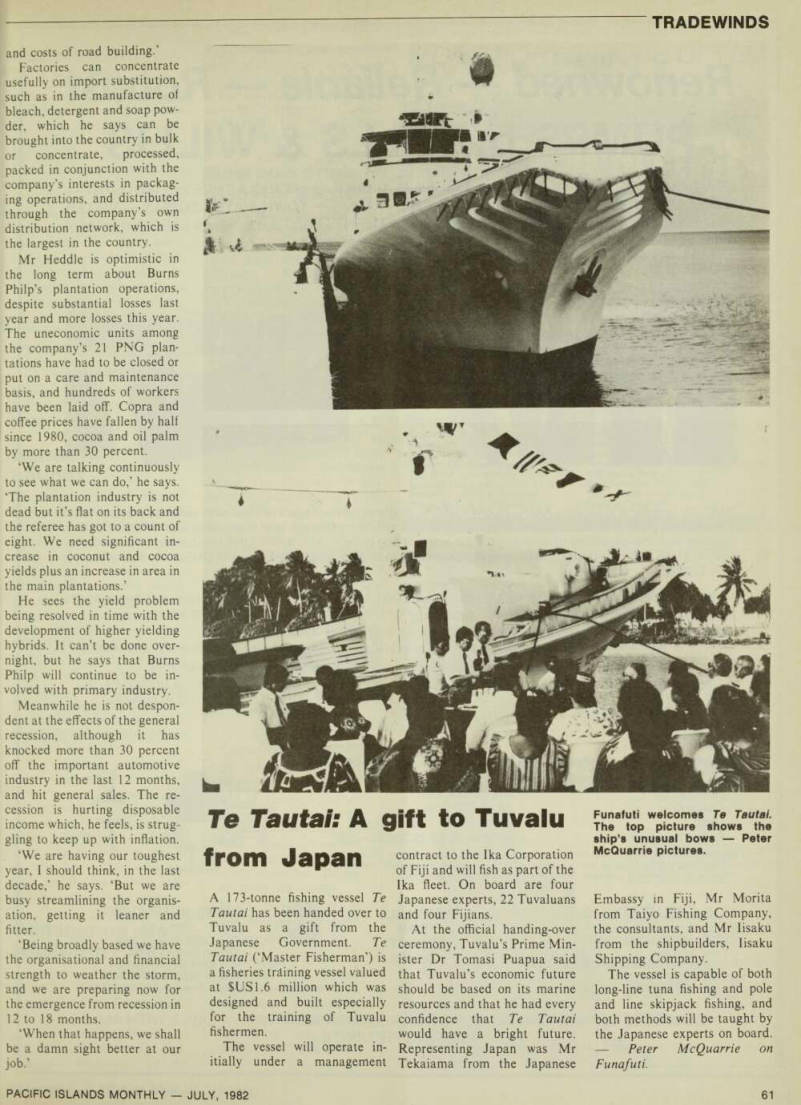
Burns Philp (Png) Ltd
A new look, and on the go for profitable ’Bos
STUART INDER talks to KENNETH HEDDLE, managing director of Burns Philp (PNG) Ltd, about the company’s active planning for diversification and expansion, which, according to Mr Heddle, will ensure the company’s profit growth in 12 to 18 months.
Although overall Pacific Islands trade is in severe recession, and Papua New Guinea is having its toughest year in a decade, Kenneth Heddle is confident, even optimistic, about the fu ture profit growth of the Burns Philp Group. ‘Look at it this way,’ he says from behind his Port Moresby desk. ‘ln almost 100 years of history, the Islands have made a significant contribution to Burns Philp’s success. ‘Now the Islands are in serious recession here in PNG we’ve only just reached the bottom of it, and I think we are going to bump along the bottom for the next 12 to 18 months. ‘But in the meantime, as a result of a very sensible diversification policy, the group has strongly developed its Aus tralian operations and is not so dependent on the Islands. ‘Now, when we in the Islands come out of this recession and start adding to the impact of that steady Australian growth, well, I think you could visualise some most exciting results!’
Kenneth Heddle is 50 and a Scot, originally from Glasgow like the original Philp. He was appointed managing director of Burns Philp (PNG) Ltd 18 months ago after spending the major part of his business ca reer in senior management pos itions in the developing world Latin America, Africa, Middle East, Southeast Asia.
Burns Philp got him from Wilkinson Sword, where for four years he had been regional director Middle East and Africa.
The recession in PNG had only just begun when he arrived he says it really bit savagely from July last year but after
90 years in PNG, Burns Philp’s image and direction were in need of rethinking, and Heddle was invited to do it with full support from the parent com pany in Sydney.
The plantation division, which now reports to Sydney, is to come under his direction too on July 1.
Burns Philp (PNG) has, as Heddle says, made a significant contribution to the group which will celebrate its centenary in 1983. James Burns chose Port Moresby in 1891 for his first branch in the South Pacific by buying, for shares, the pioneer ing Andrew Goldie’s trade store and 50 acres of land.
Burns Philp (PNG) is con siderably bigger than Burns Philp (South Sea), which runs the Fiji, Tonga and Samoa operations. For most of its life it has been the largest company in PNG, and is only surpassed now by Bougainville Copper Ltd.
It employs 5000 people, is 32 percent locally owned (26 per cent held for the PNG Govern ment by the PNG Investment Corporation), with local owner ship projected to rise to 40 percent over the next 18 to 24
months, depending on the state of the market.
Total assets are about KB5 million (about $ All 3 million).
But this figure is expected to drop by about KlO million next year which is a clue to Burns Philp’s new strategy in PNG. ‘We’ve taken stock of what we own and what we want to do, and we have too much of what we don’t need,’ says Mr Heddle. ‘We’re disposing sensibly of the excess so we can concentrate on what we do best automotive, shipping and transport, a grow ing industrial division, and of course our very large merchan dising business, particularly the wholesale.’
Burns Philp is hiving off the small businesses which once earned it the reputation of being a corporate octopus (although Mr Heddle feels that the public has never appreciated just how much BPs has ploughed back into the country in that time).
Picture theatres, liquor tav erns, small retail stores in Bulolo, Wau, Dam, Kokopo and Samarai have been sold or are for sale. The taverns should all have gone by the end of the year. Port Moresby’s old Papuan Theatre has been bought for redevelopment by businessman Hugo Berghuser.
It’s not true any more, if it ever was, that every second commercial site in Port Moresby’s town area is owned by Burns Philp and the others by Steamships Trading Co.
Burns Philp has sold off more than K 2 million’s worth of town property in the last 12 months, and the only significant superfluous block still to be sold is the Port Moresby Hotel the Bottom Pub (to distinguish it from the Papua Hotel, or Top
Kenneth Heddle
Pub, also owned by BP). The notorious Snake Pit bar has gone and the pub itself is closed, awaiting redevelopment. It’s a prime site, ideal for an office block. ‘We’re not property devel opers,’ says Mr Heddle.
He’s hopeful that the surplus property can be got into local hands, and is prepared to look at joint ventures. Residential prop erty is not for sale the company can use all it has as part of its policy of upgrading staff quarters.
BP will sell all its small retail outlets. Under recent new laws many types of small businesses will have to be 50 percent locally owned anyway, but Burns Philp sees sense in selling the stores to local businessmen who want to grow bigger. BP’s wholesale division can service a growing chain of retail outlets no matter who owns them its Port Moresby wholesale store, worth more than K 1 million, contains K 5 to K 6 million worth of goods at any one time.
In Australia in the early days Burns Philp based its expansion on wholesale operations, selling many of the goldfields trade stores it acquired to its man agers on condition they con tinued to buy wholesale from the firm.
Burns Philp’s bigger retail stores, which it is retaining, are changing their image too. In the main Port Moresby store, buyers won’t find large stocks of Stuart crystal and Wedgwood pottery as in the old days.
Papua New Guineans now comprise 75 percent of the buying power, says Mr Heddle, and although a growing middle class urban population has the money to buy Wedgwood, and is buying Wedgwood, there is not the need for the same range of stocks now that the expatri ate population is dwindling. ‘We must look to serve our main market, and expatriate ranks will continue to thin,’ said Mr Heddle.
He’s changing the image in other ways. BP buildings are being smartened up and painted in standard colours. The Burns Philp house flag is appearing on vehicles and buildings through out the country, for Mr Heddle looks on it as an image-builder. ‘When I travel I find people
recognise it now, and sometimes even wave,’ he says.
He’s considerably expanded staff training. A fully qualified accountant is looking after com mercial training and eight girls are always in training in the company’s secretarial school. ‘We’ve the best training and development department in the country,’ he says. ‘We’ve taken positive measures to beef it up so we can train citizen staff to be future managers. ‘And we are actively looking for two prominent Papua New Guineans for our board and I don’t mean window-dressing.’
The training of nationals doesn’t mean there are not good opportunities for Australians in the meantime.
Mr Heddle says: ‘We are very keen to attract bright young Australians prepared to adjust to this society for a period of three to four years. They will be given responsibility and auth ority early, and they will get tremendous experience from it, which will stand them in very good stead in their future career development. But they must be young managers interested in helping to develop this country.’
All these changes are aimed at making the company more efficient. For expansion he is looking at the company’s manu facturing base, which is cur rently seven to eight percent of its business. His target is 25 pfercent.
Because of PNG’s unique problems of terrain with a high central mountain barrier on the main island so there is no trans-island road, or any possi bility of one being economically viable for many years Mr Heddle sees great opportunities for small factories. ‘lf there is not the volume of goods from a factory in, say, Port Moresby to support ship ping costs to the other side, then you build another factory on the other side,’ he says. ‘You can establish similar plants in sev eral locations, and instead of having a KlO million turnover in one spot, you have five factories each with a turnover of K 2 million at strategic spots around the country. This devel opment is already happening and, frankly, it’s going to con tinue because of the difficulties
and costs of road building.’
Factories can concentrate usefully on import substitution, such as in the manufacture of bleach, detergent and soap pow der, which he says can be brought into the country in bulk or concentrate, processed, packed in conjunction with the company’s interests in packag ing operations, and distributed through the company’s own distribution network, which is the largest in the country.
Mr Meddle is optimistic in the long term about Burns Philp’s plantation operations, despite substantial losses last year and more losses this year.
The uneconomic units among the company’s 21 PNG plan tations have had to be closed or put on a care and maintenance basis, and hundreds of workers have been laid off. Copra and coffee prices have fallen by half since 1980, cocoa and oil palm by more than 30 percent. ‘We are talking continuously to see what we can do,’ he says. ‘The plantation industry is not dead but it’s flat on its back and the referee has got to a count of eight. We need significant in crease in coconut and cocoa yields plus an increase in area in the main plantations.’
He sees the yield problem being resolved in time with the development of higher yielding hybrids. It can’t be done over night, but he says that Burns Philp will continue to be in volved with primary industry.
Meanwhile he is not despon dent at the effects of the general recession, although it has knocked more than 30 percent off the important automotive industry in the last 12 months, and hit general sales. The re cession is hurting disposable income which, he feels, is strug gling to keep up with inflation. ‘We are having our toughest year, I should think, in the last decade,’ he says. ‘But we are busy streamlining the organis ation, getting it leaner and fitter. ‘Being broadly based we have the organisational and financial strength to weather the storm, and we are preparing now for the emergence from recession in 12 to 18 months. ‘When that happens, we shall be a damn sight better at our job.’
Advertisements & other items, p. 60 (1 item)
Quality
BEHIND THE NAME
For over a century RENOLD has been in
the forefront of power transmission
Linked with RENOLD are these
great names.
RENOLD really makes
things move
ELECTRONICALLY-
HYDRAULICALLY—
MECHANICALLY—
m
CARTER
QUALITY
TRANSMISSION PRODUCTS.
GEAR MOTORS
WORM AND
HELICAL REDUCER
a
VARIABLE
UNITS
FLEXIBLE
COUPLINGS
VIBRATING
SHAKER
DRIVES
SPROCKETS
AND GEARS
TRANSMISSION
AND CONVEYOR
CHAINS
SPRAG AND
HYDRAULIC
COUPLINGS
VARIABLE
AC/DC
CONTROLLERS
SHAFT
MOUNTED
HELICAL UNITS
RENOLD AUSTRALIA PTY LTD
• MELBOURNE (03) 560 6666
• BRISBANE (07) 275 2155
• ADELAIDE (08) 46 9077
• PERTH (09) 381 2533
• SYDNEY (02) 80 0261 £
• TOWNSVILLE (077) 79 5922 c
• NEWCASTLE (049) 61 5681 u
• WOLLONGONG (042) 71 1011 Q
from Japan

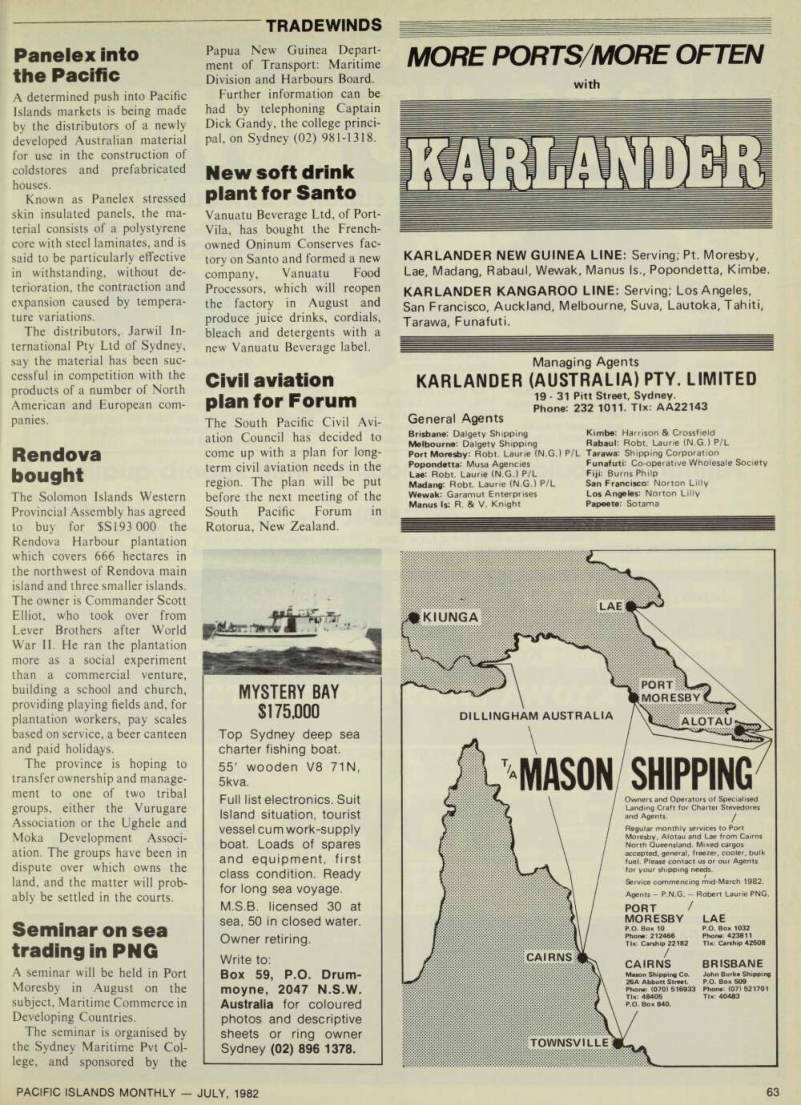
Te Tautai: A gift to Tuvalu
A 173-tonne fishing vessel Te Tautai has been handed over to Tuvalu as a gift from the Japanese Government. Te Tautai (‘Master Fisherman’) is a fisheries training vessel valued at SUSI. 6 million which was designed and built especially for the training of Tuvalu fishermen.
The vessel will operate in itially under a management
contract to the Ika Corporation of Fiji and will fish as part of the Ika fleet. On board are four Japanese experts, 22 Tuvaluans and four Fijians.
At the official handing-over ceremony, Tuvalu’s Prime Min ister Dr Tomasi Puapua said that Tuvalu’s economic future should be based on its marine resources and that he had every confidence that Te Tautai would have a bright future.
Representing Japan was Mr Tekaiama from the Japanese
Embassy in Fiji, Mr Morita from Taiyo Fishing Company, the consultants, and Mr lisaku from the shipbuilders, lisaku Shipping Company.
The vessel is capable of both long-line tuna fishing and pole and line skipjack fishing, and both methods will be taught by the Japanese experts on board.
Peter McQuarrie on
Funafuti.
Funafuti welcomes Te Tautai.
The top picture shows the ship’s unusual bows Peter
McQuarrie pictures.
Panelex into
the Pacific
A determined push into Pacific Islands markets is being made by the distributors of a newly developed Australian material for use in the construction of coldstores and prefabricated houses.
Known as Panelex stressed skin insulated panels, the ma terial consists of a polystyrene core with steel laminates, and is said to be particularly effective in withstanding, without de terioration, the contraction and expansion caused by tempera ture variations.
The distributors, Jarwil In ternational Pty Ltd of Sydney, say the material has been suc cessful in competition with the products of a number of North American and European com panies.
Rendova
bought
The Solomon Islands Western Provincial Assembly has agreed to buy for $S 193 000 the Rendova Harbour plantation which covers 666 hectares in the northwest of Rendova main island and three smaller islands.
The owner is Commander Scott Elliot, who took over from Lever Brothers after World War 11. He ran the plantation more as a social experiment than a commercial venture, building a school and church, providing playing fields and, for plantation workers, pay scales based on service, a beer canteen and paid holidays.
The province is hoping to transfer ownership and manage ment to one of two tribal groups, either the Vurugare Association or the Ughele and Moka Development Associ ation. The groups have been in dispute over which owns the land, and the matter will prob ably be settled in the courts.
Seminar on sea
trading in PNG
A seminar will be held in Port Moresby in August on the subject, Maritime Commerce in Developing Countries.
The seminar is organised by the Sydney Maritime Pvt Col lege, and sponsored by the
Papua New Guinea Depart ment of Transport: Maritime Division and Harbours Board.
Further information can be had by telephoning Captain Dick Gandy, the college princi pal, on Sydney (02) 981-1318.
New soft drink
plant for Santo
Vanuatu Beverage Ltd, of Port- Vila, has bought the French owned Oninum Conserves fac tory on Santo and formed a new company, Vanuatu Food Processors, which will reopen the factory in August and produce juice drinks, cordials, bleach and detergents with a new Vanuatu Beverage label.
Civil aviation
plan for Forum
The South Pacific Civil Avi ation Council has decided to come up with a plan for long term civil aviation needs in the region. The plan will be put before the next meeting of the South Pacific Forum in Rotorua, New Zealand.
Advertisements & other items, pp. 62-64 (1 item)
Renowned Reliable Robust
PUMPS by HILLS & WILLIS
NEW PUMPING TECHNOLOGY, now available in Australia, for AGRICULTURE and INDUSTRY for FLOOD IRRIGATION and DRAINAGE FISH FARMS TOWN WATER SUPPLY WATER POLLUTION CONTROL and WASTE WATER TREATMENT PLANTS, etc., where LARGE volumes of water or other liquids at MAXIMUM EFFICIENCIES are pumped.
Typical installation for irrigation purposes with river pumps and relift pumps in simple pump station “HW”-AV Vertical and Sloping AXIAL FLOW PUMPS, single or multi-stage, are fitted with variable, precision cast 316 grade stainless steel heat treated propeller blades which can be set to suit any flow and head conditions together with the capability of adjustments for any existing drive ALL within ONE combination Bowl Diffuser body in close grain cast iron. A large range of propeller blade adjusting angles offers in ONE pumpsize virtually a MULTITUDE of pump sizes.
An additional advantage in replacing propeller blades ONLY (if and when necessary), instead of the complete propeller, makes the servicing of HW/AV pumps a very convenient and economical proposition.
Pump Inlet, Flanged Column and Head Assemblies are in fabricated mild steel.
Product or oil lubricated line shaft drive styles are manufactured using stainless bowl shafts in all turbines.
We are able to offer full machine shop back-up of our pumps. Spare parts are readily available. • Single-Stage and Multi-Stage • Heads: Single-Stage to 10m • Flow rates; up to 7000 l/s • Bowl sizes: from 200 mm Multi-Stage to 30 m (250 cusecs) to 1200 mm Series T TURO-pump with completely impeller, forming the basis of 7 Nominal bore Capacity Head Solids handled free passage, no sealing rings (seven) Universal pump ranges. : ND 25-300 mm : up to 600 l/sec : up to 100 m liquid column : spheres of 25 to 300 mm dia. on Application; Handling of dirty water; raw unscreened sewage; communal and industrial effluent, slurries of all types, viscous fluids, crude oil, fibrous suspensions at any pumpable concentration; paper stock up to 10% bone dry consistency; food stuffs; chemical and crystalline suspensions; etc.
Hi
HILLS & WILLIS PTY. LTD.
54-56 Claremont Avenue
GREENACRE, N.S.W. 2190
(Postal Address: P.O. Box 519, Bankstown, N.S.W. 2200)
AUSTRALIA
Phone: (02) 7098080; 7097450
AVAILABLE
FROM
EXPORT
AGENTS
JARWIL international
|Ai/V PTY. LTD.
*** v Box Q 239 Queen Victoria Post Office, Sydney 2000 410 Kent Street, Sydney,
N.S.W. 2000, AUSTRALIA
Phone: (02) 29 6022. Telex: AA72102 ATTEX COMPLETE CONSULTING SUPPLY & INSTALLATION SERVICE AVAILABLE WITH ALL
PUMPING PROJECTS
MORE PORTS/MORE OFTEN
with KARLANDER NEW GUINEA LINE: Serving; Pt. Moresby, Lae, Madang, Rabaul, Wewak, Manus Is., Popondetta, Kimbe.
KARLANDER KANGAROO LINE: Serving; Los Angeles, San Francisco, Auckland, Melbourne, Suva, Lautoka, Tahiti, Tarawa, Funafuti,
Managing Agents
KARLANDER (AUSTRALIA) PTY. LIMITED
19 - 31 Pitt Street, Sydney.
Phone: 232 1011. Tlx: AA22143
General Agents
Brisbane: Dalgety Shipping Kimbe: Harrison & Crossfield Melbourne: Dalgety Shipping Rabaul; Robt. Laurie (N.G.) P/L Port Moresby: Robt. Laurie (N.G.) P/L Tarawa: Shipping Corporation Popondetta: Musa Agencies Funafuti: Co-operative Wholesale Society Lae: Robt. Laurie (N.G.) P/L Fiji: Burns Philp Madang: Robt. Laurie (N.G.) P/L San Francisco: Norton Lilly Wewak: Garamut Enterprises Los Angeles: Norton Lilly Manus Is: R. & V. Knight Papeete; Sotama
MYSTERY BAY
$175X100 Top Sydney deep sea charter fishing boat. 55' wooden V8 71N, 5kva.
Full list electronics. Suit Island situation, tourist vessel cum work-supply boat. Loads of spares and equipment, first class condition. Ready for long sea voyage.
M.S.B. licensed 30 at sea, 50 in closed water.
Owner retiring.
Write to: Box 59, P.O. Drummoyne, 2047 N.S.W.
Australia for coloured photos and descriptive sheets or ring owner Sydney (02) 896 1378.
LAE
KIUNGA
PORT m**
MORESBY
DILLINGHAM AUSTRALIA
ALOTAU
MASON SHIPPING
Agents - P.N.G. — Robert Laurie PNG
PORT /
MORESBY
P.O. Box 10 Phono: 212466 Tlx: Carship 22182 /
CAIRNS
Mason Shipping Co. 26A Abbott Street.
Phone: (0701 516933 Tlx; 48405 P.O. Box 840.
LAE
P.O. Box 1032 Phone: 423811 Tlx: Carship 42508
CAIRNS
BRISBANE
John Burke Shipping P.O. Box 509 Phone; (07) 521701 Tlx: 40483
TOWNSVILLE
close-up power
Ideal for boating and
sailing
enthusiasts!
FUJINON optics make superior binoculars!
7x50
MARINE
Waterproof Marine Binocular Magnification Diam of objective Diam of exit pupil Angle of vision Brightness Field of view at 1000 m Size (approx ) 82 x 176 ; Weight (approx ) 1300 g Ideal for long distance observation with long focal range lens. Extra lens brightness ensures clarity even in twilight.
GYRO-STABILISED
BINOCULARS
FUJINON 7x24R8
Radio Binocular has a built-in AM radio and earphone.
You cannot be at two sporting venues at once.
Watch one sport while listening to another.
FUJINON
* One hand operation (1.9 kg)
* True Binocular (10x40) * Bright clear stable image
* Externally or internally powered
* Ideal for use from all helicopters
light aircraft small ships
and land vehicles Fujinon binoculars are famous for their superb quality
Athjviak
TELMAK Pty. Ltd., 4 Sirius Road, Lane Cove, NSW 2066 Phone (02) 428 4788 ■o<«
Japan
S. Korea
T aiwan
Hong
Kong
Singapore
To: Solomon Is., New Caledonia, Fiji, W. Samoa, A. Samoa, Tahiti, Cook Is., Tonga, Vanuatu, Tuvalu, Nauru To; Guam. Saipan, Truk. Ponape, Majuro. Yap, Koror
T aiwan
Singapore
Philippines
To: Papua New Guinea. Pacific Islands.
KYOWA SHIPPING CO., LTD.
HEAD OFFICE; OSAKA OFFICE:
sth FI.. Suzumaru Bldg. 39-8, 2-chome, Nishi-Shinbashi, Minato-ku, Tokyo, Japan. Okajima Bldg., 7th Floor, 2-14. Nishihonmachi 1-chome, Nishi-ku, Osaka. Japan Phone: 03(437)2885(Rep.) Cables; “MARIQUEEN" Tokyo. Telex: 242-4651 Kyowa J. Phone; 06(533)5821 (Rep.) Cables: “MARIQUEEN" Osaka Telex: 525-6271 Ssjosa J.
YOUR BUSINESS PARTNER
o T
KYOWA
Ox
GRATING DK
2ND DK
GRATING DK
2ND DK
NO. 2 CARGO HOLD
NO
CARGO HOLD
S. Korea: Dong Sue Shipping Co., Ltd., Seoul Taiwan; Royal Steamship Corp., Ltd., Taipei Hong Kong: Dahzun Enterprises Ltd.
Singapore: Ocean Shipping & Enterprises Pte.. Ltd.
Philippines: Sky International Inc.. Manila Guam: Maritime Agencies of the Pacific Ltd., Guam Saipan: Saipan Shipping Company Inc., Saipan Truk: Truk Shipping Co., Truk Ponape; United Micronesia Development Association, Ponape Yap: Waab Transportation Co., Inc., Yap Koror: United Micronesia Development Association. Koror Solomon Is: Solomon Taiyo Ltd., Honiara Vanuatu: Pentecost Pacific S.A., Port \tla New Caledonia: Agence Maritime Du Rond Point Du Pacific. Noumea Fiji: Carpenter Shipping, Suva & Lautoka A. Samoa; Polynesia Shipping Services, Inc., Pago Pago W. Samoa: Morris Hedstrom Ltd., Apia Tahiti: Compagme Tahifienne Maritime S.A.. Papeete Cooks: Eastern Associates Ltd.. Rarotonga Tonga: E.M. Jones Ltd.. Nukualofa Rabaul: Carpenters Shipping Ltd., Rabaul Port Moresby: J.C. Waller Pty. Ltd.. Port Moresby Lae: Robert Laurie (New Gutneal Pty. Ltd.. Lae Indonesia: P.T. Porbdisa Raya Shipping Lines. Jakarta Australia: Hethenngton Kingsbury Pty. Ltd.. Sydney. N.S.W.
New Zealand: Mckay Shipping Limited, Auckland Nauru: Nauru Cooperative Society., Nauru
The strange , wonderful
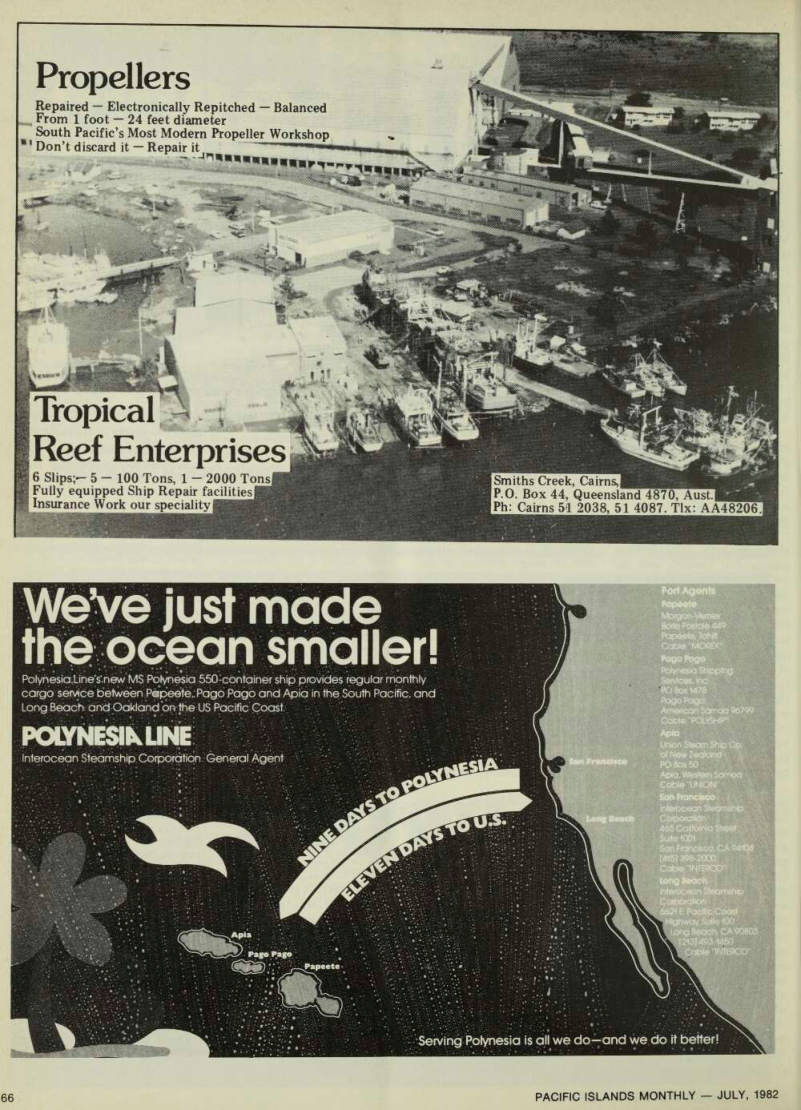
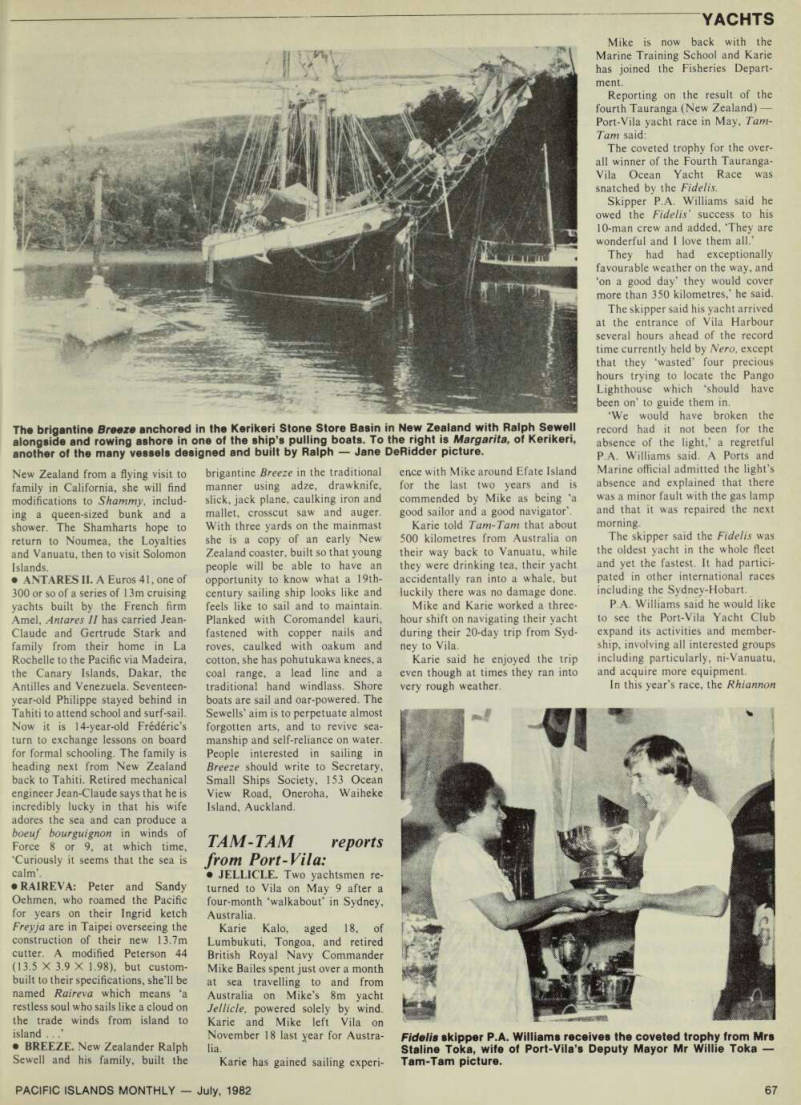
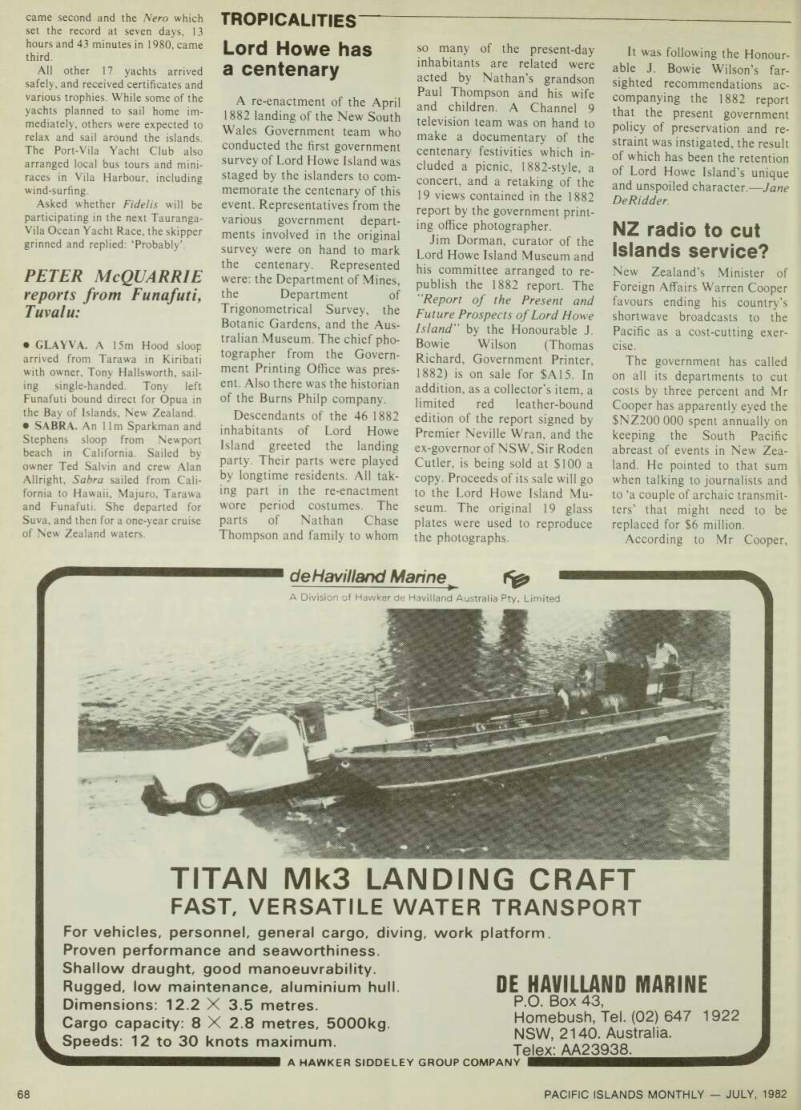
Yachts
The strange , wonderful world of the Salty Hams
PIM yachting correspondent JANE DeRIDDER, yacht Magic Dragon, is both yachtswoman and amateur radio operator. She holds the amateur radio call sign VEOMCG (Canadian high seas), VE7CCW (Canada), and ZLIBVU/ mm (New Zealand maritime mobile). In the article below she describes . . .
‘This is the Pacific Maritime Mobile Net. Will all stations stand by for any possible emerg ency or medical traffic. Emerg ency or medical traffic only . . .
Go now .. .’
This listening watch is kept daily on many yachts and in countless shore stations throughout the Pacific as fellow hams are linked together by the crisscrossing of RF waves bouncing off the reflective layers of the earth’s ionosphere.
There are increasing num bers of such SOLAS nets oper ated by amateur radio operators and dedicated to Safety Of Life At Sea. Widely spaced base stations stand by faithfully to pick up and relay signals from yachts and ships wishing to check in with daily position reports. Net Controls with the help of their shore relays accept and record check-ins, supplying weather forecasts, medical ad vice, mechanical, and other technical expertise, as re quested, shepherding their flock of ships safely into port, while a throng of silent listeners are at their mikes ready to help out if necessary. This unique and invaluable service is deeply appreciated by those of us who stand to benefit from the dedi cated vigilance of net members. ‘Hams’ are licensed amateur radio operators running exper imental radio stations from their homes. They constitute a global fraternity which has grown up with radio itself.
Often designing and building their own equipment, they have been instrumental in furthering the state of the art. Noted for public service during such dis asters as earthquakes, floods and forest fires, typhoons and tornadoes, they are sometimes able to supply communication when all other means fail.
Their ‘ham shacks’ may house tiers of electronic equip ment representing thousands of dollars. Linear amplifiers and
rotating beam antennas put them in touch with any part of the world, depending upon fre quency, season, sunspot ac tivity, ionospheric idiosyncracy, time of day or night. Or, the amateur radio station may be a single transceiver in a corner of a living room, in a car, in a plane, or aboard a yacht. For today’s compact single sideband transceivers are a far cry from the spark-gap trans mitters of the turn of the century or the bulky power hungry rigs of the more im mediate past.
An astonishing multitude of cruising yachts now carry five band single sideband trans ceivers operating over many thousands of miles on the 10, 15 and 20 metre portions of the amateur radio bands, and on 40 and 80 metres for shorter-range contacts. The radios they carry may be hybrid rigs in which all stages but the final are transistorised, and where plug in printed circuit boards make servicing a simple matter. But miniature all solid-state SSB rigs are becoming increasingly popular for shipboard use for they weigh a mere three kilograms or so and draw only about 340 milliamps in receive mode.
Maritime Mobiles or Mickey Mice as they are known can be heard on the ham bands arranging a rendez-vous, exchanging information on approaches and anchorages, or ganising the forwarding of mail, or engaging in a companionable rag-chewing ‘QSO’.
There is nothing like a chat with folks back home to re assure them of your safety at sea, via ‘phone patches’ in countries where third-party traffic is permitted. Co operative land stations ‘patch’ the voyager into their telephone systems, the understanding be ing that no business or commer
cial messages may be passed.
A licence is required to operate an amateur radio station. International agree ments require amateurs to be familiar with radio operation, regulations and theory, and to be able to communicate in Morse code. This latter ability can be important in emerg encies when voice may be unintelligible because of poor propagation, low batteries, or an overcrowded band. Meteoro logical info transmitted in ‘cw’ can be used to construct weather charts. One chap we know tapes the broadcasts to copy at a slower speed.
It is essential to get a ham licence before setting out on a cruise for it is very difficult or even impossible to obtain one once out of home waters. Some foreign nations will issue tem porary licences for use within their own territorial waters application to be made at the communications office on ar rival. Otherwise use of the ham rig can be limited to emerg encies only, at which time amateur radio operators may help a stricken vessel without fear of unlawfully working an unlicensed station.
For those of us without a technical background, getting a licence may be a challenge.
Radio clubs offer classes for beginners which some people find helpful. I used tapes to gain Morse mastery, finding several short practice sessions a day more effective than a single lengthy period of study. To bone up on basic electrical and radio principles and operating procedures, there are various study guides and radio publica tions available. Government de partment of communications bulletins provide knowledge of the regulations pertaining to amateur radio operation.
One of the most avid sea going hams we know seldom leaves his boat, shunning the ‘eyeball QSO’. A prisoner to his schedules, he lives for his radio contacts, a floating troglodyte, happy to pass his time resonat ing his antenna, giving out signal reports, comparing rigs, or just ‘reading the mail’.
Other blue-water cruisers prefer to do without ham radio. ‘Why encumber myself with skeds?’ ‘We chose this way of life in order to get away from ringing telephones and knocks
on the door.' ‘We don't want to clutter our yachts with multiband dipoles or quarter wave whips.’ ‘As a safety measure, forget it! We can’t expect anyone else to come to our aid. We are on our own.’ So go the objections.
However, most of us value contacts with friendly voices thousands of miles away, just as armchair operators enjoy vicari ous adventuring with sailors on
small ships.
Jane Deridder Re
ports from Kerikeri,
New Zealand:
• WINDSTAR. A Sparkman and Stephens 42, Windstar of Lahaina, Hawaii ventures further off the beaten track than most cruising yachts. Wally Sanger has visited Penrhyn, Rakahanga, Manihiki, the Danger Islands, Swains Island (where his was the first yacht to call in two years), Wallis and Rotuma Islands and Nauru. Windstar was nine months in Solomon Islands, and spent the 1980-81 hurricane season in Tuvalu. T can’t speak highly enough of the people here, particularly in Nanumea.’ With Merran Randall of Sydney who joined Windstar in Port-Vila, Wally managed to anchor for two nights in a roily anchorage off Norfolk Island. Here amateur radio oper ator John Anderson and his wife Florence showed the young couple around. John is well known to South Pacific yachtsmen for his detailed daily weather reports and forecasts to yachts making ocean passages.
Wally and Merran will head from New Zealand to Hong Kong via Fiji, Samoa, Papua New Guinea and the Philippines. • SHAMMY. When Bill Shamhart, general surgeon from Rosedale, California, himself underwent hand surgery, he retired early (‘Not early enough’) to cruise on his George Moore-designed, San Francisco-registered 15m ketch Shammy. Though the vessel was designed for a crew of eight, Dr Shamhart and his wife Carol usually sail the yacht themselves with the help of a British Hydro vane steering gear, a Benmar auto pilot and a 130 hp Cummins diesel.
They are joined from time to tinje by a son. When Carol returns to
New Zealand from a flying visit to family in California, she will find modifications to Shammy, includ ing a queen-sized bunk and a shower. The Shamharts hope to return to Noumea, the Loyalties and Vanuatu, then to visit Solomon Islands. • ANTARESII. A Euros 41, one of 300 or so of a series of 13m cruising yachts built by the French firm Amel, Antares II has carried Jean- Claude and Gertrude Stark and family from their home in La Rochelle to the Pacific via Madeira, the Canary Islands, Dakar, the Antilles and Venezuela. Seventeen
year-old Philippe stayed behind in
Tahiti to attend school and surf-sail.
Now it is 14-year-old Frederic’s turn to exchange lessons on board for formal schooling. The family is heading next from New Zealand back to Tahiti. Retired mechanical engineer Jean-Claude says that he is incredibly lucky in that his wife adores the sea and can produce a boeuf bourguignon in winds of Force 8 or 9, at which time, ‘Curiously it seems that the sea is calm’. • RAIREVA: Peter and Sandy Oehmen, who roamed the Pacific for years on their Ingrid ketch Freyja are in Taipei overseeing the construction of their new 13.7 m cutter. A modified Peterson 44 (13.5 X 3.9 X 1.98), but custom built to their specifications, she’ll be named Raireva which means ‘a restless soul who sails like a cloud on the trade winds from island to island .. .’ • BREEZE. New Zealander Ralph Sewell and his family, built the
brigantine Breeze in the traditional manner using adze, drawknife, slick, jack plane, caulking iron and mallet, crosscut saw and auger.
With three yards on the mainmast she is a copy of an early New Zealand coaster, built so that young people will be able to have an opportunity to know what a 19th century sailing ship looks like and feels like to sail and to maintain.
Planked with Coromandel kauri, fastened with copper nails and roves, caulked with oakum and cotton, she has pohutukawa knees, a coal range, a lead line and a traditional hand windlass. Shore boats are sail and oar-powered. The Sewells’ aim is to perpetuate almost forgotten arts, and to revive sea manship and self-reliance on water.
People interested in sailing in Breeze should write to Secretary, Small Ships Society, 153 Ocean View Road, Oneroha, Waiheke Island, Auckland.
TAM-TAM reports
from Port-Vila:
• JELLICLE. Two yachtsmen re turned to Vila on May 9 after a four-month ‘walkabout’ in Sydney, Australia.
Karie Kalo, aged 18, of Lumbukuti, Tongoa, and retired British Royal Navy Commander Mike Bailes spent just over a month at sea travelling to and from Australia on Mike’s 8m yacht Jellicle, powered solely by wind.
Karie and Mike left Vila on November 18 last year for Austra lia.
Karie has gained sailing experi
ence with Mike around Efate Island for the last two years and is commended by Mike as being ‘a good sailor and a good navigator’.
Karie told Tam-Tam that about 500 kilometres from Australia on their way back to Vanuatu, while they were drinking tea, their yacht accidentally ran into a whale, but luckily there was no damage done.
Mike and Karie worked a three hour shift on navigating their yacht
during their 20-day trip from Syd
ney to Vila.
Karie said he enjoyed the trip even though at times they ran into very rough weather.
Mike is now back with the Marine Training School and Karie has joined the Fisheries Depart ment.
Reporting on the result of the fourth Tauranga (New Zealand) Port-Vila yacht race in May, Tam- Tam said: The coveted trophy for the over all winner of the Fourth Tauranga- Vila Ocean Yacht Race was snatched by the Fidelis.
Skipper P.A. Williams said he owed the Fidelis’ success to his 10-man crew and added, ‘They are wonderful and I love them all.’
They had had exceptionally favourable weather on the way, and ‘on a good day’ they would cover more than 350 kilometres,’ he said.
The skipper said his yacht arrived at the entrance of Vila Harbour several hours ahead of the record time currently held by Nero, except that they ‘wasted’ four precious hours trying to locate the Pango Lighthouse which ‘should have been on’ to guide them in. ‘We would have broken the record had it not been for the absence of the light,’ a regretful P.A. Williams said. A Ports and Marine official admitted the light’s absence and explained that there was a minor fault with the gas lamp and that it was repaired the next morning.
The skipper said the Fidelis was the oldest yacht in the whole fleet and yet the fastest. It had partici pated in other international races including the Sydney-Hobart.
P.A. Williams said he would like to see the Port-Vila Yacht Club expand its activities and member ship, involving all interested groups including particularly, ni-Vanuatu, and acquire more equipment.
In this year’s race, the Rhiannon
The brigantine Breeze anchored in the Kerikeri Stone Store Basin in New Zealand with Ralph Sewell alongside and rowing ashore in one of the ship’s pulling boats. To the right is Margarita, of Kerikeri, another of the many vessels designed and built by Ralph Jane DeRidder picture.
Fidelia skipper P.A. Williams receives the coveted trophy from Mrs Staline Toka, wife of Port-Vila’s Deputy Mayor Mr Willie Toka Tam-Tam picture.
came second and the Nero which set the record at seven days, 13 hours and 43 minutes in 1980, came third.
All other 17 yachts arrived safely, and received certificates and various trophies. While some of the yachts planned to sail home im mediately, others were expected to relax and sail around the islands.
The Port-Vila Yacht Club also arranged local bus tours and mini races in Vila Harbour, including
wind-surfing.
Asked whether Fidelis will be participating in the next Tauranga- Vila Ocean Yacht Race, the skipper grinned and replied: ‘Probably’.
Peter Mcquarrie
reports from Funafuti ,
Tuvalu:
• GLAYVA. A 15m Hood sloop arrived from Tarawa in Kiribati with owner, Tony Hallsworth, sail
ing single-handed. Tony left
Funafuti bound direct for Opua in the Bay of Islands, New Zealand. • SABRA. An 11m Sparkman and Stephens sloop from Newport beach in California. Sailed by owner Ted Salvin and crew Alan Allright, Sabra sailed from Cali fornia to Hawaii, Majuro, Tarawa and Funafuti. She departed for Suva, and then for a one-year cruise of New Zealand waters.
Advertisements & other items, pp. 66-69 (2 items)
Propellers
Repaired Electronically Repitched Balanced From 1 foot 24 feet diameter South Pacific’s Most Modern Propeller Workshop • 1 Don’t discard it Repair it .v*#
Tropical
Reef Enterprises
6 Slips;- 5 - 100 Tons, 1 - 2000 Tons] Fully equipped Ship Repair facilities!
Insurance Work our speciality! a %■ * Smiths Creek , Cairns, Queensland Box 44 487 Aust Ph Cairns 51 2038 4087 51 Tlx AA48206
Polynesia.Line's’.new MS Polynesia 550 : container ship provides regular monthly cargo service between Papeete,. Pago Pago and Apia in the South Pacific, and Long Beach and Oakland bn the US Pacific Coast.
POLYNESIA LINE
Interocean Steamship Corporation General Agent • • > . ■ . * ,» Pago Page
fS\A
IX & D.s ■x K 3 Papeete /• * Serving Polynesia is all we do-and we do it better!
deHavilland Marine ►- A Division of Hawker de Havilland Australia Pty. Limited K 1 s wm . -• ■■■ ■: * I: ' ' I ■ ■ • m m
TITAN Mk 3 LANDING CRAFT
FAST, VERSATILE WATER TRANSPORT
For vehicles, personnel, general cargo, diving, work platform.
Proven performance and seaworthiness.
Shallow draught, good manoeuvrability.
Rugged, low maintenance, aluminium hull. DE HAVILLAND MARINE Dimensions: 12.2 X 3.5 metres. P-O. Box 43, Cargo capacity: 8 X 2.8 metres, 5000 kg. 1922 Speeds: 12 to 30 knots maximum. AA^’SSS^
A HAWKER SIDDELEY GROUP COMPANY
il
LOCAL AGENTS AND
REPRESENTATION
428 George St., Sydney.
Cables: Henco Sydney.
G.P.O. Box 3949.
Telephone: 232 5377.
For specialised and personalised buying service throughout the Pacific Islands and the East.
Resident Agents in other Pacific Territories.
PAPUA NEW GUINEA
RABAUL: M. & C. Seeto, P.O. Box 131, Rabaul.
Telephone 92 2919.
MADANG: W. Double, P.O. Box 22, Madang.
Telephone 82 2696.
FIJI
K. Witherington Ltd., P.O. Box 293, Suva.
Telephone 22 356.
VANUATU
John Lum & Associates, P.O. Box 65, Santo.
Telephone 329.
SOLOMON ISLANDS
Mr. Tom Lo, P.O. Box 327, Honiara.
Telephone 399
PACIFIC ISLANDS
TRANSPORT LINE
M.V. SIRIUS
EXPRESS
CONTAINER
•REEFER
SERVICE
between U.S.
West Coast
ports
and
O OS)
a Q>
TAHITI SAMOA
PAPEETE
PAGO PAGO
APIA
Qeqeral Stearristup (Corporation
General Agents 400 California Street, San Francisco, CA, USA PAPEETE: Agence Maritime Internationale, Tahiti PAGO PAGO: Polynesia Shipping Services, Inc.
APIA: Burns Philp (South Sea) Company, Ltd.
LTD
Tropic Alities
Services
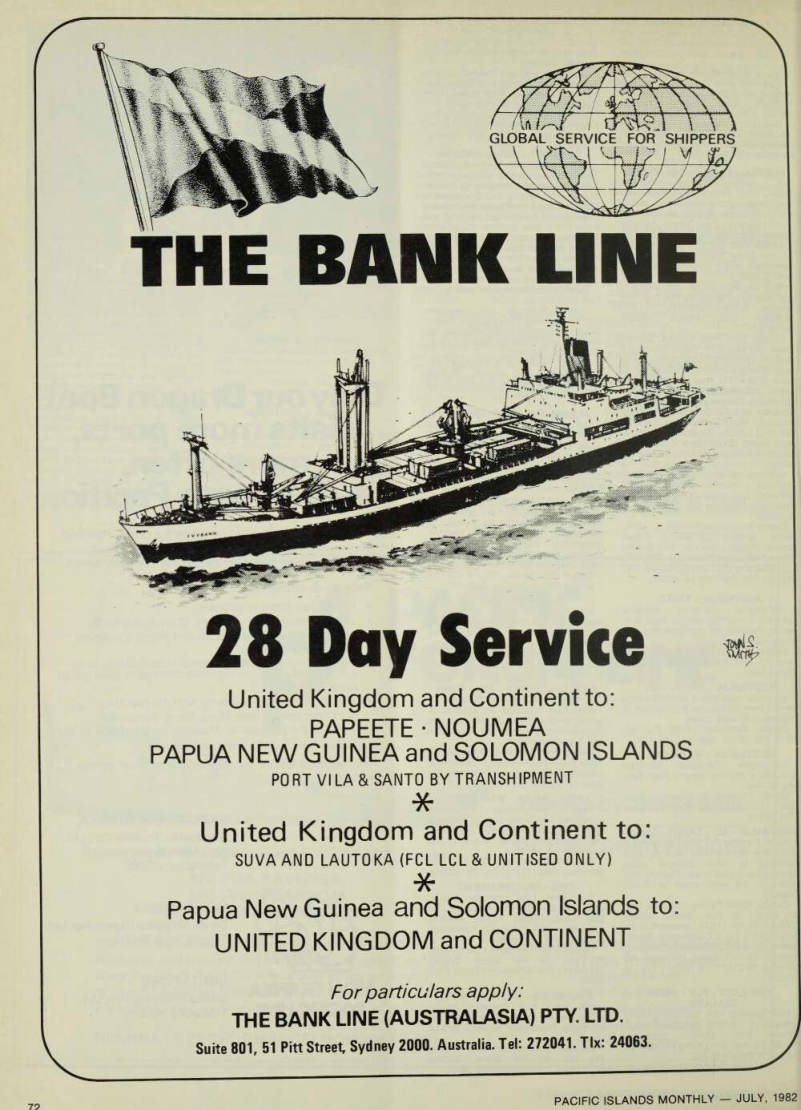
Shipping
Shipping
Should any shipping company wish to have its services cargo and passenger included in these list ings they should contact PIM.
Australia - Fiji
Karlander (Aust) Pty Ltd operates monthly cargo services from Sydney to Suva and Lautoka.
Details from Karlander (Aust) Pty Ltd, 19-31 Pitt Street, Sydney (232-1011), Dalgety Shipping, 460 Bourke Street, Melbourne (616-6700), Burns Philp (SS) Co Ltd, Suva and Lautoka.
Sofrana-Unilines (Fiji Express Line) operates to Suva and Lautoka every two weeks from the main ports on the east coast of Australia and monthly to Lautoka from Melbourne and Sydney.
Details from Sofrana-Unilines, 19 Pitt Street, Sydney, (27-2031), Trans- Austral Shipping Pty Ltd. 570 Bourke Street, Melbourne (67-9162); ACTA Pty Ltd, Brisbane (221-3116); Elders-ANL Pty Ltd, Port Adelaide (47-5688); ANL, Newcastle (049-24364); Clements & Marshall, Burnie, Tasmania (31-1833); Carpenters Shipping, 100 Thomson St, Suva. Fiji (312 244), Tlx 2199 FJ.
Australia - Samoas - Tonga
Warner Pacific Lines operates a
regular cargo service from Sydney to Nukualofa, Pago Pago, Apia and Asau.
Details from Hetherington Kingsbury Pty Ltd, 37-49 Pitt Street, Sydney (27-1671).
Australia • New Caledonia -
Fiji - Samoas - Tonga
Pacific Forum Line operates a fully containerised service (Gen/Reefer) from Sydney to Noumea, Lautoka, Suva, Apia, Pago Pago and Nuku’alofa.
Details from Pacific Forum Line, Syd ney; Union Bulkships, Sydney and Mel bourne; SATO, Noumea, Australian National Line, Brisbane; Burns Philp (SS) Co, Lautoka, Suva and Apia; Union Co, Nuku’alofa; Polynesia Shipping Services, Pago Pago or Pacific Forum Line Head Office, Apia.
Australia - Lord Howe Is -
Norfolk Is
Compagnie des Chargeurs Caledoniens operates four-weekly cargo service Sydney - Lord Howe Island and Norfolk Island.
Details: Hetherington Kingsbury Pty Ltd, 37-49 Pitt Street, Sydney (27-1671).
Australia - Kiribati
Karlander operates a 5/6 weekly ser vice from Melbourne and Sydney to Kiribati (Tarawa).
Details: Karlander (Aust) Pty Ltd, 19-31 Pitt Street, Sydney (232-1011).
Australia - Nauru -
Kiribati
Nauru Pacific Line operates regular cargo/passenger service from Mel bourne to Nauru and Tarawa Details: Nauru Corporation (Vic) Inc (Shipping Division), Nauru House, 80 Collins Street, Melbourne (653-5709), Nedlloyd Swire, 8 Spring Street, Sydney (2-0522).
Australia - New Caledonia
(And/Or) Vanuatu
Sofrana-Unilines ships serve Noumea every two weeks from the main ports along the east Australian coast.
Details from Sofrana-Unilines, 19 Pitt Street, Sydney (27-9851), Trans- Austral Shipping Pty Ltd, 570 Bourke Street, Melbourne (67-9162), ACTA Pty Ltd, Brisbane (221-3116), Elders-ANL Pty Ltd, Port Adelaide (47-5688), ANL, Newcastle (049-24364), Clements & Marshall, Burnie, Tasmania (31-1833).
Compagnie des Chargeurs Cale donians operates a three-weekly con tainerised cargo service from Sydney to Noumea.
Details Hetherington Kingsbury Pty Ltd, 37-49 Pitt Street, Sydney (27-1671).
Compagnie Generate Maritime operates a monthly service from Syd ney to Noumea, Port Vila and Santo, for containerised and break bulk cargo.
Details Compagnie Generate Mari time, 12 Castlereagh Street, Sydney (231-3700).
Australia - Nz - Fiji -
Hawaii - Us
P & O liners call at Auckland, Suva, Pago Pago and Honolulu on eastbound and westbound voyages between Syd ney and the US.
Details from P & O Booking Centre, World Travel Headquarters Pty Ltd, 33 Bligh Street, Sydney (231-6655).
AUSTRALIA - NZ - FIJI - TONGA
Vanuatu - Noumea - Solomons -
Samoas - Tahiti
P & O liners call at Auckland, Bay of Islands, Honiara, Lautoka, Noumea, Nukualofa, Pago Pago, Papeete, Port Moresby, Santo, Savusavu, Suva, Vavau and Vila on cruises from Aus tralia.
Details from P & O Booking Centre,
World Travel Headquarters Pty Ltd 33 Bligh Street, Sydney (231-6655).
Pacific Forum Line operates con tainerized and general cargo service from Australia and NZ to Fiji, Apia, Pago Pago, Tonga and other South Pacific ports.
Details from Polynesia Shipping Ser vices Inc, PO Box 1478, Pago Paqo 96799.
AUSTRALIA - NZ - FIJI - TONGA -
''Ci'ualc ‘ Noumea - Solomons -
Samoas - Tahiti - South East
Asia - Japan
Sitmar Cfuises operates a year-round cruise programme to include most of the above countries.
Details from Sitmar Cruises, 47
Elizabeth Street, Sydney (232-7511).
Australia - New Zealand -
Pacific Islands - South East
Asia-China
Minghua Cruises operates regular cruise services from Sydney to Hawaii and most Pacific ports, with several cruises to South East Asia, including Japan, China and Hong Kong.
Details Minghua Cruises, 7 Bridge Street, Sydney, NSW 2000, Burns Philp Travel offices in Melbourne (62-0151), Brisbane (31 -0391), Darwin (81 -2871).
Auckland NZ (31544); National Bank Travel in Adelaide (51-0321) and Perth (320-9365).
Australia - Micronesia
Nauru Pacific Line operates a regular container service from Melbourne to Majuro, Kosrae, Ponape, Truk, Guam and Saipan.
Details Nauru Corporation (Vic) Inc (Shipping Division), Nauru House, 80 Collins Street, Melbourne, (653-5709), Nedlloyd Swire, 8 Spring Street, Sydney (2-0522).
Australia - Tuvalu
Karlander operates a three monthly
service from Sydney and Melbourne to Tuvalu (Funafuti).
Details from Karlander (Aust) Pty Ltd, 19-31 Pitt Street. Sydney (232-1011).
Australia - Png
Karlander New Guinea Line’s cargo vessels call at Melbourne, Sydney, Port Moresby, Lae, Madang, Wewak, Manus, Kimbe, Rabaul, Popondetta.
Details from Karlander (Aust) Pty Ltd. 19-31 Pitt Street, Sydney (232-1011), Dalgety Shipping, 460 Bourke Street, Melbourne (616-6700).
Australia - Png - Solomons
A consortium of Conpac, NGAL/PNGL have three container ves sels operating on a 28 day turn-around from Melbourne, Sydney and Brisbane to Port Moresby, Lae, Rabaul, Kavieng, Wewak, Madang, Kieta and Honiara.
Details from Burns, Philp & Co. Ltd. 51 Pitt Street, Sydney (2-0547) and Interocean Swire, 8 Spring Street, Syd ney. (2-0522).
New Guinea Express Lines operates a fortnightly container service from Mel bourne, Sydney, Brisbane to Port Moresby, Lae, Alotau, Rabaul, Honiara.
Details from New Guinea Express Lines, PC Box R 73, Royal Exchange, Sydney (241-3991) MacArthur Ship ping Agency Co, 39 Creek Street, Bris bane (229-3777), New Guinea Express Lines, 327 Collins Street, Melbourne (61-3053), Niugini Express Lines, Port Moresby (21-4572), Lae (42-1536), Rabtrad Niugini Pty Ltd, Rabaul (92-2911). Alotau Stevedoring & Trans port, Alotau (61-1318) and Island Co operative Shipping Federation, Honiara (808).
Sofrana-Unilines (PNG Line) operates a monthly service to Port Moresby, Lae, Rabaul, Kieta, Honiara from main ports on the east coast of Australia.
Details from Sofrana-Unilines, 19 Pitt Street, Sydney (27-9851); Trans- Austral Shipping Pty Ltd, 570 Bourke Street, Melbourne (67-9162); ACTA Pty Ltd, Brisbane (221-3116); Elders ANL Pty Ltd, Port Adelaide (47-5688).
Australia - Tahiti
Compagnie Generate Maritime operates a monthly service from Syd ney to Papeete for containerised and break-bulk cargo.
Details Compagnie Generate Mari time, 12 Castlereagh Street, Sydney (231-3700).
Australia - Tahiti - Us
Karlander operates a monthly cargo service from Melbourne and Sydney to Papeete, US west coast.
Details: Karlander (Aust) Pty Ltd, 19-31 Pitt Street, Sydney (232-1011).
Australia - W. Samoa
Compagnie Generate Maritime operates a monthly service from Syd ney to Apia.
Details Compagnie Generate Mari time, 12 Castlereagh Street, Sydney (231-3700).
AUSTRALIA - NZ - TAHITI - CHILE Kapal Pacifico (KP) Pty Ltd offers a bi-monthly service from Geelong, East Australia to New Zealand ports Tauranga and Whangarei, Papeete and ports on the west coast of South America.
Details: Kapal Pacifco (KP) Pty Ltd, 4th Floor, 36 York Street, Sydney (233-8515) Tlx 71875; Beaufort Ship ping Agency Co, 2 Castlereagh Street, Sydney (239-1022); Universal Shipping Agency, 85 Fort Street, Auckland, NZ (30-930) Tlx 21517; I B Taylor Y Cia Ltd n Chile.
Far East - Fiji - New
Zealand
New Zealand Unit Express (NZUE) operates a monthly palletised cargo service from Manila, Keelung, <aoshiung and Hong Kong to Lautoka, Suva and thence to NZ.
Details from Carpenters Shipping,
100 Thomson Street, Suva (312-244), Tlx FJ2199, Burns Philp, Suva (311-777), P & O S.N. Co. Wellington (736-477) or Nedlloyd Swire Pty Ltd, Sydney (20-522).
Nedlloyd operates bi-weekly cargo service with four ships from Sourabaya, Jakarta, Bangkok, Port Kelang and Singapore to Suva and NZ ports.
Details from Nedlloyd (Aust) Pty Ltd, 8 Spring St, Sydney (27 3801), Burns Philp (SS) Co Ltd, Suva and Lautoka.
Far East - Mid-S. Pacific
China Navigation’s New Guinea Pacific Line operates a regular con tainer service from Hong Kong, Taiwan, Manila, Port Kelang and Singapore to Port Moresby, Lae, Rabaul and Honiara monthly and to Wewak, Madang and Kieta every three months. Cargo from the same Far Eastern ports to the South Pacific ports of Noumea, Santo, Vila, Papeete, Pago Pago, Apia, Rarotonga and Tarawa will be shipped via Japan on the monthly Bali Hai service.
Details from Steamships Trading Co., Port Moresby (21-2000).
Kyowa Shipping Ltd. operates monthly services from Japan to Guam, Saipan, Solomons, New Caledonia, Fiji, Western and American Samoa, Tahiti, Tonga and Vanuatu.
Details: Hetherington Kingsbury Pty Ltd, 37-49 Pitt Street, Sydney (27-1671); Carpenters Shipping, Suva (312-244), Tlx FJ2199.
Japan - Fiji - New Zealand
Kyowa Shipping Co Ltd operates a monthly service from main ports of Japan to Suva and Lautoka and thence to island ports and NZ.
Details from Carpenters Shipping, 100 Thompson St, Suva (312-244), Tlx FJ2199.
Japan - Micronesia
The NYK Shipping Line operates a monthly cargo service from Japan to Micronesia, calling at Kobe, Nagoya, Yokohama, Saipan, Guam, Truk, Ponape and Majuro, returning via Kobe, Nagoya and Yokohama.
Details from Burns, Philp & Co Ltd, 7 Bridge Street, Sydney (2-0547).
Japan - Png
Mitsui O.S.K. Lines operates a monthly service from main ports Japan and Port Moresby, Rabaul, Lae, Madang, Kieta and Kimbe.
Details from Robert-Laurie (PNG) Pty Ltd, Port Moresby (21-2466/ 21-1898),
New Caledonia - Fiji - West
Coast North America
PAD Line operates an approx. 3weekly ro-ro service from Noumea and Suva to Honolulu and West Coast USA and Canadian ports.
Details from Sofrana-Unilines SA, BP 1602, Noumea (27-51 -91), Tlx NMO4B; Carpenters Shipping, 100 Thomson St., Suva (312-244), Tlx FJ2199.
Png - Inter - Mainport
Papua New Guinea Line offers scheduled 10/20-day coastal liner ser vices linking all PNG major ports with containerisation, reefer, heavy lift and transhipment facilities.
Details from PNG Line, Box 543, Port Moresby. PNG, (21-1174), Tlx 22269.
Png - Uk/Continent
The Bank Line operates regular cargo service from Port Moresby, Oro Bay, Kieta, Rabaul, Kimbe, Madang and Lae to Hull, Hamburg, Rotterdam, Antwerp and Le Havre.
Details from The Bank Line (A'asia) Pty Ltd, 51 Pitt Street, Sydney (27-2041); Burns Philp (PNG) Ltd, PNG ports.
Solomons - Uk/Continent
The Bank Line operates regular cargo service from Honiara to Hull, Hamburg, Rotterdam, Antwerp and Le Havre.
Details from The Bank Line (A’asia) Pty Ltd, 51 Pitt Street, Sydney (27-2041); Trade© Shipping (588).
NZ • COOK IS - NIUE -
Tahiti
Shipping Corporation of NZ Ltd operates cargo services based on pallets and similar units from Auckland to Niue, Cook Islands and Tahiti.
Details from the Shipping Corp of NZ Ltd, PO Box 3420, Auckland (797-210), Waterfront Commission, PO Box 61, Rarotonga; Cook Islands; Niue Govt Offices, Niue Island Compagnie Maritime Polynesienne, B'P' 368, Papeete, Tahiti.
Nz - Fiji
Reef operates a regular 18-day ser vice from Auckland to Suva and Lau toka.
Details from Reef Shipping Agencies, PO Box 3382, Auckland, NZ (77-1221-3); M.V. Fijian Shipping Agencies Ltd, Private Bag, Suva, Fiji (31 1056).
Pacific Line with one ship operates fortnightly ro-ro cargo service New Zealand, Lautoka, Suva.
Details: Sofrana Unilines, 18 Cus toms Street, Auckland (773-279) PO Box 3614, Telex: NZ2313; Carpenters Shipping, 100 Thomson Street. Suva (312244), Tlx. 2199 FJ.
NZ - FIJI - NORTH AMERICA (WC) Blue Star Line Ltd Pacific Coast con tainer services. Only direct service to and from New Zealand. Blue Star ves sels call at Suva and Honolulu on NZ US-West Coast voyages.
Details from Blueport ACT (NZ) Ltd, PO Box 192, Wellington (739-029) .
Burns Philp (SS) Co Ltd, GPO Box 355, Suva, Fiji (311-777). Tlx. FJ2168 Burship.
NZ - FIJI - SAMOAS - TONGA Pacific Forum Line operates a fully containerised three-weekly service (Gen/Reefer) from Auckland to Lau toka, Suva, Apia, Pago Pago and Nukualofa.
Details from Pacific Forum Line, Auckland; Union Co, Auckland, Lau toka, Suva, Apia and Nuku'alofa; Polynesia Shipping Services, Pago Pago or Pacific Forum Line Head Office, Apia.
Nz - Tonga - Samoas
Warner Pacific Line operates a regular cargo service from Timaru, Onehunga and Westport to Nukualofa, Vavau and Apia with regular calls to Haapai and Pago Pago.
Details from McKay Shipping Ltd, PO Box 1372, Auckland, NZ; Warner Paci fic Line, Box 93, Nukualofa, Tonga and Neiafu, Vavau, Tonga; Polynesia Ship ping Services, Box 1478, Pago Pago.
American Samoa 96799, and Mealelei (Western Samoa) Ltd, Box 4171, Apia, W. Samoa.
NZ - N. CALEDONIA - FIJI -
Solomons - Png
Pacific Forum Line operates a fully containerised service (Gen /Reefer) from Lyttelton, Napier, Auckland to Suva, Lautoka, Honiara, Kieta, Lae and Port Moresby.
Details from Pacific Forum Line, Auckland; Shipping Corporation of NZ, Auckland, Lyttelton, Napier; Union Co, Auckland, Suva, Lautoka; Steamships Trading Co, Kieta, Lae, Port Moresby; Sullivans (SI) Ltd, Honiara or Pacific Forum Line Head Office, Apia.
NZ - N. CALEDONIA - VANUATU -
Png - Solomons
Sofrana Unilines with three ships operates to Vila and Santo, to Honiara and Papua New Guinea and to Norfolk Island and Noumea.
Details from Sofrana Unilines, 18 Customs Street, Auckland (773-279), PO Box 3614, Telex NZ2313.
Nz - Tahiti
Compagnie Tahitienne Maritime SA with one ship operates monthly service New Zealand - Papeete.
Details from Sofrana Unilines, PO 3ox 3614, 18 Customs St, Auckland 773-279), Tlx NZ2313.
Nz - Tonga - Samoas
Warner Pacific Line . services Auckland - Nuku'alofa/Vavau/Apia/ Pago Pago fortnightly carrying general and freezer cargoes.
Details from McKay Shipping Ltd, Downtown House, 21 Queen St, Auckland, PO Box 1372 (30-299), Cables MACSHIP, Telex NZ2554; Warner Pacific Line, Box 93, Nukualofa, Tonga; Mealelei (Western Samoa) Ltd, Box 4171, Apia, Western Samoa; Polynesia Shipping Services, Box 1478, Pago Pago, American Samoa. 96799.
Nz - Central Pacific
Kyowa Shipping Ltd operates a monthly cargo service from Auckland and Mt Maunganui to Noumea, Vila, Santo, Guam, Majuro, Nauru and Tarawa.
Details from McKay Shipping Ltd, PO Box 1372, Auckland (9-30229); Tlx 2554 NZ.
Europe - Tahiti -
New Caledonia
Compagnie Generate Maritime operates services from Europe and Mediterranean ports to Papeete and Noumea using three ro-ro and multi purpose vessels thus ensuring a bi monthly sailing to and from.
Details Compagnie Generate Mari time, 12 Castlereagh Street, Sydney (231-3700).
Europe-Tahiti-New
Caledonia - New Zealand -
Solomons - Png - Europe
Polish Ocean Lines offers regular monthly sailings for containerised and breakbulk cargo from Hamburg, Ant werp, Dunkirk and Rouen to Papeete, Noumea, New Zealand, Honiara, Lae, returning to Europe via Suez, Other ports in the South Pacific can be served with inducement.
Details from Sotama, BP 9170, Papeete (27805), Tlx. 296; SATO, BP C 2, Noumea (272094), Tlx. 163 NM SATO; Union Steamship Co of NZ. PO Box 50, Apia, Tlx. 25; Williams and Gosling, PO Box 79, Suva (312633), Tlx. 2163; Warner Pacific Line, PO Box 93, Nukualofa (21089), Tlx. 66219; Universal Shipping Agencies, PO Box 2282, Auckland (30930), Tlx. 21517.
EUROPE - TAHITI - W. SAMOA -
Fiji - N. Caledonia
Nedlloyd offers regular cargo ser vices from Northern Europe and UK to Papeete, Apia, Fiji and New Caledonia.
Details Nedlloyd (Aust) Pty Ltd, 8 Spring Street, Sydney (27-3801); Car penters Shipping, 100 Thomson St, Suva (312 244), Tlx 2199 FJ.
EUROPE - TAHITI - W. SAMOA - TONGA - FIJI - SOLOMONS - PNG -
Vanuatu
Columbus Line Reederei GMBH operates regular services from Ham burg, Hull, Rotterdam, Antwerp, Dunkirk, Le Havre, to Papeete, Apia, Suva, Lautoka, Noumea, Port Moresby, Lae, Honiara, Kieta, Rabaul, Lae. and return to Europe.
Details from Columbus Overseas Services Pty Ltd, 333 George Street, Sydney (290-2966), Columbus Mari time Services, 17 Albert Street, Auckland (77-3460); Carpenters Ship ping, 100 Thomson St, Suva (312 244), Tlx 2199 FJ.
Uk - N. Continent - Fiji
The Bank Line operates a regular cargo service from Hull, Hamburg, Bremen, Antwerp, Rotterdam and Le Havre to Suva and Lautoka.
Details from The Bank Line (A’asia) Pty Ltd, 51 Pitt Street, Sydney (27-2041); Burns Philp (South Sea) Co Ltd, Suva and Lautoka.
Uk/N. Continent - Png -
Solomons
The Bank Line operates a regular cargo service from Hull, Hamburg, Bremen, Antwerp, Rotterdam and Le
Havre to Port Moresby, Lae, Madang, Kimbe, Rabaul, Kieta and Honiara and on inducement to Yandina.
Details from The Bank Line (A’asia) Pty Ltd, 51 Pitt Street, Sydney (27-2041); Burns Philp (PNG) Ltd, PNG ports; Tradco Shipping (588).
Uk/N. Continent - Tahiti -
N. Caledonia
The Bank Line operates a regular cargo service from Hull, Hamburg, Bremen, Antwerp, Rotterdam and Le Havre to Papeete and Noumea.
Details from The Bank Line (A’asia) Pty Ltd, 51 Pitt Street, Sydney (27-2041); Ets A M Fare UTE, Papeete; Ets Ballande, Noumea.
US - FIJI - TAHITI - NZ -
Australia
The Bank Savill Line Ltd, operates regular cargo services from US Gulf ports to Australia and NZ. Calls at Suva, Lautoka and Papeete on demand.
Details from The Bank and Savill Line Ltd, 51 Pitt Street, Sydney (27-2041) or Orient Shipping Services, 32 Bridge Street, Sydney (241-2753).
Us - Hawaii - Kiribati -
Micronesia
Philippines, Micronesia & Orient Navigation Co (PM&O Lines) operates regular container service on self sustained ship with ro-ro capabilities from Oakland, Portland and Honolulu to Tarawa, Ebeye, Majuro, Kosrae, Ponape, Truk, Saipan, Yap and Koror.
Details for Micronesia can be obtained from Larry Guerrero, PM&O’
Owners Rep, PO Box 803, Saipan, Ml 96950, Cable COMMONTIME, Tlx 783605; PM80; PM&O Lines, 181 Fremont St, San Francisco, California
94105, Cable PMONAV.
Us • Hawaii - Nauru -
Micronesia
Nauru Pacific Line operates regular conventional/container and passenger service from San Francisco and Honolulu to Majuro, Ponape, Truk and Saipan. Cargo is accepted for Nauru and Kosrai with transhipment at Majuro and Ponape.
Details from Nauru Corporation (Vic) Inc (Shipping Division), Nauru House, 80 Collins Street, Melbourne (653-5709); North American Maritime Agencies, 100 California St., San Fran cisco. California 9411.
Us - Noumea - Fiji
PAD Line operates an approx 3-weekly roro service from West Coast USA and Canada to Noumea and Suva.
Details from Sofrana-Unilines SA, BP 1602, Noumea (27-51 -91), Tlx NMO4B; Carpenters Shipping, 100 Thomson St, Suva (31-2244), Tlx FJ2199; Trans- Austral Shipping, Box R 232 PO, Royal Exchange, NSW (27-2441), Tlx AA21204.
Us - Tahiti - Samoa
Pacific Islands Transport operates a five weekly cargo service from North America west coast ports to Papeete, Pago Pago, Apia.
Details from Polynesia Shipping Ser vices Inc, PO Box 1478 Pago Pago 96799.
Polynesia Line operates container and general cargo service from US west coast ports to Papeete and Pago Pago.
Details from Polynesia Shipping Ser vices Inc., PO Box 1478, Pago Pago 96799.
Advertisements & other items, pp. 70-72 (1 item)
Pacific
* * 1 ■I- 1 mm***
FORUM LINE
Regular and Reliable Container and Roll - ON - OFF Services
owned by the people
of the Forum Nations
MV FUA KAVENGA
MV FORUM SAMOA
MV FORUM NEW ZEALAND
With our head office in Apia, our regional offices in Suva, Auckland, and Sydney, and our network of agents, we cover the South Pacific to ensure your goods get to you or to your buyer on time.
We tranship also, to or from almost anywhere in the world.
NOMINATE PERFORMANCE: NOMINATE PFL
Agents in: Australia, New Zealand, Fiji, Tonga, Western Samoa, American Samoa, New Caledonia, Papua New Guinea, Solomon Is, Kiribati, Tuvalu, Vanuatu.
i * * \
Only our Dragon Boat
visits more ports,
more often,
in the South Pacific.
The New Guinea Pacific Line offers the quality handling you're used to, through its exclusive containerised service to Papua New Guinea and the Solomon Islands.
Rely on us all the way. • Fast transit times to all ports. • A guaranteed schedule every 30 days, thanks to berths in Papua New Guinea and Honiara reserved for N.G.P.L. use. • Safe, secure transport of goods in containers both L.C.L., and F.C.L. no more damage or pilferage of cargo. • A wide coverage of all ports with the monthly container service from Hong Kong, Singapore, Taiwan, the Philippines, Malaysia and Bangkok to all Papua New Guinea ports and Honiara.
For further details on our reliable Dragon Boat service contact:
PAPUA NEW GUINEA
Steamship Trading Co., Ltd.
Port Moresby Telephone: 212000
NEW GUINEA
PACIFIC UNE
HONG KONG
Swire Shipping (Agencies) Ltd.
Telephone: 5-264311
SINGAPORE °
Straits Shipping Pte. Ltd.
Telephone: 436071
r m 3
GLOBAL SERVICE FOR SHIPPERS
THE BANK LINE
28 Day Service
United Kingdom and Continent to:
PAPEETE • NOUMEA
PAPUA NEW GUINEA and SOLOMON ISLANDS
PORT VILA & SANTO BY TRANSHIPMENT
United Kingdom and Continent to: SUVA AND LAUTOKA (FCL LCL & UNITISED ONLY) * Papua New Guinea and Solomon Islands to:
UNITED KINGDOM and CONTINENT
For particulars apply:
THE BANK LINE (AUSTRALASIA) PTY. LTD.
Suite 801, 51 Pitt Street, Sydney 2000. Australia. Tel: 272041. Tlx: 24063.
Deaths

of Islands People
Posu Ank In the Markham Valley, Papua New Guinea, in April, aged 35, in a car accident.
Mr Ank, of Wangia, near Mendi, was the sitting member for Mendi and government whip in the People’s Progress Party led by Sir Julius Chan.
He was elected to parliament in 1977. It is believed he died instantly when the car he was driving overturned. Sir Julius Chan said: ‘His death has been a sad event for me personally, his parliamentary colleagues, and indeed the nation as a whole.’
Shiu Narayan Kanhai In Suva in March aged 49, from a heart attack.
Mr Kanhai was general sec retary of the Fiji Teachers Union, and National Federation Party candidate for the Nasinu Vunidawa Indian communal seat in the July elections. A spokesman for the union paid
tribute to Mr Kanhai’s ‘tremen dous and untiring contribution to the teachers in Fiji’.
Ariel David Sharan In Vancouver, in April, aged 70.
Mr Sharan was one of the founders of the Sharan Brothers Theatres cinema chain in Fiji.
Formerly a teacher, he went into business at Levuka, and with his four brothers set up a chain of cinemas throughout Fiji. He retired to Vancouver in 1977.
David Gray
In Suva in April, aged 48.
A former superintendent and deputy director of personnel and training in the Royal Fiji Police Force, Mr Gray had retired early this year, having served in the force since 1963.
He was fishing with friends when he suddenly became ill, dying on the same day.
Rev. Fe’aofaki Lose In Sydney in April, aged 58, in a car accident.
He was one of the most respected figures in the Tongan community in Australia. More than 300 Tongans attended his funeral service.
Mohammed Taiyab Khan In Lautoka, Fiji, in May, aged 55, from a heart attack.
A prominent Tavua lawyer and National Federation Party
candidate for the July general election, Mr Khan began his political career in 1966. He was appointed minister for com merce and industry when the Alliance Party won the 1972 general election. In May 1976 Mr Khan was charged with corruption, and although he was cleared of the charges in October, was not restored to a cabinet post. He returned to politics in 1977.
Ponswamy Goundar
In Labasa, Fiji, in April, aged 49, from heart failure.
Mr Goundar was appointed Commissioner Northern only four months before his death.
He was attending Labasa Hos pital for treatment after a car accident whe he suddenly col lapsed and died. He was a popular figure and Labasa’s first ‘home-grown’ com missioner.
Surendra Singh
In Suva in April, aged 46, of cancer.
A former commissioner of
inland revenue, Mr Singh joined the Fiji Civil Service in 1961, after graduating from Otago University, New Zea land, with a Bachelor of Com merce degree. He was honoured with a CBE in 1980, the citation hailing him as one of the architects of Fiji’s tax system.
Harold Picton-Smith In Navua, Fiji, in March aged 64.
Mr Picton-Smith came to Fiji in 1964 to work in the public service, holding a variety of posts, including that of Regis trar-General and Registrar of Titles, before being appointed Solicitor-General in 1971. He was responsible for the revised edition of the Laws of Fiji in 1964 and 1978. Mr Smith was made an OBE in 1980. He retired from the service in 1979 and took Fiji citizenship.
Following his retirement he spent several months in the Marshall Islands advising the local authorities on the setting up of their new administration.
Advertisers Index
Aggie Greys 74 Air New Zealand 26 Air Vanuatu 28 Aiwa 16 Almarc 36 Amatil 56 Aotea 54 Asia Seafood Co 74 Asia Tonga Trading 74 Bank Line 72 China Navigation 71 Clarion Shoji 42 De Havilland Marine 68 Gemmell Pring Assoc 50 General Steamship 69 Goodyear 4 Gow, R M 48 Henry Cumines 69 Hinchcliffe , C 74 Hitachi Ltd 2 Jarwil International 62 Jojoba Int 58 Karlander Pty Ltd 63 Kyowa Shipping 64 MacKenzie Madden 50
McDonnell Douglas 52 Marlin Modular 44 Mason Shipping 63 Mystery Bay * 63 Nelson Robertson 34 New Guinea Expeds 74 Nippon Columbia 36
N 2 Dairy Board 13
Pacific Forum Line 70 Papua Hotel 40 Pioneer 76 Polynesia Shipping 66 QBE Insurance 32 Reynold Australia 60 Sansui Electric Co 8 Shalet Roofs 74 Short Bros 20,21 Solair 30 Sonar Ship 74 Sorens Pty Ltd 46 Suzuki Motor Co 75 Tatham, S E 24 Telmark Pty Ltd 64 Toyota , £2 Tropical Reef 66 Turner, lan 74
Advertisements & other items, pp. 74-76 (2 items)
*T~ *s*'»' red
WOODEN
ROOF
TILES
Opportunity available to promote CHALET roof tile and tile machine using Pacific timbers.including coconut and rubber woods.
For further information write to:-
CHALET ROOFS LTD
P.O. Box 41 079, Auckland 3, New Zealand.
NEW GUINEA
EXPEDITIONS
ADVENTURE
HOLIDAYS
trekking • rafting diving • caving 4-wheel drive sea plane adventure Sepik expeditions PNG specialists For our 20-page fullcolour brochure contact—
NEW GUINEA
EXPEDITIONS
3rd Floor. 28 O'Connell St.
Sydney 2000 Phone (02) 231 6066 Telex AA22179 Licence 8950
REMEMBER
When Sunday becomes politically and religiously legal; those keeping Saturday the seventh day sabbath holy; opposing Sunday the first day; are simply keeping the Commandments of God and the testimony and faith of Jesus.
Revelation 12:17 and 14:12
lAN TURNER
1/3 Herbert Street,
ROCKDALE, NSW. 2216.
Stay at Aggie Grey’s . . . the South Pacific’s
legendary hotel.
Situated right in the heart of Western Samoa. Enjoy Polynesian-stylc friendliness and service, in cool surroundings, superb entertainment and food.
Magnificent white sand beaches only a short drive away. Airconditioned rooms, swimming pool and full bar facilities. bookings through Union Steamship Company of NZ, Pan Am, Air New Zealand or direct to Aggie Grey’s, Apia, Western Samoa. Cables: ‘AGGIES'Apia.
m Produce ‘
*T~ *s*'»' red
beche-de-mer;^
FISH MAW,
SHARK FINS, etc.
For details please write to:
ASIA SEAFOOD Co.
353 A Circuit Rd., Block 64 ( Republic of Singapore 1337. - Cable: Seawave
80' Steel Fishing Vessel 25 Ton Cap. $550 000 195' Steel Tanker
1071.36 K/L $256 000 US
120' Steel Passenger Cargo Vessel $3OO 000 90' Steel Twin Screw Landing Barge $3OO 000 SV Steel Trawler $225 000 52' Alloy Racer Cruiser Yacht Ex Siska 111 $lO7 000
Sonar Ships Brokerage
BOX 1811 CAIRNS, OLD.
AUSTRALIA
PH: (070) 515371
REQUIRE
DRIED SHARK FINS
FOR PRICES AND
INFORMATION ETC.,
PLEASE WRITE TO;
S. DADDOW,
ASIA TONGA TRADING,
7 KASAI ROAD,
REPUBLIC OF SINGAPORE
2880.
CABLE; "ASIATONGA"
Maps and Prints of
The Old Pacific
New catalogue listing a large stock of original antiquarian views and maps of Australia, New Zealand, Papua New Guinea and all island groups of the Pacific now available.
Write today for your free copy.
COLIN HINCHCLIFFE
7, Royd avenue. Heckmondwike. West Yorkshire.
United Kingdom. WFI6 9AL.
Suzuki 1
SUZUKI ... ppDfQRMANCE
The name of rou
a fJ l c OUTBOARDS.
«*., ■ r - T, - \1 v, • ■ • *
sum
iiHKM
SUZUKI
SUZUKI 1
SUZUKI MOTOR CO, LTD Hamamatsu, Japan SUZUKI GENERATOR SEIBOO qFR\/^r Z Du^ H Kic A 9J> F^, S n , D STR BUTORS Lm PHONE: 58-599 • PAPUA NEW GUINEA HI SPEED DIESEL ■ l^nunMcnTriu^S^ 1 FI J INIFIANJAMS AUTOPORT LTD. PHONE: 381555 • TAHITI NIPPON AUTOMOTO PHONE: 2-98-19 » AMFRmw N QAM L • VANUATU HENRI LEROUX • NEW CALENDONIA STE. SUPERCAL PHONE: 272068 *HON E p am 99QR°« mmS nMDK^Dufl S Ao '9™ HO ».I ; mb. 9 ' 9140 * WESTERN SAMOA VATCO LTD. • GUAM ISLAND CYCLERY, INC. • VAD a mdo^c 9 c?« LP CO - LTD - • NAURU EQUIPAC MOTORS PHONE: 4019 • TONGA TONGA EQUIPMENT » YAP AMBROSE • KOROR BECHESRRAKT COMPANY PHONE: 338 *TRIIK KIOMARA RTfiRF PNriMP- ajq
Kb
CO PIO(VCE«
. rt.: ■ ■
fksoMia
pioinieer HBViaill
Personal enjoyment
• i ® Only Pioneer’s tremendous range of audio expertise could give you so great a combination of advanced technology and stylish design. The new Personna Music Systems...the truly personal approach to fit any corner of your life.
The MX-80 Personna Cassette Disc Receiver Total stereo system capability is at your fingertips with Auto Function Switching. Turntable, cassette deck, FM/AM tuner and stereo amp—all in a single high-tech unit.
The RX-70 Personna Cassette Receiver Sharp styling plus solid audio engineering. Full-logic cassette deck, digital FM/AM tuner and powerful stereo amp—all very easy to use and easier still to enjoy.
C RX-70
fID PIONEER
The S-9 Personna Shelf Components Sleek matching units with an individual outlook and Auto Function Switching. Includes separate digital synthesized FM/AM tuner with programmable timer, a full-logic cassette deck, a fully automatic turntable and a stereo amp.
Personna from Pioneer. Now, stereo systems as personal as your music.
SESS
a For further information, please contact; • o iqc .
Australia: Pioneer Marketing Services Pty.Ltd.. PO. Box 317, Mord.alloc, Victoria, 3195 Fiji Islands: Brijlal & Company, G.P.O. Box No. 362, Suva Fiji Islands Tel: 22258 New Zealand: Monaco Distributors Ltd.. 2 Poland Road. Glenfield, Auckland, New Zealand Tel: (09) 444-9144 Nauru Island: Jacob Enterprises, P.O. Box No. 4. Republic of Nauru Tahiti- Tahiti Hi-Fi PO. Box 848, Papeete, Tahiti .
New'Caledonia: Menard Paciflque Sari. B.P. 3899, Noumea, New Caledonia American Samoa : Transpac Corporation, P.O. Box 1477, Pago Pago. American Samoa 96799 Tel: 633-5224 . „„ „