Advertisements & other items, pp. 1-2 (2 items)
Pacific Islands Monthly
JUNE, 1982
American Samoa US$l.75 Australia * A 51.50 ■1.50 1.50 1.95 1.75 1.75 •190 2.00 1.50 1.50 1.50 1.50 'l9O 1.50 1.75 2.25 bo Ir*
fig m ■
Thump!
Making The World An Exciting Place
■ j V:- M I Hr fork : XL. The world’s best selling 4-stroke trail bikes.
The brute force that sets the pace. XL. From those who build perfection. To those who demand it.
WORLD’S LARGEST MOTORCYCLE MANUFACTURER
HONDA MOTOR CO., LTD. TOKYO, JAPAN
fy f/ a
XLIOOS
XLSOOR
XLI2SS
XLIBSS
PAPUA NEW GUINEA: Steamships Trading Company Ltd. P.O. Box 1, Port Moresby/TAHITI: Honda Distribution S.A.R.L. B.P. 1665, Papeete/FIJI ISLANDS: Carpenters Motors Private Mail Bag Suva, Fiji/ KIRIBATI: Atoll Motor & Marine Services P.O. Box 49 Bairiki Tarawa/U.S. TRUST TERRITORY: United Micronesia Development Association P.O. Box 238, Saipan Mariana Islands 96950/ COOK ISLANDS; Cook Islands Motor Centre Ltd. P.O. Box 74, Rarotonga/AMERICAN SAMOA: Holiday Motors, Parts and Service P.O. Box 968 Pago Pago, American Samoa 96799/Haleck’s Service Certre Ltd. P.O. Box 1138, Pago Pago. American Samoa 96799/GUAM: Mark’s Motor Co., Inc. P.O. Box DV, Agana/WESTERN SAMOA: Motor Distributors (Samoa) Ltd. P.O. Box 576, Apia/SOLOMON ISLANDS: Guadalcanal Garage Limited P.O. Box 537 Honiara/NEW CALEDONIA: Establissements Ballande Boite Postale No. C 4 Noumea Cedex/NIUE ISLAND: Niue Island United Enterprises P.O.
Box 4, Alofi/NAURU: Nauru Cooperation Republic of Naulu/TUVALU; Tuvalu Co-operative Wholesale Society P.O. Box Funafuti, Tuvalu/TONGA: Tonga Industrial Traders P.O. Box 1035, Nuku’alofa Tonga
Pacific Islands Monthly
Vol. 53 No. 6
June 1982
Fusps 952480)
Founded 1930 by R. W. Robson Editor Angus Smales Associate Editor Malcolm Salmon Advertising Manager Stephen Brandon Editorial Adviser John Carter
Representatives
AUSTRALIA: Distribution: NSW & ACT: Allan Rodney Wright (Circulation) Pty Ltd, PO Box 907, Darlinghurst, NSW 2010; Elsowhors: Gordon & Gotch (A/asia) Ltd, Box 40, PO, Rosebery, NSW 2018. Advertising Reps Brisbane D. Wood, Anday Agency, Box 1918, GPO, Brisbane 4001, telephone 44 3485, 44 1546; Adelaide - Hastwell Media, PO Box 30, Glen Osmond, SA 5064, 23 Avenue Road, Frew ville, SA 5063, telephone 79 9271.
FIJI: Distribution and subscriptions Desai Bookshops, PO Box 160, Suva, Fiji, telephone Suva 23036 Advertising Fiji Times & Herald Ltd, 20 Gordon St, Suva, telephone 312 111, telex FJ2124 FRENCH POLYNESIA: Distribution - Hachette Pacifique, 10 Ave Bruat, Papeete, telephone 25610, HAWAII, UNITED STATES: Distribution PIM. Hawaii. PO Box 22250, Honolulu, Hawaii 96822 Advertising - Roger Brookes, PO Box 10217, Honolulu, Hawaii 96816, telephone 808 536 6677.
JAPAN: Advertising and subscriptions Universal Media Corporation, GPO Box 1762, Tokyo, telephone 666 3036, NEW CALEDONIA: Distribution - Depot Centre de Presse Michel Pentecost, CBP2, Noumea, telephone 27 2434, 27 4729.
NEW ZEALAND: Distribution - Gordon & Gotch, PO Box 584, 2 Carr Road, Mt. Roskill, Auckland 4 Advertising - International Media Representatives Ltd, PO Box 2313, Auckland, telephone 795 487; 493 389, cables Intereps, Auckland Subscriptions Ross Haines & Son Ltd, PO Box 1289, Auckland, telephone 769 042, PAPUA NEW GUINEA: Distribution - Gordon & Gotch.
PO Box 3395, Port Moresby, telephone 254551, 254855 Advertising PNG Post-Courier, PO Box 85, Port Moresby, telephone 21 2577, UNITED KINGDOM: The Herald & Weekly Times Ltd, No. 1 Maltravers Street, London WC2R 3DZ, England, telephone 01 836 5162, telex London 21989.
UNITED STATES MAINLAND: Advertising - Joshua B Powers Jr, Powers International Inc., 551 Fifth Ave, New York, New York 10 017, telephone 867 9580, telex 236514 Subscriptions - PIM, Hawaii, PO Box 22250, Honolulu.
Hawaii 96822.
Subscriptions
PIM is airfreighted to most subscribers and agents in the Pacific Islands and the United Stales, but not the UK or the Continent.
Payments by personal cheque are only acceptable in Aus tralian (from a branch in Australia), US and New Zealand currency. For all other remittances please send an inter national bank draft in Australian dollars.
Published monthly by Pacific Publications (Aust.) Pty Ltd and printed in Australia by Paramac, Alexandria, NSW. Aus tralian cover price is recommended retail only. Registered by Australia Post, publication No NBPI2IO. Second class postage paid at Honolulu, Hawaii. Copyright © Pacific
Publications (Aust.) Pty Ltd.
Postmaster Honolulu: Send address changes to PIM Hawaii, PO Box 22250, Honolulu Hawaii 96822
Local Aust.
American Samoa $US21 $18 Australia $A18 $18 Canada $US27 $25 Cook Islands $19 Fiji $18 French Polynesia $22 Guam
Sus23
$20 Hawaii
Sus23
$20 Japan $20 Kiribati $19 Micronesia $US23 $20 Nauru $21 New Caledonia $22 New Zealand
Snz24
$18 Niue $19 Norfolk Island $15 Northern Marianas
Sus23
$20 Papua New Guinea $23 Solomon Islands $19 Tonga $19 Tuvalu $19 United Kingdom Stg 15 $25 US Mainland
Sus27
$25 Vanuatu $19 Western Samoa $18 Elsewhere $A25
The Month
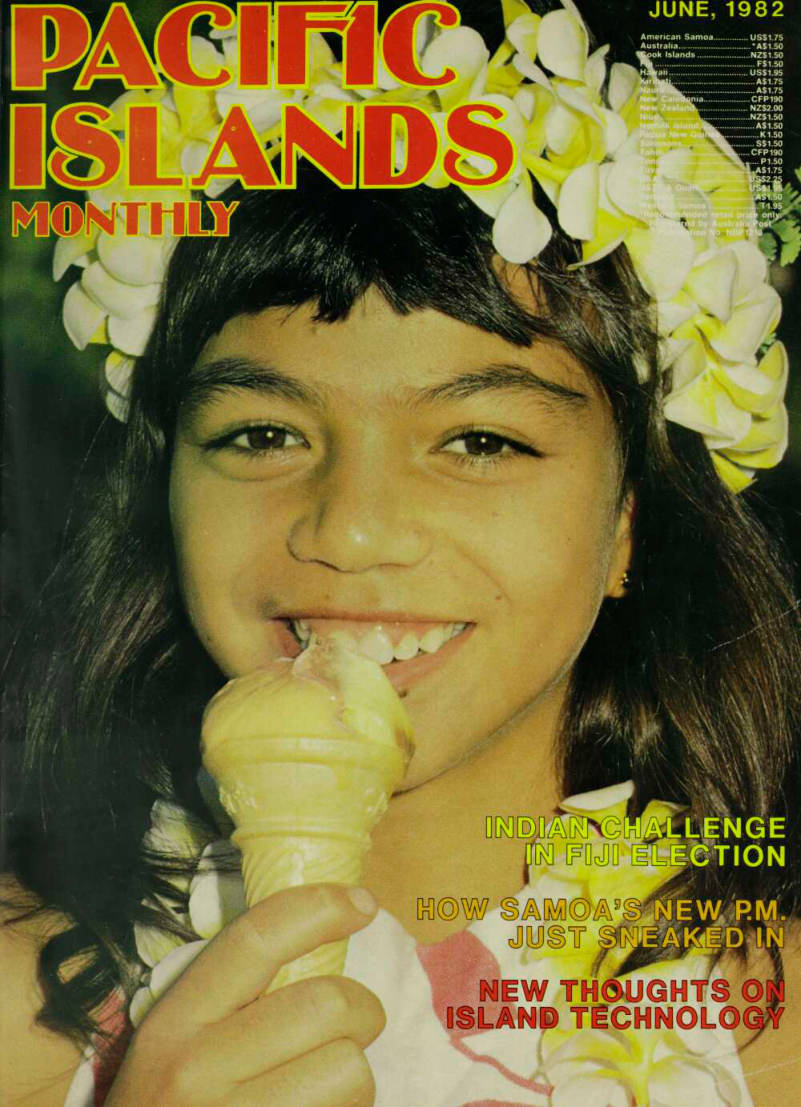
• FIJI ELECTIONS Robert Keith-Reid in Suva provides a detailed rundown on how things are looking as the vital July elections in Fiji loom close 11 • TECHNOLOGY FOR THE PACIFIC Dr Robert Waddell looks at the energy and other technological problems of the Pacific Island countries, and argues that while ‘small’ is certainly ‘beautiful’, the development strategies at present followed don’t always match the idea 15 • WESTERN SAMOA Felise Va’a in Apia tells the dramatic story of how Vaai Kolone, despite his strength in terms of parliamentary seats, managed to oust former PM Tupuola Efi by only one vote when it came to electing the prime minister. He also describes the complicated legal situation concerning elections following a recent ruling on the country’s controversial electoral laws 20 • YESTERDAY In the third of his four-part series on a 1938 voyage on an inter island trader through the then New Hebrides, E. A. Harvey describes the Port-Vila of the day, talks about the political tensions among the motley crew aboard the trader, and closes with an account of his visit to ‘scary’ Malekula 43 • THE VEHICLE IMPORT BILL Daniel Tardieu argues that a remarkable French vehicle, the Citroen FAF, could help Island countries to substantially ease the heavy financial burden imposed by imported motor vehicles 49 • YACHTS Joan D. Pease tells the story of the ordeal she and her husband endured when Cyclone Isaac struck their anchorage at Neiafu, Vavau, in March 55 This month's cover picture: A wide smile, a halo of frangipani blossom, and a cold ice-cream for a hot day.
Polynesian girl with ice-cream is the title given to this study by photographer Roger Merchant of Sydney.
Books 39 Cook Island 39 Deaths 65 Fiji 10,11,27, 36 France in the Pacific 49,28 French Polynesia 28 Hawaii 40 Island Press 31 Letters 6 Pacific nutrition 25 Pacific Peacemaker 28 Pacific Report 4 Papua New Guinea 23, 27 People 33
Pitcairn Island 25 Political Currents 18 Postmark Papeete 28 Shipping services 6 Solomon Islands 37 Technology in the Pacific 15 Tonga 33, 55, Tradewinds 49 Tropicalities 23 U.S. in the Pacific 24,26 Vanuatu 24,43 Western Samoa 20,23 Yachts 55 Yesterday 43
Advertisements & other items, pp. 3-4 (2 items)
A Pacific Publications production
76 Clarence Street, Sydney 2000 GPO Box 3408 Sydney 2001 Cables: PACPUB Sydney Telex: 21242 (answers INTARAD) Telephone: Sydney 20-231 Melbourne 63 0211 Manager; John Berry (03) 63-0211 Ext. 1860
N National
The microwave oven with a built-in “brain”
That’s the genius of National.
National’s new NE-7080 microwave oven, the Genius 11, contains a tiny microprocessor which works as an electronic brain.
So the 7080 can calculate defrost time the accurate way—by weight. Then it sets its own power level and cooking time. Bleeps when the food’s cooked.
And turns itself off.
In other words, Genius II brings all the skills of an experienced cook into your kitchen.
Right from the start, you’ll be turning out great dishes in minutes. Even if you’ve never before attempted anything more ambitious than a boiled egg.
N National
National, Panasonic and Technics are the brandnames of Matsushita Electric.
Pacific Report
Vanuatu Unions Reject Boycott Call
Vanuatu’s trade unions will not join other Pacific countries in a boycott of French exports and services called for by the Pacific Trade Union Forum. Vanuatu Trade Unions’ secretary-general Mr Kenneth Satungia said his organisation, which covers 16 trade unions, considered the boycott call was political.
Nestle Gives In To U.N. Pressure
Nestle, the world’s largest supplier of infant formula, (milk) bowed in March to international pressure and announced it will abide by UN marketing guidelines in selling formula in developing countries. The Swiss company said it will adhere to a World Health Organisation code banning advertising and free samples in nations that do not regulate the sale or distribution of infant formula. Nestle also agreed to advise mothers of the benefits of breast feeding and the dangers of incorrect preparation of the canned formula. The code was adopted at the urging of Third World countries: they have argued that contaminated milk and water in many countries and incorrect use by parents make infant formula a possible health hazard. In the past, the company had refused to abide by the letter of the WHO code,endorsing it only in ‘principle’. Critics of the company, who organised a worldwide boycott of Nestle products, praised the step, but vowed to continue the boycott until the company proves its adherence to the code.
Deroburt Libel Suit To Go On
US Judge Samuel King has refused to dismiss Nauru President Hammer Deßoburfs SUS7.S million libel suit against a Guam newspaper, declaring that defence requests for information about the financing of the case have been met. King also reversed an earlier magistrate’s order that Deßoburt turn over to the defence details of his legal costs in the case, and placed a protective order on the documents in question. King ruled as part of the pre-trial discovery process in the civil suit Deßoburt filed after the Pacific Daily News reported he was secretly backing a Marshall Islands separatist group in May 1978. The newspaper and the Gannett Co Inc are co-defendants in the suit to be tried in Honolulu in August.
Combined Seabed Survey Is Underway
Australia, New Zealand, the United States and South Pacific island countries have begun a co-ordinated search for oil under the Pacific seabed. The geo-scientific survey involves two US research ships and more than 50 scientists from the partner countries. The survey, in seas around Papua New Guinea, Tonga, Fiji, Solomon Islands. Vanuatu and US-owned Wake Island, is described as the most ambitious seabed search for oil, gas and minerals ever undertaken in the South Pacific. The results will be made public at the Pacific Energy and Mineral Resources Conference in Honolulu in August.
Cyclone Bernie Claims A Life
A man who suffered head injuries when his house collapsed during Cyclone Bernie, which ripped through Solomon Islands in April, has died in hospital. His is believed to be the only death caused by the cyclone, which first hit the Antong Java atolls and went through the southern part of Santa Ysabel, south of the provincial capital of Buala.
Vanuatu’S Sharp Population Rise
The Vanuatu Bureau of Statistics estimates that the total population at December 31 last year was 123 000, an increase of 10 300 over the official census total of 112 700 in January, 1979.
MARSHALLESE TO VOTE ON FUTURE OF US BASE Marshall islanders on Kwajalein Atoll will hold a referendum on August 13 to decide their attitude to the continued use by the United States of the atoll as a target testing base for nuclear missiles fired from Vanderberg rocket base in California. The atoll’s landowners have called for a moratorium on testing until after the referendum.
Solar Lighting For Rural Dwellers
The Fiji Government plans to buy 100 solar photovoltaic lighting sets consisting of photovoltaic panels, battery, voltage regulator or protector, fluorescent lights and associated fittings to form
part of its rural electricity programme. The decision to buy the sets comes after successful experiments by the Ministry of Energy in solar energy with special application to rural lighting.
Tests have established that the solar photovoltaic system offers tremendous potential and could substantially reduce lighting costs in remote areas.
Fijian Soldiers Upset Arabs
Dipolmatic sources in Tel Aviv have reported that Bedouin tribesmen have threatened to kill Fijian soldiers of the Sinai peacekeeping force. The threat was made after an incident said to involve two Fijians and Bedouin girls. One report said the incident consisted of two soldiers ‘looking at’ the girls but another report, regarded as more serious, said the soldiers had pulled aside the girls’ face veils in jest. The head sheikh of the area, about 15 kilometres into the desert from the northern Sinai base of El Gorah, was seen by military police and accepted an apology, which was believed to have ‘closed’ the incident.
Carpenters Win Big Tahiti Contract
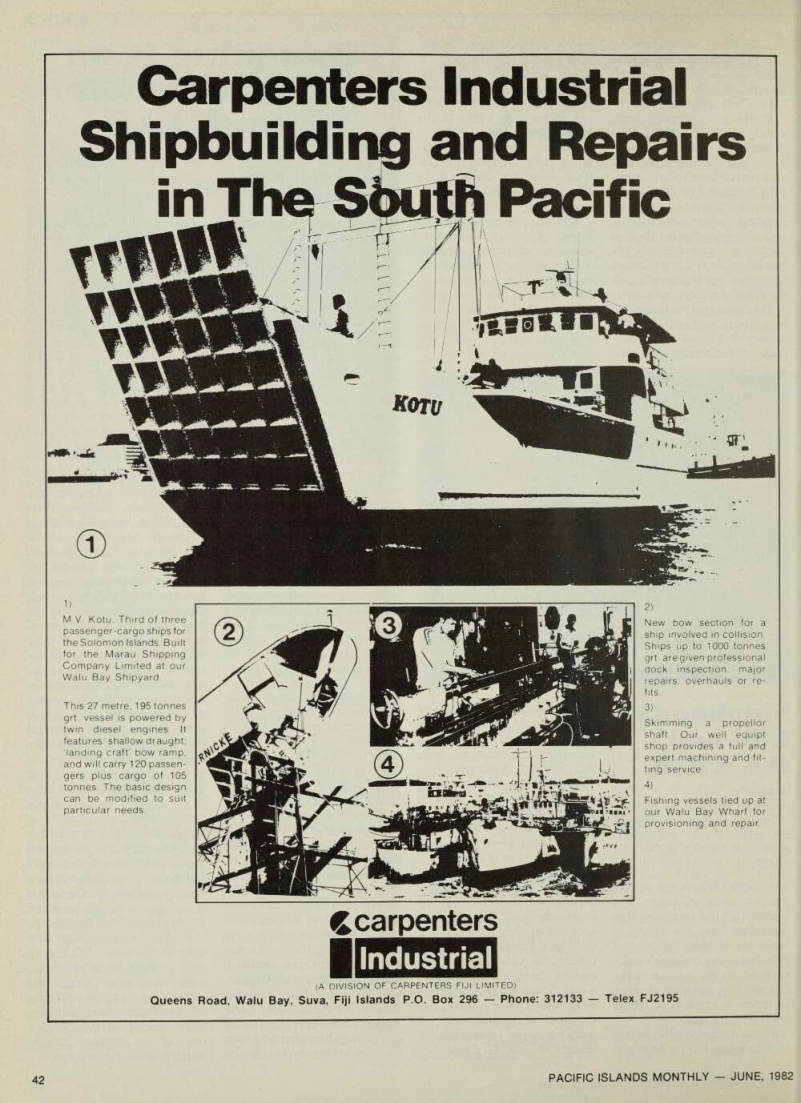
Fiji-based Carpenters Industrial has won a contract to build a $F3.5 million oil tank farm at Papeete on Tahiti for Mobil Australia and Total, the French firm. Carpenters Industrial, which competed against firms in four countries, will begin construction almost immediately. The tanks will be made at the works in Suva and shipped to Papeete for assembly. Said Mike Bowkett, a director of the company: ‘We wanted to prove that Fiji has an international engineering force to be reckoned with and this is our chance. It is our first major breakthrough. We will show that our engineering abilities and the skills of our tradesmen rank equal with the best anywhere.’
Fiji, South Korea Links
Fiji’s first Ambassador to the Republic of Korea. Jioji Kotabalavu, who was appointed ambassador to Japan last year, has presented his credentials to President Chun Doo Hwan in Seoul.
Mr Kotabalavu was formerly Permanent Secretary of Fiji Foreign Affairs.
PNG: AN EX-SOLDIER AIMS FOR THE TOP Brigadier-General Ted Diro, former commander of the Papua New Guinea Defence Force, has fixed his sights on becoming PNG’s next Prime Minister. In a interview with Stuart Inder published in the May 11 issue of the Australian weekly magazine The Bulletin, Diro said he had 43 candidates standing in the June election, of which 35 were what he called ‘hard core’. Diro, a Papuan, stresses that his group is not partisan Papuan, it is merely based on Papua, ‘as Somare is based on the north coast and Chan is based on the islands’. Inder comments: ‘What the members do have in common is that they are hand-picked, educated and with experience in business or administration. Ten of the hard core have university degrees. His candidates include three former departmental secretaries, a former Ambassador to Japan and a District Commissioner. They have agreed to abide by a code which stresses allegiance, ethics and honesty. They have to have sufficient financial standing to support the cost of their own election. Diro said: ‘We need decisions that are made impartially, objectively and are not biased towards personal interests. We want to keep the country free of corruption. We need people who can contribute intelligently towards debate and understand the issues.’ He is critical of the Chan government and the previous Somare one for what he terms their lack of cohesion and collective reponsibility. He says both men have had their opportunities and are not capable of resolving the country’s problems.
‘No Confidence’ Again In Vanutau7
A group of government members of the Vanuatu parliament is reported to be planning to move a motion of no-confidence in the Prime Minister, Father Walter Lini. A Radio Australia correspon dent who visited the Vanuatu capital recently, says members of the ruling Vanuaaku Party told him five of their colleagues had signed a notice of intention to move the motion. It was expected that the two other signatures required to get the motion introduced would be obtained. The correspondent was told by sources in the party that the move had the private support of several cabinet ministers. However, a senior member of the Opposition, Father Gerald Leymang, told the correspondent that he and eight other members of the Opposition wanted nothing to do with the move. The correspondent says that according to sources in the ruling Vanuaaku Party, there’s dissatisfaction with Father Lini’s decision to dismiss several senior expatriate civil servants without first consulting cabinet ministers affected. There was also said to be dissatisfaction over Father Lini’s alleged
failure to consult with the council of ministers about negotiations for a large loan from an American bank. An earlier move for a no confidence motion failed in March.
Fine For N-Protest Skipper
The anti-nuclear protest yacht, Pacfic Peacemaker, left Papeete on May 2. It was believed to be heading for Honolulu. Earlier, a French court in Papeete had imposed a nominal fine of CFP2O,OOO, or about SA2OO, on skipper Bill Ethell who had been charged with trespass in French Polynesia’s territorial waters.
Stirn’S New Caledonia Independence Call
Independence for New Caledonia is ‘the only way of avoiding a confrontation between Europeans and Melanesians a confrontation that would end in a bloodbath, and the departure of the Europeans’. In these terms Olivier Stirn, state secretary for France’s overseas departments and territories under President Giscard d’Estaing, has nailed his colours to the New Caledonian ‘independentist’ mast. Writing in the highly influential Paris weekly magazine L'Express Mr Stirn called for the various stages of the move to independence to be clearly defined ‘with a calendar containing guarantees of the rights of all communities in the territory, and involving them right from now in the building of their future small State’. He said: ‘The New Caledonian situation is a worrying one. Recent confrontations have not been limited to the exchange of hostile words. There have been deaths. The government should have heeded the warning. But it has chosen to preserve the status quo, with the application of a number of formal improvements. It has failed to seize the nettle of the one clear and viable solution... The indecisive policy of the government is to be condemned. It is a dangerous policy. It could lead, after a period of violence, to the precipitate and abject departure of the territory’s French-born population.’ Mr Stirn claimed he was making his criticisms ‘not from any desire to engage in partisan polemics, but out of concern for the preservation of civil peace and the image of France’.
‘Water Before Capitols’ In Micronesia
The United States Congress Committee on Interior and Insular Affairs has asked the Federal Government to spend more money on essential services like roads and water supplies in the Trust Territory of Micronesia and postpone the building of capitols for the governments of Belau, the Marshall Islands and the Federated States of Micronesia. The committee called attention to the 1983 budget which provided only SUS 7 800 000 for the capital improvements programme, compared with $8 544 000 in 1982 and $27 764 000 in 1981. The full amount was to be spent on building three capitols. The committee commented: ‘This is despite the fact that we saw hospitals with leaking roofs, muddy, water-filled roads, leaking water mains, sewage systems that weren’t connected to anything and generators that didn’t work, among other things. While the US Government did make a commitment to the Micronesian governments in 1975 to fund the building of their new capitols, and while we believe that this commitment must be honoured, we do not think it should be at the top of the list of priority items that need to be completed at this time. Roads, water and power, and other basic kinds of infrastructure are sorely needed before the capitols are built. Until these areas have their infrastructures in place, there can be no economic development.’ The committee also pointed out that the
‘Quiet Revolution’ In Tonga
The Tongan Government’s Ministry of Works plans to provide 2000 low-cost houses over the next two years at its new industrial complex in Nukualofa. The houses, each of 34.5 square metres, will have two rooms and will cost $T2200 each plus S6OO for transport and supervision costs. Twenty-five will be prefabricated weekly. Cost of the project is estimated at $4.5 million, much of which, the government hopes, will come from overseas aid.
Announcement of the building plan, and the first distribution of stockpiled emergency food supplies to people in the various post- Cyclone Isaac tent towns, were timed to coincide exactly with a peaceful, pre-arranged march to the Palace by 100 citizens, led by Catholic Bishop Patelisio Finau in full episcopal regalia, to present a 6500-signature petition directly to the King. In view of the popular groundswell of impatience and discontent in recent weeks, and the first-ever determination to bypass the normal hierarchical channels of communication with the monarch, the authorities were clearly concerned to nip any possible eruption of violence in the bud. In addition to timing its food distribution to keep the tent-people out of town, the government cancelled all defence forces and police leave over the weekend of April 3-4.
The Palace Guard was substantially increased and equipped with fixed bayonets: and numerous large beefy policemen were deployed along the march route and in the Palace grounds. As it turned out, the precautions were totally unnecessary. The 100-strong delegation strolled quietly to the palace. No banners, no chanting, no slogans. They filed through the indicated gate and seated themselves quietly in rows on the grass opposite the Palace verandah, sent in their petition and then waited, melting under a blazing sun for 40 minutes, until the King appeared on the verandah, accompanied by his brother the Prime Minister and his ‘talking chiefs’. A murmur of appreciation ran along the seated rows as the royal brothers seated themselves cross-legged on the verandah floor in a symbolic fakatonga gesture of goodwill and togetherness. Then a deep hush as their leader rose to address the King. The bishop said that it was in keeping with his duty to his God and his country that he give support to the people in a time of loss and suffering, and he respectfully begged His Majesty to pay heed to the petition and give what help he could to these his loyal subjects. In a 20-minute address (taped for re broadcasting to the nation) His Majesty thanked the people for coming to him, reminded them of the various positive actions taken by his government in the past week and agreed that efforts should be made to enable as many as possible to work overseas for a period so that they could remit funds to help in rebuilding their country. On refugee status, he said this was reserved for people displaced by war, and that cyclone victims could not expect to qualify. It was all over. The royal party rose and disappeared into the Palace. The people rose from the damp grass and filed quietly out past the fixed bayonets and impassive faced guards. In Tongan terms, the whole thing had been an epoch-making success. People felt that the run-up, signature gathering, period had had a positive effect on government action.
They were proud that they had overturned the traditional barrier between the monarch and his grassroots subjects, and been received with courtesy and kindness. They were impressed that they received support from a handful of influential commoners: Bishop Finau, the former President of the Free Wesleyan Church, Amanaki Havea, former MP Papiloa Foliaki, the former Crown Prosecutor, now in private practice, Laki Niu, and Professor Futa Helu of ‘Atenisi University. At the same time, they had noted, and will remember, all those who were not prepared to stand up and be counted the other church leaders, the town and district officers, and, above all, their elected parliamentary representa tives Penny Hodakinson in Nukualofa.
Fiji Chief Justice Upholds Custom
The courts must uphold the sanctity and moral force of customary ways which regulated the life of Fijian society, Chief Justice Sir Timoci Tuivaga, said formally. He made the comment when setting aside a lower court nine-months suspended gaol sentence and S6O fine imposed on each of five Matuku Island youths charged with assaulting another young man on Boxing Day. The court heard that on Boxing Day people from the neighbouring village of Raviravi came to Makadru Village to see some friends from Suva who had come for Christmas. A yaqona party was held which continued until the early hours of the morning. About 3 am, Tikoisuva from Raviravi was seen talking to Lati’s sister at a lonely spot some distance from the village. The five went to the spot and assaulted Tikoisuva by punching and kicking him until he was unconscious. He was carried to the village and when he came to he was again assaulted but this was stopped by a villager who came to his aid. Tikoisuva was taken to Yaroi District Hospital where he was admitted and remained for two days. Meanwhile the Makadru people held a village meeting at which the five were reprimanded and each given three strokes of the cane as punishment by a village elder.
A tabua was also presented to the chief of Raviravi village on behalf of the Makadru people by way of making amends and effecting reconciliation. The tabua was accepted which signified the complete reconciliation of the two villages. But as the matter had already been reported to the police, a team of police investigators was sent from Suva and conducted their own investigation which resulted in the five villagers being arrested, charged and brought to Suva. When passing sentence, the chief magistrate said the three strokes each that the five had received had saved them, from going to gaol. Justice Tuivaga said: The sentencing courjtolid not, with respect, give sufficient credit to the customary sanctions which from time immemorial have always been available within a village community for regularing the social behaviour and conduct of its people.’
Advertisements & other items, p. 5 (1 item)
5
ACIFIC ISLANDS MONTHLY JUNE, 1982
Polynesian
Letters
potshots
and reply
The letters published below from Francis Sanford, vice president of the government council of French Polynesia, and Marc Tevane, government council member responsible for ‘public health and population, quality of life, and cultural affairs’, were received by PIM under cover of the text of a resolution carried on March 24 by the government council.
The resolution, unanimously adopted, expressed the coun cil’s ‘shock and indignation’ at the Postmark Papeete’ article appearing in PlM’s March issue, fully endorsed the con tents of the letters of Messrs Sanford and Tevane, and, further, formally requested that they be published in PIM as well as in a number of French-language publications circulating in various parts of the Pacific.
PIM hereby accedes to the request of the government council of French Polynesia by
publishing the Wo letters re ferred to. We also publish a reply to the two letters from the authors of the article to which objection has been taken, Marie-Therese and Bengt Danielsson.
The documents sent to us from Papeete by the govern ment council of French Poly nesia are in French. As a courtesy to the council, and to Messrs Sanford and Tevane, PIM has translated them into English. • • • Notwithstanding years-long but peaceful battling by my friends and myself to win internal autonomy for Polynesia; nothwithstanding the experi ence of the past five years, during which we have suc ceeded in taking our local society along the path to greater independence, greater justice, and a greater and more equitably shared enjoyment of life; notwithstanding the care we have always exercised to ensure that this development takes place in conditions of calm and order; notwithstand ing the progress achieved in all spheres of activity notwith standing all this, your magazine still refuses to accept what seems to be obvious to everyone, in Polynesia and in the rest of the Pacific.
Through the pens of its corre spondents in Tahiti, it system atically, every month, de molishes, distorts, and decries.
In polemical and partisan style which too often strays far from realities it presents an image of our Polynesia which is as false as it is unfair.
The latest article in the March issue of your magazine is
yet another flagrant case of misplaced irony skilfully presented it is true which is not only calculated to outrage the individual who bears res ponsibility for Polynesia’s teritorial affairs, but is wound ing also for all Polynesians with a sense of pride in their history.
I have no wish to see PIM suddenly presenting the politi cal, social and economic scene in Polynesia in the opposite way to what it now does that is, in a flattering, obsequious vein. On the contrary, well-founded criti cisms have always seemed to me to be positive and necessary, especially as they concern a public man and the policies he is pursuing.
But they must be well founded, and should never take on the character of some kind of dubious exericise in destabilis ation, mixed in with a bitterness and rancour unworthy of the authors of these articles.
Francis Ariioehau
Sanford
In their article in the March issue of your magazine, Mr and Mrs Danielsson assert that Pro fessor Sinoto of the Bishop Museum has received no financial assistance from Poly nesia in undertaking his import ant archaeological diggings on the island of Huahine. I wish to make the following points: Professor Sinoto has received from Territorial funds, in the context of the Territory’s heri tage institution: in 1980, 513 650 FCP; in 1981, 1 650 190, and 1 723 350; in 1982 1 564 136, and 621 010.
From the National Associ ation for Archaeological Dig gings: in 1979, 424 915; in 1980,312 600; in 1981 545 000.
From the Archaeology De partment (from its own budget): in 1979 250 000; in 1980 84 000.
So the total of funds received by Professor Sinoto since 1979 is FCP7 688 841, or about
Sa7S 000.
As the descendant of 50-odd generations of Polynesians, and as the person responsible for culture over the past five years, you will readily understand how hurt I have been by the false statements regularly emanating from your Tahiti correspon dents.
But as a human being, I
cannot but feel a certain disdain for people who, guests at our Polynesian table for 25 years now, and often joining us in our communal feasts, are forever complaining about the food, criticising the table-setting, and denigrating the service that is offered to them.
Marc Tevane
Marie-Therese and Bengt Danielsson reply: It is sad indeed to see that our old friend Francis Sanford is still clinging to a dangerous illusion, and that, as a result, he will soon be pushed off the pedestal on which a grateful Polynesian people have put him.
His illusion is his firm belief that the new constitution con ferred or rather imposed by the government of Giscard d’Estaing in 1977 endowed the territory with the Cook Islands type of internal self-government for which he and the other Autonomist leaders had been fighting so long and so courageously.
In our capacity as political journalists, we have from the beginning criticised this suppos edly new constitution as perpetuating and strengthen ing, in slightly different forms and terms, the century-old French colonial regime. Thus, the French Government, through its High Commiss ioner, to this day retains full control over defence (including nuclear testing), foreign affairs, police, courts, immigration, the monetary system, overseas trade, air traffic, fishing rights, ocean wealth, scientific re search, cultural affairs, higher education, broadcasting and TV, and the entire civil service, run by more than 1000 expatri ate Frenchmen.
The main thing this leaves in the hands of the elected rep resentatives of the Polynesian people is the troublesome task of balancing the budget with the help of customs revenues, which hit hardest at people in low income categories, i.e., the Polynesians.
One after another, all local political leaders have rejected this neo-colonial constitution and in no uncertain terms. They have all come out in favour either of full and genuine internal self-government, or
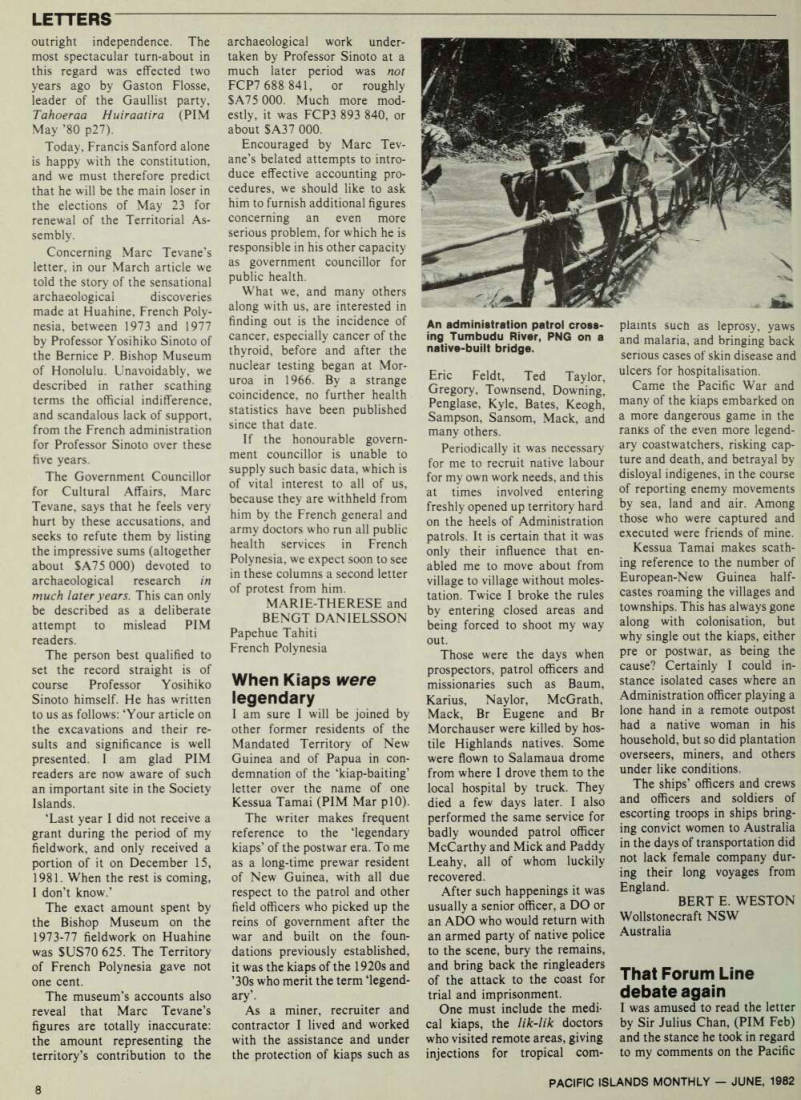
Dr Yosihiko Sinoto (right) examines a 1000 year old adze discovered intact on Huahine Island. With him is Dr Douglas Yen. To what extent did he receive financial assistance from the Territory of French Polynesia for his excavations?
outright independence. The most spectacular turn-about in this regard was effected two years ago by Gaston Flosse, leader of the Gaullist party, Tahoeraa Huiraatira (PIM May ’BO p 27).
Today, Francis Sanford alone is happy with the constitution, and we must therefore predict that he will be the main loser in the elections of May 23 for renewal of the Territorial As sembly.
Concerning Marc Tevane’s letter, in our March article we told the story of the sensational archaeological discoveries made at Huahine, French Poly nesia, between 1973 and 1977 by Professor Yosihiko Sinoto of the Bernice P. Bishop Museum of Honolulu. Unavoidably, we described in rather scathing terms the official indifference, and scandalous lack of support, from the French administration for Professor Sinoto over these five years.
The Government Councillor for Cultural Affairs, Marc Tevane, says that he feels very hurt by these accusations, and seeks to refute them by listing the impressive sums (altogether about SA7S 000) devoted to archaeological research in much later years. This can only be described as a deliberate attempt to mislead PIM readers.
The person best qualified to set the record straight is of course Professor Yosihiko Sinoto himself. He has written to us as follows: ‘Your article on the excavations and their re sults and significance is well presented. I am glad PIM readers are now aware of such an important site in the Society Islands. ‘Last year I did not receive a grant during the period of my fieldwork, and only received a portion of it on December 15, 1981. When the rest is coming, I don’t know.’
The exact amount spent by the Bishop Museum on the 1973-77 fieldwork on Huahine was SUS7O 625. The Territory of French Polynesia gave not one cent.
The museum’s accounts also reveal that Marc Tevane’s figures are totally inaccurate: the amount representing the territory’s contribution to the
archaeological work under taken by Professor Sinoto at a much later period was not FCP7 688 841, or roughly SA7S 000. Much more mod estly, it was FCP3 893 840, or about SA37 000.
Encouraged by Marc Tev ane’s belated attempts to intro duce effective accounting pro cedures, we should like to ask him to furnish additional figures concerning an even more serious problem, for which he is responsible in his other capacity as government councillor for public health.
What we, and many others along with us, are interested in finding out is the incidence of cancer, especially cancer of the thyroid, before and after the nuclear testing began at Mor uroa in 1966. By a strange coincidence, no further health statistics have been published since that date.
If the honourable govern ment councillor is unable to supply such basic data, which is of vital interest to all of us, because they are withheld from him by the French general and army doctors who run all public health services in French Polynesia, we expect soon to see in these columns a second letter of protest from him.
Marie-Therese And
Bengt Danielsson
Papehue Tahiti French Polynesia
When Kiaps
legendary
I am sure I will be joined by other former residents of the Mandated Territory of New Guinea and of Papua in con demnation of the ‘kiap-baiting’ letter over the name of one Kessua Tamai (PIM Mar plO).
The writer makes frequent reference to the ‘legendary kiaps’ of the postwar era. To me as a long-time prewar resident of New Guinea, with all due respect to the patrol and other field officers who picked up the reins of government after the war and built on the foun dations previously established, it was the kiaps of the 1920 s and ’3os who merit the term ‘legend ary’.
As a miner, recruiter and contractor I lived and worked with the assistance and under the protection of kiaps such as
Eric Feldt, Ted Taylor, Gregory, Townsend, Downing, Penglase, Kyle, Bates, Keogh, Sampson, Sansom, Mack, and many others.
Periodically it was necessary for me to recruit native labour for my own work needs, and this at times involved entering freshly opened up territory hard on the heels of Administration patrols. It is certain that it was only their influence that en abled me to move about from village to village without moles tation. Twice I broke the rules by entering closed areas and being forced to shoot my way out.
Those were the days when prospectors, patrol officers and missionaries such as Baum, Karius, Naylor, McGrath, Mack, Br Eugene and Br Morchauser were killed by hos tile Highlands natives. Some were flown to Salamaua drome from where I drove them to the local hospital by truck. They died a few days later. I also performed the same service for badly wounded patrol officer McCarthy and Mick and Paddy Leahy, all of whom luckily recovered.
After such happenings it was usually a senior officer, a DO or an ADO who would return with an armed party of native police to the scene, bury the remains, and bring back the ringleaders of the attack to the coast for trial and imprisonment.
One must include the medi cal kiaps, the lik-lik doctors who visited remote areas, giving injections for tropical com
plaints such as leprosy, yaws and malaria, and bringing back serious cases of skin disease and ulcers for hospitalisation.
Came the Pacific War and many of the kiaps embarked on a more dangerous game in the ranks of the even more legend ary coastwatchers, risking cap ture and death, and betrayal by disloyal indigenes, in the course of reporting enemy movements by sea, land and air. Among those who were captured and executed were friends of mine.
Kessua Tamai makes scath ing reference to the number of European-New Guinea half castes roaming the villages and townships. This has always gone along with colonisation, but why single out the kiaps, either pre or postwar, as being the cause? Certainly I could in stance isolated cases where an Administration officer playing a lone hand in a remote outpost had a native woman in his household, but so did plantation overseers, miners, and others under like conditions.
The ships’ officers and crews and officers and soldiers of escorting troops in ships bring ing convict women to Australia in the days of transportation did not lack female company dur ing their long voyages from England.
Bert E. Weston
Wollstonecraft NSW Australia That Forum Line
debate again
I was amused to read the letter by Sir Julius Chan, (PIM Feb) and the stance he took in regard to my comments on the Pacific
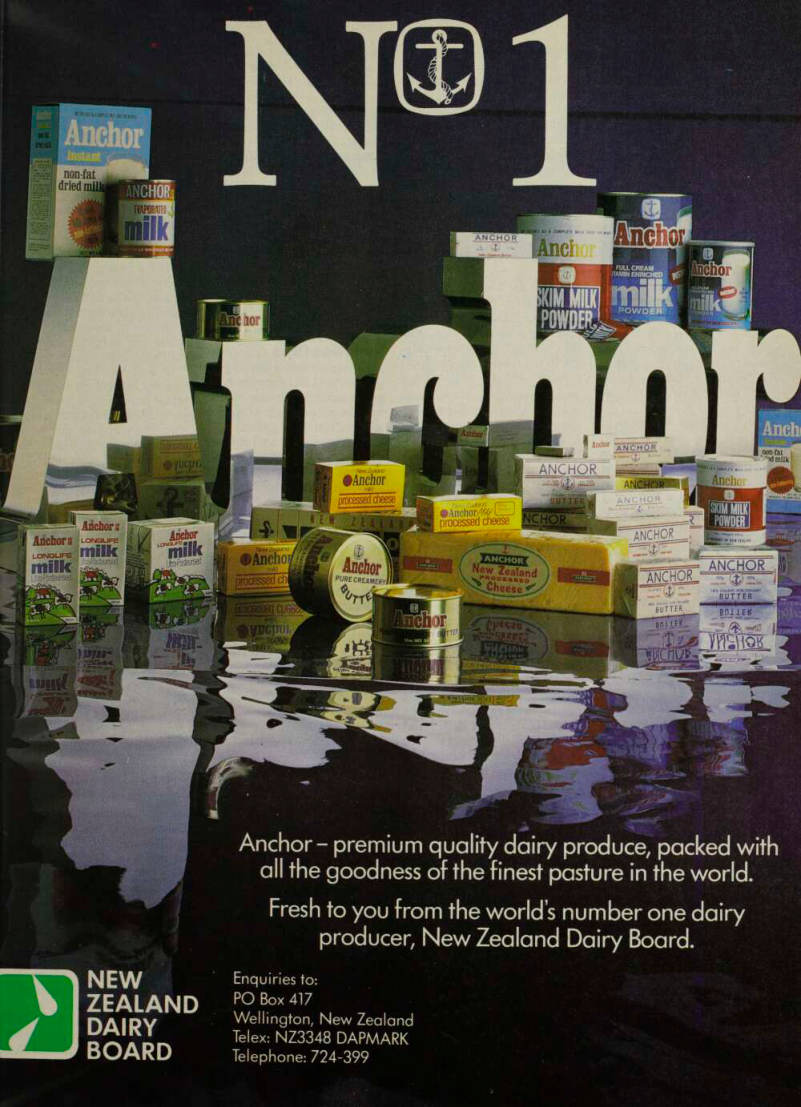
An administration patrol cross ing Tumbudu River, PNG on a native-built bridge.
Forum Line. (PIM Dec ’Bl p 9).
If some of my remarks were red herrings, then his must have been bluefin tunas.
He questions my competence to speak with authority about the state of the shipping indus try, and especially the PFL.
Without going into detail, I worked on the Marama while she was engaged on the Island run, and have subsequently observed the Forum Line vessels operating in most of the ports they service. I therefore feel that my assertions have a very sound base.
The fact that the Forum Line vessels are of the wrong type to service the Islands efficiently is borne out by comments from stevedores and shipping agents, and I therefore stand by every thing I stated in your December issue.
I did not need Sir Julius to point out the essence of his September statements. It is very clear to me that he is trying to please everybody at once.
One only needs to look in the Shipping Services pages of PIM to see that the South Pacific is more than adequately serviced without the Forum Line. If the Forum Line is a visible sign of the achievements of together ness (as stated), then I shudder to think of Sir Julius’s ideas on disarray and white elephants.
Kevin Judkins
Sydney NSW Australia Tourism in the
Isle of Pines
Having recently returned from a most enjoyable visit to New Caledonia’s Isle of Pies, I was most interested to read Malcolm Salmon’s article (PIM Dec ’Bl p5l).
I have the highest regard for Mr Salmon’s journalistic ability. However I feel that his resume of the magic island is incomplete. And lest I be ac cused of criticism, let me add that I appreciate how difficult it must be to gather material whilst on a one-day visit in the company of Club Med clients.
Mr Salmon’s brief from the New Caledonian tourist authority was, I am sure, to discuss tourism and potential tourism to the islands. The Isle of Pines has suffered dra
matically since the closure of the Relais de Knumera (hotel) in 1979 for whatever reasons.
Land, legal and financial prob lems appear such that the buildings will never be used again, even if UTH has the desire. A great pity, for the Isle of Pines is one of the few remaining paradises in our shrinking world.
What Mr Salmon failed to point out is the efforts currently being made to attract at least some tourism back to the island.
As Mr Salmon experienced, day trips are a regular feature, with clients of Noumea’s hotels taking the flight down south for a bus trip around the island and then back again. Hardly satisfy ing to the tourist, nor the local economy. What is required is a concerted effort to attract tour ists comensurate with the facili ties available. Accommodation is required if tourists are to stay for a week or two, and as much as they may have wished to stay there has been little or no choice since the Relais de Kanumera closed its doors.
Now at least there is accom modation, due to the enterprise of a local islander. Mine Host Guillaume has constructed four very comfortablle bures, a res taurant and bar, and amenities block within a few seconds of magnificent Kanumera Bay.
His accommodation, known as Nataiwatch, provides for small groups, and, as bookings have indicated, most are scuba divers wishing to take advantage of the unspoiled reefs and clear warm water. Guillaume has received asistance and encouragement from the local water-sports group Nauticlub, survivors of the closure of the Relais de Kanumera. Albert Thoma, Hilary Roots and Tony Klotz have been on the island for over 10 years. They are determined that their share of paradise is distributed to visiting divers, and they have co-operated very closely with local people such as Guillaume to ensure that the Isle of Pines at least stays on the tourist map.
Since the closure of the hotel, Nauticlub have survived on day groups, using their 10-metre boat for trips to nearby beaches, with the customary picnic barbecue of fresh fish and crust aceans. This is clearly insuffic
ient and the co-operation be tween Nauticlub the Euro pean and the Nataiwatch the Kunie is to be com mended.
May their paradise be never ending, and may Malcolm Salmon return with his family for a longer visit.
Peter Stone
Aquarius/Dive Travel Australia, Upper Ferntree Gully VIC, Australia.
To your last paragraph, Malcolm Salmon says ‘Hear, hear!’ Editor.
Thumbs up on
yachties (5)
As a regular subscriber to your periodical, I have always been interested in the section report ing the movements of yachts and craft in the Pacific.
There are amateur radio op erators’ ‘nets’ which voluntarily maintain daily contact with cruising vessels the owners of which report their respective positions, weather conditions, and other details of concern to fellow yachtsmen.
The purpose of this letter is to inquire whether you would ask your correspondents who report the arrival of the various craft, whether at Keri Keri, Raro tonga, Pago Pago or elsewhere, to include the call-sign of those craft whose owners are licensed amateur operators this has been done in a few instances and such information has been most useful.
As a licensed amateur oper ator I have contacted yachts from time to time and in a number of instances have main tained regular ‘schedules’ with the owners and have followed their progress from one port to another.
The amateurs in USA, Canada, Australia, New Zea land and other locations who conduct the ‘nets’ are primarily concerned with the respective call-signs, and do not refer to the craft by their names so that it is impossible in many cases to identify the yacht.
G.W. Mitchell
Raumati Beach New Zealand We will certainly put this proposal to our correspondents.
Editor.
Thumbs upon
yachties (6)
I would truly like to have the pleasure of ‘cracking the whip’ over Frank Lewis (PIM Jan p 8) with his griping about yachties.
I should also like to provide him with a lump of wood and wish him ‘Bon voyage’ as he sets out across the Pacific on it.
Your ‘Yachts’ column has been a feature of your magazine for many, many years.
Yachties being a close group of sailing people, caring for the safety of one another, we look forward to this feature as it is a means of knowing if someone is in trouble or needs help or, again, has made it safely to their next destination.
In Port-Vila last October I received word of my daughter’s brutal murder by a purse mug ger in the States. Yachties took care of everything for me arrangements, storage, boat, etc. I arrived back in Port-Vila in February and within three days received cabled infor mation of the death of my son.
If it had not been for all the yachties at the Tradewinds Ma rina, Suva Carol Dunlop {Black Magic), Glen and Veronika ( Piccolino ), Julia Brooke White ( Quin Qurine ), and all the others in the States who wired and kept in constant contact with me, making long distance calls sometimes three times a week, writing letters and doing so many things to help, I don’t know how I would have come through the ordeal.
Peggy Larkin
Suva Fiji
Finding missing
friends via RIM?
I am sure there are many ‘Time Before’ types who would ap preciate learning of the present whereabouts of particular friends before they read their obituaries on the back page of
Pim.
Could a ‘Missing Friends’ facility be included in your invaluable publication even, in extremis, making a charge for the service?
John Davies
Christchurch New Zealand It seems a good idea, and we’re looking at the best way to
meet your request
Editor.
Advertisements & other items, p. 9 (1 item)
inmriL
% (U j
ANCHOR
FULL CREAM
lAMIN ENRICHED f
KIM
°OWOER
POWDEP,
: ■; * \ i c SIMMffl powpebl i
ANCHOR
ANCHOR
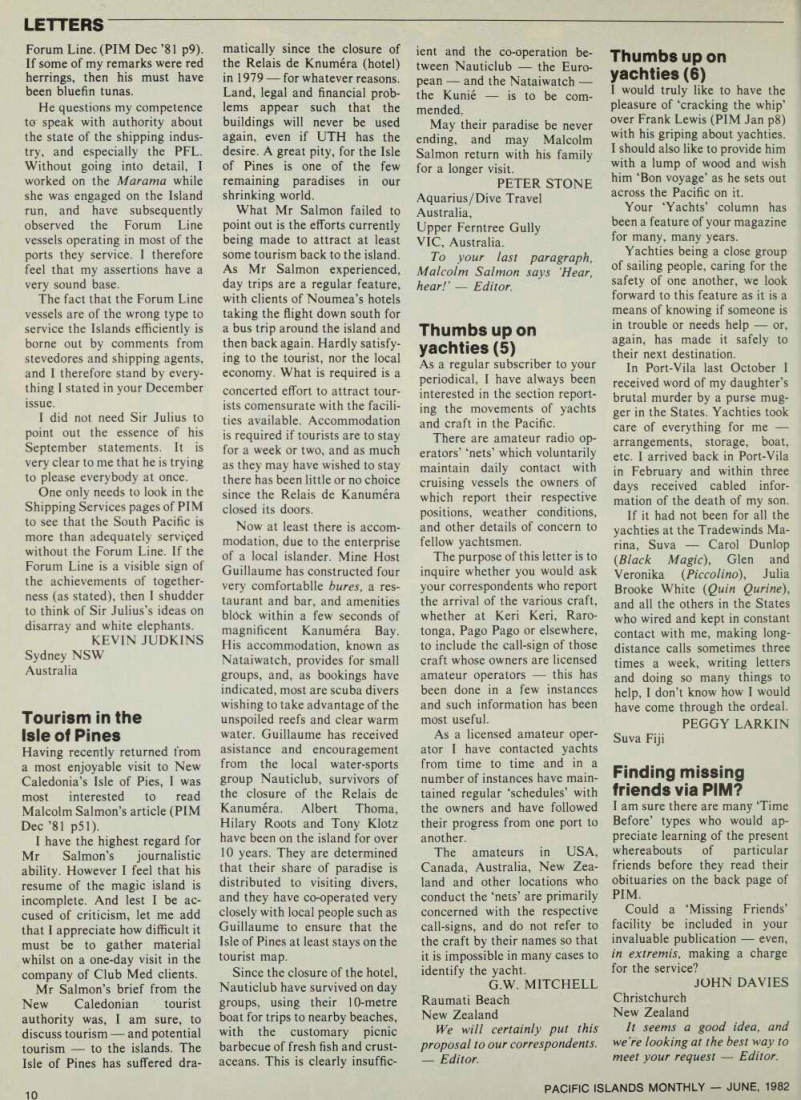
rW rnfla iir cal Anchor - premium quality dairy produce, packed with all the goodness of the finest pasture in the world.
Fresh to you from the world’s number one dairy
producer, New Zealand Dairy Board.
3 NEW
ZEALAND
DAIRY
BOARD
Enquiries to: PO Box 417 Wellington, New Zealand
Telex: NZ3348 DAPMARK
Telephone: 724-399
Balanced strength as parties
prepare for Fiji elections
Never more balanced, never more confusing. This was the situation in Fiji in May as the country prepared for its fourth general election since attaining independence in 1970. The election will be held in July, and the background is described here by ROBERT KEITH-REID writing from Suva.
Racial issues continue to be a major factor in the politics of Fiji as the country prepares for its July general election. Two well-established parties, two smaller ones and some hopeful independants provide the main force of the campaigning. In a country in which half the popu lation of 650 000 is of Indian extraction, 46 percent indigen ous Fijian and the remainder made up of small numbers of Europeans, Chinese, mixed race people and others, racial awareness is fundamental to politics. The possible develop ment of Indian dominance in Fiji politics is viewed with some alarm by the other communi ties. It hasn’t happened yet, but it nearly happened in April, 1977, and it could happen in July.
Until 1977 few Indians them selves realised the extent of the political potential which the Indian community held. Then in April of that year the Indian dominated National Federation Party (NFP) won the general election by collecting half of the 52 seats in the House of Rep resentatives. But with power in its grasp, the party faltered. Its leadership was split, its strength was sapped by factional fighting and it lost its nerve in the atmosphere of community up set which followed the election result.
The Governor-General, Ratu Sir George Cakobau, waited while the NFP leaders bickered and fought. Then he stepped in and used constitutional powers to reappoint the Alliance Party leader, Ratu Sir Kamisese Mara, as prime minister. Ironi cally he was partly influenced in his intervention by information which came secretly from NFP members who opposed the then leader of the NFP, Siddiq Koya.
Ratu Mara’s Alliance Party remained in power as a minority
government for six months, after which a new election gave the party a clear majority to govern. The new majority was 36 seats in the 52-seat house.
What caused the temporary eclipse of the Alliance Party in 1977, and could the coming election produce a parallel situ ation? The ingredient which most affected the 1977 result was the erosive influence of a minority third party, the Fijian Nationalist Party. The Nationalists campaigned on a blatantly racial platform of Fiji for the ethnic Fijians, and they split the voting pattern. They won only one seat for them selves but they created a situ ation which allowed the National Federation to win seats which would otherwise have gone to the Alliance Party.
The coming elections could well produce a similar vote-splitting situation, although this time there will be two minority parties to complicate the issue.
The Fijian Nationalist Party is one of the two minority groups, and it is campaigning strongly on ethnic grounds. It again calls for Fiji for the Fijians, it wants 46 of the 52 House of Assembly seats re served for ethnic Fijians and it
wants all Crown and freehold land to be in ethnic Fijian hands.
The new minority group is the Western United Front (WUF), another grouping of ethnic Fijians. It was formed in July last year, largely through the efforts of Ratu Osea Gavidi an appealing, talented and politically astute chief from Nadroga in southwest Viti Levu. He had a falling out with the Alliance Party in govern ment about how the big Fiji pine forest scheme should be developed. The pine forests for the scheme were planted on large tracts of land owned communally by Fijians who accepted Gavidi as their leader.
Gavidi has always had a strong following, and in the 1977 election he stood as an independant and won a seat from the Alliance. His more recent falling out with the Alliance over the pine scheme has led him into a deal with the National Federation with the avowed aim of toppling the Alliance from government.
Another member of parlia ment who became an early WUF supporter is Isikeli Nadalo, formerly a member of the National Federation. And in
March WUF received yet another supporter when the Tui Nadi, Ratu Napolioni Dawai, defected spectacularly from the Alliance. He is a wealthy independent-minded chief from the Nadi area of western Viti Levu, and earlier he had an nounced that he would not be seeking re-election because he intended to concentrate on his business interests. Then he unexpectedly swung his al legiance to WUF and now intends to stand for re-election with WUF backing.
Although WUF is essentially a Fijian party it does not follow the hard-line racial policy adopted by the Fijian National ist Party. It describes its out look as multi-racial and says it believes in co-existence and co operation between all communi ties in Fiji.
The coalition deal which has been negotiated between WUF and the National Federation will undoubtedly water down the all-Indian look of the Feder ation, and has been acclaimed by the Federation leader, Jai Ram Reddy, as the first truly multi-racial grouping capable of responding to the wishes of all communities. As part of the deal the Federation will
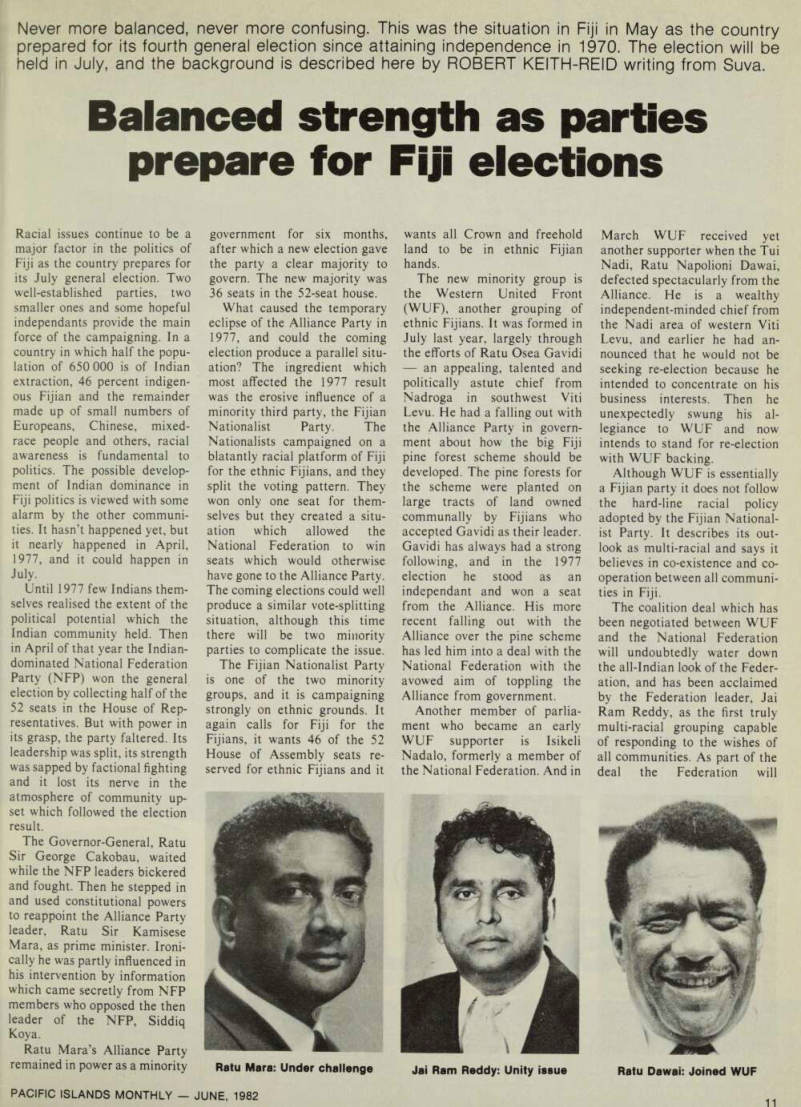
Ratu Mara: Under challenge
Jai Ram Reddy: Unity issue
Ratu Dawai: Joined WUF
ition of the Alliance. Quite literally the Alliance cannot r afford t 0 lose one Fl J lan or General vote in the constitu ency of Suva National which elects two members. Alliance , . e D . u , leaders from Ratu Mara down have declared that the Alliance must win these two seats if it is to remain the ruling group. The obvious requirement is that the Alliance will need to increase the level of its Indian support, but '* s P ros P eets of bein 8 ab,e t 0 do this are not good. . tbat can b ® sald wltb certainty is that the electoral P°i ltlo , n 15 v °P en ' and the dlfficulties of forecasting where the strength will lie are made greater by internal troubles of various types which beset both the major parties. The troubles facing the Alliance stem from the construction of the party, a mixture of three groups. The groups are the Fijian Associ ation, the Indian Alliance and the General Electors Associ ation. There has already been acrimony between the party leader, Ratu Mara, and the Indian Alliance leader within the party, James Shankar Singh. Singh, who appears to have been on bad terms with Mara for two years, withdrew
his application to be an endorsed Alliance candidate when it became apparent that the party would not give him a safe seat. It could well be that Mara’s attitude towards Singh has cost the party part of its already meagre Indian support.
The other major party, the National Federation, went through a leadership struggle in 1977. At the time this created intense factionalism which weakened the party. Speculation remains regarding the extent to which the rift has been healed. Jai Ram Reddy, the present leader, has frequently angrily denied reports that the rift still exists, but there is still one body of opinion which claims the trouble is smouldering and could flare up at the height of the elections, Mr Siddiq Koya, the man who lost the leadership in the 1977 shake-up, is wily and tough and has the reputation of being one of the most formidable politicians in Fiji. He has been uncharacteristically silent since his defeat at Mr Reddy’s hands, adding to speculation about the real state of affairs within the party. Officially the two men are reconciled. Privately many party insiders believe the ten-
sion still exists despite denials from Mr Reddy and silence from Mr Koya. , . T u he two ™J or P art ‘ es ha " e both emer f ed L scarred fr ° m tbe P ro “ as of choosing election = and,da * es ’ although there is no do “ b ‘ that the P ollt ‘ cal P t.al offering now is better than ever . e ore ' e atlona Fed ' eratlon « P a «'cular has con centrated on the endorsement . stead >' competent pro fess'°"al me " “ the ,. l so , rt of cand,dates who are likely to P rovlde f a more comfortable ‘ ma B e for r conservative and busmess factions across the F ° r the . A |lia "« Ratu Mara has also tried to find some new fac f' Particularly Indian °? es ’ and has met wlth a de B ree 0 success - Each side has been picking up defectors from the other, The Alliance has picked up in this way Senator Kuar Battan Singh, Suresh Chandra and Rajobhai Patel, all of them former stalwarts of the National Federation. The Al liance clearly hopes that the presence of such men as these in its lists could mean a win in one of two of the ten Indian commu nal seats in parliament. On the
effectively hand six national Fijian seats to WUF by not putting up opposing candidates in six electorates.
It is difficult to gauge the full extent of Fijian support for WUF. The party’s power ap pears to be only in western Viti Levu, but because of the cir cumstances the party provides a threat to the Alliance.
The Fiji Nationalists are go ing into the election under the leadership of Sakiasi Butadroka, a former Alliance supporter. Butadroka has an nounced that his party will endorst 30 candidates, but the indications are that the party is only a shadow of its 1977 self and that its influence is very much ocnfined to the Suva area in southwest Viti Levu. How ever, because of the nature of the electoral balance the Nationalists will have the po tential to undermine the pos
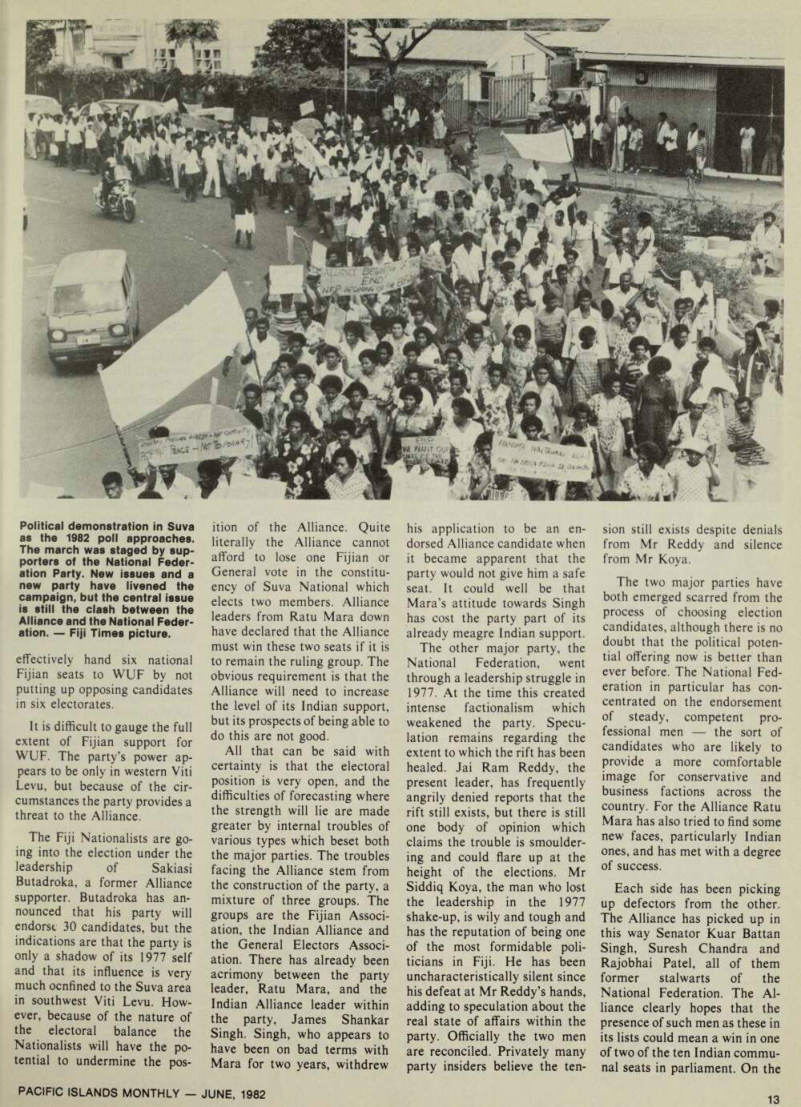
Political demonstration in Suva as the 1982 poll approaches.
The march was staged by sup porters of the National Feder ation Party. New issues and a new party have livened the campaign, but the central issue is still the clash between the Alliance and the National Feder ation. Fiji Times picture.
other hand, the National Feder ation is endorsing the widely known Sir Vijay Singh who was one of the founding members of the Alliance and was Attorney- General until 1978. He lost his portfolio because of his associ ation with an alleged flour milling fraud, and he left the Alliance as a result.
The pre-election campaign has been marked by intense and lengthy preparation perhaps much greater than for any previous Fiji election. The selec tion of endorsed candidates has been a particularly involved and sometimes painful pro cess, and has included many hours of meeting in secret.
In angling for the sympathies of nearly 293 000 registered voters, the politicians of Fiji are dealing with an electorate which is slightly more open minded than it was in the 19705.
The total numbers of sectional voters are Fijians 141 688, Indians 142 771, Generals 8254. Race remains the key to what will happen inside the polling stations, but perhaps the importance of race will be fractionally smaller than in previous polls. Certainly today’s younger Indians are much less inclined than they would have been at earlier elections to blindly follow the lead of their fathers by voting for the tree symbol of the National Feder ation.
The point is, too, that much Indian business has prospered under the government of Ratu Mara’s Alliance, but the National Federation remains an untried force in power. Balanc ing this to some extent is the attitude of some young Fijians who feel disenchanted with the Ratu Mara Alliance govern ment. They wonder whether government by National Feder ation would necessarily be the calamity claimed by the Al liance. Their disenchantment is not based so much on Alliance policies as on what they see as entrenched leadership. ‘Keep Fiji in Good Hands’ is the slogan the Alliance con tinues to circulate. But ‘lt’s Time for a Change’ is the countering slogan from the National Federation, and no matter which of the two parties occupies the government benches, the election is sure to bring a wide measure of change.
PNG: Sorting out the provincial sales tax tangle
Sales tax has developed into the hottest financial issue in Papua New Guinea since indepen dence.
Suddenly, the provinces have discovered it as the ‘cure’ to all their budgetary ills and you can now be taxed on just about everything you eat, drink, read or use. And soon you may even be taxed for using the services of your doctor or dentist.
But the anomaly that is causing the liveliest debates is that how much you are taxed, or even whether you are taxed at all, depends on where you live.
Sales tax is a new torm of tax in independent PNG. The cen tral government has never im posed it.
It is one of the taxes reserved exclusively for the 19 provincial governments established since independence. The provinces have the right to tax entertain ment and land, and impose various licensing fees.
Since many provincial gov ernments are still gaining ex perience with their new admin istrations, most of them have been overwhelmingly depen dent on central government grants. They’ve found land taxes difficult to implement, and fund-raising from fees not very rewarding.
The tax on beer as much as four toea on a stubby in some provinces is a success be cause the breweries helpfully agreed to add it to their delivery charges, and send the provinces their cheques.
But in 1979 the Milne Bay Province pioneered a new ap proach to sales tax. It estab lished a uniform rate of two percent on sales of all goods and services in the province, and collected it mainly from whole salers and the main retailers, thus minimising administrative costs.
The ‘Milne Bay System’, as it has become known, created immediate, widespread interest.
Other provinces soon came up with innovations of their own.
As a result, sales tax has become a popular fund-raising
measure, and this year, for the first time, a number of prov inces plan to raise a significant portion of their revenue from selected taxes, or a general turnover tax. Morobe, for example, plans to raise K 4.5 million out of a total budget of Kll million. The Easter High lands plans to raise K 1.2 million out of a K 7 million budget, East Sepik K 1 million out of K 7 million.
The turnover tax in the Easter Highlands will be three percent, and some of them have still to set theirs.
Problems and anomalies are beginning to show up. Already there are challenges about the definition of ‘services’, and questions are being asked about taxation of raw materials, which could lead to double or triple taxation if the final prod uct is also liable to taxation.
And is it constitutionally fair to tax only wholesalers and ‘large established retailers’, and allow small traders and itinerant sellers through the net?
And what will be the political fall-out from the taxing in equality between provinces, with the provinces having smaller commercial centres be ing disadvantaged?
Morobe is having trouble with a 10 percent tax on tyres of every kind. It doesn’t appear to have been gazetted legally, but in any case local fleet owners say they’ll get their tyres from neighbouring provinces.
Predictions are being made about the development of wide spread ‘border-hopping’ be cause there is no uniformity between various systems.
National suppliers in Port Moresby say they will be faced with a confusing number of variations involving expensive paperwork and collection prob lems.
Port Moresby Chamber of Commerce president Bryan Roper says that much of the provincial enabling legislation is simply ‘not visible’ and the business community doesn’t know what it is required to do.
Mr Roper adds; ‘The inevi table costs of collection, the ease with which the unscrupu lous evade their responsiblities, and the difficulty of monitoring such a tax in PNG all combine to render it impracticable if not impossible. We will find out that we did the wrong thing, and the tax burden will con tinue to be borne by the urban population.’
But there is hope for the future. The Department of De centralisation became so worried about the tax situation that in March it called for a major conference of the prov inces in an effort to get some sort of agreement, especially on
uniformity.
Sixty officials turned up in Port Moresby, including officials from 18 of the 19 provinces. It was very success ful. There was a detailed look at what was happening, and it was agreed that the situation was getting out of hand.
The officials technical people and not politicians agreed to support a proposal by the National Collector of Taxes, J. Lohberger, that the provinces support introduction of a special unit in Port Moresby to collect provincial taxes at the wholesale level and turn them back to the prov inces. The national body, part of the national tax system, would train staff as collectors so that in time the collection could be done in the provinces.
It was also agreed that the provinces would set a uniform level of sales tax on all goods not merely selected goods of a maximum of four percent, and six to seven percent on selected luxury goods. Sales tax would not be levied on inputs to industrial development, thus doing away with double tax ation.
The next stage is for the details to be worked out, and these to be approved by the politicians by the provincial premiers at their regular annual conference in Arawa, North Solomons, in October. If they are agreed on, the new system will operate by 1984.
There’s a long way to go. But at least the provincial sales tax problem is on the way to being resolved, even if it does mean that sales taxes will spread right
throughout PNG.
Stuart
Inder.
Advertisements & other items, p. 12 (1 item)
iSS^is^fsass’^
SUZUKI ... ppnpQKMANCE
The name of PEBF omEn..
SUZUKI prePfd Each to boat and «sage. !S «4| \1
SUZUKI
• i |i
SUZUKI
SEIBOO
OR
SUZUKI *
SUZUKI MOTOR CO, LTD Hamamatsu, Japan SUZUKI GENER>
Technology For The Pacific
Dr ROBERT WADDELL* examines the problems of rural development in Pacific Island countries and why present government strategies designed to achieve it aren’t working as well as people might have expected. He argues that appropriate technologies for the region, to be effective, must be accompanied by development strategies of a new type.
Small is beautiful - but development

strategies must go to match
Practically every government and political party in the Pacific, and particularly those more recently released from colonial rule, has promised to promote rural development.
The rural areas are after all where most of the people live.
The promises are not being kept or at least not nearly as well as people might have expected.
The fact is that the means employed to promote economic development are not usually those which would result in widely spread decentralised growth, with benefits shared among the population at large.
In a forthcoming book, ex tracts from which were recently published in The Sydney Morn ing Herald, Richard Jackson, professor of geography at the University of Papua New Guinea, chronicles the history of the OK Tedi mining venture in the Star Mountain area of PNG. In his concluding chapter Jackson makes the point that undertakings of this kind, awe inspiring as they are in size, complexity and cost, have not brought great benefits either to the inhabitants in the vicinity of the mine or to the rural popu lation in general.
The theory, of course, is that the government will receive a generous revenue from royalties
and taxes which they can then use to generate development in needy and less privileged areas.
There are two main drawbacks to this theory: much of the money disappears in bureau cratic overheads before it ever reaches its target; and con tinued dependence on hand outs from a benevolent govern ment engenders loss of initiative and the spirit of self-reliance in the recipients. The paternalistic atmosphere which was a prod uct of colonial times is thus perpetuated.
In pre-colonial times the countries of the Pacific were self-reliant and self-governing and owed not a penny to the World Bank. This is far from being the case today after all these years of ‘development’.
Not that all progress has been bad there have been vast improvements in health and education, in sanitation and protection from natural disas ters. However the fact remains that progress towards a realis ation of PNG’s original Eight Aims, for example, will not be achieved by the methods presently being pursued.
A more satisfactory type of development requires two things: an alternative develop ment strategy and alternative technology. The fact that these two things must go together is often overlooked, even by the most famous advocate of ‘Small is Beautiful’ the late Dr E. F.
Schumacher himself. Any change to an alternative way of doing things, be it something as simple as replacing coffee bushes by vegetables, is bound to have a political dimension and as such certain to meet some resistance from the powers that be. This accounts for the general lack of official support which proponents of
alternative technology receive from their own governments and foreign aid donors.
The main arguments in favour of implementing alterna tive technologies in the Pacific are that it will enable people to be more autonomous, less de pendent on foreign materials and expertise, less dependent on central government largesse, and in general to enjoy a more widely spread decentralised type of development than is to be had as a result of the current strategy of promoting a small number of capital-intensive en clave projects run mostly by large foreign firms.
The technology must arise from and suit the need. People should not be forced to buy, for instance, flat plate solar collec tors if cheap and abundant hydro-electric power is avail able, or there is no particular need for domestic hot water which cannot be met by boiling a kettle. Likewise unless cook ing fuel is very short, there is no point in requiring people in remote villages to put their pigs in concrete-floored pens in order to produce methane gas when such a procedure will cause much unnecessary social dis ruption.
Much personal involvement in the promotion of research and development of alternative technology has convinced me that one should make haste slowly, test all new techniques in pilot projects in locations where initial failures will cause no harm, and above all avoid the temptation, so easily given into by two-year contract ex perts, to think that any new product or process, be it meth ane or alcohol fuel or compost ing, is going to bring economic salvation overnight. Many a worthwhile innovation has had its reputation undeservedly
ruined by over-hasty implemen tation.
Water: There is plenty of water in the region but not always of the right kind at the right time and in the right quantities. The World Health Organisation has frequently re marked that most of the Third World’s health problems would disappear if everyone had ac cess to clean water. Priority should be given to the design and construction, preferably from local materials, of water tanks for village use. Many of the ones which are currently available or installed are either too expensive for unsubsidised villagers to afford, or have been badly designed or inexpertly built and are now lying about cracked, useless and aban doned.
Pumps are also required for various uses such as irrigation and replenishing drinking-water tanks.
There is at present heightened interest in small hydro-electricity schemes, not of the multi-Megawatt Purari variety but the kind which could supply a few kilowatts for a village. Although various models suitable for the gener ation of electricity on a small scale are available ‘off the shelf, experience has shown that these are usually beyond the resources of the average village. APACE, the Australian appropriate technology organis ation, recently wrote to leading manufacturers asking for quo tations for the hardware for a small-scale scheme and the replies indicated that the cheapest commercial product was about 10 times more ex pensive than one designed and built by researchers in PNG and Australia in a joint effort by APACE and the Appropriate
* Dr Waddell is a senior lec turer in the Department of General Studies in the Univer sity of New South Wales, Sydney, Australia. He is also a former lecturer in political studies at the University of Papua New Guinea, and is chairman (and founder) of APACE and APACE Research Ltd, bodies concerned with the development of low-impact, environmentally acceptable, technology.
Technology Development Insti tute in Lae. There is room for much more work in this field.
Biomass: Since wood is one of the most important and least regarded fuels in the less indus trialised countries, priority should go to conserving and replenishing the supply of fuel wood. Action is now being taken somewhat belatedly, but much more should be done, not only in' the cause of fuel production but equally importantly to prevent soil erosion.
Most people are aware that there are thousands of biogas plants in operation in India and China and there was a time when the Pacific was gripped by a sort of methane fever. The enthusiasm has subsided some what but there is no need to abandon this technology altogether. Biogas systems seem to have failed in those areas where the people had no com pelling economic or social reasons to keep them going without constant external supervision; they have suc ceeded within institutional frameworks and in congested peri-urban areas or areas of dense population where every square metre has to be pro ductive and where conventional fuels are costly. Where circum stances permit there is a good use for the so-called ‘lntegrated Farming System’. The effluent from the digester is allowed to flow into a series of ponds where algae are grown and subsequently harvested for use as stock feed or humus. From the algal ponds the effluent can flow into fish ponds thus provid ing protein for human consump tion. The fluid can then be fed through plastic or bamboo pipes to the roots of plants in the vegetable gardens to bring them a continuous supply of basic nutrients.
Alcohol from starchy root crops such as cassava may be used as a petrol ‘extender’ in a petrol-alcohol mix or ‘straight’ in engines modified for that purpose. The mixture, often known as ‘gasohol’, is used widely in Brazil and parts of the USA. Vegetable oil derived from the Babassu Palm (Orbignia martinana) is being extensively trialled in Brazil as a substitute for distillate in diesel engines, and a similar scheme is under way in the Philippines.
APACE is currently involved in producing an emulsifier which will enable distillate to blend with, and thus be ‘ex tended’ by, alcohol. One of the main drawbacks to the use of ethanol, or fuel alcohol, is that its distillation requires a large input of energy. APACE hopes to have eliminated the need for this energy input by inventing a process which is a substitute for distillation. As far as alcohol or vegetable oil or any other agriculture-based fuel is con cerned no country, be it Austra lia or Fiji, should rush into large-scale production without counting the costs in terms of lost food production potential; it should above all look to the end use of the fuel and decide whether it is really necessary. It should ask whether people in the rural areas are being asked to grow cash crops instead of vegetables merely to fill the tanks of private cars in the cities.
Direct Solar Energy: There are many reasons why advances in solar technology have lagged so far behind those achieved in the technology of extracting and using non-renewable re sources but there is now no excuse for this state of affairs to be tolerated, especially in re lation to the so-called ‘develop ing’ countries. A glance at the map will show that most of the ‘Third World’ lies in the sunniest regions of the globe and are therefore excellently placed to make use of this inexhaustible source of energy.
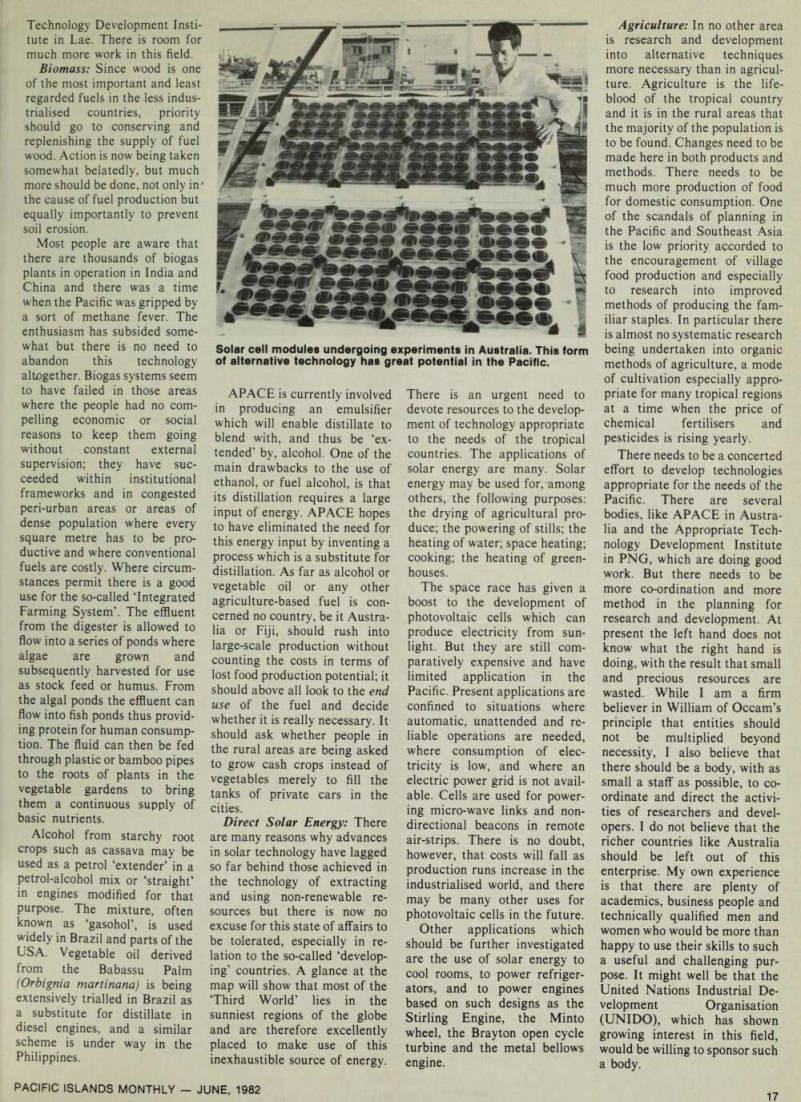
There is an urgent need to devote resources to the develop ment of technology appropriate to the needs of the tropical countries. The applications of solar energy are many. Solar energy may be used for, among others, the following purposes: the drying of agricultural pro duce; the powering of stills; the heating of water; space heating; cooking; the heating of green houses.
The space race has given a boost to the development of photovoltaic cells which can produce electricity from sun light. But they are still com paratively expensive and have limited application in the Pacific. Present applications are confined to situations where automatic, unattended and re liable operations are needed, where consumption of elec tricity is low, and where an electric power grid is not avail able. Cells are used for power ing micro-wave links and non directional beacons in remote air-strips. There is no doubt, however, that costs will fall as production runs increase in the industrialised world, and there may be many other uses for photovoltaic cells in the future.
Other applications which should be further investigated are the use of solar energy to cool rooms, to power refriger ators, and to power engines based on such designs as the Stirling Engine, the Minto wheel, the Brayton open cycle turbine and the metal bellows engine.
Agriculture: In no other area is research and development into alternative techniques more necessary than in agricul ture. Agriculture is the life blood of the tropical country and it is in the rural areas that the majority of the population is to be found. Changes need to be made here in both products and methods. There needs to be much more production of food for domestic consumption. One of the scandals of planning in the Pacific and Southeast Asia is the low priority accorded to the encouragement of village food production and especially to research into improved methods of producing the fam iliar staples. In particular there is almost no systematic research being undertaken into organic methods of agriculture, a mode of cultivation especially appro priate for many tropical regions at a time when the price of chemical fertilisers and pesticides is rising yearly.
There needs to be a concerted effort to develop technologies appropriate for the needs of the Pacific. There are several bodies, like APACE in Austra lia and the Appropriate Tech nology Development Institute in PNG, which are doing good work. But there needs to be more co-ordination and more method in the planning for research and development. At present the left hand does not know what the right hand is doing, with the result that small and precious resources are wasted. While I am a firm believer in William of Occam’s principle that entities should not be multiplied beyond necessity, I also believe that there should be a body, with as small a staff as possible, to co ordinate and direct the activi ties of researchers and devel opers. I do not believe that the richer countries like Australia should be left out of this enterprise. My own experience is that there are plenty of academics, business people and technically qualified men and women who would be more than happy to use their skills to such a useful and challenging pur pose. It might well be that the United Nations Industrial De velopment Organisation (UNIDO), which has shown growing interest in this field, would be willing to sponsor such a body.
Solar cell modules undergoing experiments in Australia. This form of alternative technology has great potential in the Pacific.
Advertisements & other items, p. 16 (1 item)
Come up to kool
The cool refreshing taste of menthol.
Vaai vs. Tupuola:
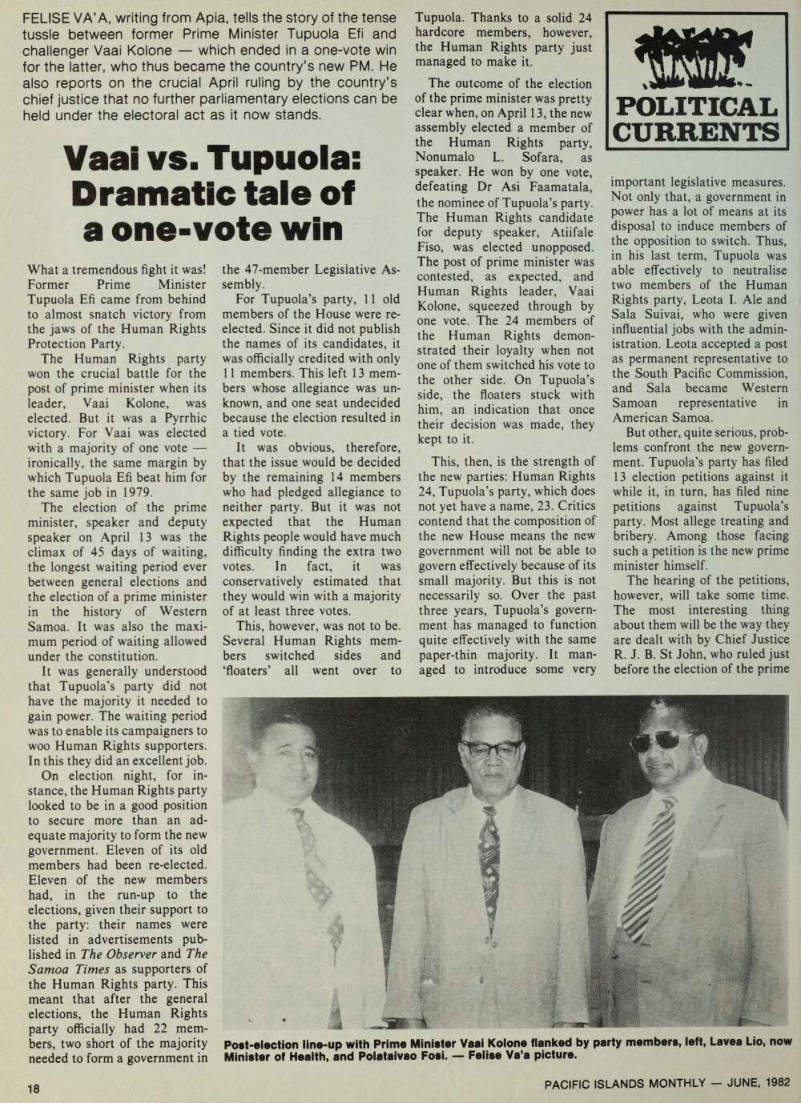
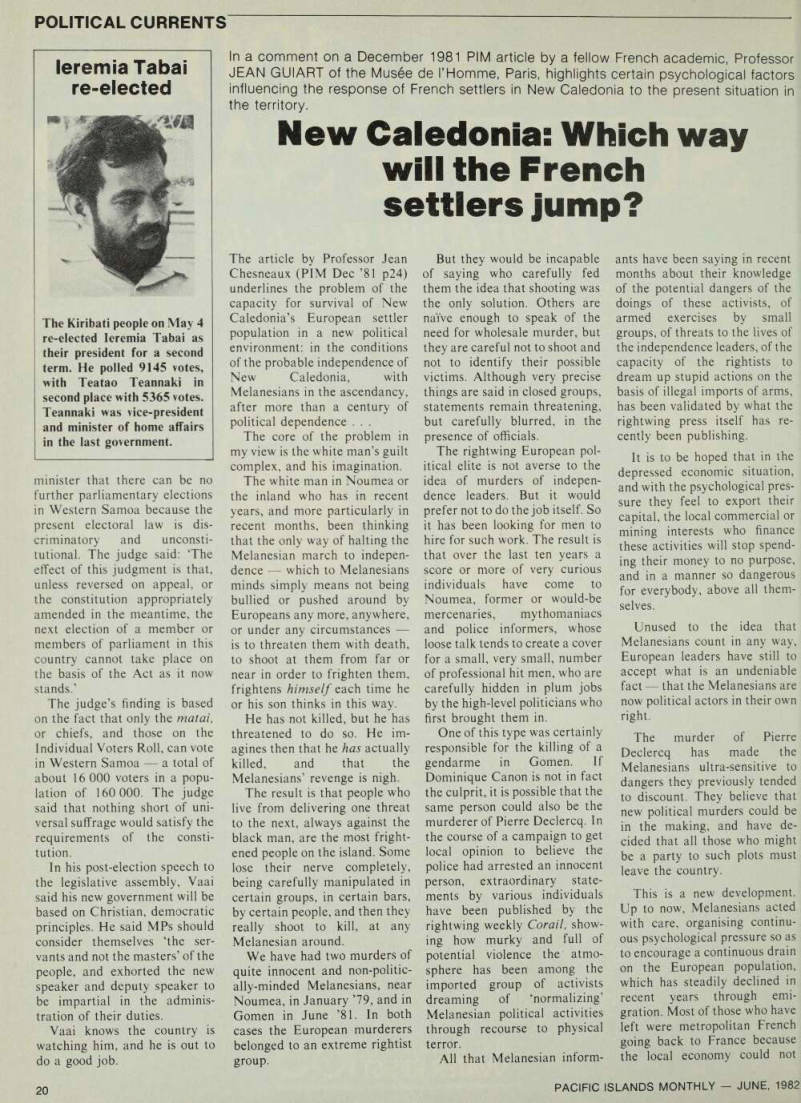
Political
Currents
Vaai vs. Tupuola: Dramatic tale of a one-vote win
FELISE VA’A, writing from Apia, tells the story of the tense tussle between former Prime Minister Tupuola Efi and challenger Vaai Kolone which ended in a one-vote win for the latter, who thus became the country’s new PM. He also reports on the crucial April ruling by the country’s chief justice that no further parliamentary elections can be held under the electoral act as it now stands.
What a tremendous fight it was!
Former Prime Minister Tupuola Efi came from behind to almost snatch victory from the jaws of the Human Rights Protection Party.
The Human Rights party won the crucial battle for the post of prime minister when its leader, Vaai Kolone, was elected. But it was a Pyrrhic victory. For Vaai was elected with a majority of one vote ironically, the same margin by which Tupuola Efi beat him for the same job in 1979.
The election of the prime minister, speaker and deputy speaker on April 13 was the climax of 45 days of waiting, the longest waiting period ever between general elections and the election of a prime minister in the history of Western Samoa. It was also the maxi mum period of waiting allowed under the constitution.
It was generally understood that Tupuola’s party did not have the majority it needed to gain power. The waiting period was to enable its campaigners to woo Human Rights supporters.
In this they did an excellent job.
On election night, for in stance, the Human Rights party looked to be in a good position to secure more than an ad equate majority to form the new government. Eleven of its old members had been re-elected.
Eleven of the new members had, in the run-up to the elections, given their support to the party: their names were listed in advertisements pub lished in The Observer and The Samoa Times as supporters of the Human Rights party. This meant that after the general elections, the Human Rights party officially had 22 mem bers, two short of the majority needed to form a government in
the 47-member Legislative As sembly.
For Tupuola’s party, 11 old members of the House were re elected. Since it did not publish the names of its candidates, it was officially credited with only 11 members. This left 13 mem bers whose allegiance was un known, and one seat undecided because the election resulted in a tied vote.
It was obvious, therefore, that the issue would be decided by the remaining 14 members who had pledged allegiance to neither party. But it was not expected that the Human Rights people would have much difficulty finding the extra two votes. In fact, it was conservatively estimated that they would win with a majority of at least three votes.
This, however, was not to be.
Several Human Rights mem bers switched sides and ‘floaters’ all went over to
Tupuola. Thanks to a solid 24 hardcore members, however, the Human Rights party just managed to make it.
The outcome of the election of the prime minister was pretty clear when, on April 13, the new assembly elected a member of the Human Rights party, Nonumalo L. Sofara, as speaker. He won by one vote, defeating Dr Asi Faamatala, the nominee of Tupuola’s party.
The Human Rights candidate for deputy speaker, Atiifale Fiso, was elected unopposed.
The post of prime minister was contested, as expected, and Human Rights leader, Vaai Kolone, squeezed through by one vote. The 24 members of the Human Rights demon strated their loyalty when not one of them switched his vote to the other side. On Tupuola’s side, the floaters stuck with him, an indication that once their decision was made, they kept to it.
This, then, is the strength of the new parties: Human Rights 24, Tupuola’s party, which does not yet have a name, 23. Critics contend that the composition of the new House means the new government will not be able to govern effectively because of its small majority. But this is not necessarily so. Over the past three years, Tupuola’s govern ment has managed to function quite effectively with the same paper-thin majority. It man aged to introduce some very
important legislative measures.
Not only that, a government in power has a lot of means at its disposal to induce members of the opposition to switch. Thus, in his last term, Tupuola was able effectively to neutralise two members of the Human Rights party, Leota I. Ale and Sala Suivai, who were given influential jobs with the admin istration. Leota accepted a post as permanent representative to the South Pacific Commission, and Sala became Western Samoan representative in American Samoa.
But other, quite serious, prob lems confront the new govern ment. Tupuola’s party has filed 13 election petitions against it while it, in turn, has filed nine petitions against Tupuola’s party. Most allege treating and bribery. Among those facing such a petition is the new prime minister himself.
The hearing of the petitions, however, will take some time.
The most interesting thing about them will be the way they are dealt with by Chief Justice R. J. B. St John, who ruled just before the election of the prime
Post-election line-up with Prime Minister Vaai Kolone flanked by party members, left, Lavea Lio, now Minister of Health, and Polataivao Fosi. Felise Va’a picture.
minister that there can be no further parliamentary elections in Western Samoa because the present electoral law is dis criminatory and unconsti tutional. The judge said: ‘The effect of this judgment is that, unless reversed on appeal, or the constitution appropriately amended in the meantime, the next election of a member or members of parliament in this country cannot take place on the basis of the Act as it now stands.’
The judge’s finding is based on the fact that only the matai, or chiefs, and those on the Individual Voters Roll, can vote in Western Samoa a total of about 16 000 voters in a popu lation of 160 000. The judge said that nothing short of uni versal suffrage would satisfy the requirements of the consti tution.
In his post-election speech to the legislative assembly, Vaai said his new government will be based on Christian, democratic principles. He said MPs should consider themselves ‘the ser vants and not the masters’ of the people, and exhorted the new speaker and deputy speaker to be impartial in the adminis tration of their duties.
Vaai knows the country is watching him, and he is out to do a good job.
Advertisements & other items, p. 19 (1 item)
Citize
SUR
Om •h.
Deep down accuracy
* 9 m A \ m m : rr. y r f»0 * tl'tr n Vf f tiff.fas r.m c i i •• mi b r.*~- 1* y
iimp
i i » '// I -i , MB i 7 A I* -V Sgs&x- -r-**-
Water-resistant quartz watches from Citizen.
Under a clear blue sky or„tke deep blue sea, these slim quartz watches from Citizen are alwiysat home. Accurate to within seconds a month, the Water Resist 100 series keeps time"at 100 metres below the, surface as well as it does on dry land. All models, analog and digital, feature day and all are made to Citizen’s high standards qf riiggedness andj>recisiqn.
X
%aiIZEN QUARTZ
WATER RESIST KJU
Ieremia Tabai
re-elected
The Kiribati people on May 4 re-elected leremia Tabai as their president for a second term. He polled 9145 votes, with Teatao Teannaki in second place with 5365 votes.
Teannaki was vice-president and minister of home affairs in the last government.
settlers Jump?
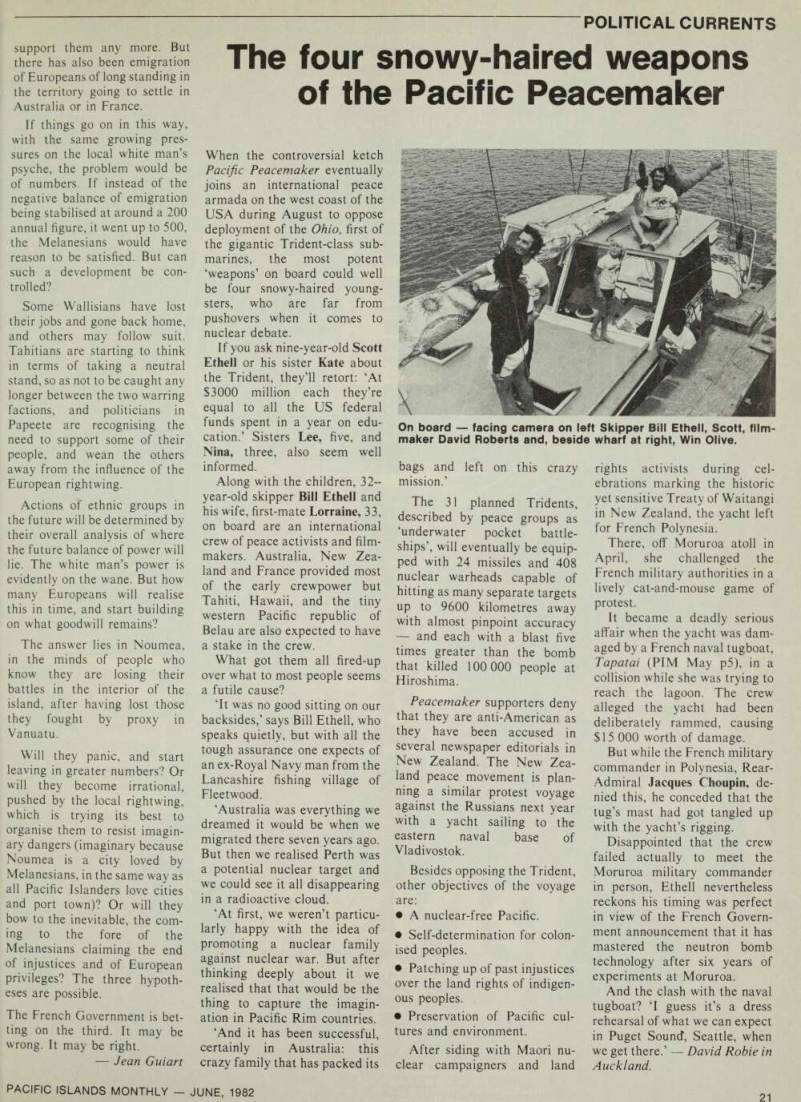
New Caledonia: Which way will the French settlers Jump?
In a comment on a December 1981 PIM article by a fellow French academic, Professor JEAN GUI ART of the Musee de I’Homme, Paris, highlights certain psychological factors influencing the response of French settlers in New Caledonia to the present situation in the territory.
The article by Professor Jean Chesneaux (PIM Dec ’Bl p 24) underlines the problem of the capacity for survival of New Caledonia’s European settler population in a new political environment; in the conditions of the probable independence of New Caledonia, with Melanesians in the ascendancy, after more than a century of political dependence . . .
The core of the problem in my view is the white man’s guilt complex, and his imagination.
The white man in Noumea or the inland who has in recent years, and more particularly in recent months, been thinking that the only way of halting the Melanesian march to indepen dence which to Melanesians minds simply means not being bullied or pushed around by Europeans any more, anywhere, or under any circumstances is to threaten them with death, to shoot at them from far or near in order to frighten them, frightens himself each time he or his son thinks in this way.
He has not killed, but he has threatened to do so. He im agines then that he has actually killed, and that the Melanesians’ revenge is nigh.
The result is that people who live from delivering one threat to the next, always against the black man, are the most fright ened people on the island. Some lose their nerve completely, being carefully manipulated in certain groups, in certain bars, by certain people, and then they really shoot to kill, at any Melanesian around.
We have had two murders of quite innocent and non-politic ally-minded Melanesians, near Noumea, in January ’79, and in Gomen in June ’Bl. In both cases the European murderers belonged to an extreme rightist group.
But they would be incapable of saying who carefully fed them the idea that shooting was the only solution. Others are naive enough to speak of the need for wholesale murder, but they are careful not to shoot and not to identify their possible victims. Although very precise things are said in closed groups, statements remain threatening, but carefully blurred, in the presence of officials.
The rightwing European pol itical elite is not averse to the idea of murders of indepen dence leaders. But it would prefer not to do the job itself. So it has been looking for men to hire for such work. The result is that over the last ten years a score or more of very curious individuals have come to Noumea, former or would-be mercenaries, mythomaniacs and police informers, whose loose talk tends to create a cover for a small, very small, number of professional hit men, who are carefully hidden in plum jobs by the high-level politicians who first brought them in.
One of this type was certainly responsible for the killing of a gendarme in Gomen. If Dominique Canon is not in fact the culprit, it is possible that the same person could also be the murderer of Pierre Declercq. In the course of a campaign to get local opinion to believe the police had arrested an innocent person, extraordinary state ments by various individuals have been published by the rightwing weekly Corail, show ing how murky and full of potential violence the atmo sphere has been among the imported group of activists dreaming of ‘normalizing’
Melanesian political activities through recourse to physical terror.
All that Melanesian inform
ants have been saying in recent months about their knowledge of the potential dangers of the doings of these activists, of armed exercises by small groups, of threats to the lives of the independence leaders, of the capacity of the rightists to dream up stupid actions on the basis of illegal imports of arms, has been validated by what the rightwing press itself has re cently been publishing.
It is to be hoped that in the depressed economic situation, and with the psychological pres sure they feel to export their capital, the local commercial or mining interests who finance these activities will stop spend ing their money to no purpose, and in a manner so dangerous for everybody, above all them selves.
Unused to the idea that Melanesians count in any way, European leaders have still to accept what is an undeniable fact that the Melanesians are now political actors in their own right.
The murder of Pierre Declercq has made the Melanesians ultra-sensitive to dangers they previously tended to discount. They believe that new political murders could be in the making, and have de cided that all those who might be a party to such plots must leave the country.
This is a new development.
Up to now, Melanesians acted with care, organising continu ous psychological pressure so as to encourage a continuous drain on the European population, which has steadily declined in recent years through emi gration. Most of those who have left were metropolitan French going back to France because the local economy could not
support them any more. But there has also been emigration of Europeans of long standing in the territory going to settle in Australia or in France.
If things go on in this way, with the same growing pres sures on the local white man’s psyche, the problem would be of numbers. If instead of the negative balance of emigration being stabilised at around a 200 annual figure, it went up to 500, the Melanesians would have reason to be satisfied. But can such a development be con trolled?
Some Wallisians have lost their jobs and gone back home, and others may follow suit.
Tahitians are starting to think in terms of taking a neutral stand, so as not to be caught any longer between the two warring factions, and politicians in Papeete are recognising the need to support some of their people, and wean the others away from the influence of the European rightwing.
Actions of ethnic groups in the future will be determined by their overall analysis of where the future balance of power will lie. The white man’s power is evidently on the wane. But how many Europeans will realise this in time, and start building on what goodwill remains?
The answer lies in Noumea, in the minds of people who know they are losing their battles in the interior of the island, after having lost those they fought by proxy in Vanuatu.
Will they panic, and start leaving in greater numbers? Or will they become irrational, pushed by the local rightwing, which is trying its best to organise them to resist imagin ary dangers (imaginary because Noumea is a city loved by Melanesians, in the same way as all Pacific Islanders love cities and port town)? Or will they bow to the inevitable, the com ing to the fore of the Melanesians claiming the end of injustices and of European privileges? The three hypoth eses are possible.
The French Government is bet ting on the third. It may be wrong. It may be right.
Jean Guiart
The four snowy-haired weapons
of the Pacific Peacemaker
When the controversial ketch Pacific Peacemaker eventually joins an international peace armada on the west coast of the USA during August to oppose deployment of the Ohio, first of the gigantic Trident-class sub marines, the most potent ‘weapons’ on board could well be four snowy-haired young sters, who are far from pushovers when it comes to nuclear debate.
If you ask nine-year-old Scott Ethell or his sister Kate about the Trident, they’ll retort: ‘At $3OOO million each they’re equal to all the US federal funds spent in a year on edu cation.’ Sisters Lee, five, and Nina, three, also seem well informed.
Along with the children, 32year-old skipper Bill Ethell and his wife, first-mate Lorraine, 33, on board are an international crew of peace activists and film makers. Australia, New Zea land and France provided most of the early crewpower but Tahiti, Hawaii, and the tiny western Pacific republic of Belau are also expected to have a stake in the crew.
What got them all fired-up over what to most people seems a futile cause? ‘lt was no good sitting on our backsides,’ says Bill Ethell, who speaks quietly, but with all the tough assurance one expects of an ex-Royal Navy man from the Lancashire fishing village of Fleetwood. ‘Australia was everything we dreamed it would be when we migrated there seven years ago.
But then we realised Perth was a potential nuclear target and we could see it all disappearing in a radioactive cloud. ‘At first, we weren’t particu larly happy with the idea of promoting a nuclear family against nuclear war. But after thinking deeply about it we realised that that would be the thing to capture the imagin ation in Pacific Rim countries. ‘And it has been successful, certainly in Australia: this crazy family that has packed its
bags and left on this crazy mission.’
The 31 planned Tridents, described by peace groups as ‘underwater pocket battle ships’, will eventually be equip ped with 24 missiles and 408 nuclear warheads capable of hitting as many separate targets up to 9600 kilometres away with almost pinpoint accuracy and each with a blast five times greater than the bomb that killed 100 000 people at Hiroshima.
Peacemaker supporters deny that they are anti-American as they have been accused in several newspaper editorials in New Zealand. The New Zea land peace movement is plan ning a similar protest voyage against the Russians next year with a yacht sailing to the eastern naval base of Vladivostok.
Besides opposing the Trident, other objectives of the voyage are: • A nuclear-free Pacific. • Self-determination for colon ised peoples. • Patching up of past injustices over the land rights of indigen ous peoples. • Preservation of Pacific cul tures and environment.
After siding with Maori nu clear campaigners and land
rights activists during cel ebrations marking the historic yet sensitive Treaty of Waitangi in New Zealand, the yacht left for French Polynesia.
There, off Moruroa atoll in April, she challenged the French military authorities in a lively cat-and-mouse game of protest.
It became a deadly serious affair when the yacht was dam aged by a French naval tugboat, Tapatai (PIM May p 5), in a collision while she was trying to reach the lagoon. The crew alleged the yacht had been deliberately rammed, causing $l5 000 worth of damage.
But while the French military commander in Polynesia, Rear- Admiral Jacques Choupin, de nied this, he conceded that the tug’s mast had got tangled up with the yacht’s rigging.
Disappointed that the crew failed actually to meet the Moruroa military commander in person, Ethell nevertheless reckons his timing was perfect in view of the French Govern ment announcement that it has mastered the neutron bomb technology after six years of experiments at Moruroa.
And the clash with the naval tugboat? T guess it’s a dress rehearsal of what we can expect in Puget Sound’, Seattle, when
we get there.’
David Robie in
Auckland.
On board facing camera on left Skipper Bill Ethell, Scott, film maker David Roberts and, beside wharf at right, Win Olive.
Advertisements & other items, p. 22 (1 item)
Teac
Lrouuvei a wuiiuui umiiicuc wiiiuuicuuy.
Incredibly refined
music reproduction performance lets you relive every detail and subtle sonic nuance
of the original performance.
Another taste of truly advanced technology
from TEAC.
p ; O s \ So 1 1 I
PRISM 30
PRISM 50
> Q 1° *?» ; *
PRISM 70
“I r
COMPONENT SYSTEMS'^
TEAC
Australia: TEAC Australia Pty., Ltd. 115 Whiteman Street South Melbourne. Victoria 3205 New Zealand: Direct Imports (N.Z.) Ltd. P.O, Box 72 Hastings Fuji: D. Jeevan & Sons P O. Box 148, Suva New Caledonia; HIFIVOX 79, Rue de Sebastopol B P 1458, Noumea Papua New Guinea: Keynote Music House Turumu Street P O Box 1192, Boroko
Cameras roll
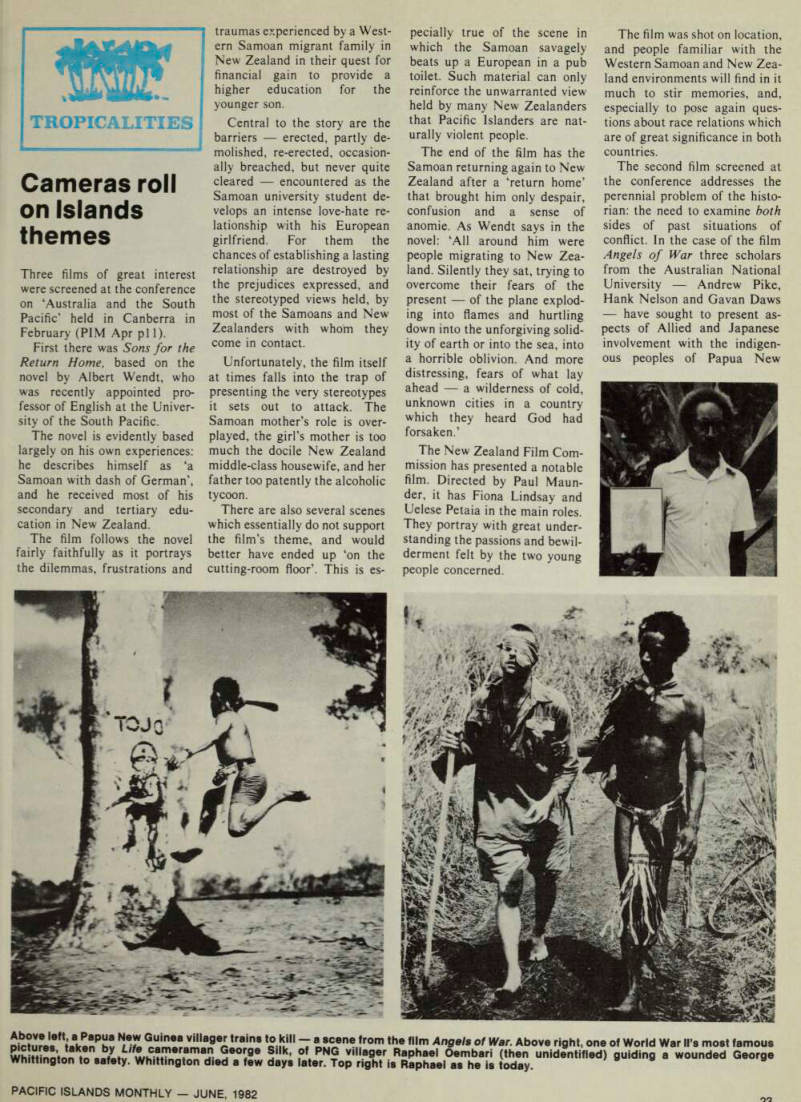
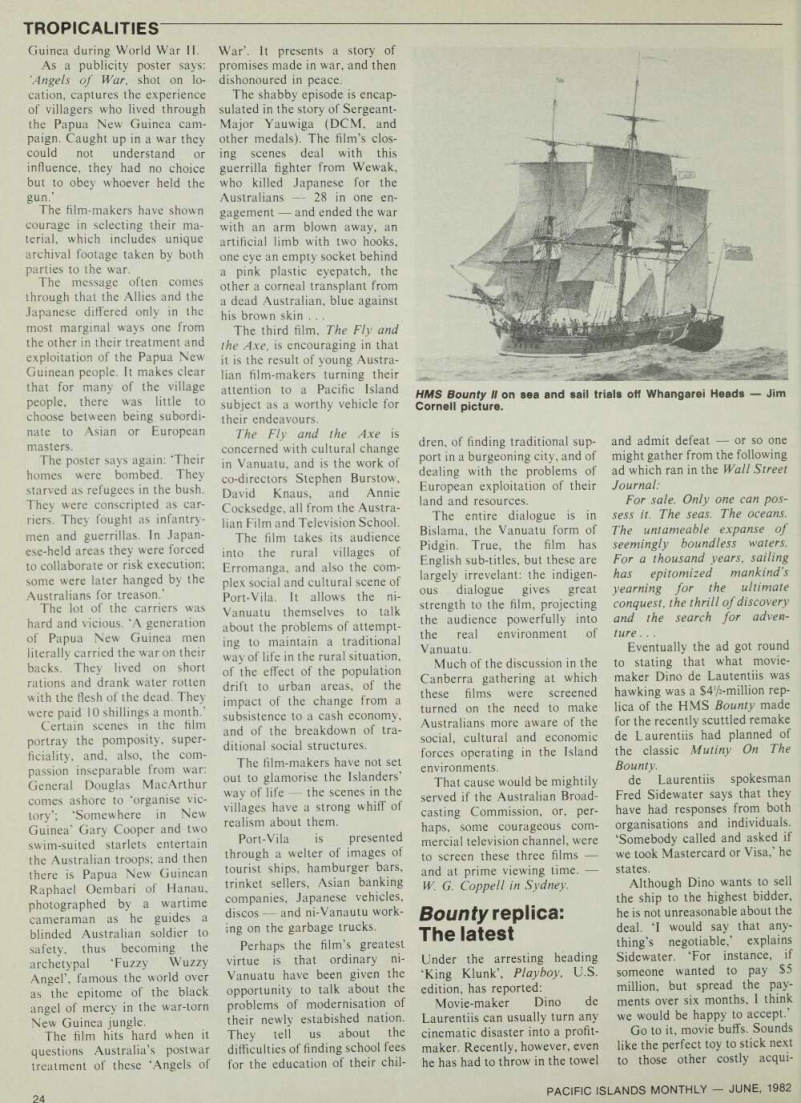
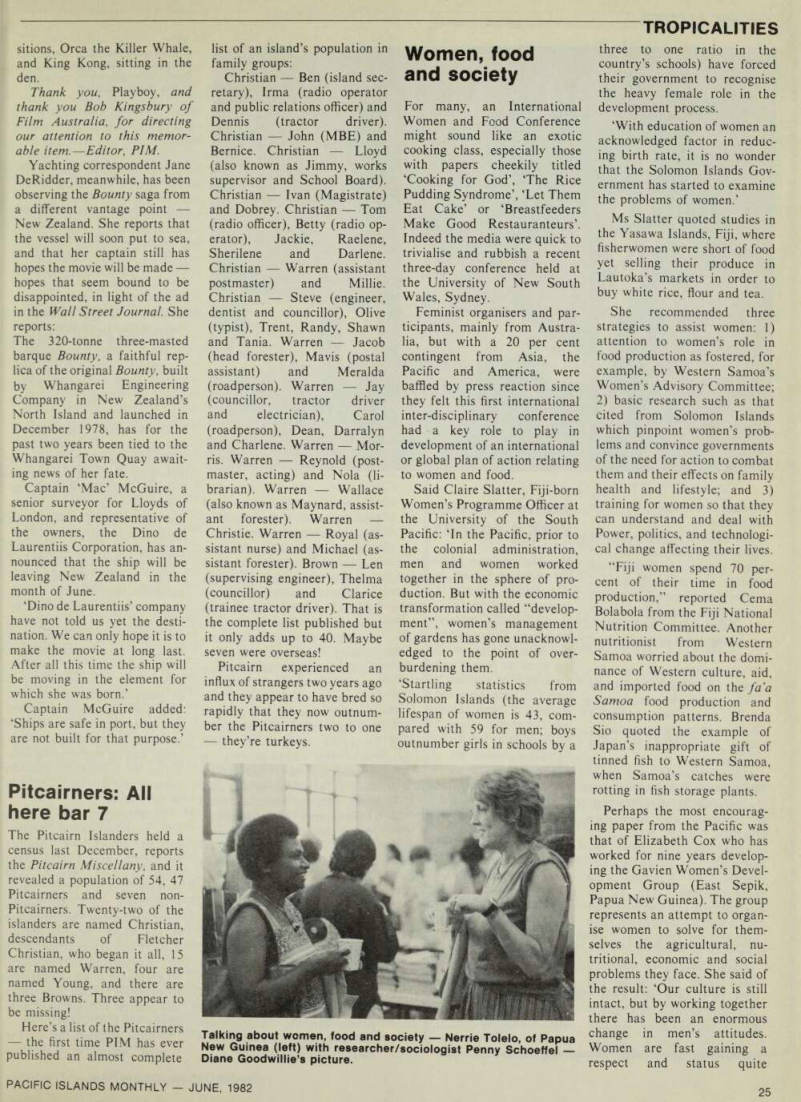
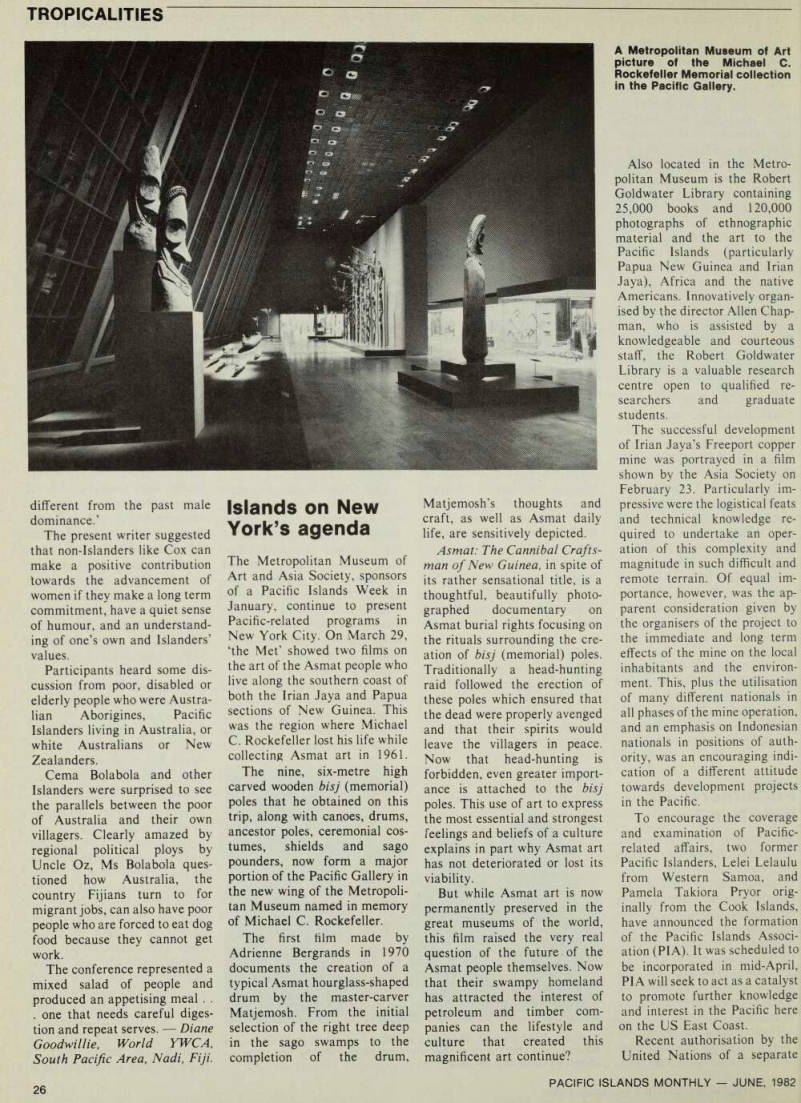
Tropicalities
Cameras roll on Islands themes
Three films of great interest were screened at the conference on ‘Australia and the South Pacific’ held in Canberra in February (PIM Apr pi 1).
First there was Sons for the Return Home, based on the novel by Albert Wendt, who was recently appointed pro fessor of English at the Univer sity of the South Pacific.
The novel is evidently based largely on his own experiences; he describes himself as ‘a Samoan with dash of German’, and he received most of his secondary and tertiary edu cation in New Zealand.
The film follows the novel fairly faithfully as it portrays the dilemmas, frustrations and
traumas experienced by a West ern Samoan migrant family in New Zealand in their quest for financial gain to provide a higher education for the younger son.
Central to the story are the barriers erected, partly de molished, re-erected, occasion ally breached, but never quite cleared encountered as the Samoan university student de velops an intense love-hate re lationship with his European girlfriend. For them the chances of establishing a lasting relationship are destroyed by the prejudices expressed, and the stereotyped views held, by most of the Samoans and New Zealanders with whom they come in contact.
Unfortunately, the film itself at times falls into the trap of presenting the very stereotypes it sets out to attack. The Samoan mother’s role is over played, the girl’s mother is too much the docile New Zealand middle-class housewife, and her father too patently the alcoholic tycoon.
There are also several scenes which essentially do not support the film’s theme, and would better have ended up ‘on the cutting-room floor’. This is es
pecially true of the scene in which the Samoan savagely beats up a European in a pub toilet. Such material can only reinforce the unwarranted view held by many New Zealanders that Pacific Islanders are nat urally violent people.
The end of the film has the Samoan returning again to New Zealand after a ‘return home’ that brought him only despair, confusion and a sense of anomie. As Wendt says in the novel: ‘All around him were people migrating to New Zea land. Silently they sat, trying to overcome their fears of the present of the plane explod ing into flames and hurtling down into the unforgiving solid ity of earth or into the sea, into a horrible oblivion. And more distressing, fears of what lay ahead a wilderness of cold, unknown cities in a country which they heard God had forsaken.’
The New Zealand Film Com mission has presented a notable film. Directed by Paul Maun der, it has Fiona Lindsay and Uelese Petaia in the main roles.
They portray with great under standing the passions and bewil derment felt by the two young people concerned.
The film was shot on location, and people familiar with the Western Samoan and New Zea land environments will find in it much to stir memories, and, especially to pose again ques tions about race relations which are of great significance in both countries.
The second film screened at the conference addresses the perennial problem of the histo rian; the need to examine both sides of past situations of conflict. In the case of the film Angels of War three scholars from the Australian National University Andrew Pike, Hank Nelson and Gavan Daws have sought to present as pects of Allied and Japanese involvement with the indigen ous peoples of Papua New
Above left, a Papua New Guinea villager trains to kill a scene from the film Angels of World War ll's most famous pictures, taken by Life cameraman George Silk, of PNG villager Raphael Oembari (then unidentifled) guiding a wounded George Whittington to safety. Whittington died a few days later. Top right is Raphael as he is today.
Guinea during World War 11.
As a publicity poster says: ‘Angels of War, shot on lo cation, captures the experience of villagers who lived through the Papua New Guinea cam paign. Caught up in a war they could not understand or influence, they had no choice but to obey whoever held the gun.’
The film-makers have shown courage in selecting their ma terial, which includes unique archival footage taken by both parties to the war.
The message often comes through that the Allies and the Japanese differed only in the most marginal ways one from the other in their treatment and exploitation of the Papua New Guinean people. It makes clear that for many of the village people, there was little to choose between being subordi nate to Asian or European masters.
The poster says again: ‘Their homes were bombed. They starved as refugees in the bush.
They were conscripted as car riers. They fought as infantry men and guerrillas. In Japan ese-held areas they were forced to collaborate or risk execution; some were later hanged by the Australians for treason.’
The lot of the carriers was hard and vicious. ‘A generation of Papua New Guinea men literally carried the war on their backs. They lived on short rations and drank water rotten with the flesh of the dead. They were paid 10 shillings a month.’
Certain scenes in the film portray the pomposity, super ficiality, and, also, the com
passion inseparable from war:
General Douglas MacArthur comes ashore to ‘organise vic tory’; ‘Somewhere in New Guinea’ Gary Cooper and two swim-suited starlets entertain the Australian troops; and then there is Papua New Guinean Raphael Oembari of Hanau, photographed by a wartime cameraman as he guides a blinded Australian soldier to safety, thus becoming the archetypal ‘Fuzzy Wuzzy Angel’, famous the world over as the epitome of the black angel of mercy in the war-torn New Guinea jungle.
The film hits hard when it questions Australia’s postwar treatment of these ‘Angels of
War’. It presents a story of promises made in war, and then dishonoured in peace.
The shabby episode is encap sulated in the story of Sergeant- Major Yauwiga (DCM, and other medals). The film’s clos ing scenes deal with this guerrilla fighter from Wewak, who killed Japanese for the Australians 28 in one en gagement and ended the war with an arm blown away, an artificial limb with two hooks, one eye an empty socket behind a pink plastic eyepatch, the other a corneal transplant from a dead Australian, blue against his brown skin . . .
The third film. The Fly and the Axe, is encouraging in that it is the result of young Austra lian film-makers turning their attention to a Pacific Island subject as a worthy vehicle for their endeavours.
The Fly and the Axe is concerned with cultural change in Vanuatu, and is the work of co-directors Stephen Burstow, David Knaus, and Annie Cocksedge, all from the Austra lian Film and Television School.
The film takes its audience into the rural villages of Erromanga, and also the com plex social and cultural scene of Port-Vila. It allows the ni- Vanuatu themselves to talk about the problems of attempt ing to maintain a traditional way of life in the rural situation, of the effect of the population drift to urban areas, of the impact of the change from a subsistence to a cash economy, and of the breakdown of tra ditional social structures.
The film-makers have not set out to glamorise the Islanders’ way of life the scenes in the villages have a strong whiff of realism about them.
Port-Vila is presented through a welter of images of tourist ships, hamburger bars, trinket sellers, Asian banking companies, Japanese vehicles, discos and ni-Vanautu work ing on the garbage trucks.
Perhaps the film’s greatest virtue is that ordinary ni- Vanuatu have been given the opportunity to talk about the problems of modernisation of their newly estabished nation.
They tell us about the difficulties of finding school fees for the education of their chil-
dren, of finding traditional sup port in a burgeoning city, and of dealing with the problems of European exploitation of their land and resources.
The entire dialogue is in Bislama, the Vanuatu form of Pidgin. True, the film has English sub-titles, but these are largely irrevelant: the indigen ous dialogue gives great strength to the film, projecting the audience powerfully into the real environment of Vanuatu.
Much of the discussion in the Canberra gathering at which these films were screened turned on the need to make Australians more aware of the social, cultural and economic forces operating in the Island environments.
That cause would be mightily served if the Australian Broad casting Commission, or, per haps, some courageous com mercial television channel, were to screen these three films and at prime viewing time.
W. G. Coppell in Sydney.
Bounty replica;
The latest
Under the arresting heading ‘King Klunk’, Playboy, U.S. edition, has reported: Movie-maker Dino de Laurentiis can usually turn any cinematic disaster into a profit maker. Recently, however, even he has had to throw in the towel
and admit defeat or so one might gather from the following ad which ran in the Wall Street Journal: For sale. Only one can pos sess it. The seas. The oceans.
The untameable expanse of seemingly boundless waters.
For a thousand years, sailing has epitomized mankind’s yearning for the ultimate conquest, the thrill of discovery and the search for adven ture . . .
Eventually the ad got round to stating that what movie maker Dino de Lautentiis was hawking was a s4‘/2-million rep lica of the HMS Bounty made for the recently scuttled remake de Laurentiis had planned of the classic Mutiny On The Bounty. de Laurentiis spokesman Fred Sidewater says that they have had responses from both organisations and individuals. ‘Somebody called and asked if we took Mastercard or Visa,’ he states.
Although Dino wants to sell the ship to the highest bidder, he is not unreasonable about the deal. ‘I would say that any thing’s negotiable,’ explains Sidewater. ‘For instance, if someone wanted to pay $5 million, but spread the pay ments over six months, I think we would be happy to accept.’
Go to it, movie buffs. Sounds like the perfect toy to stick next to those other costly acqui
HMS Bounty II on sea and sail trials off Whangarei Heads Jim Cornell picture.
sitions, Orca the Killer Whale, and King Kong, sitting in the den.
Thank you, Playboy, and thank you Bob Kingsbury of Film Australia, for directing our attention to this memor able item. — Editor, PIM.
Yachting correspondent Jane Deßidder, meanwhile, has been observing the Bounty saga from a different vantage point New Zealand. She reports that the vessel will soon put to sea, and that her captain still has hopes the movie will be made hopes that seem bound to be disappointed, in light of the ad in the Wall Street Journal. She reports: The 320-tonne three-masted barque Bounty, a faithful rep lica of the original Bounty, built by Whangarei Engineering Company in New Zealand’s North Island and launched in December 1978, has for the past two years been tied to the Whangarei Town Quay await ing news of her fate.
Captain ‘Mac’ McGuire, a senior surveyor for Lloyds of London, and representative of the owners, the Dino de Laurentiis Corporation, has an nounced that the ship will be leaving New Zealand in the month of June. ‘Dino de Laurentiis’ company have not told us yet the desti nation. We can only hope it is to make the movie at long last.
After all this time the ship will be moving in the element for which she was born.’
Captain McGuire added; ‘Ships are safe in port, but they are not built for that purpose.’
Pitcairners: All
here bar 7
The Pitcairn Islanders held a census last December, reports the Pitcairn Miscellany, and it revealed a population of 54, 47 Pitcairners and seven non- Pitcairners. Twenty-two of the islanders are named Christian, descendants of Fletcher Christian, who began it all, 15 are named Warren, four are named Young, and there are three Browns. Three appear to be missing!
Here’s a list of the Pitcairners the first time PIM has ever published an almost complete
list of an island’s population in family groups: Christian Ben (island sec retary), Irma (radio operator and public relations officer) and Dennis (tractor driver).
Christian John (MBE) and Bernice. Christian Lloyd (also known as Jimmy, works supervisor and School Board).
Christian Ivan (Magistrate) and Dobrey. Christian Tom (radio officer), Betty (radio op erator), Jackie, Raelene, Sherilene and Darlene.
Christian Warren (assistant postmaster) and Millie.
Christian Steve (engineer, dentist and councillor), Olive (typist), Trent, Randy, Shawn and Tania. Warren Jacob (head forester), Mavis (postal assistant) and Meralda (roadperson). Warren Jay (councillor, tractor driver and electrician), Carol (roadperson), Dean, Darralyn and Charlene. Warren Mor ris. Warren Reynold (post master, acting) and Nola (li brarian). Warren Wallace (also known as Maynard, assist ant forester). Warren Christie. Warren Royal (as sistant nurse) and Michael (as sistant forester). Brown Len (supervising engineer), Thelma (councillor) and Clarice (trainee tractor driver). That is the complete list published but it only adds up to 40. Maybe seven were overseas!
Pitcairn experienced an influx of strangers two years ago and they appear to have bred so rapidly that they now outnum ber the Pitcairners two to one they’re turkeys.
Women, food
and society
For many, an International Women and Food Conference might sound like an exotic cooking class, especially those with papers cheekily titled ‘Cooking for God’, ‘The Rice Pudding Syndrome’, ‘Let Them Eat Cake’ or ‘Breastfeeders Make Good Restauranteurs’, Indeed the media were quick to trivialise and rubbish a recent three-day conference held at the University of New South Wales, Sydney.
Feminist organisers and par ticipants, mainly from Austra lia, but with a 20 per cent contingent from Asia, the Pacific and America, were baffled by press reaction since they felt this first international inter-disciplinary conference had a key role to play in development of an international or global plan of action relating to women and food.
Said Claire Slatter, Fiji-born Women’s Programme Officer at the University of the South Pacific: ‘ln the Pacific, prior to the colonial administration, men and women worked together in the sphere of pro duction. But with the economic transformation called “develop ment’’, women’s management of gardens has gone unacknowl edged to the point of over burdening them. ‘Startling statistics from Solomon Islands (the average lifespan of women is 43, com pared with 59 for men; boys outnumber girls in schools by a
three to one ratio in the country’s schools) have forced their government to recognise the heavy female role in the development process. ‘With education of women an acknowledged factor in reduc ing birth rate, it is no wonder that the Solomon Islands Gov ernment has started to examine the problems of women.’
Ms Slatter quoted studies in the Yasawa Islands, Fiji, where fisherwomen were short of food yet selling their produce in Lautoka’s markets in order to buy white rice, flour and tea.
She recommended three strategies to assist women: 1) attention to women’s role in food production as fostered, for example, by Western Samoa’s Women’s Advisory Committee; 2) basic research such as that cited from Solomon Islands which pinpoint women’s prob lems and convince governments of the need for action to combat them and their effects on family health and lifestyle; and 3) training for women so that they can understand and deal with Power, politics, and technologi cal change affecting their lives.
“Fiji women spend 70 per cent of their time in food production,’’ reported Cema Bolabola from the Fiji National Nutrition Committee. Another nutritionist from Western Samoa worried about the domi nance of Western culture, aid, and imported food on the fa’a Samoa food production and consumption patterns. Brenda Sio quoted the example of Japan’s inappropriate gift of tinned fish to Western Samoa, when Samoa’s catches were rotting in fish storage plants.
Perhaps the most encourag ing paper from the Pacific was that of Elizabeth Cox who has worked for nine years develop ing the Gavien Women’s Devel opment Group (East Sepik, Papua New Guinea). The group represents an attempt to organ ise women to solve for them selves the agricultural, nu tritional, economic and social problems they face. She said of the result: ‘Our culture is still intact, but by working together there has been an enormous change in men’s attitudes.
Women are fast gaining a respect and status quite
Talking about women, food and society Nerrie Tolelo, of Papua New Guinea (left) with researcher/sociologist Penny Schoeffel Diane Goodwillie’s picture.
different from the past male dominance.’
The present writer suggested that non-islanders like Cox can make a positive contribution towards the advancement of women if they make a long term commitment, have a quiet sense of humour, and an understand ing of one’s own and Islanders’ values.
Participants heard some dis cussion from poor, disabled or elderly people who were Austra lian Aborigines, Pacific Islanders living in Australia, or white Australians or New Zealanders.
Cema Bolabola and other Islanders were surprised to see the parallels between the poor of Australia and their own villagers. Clearly amazed by regional political ploys by Uncle Oz, Ms Bolabola ques tioned how Australia, the country Fijians turn to for migrant jobs, can also have poor people who are forced to eat dog food because they cannot get work.
The conference represented a mixed salad of people and produced an appetising meal . . . one that needs careful diges tion and repeat serves. Diane Goodwillie, World YWCA, South Pacific Area, Nadi, Fiji.
Islands on New
York’s agenda
The Metropolitan Museum of Art and Asia Society, sponsors of a Pacific Islands Week in January, continue to present Pacific-related programs in New York City. On March 29, ‘the Met’ showed two films on the art of the Asmat people who live along the southern coast of both the Irian Jaya and Papua sections of New Guinea. This was the region where Michael C. Rockefeller lost his life while collecting Asmat art in 1961.
The nine, six-metre high carved wooden bisj (memorial) poles that he obtained on this trip, along with canoes, drums, ancestor poles, ceremonial cos tumes, shields and sago pounders, now form a major portion of the Pacific Gallery in the new wing of the Metropoli tan Museum named in memory of Michael C. Rockefeller.
The first film made by Adrienne Bergrands in 1970 documents the creation of a typical Asmat hourglass-shaped drum by the master-carver Matjemosh. From the initial selection of the right tree deep in the sago swamps to the completion of the drum,
Matjemosh’s thoughts and craft, as well as Asmat daily life, are sensitively depicted.
Asmat: The Cannibal Crafts man of New Guinea, in spite of its rather sensational title, is a thoughtful, beautifully photo graphed documentary on Asmat burial rights focusing on the rituals surrounding the cre ation of bisj (memorial) poles.
Traditionally a head-hunting raid followed the erection of these poles which ensured that the dead were properly avenged and that their spirits would leave the villagers in peace.
Now that head-hunting is forbidden, even greater import ance is attached to the bisj poles. This use of art to express the most essential and strongest feelings and beliefs of a culture explains in part why Asmat art has not deteriorated or lost its viability.
But while Asmat art is now permanently preserved in the great museums of the world, this film raised the very real question of the future of the Asmat people themselves. Now that their swampy homeland has attracted the interest of petroleum and timber com panies can the lifestyle and culture that created this magnificent art continue?
Also located in the Metro politan Museum is the Robert Goldwater Library containing 25,000 books and 120,000 photographs of ethnographic material and the art to the Pacific Islands (particularly Papua New Guinea and Irian Jaya), Africa and the native Americans. Innovatively organ ised by the director Allen Chap man, who is assisted by a knowledgeable and courteous staff, the Robert Goldwater Library is a valuable research centre open to qualified re searchers and graduate students.
The successful development of Irian Jaya’s Freeport copper mine was portrayed in a film shown by the Asia Society on February 23. Particularly im pressive were the logistical feats and technical knowledge re quired to undertake an oper ation of this complexity and magnitude in such difficult and remote terrain. Of equal im portance, however, was the ap parent consideration given by the organisers of the project to the immediate and long term effects of the mine on the local inhabitants and the environ ment. This, plus the utilisation of many different nationals in all phases of the mine operation, and an emphasis on Indonesian nationals in positions of auth ority, was an encouraging indi cation of a different attitude towards development projects in the Pacific.
To encourage the coverage and examination of Pacific related affairs, two former Pacific Islanders, Lelei Lelaulu from Western Samoa, and Pamela Takiora Pryor orig inally from the Cook Islands, have announced the formation of the Pacific Islands Associ ation (PIA). It was scheduled to be incorporated in mid-April, PIA will seek to act as a catalyst to promote further knowledge and interest in the Pacific here on the US East Coast.
Recent authorisation by the United Nations of a separate
A Metropolitan Museum of Art picture of the Michael C.
Rockefeller Memorial collection in the Pacific Gallery.
Pacific Islands radio section which will broadcast directly to the Pacific by satellite is another indication of the grow ing consideration given the Pacific Islands by the rest of the world. With a potential 27 votes in the UN, and the increased power projected by a 200-mile boundary under the proposed Law of the Sea Treaty, Pacific countries are becoming increas ingly important as components of the world’s political scene, in addition to their strategic and economic assets. —Caroline Yacoe in New York.
Madang’s German
cartridge cache
Recent excavations in the town of Madang, on Papua New Guinea’s north coast, have un covered an interesting cache of relics dating from the pre- World War I German colonial administraton.
Madang, known as Friedrich Wilhelmshafen in those times, was established in the early 1890 s. From 1892-96 it was the capital of the German Protec torate in New Guinea, then called Kaiser Wilhelmsland.
Today it is a busy commercial centre and popular tourist re sort, as well as being the provincial capital.
An alert youngster, noticing an odd-shaped cartridge case in some disturbed earth near what was the town centre in German times, returned with a metal detector to uncover nearly 500 others like it. Upon examination they proved to be 11 mm (.433 inch) rifle cartridges of a type issued to indigenous police for use in their Model 1871 Mauser carbines and rifles.
The cartridges are brass, bottle-shaped and measure ap proximately 58 mm in length.
Originally they were filled with 77 grains of black powder which fired their blunt-nosed lead bullets at a speed of 1430 feet per second. This is far short of the 3250 fps developed in the Colt AR-15 rifle which Papua New Guinea’s Mobile Police squads are issued with today!
Most of the shells were thickly encrusted with sediment and many were badly corroded but those that were cleaned revealed dates of manufacture ranging from 1879-88.
Why so many should have been found together remains a mystery, but one possible expla nation is that they were ex pended during target practice and returned to stores for audit purposes. They may have been deliberately dumped when ac counted for, or otherwise aban doned at the time of the Austra lian military occupation which took place in September, 1914.
R. J. Giddings.
‘Cobra’ fungus
draws crowds
A fungus sprouting through discarded copies of The Fiji Times in a garden shed at the home of Mr Shiu Nath, of Narere, Nasinu, Fiji, has brought large crowds of Hindu worshippers to the scene.
The fungus is shaped like the head of a cobra, the sacred snake revered by Hindus as a protector of the God, Shiva.
They believe that a cobra coils itself around the neck of Shiva to protect him. Mr Nath’s daughter-in-law, Mrs Urmila Wati Nand, was clearing the shed when she noticed the cobra image protruding from a heap of newspapers. When the news of the peculiar growth spread, Hindu devotees crowded to the spot and accorded it special honours, some of the people garlanding it with flowers.
The Fiji Times, wondering, probably, whether its beneficent influence had produced the phenomenon, invited microbiologist Dr Phillip Whitney and marine biologist Dr Uday Raj, both of the University of the South Pacific, to examine it.
Pronounced Dr Whitney: ‘lt is a fungus called Polypor, suggesting the many pores from which spores of the fungus are produced. It is similar in nature to mushrooms, except that mushrooms have gills from which spores are produced. This particular one has grown from a root or a piece of rotting wood on which the fungus is growing.
It could alter its shape at a later stage or just dry up and harden in its present form.’
Dr Raj commented: ‘Of significance is its peculiar shape, and this has, perhaps, misled the people into relating it with Lord Shiva.’
Advertisements & other items, p. 27 (1 item)
Pty. Ltd.
>3s^*
WATER WHEEL EXPORTS
493 Bourke Street, Melbourne, 3000, Australia Cables: Watermill - Melbourne.
Telex: AA 32165 Telephone: 602 1433
THE WATER WHEEL GROUP OF COMPANIES
Winners of Australia's Top Export Award and Flour Millers for over 100 years.
BEST AUSTRALIAN
WHEATEN FLOUR
(High Protein, Bakers, Stone ground Wholemeal, Donut).
COOLROOMS REFRIGERATED
CABINETS ETC.
INCLUDING SALT WATER
ICE MAKERS
STOCK & POULTRY FEEDS
(Pellets or Mash form)
YELLOW SPLIT PEAS &
WHOLE PEAS
(Machine-Dressed)
COMPLETE RANGE OF FROZEN
AND GENERAL FOOD ITEMS
QUALITY AUSTRALIAN
WINES
WOOD FUEL STOVES
AND WATER HEATERS
FOR FURTHER INFORMATION
Return this coupon to:
WATER WHEEL EXPORTS PTY. LTD.
Please forward me: Name Address Phone: More information on your above products/ product Export Manager Water Wheel Exports Pty. Ltd. 53 Market Street, South Melbourne 3205 Australia Telex: AA 32165 (same) Telephone; 699 1722
change not
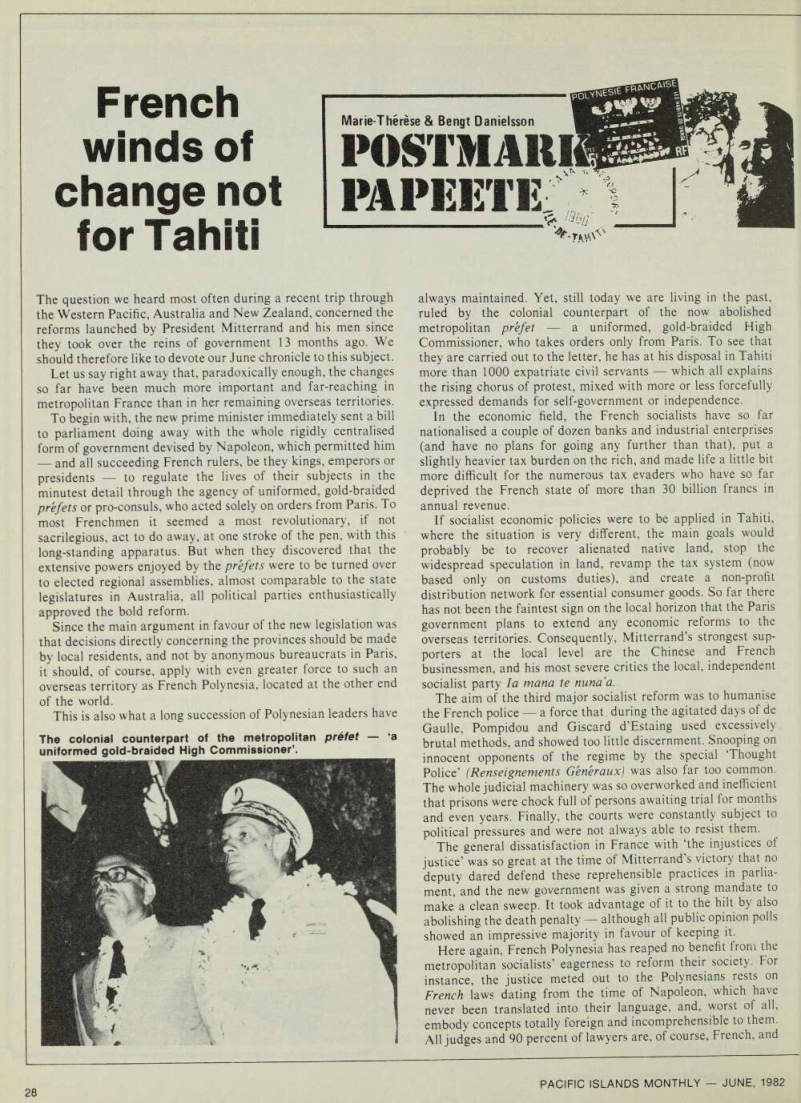
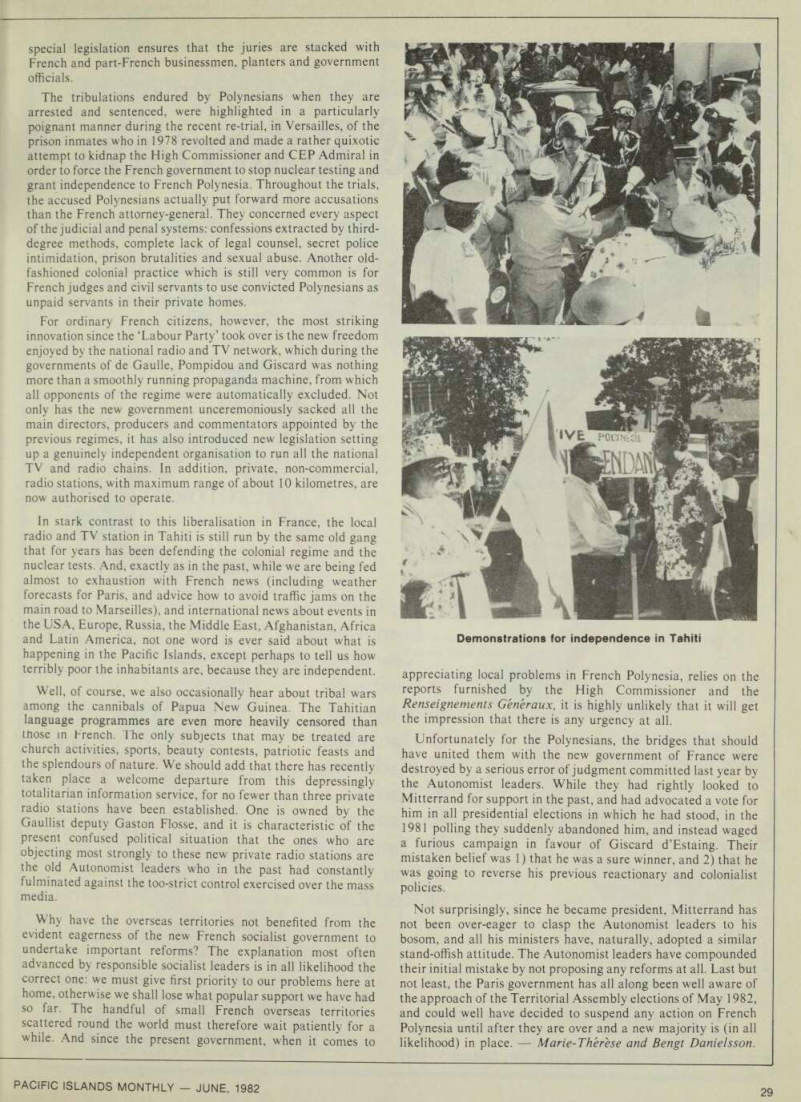
French winds of change not for Tahiti
The question we heard most often during a recent trip through the Western Pacific, Australia and New Zealand, concerned the reforms launched by President Mitterrand and his men since they took over the reins of government 13 months ago. We should therefore like to devote our June chronicle to this subject.
Let us say right away that, paradoxically enough, the changes so far have been much more important and far-reaching in metropolitan France than in her remaining overseas territories.
To begin with, the new prime minister immediately sent a bill to parliament doing away with the whole rigidly centralised form of government devised by Napoleon, which permitted him and all succeeding French rulers, be they kings, emperors or presidents to regulate the lives of their subjects in the minutest detail through the agency of uniformed, gold-braided prefets or pro-consuls, who acted solely on orders from Paris. To most Frenchmen it seemed a most revolutionary, if not sacrilegious, act to do away, at one stroke of the pen, with this long-standing apparatus. But when they discovered that the extensive powers enjoyed by the prefets were to be turned over to elected regional assemblies, almost comparable to the state legislatures in Australia, all political parties enthusiastically approved the bold reform.
Since the main argument in favour of the new legislation was that decisions directly concerning the provinces should be made by local residents, and not by anonymous bureaucrats in Paris, it should, of course, apply with even greater force to such an overseas territory as French Polynesia, located at the other end of the world.
This is also what a long succession of Polynesian leaders have
always maintained. Yet, still today we are living in the past, ruled by the colonial counterpart of the now abolished metropolitan pr'efet a uniformed, gold-braided High Commissioner, who takes orders only from Paris. To see that they are carried out to the letter, he has at his disposal in Tahiti more than 1000 expatriate civil servants which all explains the rising chorus of protest, mixed with more or less forcefully expressed demands for self-government or independence.
In the economic field, the French socialists have so far nationalised a couple of dozen banks and industrial enterprises (and have no plans for going any further than that), put a slightly heavier tax burden on the rich, and made life a little bit more difficult for the numerous tax evaders who have so far deprived the French state of more than 30 billion francs in annual revenue.
If socialist economic policies were to be applied in Tahiti, where the situation is very different, the main goals would probably be to recover alienated native land, stop the widespread speculation in land, revamp the tax system (now based only on customs duties), and create a non-profit distribution network for essential consumer goods. So far there has not been the faintest sign on the local horizon that the Paris government plans to extend any economic reforms to the overseas territories. Consequently, Mitterrand’s strongest sup porters at the local level are the Chinese and French businessmen, and his most severe critics the local, independent socialist party la mana te nuna’a.
The aim of the third major socialist reform was to humanise the French police a force that during the agitated days of de Gaulle, Pompidou and Giscard d’Estaing used excessively brutal methods, and showed too little discernment. Snooping on innocent opponents of the regime by the special ‘Thought Police’ (Renseignements Generaux) was also far too common.
The whole judicial machinery was so overworked and inefficient that prisons were chock full of persons awaiting trial for months and even years. Finally, the courts were constantly subject to political pressures and were not always able to resist them.
The general dissatisfaction in France with ‘the injustices of justice’ was so great at the time of Mitterrand’s victory that no deputy dared defend these reprehensible practices in parlia ment, and the new government was given a strong mandate to make a clean sweep. It took advantage of it to the hilt by also abolishing the death penalty although all public opinion polls showed an impressive majority in favour of keeping it.
Here again, French Polynesia has reaped no benefit from the metropolitan socialists’ eagerness to reform their society. For instance, the justice meted out to the Polynesians rests on French laws dating from the time of Napoleon, which have never been translated into their language, and, worst of all, embody concepts totally foreign and incomprehensible to them.
All judges and 90 percent of lawyers are, of course, French, and
The colonial counterpart of the metropolitan préfel - 'a uniformed gold-braided High Commissioner’.
special legislation ensures that the juries are stacked with French and part-French businessmen, planters and government officials.
The tribulations endured by Polynesians when they are arrested and sentenced, were highlighted in a particularly poignant manner during the recent re-trial, in Versailles, of the prison inmates who in 1978 revolted and made a rather quixotic attempt to kidnap the High Commissioner and CEP Admiral in order to force the French government to stop nuclear testing and grant independence to French Polynesia. Throughout the trials, the accused Polynesians actually put forward more accusations than the French attorney-general. They concerned every aspect of the judicial and penal systems: confessions extracted by third degree methods, complete lack of legal counsel, secret police intimidation, prison brutalities and sexual abuse. Another old fashioned colonial practice which is still very common is for French judges and civil servants to use convicted Polynesians as unpaid servants in their private homes.
For ordinary French citizens, however, the most striking innovation since the ‘Labour Party’ took over is the new freedom enjoyed by the national radio and TV network, which during the governments of de Gaulle, Pompidou and Giscard was nothing more than a smoothly running propaganda machine, from which all opponents of the regime were automatically excluded. Not only has the new government unceremoniously sacked all the main directors, producers and commentators appointed by the previous regimes, it has also introduced new legislation setting up a genuinely independent organisation to run all the national TV and radio chains. In addition, private, non-commercial, radio stations, with maximum range of about 10 kilometres, are now authorised to operate.
In stark contrast to this liberalisation in France, the local radio and TV station in Tahiti is still run by the same old gang that for years has been defending the colonial regime and the nuclear tests. And, exactly as in the past, while we are being fed almost to exhaustion with French news (including weather forecasts for Paris, and advice how to avoid traffic jams on the main road to Marseilles), and international news about events in the USA, Europe, Russia, the Middle East, Afghanistan, Africa and Latin America, not one word is ever said about what is happening in the Pacific Islands, except perhaps to tell us how terribly poor the inhabitants are, because they are independent.
Well, of course, we also occasionally hear about tribal wars among the cannibals of Papua New Guinea. The Tahitian language programmes are even more heavily censored than those in French. The only subjects that may be treated are church activities, sports, beauty contests, patriotic feasts and the splendours of nature. We should add that there has recently taken place a welcome departure from this depressingly totalitarian information service, for no fewer than three private radio stations have been established. One is owned by the Gaullist deputy Gaston Flosse, and it is characteristic of the present confused political situation that the ones who are objecting most strongly to these new private radio stations are the old Autonomist leaders who in the past had constantly fulminated against the too-strict control exercised over the mass media.
Why have the overseas territories not benefited from the evident eagerness of the new French socialist government to undertake important reforms? The explanation most often advanced by responsible socialist leaders is in all likelihood the correct one: we must give first priority to our problems here at home, otherwise we shall lose what popular support we have had so far. The handful of small French overseas territories scattered round the world must therefore wait patiently for a while. And since the present government, when it comes to
appreciating local problems in French Polynesia, relies on the reports furnished by the High Commissioner and the Renseignements Generaux, it is highly unlikely that it will get the impression that there is any urgency at all.
Unfortunately for the Polynesians, the bridges that should have united them with the new government of France were destroyed by a serious error of judgment committed last year by the Autonomist leaders. While they had rightly looked to Mitterrand for support in the past, and had advocated a vote for him in all presidential elections in which he had stood, in the 1981 polling they suddenly abandoned him, and instead waged a furious campaign in favour of Giscard d’Estaing. Their mistaken belief was 1) that he was a sure winner, and 2) that he was going to reverse his previous reactionary and colonialist policies.
Not surprisingly, since he became president, Mitterrand has not been over-eager to clasp the Autonomist leaders to his bosom, and all his ministers have, naturally, adopted a similar stand-offish attitude. The Autonomist leaders have compounded their initial mistake by not proposing any reforms at all. Last but not least, the Paris government has all along been well aware of the approach of the Territorial Assembly elections of May 1982, and could well have decided to suspend any action on French Polynesia until after they are over and a new majority is (in all likelihood) in place. Marie-Therese and Bengt Danielsson.
Demonstrations for independence in Tahiti
Advertisements & other items, p. 30 (1 item)
Nelson & Robertson
In our 87th Year Selling ‘Service’ to the Pacific Islands
Pty. Ltd,
-o o V.
MADANG
W.
LAE
• *. ■ •vv .•••
RABAUL
(Established 1895)
Plantation House, 197 Clarence Street, Sydney.
Cables: ‘IVAN’, Sydney, Brisbane.
Telex: AA22381, Sydney.
Phone: 29 2871
KIETA
v'. v -v *•: \ •• • •* > ..*•••
BRISBANE
SYDNEY
•«. •Vi • Vi »••• * * •*••• •%v ••• •••
LAUTOKA
SUVA
For Indents
from Australia,
New Zealand and Overseas
1 Foodstuffs
• Sof tgoods
• Hardware
i Machinery
• Travel
I Insurance
• Canned Fish
• Jute Goods
► Real Estate
...VI mm • •• a • • • »\\ . O , • •• •••A w.vt.« ... •. ... ..i ND
BRANCH OFFICES:
Nelson & Robertson Pty. Ltd., P.O. Box 575, Brisbane, Qld., Australia. 2216966 P.O. Box 2092, Govt. Bldg., Suva, Fiji. 22430 P.O. Box 258, Lautoka, Fiji. 62101 P.O. Box 2420, CPO Auckland 1, New Zealand. 774141 4i::>APUA new guinea representatives Pty. Ltd., p.o. Box 210, Rabaul, P.N.G. 922911 Box 1406, Lae, P.N.G. 422366 RO. Box 711, Madang, P.N.G. 822066 P.O. Box 253, Kieta, P.N.G. 956185 _o
Islands
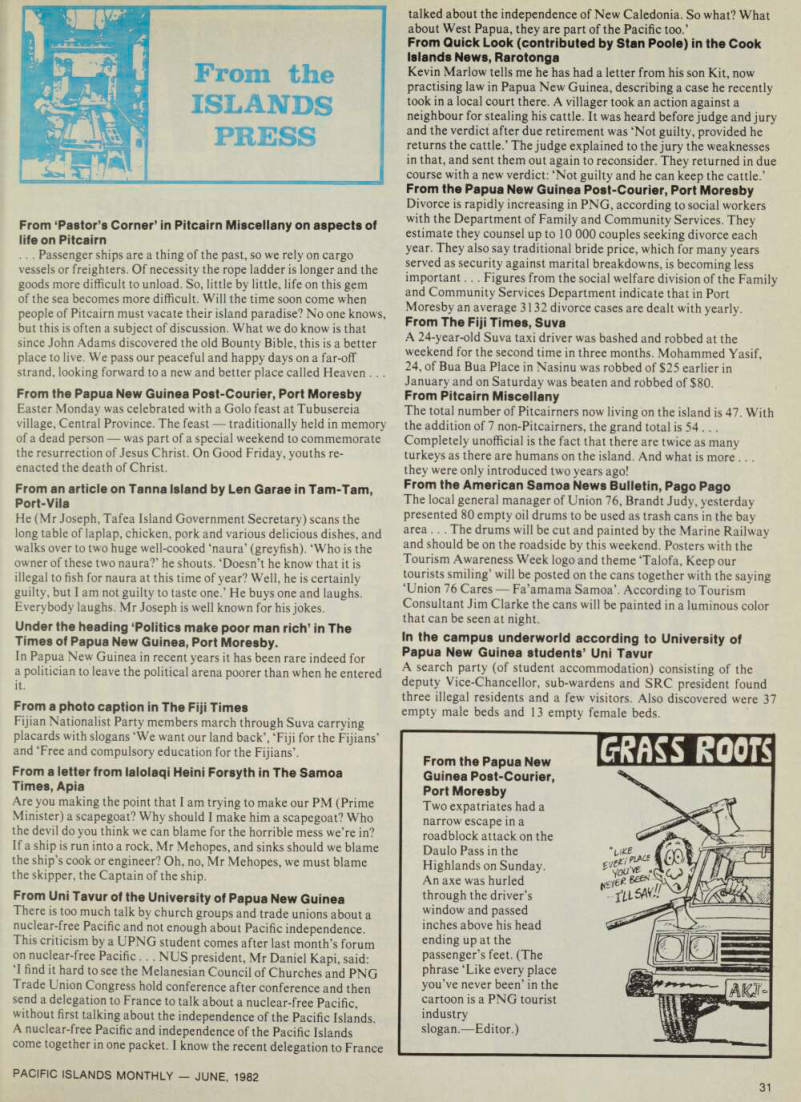
From the
Press
From ‘Pastor’s Corner’ in Pitcairn Miscellany on aspects of life on Pitcairn . . . Passenger ships are a thing of the past, so we rely on cargo vessels or freighters. Of necessity the rope ladder is longer and the goods more difficult to unload. So, little by little, life on this gem of the sea becomes more difficult. Will the time soon come when people of Pitcairn must vacate their island paradise? No one knows, but this is often a subject of discussion. What we do know is that since John Adams discovered the old Bounty Bible, this is a better place to live. We pass our peaceful and happy days on a far-off strand, looking forward to a new and better place called Heaven . ..
From the Papua New Guinea Post-Courier, Port Moresby Easter Monday was celebrated with a Golo feast at Tubusereia village, Central Province. The feast traditionally held in memory of a dead person was part of a special weekend to commemorate the resurrection of Jesus Christ. On Good Friday, youths re enacted the death of Christ.
From an article on Tanna Island by Len Garae in Tam-Tam, Port-Vila He (Mr Joseph, Tafea Island Government Secretary) scans the long table of laplap, chicken, pork and various delicious dishes, and walks over to two huge well-cooked ‘naura’ (greyfish). ‘Who is the owner of these two naura?’ he shouts. ‘Doesn’t he know that it is illegal to fish for naura at this time of year? Well, he is certainly guilty, but I am not guilty to taste one.’ He buys one and laughs.
Everybody laughs. Mr Joseph is well known for his jokes.
Under the heading ‘Politics make poor man rich’ in The Times of Papua New Guinea, Port Moresby.
In Papua New Guinea in recent years it has been rare indeed for a politician to leave the political arena poorer than when he entered it.
From a photo caption in The Fiji Times Fijian Nationalist Party members march through Suva carrying placards with slogans ‘We want our land back’, ‘Fiji for the Fijians’ and ‘Free and compulsory education for the Fijians’.
From a letter from lalolaqi Heini Forsyth in The Samoa Times, Apia Are you making the point that I am trying to make our PM (Prime Minister) a scapegoat? Why should I make him a scapegoat? Who the devil do you think we can blame for the horrible mess we’re in?
If a ship is run into a rock, Mr Mehopes, and sinks should we blame the ship’s cook or engineer? Oh, no, Mr Mehopes, we must blame the skipper, the Captain of the ship.
From Uni Tavur of the University of Papua New Guinea There is too much talk by church groups and trade unions about a nuclear-free Pacific and not enough about Pacific independence.
This criticism by a UPNG student comes after last month’s forum on nuclear-free Pacific .. . NUS president, Mr Daniel Kapi, said: T find it hard to see the Melanesian Council of Churches and PNG Trade Union Congress hold conference after conference and then send a delegation to France to talk about a nuclear-free Pacific, without first talking about the independence of the Pacific Islands.
A nuclear-free Pacific and independence of the Pacific Islands come together in one packet. I know the recent delegation to France
talked about the independence of New Caledonia. So what? What about West Papua, they are part of the Pacific too.’
From Quick Look (contributed by Stan Poole) in the Cook Islands News, Rarotonga Kevin Marlow tells me he has had a letter from his son Kit, now practising law in Papua New Guinea, describing a case he recently took in a local court there. A villager took an action against a neighbour for stealing his cattle. It was heard before judge and jury and the verdict after due retirement was ‘Not guilty, provided he returns the cattle.’ The judge explained to the jury the weaknesses in that, and sent them out again to reconsider. They returned in due course with a new verdict: ‘Not guilty and he can keep the cattle.’
From the Papua New Guinea Post-Courier, Port Moresby Divorce is rapidly increasing in PNG, according to social workers with the Department of Family and Community Services. They estimate they counsel up to 10 000 couples seeking divorce each year. They also say traditional bride price, which for many years served as security against marital breakdowns, is becoming less important.. . Figures from the social welfare division of the Family and Community Services Department indicate that in Port Moresby an average 3132 divorce cases are dealt with yearly.
From The Fiji Times, Suva A 24-year-old Suva taxi driver was bashed and robbed at the weekend for the second time in three months. Mohammed Yasif, 24, of Bua Bua Place in Nasinu was robbed of $25 earlier in January and on Saturday was beaten and robbed of $BO.
From Pitcairn Miscellany The total number of Pitcairners now living on the island is 47. With the addition of 7 non-Pitcairners, the grand total is 54 .. .
Completely unofficial is the fact that there are twice as many turkeys as there are humans on the island. And what is more .. . they were only introduced two years ago!
From the American Samoa News Bulletin, Pago Pago The local general manager of Union 76, Brandt Judy, yesterday presented 80 empty oil drums to be used as trash cans in the bay area . . . The drums will be cut and painted by the Marine Railway and should be on the roadside by this weekend. Posters with the Tourism Awareness Week logo and theme ‘Talofa, Keep our tourists smiling’ will be posted on the cans together with the saying ‘Union 76 Cares Fa’amama Samoa’. According to Tourism Consultant Jim Clarke the cans will be painted in a luminous color that can be seen at night.
In the campus underworld according to University of Papua New Guinea students’ Uni Tavur A search party (of student accommodation) consisting of the deputy Vice-Chancellor, sub-wardens and SRC president found three illegal residents and a few visitors. Also discovered were 37 empty male beds and 13 empty female beds.
Advertisements & other items, pp. 31-32 (1 item)
Grass Roots
From the Papua New Guinea Post-Courier, Port Moresby Two expatriates had a narrow escape in a roadblock attack on the Daulo Pass in the Highlands on Sunday.
An axe was hurled through the driver’s window and passed inches above his head ending up at the passenger’s feet. (The phrase ‘Like every place you’ve never been’ in the cartoon is a PNG tourist industry slogan.—Editor.)
WOU •
m
XIIiAVH
SOLAR POWER
Lucas Solar Power can satisfy your remote
power supply problem with a complete
photovoltaic power system.
Whether it be radio communications, microwave repeater stations, cathodic protection, signalling, water pumping or house lighting.
Contact us for a system sizing or for information on our range of equipment.
Lucas Industries Australia Limited 1156 Nepean Highway Cheltenham Telephone: Victoria 3192 Telex: AA 30453 (03) 581 0311
Air\knuatu is no
fly-by-night airline.
From May 8, Air Vanuatu flights to Vanuatu every Saturday and Sunday will be daylight.
Non-stop from Sydney to Port Vila on our new Boeing 737.
It’s the best way to get to our jewelled archipelago of 80 beautiful islands in the South Pacific.
Less than 4 hours from Sydney.
See your Travel Agent or Ansett International Travel for more information and bookings.
And don’t forget your sunglasses! :
People
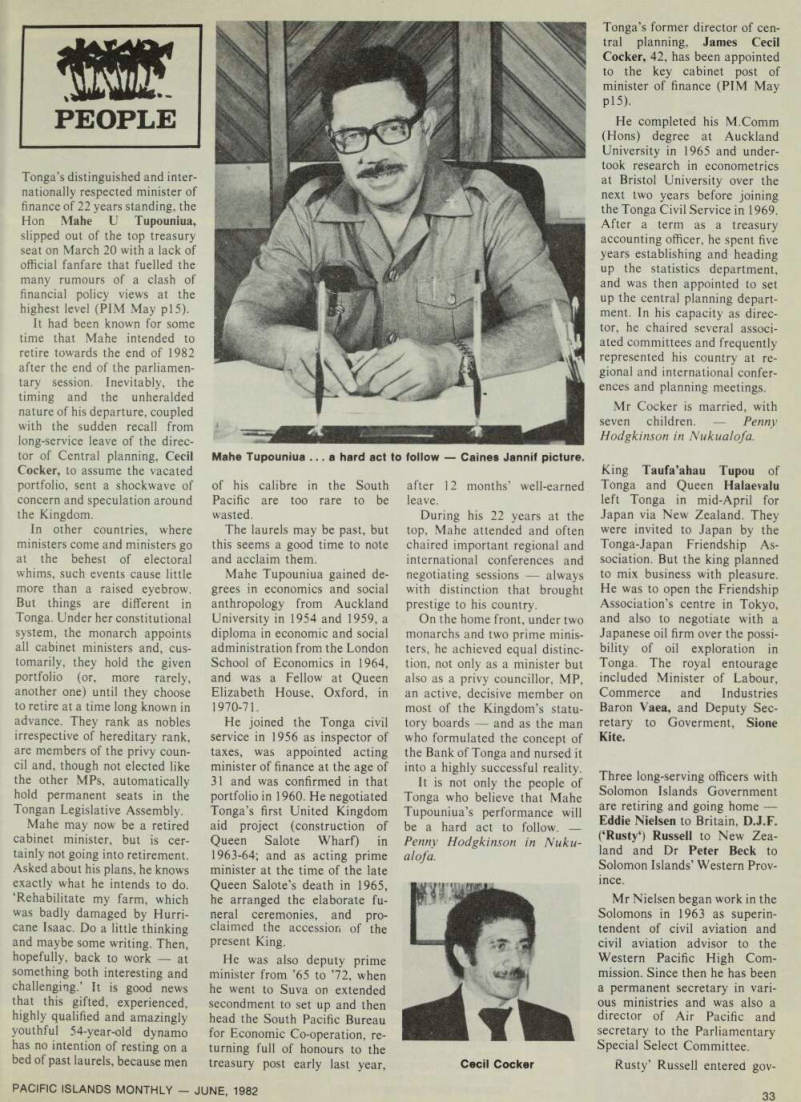


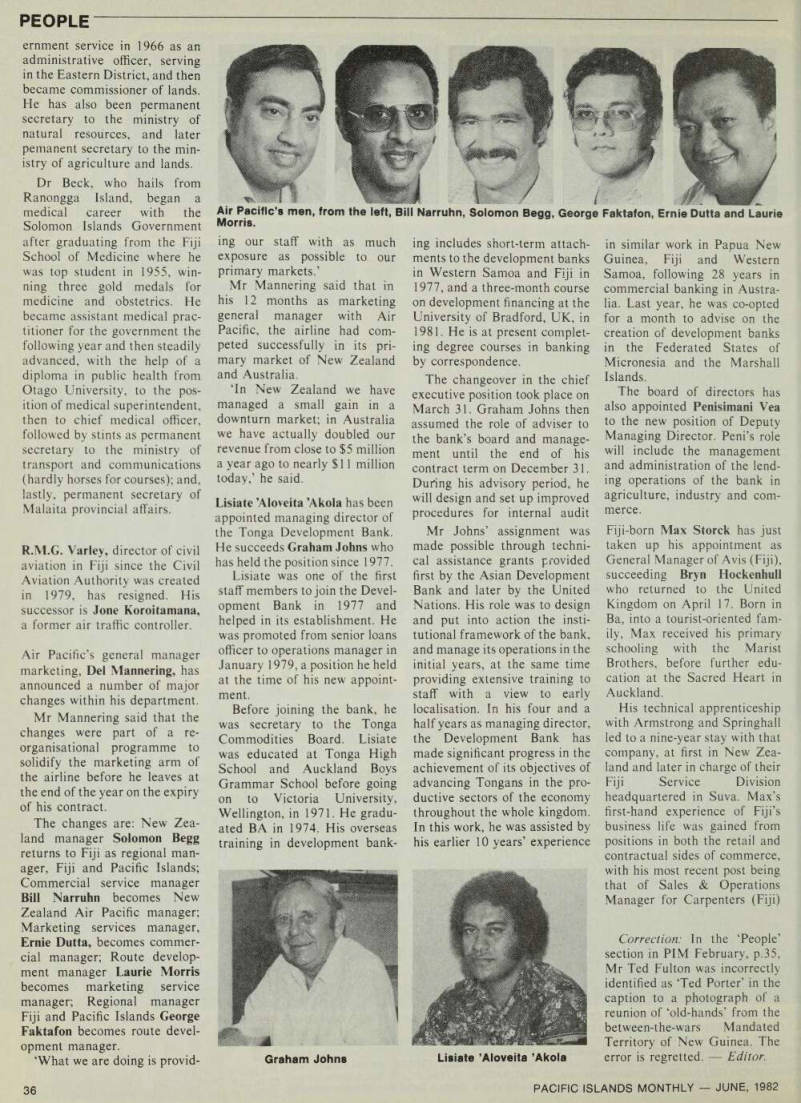
Tonga’s distinguished and inter nationally respected minister of finance of 22 years standing, the Hon Mahe U Tupouniua, slipped out of the top treasury seat on March 20 with a lack of official fanfare that fuelled the many rumours of a clash of financial policy views at the highest level (PIM May pls).
It had been known for some time that Mahe intended to retire towards the end of 1982 after the end of the parliamen tary session. Inevitably, the timing and the unheralded nature of his departure, coupled with the sudden recall from long-service leave of the direc tor of Central planning, Cecil Cocker, to assume the vacated portfolio, sent a shockwave of concern and speculation around the Kingdom.
In other countries, where ministers come and ministers go at the behest of electoral whims, such events cause little more than a raised eyebrow.
But things are different in Tonga. Under her constitutional system, the monarch appoints all cabinet ministers and, cus tomarily, they hold the given portfolio (or, more rarely, another one) until they choose to retire at a time long known in advance. They rank as nobles irrespective of hereditary rank, are members of the privy coun cil and, though not elected like the other MPs, automatically hold permanent seats in the Tongan Legislative Assembly.
Mahe may now be a retired cabinet minister, but is cer tainly not going into retirement.
Asked about his plans, he knows exactly what he intends to do. ‘Rehabilitate my farm, which was badly damaged by Hurri cane Isaac. Do a little thinking and maybe some writing. Then, hopefully, back to work at something both interesting and challenging.’ It is good news that this gifted, experienced, highly qualified and amazingly youthful 54-year-old dynamo has no intention of resting on a bed of past laurels, because men
of his calibre in the South Pacific are too rare to be wasted.
The laurels may be past, but this seems a good time to note and acclaim them.
Mahe Tupouniua gained de grees in economics and social anthropology from Auckland University in 1954 and 1959, a diploma in economic and social administration from the London School of Economics in 1964, and was a Fellow at Queen Elizabeth House, Oxford, in 1970-71.
He joined the Tonga civil service in 1956 as inspector of taxes, was appointed acting minister of finance at the age of 31 and was confirmed in that portfolio in 1960. He negotiated Tonga’s first United Kingdom aid project (construction of Queen Salote Wharf) in 1963-64; and as acting prime minister at the time of the late Queen Salote’s death in 1965, he arranged the elaborate fu neral ceremonies, and pro claimed the accession of the present King.
He was also deputy prime minister from ’65 to ’72, when he went to Suva on extended secondment to set up and then head the South Pacific Bureau for Economic Co-operation, re turning full of honours to the treasury post early last year,
after 12 months’ well-earned leave.
During his 22 years at the top, Mahe attended and often chaired important regional and international conferences and negotiating sessions always with distinction that brought prestige to his country.
On the home front, under two monarchs and two prime minis ters, he achieved equal distinc tion, not only as a minister but also as a privy councillor, MP, an active, decisive member on most of the Kingdom’s statu tory boards and as the man who formulated the concept of the Bank of Tonga and nursed it into a highly successful reality.
It is not only the people of Tonga who believe that Mahe Tupouniua’s performance will be a hard act to follow.
Penny Hodgkinson in Nuku alofa.
Tonga’s former director of cen tral planning, James Cecil Cocker, 42, has been appointed to the key cabinet post of minister of finance (PIM May pl 5).
He completed his M.Comm (Hons) degree at Auckland University in 1965 and under took research in econometrics at Bristol University over the next two years before joining the Tonga Civil Service in 1969.
After a term as a treasury accounting officer, he spent five years establishing and heading up the statistics department, and was then appointed to set up the central planning depart ment. In his capacity as direc tor, he chaired several associ ated committees and frequently represented his country at re gional and international confer ences and planning meetings.
Mr Cocker is married, with seven children. Penny Hodgkinson in Nukualofa.
King Taufa’ahau Tupou of Tonga and Queen Halaevalu left Tonga in mid-April for Japan via New Zealand. They were invited to Japan by the Tonga-Japan Friendship As sociation. But the king planned to mix business with pleasure.
He was to open the Friendship Association’s centre in Tokyo, and also to negotiate with a Japanese oil firm over the possi bility of oil exploration in Tonga. The royal entourage included Minister of Labour, Commerce and Industries Baron Vaea, and Deputy Sec retary to Goverment, Sione Kite.
Three long-serving officers with Solomon Islands Government are retiring and going home Eddie Nielsen to Britain, D.J.F. (‘Rusty 4 ) Russell to New Zea land and Dr Peter Beck to Solomon Islands’ Western Prov ince.
Mr Nielsen began work in the Solomons in 1963 as superin tendent of civil aviation and civil aviation advisor to the Western Pacific High Com mission. Since then he has been a permanent secretary in vari ous ministries and was also a director of Air Pacific and secretary to the Parliamentary Special Select Committee.
Rusty’ Russell entered gov
Mahe Tupouniua . . . a hard act to follow - Caines Jannif picture.
Cecil Cocker
ernment service in 1966 as an administrative officer, serving in the Eastern District, and then became commissioner of lands.
He has also been permanent secretary to the ministry of natural resources, and later pemanent secretary to the min istry of agriculture and lands.
Dr Beck, who hails from Ranongga Island, began a medical career with the Solomon Islands Government after graduating from the Fiji School of Medicine where he was top student in 1955, win ning three gold medals for medicine and obstetrics. He became assistant medical prac titioner for the government the following year and then steadily advanced, with the help of a diploma in public health from Otago University, to the pos ition of medical superintendent, then to chief medical officer, followed by stints as permanent secretary to the ministry of transport and communications (hardly horses for courses); and, lastly, permanent secretary of Malaita provincial affairs.
R.M.G. Varley, director of civil aviation in Fiji since the Civil Aviation Authority was created in 1979, has resigned. His successor is Jone Koroitamana, a former air traffic controller.
Air Pacific’s general manager marketing, Del Mannering, has announced a number of major changes within his department.
Mr Mannering said that the changes were part of a re organisational programme to solidify the marketing arm of the airline before he leaves at the end of the year on the expiry of his contract.
The changes are: New Zea land manager Solomon Begg returns to Fiji as regional man ager, Fiji and Pacific Islands; Commercial service manager Bill Narruhn becomes New Zealand Air Pacific manager; Marketing services manager, Ernie Dutta, becomes commer cial manager; Route develop ment manager Laurie Morris becomes marketing service manager; Regional manager Fiji and Pacific Islands George Faktafon becomes route devel opment manager. ‘What we are doing is provid-
ing our staff with as much exposure as possible to our primary markets.’
Mr Mannering said that in his 12 months as marketing general manager with Air Pacific, the airline had com peted successfully in its pri mary market of New Zealand and Australia. ‘ln New Zealand we have managed a small gain in a downturn market; in Australia we have actually doubled our revenue from close to $5 million a year ago to nearly $ll million today,’ he said.
Lisiate ’Aloveita ’Akola has been appointed managing director of the Tonga Development Bank.
He succeeds Graham Johns who has held the position since 1977.
Lisiate was one of the first staff members to join the Devel opment Bank in 1977 and helped in its establishment. He was promoted from senior loans officer to operations manager in January 1979, a position he held at the time of his new appoint ment.
Before joining the bank, he was secretary to the Tonga Commodities Board. Lisiate was educated at Tonga High School and Auckland Boys Grammar School before going on to Victoria University, Wellington, in 1971. He gradu ated BA in 1974. His overseas training in development bank-
ing includes short-term attach ments to the development banks in Western Samoa and Fiji in 1977, and a three-month course on development financing at the University of Bradford, UK, in 1981. He is at present complet ing degree courses in banking by correspondence.
The changeover in the chief executive position took place on March 31. Graham Johns then assumed the role of adviser to the bank’s board and manage ment until the end of his contract term on December 31.
During his advisory period, he will design and set up improved procedures for internal audit Mr Johns’ assignment was made possible through techni cal assistance grants provided first by the Asian Development Bank and later by the United Nations. His role was to design and put into action the insti tutional framework of the bank, and manage its operations in the initial years, at the same time providing extensive training to staff with a view to early localisation. In his four and a half years as managing director, the Development Bank has made significant progress in the achievement of its objectives of advancing Tongans in the pro ductive sectors of the economy throughout the whole kingdom.
In this work, he was assisted by his earlier 10 years’ experience
in similar work in Papua New Guinea, Fiji and Western Samoa, following 28 years in commercial banking in Austra lia. Last year, he was co-opted for a month to advise on the creation of development banks in the Federated States of Micronesia and the Marshall Islands.
The board of directors has also appointed Penisimani Vea to the new position of Deputy Managing Director. Peni’s role will include the management and administration of the lend ing operations of the bank in agriculture, industry and com merce.
Fiji-born Max Storck has just taken up his appointment as General Manager of Avis (Fiji), succeeding Bryn Hockenhull who returned to the United Kingdom on April 17. Born in Ba, into a tourist-oriented fam ily, Max received his primary schooling with the Marist Brothers, before further edu cation at the Sacred Heart in Auckland.
His technical apprenticeship with Armstrong and Springhall led to a nine-year stay with that company, at first in New Zea land and later in charge of their Fiji Service Division headquartered in Suva. Max’s first-hand experience of Fiji’s business life was gained from positions in both the retail and contractual sides of commerce, with his most recent post being that of Sales & Operations Manager for Carpenters (Fiji) Correction: In the ‘People’ section in PIM February, p. 35, Mr Ted Fulton was incorrectly identified as ‘Ted Porter’ in the caption to a photograph of a reunion of ‘old-hands’ from the between-the-wars Mandated Territory of New Guinea. The error is regretted. Editor.
Graham Johns
Air Pacific’s men, from the left, Bill Narruhn, Solomon Begg, George Faktafon, Ernie Dutta and Laurie Morris.
Lisiate ’Aloveita ’Akola
Advertisements & other items, pp. 34-35 (1 item)
Toyota
LAND CRUISER
STATION WAGON
mm ■r sp
HI ACE
ii .
JB 8
TOYOTA
SERVICE
PAPUA NEW GUINEA: ELA MOTORS,
Scratchley Rd., Badili, P.O. Box 675, Port Moresby.
NORTHERN MARIANAS & U.S.T.T.:
MICROL CORPORATION, P.O. Box 267, Saipan.
FIJI: AUTOMOTIVE SUPPLIES COMPANY, G.P.O.
Box 355, Suva.
AMERICAN SAMOA: BURNS PHILP
(SOUTHSEA) CO., LTD., P.O. Box 129, Pago Pago.
WESTERN SAMOA: BURNS PHILP (SOUTHSEA)
CO., LTD., P.O. Box 188, Apia.
TONGA: BURNS PHILP (SOUTHSEA) CO., LTD.,
P O. Box 55, Nuku’alofa.
GUAM; ATKINS, KROLL (GUAM) LTD.. P.O. Box 642 f Tamuning.
DYNA
HI-LUX
DOUBLE CAB
I i. ici it
TRUCK
HEAVY DUTY
■ a
THE TOYOTA ROAD]
READY TO TAKE
ON THE TOUGHEST OORS
Meet Toyota’s hard working commercial vehicles.
Tough. Durable. Ready to meet the challenge of the worst roads and climates. Ready to do the job called for with ease.
Rugged veterans, each one specifically designed to meet the different demands of the world’s businesses.
One of them is just right for you.
There are no vehicles more reliable. And if you need it, Toyota is ready with fast backup servjo Toyota’s roadmasters, they’re a ANUATU: VANUATU MOTORS, P.O. Box 18, Port Vila. KIRIBATI: TARAWA MOTORS, Box 36, Bairiki, OLOMON: MENDANA ENTERPRISES (5.1.) LTD., Tarawa, Kiribati. .P.O. Box 174, Honiara. NORFOLK ISLAND: BORRY’S RENTAL CARS, IVHITI: NIPPON AUTOMOTO, B. P. 342, Papeete. MOUNT PITT (ENTERPRISES) LTD., P.O. Box 169.
OOK ISLANDS: COOK ISLANDS TRADING NEW CALEDONIA: SERVICE IMPORTATION ORPORATION LTD., P.O. Box 92, Rarotonga. AUTOMOBILE DU PACIFIQUE, Rond-Point AURU: NAURU COOPERATIVE SOCIETY. du Pacifique (Station Total) B.P. 438, Noumea.
TOYOTA
The Toyota range includes:
COROLLA, STARLET CORONA, CRESSIDA, HI-LUX,
STOUT, HI ACE, DYNA, COASTER and LAND CRUISER
Tourist challenge for
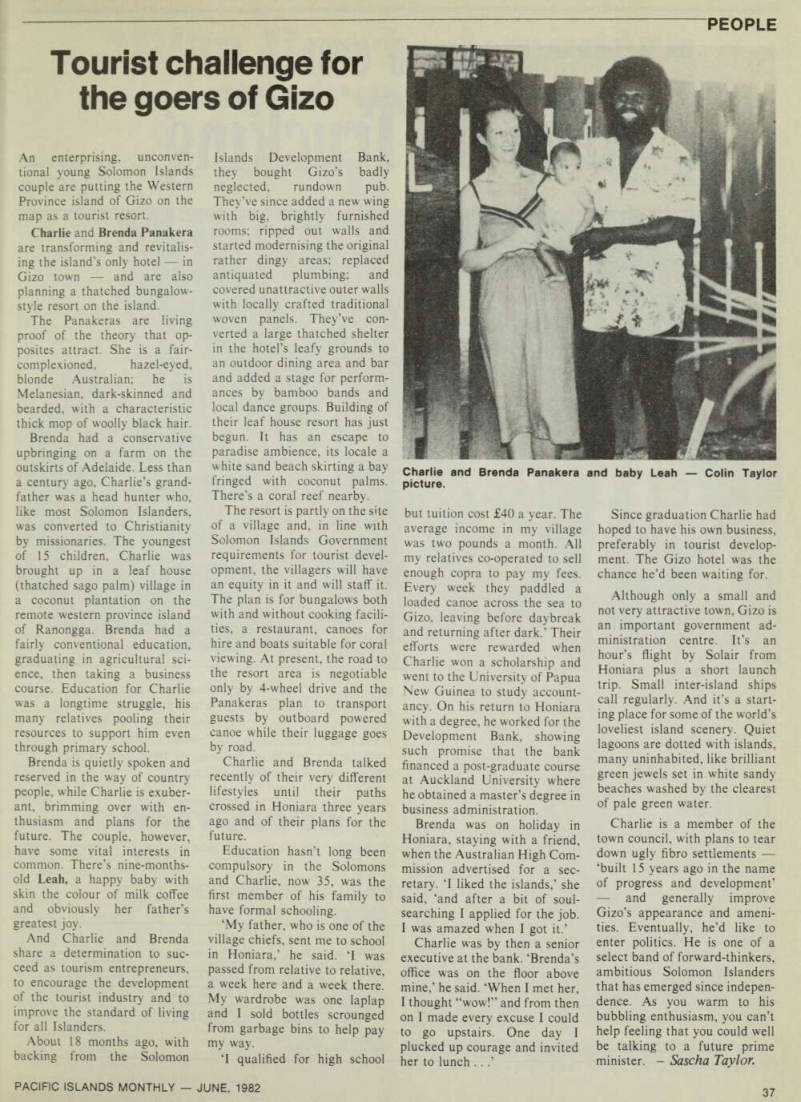
the goers of Gizo
An enterprising, unconven tional young Solomon Islands couple are putting the Western Province island of Gizo on the map as a tourist resort.
Charlie and Brenda Panakera are transforming and revitalis ing the island’s only hotel in Gizo town and are also planning a thatched bungalow style resort on the island.
The Panakeras are living proof of the theory that op posites attract. She is a fair complexioned, hazel-eyed, blonde Australian; he is Melanesian, dark-skinned and bearded, with a characteristic thick mop of woolly black hair.
Brenda had a conservative upbringing on a farm on the outskirts of Adelaide. Less than a century ago, Charlie’s grand father was a head hunter who, like most Solomon Islanders, was converted to Christianity by missionaries. The youngest of 15 children, Charlie was brought up in a leaf house (thatched sago palm) village in a coconut plantation on the remote western province island of Ranongga. Brenda had a fairly conventional education, graduating in agricultural sci ence, then taking a business course. Education for Charlie was a longtime struggle, his many relatives pooling their resources to support him even through primary school.
Brenda is quietly spoken and reserved in the way of country people, while Charlie is exuber ant, brimming over with en thusiasm and plans for the future. The couple, however, have some vital interests in common. There’s nine-months old Leah, a happy baby with skin the colour of milk coffee and obviously her father’s greatest joy.
And Charlie and Brenda share a determination to suc ceed as tourism entrepreneurs, to encourage the development of the tourist industry and to improve the standard of living for all Islanders.
About 18 months ago, with backing from the Solomon
Islands Development Bank, they bought Gizo’s badly neglected, rundown pub.
They’ve since added a new wing with big, brightly furnished rooms; ripped out walls and started modernising the original rather dingy areas; replaced antiquated plumbing; and covered unattractive outer walls with locally crafted traditional woven panels. They’ve con verted a large thatched shelter in the hotel’s leafy grounds to an outdoor dining area and bar and added a stage for perform ances by bamboo bands and local dance groups. Building of their leaf house resort has just begun. It has an escape to paradise ambience, its locale a white sand beach skirting a bay fringed with coconut palms.
There’s a coral reef nearby.
The resort is partly on the site of a village and, in line with Solomon Islands Government requirements for tourist devel opment, the villagers will have an equity in it and will staff it.
The plan is for bungalows both with and without cooking facili ties, a restaurant, canoes for hire and boats suitable for coral viewing. At present, the road to the resort area is negotiable only by 4-wheel drive and the Panakeras plan to transport guests by outboard powered canoe while their luggage goes by road.
Charlie and Brenda talked recently of their very different lifestyles until their paths crossed in Honiara three years ago and of their plans for the future.
Education hasn’t long been compulsory in the Solomons and Charlie, now 35, was the first member of his family to have formal schooling. ‘My father, who is one of the village chiefs, sent me to school in Honiara,’ he said. T was passed from relative to relative, a week here and a week there.
My wardrobe was one laplap and I sold bottles scrounged from garbage bins to help pay my way.
T qualified for high school
but tuition cost £4O a year. The average income in my village was two pounds a month. All my relatives co-operated to sell enough copra to pay my fees.
Every week they paddled a loaded canoe across the sea to Gizo, leaving before daybreak and returning after dark.’ Their efforts were rewarded when Charlie won a scholarship and went to the University of Papua New Guinea to study account ancy. On his return to Honiara with a degree, he worked for the Development Bank, showing such promise that the bank financed a post-graduate course at Auckland University where he obtained a master’s degree in business administration.
Brenda was on holiday in Honiara, staying with a friend, when the Australian High Com mission advertised for a sec retary. T liked the islands,’ she said, ‘and after a bit of soul searching I applied for the job.
I was amazed when I got it.’
Charlie was by then a senior executive at the bank. ‘Brenda’s office was on the floor above mine,’ he said. ‘When I met her, I thought “wow!” and from then on I made every excuse I could to go upstairs. One day I plucked up courage and invited her to lunch . ..’
Since graduation Charlie had hoped to have his own business, preferably in tourist develop ment. The Gizo hotel was the chance he’d been waiting for.
Although only a small and not very attractive town, Gizo is an important government ad ministration centre. It’s an hour’s flight by Solair from Honiara plus a short launch trip. Small inter-island ships call regularly. And it’s a start ing place for some of the world’s loveliest island scenery. Quiet lagoons are dotted with islands, many uninhabited, like brilliant green jewels set in white sandy beaches washed by the clearest of pale green water.
Charlie is a member of the town council, with plans to tear down ugly fibre settlements ‘built 15 years ago in the name of progress and development’ and generally improve Gizo’s appearance and ameni ties. Eventually, he’d like to enter politics. He is one of a select band of forward-thinkers, ambitious Solomon Islanders that has emerged since indepen dence. As you warm to his bubbling enthusiasm, you can’t help feeling that you could well be talking to a future prime minister. - Sascha Taylor.
Charlie and Brenda Panakera and baby Leah - Colin Taylor picture.
Advertisements & other items, p. 38 (1 item)
Keep On Trucking
Goodyear G 291-
i * 4 ft m m
Featuring flexomatic tread, this revolutionary
new design is the world’s first tire with self-adjusting tread. A top performing tire, the
thread consists of 336 independent wedge-like
projections. As the tread enters and leaves the
tire-print, these projections independently
self-adjust, resulting in reduced friction and less
tread wear.
Designed for long dependable service, the G 291 wide belts provide excellent resistance to tread and shoulder wear and increase side-wall and puncture resistance. An all-wheel tire, the G 291 works well on front, drive, and trailer wheels. It’s saves you the time and expense of rotation, reduces tire inventory and assures maximum tread life so you can keep on trucking.
GOODYEAR
See the complete line of over-the-road truck tires by Goodyear.
GOODYEAR INTERNATIONAL CORPORATION
ROOM 1603, WING ON CENTER, 111 CONNAUGHT ROAD CENTRAL, HONG KONG TEL: 5-433320, 5433331 TELEX 75606 GODYR HX GOODYEAR DISTRIBUTORS IN S.E. ASIA AND PACIFIC BASIN Richard Pieris & Co., Ltd.
Colombo, Sri Lanka Nepal Motor Company (P) Ltd.
Biratnagar, Nepal Navana Ltd.
Dacca, Bangladesh.
Diethelm & Co., Ltd.
Bangkok, Thailand Landis Brothers & Co., Ltd.
Hong Kong Guam Tire & Supply Co.
Agana, Guam Susupe Enterprises Saipan, Mariana Is.
Micro! Corporation Saipan, Mariana Is.
Truk Trading Co.
Truk E. Caroline Is.
P.A.M.I.
Kotonia, Ponape Island Transport Service Co.
Majuro Marshall Is.
Yap Cooperative Ass.
Yap. W. Carolone Is.
Cook Islands Motor Centre Ltd.
Rarotonga, Cook Is.
Ngiratkel Etpison Co., Ltd.
Koror, Palau Boroko Motors Ltd.
Port Moresby, Papua New Guinea Solomon Motors Ltd.
Honiara, Solomon Is.
Santo Engineers Santo, New Hebrides Pacific Motors Vila, New Hebrides
S.G.A.
Noumea, New Caledonia Duncombe Bay Garage Norfolk Is.
Coral Island Motors Suva, Fiji Morris Hedstrom Ltd.
Nuku'alofa, Tonga Morris Hedstrom Ltd.
Apia, Western Samoa Western Samoa Transport Cooperative Society Ltd.
Apia, Western Samoa Samoa Motors Inc.
Pago Pago, American Samoa Service Mobil Papeete, Tahiti In Shun Company Ltd.
Taipei, Taiwan GOODYEAR manufacturing locations in Asia: Philippines, Taiwan, Malaysia, Indonesia, Australia, India, Thailand.
mystery drama
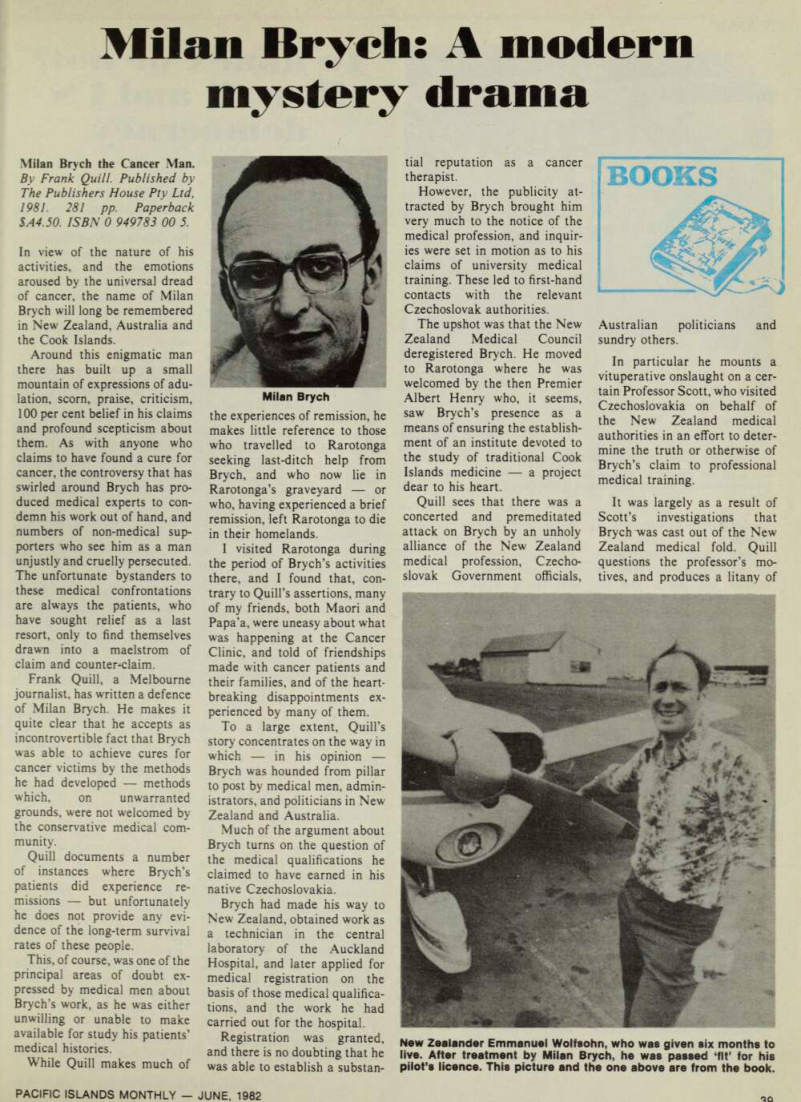
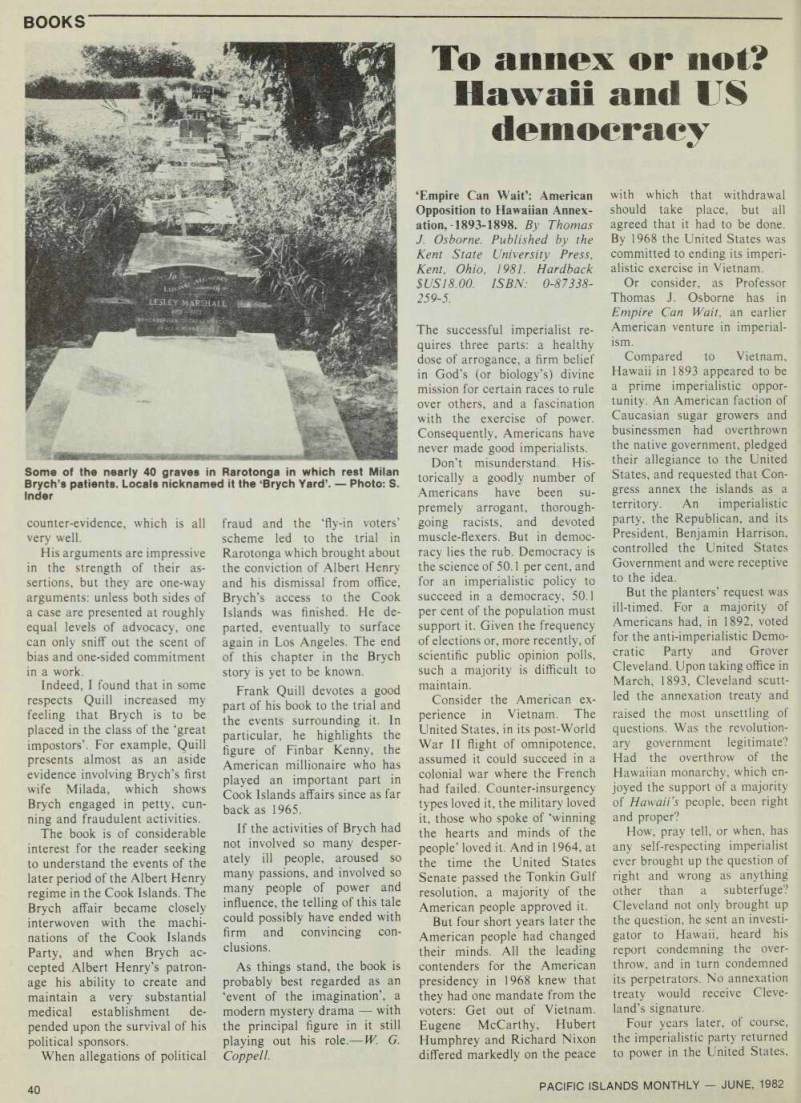
Books
Milan Brych: A modern mystery drama
Milan Brych the Cancer Man.
By Frank Quill. Published by The Publishers House Pty Ltd, 1981. 281 pp. Paperback
5A4.50. Isbn 0 949783 00 5.
In view of the nature of his activities, and the emotions aroused by the universal dread of cancer, the name of Milan Brych will long be remembered in New Zealand, Australia and the Cook Islands.
Around this enigmatic man there has built up a small mountain of expressions of adu lation, scorn, praise, criticism, 100 per cent belief in his claims and profound scepticism about them. As with anyone who claims to have found a cure for cancer, the controversy that has swirled around Brych has pro duced medical experts to con demn his work out of hand, and numbers of non-medical sup porters who see him as a man unjustly and cruelly persecuted.
The unfortunate bystanders to these medical confrontations are always the patients, who have sought relief as a last resort, only to find themselves drawn into a maelstrom of claim and counter-claim.
Frank Quill, a Melbourne journalist, has written a defence of Milan Brych. He makes it quite clear that he accepts as incontrovertible fact that Brych was able to achieve cures for cancer victims by the methods he had developed methods which, on unwarranted grounds, were not welcomed by the conservative medical com munity.
Quill documents a number of instances where Brych’s patients did experience re missions but unfortunately he does not provide any evi dence of the long-term survival rates of these people.
This, of course, was one of the principal areas of doubt ex pressed by medical men about Brych’s work, as he was either unwilling or unable to make available for study his patients’ medical histories.
While Quill makes much of
the experiences of remission, he makes little reference to those who travelled to Rarotonga seeking last-ditch help from Brych, and who now lie in Rarotonga’s graveyard or who, having experienced a brief remission, left Rarotonga to die in their homelands.
I visited Rarotonga during the period of Brych’s activities there, and I found that, con trary to Quill’s assertions, many of my friends, both Maori and Papa’a, were uneasy about what was happening at the Cancer Clinic, and told of friendships made with cancer patients and their families, and of the heart* breaking disappointments ex perienced by many of them.
To a large extent. Quill’s story concentrates on the way in which in his opinion Brych was hounded from pillar to post by medical men, admin istrators, and politicians in New Zealand and Australia.
Much of the argument about Brych turns on the question of the medical qualifications he claimed to have earned in his native Czechoslovakia.
Brych had made his way to New Zealand, obtained work as a technician in the central laboratory of the Auckland Hospital, and later applied for medical registration on the basis of those medical qualifica tions, and the work he had carried out for the hospital.
Registration was granted, and there is no doubting that he was able to establish a substan
tial reputation as a cancer therapist.
However, the publicity at tracted by Brych brought him very much to the notice of the medical profession, and inquir ies were set in motion as to his claims of university medical training. These led to first-hand contacts with the relevant Czechoslovak authorities.
The upshot was that the New Zealand Medical Council deregistered Brych. He moved to Rarotonga where he was welcomed by the then Premier Albert Henry who, it seems, saw Brych’s presence as a means of ensuring the establish ment of an institute devoted to the study of traditional Cook Islands medicine a project dear to his heart.
Quill sees that there was a concerted and premeditated attack on Brych by an unholy alliance of the New Zealand medical profession, Czecho slovak Government officials,
Australian politicians and sundry others.
In particular he mounts a vituperative onslaught on a cer tain Professor Scott, who visited Czechoslovakia on behalf of the New Zealand medical authorities in an effort to deter mine the truth or otherwise of Brych’s claim to professional medical training.
It was largely as a result of Scott’s investigations that Brych-was cast out of the New Zealand medical fold. Quill questions the professor’s mo tives, and produces a litany of
Milan Brych
New Zealander Emmanuel Wolfsohn, who was given six months to live. After treatment by Milan Brych, he was passed ‘fit’ for his pilot’s licence. This picture and the one above are from the book.
counter-evidence, which is all very well.
His arguments are impressive in the strength of their as sertions, but they are one-way arguments: unless both sides of a case are presented at roughly equal levels of advocacy, one can only sniff out the scent of bias and one-sided commitment in a work.
Indeed, I found that in some respects Quill increased my feeling that Brych is to be placed in the class of the ‘great impostors’. For example, Quill presents almost as an aside evidence involving Brych’s first wife Milada, which shows Brych engaged in petty, cun ning and fraudulent activities.
The book is of considerable interest for the reader seeking to understand the events of the later period of the Albert Henry regime in the Cook Islands. The Brych affair became closely interwoven with the machi nations of the Cook Islands Party, and when Brych ac cepted Albert Henry’s patron age his ability to create and maintain a very substantial medical establishment de pended upon the survival of his political sponsors.
When allegations of political
fraud and the ‘fly-in voters’ scheme led to the trial in Rarotonga which brought about the conviction of Albert Henry and his dismissal from office, Brych’s access to the Cook Islands was finished. He de parted, eventually to surface again in Los Angeles. The end of this chapter in the Brych story is yet to be known.
Frank Quill devotes a good part of his book to the trial and the events surrounding it. In particular, he highlights the figure of Finbar Kenny, the American millionaire who has played an important part in Cook Islands affairs since as far back as 1965.
If the activities of Brych had not involved so many desper ately ill people, aroused so many passions, and involved so many people of power and influence, the telling of this tale could possibly have ended with firm and convincing con clusions.
As things stand, the book is probably best regarded as an ‘event of the imagination’, a modern mystery drama with the principal figure in it still
playing out his role.
W G.
Coppell.
Some of the nearly 40 graves in Rarotonga in which rest Milan Brych’s patients. Locals nicknamed it the ‘Brych Yard’. - Photo: S.
Inder
democracy
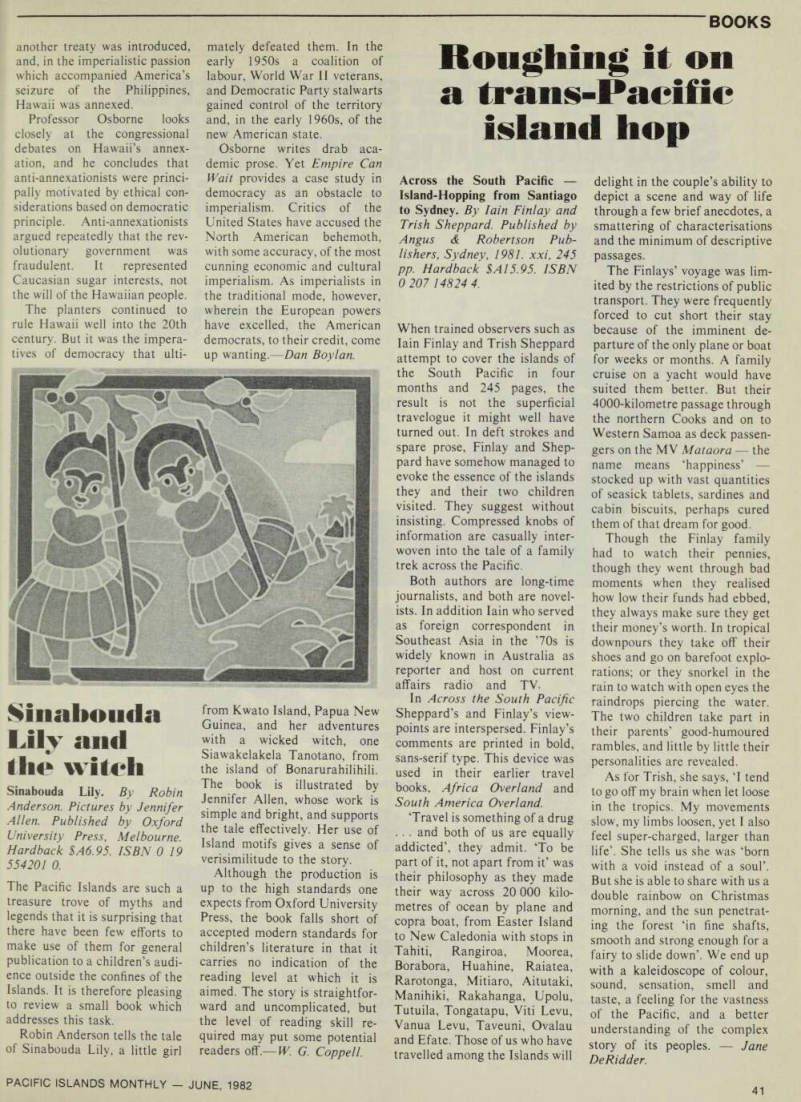
To annex or not?
Hawaii and US democracy
‘Empire Can Wait’: American Opposition to Hawaiian Annex ation, 1893-1898. By Thomas J. Osborne. Published by the Kent State University Press, Kent, Ohio, 1981. Hardback
Sus 18.00. Isbn: 0-87338-
259-5.
The successful imperialist re quires three parts: a healthy dose of arrogance, a firm belief in God’s (or biology’s) divine mission for certain races to rule over others, and a fascination with the exercise of power.
Consequently, Americans have never made good imperialists.
Don’t misunderstand His torically a goodly number of Americans have been su premely arrogant, thorough going racists, and devoted muscle-flexers. But in democ racy lies the rub. Democracy is the science of 50.1 per cent, and for an imperialistic policy to succeed in a democracy, 50.1 per cent of the population must support it. Given the frequency of elections or, more recently, of scientific public opinion polls, such a majority is difficult to maintain.
Consider the American ex perience in Vietnam. The United States, in its post-World War II flight of omnipotence, assumed it could succeed in a colonial war where the French had failed. Counter-insurgency types loved it, the military loved it, those who spoke of ‘winning the hearts and minds of the people’ loved it. And in 1964, at the time the United States Senate passed the Tonkin Gulf resolution, a majority of the American people approved it.
But four short years later the American people had changed their minds. All the leading contenders for the American presidency in 1968 knew that they had one mandate from the voters: Get out of Vietnam.
Eugene McCarthy, Hubert Humphrey and Richard Nixon differed markedly on the peace
with which that withdrawal should take place, but all agreed that it had to be done.
By 1968 the United States was committed to ending its imperi alistic exercise in Vietnam.
Or consider, as Professor Thomas J. Osborne has in Empire Can Wait, an earlier American venture in imperial ism.
Compared to Vietnam, Hawaii in 1893 appeared to be a prime imperialistic oppor tunity. An American faction of Caucasian sugar growers and businessmen had overthrown the native government, pledged their allegiance to the United States, and requested that Con gress annex the islands as a territory. An imperialistic party, the Republican, and its President, Benjamin Harrison, controlled the United States Government and were receptive to the idea.
But the planters’ request was ill-timed. For a majority of Americans had, in 1892, voted for the anti-imperialistic Demo cratic Party and Grover Cleveland. Upon taking office in March, 1893, Cleveland scutt led the annexation treaty and raised the most unsettling of questions. Was the revolution ary government legitimate?
Had the overthrow of the Hawaiian monarchy, which en joyed the support of a majority of Hawaii’s people, been right and proper?
How, pray tell, or when, has any self-respecting imperialist ever brought up the question of right and wrong as anything other than a subterfuge?
Cleveland not only brought up the question, he sent an investi gator to Hawaii, heard his report condemning the over throw, and in turn condemned its perpetrators. No annexation treaty would receive Cleve land’s signature.
Four years later, of course, the imperialistic party returned to power in the United States,
another treaty was introduced, and, in the imperialistic passion which accompanied America’s seizure of the Philippines, Hawaii was annexed.
Professor Osborne looks closely at the congressional debates on Hawaii’s annex ation, and he concludes that anti-annexationists were princi pally motivated by ethical con siderations based on democratic principle. Anti-annexationists argued repeatedly that the rev olutionary government was fraudulent. It represented Caucasian sugar interests, not the will of the Hawaiian people.
The planters continued to rule Hawaii well into the 20th century. But it was the impera tives of democracy that ulti
mately defeated them. In the early 1950 s a coalition of labour, World War II veterans, and Democratic Party stalwarts gained control of the territory and, in the early 19605, of the new American state.
Osborne writes drab aca demic prose. Yet Empire Can Wait provides a case study in democracy as an obstacle to imperialism. Critics of the United States have accused the North American behemoth, with some accuracy, of the most cunning economic and cultural imperialism. As imperialists in the traditional mode, however, wherein the European powers have excelled, the American democrats, to their credit, come up wanting.— Dan Boylan.
Slnahoiida
Lily and
the witeh
Sinabouda Lily. By Robin Anderson. Pictures by Jennifer Allen. Published by Oxford University Press, Melbourne.
Hardback 5A6.95. ISBN 0 19 554201 0.
The Pacific Islands are such a treasure trove of myths and legends that it is surprising that there have been few efforts to make use of them for general publication to a children’s audi ence outside the confines of the Islands. It is therefore pleasing to review a small book which addresses this task.
Robin Anderson tells the tale of Sinabouda Lily, a little girl
from Kwato Island, Papua New Guinea, and her adventures with a wicked witch, one Siawakelakela Tanotano, from the island of Bonarurahilihili.
The book is illustrated by Jennifer Allen, whose work is simple and bright, and supports the tale effectively. Her use of Island motifs gives a sense of verisimilitude to the story.
Although the production is up to the high standards one expects from Oxford University Press, the book falls short of accepted modern standards for children’s literature in that it carries no indication of the reading level at which it is aimed. The story is straightfor ward and uncomplicated, but the level of reading skill re quired may put some potential readers off. — W. G. Coppell.
Island hop
Books
Roughing It on a trans-Pacific Island hop
Across the South Pacific Island-Hopping from Santiago to Sydney. By lain Finlay and Trish Sheppard. Published by Angus & Robertson Pub lishers, Sydney. 1981. xxi, 245 pp. Hardback 5A15.95. ISBN 0 207 14824 4.
When trained observers such as lain Finlay and Trish Sheppard attempt to cover the islands of the South Pacific in four months and 245 pages, the result is not the superficial travelogue it might well have turned out. In deft strokes and spare prose, Finlay and Shep pard have somehow managed to evoke the essence of the islands they and their two children visited. They suggest without insisting. Compressed knobs of information are casually inter woven into the tale of a family trek across the Pacific.
Both authors are long-time journalists, and both are novel ists. In addition lain who served as foreign correspondent in Southeast Asia in the ’7os is widely known in Australia as reporter and host on current affairs radio and TV.
In Across the South Pacific Sheppard’s and Finlay’s view points are interspersed. Finlay’s comments are printed in bold, sans-serif type. This device was used in their earlier travel books, Africa Overland and South America Overland. ‘Travel is something of a drug .. . and both of us are equally addicted’, they admit. To be part of it, not apart from it’ was their philosophy as they made their way across 20 000 kilo metres of ocean by plane and copra boat, from Easter Island to New Caledonia with stops in Tahiti, Rangiroa, Moorea, Borabora, Huahine, Raiatea, Rarotonga, Mitiaro, Aitutaki, Manihiki, Rakahanga, Upolu, Tutuila, Tongatapu, Viti Levu, Vanua Levu, Taveuni, Ovalau and Efate. Those of us who have travelled among the Islands will
delight in the couple’s ability to depict a scene and way of life through a few brief anecdotes, a smattering of characterisations and the minimum of descriptive passages.
The Finlays’ voyage was lim ited by the restrictions of public transport. They were frequently forced to cut short their stay because of the imminent de parture of the only plane or boat for weeks or months. A family cruise on a yacht would have suited them better. But their 4000-kilometre passage through the northern Cooks and on to Western Samoa as deck passen gers on the MV Mataora the name means ‘happiness’ stocked up with vast quantities of seasick tablets, sardines and cabin biscuits, perhaps cured them of that dream for good.
Though the Finlay family had to watch their pennies, though they went through bad moments when they realised how low their funds had ebbed, they always make sure they get their money’s worth. In tropical downpours they take off their shoes and go on barefoot explo rations; or they snorkel in the rain to watch with open eyes the raindrops piercing the water.
The two children take part in their parents’ good-humoured rambles, and little by little their personalities are revealed.
As for Trish, she says, T tend to go off my brain when let loose in the tropics. My movements slow, my limbs loosen, yet I also feel super-charged, larger than life’. She tells us she was ‘born with a void instead of a soul’.
But she is able to share with us a double rainbow on Christmas morning, and the sun penetrat ing the forest ‘in fine shafts, smooth and strong enough for a fairy to slide down’. We end up with a kaleidoscope of colour, sound, sensation, smell and taste, a feeling for the vastness of the Pacific, and a better understanding of the complex
story of its peoples.
Jane
DeRidder.
Advertisements & other items, p. 42 (1 item)
Carpenters Industrial
Shipbuilding and Repairs
in The Sbuth Pacific
T *4 ff ff
kotu
ar 1) M V. Kotu. Third of three passenger-cargo ships for the Solomon Islands. Built for the Marau Shipping Company Limited at our Walu Bay Shipyard This 27 metre, 195 tonnes grt vessel is powered by twin diesel engines. It features: shallow draught; landing craft' bow ramp, and will carry 120 passengers plus cargo of 105 tonnes. The basic design can be modified to suit particular needs.
I 3 2 \ Y^l 4 m. ■■■
C carpenters
II
Industrial
2) New bow section for a ship involved in collision.
Ships up to 1000 tonnes grt, are given professional dock inspection, major repairs, overhauls or refits. 3) Skimming a propeller shaft. Our well equipt shop provides a full and expert machining and fitting service. 4) Fishing vessels tied up at our Walu Bay Wharf for provisioning and repair.
(A DIVISION OF CARPENTERS FIJI LIMITED)
Queens Road, Walu Bay, Suva, Fiji Islands P.O. Box 296 Phone: 312133 Telex FJ2195
Vila in ’38, shipboard politics,
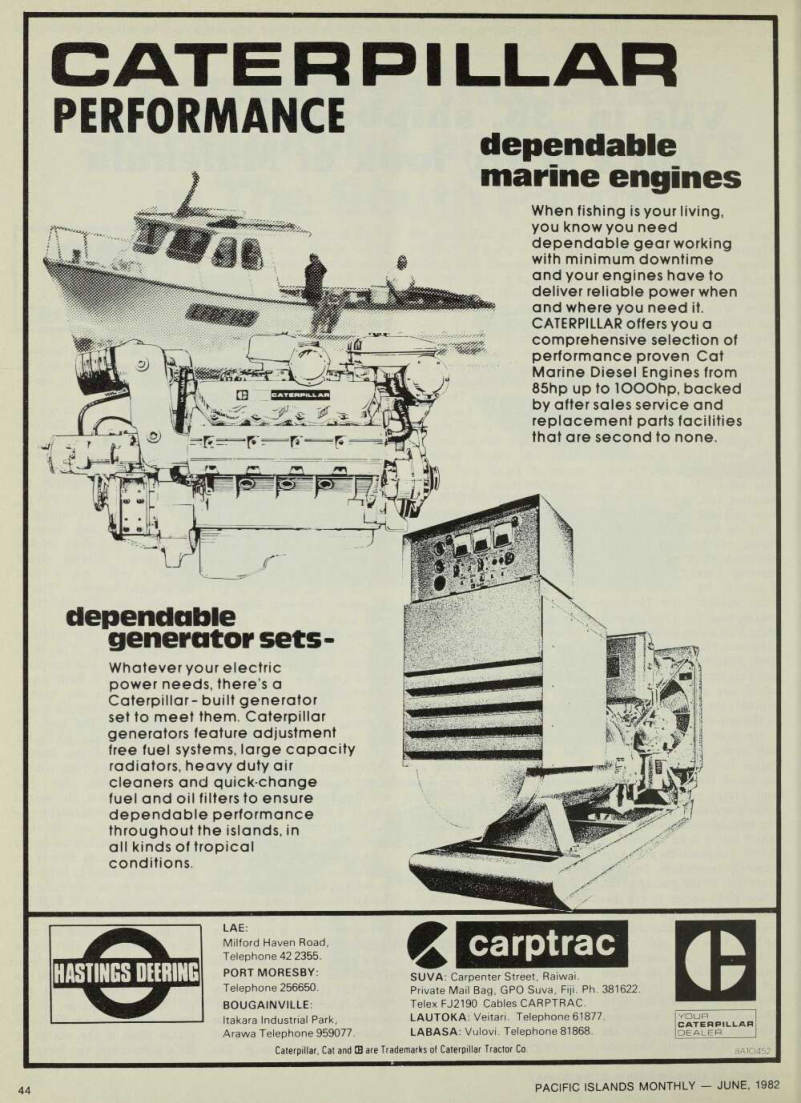
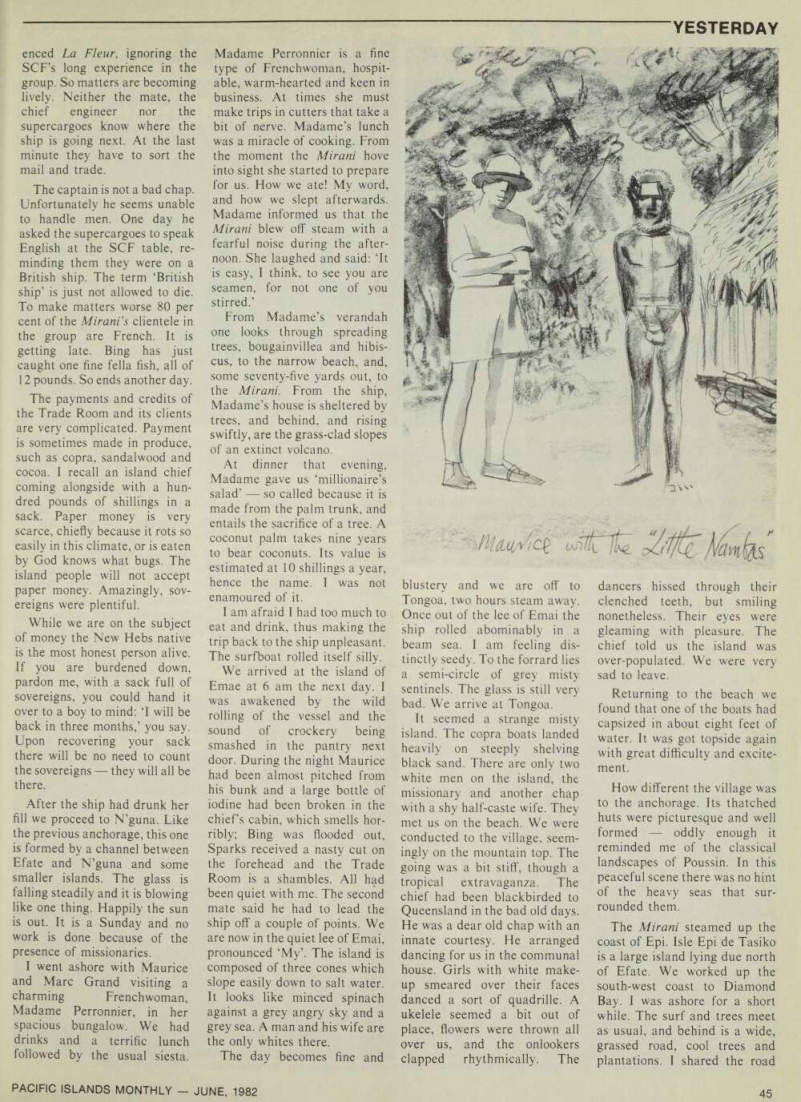
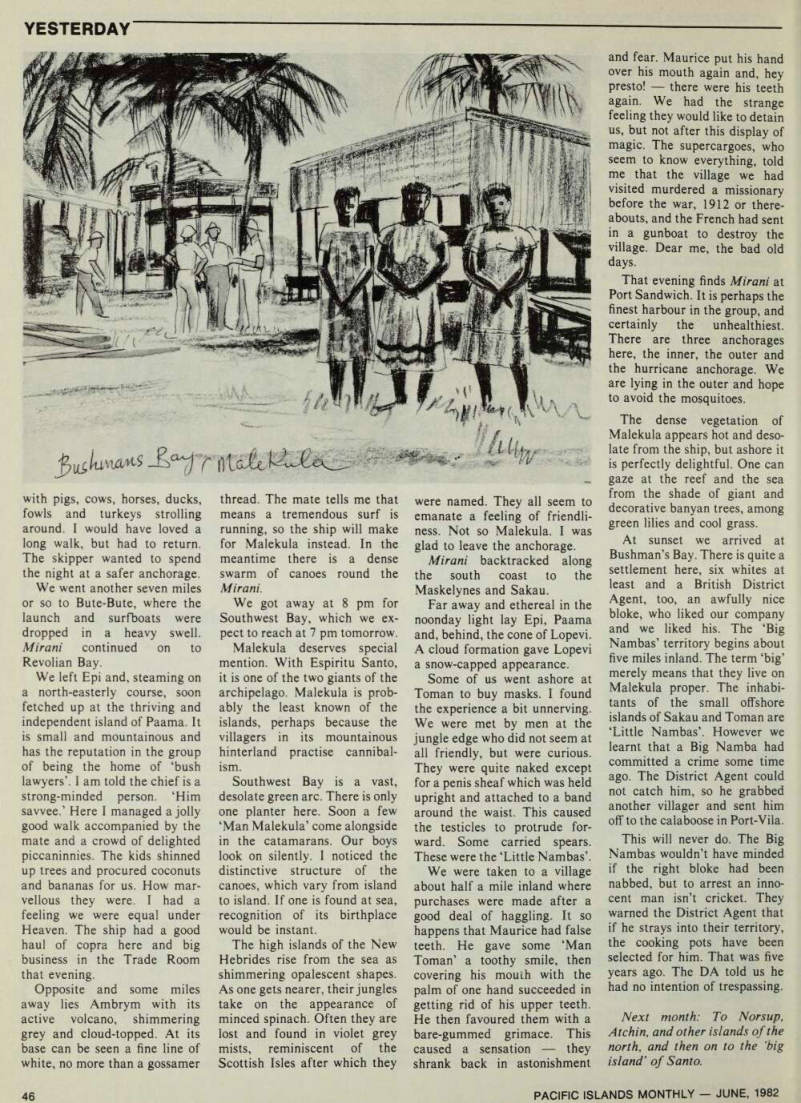
Yesterday
Vila in ’38, shipboard politics, and a scary look at Malekula
In the third of the four-part series of extracts from E. A. HARVEY’S diary of a 1938 trip through the New Hebrides on the inter-island trading vessel Mirani, he returns to Port-Vila from Tanna, and then sets out on a long watery trek through the northern islands of the group.
Back in Vila I stayed with Maurice in his weatherboard cottage and wandered around during his working hours. ‘Main Street’ is on the harbour fore shore. With a few exceptions the buildings face the water.
The biggest are certainly the cavernous SCF (Societe Commerciale Fran9aise) and the even more cavernous Burns Philp South Sea store. One could buy just everything there.
It was a fascinating place.
There were a few crummy little joints facing inwards, in cluding the Club, which wasn’t that small. At the Club, so Maurice said, plantations had been gambled away.
At the western end of Main Street was Madame Reids, a restaurant - cum - cafe - cum meeting - place - for - all - and - sundry. Its terrace almost hung over salt water. The lawn outside went down to high tide.
Here Vila whiles away the late afternoon. Here I was to pour a great quantity of queer drinks down my throat. In the heat, the effect was negligible. This is probably the reason why people in the tropics drink too much.
Up from the harbour, little side streets climb steeply to a higher level, where fine villas are found. Here live the British and French oligarchy. Their villas are almost concealed by the tropical lushness of growth which seems to be endlessly in flower. Pawpaw trees grew hap hazardly everywhere, dropping their fruit on the ground to rot.
I was given apples to eat that were imported from Australia and not in the best condition, to boot. How very odd!
I dined, of course, at Madame Reids with the Mirani lot and some from the Polynesian. We were served by Doy, a mournful Tonkinese, who had done 12 years for the murder of his family. Everyone
is chaffing Doy and asking him when he is going to cut off a solitary five-inch hair growing from his chin. Doy informs us that the good God gave it to him, and the only time he cut it off he became sick.
At dinner-time we were served by Lucy. She is a Kanaka girl who wears a very dashing bodice. She has her leg pulled unmercifully. The drill is to look coyly at Lucy I managed it rather well over my glasses. Lucy has to drop the plates and slouch behind a screen to giggle until we are compelled to say Qa va Lucy, viens id’. Lucy speaks French, Tonkinese and, of course, Biche le Mer (today’s Bislama) fluently. She is barefoot.
Charles reckons there would be no shoes on the island to fit her.
I visited the English Hos pital, located on its island. It was a large wooden building surrounded by lawns and shady trees. On its wide verandahs the native sick lay on mattresses placed upon the floor. Admit tedly the floors were cleaner than the Mirani’s decks. I was shown the nursery with its new born. The babies were in cribs and under mosquito netting.
The netting was very holey and looked very grey to me. I am told a lot of Frenchwomen prefer the English hospital for their confinement, because the French hospital is a military establishment, where they do not give anaesthetics for a mere childbirth. The English Sisters are a cheerful, dedicated lot. I asked one about germs. She laughed and said: ‘The Trade Winds blow them in and blow them out again.’
The little town is a hazardous place to navigate at night.
Street lighting is almost non existent and when the moon is new or passing out, pitch black ness reigns. Literally you have
to grope your way along. If native women are advancing down the road towards you, the effect is most disconcerting. All you see are the pale ‘Mother Hubbards’ bearing down on you. The occupants of the dresses have melted into the darkness.
I must not forget the Cala boose, the gaol. It seemed to be a shed right on the street. The door was open and a prisoner leaned against the jamb, survey ing the scene in a bored way.
The sentry was absent, doubt less momentarily. Seeing my interest, the prisoner showed me his gleaming white teeth in a wide friendly smile. I am sure it would not have occurred to him to attempt to escape. What on earth for? Port-Vila does have its charms.
At 9 am one morning we are off again. The ship hugs the west coast and in due course reaches Port Havannah. The ‘Port’ is an enormously long harbour caused by a tiny island called Deception hugging the northwest coast of Vate (Efate).
Here is the best hurricane anchorage in the group, and here we stayed some hours, watering. Long troughs carried spring water to the shore. Here it was loaded on the surfboats and towed to the ship. Seventy tons of it were for the boilers.
The Mirani is starting to simmer again. Maurice and Co start to complain loudly about the food it really is bad. Sam is ordered to go to the Trade Room: ‘You catchem two tin, no more, Pate de Foie Gras. Carry me come!’ None is sent to the captain’s table. Bit mean! We drink good wine from the Trade Room. The others in the saloon swig lime juice. The other day the cook sent in pork chops, almost cold. They were three inches thick with five inches of fat. An uproar followed. The
pork was consigned to the deep.
The skipper waded through his and left the saloon in annoy ance.
My friends tried to tell me the politics of it all. The only market for the New Hebs copra is France hence the presence of the SCF, I gathered. The voices went on: BP Sydney, BP Vila, BP London, SCF Vila, SCF Paris. I was starting to nod. Paris my memory turned over to my own student days there . . . Jerking myself awake I said: ‘Ah, a most complicated business.’ ‘You’ve no idea,’ said Charles. How right he was.
The most extraordinary jealousies go on. The ship’s various ports of call are deter mined by SCF’s head super cargo. He tells the captain where to go. The captain is new, promoted from the main BP line, where he was a third mate, to command of the Mirani.
Doubtless he had been told the modus operandi but just couldn’t believe it. He wanted to run the ship naturally, one would think, but not this ship.
The Trade Room told me darkly that he made such a mess of the providoring he had to hand that chore over to the wireless oper ator. Previously the SCF did the providoring without any trouble. It is claimed the cap tain interferes in the engine room, bringing upon his head the wrath of the chief, who has seen three captains come and go. He takes charge of the boat’s crews from the SCF and places them in the charge of BP’s supercargo, the inexperi
enced La Fleur, ignoring the SCF’s long experience in the group. So matters are becoming lively. Neither the mate, the chief engineer nor the supercargoes know where the ship is going next. At the last minute they have to sort the mail and trade.
The captain is not a bad chap.
Unfortunately he seems unable to handle men. One day he asked the supercargoes to speak English at the SCF table, re minding them they were on a British ship. The term ‘British ship’ is just not allowed to die.
To make matters worse 80 per cent of the Mirani s clientele in the group are French. It is getting late. Bing has just caught one fine fella fish, all of 12 pounds. So ends another day.
The payments and credits of the Trade Room and its clients are very complicated. Payment is sometimes made in produce, such as copra, sandalwood and cocoa. I recall an island chief coming alongside with a hun dred pounds of shillings in a sack. Paper money is very scarce, chiefly because it rots so easily in this climate, or is eaten by God knows what bugs. The island people will not accept paper money. Amazingly, sov ereigns were plentiful.
While we are on the subject of money the New Hebs native is the most honest person alive.
If you are burdened down, pardon me, with a sack full of sovereigns, you could hand it over to a boy to mind: T will be back in three months,’ you say.
Upon recovering your sack there will be no need to count the sovereigns they will all be there.
After the ship had drunk her fill we proceed to N’guna. Like the previous anchorage, this one is formed by a channel between Efate and N’guna and some smaller islands. The glass is falling steadily and it is blowing like one thing. Happily the sun is out. It is a Sunday and no work is done because of the presence of missionaries.
I went ashore with Maurice and Marc Grand visiting a
charming Frenchwoman,
Madame Perronnier, in her spacious bungalow. We had drinks and a terrific lunch followed by the usual siesta.
Madame Perronnier is a fine type of Frenchwoman, hospit able, warm-hearted and keen in business. At times she must make trips in cutters that take a bit of nerve. Madame’s lunch was a miracle of cooking. From the moment the Mirani hove into sight she started to prepare for us. How we ate! My word, and how we slept afterwards.
Madame informed us that the Mirani blew off steam with a fearful noise during the after noon. She laughed and said: Tt is easy, I think, to see you are seamen, for not one of you stirred.’
From Madame’s verandah one looks through spreading trees, bougainvillea and hibis cus, to the narrow beach, and, some seventy-five yards out, to the Mirani. From the ship, Madame’s house is sheltered by trees, and behind, and rising swiftly, are the grass-clad slopes of an extinct volcano.
At dinner that evening, Madame gave us ‘millionaire’s salad’ - so called because it is made from the palm trunk, and entails the sacrifice of a tree. A coconut palm takes nine years to bear coconuts. Its value is estimated at 10 shillings a year, hence the name. I was not enamoured of it.
I am afraid I had too much to eat and drink, thus making the trip back to the ship unpleasant.
The surfboat rolled itself silly.
We arrived at the island of Emae at 6 am the next day. I was awakened by the wild rolling of the vessel and the sound of crockery being smashed in the pantry next door. During the night Maurice had been almost pitched from his bunk and a large bottle of iodine had been broken in the chief’s cabin, which smells hor ribly; Bing was flooded out, Sparks received a nasty cut on the forehead and the Trade Room is a shambles. All had been quiet with me. The second mate said he had to lead the ship off a couple of points. We are now in the quiet lee of Emai, pronounced ‘My’. The island is composed of three cones which slope easily down to salt water.
It looks like minced spinach against a grey angry sky and a grey sea. A man and his wife are the only whites there.
The day becomes fine and
blustery and we are off to Tongoa, two hours steam away.
Once out of the lee of Emai the ship rolled abominably in a beam sea. 1 am feeling dis tinctly seedy. To the forrard lies a semi-circle of grey misty sentinels. The glass is still very bad. We arrive at Tongoa.
It seemed a strange misty island. The copra boats landed heavily on steeply shelving black sand. There are only two white men on the island, the missionary and another chap with a shy half-caste wife. They met us on the beach. We were conducted to the village, seem ingly on the mountain top. The going was a bit stiff, though a tropical extravaganza. The chief had been blackbirded to Queensland in the bad old days.
He was a dear old chap with an innate courtesy. He arranged dancing for us in the communal house. Girls with white make up smeared over their faces danced a sort of quadrille. A ukelele seemed a bit out of place, flowers were thrown all over us, and the onlookers clapped rhythmically. The
dancers hissed through their clenched teeth, but smiling nonetheless. Their eyes were gleaming with pleasure. The chief told us the island was over-populated. We were very sad to leave, Returning to the beach we found that one of the boats had capsized in about eight feet of water. It was got topside again with g rea t difficulty and excite ment ¥T How different the village was t 0 the anchorage. Its thatched l" uts w f re P ictures fl“e and well formed oddly enough it reminded me of the classical of Poussin. In this peaceful scene there was no hint eav y seas fo at sur " rounded them.
The Mirani steamed up the coast of Epi. Isle Epi de Tasiko is a large island lying due north of Efate. We worked up the south-west coast to Diamond Bay. I was ashore for a short while. The surf and trees meet as usual, and behind is a wide, grassed road, cool trees and plantations. I shared the road
with pigs, cows, horses, ducks, fowls and turkeys strolling around. I would have loved a long walk, but had to return.
The skipper wanted to spend the night at a safer anchorage.
We went another seven miles or so to Bute-Bute, where the launch and surfboats were dropped in a heavy swell.
Mirani continued on to Revolian Bay.
We left Epi and, steaming on a north-easterly course, soon fetched up at the thriving and independent island of Paama. It is small and mountainous and has the reputation in the group of being the home of ‘bush lawyers’. I am told the chief is a strong-minded person. ‘Him savvee.’ Here I managed a jolly good walk accompanied by the mate and a crowd of delighted piccaninnies. The kids shinned up trees and procured coconuts and bananas for us. How mar vellous they were. I had a feeling we were equal under Heaven. The ship had a good haul of copra here and big business in the Trade Room that evening.
Opposite and some miles away lies Ambrym with its active volcano, shimmering grey and cloud-topped. At its base can be seen a fine line of white, no more than a gossamer
thread. The mate tells me that means a tremendous surf is running, so the ship will make for Malekula instead. In the meantime there is a dense swarm of canoes round the Mirani.
We got away at 8 pm for Southwest Bay, which we ex pect to reach at 7 pm tomorrow.
Malekula deserves special mention. With Espiritu Santo, it is one of the two giants of the archipelago. Malekula is prob ably the least known of the islands, perhaps because the villagers in its mountainous hinterland practise cannibal ism.
Southwest Bay is a vast, desolate green arc. There is only one planter here. Soon a few ‘Man Malekula’ come alongside in the catamarans. Our boys look on silently. I noticed the distinctive structure of the canoes, which vary from island to island. If one is found at sea, recognition of its birthplace would be instant.
The high islands of the New Hebrides rise from the sea as shimmering opalescent shapes.
As one gets nearer, their jungles take on the appearance of minced spinach. Often they are lost and found in violet grey mists, reminiscent of the Scottish Isles after which they
were named. They all seem to emanate a feeling of friendli ness. Not so Malekula. I was glad to leave the anchorage.
Mirani backtracked along the south coast to the Maskelynes and Sakau.
Far away and ethereal in the noonday light lay Epi, Paama and, behind, the cone of Lopevi.
A cloud formation gave Lopevi a snow-capped appearance.
Some of us went ashore at Toman to buy masks. I found the experience a bit unnerving.
We were met by men at the jungle edge who did not seem at all friendly, but were curious.
They were quite naked except for a penis sheaf which was held upright and attached to a band around the waist. This caused the testicles to protrude for ward. Some carried spears.
These were the ‘Little Nambas’.
We were taken to a village about half a mile inland where purchases were made after a good deal of haggling. It so happens that Maurice had false teeth. He gave some ‘Man Toman’ a toothy smile, then covering his mouth with the palm of one hand succeeded in getting rid of his upper teeth.
He then favoured them with a bare-gummed grimace. This caused a sensation they shrank back in astonishment
and fear. Maurice put his hand over his mouth again and, hey presto! there were his teeth again. We had the strange feeling they would like to detain us, but not after this display of magic. The supercargoes, who seem to know everything, told me that the village we had visited murdered a missionary before the war, 1912 or there abouts, and the French had sent in a gunboat to destroy the village. Dear me, the bad old days.
That evening finds Mirani at Port Sandwich. It is perhaps the finest harbour in the group, and certainly the unhealthiest.
There are three anchorages here, the inner, the outer and the hurricane anchorage. We are lying in the outer and hope to avoid the mosquitoes.
The dense vegetation of Malekula appears hot and deso late from the ship, but ashore it is perfectly delightful. One can gaze at the reef and the sea from the shade of giant and decorative banyan trees, among green lilies and cool grass.
At sunset we arrived at Bushman’s Bay. There is quite a settlement here, six whites at least and a British District Agent, too, an awfully nice bloke, who liked our company and we liked his. The ‘Big Nambas’ territory begins about five miles inland. The term ‘big’ merely means that they live on Malekula proper. The inhabi tants of the small offshore islands of Sakau and Toman are ‘Little Nambas’. However we learnt that a Big Namba had committed a crime some time ago. The District Agent could not catch him, so he grabbed another villager and sent him off to the calaboose in Port-Vila.
This will never do. The Big Nambas wouldn’t have minded if the right bloke had been nabbed, but to arrest an inno cent man isn’t cricket. They warned the District Agent that if he strays into their territory, the cooking pots have been selected for him. That was five years ago. The DA told us he had no intention of trespassing.
Next month: To Norsup, Atchin, and other islands of the north, and then on to the ‘big island’ of Santo.
Advertisements & other items, pp. 44-48 (1 item)
Cate R Pi Llar
PERFORMANCE
dependable
marine engines
When fishing is your living, you know you need dependable gear working with minimum downtime and your engines have to deliver reliable power when and where you need it.
CATERPILLAR offers you a comprehensive selection of performance proven Cat Marine Diesel Engines from 85hp up to IOOOhp, backed by after sales service and replacement parts facilities that are second to none. r /TV LB LJ U . >
HASTINGS DURING
YOUR
CATERPILLAR
DEALER
dependable
Whatever your electric power needs, there’s a Caterpillar- built generator set to meet them. Caterpillar generators feature adjustment free fuel systems, large capacity radiators, heavy duty air cleaners and quick-change fuel and oil filters to ensure dependable performance throughout the islands, in all kinds of tropical conditions.
LAE:
Milford Haven Road, Telephone 42 2355.
PORT MORESBY:
Telephone 256650.
BOUGAINVILLE:
Itakara Industrial Park, Arawa Telephone 959077
carptrac
SUVA: Carpenter Street, Raiwai.
Private Mail Bag, GPO Suva, Fiji. Ph. 381622.
Telex FJ2190 Cables CARPTRAC.
LAUTOKA: Veitari. Telephone 61877.
LABASA; Vulovi. Telephone 81868.
Caterpillar, Cat and CB are Trademarks of Caterpillar Tractor Co 8A10452
Komatsu flakes a Difference
u At‘ V m In critical areas like reliability and performance, Komatsu products and systems are making a significant difference at mining and construction sites around the world.
In the USA, for example, Komatsu’s largest and most powerful work machine the D455A bulldozer is establishing a superior record of reliability and productivity at mining sites that virtually no other machine in its class can match.
And in another critical area, technology, Komatsu is also making a difference in responding to market demands for improved product quality, and for new and original product innovations.
Consider our new computerized seabed robot system: Operating on the ocean floor, it can relay TV pictures of the seabed to a mother ship, or perform man-like boring, drilling and piling operations down to planned depths of 500 meters* Discover the Komatsu difference above sea level, or down to depths of 500 meters. Komatsu a name you can build on.
•§• KOMATSU LTD
Tokyo, Japan Komatsu offices: Tokyo, Sydney, Singapore, Jakarta, Manila, Bangkok, Bangalore, Karachi, Beijing, Istanbul, Cairo, Alger, Dubai, Tehran, Baghdad, Jeddah, Riyadh, Damman, Nairobi, Abidjan, Lagos, Johannesburg, Moscow, Warsaw, Brussels, Pans, Madrid, Frankfurt, Stuttgart, London, Habana, Buenos Aires, Panama, Caracas, Sao Paulo, Bogota, Mexico City, San Francisco, Oakland, Philadelphia, Detroit, Dallas, Atlanta, Chicago, Toronto, Vancouver, and distributors in over 100 countries around the world.
I m V The Komatsu seabed robot system is currently operating in the Japan Inland Sea at depths down to a maximum of 70 meters, in a government-sponsored bridge works program
Expert
Insurance Service
throughout the islands
Queensland Insurance (Fiji) Limited
Head Office, 34 Usher St., SUVA . General Manager: L. G. Liddell A.A.1.1. Assistant Managers: R. Jackson, Vijay Lai. Phone: 23851.
LAUTOKA OFFICE: Burns Philp Bldg., Naviti St. District Manager: J. Dalton. Phone: 60642.
LABASA OFFICE: Burns Philp Bldg. District Manager: R. SHARMA. Phone: 82139
Queensland Insurance (PNG) Limited
PAPUA NEW GUINEA
Head Office, B.N.G. Building, Musgrave St..PORT MORESBY. General Manager: J. M. Dawe.
Phone: 21 2144.
LAE: 4th St. & Coronation Drive. District Manager: C. D, Hillier Phone: 423873.
MOUNT HAGEN; Hagen Drive. District Manager: G. W. Jack Phone: 521002, ARAWA: Chebu St. District Manager: J. Longbut. Phone: 951555.
MADANG: Kasagten St. District Manager: N. D. Ramage. Phone: 822020.
RABAUL; Wirraway St. District Manager: W. F. Tinker. Phone: 921014.
QBE Insurance (International) Limited
VANUATU, PORT VILA: Rue de Paris, Suite 19,Oceania Bldg. Manager; I. R. Martin.
Phone; 2299.
SANTO: Burns Philp (Vanuatu) Ltd. Phone: 230.
PACIFIC AGENCIES
NEW CALEDONIA: Ste. W. A. Johnston, S.A.R.L. 5 Rue Anatole France, NOUMEA Phone: 272083.
TAHITI Arthur Chung. Immeuble 8.1.5., Front de Mer, PAPEETE . Phone: 2.86.19.
NIUE: Burns Philp (South Sea) Company Ltd.
NORFOLK ISLAND: Burns Philp ('N I ) Company Ltd. Phone: 2191.
SAMOA: APIA, Burns Philp (South Sea) Company Ltd. Phone: 22611.
TONGA: Burns Philp (South Sea) Company Ltd. NUKUALOFA. Phone 21500 HAAPAI, VAVAU
MEMBERS OF THE;
INSURANCE GROUP LIMITED
The high cost of vehicle imports:
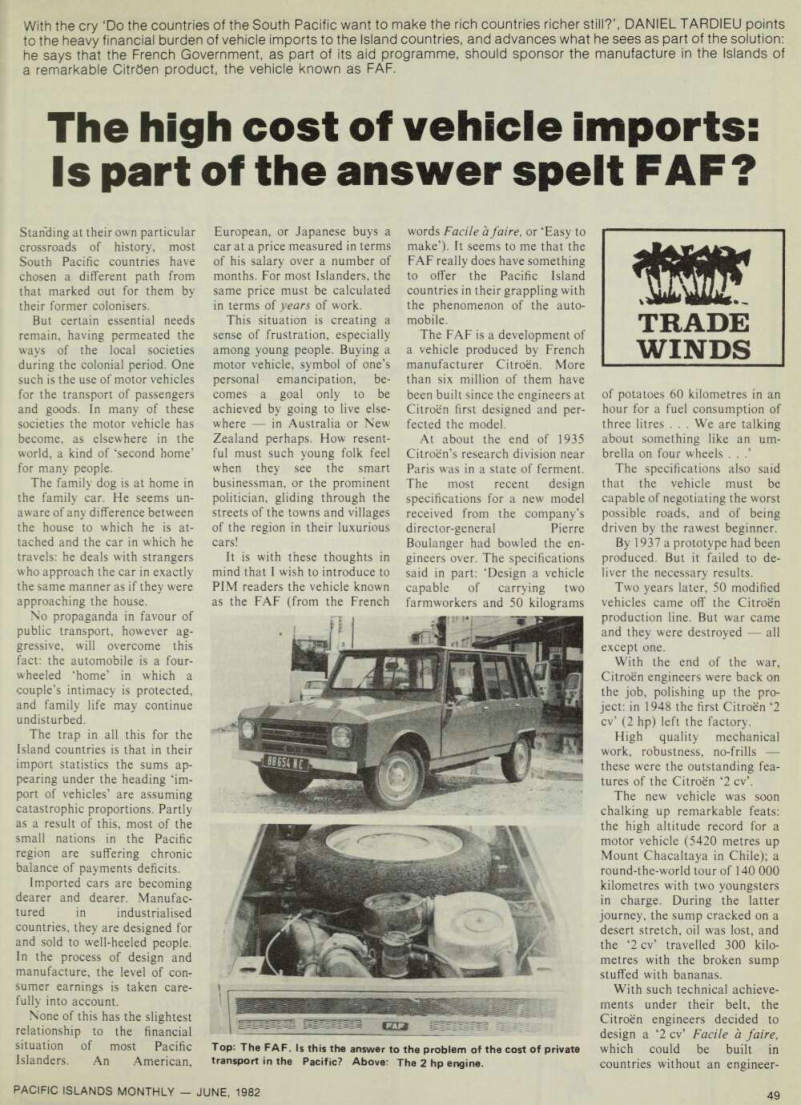

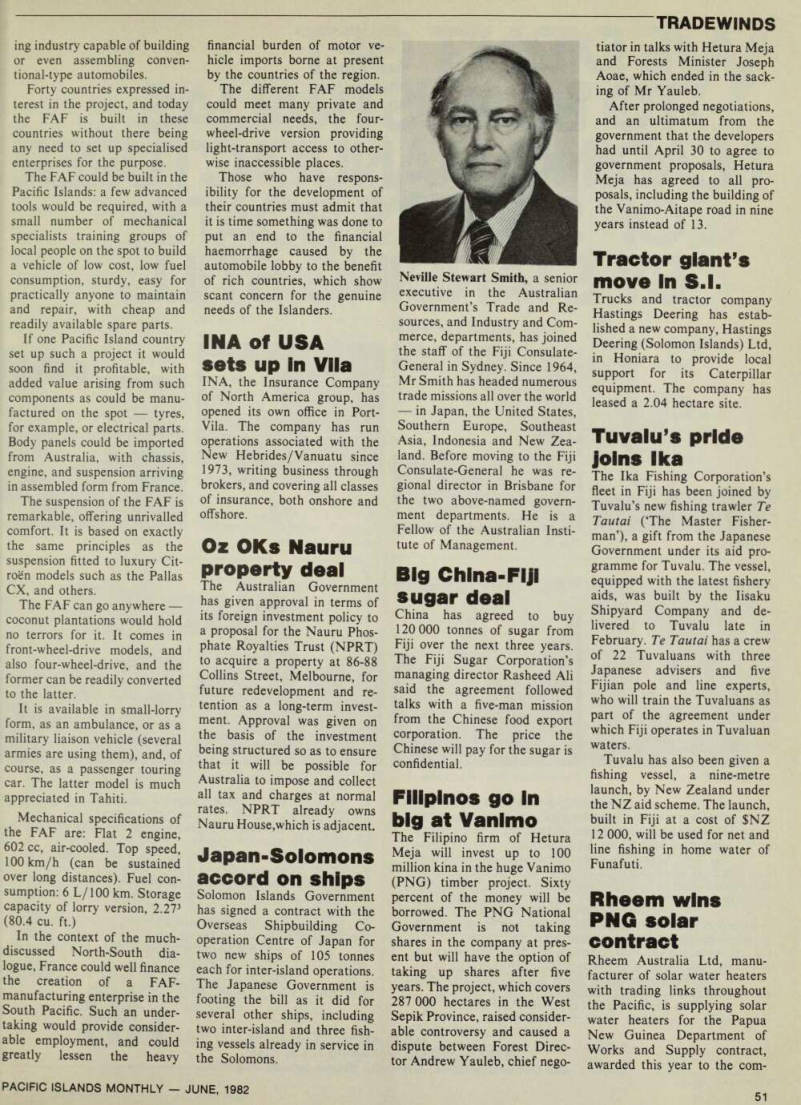
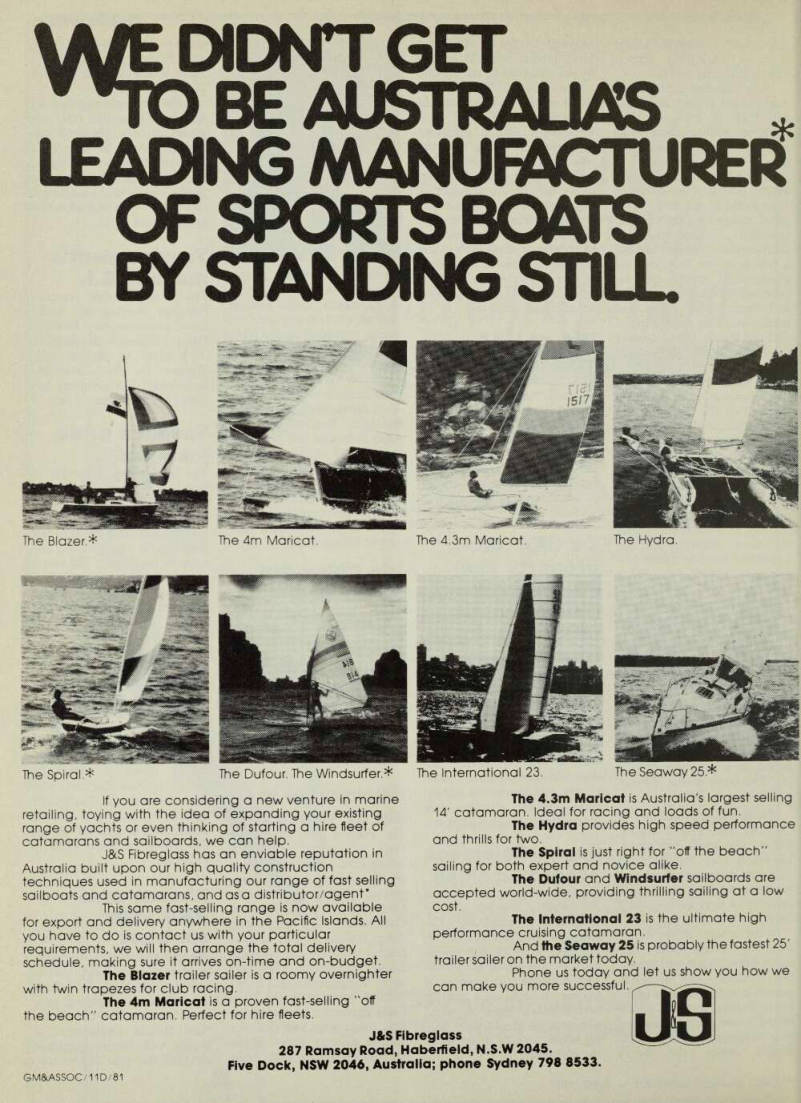
Trade
Winds
The high cost of vehicle imports: Is part of the answer spelt FAF?
With the cry ‘Do the countries of the South Pacific want to make the rich countries richer still?’, DANIEL TARDIEU points to the heavy financial burden of vehicle imports to the Island countries, and advances what he sees as part of the solution: he says that the French Government, as part of its aid programme, should sponsor the manufacture in the Islands of a remarkable Citrden product, the vehicle known as FAF.
Standing at their own particular crossroads of history, most South Pacific countries have chosen a different path from that marked out for them by their former colonisers.
But certain essential needs remain, having permeated the ways of the local societies during the colonial period. One such is the use of motor vehicles for the transport of passengers and goods. In many of these societies the motor vehicle has become, as elsewhere in the world, a kind of ‘second home’ for many people.
The family dog is at home in the family car. He seems un aware of any difference between the house to which he is at tached and the car in which he travels; he deals with strangers who approach the car in exactly the same manner as if they were approaching the house.
No propaganda in favour of public transport, however ag gressive, will overcome this fact: the automobile is a four wheeled ‘home’ in which a couple’s intimacy is protected, and family life may continue undisturbed.
The trap in all this for the Island countries is that in their import statistics the sums ap pearing under the heading ‘im port of vehicles’ are assuming catastrophic proportions. Partly as a result of this, most of the small nations in the Pacific region are suffering chronic balance of payments deficits.
Imported cars are becoming dearer and dearer. Manufac tured in industrialised countries, they are designed for and sold to well-heeled people.
In the process of design and manufacture, the level of con sumer earnings is taken care fully into account.
None of this has the slightest relationship to the financial situation of most Pacific Islanders. An American,
European, or Japanese buys a car at a price measured in terms of his salary over a number of months. For most Islanders, the same price must be calculated in terms of years of work.
This situation is creating a sense of frustration, especially among young people. Buying a motor vehicle, symbol of one’s personal emancipation, be comes a goal only to be achieved by going to live else where in Australia or New Zealand perhaps. How resent ful must such young folk feel when they see the smart businessman, or the prominent politician, gliding through the streets of the towns and villages of the region in their luxurious cars!
It is with these thoughts in mind that I wish to introduce to PIM readers the vehicle known as the FAF (from the French
words Facile a faire, or ‘Easy to make’). It seems to me that the FAF really does have something to offer the Pacific Island countries in their grappling with the phenomenon of the auto mobile.
The FAF is a development of a vehicle produced by French manufacturer Citroen. More than six million of them have been built since the engineers at Citroen first designed and per fected the model.
At about the end of 1935 Citroen’s research division near Paris was in a state of ferment.
The most recent design specifications for a new model received from the company’s director-general Pierre Boulanger had bowled the en gineers over. The specifications said in part: ‘Design a vehicle capable of carrying two farmworkers and 50 kilograms
of potatoes 60 kilometres in an hour for a fuel consumption of three litres . . . We are talking about something like an um brella on four wheels . .
The specifications also said that the vehicle must be capable of negotiating the worst possible roads, and of being driven by the rawest beginner.
By 1937 a prototype had been produced. But it failed to de liver the necessary results.
Two years later, 50 modified vehicles came off the Citroen production line. But war came and they were destroyed all except one.
With the end of the war, Citroen engineers were back on the job, polishing up the pro ject; in 1948 the first Citroen ‘2 cv’ (2 hp) left the factory.
High quality mechanical work, robustness, no-frills these were the outstanding fea tures of the Citroen ‘2 cv’.
The new vehicle was soon chalking up remarkable feats: the high altitude record for a motor vehicle (5420 metres up Mount Chacaltaya in Chile); a round-the-world tour of 140 000 kilometres with two youngsters in charge. During the latter journey, the sump cracked on a desert stretch, oil was lost, and the ‘2 cv’ travelled 300 kilo metres with the broken sump stuffed with bananas.
With such technical achieve ments under their belt, the Citroen engineers decided to design a ‘2 cv’ Facile a faire, which could be built in countries without an engineer
Top: The FAF. Is this the answer to the problem of the cost of private transport in the Pacific? Above: The 2 hp engine.
ing industry capable of building or even assembling conven tional-type automobiles.
Forty countries expressed in terest in the project, and today the FAF is built in these countries without there being any need to set up specialised enterprises for the purpose.
The FAF could be built in the Pacific Islands; a few advanced tools would be required, with a small number of mechanical specialists training groups of local people on the spot to build a vehicle of low cost, low fuel consumption, sturdy, easy for practically anyone to maintain and repair, with cheap and readily available spare parts.
If one Pacific Island country set up such a project it would soon find it profitable, with added value arising from such components as could be manu factured on the spot tyres, for example, or electrical parts.
Body panels could be imported from Australia, with chassis, engine, and suspension arriving in assembled form from France.
The suspension of the FAF is remarkable, offering unrivalled comfort. It is based on exactly the same principles as the suspension fitted to luxury Cit roen models such as the Pallas CX, and others.
The FAF can go anywhere coconut plantations would hold no terrors for it. It comes in front-wheel-drive models, and also four-wheel-drive, and the former can be readily converted to the latter.
It is available in small-lorry form, as an ambulance, or as a military liaison vehicle (several armies are using them), and, of course, as a passenger touring car. The latter model is much appreciated in Tahiti.
Mechanical specifications of the FAF are: Flat 2 engine, 602 cc, air-cooled. Top speed, 100 km/h (can be sustained over long distances). Fuel con sumption: 6 L/100 km. Storage capacity of lorry version, 2.27 3 (80.4 cu. ft.) In the context of the much discussed North-South dia logue, France could well finance the creation of a FAF manufacturing enterprise in the South Pacific. Such an under taking would provide consider able employment, and could greatly lessen the heavy
financial burden of motor ve hicle imports borne at present by the countries of the region.
The different FAF models could meet many private and commercial needs, the four wheel-drive version providing light-transport access to other wise inaccessible places.
Those who have respons ibility for the development of their countries must admit that it is time something was done to put an end to the financial haemorrhage caused by the automobile lobby to the benefit of rich countries, which show scant concern for the genuine needs of the Islanders.
Ina Of Usa
sets up in Vila
INA, the Insurance Company of North America group, has opened its own office in Port- Vila. The company has run operations associated with the New Hebrides/Vanuatu since 1973, writing business through brokers, and covering all classes of insurance, both onshore and offshore.
Oz OKs Nauru
property deal
The Australian Government has given approval in terms of its foreign investment policy to a proposal for the Nauru Phos phate Royalties Trust (NPRT) to acquire a property at 86-88 Collins Street, Melbourne, for future redevelopment and re tention as a long-term invest ment. Approval was given on the basis of the investment being structured so as to ensure that it will be possible for Australia to impose and collect all tax and charges at normal rates. NPRT already owns Nauru House,which is adjacent.
Japan-Solomons
accord on ships
Solomon Islands Government has signed a contract with the Overseas Shipbuilding Co operation Centre of Japan for two new ships of 105 tonnes each for inter-island operations.
The Japanese Government is footing the bill as it did for several other ships, including two inter-island and three fish ing vessels already in service in the Solomons.
Neville Stewart Smith, a senior executive in the Australian Government’s Trade and Re sources, and Industry and Com merce, departments, has joined the staff of the Fiji Consulate- General in Sydney. Since 1964, Mr Smith has headed numerous trade missions all over the world in Japan, the United States, Southern Europe, Southeast Asia, Indonesia and New Zea land. Before moving to the Fiji Consulate-General he was re gional director in Brisbane for the two above-named govern ment departments. He is a Fellow of the Australian Insti tute of Management.
Big China-Fiji
sugar deal
China has agreed to buy 120 000 tonnes of sugar from Fiji over the next three years.
The Fiji Sugar Corporation’s managing director Rasheed Ali said the agreement followed talks with a five-man mission from the Chinese food export corporation. The price the Chinese will pay for the sugar is confidential.
Filipinos go in
big at Vanimo
The Filipino firm of Hetura Meja will invest up to 100 million kina in the huge Vanimo (PNG) timber project. Sixty percent of the money will be borrowed. The PNG National Government is not taking shares in the company at pres ent but will have the option of taking up shares after five years. The project, which covers 287 000 hectares in the West Sepik Province, raised consider able controversy and caused a dispute between Forest Direc tor Andrew Yauleb, chief nego
tiator in talks with Hetura Meja and Forests Minister Joseph Aoae, which ended in the sack ing of Mr Yauleb.
After prolonged negotiations, and an ultimatum from the government that the developers had until April 30 to agree to government proposals, Hetura Meja has agreed to all pro posals, including the building of the Vanimo-Aitape road in nine years instead of 13.
Tractor giant’s
move In S.l.
Trucks and tractor company Hastings Deering has estab lished a new company, Hastings Deering (Solomon Islands) Ltd, in Honiara to provide local support for its Caterpillar equipment. The company has leased a 2.04 hectare site.
Tuvalu’s pride
Joins Ika
The Ika Fishing Corporation’s fleet in Fiji has been joined by Tuvalu’s new fishing trawler Te Tautai (‘The Master Fisher man’), a gift from the Japanese Government under its aid pro gramme for Tuvalu. The vessel, equipped with the latest fishery aids, was built by the lisaku Shipyard Company and de livered to Tuvalu late in February. Te Tautai has a crew of 22 Tuvaluans with three Japanese advisers and five Fijian pole and line experts, who will train the Tuvaluans as part of the agreement under which Fiji operates in Tuvaluan waters.
Tuvalu has also been given a fishing vessel, a nine-metre launch, by New Zealand under the NZ aid scheme. The launch, built in Fiji at a cost of SNZ 12 000, will be used for net and line fishing in home water of Funafuti.
Rheem wins
PNG solar
contract
Rheem Australia Ltd, manu facturer of solar water heaters with trading links throughout the Pacific, is supplying solar water heaters for the Papua New Guinea Department of Works and Supply contract, awarded this year to the com
pany’s agent Steamships Trad ing Company against compe tition from other Australian and New Zealand manufacturers.
Under tne contract Rfieem will conduct training courses on installation procedure, fault finding and general servicing for the heaters for the depart ment, and for National Housing Commission staff and Port Moresby, Lae, Kieta, Madang and Rabaul.
The heaters the company is supplying under the contract are ‘Hiline’ models, with stor age capacities of 300 and 200 litres.
They are close-coupled models with the solar collector panels and water storage cylin der integrated together on the roof.
Bids for PNG
rice project
Trans-agri, a major rice pro ducer in the Philippines, has made a bid for the job of developing a 50 000-hectare pilot rice project in Rigo, in Papua New Guinea’s Central
Province. Trans-agri’s proposals submitted to Provincial Govern ment Primary Industry Minis ter Mairi Mehutu include a financial analysis, organisation of worker and managerial train ing, engineering, marketing and pricing.
Mr Mehutu said South Korean and Thai companies would be invited to compete with Trans-agri for the tender.
Bumper bananas
on Aitutaki
Banana growers on Aitutaki in the Cook Islands created a record last year for banana exports 250 800 Kilograms.
But they are worried about their citrus exports. Because of the non-arrival of ships to take their fruit on several occasions, it has had to be eaten locally to prevent it going to waste.
NZ-Vanuatu
trade set-up
As from March 1 responsibility for New Zealand’s trade pro motion activities in Vanuatu
moved from Suva-based trade commissioner lan Stockwell to the newly appointed trade com missioner in Noumea, Richard Grant. Mr Grant is assisted by a marketing office, Albert Caradant.
Oz aid for
Raro’s Kia Ora
The Australian Development Assistance Bureau has made a grant of SAISO 000 towards the cost of modernising the Kia Orana citrus juice factory on Rarotonga in the Cook Islands.
Sparteca Ups
Fiji exports
Since SPARTECA started on January 1, 1981, Fiji’s exports to New Zealand have increased substantially.
The new trade in items which before were normally subject to customs duty and/or import licensing reached SNZ'/z million in 1981. The main items were matches (SNZI3O 000), sugar confectionery (SNZIO9 300), canned tuna (SNZBO 300).
Other significant new export products were paint (SNZ29 200) and nails
(Snz36 8000).
SPARTECA’s improved ac cess to the New Zealand market also assisted existing export items. Exports of sawn coniferous timber increased significantly to SNZI.S4 million, veneer and plywood exports reached a level of SNZ46O 900 and preserved gin ger exports were worth
Snz4Ob 600.
Two other new items, with duty-free entry, were creamed coconut (SNZI7 800) and ap parel (SNZ9 800).
Trade chief’s
term ends
The Trade Commissioner for the South Pacific in Sydney, Ron Hegerhorst is returning to Canberra at the end of the three-year contract with the South Pacific Bureau for Econ omic Co-operation, He will re turn to a position with the Australian Development Assist ance Bureau of the Department of Foreign Affairs.
Advertisements & other items, pp. 50-54 (2 items)
hotel equipment
A
Australia
serves up top
hotel equipment
Australia can supply you with most hotel requirements. A number of Australian companies specialise in making first-class hotel furniture, furnishings and general equipment designed to satisfy the most discriminating hotel executive.
Smart, contemporary, dependable products, they cover a wide range. Lounge, restaurant and outdoor furniture. Carpets. Beds and mattresses. Manchester. Curtains and blinds. Light fittings. Bathroom fittings.
Glassware and crockery. Cutlery and table top equipment. Drink dispensing equipment.
Refrigeration. Dishwashers. Cooking equipment. Cleaning and polishing appliances. Storage and shelving. And many more.
All these products have a quality and competitiveness that have brought considerable world-wide sales. Find out how Australia can satisfy your particular requirements.
Ask the expert who knows Australia.
For details of suppliers contact the Australian Trade Commissioner: Port Moresby: Telephone 25 9833.
Noumea: Telephone 27 2414, 27 2426.
Honolulu: Telephone (808) 524 5050.
Suva: Telephone 31 2844.
Ask the Australian
Trade Commissioner
J
VA/EDtONT GET
¥ TO BE AUSTRAUAS *
LEADING MANUFACTURER
OF SPORTS BOATS
BY STANDING STILL
The Blazer* The 4m Maricat.
The 4.3 m Maricat, The Hydra,
The Spiral*
The Dufour. The Windsurfer* The International 23.
The Seaway 25* If you are considering a new venture in marine retailing, toying with the idea of expanding your existing range of yachts or even thinking of starting a hire fleet of catamarans and sailboards, we can help.
J&S Fibreglass has an enviable reputation in Australia built upon our high quality construction techniques used in manufacturing our range of fast selling sailboats and catamarans, and as a distributor/agent* This same fast-selling range is now available for export and delivery anywhere in the Pacific Islands. All you have to do is contact us with your particular requirements, we will then arrange the total delivery schedule, making sure it arrives on-time and on-budget.
The Blazer trailer sailer is a roomy overnighter with twin trapezes for club racing.
The 4m Maricat is a proven fast-selling "off the beach” catamaran. Perfect for hire fleets.
The 4.3 m Maricat is Australia's largest selling 14' catamaran, Ideal for racing and loads of fun.
The Hydra provides high speed performance and thrills for two, The Spiral is just right for "off the beach” sailing for both expert and novice alike.
The Dufour and Windsurfer sailboards are accepted world-wide, providing thrilling sailing at a low cost.
The International 23 is the ultimate high performance cruising catamaran, And the Seaway 25 is probably the fastest 25' trailer sailer on the market today.
Phone us today and let us show you how we can make you more successful.
GM&ASSOC/11D/81
J&S Fibreglass 287 Ramsay Road, Haberfield, N.S.W 2045.
Five Dock, NSW 2046, Australia; phone Sydney 798 8533. u 8
NOTICE TRADE MARK:
Notice is hereby given that Aiwa Co., Ltd., a corporation duly organised and existing under the laws of Japan of 9 Kandasudacho 2-chome, Chiyodaku, Tokyo, Japan, is the sole proprietor in Papua New Guinea and Nauru and elsewhere of the following Trade Mark:
AIWA
Used in respect of the following: Radio and television equipments; sound amplifying apparatus and instruments and parts thereof; microphones, loud-speakers, tuners, record players, turntables, pickups, tape recorders, video recorders, phonograph records, tapes and other sound and/or image recording and/or reproducing apparatus, articles and implements; cassette tape recorders, combined radio receivers and cassette tape recorders, phonomotors; parts and accessories of foregoing goods.
The Proprietor claims all rights in respect of the above Trade Mark and will take all necessary legal steps against any person or company infringing those rights.
F. B. RICE & CO.
Patent Attorneys, Sydney, Australia.
mauri
HIGH QUALITY
BAKERY INGREDIENTS
Maurlpan high activity dried yeast, Dryco active dried yeast, famous PINNACLE brand bread improvers, bread shortenings, bakery oris, malt extracts, and pastrycook premrxes. d> For information and supplies: John Blake, Mauri Bakery Group, P.O. Box 89, West Footscray 3012, Victoria, Australia Telephone (03) 689 4666. Telex: AA35361, A/B: Mauriv
Mauri Bakery Group
5
GLOBAL SERVICE FOR SHIPPERS
1
THE
LINE
28 Day Service
United Kingdom and Continent to:
PAPEETE • NOUMEA
PAPUA NEW GUINEA and SOLOMON ISLANDS
PORT VILA & SANTO BY TRANSHIPMENT
* United Kingdom and Continent to SUVA AND LAUTOKA (FCL LCL & UNITISED ONLY) * Papua New Guinea and Solomon Islands to
UNITED KINGDOM and CONTINENT
For particulars apply:
THE BANK LINE (AUSTRALASIA) PTY. LTD.
Suite 801, 51 Pitt Street, Sydney 2000. Australia. Tel: 272041. Tlx: 24063.
53
TRADEWINDS
ACIFIC ISLANDS MONTHLY JUNE, 1982
The fury of Isaac
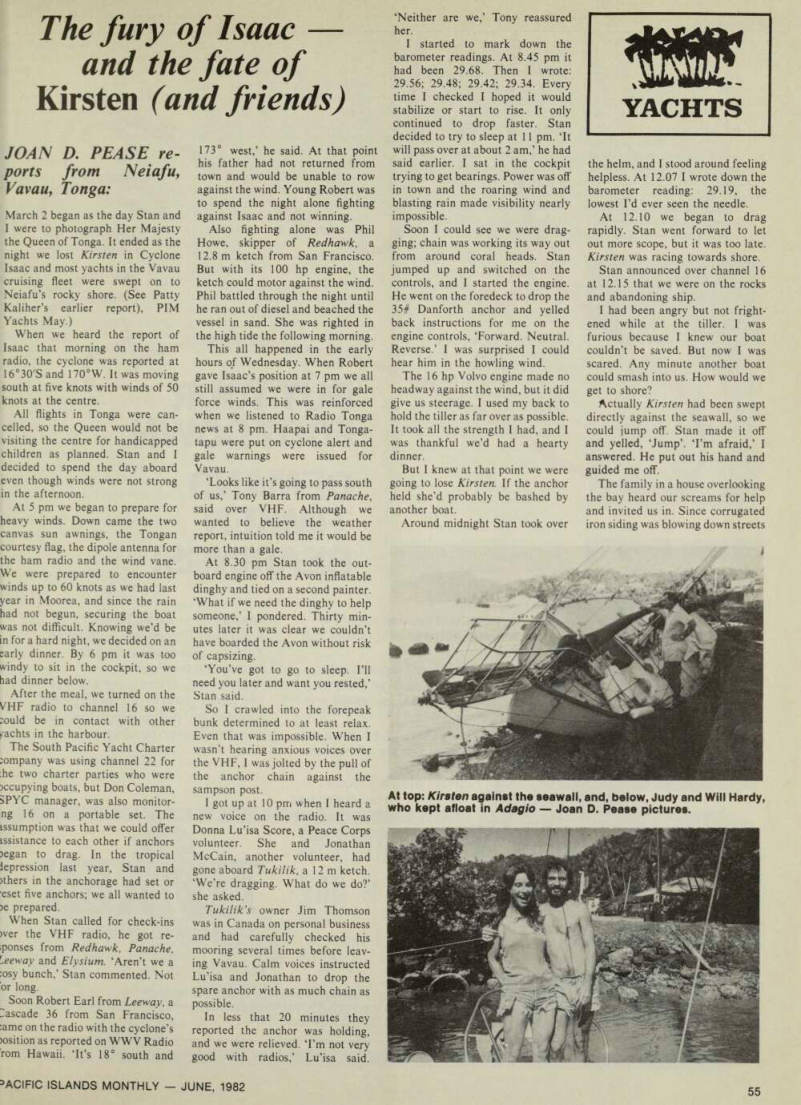


Yachts
The fury of Isaac and the fate of Kirsten (and friends)
Joan D. Pease Re
ports from Neiafu ,
Vavau, Tonga:
March 2 began as the day Stan and I were to photograph Her Majesty the Queen of Tonga. It ended as the night we lost Kirsten in Cyclone Isaac and most yachts in the Vavau cruising fleet were swept on to Neiafu’s rocky shore. (See Patty Kaliher’s earlier report), PIM Yachts May.) When we heard the report of Isaac that morning on the ham radio, the cyclone was reported at 16°30 / S and 170°W. It was moving south at five knots with winds of 50 knots at the centre.
All flights in Tonga were can celled, so the Queen would not be visiting the centre for handicapped children as planned. Stan and I decided to spend the day aboard even though winds were not strong in the afternoon.
At 5 pm we began to prepare for heavy winds. Down came the two canvas sun awnings, the Tongan
courtesy flag, the dipole antenna for
the ham radio and the wind vane.
We were prepared to encounter winds up to 60 knots as we had last year in Moorea, and since the rain had not begun, securing the boat was not difficult. Knowing we’d be in for a hard night, we decided on an early dinner. By 6 pm it was too windy to sit in the cockpit, so we had dinner below.
After the meal, we turned on the VHF radio to channel 16 so we :ould be in contact with other yachts in the harbour.
The South Pacific Yacht Charter company was using channel 22 for ;he two charter parties who were jccupying boats, but Don Coleman, SPYC manager, was also monitor ng 16 on a portable set. The issumption was that we could offer issistance to each other if anchors )egan to drag. In the tropical lepression last year, Stan and )thers in the anchorage had set or eset five anchors; we all wanted to >e prepared.
When Stan called for check-ins )ver the VHF radio, he got re iponses from Redhawk, Panache, leeway and Elysium. ‘Aren’t we a :osy bunch,’ Stan commented. Not or long.
Soon Robert Earl from Leeway, a Cascade 36 from San Francisco, :ame on the radio with the cyclone’s )osition as reported on WWV Radio fom Hawaii. ‘lt’s 18° south and
173° west,’ he said. At that point his father had not returned from town and would be unable to row against the wind. Young Robert was to spend the night alone fighting against Isaac and not winning.
Also fighting alone was Phil Howe, skipper of Redhawk, a 12.8 m ketch from San Francisco.
But with its 100 hp engine, the ketch could motor against the wind.
Phil battled through the night until he ran out of diesel and beached the vessel in sand. She was righted in the high tide the following morning.
This all happened in the early hours of Wednesday. When Robert gave Isaac’s position at 7 pm we all still assumed we were in for gale force winds. This was reinforced when we listened to Radio Tonga news at 8 pm. Haapai and Tonga tapu were put on cyclone alert and gale warnings were issued for Vavau. ‘Looks like it’s going to pass south of us,’ Tony Barra from Panache , said over VHF. Although we wanted to believe the weather report, intuition told me it would be more than a gale.
At 8.30 pm Stan took the out board engine off the Avon inflatable dinghy and tied on a second painter. ‘What if we need the dinghy to help someone,’ I pondered. Thirty min utes later it was clear we couldn’t have boarded the Avon without risk
of capsizing.
‘You’ve got to go to sleep. I’ll need you later and want you rested,’
Stan said.
So I crawled into the forepeak bunk determined to at least relax.
Even that was impossible. When I wasn’t hearing anxious voices over the VHF, I was jolted by the pull of the anchor chain against the sampson post.
I got up at 10 pm when I heard a new voice on the radio. It was Donna Lu’isa Score, a Peace Corps volunteer. She and Jonathan McCain, another volunteer, had gone aboard Tukilik, a 12 m ketch. ‘We’re dragging. What do we do?’ she asked.
Tukilik’s owner Jim Thomson was in Canada on personal business and had carefully checked his mooring several times before leav ing Vavau. Calm voices instructed Lu’isa and Jonathan to drop the spare anchor with as much chain as possible.
In less that 20 minutes they reported the anchor was holding, and we were relieved. ‘l’m not vexy good with radios,’ Lu’isa said.
‘Neither are we,’ Tony reassured her.
I started to mark down the barometer readings. At 8.45 pm it had been 29.68. Then I wrote: 29.56; 29.48; 29.42; 29.34. Every time I checked I hoped it would stabilize or start to rise. It only continued to drop faster. Stan decided to try to sleep at 11 pm. ‘lt will pass over at about 2 am,’ he had said earlier. I sat in the cockpit trying to get bearings. Power was off in town and the roaring wind and blasting rain made visibility nearly impossible.
Soon I could see we were drag ging; chain was working its way out from around coral heads. Stan jumped up and switched on the controls, and I started the engine.
He went on the foredeck to drop the 35# Danforth anchor and yelled back instructions for me on the engine controls, ‘Forward. Neutral.
Reverse.’ I was surprised I could hear him in the howling wind.
The 16 hp Volvo engine made no headway against the wind, but it did give us steerage. I used my back to hold the tiller as far over as possible.
It took all the strength I had, and I was thankful we’d had a hearty dinner.
But I knew at that point we were going to lose Kirsten. If the anchor held she’d probably be bashed by another boat.
Around midnight Stan took over
the helm, and I stood around feeling helpless. At 12.07 I wrote down the barometer reading: 29.19, the lowest I’d ever seen the needle.
At 12.10 we began to drag rapidly. Stan went forward to let out more scope, but it was too late.
Kirsten was racing towards shore.
Stan announced over channel 16 at 12.15 that we were on the rocks and abandoning ship.
I had been angry but not fright ened while at the tiller. I was furious because I knew our boat couldn’t be saved. But now I was scared. Any minute another boat could smash into us. How would we get to shore?
Actually Kirsten had been swept directly against the seawall, so we could jump off. Stan made it off and yelled, ‘Jump’. ‘l’m afraid,’ I answered. He put out his hand and guided me off.
The family in a house overlooking the bay heard our screams for help and invited us in. Since corrugated iron siding was blowing down streets
At top: Kirsten against the seawall, and, below, Judy and Will Hardy, who kept afloat in Adagio - Joan D. Pease pictures.
:and houses were falling over, we 'were happy to have a roof over our (heads.
But that didn’t last for long. The (family had attached guy lines to the iroof supports and tied them to a large, heavy safe. In one loud blast, the roof blew away, and we all ran for shelter in another room.
Our host finally decided the safest place was behind the counters of his small general store. Stan stretched out on the concrete floor hoping to get some sleep so we could work on Kirsten in the morning.
I was given a large plastic bag stuffed with skeins of yarn. It made a good pillow, but I couldn’t sleep for thoughts of Kirsten. The sound 3f the wind was like the noise of a
freight train running by.
Daylight took so long in coming, sut by 6.15 Stan and I started down ;he steps to assess the damage. I was ■elieved no boats had fallen on top )f Kirsten.
Then Stan moaned, ‘No. Oh no.’
Je was looking up the beach at the levastation. Yachts, like so many alien dominoes, were scattered up he shore. Out of a fleet of 20, only our vessels remained afloat.
Through the night I had assumed ve were the only boat to drag, now inly two private yachts remained in he water.
Quickly our priorities changed. I /ent aboard to look for money and he camera. The boat was a hambles below. Floorboards were p and goods had been tossed round, so I couldn’t find our assports, money or camera but did lanage to put on a pair of jeans ver the underwear I’d escaped in.
We started up the beach calling t each boat for survivors. First ■eeway then Tukilik, next ’lysium. No answers.
Gene and Richard Panter from 'air Seas, a 14.9 m ketch, were aving coffee on the front porch of
leir Tongan friend’s home.
‘We fought until 4:30 am,’ Gene lid, ‘and then we were washed up n the rocks.’ His son Richard had
cut his foot severely and needed medical attention. ‘Have you seen anyone else?’ I asked. They hadn’t so we continued to the home of Robyn and Don Coleman of SPYC.
Others had gathered in the kitchen of their house. The roof had blown off the living room early in the evening. Robert Earl from Leeway was there and uninjured.
Helen and Elmer Olson from Elysium, a 15.2 m ketch from Portland, Oregon, greeted us with hugs. They were OK, but their ferro-cement yacht was badly holed. Lu’isa and Jonathan had not been injured on Tukilik.
Robyn Coleman, a registered nurse, was treating an injured couple who had chartered one of the SYPC yachts which dragged its mooring. When we arrived Robyn had already sutured the man’s foot and was tending to the woman who was critically injured when she was swept off the deck and crushed between two boats. While we were there transport was arranged, and the woman was put on a door, an improvised stretcher, to be taken to
hospital.
We’d accounted for Fair Seas, Leeway, Tukilik and Elysium and could see Redhawk on the shore across the bay.
Now our worry was for Will and Judy Hardy on Adagio, a 9.1 m
sloop from Columbus, Mississippi,
because Judy was due to have a baby in two months. At the Paradise International Hotel we learned that Adagio was still afloat. As we looked down the hill we could see Judy huddled in a corner of the cockpit in her life preserver. Will was slowly letting out line as it chafed, and still was not sure they’d make it. Their dinghy had sunk, so he couldn’t get a line to a nearby mooring. Later in the morning he swam out with the line and they remained unscratched.
After reserving a room at the Vavau Guest House, we started back to our boat and encountered
Robyn Coleman who reported the injured woman needed donations of Type A positive blood. Since that is our type we continued on to the hospital where we were surprised to see so few injured persons and overjoyed to learn there were no deaths.
David McLean and his wife Hainite were also there, and David became another donor. Hearing of our loss they invited us to stay at their home while we worked on the boat. After Stan gave blood (I declined for medical reasons), we returned to the boat where I was finally able to uncover the camera from the muddy debris below deck.
After a thorough shower in fresh water, the dependable Nikonos and its flash attachment were back in operation.
We soon learned about the other yachts. Two of the SYPC boats did not drag from their moorings; the others were swept on the shore.
Swirl, a 9.1 m sloop, had left the main harbour before dark to escape the pile-up of boats. Shane Finneran and Tina Gaudette lost their Avon dinghy and an anchor, but rode out the storm. The following week they recovered both items.
Panache, a Catalina 30 sloop from Los Angeles, was on the sand, but owners Tony Barra and Jennifer Guilbert were on the ham radio at 8 am that morning sending out news of the disaster. For many days Tony had the only operating radio in all of Vavau, and he played a valuable role in getting messages out to concerned relatives around the world even before he refloated his boat three days after the storm.
Arminel H., a 21.3 m timber ketch, was thrown against a steep cliff on a rocky shore. Skipper Larry Conway had climbed the mast to get ashore. The 70-year-old ketch, which weighed 70 tonnes, proved to be the most difficult to get righted and moved in the following weeks because of its massive weight.
Elefant, a fibreglass yacht of German registry, was also on the
rocks. Her owners had built the vessel and were prepared to com plete the repairs in Vavau.
Aquavit, a small sloop from San Diego, California, had dragged from its mooring early in the evening. The owners had left the vessel in Neiafu several months before, and no one was aboard.
Fair Seas, from Los Angeles, suffered massive water damage.
Ballast fell out of the keel causing
difficulty in the refloating operation.
Leeway, an 11 m fibreglass sloop, was righted two weeks after Isaac
and moved to a sandy beach for repairs.
Elysium , built of ferro-cement by her owners, was righted four days after the cyclone and repairs are underway.
Tukilik was righted the week after Isaac struck, and owner Jim Thomson returned from Canada with materials for the repair oper ation.
Kirsten , 9.8 m Colin Archer type double-ender, was righted on March 17. Stan had built the vessel in ferro-cement over a five-year period in Alameda, California. We had moved aboard in 1975 and the following year sailed from San Francisco to Sydney, Australia, by way of French Polynesia and the Cook Islands. We recommenced cruising in 1980 and had called at New Zealand, French Polynesia and American Samoa before arriv ing in Vavau last December.
When we assessed the damage to the hull, we felt we could not trust her integrity at sea after repairs.
With the help of many local famil ies we were able to off-load gear, most of which was damaged.
Teisina and Seketi Fuko, whose home looked down on the seawall, allowed us to store our goods in their house. This was valuable assistance which helped us save many items.
Their three sons and Tei’s mother Mele brightened our days as we cleaned, sorted and packed our belongings for shipment to the United States.
After long days of work we could return to the McLean home for
quiet evenings with a happy couple.
We lived with them for a month, and their kindness was a comfort during a trying time in our lives.
Kirsten was sold in Neiafu and will sail again within the Vavau group.
I only wish we’d had her at sea, far from land, during Cyclone Isaac.
Don Travers Re
ports from Tubuai,
Austral Islands , French
Polynesia:
• ENDYMION. A 15.5 m steel sloop arrived at Tubuai late in
February with Australian owner/
builder Bob Wilson, his son Dallas, crew of Mike Williams (USA), and Dallas’ wife Glendor, of Grenada, in the Caribbean, Glendor’s 10-year-old daughter Debbie, Dallas’ and Glendor’s one-year-old son Jethro, another child on the way, and Norma Francis, also of Grenada.
Endymion is completing a cir
cumnavigation commenced at Syd
ney via Cape of Good Hope. Lots of time was spent in Grenada and Venezuela, Panama, Galapagos,
Marquesas, Rangiroa, Tahiti,
Moorea.
They left Tubuai at the end of February, bound direct for Auck land, and hoped to reach Sydney before the end of April. (Don Travers adds in a later note: Endymion left four days before the big hurricane I’ve heard about that hit Tonga (Cyclone Isaac). Depend ing on where they were and the continuing track of the storm, I imagine they could have had a very rough time. We became close friends with these folk during their visit here. Could you ask your readers in New Zealand or else where for any news of them?)
• Double Bullet. A 20 M
sloop-rigged racing catamaran ar
rived from New Zealand in early March with owner/designer/ builder Bob Hand of California and crew of Paul Pollock, Jeb Baker, (all of USA), and Lars Landfald (Norway). Double Bullet is strictly a racing machine, 10 m wide with a 21 m mast, weighing seven-and-a half tonnes. Each hull is of cold moulded cedar four layers of three metres length, and only one metre wide at the widest part.
Spartan living spaces are found only in the hulls, the super-structure consisting of netting and all held
together by box spares of graphite
fibres and epoxy, aluminium spares and stainless and titanium fittings.
Power is super-long shaft, centre moulded 35 hp outboard.
Double Bullet completed the Transpec from California to Hawaii in nine days 10 hours, including five
480-kilometre-plus days before los
ing the second rudder. From Hawaii they sailed to Palmyra, Pago Pago, Suva, and New Zealand.
Total sailing time California- New Zealand was 31 x h days.
I was fortunate to be able to sail with them from Tubuai to Tahiti.
Less than two days, quite an experience! From Tahiti Double Bullet sailed for California via Hawaii. • TALOU. A 15 m ferro-cement ketch from Toronto, Canada, with Ray and Brenda Lewis, arrived from Raivavae at night to permit emergency medical evacuation by air for their nine-months old baby Kathryn, suffering from peritonitis.
Also on board is the couple’s four year-old daughter Joanne, and crew Doug Miles from Melbourne, Aus tralia.
Talou left Tubuai shortly after arrival for Tahiti, with Ray, Doug and Joanne aboard to join Brenda and the baby. They are heading for Vancouver via Hawaii after leaving Canada’s east coast three years ago, cruising North Atlantic, West Indies, Panama, Galapagos, Pit cairn, Gambiers, Tuamotus, Societies, Tonga, Fiji, Australia, New Zealand, Raivavae. A local friend, Gilda Viriamu, ac companied them on the Raivavae- Tubuai sail. (Jane Deßidder has subsequently reported the sad news of the death of baby Kathryn in Papeete.)
Jane Deridder Re
ports from Kerikeri ,
New Zealand:
• SOFIA. The well known Baltic Trader Sofia a 37 m topsail schooner, capsized and sank off New Zealand’s North Cape at about 1.30 in the morning of February 23 in heavy seas and winds of 30 to 40 knots. According to her captain, American Evan Logan, Sofia had been taking water faster than the pumps could cope when she was swamped by two massive seas, and rolled. An Auck land girl, 20-year-old Julie May Osborne of Remuera, apparently
went down with the ship. The 16 surviving crew members, 10 Zealanders, five Americans and one Briton, spent five days in two life rafts, one of which was damaged in launching, before they were rescued by the refrigerated cargo ship,
Vasiliy Perov.
For the past 12 years a communally owned blue water cruising vessel, Sofia was on her second visit to New Zealand. She was to have been featured in the making of Savage Island, a film depicting the adventures of notori ous pirate and trader Bully Hayes, who operated in the Pacific in the latter half of the 19th century. Sofia was sailing north along New Zea land’s west coast en route from New Plymouth to Auckland when she foundered.
Using two paddles and two more improvised from a plastic bucket, the 12 men and four women man aged to get within three kilometres of Cape Reinga before being swept more than 50 kilometres offshore by wind and current. Several fishing boats and commercial vessels
passed by without seeing their
flares. Captain Logan says that they managed to attract the attention of the Russian ship with a flashlight and their last two remaining flares.
Though suffering from dehydration, exposure and salt water sores, the young people kept in amazingly
high spirits. Logan said, ‘We always
knew we would be rescued.’ • KIRIWINA. Long-time sailor Ross Ewens, Perth education officer, first went to sea at 15 on a tops’l schooner. In 1981 Ross and his wife Barbara sailed their own 10.4 m cruising/racing yacht Kiri wina from their home in Perth, 4800 kilometres along the challeng ing South Australian coast, then on up as far as Mackay in Queensland before making a 16-day crossing to New Zealand. As Ross says: ‘The weather can be bad around the Southern Ocean. We would hole up waiting for a low to pass by, then catch its tail end to move on the next port.’ After Kiriwina’s year long shakedown cruise, Barbara realised that the cruising life did not suit her. ‘lt was too indolent.’ So she and Ross became wardens at the Kerikeri Youth Hostel, hoping to add a new dimension to the place by making their yacht available to hostelers. ‘lnstead of us doing a world cruise, young people from all over the world will be able to cruise with us in the Bay of Islands on Kiriwina. ’ The musical word ‘Kiriwina’ is the name of the principal island in the Trobriand Group where Ross spent some time in the navy, and where his brother in-law served with the Papuan medical service. Kiriwina is a
Sparkmans and Stephens-designed
Double Bullet underway off Tubuai and bound for Tahiti with, left to right, Hanel, Debbie Yee, Paul Pollock, Lars Landfald and Jeb Baker - Don Travers picture.
racing sloop some of whose sister ships have been winners in both the Sydney-Hobart and the Parmelia
(Plymouth to Fremantle) yacht
races. • DOUMAR. Another vessel to sail south of Australia west to east is the British Golden Hind 31 Doumar.
Neville de Villiers was senior part ner in a medical practice in Loughborough near Nottingham when he decided he wanted to have a look at the rest of the world. So, single-handling his 9.4 m plywood sloop Doumar, and carrying with him for company his guitar, a present from his patients, de Villiers set off from Plymouth to Le Havre, then journeyed through the French canals to Marseilles. He explored Malta and the Greek islands before carrying on through the Suez to Aden, Sri Lanka, Singapore, Christmas Island, thenceto Bun burry on the Australian west coast.
Here Jenny de Villiers and the two children aged one and three jumbo jetted in to join her husband. Jenny and the children took the train to Sydney while Neville continued on south of Australia in his plywood cruising yacht. Neville says the Great Australian Bight didn’t live up to its bad reputation though there were plenty of sperm whales about. But in Bass Strait he experi enced Force 10 winds for five days.
The trim tab on the rudder broke,
necessitating hand-steering to Syd
ney. Since Doumar s arrival in New Zealand a year ago, Dr de Villiers has been practising medicine, first in Whangarei, and now in Kaeo, a small Northland community.
Though Doumar’s sailing is limited to Northland’s east coast for the time being, plans are afoot to resume blue water cruising next year. • TUFFIE. Circumnavigators Red (Rosco) and Ruth Brooks, long-time ocean wanderers on their 10.6 m ketch Tuffie, sailed from Whangarei to Bundaberg in mid- April, thence through the Great Barrier Reef and on to Darwin to complete the paperwork which will enable them to visit Bali. • KITTY OF LEIGH. Retired Bexhill schoolmaster Denis Brooke left the UK on his Laurent Giles
designed Westerly 33 ketch Kitty of
Leigh, in August 1980. T just set off to potter for three years or so, to see the rest of the world before senility set in ..Travelling always with a crew of two or three, with to date no
major mishaps or really bad
weather, it has obviously been a
happy retirement experience. Com
menting on the Pacific Islands, Denis remarked, ‘How beautiful!
And how expensive!’ Denis will
pause to experience his first winter in two years with friends in the Bay of Plenty after which ‘my plans are fluid’. • FFROG. Jamie Clarke and his sister Jan from Cirencester, Gloucestershire, bought the beamy 14 m wooden yacht Sirene in Spain, renamed her Ffrog, and with two other young people and a collection of several hundred frogs set off on a proposed two-year eastward cir cumnavigation. After their two crew members left Ffrog in Singapore, Jan and Jamie sailed alone through the Philippines, the Carolines and the Marshalls to Fiji where June Batty of Toronto joined Ffrog. During a refit in Whangarei, Jamie, now the only remaining original crew member, recounted some of their adventures like nearly being arrested by a gunboat in the Red Sea, and driving off a middle-of-the-night boarding party in Borneo with a head of anger and a winch handle. Ffrog’s next ports of call will be in Fiji and Tonga. The rounding of the Horn has been postponed for a year at least.
Jane Deridder Re
ports from Lord Howe
Island , Australia:
• HIPPO. If Easter Islanders should see the colourful sail of a windsurfer plying their shores, it could well be Roger von Bergen, a young Swiss from Geneva who plans to make the voyage to Easter Island direct from New Zealand with the windsurfer on the deck of his 10 m sloop Hippo. Roger, co designer, builder and captain of the cold-moulded ply vessel, with his parrot Cristobal obtained in the Panama Canal Zone, has spent four years in the Pacific already. An interesting recent addition to the blue African mahogany sloop is a wind generator mounted on the pulpit which Roger says produces one amp in winds of 8 to 10 knots and three amps with 12 to 15 knots of wind. When we spoke to Roger he was looking for a crew member to accompany him on the 6000 kilo metre non-stop voyage. • ARD RICH. Mike Davidson, associate editor of Australian Boat ing magazine, arrive in Opua in mid-March from Sydney via Lord Howe Island. Mike mentioned that a levy of $5O is now being charged yachts visiting Lord Howe Island.
Ard Righ, his Duncanson 10.6 m sloop had to cope with a wet windward slog from Lord Howe Island with northeast to southeast winds of 20 to 30 and higher all the way. Mike will continue his voyag
ing through Tonga, Fiji, Vanuatu
and New Caledonia, writing cruis ing pieces for his magazine as he goes. About single-handling he says, ‘l’ve had enough of that!’ • MOONPENNY. John and Ken Wood of Kerikeri, known to many overseas cruising yachtsmen be cause of the welcome, help and hospitality extended to them by the Wood family, have themselves set off on a blue water cruise in the 10 m sloop Moonpenny which John describes as ‘a prototype we hope of many more to come’. The unique cruising yacht was designed by Michel Deßidder using ideas evolved during 17 years of practical cruising on Magic Dragon. John and his son Ken assisted Deßidder in building Moonpenny because of their interest in his methods. With winds of three to 15 knots from abaft the beam, Magic Dragon and Moonpenny were able to keep within sight of each other for the entire six-day crossing from the Three Kings Islands. John talks of the satisfaction of watching each other’s boats at close quarters, and of the economy of using one engine between two boats. ‘Having long been involved with towing other boats, it was a change to be on the
receiving end. Magic Dragon only
lost half a knot and we shared the fuel bill.’ Moonpenny’s maiden voyage to Lord Howe Island ended with a 21st birthday landfall for crew member Jeannie Skinner, also of Kerikeri. As for Lord Howe Island, John reckons the Kentia palms alone are worth coming thousands of miles to see. • TALOU. (See PIM Mar p 59.) While Canadian yacht Talou was en route to Tahiti from New
Zealand, Kathryn, baby daughter
of Ray and Brenda Lewis of Toronto, was taken seriously ill. The Lewises put in to Raivavae where there is a small hospital. When it
became apparent that further medi cal aid was required, Brenda flew with the little girl to Papeete from Tubuai. Kathryn Lewis died from peritonitis. Ray sailed to Papeete to rejoin his wife and four-year-old daughter Joanne.
The cruising community extend their deepest sympathy to the Lewis family in their tragic loss. When I visited the 15 m ketch Talou in the Bay of Islands, I was struck by the warmth and contentment of this seafaring family group, and by their enthusiasm for cruising as a way of life. • SPINDRIFT. The 11 m engine less gaff cutter Spindrift arrived at Lord Howe Island with six people aboard just in time for the April 4 centenary celebration. Owner Philip Rose-Taylor of Brixham, Devon, had the ‘old-timer’ designed and built in steel to his own specifications. She was launched in Melbourne in 1976. During the building of Spindrift Rose-Taylor was sailing on the 45 m auxiliary schooner Wongala out of Mel bourne supplying explosives to min ing camps in Australia and New Zealand. Though Philip describes Spindrift as ‘not close winded’, they made Tasmania-Fiji in just 19 days, and took only 28 days from New Zealand to Tahiti, a time he hopes to better this time round. No stranger to old-fashioned sailing rigs, Philip served for three years as mate on the 17th century replica of Nonsuch (built for the 300th anniversary of the founding of the Hudson Bay Company). He also sailed on the Golden Hind replica (used in the making of the movie Shogun ) and on the Beaver replica (an East Indiaman present at the Boston Tea Party). More recently he was rigging consultant and bosun on the Bounty replica in Whang arei.
Ffrog in full sail off Kerikeri - Jane DeRidder picture
Advertisements & other items, pp. 56-60 (2 items)
Timken
o
PUTYOUR
FOOT DOWN.
DEMAND
TIMKEN
BEARINGS!
TIMKEN
RIGIS7(R(O IRAQI MARK
If you’re hard headed about the bearings you use . . . put your foot down!
Demand Timken® tapered roller bearings, and you’ll get the brand with proven quality, durability and performance.
The brand that’s given you a long run for your money, wherever it’s used.
On top of all this, you’ll benefit from our consistent supply, delivery, and sales and service engineering assistance available from Australian Timken and Authorized Timken® Bearing Distributors throughout the Pacific.
Another way of looking at it is that you’re not going to put your foot in it when you put your foot down and demand Timken bearings.
TIMKEN
REGISTERED TRADEMARK
TAPERED ROLLER BEARINGS
Authorised Timken® Bearing Distributors in the Pacific are: O F. Nelson and Co. Ltd,, APIA; Bearing Service Company Ltd., AUCKLAND; Kidd Garrett Ltd., AUCKLAND; United Enterprises Ltd., HONIARA; Sunbeam Transport Ltd., LAUTOKA; Nelle Cie SATMA, NOUMEA; Pacific Distributions; PAPEETE; P N G. Bearing Service, PORT MORESBY: Socametra, PORT VILA; Burns Philp (South Sea) Company Ltd., SUVA. unirn fi 7 fi Ai
PORT MOB
* Right in t business ce * A comfort an<Tfin£ food ♦ All airconditioned * Restaurant * Ba * Banquet hall
%A. C. NEUMANN
manager Phone 21-2622 Stay at Aggie Grey’s . . . the South Pacific’s
legendary hotel.
Situated right in the heart of Western Samoa. Enjoy Polynesian style friendliness and serviyc, in cool surroundings, superb entertainment and food.
Magnificent white sand beaches only a short drive away. Airconditioned rooms, swimming pool and full bar facilities.
Bookings through Union Steam ship Company of NZ, Pan Am.
Air New Zealand or direct to Aggie Grey’s, Apia, Western Samoa. Cables: ‘AGGIES’Apia.
Bearing us in mind will save
you a Int nf trouble
when it comes to those hard to get bearings and associated products you can rely on our expertise IMPORT EXPORT enquiries to Head Office
AC AlilAA 113 MITCHELL STREET, BENDIGO,
VICTORIA, AUSTRALIA.
Dcnmncs TELEX NO. 35105
(AUST) PTY. LTD.
with branches in
SUVA, SYDNEY, BALLARAT,
MILDURA and SHEPPARTON
IF YOU MAKE IT WITH STEEL,
MAKE CONTACT WITH FLETCHER.
Fletcher Steel offers a total steel service -» a total product range for builders, fabricators and structural engineers!
Fletcher Steel can supply structural steel, sheet and coil, plate, pipe and tube rectangular hollow sections, alloy and bright steel, bolts and nuts, etc. for virtually every industrial application.
Contact Fletcher Steel and see what they mean by a total steel service O j And match the Fletcher Steel product range with famous Duroid brand building membranes; Malthoid roll roofing and dampcoursing and Durafoil' reflective foil insulation Here's a total service for building the future of the Pacific Contact Fletcher Steel now use this handy coupon, or contact Ron Mair direct at 592-869 Auckland.
New Zealand If you make if with steel, make contact with Fletcher Steel
Fletcher
Steel
Ron Mair Fletcher Steel Export Manager P O Box 303 Auckland New Zealand Name Company Address Please send me more information on the Fletcher Steel total steel service concept
NEW TITLE FROM
AUSTRALIAN NATIONAL UNIVERSITY PRESS
Slavers in
Paradise
The Peruvian labour trade in Polynesia 1862 - 1864 H.E. Maude This is the story of the barques and brigs that sailed out of Callao in Peru, calling at every Pacific island group except Hawaii, kidnapping thousands of men, women and children by violence and treachery and transporting them to slavery and death.
Price: $A25.50 hard cover, $A10.50 soft cover For further enquiries and information about agents in your area write to: Australian National University Press PO Box 4 Canberra ACT 2600 Australia
DeZURBK
A complete valve range in a multitude of material and specification options in sizes V»” - 72” with manual, pneumatic, hydraulic or electric actuators. Proven worldwide in municipal, industrial and process applications.
Electric Control Valves Resilient Seated Butterfly Valves V-port Ball Valves Paper Stock Consistency Transmitters Eccentric Plug Valves Knife Gate Valves
A UNIT OF GENERAL. SIGNAL
ZURHK
High Pressure Butterfly Valves DeZURIK OF AUSTRALIA PTY. LTD., P.O. Box 204, Vineyard Road, Sunbury, Victoria 3429, Australia. Telephone: 03-744-2244, Telex; AA33732. dz - aus. 020 - A
SOLAR EX
ELECTRICITYFROM SUNLIGHT
Oil short, ruralised, developing nations are great beneficiaries of the advances being made in SOLAR ELECTRIC GENERATORS i ll tstts
urn
<TS ■a The communal hut of this Pacific island village has a projector and video recorder powered by a photovoltaic generator. These units are used to show the villagers current farming techniques, basic health and child care along with providing valuable assistance for the regional educational program. All of the huts have a solar powered lighting system and the communal health centre keeps drugs sterile and temperate in a solar-powered refrigerator-freezer. The villagers have a central water catchment supplied by a Solarex Photovoltaic Pumping System while communications are effected by means of a H.F, radio network powered by the central solar generator.
Photovoltaic generators where chosen over the more traditional liquid fuelled systems because they were the most cost effective option when the following was considered: •Virtual unlimited operational life • Fuel free • Minimal maintenance to be carried out by non-skilled personnel • Foreign exchange savings resulting from a lower liquid fuel bill Solar powered generators are often the most economic alternative for: • Remote homes and villages • Remote communication sites • Water pumping • Telemetry outstations, etc.
If you would like to know more about the Pacific areas most abundant free energy source, contact: SOLAREX PTY. LIMITED THE FREE ENERGY COMPANY" 5 BELLONA AVE • REGENTS PARK 2143 AUSTRALIA • P.O. BOX 204 • CHESTER HILL 2162 • TELEPHONE 644 5055 • TELEX AA21975
57
YACHTS
ACIFIC ISLANDS MONTHLY JUNE, 1982
Services
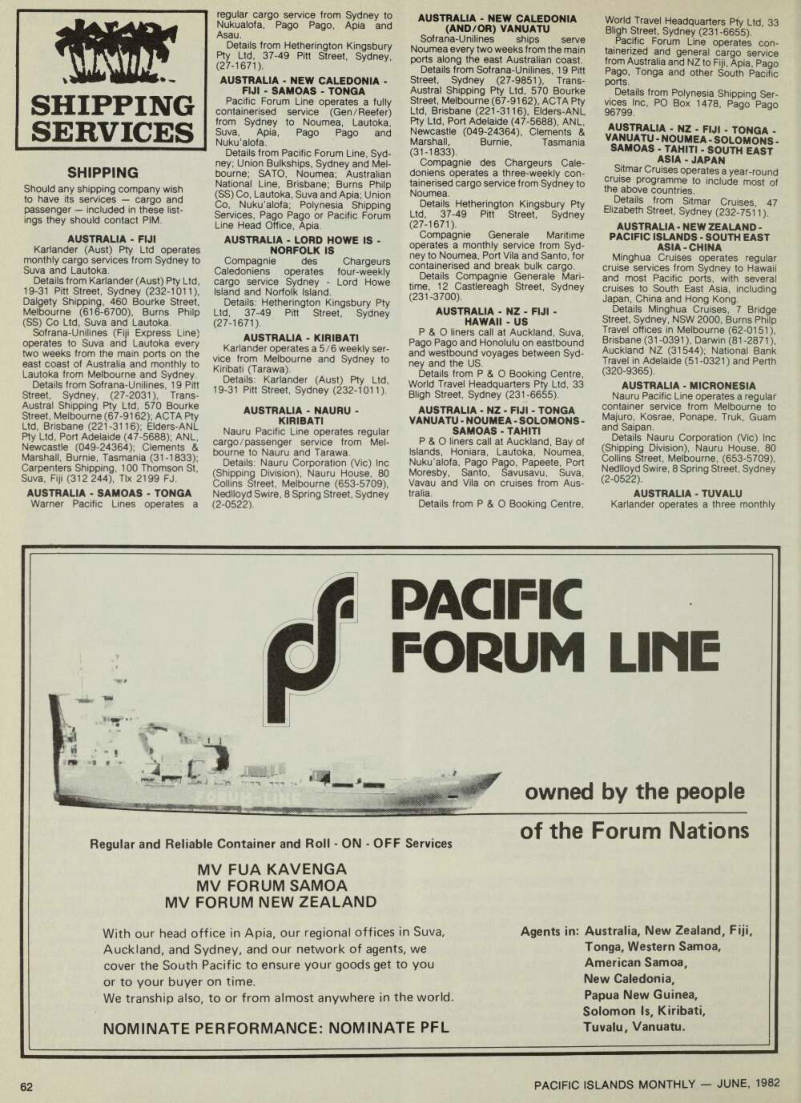
Shipping
Shipping
Should any shipping company wish to have its services cargo and passenger included in these list ings they should contact PIM.
Australia - Fiji
Karlander (Aust) Pty Ltd operates monthly cargo services from Sydney to Suva and Lautoka.
Details from Karlander (Aust) Pty Ltd, 19-31 Pitt Street, Sydney (232-1011), Dalgety Shipping, 460 Bourke Street, Melbourne (616-6700), Burns Philp (SS) Co Ltd, Suva and Lautoka.
Sofrana-Unilines (Fiji Express Line) operates to Suva and Lautoka every two weeks from the main ports on the east coast of Australia and monthly to Lautoka from Melbourne and Sydney.
Details from Sofrana-Unilines, 19 Pitt Street, Sydney, (27-2031), Trans- Austral Shipping Pty Ltd, 570 Bourke Street, Melbourne (67-9162); ACTA Pty Ltd, Brisbane (221-3116); Elders-ANL Pty Ltd. Port Adelaide (47-5688); ANL, Newcastle (049-24364); Clements & Marshall, Burnie, Tasmania (31-1833); Carpenters Shipping, 100 Thomson St, Suva, Fiji (312 244), Tlx 2199 FJ.
Australia - Samoas - Tonga
Warner Pacific Lines operates a
regular cargo service from Sydney to Nukualofa, Pago Pago, Apia and Asau.
Details from Hetherington Kingsbury Pty Ltd. 37-49 Pitt Street, Sydney, (27-1671).
Australia - New Caledonia -
Fiji - Samoas - Tonga
Pacific Forum Line operates a fully containerised service (Gen/Reefer) from Sydney to Noumea, Lautoka, Suva, Apia, Pago Pago and Nuku’alofa.
Details from Pacific Forum Line, Syd ney: Union Bulkships, Sydney and Mel bourne: SATO, Noumea; Australian National Line, Brisbane; Burns Philp (SS) Co, Lautoka, Suva and Apia; Union Co, Nukualofa; Polynesia Shipping Services, Pago Pago or Pacific Forum Line Head Office, Apia.
Australia - Lord Howe Is -
Norfolk Is
Compagnie des Chargeurs Caledoniens operates four-weekly cargo service Sydney - Lord Howe Island and Norfolk Island.
Details: Hetherington Kingsbury Pty Ltd. 37-49 Pitt Street, Sydney (27-1671).
Australia - Kiribati
Karlander operates a 5/6 weekly ser vice from Melbourne and Sydney to Kiribati (Tarawa).
Details: Karlander (Aust) Pty Ltd, 19-31 Pitt Street, Sydney (232-1011).
Australia - Nauru -
Kiribati
Nauru Pacific Line operates regular cargo/passenger service from Mel bourne to Nauru and Tarawa.
Details: Nauru Corporation (Vic) Inc (Shipping Division), Nauru House, 80 Collins Street, Melbourne (653-5709), Nedlloyd Swire, 8 Spring Street, Sydney (2-0522).
Australia - New Caledonia
(And/Or) Vanuatu
Sofrana-Unilines ships serve Noumea every two weeks from the main ports along the east Australian coast.
Details from Sofrana-Unilines, 19 Pitt Street, Sydney (27-9851), Trans- Austral Shipping Pty Ltd, 570 Bourke Street, Melbourne (67-9162), ACTA Pty Ltd, Brisbane (221-3116), Elders-ANL Pty Ltd, Port Adelaide (47-5688), ANL, Newcastle (049-24364), Clements & Marshall, Burnie, Tasmania (31-1833).
Compagnie des Chargeurs Cale donians operates a three-weekly con tainerised cargo service from Sydney to Noumea.
Details Hetherington Kingsbury Pty Ltd. 37-49 Pitt Street, Sydney (27-1671).
Compagnie Generate Maritime operates a monthly service from Syd ney to Noumea, Port Vila and Santo, for containerised and break bulk cargo.
Details Compagnie Generate Mari time, 12 Castlereagh Street, Sydney (231-3700).
Australia - Nz - Fiji -
Hawaii - Us
P & O liners call at Auckland, Suva, Pago Pago and Honolulu on eastbound and westbound voyages between Syd ney and the US.
Details from P & O Booking Centre, World Travel Headquarters Pty Ltd, 33 Bligh Street, Sydney (231-6655).
AUSTRALIA - NZ - FIJI - TONGA
Vanuatu - Noumea - Solomons -
Samoas - Tahiti
P & O liners call at Auckland, Bay of Islands, Honiara, Lautoka, Noumea, Nukualofa, Pago Pago, Papeete, Port Moresby, Santo, Savusavu, Suva, Vavau and Vila on cruises from Aus tralia.
Details from P & O Booking Centre.
World Travel Headquarters Pty Ltd, 33 Bligh Street, Sydney (231-6655).
Pacific Forum Line operates con tainerized and general cargo service from Australia and NZ to Fiji, Apia, Pago Pago, Tonga and other South Pacific ports.
Details from Polynesia Shipping Ser vices Inc, PO Box 1478, Pago Paqo 96799. y AUSTRALIA - NZ - FIJI - TONGA -
Vanuatu - Noumea - Solomons -
Samoas - Tahiti - South East
Asia - Japan
Sitmar Cruises operates a year-round cruise programme to include most of the above countries.
Details from Sitmar Cruises 47
Elizabeth Street, Sydney (232-7511).
Australia - New Zealand -
Pacific Islands - South East
Asia-China
Minghua Cruises operates regular cruise services from Sydney to Hawaii and most Pacific ports, with several cruises to South East Asia, including Japan, China and Hong Kong.
Details Minghua Cruises, 7 Bridge Street, Sydney, NSW 2000, Burns Philp Travel offices in Melbourne (62-0151), Brisbane (31 -0391), Darwin (81 -2871), Auckland NZ (31544); National Bank Travel in Adelaide (51-0321) and Perth (320-9365).
Australia - Micronesia
Nauru Pacific Line operates a regular container service from Melbourne to Majuro, Kosrae, Ponape, Truk, Guam and Saipan.
Details Nauru Corporation (Vic) Inc (Shipping Division), Nauru House, 80 Collins Street, Melbourne, (653-5709), Nedlloyd Swire, 8 Spring Street, Sydney (2-0522).
Australia - Tuvalu
Karlander operates a three monthly
service from Sydney and Melbourne to Tuvalu (Funafuti).
Details from Karlander (Aust) Pty Ltd, 19-31 Pitt Street. Sydney (232-1011).
Australia - Png
Karlander New Guinea Line’s cargo vessels call at Melbourne, Sydney, Port Moresby, Lae, Madang, Wewak, Manus, Kimbe, Rabaul, Popondetta.
Details from Karlander (Aust) Pty Ltd, 19-31 Pitt Street, Sydney (232-1011), Dalgety Shipping, 460 Bourke Street, Melbourne (616-6700).
Australia - Png - Solomons
A consortium of Conpac, NGAL/PNGL have three container ves sels operating on a 28 day turn-around from Melbourne, Sydney and Brisbane to Port Moresby, Lae, Rabaul, Kavieng, Wewak, Madang, Kieta and Honiara.
Details from Burns, Philp & Co. Ltd. 51 Pitt Street, Sydney (2-0547) and Interocean Swire, 8 Spring Street, Syd ney, (2-0522).
New Guinea Express Lines operates a fortnightly container service from Mel bourne, Sydney, Brisbane to Port Moresby, Lae, Alotau, Rabaul, Honiara.
Details from New Guinea Express Lines, PC Box R 73, Royal Exchange, Sydney (241-3991) MacArthur Ship ping Agency Co, 39 Creek Street, Bris bane (229-3777), New Guinea Express Lines, 327 Collins Street, Melbourne (61-3053), Niugini Express Lines, Port Moresby (21-4572), Lae (42-1536), Rabtrad Niugini Pty Ltd, Rabaul (92-2911), Alotau Stevedoring & Trans port, Alotau (61-1318) and Island Co operative Shipping Federation, Honiara (808).
Sofrana-Unilines (PNG Line) operates a monthly service to Port Moresby, Lae, Rabaul, Kieta, Honiara from main ports on the east coast of Australia.
Details from Sofrana-Unilines, 19 Pitt Street, Sydney (27-9851); Trans- Austral Shipping Pty Ltd, 570 Bourke Street, Melbourne (67-9162); ACTA Pty Ltd, Brisbane (221-3116): Elders ANL Pty Ltd, Port Adelaide (47-5688).
Australia - Tahiti
Compagnie Generate Maritime operates a monthly service from Syd ney to Papeete for containerised and break-bulk cargo.
Details Compagnie Generate Mari time, 12 Castlereagh Street, Sydney (231-3700).
Australia - Tahiti - Us
Karlander operates a monthly cargo service from Melbourne and Sydney to Papeete, US west coast.
Details: Karlander (Aust) Pty Ltd, 19-31 Pitt Street, Sydney (232-1011).
Australia - W. Samoa
Compagnie Generate Maritime operates a monthly service from Syd ney to Apia.
Details Compagnie Generate Mari time, 12 Castlereagh Street, Sydney (231-3700).
AUSTRALIA - NZ - TAHITI - CHILE Kapal Pacifico (KP) Pty Ltd offers a bi-monthly service from Geelong, East Australia to New Zealand ports Tauranga and Whangarei, Papeete and ports on the west coast of South America.
Details; Kapal Pacifco (KP) Pty Ltd, 4th Floor, 36 York Street, Sydney (233-8515) Tlx 71875; Beaufort Ship ping Agency Co, 2 Castlereagh Street, Sydney (239-1022); Universal Shipping Agency, 85 Fort Street, Auckland, NZ (30-930) Tlx 21517; I B Taylor Y Cia Ltd in Chile.
Far East - Fiji - New
Zealand
New Zealand Unit Express (NZUE) operates a monthly palletised cargo service from Manila. Keelung, Kaoshiung and Hong Kong to Lautoka, Suva and thence to NZ.
Details from Carpenters Shipping,
100 Thomson Street, Suva (312-244), Tlx FJ2199, Burns Philp, Suva (311-777), P & O S.N. Co, Wellington (736-477) or Nedlloyd Swire Pty Ltd.
Sydney (20-522).
Nedlloyd operates bi-weekly cargo service with four ships from Sourabaya, Jakarta, Bangkok, Port Kelang and Singapore to Suva and NZ ports.
Details from Nedlloyd (Aust) Pty Ltd, 8 Spring St, Sydney (27 3801), Burns Philp (SS) Co Ltd, Suva and Lautoka.
Far East - Mid-S. Pacific
China Navigation’s New Guinea Pacific Line operates a regular con tainer service from Hong Kong. Taiwan, Manila, Port Kelang and Singapore to Port Moresby, Lae, Rabaul and Honiara monthly and to Wewak, Madang and Kieta every three months. Cargo from the same Far Eastern ports to the South Pacific ports of Noumea, Santo, Vila, Papeete, Pago Pago, Apia, Rarotonga and Tarawa will be shipped via Japan on the monthly Bali Hai service.
Details from Steamships Trading Co., Port Moresby (21 -2000).
Kyowa Shipping Ltd, operates monthly services from Japan to Guam, Saipan, Solomons, New Caledonia, Fiji, Western and American Samoa, Tahiti, Cook Is., Tonga and Vanuatu.
Details: Hetherington Kingsbury Pty Ltd, 37-49 Pitt Street, Sydney (27-1671); Carpenters Shipping, Suva (312-244), Tlx FJ2199.
Japan - Fiji - New Zealand
Kyowa Shipping Co Ltd operates a monthly service from main ports of Japan to Suva and Lautoka and thence to island ports and NZ.
Details from Carpenters Shipping, 100 Thompson St, Suva (312-244), Tlx FJ2199.
Japan - Micronesia
The NYK Shipping Line operates a monthly cargo service from Japan to Micronesia, calling at Kobe. Nagoya, Yokohama, Saipan, Guam, Truk, Ponape and Majuro, returning via Kobe, Nagoya and Yokohama.
Details from Burns, Philp & Co Ltd. 7 Bridge Street, Sydney (2-0547).
Japan - Png
Mitsui O.S.K. Lines operates a monthly service from main ports Japan and Port Moresby, Rabaul, Lae, Madang, Kieta and Kimbe.
Details from Robert-Laurie (PNG) Pty Ltd, Port Moresby (21-2466/ 21-1898).
New Caledonia - Fiji - West
Coast North America
PAD Line operates an approx. 3weekly ro-ro service from Noumea and Suva to Honolulu and West Coast USA and Canadian ports.
Details from Sofrana-Unilines SA, BP 1602, Noumea (27-51 -91). Tlx NMO4B; Carpenters Shipping, 100 Thomson St., Suva (312-244), Tlx FJ2199.
Png - Inter - Mainport
Papua New Guinea Line offers scheduled 10/20-day coastal liner ser vices linking all PNG major ports with containerisation, reefer, heavy lift and transhipment facilities.
Details from PNG Line, Box 543, Port Moresby, PNG, (21-1174), Tlx 22269.
Png - Uk/Continent
The Bank Line operates regular cargo service from Port Moresby, Oro Bay, Kieta, Rabaul, Kimbe, Madang and Lae to Hull, Hamburg, Rotterdam, Antwerp and Le Havre.
Details from The Bank Line (A’asia) Pty Ltd, 51 Pitt Street, Sydney (27-2041); Burns Philp (PNG) Ltd, PNG ports.
Solomons - Uk/Continent
The Bank Line operates regular cargo service from Honiara to Hull, Hamburg, Rotterdam, Antwerp and Le Havre.
Details from The Bank Line (A’asia) Pty Ltd, 51 Pitt Street, Sydney (27-2041); Tradco Shipping (588).
NZ - COOK IS - NIUE -
Tahiti
Shipping Corporation of NZ Ltd operates cargo services based on pallets and similar units from Auckland to Niue, Cook Islands and Tahiti.
Details from the Shipping Corp of NZ Ltd, PO Box 3420, Auckland (797-210), Waterfront Commission, PO Box 61, Rarotonga; Cook Islands; Niue Govt Offices, Niue Island Compagnie Maritime Polynesienne, B'P’ 368, Papeete, Tahiti.
Nz - Fiji
Reef operates a regular 18-day ser vice from Auckland to Suva and Lau toka.
Details from Reef Shipping Agencies, PO Box 3382, Auckland, NZ (77-1221-3); M.V. Fijian Shipping Agencies Ltd, Private Bag, Suva, Fiji (31 1056).
Pacific Line with one ship operates fortnightly ro-ro cargo service New Zealand, Lautoka, Suva.
Details: Sofrana Unilines, 18 Cus toms Street, Auckland (773-279) PO Box 3614, Telex: NZ2313; Carpenters Shipping, 100 Thomson Street, Suva (312244), Tlx. 2199 FJ.
NZ - FIJI - NORTH AMERICA (WC) Blue Star Line Ltd Pacific Coast con tainer services. Only direct service to and from New Zealand. Blue Star ves sels call at Suva and Honolulu on NZ US-West Coast voyages.
Details from Blueport ACT (NZ) Ltd, PO Box 192, Wellington (739-029) , Burns Philp (SS) Co Ltd, GPO Box 355, Suva, Fiji (311-777). Tlx. FJ2168 Burship.
NZ - FIJI - SAMOAS - TONGA Pacific Forum Line operates a fully containerised three-weekly service (Gen/Reefer) from Auckland to Lau toka, Suva, Apia, Pago Pago and Nukualofa.
Details from Pacific Forum Line, Auckland: Union Co, Auckland, Lau toka, Suva, Apia and Nuku’alofa; Polynesia Shipping Services, Pago Pago or Pacific Forum Line Head Office, Apia.
Nz - Tonga - Samoas
Warner Pacific Line operates a regular cargo service from Timaru, Onehunga and Westport to Nukualofa.
Vavau and Apia with regular calls to Haapai and Pago Pago.
Details from McKay Shipping Ltd, PO Box 1372, Auckland, NZ; Warner Paci fic Line, Box 93, Nukualofa, Tonga and Neiafu, Vavau, Tonga; Polynesia Ship ping Services, Box 1478, Pago Pago, American Samoa 96799, and Mealelei (Western Samoa) Ltd, Box 4171, Apia, W. Samoa.
NZ - N. CALEDONIA - FIJI -
Solomons - Png
Pacific Forum Line operates a fully containerised service (Gen/Reefer) from Lyttelton, Napier, Auckland to Suva, Lautoka, Honiara, Kieta, Lae and Port Moresby.
Details from Pacific Forum Line, Auckland; Shipping Corporation of NZ, Auckland, Lyttelton, Napier; Union Co, Auckland, Suva, Lautoka; Steamships Trading Co, Kieta, Lae, Port Moresby; Sullivans (SI) Ltd, Honiara or Pacific Forum Line Head Office, Apia.
NZ - N. CALEDONIA - VANUATU -
Png - Solomons
Sofrana Unilines with three ships operates to Vila and Santo, to Honiara and Papua New Guinea and to Norfolk Island and Noumea.
Details from Sofrana Unilines, 18 Customs Street, Auckland (773-279), PO Box 3614, Telex NZ2313.
Nz - Tahiti
Compagnie Tahitienne Maritime SA with one ship operates monthly service New Zealand - Papeete.
Details from Sofrana Unilines. PO Box 3614, 18 Customs St, Auckland (773-279), Tlx NZ2313.
Nz - Tonga - Samoas
Warner Pacific Line services Auckland - Nuku’alofa/Vavau/Apia/ Pago Pago fortnightly carrying general and freezer cargoes.
Details from McKay Shipping Ltd, Downtown House, 21 Queen St, Auckland, PO Box 1372 (30-299), Cables MACSHIP, Telex NZ2554; Warner Pacific Line, Box 93, Nukualofa, Tonga; Mealelei (Western Samoa) Ltd, Box 4171, Apia, Western Samoa; Polynesia Shipping Services, Box 1478, Pago Pago, American Samoa. 96799.
Nz - Central Pacific
Kyowa Shipping Ltd operates a monthly cargo service from Auckland and Mt Maunganui to Noumea, Vila, Santo, Guam, Majuro, Nauru and Tarawa.
Details from McKay Shipping Ltd, PO Box 1372, Auckland (9-30229); Tlx 2554 NZ.
Europe - Tahiti -
New Caledonia
Compagnie Generate Maritime operates services from Europe and Mediterranean ports to Papeete and Noumea using three ro-ro and multi purpose vessels thus ensuring a bi monthly sailing to and from.
Details Compagnie Generate Mari time, 12 Castlereagh Street, Sydney (231-3700).
Europe-Tahiti-New
Caledonia - New Zealand -
Solomons- Png - Europe
Polish Ocean Lines offers regular monthly sailings for containerised and breakbulk cargo from Hamburg, Ant werp, Dunkirk and Rouen to Papeete, Noumea, New Zealand, Honiara, Lae, returning to Europe via Suez. Other ports in the South Pacific can be served with inducement.
Details from Sotama, BP 9170, Papeete (27805), Tlx. 296; SATO, BP C 2, Noumea (272094), Tlx. 163 NM SATO; Union Steamship Co of NZ, PO Box 50, Apia, Tlx. 25; Williams and Gosling, PO Box 79, Suva (312633), Tlx. 2163; Warner Pacific Line, PO Box 93, Nukualofa (21089), Tlx. 66219; Universal Shipping Agencies, PO Box 2282, Auckland (30930). Tlx. 21517.
EUROPE - TAHITI - W. SAMOA -
Fiji - N. Caledonia
Nedlloyd offers regular cargo ser vices from Northern Europe and UK to Papeete, Apia, Fiji and New Caledonia.
Details Nedlloyd (Aust) Pty Ltd, 8 Spring Street, Sydney (27-3801); Car penters Shipping, 100 Thomson St, Suva (312 244), Tlx 2199 FJ.
EUROPE - TAHITI - W. SAMOA - TONGA - FIJI - SOLOMONS - PNG -
Vanuatu
Columbus Line Reederei GMBH operates regular services from Ham burg, Hull, Rotterdam, Antwerp, Dunkirk, Le Havre, to Papeete, Apia, Suva, Lautoka, Noumea, Port Moresby, Lae, Honiara, Kieta, Rabaul, Lae, and return to Europe.
Details from Columbus Overseas Services Pty Ltd, 333 George Street, Sydney (290-2966), Columbus Mari time Services, 17 Albert Street, Auckland (77-3460); Carpenters Ship ping, 100 Thomson St, Suva (312 244), Tlx 2199 FJ.
Uk - N. Continent - Fiji
The Bank Line operates a regular cargo service from Hull, Hamburg, Bremen, Antwerp, Rotterdam and Le Havre to Suva and Lautoka.
Details from The Bank Line (A’asia) Pty Ltd, 51 Pitt Street, Sydney (27-2041); Burns Philp (South Sea) Co Ltd, Suva and Lautoka.
Uk/N. Continent - Png -
Solomons
The Bank Line operates a regular cargo service from Hull, Hamburg, Bremen, Antwerp, Rotterdam and Le
Havre to Port Moresby, Lae, Madang, Kimbe, Rabaul, Kieta and Honiara and on inducement to Yandina.
Details from The Bank Line (A’asia) Pty Ltd, 51 Pitt Street, Sydney (27-2041); Burns Philp (PNG) Ltd, PNG ports; Tradco Shipping (588).
Uk/N. Continent - Tahiti -
N. Caledonia
The Bank Line operates a regular cargo service from Hull, Hamburg, Bremen, Antwerp, Rotterdam and Le Havre to Papeete and Noumea.
Details from The Bank Line (A’asia) Pty Ltd, 51 Pitt Street, Sydney (27-2041); Ets A M Fare DTE. Papeete; Ets Ballande, Noumea.
US - FIJI - TAHITI - NZ -
Australia
The Bank Savill Line Ltd, operates regular cargo services from US Gulf ports to Australia and NZ. Calls at Suva, Lautoka and Papeete on demand.
Details from The Bank and Savill Line Ltd, 51 Pitt Street, Sydney (27-2041) or Orient Shipping Services, 32 Bridge Street, Sydney (241-2753).
Us - Hawaii - Kiribati -
Micronesia
Philippines, Micronesia & Orient Navigation Co (PM&O Lines) operates regular container service on self sustained ship with ro-ro capabilities from Oakland, Portland and Honolulu to Tarawa, Ebeye, Majuro, Kosrae, Ponape, Truk, Saipan, Yap and Koror.
Details for Micronesia can be obtained from Larry Guerrero, PM&O‘ Owners Rep, PO Box 803, Saipan, Ml 96950, Cable COMMONTIME, Tlx 783605; PM80; PM&O Lines, 181 Fremont St, San Francisco, California
94105, Cable PMONAV.
Us - Hawaii - Nauru -
Micronesia
Nauru Pacific Line operates regular conventional/container and passenger service from San Francisco and Honolulu to Majuro, Ponape, Truk and Saipan, Cargo is accepted for Nauru and Kosrai with transhipment at Majuro and Ponape.
Details from Nauru Corporation (Vic) Inc (Shipping Division), Nauru House, 80 Collins Street, Melbourne (653-5709); North American Maritime Agencies, 100 California St., San Fran cisco, California 9411.
Us - Noumea - Fiji
PAD Line operates an approx 3-weekly roro service from West Coast USA and Canada to Noumea and Suva.
Details from Sofrana-Unilines SA, BP 1602, Noumea (27-51-91), Tlx NMO4B; Carpenters Shipping, 100 Thomson St, Suva (31-2244), Tlx FJ2199; Trans- Austral Shipping, Box R 232 PC, Royal Exchange, NSW (27-2441), Tlx AA21204.
Us - Tahiti - Samoa
Pacific Islands Transport operates a five weekly cargo service from North America west coast ports to Papeete, Pago Pago, Apia.
Details from Polynesia Shipping Ser vices Inc, PC Box 1478 Pago Pago 96799.
Polynesia Line operates container and general cargo service from US west coast ports to Papeete and Pago Pago.
Details from Polynesia Shipping Ser vices Inc., PC Box 1478, Pago Pago 96799.
Advertisements & other items, pp. 62-64 (1 item)
Pacific
FORUM LINE
t Regular and Reliable Container and Roll - ON - OFF Services
owned by the people
of the Forum Nations
MV FUA KAVENGA
MV FORUM SAMOA
MV FORUM NEW ZEALAND
With our head office in Apia, our regional offices in Suva, Auckland, and Sydney, and our network of agents, we cover the South Pacific to ensure your goods get to you or to your buyer on time.
We tranship also, to or from almost anywhere in the world.
NOMINATE PERFORMANCE: NOMINATE PFL
Agents in: Australia, New Zealand, Fiji, Tonga, Western Samoa, American Samoa, New Caledonia, Papua New Guinea, Solomon Is, Kiribati, Tuvalu, Vanuatu.
i.i'ci.'i W I IF- S % '; X. %Xj c<i^
Only our Dragon Boat
visits more ports,
more often,
in the South Pacific.
The New Guinea Pacific Line offers the quality handling you're used to, through its exclusive containerised service to Papua New Guinea and the Solomon Islands.
Rely on us all the way. • Fast transit times to all ports. • A guaranteed schedule every 30 days, thanks to berths in Papua New Guinea and Honiara reserved for N.G.P.L. use. • Safe, secure transport of goods in containers, both L.C.L., and F.C.L. no more damage or pilferage of cargo. • A wide coverage of all ports with the monthly container service from Hong Kong, Singapore, Taiwan, the Philippines, Malaysia and Bangkok to all Papua New Guinea ports and Honiara.
For further details on our reliable Dragon Boat service contact:
PAPUA NEW GUINEA
Steamship Trading Co., Ltd.
Port Moresby Telephone: 212000
NEW GUINEA
PACIFIC UNE
HONG KONG
Swire Shipping (Agencies) Ltd.
Telephone: 5-264311
SINGAPORE °
Straits Shipping Pte. Ltd.
Telephone: 436071 g
PACIFIC ISLANDS
C TRANSPORT LINE
M.V. SIRIUS
and I°°** U 1
TAHITI SAMOA ssxoc5 s -
xoc Qeqeral Stearqship (Corpora ltd General Agents 400 California Street, San Francisco, CA, USA PAPEETE: Agence Maritime Internationale, Tahiti PAGO PAGO: Polynesia Shipping Services, Inc.
APIA: Burns Philp (South Sea) Company, Ltd.
T
jWIiM
LOCAL AGENTS AND
REPRESENTATION
428 George St., Sydney.
Cables: Henco Sydney.
G.P.O. Box 3949.
Telephone: 232 5377.
For specialised and
personalised buying
service throughout
the Pacific Islands and the East.
Resident Agents in other Pacific Territories.
PAPUA NEW GUINEA
RABAUL: M. & C. Seeto, P.O. Box 131, Rabaul.
Telephone 92 2919.
MADANG: W. Double, P.O. Box 22, Madang.
Telephone 82 2696.
FIJI
K. Witherington Ltd., P.O. Box 293, Suva.
Telephone 22 356.
VANUATU
John Lum & Associates, P.O. Box 65, Santo.
Telephone 329.
SOLOMON ISLANDS
Mr. Tom Lo, P.O. Box 327, Honiara.
Telephone 399 ■q
WeVe just made
the ocean smaller!
Polynesia Line's new MS Polynesia 550-container ship provides regular monthly cargo service between Papeete, Pago Pago and Apia in the South Pacific, and Long Beach and Oakland on the US Pacific Coast.
POLYNESIA LINE
Interocean Steamship Corporation General Agent b V *2 <2 u £ 3 & * V Apia Paso Papeete Serving Polynesia is all we do—and we do it better!
Port Agents Papeete Morgan-Vemex Boil© Postal© 449 Papeete. Tahiti Cable '•MOROT Pago Pago Polynesia Shipping Services. inc.
PO Box 1478 Pago Pago, American Samoa 96799 Cable "POIYSHiP"
Apia Union Steam Ship Co. of New Zealand PO Boxso Apia, Western Samoa Cable “UNION"
San Francisco Interocean Steamship Corporation 465 California Street Suite 10CH Son Francisco, CA94104 (415) 398-2000 Cable INTERCO"
Long Beach inter Ocean Steamship Corporation 6621 E Pacific Coast \ Highway. Suite 100 ' long Beach. C A 90803 t213j493-1450 Cable “tNTERCO-
Deaths
of Islands People
Roy Davies In Brisbane, in November, aged 60.
English-born Roy Davies saw more than 20 years service with the government of Solomon Islands.
Appointed an Administrative Officer (Cadet) in SI in 1944, he was promoted to Adminis trative Officer in 1947. He served in various districts in SI until January 1957, when he was appointed Secretary to the government of the Gilbert and Ellice Islands Colony.
Returning to SI in 1962, he served there until his retirement in 1973, at which time he held the office of deputy chief sec retary.
He was awarded the OBE for his public service.
The Rev Alovaka Maui In Funafuti, Tuvalu, on January 18, aged 43.
The son of a former pastor,
the Rev Alovaka Maui became interested in the church when he left King George V Second ary School, Tarawa, in 1959.
He was awarded a scholarship at the Malua Theological Col lege in Western Samoa, from 1960-64, continuing his studies in Tarawa and Fiji. Ordained in 1969, he became a prominent and active member of the Tuvalu Church. He represented the church at many overseas meetings and planned many developments, including the Tuvalu Church Women’s Office.
One of his greatest ambitions was to establish the Tuvalu Theological College. It was expected the college would open early this year on Funafuti.
In 1978 Mr Maui became the church’s secretary-general after obtaining a master’s degree in theology in Auckland.
Ratu George Mataika In Suva in March.
A retired senior civil servant and district commissioner, Ratu George was made an Officer of the British Empire in 1977. He joined the Royal Fiji Military Forces at the beginning of World War II and served in the Solomon Islands. After the war Ratu George served in the
Territorial Force until he was transferred to the Western Div ision in 1964, as an administrat ive officer. In 1970 he became commissioner of the Eastern Division and was promoted to Nausori in 1973 as com missioner Central, retiring in 1975.
Cr Ram Chandar Mahadeo In Savusavu, Fiji, in February, aged 52.
The mayor of Savusavu for five years, Cr Mahadeo had just been selected as an Alliance Party candidate in the July
general elections to contest the Savusavu/Macuata East Indian Communal seat.
Robert Henry de Wolf Haynes In Savusavu, Fiji, in February, aged 85.
Robbie Haynes was born in Auckland in 1896 and came to Fiji with his parents at the age of 18 months. He grew up and lived in Savusavu all his life. He helped to build the Savusavu east coast road, and was active in the copra industry in the 19205. In more recent years he devoted himself to developing tourism on his plantation.
Emily Anne Westwood In Sydney in February, aged 79.
Born on Norfolk Island in 1903, Emily spent some years teaching on Norfolk and in Australia before marrying John Westwood. They farmed on Norfolk Island until the out break of World War II when they returned to mainland Aus tralia. In 1948 the Westwoods moved back to Norfolk Island for a few years, returning to Australia.
Advertisers Index
Aggie Greys 57 Air Vanuatu 32 Amatil 16 Asia Seafood Co 66 Asia Tonga Trading 66
Anu 58
Aust Timken 56 Bank Line 54 Bendigo Bearings 57 R Bruderer 66 Carpenters Ind 42 Carptrac 44 China Navigation 63 Citizen Watches 19 Dept of Trade 50 Dezurik of Aust 58 Farrell 66 Fletcher Steel 58 Forum Line 62 General Steamship 64 Goodyear 38 Henry Cumines 64 C Hinchcliffe 66
Honda 2 Hunter 66 Jarwil international 52 Komatsu 47 Lucas Industries 32 Matsushita 4
Mbt 53
Nelson Robertson 30 NZ Dairy Board 9 Papua Hotel 57 Pioneer 67
Polynesia Shipping 64
QBE Insurance 48 Qld Subnormal Childrens Assoc Insert F B Rice 53 Solarex 60 Sonar Ship 66 Suzuki Motor Co 12 Teac 22 Toyota 68 Toyota DPS 34,35 Waterwheel 27
Advertisements & other items, pp. 66-68 (1 item)
btty
Freely
Given
A true understanding of God's Word.
If you have been searching for the true meaning, of the Scriptures this free monthly booklet is for you.
Write to God's Way P.O. Box 41, North Ryde, Australia 2113
FOR SALE
—LAE—
Land and Buildings.
Approx. 1 Hectare Flat Land Business Lease with Buildings. 300.000 K 0.n.0.
N.E. HUNTER
3/55 Brisbane Street,
MACKAY, OLD. 4740.
btty
80' Steel Fishing Vessel 25 Ton Cap. $550 000 195' Steel Tanker
1071.36 K/L $256 000 US
120' Steel Passenger Cargo Vessel $3OO 000 90' Steel Twin Screw Landing Barge $3OO 000 80' Steel Trawler $225 000 52' Alloy Racer Cruiser Yacht Ex Siska 111 $lO7 000
Sonar Ships Brokerage
BOX 1811 CAIRNS. OLD.
AUSTRALIA
PH: (070) 515371
® Produce *
i FISH MAW,
SHARK FINS, etc.
For details please write to:
ASIA SEAFOOD Co.
353 A Circuit Rd„ Block 64, Republic of Singapore 1337. , Cable: Seawave
WANTED <
7 Waterfront Holiday Village
LAND SITES
For approx. 30 Holiday Bungalows each. Only isolated areas in beautiful totally natural environment are of interest. No roads, no electricity required. Total value of project to the local tourist economy is in excess of $6,000,000 per annum.
All South Pacific areas are of interest - except Vanuatu. For further details contact: Robert Bruderer, P.O. Box 149, Broad way, NSW. Australia.:»^_^•;^-' >~
CITIZEN WATCHES J
AUSTRALIA PTY. LTD.
II f i J 22 Old Pittwater Road, Brookvale, NSW. 2100 * Telephone: 939 1011 P.O. Box 218, Brookvale,
NSW. 2100.
l\ Cables: CITIZEN, Sydney.
Telex: AA26633
REQUIRE
DRIED SHARK FINS
FOR PRICES AND
INFORMATION ETC.,
PLEASE WRITE TO:
S. DADDOW,
ASIA TONGA TRADING,
7 KASAI ROAD,
REPUBLIC OF SINGAPORE
2880.
CABLE: "ASIATONGA"
Maps and Prints of
The Old Pacific
New catalogue listing a large stock of original antiquarian views and maps of Australia, New Zealand, Papua New Guinea and all island groups of the Pacific now available.
Write today for your free copy.
COLIN HINCHCLIFFE
7, Royd avenue. Heckmondwike. West Yorkshire.
United Kingdom. WFI6 9AL.
- ' J fin# r
fetsowia
« » Only Pioneer’s tremendous range of audio expertise could give you so great a combination of advanced technology and stylish design. The new Personna Music Systems...the truly personal approach to fit any corner of your life.
The RX-70 Personna Cassette Receiver Sharp styling plus solid audio engineering. Full-logic cassette deck, digital FM/AM tuner and powerful stereo amp—all very easy to use and easier still to enjoy.
CiD PIONEER'
RX-70 The MX-80 Personna Cassette Disc Receiver Total stereo system capability is at your fingertips with Auto Function Switching. Turntable, cassette deck, FM/AM tuner and stereo amp—all in a single high-tech unit.
The S-9 Personna Shelf Components Sleek matching units with an individual outlook and Auto Function Switching. Includes separate digital synthesized FM/AM tuner with programmable timer, a full-logic cassette deck, a fully automatic turntable and a stereo amp.
Personna from Pioneer. Now, stereo systems as personal as your music.
S-9 For further information, please contact: Australia: Pioneer Marketing Services Pty.Ltd., P.O. Box 317, Mordialloc, Victoria, 3195 Tel: 90-9011 Fiji Islands: Brijlal & Company, G.P.O. Box No. 362, Suva, Fiji Islands Tel: 22258 New Zealand: Monaco Distributors Ltd., 2 Poland Road, Glenfield, Auckland.
New Zealand Tel: (09) 444-9144 Norfolk Island: Burns Philp (Norfolk Island) Ltd., P.O. Box 21, Norfolk Island, Nauru Island: Jacob Enterprises. P.O. Box No. 4, Republic of Nauru Tahiti: Tahiti Hi-Fi, P.O. Box 848, Papeete. Tahiti New Caledonia: Menard Pacifique Sari, B.P 3899, Noumea, New Caledonia Tel: 48-24.36 American Samoa: Transpac Corporation. P.O. Box 1477, Pago Pago, American Samoa 96799 Tel: 633-5224 Rarotonga: South Seas International Ltd., P.O. Box 49, Rarotonga, Cook Islands Tel: 2327
PAPUA NEW GUINEA:
ELA MOTORS.
Scratchley Rd., Badili, P.O. Box 675, Port Moresby.
NORTHERN MARIANAS
& U.S.T.T.: MICROL
CORPORATION,
P.O. Box 267, Saipan.
FIJI:
AUTOMOTIVE
SUPPLIES COMPANY,
G.P.O. Box 355, Suva.
AMERICAN SAMOA;
BURNS PHILP
(SOUTHSEA) CO., LTD.,
P.O. Box 129, Pago Pago.
WESTERN SAMOA'
BURNS PHILP
(SOUTHSEA) CO., LTD.,
P.O. Box 188, Apia.
TONGA: BURNS PHILP
(SOUTHSEA) CO., LTD.,
P.O. Box 55, Nukualofa.
GUAM: ATKINS, KROLL
(GUAM) LTD., P.O. Box
6428, Tamuning.
VANUATU:
VANUATU MOTORS,
P.O. Box 18, Port Vila:-
SOLOMON;
MENDANA
ENTERPRISES (5.1.) LTD.,
G.P.O. Box 174, Honiara.
TAHITI: NIPPON
AUTOMOTO, B.P. 342,
Papeete.
COOK ISLANDS:
COOK ISLANDS
TRADING
CORPORATION LTD.,
P.O. Box 92, Rarotonga.
NAURU:
NAURU COOPERATIVE
SOCIETY.
KIRIBATI:
TARAWA MOTORS, Box 36,
Bainki, Tarawa, Kiribati.
NORFOLK ISLAND:
BORRY’S RENTAL CARS,
MOUNT PITT
(ENTERPRISES) LTD.,
P.O. Box 169.
NEW CALEDONIA:
SERVICE IMPORTATION
AUTOMOBILE DU
PACIFIQUE, Rond-Point du Pacifique (Station Total) B.P. 438, Noumea.
TOYOTA
SERVICE
TOYOTA
The Toyota range includes: COROLLA, STARLET, CORONA, CRESSIDA, HI-LUX, STOUT. HI ACE, DYNA, COASTER and LAND CRUISER