Monthly
Pacific
Islands
MM,
American Samoa US$l.75 Australia *A$l.5O Cook Islands NZ$l.5O Fiji F 51.50 Hawaii US$l.95 Kiribati A 51.75 Nauru A 51.75 New Caledonia CFPI9O New Zealand NZ$2.OO Niue NZ$l.5O Norfolk Island A 51.50 Papua New Guinea K 1.50 Solomons 551.50 Tahiti CFPI9O Tonga P 1.50 Tuvalu A 51.75
Usa U 552.25
USTT & Guam US$l.95 Vanuatu A 51.50 Western Samoa T 1.95 •Recommended retail price only.
Regista||d by Australia Post PubflWion No. NBPI2IO
rrh
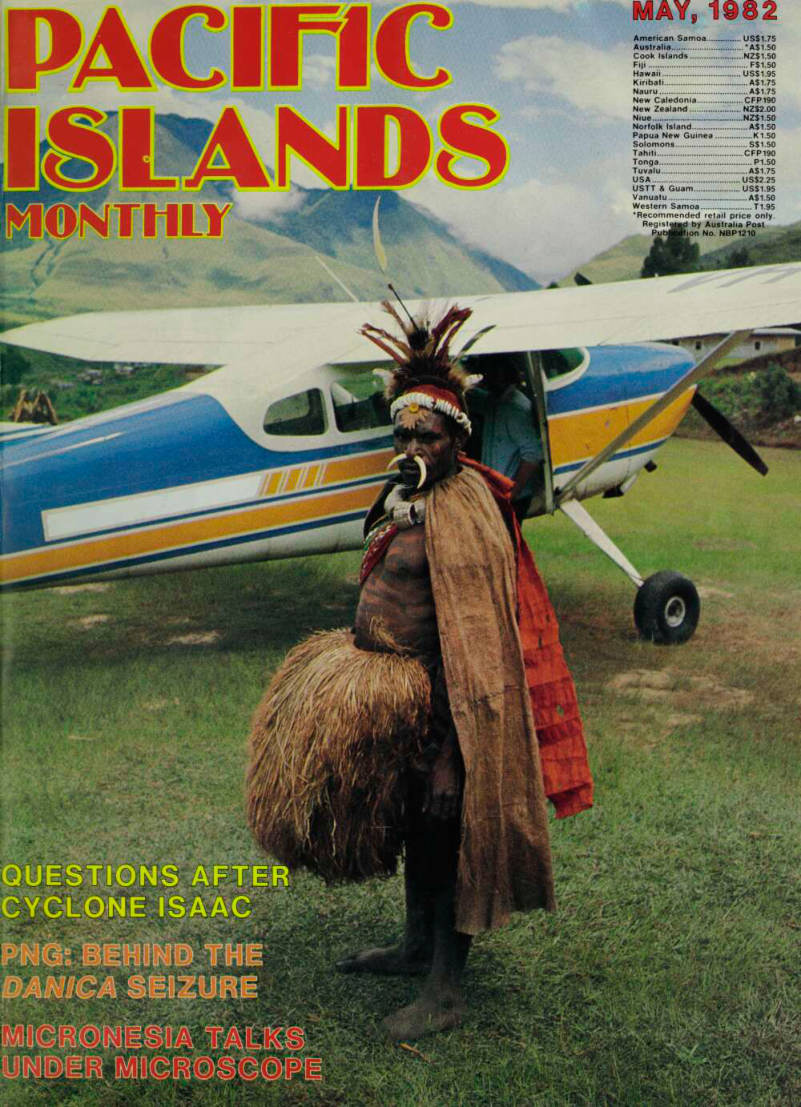
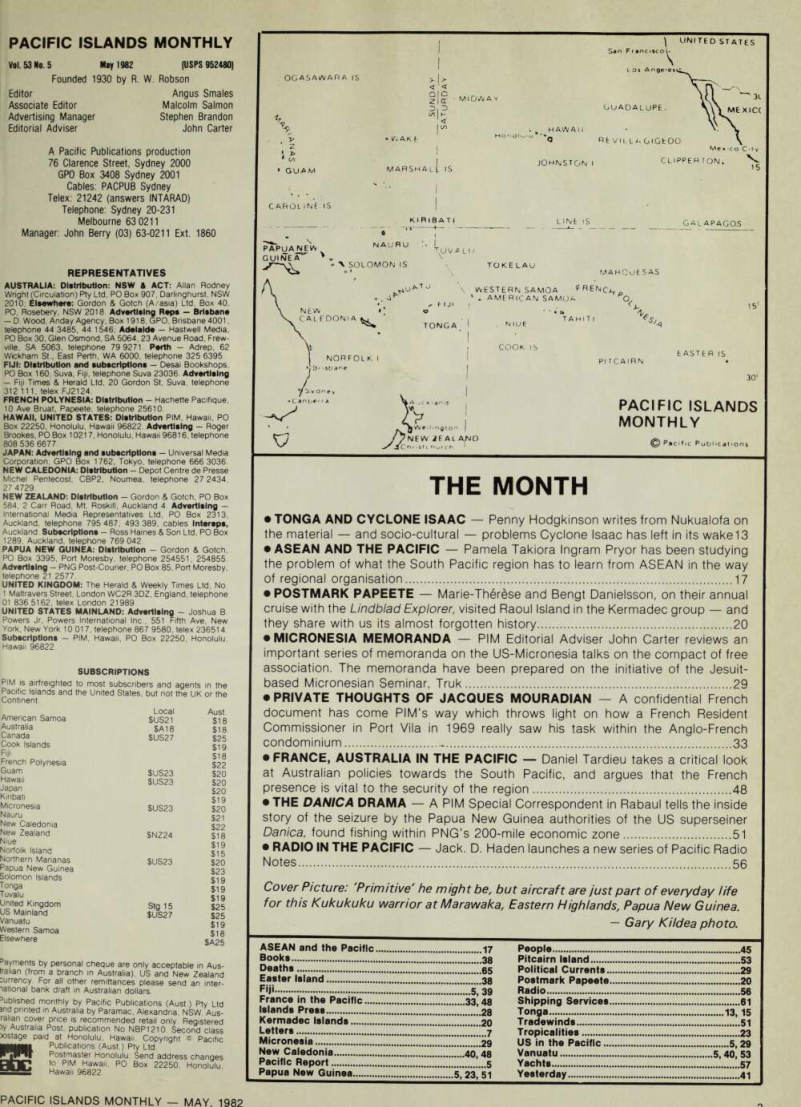
Cover Picture: 'Primitive' he might be , but aircraft are just part of everyday life for this Kukukuku warrior at Marawaka, Eastern Highlands , Papua New Guinea. — Gary KUdea photo.
Advertisements & other items, p. 2 (1 item)
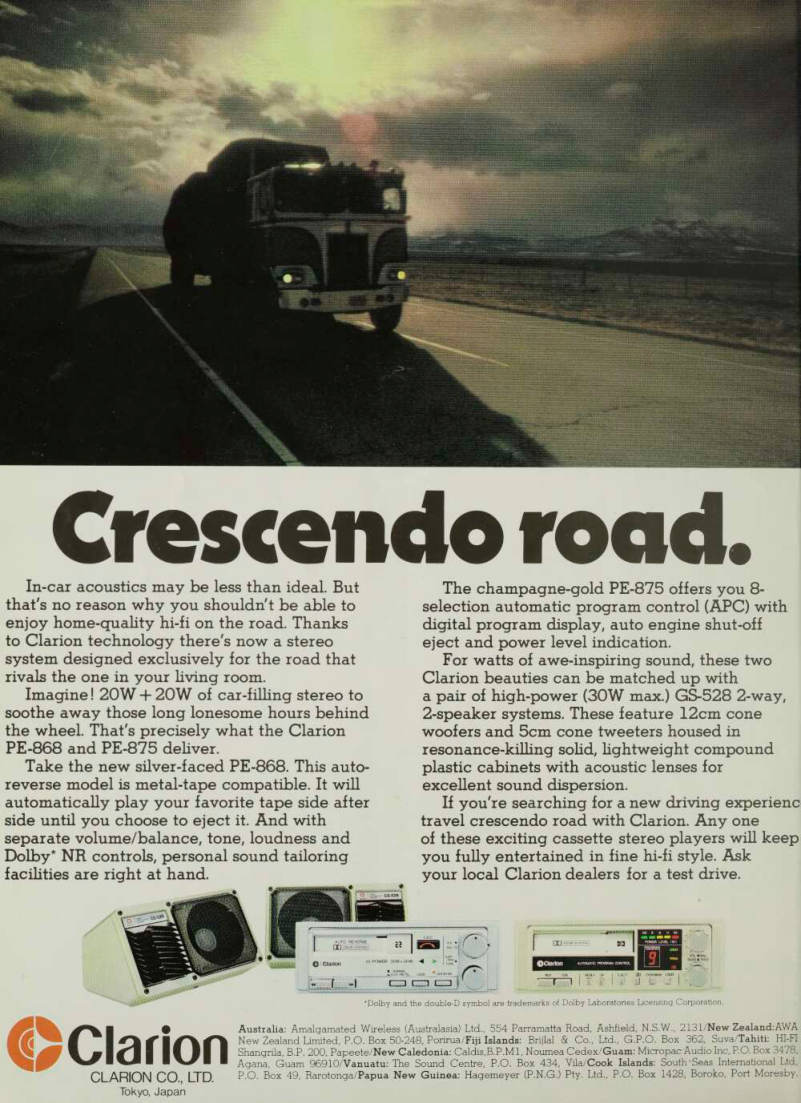
Crescendo road.
In-car acoustics may be less than ideal. But that's no reason why you shouldn't be able to enjoy home-quality hi-fi on the road. Thanks to Clarion technology there's now a stereo system designed exclusively for the road that rivals the one in your living room.
Imagine! 20 W + 20W of car-filling stereo to soothe away those long lonesome hours behind the wheel. That's precisely what the Clarion PE-868 and PE-875 deliver.
Take the new silver-faced PE-868. This autoreverse model is metal-tape compatible. It will automatically play your favorite tape side after side until you choose to eject it. And with separate volume/balance, tone, loudness and Dolby* NR controls, personal sound tailoring facilities are right at hand.
The champagne-gold PE-875 offers you 8selection automatic program control (APC) with digital program display, auto engine shut-off eject and power level indication.
For watts of awe-inspiring sound, these two Clarion beauties can be matched up with a pair of high-power (SOW max.) GS-528 2-way, 2-speaker systems. These feature 12cm cone woofers and scm cone tweeters housed in resonance-killing solid, lightweight compound plastic cabinets with acoustic lenses for excellent sound dispersion.
If you're searching for a new driving experienc travel crescendo road with Clarion. Any one of these exciting cassette stereo players will keep you fully entertained in fine hi-fi style. Ask your local Clarion dealers for a test drive.
O Clarion r
*OO7 METAL LOUD - tXXBVWJ
CZD C=n CZZ3 1
II *Dolby and the double-D symbol are trademarks of Dolby Laboratories Licensing Corporation.
©Clarion
CLARION CO., LTD.
Tokyo, Japan Australia: Amalgamated Wireless (Australasia) Ltd., 554 Parramatta Road, Ashfield, N.S.W., 2131/New Zealand:AWA New Zealand Limited, P.O. Box 50-248, Porirua/Fiji Islands; Brijlal & Co., Ltd., G.P.O. Box 362, Suva/Tahiti: HI-FI Shangrila, B.P. 200, Papeete/New Caledonia: Caldis,B.P.Ml, Noumea Cedex/Guam: Micropac Audio Inc, P.O. Box 3478, Agana, Guam 96910/Vanuatu: The Sound Centre, P.O. Box 434, Vila/Cook Islands: South'Seas International Ltd, P.O. Box 49, Rarotonga/Papua New Guinea: Hagemeyer (P.N.G.) Pty. Ltd., P.O. Box 1428, Boroko, Port Moresby.
Pacific Islands Monthly
Vol. 53 No. 5
May 1982
(Usps 952480)
Representatives
AUSTRALIA: Distribution: NSW A ACT: Allan Rodney Wright (Circulation) Pty Ltd, PO Box 907, Darlinghurst, NSW 2010; Elsewhere: Gordon & Gotch (A/asia) Ltd, Box 40, PO, Rosebery, NSW 2018 Advertising Reps - Brisbane D. Wood, Anday Agency, Box 1918, GPO, Brisbane 4001, telephone 44 3485, 44 1546: Adelaide - Hastwell Media, PO Box 30, Glen Osmond, SA 5064, 23 Avenue Road, Frew ville, SA 5063, telephone 79 9271 Perth Adrep, 62 Wickham St., East Perth, WA 6000, telephone 325 6395 FIJI: Distribution and subscriptions Desai Bookshops, PO Box 160, Suva, Fiji, telephone Suva 23036. Advertising Fiji Times & Herald Ltd, 20 Gordon St, Suva, telephone 312 111, telex FJ2124 FRENCH POLYNESIA: Distribution - Hachette Pacifique, 10 Ave Bruat, Papeete, telephone 25610.
HAWAII, UNITED STATES: Distribution PIM, Hawaii, PO Box 22250, Honolulu, Hawaii 96822 Advertising Roger Brookes, PO Box 10217, Honolulu, Hawaii 96816, telephone 808 536 6677 JAPAN: Advertising and subscriptions - Universal Media Corporation, GPO Box 1762, Tokyo, telephone 666 3036.
NEW CALEDONIA: Distribution - Depot Centre de Presse Michel Pentecost, CBP2, Noumea, telephone 27 2434, 27 4729.
NEW ZEALAND; Distribution - Gordon & Gotch, PO Box 584, 2 Carr Road, Mt. Roskill, Auckland 4 Advertising International Media Representatives Ltd, PO Box 2313, Auckland, telephone 795 487; 493 389, cables Intereps, Auckland Subscriptions Ross Haines & Son Ltd, PO Box 1289, Auckland, telephone 769 042.
PAPUA NEW GUINEA: Distribution - Gordon & Gotch, PO Box 3395, Port Moresby, telephone 254551, 254855.
Advertising PNG Post-Courier, PO Box 85, Port Moresby, telephone 21 2577.
UNITED KINGDOM: The Herald & Weekly Times Ltd, No. 1 Maltravers Street, London WC2R 3DZ, England, telephone 01 836 5162, telex London 21989 UNITED STATES MAINLAND: Advertising - Joshua B Powers Jr, Powers International Inc , 551 Fifth Ave, New York, New York 10 017, telephone 867 9580, telex 236514 Subscriptions PIM, Hawaii, PO Box 22250, Honolulu, Hawaii 96822
Subscriptions
PIM is airfreighted to most subscribers and agents in the Pacific Islands and the United States, but not the UK or the Continent.
p ayments by personal cheque are only acceptable in Aus tralian (from a branch in Australia), US and New Zealand :urrency. For all other remittances please send an inter national bank draft in Australian dollars, published monthly by Pacific Publications (Aust.) Pty Ltd md printed in Australia by Paramac, Alexandria, NSW Aus ralian cover price is recommended retail only Registered )y Australia Post, publication No NBPI2IO. Second class xnstage paid_at Honolulu, Hawaii Copyright t Pacific
Publications (Aust) Pty Ltd.
Postmaster Honolulu Send address changes to PIM Hawaii, PO Box 22250. Honolulu Hawaii 96822
tbtb Local Aust.
American Samoa
Sus21
$18 Australia $A18 $18 Canada $US27 $25 Cook Islands $19 Fiji $18 French Polynesia $22 Guam
Sus23
$20 Hawaii $US23 $20 Japan $20 Kiribati $19 Micronesia
Sus23
$20 Nauru $21 New Caledonia $22 New Zealand Niue Norfolk Island
Snz24
$18 $19 $15 Northern Marianas
Sus23
$20 Papua New Guinea $23 Solomon Islands $19 $19
Tonga
Tuvalu $19
United Kingdom
Stg 15 $25 US Mainland Vanuatu
Sus27
$25 $19 $18 $A25 Western Samoa Elsewhere
The Month
• TONGA AND CYCLONE ISAAC Penny Hodgkinson writes from Nukualofa on the material and socio-cultural problems Cyclone Isaac has left in its wake 13 • ASEAN AND THE PACIFIC Pamela Takiora Ingram Pryor has been studying the problem of what the South Pacific region has to learn from ASEAN in the way of regional organisation 17 • POSTMARK PAPEETE Marie-Therdse and Bengt Danielsson, on their annual cruise with the Lindblad Explorer, visited Raoul Island in the Kermadec group and they share with us its almost forgotten history 20 • MICRONESIA MEMORANDA PIM Editorial Adviser John Carter reviews an important series of memoranda on the US-Micronesia talks on the compact of free association. The memoranda have been prepared on the initiative of the Jesuit based Micronesian Seminar, Truk 29 • PRIVATE THOUGHTS OF JACQUES MOURADIAN A confidential French document has come PlM’s way which throws light on how a French Resident Commissioner in Port Vila in 1969 really saw his task within the Anglo-French condominium - 33 • FRANCE, AUSTRALIA IN THE PACIFIC Daniel Tardieu takes a critical look at Australian policies towards the South Pacific, and argues that the French presence is vital to the security of the region 48 • THE DANICA DRAMA A PIM Special Correspondent in Rabaul tells the inside story of the seizure by the Papua New Guinea authorities of the US superseiner Danica, found fishing within PNG’s 200-mile economic zone 51 • RADIO IN THE PACIFIC Jack. D. Haden launches a new series of Pacific Radio Notes 56
ASEAN and the Pacific 17 Books
Deaths "Z..6S
Easter Island
E'ji 5,39
France in the Pacific 33,43 Islands Press ...28 Kermadec Islands 20 Letters Micronesia New Caledonia !."!!!."40 48 Pacific Report .5 Papua New Guinea 5,23, 51
People... 45 Pitcairn Island 53 Political Currents 29 Postmark Papeete 20 Radio 56 Shipping Services 61 Tonga 13,15 Tradewinds 51 Tropicalities 23 US in the Pacific 5, 29 Vanuatu 5,40, 53 Yachts 57 Yesterday 41
Advertisements & other items, pp. 3-4 (2 items)
3
PACIFIC ISLANDS MONTHLY MAY 1982
Founded 1930 by R. W. Robson Editor Angus Smales Associate Editor Malcolm Salmon Advertising Manager Stephen Brandon Editorial Adviser John Carter A Pacific Publications production 76 Clarence Street, Sydney 2000 GPO Box 3408 Sydney 2001 Cables: PACPUB Sydney Telex; 21242 (answers INTARAD) Telephone: Sydney 20-231 Melbourne 63 0211 Manager: John Berry (03) 63-0211 Ext. 1860
Innovation
Scott Carpenter
and JVC.
Both explorers.
Both dedicated to —
* m Scott Carpenter. An explorer who has spent his professional career on the cutting edge of innovation. One of the original US astronauts and an aquanaut. The only man to penetrate both inner and outer space.
JVC, too. has always been identified with innovation. Like Scott, we have spent years opening up new worlds. New worlds of home entertainment. We originated VMS. the most widely used home video system. We make versatile equipment like the HR-2200 portable video cassette recorder and the GX-68 video camera.
Take a look and see if you don V agree that JVC products are out of this world.
Innovation
- rc k v. t 00 V
JVC
Pacific Report
Fiji, Png: Two Elections, Two Issues
Two issues are coming to dominate 1982’s election campaigning in the two largest Island countries of the South Pacific: in Fiji (which goes to the polls in July) it is race, and in Papua New Guinea (where voting begins in June) it is a medium-term threat of political instability. In Fiji, the Fijian Nationalist Party, which briefly brought down the Alliance Party in 1977 by splitting the Fijian vote, is campaigning vigorously on practically the same platform it used then ‘Fiji for the Fijians’. This time its manifesto is calling for the reservation of 46 of the 52 House of Representatives seats for ethnic Fijians, free and compulsory primary and secondary education for Fijians, and the return of all Crown and freehold land to Fijians. In the event, these policies might actually help the ruling Alliance Party, for nervous Indians may feel that life under the Alliance is to be preferred to all that.
But the fact remains that the campaigning is more racist than in any previous election. In Papua New Guinea, the only hope of immediate formation of a government after the election is if either Michael Somare’s Pangu Party or lambakey Okuk’s National Party wins an outright majority. Sir Julius Chan’s Peoples Progress Party couldn’t possibly do it. The situation is causing deep concern to the more thoughtful politicians, who feel that something must be done to bring improved party-political behaviour to PNG before the country runs into serious political instability. No leader can depend on support for long, with the result that government at best is confused, and at worst inefficient and ineffective as key politicians blatantly demand favours for their loyalty.
Micronesia Talks Off And On?
The United States has asked the Marshall Islands Government to resume talks on the Compact of Free Association, which broke down in February when the US sought to exclude from the talks ‘subsidiary matters’, including radiation problems. High Com missioner of the Trust Territory Mrs Janet McCoy told Marshalls Foreign Secretary Tony deßrum that the US was now willing to resume discussion on radiation problems, and suggested that the talks, which until February were held in Washington, should be resumed in Honolulu. At press time, information on the Marshalls’ reply was not available, but deßrum had indicated his government’s willingness to continue discussion. The February breakdown of the talks followed a US demand that the right of ‘military denial’ (the right to refuse admission to Micronesia to other powers) should be valid for 100 years instead of the 15 years defined in the compact. The US also claimed unrestricted access to Kwajalein’s missile test base for the next 62 years under the 99-year lease signed in the 1960 s and running from 1944. The Marshallese said they could not accept this lease because it was forced upon them. The US also refused to discuss radiation issues connected with the storage of nuclear weapons and the servicing of nuclear-powered submarines in Micronesian bases. The turn-around in the US position on this issue appears to have opened the way for the talks to resume.
Conference Plans Action On Environment
A plan of action for management of the natural resources and environment of the South Pacific region was adopted by an international conference in Rarotonga in March. The conference declared that deforestation and fisheries major matters of concern in the region should be carried out on the basis of reliable information to ensure sustainable production. It also stressed the need to adapt traditional conservation practices and technology, and systems of land and reef tenure, in managing regional resources. On nuclear issues, the conference declared: The storage and release of nuclear wastes in the Pacific regional environment shall be prevented.’ On nuclear tests: ‘The testing of nuclear devices against the wishes of the people will not be permitted.’ France and New Caledonia refused to accept this clause, and Wallis and Futuna abstained from the vote on it.
Twenty countries and territories were represented at the conference which was jointly organised by the United Nations Environment Programme, the South Pacific Commission, the
South Pacific Bureau for Economic Co-operation, and the UN Economic and Social Commission for Asia and the Pacific. Day to-day implementation of the action plan will be the responsibility of a small secretariat set up within the South Pacific Commission.
‘No-Confidence’ Move Fails In Vila
A planned parliamentary motion of no confidence in Vanuatu Prime Minister Father Walter Lini failed in March following intervention by the secretary-general of the ruling Vanuaaku Party, Barak Sope. Mr Sope said in a nation-wide broadcast on March 18 that a member of the Vanuaaku Party had tabled the motion, but ‘had not followed the right channels’. He said any challenge by a party member to Fr Lini’s leadership should be made through the party structure, and not parliament. Fr Lini is also president of the Vanuaaku Party. PIM understands from sources in Port-Vila that former minister Reuben Seru was closely associated with the move. Along with another Vanuaaku Party minister, George Worek, Mr Seru had shortly before been dropped from the cabinet (PIM Feb p 33). PIM understands that although six names appeared on the no-confidence motion, there were not six signatures. In the event the no-confidence motion was never formally presented in parliament.
‘No Trident Base For Belau’ Admiral
Rear-Admiral Bruce DeMars, commander of US naval forces in the Northern Marianas, has denied reports that the US plans to build a Trident submarine base in Belau. While touring the Trust Territory, Admiral DeMars said at Koror: The US navy has no plans now or in the foreseeable future for building any submarine base in Palau (Belau). The development and deployment of the long-range Trident 1(C-4) missile has rendered it unnecessary for forward basing of US navy ballistic missile submarines. The increased range of the Trident systems means that a Trident equipped ballistic missile submarine does not have to operate far forward for it to be able to execute its strategic mission.’ Rear- Admiral DeMars said Guam had seen the phase-out of the shorter-range Polaris missile, and any basing of Trident submarines in Palau, which had none of Guam’s facilities, would require a prohibitively huge investment to construct the required logistic support installations. He added: The fact of the matter is that the US navy has never considered a Trident base in Palau, and one has to question the motives of those individuals who purport to have information to the contrary.'
U.S. Ships’ Visit ‘A Mistake’ Mara
The decision to allow two United States Navy ships USS Marvin Shields and USS Robert E. Peary to berth at Suva after the US Government refused to ‘confirm or deny’ that there were nuclear arms aboard the vessels, was a mistake by the Fiji foreign affairs department, Prime Minister Ratu Sir Kamisese Mara has said.
Cabinet decided in 1980 not to allow nuclear-powered vessels or vessels carrying nuclear weapons to enter Fiji ports. Ratu Mara said that if a request to disclose whether a vessel was or was not carrying nuclear weapons was refused, they would presume that nuclear weapons were being carried, and refusal of entry would be automatic. Ratu Mara said he had issued a directive to Foreign Affairs that he must personally see all applications from other countries seeking permission to send such warships on visits to Fiji ports. He said he had been very much embarrassed by the visit of the two US warships. Shortly afterwards, the ships were politely refused entry to Port-Vila, Vanuatu (PIM Mar p 17).
New ‘Rimpac’ Exercises Off Hawaii
New exercises involving naval units from Australia, New Zealand, the United States, Canada and Japan took place off Hawaii in April. Code-named Rimpac 82, the exercises were part of a series conducted under this name by ‘Pacific Rim’ countries.
Meeting For N-Free, Independent Pacific
Port-Vila, Vanuatu, will be the venue for the fourth Nuclear-Free and Independent Pacific Conference in March, 1983. Prep arations for the 10-day conference expected to be attended by about 100 delegates from throughout the Islands and a number of Pacific Rim countries, were discussed at a meeting in Hawaii late in March. The conference follows similar gatherings in Fiji in 1975, Ponape, Caroline Islands, in 1978, and Hawaii in 1980. The 1980 conference established the Pacific Concerns Resource Centre (PCRC), as a continuing co-ordinating centre. This body is organising the Port-Vila meeting.
Business As Usual For Tonga’S Tourism
Tonga’s tourist facilities escaped virtually undamaged from Cyclone Isaac in March. An announcement by the Tonga Visitors
Bureau says: Tonga depends on tourism as a major income earner. As it adds up the cost of Cyclone Isaac, the tiny kingdom is heartened to discover its essential tourist industry to be unscathed and fully functioning . . . accommodation remains available at pre-cyclone level . . . self-contained for electric power, and mostly with independent water supplies, major international hotels rode out the cyclone with little more to show than some easily repaired broken glass. Motels and guesthouses in Tongatapu and Vavau were often as lightly affected and there was much that was untouched. Air and sea communications were effectively so little time out of service that it has been possible to avoid re-scheduling of bookings made for the present time . . .
The escape from damage of Tonga’s tourist industry is a major factor in favour of rapid recovery from the cost of Cyclone Isaac.’
‘Sunnyside Up’ For Paris, Vila
The Vanuatu Government has budgeted for expenditure for 1982 of 2 472 000 000 vatu (SA24 720 000), an increase of five percent over the 1981 figure. Local revenue is expected to contribute 68 percent, with 30 percent coming from British and French aid sources, and two percent from reserves. Finance Minister Kalpokor Kalsakau reported a trade deficit of $22 930 000 in 1981, as against $24730000 in 1980. Copra, much of which was stored and not exported in 1980 because of the Santo secessionist revolt, accounted for 76 percent of total export revenue in 1981. Cocoa exports of 953 tonnes earned $1 119 000, the highest return for 10 years; fish $8 260 000, coffee $46 000, beef $1 600 000 (a record), and sawn timber $214 000. The government was spending $2 million on expanding cattle projects. A new tax of 10 percent on hotel accommodation and licensed premises was to come into effect in April. Mr Kalsakau warned that unless the quality of copra improved, the sole purchaser of Vanuatu copra in Europe would stop buying it. The minister also reported that relations with France had improved vastly, and that aid talks in Paris had been cordial and constructive.
If Indonesia-Png Relations Went Bad?
‘Heavies’ from the Australian and Japanese worlds of economics, business, diplomacy, journalism and geopolitics gathered in Melbourne on March 25-26 for the Tenth Australia-Japan Relations Symposium. Among the speakers was Japan’s Ambassador to Australia, Mizuo Kuroda. Robert O’Neill, professorial fellow and head of the Strategic and Defence Studies Centre at the Australian National University, told the symposium that the East Asian-West Pacific area contained ‘four politico strategic contests, and one area of possible concern’. The four were Soviet-US rivalry, Sino-Soviet rivalry, the Korean conflict, and the ASEAN-Indochina tensions. The ‘area of possible concern’ was ‘super-power rivalry for influence amongst the recently decolonised, or yet-to-be-decolonised, states of the southwest Pacific’. In discussion on Dr O’Neill’s paper, Creighton Burns, editor of The Age, Melbourne, warned that the potential threat in the latter area came not only from super-power rivalries.
For example, he said, the possibility of worsening relations between Indonesia and Papua New Guinea had to be taken seriously into account. He said Australian defence department strategists had studied this possible scenario. During the previous week, the National Party leader in PNG, lambakey Okuk, had been quoted as saying that PNG had been assured that there was nothing to fear from the movement of up to a million Javanese into Irian Jaya. ‘But with Irian Jaya a stone’s throw away, these assurances sound horribly like those that were given to the people of Afghanistan and Poland,’ Mr Okuk was reported to have said.
Protest Yacht In Moruroa Accident
Pacific Peacemaker, the Australian anti-nuclear protest yacht, was disabled by a French police boat off Moruroa Atoll, French Polynesia, on April 2. The accident occurred when a derrick on the police boat struck the yacht’s mast, bringing it crashing down on its stern. The derrick was being used to lower a rubber dinghy carrying water police who were about to fix a towline to the yacht in order to move it away from the area. At last report, Pacific Peacemaker was in Papeete, where its skipper, Bill Ethell, was arrested and charged with illegal presence in French Polynesia’s waters.
Guilty Verdict In Noumea Trial
In Noumea in March, a multi-racial jury of four found a white farmer guilty of ‘involuntary homicide’. The settler, Guy de Saint-
Quentin, 49, was accused of killing a Melanesian man, Emile Kutu, 41, last June (PIM Aug ’Bl p 6). The court heard that Saint- Quentin fired two rifle shots at a vehicle in which Kutu was a passenger. He was among a group of five Melanesians who had driven to Saint-Quentin’s property at Gomen, about 300 kilometres from Noumea, in an effort to recover the wages of one of the group. Saint-Quentin said in his defence that the men had been drinking, and had behaved aggressively.
Slow-Boat Poll In Kiribati
Kiribati went to the polls on March 26 to elect a new 36-seat parliament, but it was expected to take at least a month before the results were known because of the remoteness of some of the republic’s islands. When the House of Assembly meets it will accept nominations for the post of president of the republic, at present held by leremia Tabai. Those nominated will then have to face a general presidential election, and the result of this is not likely to be known before well into May. The assembly may nominate for president not fewer than three and not more than four candidates, all of whom must be elected members of parliament. Term of office for the president is four years, the same as for parliament, and a president can serve only three terms.
President Tabai has served only one term so far.
Islands Protests At N.Z. Radio Cuts
Radio Vanuatu in March joined in protests by radio services of Island countries against the closure of Radio New Zealand transmissions and transcription services. The radio’s director, Joe Carlo, pointed out in a letter, signed also by members of his staff, that Radio Vanuatu regularly broadcasts New Zealand Broad casting Corporation transcription service programmes on its English-language transmission, including the popular Pacific Link public affairs programme and the new Pacific Connection musical programme. lan Mclntyre in Port-Vila. 40 YEARS AGO, THE YANKS WERE COMING March 17, 1982, marked the 40th anniversary of the arrival in the New Hebrides (now Vanuatu) of a convoy of US warships and escorted troopships. The arrival signalled the beginning of a four year occupation by US and Allied military forces. The occupation is remembered as a period of ‘dollar prosperity’, but also as a period which changed the face of the country as the US poured its massive resources into creating a defensible base for the war against the Japanese. War did not come to the country, but Santo was bombed several times by Solomons-based Japanese aircraft. The only casualty, commemorated to this day by a memorial plaque, was ‘Bossy’ a cow. To mark the occasion, Radio Vanuatu asked Major Ernie Reid, longtime Port- Vila resident and former commander of the New Hebrides Defence Force, to make a broadcast speech. A party of US visitors arrived in Port-Vila on March 31. They were with the first wave to go to the New Hebrides from the US 40 years ago.
Cooks Government Buys Rarotongan
New Zealand has decided to sell for SNZS.S million its stake in the Rarotongan Hotel to the Cook Islands Government. The sale will be financed by a New Zealand Government loan of $5.5 million at seven percent interest over 28 years. Cook Islands Government officials and the hotel staff were ‘delighted’ at the decision, said the Cooks’ Minister of Economic Development Vincent Ingram. The Cook Islands already owned a third of the hotel and Air New Zealand and the Tourist Hotel Corporation held the other shares. William Gasson in Wellington.
Huge Undersea Mountain Found
The Russian research ship, Kallisto, which is making a seismological survey of the ocean bed in Samoan waters, has discovered a very large undersea mountain about 160 kilometres south of the island of Upolu, and close to the Tpnga Trench. The mountain, which is said to rise to a height of seven kilometres, has been named Uo Mamae (‘Constant Friend’) at the suggestion of two Samoan Observatory technicians on board the vessel. If the height of 7000 metres is correct, Uo Mamae is as tall as some of the highest mountains on the earth’s surface. Mt Everest, the highest, is 8850 metres, Uo Mamae would rank with China’s Pik Komunizma (7496 metres), the world’s 12th highest mountain.
Tuvalu’S Nivaga In Trouble
The freighter Nivaga, the only asset Tuvalu, as the Ellice Islands, acquired when severing partnership with the Gilbert Islands (now Kiribati) in October, 1975, is confined to port. On her last voyage, from Suva to Funafuti early in February, she was found to be taking water.
Letters

Spc-Spec:
Bureaucrats can’t decide
I would like to refer to your report on the proceedings of the South Pacific Conference which appeared under the title ‘lsland links unweakened but can the structure remain’ (PIM Dec 'Bl, pp 13-17).
On page 14 you quote me as saying ‘there is not as much overlapping as many people think’. While it is true that I made that statement, it is also true that the quotation is incom plete and could easily be read out of context.
The statement ‘there is not as much overlapping as most people think' was made during discussions on relationships be tween the South Pacific Bureau for Economic Co-operation and the South Pacific Commission.
Other pertinent comments were also made by me, and those have not been included in your report. For the benefit of your readers I would like to reiterate those comments so that the above quotation could be read in the proper context.
The secretary-general of the South Pacific Commission and I have made much effort to minimise duplication, and promote rationalisation of pro grammes. However, there is a limit to what the chief execu tives of the two organisations can achieve to promote rational isation and harmonisation of regional effort. As long as there exist two separate organisations with separate governing bodies, representing different member ships and interests, there are likely to be difficulties in achiev ing the highest level possible in rationalisation and harmonis ation of programmes.
I made it quite clear at the conference that both the South Pacific Bureau for Economic Co-operation and the South Pacific Commission arc answer able to their respective govern ing bodies, the Forum/SPEC Committee and the Confcr ence/Committec of Repres entatives of Participating Gov ernments, and arc duly-bound to implement decisions made by those governing bodies. To re duce duplication to a minimum
possible under the present ar rangements, it is necessary that country representatives attend ing SPC meetings are briefed on Forum/SPEC Committee decisions, and also conversely so that consistency of approach would be adopted by each country this would facilitate harmonisation in collective decision-making. For the highest level of rationalisation to occur, it would also be necessary to review and, where applicable, revise the mandates of SPEC and the South Pacific Commission to achieve har mony and complementarity.
This is a political matter and the necessary decision could only come from the respective decision-making bodies at the highest level.
The concerns that have been expressed about duplication would appear to apply even more strongly to costs each country has to pay to maintain the two institutions and to attend meetings convened by them. Apart from financial costs, the demands on small bureaucracies can also be ex cessive.
Representatives of some countries tend to believe that a single, more general, regional organisation could better serve the region than two organis ations. You are aware, of course, that SPEC is currently undertaking an exercise that is aimed at assisting the SPEC Committee and the South Pacific Forum to consider this matter further.
I was also reported as defend ing the existence of the two institutions. This conclusion is incorrect. It is not the role of a regional civil servant, like the director of SPEC, either to
defend the existence of the two institutions or to argue a case for a single institution. That role rightly belongs to country rep resentatives and political leaders. As long as the South Pacific Bureau for Economic Co-operation and the South Pacific Commission continue to exist, 1 am obliged to work closely with the secretary general of the South Pacific Commission so that maximum possible benefits may be achieved for the region within the constraints of existing ar rangements.
I did defend the secretary general of the South Pacific Commission and the director of SPEC from implied criticism that they were not doing enough to promote rationalisation of effort. Indeed, I went so far as to say that in essence the ball was (and is) in the court of the decision-makers, not the chief executives of the South Pacific Commission and the South Pacific Bureau for Economic Co-operation.
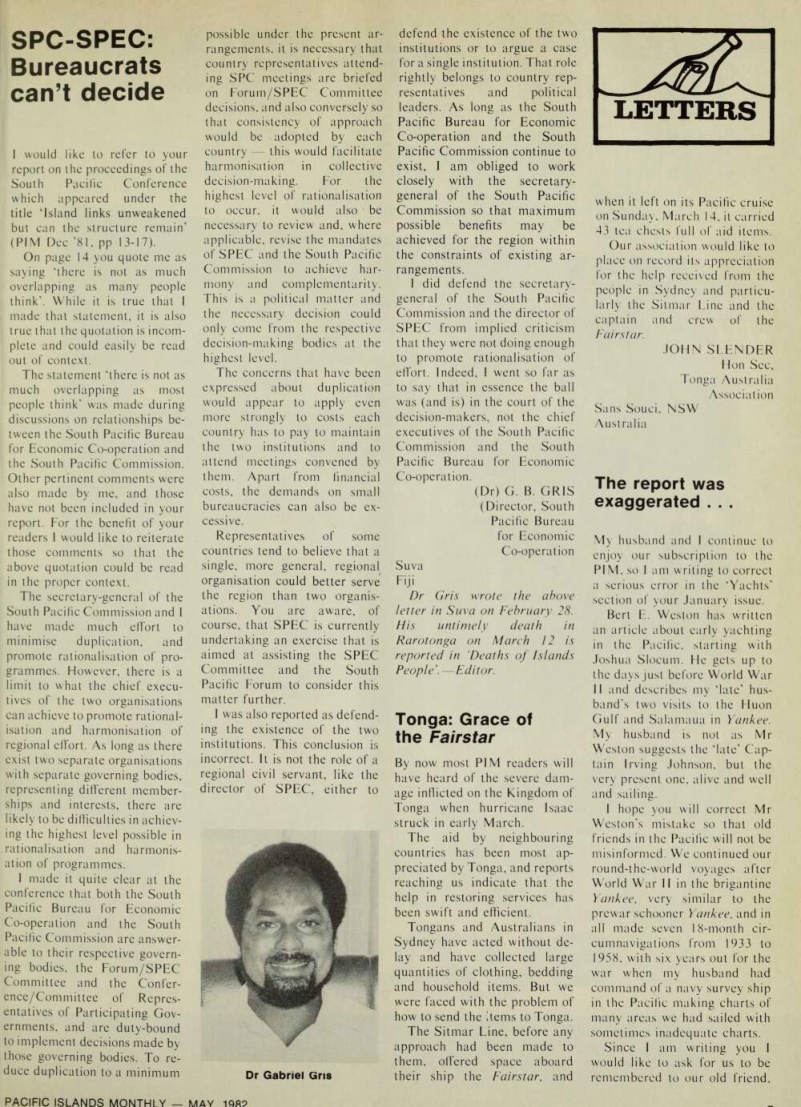
(Dr) G. B. Gris
(Director, South Pacific Bureau for Economic Co-operation Suva Fiji Dr Gris wrote the above letter in Suva on February 28.
His untimely death in Rarotonga on March 12 is reported in ‘Deaths of Islands People'. — Editor.
Tonga: Grace of
the Fairstar By now most PIM readers will have heard of the severe dam age inflicted on the Kingdom of Tonga when hurricane Isaac struck in early March.
The aid by neighbouring countries has been most ap preciated by Tonga, and reports reaching us indicate that the help in restoring services has been swift and efficient.
Tongans and Australians in Sydney have acted without de lay and have collected large quantities of clothing, bedding and household items. But we were faced with the problem of how to send the items to Tonga.
The Sitmar Line, before any approach had been made to them, offered space aboard their ship the Fairstar, and
when it left on its Pacific cruise on Sunday, March 14, it carried 43 lea chests full of aid items.
Our association would like to place on record its appreciation for the help received from the people in Sydney and particu larly the Sitmar Line and the captain and crew of the Fair star.
John Slender
Hon Sec, Tonga Australia Association Sans Souci, NSW Australia
The report was
exaggerated . . .
My husband and I continue to enjoy our subscription to the PIM, so I am writing to correct a serious error in the ‘Yachts' section of your January issue.
Bert E. Weston has written an article about early yachting in the Pacific, starling with Joshua Slocum. He gets up to the days just before World War II and describes my Mate’ hus band's two visits to the Huon Gulf and Salamaua in Yankee.
My husband is not as Mr Weston suggests the Male’ Cap tain Irving Johnson, but the very present one, alive and well and sailing.
I hope you will correct Mr Weston’s mistake so that old friends in the Pacific will not be misinformed. We continued our round-the-world voyages after World War II in the brigantine Yankee, very similar to the prewar schooner Yankee, and in all made seven 18-month cir cumnavigations from 1933 to 1958, with six years out for the war when my husband had command of a navy survey ship in the Pacific making charts of many areas we had sailed with sometimes inadequate charts.
Since I am writing you I would like to ask for us to be remembered to our old friend.
Dr Gabriel Gris
Mr Robson, who also is not ‘late’, I believe.
Electa Johnson
Hadley, Mass
I Usa
Thumbs up
on yachties (3)
We have just received our January 1982 issue of your fine publication, and I hasten to comment on the letter of Frank Lewis (p 8). Needless to say, I wholly and totally disagree with the philosophy of the gentleman from Rabaul. To each his own, of course.
Mr Lewis must be delighted with your January issue, for it devotes but two half pages to yacht movement accounts somewhat of a disappointment to me. I was pleased, though, to see the report on Hawaiki and the splendid McDaniel family.
We became acquainted with them during their most recent visit here in their fine vessel.
Equally line are the captain and crew of Hawaiki.
In the same January issue, Bert Jy. Weston provides an interesting account of the days when cruising yachts were few and far between. I found his account interesting and, as a lad, I, too, was interested in the account of the voyage of Stock’s Dream Ship, as published in National Geographic.
I believe that Mr Weston was in error in his statement that Svaap was wrecked in the Galapagos Islands. She did go ashore in the jungles of the Riyer Sambu, but she was refloated. Later, in the Galapagos, William A.
Robinson was stricken with appendicitis and almost lost his life. The U.S. Navy responded, from Panama, and the appendix was removed and the patient survived. The Svaap was aban doned but not wrecked in the Galapagos, at the time of the evacuation of the Robinsons. I believe that the Svaap was confiscated by the Ecuadorian Government and taken to Guayaquil.
Mr Weston also speaks of the late Captain ‘lrvine Johnston’, of the Yankee. I have not heard of the death of that great seaman, and I hope that the
report is false, as is Mr Weston’s spelling of Irving Johnson’s name. In spite of a few errors, I enjoyed reading Mr Weston’s account.
Again my compliments to Pacific Islands Monthly for a fine publication.
Bruce B. Mccloskey
Fort Lauderdale, Florida
Usa
Thumbs down
on yachties (3)
You asked (January issue) if any other reader cared to com ment on Frank Lewis’s letter about overdoing the Yachtie gossip column.
Yes, indeed. I endorse his comments 100 percent.
What’s needed in PIM is more basic transportation news, especially air transport. You’re missing a lot in this area. Air service is vital for the entire Pacific basin but little enough air news makes its way into your magazine.
For example, is there any new activity for that landing strip on Pitcairn? Are you pushing the idea? And how about the Tokelau islands any trans port news of there? And how about the Ogasawara Islands, any transport to there? Air Nauru keeps expanding but I get the news elsewhere, such as it is. How about Air Pacific and its problems? And Ansett’s efforts to buy into Air Polynesia?
PIM is a fine magazine but I have the feeling that it carries less topical info than it used to do.
Wayne W. Parrish
Washington DC
Usa
Point taken. A special avi ation issue of PIM is on the way up. Ansett’s dealings with Polynesian Airlines were, we feel, adequately covered in our February issue (psl). — Editor.
Limitations of Bislama I was disappointed to read in the February PIM of the recent enthusiasm in Port-Vila for the
wider use of the Bislama language.
It is understandable that new nations with a large number of vernacular languages should look for a common voice to express unity and national identity. There was a similar debate in India in 1947 about the wisdom of retaining English as the official language, and although it was adopted in itially, English was later aban doned in favour of Hindi.
But the conference in Vila, as reported by Donald Topping, failed to identify some of the obvious problems in using a ‘Pidgin’ language as the vehicle of education, commerce, and litigation, and assumed that a language which is suitable for the translation of the Bible, will be adequate for all other forms of communication.
This is nonsense. Not only is it philological nonsense, it is political nonsense, and totally
impractical.
There is no reason to doubt that Bislama, given time, would evolve into a language capable of fulfilling all the requirements of Vanuatu, just as English evolved from Anglo-Saxon, Latin and Greek. But Vanuatu cannot wait that long; it re quires access to the literature and technology of the 20th century before that century ends.
Spoken languages cannot be introduced by decree or by promulgating a standard dic tionary. Few people in the world speak Esperanto. The
Bislama announcement of the arrival in Vanuatu of the first consignment of the country’s new currency in the Vanuatu Government weekly Tam-Tam which appears in three languages Bislama, English and French, Academic Fransaise has failed to erase words like ‘weekend’ and ‘sandwich’ from French.
Even the Oxford English Dic tionary is obliged to issue a supplement from time to time, which recognises words that have become part of current usage, such as ‘supermarket’ and ‘commuter’, words which may have a dubious etymology, but which no amount of linguis tic restructure can remove. To speak, as the missionaries in Vila do so glibly, of ‘expunging Anglicisms’ from Bislama, is philologically naive.
Since Pidgin languages evolved as a means of communi cation between groups of people without a common language, the idea of a standard or definitive Pidgin, even of ‘good’
Pidgin, is also an illusion. As the groups who must communicate in this way are vastly different, the form of the language which effectively provides communication will vary from village to village, island to island, and from nation to nation; but no one form can be said to be more correct than any other. If mutual understanding is achieved, it must be ‘good’
Pidgin, whatever words are used. If Anglicisms are needed to provide vocabulary, they are
an integral and essential part of the language. Furthermore, uniformity has never been a feature of Pidgin; the links between the ‘Tokpisin’ of Papua New Guinea and the Bislama of Vanuatu are not as close as has been suggested. Anyone who has travelled widely in the region would know that unedu cated village people in Vanuatu really do not understand Tokpisin at all.
It is of particular interest, in view of some of the vested interests in Bislama, that the only language which has been successfully introduced in the modern world is Hebrew, the language of the Old Testament.
Those who know Biblical and Modern Hebrew are aware that the vocabulary of the Bible was quite inadequate of the needs of modern Israel, and the language has had to acquire many thousands of new words.
In spite of all attempts to coin appropriate words from Semitic roots, Anglicisms have poured in, and today Israelis talk quite normally of ‘university’, ‘sweaters’, and even ‘sandwiches’ (or, as they say it, ‘sandwichim’). The Bible trans lators, of all people, could be expected to know this.
Bislama is a colloquial language, of a type which has many parallels in the rest of the world, and as such it will survive, whatever linguists, poli ticians and others may decide.
If it is employed as a written language, especially as the me dium of education, its effect will be to arrest development. This is too high a price to pay for a hypothetical enhancement of national cultural awareness.
The younger generation of ni- Vanuatu, if they are to develop their country, require a litera ture wider than the textbooks of Western religion; they cannot wait for Shakespeare or the Encyclopaedia Britannica to be translated into Bislama, even if it were economically feasible to do so.
Expatriates, or nationals who are already bi- or tri-lingual, may indulge in the promotion of Bislama with the best of inten tions. However genuine their motives, the end result will still be to delay the advance of universal education in Vanuatu, or to channel its progress along
strictly sectarian lines.
(Dr) R. K. Likeman
Te Kuiti New Zealand
An ‘Anzus
Lake’?
A recent article in the Austra lian weekly magazine The Bull etin is of particular importance to Pacific Islanders. According to the report from Washington by John Edwards, a sentence regarding the Pacific has been added to the annual statement from the US Joint Chiefs of Staff in reference to the ANZUS treaty. It reads: ‘Aus tralia and New Zealand possess the best capability for assisting US power projection into the Pacific islands in response to crises there.’
As Edwards points out, the intention is that Australia and New Zealand are expected to ‘help out’ in asserting Western interests in the Pacific.
Of even greater interest though is Edwards’ discussion of a US National War College article by John Dorrance, who describes the South Pacific as ‘being in effect an ANZUS lake’. Of course the knowledge that the Americans regard the Pacific in this way is not new.
What appears to be new is the formalising of this opinion by its inclusion in an official statement of policy. The fact in itself is extremely important because, as Edwards says, if an un friendly government came to power in the region, or a
formerly friendly one offered
basing rights to a country the ANZUS partners didn’t like, the US would assume the right to intervene.
The situation is likely to arise, but when, and what action the ANZUS partners would take in the event, is hard to judge. In any case the machin ery for intervention in Pacific affairs is being established, and the ocean I have heard de scribed as an ‘American Lake’ is now to be officially recognised as such. Such power, these Americans, to turn oceans into lakes.
Elizabeth Jane Byrne
Darwin, NT Australia
Uniting the two Samoas As a Samoan citizen, born in Western Samoa but raised in American Samoa and the US, I would like to share some con cern with respect to the recent meeting between our two leaders, Prime Minister Tupuola Efi of Western Samoa and Governor Peter T. Coleman of American Samoa. The meet ing was reported in PIM (Nov ’Bl, p 6). The issues under consideration were an easing of relations between our islands, and the possibility of uniting the Samoas.
To me, it seems rather suspect that Governor Coleman has insisted on an easing and improvement of relations be tween our islands, and yet continues to resist the idea of a possible unification. Consider ing the long-standing animosity, hardship, and economic in equality that this separation has caused the Samoan people, many of whom find themselves cut off and divided from their family and friends, I feel it would greatly benefit both islands to combine our re sources.
Admittedly this is no easy thing, taking into account the complex nature of our past colonial history, differing governmental styles, etc. But I ask sincerely: Could this not be because of an obvious wish by the privileged few to ‘hold on to what they have’ rather than spread it around in a fair and equitable way amongst our people? The US has stated a desire to help both our islands.
But this would be much more feasible with a unification.
I think it is a myth that one side of our islands would gain advantage once unification oc curred, provided there is a sound and fair leadership dis played by all parties concerned.
I believe firmly in the mainten ance and strengthening of our Samoan identity, unity, cultural heritage all those things that make our country distinctive and unique in the world. I see no difficulty affirming these things, given a sound and sensitive regional philosophy on the part of our governments and the United States.
For those who fear a tamper ing with our culture by a superpower such as the United States, I would argue that the nature of reality requires assist ance from a benevolent con tributor. We have many financial, educational and social problems which require aid and, if given in a spirit of goodwill, a wish to help, then this aid I feel should be ac cepted. It is not fair that only a few should benefit when there is such a need for help for our entire and troubled homeland.
Felani A. Peters
Portland, Oregon
Usa
Academic book
reviewers’ lot
I am sympathetic to John McKenna’s request (PIM, Mar, plO) that serious academic books on the Pacific, usually with very small print runs, should be reviewed very soon after publication to ensure that island readers can order them with some hope of finding the desired item in print.
This is a perfectly reasonable thing to ask, but as a periodic reviewer of academic books for PIM, I realise the editor has little chance of meeting such a request, largely because most reviewers of these books fit the task into a heavy teaching and research load, and the instant review is just not possible.
I stand condemned at the moment, since I have a book to be reviewed for PIM which I accepted on the understanding that the review could not be done before May or June.
As a compromise could I suggest that the editor include a list of books received in the book section of PIM each month? I realise such infor mation is not as useful as a full review. But at least island readers would know quickly what had been published, and might sometimes order on that information alone.
(Dr) Caroline Ralston
Macquarie University North Ryde, NSW Australia Thanks for the suggestion.
It’s one we reckon we’ll be able to meet. — Editor.
Advertisements & other items, p. 8 (1 item)
Suzuki 1
SUZUKI... PERF
The name of ,j£ou
SUZUKI prepared t]Z figure Each boat and usage. 5& P \1 --
ZUKI
su vi. 0 ■ Vi- viteinsnas ty_
|||£ig| g 1^
SUZUKI 1
SUZUKI MOTOR CO, LTD. Hamamatsu, Japan —^ mm
SUZUKI GENERATOR SEIBOC
• NEW ZEALAND SOUTH PACIFIC SUZUKI DISTRIBUTORS LTD, PHONE: 58-599 • PAPUA N HI SPEED SERVICE PTY LTD. PHONE: 42-2679 • FIJI NIRANJANS AUTOPORT LTD. PHONE: 381555 • TAHITI NIPPON AUTOMOTO PHONE. 2-98 1 • SOLOMON SOLOMON ISLAND PHONE: 565 • VANUATU HENRI LEROUX • NEW CALENDONiASTE SUPERCAL PHONE. 272i068 • AMERIAN SAMOA PACIFIC PRODUCTS, INC. PHONE: 639-9140 • WESTERN SAMOA VATCO • G U/W CYCLERY, INC.
PHONE; 565-2298 • NIUE BURNS PHILP CO.,LTD. • NAURU EQUIPAC MOTORS PHONE: 4019 • TONGA TONGA EQUIPMENT nmuconoAi/ T mMDAKIV DUHMC- QQfi A TQII V. KIFIMARA RTORF PHONF - 470
Masta Vatu i kam tru long
Vanuatu
Niufala mane blong Va nuatu - VATU, hemi kam tru long Vila finis long Air Vanuatu. Plen ia i mekem wan spesel trip wetem ma ne ia i kam tru long Vila klosap long 2 klok long Sarere Febreware 27 long moning.
Maneja blong Central Bank. Mista John Howard hemi bin flae i go long Syd ney, long Ostrslia mo kam bak long Vanuatu wetem mane long Air Vanuatu.
Praem Minista Walter Li ni mo Misis Uni, Minista
blong Finans, Mista Kalpo kor Kalsakau mo Minista blong Helth, Mista Willie Korisa, oli stop long eapot blong lukim niufala mane i kam tru.
Olgeta Mobael oli kad gud long nait ia stat long eapot i kam kasem taon taem ol trak oli karem ma ne ia i kam long taon.
Bambae oli stat jenisim mane long manis ia. Cen tral Bank hemi no talem stret taem blong hem yet blong jenisim olgeta Franis Franc mo dola blong Os trelia i kam long Vatu.
Advertisements & other items, pp. 10-12 (1 item)
wnrk well tn make you profit
Australian building fittings and hardware
Australia has the biggest building industry of countries nearest the Pacific Islands. It uses a great variety of Australian made building materials that give high standards of performance in all conditions. Products such as solar hot water systems, insulation materials, window and door fittings, floor tiles, bathroom and laundry fittings, hardware, adhesives and sealants, light fittings, electrical and security equipment.
And there are many more. You get quick delivery and service from Australia. Check out Australian suppliers for your requirements.
LLjJ
For information Ask the Australian Trade Commissioner Port Moresby: Phone 25 9333. Suva: Phone 31 2844.
Noumea: Phone 27 2414, 27 2426.
Honolulu: Phone (808) 524 5050. (D <r 0 <P D 3 -2 sS o m
i- *'■‘*o ca National Panasonic •■V
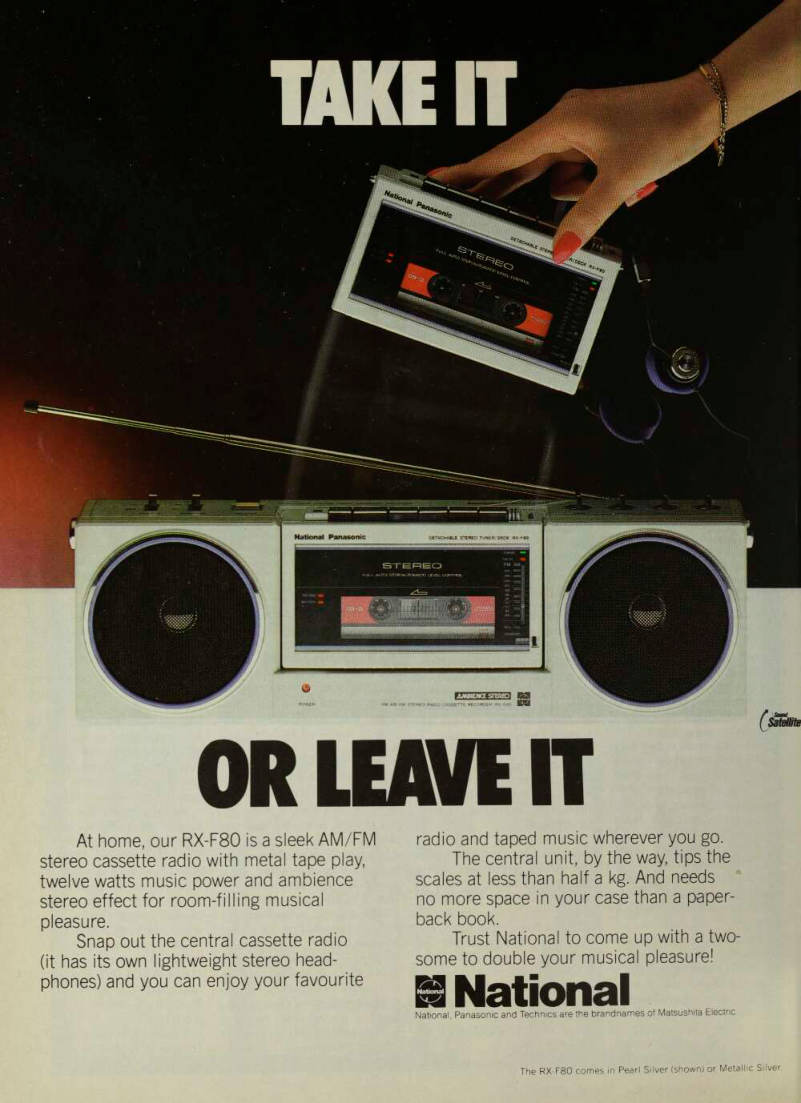
OR LEAVE IT
At home, our RX-FBO is a sleek AM/FM stereo cassette radio with metal tape play, twelve watts music power and ambience stereo effect for room-filling musical pleasure.
Snap out the central cassette radio (it has its own lightweight stereo headphones) and you can enjoy your favourite radio and taped music wherever you go.
The central unit, by the way, tips the scales at less than half a kg. And needs no more space in your case than a paperback book.
Trust National to come up with a twosome to double your musical pleasure!
H National
National, Panasonic and Technics are the brandnames of Matsushita Electric The RX-FBO comes in Pearl Silver (shown) or Metallic Silver.
Tonga: Chaos and questioning in
the wake of Cyclone Isaac
PIM correspondent in Nukualofa, PENNY HODGKINSON, describes the havoc wrought in Tonga by Cyclone Isaac and the problems and complexities of the task of putting things right.
Tropical cyclone Isaac slam med into Tonga on March 3.
Spawned north of Niue, he built up a wind force that peaked around 220 kilometres an hour on his wild south-westerly ram page.
He passed close enough to Vavau to rip into buildings, crops and anchored yachts with hurricane-force winds, devas tated the Haapai group which lay directly in his path, and came within 30 kilometres of Tongalapu at 1.45 pm, by which time barometric pressure was down to 976 millibars.
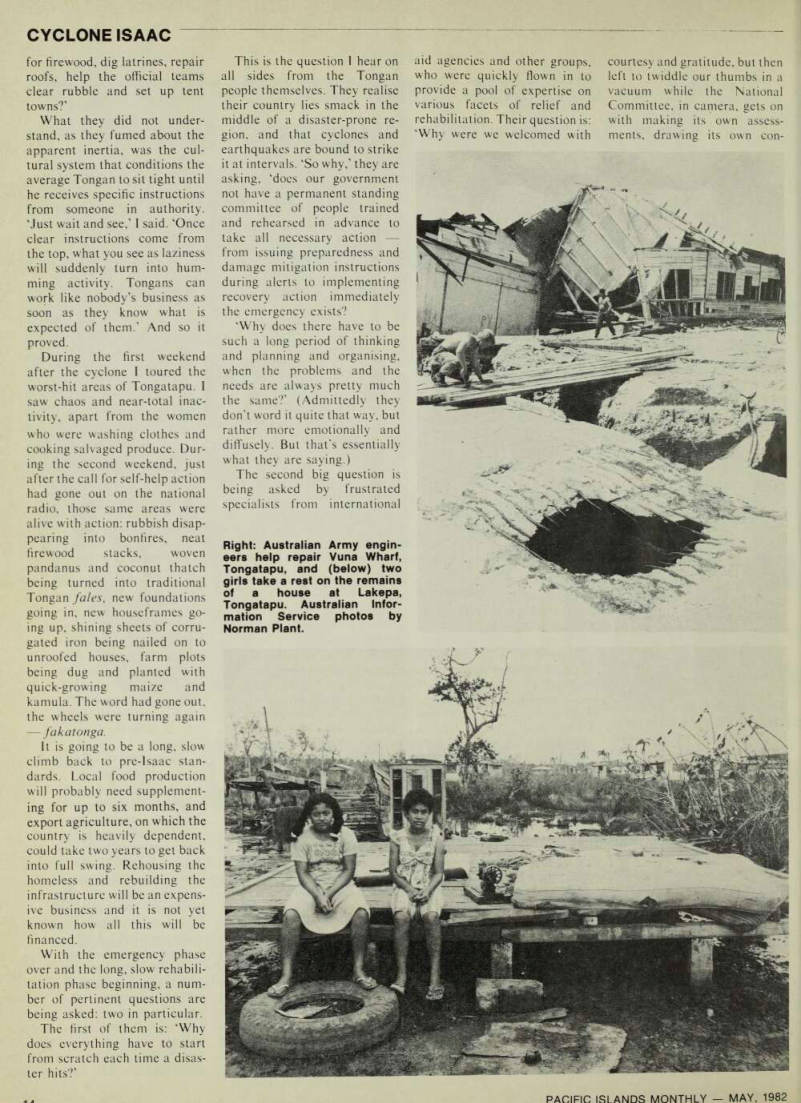
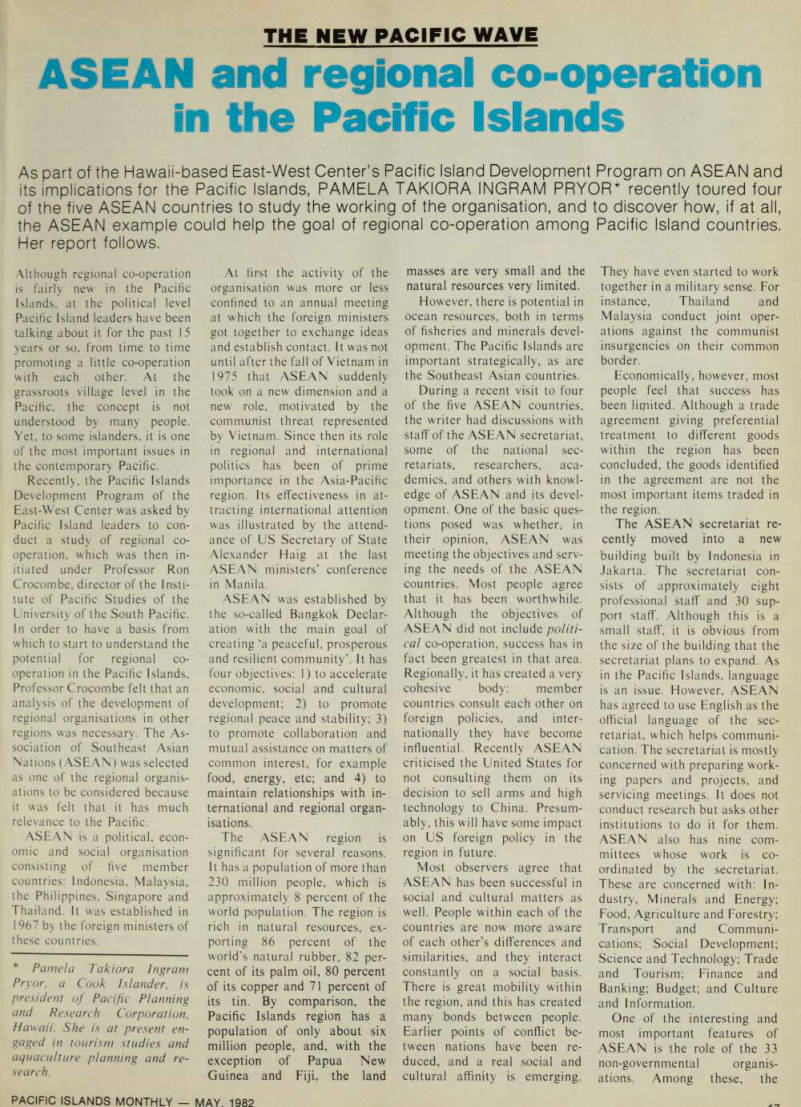
Unfortunately, his Tonga lapu visit coincided with high tide, creating a cyclonic tidal surge which lifted the sea far above normal high tide level and sent it pounding its way over 300 metres inland, with waves up to 1.5 metres and more smashing their way through the Nukualofa seafront suburb of Sopu and a number of low-lying western district vil lages, and doing even more damage than the furious wind.
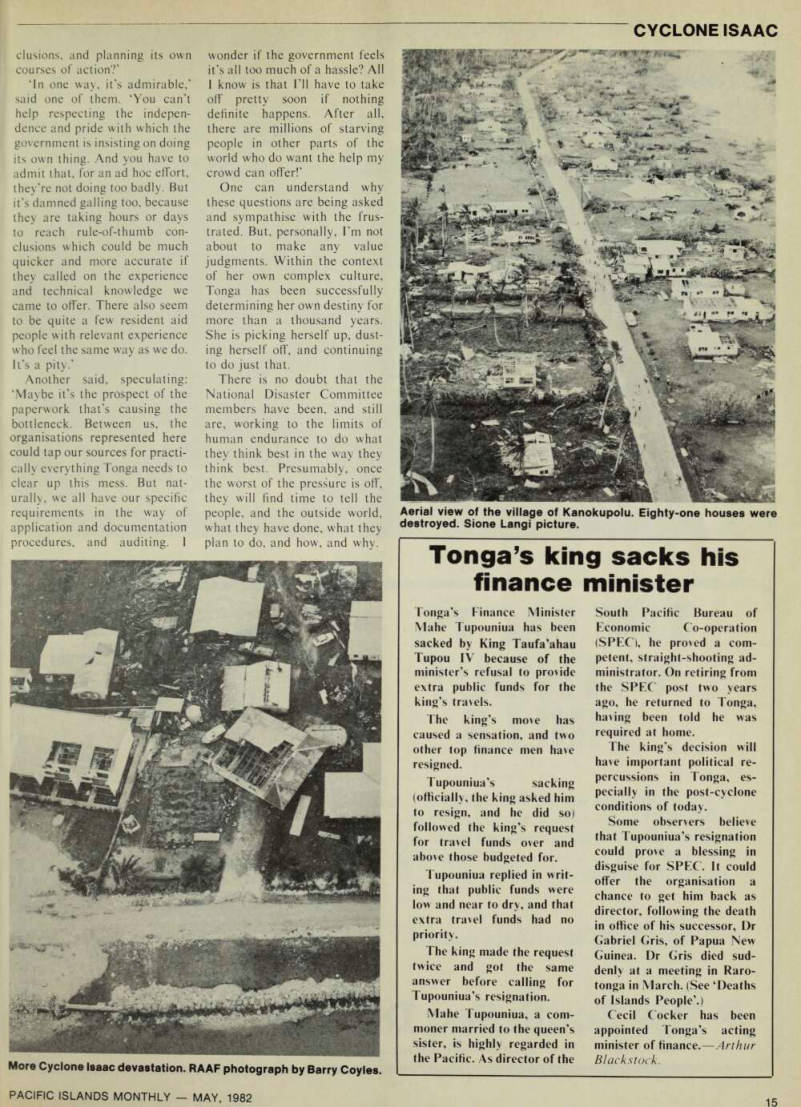
It is saddening that six people died as a result of Isaac’s destructive forces. But when you listen to the stories of those whose homes fell on them, who swam for their lives, who raced for shelter through a world suddenly filled with falling trees and jagged flying debris, or who clung to rooftops while the wind raged round them and the sea raged below, you can only wonder with amazement and thankfulness that the death 101 l was not many limes higher.
Damage assessment is a com plex business in a country of scattered islands. But the pic ture is beginning to take shape.
Things arc not as bad as the first radio reports sent out to the world in the immediate after math of shock and terror tended to indicate. But they are grim enough, and bound to set back Tonga’s progress for a long lime to come.
The eventual bill for agricul tural losses and damage to
buildings combined seems likely to come to between ST2O million and $3O million. On lop of that will come the cost of restoring badly damaged essen tial services and rebuilding wrecked roads, retaining sea walls and wharf facilities, which will involve many millions more. It is a daunting prospect for a small country with a tenuous hold on economic stab ility at the best of times. But Tonga is facing it with courage.
Australia and New Zealand responded with speed, efficiency and generosity to the kingdom’s plight, sending in an immediate stream of practical aid by plane and ship tents, food, drugs, technical equip ment and defence personnel with technical skills. Day by day, similar offers of help in cash and kind flowed in from other countries, not only in the immediate region but from all over the world. Day by day, specialists in various aspects of disaster relief and rehabilitation flew in from other countries and many international agencies, to put their skills at Tonga’s service.
The National Disaster Com mittee effectively the Cabi net Ministers took control of the situation on March 4 under the chairmanship of the Minis ter of Works and Education, Dr Langi Kavaliku. Two days later it set up an Ops Room at Defence HQ in Nukualofa, and sub-committees began handling specific areas of responsibility such as administration, overseas liaison, relief distribution, transport, health, construction and repairs, damage assess ment, etc.
Restoration of essential ser vices got under way with im pressive speed thanks to extra ordinary, round-the-clock efforts by all concerned. Cable & Wireless re-established com munication with the outside world within a few hours of Isaac’s peak and handled phenomenal traffic 24 hours a day. Blocked roads were rapidly cleared, and power, water and telephone services re-connected to all but the worst-hit areas in double-quick time. Health officials speedily evacuated families from heavily contaminated swamped areas.
gave antibiotic injections to prevent disease, arranged treat ment for the sick and injured.
Red Cross mobile teams distrib uted clothes and food and gave first aid for minor injuries. Field survey teams toured one area after another compiling raw data on damage which evaluators turned into refined estimates for the Disaster Com mittee.
Admittedly, some other as pects seemed slow in receiving attention and there was con siderable frustration and covert criticism: on the one hand, among those camping out in the open beside the ruins of their homes; on the other, among those who wanted to give con structive help to those at grassroots level, but could not find anybody willing to use their willingly-proffered services.
Some overseas press corre spondents were frustrated by lack of official information, and volubly incensed about ‘all those local people just sitting around on their butts doing nothing’. ‘Why,’ they asked, ‘aren’t they trying to tidy up, burn rubbish, chop fallen trees
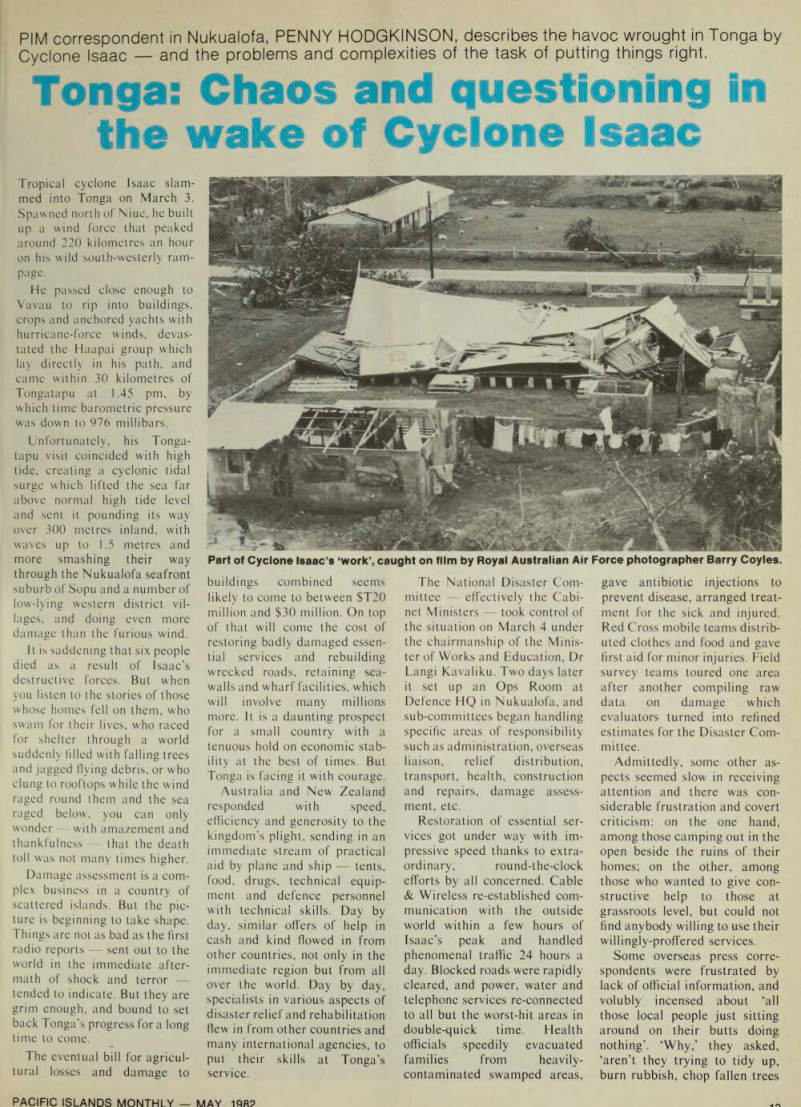
Part of Cyclone Isaac’s ‘work’, caught on film by Royal Australian Air Force photographer Barry Coyles.
Cyclone Isaac
for firewood, dig latrines, repair roofs, help the official teams clear rubble and set up tent towns?’
What they did not under stand, as they fumed about the apparent inertia, was the cul tural system that conditions the average Tongan to sit tight until he receives specific instructions from someone in authority. ‘Just wait and see,’ I said. ‘Once clear instructions come from the top, what you see as laziness will suddenly turn into hum ming activity. Tongans can work like nobody’s business as soon as they know what is expected of them.’ And so it proved.
During the first weekend after the cyclone I toured the worst-hit areas of Tongatapu. I saw chaos and near-total inac tivity, apart from the women who were washing clothes and cooking salvaged produce. Dur ing the second weekend, just after the call for self-help action had gone out on the national radio, those same areas were alive with action: rubbish disap pearing into bonfires, neat firewood slacks, woven pandanus and coconut thatch being turned into traditional Tongan fates, new foundations going in, new houscframes go ing up, shining sheets of corru gated iron being nailed on to unroofed houses, farm plots being dug and planted with quick-growing maize and kamula. The word had gone out. the wheels were turning again fakatonga.
It is going to be a long, slow climb back to pre-Isaac stan dards. Local food production will probably need supplement ing for up to six months, and export agriculture, on which the country is heavily dependent, could take two years to gel back into full swing. Rehousing the homeless and rebuilding the infrastructure will be an expens ive business and it is not yet known how all this will be financed.
With the emergency phase over and the long, slow rehabili tation phase beginning, a num ber of pertinent questions are being asked: two in particular.
The first of them is: ‘Why does everything have to start from scratch each time a disas ter hits?’
This is the question I hear on all sides from the Tongan people themselves. They realise their country lies smack in the middle of a disaster-prone re gion, and that cyclones and earthquakes are bound to strike it at intervals. ‘So why,’ they are asking, ‘docs our government not have a permanent standing committee of people trained and rehearsed in advance to take all necessary action from issuing preparedness and damage mitigation instructions during alerts to implementing recovery action immediately the emergency exists? ‘Why does there have to be such a long period of thinking and planning and organising, when the problems and the needs are always pretty much the same?’ (Admittedly they don’t word it quite that way, but rather more emotionally and diffusely. But that’s essentially what they are saying.) The second big question is being asked by frustrated specialists from international
aid agencies and other groups, who were quickly flown in to provide a pool of expertise on various facets of relief and rehabilitation. Their question is: ‘Why were we welcomed with
courtesy and gratitude, but then left to twiddle our thumbs in a vacuum while the National Committee, in camera, gets on with making its own assess ments, drawing its own con-
Right: Australian Army engin eers help repair Vuna Wharf, Tongatapu, and (below) two girls take a rest on the remains of a house at Lakepa, Tongatapu. Australian Infor mation Service photos by Norman Plant.
elusions, and planning its own courses of action?’ ‘ln one way, it’s admirable,’ said one of them. ‘You can’t help respecting the indepen dence and pride with which the government is insisting on doing its own thing. And you have to admit that, for an ad hoc effort, they’re not doing too badly. But it’s damned galling too, because they are taking hours or days to reach rule-of-thumb con clusions which could be much quicker and more accurate if they called on the experience and technical knowledge we came to offer. There also seem to be quite a few resident aid people with relevant experience who feel the same way as we do.
It’s a pity.’
Another said, speculating: ‘Maybe it’s the prospect of the paperwork that’s causing the bottleneck. Between us, the organisations represented here could tap our sources for practi cally everything Tonga needs to clear up this mess. But nat urally, we all have our specific requirements in the way of application and documentation procedures, and auditing. I
wonder if the government feels it’s all too much of a hassle? All I know is that I’ll have to take off pretty soon if nothing definite happens. After all, there are millions of starving people in other parts of the world who do want the help my crowd can offer!’
One can understand why these questions are being asked and sympathise with the frus trated. But, personally, I’m not about to make any value judgments. Within the context of her own complex culture, Tonga has been successfully determining her own destiny for more than a thousand years.
She is picking herself up, dust ing herself ofif, and continuing to do just that.
There is no doubt that the National Disaster Committee members have been, and still are, working to the limits of human endurance to do what they think best in the way they think best. Presumably, once the worst of the pressure is off, they will find time to tell the people, and the outside world, what they have done, what they plan to do, and how, and why.
More Cyclone Isaac devastation. RAAF photograph by Barry Coyles.
Aerial view of the village of Kanokupolu. Eighty-one houses were destroyed. Sione Langi picture.
Tonga’s king sacks his
finance minister
Tonga’s Finance Minister Mahe Tupouniua has been sacked by King Taufa’ahau Tupou IV because of the minister’s refusal to provide extra public funds for the king’s travels.
The king’s move has caused a sensation, and two other top finance men have resigned.
Tupouniua’s sacking (officially, the king asked him to resign, and he did so) followed the king’s request for travel funds over and above those budgeted for.
Tupouniua replied in writ ing that public funds were low and near to dry, and that extra travel funds had no priority.
The king made the request twice and got the same answer before calling for Tupouniua’s resignation.
Mahe Tupouniua, a com moner married to the queen’s sister, is highly regarded in the Pacific. As director of the
South Pacific Bureau of
Economic Co-operation
(SPEC), he proved a com petent, straight-shooting ad ministrator. On retiring from the SPEC post two years ago, he returned to Tonga, having been told he was required at home.
The king’s decision will have important political re percussions in Tonga, es pecially in the post-cyclone conditions of today.
Some observers believe that Tupouniua’s resignation could prove a blessing in disguise for SPEC. It could offer the organisation a chance to get him back as director, following the death in office of his successor, Dr Gabriel Gris, of Papua New Guinea. Dr Gris died sud denly at a meeting in Raro tonga in March. (See ‘Deaths of Islands People’.) Cecil Cocker has been appointed Tonga’s acting
minister of finance.
-Arthur
Blackstock.
Advertisements & other items, p. 16 (1 item)
The Facts
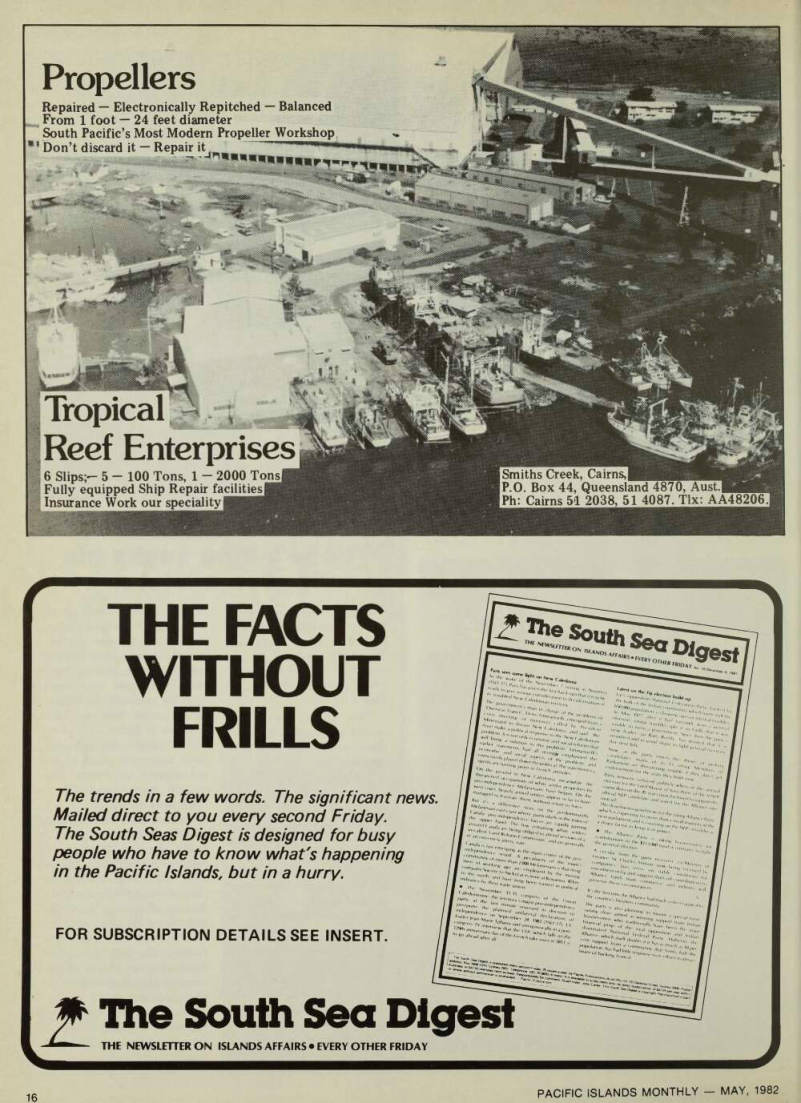
Propellers
Repaired Electronically Repitched Balanced From 1 foot 24 feet diameter South Pacific’s Most Modern Propeller Workshop 11 Don’t discard it Repair it 1111,1
■"'WMWH
' *■ i««K, s""" 5 . -Jf:
Tropical
Reef Enterprises^
6 Slips;- 5 - 100 Tons, 1 - 2000 Tons] Fully equipped Ship Repair facilities^ Insurance Work our speciality! j Smiths Creek, Cairns,| P.O. Box 44, Queensland 4870, Aust| Ph: Cairns 51 2038, 51 4087. Tlx; AA482061
THE FACTS
WITHOUT
FRILLS
The trends in a few words. The significant news.
Mailed direct to you every second Friday.
The South Seas Digest is designed for busy people who have to know what's happening in the Pacific Islands, but in a hurry.
FOR SUBSCRIPTION DETAILS SEE INSERT.
f Hie South Sea Digest
* The So UthSe a Dl S ' f WstfTTf 9est
OTH m
UtIDAY
m.
THE NEWSLETTER ON ISLANDS AFFAIRS • EVERY OTHER FRIDAY
ASEAN and regional co-operation
The New Pacific Wave
ASEAN and regional co-operation in the Pacific Islands
As part of the Hawaii-based East-West Center’s Pacific Island Development Program on ASEAN and its implications for the Pacific Islands, PAMELA TAKIORA INGRAM PRYOR* recently toured four of the five ASEAN countries to study the working of the organisation, and to discover how, if at all, the ASEAN example could help the goal of regional co-operation among Pacific Island countries.
Her report follows.
Although regional co-operation is fairly new in the Pacific Islands, at the political level Pacific Island leaders have been talking about it for the past 15 years or so, from time to time promoting a little co-operation with each other. At the grassroots village level in the Pacific, the concept is not understood by many people.
Yet, to some islanders, it is one of the most important issues in the contemporary Pacific.
Recently, the Pacific Islands Development Program of the East-West Center was asked by Pacific Island leaders to con duct a study of regional co operation, which was then in itiated under Professor Ron Crocombe, director of the Insti tute of Pacific Studies of the University of the South Pacific.
In order to have a basis from which to start to understand the potential for regional co operation in the Pacific Islands, Professor Crocombe felt that an analysis of the development of regional organisations in other regions was necessary. The As sociation of Southeast Asian Nations (ASEAN) was selected as one of the regional organis ations to be considered because it was fell that it has much relevance to the Pacific.
ASEAN is a political, econ omic and social organisation consisting of five member countries: Indonesia, Malaysia, the Philippines, Singapore and Thailand. It was established in 1967 by the foreign ministers of these countries.
At first the activity of the organisation was more or less confined to an annual meeting at which the foreign ministers got together to exchange ideas and establish contact. It was not until after the fall of Vietnam in 1975 that ASEAN suddenly took on a new dimension and a new role, motivated by the communist threat represented by Vietnam. Since then its role in regional and international politics has been of prime importance in the Asia-Pacific region. Its effectiveness in at tracting international attention was illustrated by the attend ance of US Secretary of Stale Alexander Haig at the last ASEAN ministers’ conference in Manila.
ASEAN was established by the so-called Bangkok Declar ation with the main goal of creating ‘a peaceful, prosperous and resilient community’. It has four objectives: 1) to accelerate economic, social and cultural development; 2) to promote regional peace and stability; 3) to promote collaboration and mutual assistance on matters of common interest, for example food, energy, etc; and 4) to maintain relationships with in ternational and regional organ isations.
The ASEAN region is significant for several reasons.
It has a population of more than 230 million people, which is approximately 8 percent of the world population. The region is rich in natural resources, ex porting 86 percent of the world’s natural rubber, 82 per cent of its palm oil, 80 percent of its copper and 71 percent of its tin. By comparison, the Pacific Islands region has a population of only about six million people, and, with the exception of Papua New Guinea and Fiji, the land
masses are very small and the natural resources very limited.
However, there is potential in ocean resources, both in terms of fisheries and minerals devel opment. The Pacific Islands are important strategically, as are the Southeast Asian countries.
During a recent visit to four of the five ASEAN countries, the writer had discussions with staff of the ASEAN secretariat, some of the national sec retariats, researchers, aca demics, and others with knowl edge of ASEAN and its devel opment. One of the basic ques tions posed was whether, in their opinion, ASEAN was meeting the objectives and serv ing the needs of the ASEAN countries. Most people agree that it has been worthwhile.
Although the objectives of ASEAN did not include politi cal co-operation, success has in fact been greatest in that area.
Regionally, it has created a very cohesive body: member countries consult each other on foreign policies, and inter nationally they have become influential. Recently ASEAN criticised the United States for not consulting them on its decision to sell arms and high technology to China. Presum ably, this will have some impact on US foreign policy in the region in future.
Most observers agree that ASEAN has been successful in social and cultural matters as well. People within each of the countries are now more aware of each other’s differences and similarities, and they interact constantly on a social basis.
There is great mobility within the region, and this has created many bonds between people.
Earlier points of conflict be tween nations have been re duced, and a real social and cultural affinity is emerging.
They have even started to work together in a military sense. For instance, Thailand and Malaysia conduct joint oper ations against the communist insurgencies on their common border.
Economically, however, most people feel that success has been liqiited. Although a trade agreement giving preferential treatment to different goods within the region has been concluded, the goods identified in the agreement are not the most important items traded in the region.
The ASEAN secretariat re cently moved into a new building built by Indonesia in Jakarta. The secretarial con sists of approximately eight professional staff and 30 sup port staff. Although this is a small staff, it is obvious from the size of the building that the secretarial plans to expand. As in the Pacific Islands, language is an issue. However, ASEAN has agreed to use English as the official language of the sec retarial, which helps communi cation. The secretariat is mostly concerned with preparing work ing papers and projects, and servicing meetings. It does not conduct research but asks other institutions to do it for them.
ASEAN also has nine com mittees whose work is co ordinated by the secretariat.
These are concerned with: In dustry, Minerals and Energy; Food, Agriculture and Forestry; Transport and Communi cations; Social Development; Science and Technology; Trade and Tourism; Finance and Banking; Budget; and Culture and Information.
One of the interesting and most important features of ASEAN is the role of the 33 non-governmental organis ations. Among these, the
* Pamela Takiora Ingram Pryor, a Cook Islander, is president of Pacific Planning and Research Corporation.
Hawaii. She is at present en gaged in tourism studies and aquaculture planning and re search.
ASEAN Chambers of Com merce and Industry has devel oped into a very powerful and effective organisation. Others include a bankers’ association, a petroleum organisation, a mo tion picture producers’ associ ation, a travel association, a women’s organisation, and many more. These bodies are especially important in arousing and maintaining an awareness of ASEAN, involving as they do people from so many different sectors.
Membership of ASEAN is limited to the five founding countries. Sri Lanka recently applied for membership but is unlikely to be accepted because people in ASEAN feel that it is outside the region unlike Brunei, for example, which is within the ASEAN region and will soon become independent.
There has also been some inter est expressed by Burma.
Papua New Guinea has been an observer at ASEAN meet ings for several years. As it shares a common border with Indonesia, there has been some speculation that it will apply for membership. Some observers believe that PNG is an obvious choice for joining ASEAN be cause it would provide a link between the ASEAN countries and the Pacific. However, others think that this link could best be achieved in some other manner, for example through PNG’s membership in a regional Pacific organisation which could develop a relationship and dialogue with ASEAN. (Editor's note: PNG already regards its observer status in ASEAN as a major component of a bridging role between Southeast Asia and the Pacific.
Its official policy, however, is not to seek membership of ASEAN on the grounds that its primary role is in the Pacific.) Already, the South Pacific Bureau of Economic Co operation (SPEC) has initiated contacts with ASEAN. SPEC’s membership includes all inde pendent Pacific Island countries, but not the depen dent territories.
Several conditions appear necessary before regional co operation can exist. One is a common external threat, the second is internal stability within the region, and the third is economic development. It appears to some observers of
the Pacific Islands that all these conditions exist. Deputy Prime Minister of Papua New Guinea, lambakey Okuk recently men tioned his country’s concern over Soviet expansionism in the Pacific and the consequent need for alliances. Other Pacific Islands people seriously fear US expansion and imperialism in the Pacific, especially in the exploitation of ocean resources.
Still others feel threatened by Japan’s recent interest in the Pacific, both in terms of the dumping of nuclear wastes and the exploitation of ocean re sources. Some feel threatened by China, which has not yet made expansionist moves, but has established diplomatic re lationships and embassies with a number of Pacific countries.
Today all Pacific Island leaders perceive some need for regional co-operation. The leaders of the most recently independent countries may not be enthusiastic about this con cept, perhaps because they have Just disposed of their colonial masters and are more con cerned with establishing their countries as entities and them selves as individuals. After a period of time, and increased awareness of the various forms of domination that could be imposed by the industrialised Pacfic Rim countries, the benefits of regional co-operation will probably gain appeal. How ever, even the leaders who support the concept sometimes have a difficult time articulat ing the benefits, and when they do promote regionalism they find public support lacking be cause people in the Pacific
Islands are more concerned with national problems at pres ent, particularly economic crises.
Some forms of regional co operation have been going on for years in the Pacific. First, the early traditional societies, in the Western Pacific particu larly, traded with one another.
Next, in the 1800 s and 1900 s, indigenous missionaries by the hundreds travelled to preach the gospel in other countries.
Western traders followed with multi-national activities. Dur ing the colonial period several groups of countries were admin istered by the same colonial powers. During World Wars I and 11, men from Pacific Island countries served in the armed forces of the colonial powers, and since World War 11, many regional and sub-regional or ganisations have been estab lished. The University of the South Pacific has compiled a directory showing that over 200 such organisations now exist.
The Soutn Pacific Com mission is the oldest inter governmental body, having been established in 1947. But it is constrained by its non political charter, and by having a membership swollen by non island nations. More recently the South Pacific Forum has also been an effective regional entity. But it too is constrained by the somewhat over-powering
membership of Australia and New Zealand, as well as by the exclusion of many dependent Pacific Islands territories.
Perhaps the lack of public support represents, in fact, a grassroots awareness that no past or existing regional entity truly represents grassroots in terests as a whole. Increasingly this must be the case as Polynesians, Melanesians, and Micronesians find greater ident ity with each other through increased social and pro fessional contact. This much is obvious to persons attending any international conference, workshop or forum run by island people for their own benefit. The sense of mission, camaraderie and cohesion that quickly permeates such gather ings is always obvious, as well as effective and, of course, emotional.
There thus appears to be a need now for a different form of regional co-operation. No one knows yet what form that co operation will take, although several suggestions have been made. Initially, there is a great need to build awareness of regional co-operation in the Pacific Islands to illustrate and highlight what the benefits might be. To many islanders it seems that the time has come to benefit from the political co hesion and solidarity that could result from effective regional co-operation.
The Pacific Islands are fortu nate. We have a cultural and historical basis upon which to build regionally. A Pacific spirit already exists which allows for regional co-operation. We only need to harness this spirit, learn from the experiences of others, including ASEAN, and move with the new Pacific wave of regional co-operation.
To move forward it is essen tial that Pacific Islanders at all levels understand what regional co-operation is and how it works. This has been ac complished in the ASEAN countries, where the man in the street is much more aware of ASEAN than the Pacific Islander is of SPEC. Once the costs and benefits have been further explored and presented to the public, awareness of the need may well develop into increased support for regional co-operation and even to public demand for it.
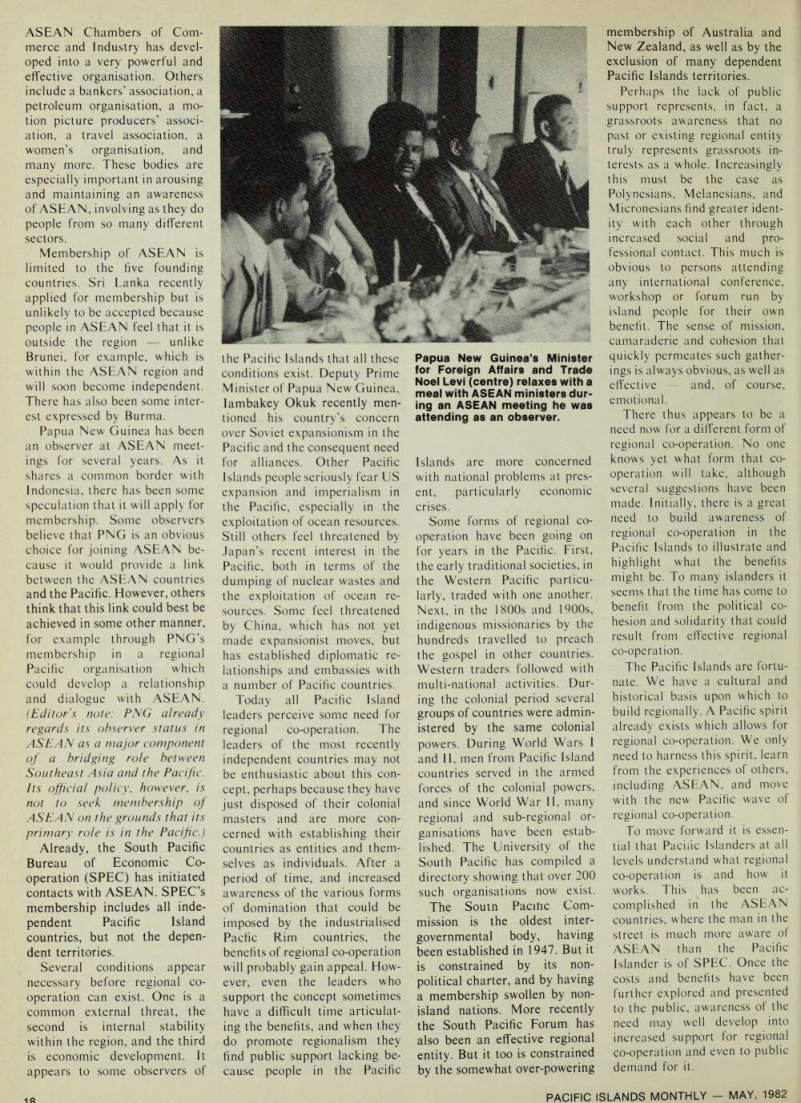
Papua New Guinea’s Minister for Foreign Affairs and Trade Noel Levi (centre) relaxes with a meal with ASEAN ministers dur ing an ASEAN meeting he was attending as an observer.
Advertisements & other items, p. 19 (1 item)
Nz Police
- ' U M % -.1 ' Hi ■ -■ '***s&& * (Se cti ° n And if you’re between the ages of 19-34 and meet the minimum requirements of 173 cm tall, 67kg in weight and have a chest measurement of 91cm at least, you may apply to become a Police Officer.
For those that possess the right physical and mental requirements, a good work record and a satisfactory educational background the Police offer you a worthwhile and rewarding career with thorough training, the opportunity for promotion, and excellent starting salary with s leave CjO
SERVING THE COMMUNITY
NZ POLICE
superannuation benefits, generous leave (including sick leave with pay), free uniform, but above all we offer job security, satisfaction and comradeship in a necessary job helping society.
If you’re interested, we would like to talk it over with you. Call at your nearest Police Station for further details
WE WANT THE BEST
L82593AC
A forgotten
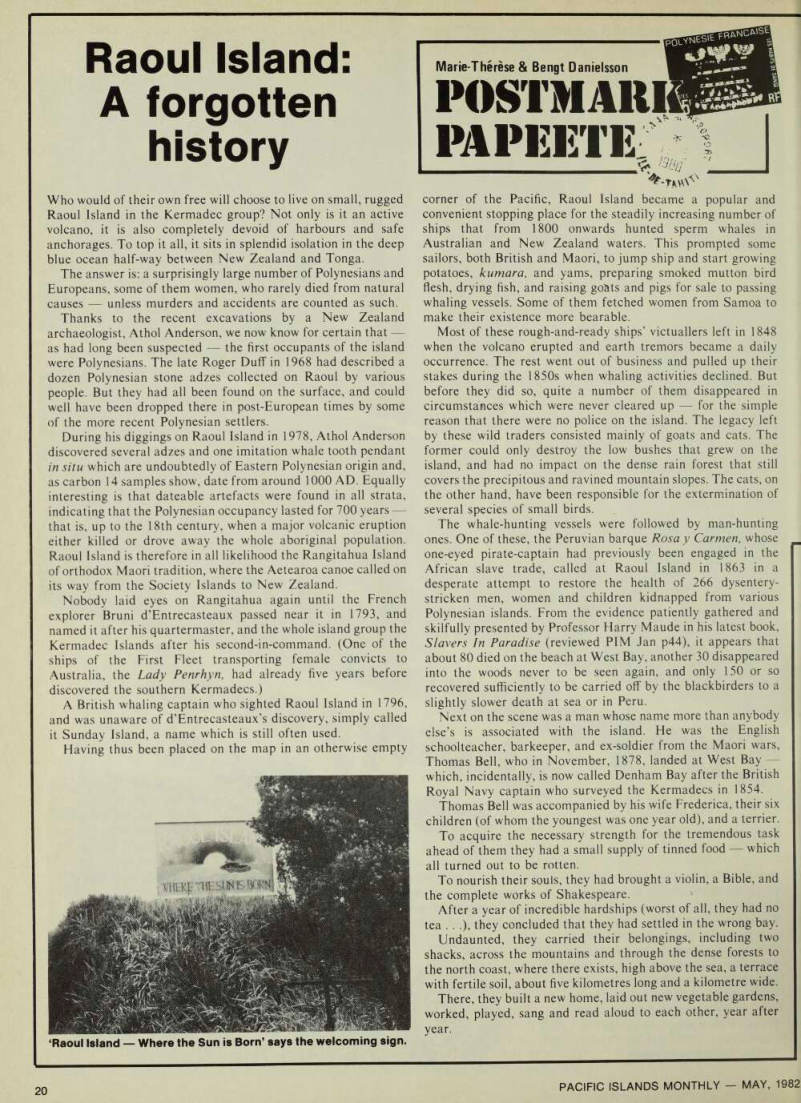
Raoul Island: A forgotten history
Who would of their own free will choose to live on small, rugged Raoul Island in the Kermadec group? Not only is it an active volcano, it is also completely devoid of harbours and safe anchorages. To top it all, it sits in splendid isolation in the deep blue ocean half-way between New Zealand and Tonga.
The answer is: a surprisingly large number of Polynesians and Europeans, some of them women, who rarely died from natural causes unless murders and accidents are counted as such.
Thanks to the recent excavations by a New Zealand archaeologist, Athol Anderson, we now know for certain that as had long been suspected the first occupants of the island were Polynesians. The late Roger Duff in 1968 had described a dozen Polynesian stone adzes collected on Raoul by various people. But they had all been found on the surface, and could well have been dropped there in post-European times by some of the more recent Polynesian settlers.
During his diggings on Raoul Island in 1978, Athol Anderson discovered several adzes and one imitation whale tooth pendant in situ which are undoubtedly of Eastern Polynesian origin and, as carbon 14 samples show, date from around 1000 AD. Equally interesting is that dateable artefacts were found in all strata, indicating that the Polynesian occupancy lasted for 700 years that is, up to the 18th century, when a major volcanic eruption either killed or drove away the whole aboriginal population.
Raoul Island is therefore in all likelihood the Rangitahua Island of orthodox Maori tradition, where the Aetearoa canoe called on its way from the Society Islands to New Zealand.
Nobody laid eyes on Rangitahua again until the French explorer Bruni d’Entrecasteaux passed near it in 1793, and named it after his quartermaster, and the whole island group the Kermadec Islands after his second-in-command. (One of the ships of the First Fleet transporting female convicts to Australia, the Lady Penrhyn, had already five years before discovered the southern Kermadecs.) A British whaling captain who sighted Raoul Island in 1796, and was unaware of d’Entrecasteaux’s discovery, simply called it Sunday Island, a name which is still often used.
Having thus been placed on the map in an otherwise empty
corner of the Pacific, Raoul Island became a popular and convenient stopping place for the steadily increasing number of ships that from 1800 onwards hunted sperm whales in Australian and New Zealand waters. This prompted some sailors, both British and Maori, to jump ship and start growing potatoes, kumara, and yams, preparing smoked mutton bird flesh, drying fish, and raising goats and pigs for sale to passing whaling vessels. Some of them fetched women from Samoa to make their existence more bearable.
Most of these rough-and-ready ships’ victuallers left in 1848 when the volcano erupted and earth tremors became a daily occurrence. The rest went out of business and pulled up their stakes during the 1850 s when whaling activities declined. But before they did so, quite a number of them disappeared in circumstances which were never cleared up for the simple reason that there were no police on the island. The legacy left by these wild traders consisted mainly of goats and cats. The former could only destroy the low bushes that grew on the island, and had no impact on the dense rain forest that still covers the precipitous and ravined mountain slopes. The cats, on the other hand, have been responsible for the extermination of several species of small birds.
The whale-hunting vessels were followed by man-hunting ones. One of these, the Peruvian barque Rosa y Carmen, whose one-eyed pirate-captain had previously been engaged in the African slave trade, called at Raoul Island in 1863 in a desperate attempt to restore the health of 266 dysentery stricken men, women and children kidnapped from various Polynesian islands. From the evidence patiently gathered and skilfully presented by Professor Harry Maude in his latest book, Slavers In Paradise (reviewed PIM Jan p 44), it appears that about 80 died on the beach at West Bay, another 30 disappeared into the woods never to be seen again, and only 150 or so recovered sufficiently to be carried off by the blackbirders to a slightly slower death at sea or in Peru.
Next on the scene was a man whose name more than anybody else’s is associated with the island. He was the English schoolteacher, barkeeper, and ex-soldier from the Maori wars, Thomas Bell, who in November, 1878, landed at West Bay which, incidentally, is now called Denham Bay after the British Royal Navy captain who surveyed the Kermadecs in 1854.
Thomas Bell was accompanied by his wife Frederica, their six children (of whom the youngest was one year old), and a terrier.
To acquire the necessary strength for the tremendous task ahead of them they had a small supply of tinned food which all turned out to be rotten.
To nourish their souls, they had brought a violin, a Bible, and the complete works of Shakespeare.
After a year of incredible hardships (worst of all, they had no tea .. .), they concluded that they had settled in the wrong bay.
Undaunted, they carried their belongings, including two shacks, across the mountains and through the dense forests to the north coast, where there exists, high above the sea, a terrace with fertile soil, about five kilometres long and a kilometre wide.
There, they built a new home, laid out new vegetable gardens, worked, played, sang and read aloud to each other, year after year.
‘Raoul Island - Where the Sun is Born’ says the welcoming sign.
On the rare occasions when Thomas Bell managed to obtain passage on some ship bound for New Zealand, it was invariably in order to bring back more sheep, and he never stayed away longer than absolutely necessary.
The remarkable Bells had three more children, and seemed to be perfectly happy with their crowded solitude and strenuous life.
As the children grew up, however, they left their island home one after the other, eager to see the wonderful world they had only read about.
Their parents did not transfer their affections to the new settlers who arrived in the 1890 s, following New Zealand’s annexation of the Kermadecs. The government had taken this step due to its fear of German colonial expansion in the Pacific.
In fact, the Bells were furious when one day they discovered that a group of settlers had installed themselves in Denham Bay.
But, as it soon turned out, the newcomers, who had all expected to find a perfect South Sea paradise, totally lacked the stamina and determination of Thomas and Frederica Bell.
Within a year they had all given up the unequal battle against sore feet, boredom, tropical ulcers, claustrophobia and tummy aches.
Greatly relieved, the Bells continued their lonely life on what they called The Terrace’, until the outbreak of World War I when they were forcibly taken off the island by a New Zealand government vessel.
No attempts, however, were made to fortify Raoul Island, which was consequently used as a base in 1917 by the German raiding ship Wolf for its successful attacks on British naval and cargo ships crossing the Tasman Sea.
The present population of Raoul Island consists of five cheerful young New Zealand meteorologists whose daily reports greatly help the governments and ships’ captains in the Western
Pacific to foresee sudden changes in the weather the approach of hurricanes, for example.
Their offices and comfortable living quarters have been built on The Terrace’ where the Bells had their homestead. Its exact location can easily be determined by a double row of magnificent Norfolk pines, and the numerous huge orange trees that have grown up from the seeds given to the Bells at the turn of the century by the captain of the steamer Richmond. During one of its regular runs between Auckland, Samoa, Rarotonga and Tahiti, the vessel exhausted its supply of coal, and called at Raoul Island where the crew gathered firewood.
Finding the oranges exceptionally sweet and tasty, we saved some seeds which we have just planted in their Tahitian home soil.
Frankly, we had expected to find somewhere in the meteorological station a few historical mementoes books, pictures, or other objects left behind by the previous occupants.
But there was nothing.
The genial young New Zealanders manning the station did not even know the story of the indomitable Bells.
In truth, they can be excused. They have come out to Raoul Island on a brief, one-year assignment, and they are too busy to go delving into the past. How could they anyway in view of the fact that their small library squeezed in between a video cassette player and a cardboard box in the billiard room does not contain a single work on the history and geography of the Kermadecs?
This article should therefore be seen not only as an attempt to tell a little-known story which is in itself of great interest. It is also our means of thanking the whole five-man population of Raoul Island for the hospitality they showed us on our recent
visit on the Lindblad Explorer.
Marie-Thérèse and
Bengt Danielsson.
Advertisements & other items, pp. 21-22 (2 items)
fly-by-night airline.
Air Vanuatu is no
% From May 8, Air Vanuatu flights to Vanuatu every Saturday and Sunday will be daylight.
Non-stop from Sydney to Port Vila on our new Boeing 737.
It’s the best way to get to our jewelled archipelago of 80 beautiful islands in the South Pacific.
Less than 4 hours from Sydney.
See your Travel Agent or Ansett International Travel for more information and bookings.
And don’t forget your sunglasses!
4a r^VvnTt'^
Reach out and the
■ ■// >i-
life-
rnmi r - .
The Spectrum 50 matched-
component system finally puts a
richer musical life within reach of
the most restrictive hi-fi budgets.
Each Spectrum 50 component is
a star in a perfectly harmonizing
audio galactic system. The brain-
child of some of the hi-fi world’s
most dedicated engineers.
Reach out, and your journey to
music’s realm of inner space can
begin now!
i « * '-Us I frj .
SP**- 5 s * m a* mm s* - I il '
Spectrum 50
TRIO-KENWOOD CORPORATION
Shionogi Shibuya Building, 17-5, 2-chome, Shibuya,
Shibuya-ku, Tokyo 150, Japan
TRIO-KENWOOD (AUSTRALIA) PTY. LTD.
4E Woodcock Place, Lane Cove, N.S.W. 2066, Australia. Tel: 428-1455 KA-50 Stereo Integrated Amplifier KT-30 FM-AM Stereo Tuner KX-50 Metal-Tape Stereo Cassette Deck with Dolby* NR
KD-40R
Direct-Drive Auto-Return Turntable
LS-110F
: : > 65W 3-way Speaker System
SRC-5
Audio Rack with glass door and casters GE-90 Stereo Graphic Equalizer (option) *TM Dolby Licensing Corp.
NEW ZEALAND JOHN GILBERT & CO., LTD. Auckland Tel. 30-839 FIJI PEPE’S DUTY FREE CENTRE LTD. Tel. 26187, 25191 PAPUA NEW GUINEA S.O. SVENSSON (N.G.) LTD. Port Moresby Tel. 42-4467 SOLOMON ISLANDS TECHNIQUE RADIOS CENTRE LTD. Honiara Tel. 416 NEW CALEDONIA HI-FI VOX Noumea Tel. 27-2466 VANUATU FUNG CHOI LUEN. Port-Vila Tel. 2556
TAHITI MAISON AURORE Papeete Tel. 29703
AMERICAN SAMOA ISLAND PACIFIC AGENCIES, INC. Pago Pago Tel. 633-4687
REPUBLIC OF NAURU NAURU CO-OPERATIVE SOCIETY
MARIANA ISLANDS J.C. TENORIO ENTERPRISES Saipan Tel. 6445
‘Hugo’s Folly’
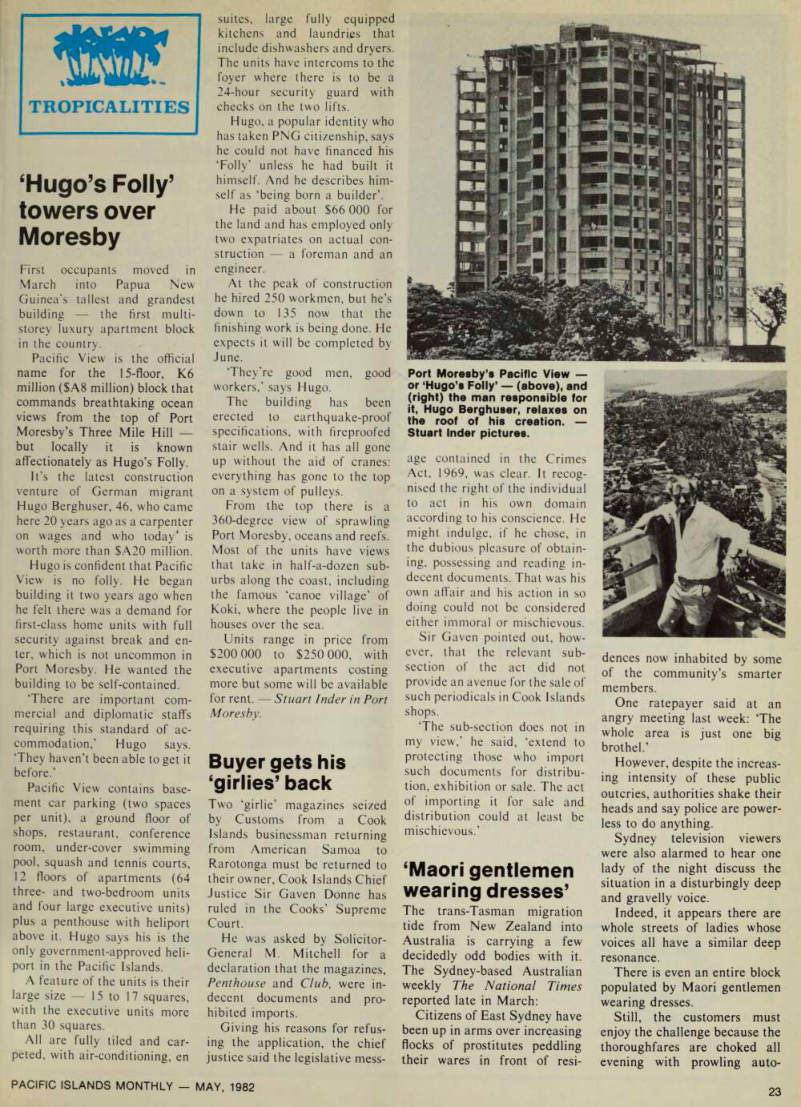

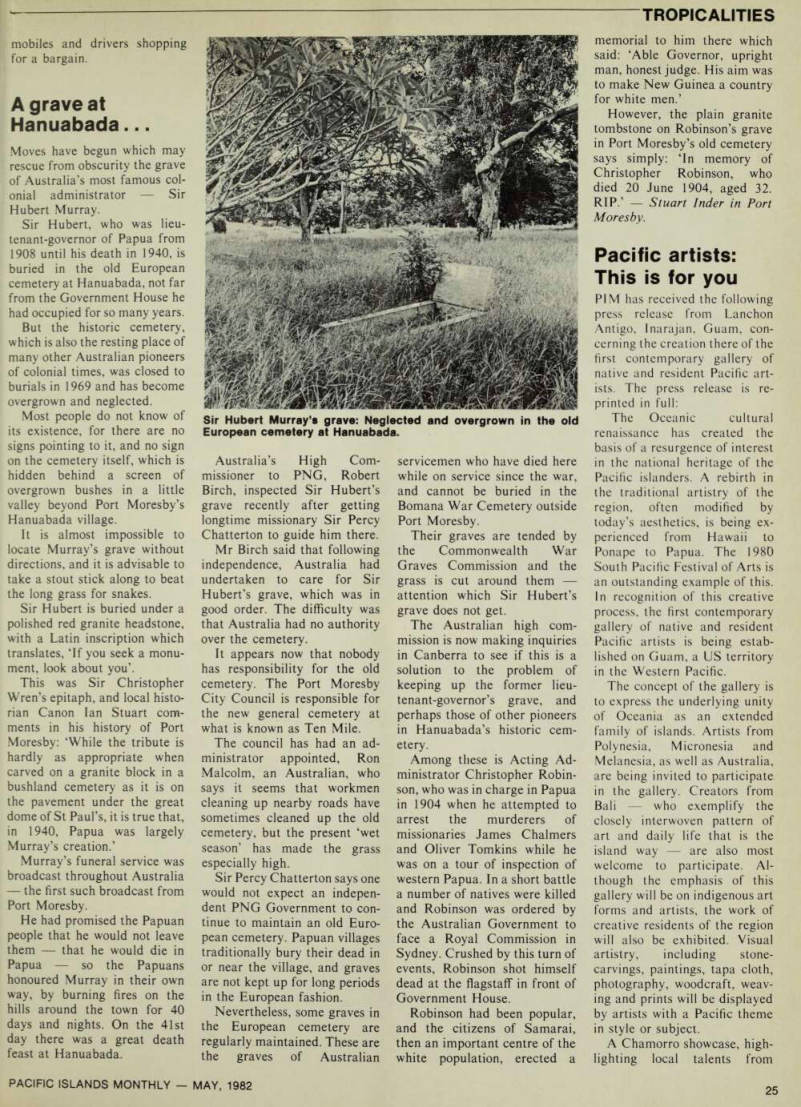
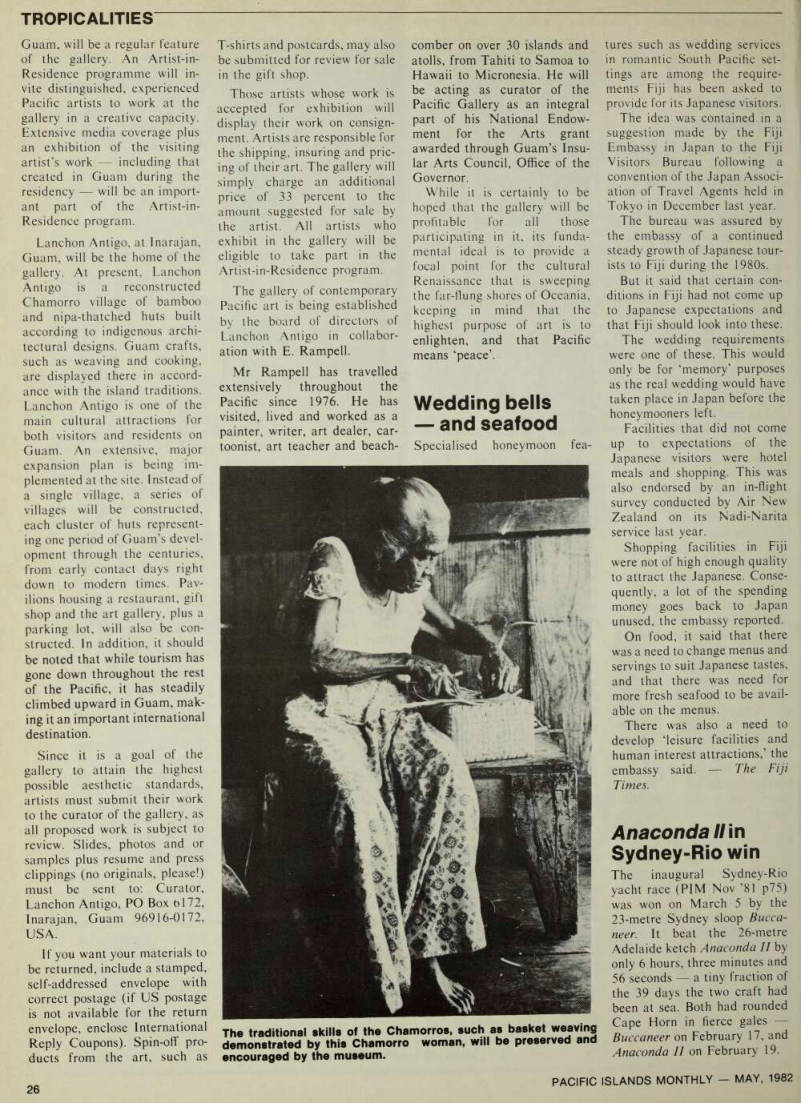
Tropicalities
towers over
Moresby
First occupants moved in March into Papua New Guinea’s tallest and grandest building the first multi storey luxury apartment block in the country.
Pacific View is the official name for the 15-floor, K 6 million (SAB million) block that commands breathtaking ocean views from the top of Port Moresby’s Three Mile Hill but locally it is known affectionately as Hugo’s Folly.
It’s the latest construction venture of German migrant Hugo Berghuser, 46, who came here 20 years ago as a carpenter on wages and who today* is worth more than SA2O million.
Hugo is confident that Pacific View is no folly. He began building it two years ago when he felt there was a demand for first-class home units with full security against break and en ter, which is not uncommon in Port Moresby. He wanted the building to be self-contained.
There are important com mercial and diplomatic staffs requiring this standard of ac commodation,’ Hugo says.
They haven’t been able to get it before.’
Pacific View contains base ment car parking (two spaces per unit), a ground floor of shops, restaurant, conference room, under-cover swimming pool, squash and tennis courts, 12 floors of apartments (64 three- and two-bedroom units and four large executive units) plus a penthouse with heliport above it. Hugo says his is the only government-approved heli port in the Pacific Islands.
A feature of the units is their large size l5 to 17 squares, with the executive units more than 30 squares.
All are fully tiled and car peted, with air-conditioning, en
suites, large fully equipped kitchens and laundries that include dishwashers and dryers.
The units have intercoms to the foyer where there is to be a 24-hour security guard with checks on the two lifts.
Hugo, a popular identity who has taken PNG citizenship, says he could not have financed his ‘Folly’ unless he had built it himself. And he describes him self as ‘being born a builder’.
He paid about $66 000 for the land and has employed only two expatriates on actual con struction a foreman and an engineer.
At the peak of construction he hired 250 workmen, but he’s down to 135 now that the finishing work is being done. He expects it will be completed by June. ‘They’re good men, good workers,’ says Hugo.
The building has been erected to earthquake-proof specifications, with fireproofed stair wells. And it has all gone up without the aid of cranes: everything has gone to the lop on a system of pulleys.
From the top there is a 360-degree view of sprawling Port Moresby, oceans and reefs.
Most of the units have views that take in half-a-dozen sub urbs along the coast, including the famous ‘canoe village’ of Koki, where the people live in houses over the sea.
Units range in price from S2OO 000 to $250 000, with executive apartments costing more but some will be available
for rent.
Stuart Inder in Port
Moresby.
Buyer gets his
‘girlies’ back
Two ‘girlie’ magazines seized by Customs from a Cook Islands businessman returning from American Samoa to Rarotonga must be returned to their owner, Cook Islands Chief Justice Sir Gaven Donne has ruled in the Cooks’ Supreme Court.
He was asked by Solicitor- General M. Mitchell for a declaration that the magazines, Penthouse and Club, were in decent documents and pro hibited imports.
Giving his reasons for refus ing the application, the chief justice said the legislative mess-
age contained in the Crimes Act, 1969, was clear. It recog nised the right of the individual to act in his own domain according to his conscience. He might indulge, if he chose, in the dubious pleasure of obtain ing, possessing and reading in decent documents. That was his own affair and his action in so doing could not be considered either immoral or mischievous.
Sir Gaven pointed out, how ever, that the relevant sub section of the act did not provide an avenue for the sale of such periodicals in Cook Islands shops.
The sub-section does not in my view,’ he said, ‘extend to protecting those who import such documents for distribu tion, exhibition or sale. The act of importing it for sale and distribution could at least be mischievous.’
‘Maori gentlemen
wearing dresses’
The trans-Tasman migration tide from New Zealand into Australia is carrying a few decidedly odd bodies with it.
The Sydney-based Australian weekly The National Times reported late in March: Citizens of East Sydney have been up in arms over increasing flocks of prostitutes peddling their wares in front of resi-
dences now inhabited by some of the community’s smarter members.
One ratepayer said at an angry meeting last week: The whole area is just one big brothel.’
However, despite the increas ing intensity of these public outcries, authorities shake their heads and say police are power less to do anything.
Sydney television viewers were also alarmed to hear one lady of the night discuss the situation in a disturbingly deep and gravelly voice.
Indeed, it appears there are whole streets of ladies whose voices all have a similar deep resonance.
There is even an entire block populated by Maori gentlemen wearing dresses.
Still, the customers must enjoy the challenge because the thoroughfares are choked all evening with prowling auto
Port Moresby’s Pacific Viewor ‘Hugo’s Folly’ - (above), and (right) the man responsible for it, Hugo Berghuser, relaxes on the roof of his creation. - Stuart Inder pictures.
mobiles and drivers shopping for a bargain.
A grave at
Hanuabada...
Moves have begun which may rescue from obscurity the grave of Australia’s most famous col onial administrator Sir Hubert Murray.
Sir Hubert, who was lieu tenant-governor of Papua from 1908 until his death in 1940, is buried in the old European cemetery at Hanuabada, not far from the Government House he had occupied for so many years.
But the historic cemetery, which is also the resting place of many other Australian pioneers of colonial times, was closed to burials in 1969 and has become overgrown and neglected.
Most people do not know of its existence, for there are no signs pointing to it, and no sign on the cemetery itself, which is hidden behind a screen of overgrown bushes in a little valley beyond Port Moresby’s Hanuabada village.
It is almost impossible to locate Murray’s grave without directions, and it is advisable to take a stout stick along to beat the long grass for snakes.
Sir Hubert is buried under a polished red granite headstone, with a Latin inscription which translates, ‘lf you seek a monu ment, look about you’.
This was Sir Christopher Wren’s epitaph, and local histo rian Canon lan Stuart com ments in his history of Port Moresby; ‘While the tribute is hardly as appropriate when carved on a granite block in a bushland cemetery as it is on the pavement under the great dome of St Paul’s, it is true that, in 1940, Papua was largely Murray’s creation.’
Murray’s funeral service was broadcast throughout Australia the first such broadcast from Port Moresby.
He had promised the Papuan people that he would not leave them that he would die in Papua so the Papuans honoured Murray in their own way, by burning fires on the hills around the town for 40 days and nights. On the 41st day there was a great death feast at Hanuabada.
Australia’s High Com missioner to PNG, Robert Birch, inspected Sir Hubert’s grave recently after getting longtime missionary Sir Percy Chatterton to guide him there.
Mr Birch said that following independence, Australia had undertaken to care for Sir Hubert’s grave, which was in good order. The difficulty was that Australia had no authority over the cemetery.
It appears now that nobody has responsibility for the old cemetery. The Port Moresby City Council is responsible for the new general cemetery at what is known as Ten Mile.
The council has had an ad ministrator appointed, Ron Malcolm, an Australian, who says it seems that workmen cleaning up nearby roads have sometimes cleaned up the old cemetery, but the present ‘wet season’ has made the grass especially high.
Sir Percy Chatterton says one would not expect an indepen dent PNG Government to con tinue to maintain an old Euro pean cemetery. Papuan villages traditionally bury their dead in or near the village, and graves are not kept up for long periods in the European fashion.
Nevertheless, some graves in the European cemetery are regularly maintained. These are the graves of Australian
servicemen who have died here while on service since the war, and cannot be buried in the Bomana War Cemetery outside Port Moresby.
Their graves are tended by the Commonwealth War Graves Commission and the grass is cut around them attention which Sir Hubert’s grave does not get.
The Australian high com mission is now making inquiries in Canberra to see if this is a solution to the problem of keeping up the former lieu tenant-governor’s grave, and perhaps those of other pioneers in Hanuabada’s historic cem etery.
Among these is Acting Ad ministrator Christopher Robin son, who was in charge in Papua in 1904 when he attempted to arrest the murderers of missionaries James Chalmers and Oliver Tomkins while he was on a tour of inspection of western Papua. In a short battle a number of natives were killed and Robinson was ordered by the Australian Government to face a Royal Commission in Sydney. Crushed by this turn of events, Robinson shot himself dead at the flagstaff in front of Government House.
Robinson had been popular, and the citizens of Samarai, then an important centre of the white population, erected a
memorial to him there which said: ‘Able Governor, upright man, honest judge. His aim was to make New Guinea a country for white men.’
However, the plain granite tombstone on Robinson’s grave in Port Moresby’s old cemetery says simply: ‘ln memory of Christopher Robinson, who died 20 June 1904, aged 32.
RIP.’ Stuart Inder in Port Moresby.
Pacific artists:
This is for you
PIM has received the following press release from Lanchon Antigo, Inarajan, Guam, con cerning the creation there of the first contemporary gallery of native and resident Pacific art ists. The press release is re printed in full: The Oceanic cultural renaissance has created the basis of a resurgence of interest in the national heritage of the Pacific islanders. A rebirth in the traditional artistry of the region, often modified by today’s aesthetics, is being ex perienced from Hawaii to Ponape to Papua. The 1980 South Pacific Festival of Arts is an outstanding example of this.
In recognition of this creative process, the first contemporary gallery of native and resident Pacific artists is being estab lished on Guam, a US territory in the Western Pacific.
The concept of the gallery is to express the underlying unity of Oceania as an extended family of islands. Artists from Polynesia, Micronesia and Melanesia, as well as Australia, are being invited to participate in the gallery. Creators from Bali who exemplify the closely interwoven pattern of art and daily life that is the island way are also most welcome to participate. Al though the emphasis of this gallery will be on indigenous art forms and artists, the work of creative residents of the region will also be exhibited. Visual artistry, including stone carvings, paintings, tapa cloth, photography, woodcraft, weav ing and prints will be displayed by artists with a Pacific theme in style or subject.
A Chamorro showcase, high lighting local talents from
Sir Hubert Murray’s grave: Neglected and overgrown in the old European cemetery at Hanuabada.
Guam, will be a regular feature of the gallery. An Artist-in- Residence programme will in vite distinguished, experienced Pacific artists to work at the gallery in a creative capacity.
Extensive media coverage plus an exhibition of the visiting artist’s work including that created in Guam during the residency will be an import ant part of the Artist-in- Residence program.
Lanchon Antigo, at Inarajan, Guam, will be the home of the gallery. At present, Lanchon Antigo is a reconstructed Chamorro village of bamboo and nipa-thatched huts built according to indigenous archi tectural designs. Guam crafts, such as weaving and cooking, are displayed there in accord ance with the island traditions.
Lanchon Antigo is one of the main cultural attractions for both visitors and residents on Guam. An extensive, major expansion plan is being im plemented at the site. Instead of a single village, a series of villages will be constructed, each cluster of huts represent ing one period of Guam’s devel opment through the centuries, from early contact days right down to modern limes. Pav ilions housing a restaurant, gift shop and the art gallery, plus a parking lot, will also be con structed. In addition, it should be noted that while tourism has gone down throughout the rest of the Pacific, it has steadily climbed upward in Guam, mak ing it an important international destination.
Since it is a goal of the gallery to attain the highest possible aesthetic standards, artists must submit their work to the curator of the gallery, as all proposed work is subject to review. Slides, photos and or samples plus resume and press clippings (no originals, please!) must be sent to: Curator, Lanchon Antigo, PO Box 0172, Inarajan, Guam 96916-0172,
Usa.
If you want your materials to be returned, include a stamped, self-addressed envelope with correct postage (if US postage is not available for the return envelope, enclose International Reply Coupons). Spin-off pro ducts from the art, such as
T-shirts and postcards, may also be submitted for review for sale in the gift shop.
Those artists whose work is accepted for exhibition will display their work on consign ment. Artists are responsible for the shipping, insuring and pric ing of their art. The gallery will simply charge an additional price of 33 percent to the amount suggested for sale by the artist. All artists who exhibit in the gallery will be eligible to take part in the Artist-in-Residence program.
The gallery of contemporary Pacific art is being established by the board of directors of Lanchon Anligo in collabor ation with E. Rampell.
Mr Rampell has travelled extensively throughout the Pacific since 1976. He has visited, lived and worked as a painter, writer, art dealer, car toonist, art teacher and beach
comber on over 30 islands and atolls, from Tahiti to Samoa to Hawaii to Micronesia. He will be acting as curator of the Pacific Gallery as an integral part of his National Endow ment for the Arts grant awarded through Guam’s Insu lar Arts Council, Office of the Governor.
While it is certainly to be hoped that the gallery will be profitable for all those participating in it, its funda mental ideal is to provide a focal point for the cultural Renaissance that is sweeping the far-flung shores of Oceania, keeping in mind that the highest purpose of art is to enlighten, and that Pacific means ‘peace’.
Wedding bells
and seafood
Specialised honeymoon fea-
lures such as wedding services in romantic South Pacific set tings are among the require ments Fiji has been asked to provide for its Japanese visitors.
The idea was contained in a suggestion made by the Fiji Embassy in Japan to the Fiji Visitors Bureau following a convention of the Japan Associ ation of Travel Agents held in Tokyo in December last year.
The bureau was assured by the embassy of a continued steady growth of Japanese tour ists to Fiji during the 1980 s.
But it said that certain con ditions in Fiji had not come up to Japanese expectations and that Fiji should look into these.
The wedding requirements were one of these. This would only be for ‘memory’ purposes as the real wedding would have taken place in Japan before the honeymooners left.
Facilities that did not come up to expectations of the Japanese visitors were hotel meals and shopping. This was also endorsed by an in-flight survey conducted by Air New Zealand on its Nadi-Narita service last year.
Shopping facilities in Fiji were not of high enough quality to attract the Japanese. Conse quently, a lot of the spending money goes back to Japan unused, the embassy reported.
On food, it said that there was a need to change menus and servings to suit Japanese tastes, and that there was need for more fresh seafood to be avail able on the menus.
There was also a need to develop ‘leisure facilities and human interest attractions,’ the
embassy said.
The Fiji
Times.
Anaconda II in
Sydney-Rio win
The inaugural Sydney-Rio yacht race (PIM Nov ’Bl p 75) was won on March 5 by the 23-metre Sydney sloop Bucca neer. It beat the 26-metre Adelaide ketch Anaconda II by only 6 hours, three minutes and 56 seconds a tiny fraction of the 39 days the two craft had been at sea. Both had rounded Cape Horn in fierce gales Buccaneer on February 17, and Anaconda II on February 19.
The traditional skills of the Chamorros, such as basket weaving demonstrated by this Chamorro woman, will be preserved and encouraged by the museum.
Advertisements & other items, pp. 24-27 (1 item)
Performance
/Tt sssLs. 5) K. • I
dependable
marine engines
When fishing is your living, you know you need dependable gear working with minimum downtime and your engines have to deliver reliable power when and where you need it.
CATERPILLAR offers you a comprehensive selection of performance proven Cat Marine Diesel Engines from 85hp up to IOOOhp, backed by after sales service and replacement parts facilities that are second to none.
X
dependable
generator sets-
Whatever your electric power needs, there’s a Caterpillar- built generator set to meet them. Caterpillar generators feature adjustment free fuel systems, large capacity radiators, heavy duty air cleaners and quick-change fuel and oil filters to ensure dependable performance throughout the islands, in all kinds of tropical conditions. n r '
HASTINGS DURING
LAE:
Milford Haven Road, Telephone 42 2355.
PORT MORESBY:
Telephone 256650.
BOUGAINVILLE:
Itakara Industrial Park, Arawa Telephone 959077.
carptrac
SUVA: Carpenter Street, Raiwai.
Private Mail Bag, GPO Suva, Fiji. Ph. 381622.
Telex FJ2190 Cables CARPTRAC.
LAUTOKA: Veitari. Telephone 61877.
LABASA: Vulovi. Telephone 81868.
YOUR
CATERPILLAR
DEALER
Caterpillar. Cat and CB are Trademarks of Caterpillar Tractor Co 8A1Q452
■1 i \ * $ - V
i Mi m
t m ias si ■103.3 w:i>i j *: i i SI-808: Just Him You Thought Heard It AH There’s still a few surprises left from high fidelity components. Like the M-808 mini system from AIWA.
With 50 big Watts per channel of superb music reproduction, in a delightfully compact (and visually
stunning) package.
Along with an ultra-low distortion
“PLUS A class” power amplifier and
AlWA’s exclusive “Dynamic Super
Loudness” bass enhancement sys-
tem, the M-808 features one-touch PLL synthesizer tuning and a metal- Al WA for craftsmanship
A WA
capable cassette deck equipped with new Dolby* C-type noise reduction. Plus a wide selection of user options that include a multi-function digital timer
(shown), auto-loading direct drive turntable, seven-
band graphic equalizer and a deluxe infrared wireless remote control unit.
Heard any good ones lately? Maybe
you should eavesdrop on the M-808.
Slightly smaller. But you’d never know it from its sound. •Dolby and the double D symooi of Doibv Latxva’ooes Licensing Corpora AIWA CO., LTD. i 1-9, Ueno 1-chome, Taito-ku, Tokyo, Japan.
Australia AIWA Australia Pty., Ltd., P.O. Box 339, Rockdale, N.S.W., Australia 2216 Tel; 597-2388/2808 Cook Islands Island Merchants Ltd., P.O. Box 69, Rarotonga, Cook Islands Fiji D. Ranchhod & Company, Corner or Vidilo St. & Vitogo PDE, P.O. Box 18, Lautoka. Fiji Tel; 60227 Fiji P. Hargovind Bros.. Duty Free Centre, 190 Renwick Road Suva Fiji Tel: 24350 Guam Micropac Audio. Inc., P.O. Box 3478, Agana, Guam 96910 Tel; 472-8091 New Caledonia hifivox; 79 Rue de Sebastopol, B.P. 1458, Noumea, New Caledonia Tel; 27 24 66 et 28 29 31 New Zealand Miles & Carlaw Ltd., Air New Zealand House 1 Queen Street, Auckland New Zealand Tel: 797-880 P.N.G. Oceania Indent Agency (PN G.) Pty., Ltd., Box 5518. Boroko, Port Moresby, P.N.G. Tel: PM 256406 Solomon Islands Harvest Pacific Ltd., G.P.O. 517, Honiara, Solomon Islands Tel: 718 Tahiti Fare Hi-Fi Stereo, Rue de Marechal Foch, P.O. Box 269, Papeete, Tahiti R C 6604 A Vanuatu (New Hebrides) The Sound Centre Ltd., P.O. Box 434, Vila, Vanuatu (New Hebrides) Tel; 2035
Islands
From the
Press
A warning about sharks in Tam-Tam, Port-Vila Shark attacks in Vanuatu are becoming more frequent than ever.
A young boy was recently killed by a shark at Aroa, North Pentecost. Reports said the boy was swimming with some divers, with a siring of fish round his waist when attacked. His belly was almost sheared completely, which suggested that perhaps the shark was after the divers’ catch when it bit the boy. Tam-Tam would like to inform all divers that it is dangerous to lie a string of fish round their waists while diving. This technique is like a magnet to sharks as they are attracted by the smell of blood.
From the Arawa Bulletin, North Solomons Eight break-ins were reported of which five occurred in Arawa and three in Kieta. Among the five houses broken into in Arawa were two police houses. The homes belonged to the Arawa Station Commander and an officer of the CIB, and the thieves made off with some goods from one of the houses. Police believe the culprit may have broken into these homes in retaliation for police pressure on criminal activities.
From a letter in The Fiji Times from Alison Cupit, secretary for the Society for the Prevention of Cruelty to Animals Our organisation was dismayed to read about the proposal to sell greyhounds to the general public to use for racing. Greyhounds are not just another dog; they will instinctively, and by training, chase and tear apart anything that runs, including people .. When such dogs fail to win or are retired from racing, usually at B'/z years of age, they will probably be set loose. Crossbred greyhounds of which we can expect thousands, are even more dangerous than purebreds.
If you think we have a dog nuisance problem now, just wait until 1000 greyhounds and their off-spring get loose.
From the Tuvalu News Sheet, Funafuti Two lovers have now been missing by canoe for more than a month.
The lovers, Mr Teuhie Pelio and Miss Ailua Soapi, were reported to have disappeared by canoe from Nanumea by night after the boy’s proposal to marry the girl was turned down by her parents.
To date there has been no news concerning their recovery and the islands’ search for them has been called off.
The planets have gone political, reports The Fiji Times, Suva The Alliance Party will win the July general election this year so say the celestial bodies that are said to govern man’s everyday actions. The prediction comes from Mrs Minakshi Patel of Suva, who has made the study of heavenly bodies, the planets, her hobby.
A doggy tale from the Cook Islands News, Rarotonga For some lime a resident of Avatiu suspected foul play. Food from his fridge had gone missing on many occasions. He reported the matter to friends and neighbours. His friends sympathised and helped keep an all night vigil. The other night, however, the culprit was caught. Redhanded too. A neighbour’s dog opened the fridge by pressing the handle with its teeth. Our friend was astonished and could only watch in amazement as the dog took a pound of steak from the fridge.
From The Fiji Times, Suva Vandals have struck the streets of Suva leaving the recently installed new parking meters stuffed with paper clips and nails.
Suva Town Clerk Mr Vishnu Chand said it was deliberate interference by people “who are outright dishonest” ... Mr Chand said the offenders wanted to avoid the new parking rate of 15 minutes for 10 cents.
From ‘Things we hear’ in The Norfolk Islander, Norfolk Island The following is the text of a little note shoved under the Printery door during the week: ‘Why is it that in the past months several people have obtained permits to live on Norfolk Island easily, leaving us to wonder how and why? Yet another person, a professional who has had a lot to contribute in the past, and would have had in the future, was refused. It is obvious to even the most dense that money and political influence count rather too much here. It is also sad to see some of those who make these decisions, playing their self-centred power games, scratching each others’ backs etc, and in the long run giving only a token thought to us ordinary people who live here.
From a letter to the editor, Arawa Bulletin, Papua New Guinea, complaining about the increased drunkenness and associated problems in contrast to
a neighbouring province
It is worth noting, too, that the young people of Buin, even though liquor consumption is free, still recognise and respect their leaders.
They obey and do things the right way even though it’s driving without a licence, drinking in a public place, a funeral, celebrations of important days as Ist September, 16th September, Christmas Day, New Year’s Day, or Easter Day etc, or whether it’s political, social, economic or religious matters.
From The Fiji Times, Suva Being grog-doped is said to make one forgetful but the grog left after mixing, kosa, can help keep unwanted dogs from the compound ... (A reader) reports that dried kosa spread over the lawn deters dogs from answering their call of nature on it. He has for the past three weeks kept his lawn in a spotless condition by dutifully spreading kosa every afternoon. Not only does his yard remain clean, but he can also get a better night’s sleep than most other people, who have to cope with howling dogs outside their windows every night.
Extracts from a letter on the problem of littering, Marshall Islands Journal It seems to me that the outer islands are much cleaner than the centre because people in the outer islands are looking after their land and make sure that everything in their land are in good order and also the power of the leadership in the outer islands very powerful to make people in the outer islands have to clean their land. Here in the centre we got lot of problems because many people come to the centre from the outer islands, they are not employees but they just want to live with their family and make
population explosion.
From a report in Tam-Tam, Port-Vila on the birth of a
six-legged calf
Another puzzling feature of the calf is that nobody who has seen it can confirm whether it is a female or a male. A spokesman from the Ministry of Agriculture said, this peculiarity occurs in plants and animals alike. It happens to pineapples, coconut seedlings, chickens and so on. He said, even nature makes mistakes.
From a letter in the Papua New Guinea Post-Courier supporting the idea of estabishing legalised brothels A brothel would be healthier and it would help stop the spread of venereal disease. It is also much more comfortable to be in a house and in a bed than in the bush .. .
And a reply to the above ... Brother, I can fully assure you that you are a double-minded half-wit. You stated that a brothel is healthier and would stop the spread of VD. You preferred a brothel to this K 2 business. How do you judge them? Are you an expert?
I am a Hoskins citizen and assure you that a brothel is profitless.
From the Norfolk Island Government Gazette The following application has been made under the Building Ordinance. Reference: 82/1. Applicant: Mr D. Sanderson.
Location: Taylors Road, east of Bistro Restaurant. Work proposed: Erect pergola (already erected).
talks under microscope
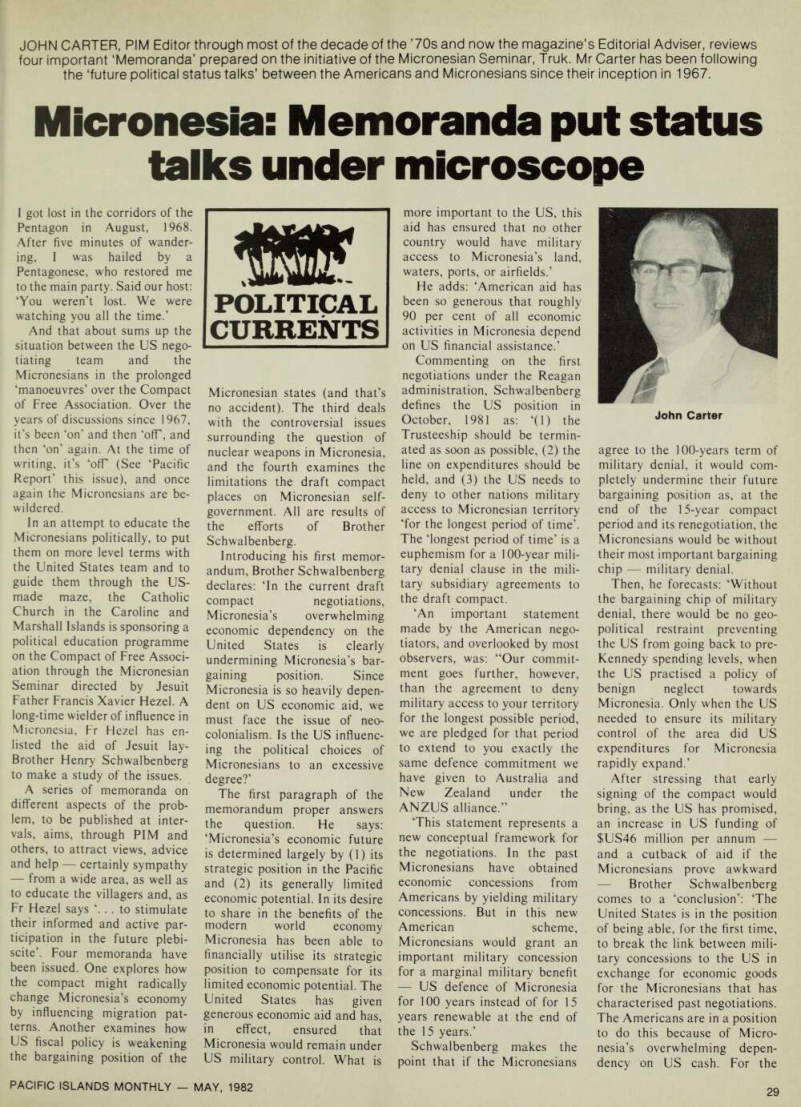
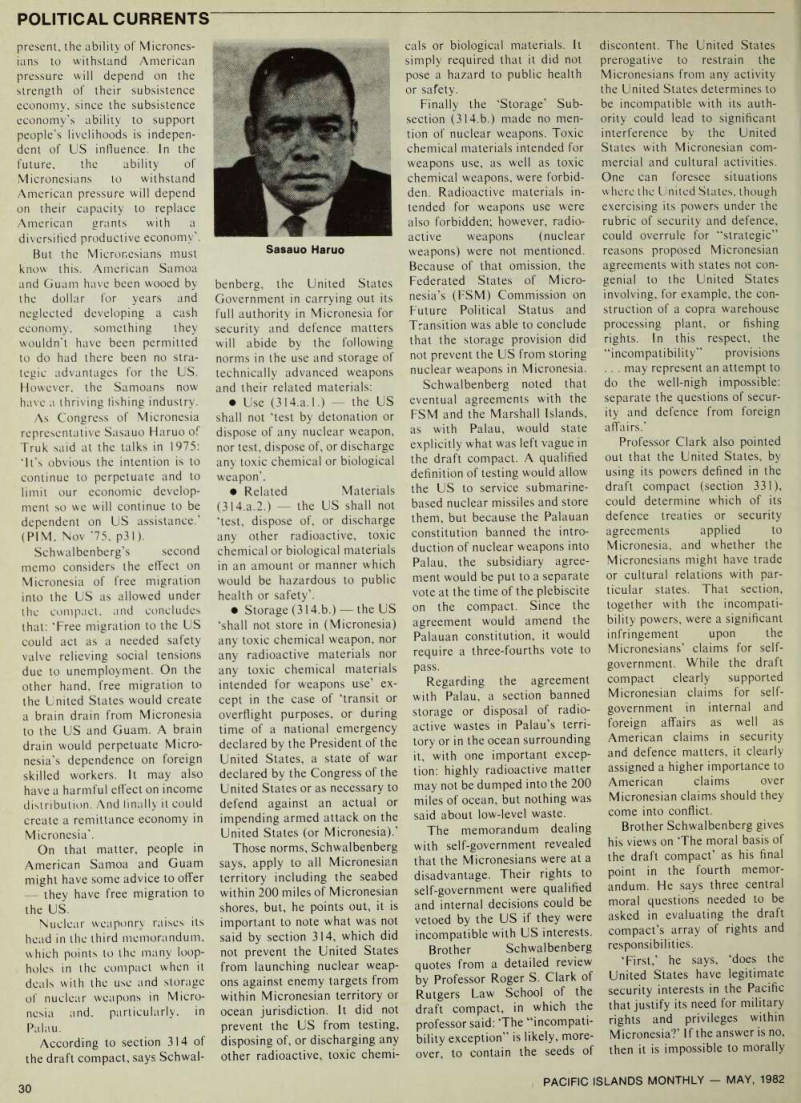
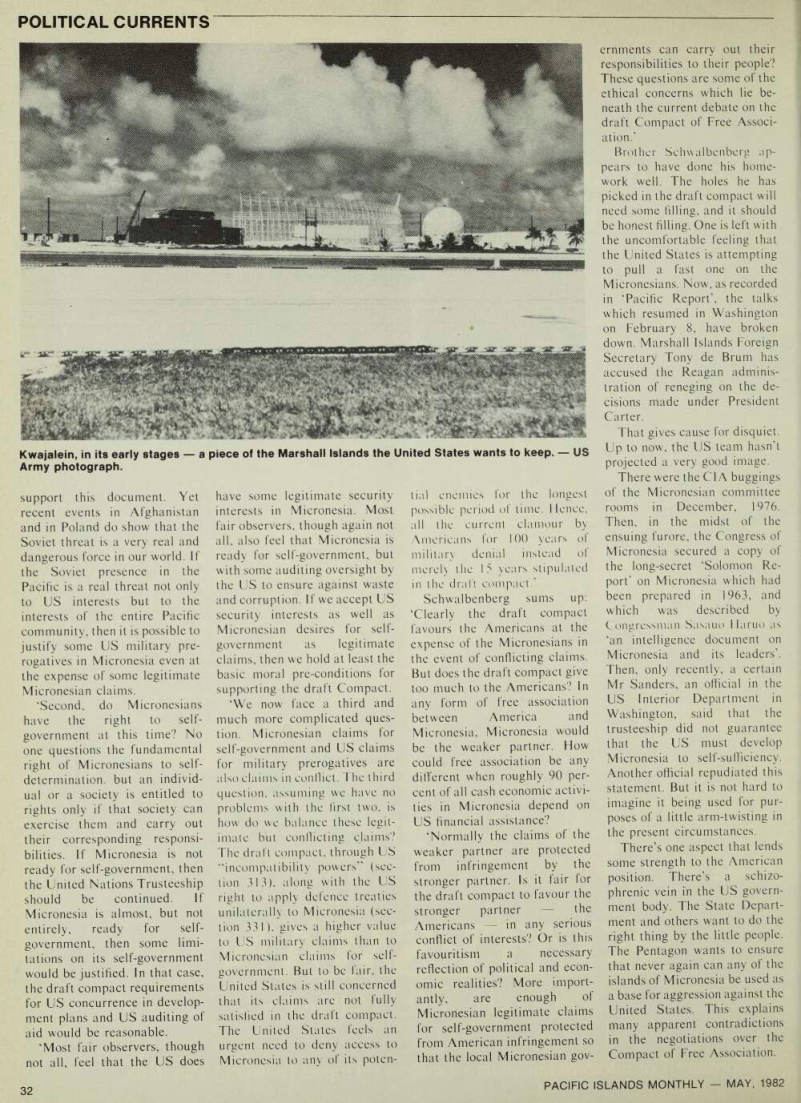
Political
Currents
Micronesia: Memoranda put status talks under microscope
JOHN CARTER, RIM Editor through most of the decade of the ’7os and now the magazine’s Editorial Adviser, reviews four important ‘Memoranda’ prepared on the initiative of the Micronesian Seminar, Truk. Mr Carter has been following the ‘future political status talks’ between the Americans and Micronesians since their inception in 1967.
I got lost in the corridors of the Pentagon in August, 1968.
After five minutes of wander ing, I was hailed by a Pentagonese, who restored me to the main party. Said our host: ‘You weren’t lost. We were watching you all the time.’
And that about sums up the situation between the US nego tiating team and the Micronesians in the prolonged ‘manoeuvres’ over the Compact of Free Association. Over the years of discussions since 1967, it’s been ‘on’ and then ‘off 1 , and then ‘on’ again. At the time of writing, it’s ‘off (See ‘Pacific Report’ this issue), and once again the Micronesians are be wildered.
In an attempt to educate the Micronesians politically, to put them on more level terms with the United States team and to guide them through the US made maze, the Catholic Church in the Caroline and Marshall Islands is sponsoring a political education programme on the Compact of Free Associ ation through the Micronesian Seminar directed by Jesuit Father Francis Xavier Hezel. A long-time wielder of influence in Micronesia, Fr Hezel has en listed the aid of Jesuit lay- Brother Henry Schwalbenberg to make a study of the issues.
A series of memoranda on different aspects of the prob lem, to be published at inter vals, aims, through PIM and others, to attract views, advice and help certainly sympathy from a wide area, as well as to educate the villagers and, as Fr Hezel says ‘.. . to stimulate their informed and active par ticipation in the future plebi scite’. Four memoranda have been issued. One explores how the compact might radically change Micronesia’s economy by influencing migration pat terns. Another examines how US fiscal policy is weakening the bargaining position of the
Micronesian states (and that’s no accident). The third deals with the controversial issues surrounding the question of nuclear weapons in Micronesia, and the fourth examines the limitations the draft compact places on Micronesian self government. All are results of the efforts of Brother Schwalbenberg.
Introducing his first memor andum, Brother Schwalbenberg declares: ‘ln the current draft compact negotiations, Micronesia’s overwhelming economic dependency on the United States is clearly undermining Micronesia’s bar gaining position. Since Micronesia is so heavily depen dent on US economic aid, we must face the issue of neo colonialism. Is the US influenc ing the political choices of Micronesians to an excessive degree?’
The first paragraph of the memorandum proper answers the question. He says: ‘Micronesia’s economic future is determined largely by (1) its strategic position in the Pacific and (2) its generally limited economic potential. In its desire to share in the benefits of the modern world economy Micronesia has been able to financially utilise its strategic position to compensate for its limited economic potential. The United States has given generous economic aid and has, in effect, ensured that Micronesia would remain under US military control. What is
more important to the US, this aid has ensured that no other country would have military access to Micronesia’s land, waters, ports, or airfields.’
He adds: ‘American aid has been so generous that roughly 90 per cent of all economic activities in Micronesia depend on US financial assistance.’
Commenting on the first negotiations under the Reagan
administration, Schwalbenberg
defines the US position in October, 1981 as: ‘(1) the Trusteeship should be termin ated as soon as possible, (2) the line on expenditures should be held, and (3) the US needs to deny to other nations military access to Micronesian territory ‘for the longest period of time’.
The ‘longest period of time’ is a euphemism for a 100-year mili tary denial clause in the mili tary subsidiary agreements to the draft compact. ‘An important statement made by the American nego tiators, and overlooked by most observers, was: “Our commit ment goes further, however, than the agreement to deny military access to your territory for the longest possible period, we are pledged for that period to extend to you exactly the same defence commitment we have given to Australia and New Zealand under the ANZUS alliance.” ‘This statement represents a new conceptual framework for the negotiations. In the past Micronesians have obtained economic concessions from Americans by yielding military concessions. But in this new American scheme, Micronesians would grant an important military concession for a marginal military benefit US defence of Micronesia for 100 years instead of for 15 years renewable at the end of the 15 years.’
Schwalbenberg makes the point that if the Micronesians
agree to the 100-years term of military denial, it would com pletely undermine their future bargaining position as, at the end of the 15-year compact period and its renegotiation, the Micronesians would be without their most important bargaining chip military denial.
Then, he forecasts: ‘Without the bargaining chip of military denial, there would be no geo political restraint preventing the US from going back to pre- Kennedy spending levels, when the US practised a policy of benign neglect towards Micronesia. Only when the US needed to ensure its military control of the area did US expenditures for Micronesia rapidly expand.’
After stressing that early signing of the compact would bring, as the US has promised, an increase in US funding of SUS 46 million per annum and a cutback of aid if the Micronesians prove awkward Brother Schwalbenberg comes to a ‘conclusion’; ‘The United States is in the position of being able, for the first time, to break the link between mili tary concessions to the US in exchange for economic goods for the Micronesians that has characterised past negotiations.
The Americans are in a position to do this because of Micro nesia’s overwhelming depen dency on US cash. For the
John Carter
present, the ability of Micrones ians to withstand American pressure will depend on the strength of their subsistence economy, since the subsistence economy’s ability to support people’s livelihoods is indepen dent of US influence. In the future, the ability of Micronesians to withstand American pressure will depend on their capacity to replace American grants with a diversified productive economy'.
But the Micronesians must know this. American Samoa and Guam have been wooed by the dollar for years and neglected developing a cash economy, something they wouldn't have been permitted to do had there been no stra tegic advantages for the US.
However, the Samoans now have a thriving fishing industry.
As Congress of Micronesia representative Sasauo Haruo of Truk said at the talks in 1975: ‘lt's obvious the intention is to continue to perpetuate and to limit our economic develop ment so we will continue to be dependent on US assistance.’ (PIM, Nov ’75, p3l).
Schwalbenberg’s second memo considers the effect on Micronesia of free migration into the US as allowed under the compact, and concludes that; ‘Free migration to the US could act as a needed safely valve relieving social tensions due to unemployment. On the other hand, free migration to the United Slates would create a brain drain from Micronesia to the US and Guam. A brain drain would perpetuate Micro nesia’s dependence on foreign skilled workers. It may also have a harmful effect on income distribution. And finally it could create a remittance economy in Micronesia’.
On that matter, people in American Samoa and Guam might have some advice to offer they have free migration to the US.
Nuclear weaponry raises its head in the third memorandum, which points to the many loop holes in the compact when it deals with the use and storage of nuclear weapons in Micro nesia and, particularly, in Palau.
According to section 314 of the draft compact, says Schwal-
benberg, the United States Government in carrying out its full authority in Micronesia for security and defence matters will abide by the following norms in the use and storage of technically advanced weapons and their related materials: • Use (314.a.1.) the US shall not ‘test by detonation or dispose of any nuclear weapon, nor test, dispose of, or discharge any toxic chemical or biological weapon’. • Related Materials (314.a.2.) the US shall not ‘test, dispose of, or discharge any other radioactive, toxic chemical or biological materials in an amount or manner which would be hazardous to public health or safety’. • Storage (314. b.) the US ‘shall not store in (Micronesia) any toxic chemical weapon, nor any radioactive materials nor any toxic chemical materials intended for weapons use’ ex cept in the case of ‘transit or overflight purposes, or during time of a national emergency declared by the President of the United States, a state of war declared by the Congress of the United States or as necessary to defend against an actual or impending armed attack on the United States (or Micronesia).’
Those norms, Schwalbenberg says, apply to all Micronesian territory including the seabed within 200 miles of Micronesian shores, but, he points out, it is important to note what was not said by section 314, which did not prevent the United States from launching nuclear weap ons against enemy targets from within Micronesian territory or ocean jurisdiction. It did not prevent the US from testing, disposing of, or discharging any other radioactive, toxic chemi
cals or biological materials. It simply required that it did not pose a hazard to public health or safety.
Finally the ‘Storage’ Sub section (314. b.) made no men tion of nuclear weapons. Toxic chemical materials intended for weapons use, as well as toxic chemical weapons, were forbid den. Radioactive materials in tended for weapons use were also forbidden; however, radio active weapons (nuclear weapons) were not mentioned.
Because of that omission, the Federated States of Micro nesia’s (FSM) Commission on Future Political Status and Transition was able to conclude that the storage provision did not prevent the US from storing nuclear weapons in Micronesia.
Schwalbenberg noted that eventual agreements with the FSM and the Marshall Islands, as with Palau, would state explicitly what was left vague in the draft compact. A qualified definition of testing would allow the US to service submarine based nuclear missiles and store them, but because the Palauan constitution banned the intro duction of nuclear weapons into Palau, the subsidiary agree ment would be put to a separate vote at the time of the plebiscite on the compact. Since the agreement would amend the Palauan constitution, it would require a three-fourths vote to pass.
Regarding the agreement with Palau, a section banned storage or disposal of radio active wastes in Palau’s terri tory or in the ocean surrounding it, with one important excep tion; highly radioactive matter may not be dumped into the 200 miles of ocean, but nothing was said about low-level waste.
The memorandum dealing with self-government revealed that the Micronesians were at a disadvantage. Their rights to self-government were qualified and internal decisions could be vetoed by the US if they were incompatible with US interests.
Brother Schwalbenberg quotes from a detailed review by Professor Roger S. Clark of Rutgers Law School of the draft compact, in which the professor said: ‘The “incompati bility exception” is likely, more over, to contain the seeds of
discontent. The United States prerogative to restrain the Micronesians from any activity the United Slates determines to be incompatible with its auth ority could lead to significant interference by the United States with Micronesian com mercial and cultural activities.
One can foresee situations where the United Slates, though exercising its powers under the rubric of security and defence, could overrule for “strategic” reasons proposed Micronesian agreements with states not con genial to the United States involving, for example, the con struction of a copra warehouse processing plant, or fishing rights. In this respect, the “incompatibility” provisions . . . may represent an attempt to do the well-nigh impossible: separate the questions of secur ity and defence from foreign affairs.’
Professor Clark also pointed out that the United States, by using its powers defined in the draft compact (section 331), could determine which of its defence treaties or security agreements applied to Micronesia, and whether the Micronesians might have trade or cultural relations with par ticular slates. That section, together with the incompati bility powers, were a significant infringement upon the Micronesians’ claims for self government. While the draft compact clearly supported Micronesian claims for self government in internal and foreign affairs as well as American claims in security and defence matters, it clearly assigned a higher importance to American claims over Micronesian claims should they come into conflict.
Brother Schwalbenberg gives his views on ‘The moral basis of the draft compact’ as his final point in the fourth memor andum. He says three central moral questions needed to be asked in evaluating the draft compact’s array of rights and
responsibilities.
‘First,’ he says, ‘does the United States have legitimate security interests in the Pacific that justify its need for military rights and privileges within Micronesia?’ If the answer is no, then it is impossible to morally
Sasauo Haruo
support this document. Yet recent events in Afghanistan and in Poland do show that the Soviet threat is a very real and dangerous force in our world. If the Soviet presence in the Pacific is a real threat not only to US interests but to the interests of the entire Pacific community, then it is possible to justify some US military pre rogatives in Micronesia even at the expense of some legitimate Micronesian claims. ‘Second, do Micronesians have the right to self government at this time? No one questions the fundamental right of Micronesians to self determination. but an individ ual or a society is entitled to rights only if that society can exercise them and carry out their corresponding responsi bilities. If Micronesia is not ready for self-government, then the United Nations Trusteeship should be continued. If Micronesia is almost, but not entirely, ready for self government, then some limi tations on its self-government would be justified. In that case, the draft compact requirements for US concurrence in develop ment plans and US auditing of aid would be reasonable. ‘Most fair observers, though not all, feel that the US does
have some legitimate security interests in Micronesia. Most fair observers, though again not all, also feel that Micronesia is ready for self-government, but with some auditing oversight by the US to ensure against waste and corruption. If we accept US security interests as well as Micronesian desires for self government as legitimate claims, then we hold at least the basic moral pre-conditions for supporting the draft Compact. ‘We now face a third and much more complicated ques tion. Micronesian claims for self-government and US claims for military prerogatives are also claims in conflict. The third question, assuming wc have no problems with the first two, is how do we balance these legit imate but conflicting claims?
The draft compact, through US “incompatibility powers” (sec tion 313), along with the US right to apply defence treaties unilaterally to Micronesia (sec tion 331), gives a higher value to US military claims than to Micronesian claims for self government. But to be lair, the United Stales is still concerned that its claims arc not fully satisfied in the draft compact.
The United Slates feels an urgent need to deny access to Micronesia to any of its polcn
tial enemies for the longest possible period of time. Hence, all the current clamour by Americans for 100 years of military denial instead ot merely the 15 years stipulated in the draft compact.’
Schwalbenberg sums up: ‘Clearly the draft compact favours the Americans at the expense of the Micronesians in the event of conflicting claims.
But does the draft compact give 100 much to the Americans? In any form of free association between America and Micronesia, Micronesia would be the weaker partner. How could free association be any different when roughly 90 per cent of all cash economic activi ties in Micronesia depend on US financial assistance? ‘Normally the claims of the weaker partner are protected from infringement by the stronger partner. Is it fair for the draft compact to favour the stronger partner the Americans in any serious conflict of interests? Or is this favouritism a necessary reflection of political and econ omic realities? More import antly, are enough of Micronesian legitimate claims for self-government protected from American infringement so that the local Micronesian gov
ernments can carry out their responsibilities to their people?
These questions are some of the ethical concerns which lie be neath the current debate on the draft Compact of Free Associ ation.' Brother Schwalbenberg ap pears to have done his home work well. The holes he has picked in the draft compact will need some filling, and it should be honest filling. One is left with the uncomfortable feeling that the United States is attempting to pull a fast one on the Micronesians. Now, as recorded in ‘Pacific Report’, the talks which resumed in Washington on February 8, have broken down. Marshall Islands Foreign Secretary Tony de Brum has accused the Reagan adminis tration of reneging on the de cisions made under President Carter.
That gives cause for disquiet.
Up to now, the US team hasn’t projected a very good image.
There were the CIA buggings of the Micronesian committee rooms in December, 1976.
Then, in the midst of the ensuing furore, the Congress of Micronesia secured a copy of the long-secret ‘Solomon Re port’ on Micronesia which had been prepared in 1963, and which was described by Congressman Sasauo Haruo as ‘an intelligence document on Micronesia and its leaders’.
Then, only recently, a certain Mr Sanders, an official in the US Interior Department in Washington, said that the trusteeship did not guarantee that the US must develop Micronesia to self-sufficiency.
Another official repudiated this statement. But it is not hard to imagine it being used for pur poses of a little arm-twisting in the present circumstances.
There’s one aspect that lends some strength to the American position. There’s a schizo phrenic vein m the US govern ment body. The State Depart ment and others want to do the right thing by the little people.
The Pentagon wants to ensure that never again can any of the islands of Micronesia be used as a base for aggression against the United States. This explains many apparent contradictions in the negotiations over the Compact of Free Association.
Kwajalein, in its early stages - a piece of the Marshall islands the United States wants to keep. - US Army photograph.
Advertisements & other items, p. 31 (1 item)
statesman
Some pleasures know
neither time nor place...
t IV ac -■ ■ * V
Ssm *
* I .V ■ IP** . /. r. * A / / / . f?S ■V-
statesman
SMOOTH, MILD CIGARS
Corona • Commodore Panatella • Lancers • Tipped Lancers • Panatella W 7
really thought
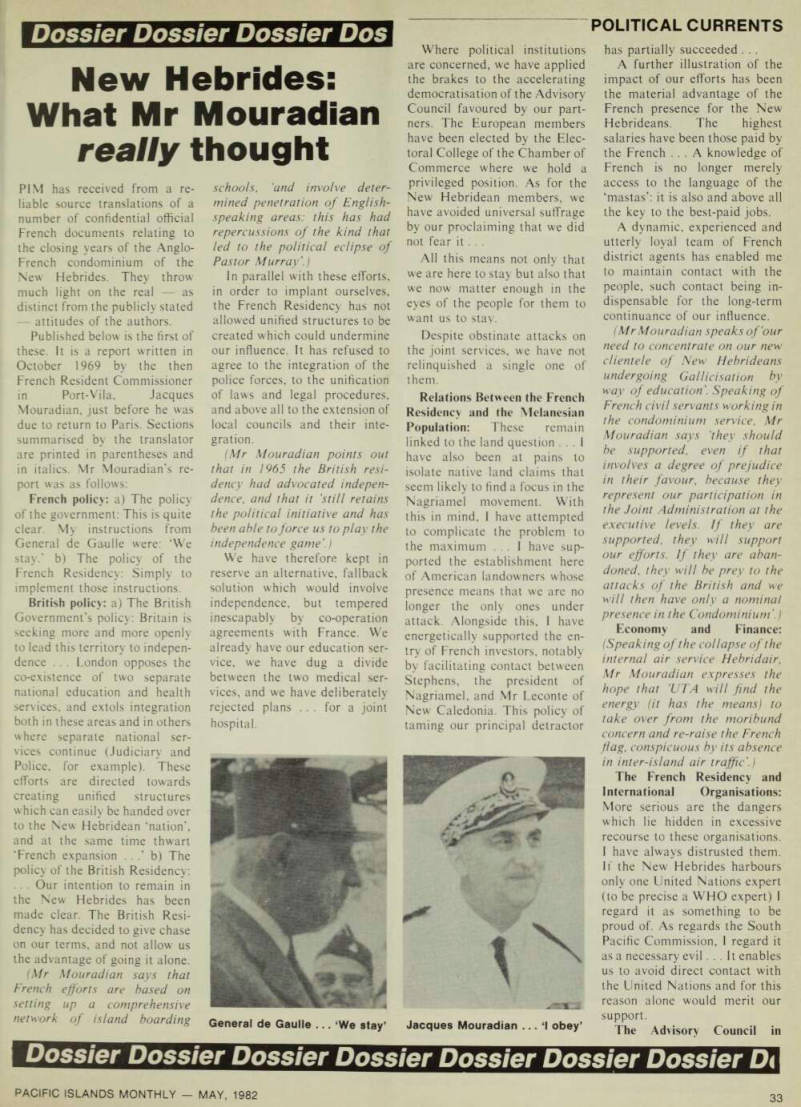



New Hebrides: What Mr Mouradian really thought
Dossier Dossier Dossier
PIM has received from a re liable source translations of a number of confidential official French documents relating to the closing years of the Anglo- French condominium of the New Hebrides. They throw much light on the real as distinct from the publicly stated attitudes of the authors.
Published below is the first of these. It is a report written in October 1969 by the then French Resident Commissioner in Port-Vila, Jacques Mouradian, just before he was due to return to Paris. Sections summarised by the translator are printed in parentheses and in italics. Mr Mouradian’s re port was as follows; French policy: a) The policy of the government; This is quite clear. My instructions from General de Gaulle were: ‘We stay.’ b) The policy of the French Residency: Simply to implement those instructions.
British policy: a) The British Government’s policy: Britain is seeking more and more openly to lead this territory to indepen dence . . . London opposes the co-existence of two separate national education and health services, and extols integration both in these areas and in others where separate national ser vices continue (Judiciary and Police, for example). These efforts are directed towards creating unified structures which can easily be handed over to the New Hebridean ‘nation’, and at the same time thwart ‘French expansion .. .’ b) The policy of the British Residency: .. . Our intention to remain in the New Hebrides has been made clear. The British Resi dency has decided to give chase on our terms, and not allow us the advantage of going it alone. (Mr Mouradian says that French efforts are based on setting up a comprehensive network of island boarding
schools, 'and involve deter mined penetration of English speaking areas: this has had repercussions of the kind that led to the political eclipse of Pastor Murray’.} In parallel with these efforts, in order to implant ourselves, the French Residency has not allowed unified structures to be created which could undermine our influence. It has refused to agree to the integration of the police forces, to the unification of laws and legal procedures, and above all to the extension of local councils and their inte gration. (Mr Mouradian points out that in 1965 the British resi dency had advocated indepen dence, and that it ‘still retains the political initiative and has been able to force us to play the independence game’.} We have therefore kept in reserve an alternative, fallback solution which would involve independence, but tempered inescapably by co-operation agreements with France. We already have our education ser vice, we have dug a divide between the two medical ser vices, and we have deliberately rejected plans ... for a joint hospital.
Where political institutions are concerned, we have applied the brakes to the accelerating democratisation of the Advisory Council favoured by our part ners. The European members have been elected by the Elec toral College of the Chamber of Commerce where we hold a privileged position. As for the New Hebridean members, we have avoided universal suffrage by our proclaiming that we did not fear it. . .
All this means not only that we are here to stay but also that we now matter enough in the eyes of the people for them to want us to stay.
Despite obstinate attacks on the joint services, we have not relinquished a single one of them.
Relations Between the French Residency and the Melanesian Population: These remain linked to the land question ... I have also been at pains to isolate native land claims that seem likely to find a focus in the Nagriamel movement. With this in mind, I have attempted to complicate the problem to the maximum . . . I have sup ported the establishment here of American landowners whose presence means that we are no longer the only ones under attack. Alongside this, I have energetically supported the en try of French investors, notably by facilitating contact between Stephens, the president of Nagriamel, and Mr Leconte of New Caledonia. This policy of taming our principal detractor
has partially succeeded . . .
A further illustration of the impact of our efforts has been the material advantage of the French presence for the New Hebrideans. The highest salaries have been those paid by the French ... A knowledge of French is no longer merely access to the language of the ‘mastas’: it is also and above all the key to the best-paid jobs.
A dynamic, experienced and utterly loyal team of French district agents has enabled me to maintain contact with the people, such contact being in dispensable for the long-term continuance of our influence. (Mr Mouradian speaks of‘our need to concentrate on our new clientele of New Hebrideans undergoing Gallicisation by way of education’. Speaking of French civil servants working in the condominium service, Mr Mouradian says ‘they should be supported, even if that involves a degree of prejudice in their favour, because they represent our participation in the Joint Administration at the executive levels. If they are supported, they will support our efforts. If they are aban doned, they will be prey to the attacks of the British and we will then have only a nominal presence in the Condominium’.) Economy and Finance: (Speaking of the collapse of the internal air service Hebridair, Mr Mouradian expresses the hope that ‘UTA will find the energy (it has the means) to take over from the moribund concern and re-raise the French fiag, conspicuous by its absence in inter-island air traffic’.) The French Residency and International Organisations: More serious are the dangers which lie hidden in excessive recourse to these organisations. 1 have always distrusted them.
If the New Hebrides harbours only one United Nations expert (to be precise a WHO expert) I regard it as something to be proud of. As regards the South Pacific Commission, 1 regard it as a necessary evil... It enables us to avoid direct contact with the United Nations and for this reason alone would merit our support.
The Advisory Council in
Dossier Dossie? Dossier dossier Dossier Dossier Dossier D<
General de Gaulle . . . 'We stay’
Jacques Mouradian . . . ‘I obey’
1969: On the European side, the elected members are the most interesting because they are supposed to reflect public opinion ... I applaud the pres ence of Mr Delacroix, of whose ambition to lead an indigenous movement I am aware: every thing he touches ends in disas ter and I do not think he will fail to run true to form on this occasion. Meanwhile, he has provided us with a liberal ban ner which has been lacking among the French here, and by pulling the carpet from under the British he will bring them to positions closer to our own.
Mr Seagoe is a decided asset for us if we can continue to keep him in our camp. He has the ear of many New Hebrideans and represents those among the settlers who are cautiously pro gressive.
As for Archdeacon Rawcliffe, he is an Anglican Murray, given to the same demagogy and the same de nials. Obliged to come to terms with our education and to put up with our initiatives, he will become our accomplice willy nilly and will suffer the conse quences.
Moruroa ‘clean’
says French MP
There is ‘no radioactive con tamination problem at Mor uroa’, according to a statement made in March by French parliamentarian Louis Darinot.
Mr Darinot, chairman of the National Assembly’s defence commission, headed a working party which interviewed French scientists at Moruroa and later spent eight days in Australia for talks with Australian Foreign Minister Tony Street.
Mr Darinot conceded that ‘tiny coral atolls’ still bore traces of the effects of the 1981 storm which dispersed radioac tive waste into the ocean (PIM Jan p 6), and that notices saying ‘Non-decontaminated zone possible radiation dangers’ had been erected on them. But Moruroa, he said, was safe.
Mr Darinot said it was poss ible that tests would be held in future on Fangataufa Atoll, 150 kilometres to the south of Moruroa, but that Fangataufa ‘would never replace’ Moruroa.
Mr Darinot told Mr Street
that when he reported to French Defence Minister Charles Hernu he would ask him to permit Australian parliamen tarians to visit Moruroa. But, he added, ‘I would understand if this was refused’.
French do have
neutron bomb
The French Atomic Energy Agency announced in March that the most recent tests at Moruroa had ‘perfected and miniaturised’ the neutron bomb.
The announcement ended a long period of uncertainty as to whether France was in fact developing the weapon.
During the presidential elec tion campaign. President Mit terrand was cautious on the subject, saying that develop ment of the neutron bomb would imply ‘a change of strat
egy’. The ‘change’ has appar ently now been made.
The bomb kills a maximum number of people by its high radiation rate and destroys a minimum number of buildings because of its low blast effect.
Hawaii senator
raps N-policies
Hawaii Senator Spark Matsu naga has called for a drastic revision of US policy on nuclear issues in the Pacific, saying that the US must take much of the blame for the ‘nuclear-free Pacific’ movement, because it had ‘shown no sympathy for the motives of its supporters’.
Addressing a luncheon in Honolulu earlier this year, the senator said: ‘Why stir up a hornet’s nest in the Pacific at this moment? We should not even talk about new interim storage sites in the Pacific until
we develop standards for per manent disposal that we our
selves find acceptable . . .
‘Even the United States is only now beginning to discover how complex and uncertain are safety measures surrounding the production and containment of nuclear materials ... If we want to halt the “nuclear-free Pacific” which Ambassador Bodde (former US Ambassador in Suva and now at the East- West Center) correctly de scribes as the most serious threat to American interests in the Pacific, we need to address its roots, which are in the unanimous, Pacific Islands wide opposition to nuclear dumping or storage on islands
or on the seabed.’
Paul
Addison
in Honolulu.
Islands politics
under study
The first international confer ence of social scientists inter ested in Pacific politics took place at the Hawaii campus of Brigham Young University be tween February 4 and 6. Spon sored by the Institute for Polynesian Studies, the general theme was the Politics of Evolv ing Political Cultures in the Pacific Islands. Over 30 scholars attended, drawn from universities in Hawaii, the con tinental United Slates, Austra lia, New Zealand and Papua New Guinea. Also in attend ance were George Atkin, editor of Solomons Toktok and T.S.I. laone Taulapapa of the Pacific Islanders’ Educational Re source Centre in Auckland.
Papers given at the confer ence included four on American Micronesia, three on PNG, two on the Solomons, two on Vanuatu, and one each on New Caledonia, Western Samoa, Pacific Islanders in New Zea land, and Fiji Indians. The keynote address was given by Emeritus Professor Norman Meller of the University of Hawaii.
The success of the conference prompted suggestions for further meetings, possibly else where in the Pacific. The full proceedings are shortly to be published by the Institute for Polynesian Studies at Brigham
Young University.
(Dr)
James Jupp
in Canberra.
A deadly ‘mushroom’ over Moruroa Atoll in the days of the tests in the air. Shortly after this test, they went underground. But, are they any safer? The last atmospheric tests took place in 1975. The underground tests since then have given rise to new controversies, centring especially on claims that they are destroying the structure of the atoll.
Advertisements & other items, pp. 34-36 (1 item)
Toyota
LAND CRUISER
STATION WAGON
■ p
HI ACE
CB a :-'i m
TOYOTA
SERVICE
PAPUA NEW GUINEA: ELA MOTORS,
Scratchley Rd., Badili, P.O. Box 675, Port Moresby.
NORTHERN MARIANAS & U.S.T.T.:
MICROL CORPORATION, P.O. Box 267, Saipan.
FIJI: AUTOMOTIVE SUPPLIES COMPANY, G.P.O.
Box 355, Suva.
AMERICAN SAMOA: BURNS PHILP
(SOUTHSEA) CO., LTD., P.O. Box 129, Pago Pago.
WESTERN SAMOA: BURNS PHILP (SOUTHSEA)
CO., LTD., P.O. Box 188, Apia.
TONGA: BURNS PHILP (SOUTHSEA) CO., LTD.,
P.O. Box 55, Nuku’alofa.
GUAM; ATKINS, KROLL (GUAM) LTD., P.O. Box 642 Tamuning.
DYNA
HI-LUX
DOUBLE CAB
-+..i Ci P
TRUCK
HEAVY DUTY
/ S
THE TOYOTA ROADMA
READY TO TAKE
ON THE TOUGHEST OOBS
Meet Toyota’s hard working commercial vehicles.
Tough. Durable. Ready to meet the challenge of the worst roads and climates. Ready to do the job called for with ease.
Rugged veterans, each one specifically designed to meet the different demands of the world’s businesses.
One of them is just right for you.
There are no vehicles more reliable. And if you need it, Toyota is ready with fast backup service.
Toyota’s roadmasters, they’re a winnin^^^ NUATU: VANUATU MOTORS, P.O. Box 18, Port Vila, KIRIBATI: TARAWA MOTORS, Box 36, Bairiki I niIAM. k ACTKirv AK I A K i-rrr»nni r-\ /<-% . v • -T- .
Tarawa, Kiribati.
NORFOLK ISLAND: BORRY’S RENTAL CARS,
MOUNT PITT (ENTERPRISES) LTD., P.O. Box 169.
NEW CALEDONIA: SERVICE IMPORTATION
AUTOMOBILE DU PACIFIQUE, Rond-Point
du Pacifique (Station Total) B.P. 438, Noumea.
The Toyota range includes:
COROLLA, STARLET, CORONA, CRESSIDA, HI-LUX
STOUT, HI ACE, DYNA, COASTER and LAND CRUISER
n
HEB
THE HEAUNG PACIFIC.
THE FIRST BICYCLE DESIGNED AND BUILT FOR THE PACIFIC The new Healing “Pacific” is now available.
It’s the first bicycle designed expressly for the special conditions of the islands of the Pacific. Produced in New Zealand, in one of the world’s most modern cycle factories, the Healing Pacific has been built strong, to last long.
All tubing, rims and other components are heavy-duty specification, engineered to handle all conditions. A special feature is the extra-strong double-bar design.
Tyres are heavy duty balloon style, suitable for sealed and unsealed roads. The full sized wheels (26 x 2 x VA) keep going, whether the going’s hard or soft. They handle bumpy roads with ease, and the heavy duty spokes stand up to the demands of heavy duty service.
Standard features on the Healing Pacific include rear coaster brake, full length mudguards, safety reflector pedals, two red rear reflectors and warning bell.
The saddle is the broad, well-sprung, comfortable roadster style.
The Healing Pacific has been built to deliver maximum quality and value for money. The high gloss black paintwork is a special formulation, developed by Healing technology, to withstand the wide range of Pacific climatic conditions.
Invest in a Healing Pacific, and you’ll have low cost, economical, long-life transport. The first bicycle designed and built for the Pacific.
HEALING
CYCLES
PRODUCTS OF HEALING TECHNOLOGY
TRADE ENQUIRIES TO:
HEAUNG INDUSTRIES LTD.
PRIVATE BAG, ROSEBANK, AUCKLAND 7, N.Z.
1
at its modern history
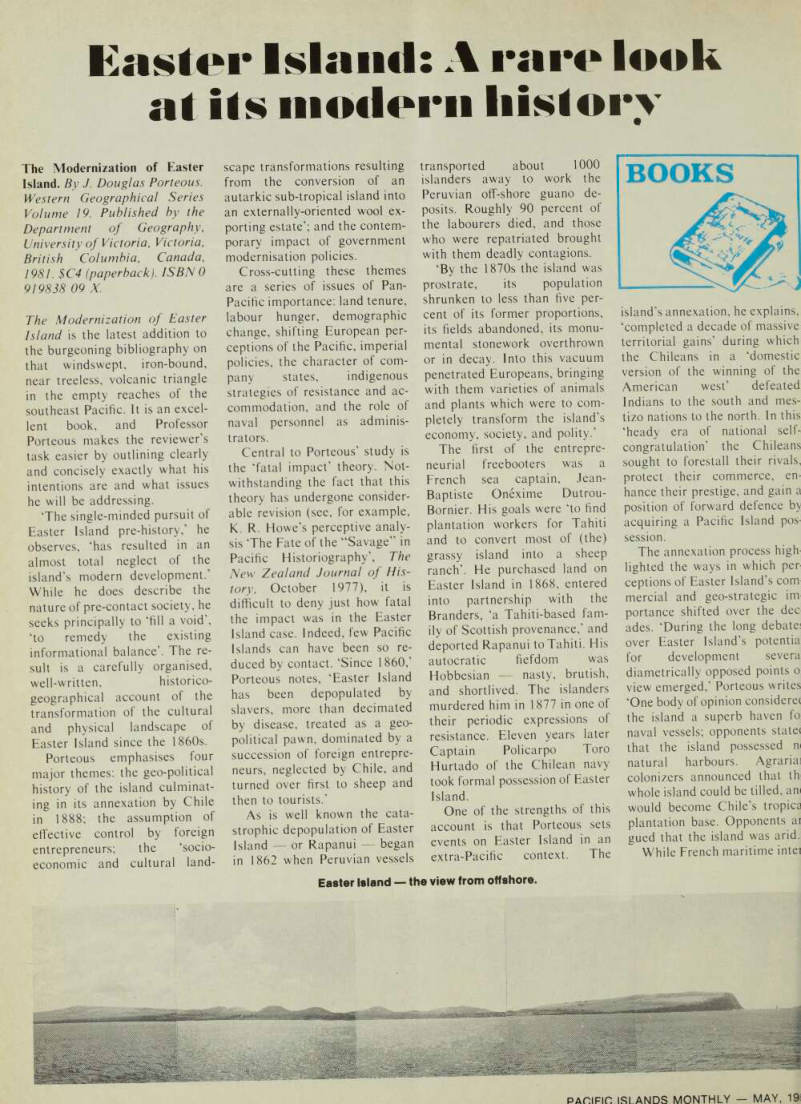
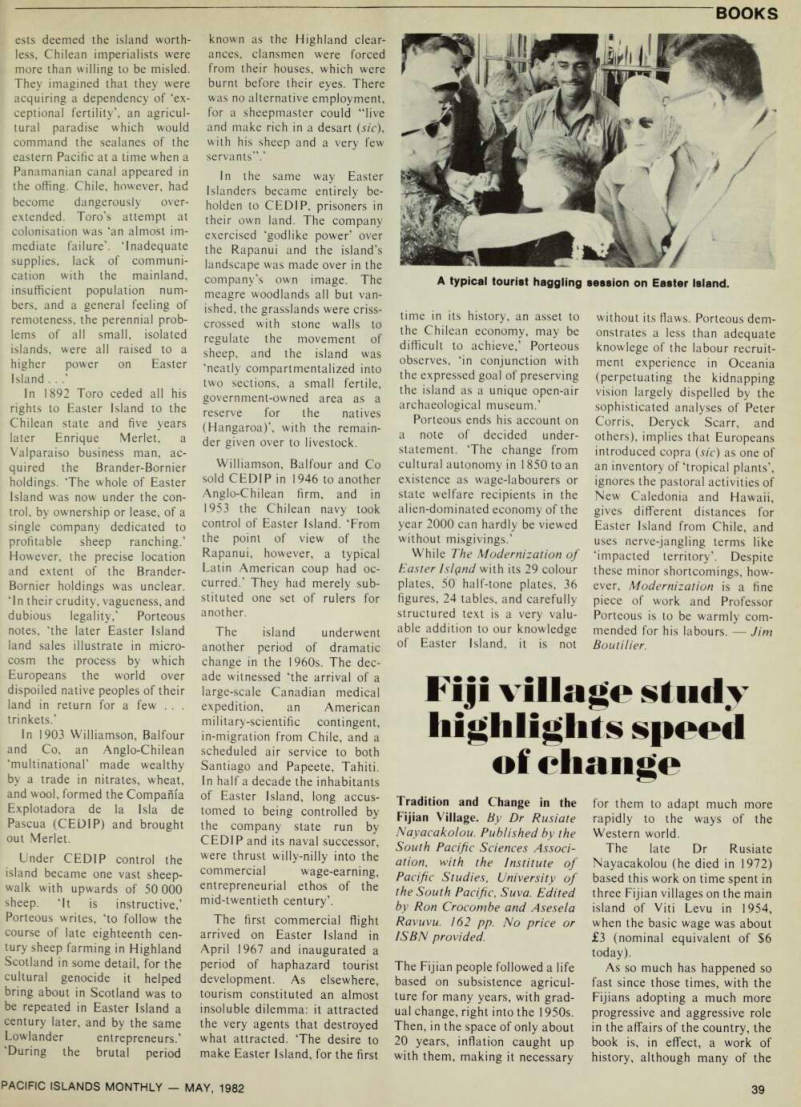
Books
Easter Island: A rare look at its modern history
The Modernization of Easter Island. By J. Douglas Porteous.
Western Geographical Series Volume 19. Published by the Department of Geography, University of Victoria, Victoria, British Columbia, Canada, 1981. SC4 (paperback). ISBN 0 919838 09 X.
The Modernization of Easter Island is the latest addition to the burgeoning bibliography on that windswept, iron-bound, near treeless, volcanic triangle in the empty reaches of the southeast Pacific. It is an excel lent book, and Professor Porteous makes the reviewer’s task easier by outlining clearly and concisely exactly what his intentions are and what issues he will be addressing. ‘The single-minded pursuit of Easter Island pre-history,’ he observes, ‘has resulted in an almost total neglect of the island’s modern development.’
While he does describe the nature of pre-contact society, he seeks principally to ‘fill a void', ‘to remedy the existing informational balance’. The re sult is a carefully organised, well-written, historico geographical account of the transformation of the cultural and physical landscape of Easter Island since the 1860 s.
Porteous emphasises four major themes: the geo-political history of the island culminat ing in its annexation by Chile in 1888; the assumption of effective control by foreign entrepreneurs; the ‘socio economic and cultural land
scape transformations resulting from the conversion of an autarkic sub-tropical island into an externally-oriented wool ex porting estate’; and the contem porary impact of government modernisation policies.
Cross-cutting these themes are a series of issues of Pan- Pacific importance; land tenure, labour hunger, demographic change, shifting European per ceptions of the Pacific, imperial policies, the character of com pany states, indigenous strategies of resistance and ac commodation, and the role of naval personnel as adminis trators.
Central to Porteous’ study is the ‘fatal impact’ theory. Not withstanding the fact that this theory has undergone consider able revision (see, for example, K. R. Howe’s perceptive analy sis ‘The Fate of the “Savage” in Pacific Historiography’, The New Zealand Journal of His tory, October 1977), it is difficult to deny just how fatal the impact was in the Easter Island case. Indeed, few Pacific Islands can have been so re duced by contact. ‘Since 1860,’
Porteous notes, ‘Easter Island has been depopulated by slavers, more than decimated by disease, treated as a geo political pawn, dominated by a succession of foreign entrepre neurs, neglected by Chile, and turned over first to sheep and then to tourists.’
As is well known the cata strophic depopulation of Easter Island or Rapanui began in 1862 when Peruvian vessels
transported about 1000 islanders away to work the Peruvian off-shore guano de posits. Roughly 90 percent of the labourers died, and those who were repatriated brought with them deadly contagions. ‘By the 1870 s the island was prostrate, its population shrunken to less than five per cent of its former proportions, its fields abandoned, its monu mental stonework overthrown or in decay. Into this vacuum penetrated Europeans, bringing with them varieties of animals and plants which were to com pletely transform the island’s economy, society, and polity.’
The first of the entrepre neurial freebooters was a French sea captain, Jean- Baptiste Onexime Dutrou- Bornier. His goals were ‘to find plantation workers for Tahiti and to convert most of (the) grassy island into a sheep ranch’. He purchased land on Easter Island in 1868, entered into partnership with the Branders, ‘a Tahiti-based fam ily of Scottish provenance,’ and deported Rapanui to Tahiti. His autocratic fiefdom was Hobbesian nasty, brutish, and shortlived. The islanders murdered him in 1877 in one of their periodic expressions of resistance. Eleven years later Captain Policarpo Toro Hurtado of the Chilean navy took formal possession of Easter Island.
One of the strengths of this account is that Porteous sets events on Easter Island in an extra-Pacific context. The
island’s annexation, he explains, ‘completed a decade of massive territorial gains’ during which the Chileans in a ‘domestic version of the winning of the American west’ defeated Indians to the south and mes tizo nations to the north. In this ‘heady era of national self congratulation’ the Chileans sought to forestall their rivals, protect their commerce, en hance their prestige, and gain a position of forward defence by acquiring a Pacific Island pos session.
The annexation process high lighted the ways in which per ceptions of Easter Island’s com mercial and geo-strategic im portance shifted over the dec ades. ‘During the long debate over Easter Island’s potentia for development severa diametrically opposed points o view emerged,’ Porteous writes ‘One body of opinion considere( the island a superb haven fo naval vessels; opponents state* that the island possessed n< natural harbours. Agrariai colonizers announced that thi whole island could be tilled, an* would become Chile’s tropica plantation base. Opponents ar gued that the island was arid.
While French maritime intei
Easter Island-the view from offshore.
ests deemed the island worth less, Chilean imperialists were more than willing to be misled.
They imagined that they were acquiring a dependency of ‘ex ceptional fertility’, an agricul tural paradise which would command the sealanes of the eastern Pacific at a time when a Panamanian canal appeared in the offing. Chile, however, had become dangerously over extended. Toro’s attempt at colonisation was ‘an almost im mediate failure’. 'lnadequate supplies, lack of communi cation with the mainland, insufficient population num bers, and a general feeling of remoteness, the perennial prob lems of all small, isolated islands, were all raised to a higher power on Easter Island . ..’
In 1892 Toro ceded all his rights to Easter Island to the Chilean state and five years later Enrique Merlet, a Valparaiso business man, ac quired the Brander-Bornier holdings. ‘The whole of Easter Island was now under the con trol, by ownership or lease, of a single company dedicated to profitable sheep ranching.’
However, the precise location and extent of the Brander- Bornier hojdings was unclear.
'ln their crudity, vagueness, and dubious legality,’ Porteous notes, ‘the later Easter Island land sales illustrate in micro cosm the process by which Europeans the world over dispoiled native peoples of their land in return for a few . . . trinkets.’
In 1903 Williamson, Balfour and Co, an Anglo-Chilean ‘multinational’ made wealthy by a trade in nitrates, wheat, and wool, formed the Compania Explotadora de la Isla de Pascua (CEDIP) and brought out Merlet.
Under CEDIP control the island became one vast sheep walk with upwards of 50 000 sheep. ‘lt is instructive,’
Porteous writes, ‘to follow the course of late eighteenth cen tury sheep farming in Highland Scotland in some detail, for the cultural genocide it helped bring about in Scotland was to be repeated in Easter Island a century later, and by the same Lowlander entrepreneurs.’ ‘During the brutal period
known as the Highland clear ances, clansmen were forced from their houses, which were burnt before their eyes. There was no alternative employment, for a sheepmaster could “live and make rich in a desart {sic), with his sheep and a very few servants”.’
In the same way Easter Islanders became entirely be holden to CEDIP, prisoners in their own land. The company exercised ‘godlike power’ over the Rapanui and the island’s landscape was made over in the company’s own image. The meagre woodlands all but van ished, the grasslands were criss crossed with stone walls to regulate the movement of sheep, and the island was ‘neatly compartmentalized into two sections, a small fertile, government-owned area as a reserve for the natives (Hangaroa)’, with the remain der given over to livestock.
Williamson, Balfour and Co sold CEDIP in 1946 to another Anglo-Chilean firm, and in 1953 the Chilean navy took control of Easter Island. ‘From the point of view of the Rapanui, however, a typical Latin American coup had oc curred.’ They had merely sub stituted one set of rulers for another.
The island underwent another period of dramatic change in the 19605. The dec ade witnessed ‘the arrival of a large-scale Canadian medical expedition, an American military-scientific contingent, in-migration from Chile, and a scheduled air service to both Santiago and Papeete, Tahiti.
In half a decade the inhabitants of Easter Island, long accus tomed to being controlled by the company state run by CEDIP and its naval successor, were thrust willy-nilly into the commercial wage-earning, entrepreneurial ethos of the mid-twentieth century’.
The first commercial flight arrived on Easter Island in April 1967 and inaugurated a period of haphazard tourist development. As elsewhere, tourism constituted an almost insoluble dilemma: it attracted the very agents that destroyed what attracted. ‘The desire to make Easter Island, for the first
time in its history, an asset to the Chilean economy, may be difficult to achieve,’ Porteous observes, ‘in conjunction with the expressed goal of preserving the island as a unique open-air archaeological museum.’
Porteous ends his account on a note of decided under statement. ‘The change from cultural autonomy in 1850 to an existence as wage-labourers or state welfare recipients in the alien-dominated economy of the year 2000 can hardly be viewed without misgivings.’
While The Modernization of Easter Island with its 29 colour plates, 50 half-tone plates, 36 figures, 24 tables, and carefully structured text is a very valu able addition to our knowledge of Easter Island, it is not
without its flaws. Porteous dem onstrates a less than adequate knowlege of the labour recruit ment experience in Oceania (perpetuating the kidnapping vision largely dispelled by the sophisticated analyses of Peter Corns, Deryck Scarr, and others), implies that Europeans introduced copra (sic) as one of an inventory of‘tropical plants’, ignores the pastoral activities of New Caledonia and Hawaii, gives different distances for Easter Island from Chile, and uses nerve-jangling terms like ‘impacted territory’. Despite these minor shortcomings, how ever, Modernization is a fine piece of work and Professor Porteous is to be warmly com
mended for his labours.
Jim
Boutilier.
A typical tourist haggling session on Easter Island.
Fiji village study
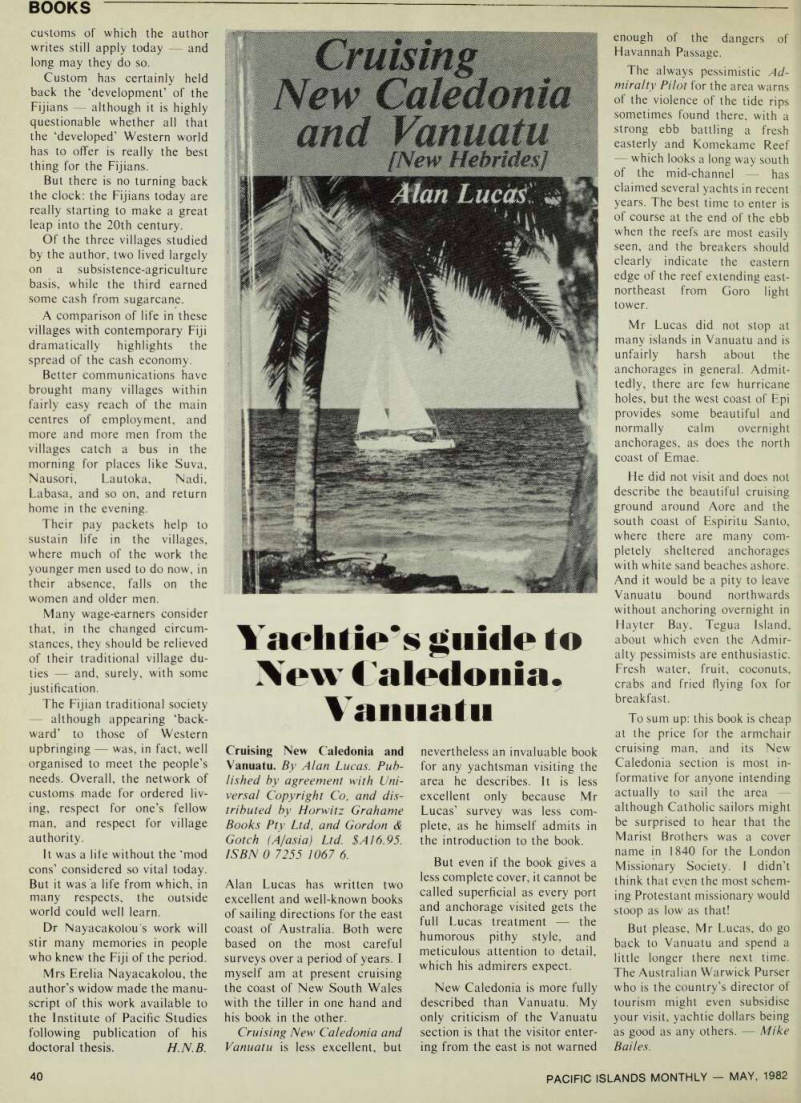
highlights speed of change
Tradition and Change in the Fijian Village. By Dr Rusiate Nayacakolou. Published by the South Pacific Sciences Associ ation, with the Institute of Pacific Studies. University of the South Pacific, Suva. Edited by Ron Crocombe and Asesela Ravuvu. 162 pp. No price or ISBN provided.
The Fijian people followed a life based on subsistence agricul ture for many years, with grad ual change, right into the 19505.
Then, in the space of only about 20 years, inflation caught up with them, making it necessary
for them to adapt much more rapidly to the ways of the Western world.
The late Dr Rusiate Nayacakolou (he died in 1972) based this work on time spent in three Fijian villages on the main island of Viti Levu in 1954, when the basic wage was about £3 (nominal equivalent of $6 today).
As so much has happened so fast since those times, with the Fijians adopting a much more progressive and aggressive role in the affairs of the country, the book is, in effect, a work of history, although many of the
customs of which the author writes still apply today and long may they do so.
Custom has certainly held back the ‘development’ of the Fijians although it is highly questionable whether all that the ‘developed’ Western world has to offer is really the best thing for the Fijians.
But there is no turning back the clock: the Fijians today are really starting to make a great leap into the 20th century.
Of the three villages studied by the author, two lived largely on a subsistence-agriculture basis, while the third earned some cash from sugarcane.
A comparison of life in these villages with contemporary Fiji dramatically highlights the spread of the cash economy.
Better communications have brought many villages within fairly easy reach of the main centres of employment, and more and more men from the villages catch a bus in the morning for places like Suva, Nausori, Lautoka, Nadi, Labasa, and so on, and return home in the evening.
Their pay packets help to sustain life in the villages, where much of the work the younger men used to do now, in their absence, falls on the women and older men.
Many wage-earners consider that, in the changed circum stances, they should be relieved of their traditional village du ties and, surely, with some justification.
The Fijian traditional society - although appearing ‘back ward’ to those of Western upbringing was, in fact, well organised to meet the people’s needs. Overall, the network of customs made for ordered liv ing, respect for one’s fellow man, and respect for village authority.
It was a life without the ‘mod cons’ considered so vital today.
But it was a life from which, in many respects, the outside world could well learn.
Dr Nayacakolou’s work will stir many memories in people who knew the Fiji of the period.
Mrs Erelia Nayacakolou, the author’s widow made the manu script of this work available to the Institute of Pacific Studies following publication of his
doctoral thesis.
H.N.B.
New Caledonia,
Yachtie’s guide to New Caledonia, Vanuatu
Cruising New Caledonia and Vanuatu. By Alan Lucas. Pub lished by agreement with Uni versal Copyright Co, and dis tributed by Horwitz Grahame Books Pty Ltd, and Gordon & Gotch (A/asia) Ltd. 5A16.95.
Isbn 0 7255 1067 6.
Alan Lucas has written two excellent and well-known books of sailing directions for the east coast of Australia. Both were based on the most careful surveys over a period of years. I myself am at present cruising the coast of New South Wales with the tiller in one hand and his book in the other.
Cruising New Caledonia and Vanuatu is less excellent, but
nevertheless an invaluable book for any yachtsman visiting the area he describes. It is less excellent only because Mr Lucas’ survey was less com plete, as he himself admits in the introduction to the book.
But even if the book gives a less complete cover, it cannot be called superficial as every port and anchorage visited gets the full Lucas treatment the humorous pithy style, and meticulous attention to detail, which his admirers expect.
New Caledonia is more fully described than Vanuatu. My only criticism of the Vanuatu section is that the visitor enter ing from the east is not warned
enough of the dangers of Havannah Passage.
The always pessimistic Ad miralty Pilot for the area warns of the violence of the tide rips sometimes found there, with a strong ebb battling a fresh easterly and Komekame Reef which looks a long way south of the mid-channel has claimed several yachts in recent years. The best time to enter is of course at the end of the ebb when the reefs are most easily seen, and the breakers should clearly indicate the eastern edge of the reef extending east northeast from Goro light tower.
Mr Lucas did not stop at many islands in Vanuatu and is unfairly harsh about the anchorages in general. Admit tedly, there are few hurricane holes, but the west coast of Epi provides some beautiful and normally calm overnight anchorages, as does the north coast of Emae.
He did not visit and does not describe the beautiful cruising ground around Aore and the south coast of Espiritu Santo, where there are many com pletely sheltered anchorages with white sand beaches ashore.
And it would be a pity to leave Vanuatu bound northwards without anchoring overnight in Hayter Bay, Tegua Island, about which even the Admir alty pessimists are enthusiastic.
Fresh water, fruit, coconuts, crabs and fried flying fox for breakfast.
To sum up: this book is cheap at the price for the armchair cruising man, and its New Caledonia section is most in formative for anyone intending actually to sail the area although Catholic sailors might be surprised to hear that the Marist Brothers was a cover name in 1840 for the London Missionary Society. I didn’t think that even the most schem ing Protestant missionary would stoop as low as that!
But please, Mr Lucas, do go back to Vanuatu and spend a little longer there next time.
The Australian Warwick Purser who is the country’s director of tourism might even subsidise your visit, yachtie dollars being
as good as any others.
Mike
Bailes.
To Aneityum, Futuna - and to Tanna’s Mt Yasur volcano
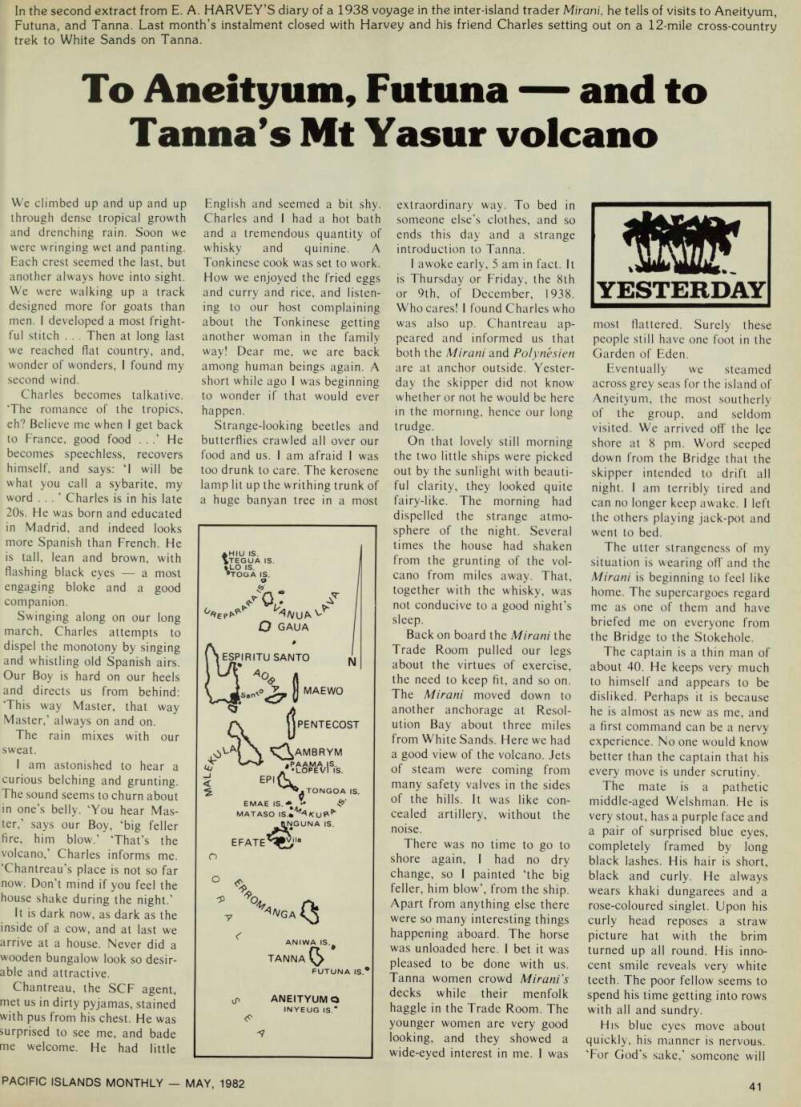

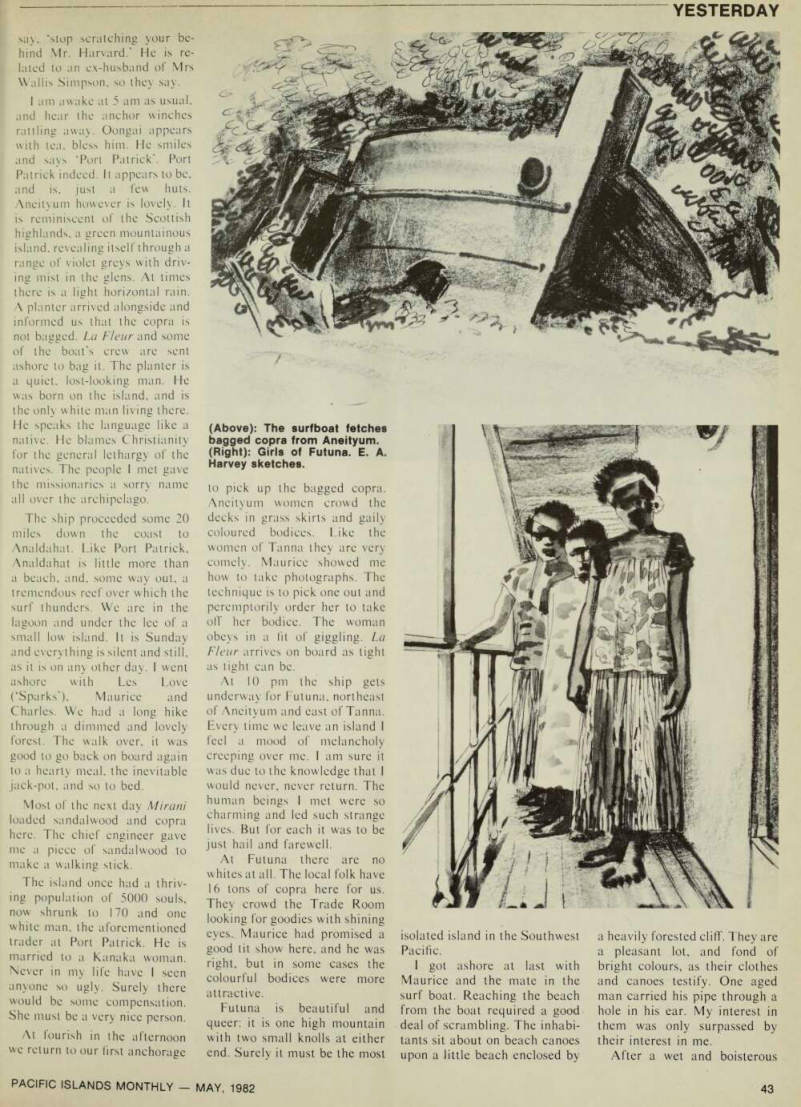
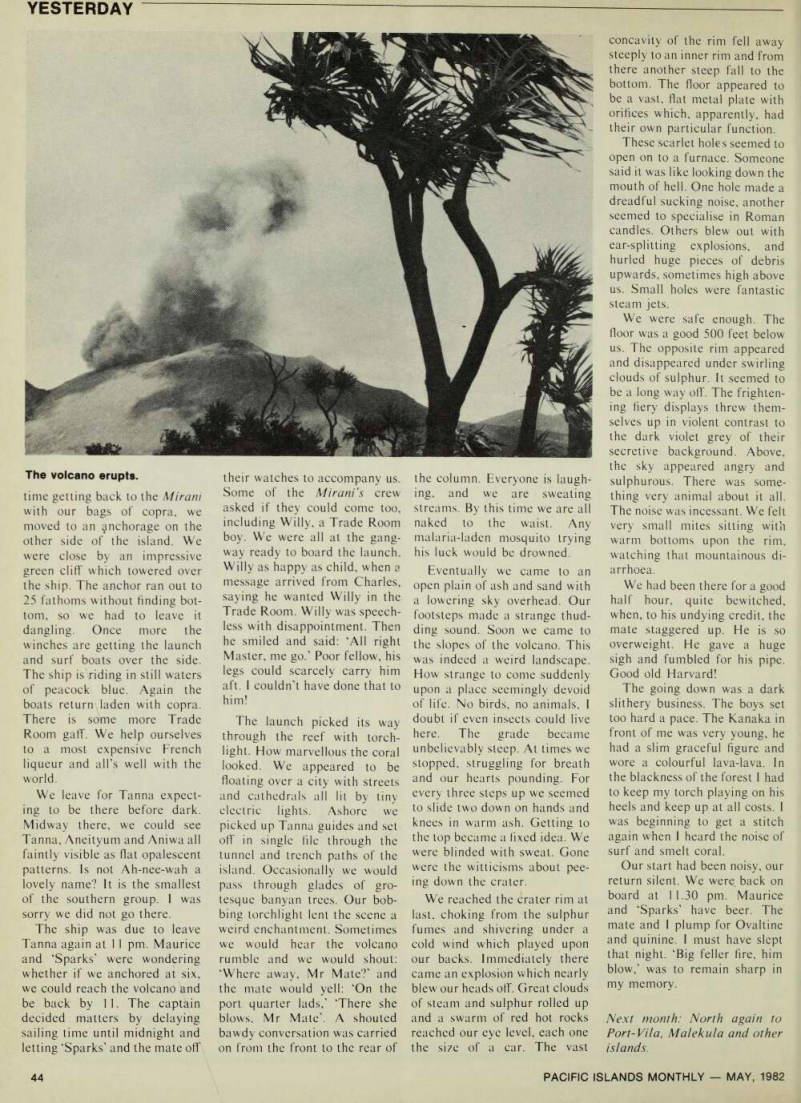
Tanna’s Mt Yasur volcano
Yesterday
In the second extract from E. A. HARVEY’S diary of a 1938 voyage in the inter-island trader Mirani, he tells of visits to Aneityum, Futuna, and Tanna. Last month’s instalment closed with Harvey and his friend Charles setting out on a 12-mile cross-country trek to White Sands on Tanna.
We climbed up and up and up through dense tropical growth and drenching rain. Soon we were wringing wet and panting.
Each crest seemed the last, but another always hove into sight.
We were walking up a track designed more for goats than men. I developed a most fright ful stitch . . . Then at long last we reached flat country, and, wonder of wonders, I found my second wind.
Charles becomes talkative. ‘The romance of the tropics, eh? Believe me when I get back to France, good food . . .’ He becomes speechless, recovers himself, and says: T will be what you call a sybarite, my word . . . ’ Charles is in his late 20s. He was born and educated in Madrid, and indeed looks more Spanish than French. He is tall, lean and brown, with flashing black eyes a most engaging bloke and a good companion.
Swinging along on our long march, Charles attempts to dispel the monotony by singing and whistling old Spanish airs.
Our Boy is hard on our heels and directs us from behind: ‘This way Master, that way Master,’ always on and on.
The rain mixes with our sweat.
I am astonished to hear a curious belching and grunting.
The sound seems to churn about in one’s belly. ‘You hear Mas ter,’ says our Boy, ‘big feller fire, him blow.’ ‘That’s the volcano,’ Charles informs me. ‘Chantreau’s place is not so far now. Don’t mind if you feel the house shake during the night.’
It is dark now, as dark as the inside of a cow, and at last we arrive at a house. Never did a wooden bungalow look so desir able and attractive.
Chantreau, the SCF agent, met us in dirty pyjamas, stained with pus from his chest. He was surprised to see me, and bade me welcome. He had little
English and seemed a bit shy.
Charles and I had a hot bath and a tremendous quantity of whisky and quinine. A Tonkinese cook was set to work.
How we enjoyed the fried eggs and curry and rice, and listen ing to our host complaining about the Tonkinese getting another woman in the family way! Dear me, we are back among human beings again. A short while ago I was beginning to wonder if that would ever happen.
Strange-looking beetles and butterflies crawled all over our food and us. I am afraid I was too drunk to care. The kerosene lamp lit up the writhing trunk of a huge banyan tree in a most
extraordinary way. To bed in someone else’s clothes, and so ends this day and a strange introduction to Tanna.
I awoke early, 5 am in fact. It is Thursday or Friday, the Bth or 9th, of December, 1938.
Who cares! I found Charles who was also up. Chantreau ap peared and informed us that both the Mirani and Polynesian are at anchor outside. Yester day the skipper did not know whether or not he would be here in the morning, hence our long trudge.
On that lovely still morning the two little ships were picked out by the sunlight with beauti ful clarity, they looked quite fairy-like. The morning had dispelled the strange atmo sphere of the night. Several times the house had shaken from the grunting of the vol cano from miles away. That, together with the whisky, was not conducive to a good night’s sleep.
Back on board the Mirani the Trade Room pulled our legs about the virtues of exercise, the need to keep fit, and so on.
The Mirani moved down to another anchorage at Resol ution Bay about three miles from White Sands. Here we had a good view of the volcano. Jets of steam were coming from many safety valves in the sides of the hills. It was like con cealed artillery, without the noise.
There was no time to go to shore again, I had no dry change, so I painted ‘the big feller, him blow’, from the ship.
Apart from anything else there were so many interesting things happening aboard. The horse was unloaded here. I bet it was pleased to be done with us.
Tanna women crowd Mirani’s decks while their menfolk haggle in the Trade Room. The younger women are very good looking, and they showed a wide-eyed interest in me. I was
most flattered. Surely these people still have one foot in the Garden of Eden.
Eventually we steamed across grey seas for the island of Aneilyum, the most southerly of the group, and seldom visited. We arrived off the lee shore at 8 pm. Word seeped down from the Bridge that the skipper intended to drift all night. I am terribly tired and can no longer keep awake. I left the others playing jack-pot and went to bed.
The utter strangeness of my situation is wearing off and the Mirani is beginning to feel like home. The supercargoes regard me as one of them and have briefed me on everyone from the Bridge to the Stokehole.
The captain is a thin man of about 40. He keeps very much to himself and appears to be disliked. Perhaps it is because he is almost as new as me, and a first command can be a nervy experience. No one would know better than the captain that his every move is under scrutiny.
The mate is a pathetic middle-aged Welshman. He is very stout, has a purple face and a pair of surprised blue eyes, completely framed by long black lashes. His hair is short, black and curly. He always wears khaki dungarees and a rose-coloured singlet. Upon his curly head reposes a straw picture hat with the brim turned up all round. His inno cent smile reveals very white teeth. The poor fellow seems to spend his time getting into rows with all and sundry.
His blue eyes move about quickly, his manner is nervous. ‘For God’s sake,’ someone will
say, ‘slop scratching your be hind Mr. Harvard.' He is re lated to an ex-husband of Mrs Wallis Simpson, so they say.
I am awake at 5 am as usual, and hear the anchor winches rattling away. Oongai appears with lea, bless him. He smiles and says ‘Port Patrick'. Port Patrick indeed. It appears to be. and is. just a few huts.
Ancilyum however is lovely. It is reminiscent of the Scottish highlands, a green mountainous island, revealing itself through a range of violet greys with driv ing mist in the glens. At limes there is a light horizontal rain.
A planter arrived alongside and informed us that the copra is not bagged. La Fleur and some of the boat’s crew are sent ashore to bag it. The planter is a quiet, lost-looking man. He was born on the island, and is the only while man living there.
He speaks the language like a native. He blames Christianity for the general lethargy of the natives. The people I met gave the missionaries a sorry name all over the archipelago.
The ship proceeded some 20 miles down the coast to Analdahal. Like Port Patrick, Analdahal is little more than a beach, and, some way out, a tremendous reef over which the surf thunders. We arc in the lagoon and under the Ice of a small low island. It is Sunday and everything is silent and still, as it is on any other day. I went ashore with Lcs Love (‘Sparks’), Maurice and Charles. We had a long hike through a dimmed and lovely forest. The walk over, it was good to go back on board again to a hearty meal, the inevitable jack-pot, and so to bed.
Most of the next day Mlrani loaded sandalwood and copra here. The chief engineer gave me a piece of sandalwood to make a walking slick.
The island once had a thriv ing population of 5000 souls, now shrunk to 170 and one while man. the aforementioned trader at Port Patrick. He is married to a Kanaka woman.
Never in my life have I seen anyone so ugly. Surely there would be some compensation.
She must be a very nice person.
At lourish in the afternoon we return to our first anchorage
to pick up the bagged copra.
Ancilyum women crowd the decks in grass skirls and gaily coloured bodices. Like the women of Tanna they arc very comely. Maurice showed me how to lake photographs. The technique is to pick one out and peremptorily order her to take off her bodice. The woman obeys in a lit of giggling. La Fleur arrives on board as light as tight can be.
At 10 pm the ship gels underway for Futuna, northeast of Ancilyum and cast of Tanna.
Every lime we leave an island I feel a mood of melancholy creeping over me. I am sure it was due to the knowledge that I would never, never return. The human beings I met were so charming and led such strange lives. But for each it was to be just hail and farewell.
At Futuna there are no whiles at all. The local folk have 16 tons of copra here for us.
They crowd the Trade Room looking for goodies with shining eyes. Maurice had promised a good tit show here, and he was right, but in some cases the colourful bodices were more attractive.
Futuna is beautiful and queer: it is one high mountain with two small knolls at either end. Surely it must be the most
isolated island in the Southwest Pacific.
I got ashore at last with Maurice and the mate in the surf boat. Reaching the beach from the boat required a good deal of scrambling. The inhabi tants sit about on beach canoes upon a little beach enclosed by
a heavily forested cliff. They are a pleasant lot, and fond of bright colours, as their clothes and canoes testify. One aged man carried his pipe through a hole in his ear. My interest in them was only surpassed by their interest in me.
After a wet and boisterous
(Right): Girls of Futuna. E. A.
Harvey sketches.
(Above): The surfboat fetches bagged copra from Aneityum.
lime getting back to the Mirani with our bags of copra, we moved to an anchorage on the other side of the island. We were close by an impressive green cliff which towered over the ship. The anchor ran out to 25 fathoms without finding bot tom, so we had to leave it dangling. Once more the winches are getting the launch and surf boats over the side.
The ship is riding in still waters of peacock blue. Again the boats return laden with copra.
There is some more Trade Room gaff. We help ourselves to a most expensive French liqueur and all’s well with the world.
We leave for Tanna expect ing to be there before dark.
Midway there, we could see Tanna, Aneityum and Aniwa all faintly visible as flat opalescent patterns. Is not Ah-nee-wah a lovely name? It is the smallest of the southern group. I was sorry we did not go there.
The ship was due to leave Tanna again at 1 1 pm. Maurice and ‘Sparks’ were wondering whether if we anchored at six, we could reach the volcano )and be back by 11. The captain decided matters by delaying sailing time until midnight and letting ‘Sparks’ and the mate off
their watches to accompany us.
Some of the Mi rani’s crew asked if they could come too, including Willy, a Trade Room boy. We were all at the gang way ready to board the launch.
Willy as happy as child, when a message arrived from Charles, saying he wanted Willy in the Trade Room. Willy was speech less with disappointment. Then he smiled and said: ‘All right Master, me go.’ Poor fellow, his legs could scarcely carry him aft. I couldn’t have done that to him!
The launch picked its way through the reef with torch light. How marvellous the coral looked. We appeared to be floating over a city with streets and cathedrals all lit by tiny electric lights. Ashore we picked up Tanna guides and set off in single file through the tunnel and trench paths of the island. Occasionally we would pass through glades of gro tesque banyan trees. Our bob bing torchlight lent the scene a weird enchantment. Sometimes we would hear the volcano rumble and we would shout: ‘Where away, Mr Male?’ and the mate would yell; ‘On the port quarter lads,’ ‘There she blows, Mr Male’. A shouted bawdy conversation was carried on from the front to the rear of
the column. Everyone is laugh ing, and we are sweating streams. By this time we are all naked to the waist. Any malaria-laden mosquito trying his luck would be drowned.
Eventually we came to an open plain of ash and sand with a lowering sky overhead. Our footsteps made a strange thud ding sound. Soon we came to the slopes of the volcano. This was indeed a weird landscape.
How strange to come suddenly upon a place seemingly devoid of life. No birds, no animals, I doubt if even insects could live here. The grade became unbelievably sleep. At times we stopped, struggling for breath and our hearts pounding. For every three steps up we seemed to slide two down on hands and knees in warm ash. Getting to the lop became a fixed idea. We were blinded with sweat. Gone were the witticisms about pee ing down the crater.
We reached the crater rim at last, choking from the sulphur fumes and shivering under a cold wind which played upon our backs. Immediately there came an explosion which nearly blew our heads off. Great clouds of steam and sulphur rolled up and a swarm of red hot rocks reached our eye level, each one the size of a car. The vast
concavity of the rim fell away steeply to an inner rim and from there another steep fall to the bottom. The floor appeared to be a vast, flat metal plate with orifices which, apparently, had their own particular function.
These scarlet holes seemed to open on to a furnace. Someone said it was like looking down the mouth of hell. One hole made a dreadful sucking noise, another seemed to specialise in Roman candles. Others blew out with ear-splitting explosions, and hurled huge pieces of debris upwards, sometimes high above us. Small holes were fantastic steam jets.
We were safe enough. The floor was a good 500 feet below us. The opposite rim appeared and disappeared under swirling clouds of sulphur. It seemed to be a long way off. The frighten ing fiery displays threw them selves up in violent contrast to the dark violet grey of their secretive background. Above, the sky appeared angry and sulphurous. There was some thing very animal about it all.
The noise was incessant. We felt very small mites sitting with warm bottoms upon the rim, watching that mountainous di arrhoea.
We had been there for a good half hour, quite bewitched, when, to his undying credit, the mate staggered up. He is so overweight. He gave a huge sigh and fumbled for his pipe.
Good old Harvard!
The going down was a dark slithery business. The boys set too hard a pace. The Kanaka in front of me was very young, he had a slim graceful figure and wore a colourful lava-lava. In the blackness of the forest I had to keep my torch playing on his heels and keep up at all costs. 1 was beginning to get a stitch again when I heard the noise of surf and smelt coral.
Our start had been noisy, our return silent. We were, back on board at 11.30 pm. Maurice and ‘Sparks’ have beer. The mate and I plump for Ovaltine and quinine. I must have slept that night. ‘Big feller fire, him blow,’ was to remain sharp in my memory.
Next month: North again to Port-Vila, Malekula and other islands.
The volcano erupts.
Advertisements & other items, p. 42 (1 item)
Expert
Insurance Service
throughout the islands
i
Queensland Insurance (Fiji) Limited
Head Office. 34 Usher St SUVA General Manager L G Liddell A A. 1,1 Assistant Managers; R Jackson. Vijay Lai Phone 23851 LAUTOKA OFFICE Burns Philp Bldg . Naviti St District Manager J Dalton Phone: 60642
Queensland Insurance (PNG) Limited
PAPUA NEW GUINEA
Head Office. B N G Building. Musgrave St PORT MORESBY General Manager J M Dawe.
Phone 212144 LAE 4th St & Coronation Drive District Manager C D Hillier Phone: 423873.
MOUNT HAGEN Hagen Drive District Manager G W. Jack Phone 521002 ARAWA Chebu St District Manager J Longbut Phone 951555 MADANG Kasagten St District Manager N D Ramage Phone 822020 RABAUL Wirraway St District Manager W F Tinker Phone 921014
QBE Insurance Limited
VANUATU . PORT VILA Rue de Pans .Suite 19, Oceania Bldg Manager I R Martin Phone: 2299 SANTO Burns Philp ( Vanuatu) Ltd Phone 230
PACIFIC AGENCIES
NEW CALEDONIA Ste W A Johnston. S A R L 5 Rue Anatole France. NOUMEA Phone 272083 TAHITI Arthur Chung. Immeuble B IS. Front de Mer. PAPEETE Phone 286 19 NIUE Burns Philp (South Sea) Company Ltd NORFOLK ISLAND Burns Philp ('N I) Company Ltd. Phone 2191 SAMOA APIA. Burns Philp (South Sea) Company Ltd Phone 22611 TONGA Burns Philp (South Sea) Company Ltd NUKU'ALOFA Phone 21500 HAAPAI. VAVAU
MEMBERSOFTHE
QBE INSURANCE GROUP LIMITED
People
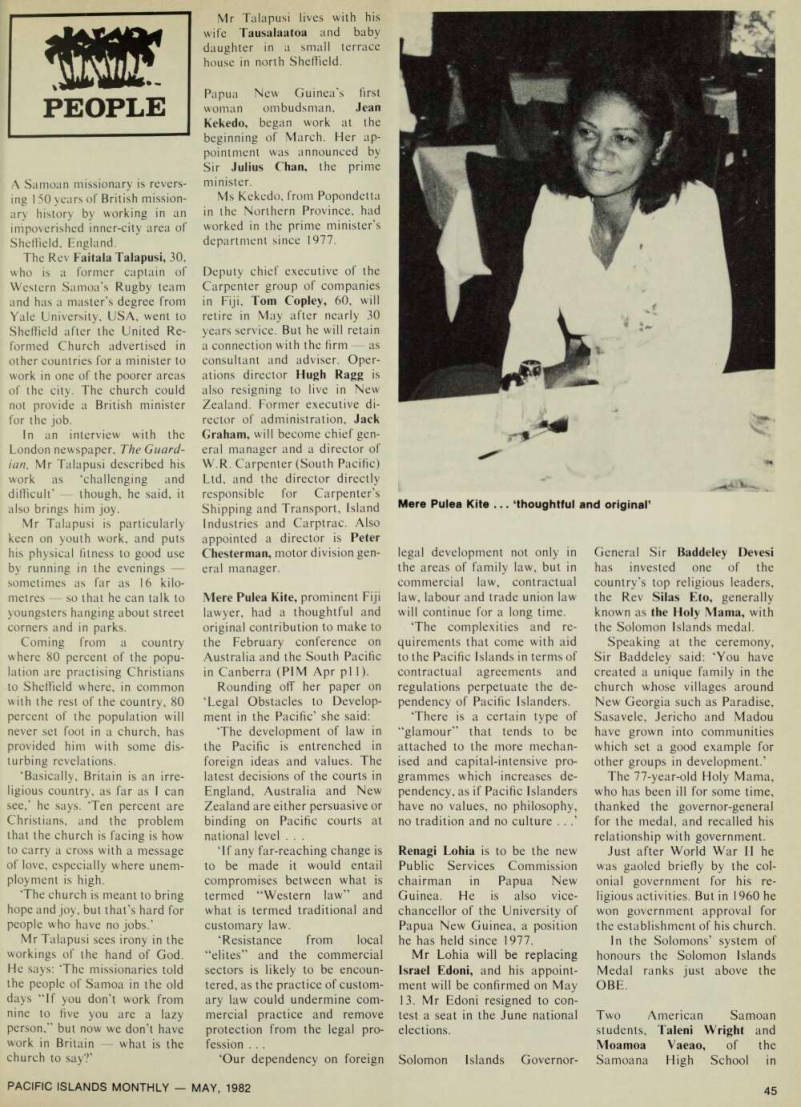
Mr Talapusi lives with his wife Tausalaatoa and baby daughter in a small terrace house in north Sheffield.
Papua New Guinea’s first woman ombudsman, Jean Kekedo, began work at the beginning of March. Her ap pointment was announced by Sir Julius Chan, the prime minister.
Ms Kekedo, from Popondclla in the Northern Province, had worked in the prime minister’s department since 1977.
Deputy chief executive of the Carpenter group of companies in Fiji, Tom Copley, 60, will retire in May after nearly 30 years service. But he will retain a connection with the firm as consultant and adviser. Oper ations director Hugh Ragg is also resigning to live in New Zealand. Former executive di rector of administration. Jack Graham, will become chief gen eral manager and a director of W.R. Carpenter (South Pacific) Ltd, and the director directly responsible for Carpenter’s Shipping and Transport, Island Industries and Carptrac. Also appointed a director is Peter Chesterman, motor division gen eral manager.
Mere Pulea Kite, prominent Fiji lawyer, had a thoughtful and original contribution to make to the February conference on Australia and the South Pacific in Canberra (PIM Apr pi 1).
Rounding off her paper on ‘Legal Obstacles to Develop ment in the Pacific’ she said: ‘The development of law in the Pacific is entrenched in foreign ideas and values. The latest decisions of the courts in England, Australia and New Zealand are either persuasive or binding on Pacific courts at national level . . . ‘lf any far-reaching change is to be made it would entail compromises between what is termed “Western law” and what is termed traditional and customary law. ‘Resistance from local “elites” and the commercial sectors is likely to be encoun tered, as the practice of custom ary law could undermine com mercial practice and remove protection from the legal pro fession . .. ‘Our dependency on foreign
A Samoan missionary is revers ing 150 years of British mission ary history by working in an impoverished inner-city area of Sheffield, England.
The Rev Faitala Talapusi, 30, who is a former captain of Western Samoa’s Rugby team and has a master’s degree from Yale University, USA, went to Sheffield after the United Re formed Church advertised in other countries for a minister to work in one of the poorer areas of the city. The church could not provide a British minister for the job.
In an interview with the London newspaper. The Guard ian, Mr Talapusi described his work as ‘challenging and difficult’ though, he said, it also brings him joy.
Mr Talapusi is particularly keen on youth work, and puts his physical fitness to good use by running in the evenings sometimes as far as 16 kilo metres so that he can talk to youngsters hanging about street corners and in parks.
Coming from a country where 80 percent of the popu lation are practising Christians to Sheffield where, in common with the rest of the country, 80 percent of the population will never set foot in a church, has provided him with some dis turbing revelations. ‘Basically, Britain is an irre ligious country, as far as I can see,’ he says. ‘Ten percent are Christians, and the problem that the church is facing is how to carry a cross with a message of love, especially where unem ployment is high. ‘The church is meant to bring hope and joy, but that’s hard for people who have no jobs.’
Mr Talapusi sees irony in the workings of the hand of God.
He says: ‘The missionaries told the people of Samoa in the old days “If you don’t work from nine to five you are a lazy person,” but now we don’t have work in Britain what is the church to say?’
legal development not only in the areas of family law, but in commercial law, contractual law, labour and trade union law will continue for a long time. ‘The complexities and re quirements that come with aid to the Pacific Islands in terms of contractual agreements and regulations perpetuate the de pendency of Pacific Islanders. ‘There is a certain type of “glamour” that tends to be attached to the more mechan ised and capital-intensive pro grammes which increases de pendency, as if Pacific Islanders have no values, no philosophy, no tradition and no culture . . .’
Renagi Lohia is to be the new Public Services Commission chairman in Papua New Guinea. He is also vice chancellor of the University of Papua New Guinea, a position he has held since 1977.
Mr Lohia will be replacing Israel Edoni, and his appoint ment will be confirmed on May 13. Mr Edoni resigned to con test a seat in the June national elections.
Solomon Islands Governor-
General Sir Baddeley Devesi has invested one of the country’s top religious leaders, the Rev Silas Eto, generally known as the Holy Mama, with the Solomon Islands medal.
Speaking at the ceremony, Sir Baddeley said: ‘You have created a unique family in the church whose villages around New Georgia such as Paradise, Sasavele, Jericho and Madou have grown into communities which set a good example for other groups in development.’
The 77-year-old Holy Mama, who has been ill for some time, thanked the governor-general for the medal, and recalled his relationship with government.
Just after World War II he was gaoled briefly by the col onial government for his re ligious activities. Butin 1960 he won government approval for the establishment of his church.
In the Solomons’ system of honours the Solomon Islands Medal ranks just above the
Qbe.
Two American Samoan students, Taleni Wright and Moamoa Vaeao, of the Samoana High School in
Mere Pulea Kite . . . ‘thoughtful and original’
American Samoa have become the first local high school students to ‘sign on’ for collegi ate football scholarships in the United States. American ‘grid iron’, like baseball, appears to be one of the main reasons why universities exist in the United States, and ability to play the game well seems as much an asset as brains when competing for a place in a university.
Wright has signed for Arizona Slate University and Vaeao for the University of Hawaii. The former played last year for ‘the Sharks’, undefeated in the American Samoa competition last year, and Vaeao was a Tep’ in the Samoan team to tour Hawaii in 1979.
Richard Dorman, 56, is the new British high commissioner in Vanuatu. He succeeds William Ashford, who has been in the job since independence on July 30, 1980. Mr Ashford is retiring from the diplomatic service on completion of his mission in Vanuatu.
Derek Butterfield left Port-Vila at the end of February after 12 years in the educational field in the New Hebrides/Vanualu. In the pre-independence period he was senior education officer in the British education depart ment, and since independence has worked as an adviser to Vanuatu’s education ministry, involved mainly with curricu lum development.
He was given a rousing send off in Port-Vila before he left with his wife Edna for their home in Britain.
Port Moresby, Papua New Guinea, lawyer John Gawi has been barred from the Ela Beach District Court by Magistrate Clement Malaisa because he told the magistrate: ‘This is the most disastrous and the most useless court in PNG. The policemen are the most incom petent and the magistrate is slack.’ A few days later, Mr Mawi appeared for a client at the National Court and was refused a hearing by the Deputy Chief Justice Mr Justice Kearney, who told him that his remarks at the Ela Beach Court would bring the courts into disrepute.
Canon Rex Davis, sub-dean of Lincoln Cathedral, England, and a tireless worker for the Foundation of the Peoples of the South Pacific, has another project underway.
It is the Matthew Flinders Room Project’, and represents an attempt by the Australian born Canon Davis to strengthen ties between his native country and his adopted home of Lincolnshire. The figure of Lincolnshire-born Flinders, the first explorer to circumnavigate Australia (1801-03), suggested itself as a highly effective sym bol of such ties.
Specifically, the plan is to refurbish an 18lh-cenlury draw ing room in the conference centre of Edward King House, in the grounds of Lincolnshire Cathedral, as a place of wel come for Australians visiting Lincoln.
The Working Group for the project, which was inaugurated in Lincoln in the presence of the London-based agents-general of the Australian stales in March, have appealed for a sum of $3BOO to meet costs of reno vation of the drawing room.
PIM readers interested in this project to honour a great Pacific (and Indian) Ocean navigator, may have further details from Canon Davis, c/o Edward King House, The Old Palace, Lincoln, LN2 IPU, England.
Karl H. Rensch of the Austra lian National University has chalked up a linguistic ‘first’ with his booklet Palalau Faka'Uvea : it is the only ac count of the Wallisian language at present on sale anywhere in the world.
He says in an introduction: ‘Wallisian is a Polynesian language spoken by 6000 people on Wallis Island and 11 000 Wallisians living in New Caledonia and Vanuatu.
Wallisian and the language of neighbouring Futuna island are so close that the two groups understand each other. ‘The first linguistic studies of Wallisian were undertaken by French missionaries, notably Monsignor Bataillon. At pres ent there is no linguistic ac count of the Wallisian tongue on sale. This little publication is
addressed to people who have contact with Wallisians, and wish to get to know their language.’
The only drawback about Mr Rensch’s effort is that the ‘teaching’ language in his book let is French. But any English speaker who has just a bit more than schoolboy/girl French would have little difficulty find ing his/her way around in it. It is a basic introduction, and employs very few French words that would be unfamiliar to anyone so equipped.
Copies of the booklet, along with a cassette recording of 24 conversations, can be had for SAIO from Archipelago Press, 7 Jelbart St, Mawson, ACT, Aus tralia 2607.
Dr Malcolm McNamara has replaced Terry Baker as New Zealand representative in Niue.
Dr McNamara’s earlier ser vice has been in Bonn and Tokyo. He goes to Niue after a time on secondment to the New Zealand ministry of defence.
A former guidance co-ordinator and careers adviser at New Zealand’s Edgewater College has been appointed to the new position of Maori and Pacific Island student adviser at Auck land University.
She is Mrs Shirley Patoka, who will provide counselling and orientation services for 600 Maori and Pacific Island students at the university, and also encourage Polynesian sec ondary school students to go on to university. She will also help to plan a marae on the campus.
Born in Auckland, Mrs Patoka graduated BA at Auck land University in education and history.
Papua New Guinea’s Minister of Finance John Kaputin is frustrated. He feels the
country’s public servants aren’t
‘performing’.
In an interview with Stuart Inder published in The Sydney Morning Herald in March, he said there were more than 5000 national public servants in the country costing K2OO million (5A263 million) a year in salaries, but asked what the country was getting for the money. T think we should look
at the departments that aren’t performing.’
Although PNG was basically an agrarian country, the depart ment of primary industry was not supplying the specialist assistance needed. Departments such as education, lands and health all needed to be ‘combed’ to see what the people in them were doing. ‘Look at it this way,’ he said to I nder. ‘We asked for indepen dence and got it. We set our own rules but we have reached the stage when the rules should be implemented I mean the constitution and our various policies. ‘lf I’m going to be beating my head against a brick wall in trying to get them im plemented, my time could be better utilised elsewhere. I could go back to help the people.’
Stuart Inder asked the once mercurial radical (he has been stripped of two portfolios, and gaoled in the course of his stormy political career) if he had ‘mellowed’.
John Kapulin didn’t think so.
He said: ‘lt would be very damaging if I accepted that premise because it means I have been sucked into the system and am not thinking any more.
What has happened, I think, is that 1 have exhausted all the people I can debate with. If I could find 100 people to raise the sort of questions we’re discussing I would be out there in the forefront.
James Ley of Wisconsin, USA, has been appointed Marshall Islands program and budget officer.
From May to December, 1981, Mr Ley worked for the government of Papua New Guinea as a loan and project manager.
Justice Russell Fox has been appointed chief judge of the Supreme court of Norfolk Island, the Australian Govern ment has announced.
Justice Fox, who is a judge of Australia’s Federal Court, will hold the new appointment in addition to his existing one. He headed the Australian Govern ment’s Ranger uranium en vironmental inquiry in 1977.
Advertisements & other items, p. 47 (1 item)
Tdon wb
Deals the
winning
hand In rat
control!
TALON WB is a world breakthrough in killing rats and mice. Developed by ICI Tasman in New Zealand talon wb is a sure way to increase profits by eliminating rat damage to CROPS!
SOLID BLOCKS Can be wired or nailed out of reach of children & animals. Easily handled - won t blow away. & $ K/n Co 73 m as so C 5 I c o 0) 900 WATERPROOF Safe year round use - will not dissolve, resists mould for extended periods.
DEADLY
Kills even the toughest rats - Including those resistant to warfarin based poisons.
EFFECTIVE
POWERFUL
Highly attractive to rats & mice - no pre-baiting Is required.
Kills more rats - a lethal dose can be consumed In a single feed. >T\ \ Do not lay baits In places accessible to children, pets and domestic animals. Wash hands and exposed skin before meals and after work. Do not store near food or feed. Burn or bury all / , rodent bodies and uneaten bait. Empty containers should not be re-used but disposed of / safely.
Iklonwß
ICQ A Product of ICI Tasman Limited P.O Box 900, Auckland, New Zealand
WARNING
/m Whatever your crops COCOA COCONUTS SUGARCANE.
RATS KILL PROFITS! NOW TALON WB KILLS RATS!
Pacific regional

France and Pacific regional security
DANIEL TARDIEU has closed his ‘Noumea Notebook’ and will henceforth share out his time between Sydney and French Polynesia as places of residence. In the article below he presents a controversial viewpoint on Australian policy towards the South Pacific, especially as it relates to New Caledonia.
The political future of the countries of the South Pacific has become a matter of active concern to Australian poli ticians, and more particularly to the Australian media.
But very few of the individ uals studying the subject ap pear to have discerned the fact that the politics of the South Pacific is characterised by a number of different trends. For example, the division between the Melanesian world, which is under Australian influence, and the Polynesians, is very real: it can for example be observed constantly at meetings of the South Pacific Commission and the South Pacific Forum.
Thus, we have the Prime Minister of the Cook Islands, Dr Sir Thomas Davis, saying that he considers ‘the French presence necessary for regional security’, and that ‘it is mean ingless to say you are opposed to nuclear testing’. The attitude of the Kingdom of Tonga is gener ally very close to that of the Cooks.
On the other hand, the pos itions of the Melanesian countries are becoming steadily more radical. Their attitudes are accompanied by acts of outright interference in the affairs of New Caledonia.
Australia is supporting Kanak socialist independence:
there is a certain contradiction in the stand adopted by Canberra officials who declare themselves in favour of New Caledonia’s independence. The independence option is not at all the one supported by the majority of the territory’s popu lation. The sole plan for inde pendence is that of the Indepen dence Front, which favours Kanak socialist independence.
Under this plan, inhabitants of New Caledonia who are not of Kanak origin will be re garded as foreigners, and al lowed to remain in the country for a period of three years.
However, these ‘foreigners’ represent more than 60 percent of the population. They include, apart from 20 000 Polynesians, Vietnamese, Indonesians, and people of mixed race, as well as Europeans, most of them from families that like Australians have been there for four or five generations.
What would happen if Kanak socialist independence were in fact declared? Such a possi bility is by no means to be ruled out in the medium term say, 1984-85. It would inevitably lead to a considerable human
exodus and in which direc tion? Naturally, to Australia.
Would Australia, looked upon for so many years with longing by New Caledonians as a land of refuge, dare to turn away men and women uprooted from their native land and forced into exile?
The programme of the main pro-independence party Union Caledonienne, recently re vealed in the Noumea weekly Corail , is a document of quite stunning naivete; it is devoid of any social or economic content.
The takeover of all land envis aged in it would drive away most farmers and cattlemen.
The economic consequences of the advent of independence in such conditions would be cata strophic, forcing the departure of all of those with the skills to keep the wheels of New Caledonia’s economy turning.
Without the financial assistance of France, at present worth SA2OO million a year, the country would sink into the direst poverty.
Advocating a policy presup poses that one has the means to carry it through.
Australia over recent years
has constantly proclaimed its desire for closer relationships with South Pacific countries. Its diplomatic and financial pres ence in the area attests to this desire, particularly in relation to South Pacific Forum and South Pacific Commission countries.. The same may be said for the recently concluded trade agreement known as SPARTECA, offering prefer ential treatment to these under-developed countries.
The 300 000 people in the French territories (French Polynesia, Wallis and Futuna, and New Caledonia) benefit from the civil expenditures of France in the South Pacific, which amount to more than SA4OO million a year. As a result their standard of living even if some people consider it artificial is very high, and simply cannot be compared with that in the independent countries. (A Melanesian policeman in Noumea gets a higher salary than Walter Lini.) As Sir Thomas Davis said recently: ‘Why throw away all these advantages and all that
security for the sake of a passport, or a seat in the UN?’
Other South Pacific countries have understood the situation.
Let us mention only the territories under American tu telage, which are very seldom talked about in Canberra: Guam, the Trust Territory, and American Samoa. Nor can one avoid mention of the countries living in Wellington’s shadow:
Niue, Tokelau and the Cooks.
It seems that an important question Australia should ask itself is whether one can remain friends with one’s neighbours if one buys nothing from them, and is concerned only with selling things to them if one engages in what might be called ‘unilateral trade’?
This in fact is the image projected at present by Austra
lia and New Zealand as well.
The freighters serving the Pacific Islands are fully loaded with goods when they leave Sydney or Auckland. But they go back empty. Vanuatu ex ports 65 percent of its produce to Europe 40 percent is taken by France and New Caledonia combined. New Caledonia ex ports nothing either to Australia or New Zealand, and yet it is a long-standing buyer from both.
Fiji is able to dispose of its surplus sugar thanks to the European Economic Com munity, and the same can be said for the Polynesian countries. Certainly the SPAR TECA is an important first step towards evening matters up.
But it won’t be tomorrow that Australia starts buying copra from Vanuatu, nickel and chro mite from New Caledonia, or sugar from Fiji.
Australia’s efforts in the fields of technical and financial aid are constantly growing. But they are not in the same league as those of France, which ‘mothers’ its brood of French Pacific territories in exactly the
A Noumea butcher’s shop owned by the Creugnet family, who have been present in New Caledonia for several generations. One bearer of the Creugnet name was a prominent supporter of the 1980 secessionist revolt on the Vanuatu island of Santo.
same way as it does the depart ments of metropolitan France.
These efforts will go on doubtless on a somewhat re duced scale should a given territory become independent.
Could Australia find the ma terial and financial means to match this kind of aid? Would it be able to absorb the thousands of families who would come seeking re f uge on its soil? After the ‘boat people’ of Indochina, will there be New Caledonian ‘boat people’ drifting off the coast of Australia?
Helping in the development of the (English-speaking) countries of the South Pacific is highly praiseworthy in itself.
But it is not enough, and, it seems, the present effort in this direction stems from a rather short-sighted and summary judgment.
Canberra must henceforth consider the effects of racially based political independence in New Caledonia, and particu larly its possible repercussions, which could well get out of control. Migration and financial aid are the first matters to be considered.
In the medium term, SPAR TECA should be extended to include other countries (with possible substantial effects on some sectors of Australian in dustry). To combat unemploy ment in the Islands, aid should be given in the planning of regional production through the export of technologies that can be assimilated in the countries concerned. There should be a serious effort to absorb food products from the Islands. This would be quite practicable in the case of crops out-of-season in Australia. During eastern Australia’s winter months, cer tain products could be obtained from sub-tropical countries.
Help should be given for the establishment of a development bank.
Military-strategic thinking has certainly developed in re cent years, but the notion of the importance of a physical pres ence in a given region retains its validity for example in terms of aid to the local populations, and maritime surveillance of economic zones. The Pacific is vast and empty.
The USSR has never suc ceeded in fully meeting the food
needs of its population. In order to cope with the shortage of protein, it has built a highly sophisticated fishing fleet, with floating factories that take thou sands of tonnes of fish out of many of the world’s oceans, but particularly in our part of the world, in the Roaring Fifties of the southern Pacific. Here they meet impossible seas, which test to the limit the endurance of both ships and crews.
Maintaining these ships and resting these crews is a very costly matter for the Soviet Union. Noumea is a port ad equately equipped to meet these needs of the Soviet fishing fleet ... Papeete too!
The French presence is necessary for regional security’
I take as my own the remark of the Cook Islands Prime Minister. Would Australia be ready to fill the military void left with the departure of 3500 members of the armed forces from Noumea, 14 000 from French Polynesia, and a fleet of patrol boats and military obser vation aircraft which keep watch over their economic zones? They are defensive mili tary means to be sure, but they are well equipped and effective.
An end to the French pres ence, which is so often de manded, would not necessarily mean an end to the under ground tests at Moruroa. This atoll is French property, having been sold to France by the Territorial Assembly of French Polynesia. It is part of French national soil. It is also an irreplaceable .source of finance for the people of French Polynesia.
The recent Canberra confer ence on Australia and the South Pacific (PIM Apr p 11) doesn’t appear to have taken note of such viewpoints as these.
It seems it is up to the conferees at similar gatherings in future to draw their infor mation from a wider spectrum of sources.
Daniel Tardieu
Advertisements & other items, pp. 48-50 (3 items)
#«;•«* : : : ;il
'' i .
V.,- '/'■ .-■ . S : ’ • , - ‘Just what we need to quiet 1 around Love I ■ H «v.
Sfe
W-.V-V
ili : “By far the quietest and most comfortable:’ im ■ “5-across seui is great.”
m ill m ‘l’m very Impressed... clean, quiet, roomy”
“Engines seem only to whisper”
■HHHI
The world’s first New Generation Jet is earning a warm welcome wherever it flies. The quotes at left are written reactions from first-time flyers on the new Super 80.
Their enthusiasm is not surprising - to us or to the 10 airlines on four continents flying the Super 80. After all, this jetliner has seats as wide as those on jumbo jets.
And four out of five seats are beside a window or on the aisle. The cabin’s extra length and concealed overhead storage racks add to the aura of spacious comfort.
Inside the cabin, engine sound is just a soft hum. Outside, the Super 80 is only half as loud during take-off and landing as comparably-sized jetliners. It’s the quietest, most fuel-efficient twinjet in service today.
Come aboard a new Super 80 the first chance you get. And discover a plane ride worth writing home about.
Super 80
Technical Manual
Letraset
Letraset wish to announce the release of their latest Technical Manual.
This edition has over three hundred pages and is an exciting view of the breadth of graphic art materials available in the Letraset range.
If you would like a copy of this 15th edition please send A 512.00 for airmail delivery or A 57.00 for seamail with the return slip shown below.
A 1 so join the Letraset
mailing list for a constant supply of information on the latest graphic art materials and typographic trends from around the world.
ĥ
France And Australia
France And Australia
Seven-nation Nauru Agreement
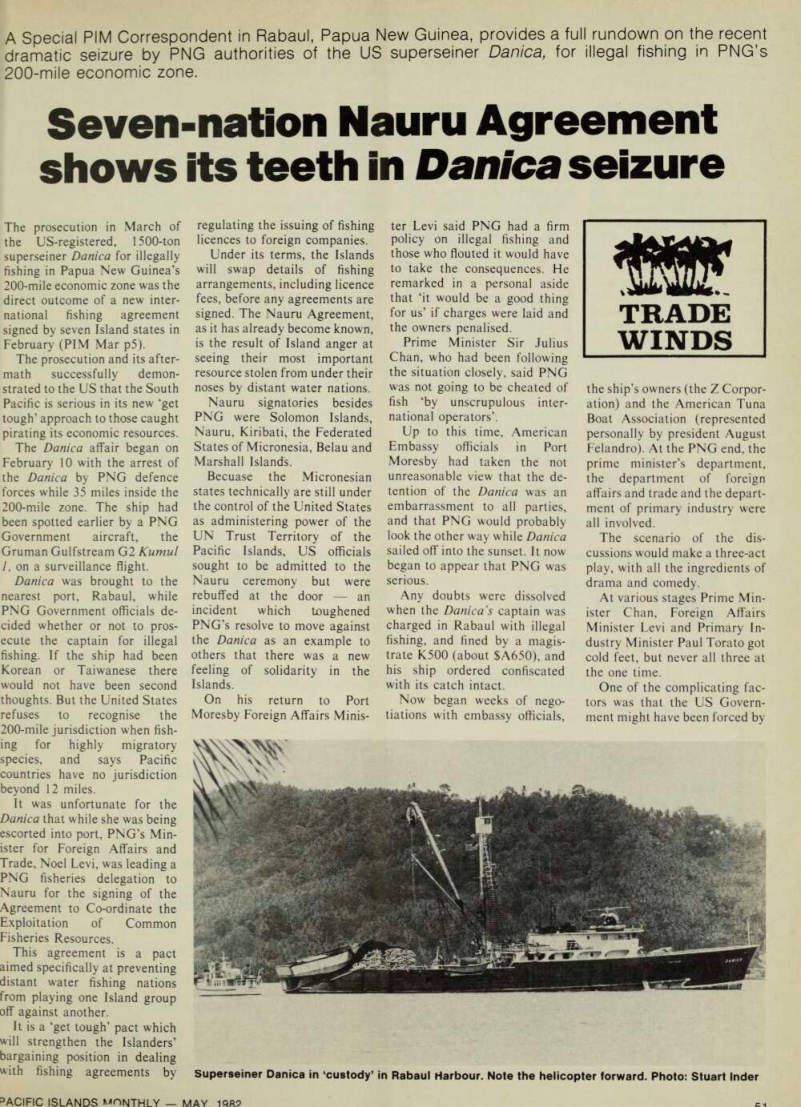

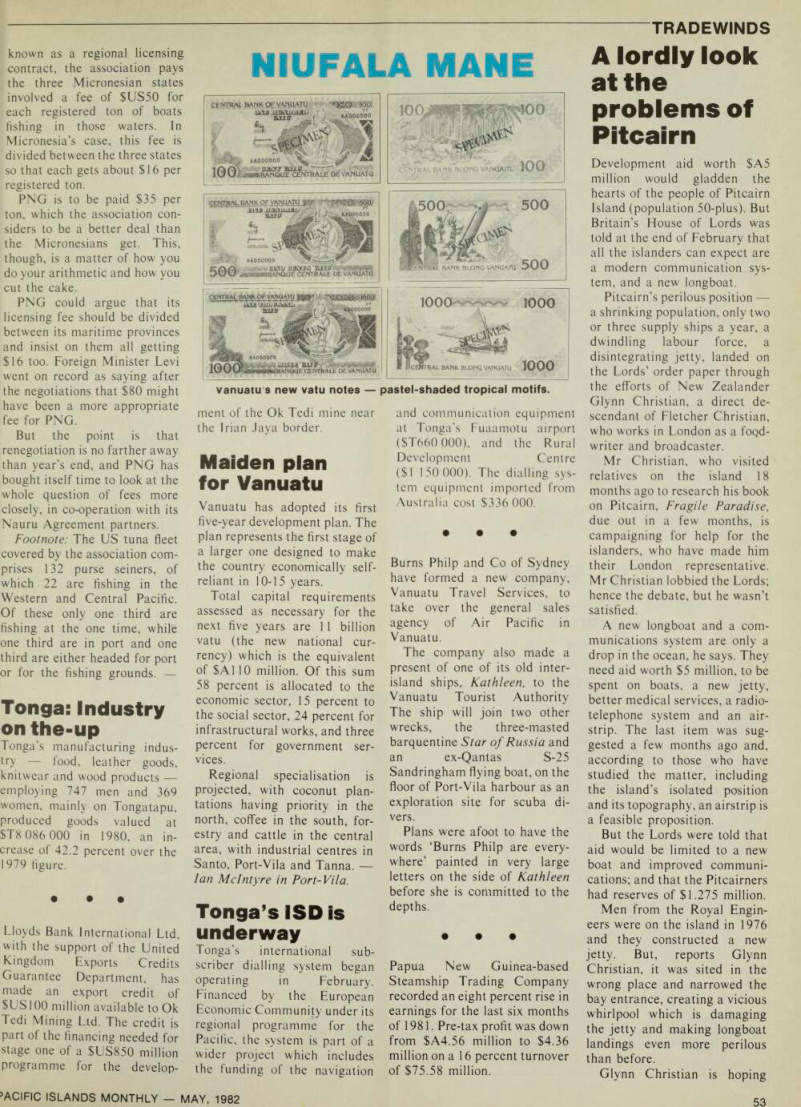
Trade
Winds
Seven-nation Nauru Agreement shows its teeth in Danica seizure
A Special PIM Correspondent in Rabaul, Papua New Guinea, provides a full rundown on the recent dramatic seizure by PNG authorities of the US superseiner Danica, for illegal fishing in PNG’s 200-mile economic zone.
The prosecution in March of the US-registered, 1500-ton superseiner Danica for illegally fishing in Papua New Guinea’s 200-mile economic zone was the direct outcome of a new inter national fishing agreement signed by seven Island states in February (PIM Mar p 5).
The prosecution and its after math successfully demon strated to the US that the South Pacific is serious in its new ‘get tough’ approach to those caught pirating its economic resources.
The Danica affair began on February 10 with the arrest of the Danica by PNG defence forces while 35 miles inside the 200-mile zone. The ship had been spotted earlier by a PNG Government aircraft, the Gruman Gulfstream G 2 Kumul I, on a surveillance flight.
Danica was brought to the nearest port, Rabaul, while PNG Government officials de cided whether or not to pros ecute the captain for illegal fishing. If the ship had been Korean or Taiwanese there would not have been second thoughts. But the United States refuses to recognise the 200-mile jurisdiction when fish ing for highly migratory species, and says Pacific countries have no jurisdiction beyond 12 miles.
It was unfortunate for the Danica that while she was being escorted into port, PNG’s Min ister for Foreign Affairs and Trade, Noel Levi, was leading a PNG fisheries delegation to Nauru for the signing of the Agreement to Co-ordinate the Exploitation of Common Fisheries Resources.
This agreement is a pact aimed specifically at preventing distant water fishing nations from playing one Island group off against another.
It is a ‘get tough’ pact which will strengthen the Islanders’ bargaining position in dealing with fishing agreements by
regulating the issuing of fishing licences to foreign companies.
Under its terms, the Islands will swap details of fishing arrangements, including licence fees, before any agreements are signed. The Nauru Agreement, as it has already become known, is the result of Island anger at seeing their most important resource stolen from under their noses by distant water nations.
Nauru signatories besides PNG were Solomon Islands, Nauru, Kiribati, the Federated States of Micronesia, Belau and Marshall Islands.
Becuase the Micronesian states technically are still under the control of the United States as administering power of the UN Trust Territory of the Pacific Islands, US officials sought to be admitted to the Nauru ceremony but were rebuffed at the door an incident which toughened PNG’s resolve to move against the Danica as an example to others that there was a new feeling of solidarity in the Islands.
On his return to Port Moresby Foreign Affairs Minis
ter Levi said PNG had a firm policy on illegal fishing and those who flouted it would have to take the consequences. He remarked in a personal aside that ‘it would be a good thing for us’ if charges were laid and the owners penalised.
Prime Minister Sir Julius Chan, who had been following the situation closely, said PNG was not going to be cheated of fish ‘by unscrupulous inter national operators’.
Up to this time, American Embassy officials in Port Moresby had taken the not unreasonable view that the de tention of the Danica was an embarrassment to all parties, and that PNG would probably look the other way while Danica sailed off into the sunset. It now began to appear that PNG was serious.
Any doubts were dissolved when the Danica's captain was charged in Rabaul with illegal fishing, and fined by a magis trate K5OO (about SA6SO), and his ship ordered confiscated with its catch intact.
Now began weeks of nego tiations with embassy officials,
the ship’s owners (the Z Corpor ation) and the American Tuna Boat Association (represented personally by president August Felandro). At the PNG end, the prime minister’s department, the department of foreign affairs and trade and the depart ment of primary industry were all involved.
The scenario of the dis cussions would make a three-act play, with all the ingredients of drama and comedy.
At various stages Prime Min ister Chan, Foreign Affairs Minister Levi and Primary In dustry Minister Paul Torato got cold feet, but never all three at the one time.
One of the complicating fac tors was that the US Govern ment might have been forced by
Superseiner Danica in ‘custody’ in Rabaul riarbour. Note the helicopter forward. Photo: Stuart Inder
rules of its own making to put an embargo on trade between PNG and the US.
Another was that the PNG Government is a four-party coalition, and there is not the Cabinet discipline that is found in many other Westminster type governments. Sir Julius couldn’t always get the act together so his Government could speak as one firm voice.
But the final result was along the lines he was aiming for.
Danica was released to its owners for K2OO 000, and the American Tuna Boat Associ ation entered into an agreement with PNG for its members to pay licence fees in future.
Sir Julius saw it as the victory it was, despite the views of the local press who considered it a ‘sell-out’ to release the Danica at a fraction of its value, and appeared to consider the licens ing agreement as a temporary, fairly hollow arrangement.
Sir Julius said the Danica affair would produce a message that should be heard ‘loud and clear at the Law of the Sea
Conference in New York’.
He said the affair had been of great service to PNG and other Pacific nations far more valuable than the release fee of K2OO 000 indicated. It showed that PNG would ‘not bow down to foreign interests, and that anybody caught poaching our fish will be prosecuted, regard less of their nationality’.
He added: ‘l’m sure the message will be received by foreign fishing companies. I am equally sure that in the not-too distant future we will look back on this episode as the turning point when PNG at last began to receive a just deal for the wealth that comes from our waters.’
This view was supported pub licly by the Australian Govern ment and by Fiji’s Prime Minis ter Ratu Sir Kamisese Mara significant support in Mara’s case because he had been a little toffee-nosed at not having been invited to sign the Nauru Agreement.
PNG’s action so close on the heels of the Nauru Agreement,
was the best advertisement the Islands could have that they do mean business.
And to underline the fact that it has every intention of follow ing through, PNG on March 11 officially opened a Surveillance Centre which will be engaged in policing PNG fishing grounds, as well as guarding the nation against smuggling and illegal immigration.
The centre is jointly operated by the department of defence, department of primary industry (fisheries division), department of transport and civil aviation (maritime division) and the bureau of customs. ‘Unlike the smaller Pacific nations,’ said Sir Julius in opening the centre, ‘PNG is fortunate to have the finances to effect some measure of deter rence. With this centre to co ordinate surveillance, we should at last be able to protect our resources effectively.”
Sir Julius made no effort to hide his delight that an inciden tal bonus of the Danica affair, which would carry over into the
Surveillance Centre’s activities, was the expanded use of the Kumul 1. His government has been under attack for wasting public funds in the purchase of the aircraft, which it uses for VIPs when commercial aircraft schedules are found to be unsat isfactory.
Kumul I was carrying mem bers of the PNG Defence Force’s operations branch when it sighted Danica , and at least three other unlicensed foreign fishing vessels the same week.
She will be used for similar operations by the Surveillance Centre.
The agreement with the Tuna Boat Association was signed on March 17 and expires on December 31 this year. This date was chosen because it is the expiry date of an earlier agreement the association has with the Micronesian states.
New agreements will thus all begin together on January 1 next.
Under the Micronesian agreement, covering an area of three million square miles, and
known as a regional licensing contract, the association pays the three Micronesian states involved a fee of SUSSO for each registered ton of boats fishing in those waters. In Micronesia’s case, this fee is divided between the three states so that each gets about $l6 per registered ton.
PNG is to be paid $35 per ton, which the association con siders to be a better deal than the Micronesians get. This, though, is a matter of how you do your arithmetic and how you cut the cake.
PNG could argue that its licensing fee should be divided between its maritime provinces and insist on them all getting $l6 too. Foreign Minister Levi went on record as saying after the negotiations that $BO might have been a more appropriate fee for PNG.
But the point is that renegotiation is no farther away than year’s end, and PNG has bought itself time to look at the whole question of fees more closely, in co-operation with its Nauru Agreement partners.
Footnote: The US tuna fleet covered by the association com prises 132 purse seiners, of which 22 are fishing in the Western and Central Pacific.
Of these only one third are fishing at the one time, while one third are in port and one third are either headed for port or for the fishing grounds.
Tonga: Industry
on the-up
Tonga’s manufacturing indus try food, leather goods, knitwear and wood products employing 747 men and 369 women, mainly on Tongalapu, produced goods valued at STB 086 000 in 1980, an in crease of 42.2 percent over the 1979 figure. • • • Lloyds Bank International Ltd, with the support of the United Kingdom Exports Credits Guarantee Department, has made an export credit of SUSIOO million available to Ok Tedi Mining Ltd. The credit is part of the financing needed for stage one of a SUSBSO million programme for the develop-
ment of the Ok Tedi mine near the Irian Jaya border.
Maiden plan
for Vanuatu
Vanuatu has adopted its first five-year development plan. The plan represents the first stage of a larger one designed to make the country economically self reliant in 10-15 years.
Total capital requirements assessed as necessary for the next five years are 11 billion vatu (the new national cur rency) which is the equivalent of $ AllO million. Of this sum 58 percent is allocated to the economic sector, 15 percent to the social sector, 24 percent for infrastructural works, and three percent for government ser vices.
Regional specialisation is projected, with coconut plan tations having priority in the north, coffee in the south, for estry and cattle in the central area, with industrial centres in Santo, Port-Vila and Tanna. lan Mclntyre in Port-Vila.
Tonga’s iSD is
underway
Tonga’s international sub scriber dialling system began operating in February.
Financed by the European Economic Community under its regional programme for the Pacific, the system is part of a wider project which includes the funding of the navigation
and communication equipment at Tonga's Fuaamolu airport (ST66O 000), and the Rural Development Centre ($1 150 000). The dialling sys tem equipment imported from Australia cost $336 000. • • • Burns Philp and Co of Sydney have formed a new company, Vanuatu Travel Services, to take over the general sales agency of Air Pacific in Vanuatu.
The company also made a present of one of its old inter island ships, Kathleen, to the Vanuatu Tourist Authority The ship will join two other wrecks, the three-masted barquentine Star of Russia and an ex-Qantas S-25 Sandringham flying boat, on the floor of Port-Vila harbour as an exploration site for scuba di vers.
Plans were afoot to have the words ‘Burns Philp are every where’ painted in very large letters on the side of Kathleen before she is committed to the depths. • • • Papua New Guinea-based Steamship Trading Company recorded an eight percent rise in earnings for the last six months of 1981. Pre-tax profit was down from $A4.56 million to $4.36 million on a 16 percent turnover of $75.58 million.
A lordly look
at the
problems of
Pitcairn
Development aid worth SAS million would gladden the hearts of the people of Pitcairn Island (population 50-plus). But Britain’s House of Lords was told at the end of February that all the islanders can expect are a modern communication sys tem, and a new longboat.
Pitcairn’s perilous position a shrinking population, only two or three supply ships a year, a dwindling labour force, a disintegrating jetty, landed on the Lords’ order paper through the efforts of New Zealander Glynn Christian, a direct de scendant of Fletcher Christian, who works in London as a foqd writer and broadcaster.
Mr Christian, who visited relatives on the island 18 months ago to research his book on Pitcairn, Fragile Paradise, due out in a few months, is campaigning for help for the islanders, who have made him their London representative.
Mr Christian lobbied the Lords; hence the debate, but he wasn’t satisfied.
A new longboat and a com munications system are only a drop in the ocean, he says. They need aid worth $5 million, to be spent on boats, a new jetty, better medical services, a radio telephone system and an air strip. The last item was sug gested a few months ago and, according to those who have studied the matter, including the island’s isolated position and its topography, an airstrip is a feasible proposition.
But the Lords were told that aid would be limited to a new boat and improved communi cations; and that the Pitcairners had reserves of $1,275 million.
Men from the Royal Engin eers were on the island in 1976 and they constructed a new jetty. But, reports Glynn Christian, it was sited in the wrong place and narrowed the bay entrance, creating a vicious whirlpool which is damaging the jetty and making longboat landings even more perilous than before.
Glynn Christian is hoping
Niufala Mane
Vanuatu's new vatu notes-pastel-shaded tropical motifs.
that help might be engineered by the New Zealand-based Vol unteer Service Abroad.
Meanwhile, a new problem has arisen for the Pitcairners. A new Nationality Bill in Britain has taken away their British passports.
They’re waiting to hear what the British Government is going to do about it; whether they will become New Zealanders, or, perhaps, Fijians in whose orbit they circled for many years, governed from an office in Suva.
Meanwhile, they are still on the list of the United Nations’
Committee of 24 as a colony needing to be independent!
SWSIOO solar
heater
A solar healer costing SWSIOO has been devised and a proto type produced by the Western Samoa-based firm Oceania Ap propriate Technology Ltd in association with the University of Samoa. Managing director Clem Hibbot described the heater as a major breakthrough for the firm, which also makes building hardboard and furni ture from coconut husks. It is intended to market the heater under the name of ‘Samosolar Collector'. • • • Two German citizens, Bruno Schwegnarn and Heinz Bauer, have opened a restaurant at Antebuka in Kiribati. They have invested SA4SO 000 in the project. Built in traditional Gilbertese style, it is modelled on the lines of the maneaba, or meeting house, and is named the Maneaba Restaurant. • • • The Pacific Area Travel Associ ation (PATA) will hold its 1982 Marketing Workshop at the Lakeside International Hotel, Canberra, Australia, from June 10-13. lan L. Kennedy, director of the association’s South Pacific regional office, expects more than 250 people to attend. • • • Solomon Islands Parliament has approved a plan to build an
airstrip at North Choiseul in the Western district. The govern ment has also agreed to write off 55632 000 of debts of $l.B million owing by provinces. The remainder will be converted to 10-year loans. • • • Work will begin in Japan about the middle of this year on two new ships which Japan is giving to the Solomon Islands as part of its aid programme. The ships, intended for inter-island traffic, will be of 105 tonnes gross with a cruising speed of seven knots. • • • The Papua New Guinea Gov ernment is hoping to produce 40 000 tonnes of white sugar a year from its sugar mill com plex which is being built at a cost of about SABS million on part of the Gusap Downs cattle ranch in southern Madang Province, about 200 kilometres from Lae. The builders are Kawasaki Heavy Industries.
The complex is expected to be ready to take the first harvest of cane in July an antici pated 11 000 tonnes and maximum capacity is expected to be attained in about four years. Two main varieties of cane are being grown at Ramu.
They are Nagnar, an old Aus tralian variety, and Q9O, a variety developed in Queens land.
About a third of the cane will be harvested by hand and 1500 people are already at work.
Technical assistance is being given by the Queensland Insti tute of Technology which is training 15 technicians to work at the Ramu plant. • • • New Zealand and Papua New Guinea have signed a memor andum of understanding under which New Zealand will con tribute SNZ2 million in capital and technical assistance to com plete the Timber Industry Training College at Lae.
Officially opened in 1979, the college is the largest project in New Zealand’s bilateral aid programme in Papua New
Guinea.
Neville Peat
Wellington.
in
Advertisements & other items, pp. 51-54 (2 items)
51
3 ACIFIC ISLANDS MONTHLY MAY IQftP
Panelex
<r
BUILDING SYSTEMS
AVAILABLE
FROM
EXPORT
AGENTS
PHONE: (02) 29
JARWIL INTERNATIONAL
Box Q 239, Queen Victoria Post Office, Sydney 2000. 410 Kent Street, Sydney,
N.S.W. 2000, AUSTRALIA.
6022 TELEX: AA72102 ATTEX
INSULATED BUILDINGS FOR COMMERCIAL & DOMESTIC PURPOSES
FREEZERS & CHILLERS
PANELEX COLD-STORES
SUITABLE FOR ALL FOOD PRODUCTS
• STRONG
• LIGHTWEIGHT
• ECONOMICALLY PRICED
• SIZES FROM 2.4 m x 2.4 m AND UPWARDS IN MULTIPLES OF 1.2 m SIZES COMPLETE
WITH PACKAGE REFRIGERATION UNITS
PREFABRICATED BUILDINGS
HOUSING & GENERAL PURPOSE
BUILDINGS FOR
• SITE OFFICES
• STORAGE
• LUNCHROOMS
• ETC
PREFABRICATED, EASY TO ERECT OR TO
TRANSPORT TO DIFFERENT LOCATIONS
LAE
:;:RORTPU*
I MORESBY
DILLINGHAM AUSTRALIA
ALOTAU
MASON SHIPPING
Agents - P.N.G. Robert Laurie PNG
PORT
MORESBY LAE
P.O. Box 10 P.O. Box 1032 Phone; 212466 Phone: 423811 Tlx: Carship 22182 Tlx: Carship 42508
CAIRNS
CAIRNS
BRISBANE
Mason Shipping Co 26A Abbott Street.
John Burke Shipping P.O. Box 509 Phone; (070) 516933 Phone; (07) 521701 Tlx: 48405 Tlx: 40483 P.O. Box 840
TOWNSVILLE
FOR SALE
Now Major Professional Re-Fit Completed
M.V. BARRENJOEY
60' Inter-Island Steel Cargo Ketch
$175,00P 00 In immaculate condition with full 12 months N.S.W., M.S.B.
Survey for Sea-going Cargo Cert. Comm. Fishing Licence. Limited Coasting, 25 pass. Harbour & Rivers, 50 pass. 64 tons light ship 60' x 17' x 7' (unladen) Cargo capacity 26 tons or 42m 3 For’d insulated hold 16m 3 Aft uninsulated 16m 3 , Freezer (-18°C) 5m 3 , Cooler (+5°C) 5m 3 .
Main engine 6 cyl. 153 hp Scania recently overhauled. Aux. power supplied by 20 kVA Perkins & 10 kVA Lister. Diesel fuel cap. 8,500 litres range approx. 1800mls at 6 knots.
Accom. 2 cabins 4 bunks, shower, toilet, galley, sep.
Ige. saloon. 24 mile Furuno Radar, TKC Auto-pilot coupled to hydraulic Palmarine steering, RDF, Sounder, SSB Radio, Mech. double drum anchor winch, Hydraulic winch to lifting derrick. For further details and inspection contact:
woe
marine
COMMERCIAL
HEAD OFFICE - 17th FLOOR
55 CLARENCE ST., SYDNEY N.S.W. 2000.
PHONE: (02) 290 3501
TELEX: 21046
PLEASURE • FISHING • SHIP AND BOAT SALES
orders) in Sydney
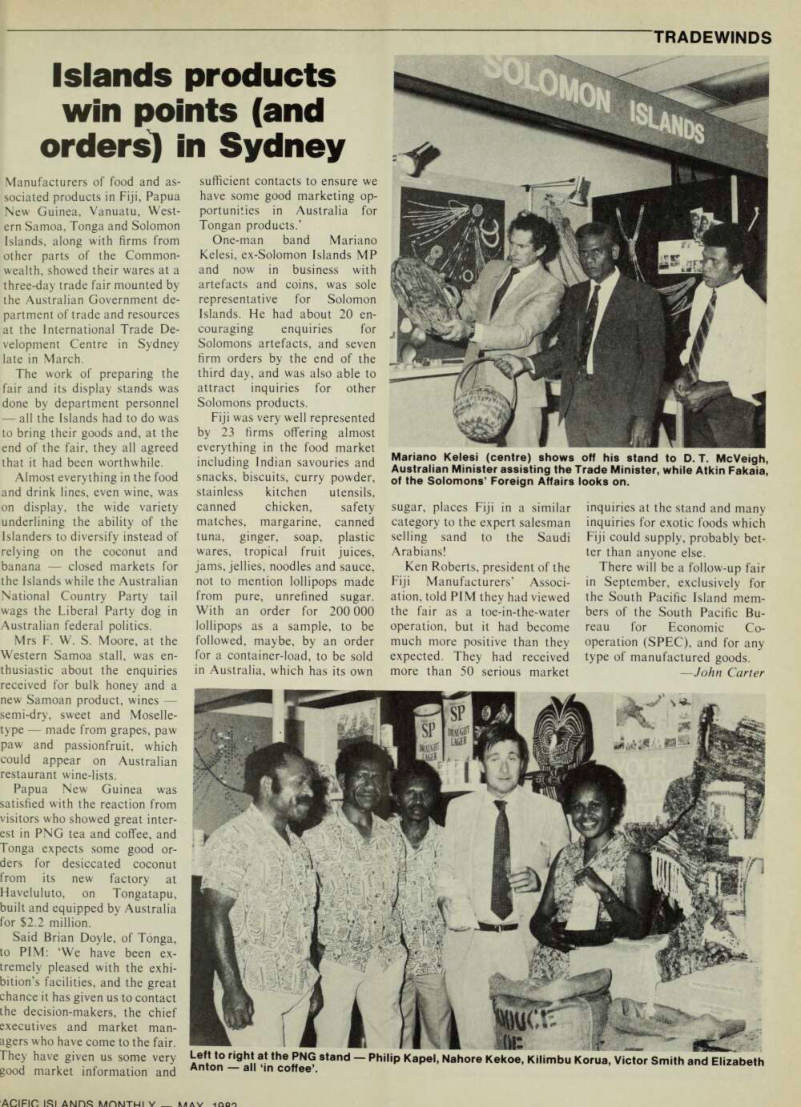
Islands products win points (and orders) in Sydney
Manufacturers of food and as sociated products in Fiji, Papua New Guinea, Vanuatu, West ern Samoa, Tonga and Solomon Islands, along with firms from other parts of the Common wealth, showed their wares at a three-day trade fair mounted by the Australian Government de partment of trade and resources at the International Trade De velopment Centre in Sydney late in March.
The work of preparing the fair and its display stands was done by department personnel all the Islands had to do was to bring their goods and, at the end of the fair, they all agreed that it had been worthwhile.
Almost everything in the food and drink lines, even wine, was on display, the wide variety underlining the ability of the Islanders to diversify instead of relying on the coconut and banana closed markets for the Islands while the Australian National Country Party tail wags the Liberal Party dog in Australian federal politics.
Mrs F. W. S. Moore, at the Western Samoa stall, was en thusiastic about the enquiries received for bulk honey and a new Samoan product, wines semi-dry, sweet and Moselle type made from grapes, paw paw and passionfruit, which could appear on Australian restaurant wine-lists.
Papua New Guinea was satisfied with the reaction from visitors who showed great inter est in PNG tea and coffee, and Tonga expects some good or ders for desiccated coconut from its new factory at
Haveluluto, on Tongatapu,
built and equipped by Australia for $2.2 million.
Said Brian Doyle, of Tonga, to PIM: ‘We have been ex tremely pleased with the exhi bition’s facilities, and the great chance it has given us to contact the decision-makers, the chief executives and market man agers who have come to the fair.
They have given us some very good market information and
sufficient contacts to ensure we have some good marketing op portunities in Australia for Tongan products.’
One-man band Mariano Kelesi, ex-Solomon Islands MP and now in business with artefacts and coins, was sole representative for Solomon Islands. He had about 20 en couraging enquiries for Solomons artefacts, and seven firm orders by the end of the third day, and was also able to attract inquiries for other Solomons products.
Fiji was very well represented by 23 firms offering almost everything in the food market including Indian savouries and snacks, biscuits, curry powder, stainless kitchen utensils, canned chicken, safety matches, margarine, canned tuna, ginger, soap, plastic wares, tropical fruit juices, jams, jellies, noodles and sauce, not to mention lollipops made from pure, unrefined sugar.
With an order for 200 000 lollipops as a sample, to be followed, maybe, by an order for a container-load, to be sold in Australia, which has its own
sugar, places Fiji in a similar category to the expert salesman selling sand to the Saudi Arabians!
Ken Roberts, president of the Fiji Manufacturers’ Associ ation, told PIM they had viewed the fair as a toe-in-the-water operation, but it had become much more positive than they expected. They had received more than 50 serious market
inquiries at the stand and many inquiries for exotic foods which Fiji could supply, probably bet ter than anyone else.
There will be a follow-up fair in September, exclusively for the South Pacific Island mem bers of the South Pacific Bu reau for Economic Co operation (SPEC), and for any type of manufactured goods.
John Carter
Mariano Kelesi (centre) shows off his stand to D. T. McVeigh, Australian Minister assisting the Trade Minister, while Atkin Fakaia, of the Solomons’ Foreign Affairs looks on.
Left to right at the PNG stand - Philip Kapel, Nahore Kekoe, Kilimbu Korua, Victor Smith and Elizabeth Anton - all ‘in coffee'.
Advertisements & other items, p. 55 (1 item)
Acific Is I Amds Momtwi V Uav Iqqo
Pacific Radio
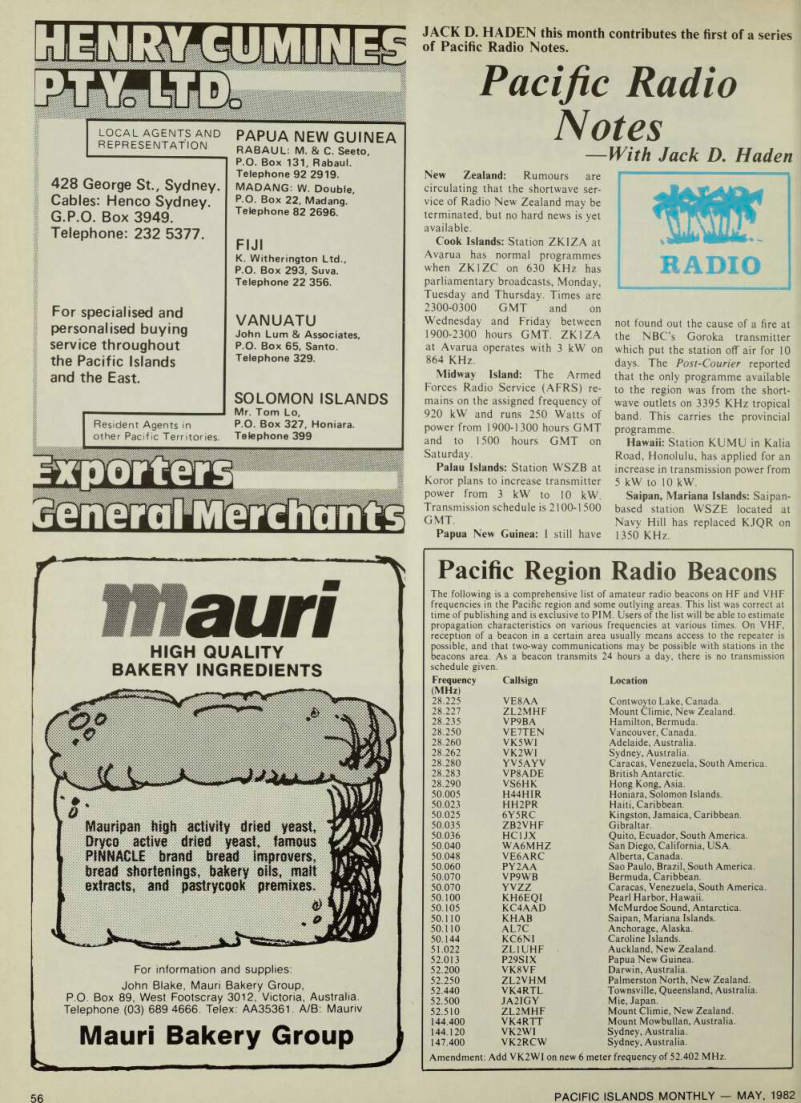
Radio
Pacific Radio Notes —With Jack D. Haden
JACK D. HADEN this month contributes the first of a series of Pacific Radio Notes.
New Zealand: Rumours are circulating that the shortwave ser vice of Radio New Zealand may be terminated, but no hard news is yet available.
Cook Islands: Station ZKIZA at Avarua has normal programmes when ZKIZC on 630 KHz has
parliamentary broadcasts, Monday,
Tuesday and Thursday. Times are 2300-0300 GMT and on
Wednesday and Friday between
1900-2300 hours GMT. ZKIZA at Avarua operates with 3 kW on 864 KHz.
Midway Island: The Armed Forces Radio Service (APRS) re mains on the assigned frequency of 920 kW and runs 250 Watts of power from 1900-1300 hours GMT and to 1500 hours GMT on Saturday.
Palau Islands: Station WSZB at Koror plans to increase transmitter power from 3 kW to 10 kW.
Transmission schedule is 2100-1500
Gmt.
Papua New Guinea: I still have
not found out the cause of a fire at the NBC’s Goroka transmitter which put the station off air for 10 days. The Post-Courier reported that the only programme available to the region was from the short wave outlets on 3395 KHz tropical band. This carries the provincial programme.
Hawaii: Station KUMU in Kalia Road, Honolulu, has applied for an increase in transmission power from 5 kW to 10 kW.
Saipan, Mariana Islands: Saipan based station WSZE located at Navy Hill has replaced KJQR on 1350 KHz.
Pacific Region Radio Beacons
The following is a comprehensive list of amateur radio beacons on HF and VHF frequencies in the Pacific region and some outlying areas. This list was correct at time of publishing and is exclusive to PIM. Users of the list will be able to estimate propagation characteristics on various frequencies at various times. On VHF, reception of a beacon in a certain area usually means access to the repeater is possible, and that two-way communications may be possible with stations in the beacons area. As a beacon transmits 24 hours a day, there is no transmission schedule given.
Amendment: Add VK2WI on new 6 meter frequency of 52.402 MHz.
Frequency (MHz) Callsign Location 28.225
Ve8Aa
Contwoyto Lake, Canada. 28.227
Zl2Mhf
Mount Climie, New Zealand. 28.235
Vp9Ba
Hamilton, Bermuda. 28.250
Ve7Ten
Vancouver, Canada. 28.260
Vk5Wi
Adelaide, Australia. 28.262
Vk2Wi
Sydney, Australia. 28.280
Yv5Ayv
Caracas, Venezuela, South America. 28.283
Vp8Ade
British Antarctic. 28.290
Vs6Hk
Hong Kong, Asia. 50.005
H44Hir
Honiara, Solomon Islands. 50.023
Hh2Pr
Haiti, Caribbean. 50.025
6Y5Rc
Kingston, Jamaica, Caribbean. 50.035
Zb2Vhf
Gibraltar. 50.036
Hc1Jx
Quito, Ecuador, South America. 50.040
Wa6Mhz
San Diego, California, USA. 50.048
Ve6Arc
Alberta, Canada. 50.060
Py2Aa
Sao Paulo, Brazil, South America. 50.070
Vp9Wb
Bermuda, Caribbean. 50.070
Yvzz
Caracas, Venezuela, South America. 50.100
Kh6Eqi
Pearl Harbor, Hawaii. 50.105
Kc4Aad
McMurdoe Sound, Antarctica. 50.110
Khab
Saipan, Mariana Islands. 50.110
Al7C
Anchorage, Alaska. 50.144
Kc6N1
Caroline Islands. 51.022
Zl1Uhf
Auckland, New Zealand. 52.013
P29Six
Papua New Guinea. 52.200
Vk8Vf
Darwin, Australia. 52.250
Zl2Vhm
Palmerston North, New Zealand. 52.440
Vk4Rtl
Townsville, Queensland, Australia. 52.500
Ja2Igy
Mie, Japan. 52.510
Zl2Mhf
Mount Climie, New Zealand. 144.400
Vk4Rtt
Mount Mowbullan, Australia. 144.120
Vk2W1
Sydney, Australia. 147.400
Vk2Rcw
Sydney, Australia.
Advertisements & other items, p. 56 (1 item)
maun
LfTOl Mil
LOCAL AGENTS AND
REPRESENTATION
428 George St., Sydney.
Cables: Henco Sydney.
G.P.O. Box 3949.
Telephone: 232 5377.
PAPUA NEW GUINEA
RABAUL: M. & C. Seeto, P.O. Box 131, Rabaul.
Telephone 92 2919.
MADANG: W. Double, P.O. Box 22, Madang.
Telephone 82 2696.
FIJI
K. Witherington Ltd., P.O. Box 293, Suva.
Telephone 22 356.
For specialised and
personalised buying
service throughout
the Pacific Islands and the East.
Resident Agents in other Pacific Territories.
VANUATU
John Lum & Associates, P.O. Box 65, Santo.
Telephone 329.
SOLOMON ISLANDS
Mr. Tom Lo, P.O. Box 327, Honiara.
Telephone 399
maun
HIGH QUALITY
BAKERY INGREDIENTS
m Mauripan high activity dried yeast, Dryco active dried yeast, famous PINNACLE brand bread improvers, bread shortenings, bakery oils, matt extracts, and pastrycook premixes. d) For information and supplies; John Blake, Mauri Bakery Group, P.O. Box 89, West Footscray 3012, Victoria, Australia.
Telephone (03) 689 4666. Telex: AA35361. A/B: Mauriv
Mauri Bakery Group
Call it Isaac or Aizake y
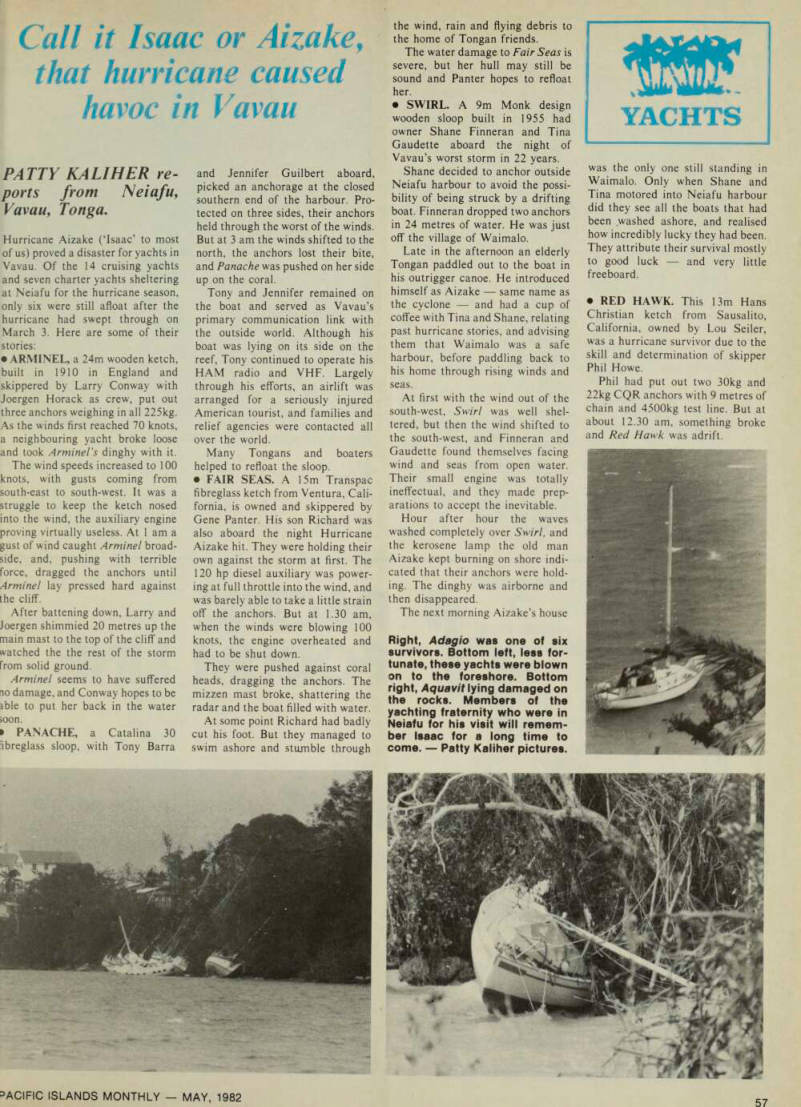
Yachts
Call it Isaac or Aizake y that hurricane caused havoc in Vavau
Patty Kaliher Re
ports from Neiafu,
Vavau, Tonga .
Hurricane Aizake (‘lsaac’ to most of us) proved a disaster for yachts in Vavau. Of the 14 cruising yachts and seven charter yachts sheltering at Neiafu for the hurricane season, only six were still afloat after the hurricane had swept through on March 3. Here are some of their stories: • ARMINEL, a 24m wooden ketch, built in 1910 in England and skippered by Larry Conway with Joergen Horack as crew, put out three anchors weighing in all 225 kg.
As the winds first reached 70 knots, a neighbouring yacht broke loose and took Arminel’s dinghy with it.
The wind speeds increased to 100 knots, with gusts coming from south-east to south-west. It was a struggle to keep the ketch nosed into the wind, the auxiliary engine proving virtually useless. At 1 am a gust of wind caught Arminel broad side, and, pushing with terrible force, dragged the anchors until Arminel lay pressed hard against the cliff.
After battening down, Larry and Joergen shimmied 20 metres up the main mast to the top of the cliff and watched the the rest of the storm from solid ground.
Arminel seems to have suffered no damage, and Conway hopes to be ible to put her back in the water >oon. • PANACHE, a Catalina 30 ibreglass sloop, with Tony Barra
and Jennifer Guilbert aboard, picked an anchorage at the closed southern end of the harbour. Pro tected on three sides, their anchors held through the worst of the winds.
But at 3 am the winds shifted to the north, the anchors lost their bite, and Panache was pushed on her side up on the coral.
Tony and Jennifer remained on the boat and served as Vavau’s primary communication link with the outside world. Although his boat was lying on its side on the reef, Tony continued to operate his HAM radio and VHF. Largely through his efforts, an airlift was arranged for a seriously injured American tourist, and families and relief agencies were contacted all over the world.
Many Tongans and boaters helped to refloat the sloop. • FAIR SEAS. A 15m Transpac fibreglass ketch from Ventura, Cali fornia, is owned and skippered by Gene Panter. His son Richard was also aboard the night Hurricane Aizake hit. They were holding their own against the storm at first. The 120 hp diesel auxiliary was power ing at full throttle into the wind, and was barely able to take a little strain off the anchors. But at 1.30 am, when the winds were blowing 100 knots, the engine overheated and had to be shut down.
They were pushed against coral heads, dragging the anchors. The mizzen mast broke, shattering the radar and the boat filled with water.
At some point Richard had badly cut his foot. But they managed to swim ashore and stumble through
the wind, rain and flying debris to the home of Tongan friends.
The water damage to Fair Seas is severe, but her hull may still be sound and Panter hopes to refloat her. • SWIRL. A 9m Monk design wooden sloop built in 1955 had owner Shane Finneran and Tina Gaudette aboard the night of Vavau’s worst storm in 22 years.
Shane decided to anchor outside Neiafu harbour to avoid the possi bility of being struck by a drifting boat. Finneran dropped two anchors in 24 metres of water. He was just off the village of Waimalo.
Late in the afternoon an elderly Tongan paddled out to the boat in his outrigger canoe. He introduced himself as Aizake same name as the cyclone and had a cup of coffee with Tina and Shane, relating past hurricane stories, and advising them that Waimalo was a safe harbour, before paddling back to his home through rising winds and seas.
At first with the wind out of the south-west, Swirl was well shel tered, but then the wind shifted to the south-west, and Finneran and Gaudette found themselves facing wind and seas from open water.
Their small engine was totally ineffectual, and they made prep arations to accept the inevitable.
Hour after hour the waves washed completely over Swirl, and the kerosene lamp the old man Aizake kept burning on shore indi cated that their anchors were hold ing. The dinghy was airborne and
then disappeared.
The next morning Aizake’s house
was the only one still standing in Waimalo. Only when Shane and Tina motored into Neiafu harbour did they see all the boats that had been washed ashore, and realised
how incredibly lucky they had been.
They attribute their survival mostly to good luck and very little freeboard. • RED HAWK. This 13m Hans Christian ketch from Sausalito, California, owned by Lou Seiler, was a hurricane survivor due to the skill and determination of skipper Phil Howe.
Phil had put out two 30kg and 22kg CQR anchors with 9 metres of chain and 4500 kg test line. But at about 12.30 am, something broke and Red Hawk was adrift.
Right, Adagio was one of six survivors. Bottom left, less for tunate, these yachts were blown on to the foreshore. Bottom right, Aquavit lying damaged on the rocks. Members of the yachting fraternity who were in Neiafu for his visit will remem ber Isaac for a long time to
come. - Patty Kaliher pictures.
Using the 100 hp auxiliary en gine, Phil made slow progress against the wind towards the middle of the harbour dodging other boats, some of which were drifting out of control towards the shore.
Howe was at the wheel, unable to see with 100 knot winds blowing spray into his eyes and waves washing over him as he steered the boat into the wind. The minute the bow fell a few degrees away from the wind direction, the entire boat would be heeled over by the force of the hurricane. The VHF radio was relaying the distress calls of other boats as they were blown onto the rocks. The dinghy, outboard and all, was spinning in mid-air and eventu ally broke loose.
Phil Howe took his bearings from lights ashore at the power plant, which was still generating although all power lines were down, and the hospital, which has its own gener ator.
By 4 am, all lights on shore had gone out, and the wind had shifted around and started to drop. Steering blind, Phil at last found himself on a fairly protected shore across from town. He grounded the boat as the tide was going out.
Later, when the sun came up and the tide came back in, Howe backed Red Hawk off the shore, and promptly ran out of fuel. He found
himself drifting rapidly down the harbour in 35-40 knot winds. He raised sails and brought Red Hawk back to his previous grounding site.
The wind kept trying to blow the boat away, so Phil swam ashore with lines which he attached to some tree trunks that happened to be still standing.
It took a long time to raise anyone on the radio, but finally a Tongan fishing boat towed Red Hawk to Neiafu, where she was refuelled and anchored.
Here, finally, is a rundown on the status of the 21 cruising and charter yachts in Vavau after Hurricane Aizake; • ADAGIO. Survived undamaged. • AQUAVIT. On the rocks. • ARMINEL. On the coral shore, attempting to refloat. • ELEFANT. On the rocks, repairs
underway.
• ELYSIUM. On the rocks, repairs
underway.
• ESETA. On the rocks, repairs
underway.
• FAIR SEAS. Sunk, attempt will be made to refloat. • KAINUI. Survived. • KIRSTEN. On the rocks and badly holed. (Kirsten is owned by Stan and Joan D. Pease. Joan is a frequent contributor to PlM’s
yachting columns).
• LEEWAY. On the rocks, attempt-
ing to refloat. • PANACHE. Was on the reef, refloated. • RED HAWK. Survived
undamaged.
• South Pacific Yacht
CHARTERS. Two survived, one was lost, and four are on the shoreline undergoing repairs. • SWIRL. Survived undamaged. • TUKILIK. On the shore and holed.
Leeway on the rocks. - Patty Kaiiher picture.
Advertisements & other items, p. 58 (2 items)
Yachts
Forum Line
PACIFIC
w ?*** “ I m i Regular and Reliable Container and Roll - ON - OFF Services
owned by the people
of the Forum Nations
MV FUA KAVENGA
MV FORUM SAMOA
MV FORUM NEW ZEALAND
With our head office in Apia, our regional offices in Suva, Auckland, and Sydney, and our network of agents, we cover the South Pacific to ensure your goods get to you or to your buyer on time.
We tranship also, to or from almost anywhere in the world.
NOMINATE PERFORMANCE: NOMINATE PFL
Agents in: Australia, New Zealand, Fiji, Tonga, Western Samoa, American Samoa, New Caledonia, Papua New Guinea, Solomon Is, Kiribati, Tuvalu, Vanuatu.
The yachting life: It
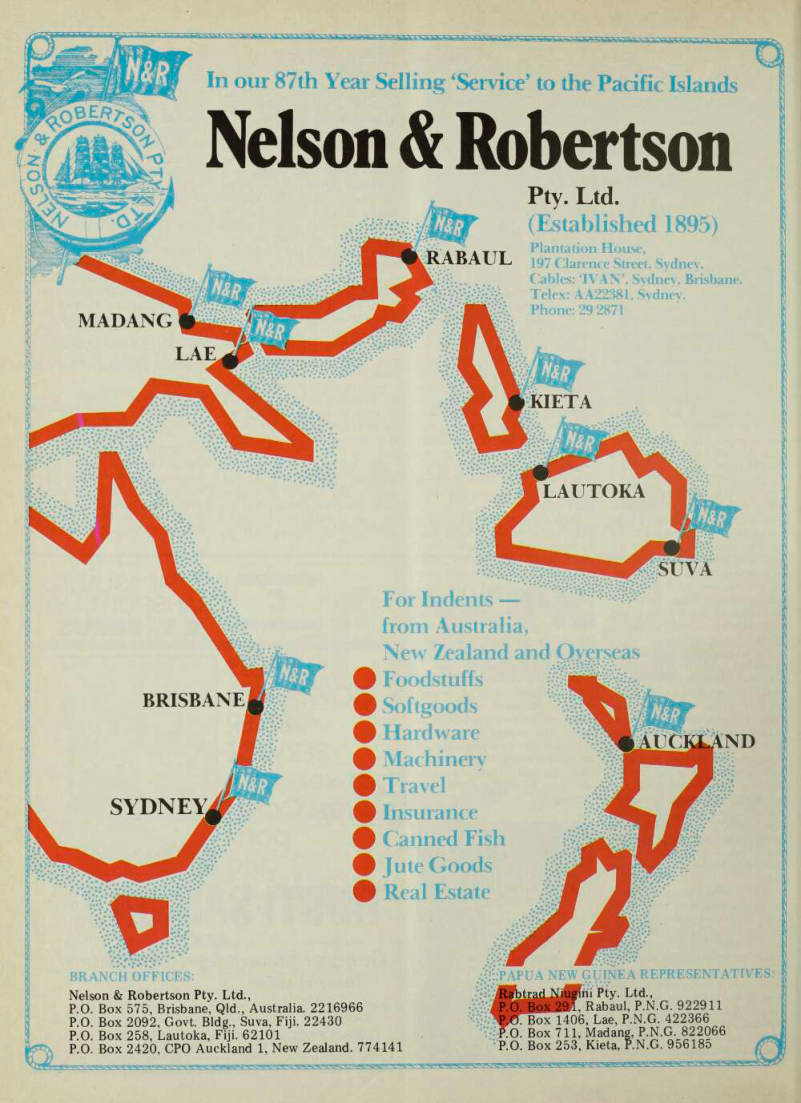
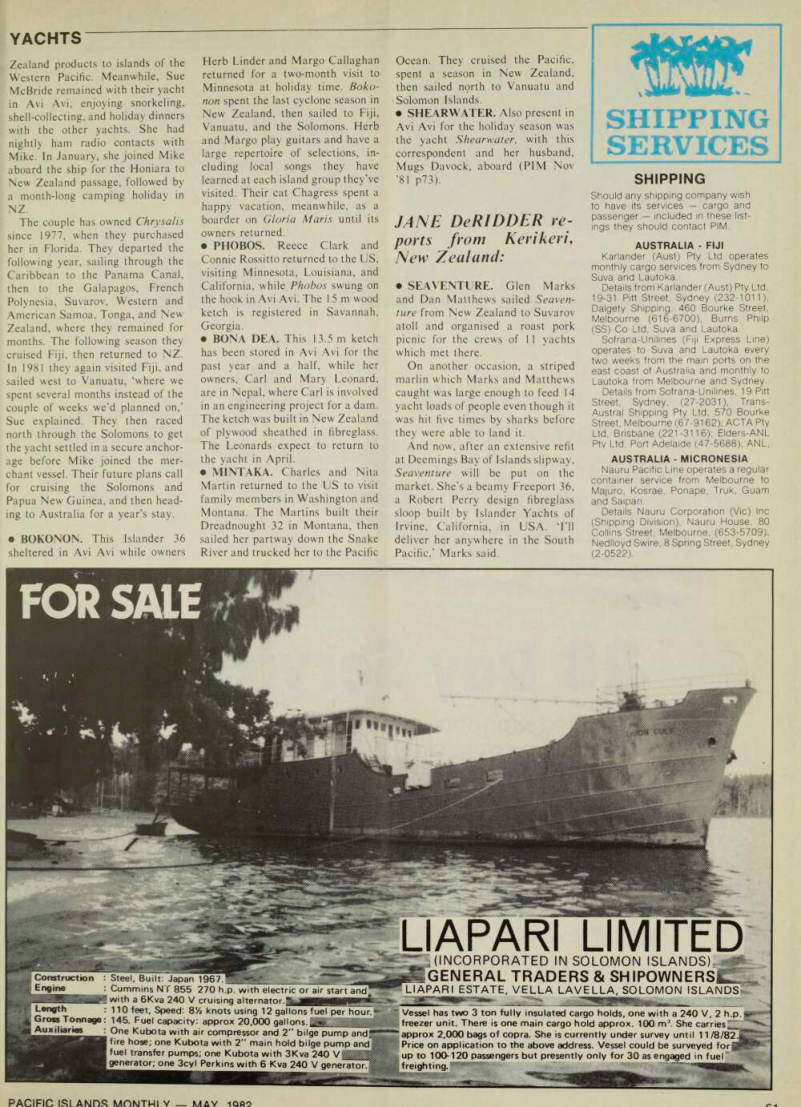
ain't all beer and skittle ...
Writing from Kerikeri, New Zealand, PIM yachting correspondent JANE DeRIDDER takes an affectionate but realistic look at the joys and the trials of the yachting life.
She concludes . . .
Flying fish and billowing sails.
Sunshine and tradewinds. Brown skinned girls. Rum punches ... The dream is pursued by countless would-be small boat voyagers who give up the rat race, the time clock, the mortgage payments, the idiot box, the lawn mower, only to tumble out of the familiar comfort of the armchair into a frantic chase for elusive values. The life’s savings that are not gobbled up by the dream yacht itself may soon be eroded by unforeseen expenses and soaring prices. Many vessels never leave the dock more than a dozen abortive times. A few never leave
the backyard.
Some dreamers, led by visions of cotton sails, caulked seams, dead eyes and baggywrinkle, spend their waking hours keeping ahead of dry rot. The idea was great but the vessel they chose was too old or too far gone to start with. Or maybe just too big. Anyhow, the leaky seams and sloshing bilges are ac companied by mildew, rust and soggy bedding and the bubble bursts.
Still other cruising hopefuls find themselves the slaves of their own electronic monsters with their in cessant demands for overhauls, parts, or just a little more juice.
These gadget-happy skippers can
seldom cut themselves free from their electrical umbilical cords A surprising number of dogged souls do manage to sail off into the unknown in monohulls and multihulls, gaff-headed schooners and tupperware sloops, stolid motor sailers and engineless cockle shells, converted lifeboats and megabuck moneytrees each secure in the knowledge that his is the only way to go.
But too many set out in untried craft with green crews, never having cruised their own waters, not realis ing that the inevitable bugs can be more readily run to earth and eradicated before leaving sheltered, familiar cruising grounds. Without so much as a trusty leadline, they have a depth sounder that they cannot always fathom. Instead of adequate anchor tackle, they have a radio to call for help.
Seasickness takes its toll. Crew members desert at each port of call
like rats leaving a sinking ship.
The hardy carry on only to be stricken with sunstroke, dysentery or ‘teak seat’. Those that survive the sun, the drinking water and the damp bathing suits may succumb to coral infections and fish poisoning, more exotic certainly, but no less
painful.
Even shipwreck is not unheard of.
But there are hundreds, who, undaunted by officialese or cockroaches, carry on to have adventurous, fascinating lives ply ing the oceans and visiting foreign shores as masters of their own vessels. Chances are these people have more than their share of energy and know-how, and don’t mind hard work.
There are those who can afford to have repairs and maintenance done by professionals, who perhaps have paid skippers deliver their boats when obligations keep them else where, or they may have their yachts shipped or trucked for portions of their trip when time runs short. There are well-equipped rac ing yachts taking part in ocean races and subsequent cruising, often with little fanfare.
Then there is that great host of salty characters often on modest budgets, sometimes working here and there to keep themselves in beans, who manage to cruise for years and thrive on the vagabond existence. Perhaps they have built their own boats. More often than not they have the ability and
knowledge as well as the tools and spares to do their their own main tenance and repairs, mechanical and electronic as well as structural if necessary. They smile to them selves when envious people say how lucky they are, for that it is not all luck they are only too well aware.
Cruising on your own boat can seldom be done too happily on a shoestring. Maybe a modest, ingeni ous person can live on next to nothing but a boat cannot. Even the simplest of yachts must be hauled regularly to have bottom anti fouled. And this is just a beginning.
The more complicated the gear, the more expensive the maintenance on a logarithmic scale. The old saying the ‘a boat is a hole in the water lined with wood into which you pour all your money’ is no less true today when the hole may well be lined with fibreglass, steel, aluminium or ferrocement.
Cruising can be fun and challeng ing. But it may not be cheap or easy.
It cannot be done successfully on a vision. It can be costly, uncomfort able, inconvenient, even frighten ing.
Our log tells of trade wind voyaging, Polynesian feasting, dancing and singing; of landing giant wahoo and hunting wild pig and goat; of diving in coral barrier reefs and of shooting surf by
moonlight; of shell leis and flower crowns, fairy terns and blue noddies; of taste sensations such as roast dog, barbecued goat, grilled bobby, raw fish, marinated octopus,
fresh-plucked pamplemousse.
But our log also reminds us sail handling in fierce doldrum squalls; of bouncing uncomfortably in surgy anchorages as a result of distant high latitude southern winter gales; of being driven aground on coral after midnight anchor drills in gusty winds and torrential rains.
Our log tells too of anxious red rimmed eyes searching out elusive atoll landfalls; of nau-nau bites, most unpleasant eruptions; and of weak, aching, tingly limbs after a case of ciguatera fish poisoning.
It ain’t all beer and skittles . ..
Marcia Davock
reports from Port-Vi la,
Vanuatu:
• CHRYSALIS. This Alberg designed 11.5 m fibreglass sloop from Corpus Christi, Texas (PIM Jul ’Bl p 65) spent most of the 1981-1982 cyclone season in the Florida Islands group of the Solomons. Owner Mike Phelps found a job for several months as second mate aboard the Captaine Cook, a 12 000-tonne merchant vessel that mainly carried New
Zealand products to islands of the Western Pacific. Meanwhile, Sue Mcßride remained with their yacht in Avi Avi, enjoying snorkeling, shell-collecting, and holiday dinners with the other yachts. She had nightly ham radio contacts with Mike. In January, she joined Mike aboard the ship for the Honiara to New Zealand passage, followed by a month-long camping holiday in NZ.
The couple has owned Chrysalis since 1977, when they purchased her in Florida. They departed the following year, sailing through the Caribbean to the Panama Canal, then to the Galapagos, French Polynesia, Suvarov, Western and American Samoa, Tonga, and New Zealand, where they remained for months. The following season they cruised Fiji, then returned to NZ.
In 1981 they again visited Fiji, and sailed west to Vanuatu, ‘where we spent several months instead of the couple of weeks we’d planned on,’
Sue explained. They then raced north through the Solomons to get the yacht settled in a secure anchor age before Mike joined the mer chant vessel. Their future plans call for cruising the Solomons and Papua New Guinea, and then head ing to Australia for a year’s stay. • BOKONON. This Islander 36 sheltered in Avi Avi while owners
Herb Linder and Margo Callaghan returned for a two-month visit to Minnesota at holiday time. Boko non spent the last cyclone season in New Zealand, then sailed to Fiji, Vanuatu, and the Solomons. Herb and Margo play guitars and have a large repertoire of selections, in cluding local songs they have learned at each island group they’ve visited. Their cat Chagress spent a happy vacation, meanwhile, as a boarder on Gloria Maris until its owners returned. • PHOBOS. Reece Clark and Connie Rossitto returned to the US, visiting Minnesota, Louisiana, and California, while Phobos swung on the hook in Avi Avi. The 15 m wood ketch is registered in Savannah, Georgia. • BONA DEA. This 13.5 m ketch has been stored in Avi Avi for the past year and a half, while her owners, Carl and Mary Leonard, are in Nepal, where Carl is involved in an engineering project for a dam.
The ketch was built in New Zealand of plywood sheathed in fibreglass.
The Leonards expect to return to the yacht in April. • MINTAKA. Charles and Nita Martin returned to the US to visit family members in Washington and Montana. The Martins built their Dreadnought 32 in Montana, then sailed her partway down the Snake River and trucked her to the Pacific
Ocean. They cruised the Pacific, spent a season in New Zealand, then sailed north to Vanuatu and Solomon Islands. • SHEARWATER. Also present in Avi Avi for the holiday season was the yacht Shearwater, with this correspondent and her husband, Mugs Davock, aboard (PIM Nov ’Bl p 73).
Jane Deridder Re
ports from Kerikeri ,
New Zealand:
• SEAVENTURE. Glen Marks and Dan Matthews sailed Seaven ture from New Zealand to Suvarov atoll and organised a roast pork picnic for the crews of 11 yachts which met there.
On another occasion, a striped marlin which Marks and Matthews caught was large enough to feed 14 yacht loads of people even though it was hit five times by sharks before they were able to land it.
And now, after an extensive refit at Deemings Bay of Islands slipway, Seaventure will be put on the market. She’s a beamy Freeport 36, a Robert Perry design fibreglass sloop built by Islander Yachts of Irvine, California, in USA. ‘l’ll deliver her anywhere in the South Pacific.’ Marks said.
Advertisements & other items, pp. 59-60 (1 item)
Tahiti Samoa Ef Co
PACIFIC ISLANDS
TRANSPORT LINE
M.V. SIRIUS
and 1 ° og> Q>
TAHITI SAMOA EF co
xoc
Qeqeral Steairfship (Corpora tiori
General Agents 400 California Street, San Francisco, CA, USA PAPEETE: Agence Maritime Internationale, Tahiti PAGO PAGO: Polynesia Shipping Services, Inc.
APIA: Burns Philp (South Sea) Company, Ltd.
PORT MO
* Right in business cel * A comfort food * All rpoms airconditioned * Restaurant * Bar * Banquet hall
i 4 .A. C. NEUMANN
t\ manager Phone 21-2622
JL sM
edi
* -0 2: o sc V • • In our 87th Year Selling ‘Service’ to the Pacific Islands
Nelson & Robertson
MADANG
RABAUL
I:?:::;:-;’.-:--:--.-::-
LAE
KIETA
••vo
Pty. Ltd.
(Established 1895)
Plantation House, 197 Clarence Street, Sydney.
Cables: ‘IVAN’, Sydney, Brisbane.
Telex: AA22381, Sydney.
Phone: 29 2871
BRISBANE
SYDNEY
LAUTOKA
... ; : *• v’./I v-; •V. •'
For Indents '
from Australia,
New Zealand and Overseas
Foodstuffs
Softgoods
Hardware
Machinery
Travel
Insurance
Canned Fish
Jute Goods
Real Estate
r SUVA
W;*:*; •* *
BRANCH OFFICES;
Nelson & Robertson Pty. Ltd., P.O. Box 575, Brisbane, Qld., Australia. 2216966 P.O. Box 2092, Govt. Bldg., Suva, Fiji. 22430 P.O. Box 258, Lautoka, Fiji. 62101 P.O. Box 2420, CPO Auckland 1, New Zealand. 774141 *»
AUC
•’V • .Vi.; w: •• •••* ND
APU A NEW GUINEA REPRESENTATIVES:
[ni Pty. Ltd., Rabaul, P.N.G. 922911 ’80x~1406, Lae, P.N.G. 422366 r .O. Box 711, Madang, P.N.G. 822066 Box P.O. Box 253, Kieta, P.N.G. 956185
Shipping
Services
Shipping
Should any shipping company wish to have its services cargo and passenger included in these list ings they should contact PIM.
Australia - Fiji
Karlander (Aust) Pty Ltd operates monthly cargo services from Sydney to Suva and Lautoka.
Details from Karlander (Aust) Pty Ltd, 19-31 Pitt Street, Sydney (232-1011), Dalgety Shipping, 460 Bourke Street, Melbourne (616-6700), Burns Philp (SS) Co Ltd, Suva and Lautoka.
Sofrana-Unilines (Fiji Express Line) operates to Suva and Lautoka every two weeks from the main ports on the east coast of Australia and monthly to Lautoka from Melbourne and Sydney.
Details from Sofrana-Unilines, 19 Pitt Street, Sydney, (27-2031), Trans- Austral Shipping Pty Ltd, 570 Bourke Street, Melbourne (67-9162); ACTA Pty Ltd, Brisbane (221-3116); Elders-ANL Pty Ltd, Port Adelaide (47-5688); ANL,
Australia - Micronesia
Nauru Pacific Line operates a regular container service from Melbourne to Majuro, Kosrae, Ponape, Truk, Guam and Saipan.
Details Nauru Corporation (Vic) Inc (Shipping Division), Nauru House, 80 Collins Street, Melbourne, (653-5709), Nedlloyd Swire, 8 Spring Street, Sydney (2-0522).
Newcastle (049-24364); Clements & Marshall, Burnie, Tasmania (31-1833); Carpenters Shipping, 100 Thomson St, Suva, Fiji (312 244), Tlx 2199 FJ.
Australia - Samoas - Tonga
Warner Pacific Lines operates a regular cargo service from Sydney to Nukualofa, Pago Pago, Apia and Asau Details from Hetherington Kingsbury Pty Ltd, 37-49 Pitt Street, Sydney, (27-1671).
Australia - New Caledonia -
Fiji - Samoas - Tonga
Pacific Forum Line operates a fully containerised service (Gen/Reefer) from Sydney to Noumea, Lautoka, Suva, Apia, Pago Pago and Nuku'alofa.
Details from Pacific Forum Line, Syd ney; Union Bulkships, Sydney and Mel bourne; SATO, Noumea; Australian National Line, Brisbane; Burns Philp (SS) Co, Lautoka, Suva and Apia; Union Co, Nuku’alofa; Polynesia Shipping Services, Pago Pago or Pacific Forum Line Head Office. Apia.
Australia - Lord Howe Is -
Norfolk Is
Compagnie des Chargeurs Caledonians operates four-weekly cargo service Sydney - Lord Howe Island and Norfolk Island.
Details: Hetherington Kingsbury Pty Ltd, 37-49 Pitt Street, Sydney (27-1671).
Australia - Kiribati
Karlander operates a 5/6 weekly ser vice from Melbourne and Sydney to Kiribati (Tarawa).
Details: Karlander (Aust) Pty Ltd, 19-31 Pitt Street, Sydney (232-1011).
Australia - Nauru -
Kiribati
Nauru Pacific Line operates regular cargo/passenger service from Mel bourne to Nauru and Tarawa.
Details: Nauru Corporation (Vic) Inc (Shipping Division), Nauru House, 80 Collins Street, Melbourne (653-5709), Nedlloyd Swire, 8 Spring Street, Sydney (2-0522).
Australia - New Caledonia
(And/Or) Vanuatu
Sofrana-Unilines ships serve Noumea every two weeks from the main ports along the east Australian coast.
Details from Sofrana-Unilines, 19 Pitt Street, Sydney (27-9851), Trans- Austral Shipping Pty Ltd, 570 Bourke Street, Melbourne (67-9162), ACTA Pty Ltd, Brisbane (221-3116), Elders-ANL Pty Ltd, Port Adelaide (47-5688), ANL, Newcastle (049-24364), Clements & Marshall, Burnie, Tasmania (31-1833), Compagnie des Chargeurs Cale doniens operates a three-weekly con tainerised cargo service from Sydney to Noumea.
Details Hetherington Kingsbury Pty Ltd, 37-49 Pitt Street, Sydney (27-1671).
Compagnie Generale Maritime operates a monthly service from Syd ney to Noumea, Port Vila and Santo, for containerised and break bulk cargo.
Details Compagnie Generale Mari time, 12 Castlereagh Street, Sydney (231-3700).
Australia - Nz - Fiji -
Hawaii - Us
P & O liners call at Auckland, Suva, Pago Pago and Honolulu on eastbound and westbound voyages between Syd ney and the US.
Details from P & O Booking Centre, World Travel Headquarters Pty Ltd, 33 Bligh Street, Sydney (231-6655).
AUSTRALIA - NZ - FIJI - TONGA -
Vanuatu - Noumea - Solomons -
Samoas - Tahiti - South East
Asia - Japan
Sitmar Cruises operates a year-round cruise programme to include most of the above countries.
Details from Sitmar Cruises, 47 Elizabeth Street, Sydney (232-7511).
“ AUSTRALIA -NZ - FIJI - TONGA
Vanuatu - Noumea - Solomons -
Samoas - Tahiti
P & O liners call at Auckland, Bay of Islands, Honiara, Lautoka, Noumea, Nuku’alofa, Pago Pago, Papeete, Port Moresby, Santo, Savusavu, Suva, Vavau and Vila on cruises from Aus tralia.
Details from P & O Booking Centre, World Travel Headquarters Pty Ltd, 33 Bligh Street, Sydney (231-6655).
Pacific Forum Line operates con tainerized and general cargo service from Australia and NZ to Fiji, Apia, Pago Pago, Tonga and other South Pacific ports.
Details from Polynesia Shipping Ser vices Inc, PO Box 1478, Paqo Paqo 96799.
Australia - New Zealand -
Pacific Islands - South East
Asia-China
Minghua Cruises operates regular cruise services from Sydney to Hawaii and most Pacific ports, with several cruises to South East Asia, including Japan, China and Hong Kong.
Details Minghua Cruises, 7 Bridge Street, Sydney, NSW 2000, Burns Philp Travel offices in Melbourne (62-0151), Brisbane (31 -0391), Darwin (81 -2871), Auckland NZ (31544); National Bank Travel in Adelaide (51-0321) and Perth (320-9365).
Australia - Tuvalu
Karlander operates a three monthly service from Sydney and Melbourne to Tuvalu (Funafuti).
Details from Karlander (Aust) Pty Ltd, 19-31 Pitt Street, Sydney (232-1011).
Australia - Png
Karlander New Guinea Line's cargo vessels call at Melbourne, Sydney, Port Moresby, Lae, Madang, Wewak, Manus, Kimbe, Rabaul, Popondetta Details from Karlander (Aust) Pty Ltd, 19-31 Pitt Street, Sydney (232-1011), Dalgety Shipping, 460 Bourke Street, Melbourne (616-6700).
Australia - Png - Solomons
A consortium of Conpac, NGAL/PNGL have three container ves sels operating on a 28 day turn-around from Melbourne, Sydney and Brisbane to Port Moresby, Lae, Rabaul, Kavieng, Wewak, Madang, Kieta and Honiara.
Details from Burns, Philp & Co. Ltd. 51 Pitt Street, Sydney (2-0547) and Interocean Swire, 8 Spring Street, Syd ney, (2-0522).
New Guinea Express Lines operates a fortnightly container service from Mel bourne, Sydney, Brisbane to Port Moresby, Lae, Alotau, Rabaul, Honiara.
Details from New Guinea Express Lines. PO Box R 73, Royal Exchange, Sydney (241-3991) MacArthur Ship ping Agency Co, 39 Creek Street, Bris bane (229-3777), New Guinea Express Lines, 327 Collins Street, Melbourne (61-3053), Niugini Express Lines, Port Moresby (21-4572), Lae (42-1536), Rabtrad Niugini Pty Ltd, Rabaul (92-2911), Alotau Stevedoring & Trans port, Alotau (61-1318) and Island Co operative Shipping Federation, Honiara (808).
Sofrana-Unilines (PNG Line) operates a monthly service to Port Moresby, Lae, Rabaul, Kieta, Honiara from main ports on the east coast of Australia.
Details from Sofrana-Unilines, 19 Pitt Street, Sydney (27-9851); Trans- Austral Shipping Pty Ltd, 570 Bourke Street, Melbourne (67-9162); ACTA Pty Ltd, Brisbane (221-3116); Elders ANL Pty Ltd, Port Adelaide (47-5688).
Australia - Tahiti
Compagnie Generale Maritime operates a monthly service from Syd ney to Papeete for containerised and break-bulk cargo.
Details Compagnie Generale Mari time, 12 Castlereagh Street, Sydney (231-3700).
Australia - Tahiti - Us
Karlander operates a monthly cargo
service from Melbourne and Sydney to Papeete, US west coast.
Details; Karlander (Aust) Pty Ltd, 19-31 Pitt Street, Sydney (232-1011).
Australia - W. Samoa
Compagnie Generale Maritime operates a monthly service from Syd ney to Apia.
Details Compagnie Generale Mari time, 12 Castlereagh Street, Sydney (231-3700).
Far East - Mid-S. Pacific
China Navigation's New Guinea Pacific Line operates a regular con tainer service from Hong Kong, Taiwan, Manila, Port Kelang and Singapore to Port Moresby, Lae, Rabaul and Honiara monthly and to Wewak, Madang and Kieta every three months. Cargo from the same Far Eastern ports to the South Pacific ports of Noumea, Santo, Vila, Papeete. Pago Pago, Apia, Rarotonga and Tarawa will be shipped via Japan on the monthly Bali Hai service.
Details from Steamships Trading Co., Port Moresby (21-2000).
Kyowa Shipping Ltd, operates monthly services from Japan to Guam, Saipan, Solomons. New Caledonia, Fiji, Western and American Samoa, Tahiti, Cook Is., Tonga and Vanuatu.
Details: Hethenngton Kingsbury Pty Ltd, 37-49 Pitt Street, Sydney (27-1671); Carpenters Shipping. Suva (312-244), Tlx FJ2199.
AUSTRALIA - NZ - TAHITI - CHILE Kapal Pacifico (KP) Pty Ltd offers a bi-monthly service from Geelong, East Australia to New Zealand ports Tauranga and Whangarei, Papeete and ports on the west coast of South America.
Details: Kapal Pacifco (KP) Pty Ltd, 4th Floor, 36 York Street, Sydney (233-8515) Tlx 71875; Beaufort Ship ping Agency Co, 2 Castlereagh Street, Sydney (239-1022); Universal Shipping
Agency, 85 Fort Street, Auckland, NZ (30-930) Tlx 21517; I B Taylor Y Cia Ltd in Chile.
Far East - Fiji - New
Zealand
New Zealand Unit Express (NZUE) operates a monthly palletised cargo service from Manila, Keelung, Kaoshiung and Hong Kong to Lautoka, Suva and thence to NZ.
Details from Carpenters Shipping, 100 Thomson Street, Suva (312-244), Tlx FJ2199, Burns Philp, Suva (311-777), P & O S.N. Co, Wellington (736-477) or Nedlloyd Swire Pty Ltd, Sydney (20-522).
Nedlloyd operates bi-weekly cargo service with four ships from Sourabaya, Jakarta, Bangkok, Port Kelang and Singapore to Suva and NZ ports.
Details from Nedlloyd (Aust) Pty Ltd, 8 Spring St, Sydney (27 3801), Burns Philp (SS) Co Ltd, Suva and Lautoka.
Japan - Fiji - New Zealand
Kyowa Shipping Co Ltd operates a monthly service from main ports of Japan to Suva and Lautoka and thence to island ports and NZ.
Details from Carpenters Shipping, 100 Thompson St, Suva (312-244), Tlx FJ2199.
Japan - Micronesia
The NYK Shipping Line operates a monthly cargo service from Japan to Micronesia, calling at Kobe, Nagoya, Yokohama, Saipan, Guam, Truk, Ponape and Majuro, returning via Kobe, Nagoya and Yokohama Details from Burns, Philp & Co Ltd, 7 Bridge Street, Sydney (2-0547).
Japan - Png
Mitsui O.S.K. Lines operates a monthly service from main ports Japan and Port Moresby, Rabaul, Lae, Madang, Kieta and Kimbe.
Details from Robert-Laurie (PNG) Pty
Ltd, Port Moresby (21-2466/ 21-1898).
New Caledonia - Fiji - West
Coast North America
PAD Line operates an approx. 3weekly ro-ro service from Noumea and Suva to Honolulu and West Coast USA and Canadian ports.
Details from Sofrana-Unilines SA, BP 1602, Noumea (27-51 -91), Tlx NMO4B; Carpenters Shipping, 100 Thomson St Suva (312-244), Tlx FJ2199.
Png - Inter - Mainport
Papua New Guinea Line offers scheduled 10/20-day coastal liner ser vices linking all PNG major ports with containerisation, reefer, heavy lift and transhipment facilities.
Details from PNG Line, Box 543, Port Moresby, PNG, (21-1174), Tlx 22269,
Png - Uk/Continent
The Bank Line operates regular cargo service from Port Moresby, Oro Bay, Kieta, Rabaul, Kimbe, Madang and Lae to Hull, Hamburg, Rotterdam, Antwerp and Le Havre.
Details from The Bank Line (A’asia) Pty Ltd, 51 Pitt Street, Sydney (27-2041); Burns Philp (PNG) Ltd, PNG ports.
Solomons - Uk/Continent
The Bank Line operates regular cargo service from Honiara to Hull, Hamburg, Rotterdam, Antwerp and Le Havre.
Details from The Bank Line (A’asia) Pty Ltd, 51 Pitt Street, Sydney (27-2041); Tradco Shipping (588).
NZ - COOK IS - NIUE -
Tahiti
Shipping Corporation of NZ Ltd operates cargo services based on pallets and similar units from Auckland to Niue, Cook Islands and Tahiti.
Details from the Shipping Corp of NZ Ltd, PO Box 3420, Auckland
(797-210), Waterfront Commission, PO Box 61, Rarotonga; Cook Islands; Niue Govt Offices, Niue Island Compagnie Maritime Polynesienne, B'P' 368, Papeete, Tahiti.
Nz - Fiji
Reef operates a regular 18-day ser vice from Auckland to Suva and Lau toka.
Details from Reef Shipping Agencies, PO Box 3382, Auckland, NZ (77-1221-3); M.V. Fijian Shipping Agencies Ltd, Private Bag, Suva, Fiji (31 1056).
Pacific Line with one ship operates fortnightly ro-ro cargo service New Zealand, Lautoka, Suva.
Details: Sofrana Unilines, 18 Cus toms Street, Auckland (773-279) PO Box 3614, Telex: NZ2313; Carpenters Shipping, 100 Thomson Street, Suva (312244), Tlx. 2199 FJ.
NZ - FIJI - NORTH AMERICA (WC) Blue Star Line Ltd Pacific Coast con tainer services. Only direct service to and from New Zealand. Blue Star ves sels call at Suva and Honolulu on NZ US-West Coast voyages.
Details from Blueport ACT (NZ) Ltd, PO Box 192, Wellington (739-029) , Burns Philp (SS) Co Ltd, GPO Box 355, Suva, Fiji (311-777). Tlx. FJ2168 Burship.
NZ - FIJI - SAMOAS - TONGA Pacific Forum Line operates a fully containerised three-weekly service (Gen/Reefer) from Auckland to Lau toka, Suva, Apia, Pago Pago and Nuku'alofa.
Details from Pacific Forum Line, Auckland; Union Co, Auckland, Lau toka, Suva, Apia and Nuku’alofa; Polynesia Shipping Services, Pago Pago or Pacific Forum Line Head Office, Apia.
Nz- Tonga -Samoas
Warner Pacific Line operates a
regular cargo service from Timaru, Onehunga and Westport to Nukualofa, Vavau and Apia with regular calls to Haapai and Pago Pago.
Details from McKay Shipping Ltd, PO Box 1372, Auckland, NZ; Warner Paci fic Line, Box 93, Nukualofa, Tonga and Neiafu, Vavau, Tonga; Polynesia Ship ping Services, Box 1478, Pago Pago,, , American Samoa 96799, and Mealelei 1 (Western Samoa) Ltd, Box 4171, Apia, W. Samoa.
NZ - N. CALEDONIA - FIJI -
Solomons - Png
Pacific Forum Line operates a fully containerised service (Gen/Reefer) from Lyttelton, Napier, Auckland to Suva, Lautoka, Honiara, Kieta, Lae and Port Moresby.
Details from Pacific Forum Line, Auckland; Shipping Corporation of NZ, Auckland, Lyttelton, Napier; Union Co, Auckland, Suva, Lautoka; Steamships Trading Co, Kieta, Lae, Port Moresby; Sullivans (SI) Ltd, Honiara or Pacific Forum Line Head Office, Apia.
NZ - N. CALEDONIA - VANUATU -
Png - Solomons
Sofrana Unilines with three ships operates to Vila and Santo, to Honiara and Papua New Guinea and to Norfolk Island and Noumea.
Details from Sofrana Unilines, 18 Customs Street. Auckland (773-279), PO Box 3614, Telex NZ2313.
Nz - Tahiti
Compagnie Tahitienne Maritime SA with one ship operates monthly service New Zealand - Papeete.
Details from Sofrana Unilines, PO Box 3614, 18 Customs St, Auckland (773-279), Tlx NZ2313.
Nz • Tonga - Samoas
Warner Pacific Line services Auckland - Nuku’alofa/Vavau/Apia/ Pago Pago fortnightly carrying general and freezer cargoes.
Details from McKay Shipping Ltd, Downtown House, 21 Queen St, Auckland, PO Box 1372 (30-299), Cables MACSHIP, Telex NZ2554; Warner Pacific Line, Box 93, Nukualofa, Tonga; Mealelei (Western Samoa) Ltd, Box 4171, Apia, Western Samoa; Polynesia Shipping Services, Box 1478, Pago Pago, American Samoa, 96799.
Nz - Central Pacific
Kyowa Shipping Ltd operates a monthly cargo service from Auckland and Mt Maunganui to Noumea, Vila, Santo, Guam, Majuro, Nauru and Tarawa.
Details from McKay Shipping Ltd, PO Box 1372, Auckland (9-30229); Tlx 2554 NZ.
Europe - Tahiti -
New Caledonia
Compagnie Generate Maritime operates services from Europe and Mediterranean ports to Papeete and Noumea using three ro-ro and multi purpose vessels thus ensuring a bi monthly sailing to and from.
Details Compagnie Generate Mari time, 12 Castlereagh Street, Sydney (231-3700).
Europe - Tahiti - New
Caledonia - New Zealand -
Solomons - Png - Europe
Polish Ocean Lines offers regular monthly sailings for containerised and breakbulk cargo from Hamburg, Ant werp, Dunkirk and Rouen to Papeete, Noumea, New Zealand, Honiara, Lae, returning to Europe via Suez. Other ports in the South Pacific can be served with inducement.
Details from Sotama, BP 9170, Papeete (27805), Tlx. 296; SATO, BP C 2, Noumea (272094), Tlx. 163 NM SATO; Union Steamship Co of NZ, PO Box 50, Apia, Tlx. 25; Williams and Gosling, PO Box 79, Suva (312633), Tlx. 2163; Warner Pacific Line, PO Box 93, Nukualofa (21089), Tlx. 66219; Universal Shipping Agencies, PO Box 2282, Auckland (30930), Tlx. 21517,
EUROPE - TAHITI - W. SAMOA -
Fiji - N. Caledonia
Nedlloyd offers regular cargo ser ' vices from Northern Europe and UK to Papeete, Apia, Fiji and New Caledonia.
Details Nedlloyd (Aust) Pty Ltd, 8 Spring Street, Sydney (27-3801); Car penters. Shipping, 100 Thomson St, Suva (312 244), Tlx 2199 FJ, EUROPE - TAHITI - W. SAMOA - TONGA - FIJI - SOLOMONS - PNG -
Vanuatu
Columbus Line Reederei GMBH operates regular services from Ham burg, Hull, Rotterdam, Antwerp, Dunkirk, Le Havre, to Papeete, Apia, Suva, Lautoka, Noumea, Port Moresby, Lae, Honiara, Kieta, Rabaul, Lae, and return to Europe.
Details from Columbus Overseas Services Pty Ltd, 333 George Street, Sydney (290-2966), Columbus Mari time Services, 17 Albert Street, Auckland (77-3460); Carpenters Ship ping, 100 Thomson St, Suva (312 244), Tlx 2199 FJ.
Uk - N. Continent - Fiji
The Bank Line operates a regular cargo service from Hull, Hamburg, Bremen, Antwerp, Rotterdam and Le Havre to Suva and Lautoka.
Details from The Bank Line (A’asia) Pty Ltd, 51 Pitt Street, Sydney (27-2041); Burns Philp (South Sea) Co Ltd, Suva and Lautoka.
Uk/N. Continent - Png -
Solomons
The Bank Line operates a regular cargo service from Hull, Hamburg, Bremen, Antwerp, Rotterdam and Le Havre to Port Moresby, Lae, Madang, Kimbe, Rabaul, Kieta and Honiara and on inducement to Yandina.
Details from The Bank Line (A’asia) Pty Ltd, 51 Pitt Street, Sydney (27-2041); Burns Philp (PNG) Ltd, PNG ports; Tradco Shipping (588).
Uk/N. Continent - Tahiti -
N. Caledonia
The Bank Line operates a regular cargo service from Hull, Hamburg, Bremen, Antwerp, Rotterdam and Le Havre to Papeete and Noumea.
Details from The Bank Line (A'asia) Pty Ltd, 51 Pitt Street, Sydney (27-2041); Ets A M Fare UTE, Papeete; Ets Ballande, Noumea.
US - FIJI - TAHITI - NZ -
Australia
The Bank Savill Line Ltd, operates regular cargo services from US Gulf ports to Australia and NZ. Calls at Suva, Lautoka and Papeete on demand.
Details from The Bank and Savill Line Ltd, 51 Pitt Street, Sydney (27-2041) or Orient Shipping Services, 32 Bridge Street, Sydney (241-2753).
Us - Hawaii - Kiribati -
Micronesia
Philippines, Micronesia & Orient Navigation Co (PM&O Lines) operates regular container service on self sustained ship with ro-ro capabilities from Oakland, Portland and Honolulu to Tarawa, Ebeye, Majuro, Kosrae, Ponape, Truk, Saipan, Yap and Koror.
Details for Micronesia can be obtained from Larry Guerrero, PM&O Owners Rep, PO Box 803, Saipan, Ml 96950, Cable COMMONTIME, Tlx 783605; PM80; PM&O Lines, 181 Fremont St. San Francisco, California 94105, Cable PMONAV.
Us - Hawaii - Nauru -
Micronesia
Nauru Pacific Line operates regular conventional/container and passenger service from San Francisco and Honolulu to Majuro, Ponape, Truk and Saipan. Cargo is accepted for Nauru and Kosrai with transhipment at Majuro and Ponape.
Details from Nauru Corporation (Vic) Inc (Shipping Division), Nauru House, 80 Collins Street. Melbourne
•(653-5709); North American Maritime Agencies, 100 California St., San Fran cisco, California 9411
Us - Noumea - Fiji
PAD Line operates an approx 3-weekly roro service from West Coast USA and Canada to Noumea and Suva.
Details from Sofrana-Unilines SA, BP 1602, Noumea (27-51 -91), Tlx NMO4B; Carpenters Shipping, 100 Thomson St, Suva (31-2244), Tlx FJ2199; Trans- Austral Shipping, Box R 232 PC, Royal Exchange, NSW (27-2441), Tlx AA21204.
Us - Tahiti - Samoa
Pacific Islands Transport operates a five weekly cargo service from North America west coast ports to Papeete, Pago Pago, Apia.
Details from Polynesia Shipping Ser vices Inc, PO Box 1478 Pago Pago 96799.
Polynesia Line operates container and general cargo service from US west coast ports to Papeete and Pago Pago, Details from Polynesia Shipping Ser vices Inc., PO Box 1478, Pago Pago 96799.
Advertisements & other items, pp. 61-64 (2 items)
Yachts
61
PACIFIC ISLANDS MONTI-11 Y MAY IQftO
For Sale
|r» m Construction : Steel, Built: Japan Cummins NT 855 270 h.p. with electric or air start and! [with a 6Kva 240 V cruising alternator. 110 feet. Speed: 814 knots using 12 gallons fuel per hourj Gross Tonnage : 145. Fuel capacity: approx 20,000 gallons.!
Auxiliaries : One Kubota with air compressor and 2" bilge pump and| Bfire hose; one Kubota with 2" main hold bilge pump and| I fuel transfer pumps; one Kubota with 3Kva 240 M\ I generator; one 3cyl Perkins with 6 Kva 240 V generator.
LIAPARI LIMITED
% (INCORPORATED IN SOLOMON ISLANDS).
GENERAL TRADERS & SHIPOWNERS!
SOLOMON ISLANDS*
LIAPARI ESTATE, VELLA LAVELLA,
Vessel has two 3 ton fully insulated cargo holds, one with a 240 V, 2 h.p.
I freezer unit. There is one main cargo hold approx. 100 m 3. She carries! ’approx 2,000 bags of copra. She is currently under survey until 11 /8/82.
I Price on application to the above address. Vessel could be surveyed for| |up to 100-120 passengers but presently only for 30 as engaged in fuel I freighting.
I
THE
LINE
28 Day Service
United Kingdom and Continent to:
PAPEETE • NOUMEA
PAPUA NEW GUINEA and SOLOMON ISLANDS
PORT VILA & SANTO BY TRANSHIPMENT
* United Kingdom and Continent to: SUVA AND LAUTOKA (FCL LCL & UNITISED ONLY) * Papua New Guinea and Solomon Islands to:
UNITED KINGDOM and CONTINENT
For particulars apply:
THE BANK LINE (AUSTRALASIA) PTY. LTD.
18th Floor 1 York Street SYDNEY NSW 2000 Australia Tel: 272041 Telex: 24063 2.
ITftb
< i u
Only our Dragon Boat
visits more ports,
more often,
in the South Pacific.
The New Guinea Pacific Line offers the quality handling you're used to, through its exclusive containerised service to Papua New Guinea and the Solomon Islands.
Rely on us all the way. • Fast transit times to all ports. • A guaranteed schedule every 30 days, thanks to berths in Papua New Guinea and Honiara reserved for N.G.P.L. use. • Safe, secure transport of goods in containers both L.C.L., and F.C.L. no more damage or pilferage of cargo. • A wide coverage of all ports with the monthly container service from Hong Kong, Singapore, Taiwan, the Philippines, Malaysia and Bangkok to all Papua New Guinea ports and Honiara.
For further details on our reliable Dragon Boat service contact:
PAPUA NEW GUINEA
Steamship Trading Co., Ltd.
Port Moresby Telephone: 212000
NEW GUINEA
PACIFIC UNE
HONG KONG
Swire Shipping (Agencies) Ltd.
Telephone: 5-264311
SINGAPORE §
Straits Shipping Pte. Ltd.
Telephone: 436071 §
To: Solomon Is.. New Caledonia. Fiji. W. Samoa, A. Samoa, Tahiti. Cook Is., Tonga, Vanuatu, Tuvalu, Nauru To: Guam, Saipan. Truk, Ponape, Majuro, Yap, Koror To: Papua New Guinea, Pacific Islands.
KYOWA SHIPPING CO., LTD.
HEAD OFFICE:
sth FI., Suzumaru Bldg. 39-8, 2-chome, Nishi-Shinbashi, Minato-ku, Tokyo, Japan.
Phone; 03(437)2885(Rep.) Cables; “MARIQUEEN" Tokyo. Telex: 242-4651 Kyowa J.
OSAKA OFFICE:
Okajima Bldg., 7th Floor, 2-14, Nishihonmachi 1-chome, Nishi-ku, Osaka, Japan Phone; 06(533)5821 (Rep.) Cables: “MARIQUEEN" Osaka Telex: 525-6271 Ssjosa J. i I A f
AGENTS
S. Korea: Dong Sue Shipping Co., Ltd., Seoul Taiwan: Royal Steamship Corp., Ltd., Taipei Hong Kong: Dahzun Enterprises Ltd.
Singapore; Ocean Shipping & Enterprises Pte.. Ltd.
Philippines: Sky International Inc., Manila Guam; Maritime Agencies of the Pacific Ltd., Guam Saipan: Saipan Shipping Company Inc., Saipan Truk; Truk Shipping Co., Truk Ponape: United Micronesia Development Association, Ponape Yap: Waab Transportation Co., Inc., Yap Koror: United Micronesia Development Association, Koror Solomon Is: Solomon Taiyo Ltd., Honiara Vanuatu: Pentecost Pacific S.A., Port Vila New Caledonia: Agence Maritime Du Rond Point Du Pacific, Noumea Fiji: Carpenter Shipping, Suva & Lautoka A. Samoa; Polynesia Shipping, Services, Inc.. Pago Pago W. Samoa; Morris Hedstrom Ltd., Apia Tahiti: Compagnie Tahitienne Maritime S.A.. Papeete Cooks: Eastern Associates Ltd.. Rarotonga Tonga: E.M. Jones Ltd.. Nukualofa Rabaul; Carpenters Shipping Ltd., Rabaul Port Moresby: J.C. Waller Pty. Ltd., Port Moresby Lae: Robert Laurie (New GuJnea) Pty. Ltd., Lae Indonesia: P.T. Porbdisa J Raya Shipping Lines. Jakarta Australia; Hetherington Kingsbury Pty. Ltd., Sydney. N.S.W.
New Zealand; Mckay Shipping Limited, Auckland Nauru: Nauru Cooperative Society., Nauru
Deaths
of Islands People
Dr Gabriel Gris In Rarotonga on March 12, aged 40.
Dr Gris, director of the South Pacific Bureau for Economic Co-operation (SPEC), died sud denly while attending a confer ence on the environment.
A colleague and friend, J.D.
Speake, formerly regional den tal health officer, Papua, and dental public health officer, South Pacific Commission, writes in tribute: I first met Gabriel at a conference at what was then, in 1968, the Administrative Col lege in Waigani. At the time, he was the administration dentist in Mount Hagen. The most striking thing about him was his quiet yet confident bearing. He did not speak often, or loudly, or apparently with great force, and yet, when he did say something, there was no doubt that people listened.
It is perhaps indicative of his lifestyle that he was not even able to stay to the end of that conference. Arrangements had already been made for him to undertake a study tour of sev eral months in Southeast Asia, and he left after only a couple of days.
We next met about two years later and worked together for a few months before he had to leave Papua New Guinea’s tropic climes for the rigours of Michigan’s Ann Arbor in win ter. Eighteen months later he was back in Port Moresby complete with a master’s degree and, for a time, headed the then territory’s Dental Service. But he was soon asked to apply his
talents in the sphere of higher education.
The last time I saw him, just over a year ago, was at another conference, this time in Suva, his home base as director of the South Pacific Bureau for Econ omic Co-operation, a post he had taken up in 1980. Although clearly hard-pressed, he man aged to find time to spend a few hours with his former col leagues, not only in his official capacity at the opening cere mony, but also to make a significant contribution to the technical session that followed.
Few of us who were there will forget his masterly summary, combining as it did his abiding interest in health and his broad experience as an administrator.
If there is consolation to be derived at this time, it is that he lived his all too short life to the full, contributing much and achieving a great deal. From an outer island in the Manus group, he qualified as a dental practitioner at the Fiji School of Medicine, obtained a higher degree from a major American University, was the first Papua New Guinean vice-chancellor of the University of PNG, headed a government depart ment (decentralisation), and di rected an inter-governmental international organisation.
It seems highly likely that his very positive contributions in these diverse areas took their toll, most obviously on his health, but also in terms of the personal and family sacrifices which such a busy life entails.
Nonetheless, he was an excel lent husband and father. His loss is shared not only by his friends and colleagues, by PNG and by the South Pacific, but most particularly by Sarah and his children, and, to them, we extend our sympathy.
Dr Leonard Goodman In Sydney in March, aged 74.
Dr Leonard Goodman,
Frcs (Ed.), Mrcs (Eng.),
LRCP (Lond.), D.Obst. RCDG (Eng.), had already had a ca reer with the British colonial service in Africa before begin ning a new phase of his life in the South Pacific in 1959.
His work in the Pacific spanned 13 years, first as sur geon specialist for Western Samoa with the South Pacific Health Service until 1965, then as chief tutor in surgery at the
Fiji School of Medicine until his retirement at the end of 1972.
Born in London, he joined the colonial medical service in 1938, and for the next 14 years held various posts in the Gold Coast as medical officer, pathol ogist, surgeon specialist, obste trician and gynaecologist. He was, for a time, surgeon special ist in Aden.
Following his retirement from Pacific service, Dr Good man and his wife, Alys, re turned to England, but after so many years in the tropics they found life there unsatisfactory, and bought an apartment in Sydney where they lived quietly until Dr Goodman was struck down by cancer of the spine at the end of last year. He chose to remain at home, but meanwhile Alys suffered a heart attack and was in hospital when her hus band died.
Leonard Goodman was a well-loved surgeon, a gentleman of the old school, courteous, dedicated and highly ac complished in a number of spheres in addition to medicine.
He was a violinist, singer and lover of fine music, an artist of note, author, photographer, and radio and electronics buff.
While very ill, he struggled successfully to complete the preparation of the last of a series of historic photographs he had taken of African tribes more than 40 years ago, and which he had been progress ively sending at his own expense to the Bodleian Library at Oxford. The library’s letter of thanks arrived shortly after his death.
Reviews of Samoan and Fiji literature from his graceful pen frequently appeared in PIM, together with his balanced and constructive commentaries on
the Pacific medical scene. A new generation of young medi cal and health officers benefited from his instruction at the Fiji School of Medicine, and his name will remain a significant one in the school’s history.
S.I.
Leslie Francis Gill At Brighton Beach, Victoria, Australia, in March, aged 95.
Born in Melbourne, Leslie Gill went to the Western Solomon Islands in 1911. After a period as plantation manager, he became a planter and trader and acquired several plan tations, setting up trade stores in the area of Vella Lavella, Gizo and Munda. He was active in setting up the Planters’ and Settlers’ Association and in the production of its newspaper, The Planters’ Gazette. He was also involved in the formation of the Advisory Council and was an active member over the years.
During World War II much of his property was destroyed and he was recruited by the US Navy Intelligence Service as a lieutenant. After the war he returned to the Western Solomons and remained there until failing eyesight forced him to return to Melbourne in 1958.
For his services to the ad vancement of both the local people and white settlers, Francis Gill received a Coron ation Medal in 1953 and a little later the MBE.
Richard Patrick McFall In Apia, in February, aged 62.
Richard McFall worked in the Western Samoa public ser vice for 38 years, retiring from his job as postmaster in 1974.
He was the manager of the Tiafau Hotel with his wife Bessie.
Advertisements & other items, p. 65 (1 item)
65
PACIFIC ISLANDS MONTHI Y MAY IQ ft?
Advertisers Index
Air Vanuatu 21 Aiwa 27 Amatil 31 Asia Seafood Co 66 Asia Tonga Trading 66 Bankline 62 Carptrac 24 China Navigation 63 Clarion Shoji 2 Dept of Trade 10 General Steamship 59 Goodyear 16 Healing Cycles 36 Henry Cumines 56 Hinchcliffe, Colin 66
Ici 47
Jarwil International 52 Kyowa Shipping 64 Letraset Aust 30 Liapari Ltd 61
Mbt 56
Mason Shipping 54 Matsushita 12 McDonnell Douglas 48 National Marine 54 Nelson & Robertson6o NZ Dairy Board 67 NZ Police 19 Pacific Forum Line 58 Papua Hotel 59 Pioneer 68 QBE Insurance 40 Sonar Ship 66 Suzuki Motor Co 8 Toyota 34 Trio Kenwood 22 Tropical Reef 16 Victor 4 Video Recorder 66
Advertisements & other items, pp. 66-68 (1 item)
Maps and Prints of
BUYING OR SELLING
LIST WITH US FOR:
COMMERCIAL SHIPS
FISHING VESSELS
YACHTS
TRAWLERS
WORK BOATS
Sonar Ships Brokerage
BOX 1811 CAIRNS. OLD.
AUSTRALIA
PH: (070) 515371
Mi Produce *
: “ %e «f i ' rerf
i FISH MAW,
SHARK FINS, etc.
For details please write to:
ASIA SEAFOOD Co.
353 A Circuit Rd., Block 64, Republic of Singapore 1337. *■ Cable: Seawave
REQUIRE
DRIED SHARK FINS
FOR PRICES AND
INFORMATION ETC.,
PLEASE WRITE TO:
S. DADDOW,
ASIA TONGA TRADING,
7 KASAI ROAD,
REPUBLIC OF SINGAPORE,
2880.
CABLE: "ASIATONGA"
SONY
VIDEO RECORDERS
VIDEO MOVIES
VIDEO ACCESSORIES
JVC
AKAI
m
IMTEPCAPE- VIDEO RECORDER CEIMTRE
19-21 Lonsdale Street. Melbourne, Victoria 3000 Telephone: 103) 633 086, 633 196 V
KP-5020PSE KP-7220PSE
Maps and Prints of
The Old Pacific
New catalogue listing a large stock of original antiquarian views and maps of Australia, New Zealand, Papua New Guinea and all island groups of the Pacific now available.
Write today for your free copy.
COLIN HINCHCLIFFE
7, Royd avenue. Heckmondwike. West Yorkshire.
United Kingdom. WFI6 9AL.
Anchor
Instant
KIM
POW
ilk
'A OEH
; a
MIS
pwruai , anchor
ANCHOR
*• l-Z mm . (■I imBBSn *W?«rvS ■ Vi Jf - f H ■ IB i
NEW
ZEALAND
DAIRY
BOARD
Anchor - premium quality dairy produce, packed with all the goodness of the finest pasture in the world. i Fresh to you from the world s number one dairy
producer, New Zealand Dairy Board.
i Enquiries to: PO Box 417 Wellington, New Zealand
Telex: NZ3348 DAPMARK
Telephone: 724-399
/V -/ € c. ✓ n tewowia MR WWiih e a 9 Bii.<‘ Only Pioneer’s tremendous range of audio expertise could give you so great a combination of advanced technology and stylish design. The new Personna Music Systems...the truly personal approach to fit any corner of your life.
The RX-70 Personna Cassette Receiver Sharp styling plus solid audio engineering. Full-logic cassette deck, digital FM/AM tuner and powerful stereo amp—all very easy to use and easier still to enjoy.
O RX-70
CD PIONEER
For further information, please contact: Australia: Pioneer Marketing Services Pty. Ltd., P.O. Box 317. Mordialloc. Victoria, 3195 Tel; 90-9011 Fiji Islands: Brijlal & Company, G.P.O. Box No. 362, Suva, Fiji Islands Tel: 22258 New Zealand: Monaco Distributors Ltd., 2 Poland Road. Glenfield, Auckland.
New Zealand Tel: (09) 444-9144 Norfolk Island: Burns Philp (Norfolk Island) Ltd., P.O. Box 21. Norfolk Island, New Hebrides: Burns Philp (New Hebrides) Ltd.. Vila. New Hebrides The MX-80 Personna Cassette Disc Receiver Total stereo system capability is at your fingertips with Auto Function Switching. Turntable, cassette deck, FM/AM tuner and stereo amp—all in a single high-tech unit.
The S-9 Personna Shelf Components Sleek matching units with an individual outlook and Auto Function Switching. Includes separate digital synthesized FM/AM tuner with programmable timer, a full-logic cassette deck, a fully automatic turntable and a stereo amp.
Personna from Pioneer. Now, stereo systems as personal as your music.
S-9 Nauru Island: Jacob Enterprises, P.O. Box No. 4, Republic of Nauru Tahiti: Tahiti Hi-Fi, P.O. Box 848, Papeete, Tahiti New Caledonia: Menard Pacifique Sari, B.P 3899. Noumea, New Caledonia Tel; 48*24*36 American Samoa: Transpac Corporation, P.O. Box 1477, Pago Pago, American Samoa 96799 Tel: 633-5224 , , , T Rarotonga: South Seas International Ltd.. P.O. Box 49. Rarotonga, Cook Islands Tel. 2327 Papua New Guinea: Bali Merchants Pty. Ltd., P.O. Box 6103, Boroko Tel: 254887