Pacific

Islands
Monthly
I—a
American Samoa US$l.75 Australia *A$l.5O Cook Islands NZ$l.5O Fiji F 51.50 Hawaii US$l.95 Kiribati A 51.75 Nauru A 51.75 New Caledonia CFPI9O New Zealand NZ$2.OO Niue NZ$l.5O Norfolk Island A 51.50 Papua New Guinea K 1.50 Solomons 551.50 Tahiti CFPI9O Tonga P 1.50 Tuvalu —A$l.75
Usa U 552.25
USTT & Guam US$l.95 Vanuatu A 51.50 Western Samoa T 1.95 * Recommended retail price only.
Registered by Australia Post Publication No. NBPI2IO
(Q)l /Mm) OiOVAXiid©© ==
Lcmb ©Ini ‘Metamismi
I3Iiini^Ds®I&Ini©I1 9
Tikopia: ‘The Viry
K Last Paradise...’
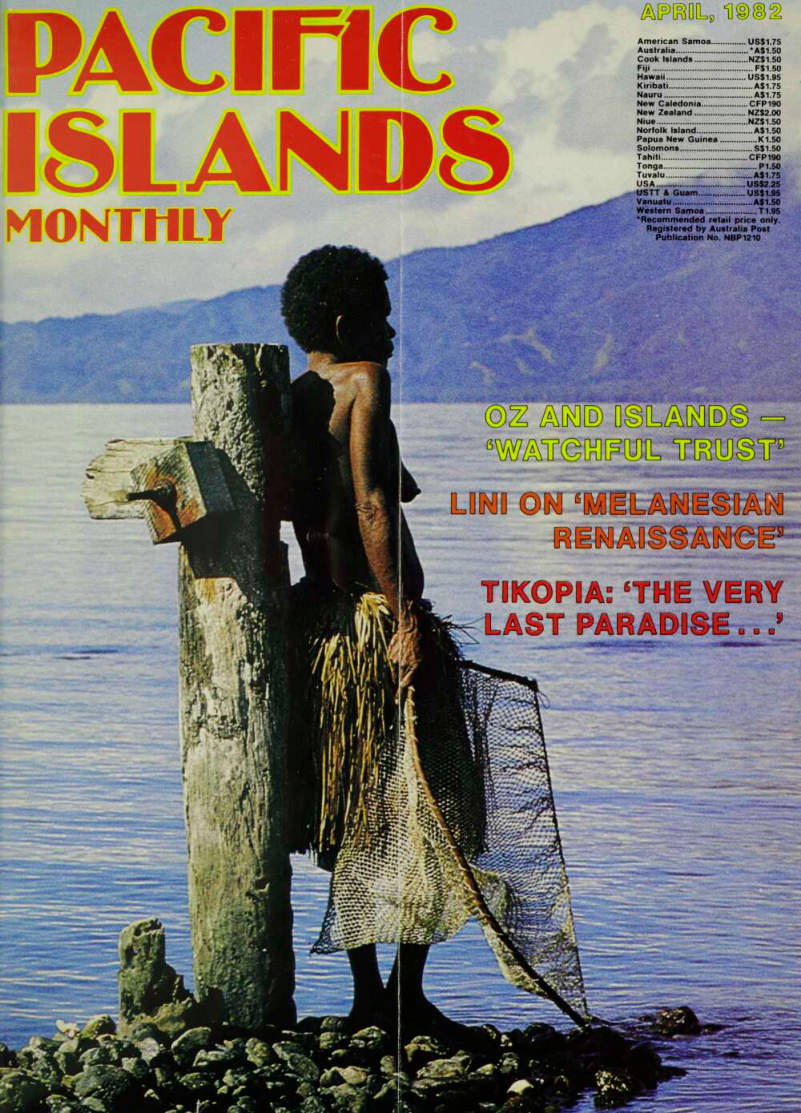
Cover picture: Waiting for sardines, Milne Bay Province, Papua New Guinea. Alan Weeks picture.
Advertisements & other items, p. 2 (1 item)
A symphony by nature.
% -i L ■ ■ m I mm \ si V-.ii as II x ---.
TO® > “ : . & \ . V.uf&foi ?W .• * i' WfcjA' .'S'‘VV ,• • A<‘.' •- ..V. i “ v ” **' - ...
Prelude in name only.
A symphony by nature.
The new Honda Prelude is a car that dreams are made of. The car with all the value features you’ve always wanted: power, performance, and style, plus traditional Honda driving economy.
Over-sized bumpers with recessed side and turn indicators not only look smart, but combine safety with classic appearance.
Inside, surfaces are carefully color coordinated and finished in smooth, 5 cut-pile carpeting. Even the doors have the same luxurious carpet trim. And an smoked Prelude’s m .. me same luxurious carpet tnr V ' V Metric sunroof with elegant w glass further emphasizes the already stunning looks.
Options include Hondamatic transmission with overdrive, an exclusive Honda power steering system, and sporty alloy wheels.
Prelude and symphony.
By Honda.
10NDA MOTOR CO., LTD. TOKYO, JAPAN
PAPUA NEW GUINEA: Steamships-Machinery P.O. Box 1, Port Moresby/TAHITI: Honda Distribution S.A.R.L. BP 1665 Papeete/FIJI ISLANDS: Carpenters Motors 61-63 Foster St., Walu Bay, Suva/KIRIBATI: Atoll Auto Stores PO. Box 71, Bairiki Tarawa/U.S. TRUST TERRITORY: United Micronesia Development Assn. P.O. Box 238, Saipan, Mariana Islands 96950/COOK ISLANDS! Cook Islands Motor Center Ltd. P.O. Box 74, Rarotonga/AMERICAN SAMOA: Holiday Motors, Parts and Service PO. Box 968, Pago Pago Haleck’s Service Center P.O. Box 1138, Pago Pago/GUAM: Mark’s Motor Co., Inc. P.O. Box DV. Agana/WESTERN SAMOA: Motor Distributors (Samoa) Ltd. P.O. Box 576, Apia/SOLOMON ISLANDS: Trading Company (Solomon) Ltd. P.O. Box 114, Honiara/NEW CALEDONIA: Establissements Ballande Boite Postale No. C 4, Noumea Cedex/ NIUE ISLAND: Niue Island United Enterprises P.O. Box 4, Alofi/NAURU: Nauru Cooperative Society Republic of Nai u, Nauru Island. Central Pacific/VANUATU: Santo Gas Centre Ltd. P.O. Box 45, Santo/TUVALU: Tuvalu Co-operative Wholesale Society P.O. Box Funafuti. Tuvalu/TONGA: Morris Hedstrom Ltd. P.O. Box 63, Nukualofa Tonga.
Pacific Islands Monthly
Vol. 53 No. 4
April 1982
(Usps 952480)
Representatives
AUSTRALIA: Distribution: NSW & ACT: Allan Rodney Wright (Circulation) Pty Ltd. PO Box 907, Darlinghurst, NSW 2010 Elsewhere: Gordon & Gotch (A/asia) Ltd, Box 40.
PO, Rosebery, NSW 2018 Advertising Melbourne Brown Orr Fletcher Burrows Pty Ltd, 614 Queensberry St, North Melbourne 3051, telephone 329 8522, telex 31717, Brisbane D. Wood, Anday Agency, Box 1918, GPO, Bris bane 4001, telephone 44 3485, 44 1546, Adelaide Hast well Media, PO Box 30, Glen Osmond. SA 5064, 23 Avenue Road. Frewville, SA 5063. telex 87113 Perth - Adrep, 62 Wickham St., East Perth, WA 6000, telephone 325 6395.
FIJI: Distribution and subscriptions Desai Bookshops, PO Box 160, Suva. Fiji, telephone Suva 23036 Advertising Fiji Times & Herald Ltd, 20 Gordon St, Suva, telephone 312 111, telex FJ2124.
FRENCH POLYNESIA: Distribution Hachette Pacifique, 10 Ave Bruat, Papeete, telephone 25610 HAWAII, UNITED STATES; Distribution PIM, Hawaii. PO Box 22250, Honolulu, Hawaii 96822 Advertising Roger Brookes, PO Box 10217. Honolulu, Hawaii 96816, telephone 808 536 6677 JAPAN: Advertising and subscriptions Universal Media Corporation, GPO Box 1762, Tokyo, telephone 666 3036.
NEW CALEDONIA: Distribution Depot Centre de Presse Michel Pentecost, CBP2, Noumea, telephone 27 2434 27 4729 NEW ZEALAND: Distribution Gordon & Gotch, PO Box 584, 2 Carr Road, Mt Roskill, Auckland 4 Advertising - International Media Representatives Ltd, PO Box 2313.
Auckland, telephone 795 487; 493 389, cables Intereps.
Auckland. Subscriptions Ross Haines & Son Ltd. PO Box 1289. Auckland, telephone 769 042 PAPUA NEW GUINEA: Distribution Gordon & Gotch, PO Box 3395, Port Moresby, telephone 254551, 254855 Advertising - PNG Post-Courier, PO Box 85, Port Moresby, telephone 21 2577 UNITED KINGDOM; The Herald & Weekly Times Ltd, No 1 Maltravers Street, London WC2R 3DZ, England, telephone 01 836 5162, telex London 21989 UNITED STATES MAINLAND: Advertising Joshua B Powers Jr, Powers International Inc , 551 Fifth Ave, New York, New York 10 017, telephone 867 9580, telex 236514 Subscriptions - PIM, Hawaii, PO Box 22250, Honolulu, Hawaii 96822
Subscriptions
PIM is airfreighted to most subscribers and agents in the Pacific Islands and the United States, but not the UK or the Continent.
Payments by personal cheque are only acceptable in Aus tralian (from a branch in Australia), US and New Zealand currency. For all other remittances please send an inter national bank draft in Australian dollars.
Published monthly by Pacific Publications (Aust.) Pty Ltd and printed in Australia by Paramac, Alexandria, NSW Aus tralian cover price is recommended retail only Registered by Australia Post, publication No NBPI2IO. Second class postage paid at Honolulu, Hawaii Copyright c Pacific Publications (Aust.) Pty Ltd Postmaster Honolulu: Send address changes to PIM Hawaii, PO Box 22250, Honolulu Hawaii 96822,
Local Aust.
American Samoa $US21 $18 Australia $A18 $18 Canada $US27 $25 Cook Islands $19 Fiji $18 French Polynesia $22 Guam $US23 $20 Hawaii $US23 $20 Japan $20 Kiribati $19 Micronesia $US23 $20 Nauru $21 New Caledonia $22 New Zealand
Snz24
$18 Niue $19 Norfolk Island $15 Northern Marianas $US23 $20 Papua New Guinea $23 Solomon Islands $19 Tonga $19 Tuvalu $19 United Kingdom Stg 15 $25 US Mainland
Sus27
$25 Vanuatu $19 Western Samoa $18 Elsewhere $A25
The Month
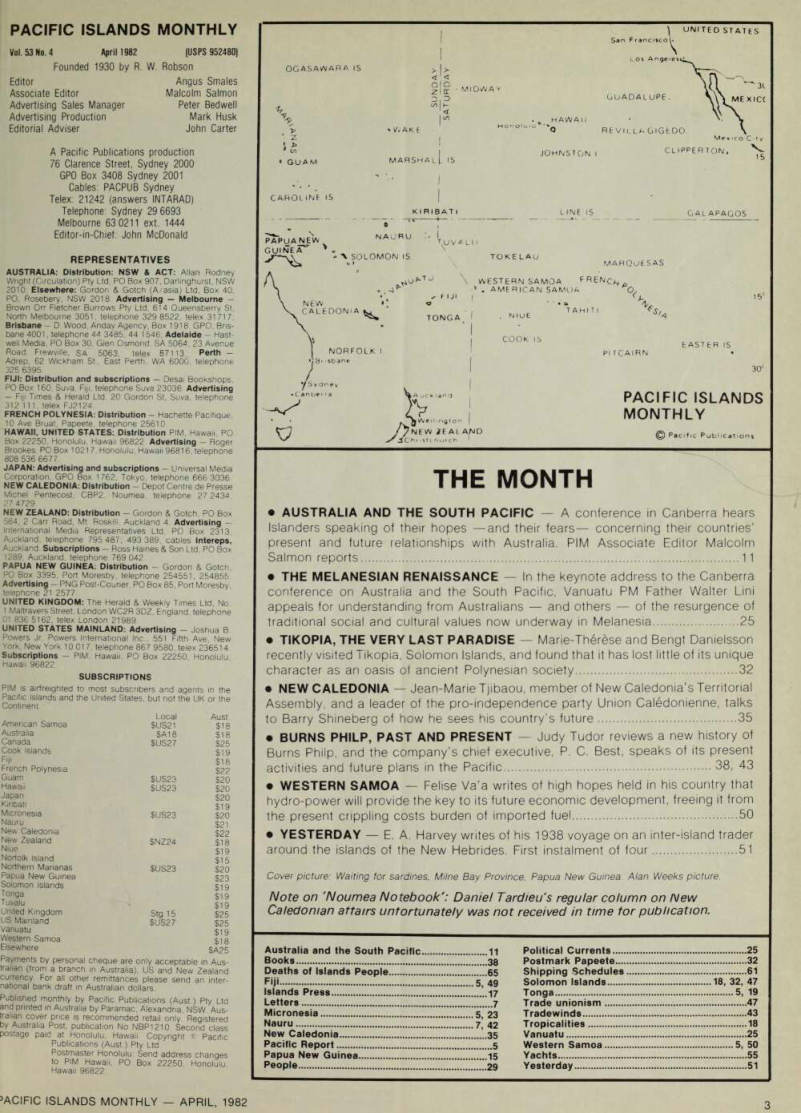
• AUSTRALIA AND THE SOUTH PACIFIC A conference in Canberra hears Islanders speaking of their hopes —and their fears — concerning their countries’ present and future relationships with Australia. PIM Associate Editor Malcolm Salmon reports 11 • THE MELANESIAN RENAISSANCE In the keynote address to the Canberra conference on Australia and the South Pacific, Vanuatu PM Father Walter Lini appeals for understanding from Australians and others of the resurgence of traditional social and cultural values now underway in Melanesia 25 • TIKOPIA, THE VERY LAST PARADISE Marie-Therese and Bengt Danielsson recently visited Tikopia, Solomon Islands, and found that it has lost little of its unique character as an oasis of ancient Polynesian society 32 • NEW CALEDONIA Jean-Marie Tjibaou, member of New Caledonia’s Territorial Assembly, and a leader of the pro-independence party Union Caledonienne, talks to Barry Shineberg of how he sees his country’s future 35 • BURNS PHILP, PAST AND PRESENT Judy Tudor reviews a new history of Burns Philp, and the company’s chief executive, P. C. Best, speaks of its present activities and future plans in the Pacific 38, 43 • WESTERN SAMOA Felise Va’a writes of high hopes held in his country that hydro-power will provide the key to its future economic development, freeing it from the present crippling costs burden of imported fuel 50 • YESTERDAY E. A. Harvey writes of his 1938 voyage on an inter-island trader around the islands of the New Hebrides. First instalment of four 51
Note on 'Noumea Notebook': Daniel Tardieu's regular column on New Caledonian affairs unfortunately was not received in time tor publication.
Australia and the South Pacific 11 Books 38 Deaths of Islands People 65 Fiji 5, 49 Islands Press 17 Letters 7 Micronesia 5, 23 Nauru 7, 42 New Caledonia ’.35 Pacific Report 5 Papua New Guinea 15 People 29
Political Currents 25 Postmark Papeete 32 Shipping Schedules 61 Solomon Islands 18, 32, 47 Tonga 5, 19 Trade unionism 47 Tradewinds 43 Tropicalities 18 Vanuatu 25 Western Samoa 5, 50 Yachts 55 Yesterday 51
Advertisements & other items, pp. 3-4 (2 items)
3
S ACIFIC ISLANDS MONTHLY APRIL, 1982
Founded 1930 by R. W. Robson Editor Angus Smales Associate Editor Malcolm Salmon Advertising Sales Manager Peter Bedwell Advertising Production Mark Husk Editorial Adviser John Carter A Pacific Publications production 76 Clarence Street, Sydney 2000 GPO Box 3408 Sydney 2001 Cables; PACPUB Sydney Telex. 21242 (answers INTARAD) Telephone: Sydney 29 6693 Melbourne 63 0211 ext. 1444 Editor-in-Chief; John McDonald
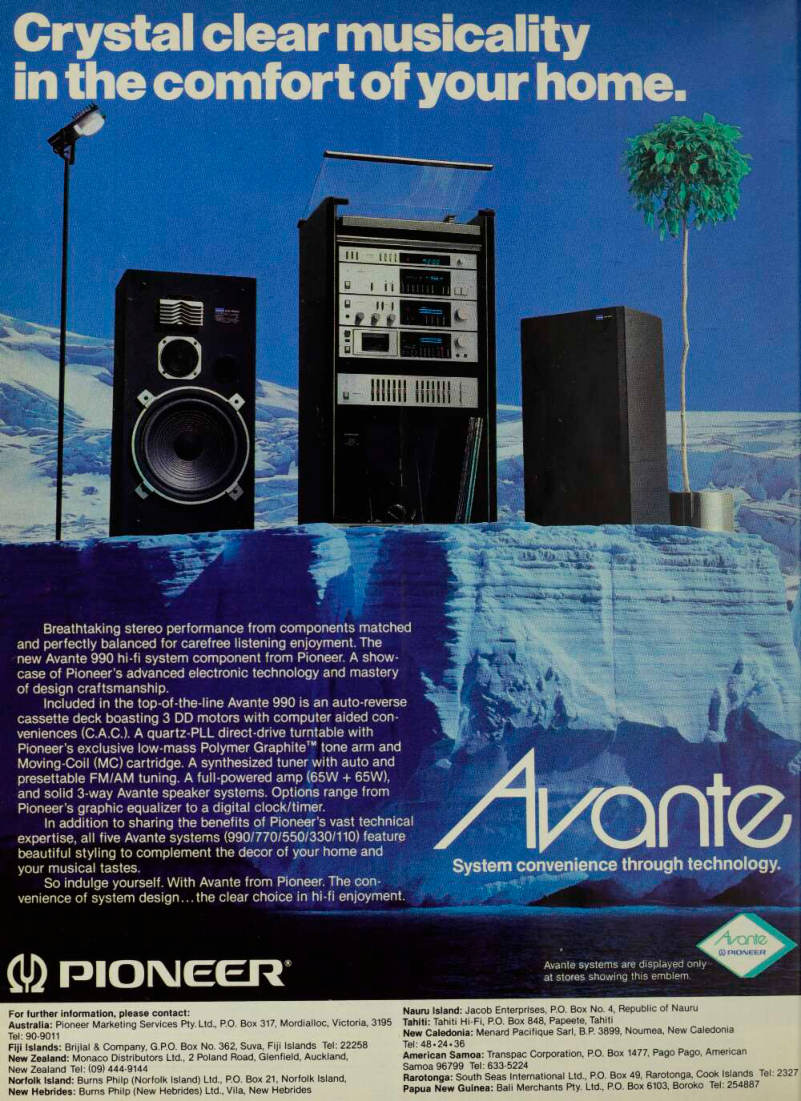
Crystal clear musicality
in the comfort of your home.
MJil
mm 3 M 1 Breathtaking stereo performance from components matched and perfectly balanced for carefree listening enjoyment. The new Avante 990 hi-fi system component from Pioneer. A showcase of Pioneer’s advanced electronic technology and mastery of design craftsmanship.
Included in the top-of-the-line Avante 990 is an auto-reverse cassette deck boasting 3 DD motors with computer aided conveniences (C.A.C.). A quartz-PLL direct-drive turntable with Pioneer’s exclusive low-mass Polymer Graphite™ tone arm and Moving-Coil (MC) cartridge. A synthesized tuner with auto and presettable FM/AM tuning. A full-powered amp (65W + 65W), and solid 3-way Avante speaker systems. Options range from Pioneer’s graphic equalizer to a digital clock/timer.
In addition to sharing the benefits of Pioneer’s vast technical expertise, all five Avante systems (990/770/550/330/110) feature beautiful styling to complement the decor of your home and your musical tastes.
So indulge yourself. With Avante from Pioneer. The convenience of system design...the clear choice in hi-fi enjoyment.
System convenience through technology.
CM) PIONEER
Avante systems are displayed only at stores showing this emblem.
For further information, please contact: Nauru Island: Jacob Eruerpuses, dua *» Australia: Pioneer Marketing Services Pty. Ltd., P.O. Box 317, Mordialloc, Victoria, 3195 Tahiti: Tahiti Hi-Fi, P.O. Box 848, Papeete, Tahiti Tel- 90-9011 New Caledonia: Menard Pacifique Sari, B.P. 389 Fiji Islands: Brijlal & Company, G.P.O. Box No. 362, Suva, Fiji Islands Tel: 22258 Tel: 48*24.36 New Zealand: Monaco Distributors Ltd., 2 Poland Road, Glenfield, Auckland, American Samoa: Transpac Corporation, P.O. B New Zealand Tel: (09) 444-9144 Samoa 96799 Tel: 633-5224 Norfolk Island: Burns Philp (Norfolk Island) Ltd., P.O. Box 21, Norfolk Island, Rarotonga: South Seas International Ltd. P.O. t New Hebrides: Burns Philp (New Hebrides) Ltd., Vila, New Hebrides Papua New Guinea: Bali Merchants Pty. Ltd., P.
New Caledonia: Menard Pacifique Sari, B.P. 3899, Noumea, New Caledonia Tel: 48*24*36 American Samoa: Transpac Corporation, P.O. Box 1477, Pago Pago, American Samoa 96799 Tel: 633-5224 „ , .
Rarotonga: South Seas International Ltd., P.O. Box 49, Rarotonga, Cook Islands Tel. 2327 Papua New Guinea: Bali Merchants Pty. Ltd., P.O. Box 6103, Boroko Tel: 254887
Pacific Report
Change Of Government In W. Samoa?
Party politics came to Western Samoa with a vengeance with the resounding success at the February 27 general elections of Vaai Kolone’s Human Rights Protection Party (HRPP), which won 22 of the 47 seats in the Legislative Assembly. Eleven of the 22 seats were won by newcomers, sitting members holding the rest.
Tupuola Efi’s former government group (it’s not, strictly, a party) held on to only 11 seats so that the HRPP was only two short of a majority which was expected to come from among the 13 uncommitted members. The result was not a foregone con clusion, however. If the 13 freelancers gave their support to Tupuola Efi admittedly an unlikely event then parliament would be as you were. In one seat the vote was tied, and will be decided by the drawing of lots. Mapuilesua Pelenato’s Labour Party seems to have foundered before setting sail, as he was heavily defeated by Tagaloa Leota Pita. Many well-known stalwarts fell by the wayside. Human Rights lost Laulu Fetaui, widow of first Prime Minister Mataafa, Tuigamala Saofaiga, Faamatuainu Tala Mailei, Leulu Leifaga and Matautia Fagalua.
The government party lost Speaker Tu’u’u Faletoese, Deputy Speaker A’e’au Taulupo’o, former Cabinet minister Asi Eikeni, Minister of Economic Affairs Letiu Tamatoa, former WSTEC general manager Aumua loane, former minister Tofaeono Tile, Toomalatai Siaki, and Talamaivao Niko. As the dust was clearing early in March, indications were that Human Rights might end up with 30 members and Tupuola Efi’s party 17. Felise Va’a in Apia.
Png Seizes Big U.S. Fishing Vessel
Rabaul, Papua New Guinea, District Court in early March ordered the seizure of an American trawler, its equipment, including a helicopter, and its catch of fish. It was a mandatory decision under the PNG 1974 Fisheries Act and was thought likely to bring retaliatory trade sanctions by the USA. The trawler, Danica, skippered by William Pryor Lowie, was arrested by PNG Defence Force patrol boats north of New Ireland for alleged illegal fishing.
Lowie, of Florida, who pleaded not guilty, was fined K5OO, in default three months gaol. Some delicate diplomatic bargaining was expected behind the scenes because the United States refuses to recognise laws controlling tuna in 200-mile fishery zones and, under its own Magnuson Act, is bound to impose an embargo on imports of fish from countries which have seized US vessels. The US fish market has been worth K2O million a year to PNG’s fishing industry. Danica is a 100-tonne, 80-metre mother ship worth about SAI2 million. As well as its helicopter, it is equipped with satellite navigation. Essalon Fishing Co (Captain Lowie) had until about March 28 to appeal against the court’s decision, a move lawyers in PNG thought unlikely to succeed.
According to reports, the more likely option was that Essalon would be offered first-choice best-price status when the PNG Government put the confiscated vessel on the market.
Tonga: Grim Legacy Of Cyclone Isaac
Cyclone Isaac, which struck Tonga on March 2, wreaked greatest havoc in the central island group of Haapai. Second worst hit was the island of Tongatapu to the south, especially the seafront of the capital Nukualofa, and the island’s western district villages.
Islands of the Vavau group to the north, and the island of Eua, southeast of Tongatapu, also suffered severe damage. Estimates of loss of life have not been completed (March 8). But it is known that a baby was drowned off Sopu, on the Nukualofa seafront, a man in a dinghy was lost off Nukualofa, another was killed in a house collapse in Haapai, and a child was electrocuted on March 7 after touching live wires during electrical repair work in Nukualofa. Other people are believed missing, but no firm information on them is yet available. Official estimates of damage to trees, crops and buildings run into tens of millions of ST.
Estimation of damage to civil engineering works roads, seawalls, etc has not been completed, but this will certainly add many millions more. Emergency aid has flowed in from Australia, New Zealand, French Polynesia, Guam and the United Kingdom. A New Zealand relief ship has already arrived. In a recent move, Australian and New Zealand army doctors and
engineers switched their base trom NuKualota to Haapai.
Reactions on the Tongan side include; establishment by government of a national disaster fund with a sum of $1 million; a visit by the king and queen in the vessel Olovaha to the stricken areas of Haapai and Vavau; and the establishment of a national disaster committee which, based in the national defence headquarters in Nukualofa, will oversee the distribution of aid.
Penny Hodgkinson in Nukualofa.
Micronesian Seminar’S ‘Memoranda’
The Catholic-based Micronesian Seminar in Truk, Federated States of Micronesia, is giving Pacific-wide circulation to a series of ‘Memoranda’. The latest released, Memos Three and Four, address the questions of nuclear weapons in Micronesia, particularly in Palau, and self-government, in the context of the Draft Compact of Free Association with the United States. Memo Three, written by Henry M. Schwalbenberg, SJ, closes with the words: ‘ln the past there has been general agreement among Christian theologians that the possession of nuclear weapons can be tolerated if this provides a deterrent to nuclear war, which is considered a greater evil. Today, however, a growing number of Catholic theologians question whether even the possession of nuclear weapons can be tolerated. The moral issue facing Palau is whether or not the servicing of nuclear weapons in Palau will help deter nuclear war. I suspect that with or without a Palauan base the American ability to deter a Soviet attack is unchanged.
Unless a good argument can be made that a Palauan base is needed to help deter a nuclear war, then the moral argument for having one is extremely weak. The morality of nuclear weapons in Palau may not be considered in the public debate that will arise once a date for the plebiscite is announced. Like the Marshalls with Kwajalein, Palau stands to make substantial money if the Americans ever decided to use Malakal Harbour as a base. There is a danger that the important moral issue here may be obscured by a desire for money.’
NOUMEA: 17 000 SIGN FOR CANON’S RELEASE A petition calling for the release of Dominique Canon, 20, held since September 22 1981 as chief suspect in the September 19 murder in Noumea of Union Caledonienne leader Pierre Declercq, had attracted 17 000 signatures by late February. The campaign was given impetus by the findings of a Paris ballistics expert called in to study the case. He stated his view that the traces of gunpowder found at the scene of the crime could not have come from the rifle seized at Canon’s home.
Fiji: Confusion As Poll Approaches
One fact that emerged in March from an increasingly confused Fiji political scene is that the ruling Alliance Party will enter the July elections in a precarious position. It is possible that only another split in the usually bickering ranks of the opposition National Federation Party could save it from defeat (as was the case in 1977 when a split Indian vote gave the Alliance a comfortable majority). Both parties are running into trouble with sour and resentful reactions from disappointed applicants’for endorsement as parliamentary candidates. Ratu Sir Kamisese Mara has had a bitter row with James Shankar Singh, president of the Indian Alliance, which could erode some of the ruling party’s already small support among the Indian community. There are also hints that opposition from two small Fijian-based parties, the Fijian Nationalists and the Western United Front (which has teamed up with the NFP with the idea of forming a coalition government), could be more of a problem for it than the Alliance cares to admit.
A further headache is the possibility that supporters of the ousted NFP leader Siddiq Koya will change tack and support the present leader Jai Ram Reddy. If Reddy’s claim that the NFP will move into the election as a united force is borne out, the Alliance faces an alarming prospect. Robert Keith-Reid in Suva.
Vanuatu And The Commonwealth Games
Vanuatu’s Prime Minister, Father Walter Lini, said in Canberra in February his government had not yet decided whether it would boycott the Commonwealth Games, due to begin in Brisbane on September 30. During the week before his visit to Australia, Fr Lini had been reported as saying Vanuatu may boycott the Games over the Australian Aboriginal land rights issue. Asked about these comments, he said: ‘The position of the Vanuatu Government and people in regard to the Commonwealth Games is as yet undecided, mainly because we are one of the newest members of the Commonwealth, and we have not actually trained our people sufficiently to participate in the Games.’ He said the Games and the issue of Aboriginal land rights were two separate issues. The government supported the Aboriginal land issue, but
he could not say whether he would tie that in with the Games.
Fr Lini said he had had some discussions with Aboriginal leaders, including members of the Aboriginal Development Commission, during his visit. They had not formally asked Vanuatu to boycott the Games. They are looking obviously at Pacific Island nations for support but they did not put any particular request to me, he said. The decision depended on how important the Australian public thought the issue was. If all the Australian churches thought the issue important, it would be easy for other Pacific Islands to see how they could act in support of the Aboriginal issue. Sue Green in Canberra.
‘Spies In Png,’ Says Chan
‘There are spies in Papua New Guinea’, the Papua New Guinea Parliament was told in February when Prime Minister Sir Julius Chan tabled his National Intelligence Organisation Bill. But the House refused to be stampeded. Debate on the bill lapsed because not enough members were there to vote. Sir Julius had refuted charges that the National Intelligence Organisation (NIO), which would be created by the bill, would terrorise PNG’s own citizens, or that he wanted dictatorial powers. Under the bill, NIO officers would have power to enter and search premises, use listening devices and open postal articles for inspection. Sir Julius argued that the bill was aimed at protecting PNG’s national security from subversive activities.
Santo Damages Claim Is Filed
The Vanuatu Government has made a detailed claim amounting to SA4 893 000 to the French and British governments for damage caused in the rebellion on Santo in 1980. The package claim contains 829 individual claims for a total of $1 149 000, 24 company and associations’ claims for $3 504 000, and a government claim for $240 000. The largest single claim is for $2 079 000 by the owners of Santo’s former copra mill, which was destroyed by fire during the attempted secession. Both the British and French Governments had earlier indicated that they were willing to consider paying compensation for properly documented claims, provided that the claims, as submitted, were final. A Vanuatu Government spokesmen confirmed that the claims as described above are final. lan Mclntyre in Port-Vila.
Fiji Military Want New Patrol Boats
The Fiji Government is studying a request from the Royal Fiji Military Forces for six new steel-hulled patrol boats at a cost of $1 million each. Designed at the government shipyard in Suva, the vessels will be of 50 metres length overall, have a speed of 18 knots, a helicopter pad, two electronic radars, two machine guns (50 calibre) and a 30 millimetre cannon. The Naval Squadron wants them to replace the three aging ex-US mine-sweepers and use them mainly for patrolling the country’s 200-mile economic and fisheries zone. One of the old patrol boats has, in the past two months, arrested a Taiwanese fishing trawler and a Korean trawler for alleged illegal fishing in Fiji waters. The vessels are at Suva, with their captains awaiting trial.
Tonga Peace Corps Man Convicted
A Tongan jury in February found former US Peace Corps Volunteer William Joseph Adams guilty on two counts of possessing Indian hemp, and Mr Justice Henry Hill sentenced him to six months’ imprisonment on the first count but waived sentence on the second. Passing sentence, Justice Hill said he took into account that the total quantity involved was only six grams, and that the accused had not planted any of the seeds in his possession, or involved any Tongans in smoking marihuana.
He had taught agriculture and English for a year on Nomuka Island in Haapai, and had achieved good results although isolated and depressed by being the only expatriate in this outer-island community. He had also been dismissed from the US Peace Corps, forfeiting emoluments that would have been due to him at the end of 1982. Nevertheless, the judge said, persons directly involved in agriculture were best placed to introduce the growing and use of Indian hemp in defiance of Tongan law. The accused had been in that position, and 260 seeds had been found in his possession. Penny Hodgkinson in Nukualofa.
New Otec Projects For Hawaii
The US Department of Energy has given the go-ahead for two design teams to develop concepts for Ocean Thermal Energy Conversion (OTEC) plants that will be based on Oahu in the Hawaiian Islands. The federal agency announced in February that it was awarding two contracts, each worth $9OO 000, for conceptual designs of two OTEC plants. One would be an offshore plant, the other onshore. OTEC uses temperature
differences between surface and deep ocean water to produce electricity. The awards were made despite mammoth cutbacks in federal aid to alternative energy projects. However, there are already hints that there may not be money available in later years to carry the projects through. Both concepts are based on a 40-megawatt pilot plant that would provide electricity to a community of about 40 000 people. Paul Addison in Honolulu.
Parliamentary Union Men In Vanuatu
Vanuatu, which has applied for full membership of the Asian- Pacific Parliamentary Union, has been visited by a five-man delegation of Japanese parliamentarians who sought to explain the implications of membership of the union. The delegation was led by Daisuke Akita, deputy to the Japanese Diet, and included Yoshiharu Takeno, the parliamentary union’s secretary-general.
The delegation called at Nauru on its way home. lan Mclntyre in Port-Vila.
AID FROM UK, FRANCE, NZ, FOR VANUATU The British semi-government Commonwealth Development Corporation (CDC) has been authorised to operate in Vanuatu. It will work in partnership with the Vanuatu Government on projects including coffee and cocoa-growing, beef cattle, and forestry, studies of which have been underway for some time. The CDC has long been established in Fiji, Papua New Guinea and Solomon Islands. Meanwhile, it has been agreed that the French financial aid organisation, Caisse Centrale, will operate in Vanuatu through the Vanuatu Development Bank, funding low interest loans for small and medium commercial projects. Larger projects will be financed directly by Caisse Centrale which is expected to offer long-term loans (15 years) at interest of about 5 percent, and make available technical expertise for develop ment projects. Caisse Centrale operated in the country under the French administration before independence. New Zealand’s first official aid mission, led by Bryce Harland, director of external aid in New Zealand’s ministry of foreign affairs, has been in Vanuatu inspecting projects and evaluating others in areas where it is felt New Zealand could offer technical assistance. Projects now being undertaken by New Zealand include forestry, reef-clearing, health, education and the Vanuatu Police Training School, with extensions of regional aid schemes, and training in education and technical fields being considered as new projects. lan Mclntyre in Port-VUa.
Kl5O 000 BREWERY FIRE IN PORT MORESBY A fire at the South Pacific Brewery in Port Moresby, Papua New Guinea, towards the end of February destroyed the VIP lounge, two offices and a laboratory. The damage is assessed at about Kl5O 000. The brewery’s operations were not affected.
Fiji Sugar Men In China
A 10-man delegation from the Fiji sugar industry paid a six-day visit to the People’s Republic of China in February. The delegation toured sugar-growing areas in southern China, paying special attention to methods of cane transport, and the use of waste products from the factory process.
Vanuatu In U.N. Water Scheme
Vanuatu has been included in the United Nations campaign for ‘water for all by 1990’ through the World Health Organisation.
The campaign in Vanuatu will cost about SUSS million. More than 90 percent of urban residents in Port-Vila and Santo have access to a water supply, but fewer than 25 percent of rural dwellers have a proper supply.
Toberua Gets ‘Hideaway’ Award
Toberua Island, a miniature resort 32 kilometres from Suva in Bau Waters, has been rated one of the world’s top 12 retreats for people who ‘want to get away from it all’. A ‘Hideaway of the Year Award’ has been conferred on Toberua by Harper Associates of Fairfax Station, Virginia, USA. The company specialises in reporting on what it considers to be the world’s most ‘peaceful and unspoiled’ places. The island shares the award with resorts in Britain, France, the United States and the Caribbean. A commemorative plaque from Harper Associates will soon go on display at the island, where accommodation is limited to a maximum of 28 guests staying in 14 self-contained bures.
Png Checks Money Dealings Of Missions
Papua New Guinea’s ministry of foreign affairs and trade has launched an inquiry into the financial management of its overseas missions. The inquiry follows a preliminary audit check which indicated that all PNG missions have been operating on cash deficits.
Healthy

Letters
Healthy feasters of old Nauru
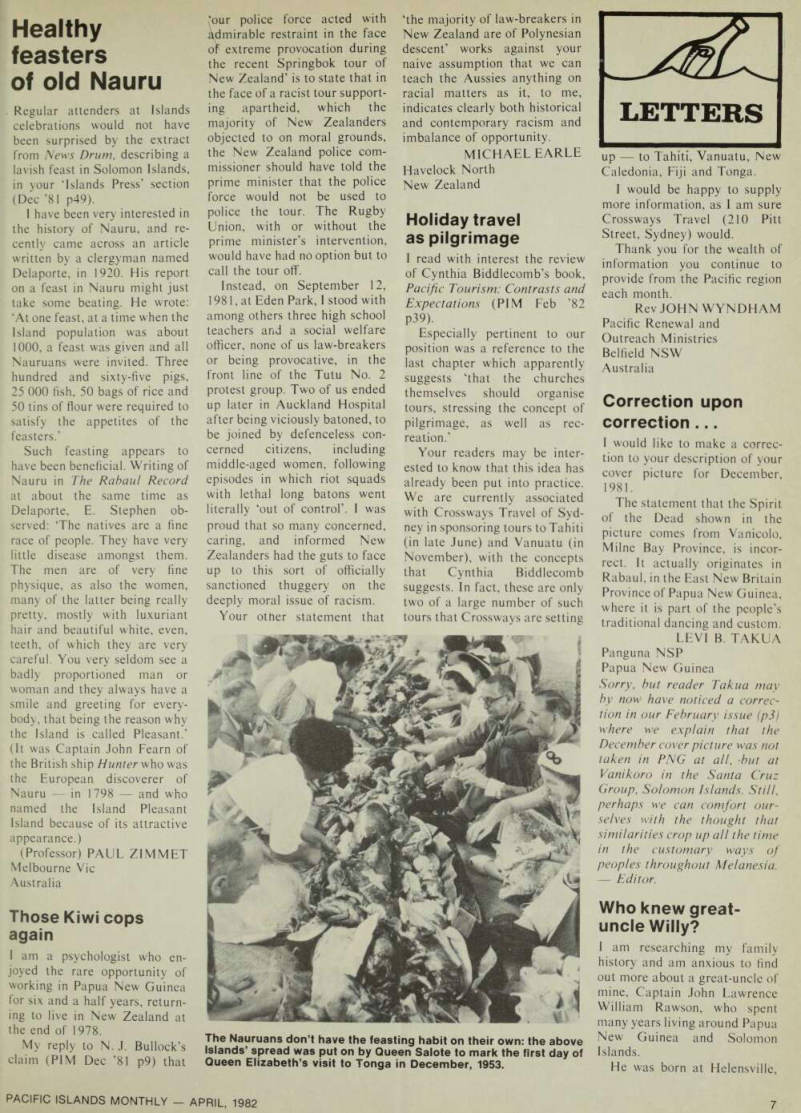
Regular attenders at Islands celebrations would not have been surprised by the extract from News Drum, describing a lavish feast in Solomon Islands, in your ‘lslands Press’ section (Dec ’Bl p 49).
I have been very interested in the history of Nauru, and re cently came across an article written by a clergyman named Delaporte, in 1920. His report on a feast in Nauru might just take some beating. He wrote: ‘At one feast, at a time when the Island population was about 1000, a feast was given and all Nauruans were invited. Three hundred and sixty-five pigs, 25 000 fish, 50 bags of rice and 50 tins of flour were required to satisfy the appetites of the feasters.’
Such feasting appears to have been beneficial. Writing of Nauru in The Rabaul Record at about the same time as Delaporte, E. Stephen ob served: ‘The natives are a fine race of people. They have very little disease amongst them.
The men are of very fine physique, as also the women, many of the latter being really pretty, mostly with luxuriant hair and beautiful white, even, teeth, of which they are very careful. You very seldom see a badly proportioned man or woman and they always have a smile and greeting for every body, that being the reason why the Island is called Pleasant.’ (It was Captain John Fearn of the British ship Hunter who was the European discoverer of Nauru in 1798 and who named the Island Pleasant Island because of its attractive appearance.)
(Professor)
Paul Zimmet
Melbourne Vic Australia Those Kiwi cops
again
I am a psychologist who en joyed the rare opportunity of working in Papua New Guinea for six and a half years, return ing to live in New Zealand at the end of 1978.
My reply to N. J. Bullock’s claim (PIM Dec ’Bl p 9) that
‘our police force acted with admirable restraint in the face of extreme provocation during the recent Springbok tour of New Zealand’ is to state that in the face of a racist tour support ing apartheid, which the majority of New Zealanders objected to on moral grounds, the New Zealand police com missioner should have told the prime minister that the police force would not be used to police the tour. The Rugby Union, with or without the prime minister’s intervention, would have had no option but to call the tour off.
Instead, on September 12, 1981, at Eden Park, I stood with among others three high school teachers and a social welfare officer, none of us law-breakers or being provocative, in the front line of the Tutu No. 2 protest group. Two of us ended up later in Auckland Hospital after being viciously batoned, to be joined by defenceless con cerned citizens, including middle-aged women, following episodes in which riot squads with lethal long batons went literally ‘out of control’. I was proud that so many concerned, caring, and informed New Zealanders had the guts to face up to this sort of officially sanctioned thuggery on the deeply moral issue of racism.
Your other statement that
‘the majority of law-breakers in New Zealand are of Polynesian descent’ works against your naive assumption that we can teach the Aussies anything on racial matters as it, to me, indicates clearly both historical and contemporary racism and imbalance of opportunity.
Michael Earle
Havelock North New Zealand
Holiday travel
as pilgrimage
I read with interest the review of Cynthia Biddlecomb’s book, Pacific Tourism: Contrasts and Expectations (PIM Feb ’B2 p 39).
Especially pertinent to our position was a reference to the last chapter which apparently suggests ‘that the churches themselves should organise tours, stressing the concept of pilgrimage, as well as rec reation.’
Your readers may be inter ested to know that this idea has already been put into practice.
We are currently associated with Crossways Travel of Syd ney in sponsoring tours to Tahiti (in late June) and Vanuatu (in November), with the concepts that Cynthia Biddlecomb suggests. In fact, these are only two of a large number of such tours that Crossways are setting
up to Tahiti, Vanuatu, New Caledonia, Fiji and Tonga.
I would be happy to supply more information, as I am sure Crossways Travel (210 Pitt Street, Sydney) would.
Thank you for the wealth of information you continue to provide from the Pacific region each month.
Rev John Wyndham
Pacific Renewal and Outreach Ministries Belfield NSW Australia
Correction upon
correction ...
I would like to make a correc tion to your description of your cover picture for December, 1981.
The statement that the Spirit of the Dead shown in the picture comes from Vanicolo, Milne Bay Province, is incor rect. It actually originates in Rabaul, in the East New Britain Province of Papua New Guinea, where it is part of the people’s traditional dancing and custom.
Levi B. Takua
Panguna NSP Papua New Guinea Sorry, but reader Takua may by now have noticed a correc tion in our February issue (p3j where we explain that the December cover picture was not taken in PNG at all, but at Vanikoro in the Santa Cruz Group, Solomon Islands. Still, perhaps we can comfort our selves with the thought that similarities crop up all the time in the customary ways of peoples throughout Melanesia.
Editor.
Who knew great
uncle Willy?
I am researching my family history and am anxious to find out more about a great-uncle of mine, Captain John Lawrence William Rawson, who spent many years living around Papua New Guinea and Solomon Islands.
He was born at Helensville,
The Nauruans don’t have the feasting habit on their own: the above Islands’ spread was put on by Queen Salote to mark the first day of Queen Elizabeth’s visit to Tonga in December, 1953.
New Zealand, on February 28, 1889, the 14th of 16 children of Captain Thomas and Mary Rawson. He did not keep in close contact with his family and consequently I knew very little about him until I read his obituary in a copy of the March
1954 Pim.
Apparently he worked for Lever Brothers and for many years was the master of the MV Kurimarau. During World War 11, he evacuated all the Lever Brothers staff and many other Europeans to Sydney when the Japanese invasion appeared im minent. He was later seconded to US Naval Intelligence, and played an active part in the war.
He returned to his life as a captain on Island trading boats, and died at sea in February 1954.
Would any of your readers be able to tell me anything else about him, good or bad? Can anyone tell me if he was buried at sea? I would be very grateful for any reminiscences about Willy, or Bill, Rawson as his nieces and nephews knew him, and his life in the Pacific. I would also be very pleased to hear from any one who has a photo of him.
(Mrs) Robyn Speller
69 Vale Road St Heliers Auckland 5 New Zealand Thumbs down on
yachties (1)
I refer to the letter by Frank Lewis (PIM Jan p 8), and would like to express my full agree ment with him.
The ‘Yachts’ section of PIM has become too detailed, with unnecessary information about yachtsmen’s families, their life history, their hobbies, etc. It needs drastic editing to make it precise and interesting for all readers of the magazine.
The ‘People’ section covers a lot more material in two pages than six pages of ‘Yachts’.
(Dr) N.C. Patil
Madang Papua New Guinea Thumbs down on yachties (2) Although already guilty of writ ing a good number of letters to PIM over the years, I neverthe
less wish to respond to the editor’s invitation to comment on the letter from Frank Lewis concerning yachties (PIM Jan p 8). As a former resident of Papua New Guinea, I agree completely with Mr Lewis. I have also had experience in the matter in South America, the West Indies, and elsewhere.
What has particularly spurred me to write, however, is the recent news of the death by drowning of three crew mem bers of a trawler who had gone to the rescue of amateur sea farers on the Queensland coast.
Not only do I find the yachtie column in PIM boring, but it also, it seems to me, tends to glamorise an activity which very often leads to great com munity costs in searching for or salvaging the wrecked craft of inexperienced or careless sailors.
Some members of this ‘leisure class’ (so described by Mr Lewis) appear to take for granted our support for their ventures.
I remember coming home in Kavieng about 20 years ago after a rough medical patrol through the islands to find that my room, in our bachelors’ quarters, was occupied by one of these wandering yachties.
Questioned, the man, skipper of a 10-foot ‘coconut shell’ (with an Israeli flag!) contended that the district commissioner had authorised him to stay until his engine was repaired. I replied that I, not the ‘DC’, was paying the rent, and proceeded to hurl my imposed guest’s bedding, maps and clothes out through the window. He was about to be propelled through the same exit, when one of my friends intervened in favour of moder ation.
I understand that for several weeks the man, in no great hurry to have the repair work done, and not keen to go only by sail, bludged around various government houses or plan tations.
In one of them, near Namatanai, perhaps taking his cue from me, he threw out the window the bacon-and-eggs breakfast presented to him by his long-suffering host, com plaining loudly that the break fast was ‘over-cooked’.
Not all yachties, stranded or
not, behave like that, I’m sure.
Nor do reporters or ‘anthropol ogists’ abuse the hospitality offered them in many PNG outstations.
But many should understand why they are not always wel come in South Pacific ports.
Islanders, in spite of their legendary kindness, sometimes have things to do that are more important than greeting and supporting visitors, or picking them up off reefs.
In the old days, a deposit equivalent to about $5OO was required by the PNG adminis tration from would-be ‘explorers’ to pay for their eventual rescue in the ‘restric ted areas.’ This cooled the ardour of many. I am told that the guides of Chamonix, based near the foot of Mont Blanc in south-eastern France, sick and tired of risking their lives in the rescue of careless climbers, have instituted a similar ar rangement.
Why shouldn't international maritime authorities consider instituting expensive ‘sailing li cences’ for imprudent or poorly trained yachties?
They are free to risk their lives, but why should taxpayers contribute to the costs of their expensive hobby, which often leads to tragedies?
John Huon De
Navrancourt
Atherton Qld Australia Thumbs up on
yachties (Fig. 1)
I refer to the letter from Frank Lewis (PIM Jan p 8), and must leap to the defence of the yachting pages.
As an underwriter privileged to have a lot of insurance in Solomon Islands, PIM is partly business-required reading, but largely purely pleasure.
My love of the Pacific was kindled in childhood by the account of the voyage of the Svaap (co-incidentally referred to in your January issue), and my interest in the Islands and their peoples has never waned.
Like it or not, Mr Lewis, yachts do form a link between Islands, a source of communi cation between the peoples, and the means by which people
from all walks of life around the world come to know and love the Pacific Islanders.
Speaking personally, I do not have an abiding interest in New Caledonian politics, but it causes me no hardship to turn the pages after a quick glance as I am fully aware that those pages may be of vital interest to others.
My company is one of the few insurers prepared to cover cruis ing yachts, and your columns are therefore of business value as well as providing the delight of reading about yachties and their voyages in seas I would love to be sailing over myself.
Seven pages are not enough!
G.E. Winslow
Leura NSW Australia Thumbs up on
yachties (2)
In the January PIM, you pub lished a letter concerning your coverage of yacht movements in the southwest Pacific. You also ask for comment on this topic.
Yachts mentioned in PI M’s ‘Yachts’ columns occasionally sail on into Australia’s Search and Rescue area of respons ibility. The Australian Coastal Surveillance Centre (ACSC), the Marine SAR authority, often becomes involved in try ing to establish the whereabouts of yachts that have sailed across the Pacific.
On some occasions when a yacht has experienced difficulty and required assistance it has made contact with either a coast radio station or the ‘Pacific Net’ operated by radio amateurs, and word has been passed to the ACSC concerning the yacht’s predicament.
In several incidents like these, ACSC SAR co ordinators have found the infor mation contained in PIM to be invaluable in providing a de tailed description and area of intended movements of the yachts in question.
We therefore support its con tinuance, as I am sure do other Marine SAR authorities.
M.H. Julian
Coastal Services Division Transport Australia Canberra ACT Australia
Advertisements & other items, pp. 8-10 (1 item)
prism
discover a wono or ummaie sonic Clarity.
Incredibly refined
music reproduction performance lets you relive every detail and subtle sonic nuance
of the original performance.
Another taste of truly advanced technology from TEAC. So
PRISM 30
PRISM 50
31 I C O I
PRISM 70
fe wa • a i
prism
zi "component systems^
TEAC
Australia; TEAC Australia Pty., Ltd. 115 Whiteman Street South Melbourne, Victoria 3205 New Zealand: Direct Imports (N.Z.) Ltd. P.O. Box 72 Hastings Fuji: D. Jeevan & Sons P 0. Box 148, Suva New Caledonia: HIFIVOX 79, Rue de Sebastopol B.P 1458, Noumea
PERFORMANCE
dependable
2) LB fl r—r^—f UH Sb A «) w bk
marine engines
When fishing is your living, you know you need dependable gear working with minimum downtime and your engines have to deliver reliable power when and where you need it.
CATERPILLAR offers you a comprehensive selection of performance proven Cat Marine Diesel Engines from 85hp up to IOOOhp, backed by after sales service and replacement parts facilities that are second to none.
dependable
generator sets-
Whatever your electric power needs, there’s a Caterpillar- built generator set to meet them. Caterpillar generators feature adjustment free fuel systems, large capacity radiators, heavy duty air cleaners and quick-change fuel and oil filters to ensure dependable performance throughout the islands, in ail kinds of tropical conditions.
: iiru
nr
HASTINGS DURING
LAE:
Milford Haven Road, Telephone 42 2355.
PORT MORESBY:
Telephone 256650.
BOUGAINVILLE:
Itakara Industrial Park, Arawa Telephone 959077.
carptrac
SUVA: Carpenter Street, Raiwai.
Private Mail Bag, GPO Suva, Fiji. Ph. 381622, Telex FJ2190 Cables CARPTRAC.
LAUTOKA; Veitari. Telephone 61877.
LABASA: Vulovi. Telephone 81868.
YOUR
CATERPILLAR
DEALER
Caterpillar, Cat and CB are Trademarks of Caterpillar Tractor Co.
BA104;
Australia and the Islands: A mutual
Conference: Australia & The South Pacific
Australia and the Islands: A mutual trust, a mutual watchfulness
PIM Associate Editor
Malcolm Salmon
attended the conference on 'Australia and the South Pacific’ in Canberra on February 18-19. His report begins on this page.
The organisers planned a con ference of 120 registered, paid up participants. They finished with 250, with freeloaders boosting the numbers in and around the conference hall to 300 or more at some sessions.
That in brief is the story of the ‘Australia and the South Pacific’ conference held at Burgmann College, Australian National University, Canberra, on February 18-19.
Sponsored by the ANU’s Council for Continuing Edu cation, and the Australian sec tion of the Foundation for the Peoples of the South Pacific, the conference indicated a growing Australian public awareness of the importance and the problems of the country’s relations with the Pacific Islands. It offered some faint hope that the days when Australian public attitudes to the Islands are as Australian Foreign Minister Tony Street remarked in opening the confer ence ‘largely shaped by the novels of James A. Michener’ may at long, long last be numbered.
As a measure of the drawing power of the conference and of the web of diverse power interests enveloping the South Pacific region the following Canberra embassies and high commissions coughed up their SASO to send a representative: the United States, the Soviet Union ( it cost them $lOO, because they sent two), Japan, China, France, Canada, Italy and Chile. ‘Locals’ like Papua New Guinea, Fiji and New Zealand were also there. A representative of India’s minis try of communications (not the high commission) was in attend ance.
Australia’s department of foreign affairs demonstrated its interest by sending no fewer than 20 of its officers.
If Islanders were outnum bered by non-islanders in the conference overall, they played a prominent part in the work of
leading off conference dis cussions: they were among the principal speakers in opening seven of the 11 full sessions, and served as convenors at five of the 11 workshops.
Those involved in this leader ship work were from Solomon Islands, Western Samoa, Fiji, Tonga, New Caledonia and Palau.
Grappling with their subject, speaker after speaker toyed with various ways of expressing the precise quality of the re lationship between Australia and the Island states of the South Pacific.
There were references to ‘metropolis’ Australia, which, if the Greeks who coined the word
are to be believed, makes Aus tralia a kind of ‘mother city’ to the Island states, at the centre of some sort of vast oceanic countryside. There were other, quite direct, uses of the parent child metaphor.
There was a ‘Siamese-twin’ image employed, and geometry was called in to give us a ‘centre’ (Australia) and a ‘per iphery’ (the Islands). And so on.
One speaker, scrupulously ac knowledging his debt to Pierre Trudeau’s description of Canada’s relations with the United Slates, said the Islanders’ experience in re lations with Australia was like that of ‘a man in bed with an elephant’. ‘When the elephant turned over or sneezed or snored it had quite an unsettling effect on the other occupant of the bed,’ said he. (The same speaker, Epeli Hau’ofa of Tonga, added: ‘I think some people would prefer to liken our relationship to the courtship between Beauty and the Beast
. . With exquisite Polynesian politeness, he refrained from telling his audience which was which).
The conference planners cast a wide net, with virtually every aspect of the subject touched upon in one form of meeting or another.
No resolutions were adopted.
Presumably the aim was to achieve what is sometimes called a ‘Pacific-style consen sus’ a very elusive animal indeed. Certainly, it was not caught and put on display at the end of this conference.
As in any international con ference held in any country, whatever the subject, the locals fought their own battles the ones they were fighting the week before the conference, and the ones they will be fighting the week after.
So, among Australians at the conference, the environ mentalists (‘greenies’ to their detractors) fought the devel opers (‘money-grubbers’ and worse to those who don’t like them). ‘Anti-nukes’ did battle with ‘pro-nukes’, ‘radicals’ clashed with ‘conservatives’, and so on. Mostly the battles had a demonstrable connection with Island concerns, but some times they did not.
One that did was the under ground and largely silent, war waged by the International De velopment Action group who, throughout the conference, diligently ‘flogged’ their anti- Burns Philp booklet, A Touch of Australian Enterprise: The Vanuatu Experience, under the noses of the several executives of that company including chief executive officer Philip Best who were present. But at the end of the day honours were about even. No doubt the IDA people sold a lot of copies of their booklet. For their part, the BP men remained unflappable, and indeed won plaudits from many for their tireless attendance at confer ence and workshop sessions.
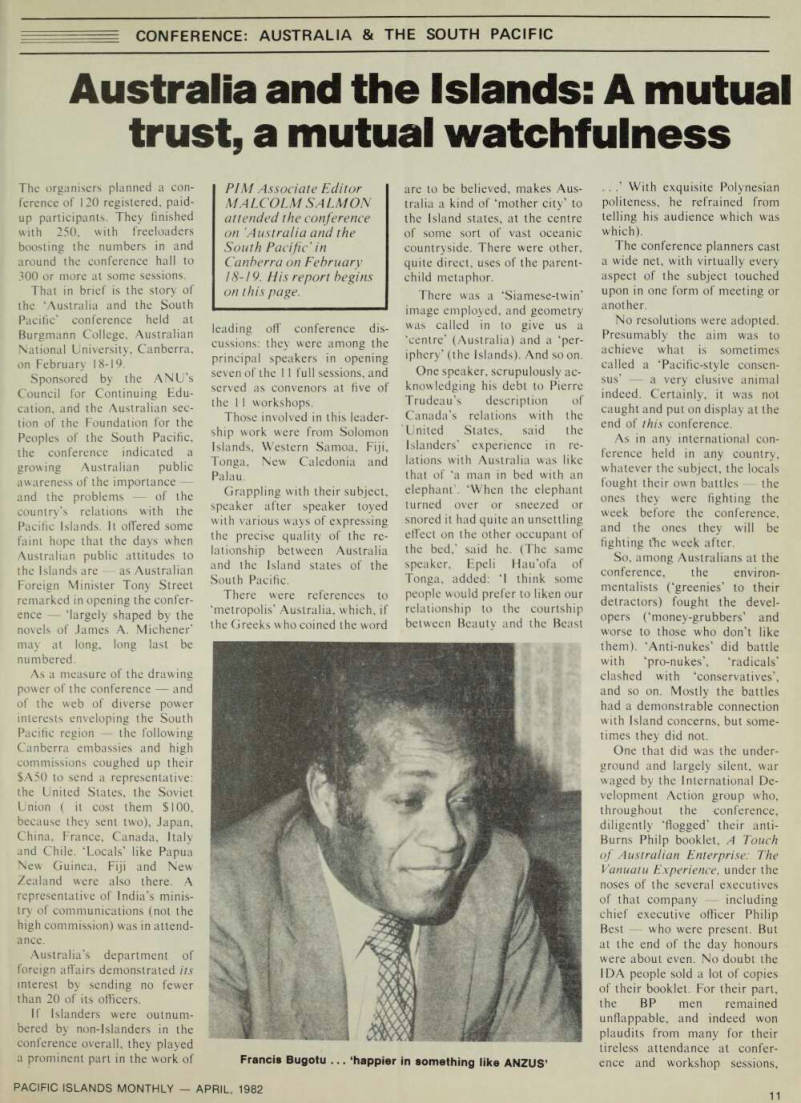
Francis Bugotu ... ‘happier in something like ANZUS’
whether they directly con cerned them or not.
It wouldn’t have been Austra lia and it most certainly wouldn’t have been Canberra if some good old-fashioned party-politicking hadn’t reared its head at some stage.
In one of the two summing-up statements at the close of the conference, Alan Matheson, representing the Labor Party oriented Australian Council of Trade Unions, claimed that the extreme brevity of Foreign Min ister Tony Street’s speech and stay at the conference provided a true measure of the import ance attached to the South Pacific by Australia’s Liberal- National Country Party govern ment.
This sally brought a sharp protest to the organisers from representatives of the depart ment of foreign affairs, who claimed that 10 minutes was all that had been allotted by the organisers for the Street speech.
The organisers later confirmed that this was so.
Mr Matheson made a much more serious point when he said later on in his summing-up remarks; ‘.. . there was no doubt in the minds of many participants that Australia was increasingly be ing incorporated into US mili tary and strategic designs and systems for the region. ‘Any new direction for Aus tralian relationships with Pacific Island nations will de pend on the degree to which Australians can spend as much time discussing a “nuclear-free zone’’ within its own boundaries as it does a “nuclear-free Pacific”. ‘The time is coming when it will be the nuclear issue within Australia that will determine Australian relationships with its Pacific neighbours. ‘For many Pacific Islanders Australia represents the begin ning of the nuclear cycle. To them it is little more than hypocritical to be talking of a nuclear-free Pacific while con tinuing to supply uranium to countries such as Japan, France and the USA’.
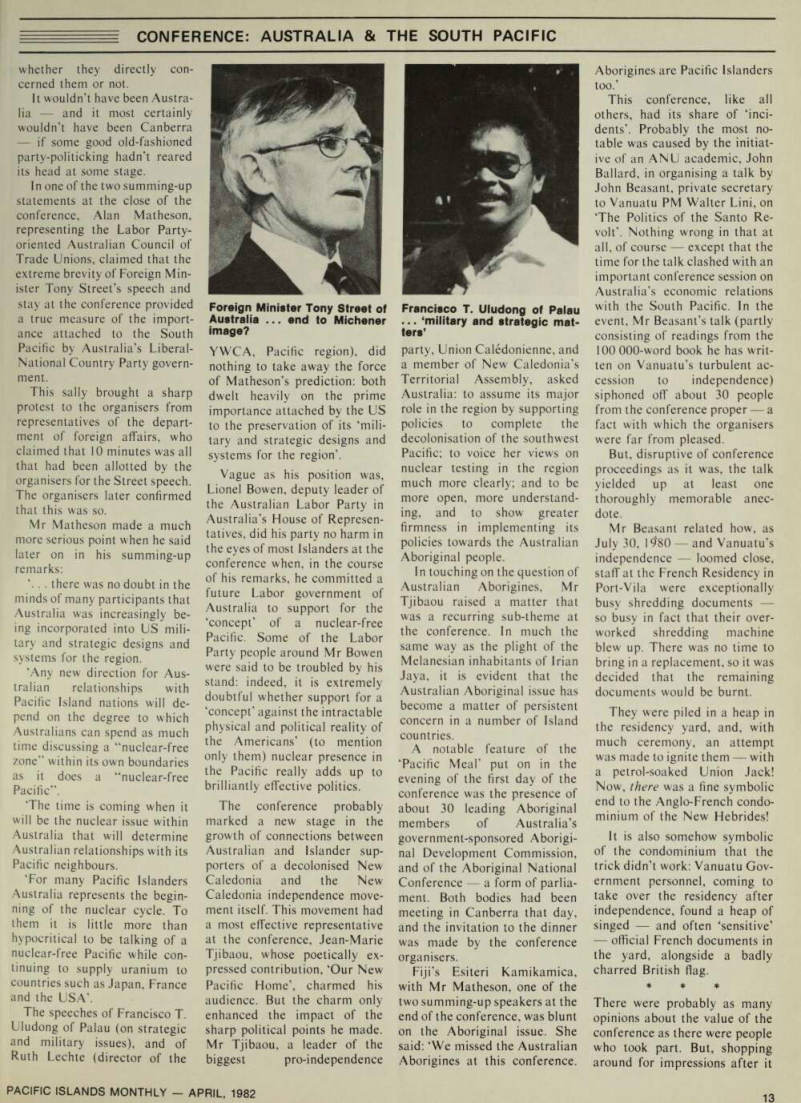
The speeches of Francisco T.
Uludong of Palau (on strategic and military issues), and of Ruth Lechte (director of the
YWCA, Pacific region), did nothing to take away the force of Matheson’s prediction: both dwelt heavily on the prime importance attached by the US to the preservation of its ‘mili tary and strategic designs and systems for the region’.
Vague as his position was, Lionel Bowen, deputy leader of the Australian Labor Party in Australia’s House of Represen tatives, did his party no harm in the eyes of most Islanders at the conference when, in the course of his remarks, he committed a future Labor government of Australia to support for the ‘concept’ of a nuclear-free Pacific. Some of the Labor Party people around Mr Bowen were said to be troubled by his stand: indeed, it is extremely doubtful whether support for a ‘concept’ against the intractable physical and political reality of the Americans’ (to mention only them) nuclear presence in the Pacific really adds up to brilliantly effective politics.
The conference probably marked a new stage in the growth of connections between Australian and Islander sup porters of a decolonised New Caledonia and the New Caledonia independence move ment itself. This movement had a most effective representative at the conference, Jean-Marie Tjibaou, whose poetically ex pressed contribution, ‘Our New Pacific Home’, charmed his audience. But the charm only enhanced the impact of the sharp political points he made.
Mr Tjibaou, a leader of the biggest pro-independence
party, Union Caledonienne, and a member of New Caledonia’s Territorial Assembly, asked Australia: to assume its major role in the region by supporting policies to complete the decolonisation of the southwest Pacific; to voice her views on nuclear testing in the region much more clearly; and to be more open, more understand ing, and to show greater firmness in implementing its policies towards the Australian Aboriginal people.
In touching on the question of Australian Aborigines, Mr Tjibaou raised a matter that was a recurring sub-theme at the conference. In much the same way as the plight of the Melanesian inhabitants of Irian Jaya, it is evident that the Australian Aboriginal issue has become a matter of persistent concern in a number of Island countries.
A notable feature of the ‘Pacific Meal’ put on in the evening of the first day of the conference was the presence of about 30 leading Aboriginal members of Australia’s government-sponsored Aborigi nal Development Commission, and of the Aboriginal National Conference a form of parlia ment. Both bodies had been meeting in Canberra that day, and the invitation to the dinner was made by the conference organisers.
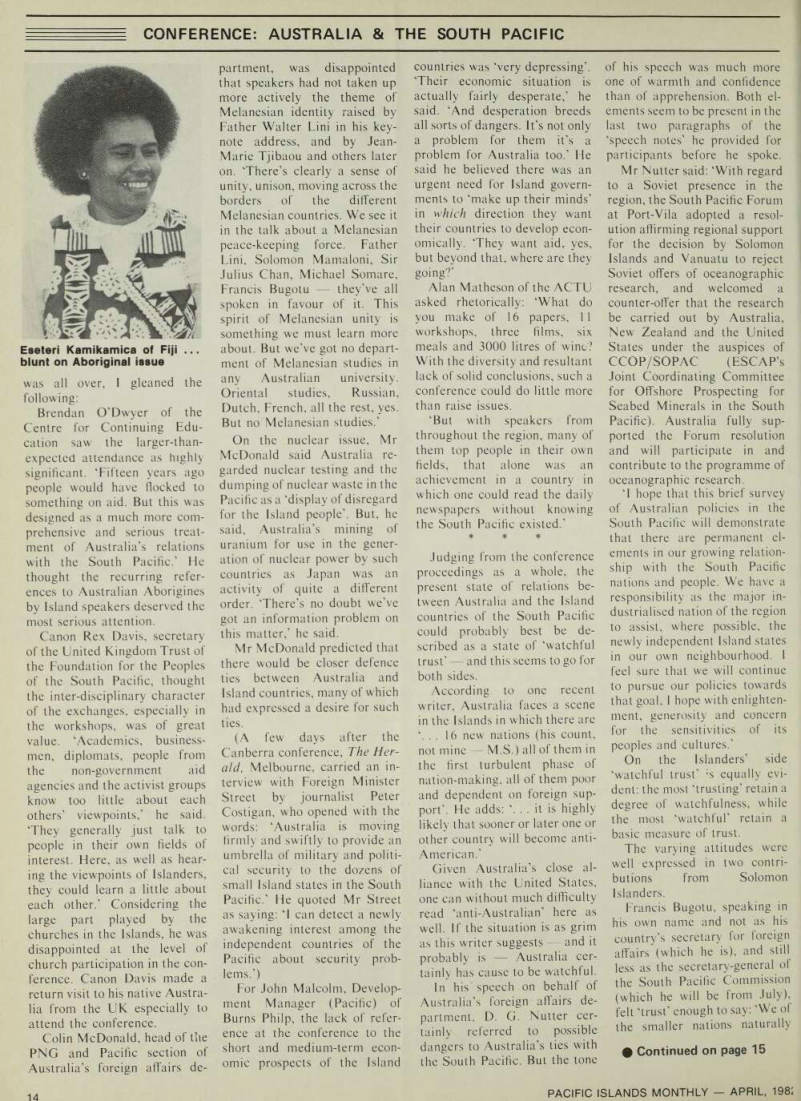
Fiji’s Esiteri Kamikamica, with Mr Matheson, one of the two summing-up speakers at the end of the conference, was blunt on the Aboriginal issue. She said; ‘We missed the Australian Aborigines at this conference.
Aborigines are Pacific Islanders too.’
This conference, like all others, had its share of ‘inci dents’. Probably the most no table was caused by the initiat ive of an ANU academic, John Ballard, in organising a talk by John Beasant, private secretary to Vanuatu PM Walter Lini, on ‘The Politics of the Santo Re volt’. Nothing wrong in that at all, of course except that the time for the talk clashed with an important conference session on Australia’s economic relations with the South Pacific. In the event, Mr Beasanl’s talk (partly consisting of readings from the 100 000-word book he has writ ten on Vanuatu’s turbulent ac cession to independence) siphoned off about 30 people from the conference proper a fact with which the organisers were far from pleased.
But, disruptive of conference proceedings as it was, the talk yielded up at least one thoroughly memorable anec dote.
Mr Beasant related how, as July 30, — and Vanuatu’s independence loomed close, staff at the French Residency in Port-Vila were exceptionally busy shredding documents so busy in fact that their over worked shredding machine blew up. There was no time to bring in a replacement, so it was decided that the remaining documents would be burnt.
They were piled in a heap in the residency yard, and, with much ceremony, an attempt was made to ignite them with a petrol-soaked Union Jack!
Now, there was a fine symbolic end to the Anglo-French condo minium of the New Hebrides!
It is also somehow symbolic of the condominium that the trick didn’t work: Vanuatu Gov ernment personnel, coming to take over the residency after independence, found a heap of singed and often ‘sensitive’ official French documents in the yard, alongside a badly charred British flag. ♦ ♦ ♦ There were probably as many opinions about the value of the conference as there were people who took part. But, shopping around for impressions after it
Foreign Minister Tony Street of Australia ... end to Michener image?
Francisco T. Uludong of Palau ... ‘military and strategic mat ters’
was all over, I gleaned the following; Brendan O’Dwyer of the Centre for Continuing Edu cation saw the larger-than expected attendance as highly significant. ‘Fifteen years ago people would have flocked to something on aid. But this was designed as a much more com prehensive and serious treat ment of Australia’s relations with the South Pacific.’ He thought the recurring refer ences to Australian Aborigines by Island speakers deserved the most serious attention.
Canon Rex Davis, secretary of the United Kingdom Trust of the Foundation for the Peoples of the South Pacific, thought the inter-disciplinary character of the exchanges, especially in the workshops, was of great value. ‘Academics, business men, diplomats, people from the non-government aid agencies and the activist groups know too little about each others’ viewpoints,’ he said. ‘They generally just talk to people in their own fields of interest. Here, as well as hear ing the viewpoints of Islanders, they could learn a little about each other.’ Considering the large part played by the churches in the Islands, he was disappointed at the level of church participation in the con ference. Canon Davis made a return visit to his native Austra lia from the UK especially to attend the conference.
Colin McDonald, head of the PNG and Pacific section of Australia’s foreign affairs de
partment, was disappointed that speakers had not taken up more actively the theme of Melanesian identity raised by Father Walter Lini in his key note address, and by Jean- Marie Tjibaou and others later on. ‘There’s clearly a sense of unity, unison, moving across the borders of the different Melanesian countries. We see it in the talk about a Melanesian peace-keeping force. Father Lini, Solomon Mamaloni, Sir Julius Chan, Michael Somare, Francis Bugotu they’ve all spoken in favour of it. This spirit of Melanesian unity is something we must learn more about. But we’ve got no depart ment of Melanesian studies in any Australian university.
Oriental studies, Russian, Dutch, French, all the rest, yes.
But no Melanesian studies.’
On the nuclear issue, Mr McDonald said Australia re garded nuclear testing and the dumping of nuclear waste in the Pacific as a ‘display of disregard for the Island people’. But, he said, Australia’s mining of uranium for use in the gener ation of nuclear power by such countries as Japan was an activity of quite a different order. ‘There’s no doubt we’ve got an information problem on this matter,’ he said.
Mr McDonald predicted that there would be closer defence ties between Australia and Island countries, many of which had expressed a desire for such ties. (A few days after the Canberra conference, The Her ald, Melbourne, carried an in terview with Foreign Minister Street by journalist Peter Costigan, who opened with the words; ‘Australia is moving firmly and swiftly to provide an umbrella of military and politi cal security to the dozens of small Island states in the South Pacific.’ He quoted Mr Street as saying: ‘I can detect a newly awakening interest among the independent countries of the Pacific about security prob lems.’) For John Malcolm, Develop ment Manager (Pacific) of Burns Philp, the lack of refer ence at the conference to the short and medium-term econ omic prospects of the Island
countries was ‘very depressing’.
Their economic situation is actually fairly desperate,’ he said. ‘And desperation breeds all sorts of dangers. It’s not only a problem for them it’s a problem for Australia too.’ He said he believed there was an urgent need for Island govern ments to ‘make up their minds’ in which direction they want their countries to develop econ omically. ‘They want aid,, yes, but beyond that, where are they going?’
Alan Matheson of the ACTU asked rhetorically: ‘What do you make of 16 papers, 11 workshops, three films, six meals and 3000 litres of wine?
With the diversity and resultant lack of solid conclusions, such a conference could do little more than raise issues. ‘But with speakers from throughout the region, many of them top people in their own fields, that alone was an achievement in a country in which one could read the daily newspapers without knowing the South Pacific existed.’ * * * Judging from the conference proceedings as a whole, the present state of relations be tween Australia and the Island countries of the South Pacific could probably best be de scribed as a state of ‘watchful trust’ and this seems to go for both sides.
According to one recent writer, Australia faces a scene in the Islands in which there are ‘. . . 16 new nations (his count, not mine M.S.) all of them in the first turbulent phase of nation-making, all of them poor and dependent on foreign sup port’. He adds: ‘. . . it is highly likely that sooner or later one or other country will become anti- American.’
Given Australia’s close al liance with the United States, one can without much difficulty read ‘anti-Australian’ here as well. If the situation is as grim as this writer suggests and it probably is Australia cer tainly has cause to be watchful.
In his'speech on behalf of Australia’s foreign affairs de partment, D. G. Nutter cer tainly referred to possible dangers to Australia’s ties with the South Pacific. But the tone
of his speech was much more one of warmth and confidence than of apprehension. Both el ements seem to be present in the last two paragraphs of the ‘speech notes’ he provided for participants before he spoke.
Mr Nutter said: ‘With regard to a Soviet presence in the region, the South Pacific Forum at Port-Vila adopted a resol ution affirming regional support for the decision by Solomon Islands and Vanuatu to reject Soviet offers of oceanographic research, and welcomed a counter-offer that the research be carried out by Australia, New Zealand and the United States under the auspices of
Ccop/Sopac (Escap’S
Joint Coordinating Committee for Offshore Prospecting for Seabed Minerals in the South Pacific). Australia fully sup ported the Forum resolution and will participate in and contribute to the programme of oceanographic research. ‘I hope that this brief survey of Australian policies in the South Pacific will demonstrate that there are permanent el ements in our growing relation ship with the South Pacific nations and people. We have a responsibility as the major in dustrialised nation of the region to assist, where possible, the newly independent Island states in our own neighbourhood. 1 feel sure that we will continue to pursue our policies towards that goal, 1 hope with enlighten ment, generosity and concern for the sensitivities of its peoples and cultures.’
On the Islanders’ side ‘watchful trust’ ; s equally evi dent: the most ‘trusting’ retain a degree of watchfulness, while the most ‘watchful’ retain a basic measure of trust.
The varying attitudes were well expressed in two contri butions from Solomon Islanders.
Francis Bugolu, speaking in his own name and not as his country’s secretary for foreign affairs (which he is), and still less as the secretary-general of the South Pacific Commission (which he will be from July), felt ‘trust’ enough to say: ‘We of the smaller nations naturally
• Continued on page 15
Eseteri Kamikamica of Fiji ... blunt on Aboriginal issue
feel more security-conscious and would feel more secure if we were part of an organised pact such as the ANZUS.’
But this did not prevent him from chiding Australia for distancing itself from the region in many respects, or from call ing for more Australian action to correct the glaring imbalance of trade with such countries as his own.
Mr Bugotu’s compatriot, Joses Tuhanuku, secretary- gen eral of the Solomons’ National Union of Workers, who chaired the session on Australia’s econ omic relations with the Pacific, opened proceedings with the words; ‘The discussion will be on Australia’s economic re lations with Pacific, or, more precisely, Australian imperial ism.’
But even Mr Tuhanuku seemed to be signalling that he did not regard Australia as ‘all bad; he smiled as he uttered the dread pejorative.
For one side as for the other, the problem is to find ways by which, without abandoning watchfulness, the element of trust in the relationship may be strengthened in other words, to prevent at all costs the state of ‘watchful trust’ from degenerating into one of sus picion, or worse.
Advertisements & other items, pp. 12-14 (3 items)
favourite videotaping system.
Catch the big catch with the world’s
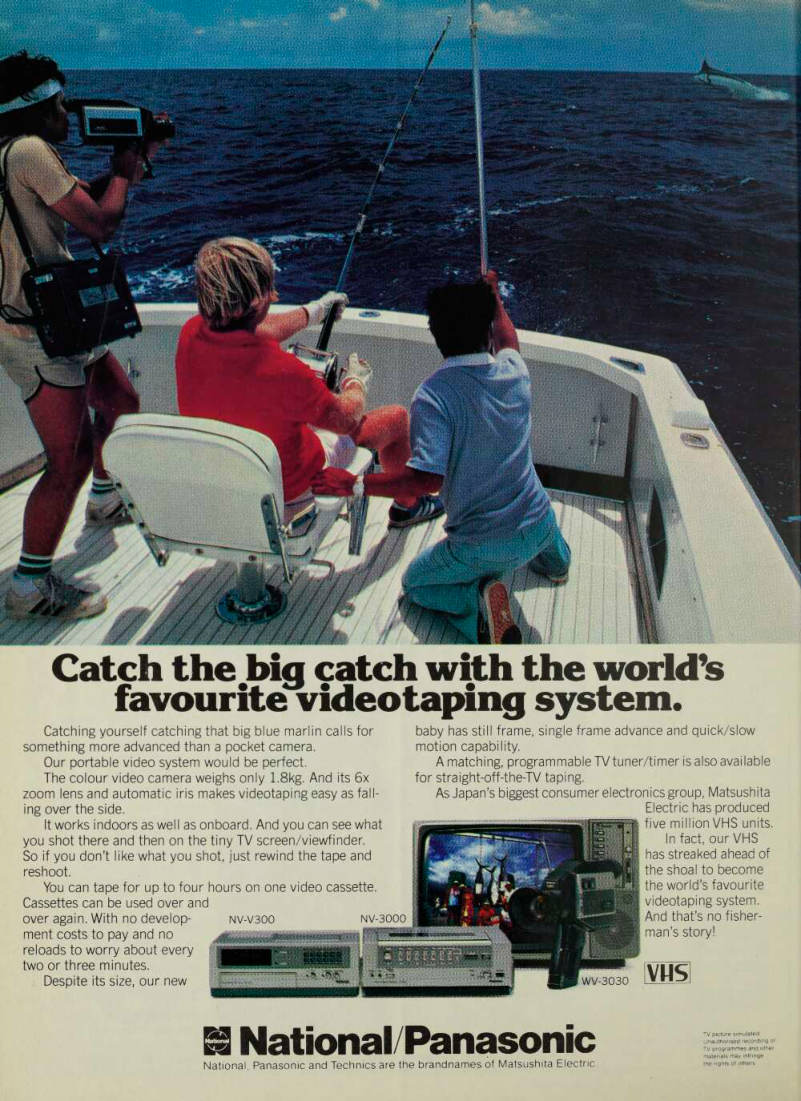
Catching yourself catching that big blue marlin calls for something more advanced than a pocket camera.
Our portable video system would be perfect.
The colour video camera weighs only I.Bkg. And its 6x zoom lens and automatic iris makes videotaping easy as falling over the side.
It works indoors as well as onboard. And you can see what you shot there and then on the tiny TV screen/viewfinder.
So if you don't like what you shot, just rewind the tape and reshoot.
You can tape for up to four hours on one video cassette.
Cassettes can be used over and over again. With no development costs to pay and no reloads to worry about every two or three minutes.
Despite its size, our new baby has still frame, single frame advance and quick/slow motion capability.
A matching, programmable TV tuner/timer is also available for straight-off-the-TV taping.
As Japan’s biggest consumer electronics group, Matsushita Electric has produced five million VHS units.
In fact, our VHS has streaked ahead of the shoal to become the world’s favourite videotaping system.
And that’s no fisherman’s story!
VHS
S National Panasonic
National, Panasonic and Technics are the brandnames of Matsushita Electric.
TV picture simulated Unauthorised recording of TV programmes and other materials may infringe the rights of others
13
CONFERENCE: AUSTRALIA & THE SOUTH PACIFIC
PACIFIC ISLANDS MONTHLY - APRIL, 1982
14
PACIFIC ISLANDS MONTHLY APRIL, 198
CONFERENCE: AUSTRALIA & THE SOUTH PACIFIC
New strong push for a two-party
system in Papua New Guinea
STUART INDER reports from Port Moresby on a new debate in Papua New Guinea on the creation of a two-party system as a possible answer to the persistent failure of the existing party-political system to work adequately. Interest in the problem is such that a call has gone out for the existing parties to move swiftly and form themselves into two strong parties even before the next elections, due to be held in June.
There is growing concern in Papua New Guinea that the continued failure of the party political system could bring political chaos to the country.
Urgency of the debate has been highlighted by the fact that PNG goes to the polls in the next few months, with all the ingredients for continued instability in government still intact.
The debate was launched by
Prime Minister Sir Julius Chan in the dying hours of the second parliament in late February when he pressed for consti tutional changes. It’s been fol lowed by a public appeal from Cecil Abel, a former politician, for candidates to form a two party system for the elections, and to agree to go to the people if a government should fall.
The voters must mobilise to force all candidates to agree to conditions that will rescue this country from certain disaster,’
Abel says in one of the two PNG national newspapers, the Papua New Guinea Post- Courier. The paper has invited electors to take part in a national debate in its columns.
Public concern arises from the fact that PNG’s govern ments since independence have been coalitions, as no party has had the numbers to govern in its own right. The present Chan government comprises four small parties.
But there is little party loy alty in PNG and no leader can depend on support for long, as politicians chop and change their allegiances, often on the promise of a better deal else where.
The result has been, at best, confused government, and, at worst, inefficient, ineffective government as key politicians blatantly demand favours for their loyalty. The size of Chan’s Cabinet 27 reflects this need for political pay-offs.
Under both Somare and Chan, government has been continually distracted by specu lation on whether it can survive, with the result that insufficient planning gets done and the roots of development problems are not tackled.
Among the weaknesses that have caused this state of affairs is the constitutional require ment that parliament can move a vote of no-confidence against
a government six months after it has taken office, yet a leader of government cannot ask the governor-general to dissolve parliament.
A coalition which falls from a no-confidence motion is simply replaced by another group which itself could fall from a no-confidence motion six months later.
The scenario could continue for four years of the five-year life of parliament, and Sir Julius Chan’s worry is that this could start to happen, and government would be virtually impossible in PNG.
Cecil Abel’s solution to the problem is that voters call on all groups to combine and form only two strong parties, and that if a government falls it must agree to go to the electors.
Sir Julius also hopes for stronger parties, but in a per sonal interview he expressed doubt to me that there could be any worthwhile changes with out a change to the constitution.
He sees the right of a govern ment leader to call for a dissol ution as an important weapon against ‘those members with no allegiances who are likely to use a government for their own ends’. ‘Fifty or 60 percent of us
don’t come back after each election,’ said Sir Julius. ‘Now that’s an important restraint on both the prime minister and the members. Members would think twice before bringing down a government, and the prime minister is not likely to take it lightly, either. I’m sure you would get immediate stab ility. ‘lt would be silly for people not to try this if we are all genuinely trying to find some sort of arrangement that will bring stability. ‘The Westminster system works when the party system is entrenched, and the prime min ister knows what numbers he’s got and can count on them.' Sir Julius would like to see a vote of no-confidence being possible only once every 12 months. ‘lf you have a vote of no confidence after six months and it fails, then it should be regarded as a vote of confidence - and you should be given another six months to enjoy that. That makes a year. ‘A government needs at least a year to introduce at least one budget and to live through that budget. A government needs breathing space. ‘A vote of no-confidence every sitting, which is possible now, can quickly breed insta bility and if you have a constant change of government in a new country it can become very dicey. ‘You may not, for instance, continue to have the support of the disciplined forces, es pecially if they are better organ ised than your political insti tutions.’
Sir Julius has proposed that politicians from all national parties get together early in the life of the new parliament to seek changes in the interests of greater stability in PNG gov ernment.
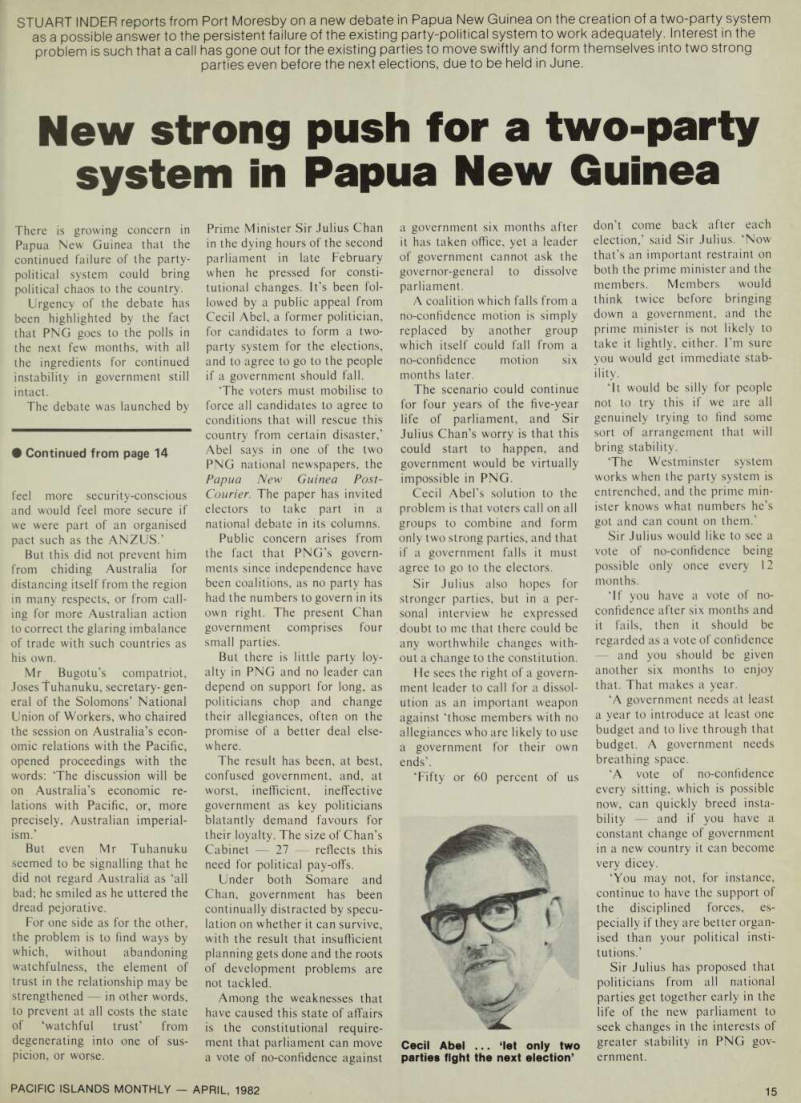
Cecil Abel ... ‘let only two parties fight the next election’
Advertisements & other items, pp. 15-16 (2 items)
15
PACIFIC ISLANDS MONTHLY APRIL, 1982
• Continued from page 14
Blue never looked so true!’
vanity Shelf Adjustable Mirror Towel Ring
Dorf
Towel Rail Guest Towel Holder Toothbrush/Tumbler Holder Toilet Roll Holder Soap Dish
Blue never looked so true!’
Available in. Polar White The Tapware - Dorf ‘Flora’; contemporary yet functional.
The Accessories - Dorfs ‘Designer’ Collection.
The Colour Range - chosen to bring out the decorator in you.
The Total Effect - fabulous; so take a bow! o o o Lemon Royal Carmine Shannon Mission Twist Blue Green Brown Dorf ‘Flora’ vanity basin set in ‘Royal Blue’ finish. / m *r * v> 9 o-
Dorf Industries Pty Ltd
Manufacturers of Taps, Showers and Plumbing Products. 0.3 544 1011 Telex; AA 34449
Press
From the
Islands
From the Cook Islands News, Rarotonga The people of Arorangi have again decided that enough is enough and this time the space invader machines will have to be restricted.
According to the Education, Internal Affairs Departments and the Probation Office, as soon as these machines were introduced, child delinquency and absenteeism from school came about. As the senior Probation Officer Mr B.C. Nicholls stated: ‘When after a young offender, the first place we usually look and find them is at these space invader machines.’
From an article in the Samoa Times, Apia, describing a campaign to eradicate the giant African snail discovered in two Western Samoa ports Being bi-sexual in nature, the snail’s body even if crushed can reproduce so that crushing them only helps to increase their population . . . Further, it is an extremely cunning creature which hides during the day in piles of rubbish, dirt and moisture (they particularly relish empty Vailima bottles which is how they got to Vaitele in the first place) and coming out only at night or when there is plenty of rain to forage. When it has nothing to eat it goes into hibernation for long stretches of time. It is believed the snail was first brought to American Samoa eight years ago by Oriental fishermen who regarded it as a delicacy.
Vanuatu Prime Minister Walter Uni, addressing a leadership conference, reported in Tam-Tam, Port-Via There are few of us who cannot but be profoundly disturbed at what the cult of commercialism, together with the Western creed of materialism, is doing to our Pacific values, traditions and manner of living.
From The Fiji Times More Indians are leaving the country to find alternative employment overseas. According to figures released by the Bureau of Statistics for the month of September, 1981, Fiji citizens emigrating to various destinations totalled 257, of which 226 were Indians, 11 Fijians, seven Chinese, six Europeans and seven other races.
From the Papua New Guinea Post-Courier A black American woman working as a United Nations volunteer plans to promote the sale of PNG artifacts in the US. Mrs Jacqueline Lewis-Harris says PNG has a potential to supply the US market with its different varieties of artifacts. She says not many black Americans know that Papua New Guineans are black.
Celebrating Christmas in the Marshall Islands, according to the Marshall Islands Journal .. . and they seemed to enjoy every moment of it. Especially the throwing of the candies. This is the part where wearing goggles for safety is advisable for spectators. You’ll never know what is flying in your way candies or bars of soap or cans of tuna.
From the Papua New Guinea Post-Courier ‘Suicide is the only solution to unemployment,’ reckons Oriveta Keai, an unemployed youth who lives in Port Moresby. Oriveta, 18, from Kwikila in the Central Province, says being without a job is ‘an endless struggle and a losing battle against changing times’. ‘Criminal activites are the only way for many of the unemployed to get the necessities of life,’ he said this week.
From the Papua New Guinea Post-Courier A lawyer was barred from Ela Beach District Court yesterday after he described the magistrate as ‘slack’. Magistrate Mr Clement Malaisa made the order against Mr John Gawi after Mr Gawi arrived late for the hearing of a charge against a Government minister. Mr Gawi apologised for arriving late but added: ‘This is the most disastrous and the most useless court in PNG. The policemen are most incompetent and the magistrate is slack,’ he said.
From The Fiji Times Fiji is wasting its time and its money persevering with an already depressed copra industry, says the president of the Fiji Copra Producers’ Association, Mr Robin Mercer. Its future lies in coconuts with greater use being made of by-products and more sophisticated end products, he told the association’s annual general meeting. Copra is a depressed industry, not just in Fiji but throughout the world, said Mr Mercer.
From the Tonga Chronicle About Ts4o 000 was spent in Vava’u by visiting yachts during the year 1980/81, the Tonga Statistics Department has announced. Of this amount, some Ts7ooo was spent on local produce and T 59500 on Tongan handicrafts. The most popular items of handicraft were tapa, carvings and basketware which netted T 52400, $2699 and $2BOO respectively.
From a letter by Pili Tafiaola of USA in The Observer,
Apia
I am a Samoan who was forced to emigrate to the US last year (after the strike) due to financial reasons, which is the main reason why Samoa today has more birds on it than people. Our political system is a mess and is the cause of our miseries. This present system has to go in favour of universal suffrage. I truly believe that we will never ever as a nation be able to stand on our own two feet.
I have nothing against the faa-Samoa but for Simi’s sake, I must say that we have some of the most incompetent politicians in the world who know little about politics and nothing about economics.
From the Arawa Bulletin, North Solomons Province,
Png
People in the Mamagota village in the Siwai area have claimed that they have traced the missing link of an old woman who disappeared last year. Mr Samson Karemara of Sare village said a group of men fishing in the Tipiru area last Saturday killed a crocodile which they believe ate the woman. The crocodile measured approximate!} 4 feet in length with a belly width of 17 inches. Mr Karemara claimed that after cutting the belly of the crocodile they found bones and other things belonging to the woman.
From an article on crocodiles in the News Drum, Honiara Some people think that crocodiles are dangerous many wild animals are dangerous but this is not a good reason to kill them.
They are a part of our environment and have as much right to live as other living things. After all, people kill more people, either accidentally or intentionally, than all other living things combined.
From The Times of Papua New Guinea, Port Moresby The provincial education authorities in the country have come under fire for ‘conspiracy against the education of girls’. Statistics for 1980 compared to 1981, as shown by the Education Research Unit of the University of Papua New Guinea, state that 578 girls were pushed out to let boys into high school.
From the Marshall Islands Journal Delegate Santos Olikong of the State of Koror said the first year of the Republic was ‘a step backward’ and if Palauans had any pride left at all, they would spend the holiday season quietly at home and without 100 much fanfare . . . The President’s office had been wiped out, the status talks are much in doubt, and public employees do not care much about their public responsibilities as long as they continue to receive their pay checks. Furthermore, the nation is faced with a multi-million dollar debt, and, from all indications, the Republic will continue to receive declining U.S. assistance in the years ahead.
‘No longer through
Tropicalities
Francis BUgotu
Australia and the Islands: ‘No longer through a glass darkly..'
Among the best received of the many speeches made at the Australia and the South Pacific conference held at the Australian National University on February 18-19 were those of FRANCIS BUGOTU and Dr EPELI HAU’OFA.
Mr Bugotu is secretary of foreign affairs, Solomon Islands, and s ecret ry-general-el ect of the South Pacific Commission.
Dr Hau’afa is director of the Rural Development Centre, University of the South Pacific Extension, Tonga. Texts of the two speeches begin on this page. Mr Bugotu’s speech was given in his own name and did not necessarily represent the views of the Solomon Islands Government.
Australia is at last able to appreciate the importance and meaning of living with its island neighbours in the South Pacific.
No longer do we have to look through dark glasses but can now relate face to face. It behoves all of our nations in the region therefore to cultivate and maintain this relationship which has taken on new and more positive direction.
The New Direction is not around the corner, it is here.
Today is tomorrow faster than it has ever been in the past. This phenomenon of a new era is worldwide but for us in the South Pacific, it must find its meaning in the region. It means being realistic in terms of who we are, where we are, what we have, and what help we can reasonably expect from our true friends and neighbours and use our combined available talents for the betterment of the region.
In this context we must accept the fact that the South Pacific is our home, and dispel any notion that other world-bloc nations could really be interested in our welfare other than to use our islands and region for self interest and gain.
Most Island countries have now either attained indepen dence or achieved some form of autonomy, which would call for new kinds of relationship with Australia. With the background of independence and self assurance, young nations are beginning to put out feelers around their new world environ ment. They quickly move into both natural and historical affiliations to hold hands with their ethnic brothers or colonial mothers, lest they fall danger ously. A period of uncertainty becomes evident at about this time, and lasts longer than one would wish for, with feelings couched in bombastic but less effective political jargon. This is inevitable however as a by product in the process of quick changes, and violations of in
herited norms of the society.
The biggest danger that any young developing country with inadequate means in qualified manpower and money supply faces is ignorance. A pattern emerges where newly elected governments would either through ignorance or pride, not accept an existing timetable or development plan as workable or progressive without being put to the test. In some cases there is distinct muddle as to what is workable or achievable, and what is an aspired dream.
Little learning leads to hasty beliefs in confidence tricksters who tlourish when countries become newly independent.
They come in sheep’s clothing either as individuals or com panies seeking to be confiden tial advisers ravenously hunting for suckers. In their field of ‘expertise’ they know whom to see and whom not to see.
Australia and New Zealand will note and understand, lest these invaders become instru mental in bringing about bad relations in the region, and we islanders have to be on our guard. In the main, we have no more colonialists left to fight.
We now only have ourselves to blame if we allow misfits and confidence tricksters to enter our countries and drain our life blood from the source.
A possible new direction in bringing about realism in the South Pacific is through the regional institutions, through recognising the relative func tions and values, past and pres ent, of the South Pacific Com mission and the South Pacific Bureau for Economic Co operation. In this context we are required first of all to accept the fact that situations have changed and will change in the region. In the new direction concerning the future of our regional institutions, we must therefore be guided by the wishes of the young nations of the region. To draw a possible analogy, when children grow up they have to change their per sonal habits and learn to look after themselves in new sets of circumstances, and move amongst new groups of people.
If parents do not heed such warnings about the need for children to think for them selves, there would be dissen sion and disharmony in the home. Hence if it is the general feeling in the region that a new direction is desired with respect to the structures and responsi bilities of the SPC and SPEC then it should be respected.
The South Pacific Com mission was established by metropolitan powers in 1947, round about the time a number
of our present political leaders were born, and many were still going to school. In the 1950 s and early 1960 s SPC was the recognised hub of activity and exciting experience in inter territorial co-operation in the region. Its annual conference became what it remains today, a forum in which all govern ments and administrations meet on ostensibly equal terms. The fact really is that some were more equal than others, al though these differences were kept in the background. Never theless it has always been as sumed by many islanders and island countries that the SPC would evolve as its members become autonomous. The SPC in fact did change, but, as we have learned from the last meeting in Vanuatu, it has probably not changed suffi ciently to meet the aspirations of many countries.
In the ’6os and ’7os, the United Nations agencies dis covered the region in a big way with their money and other forms of aid, to be followed later by non-government bodies like the Foundation for the Peoples of the South Pacific (FSP), International Human Assistance Programme (IHAP), World Vision, and other NGOs keen to help. On the other hand the wave of political indepen dence which swept through the Island countries at this time helped to bring out into the open the differences in the thinking amongst metropolitan powers themselves, between island countries and metropoli tan powers, and even between bigger island countries and smaller more dependent territories. In the ensuing cli mate of debate, Australia and New Zealand fortunately threw in their lot with the island countries, and were ‘for’ the region.
It became apparent that the potential in SPC as a regional forum was being stifled, that something other than the SPC was needed and so the South Pacific Forum was launched in 1971 as a regular meeting of the heads of governments in the region. Originally focusing on economic issues, the Forum in 1972 established as its ‘trade
secretarial’, the South Pacific Bureau for Economic Co operation (SPEC) to become the second major regional bu reaucracy today. As in the world of business and govern ment, cumbersome bureau cracies are toppling, and now need to be replaced by simpler, more effective, yet more demo cratic, institutions.
A new direction or perspec tive here therefore would be a thorough and serious examin ation of the present situation both in governments and poli tics, taking into account what the island nations really would want, and at what costs in manpower and money.
Whither Australia?: Austra lia’s persistent difficulty in its relations with Pacific Island countries, experienced perhaps even more intensely than by New Zealand, is its inability to identify itself fully as part of the South Pacific community. It has too obvious a lead in industrialisation and sophisti cation; and, while as Prime Minister Fraser said, ‘Australia belongs rather to Western so ciety, and is thoroughly West ern in its values and institutions, so that it regards all its neigh bours other than New Zealand as Third World countries’, its meaningful relationships with us will not go beyond aid, and matters of strategic and geo graphical significance. We in smaller island countries would hope that, as‘part of a new perspective and direction, this altitude would change to ac commodate the fact that we all belong to one region, with common destiny. We of the smaller nations naturally feel more security-conscious, and would feel more secure if we were part of an organised pact such as the ANZUS.
For our relative sizes we have attractive options which Aus tralia would be proud to talk about our diversity of cul tures, and our natural beauty and wealth potentials. We our selves appear moreover to be inclined towards the Western bloc with its democratic pat terns of behaviour, so Australia should not find it too difficult to understand us. What we would not wish to see is Australia
playing super-power tactics which would not accord with our traditional consensus pat terns of behaviour.
In the eyes of many in the region, Australia and New Zea land are relatively rich and would be 100 protective for any real breakthrough to be made in their relations with the other South Pacific island nations.
They would have so much to lose. The horns of their di lemma are either to dance to the USA tune, or try to find some autonomy for themselves and include the islands of the Pacific in their concern.
In fact many would say that Australia and New Zealand put their South Pacific relationships very much in a subordinate position, and are only interested in us because if we are not their friends we could be a danger to them by letting someone else use us against them. The way some of us island nations are behaving at the moment, we can hardly blame Australians if they think we are a bit of a joke.' So I would ask Australia and New Zealand to work out how to treat us in such a way that credibility and mutual trust would develop. What is there to be done about the continuing failure for example to correct the imbalance of trade between Australia and Pacific Island countries like Solomon Islands?
SPARTECA will not work with just a positive list of primary goods items which can go into Australia, and New Zealand’s negative list of preferential trade items which cannot go into New Zealand.
Realistic treatment and genuine concern will mean definite transfer of resources to investment in the South Pacific islands, to produce goods, which could be sent to Australia and New Zealand. The sad alterna tive which must be realised is that there would be no way out of increasing aid-dependency for the small countries of the South Pacific. Australia in the circumstances will have to ac cept that it is going to have to foot more and more of the bill even to the extent of balance-of payments financing, which is something she and other donors I am sure do not wish to happen.
Advertisements & other items, p. 18 (1 item)
Conference: Australia & The South Pacific
warm new web of
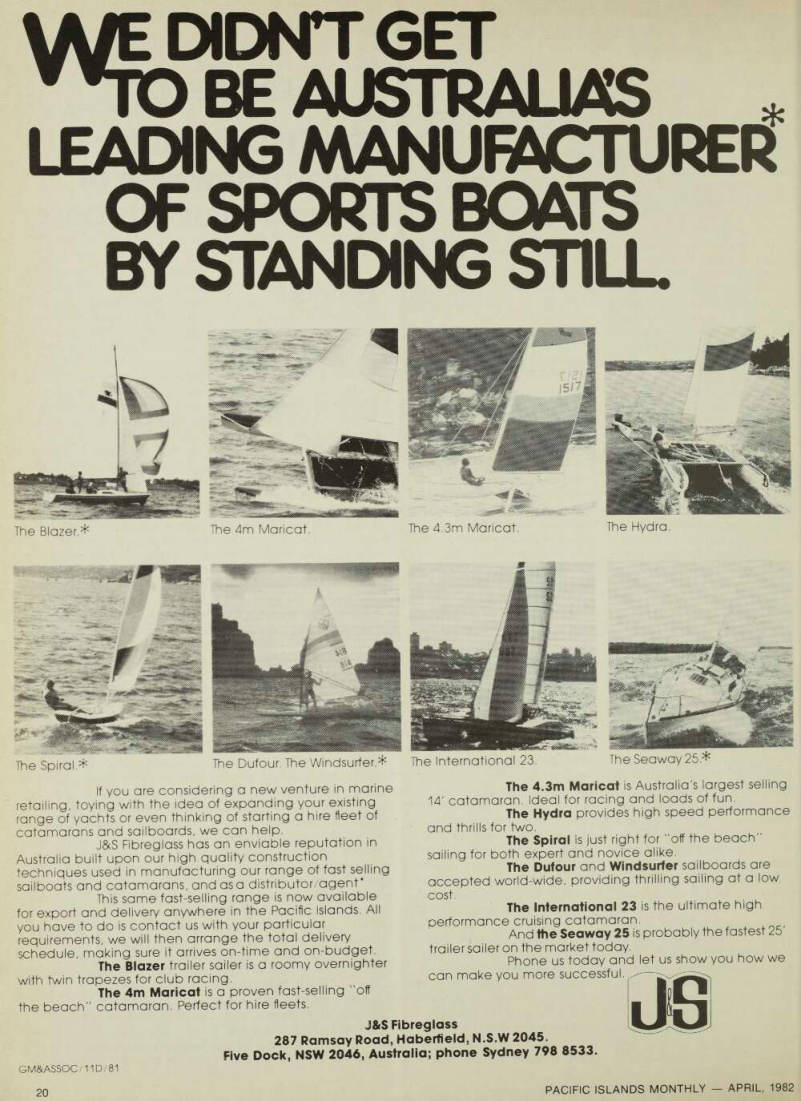
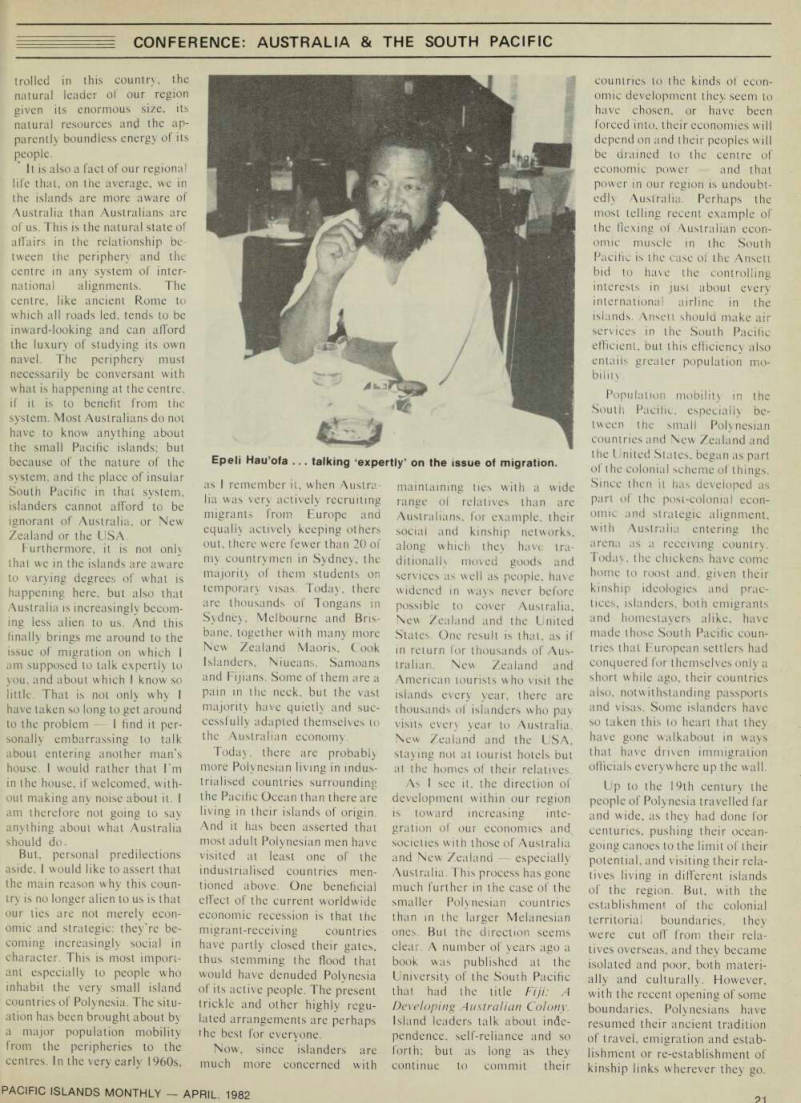

Epeli Hau’ofa
Pacific migration: A warm new web of human contacts is born
I must confess that I have not been able to fathom the wisdom of having a group of South Pacific Islanders come all the way to Canberra to make a spectacle of themselves in front of audiences and the media.
This kind of gathering reminds one, somehow, of those early years when one was a faithful and regular church-goer. The exercise of going to church regularly could become quite painful as not only was nothing new ever said, but also, and worse, things were repeated over and over every Sunday until one could stop listening and use the familiarity and cosiness of the situation to meditate on things totally un connected with the messages of the sermons of the day. But church congregations serve the very useful purpose of getting people of like mind together under the same roof, where they show their solidarity with each other and with the Lord, and where they reassure each other that things are going fine under divine guidance.
So, I believe, are conferences of this kind, or of most other kinds. We are solemnly gath ered here in Canberra, the cleanest city in the universe, to reaffirm the brotherhood of mankind: Lillie Brothers com ing to Big Brother’s house to have a pow-wow, to pay Big Brother honour due to his seniority, to give a little and, it may be hoped take back more than usual, to express views on Big Brother’s occasional lapses in fraternal responsibility, and, finally, to receive a blessing or two from the head of the tribe.
We should do more of this, I’m all for it. And we should also hold a similar conference next year at our university campus in Suva or at Waigani in Port
Moresby. In that meeting a group of merry Australians should come over to make a spectacle of themselves for our delectation. It’s what we in the islands call ‘true reciprocity’.
But, now that I’m here, I must sing a song or two for my air fares, and for the privilege and joy of being back in Canberra the Beautiful, where many of us from the islands have spent probably the most titillating years of our post-church-going lives.
About 20 years ago, when I first came to Australia for higher education, our then country-town pastor took me and a group of Fijian students for service at a small church located isolatedly on a farming property. After the pastor had introduced us to the congre gation outside the church, an elderly lady came up and, without a trace of malice or regret, said to me: “A few years ago, I wouldn’t have shaken your hand.” We have come a long way since the 1950 s and early 19605. Through education of various sorts, the mass me dia, greater international mo bility of ordinary people, and through the humanistic move ments of the 1960 s and early 19705, we, or some of us any way, have come to know each other well, and have formed, across national boundaries, last ing personal ties of friendship and in some cases, personal hostility.
And, through technological advancement and economic and strategic alignments in our re gion, Australia and the islands of the western and central South Pacific are being inexor ably drawn into a single system with intensifying bonds bonds that are increasingly be ing devised and perhaps con
trolled in this country, the natural leader of our region given its enormous size, its natural resources and the ap parently boundless energy of its people.
It is also a fact of our regional life that, on the average, we in the islands are more aware of Australia than Australians are of us. This is the natural state of affairs in the relationship be tween the periphery and the centre in any system of inter national alignments. The centre, like ancient Rome to which all roads led, tends to be inward-looking and can afford the luxury of studying its own navel. The periphery must necessarily be conversant with what is happening at the centre, if it is to benefit from the system. Most Australians do not have to know anything about the small Pacific islands; but because of the nature of the system, and the place of insular South Pacific in that system, islanders cannot afford to be ignorant of Australia, or New Zealand or the USA, Furthermore, it is not only that we in the islands are aware to varying degrees of what is happening here, but also that Australia is increasingly becom ing less alien to us. And this finally brings me around to the issue of migration on which 1 am supposed to talk expertly to you, and about which 1 know so little. That is not only why I have taken so long to get around to the problem I find it per sonally embarrassing to talk about entering another man’s house. I would rather that Em in the house, if welcomed, with out making any noise about it. I am therefore not going to say anything about what Australia should do.
But, personal predilections aside. I would like to assert that the main reason why this coun try is no longer alien to us is that our ties are not merely econ omic and strategic; they’re be coming increasingly social in character. This is most import ant especially to people who inhabit the very small island countries of Polynesia. The situ ation has been brought about by a major population mobility from the peripheries to the centres. In the very early 19605,
as I remember it, when Auslra lia was very actively recruiting migrants from Europe and equally actively keeping others out, there were fewer than 20 of my countrymen in Sydney, the majority of them students on temporary visas. Today, there are thousands of longans in Sydney, Melbourne and Bris bane, together with many more New Zealand Maoris, Cook Islanders, Niueans. Samoans and Fijians. Some of them are a pain in the neck, but the vast majority have quietly and suc cessfully adapted themselves to the Australian economy.
Today, there are probably more Polynesian living in indus trialised countries surrounding the Pacific Ocean than there are living in their islands of origin.
And it has been asserted that most adult Polynesian men have visited at least one of the industrialised countries men tioned above. One beneficial effect of the current worldwide economic recession is that the
migrant-receiving countries
have partly closed their gates, thus stemming the flood that would have denuded Polynesia of its active people. The present trickle and other highly regu lated arrangements are perhaps the best for everyone.
Now, since islanders are much more concerned with
maintaining ties with a wide range of relatives than are Australians, for example, their social and kinship networks, along which they have tra ditionally moved goods and services as well as people, have widened in ways never before possible to cover Australia, New Zealand and the United Stales One result is that, as if in return for thousands of Aus tralian. New Zealand and American tourists who visit the islands every year, there are thousands of islanders who pay visits every year to Australia.
New Zealand and the USA, staying not at tourist hotels but at the homes of their relatives As I see it, the direction of development within our region is toward increasing inte gration of our economies societies with those of Australia and New Zealand especially Australia. This process has gone much further in the case of the smaller Polynesian countries than in the larger Melanesian ones. But the direction seems clear. A number of years ago a book was published at the University of the South Pacific that had the title Fiji: A Developing Australian Colony.
Island leaders talk about inde pendence, self-reliance and so forth; but as long as they continue to commit their
countries to the kinds of econ omic development they seem to have chosen, or have been forced into, their economies will depend on and their peoples will be drained to the centre of economic power and that power in our region is undoubt edly Australia. Perhaps the most telling recent example of the flexing of Australian econ omic muscle in the South Pacific is the case of the Ansett bid to have the controlling interests in just about every international airline in the islands. Ansett should make air services in the South Pacific efficient, but this efficiency also entails greater population mo bility .
Population mobility in the South Pacific, especially be tween the small Polynesian countries and New Zealand and the United States, began as part of the colonial scheme of things.
Since then it has developed as part of the post-colonial econ omic and strategic alignment, with Australia entering the arena as a receiving country.
Today, the chickens have come home to roost and. given their kinship ideologies and prac tices, islanders, both emigrants and homestayers alike, have made those South Pacific coun tries that European settlers had conquered for themselves only a short while ago, their countries also, notwithstanding passports and visas. Some islanders have so taken this to heart that they have gone walkabout in ways that have driven immigration officials everywhere up the wall.
Up to the 19th century the people of Polynesia travelled far and wide, as they had done for centuries, pushing their ocean going canoes to the limit of their potential, and visiting their rela tives living in different islands of the region. But, with the establishment of the colonial territorial boundaries, they were cut off from their rela tives overseas, and they became isolated and poor, both materi ally and culturally. However, with the recent opening of some boundaries, Polynesians have resumed their ancient tradition of travel, emigration and estab lishment or re-establishment of kinship links wherever they go.
Epeli Hau’ofa ... talking ‘expertly' on the issue of migration.
They are now visiting countries like Australia, looking up rela tives, giving them gifts of fam ily news and traditionally valued goods, and returning home with wonderful stories, cash, goods of all kinds, new ideas, heightened aspirations and a determination to revisit them again and again.
These are very warm and very human things that are happening in the South Pacific region beneath the hard and tough reality of horse-trading conducted at the rarefied levels of international trade, aid and diplomacy. At those levels islan ders are the weak parties depen dent on their far, far stronger neighbours for their so-called development. But at the much lower level of mobility of thou sands of ordinary folk, islanders move, not as dependent people looking for handouts, or as groups of clients making spec tacles of themselves at confer ences like this, but as free and independent kinsmen visiting their relatives wherever they are in their ocean, to have a good time, to earn some honest money by hard work for short periods, and then to return home to build a house or to set up a business that will surely collapse.
When we talk about the issue of migration at official and academic levels, we tend to do so in terms of social, political and economic implications to countries and institutions. But those who migrate, or who visit their relatives abroad, do not think in terms of larger impli cations which are too abstract and remote to be of immediate concern to them. These people make their decisions on the basis of their evaluation of their personal needs and the needs of those closest to them.
As I see it, the issue of migration in the islands revolves on two related problems. The first is the problem of the economic and social viability of local groups and nations that are being drained of their active manpower, pitched against the needs of individuals for social and economic opportunities for themselves and their families.
The other problem is the will ingness of receiving countries to
continue accepting migrants and short-term visitors. There has been a tendency for coun tries like Australia and New Zealand to assist in the econ omic development of the South Pacific islands with the aim to enable the islands to provide adequately for the needs of their people and so prevent or diminish the desire for emi gration. But the reality of small ness and lack of resources to develop the islands along the lines their inhabitants have taken, coupled with high popu lation growth rates and even higher levels of aspirations, have put an effective limit on how far these small states can develop in order to meet the growing demands of their people.
But, if it is the case, as I have dared to suggest, that there is already a growing integration of the economies and societies in our region, which includes Aus tralia and New Zealand, then it is inevitable that goods and people will continue to flow within the system. During my regular fits of insanity, I see the day when all boundaries in our region are done away with in order to allow for an unfettered movement of trade, industries and people. For many years now, some well-intentioned indi viduals and groups have been trying to persuade Australian governments to accept more migrants from the islands. I think that in keeping with our growing integration, all doors in our region should be opened. If Australia is asked to accept migrants and goods from the islands, then it is only reason able and fair that the islands also open their doors for Austra lians and for Australian goods and industries. Not many Aus tralians or Australian industries would like to come to the islands, but there are people here at the centre who are sufficiently crazy to wish to opt out of the ratrace and go tropical. And there are many islanders who are sufficiently insane to wish to come to the centre and join the fray. Thus, those who wish to live in the world of fast pace and acceler ated growth will have their desires fulfilled at the centre of
the system. And those who wish to lead a more relaxed life, to live in a world where things are small-scale and easy to compre hend, will have their desires fulfilled by moving to the peri pheries of the system.
But to return from fantasy to reality, I think that it is not what we say and do as conferees and analysts, but the actual doings of thousands of mobile people that will have the greatest impact on the issue of population mobility in our re gion. And I also think that in the near future, Australian citi zens of South Pacific islands origin will press for greater Australian involvement in our region than has so far been the case. They, with their citizen ship and upbringing here, and with their social, cultural and historical ties with the islands, will, it may be hoped, become more effective spokesmen for their country’s relationship with the island South Pacific than any of us here today.
Niue looks at
idea of TV...
Problem how to keep Niue Island’s population of 3578 at home. Possible solution in troduce television to the island.
Niue’s Auckland Consul Toke Talagi has the task of assessing the technical feasi bility of introducing television to Niue, and of examining the legal implications of the use of overseas programmes. ‘lf we get television the programmes will most likely come from New Zealand,’ he said. Public submissioins have been called for on the scheme before the Niue Government makes a decision.
About three times as many Niueans live in New Zealand as at home, and the island govern ment is keen to stop the exodus and bring people back.
Meanwhile, one of the first things Mr Talagi did was look for a videotape of an Australian documentary on the introduc tion of television to Yap. That painted a controversial view <of the impact of television on an island community. William Gas son in Wellington.
... and also
to Yap
What Mr Talagi saw when he watched the ‘Australian docu mentary’ is described in the following terms in a New Zea land Herald report of November 27, 1981: ‘Blatant electronic colonialism,’ complete with sinister CIA undertones, is investigated in ‘Yap . . . How Did You Know We’d Like TV?’ on TV-1 at 9.30 tonight.
When Australian filmmaker Dennis O’Rourke went to the small Pacific island of Yap, he was looking for a ‘metaphor’ for the relation between the United States and the Third World.
He found the inhabitants in tin shacks, staring with glazed eyes at television.
The television system was installed in Yap in 1979 by a Los Angeles-based company.
It came complete with adver tisements for ‘your local Southern California Ford dealer,’ ‘Big Macs’, vacations in Barbados, and carpet shampoo.
Many of the local population are opposed to television, re garding it as a further threat to their culture and as an attempt by outsiders to create change.
They feel that television along with many other things provided by the United States is designed to create depen dency.
They have a theory, not supported by evidence, that the company which installed the television system to Yap has connections with the CIA.
They say it is a conspiracy to promote United States culture and values in an otherwise insignificant, but strategically important, island . . .
It has been so inundated with free handouts that the people are abandoning their culture and turning to American values and institutions.
Village life, fishing in the lagoon and gardening in the taro patches is being replaced with canned food, beer and shanty towns.
Many people feel that little has been done for the islanders except what was in the strategic self-interest of the United States . . .
Advertisements & other items, pp. 19-24 (4 items)
19
CONFERENCE: AUSTRALIA & THE SOUTH PACIFIC
PACIFIC ISLANDS MONTHLY APRIL, 1982
Leading Manufacturer
\A/E DIDNT GET
¥ TO BE AUSTRAUAS *
OF SPORTS BOATS
GY STANDING STILL
i
■ fgpr
The Blazer.* The 4m Maricat.
The 4.3 m Maricat.
The Hydra. f ... ai The Dufour. The Windsurfer* The International 23.
The Spiral*
If you are considering a new venture in marine retailing, toying with the idea of expanding your existing range of yachts or even thinking of starting a hire fleet of catamarans and sailboards, we can help.
J&S Fibreglass has an enviable reputation in Australia built upon our high quality construction techniques used in manufacturing our range of fast selling sailboats and catamarans, and as a distributor/agent' This same fast-selling range is now available for export and delivery anywhere in the Pacific Islands. All you have to do is contact us with your particular requirements, we will then arrange the total delivery schedule, making sure it arrives on-time and on-budget.
The Blazer trailer sailer is a roomy overnighter with twin trapezes for club racing.
The 4m Maricat is a proven fast-selling "off the beach" catamaran. Perfect for hire fleets. - The Seaway 25* The 4.3 m Maricat is Australia's largest selling 14' catamaran. Ideal for racing and loads of fun.
The Hydra provides high speed performance and thrills for two.
The Spiral is just right for "off the beach" sailing for both expert and novice alike.
The Dufour and Windsurfer sailboards are accepted world-wide, providing thrilling sailing at a low cost.
The International 23 is the ultimate high performance cruising catamaran.
And the Seaway 25 is probably the fastest 25 trailer sailer on the market today.
Phone us today and let us show you how we can make you more successful.
GM&ASSOC/11D/81
J&S Fibreglass 287 Ramsay Road, Haberfield, N.S.W 2045.
Five Dock, NSW 2046, Australia; phone Sydney 798 8533
tiS
SOLAREX
ELECTRICITYFROM SUNLIGHT
Oil short, ruralised, developing nations are great beneficiaries of the advances being made in SOLAR ELECTRIC GENERATORS 3 e It si stit
SIS
f ■ • V & $ ' rw ■ ttfei & ■ The communal hut of this Pacific island village has a projector and video recorder powered by a photovoltaic generator. These units are used to show the villagers current farming techniques, basic health and child care along with providing valuable assistance for the regional educational program. All of the huts have a solar powered lighting system and the communal health centre keeps drugs sterile and temperate in a solar-powered refrigerator-freezer. The villagers have a central water catchment supplied by a Solarex Photovoltaic Pumping System while communications are effected by means of a H.F. radio network powered by the central solar generator.
Photovoltaic generators where chosen over the more traditional liquid fuelled systems because they were the most cost effective option when the following was considered: •Virtual unlimited operational life • Fuel free • Minimal maintenance to be carried out by non-skilled personnel •Foreign exchange savings resulting from a lower liquid fuel bill.
Solar powered generators are often the most economic alternative for: • Remote homes and villages • Remote communication sites • Water pumping •Telemetry outstations, etc.
If you would like to know more about the Pacific areas most abundant free energy source, contact: SOLAREX PTY. LIMITED THE FREE ENERGY COMPANY" 5 BELLONA AVE • REGENTS PARK 2143 AUSTRALIA • P.O. BOX 204 • CHESTER HILL 2162 • TELEPHONE 644 5055 • TELEX AA21975
Save energy.
Save money.
With Rheem Solar.
i m 9^ Now is the time to think about installing Rheem Solar.
With a Rheem Solar system, you can save on your annual hot water bill and help conserve valuable energy.
A Rheem Solar system offers you some very special features:- The exclusive Rheem Sunstat* valve controls water temperature.
This means your water temperature can’t exceed 70 degrees, so there is no risk of accidental scalding.
Rheem Solar systems have all copper absorber plates, one of the best heat conductors in the world.
Their 200 or 300litre capacity will suit your family needs.
And they come with Rheem reliability and 40 years' experience in the hot water business.
For a free brochure on Rheem Solar, send in the coupon below. fib: Export Manager, Appliance Division, Rheem Australia Ltd, RO.
Box 6, Rydalmere 2116. Australia.
Name: Address: DISTRIBUTORS: PAPUA NEW GUINEA. Steamships Trading Co.
Port Moresby, Lae, Kieta, Goroka, Madang, Rabaul, Popondetta, Kundiawa, Samaria, Mt. Hagen, Vanimo. Mainland Plumbing Supplies: Lae. NEW CALEDONIA. Ballande: Noumea. TAHITI. Coupimex: Papeete.
We would welcome enquiries for agencies in areas not covered above.
RHAIIO6
21
CONFERENCE: AUSTRALIA & THE SOUTH PACIFIC
PACIFIC ISLANDS MONTHLY APRIL, 1982
23
CONFERENCE: AUSTRALIA & THE SOUTH PACIFIC
PACIFIC ISLANDS MONTHLY APRIL, 1982
the ‘Melanesian Renaissance’
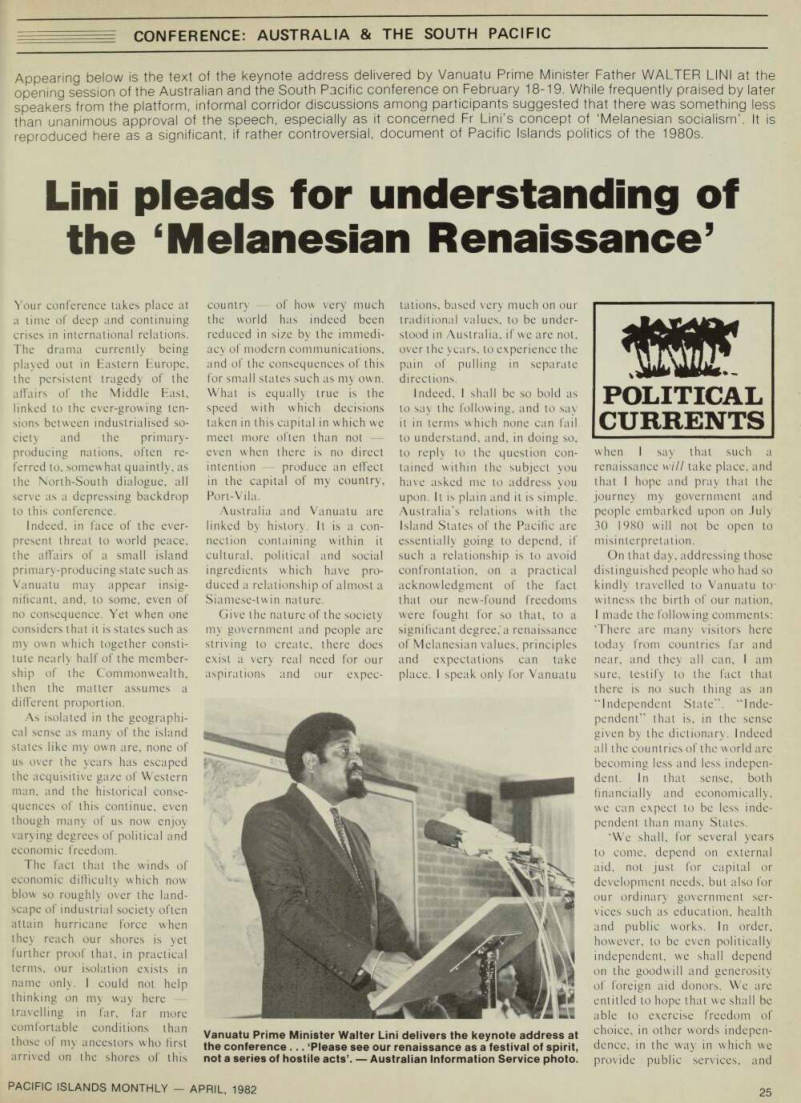
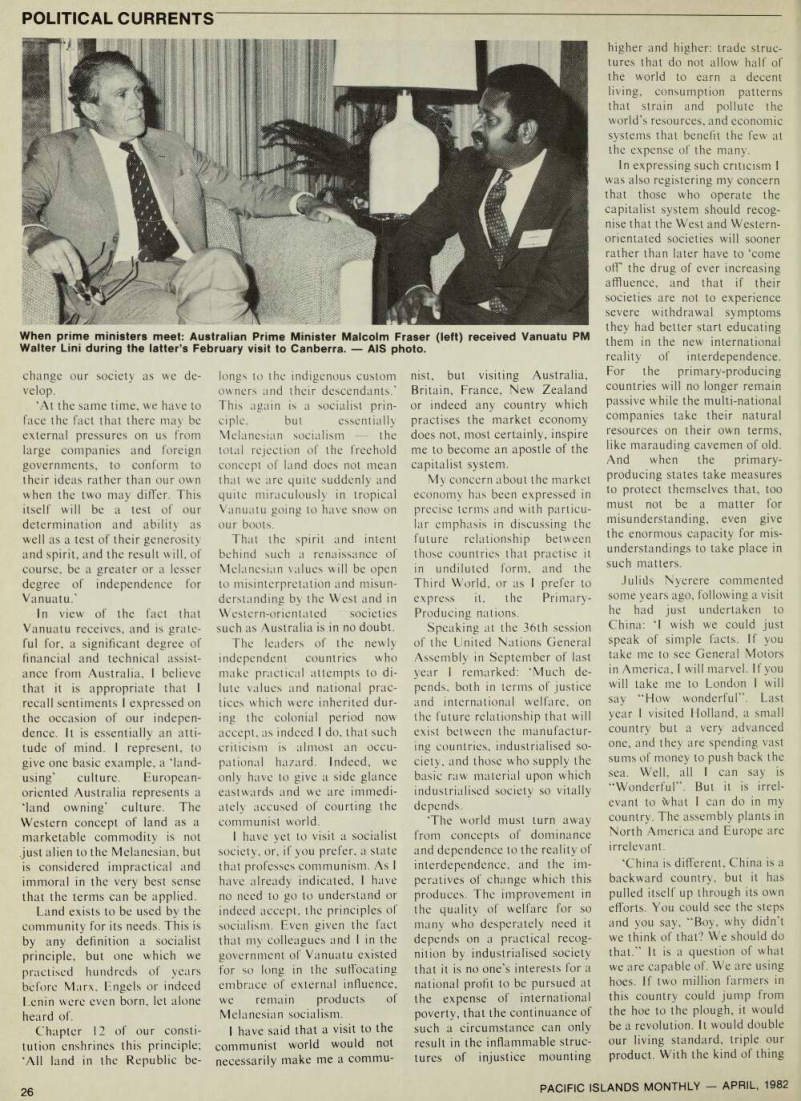
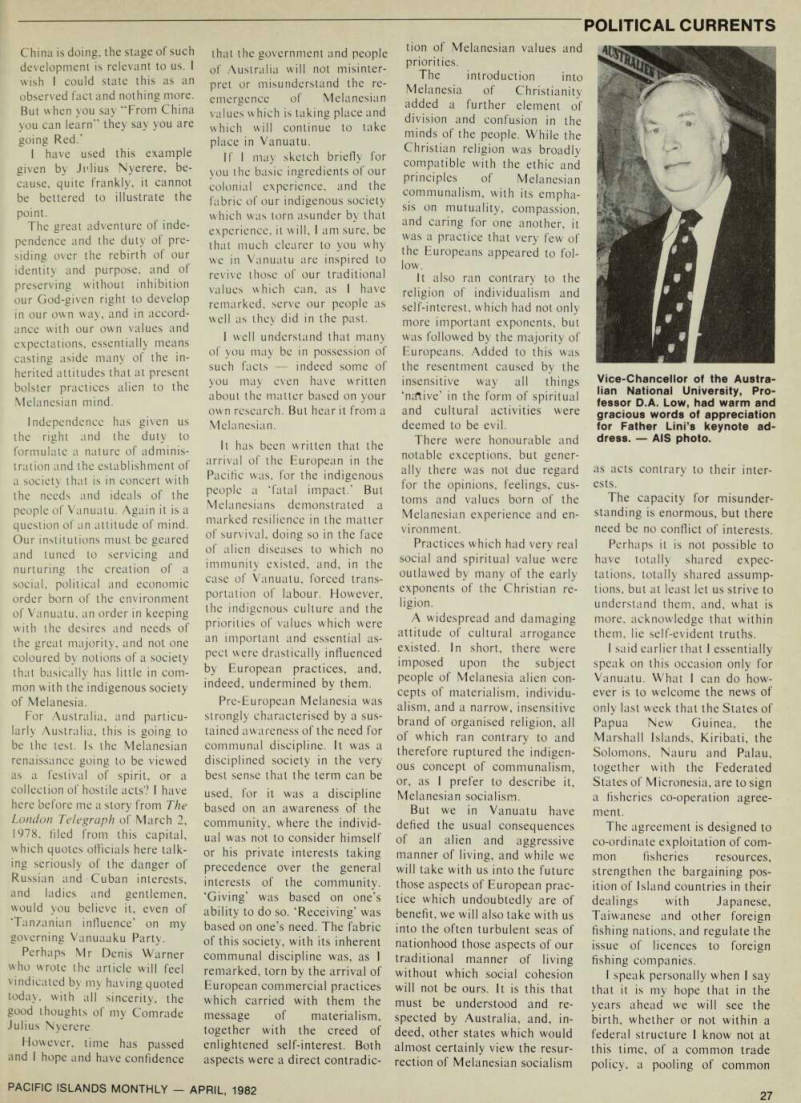

Political
Currents
Lini pleads for understanding of the ‘Melanesian Renaissance’
Appearing below is the text of the keynote address delivered by Vanuatu Prime Minister Father WALTER LINI at the opening session of the Australian and the South Pacific conference on February 18-19. While frequently praised by later speakers from the platform, informal corridor discussions among participants suggested that there was something less than unanimous approval of the speech, especially as it concerned Fr Lini’s concept of ‘Melanesian socialism’. It is reproduced here as a significant, if rather controversial, document of Pacific Islands politics of the 1980 s.
Your conference takes place at a time of deep and continuing crises in international relations.
The drama currently being played out in Eastern Europe, the persistent tragedy of the affairs of the Middle East, linked to the ever-growing ten sions between industrialised so ciety and the primary producing nations, often re ferred to, somewhat quaintly, as the North-South dialogue, all serve as a depressing backdrop to this conference.
Indeed, in face of the ever present threat to world peace, the affairs of a small island primary-producing stale such as Vanuatu may appear insig nificant, and, to some, even of no consequence. Yet when one considers that it is states such as my own which together consti tute nearly half of the member ship of the Commonwealth, then the matter assumes a different proportion.
As isolated in the geographi cal sense as many of the island stales like my own are, none of us over the years has escaped the acquisitive gaze of Western man, and the historical conse quences of this continue, even though many of us now enjoy varying degrees of political and economic freedom.
The fact that the winds of economic difficulty which now blow so roughly over the land scape of industrial society often attain hurricane force when they reach our shores is yet further proof that, in practical terms, our isolation exists in name only. I could not help thinking on my way here travelling in far, far more comfortable conditions than those of my ancestors who first arrived on the shores of this
country of how very much the world has indeed been reduced in size by the immedi acy of modern communications, and of the consequences of this for small slates such as my own.
What is equally true is the speed with which decisions taken in this capital in which we meet more often than not even when there is no direct intention produce an effect in the capital of my country, Porl-Vila.
Australia and Vanuatu are linked by history. 11 is a con nection containing within it cultural, political and social ingredients which have pro duced a relationship of almost a Siamese-twin nature.
Give the nature of the society my government and people are striving to create, there does exist a very real need for our aspirations and our expec
tations, based very much on our traditional values, to be under stood in Australia, if we are not, over the years, to experience the pain of pulling in separate directions.
Indeed. I shall be so bold as to say the following, and to say it in terms which none can fail to understand, and, in doing so, to reply to the question con tained within the subject you have asked me to address you upon. It is plain and it is simple.
Australia’s relations with the Island States of the Pacific are essentially going to depend, if such a relationship is to avoid confrontation, on a practical acknowledgment of the fact that our new-found freedoms were fought for so that, to a significant degree,'a renaissance of Melanesian values, principles and expectations can take place. I speak only for Vanuatu
when I say that such a renaissance will take place, and that I hope and pray that the journey my government and people embarked upon on July 30 1980 will not be open to misinterpretation.
On that day, addressing those distinguished people who had so kindly travelled to Vanuatu to* witness the birth of our nation, I made the following comments: There arc many visitors here today from countries far and near, and they all can, I am sure, testify to the fact that there is no such thing as an “Independent State”. “Inde pendent” that is, in the sense given by the dictionary. Indeed all the countries of the world are becoming less and less indepen dent. In that sense, both financially and economically, we can expect to be less inde pendent than many States. ‘We shall, for several years to come, depend on external aid, not just for capital or development needs, but also for our ordinary government ser vices such as education, health and public works. In order, however, to be even politically independent, we shall depend on the goodwill and generosity of foreign aid donors. We are entitled to hope that we shall be able to exercise freedom of choice, in other words indepen dence, in the way in which we provide public services, and
Vanuatu Prime Minister Walter Lini delivers the keynote address at the conference ... ‘Please see our renaissance as a festival of spirit, not a series of hostile acts’. - Australian Information Service photo.
change our society as we de velop. ‘At the same time, we have to face the fact that there may be external pressures on us from large companies and foreign governments, to conform to their ideas rather than our own when the two may differ. This itself will be a test of our determination and ability as well as a test of their generosity and spirit, and the result will, of course, be a greater or a lesser degree of independence for Vanuatu.’
In view of the fact that Vanuatu receives, and is grate ful for, a significant degree of financial and technical assist ance from Australia, I believe that it is appropriate that 1 recall sentiments I expressed on the occasion of our indepen dence. It is essentially an atti tude of mind. I represent, to give one basic example, a ‘land using’ culture. European oriented Australia represents a ‘land owning’ culture. The Western concept of land as a marketable commodity is not just alien to the Melanesian, but is considered impractical and immoral in the very best sense that the terms can be applied.
Land exists to be used by the community for its needs. This is by any definition a socialist principle, but one which we practised hundreds of years before Marx, Engels or indeed Lenin were even born, let alone heard of.
Chapter 12 of our consti tution enshrines this principle; ‘All land in the Republic be
longs to the indigenous custom owners and their descendants.’
This again is a socialist prin ciple. but essentially Melanesian socialism the total rejection of the freehold concept of land does not mean that we arc quite suddenly and quite miraculously in tropical Vanuatu going to have snow on our bools.
That the spirit and intent behind such a renaissance of Melanesian values will be open to misinterpretation and misun derstanding by the West and in Western-orientated societies such as Australia is in no doubt.
The leaders of the newly independent countries who make practical attempts to di lute values and national prac tices which were inherited dur ing the colonial period now accept, as indeed I do, that such criticism is almost an occu pational hazard. Indeed, we only have to give a side glance eastwards and we are immedi ately accused of courting the communist world. 1 have yet to visit a socialist society, or, if you prefer, a stale that professes communism. As 1 have already indicated. 1 have no need to go to understand or indeed accept, the principles of socialism. Even given the fact that my colleagues and 1 in the government of Vanuatu existed for so long in the suffocating embrace of external influence, we remain products of Melanesian socialism. 1 have said that a visit to the communist world would not necessarily make me a commu
nist, but visiting Australia, Britain, France, New Zealand or indeed any country which practises the market economy does not, most certainly, inspire me to become an apostle of the capitalist system.
My concern about the market economy has been expressed in precise terms and with particu lar emphasis in discussing the future relationship between those countries that practise it in undiluted form, and the Third World, or as I prefer to express it, the Primary- Producing nations.
Speaking at the 361 h session of the United Nations General Assembly in September of last year I remarked: ‘Much de pends, both in terms of justice and international welfare, on the future relationship that will exist between the manufactur ing countries, industrialised so ciety, and those who supply the basic raw material upon which industrialised society so vitally depends. ‘The world must turn away from concepts of dominance and dependence to the reality of interdependence, and the im peratives of change which this produces. The improvement in the quality of welfare for so many who desperately need it depends on a practical recog nition by industrialised society that it is no one’s interests for a national profit to be pursued at the expense of international poverty, that the continuance of such a circumstance can only result in the inflammable struc tures of injustice mounting
higher and higher; trade struc tures that do not allow half of the world to earn a decent living, consumption patterns that strain and pollute the world’s resources, and economic systems that benefit the few at the expense of the many.
In expressing such criticism 1 was also registering my concern that those who operate the capitalist system should recog nise that the West and Western orientated societies will sooner rather than later have to ‘come off the drug of ever increasing affluence, and that if their societies are not to experience severe withdrawal symptoms they had better start educating them in the new international reality of interdependence.
For the primary-producing countries will no longer remain passive while the multi-national companies take their natural resources on their own terms, like marauding cavemen of old.
And when the primary producing states take measures to protect themselves that, too must not be a matter for misunderstanding, even give the enormous capacity for mis understandings to take place in such matters.
Julids Nyerere commented some years ago, following a visit he had just undertaken to China: ‘I wish we could just speak of simple facts. If you take me to see General Motors in America, I will marvel. If you will take me to London I will say “How wonderful”. Last year I visited Holland, a small country but a very advanced one, and they are spending vast sums of money to push back the sea. Well, all I can say is “Wonderful”. But it is irrel evant to I can do in my country. The assembly plants in North America and Europe are irrelevant. ‘China is different, China is a backward country, but it has pulled itself up through its own efforts. You could see the steps and you say, “Boy, why didn’t we think of that? We should do that.” It is a question of what we are capable of. We are using hoes. If two million farmers in this country could jump from the hoe to the plough, it would be a revolution. It would double our living standard, triple our product. With the kind of thing
When prime ministers meet: Australian Prime Minister Malcolm Fraser (left) received Vanuatu PM Walter Lini during the latter’s February visit to Canberra. - AIS photo.
China is doing, the stage of such development is relevant to us. I wish I could state this as an observed fact and nothing more.
But when you say “From China you can learn” they say you are going Red.’ 1 have used this example given by Julius Nyerere, be cause, quite frankly, it cannot be bettered to illustrate the point.
The great adventure of inde pendence and the duty of pre siding over the rebirth of our identity and purpose, and of preserving without inhibition our God-given right to develop in our own way, and in accord ance with our own values and expectations, essentially means casting aside many of the in herited attitudes that at present bolster practices alien to the Melanesian mind.
Independence has given us the right and the duly to formulate a nature of adminis tration and the establishment of a society that is in concert with the needs and ideals of the people of Vanuatu. Again it is a question of an altitude of mind.
Our institutions must be geared and tuned to servicing and nurturing the creation of a social, political and economic order born of the environment of Vanuatu, an order in keeping with the desires and needs of the great majority, and not one coloured by notions of a society that basically has little in com mon with the indigenous society of Melanesia.
For Australia, and particu larly Australia, this is going to be the test. Is the Melanesian renaissance going to be viewed as a festival of spirit, or a collection of hostile acts? I have here before me a story from The London Telegraph of March 2, 1978, tiled from this capital, which quotes officials here talk ing seriously of the danger of Russian and Cuban interests, and ladies and gentlemen, would you believe it, even of ‘Tanzanian influence’ on my governing Vanuaaku Party.
Perhaps Mr Denis Warner who wrote the article will feel vindicated by my having quoted today, with all sincerity, the good thoughts of my Comrade Julius Nyerere However, lime has passed and I hope and have confidence
that the government and people of Australia will not misinter pret or misunderstand the re cmergcncc of Melanesian values which is taking place and which will continue to lake place in Vanuatu.
If I may sketch briefly for you the basic ingredients of our colonial experience, and the fabric of our indigenous society which was lorn asunder by that experience, it will, I am sure, be that much clearer to you why we in Vanuatu arc inspired to revive those of our traditional values which can, as 1 have remarked, serve our people as well as they did in the past. 1 well understand that many of you may be in possession of such facts indeed some of you may even have written about the matter based on your own research. But hear it from a Melanesian.
It has been written that the arrival of the European in the Pacific was, for the indigenous people a ‘fatal impact.’ But Melanesians demonstrated a marked resilience in the matter of survival, doing so in the face of alien diseases to which no immunity existed, and, in the case of Vanuatu, forced trans portation of labour. However, the indigenous culture and the priorities of values which were an important and essential as pect were drastically influenced by European practices, and, indeed, undermined by them.
Pre-European Melanesia was strongly characterised by a sus tained awareness of the need for communal discipline. It was a disciplined society in the very best sense that the term can be used, for it was a discipline based on an awareness of the community, where the individ ual was not to consider himself or his private interests taking precedence over the general interests of the community. ‘Giving’ was based on one’s ability to do so. ‘Receiving’ was based on one’s need. The fabric of this society, with its inherent communal discipline was, as I remarked, torn by the arrival of European commercial practices which carried with them the message of materialism, together with the creed of enlightened self-interest. Both aspects were a direct contradic
tion of Melanesian values and priorities.
The introduction into Melanesia of Christianity added a further element of division and confusion in the minds of the people. While the Christian religion was broadly compatible with the ethic and principles of Melanesian communalism, with its empha sis on mutuality, compassion, and caring for one another, it was a practice that very few of the Europeans appeared to fol low.
It also ran contrary to the religion of individualism and self-interest, which had not only more important exponents, but was followed by the majority of Europeans. Added to this was the resentment caused by the insensitive way all things ‘native’ in the form of spiritual and cultural activities were deemed to be evil.
There were honourable and notable exceptions, but gener ally there was not due regard for the opinions, feelings, cus toms and values born of the Melanesian experience and en vironment.
Practices which had very real social and spiritual value were outlawed by many of the early exponents of the Christian re ligion.
A widespread and damaging attitude of cultural arrogance existed. In short, there were imposed upon the subject people of Melanesia alien con cepts of materialism, individu alism, and a narrow, insensitive brand of organised religion, all of which ran contrary to and therefore ruptured the indigen ous concept of communalism, or, as I prefer to describe it, Melanesian socialism.
But we in Vanuatu have defied the usual consequences of an alien and aggressive manner of living, and while we will take with us into the future those aspects of European prac tice which undoubtedly are of benefit, we will also take with us into the often turbulent seas of nationhood those aspects of our traditional manner of living without which social cohesion will not be ours. It is this that must be understood and re spected by Australia, and, in deed, other states which would almost certainly view the resur rection of Melanesian socialism
as acts contrary to their inter ests.
The capacity for misunder standing is enormous, but there need be no conflict of interests.
Perhaps it is not possible to have totally shared expec tations, totally shared assump tions, but at least let us strive to understand them, and, what is more, acknowledge that within them, lie self-evident truths. 1 said earlier that I essentially speak on this occasion only for Vanuatu. What I can do how ever is to welcome the news of only last week that the States of Papua New Guinea, the Marshall Islands, Kiribati, the Solomons, Nauru and Palau, together with the Federated States of Micronesia, are to sign a fisheries co-operation agree ment.
The agreement is designed to co-ordinate exploitation of com mon fisheries resources, strengthen the bargaining pos ition of Island countries in their dealings with Japanese, Taiwanese and other foreign fishing nations, and regulate the issue of licences to foreign fishing companies.
I speak personally when I say that it is my hope that in the years ahead we will see the birth, whether or not within a federal structure I know not at this lime, of a common trade policy, a pooling of common
Vice-Chancellor of the Austra lian National University, Pro fessor D.A. Low, had warm and gracious words of appreciation for Father Lini’s keynote ad dress. - AIS photo.
services, and perhaps a common foreign policy, among the slates of Melanesia.
It is my considered opinion that much will depend on such a vision of the future being fulfilled. Certainly such an as sociation of Melanesian states would hasten the day when we could finally rid ourselves of the inhibition of requiring foreign aid.
For while I have been talking about domestic strategy, the awakening and gaining of strength in the Islands of the Pacific will undoubtedly and quite rightly influence us to draw' more closely together, in order to generate yet further strength. This in turn will assist us towards developing a re gional strategy, which I hope will include a common policy on foreign relations.
Vanuatu’s marine economic zone is a potential source of great economic strength, and we intend to safeguard it and to see that it is utilised for the good of the majority of our people.
It will only be by a coming together of the Island states that we will maintain our hard won independence in a danger ous and precarious world. The Pacific is one of the last regions of the world where the heavy hand of colonialism continues to be played.
These remnants of the past must be lifted from our ocean, for, in all truth, and as I have remarked before, until all of us are free, none of us are. We will be watching Australia with the greatest of interest in this re gard, and if at limes we become bolder in international matters, then our reasons for so doing, will. I hope, be understood in
this and other capitals.
My government’s decision of two weeks ago to prohibit two American warships from visit ing Port-Vila, because no assur ance could be given by the government of the United States that nuclear devices were not being carried on board was, 1 hope, understood and appreci ated. That, ladies and gentlemen, is just one small piece of evidence as to how bold we hope to be in the future.
There was a book written some years ago called The Ugly American which spoke of an aggressive American influence in Southeast Asia. 1 hope that there will never be a cause for a work to be written called The Ugly Australian. I hope and believe not. It has been said by another, and at a different time, that Australia is a ‘white island in a brown sea’.
There are good and encourag ing signs, particularly among the young in Australia, that the natural commitment their country has to the Pacific has to be practically acknowledged.
There are good and positive signs that this is so in the government of Australia, and 1 applaud it.
The success of Australia’s relations with the Pacific Islands states will be based upon the practical and sus tained recognition that no one culture is basically superior to another, that each and every culture, together with its social, political and economic ingredi ents, has a meaning and value to the people who gave birth to it.
It remains the hope of the government I lead that such a principle will colour Australian Pacific policies in the years that lie ahead.
Advertisements & other items, pp. 25-31 (2 items)
25
CONFERENCE: AUSTRALIA & THE SOUTH PACIFIC
PACIFIC ISLANDS MONfHLY APRIL, 1982
Quality
BEHIND THE NAME
: or over a century RENOLD has been in
the forefront of power transmission
Linked with RENOLD are these
great names.
RENOLD really makes
things move
ELECTRONICALLY—
HYDRAULICALLY-
MECHANICALLY—
TR
LARTER
ft**
QUALITY
TRANSMISSION PRODUCTS
GEAR MOTORS
WORM AND
HELICAL REDUCER
FLEXIBLE
COUPLINGS
TRANSMISSION
AND CONVEYOR
CHAINS
SHAFT
MOUNTED
HELICAL UNITS
VIBRATING
SHAKER
DRIVES
SPRAG AND
HYDRAULIC
COUPLINGS
ft
VARIABLE
UNITS
SPROCKETS
AND GEARS
VARIABLE
AC/DC
CONTROLLERS
RENOLD AUSTRALIA PTY LTD
• MELBOURNE (03) 560 6666
• BRISBANE (07) 275 2155
• ADELAIDE (08) 46 9077
• PERTH (09) 381 2533
• SYDNEY (02) 80 0261
• TOWNSVILLE (077) 79 5922 '
• NEWCASTLE (049) 61 5681 L
• WOLLONGONG (042) 71 1011 t
■~~w
SONY
VIDEO RECORDERS
VIDEO MOVIES
W J VIDEO ACCESSORIES
JVC
JVC
r CM
INTERCAPE-VIDEO RECORDER CENTRE
19-21 Lonsdale Street. Melbourne, Victoria 3000 Telephone: (03) 633 086, 633 196
» M
neither time nor place.
«w m *r¥ i r mn s&n.
VM S s sa® w '*W' ’ *4 wLt. f: f ii i i m K 5 A /■
C/ G/l/?S
' V r* <- ,■ i
SMOOTH, MILD CIGARS
A/ Corona • Commodore Panatella • Lancers • Tipped Lancers • Panatella W 754
DeZURBK
A complete valve range in a multitude of material and specification options in sizes V»" - 72” with manual, pneumatic, hydraulic or electric actuators. Proven worldwide in municipal, industrial and process applications.
Electric Control Valves sJ Resilient Seated Butterfly Valves V-port Ball Valves High Pressure Butterfly Valves
DeZURBK
DeZURIK OF AUSTRALIA PTY. LTD., P.O. Box 204, Vineyard Road, Sunbury, Victoria 3429, Australia. Telephone: 03-744-2244, Telex: AA33732.
Paper Stock Consistency Transmitters Eccentric Plug Valves 1 Knife Gate Valves T
A UIMrT OF GENERAL SIGNAL
People
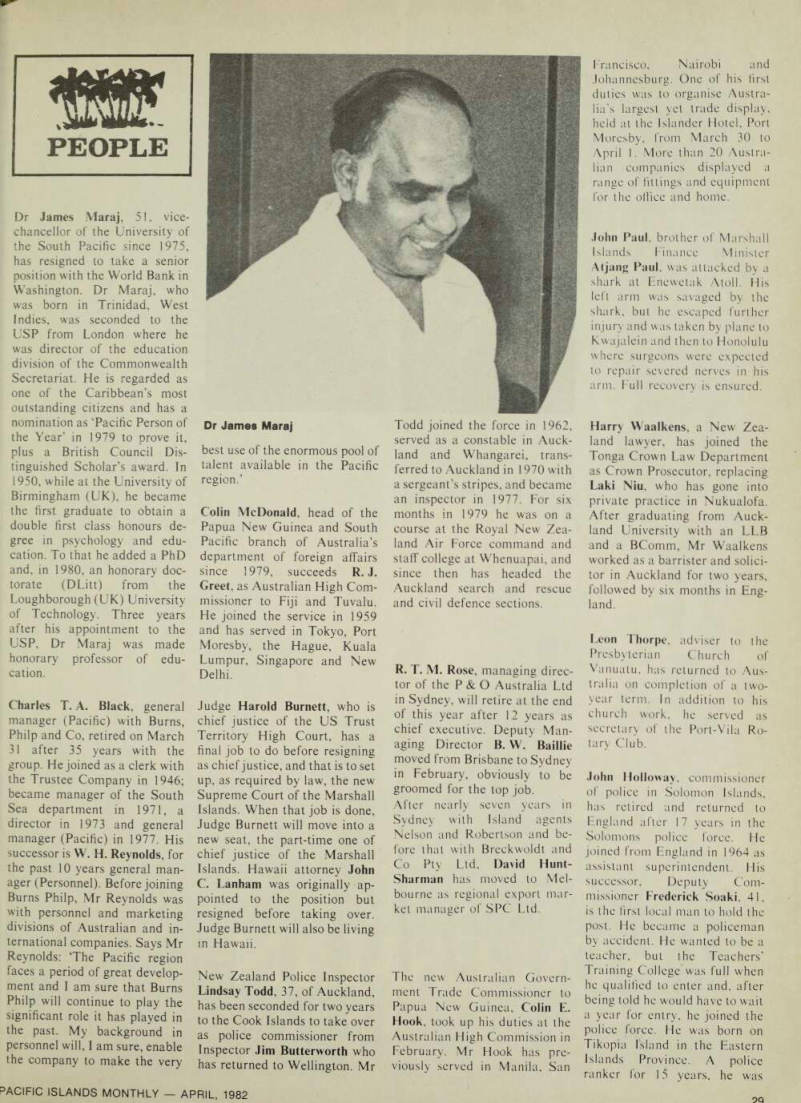
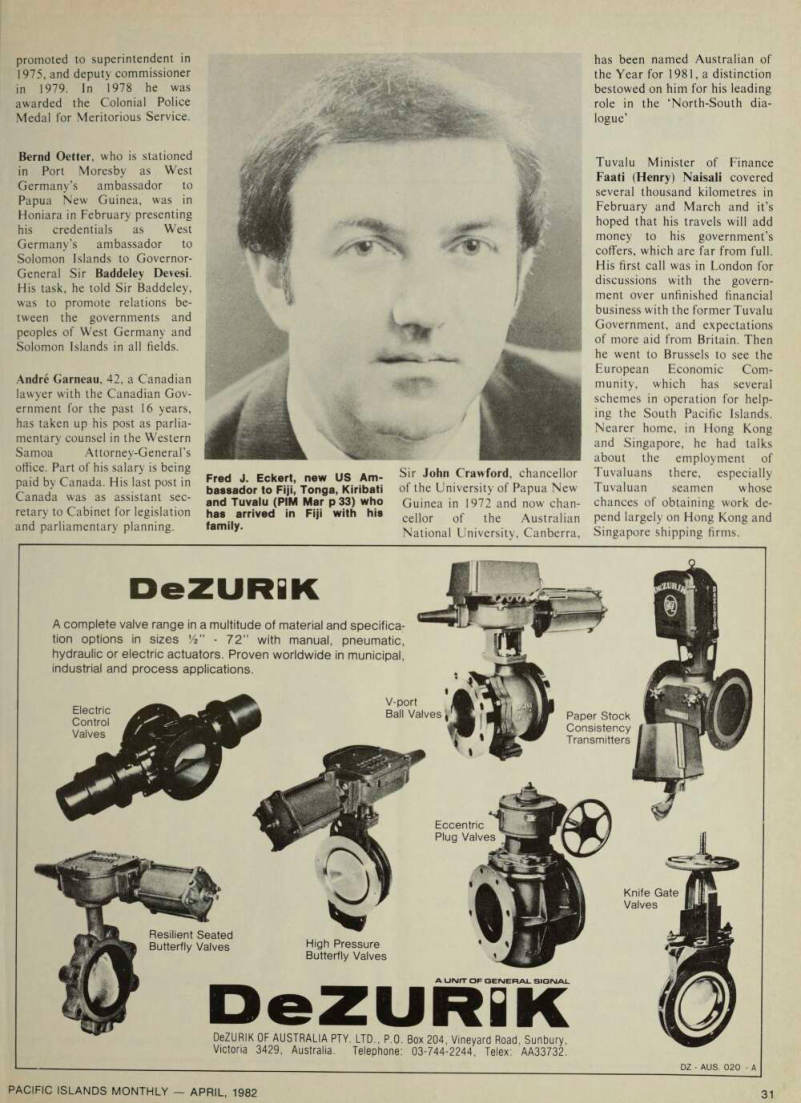
Dr James Maraj, 51, vice chancellor of the University of the South Pacific since 1975, has resigned to take a senior position with the World Bank in Washington. Dr Maraj, who was born in Trinidad, West Indies, was seconded to the USP from London where he was director of the education division of the Commonwealth Secretariat. He is regarded as one of the Caribbean’s most outstanding citizens and has a nomination as ‘Pacific Person of the Year’ in 1979 to prove it, plus a British Council Dis tinguished Scholar’s award. In 1950, while at the University of Birmingham (UK), he became the first graduate to obtain a double first class honours de gree in psychology and edu cation. To that he added a PhD and, in 1980, an honorary doc torate (DLitt) from the Loughborough (UK) University of Technology. Three years after his appointment to the USP, Dr Maraj was made honorary professor of edu cation.
Charles T. A. Black, general manager (Pacific) with Burns, Philp and Co, retired on March 31 after 35 years with the group. He joined as a clerk with the Trustee Company in 1946; became manager of the South Sea department in 1971, a director in 1973 and general manager (Pacific) in 1977. His successor is W. H. Reynolds, for the past 10 years general man ager (Personnel). Before joining Burns Philp, Mr Reynolds was with personnel and marketing divisions of Australian and in ternational companies. Says Mr Reynolds: ‘The Pacific region faces a period of great develop ment and I am sure that Burns Philp will continue to play the significant role it has played in the past. My background in personnel will, I am sure, enable the company to make the very
best use of the enormous pool of talent available in the Pacific region.’
Colin McDonald, head of the Papua New Guinea and South Pacific branch of Australia’s department of foreign affairs since 1979, succeeds R. J.
Greet, as Australian High Com missioner to Fiji and Tuvalu.
He joined the service in 1959 and has served in Tokyo, Port Moresby, the Hague, Kuala Lumpur, Singapore and New Delhi.
Judge Harold Burnett, who is chief justice of the US Trust Territory High Court, has a final job to do before resigning as chief justice, and that is to set up, as required by law, the new Supreme Court of the Marshall Islands. When that job is done, Judge Burnett will move into a new seat, the part-time one of chief justice of the Marshall Islands. Hawaii attorney John C. Lanham was originally ap pointed to the position but resigned before taking over.
Judge Burnett will also be living in Hawaii.
New Zealand Police Inspector Lindsay Todd, 37, of Auckland, has been seconded for two years to the Cook Islands to take over as police commissioner from Inspector Jim Butterworth who has returned to Wellington. Mr
Todd joined the force in 1962, served as a constable in Auck land and Whangarei, trans ferred to Auckland in 1970 with a sergeant’s stripes, and became an inspector in 1977. For six months in 1979 he was on a course at the Royal New Zea land Air Force command and staff college at Whenuapai, and since then has headed the Auckland search and rescue and civil defence sections.
R. T. M. Rose, managing direc tor of the P & O Australia Ltd in Sydney, will retire at the end of this year after 12 years as chief executive. Deputy Man aging Director B. W. Baillie moved from Brisbane to Sydney in February, obviously to be groomed for the top job.
After nearly seven years in Sydney with Island agents Nelson and Robertson and be fore that with Brcckwoldl and Co Pty Ltd, David Hunt- Sharman has moved to Mel bourne as regional export mar ket manager of SPC Ltd.
The new Australian Govern ment Trade Commissioner to Papua New Guinea, Colin E.
Hook, took up his duties at the Australian High Commission in February. Mr Hook has pre viously served in Manila, San
Francisco, Nairobi and Johannesburg. One of his first duties was to organise Austra lia’s largest yet trade display, held at the Islander Hotel, Port Moresby, from March 30 to April I. More than 20 Austra lian companies displayed a range of fittings and equipment for the office and home.
John Paul, brother of Marshall Islands Finance Minister Atjang Paul, was attacked by a shark at Encwelak Atoll. His left arm was savaged by the shark, but he escaped further injury and was taken by plane to Kwajalein and then to Honolulu where surgeons were expected to repair severed nerves in his arm. Full recovery is ensured.
Harry Waalkens, a New Zea land lawyer, has joined the Tonga Crown Law Department as Crown Prosecutor, replacing Laki Niu, who has gone into private practice in Nukualofa.
After graduating from Auck land University with an LLB and a BComm, Mr Waalkens worked as a barrister and solici tor in Auckland for two years, followed by six months in Eng land.
Eeon Thorpe, adviser to the Presbyterian Church of Vanuatu, has returned to Aus tralia on completion of a two year term. In addition to his church work, he served as secretary of the Porl-Vila Ro tary Club.
John Holloway, commissioner of police in Solomon Islands, has retired and returned to England after 17 years in the Solomons police force. He joined from England in 1964 as assistant superintendent. His successor, Deputy Com missioner Frederick Soaki, 41, is the first local man to hold the post. He became a policeman by accident. He wanted to be a teacher, but the Teachers’
Training College'was full when he qualified to enter and, after being told he would have to wait a year for entry, he joined the police force. He was born on Tikopia Island in the Eastern Islands Province. A police ranker for 15 years, he was
Dr James Maraj
promoted to superintendent in 1975, and deputy commissioner in 1979. In 1978 he was awarded the Colonial Police Medal for Meritorious Service.
Bernd Getter, who is stationed in Port Moresby as West Germany’s ambassador to Papua New Guinea, was in Honiara in February presenting his credentials as West Germany’s ambassador to Solomon Islands to Governor- General Sir Baddeley Devesi.
His task, he told Sir Baddeley, was to promote relations be tween the governments and peoples of West Germany and Solomon Islands in all fields.
Andre Garneau, 42, a Canadian lawyer with the Canadian Gov ernment for the past 16 years, has taken up his post as parlia mentary counsel in the Western Samoa Attorney-General’s office. Part of his salary is being paid by Canada. His last post in Canada was as assistant sec retary to Cabinet for legislation and parliamentary planning.
Sir John Crawford, chancellor of the University of Papua New Guinea in 1972 and now chan cellor of the Australian National University, Canberra,
has been named Australian of the Year for 1981, a distinction bestowed on him for his leading role in the ‘North-South dia logue’
Tuvalu Minister of Finance Faati (Henry) Naisali covered several thousand kilometres in February and March and it’s hoped that his travels will add money to his government’s coffers, which are far from full.
His first call was in London for discussions with the govern ment over unfinished financial business with the former Tuvalu Government, and expectations of more aid from Britain. Then he went to Brussels to see the European Economic Com munity, which has several schemes in operation for help ing the South Pacific Islands.
Nearer home, in Hong Kong and Singapore, he had talks about the employment of Tuvaluans there, especially Tuvaluan seamen whose chances of obtaining work de pend largely on Hong Kong and Singapore shipping firms.
Fred J. Eckert, new US Am bassador to Fiji, Tonga, Kiribati and Tuvalu (PIM Mar p 33) who has arrived in Fiji with his family.
Tikopia, the very East paradise
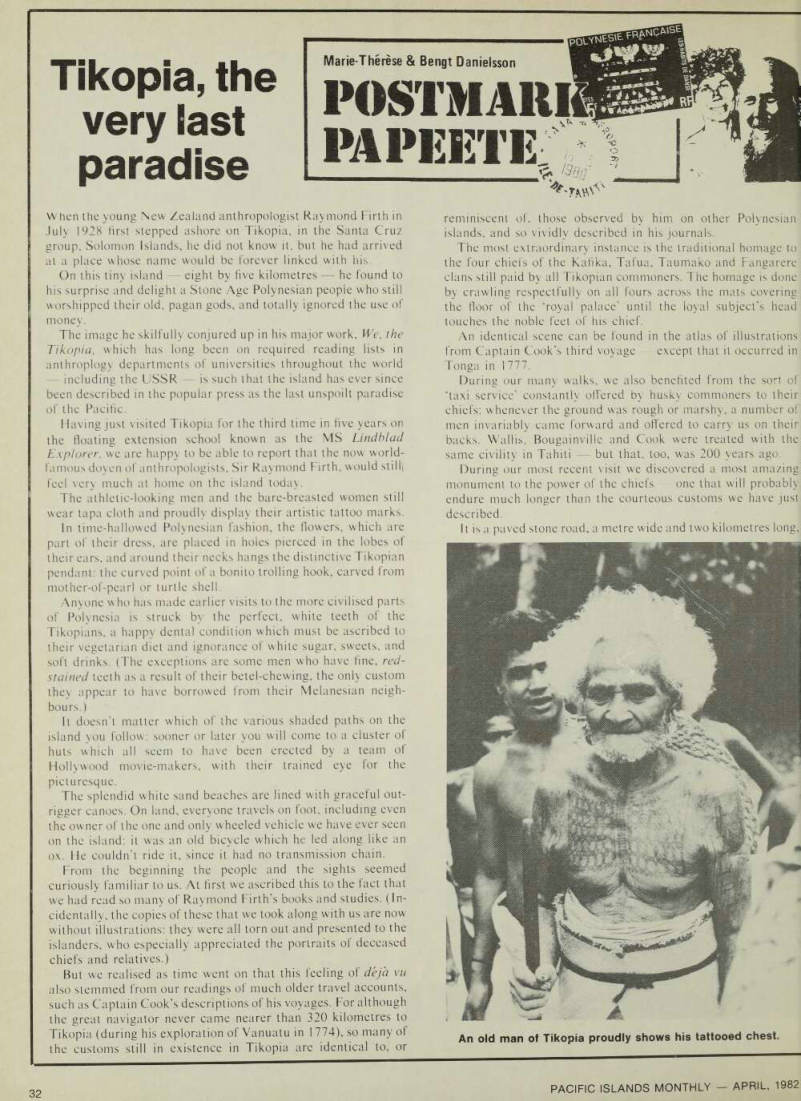

very East paradise
When the young New Zealand anthropologist Raymond Firth in July 1928 first stepped ashore on Tikopia, in the Santa Cruz group, Solomon Islands, he did not know it, but he had arrived at a place whose name would be forever linked with his.
On this tiny island eight by five kilometres he found to his surprise and delight a Stone Age Polynesian people who still worshipped their old. pagan gods, and totally ignored the use of money.
The image he skilfully conjured up in his major work. We, the Tikopia, which has long been on required reading lists in anlhroplogy departments of universities throughout the world including the USSR is such that the island has ever since been described in the popular press as the last unspoilt paradise of the Pacific.
Having just visited Tikopia for the third lime in five years on the floating extension school known as the MS Lindblad Explorer, we are happy to be able to report that the now world famous doyen of anthropologists. Sir Raymond Firth, would slilll feel very much at home on the island today.
The athletic-looking men and the bare-breasted women still wear tapa cloth and proudly display their artistic tattoo marks.
In time-hallowed Polynesian fashion, the flowers, which are part of their dress, are placed in holes pierced in the lobes of their ears, and around their necks hangs the distinctive Tikopian pendant: the curved point of a bonito trolling hook, carved from mother-of-pearl or turtle shell.
Anyone w'ho has made earlier visits to the more civilised parts of Polynesia is struck by the perfect, while teeth of the Tikopians, a happy dental condition which must be ascribed to their vegetarian diet and ignorance of while sugar, sweets, and soft drinks. (The exceptions are some men who have fine, red stained teeth as a result of their betel-chewing, the only custom they appear to have borrowed from their Melanesian neigh bours.) It doesn’t matter which of the various shaded paths on the island you follow: sooner or later you will come to a cluster of huts which all seem to have been erected by a team of Hollywood movie-makers, with their trained eye for the picturesque.
The splendid white sand beaches are lined with graceful out rigger canoes. On land, everyone travels on foot, including even the owner of the one and only wheeled vehicle we have ever seen on the island; it was an old bicycle which he led along like an ox. He couldn’t ride it, since it had no transmission chain.
From the beginning the people and the sights seemed curiously familiar to us. At first we ascribed this to the fact that we had read so many of Raymond Firth’s books and studies. (In cidentally, the copies of these that we took along with us are now without illustrations: they were all torn out and presented to the islanders, who especially appreciated the portraits of deceased chiefs and relatives.) But we realised as time went on that this feeling of deja vu also stemmed from our readings of much older travel accounts, such as Captain Cook’s descriptions of his voyages. For although the great navigator never came nearer than 320 kilometres to Tikopia (during his exploration of Vanuatu in 1774), so many of the customs still in existence in Tikopia are identical to, or
reminiscent of, those observed by him on other Polynesian islands, and so vividly described in his journals.
The most extraordinary instance is the traditional homage to the four chiefs of the Kafika, Tafua, Taumako and Fangarere clans still paid by all Tikopian commoners. The homage is done by crawling respectfully on all fours across the mats covering the floor of the ‘royal palace’ until the loyal subject's head touches the noble feet of his chief.
An identical scene can be found in the atlas of illustrations from Captain Cook’s third voyage except that it occurred in Tonga in 1777.
During our many walks, we also benefited from the sort of Taxi service' constantly offered by husky commoners to their chiefs: whenever the ground was rough or marshy, a number of men invariably came forward and offered to carry us on their backs. Wallis, Bougainville and Cook were treated with the same civility in Tahiti but that, too, was 200 years ago.
During our most recent visit we discovered a most amazing monument to the power of the chiefs one that will probably endure much longer than the courteous customs we have just described.
It is a paved stone road, a metre wide and two kilometres long,
An old man of Tikopia proudly shows his tattooed chest.
i al the fool of the huge cliff that juts like a sugarloaf out of the middle of the narrow south coast, between the lagoon and the Roto crater lake. its purpose is to permit easy access to the last village, Namo, at the foot of the 400-metre high mountain that occupies the north-eastern half of the island.
The so-called ara metua on Rarotonga is justifiably admired as a splendid example of the collective engineering achievement of a small Slone Age tribe. The ara metua on Tikopia testifies to even greater building skills, and certainly represents an even greater human effort. It also offers more beautiful views, since it hugs the shore of the lake.
How is it that the Tikopians alone of all the Polynesian peoples have managed to preserve their culture almost intact?
All who have tried to answer this most intriguing question have, of course, pointed to the extreme isolation of the island, and to the lack not only of harbours but even of a sheltered anchorage. This answer certainly has great merit.
But it must also be remembered that the isolation of the island is not only measured in the number of nautical miles separating it from the nearest European-style commercial centres 220 to Santa Cruz, and 640 to Honiara but is also, and perhaps even more importantly, due to the simple fact that captains of trading vessels have never bothered to visit Tikopia because the people there had nothing to sell, and consequently no money with which to buy European goods either.
True enough, there are quite a few coconut palms on Tikopia.
But copra production is nil, since the islanders eat and drink all the nuts. Similarly, they consume all the yams, sweet potatoes, manioc roots and other crops they manage to grow on the mountain slopes around the crater lake. Until now, production has kept pace with population growth, and famines have only occurred when hurricanes have destroyed the gardens. This happened, for instance, in 1952-53, when 17 people are reported to have died of starvation.
But the present population stands at 2200, which is 900 more than during Raymond Firth’s first field work in 1928-29.
Considering that a third of the island’s total area of roughly 30 square kilometres is taken up by mountains, and another third by the crater lake, one marvels at the Tikopians’ capacity for survival. But there is a limit to it, and that limit has certainly been reached.
The only solution to the problem so far tried has been migration, and there is now a Tikopian colony of 250 on Russell Island, and a much smaller one on Vanikoro. The purely demographic problem can undoubtedly be solved in this manner for several generations to come. But there is a price to pay in the form of a gradual loss of cultural values. Many of these migrants will naturally come back to Tikopia for shorter or longer periods (if not for good), and bring with them all sorts of new articles, plants, animals and ideas which will mean that the islanders’ unique ‘proto-Polynesian’ way of life will slowly change, and perhaps in the end be totally destroyed.
While waiting for the inevitable, however, Tikopia today is still a ‘paradise island’ without peer anywhere in the Pacific. So let us only add a final word of warning for those of our readers who might want to get away from the burdens and worries of their drab, civilised existence.
Don’t jump on the first plane or ship heading for Solomon Islands. You will never be allowed to settle on Tikopia, and the SI Government is extremely reluctant even to grant foreigners permission to make a brief visit to the island.
However galling this restrictive policy may seem to those who dream of an earthy paradise, it is certainly in the best interest of the islanders. Or, as a Honiara government official once put it: ‘The Tikopians are a happy people, because they have no malaria, no snakes, and no foreigners. Let us keep it that way.’
Marie-Therese and Bengt Danielsson.
Advertisements & other items, pp. 33-34 (1 item)
Pty. Ltd.
WATER WHEEL EXPORTS
493 Bourke Street, Melbourne, 3000, Australia Cables: Watermill-Melbourne.
Telex: AA 32165 Telephone: 602 1433
THE WATER WHEEL GROUP OF COMPANIES
Winners of Australia's Top Export Award and Flour Millers for over 100 years.
BEST AUSTRALIAN
WHEATEN FLOUR
(High Protein, Bakers, Stone ground Wholemeal, Donut).
COOLROOMS REFRIGERATED
CABINETS ETC.
INCLUDING SALT WATER
ICE MAKERS
STOCK & POULTRY FEEDS
(Pellets or Mash form)
YELLOW SPLIT PEAS &
WHOLE PEAS
(Machine-Dressed)
COMPLETE RANGE OF FROZEN
AND GENERAL FOOD ITEMS
QUALITY AUSTRALIAN
WINES
WOOD FUEL STOVES
AND WATER HEATERS
FOR FURTHER INFORMATION
Return this coupon to:
WATER WHEEL EXPORTS PTY. LTD.
Please forward me: Name Address More information on your above products/ product Phone: Export Manager Water Wheel Exports Pty. Ltd. 493 Bourke Street, Melbourne 3000.
Australia.
Komatsu flakes a Difference
:*ra .T n; i u K In critical areas like reliability and performance, Komatsu products and systems are making a significant difference at mining and construction sites around the world.
In the USA, for example, Komatsu’s largest and most powerful work machine the D455A bulldozer is establishing a superior record of reliability and productivity at mining sites that virtually no other machine in its class can match.
And in another critical area, technology, Komatsu is also making a difference in responding to market demands for improved product quality, and for new and original product innovations.
Consider our new computerized seabed robot system: Operating on the ocean floor, it can relay TV pictures of the seabed to a mother ship, or perform man-like boring, drilling and piling operations down to planned depths of 500 meters* Discover the Komatsu difference above sea level, or down to depths of 500 meters. Komatsu a name you can build on.
•(•KOMATSU LTD.
Tokyo, Japan Komatsu offices: Tokyo, Sydney, Singapore, Jakarta, Manila, Bangkok, Bangalore, Karachi, Beijing, Istanbul, Cairo, Alger, Dubai, Tehran, Baghdad, Jeddah, Riyadh, Damman, Nairobi, Abidjan, Lagos, Johannesburg, Moscow, Warsaw, Brussels, Paris, Madrid, Frankfurt, Stuttgart, London, Habana, Buenos Aires, Panama, Caracas, Sao Paulo, Bogota, Mexico City, San Francisco, Oakland, Philadelphia, Detroit, Dallas, Atlanta, Chicago, Toronto, Vancouver, and distributors in over 100 countries around the world.
In Technology
The Komatsu seabed robot system is currently operating in the Japan Inland Sea at depths down to a max.mum of 70 meters, in a government-sponsored bridge works program
Jean-Marie Tjibaou on New Caledonia’s goals
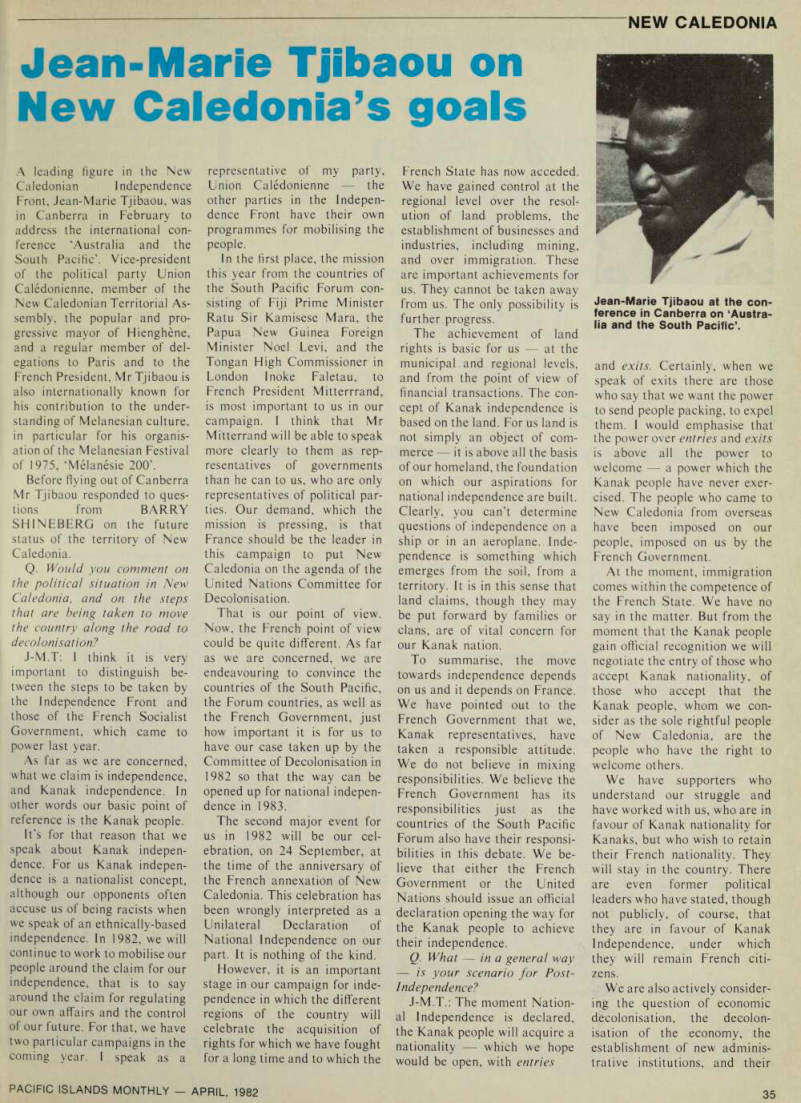

New Caledonia’s goals
A leading figure in the New Caledonian Independence Front, Jean-Marie Tjibaou, was in Canberra in February to address the international con ference ‘Australia and the South Pacific’. Vice-president of the political party Union Caledonienne, member of the New Caledonian Territorial As sembly, the popular and pro gressive mayor of Hienghene, and a regular member of del egations to Paris and to the French President, Mr Tjibaou is also internationally known for his contribution to the under standing of Melanesian culture, in particular for his organis ation of the Melanesian Festival of 1975, ‘Melanesie 200’.
Before flying out of Canberra Mr Tjibaou responded to ques tions from BARRY SHINEBERG on the future status of the territory of New Caledonia.
Q. Would you comment on the political situation in New Caledonia, and on the steps that are being taken to move the country along the road to decolonisation?
J-M.T; I think it is very important to distinguish be tween the steps to be taken by the Independence Front and those of the French Socialist Government, which came to power last year.
As far as we are concerned, what we claim is independence, and Kanak independence. In other words our basic point of reference is the Kanak people.
It’s for that reason that we speak about Kanak indepen dence. For us Kanak indepen dence is a nationalist concept, although our opponents often accuse us of being racists when we speak of an ethnically-based independence. In 1982, we will continue to work to mobilise our people around the claim for our independence, that is to say around the claim for regulating our own affairs and the control of our future. For that, we have two particular campaigns in the coming year. 1 speak as a
representative of my party, Union Caledonienne the other parties in the Indepen dence Front have their own programmes for mobilising the people.
In the first place, the mission this year from the countries of the South Pacific Forum con sisting of Fiji Prime Minister Ratu Sir Kamisese Mara, the Papua New Guinea Foreign Minister Noel Levi, and the Tongan High Commissioner in London Inoke Faletau, to French President Mitterrand, is most important to us in our campaign. I think that Mr Mitterrand will be able to speak more clearly to them as rep resentatives of governments than he can to us, who are only representatives of political par ties. Our demand, which the mission is pressing, is that France should be the leader in this campaign to put New Caledonia on the agenda of the United Nations Committee for Decolonisation.
That is our point of view.
Now, the French point of view could be quite different. As far as we are concerned, we are endeavouring to convince the countries of the South Pacific, the Forum countries, as well as the French Government, just how important it is for us to have our case taken up by the Committee of Decolonisation in 1982 so that the way can be opened up for national indepen dence in 1983.
The second major event for us in 1982 will be our cel ebration, on 24 September, at the time of the anniversary of the French annexation of New Caledonia. This celebration has been wrongly interpreted as a Unilateral Declaration of National Independence on our part. It is nothing of the kind.
However, it is an important stage in our campaign for inde pendence in which the different regions of the country will celebrate the acquisition of rights for which we have fought for a long time and to which the
French State has now acceded.
We have gained control at the regional level over the resol ution of land problems, the establishment of businesses and industries, including mining, and over immigration. These are important achievements for us. They cannot be taken away from us. The only possibility is further progress.
The achievement of land rights is basic for us at the municipal and regional levels, and from the point of view of financial transactions. The con cept of Kanak independence is based on the land. For us land is not simply an object of com merce it is above all the basis of our homeland, the foundation on which our aspirations for national independence are built.
Clearly, you can’t determine questions of independence on a ship or in an aeroplane. Inde pendence is something which emerges from the soil, from a territory. It is in this sense that land claims, though they may be put forward by families or clans, are of vital concern for our Kanak nation.
To summarise, the move towards independence depends on us and it depends on France.
We have pointed out to the French Government that we, Kanak representatives, have taken a responsible attitude.
We do not believe in mixing responsibilities. We believe the French Government has its responsibilities just as the countries of the South Pacific Forum also have their responsi bilities in this debate. We be lieve that either the French Government or the United Nations should issue an official declaration opening the way for the Kanak people to achieve their independence.
Q. What in a general way is your scenario for Post- Independence?
J-M.T.: The moment Nation al Independence is declared, the Kanak people will acquire a nationality which we hope would be open, with entries
and exits. Certainly, when we speak of exits there are those who say that we want the power to send people packing, to expel them. 1 would emphasise that the power over entries and exits is above all the power to welcome a power which the Kanak people have never exer cised. The people who came to New Caledonia from overseas have been imposed on our people, imposed on us by the French Government.
At the moment, immigration comes within the competence of the French State. We have no say in the matter. But from the moment that the Kanak people gain official recognition we will negotiate the entry of those who accept Kanak nationality, of those who accept that the Kanak people, whom we con sider as the sole rightful people of New Caledonia, are the people who have the right to welcome others.
We have supporters who understand our struggle and have worked with us, who are in favour of Kanak nationality for Kanaks, but who wish to retain their French nationality. They will stay in the country. There are even former political leaders who have stated, though not publicly, of course, that they are in favour of Kanak Independence, under which they will remain French citi zens.
We are also actively consider ing the question of economic decolonisation, the decolon isation of the economy, the establishment of new adminis trative institutions, and their
Jean-Marie Tjibaou at the con ference in Canberra on ‘Austra lia and the South Pacific’.
suitability for our particular needs.
We want such discussions to be put on a formal basis. When we speak of Socialist Kanak Independence, we want insti tutions which reflect the Melanesian approach to their heritage, their property and their resources. Equally there is a Melanesian appproach to the management of their patri mony, to small or medium-sized enterprises, and there is Melanesian way of viewing the distribution of work, welfare, social services and care for the environment so that the country may have a soul which comes from itself and not from elsewhere.
There is also a lot to be done to decolonise the minds of the people, and this concerns not just us Caledonians, but it still remains a problem for the Pacific people as a whole, I feel.
So that’s the independence scenario from our point of view Q What is the point of view of the French Government on the immediate future of New Caledonia?
J-M.T.: I don’t know. At the moment, the government has taken many of our demands into account. In both national and international arenas, France speaks of introducing measures for removing social inequalities, for less unemployment, for more welfare, for improvements in the environment, and so on.
In these matters, we support the government. Indeed, the measures the government has introduced reforms affecting land, cultural projects, credit systems for economic develop ment and administrative changes those we, too, envis age as part of our framework for independence.
The only, but the most im portant, aspect missing from this programme is the ultimate destiny the French Goverment proposes for us. Is it towards France, or is it in the direction of a Kanak nation? The French Government will not be explicit on this point. One day it will express its opinion. At the moment we have decided on a truce. We await the implemen tation of their proposed re forms.
Q. Has there been a consider able change in opinion in New Caledonia since May 10 of last year?
J-M.T.: What is most notice able in New Caledonia is the changed political climate. It is a great relief for us no longer to be under suspicion, no longer to be continually pursued by the police, by the intelligence ser vice (renseignements gen'er aux), by the gardes mobiles, every time that we have a demonstration.
Q. What is happening among the people themselves? How are they reacting?
J-M.T. I would say that there are more and more people who are opening up, who are openly discussing indepen dence. Some contact us in order to obtain further explanation.
The way we are talking is not new it dates from the elections of 1979. The young people started speaking about Kanak independence in 1969.
So it is a discussion that already has a history in New Caledonia.
But the ears of people were closed, their hearts and minds
were not open. I think that now people are more ready to listen to what we are saying.
There are also people who have always refused to admit the legitimate claims of the Kanak people and have joined up with the PNC (Parti National Caledonien). To my way of thinking, this party is rather like the white putsch in Santo whose history has already been written.
Q. Some comments by way oj conclusion?
J-M.T.: 1 would like to say that if the claims of the Kanak people are not met, we will continue the struggle. We have our responsibilities but at pres ent. the prime responsibility for decolonising rests with the col onial power, the French Social ist Government. We are hope ful, because we have confidence in the Socialist Party. The government has other preoccu pations of course, but we have good contacts with the Socialist Party, and with the Communist Party also, and we are confident that history is on our side.
Advertisements & other items, pp. 36-37 (2 items)
Look, listen
and learn with
Australian
educational
equipment
a
*J I I*
Australia has great experience and technical skill in most forms of audio visual and general educational equipment. So it has a great deal to offer in the field of teaching and in providing information. Film strips, projectors, books, charts, stationery products, teaching aids and equipment, prerecorded cassettes, slides, scientific equipment and anatomical models are typical of the large number of Australian educational items available. With strong emphasis being placed on advancing the educational system, there will be considerable demand for educational equipment of this high standard. Australian suppliers can help, their proximity will speed delivery too. Check what they have to offer.
Ask the expert who knows Australia The Australian Trade Commissioner can give you detailsof suppliersand also advise you on ways to research or develop markets in Australia. You can contact an Australian Trade Commissioner at these addresses;
FIJI
P.O. Box 1252, Suva.
Ph0ne:312844
PAPUA NEW GUINEA
P.O. Box 9129, Hohola Phone: 25 9333
NEW CALEDONIA
P.O. Box 22, Noumea.
Phone: 27 2414
HAWAII
Australian Consulate, 1000 Bishop Street, Hawaii, 96813 Phone: (808)524 5050
P Ask the Australian Ik-ade Commissioner
Rugged Reliable Economical
DIESEL ENGINES
GENERATING SETS
from 3KW (4HP) to 300 KW (400 HP) Heat-exchanger Cooled Radiator Cooled Air Cooled f A« Division of MacQuarrie Industries Pty. Ltd.
P.O. Box 20, COBURG. Victoria 3058.
Phone: (03) 350 3411 Telex: AA33729.
maun
HIGH QUALITY
BAKERY INGREDIENTS
m Mauripan high activity dried yeast, Dryco active dried yeast, famous PINNACLE brand bread improvers, bread shortenings, bakery oils, malt extracts, and pastrycook premixes. d) For information and supplies: John Blake, Mauri Bakery Group, P.O. Box 89, West Footscray 3012, Victoria, Australia.
Telephone (03) 689 4666. Telex: AA35361. A/B: Maunv
Mauri Bakery Group
37
NEW CALEDONIA
PACIFIC ISLANDS MONTFILY APRIL, 1982
The BP 'History' : Great, but
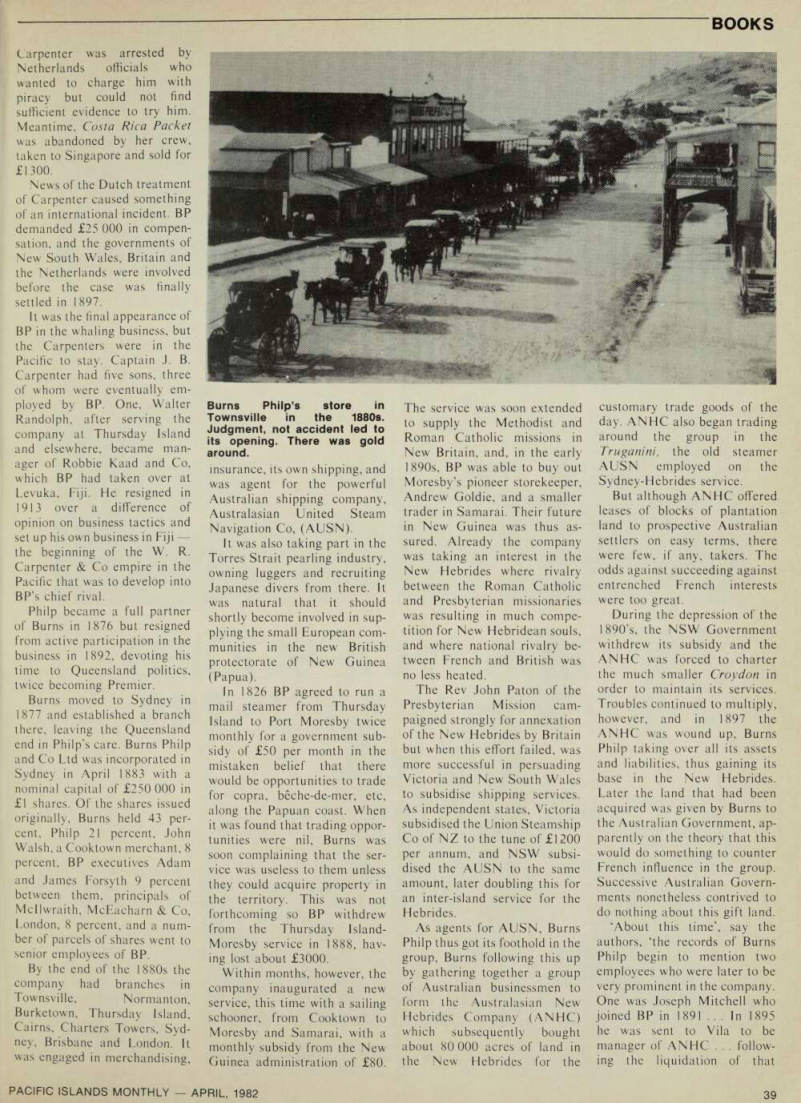

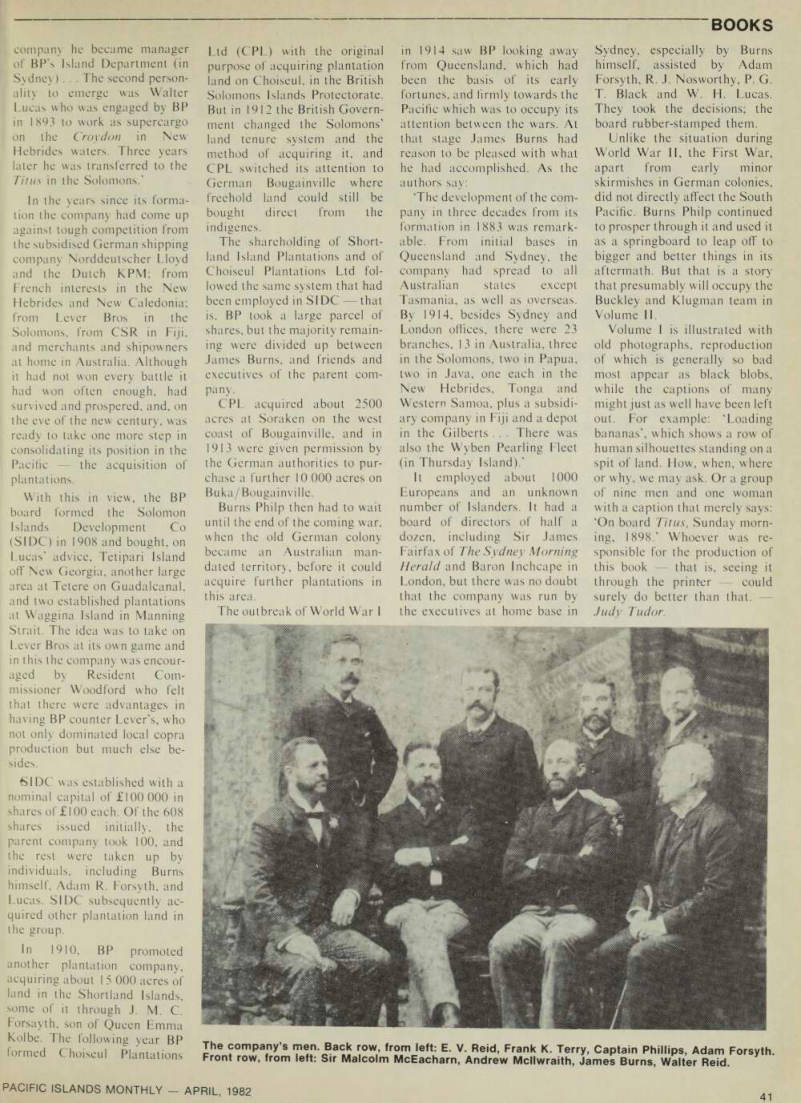
Books
The BP 'History' : Great, but where's the lighter side?
The History of Burns Philp: The Australian Company in the South Pacific. By Kenneth Buckley and Kris Klugman.
Published by Burns Philp and Co Ltd. Distributed by Angus & Robertson. PO Box 290, North Ryde, Australia, 2113.
No ISBN supplied. Price 5A14.95, or $17.95 including postage anywhere within the South Pacific.
After one false start and a considerable amount of backing and filling. Burns Philp and Co Ltd has at last brought forth the story of its first century or part of it, since Volume I, now released, covers only the years 1883-1914. Volume ll,covering the rest, is not due for publica tion until next year, 1983 being the 100th anniversary of the incorporation of the company.
Why two biles at the cherry are necessary is a bit of a mystery, as Volume I is by no means a large tome. The pres ent chairman of the company, J.
D. O. Burns, says in reference to this in his foreword that the company ‘didn’t want a book that was 100 fat’.
He also says that Volume 11 will ‘probably take the history up until the end of the Second World War’, as an account of the company since that time is best left to someone writing in the 21st century.
Let’s hope he’s kidding. Rev olutionary changes have oc curred in the BP company in the past 38 years, and the story of its first 100 years won’t be complete without some account of them. The BP upper echelons have always been coy to the point of phobia about publicity
of any sort, and one gets the impression from the foreword that, even yet, neither the family nor the Top Brass takes kindly to baring the company’s immortal soul. That being so, doing it in two instalments is probably as much as they can stomach.
In the early 19705, BP en gaged the late Charles Bateson, an established writer, to pro duce the history. At the time it was believed that early records were scanty, but Bateson proved this to be wrong, devot ing a couple of years to dredg ing them up from Australia, the Pacific Islands, London and elsewhere, and literally filling a small basement in Sydney head office with the result. He had also drafted half a dozen chap ters of the proposed book when he died suddenly. The whole project went into cold storage for some time. But in the late 1970 s two Sydney University academics. Professor Kenneth Buckley and Mrs Kris Klugman, undertook to do the job.
They started off anew and the result is a thoroughly pro fessional job, full of infor mation, although if any former Pacific BP-walcher goes looking within its covers for the lighter side of the company’s history and, after all, neither it nor its Islands personnel were immune from local influences they can forget it. Nor do the personalities of the chief characters emerge as anything but two-dimensional with the possible exception of Walter Lucas, who was described as ‘foul-mouthed’, mostly it seemed because he used the favourite Australian adjective ‘bloody’.
The only grin this reviewer got out of the whole story came at the last page where Lucas describes how he got the near hulk SS Moresby resurrected and provisioned at Sydney at the outbreak of World War 1 and finally to Rabaul with supplies for the Australian
force that had taken the town from the Germans. Lucas was subsequently seconded to the Australian Expropriation Board, which took over German plantations in New Guinea and disposed of them to Australians.
But that story does not come within the scope of Volume I.
One of the problems in fleshing-out these early BP characters is that on paper they all behaved like a lot of canny Scots, and emerge as personalities only via snippets of reports or business letters.
James Burns dominated the company until his death and thus Volume 1 as well, and he appears to have destroyed let ters addressed to him person ally. Letters that have survived are from Burns to others to his partner Philp in the early years, and later to P. G. T.
Black, accountant, chief inspec tor and later general manager of the company.
Although the company was not incorporated until 1883, Burns and Philp separately and together had had successful careers for at least a decade before.
Burns, then not quite 17, had migrated to Australia with his elder brother in 1862. They came modestly endowed by their family in Edinburgh and settled in Queensland, the elder brother setting up as a storekeeper on his own account, and James initially as a jackaroo on outback properties before joining his brother in 1867. That same year gold was discovered at Gympie and young James immediately went there to open a branch store for J. & J. Burns.
Although Queensland goldmining and agriculture were to form the original basis of the BP empire, the brothers’ partnership effectively came to an end in 1869 when their father died and it was decided that young James should return to Edinburgh to clean up the estate. He did not return to Brisbane until 1872 and from
then his fortunes took a new direction.
He built a store in Townsville on his own account the same year, began servicing the min ing fields of Ravenswood, Char ters Towers, the Palmer River, etc.
Burns had already met Robert Philp who, as a 10-year old, had migrated with his parents from Glasgow in the same year as the Burns brothers arrived in Brisbane. In 1874 James Burns offered Philp a job in Townsville at £250 per an num, with the prospect of a partnership later on. For the next two years they worked together, not only consolidating their business partnership but cementing a firm personal re lationship, although they differed considerably in charac ter.
Burns was the canny, Edinburgh Scotspyterian, sold on the work ethic, energetic, far-seeing, and with his feet on the ground. Philp was much more given to adventures and personal speculations that oc casionally backfired.
It was Philp who launched the partnership into recruiting Pacific Islands labour for the Queensland canefields against the better judgment of Burns, who, while he had no moral scruples about it, was convinced that it could generate far more problems than it was worth, and by the mid-1880s, was instru mental in withdrawing the firm from it altogether.
It was Philp who involved the firm in another cause celebre in 1 877, at a time when Burns was in London, by acquiring a whaling ship, Costa Rica Packet, and despatching it with its master. Captain John Bolton Carpenter, into Malaysian waters to search for whales.
Before anything was ac complished, Carpenter came across an abandoned proa off one of the Indonesian islands and a couple of damaged cases of liquor were taken from it.
Subsequently, at Ternate,
Carpenter was arrested by Netherlands officials who wanted to charge him with piracy but could not find sufficient evidence to try him.
Meantime, Costa Rica Packet was abandoned by her crew, taken to Singapore and sold for £l3OO.
News of the Dutch treatment of Carpenter caused something of an international incident. BP demanded £25 000 in compen sation, and the governments of New South Wales, Britain and the Netherlands were involved before the case was finally settled in 1897.
It was the final appearance of BP in the whaling business, but the Carpenters were in the Pacific to slay. Captain J. B.
Carpenter had five sons, three of whom were eventually em ployed by BP. One, Waller Randolph, after serving the company at Thursday Island and elsewhere, became man ager of Robbie Kaad and Co, which BP had taken over at Levuka, Fiji. He resigned in 1913 over a difference of opinion on business tactics and set up his own business in Fiji the beginning of the W. R.
Carpenter & Co empire in the Pacific that was to develop into BP’s chief rival.
Philp became a full partner of Burns in 1876 but resigned from active participation in the business in 1892, devoting his time to Queensland politics, twice becoming Premier.
Burns moved to Sydney in 1877 and established a branch there, leaving the Queensland end in Philp’s care. Burns Philp and Co Ltd was incorporated in Sydney in April 1883 with a nominal capital of £250 000 in £1 shares. Of the shares issued originally. Burns held 43 per cent, Philp 21 percent, John Walsh, a Cooktown merchant, 8 percent, BP executives Adam and James Forsyth 9 percent between them, principals of Mcllwraith, McEacharn & Co, London, 8 percent, and a num ber of parcels of shares went to senior employees of BP.
By the end of the 1880 s the company had branches in Townsville, Normanton, Burketown, Thursday Island, Cairns, Charters Towers, Syd ney, Brisbane and London. It was engaged in merchandising,
insurance, its own shipping, and was agent for the powerful Australian shipping company, Australasian United Steam Navigation Co, (AUSN).
It was also taking part in the Torres Strait pearling industry, owning luggers and recruiting Japanese divers from there. It was natural that it should shortly become involved in sup plying the small European com munities in the new British protectorate of New Guinea (Papua).
In 1826 BP agreed to run a mail steamer from Thursday Island to Port Moresby twice monthly for a government sub sidy of £5O per month in the mistaken belief that there would be opportunities to trade for copra, beche-de-mer, etc, along the Papuan coast. When it was found that trading oppor tunities were nil, Burns was soon complaining that the ser vice was useless to them unless they could acquire property in the territory. This was not forthcoming so BP withdrew from the Thursday Island- Moresby service in 1888, hav ing lost about £3OOO.
Within months, however, the company inaugurated a new service, this time with a sailing schooner, from Cooktown to Moresby and Samarai, with a monthly subsidy from the New Guinea administration of £BO.
The service was soon extended to supply the Methodist and Roman Catholic missions in New Britain, and, in the early 1890 s, BP was able to buy out Moresby’s pioneer storekeeper, Andrew Goldie, and a smaller trader in Samarai. Their future in New Guinea was thus as sured. Already the company was taking an interest in the New Hebrides where rivalry between the Roman Catholic and Presbyterian missionaries was resulting in much compe tition for New Hebridean souls, and where national rivalry be tween French and British was no less heated.
The Rev John Paton of the Presbyterian Mission cam paigned strongly for annexation of the New Hebrides by Britain but when this effort failed, was more successful in persuading Victoria and New South Wales to subsidise shipping services.
As independent states, Victoria subsidised the Union Steamship Co of NZ to the tune of £l2OO per annum, and NSW subsi dised the AUSN to the same amount, later doubling this for an inter-island service for the Hebrides.
As agents for AUSN, Burns Philp thus got its foothold in the group, Burns following this up by gathering together a group of Australian businessmen to form the Australasian New Hebrides Company (ANHC) which subsequently bought about 80 000 acres of land in the New Hebrides for the
customary trade goods of the day. ANHC also began trading around the group in the Truganini, the old steamer AUSN employed on the Sydney-Hebrides service.
But although ANHC offered leases of blocks of plantation land to prospective Australian settlers on easy terms, there were few, if any, takers. The odds against succeeding against entrenched French interests were too great.
During the depression of the 1890’s, the NSW Government withdrew its subsidy and the ANHC was forced to charter the much smaller Croydon in order to maintain its services.
Troubles continued to multiply, however, and in 1897 the ANHC was wound up. Burns Philp taking over all its assets and liabilities, thus gaining its base in the New Hebrides.
Later the land that had been acquired was given by Burns to the Australian Government, ap parently on the theory that this would do something to counter French influence in the group.
Successive Australian Govern ments nonetheless contrived to do nothing about this gift land.
"About this time’, say the authors, "the records of Burns Philp begin to mention two employees who were later to be very prominent in the company.
One was Joseph Mitchell who joined BP in 1891 ... In 1895 he was sent to Vila to be manager of ANHC . . . follow ing the liquidation of that
Burns Philp’s store in Townsville in the 1880s.
Judgment, not accident led to its opening. There was gold around.
company he became manager of BP s Island Department (in Sydney) . . . The second person ality to emerge was Walter Lucas who was engaged by BP in 1893 to work as supercargo on the Croydon in New Hebrides waters. Three years later he was transferred to the Titus in the Solomons.’
In the years since its forma tion the company had come up against lough competition from the subsidised German shipping company Norddeulscher Lloyd and the Dutch KPM: from French interests in the New Hebrides and New Caledonia; from Lever Bros in the Solomons, from CSR in Fiji, and merchants and shipowners at home in Australia. Although it had not won every battle it had won often enough, had survived and prospered, and, on the eve of the new century, was ready to take one more step in consolidating its position in the Pacific the acquisition of plantations.
With this in view, the BP board formed the Solomon Islands Development Co (SIDC) in 1908 and bought, on Lucas’ advice, Tetipari Island off New Georgia, another large area at Tctere on Guadalcanal, and two established plantations at Waggina Island in Manning Strait. The idea was to lake on Lever Bros at its own game and in this the company was encour aged by Resident Com missioner Woodford who fell that there were advantages in having BP counter Lever’s, who not only dominated local copra production but much else be sides.
SIDC was established with a nominal capital of £lOO 000 in shares of £ 100 each. Of the 608 shares issued initially, the parent company look 100, and the rest were taken up by individuals, including Burns himself, Adam R. Forsyth, and Lucas. SIDC subsequently ac quired other plantation land in the group.
In 1910, BP promoted another plantation company, acquiring about 15 000 acres of land in the Shorlland Islands, some of it through J. M. C.
Forsaylh, son of Queen Emma Kolbc. The following year BP formed Choiseul Plantations
Ltd (CPL) with the original purpose of acquiring plantation land on Choiscul, in the British Solomons Islands Protectorate.
But in 1912 the British Govern ment changed the Solomons’ land tenure system and the method of acquiring it, and CPL switched its attention to German Bougainville where freehold land could still be bought direct from the indigenes.
The shareholding of Short land Island Plantations and of Choiscul Plantations Ltd fol lowed the same system that had been employed in SI DC that is, BP look a large parcel of shares, but the majority remain ing were divided up between James Burns, and friends and executives of the parent com pany.
CPL acquired about 2500 acres at Soraken on the west coast of Bougainville, and in 1913 were given permission by the German authorities to pur chase a further 10 000 acres on Buka/Bougainville.
Burns Philp then had to wail until the end of the coming war, when the old German colony became an Australian man dated territory, before it could acquire further plantations in this area.
The outbreak of World War I
in 1914 saw BP looking away from Queensland, which had been the basis of its early fortunes, and firmly towards the Pacific which was to occupy its attention between the wars. At that stage James Burns had reason to be pleased with what he had accomplished. As the authors say: ‘The development of the com pany in three decades from its formation in 1883 was remark able. From initial bases in Queensland and Sydney, the company had spread to all Australian states except Tasmania, as well as overseas.
By 1914, besides Sydney and London offices, there were 23 branches, 13 in Australia, three in the Solomons, two in Papua, two in Java, one each in the New Hebrides, Tonga and Western Samoa, plus a subsidi ary company in Fiji and a depot in the Gilberts . . . There was also the Wyben Pearling Fleet (in Thursday Island).' It employed about 1000 Europeans and an unknown number of Islanders. It had a board of directors of half a dozen, including Sir James Fairfax of The Sydney Morning Herald and Baron Inchcape in London, but there was no doubt that the company was run by the executives at home base in
Sydney, especially by Burns himself, assisted by Adam Forsyth, R. J. Nosworthy, P. G.
T. Black and W. H. Lucas.
They took the decisions; the board rubber-stamped them.
Unlike the situation during World War 11, the First War, apart from early minor skirmishes in German colonies, did not directly affect the South Pacific. Burns Philp continued to prosper through it and used it as a springboard to leap off to bigger and better things in its aftermath. But that is a story that presumably will occupy the Buckley and Klugman team in Volume IF Volume I is illustrated with old photographs, reproduction of which is generally so bad most appear as black blobs, while the captions of many might just as well have been left out. For example: ‘Loading bananas’, which shows a row of human silhouettes standing on a spit of land. How, when, where or why, we may ask. Or a group of nine men and one woman with a caption that merely says: ‘On board Titus, Sunday morn ing, 1898.’ Whoever was re sponsible for the production of this book that is, seeing it through the printer could surely do better than that. -
Judy Tudor.
The company’s men. Back row, from left: E. V. Reid, Frank K. Terry, Captain Phillips, Adam Forsyth.
Front row, from left: Sir Malcolm McEacharn, Andrew Mcllwraith, James Burns, Walter Reid.
Advertisements & other items, pp. 40-42 (1 item)
Shorts Wide-Bodied
I, wm ■a*- i Of 1111 . *<
®as@e
V* &* . *
%rSb
A ■ **-.•• •
SHORTS WIDE-BODIED
REGIONAL AIRLINERS
ARE READY
FOR THE 1980 s
It took the world's oldest and one of the most experienced airplane manufacturers to build wide-bodied generation Commuterliners. In every aspect the Shorts 330 and 360 are designed for efficiency, and the 330 is already well proven in airline service having carried over seven million fare-paying passengers to date whilst the 360 benefits greatly from its established heritage.
They are built with simple and functional, highly reliable philosophies in mind. They are equipped with quiet, fuel-efficient engines. And they have the most advanced flight deck equipment to be found on a comparable aircraft.
The 330 and 360 provide outstanding comfort and appeal for up to 30 and 36 passengers respectively.
With these facilities, commuter passengers, and the airline operators, have the widest choice of reliable, fuel efficient, wide-bodied regional airliners in the world.
The New
bobcat
Loaders
by Clark
Y"
CU1 R „
»*3 Your choice of 641 Powerful Deutz diesel 32hp 642 Economic Ford petrol 30hp 743 Quiet Kubota diesel 36hp 843 Reliable Perkins diesel 56hp See the New 40 Series AT YOUR NBA REST CLARK BOBCA T DBA L ER BOROKO Conquip ph 25 6699 telex NE 2247 LAE Conquip ph 45 1545 telex NE 42586
CL4RK
Clark Equipment Australia Limited Melroe Division
live (and like) it

Life as Nauruans live (and like) it
The Nauruans. By Solange Petit-Skinner. Published by the Macduff Press, San Francisco, 1981. 304 pp. Hardback 5U524.30 posted. ISBN 0 9606272 0 0.
For many islanders indepen dence has stimulated a pride in their ethos and culture, long stifled by colonial political and economic domination. As a re sult we find an increasing num ber of works being produced dealing with the indigenous way of life and historical heritage of a people, and written by local or expatriate writers for island readers rather than academic colleagues.
The Nauruans is a welcome addition to this new type of literature, for during her fieldwork on Nauru in 1975-76 Solange Petit-Skinner evidently succeeded in penetrating the polite but arm’s length reserve with which the Nauruans treat most expatriates. She obviously liked and admired them, and the empathy engendered has enabled her to write an authori tative yet sympathetic account of the island and its people, with special emphasis on the individ ual life cycle, fishing, games and medicine, and a final chap ter transcribing 13 traditional stories in Nauruan and English for the children of today and tomorrow.
It seems that the Nauruans have much to teach us, for example in grooming, body care, cleanliness and the good manners governing inter personal relations; and there is no better guide than the author for these and many other hith erto unrecorded aspects of their remarkably complex yet still cohesive lifestyle, which she deals with in her fascinating English laced with French id iomatic phrases. Who knew before, for instance, that with their unusually acute sense of smell the Nauruans have devel oped ways of perpetuating an enticing personal fragrance which would make the fortune of a Parisian perfumer?
With the Nauruans per
fumed lotions are considered too evanescent and an island beauty apparently prefers to steam herself in scent to that it ‘penetrates her hair, her breath and the perfume circulates through her entire body’; or, better still, she drinks a potion of aromatic plants, leaves or flowers till the fragrance is exhaled ‘and a pleasant air floats all around the person, as if the body is wrapped in a scented aura’. We are assured that the exhalations are long lasting and that ‘to attach a lover, to attract a partner or to be the belle of the ball these potions are miraculous’; evi dently a date with someone who has been imbibing a spoonful of Eau de Nauru three times a day after meals could be quite something to remember.
Again, it is intriguing to learn that the Nauruan may ay o (healer) often knows by in tuition not only when his next patient will arrive but what he will be suffering from and the appropriate treatment surely a valuable time-saver for any busy G.P. and there is at least one mayayo who special ises in finding lost things by using similar techniques of pre vision without having to stir from his surgery.
But enough has been quoted to show that this is a refreshingly different study from the typical ethnographic treatise. There is, in fact, no other way of learning about this unique community after its enforced exile during World War 11, when most of the old men and women, who were repositories of traditional lore and values, succumbed to pri vations; for Hambruch and Kayser, the two pre-war authorities on Nauru, describe a society which no longer exists.
The book is furthermore likely to become a collectors’ piece, for the only way known to obtain a copy is direct from the publishers: the Mac Duff Press, 110 Sutter St, Suite 1003, San Francisco. California 94104,
H. E. Maude.
BP and the Pacific: What it does,
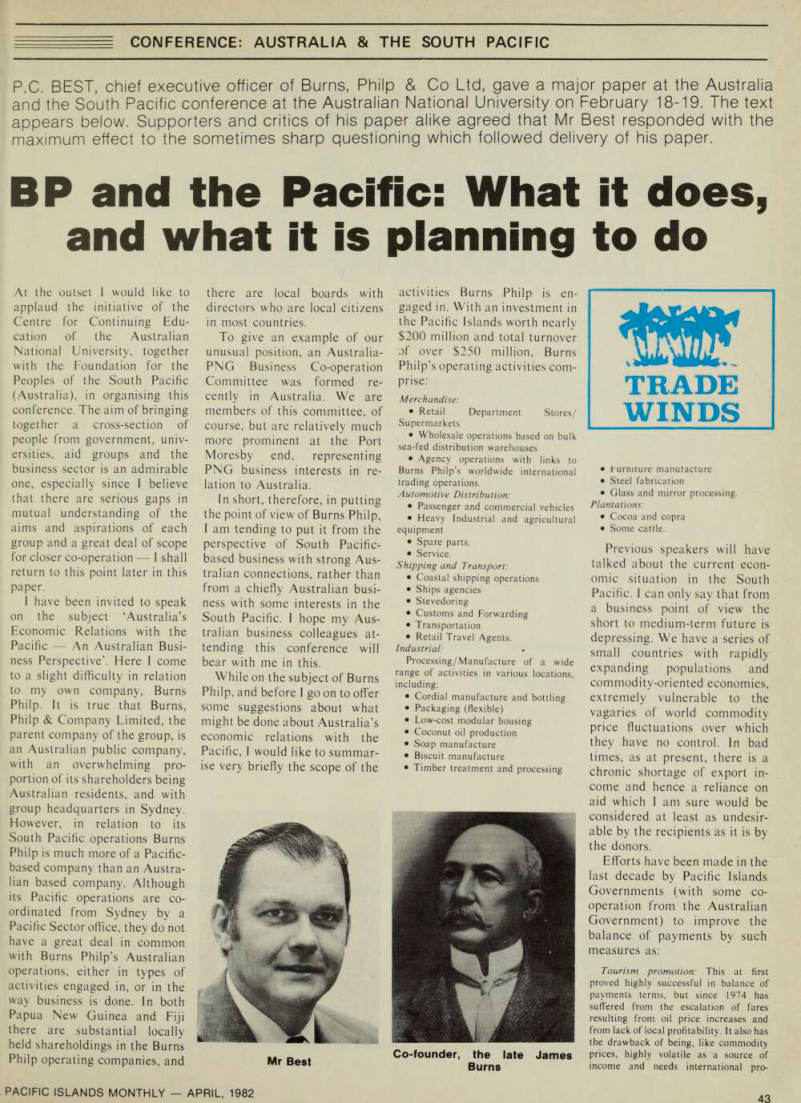

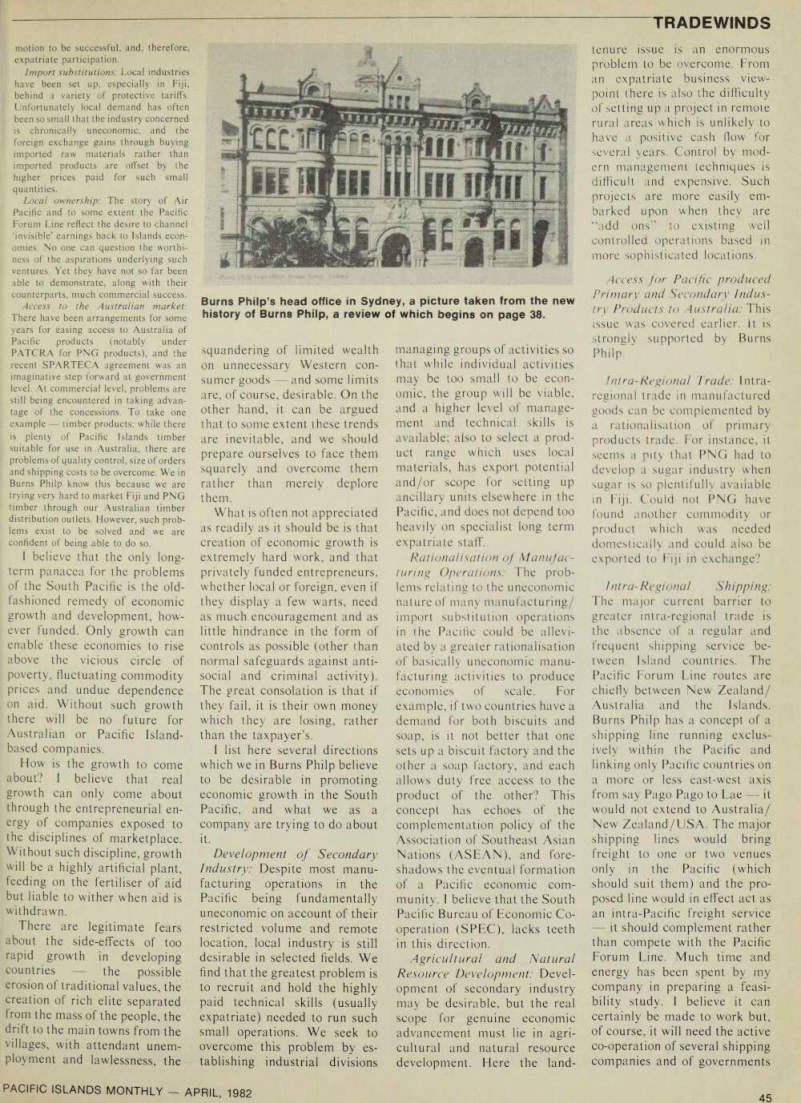
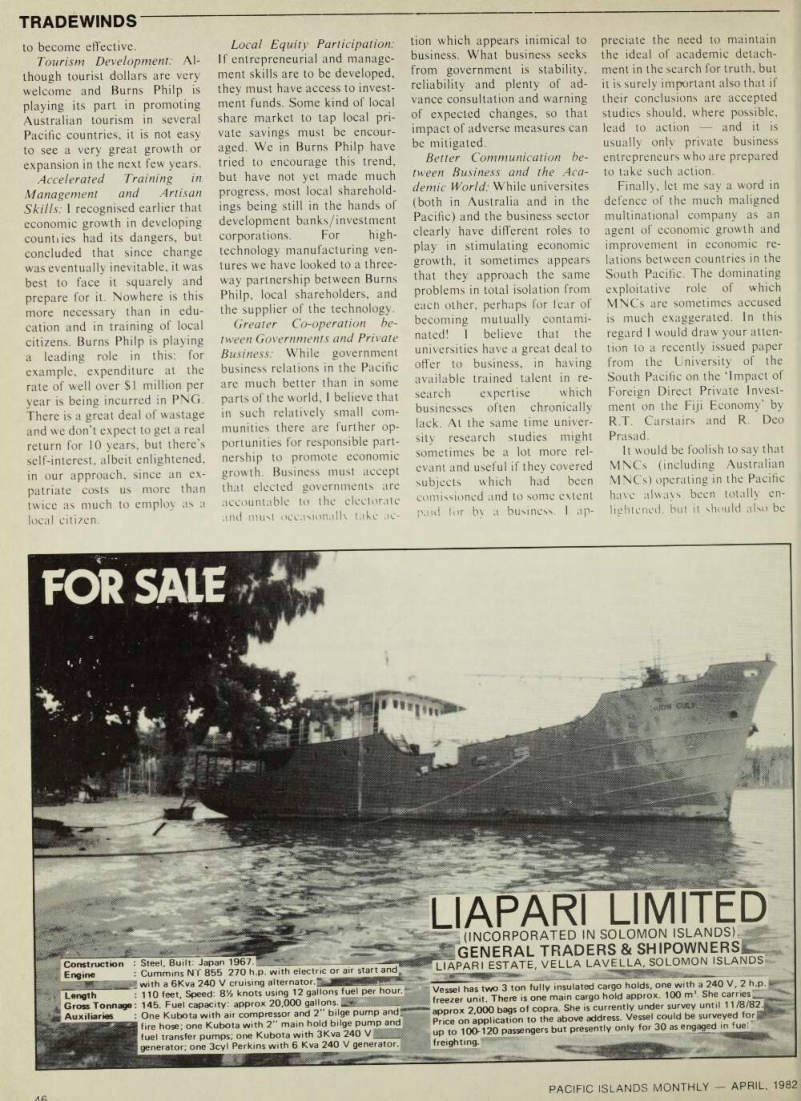
Trade
Winds
BP and the Pacific: What it does, and what it is planning to do
P.C. BEST, chief executive officer of Burns, Philp & Co Ltd, gave a major paper at the Australia and the South Pacific conference at the Australian National University on February 18-19. The text appears below. Supporters and critics of his paper alike agreed that Mr Best responded with the maximum effect to the sometimes sharp questioning which followed delivery of his paper.
At the outset I would like to applaud the initiative of the Centre for Continuing Edu cation of the Australian National University, together with the Foundation for the Peoples of the South Pacific (Australia), in organising this conference. The aim of bringing together a cross-section of people from government, univ ersities, aid groups and the business sector is an admirable one, especially since 1 believe that there are serious gaps in mutual understanding of the aims and aspirations of each group and a great deal of scope for closer co-operation I shall return to this point later in this paper. 1 have been invited to speak on the subject ‘Australia’s Economic Relations with the Pacific - An Australian Busi ness Perspective’. Here I come to a slight difficulty in relation to my own company, Burns Philp. It is true that Burns, Philp & Company Limited, the parent company of the group, is an Australian public company, with an overwhelming pro portion of its shareholders being Australian residents, and with group headquarters in Sydney.
However, in relation to its South Pacific operations Burns Philp is much more of a Pacific based company than an Austra lian based company. Although its Pacific operations are co ordinated from Sydney by a Pacific Sector office, they do not have a great deal in common with Burns Philp’s Australian operations, either in types of activities engaged in, or in the way business is done. In both Papua New Guinea and Fiji there are substantial locally held shareholdings in the Burns Philp operating companies, and
there are local boards with directors who are local citizens in most countries.
To give an example of our unusual position, an Australia- PNG Business Co-operation Committee was formed re cently in Australia. We are members of this committee, of course, but are relatively much more prominent at the Port Moresby end, representing PNG business interests in re lation to Australia.
In short, therefore, in putting the point of view of Burns Philp, I am tending to put it from the perspective of South Pacific based business with strong Aus tralian connections, rather than from a chiefly Australian busi ness with some interests in the South Pacific. I hope my Aus tralian business colleagues at tending this conference will bear with me in this.
While on the subject of Burns Philp, and before I go on to offer some suggestions about what might be done about Australia’s economic relations with the Pacific, I would like to summar ise very briefly the scope of the
activities Burns Philp is en gaged in. With an investment in the Pacific Islands worth nearly $2OO million and total turnover of over $250 million. Burns
Philp’s operating activities com
prise:
Merchandise: • Retail Department Stores/ Supermarkets • Wholesale operations based on bulk sea-fed distribution warehouses • Agency operations with links to Burns Philp’s worldwide international trading operations.
Automotive Distribution: • Passenger and commercial vehicles • Heavy Industrial and agricultural equipment • Spare parts. • Service.
Shipping and Transport: • Coastal shipping operations • Ships agencies • Stevedoring • Customs and Forwarding • Transportation • Retail Travel Agents.
Industrial: Processing/Manufacture of a wide range of activities in various locations, including: • Cordial manufacture and bottling • Packaging (flexible) • Low-cost modular housing • Coconut oil production • Soap manufacture • Biscuit manufacture • Timber treatment and processing
• furniture manufacture • Steel fabrication • Glass and mirror processing.
Plantations: • Cocoa and copra • Some cattle.
Previous speakers will have talked about the current econ omic situation in the South Pacific. I can only say that from a business point of view the short to medium-term future is depressing. We have a series of small countries with rapidly expanding populations and commodity-oriented economies, extremely vulnerable to the vagaries of world commodity price fluctuations over which they have no control. In bad times, as at present, there is a chronic shortage of export in come and hence a reliance on aid which I am sure would be considered at least as undesir able by the recipients as it is by the donors.
Efforts have been made in the last decade by Pacific Islands Governments (with some co operation from the Australian Government) to improve the balance of payments by such measures as: Tourism promotion: This at first proved highly successful in balance of payments terms, but since 1974 has suffered from the escalation of fares resulting from oil price increases and from lack of local profitability. It also has the drawback of being, like commodity prices, highly volatile as a source of income and needs international pro
Mr Best
Co-founder, the late James Burns
motion to be successful, and, therefore, expatriate participation.
Import substitutions: Local industries have been set up, especially in Fiji, behind a variety of protective tariffs.
Unfortunately local demand has often been so small that the industry concerned is chronically uneconomic, and the foreign exchange gains through buying imported raw materials rather than imported products are offset by the higher prices paid for such small quantities.
Local ownership: The story of Air Pacific and to some extent the Pacific Forum Line reflect the desire to channel ‘invisible’ earnings back to Islands econ omies. No one can question the worthi ness of the aspirations underlying such ventures. Yet they have not so far been able to demonstrate, along with their counterparts, much commercial success.
Access to the Australian market: There have been arrangements for some years for easing access to Australia of Pacific products (notably under PATCRA for PNG products), and the recent SPARTECA agreement was an imaginative step forward at government level. At commercial level, problems are still being encountered in taking advan tage of the concessions. To take one example timber products: while there is plenty of Pacific Islands timber suitable for use in Australia, there are problems of quality control, size of orders and shipping costs to be overcome. We in Burns Philp know this because we are trying very hard to market Fiji and PNG timber through our Australian timber distribution outlets. However, such prob lems exist to be solved and we are confident of being able to do so. 1 believe that the only long term panacea for the problems of the South Pacific is the old fashioned remedy of economic growth and development, how ever funded. Only growth can enable these economies to rise above the vicious circle of poverty, fluctuating commodity prices and undue dependence on aid. Without such growth there will be no future for Australian or Pacific Island based companies.
How is the growth to come about? 1 believe that real growth can only come about through the entrepreneurial en ergy of companies exposed to the disciplines of marketplace.
Without such discipline, growth will be a highly artificial plant, feeding on the fertiliser of aid but liable to wither when aid is withdrawn.
There are legitimate fears about the side-effects of too rapid growth in developing countries the possible erosion of traditional values, the creation of rich elite separated from the mass of the people, the drift to the main towns from the villages, with attendant unem ployment and lawlessness, the
squandering of limited wealth on unnecessary Western con sumer goods and some limits are, of course, desirable. On the other hand, it can be argued that to some extent these trends are inevitable, and we should prepare ourselves to face them squarely and overcome them rather than merely deplore them.
What is often not appreciated as readily as it should be is that creation of economic growth is extremely hard work, and that privately funded entrepreneurs, whether local or foreign, even if they display a few warts, need as much encouragement and as little hindrance in the form of controls as possible (other than normal safeguards against anti social and criminal activity).
The great consolation is that if they fail, it is their own money which they are losing, rather than the taxpayer’s.
I list here several directions which we in Burns Philp believe to be desirable in promoting economic growth in the South Pacific, and what we as a company are trying to do about it.
Development of Secondary Industry: Despite most manu facturing operations in the Pacific being fundamentally uneconomic on account of their restricted volume and remote location, local industry is still desirable in selected fields. We find that the greatest problem is to recruit and hold the highly paid technical skills (usually expatriate) needed to run such small operations. We seek to overcome this problem by es tablishing industrial divisions
managing groups of activities so that while individual activities may be too small to be econ omic, the group will be viable, and a higher level of manage ment and technical skills is available; also to select a prod uct range which uses local materials, has export potential and/or scope for setting up ancillary units elsewhere in the Pacific, and does not depend too heavily on specialist long term expatriate staff.
Rationalisation of Manufac turing Operations: The prob lems relating to the uneconomic nature of many manufacturing/ import substitution operations in the Pacific could be allevi ated by a greater rationalisation of basically uneconomic manu facturing activities to produce economies of scale. For example, if two countries have a demand for both biscuits and soap, is it not better that one sets up a biscuit factory and the other a soap factory, and each allows duty free access to the product of the other? This concept has echoes of the complementation policy of the Association of Southeast Asian Nations (ASEAN), and fore shadows the eventual formation of a Pacific economic com munity. I believe that the South Pacific Bureau of Economic Co operation (SPEC), lacks teeth in this direction.
Agricultural and Natural Resource Development: Devel opment of secondary industry may be desirable, but the real scope for genuine economic advancement must lie in agri cultural and natural resource development. Flere the land
tenure issue is an enormous problem to be overcome. From an expatriate business view point there is also the difficulty of setting up a project in remote rural areas which is unlikely to have a positive cash flow for several years. Control by mod ern management techniques is difficult and expensive. Such projects are more easily em barked upon when they are “add ons” to existing well controlled operations based in more sophisticated locations.
Access for Pacific produced Primary and Secondary Indus try Products to Australia: This issue was covered earlier. It is strongly supported by Burns Philp.
Intra-Regional Trade: Intra regional trade in manufactured goods can be complemented by a rationalisation of primary products trade. For instance, it seems a pity that PNG had to develop a sugar industry when sugar is so plentifully available in Fiji. Could not PNG have found another commodity or product which was needed domestically and could also be exported to Fiji in exchange?
I ntra-Regional Shipping: The major current barrier to greater intra-regional trade is the absence of a regular and frequent shipping service be tween Island countries. The Pacific Forum Line routes are chiefly between New Zealand/ Australia and the Islands.
Burns Philp has a concept of a shipping line running exclus ively within the Pacific and linking only Pacific countries on a more or less east-west axis from say Pago Pago to Lae it would not extend to Australia/ New Zealand/USA. The major shipping lines would bring freight to one or two venues only in the Pacific (which should suit them) and the pro posed line would in effect act as an intra-Pacific freight service it should complement rather than compete with the Pacific Forum Line. Much time and energy has been spent by my company in preparing a feasi bility study. 1 believe it can certainly be made to work but, of course, it will need the active co-operation of several shipping companies and of governments
Burns Philp’s head office in Sydney, a picture taken from the new history of Burns Philp, a review of which begins on page 38.
to become effective.
Tourism Development: Al though tourist dollars are very welcome and Burns Philp is playing its part in promoting Australian tourism in several Pacific countries, it is not easy to see a very great growth or expansion in the next few years.
Accelerated Training in Management and Artisan Skills: I recognised earlier that economic growth in developing countiies had its dangers, but concluded that since change was eventually inevitable, it was best to face it squarely and prepare for it. Nowhere is this more necessary than in edu cation and in training of local citizens. Burns Philp is playing a leading role in this: for example, expenditure at the rate of well over $1 million per year is being incurred in PNG.
There is a great deal of wastage and we don’t expect to get a real return for 10 years, but there’s self-interest, albeit enlightened, in our approach, since an ex patriate costs us more than twice as much to employ as a local citizen.
Local Equity Participation: If entrepreneurial and manage ment skills are to be developed, they must have access to invest ment funds. Some kind of local share market to tap local pri vate savings must be encour aged. We in Burns Philp have tried to encourage this trend, but have not yet made much progress, most local sharehold ings being still in the hands of
development banks/investment
corporations. For high technology manufacturing ven tures we have looked to a three way partnership between Burns Philp, local shareholders, and the supplier of the technology.
Greater Co-operation be tween Governments and Private Business: While government business relations in the Pacific are much better than in some parts of the world, 1 believe that in such relatively small com munities there are further op portunities for responsible part nership to promote economic growth. Business must accept that elected governments are accountable lo the electorate and must occasionalK take ac
tion which appears inimical to business. What business seeks from government is stability, reliability and plenty of ad vance consultation and warning of expected changes, so that impact of adverse measures can be mitigated.
Better Communication be tween Business and the Aca demic World: While universites (both in Australia and in the Pacific) and the business sector clearly have different roles to play in stimulating economic growth, it sometimes appears that they approach the same problems in total isolation from each other, perhaps for fear of becoming mutually contami nated! I believe that the universities have a great deal to offer lo business, in having available trained talent in re search expertise which businesses often chronically lack. At the same lime univer sity research studies might sometimes be a lot more rel evant and useful if they covered subjects which had been comissioned and lo some extent paid for by a business. 1 ap
preciale the need lo maintain the ideal of academic detach ment in the search for truth, but it is surely important also that if their conclusions are accepted studies should, where possible, lead lo action and it is usually only private business entrepreneurs who are prepared to take such action.
Finally, let me say a word in defence of the much maligned multinational company as an agent of economic growth and improvement in economic re lations between countries in the South Pacific. The dominating exploitative role of which MNCs are sometimes accused is much exaggerated. In this regard I would draw your atten tion to a recently issued paper from the University of the South Pacific on the ‘lmpact of Foreign Direct Private Invest ment on the Fiji Economy’ by R.T. Carslairs and R. Deo Prasad.
It would be foolish to say that MNCs (including Australian MNCs) operating in the Pacific have always been totally en lightened. but it should also be
remembered that they can learn and adapt from their mistakes like everyone else, and are doing so. Above all, they are subject to the disciplines of manage ment in the international mar ketplace. Through MNCs, an increasing number of South Pacific people arc being trained to manage operations which truly have to compete on an international basis. This is surely superior to managing a scries of ‘sheltered workshops’ which may have to increasingly rely on aid for survival.
In Burns Philp, with a pres ence in most Pacific countries, we feel we arc uniquely well placed to help along lhe*course of economic co-operation in the South Pacific (and it is in our interest to do so). Through our buying offices around the world we can help to secure belter terms for individual countries’ purchases.
I think we all agree that a prosperous, largely self supporting South Pacific is in Australia’s interest just as much as that of the peoples of the Pacific themselves.
Advertisements & other items, pp. 43-46 (3 items)
43
CONFERENCE: AUSTRALIA & THE SOUTH PACIFIC
PACIFIC ISLANDS MONTHLY APRIL, 1982
ici amh.Q MONTHLY APRIL, 1982
Expert
Insurance Service
throughout the islands
Queensland Insurance (Fiji) Limited
Head Office. 34 Usher St SUVA Genera! Manager L G Liddell A A . 1.1 Assistant Managers R Jackson. V : ijay Lai Phone 23851 LAUTOKA OFFICE Burns Ph.lp Bldg . Naviti St District Manager J Dalton Phone 60642
Queensland Insurance (PNG) Limited
PAPUA NEW GUINEA
Head Office B N G Bunding, Musgrave St PORT MORESBY General Manager J M Dawe Phone 212144 LAE 4th St & Coronation Drive District Manager G, D Hillier Phone; 423873 MOUNT HAGEN Hagen Drive District Manager G W Jack P bone 52 1002 ARAWA ChebuSt District Manager J Longbut Phone 951555 MADANG KasagtenSt District Manager N D Ramage_Pnone 80 RABAUL Wirraway St District Manager W F Tinker Phor e 92
QBE Insurance Limited
VANUATU PORT VILA Rue de Pans .Suite 19. Oceania Bldg Manager I R Martin Phone 2299 SANTO Burns Philp ( Vanuatu ) Ltd Phone 230
PACIFIC AGENCIES ~,C A
NEW CALEDONIA Ste W A Johnston S A R L 5 Rue Anatole France. NOUMEA Phone 272083 TAHITI Arthur Chung Immeuble B I S Front de Mer. PAPEETE Phone 286 19 NIUE Burns Philp (South Sea) Company Ltd NORFOLK ISLAND Burns Philp CN I) Company Ltd Phone 2191
MEMBERS OF THE
INSURANCE GROUP UMITED
FOR SALE
V.'**. i, W
ii |W'
A. ,iH; *• •
JPL 2m.
:.T?L :::• ■ 1 -
illilll
'm
sIK ii
■ i: i ■ .
Construction : Steel, Built; Japan .—- ——j : Cummins NT 855 270 h.p. with electric or air start and, P with a 6Kva 240 V cruising alternator. th ‘: 110 feet. Speed: B’/2 knots using 12 gallons fuel per hour. ; Tonnage : 145. Fuel capacity: approx 20,000 gallons, ||IL~ i Auxiliaries : One Kubota with air compressor and 2" bilge pump andl I fire hose; one Kubota with 2" main hold bilge pump and| I fuel transfer pumps; one Kubota with 3Kva 240 V generator; one 3cyl Perkins with 6 Kva 240 V generator^ 1
liapari limited
SSS * -r-r IM m/lAM ICI A Mnci
(INCORPORATED IN SOLOMON ISLANDS). JU,
M GENERAL TRADERS & SHIPOWNERS^
LIAPARI ESTATE, VELLA LAVELLA, SOLOMON ISLANDS
Vessel has two 3 ton fully insulated cargo holds, one with a 240 V, 2 h £. freezer unit. There is one main cargo hold approx. 100 m She carries * approx 2,000 bags of copra. She is currently under survey until 11/8/82.
Price on application to the above address. Vessel could be surveyed for up to 100-120 passengers but presently only for 30 as engaged I freighting “
Solomons
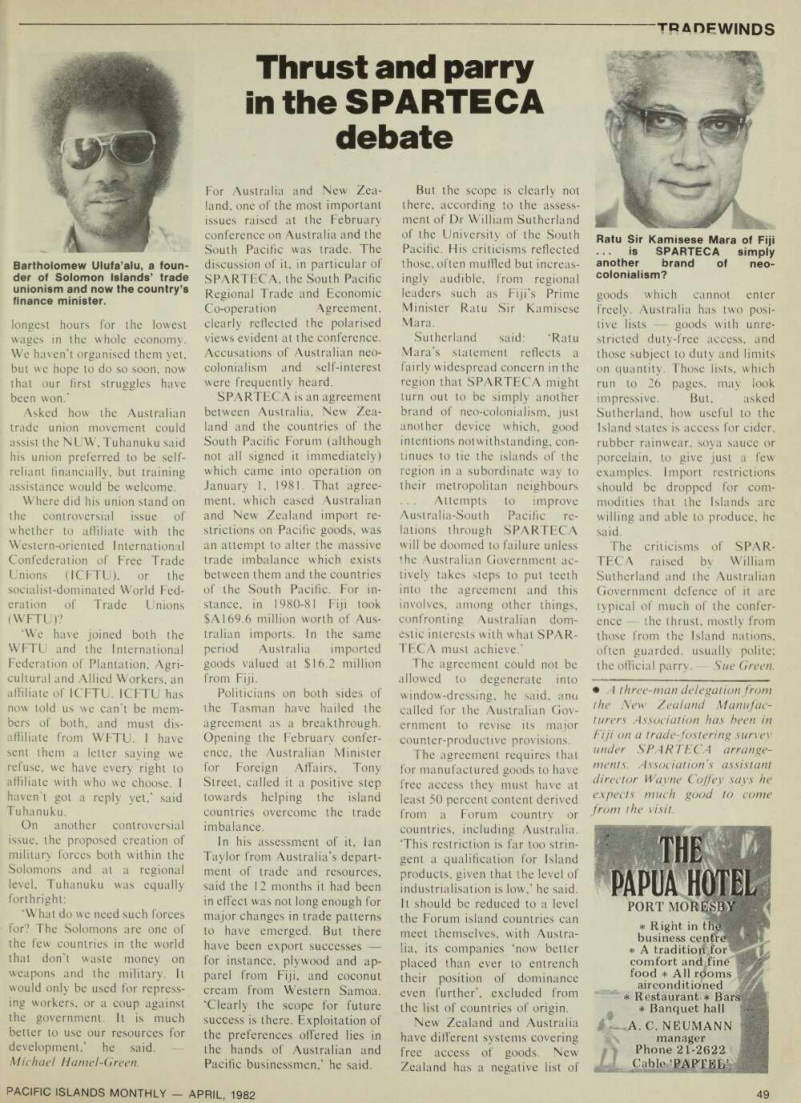
Workshop hears of unionism in Solomons
Trade union issues did not rate highly on the agenda of the February conference in Can berra on Australia and the South Pacific. Only one Pacific trade unionist was invited, and no lime made available for him to address the conference as a whole.
This was surprising in the light of recent initiatives towards regional trade union co operation culminating in May last year a conference in Vanuatu which established the Pacific Trade Union Forum.
The Pacific unionist invited was Joses Tuhanuku, the force ful young secretary-general of the Solomon Islands’ National Union of Workers. In a well attended workshop that in cluded Australian trade union ists, academics, aid organis
ation workers, and public ser vants, Tuhanuku led a lively discussion on the role of trade unions in Pacific countries, drawing on his own union’s experience. ‘ln our traditional village fife, we didn’t need trade unions,’
Tuhanuku told the workshop. ‘No one was over us, we worked only to meet our own needs.
Now, with foreign-based com panies in the timber, copra and fishing industries, we are work ing for employers. People from different villages and islands find themselves together. The union overcomes the local rival ries and wins belter conditions for all.' Founded in 1975, Tuhan uku’s National Union of Workers was organised as a single union that would cover all
kinds of workers. ‘We only have 16 000 workers in the whole Solomons, and over 10 000 are members of our union. Unions based on single industries would have been 100 small to be effec tive,' he said.
How successful was the NUW? Did the government and employers accept it?
The finance minister in the present government was one of the union’s founders,’ Tuhan uku replied. ‘We formed the National Democratic Parly to represent our interests politi cally, and now we feel we have a voice in the government.’ ‘The employers, well, they still don’t accept us, but they have to negotiate with us, we have forced that on them.’
A large proportion of the workshop participants were women, and Tuhanuku was pressed as to what his union was doing for women workers. ‘We do have many women members, but they do not like to gel involved in organising. We are trying to encourage them,' Tuhanuku said, ‘Many women are domestics, working the
longest hours for the lowest wages in the whole economy.
We haven’t organised them yet, but we hope to do so soon, now that our first struggles have been won.' Asked how the Australian trade union movement could assist the NUW, Tuhanuku said his union preferred to be self reliant financially, but training assistance would be welcome.
Where did his union stand on the controversial issue of whether to affiliate with the Western-oriented International Confederation of Free Trade Unions (ICFTU), or the socialist-dominated World Fed eration of Trade Unions
(Wftu)?
‘We have joined both the WFTU and the International Federation of Plantation, Agri cultural and Allied Workers, an affiliate of ICFTU. ICFTU has now told us we can’t be mem bers of both, and must dis affiliate from WFTU. I have sent them a letter saying we refuse, we have every right to affiliate with who we choose. 1 haven't got a reply yet,’ said Tuhanuku.
On another controversial issue, the proposed creation of military forces both within the Solomons and at a regional level, Tuhanuku was equally forthright: ‘What do we need such forces for? The Solomons are one of the few countries in the world that don’t waste money on weapons and the military. It would only be used for repress ing workers, or a coup against the government. It is much better to use our resources for development,’ he said.
Michael Hamel-Green.
Bartholomew Ulufa’alu, a foun der of Solomon Islands’ trade unionism and now the country’s finance minister.
Advertisements & other items, pp. 47-48 (1 item)
//////Aarque
A leader in r
Graphic Communication The Re P r ographics Division of GAF (Australasia) Pty. Ltd. has changed its name to
DRAFTING
EQUIPMENT
& MEDIA
DIAZO
MATERIALS
DIAZO PLAN
PRINTING
MACHINES
ULTRA-FINE
DRAFTING FILM
MICROFILM
EQUIPMENT
DRAFTING
& WRITING
PRODUCTS
CAD MATERIALS
///AARQUE
AARQUE SYSTEMS PTY. LTD.
Early in 1981 the GAF Corporation announced a restructure. Following that announcement the Reprographic Division of GAF was purchased as a world-wide business by the AARQUE group of companies, a Jamestown, New York based corporation.
In the Australasian region AARQUE will continue to operate the reprographic business previously run by GAF and the company will be trading under the name of AARQUE SYSTEMS PTY. LTD. Manufacturing plants for diazo and sensitised materials are located in Sydney, Melbourne and Wellington, New Zealand, and Official Agents have been appointed in South East Asia and the Pacific Basin.
AARQUE will continue to expand its interest in the reprographic areas, with advanced diazo printers, drafting equipment and materials, and will accelerate the world-wide coordination available to meet the technological developments of the future.
AARQUE SYSTEMS PTY. LTD., P.O. Box 226, Waterloo, N.S.W. AUSTRALIA 2017 Please send me the details as marked below and the name and address of my nearest supplier.
CU Diazo Printers & Materials CH Drafting Equipment and Supplies
OGeneral literature
NAME
ADDRESS
V
V
GLOBAL SERVICE FOR SHIPPERS
THE BANK LINE
28 Day Service
United Kingdom and Continent to:
PAPEETE • NOUMEA
PAPUA NEW GUINEA and SOLOMON ISLANDS
PORT VILA & SANTO BY TRANSHIPMENT
■X"
United Kingdom and Continent to: SUVA AND LAUTOKA (FCL LCL & UNITISED ONLY) Papua New Guinea and Solomon Islands to:
UNITED KINGDOM and CONTINENT
-JStN-S
wr mr For particulars apply:
THE BANK LINE (AUSTRALASIA) PTY. LTD.
18th Floor 1 York Street SYDNEY N.S.W. 2000 Australia Tel: 272041 Telex: 24063
in the SPARTECA
Thrust and parry in the SPARTECA debate
For Australia and New Zea land, one of the most important issues raised at the February conference on Australia and the South Pacific was trade. The discussion of it, in particular of SPARTECA, the South Pacific Regional Trade and Economic Co-operation Agreement, clearly reflected the polarised views evident at the conference.
Accusations of Australian neo colonialism and self-interest were frequently heard.
SPARTECA is an agreement between Australia, New Zea land and the countries of the South Pacific Forum (although not all signed it immediately) which came into operation on January 1, 1981. That agree ment, which eased Australian and New Zealand import re strictions on Pacific goods, was an attempt to alter the massive trade imbalance which exists between them and the countries of the South Pacific. For in stance, in 1980-81 Fiji took $A 169.6 million worth of Aus tralian imports. In the same period Australia imported goods valued at $16.2 million from Fiji.
Politicians on both sides of the Tasman have hailed the agreement as a breakthrough.
Opening the February confer ence, the Australian Minister for Foreign Affairs, Tony Street, called it a positive step towards helping the island countries overcome the trade imbalance.
In his assessment of it, lan Taylor from Australia’s depart ment of trade and resources, said the 12 months it had been in effect was not long enough for major changes in trade patterns to have emerged. But there have been export successes for instance, plywood and ap parel from Fiji, and coconut cream from Western Samoa. ‘Clearly the scope for future success is there. Exploitation of the preferences offered lies in the hands of Australian and Pacific businessmen,’ he said.
But the scope is clearly not there, according to the assess ment of Dr William Sutherland of the University of the South Pacific. His criticisms reflected those, often muffled but increas ingly audible, from regional leaders such as Fiji’s Prime Minister Ratu Sir Kamisese Mara.
Sutherland said: ‘Ratu Mara’s statement reflects a fairly widespread concern in the region that SPARTECA might turn out to be simply another brand of neo-colonialism, just another device which, good intentions notwithstanding, con tinues to tie the islands of the region in a subordinate way to their metropolitan neighbours Attempts to improve Australia-South Pacific re lations through SPARTECA will be doomed to failure unless the Australian Government ac tively takes steps to put teeth into the agreement and this involves, among other things, confronting Australian dom estic interests with what SPAR TECA must achieve.’
The agreement could not be allowed to degenerate into window-dressing, he said, anu called for the Australian Gov ernment to revise its major counter-productive provisions.
The agreement requires that for manufactured goods to have free access they must have at least 50 percent content derived from a Forum country or countries, including Australia.
This restriction is far too strin gent a qualification for Island products, given that the level of industrialisation is low,’ he said.
It should be reduced to a level the Forum island countries can meet themselves, with Austra lia, its companies ‘now better placed than ever to entrench their position of dominance even further’, excluded from the list of countries of origin.
New Zealand and Australia have different systems covering free access of goods. New Zealand has a negative list of
goods which cannot enter freely. Australia has two posi tive lists goods with unre stricted duty-free access, and those subject to duty and limits on quantity. Those lists, which run to 26 pages, may look impressive. But, asked Sutherland, how useful to the Island states is access for cider, rubber rainwear, soya sauce or porcelain, to give just a few examples. Import restrictions should be dropped for com modities that the Islands are willing and able to produce, he said.
The criticisms of SPAR TECA raised by William Sutherland and the Australian Government defence of it are typical of much of the confer ence the thrust, mostly from those from the Island nations, often guarded, usually polite;
the official parry.
Sue Green.
• A three-man delegation from the New Zealand Manufac turers Association has been in Fiji on a trade-fostering survey under SP ARTEC A arrange ments. Association’s assistant director Wayne Coffey says he expects much good to come from the visit.
Ratu Sir Kamisese Mara of Fiji
... is SPARTECA simply
another brand of neo colonialism?
Advertisements & other items, p. 49 (1 item)
Port Mob
* Right in t business cep, ♦ A comfort food * All airconditioned * Restaurant * Ba * Banquet hall
A. C. NEUMANN
manager Phone 21-2622 C ab \om
the hydro tunnel
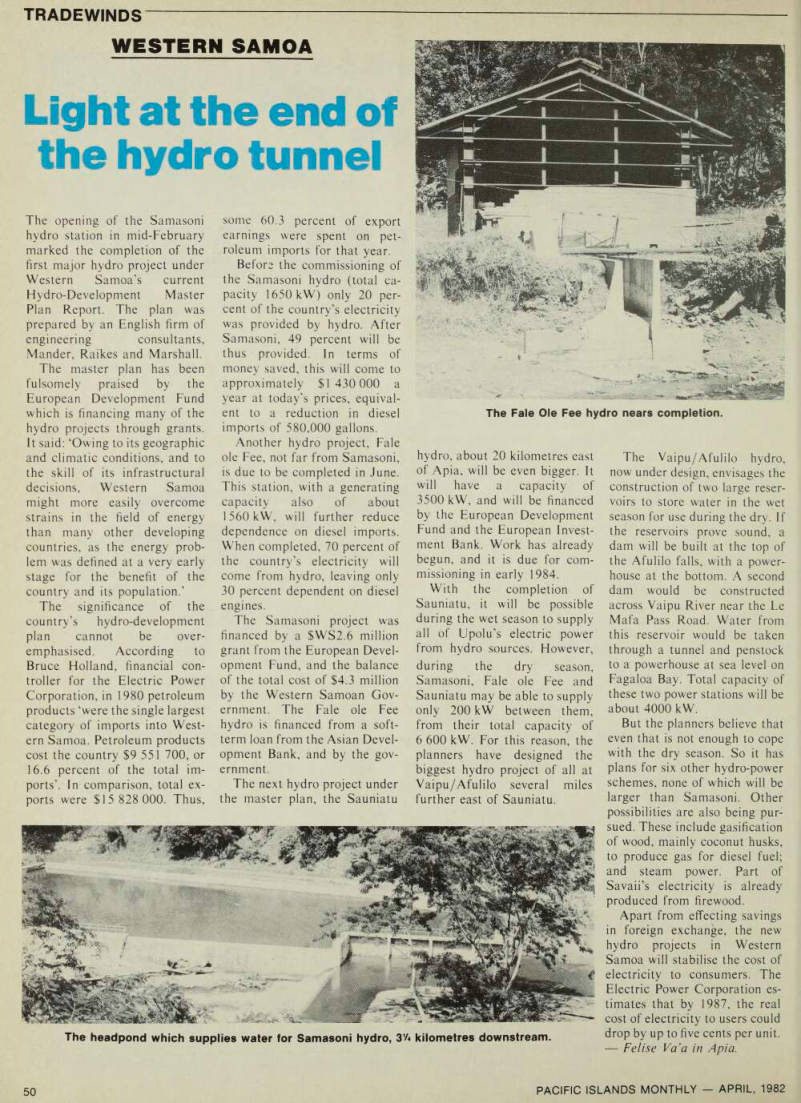
Western Samoa
Light at the end of the hydro tunnel
The opening of the Samasoni hydro station in mid-February marked the completion of the first major hydro project under Western Samoa’s current Hydro-Development Master Plan Report. The plan was prepared by an English firm of engineering consultants, Mander, Raikes and Marshall.
The master plan has been fulsomely praised by the European Development Fund which is financing many of the hydro projects through grants.
It said: ‘Owing to its geographic and climatic conditions, and to the skill of its infrastructural decisions, Western Samoa might more easily overcome strains in the field of energy than many other developing countries, as the energy prob lem was defined at a very early stage for the benefit of the country and its population.’
The significance of the country’s hydro-development plan cannot be over emphasised. According to Bruce Holland, financial con troller for the Electric Power Corporation, in 1980 petroleum products ‘were the single largest category of imports into West ern Samoa. Petroleum products cost the country $9 551 700, or 16.6 percent of the total im ports’. In comparison, total ex ports were $l5 828 000. Thus,
some 60.3 percent of export earnings were spent on pet roleum imports for that year.
Before the commissioning of the Samasoni hydro (total ca pacity 1650 kW) only 20 per cent of the country’s electricity was provided by hydro. After Samasoni, 49 percent will be thus provided. In terms of money saved, this will come to approximately $1430 000 a year at today’s prices, equival ent to a reduction in diesel imports of 580,000 gallons.
Another hydro project, Fale ole Fee, not far from Samasoni, is due to be completed in June.
This station, with a generating capacity also of about 1560 kW, will further reduce dependence on diesel imports.
When completed, 70 percent of the country’s electricity will come from hydro, leaving only 30 percent dependent on diesel engines.
The Samasoni project was financed by a SWS2.6 million grant from the European Devel opment Fund, and the balance of the total cost of $4.3 million by the Western Samoan Gov ernment. The Fale ole Fee hydro is financed from a soft term loan from the Asian Devel opment Bank, and by the gov ernment.
The next hydro project under the master plan, the Sauniatu
hydro, about 20 kilometres east of Apia, will be even bigger. It will have a capacity of 3500 kW, and will be financed by the European Development Fund and the European Investrnent Bank. Work has already begun, and it is due for commissioning in early 1984.
With the completion of Sauniatu, it will be possible during the wet season to supply aP of Upolu’s electric power from hydro sources. However, during the dry season, Samasoni, Fale ole Fee and Sauniatu may be able to supply only 200 kW between them, from their total capacity of 6 600 kW. For this reason, the planners have designed the biggest hydro project of all at Vaipu/Afulilo several miles further east of Sauniatu.
The Vaipu/Afulilo hydro, now under design, envisages the construction of two large reser voirs to store water in the wet season for use during the dry. If the reservoirs prove sound, a dam will be built at the top of the Afulilo falls, with a power house at the bottom. A second dam would be constructed across Vaipu River near the Le Mafa Pass Road. Water from this reservoir would be taken through a tunnel and penstock to a powerhouse at sea level on Fagaloa Bay. Total capacity of these two power stations will be about 4000 kW.
But the planners believe that even that is not enough to cope with the dry season. So it has plans for six other hydro-power schemes, none of which will be larger than Samasoni. Other possibilities are also being pur sued. These include gasification of wood, mainly coconut husks, to produce gas for diesel fuel; and steam power. Part of Savaii’s electricity is already produced from firewood.
Apart from effecting savings in foreign exchange, the new hydro projects in Western Samoa will stabilise the cost of electricity to consumers. The Electric Power Corporation es timates that by 1987, the real cost of electricity to users could drop by up to five cents per unit.
Felise Va’a in Apia.
The headpond which supplies water for Samasoni hydro, 3¼ kilometres downstream.
The Fale Ole Fee hydro nears completion.
With a New Hebrides inter-island
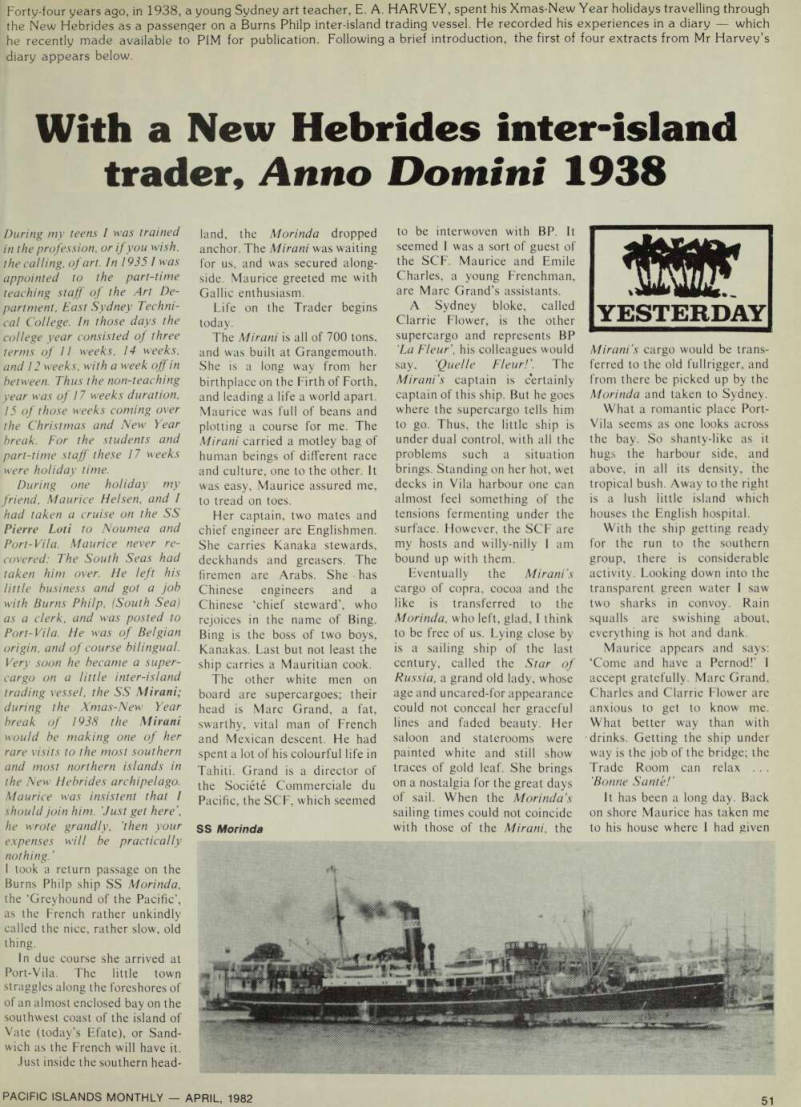
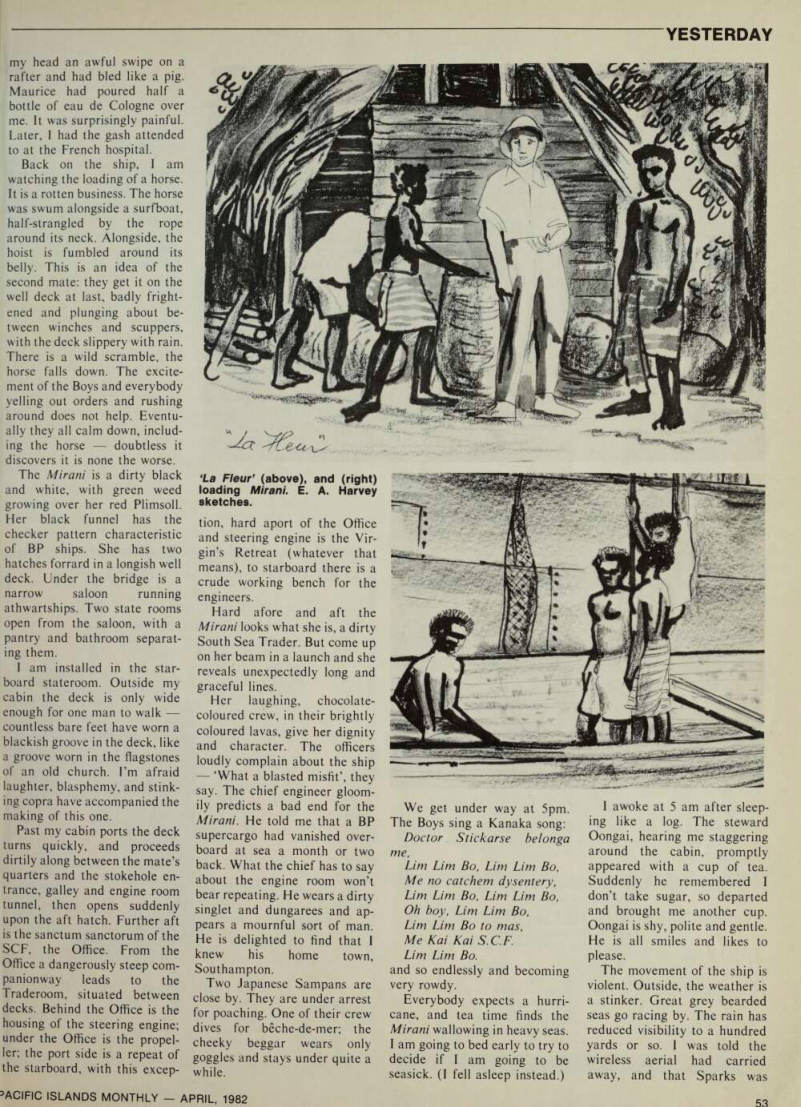
Yesterday
With a New Hebrides inter-island trader. Anno Domini 1938
Forty-four years ago, in 1938, a young Sydney art teacher, E. A. HARVEY, spent his Xmas-New Year holidays travelling through the New Hebrides as a passenger on a Burns Philp inter-island trading vessel. He recorded his experiences in a diary which he recently made available to PIM for publication. Following a brief introduction, the first of four extracts from Mr Harvey’s diary appears below.
During my teens I was trained in the profession, or if you wish, the calling, of art. Ini 935 I was appointed to the part-time teaching staff of the Art De partment, East Sydney Techni cal College. In those days the college year consisted of three terms ofll weeks, 14 weeks, and 12 weeks, with a week off in between. Thus the non-teaching year was of 17 weeks duration, 15 of those weeks coming over the Christmas and New Year break. For the students and part-time staff these 17 weeks were holiday time.
During one holiday my friend, Maurice Helsen, and I had taken a cruise on the SS Pierre Loti to Noumea and Port-Vila. Maurice never re covered: The South Seas had taken him over. He left his little business and got a job with Burns Philp, (South Sea) as a clerk, and was posted to Port-Vila. He was of Belgian origin, and of course bilingual.
Very soon he became a super cargo on a little inter-island trading vessel, the SS Mirani; during the Xmas-New Year break of 1938 the Mirani would be making one of her rare visits to the most southern and most northern islands in the New Hebrides archipelago.
Maurice was insistent that I should join him. ‘Just get here’, he wrote grandly, ‘then your expenses will be practically nothing. ’ 1 took a return passage on the Burns Philp ship SS Morinda, the ‘Greyhound of the Pacific’, as the French rather unkindly called the nice, rather slow, old thing.
In due course she arrived at Port-Vila. The little town straggles along the foreshores of of an almost enclosed bay on the southwest coast of the island of Vate (today’s Efate), or Sand wich as the French will have it.
Just inside the southern head
land, the Morinda dropped anchor. The Mirani was waiting for us, and was secured along side. Maurice greeted me with Gallic enthusiasm.
Life on the Trader begins today.
The Mirani is all of 700 tons, and was built at Grangemouth.
She is a long way from her birthplace on the Firth of Forth, and leading a life a world apart.
Maurice was full of beans and plotting a course for me. The Mirani carried a motley bag of human beings of different race and culture, one to the other. It was easy, Maurice assured me, to tread on toes.
Her captain, two mates and chief engineer arc Englishmen.
She carries Kanaka stewards, deckhands and greasers. The firemen are Arabs. She has Chinese engineers and a Chinese ‘chief steward', who rejoices in the name of Bing.
Bing is the boss of two boys, Kanakas. Last but not least the ship carries a Mauritian cook.
The other white men on board are supercargoes; their head is Marc Grand, a fat, swarthy, vital man of French and Mexican descent. He had spent a lot of his colourful life in Tahiti. Grand is a director of the Societe Commerciale du Pacific, the SCF, which seemed
to be interwoven with BP. It seemed 1 was a sort of guest of the SCF. Maurice and Emile Charles, a young Frenchman, are Marc Grand’s assistants.
A Sydney bloke, called Clarrie Flower, is the other supercargo and represents BP La Fleur’, his colleagues would say, ‘Quelle Fleur!’. The Mi rani’s captain is certainly captain of this ship. But he goes where the supercargo tells him to go. Thus, the little ship is under dual control, with all the problems such a situation brings. Standing on her hot, wet decks in Vila harbour one can almost feel something of the tensions fermenting under the surface. However, the SCF are my hosts and willy-nilly I am bound up with them.
Eventually the Mi rani’s cargo of copra, cocoa and the like is transferred to the Morinda, who left, glad, I think to be free of us. Lying close by is a sailing ship of the last century, called the Star of Russia, a grand old lady, whose age and uncared-for appearance could not conceal her graceful lines and faded beauty. Her saloon and staterooms were painted white and still show traces of gold leaf. She brings on a nostalgia for the great days of sail. When the Morinda’s sailing times could not coincide with those of the Mirani, the
Mi rani’s cargo would be trans ferred to the old fullrigger, and from there be picked up by the Morinda and taken to Sydney.
What a romantic place Porl- Vila seems as one looks across the bay. So shanty-like as it hugs the harbour side, and above, in all its density, the tropical bush. Away to the right is a lush little island which houses the English hospital.
With the ship getting ready for the run to the southern group, there is considerable activity. Looking down into the transparent green water I saw two sharks in convoy. Rain squalls are swishing about, everything is hot and dank.
Maurice appears and says; ‘Come and have a Pernod!' 1 accept gratefully. Marc Grand, Charles and Clarrie Flower are anxious to get to know me.
What better way than with drinks. Getting the ship under way is the job of the bridge; the Trade Room can relax ...
'Bonne Santel’
It has been a long day. Back on shore Maurice has taken me to his house where I had given
SS Morinda
my head an awful swipe on a rafter and had bled like a pig.
Maurice had poured half a bottle of eau de Cologne over me. It was surprisingly painful.
Later, I had the gash attended to at the French hospital.
Back on the ship, I am watching the loading of a horse.
It is a rotten business. The horse was swum alongside a surfboat, half-strangled by the rope around its neck. Alongside, the hoist is fumbled around its belly. This is an idea of the second mate: they get it on the well deck at last, badly fright ened and plunging about be tween winches and scuppers, with the deck slippery with rain.
There is a wild scramble, the horse falls down. The excite ment of the Boys and everybody yelling out orders and rushing around does not help. Eventu ally they all calm down, includ ing the horse doubtless it discovers it is none the worse.
The Mirani is a dirty black and white, with green weed growing over her red Plimsoll.
Her black funnel has the checker pattern characteristic of BP ships. She has two hatches forrard in a longish well deck. Under the bridge is a narrow saloon running athwartships. Two state rooms open from the saloon, with a pantry and bathroom separat ing them.
I am installed in the star board stateroom. Outside my cabin the deck is only wide enough for one man to walk countless bare feet have worn a blackish groove in the deck, like a groove worn in the flagstones of an old church. I’m afraid laughter, blasphemy, and stink ing copra have accompanied the making of this one.
Past my cabin ports the deck turns quickly, and proceeds dirtily along between the mate’s quarters and the stokehole en trance, galley and engine room tunnel, then opens suddenly upon the aft hatch. Further aft is the sanctum sanctorum of the SCF, the Office. From the Office a dangerously steep com panionway leads to the Traderoom, situated between decks. Behind the Office is the housing of the steering engine; under the Office is the propel ler; the port side is a repeat of the starboard, with this excep-
tion, hard aport of the Office and steering engine is the Vir gin’s Retreat (whatever that means), to starboard there is a crude working bench for the engineers.
Hard afore and aft the Mirani looks what she is, a dirty South Sea Trader. But come up on her beam in a launch and she reveals unexpectedly long and graceful lines.
Her laughing, chocolate coloured crew, in their brightly coloured lavas, give her dignity and character. The officers loudly complain about the ship ‘What a blasted misfit’, they say. The chief engineer gloom ily predicts a bad end for the Mirani. He told me that a BP supercargo had vanished over board at sea a month or two back. What the chief has to say about the engine room won’t bear repeating. He wears a dirty singlet and dungarees and ap pears a mournful sort of man.
He is delighted to find that I knew his home town,
Southampton.
Two Japanese Sampans are close by. They are under arrest for poaching. One of their crew dives for beche-de-mer; the cheeky beggar wears only goggles and stays under quite a while.
We get under way at spm.
The Boys sing a Kanaka song: Doctor Stickarse belonga me, Lim Lim 80, Lim Lim 80, Me no catchem dysentery, Lim Lim 80, Lim Lim 80, Oh boy, Lim Lim 80, Lim Lim Bo to mas, Me Kai Kai S.C.f.
Lim Lim 80. and so endlessly and becoming very rowdy.
Everybody expects a hurri cane, and tea time finds the Mirani wallowing in heavy seas.
I am going to bed early to try to decide if I am going to be seasick. (I fell asleep instead.)
I awoke at 5 am after sleep ing like a log. The steward Oongai, hearing me staggering around the cabin, promptly appeared with a cup of tea.
Suddenly he remembered I don’t take sugar, so departed and brought me another cup.
Oongai is shy, polite and gentle.
He is all smiles and likes to please.
The movement of the ship is violent. Outside, the weather is a stinker. Great grey bearded seas go racing by. The rain has reduced visibility to a hundred yards or so. I was told the wireless aerial had carried away, and that Sparks was
‘La Fleur ’ (above), and (right) loading Mirani. E. A. Harvey sketches.
seasick and in a foul temper. 1 had forgotten to introduce our wireless operator. He is an Australian and somewhat re served. Stamp collectors write to him from all over the world with self-addressed envelopes and money for New Hebrides stamps. The chief engineer is a little seasick, I am a little seedy.
Maurice and M’sieur Charles are in fine fettle.
A discussion took place over the probable course of the ship.
Mirani had overshot the island of Erromango in the dark. She is now turning broadside on and facing it. The poor little ship is rolling heavily and taking water. The glass is still falling.
At 11 am 1 ate a tremendous breakfast and fell much better.
Erromango is in sight close by.
Clouds of rain reduce visibility almost to zero. We have passed our anchorage in Dillons Bay and are now hove-to on the southern and lee shore. The supercargoes say the skipper is scared and mucking about. I am told it is his first command.
Obviously he will take extra care that nothing blots his copy book.
From the ship we see a grey sky and a grey sea and in between is Erromango green to the water’s edge. The ship is just turning round after reach ing the end of the lee shore. She is patrolling back again, the screw just turning. Everybody is waiting, but for how long? Mate doesn’t know ‘bloody skipper won’t confide,’ he complains.
The SCF chaps call the captain a taxi-driver; he calls them a pack of grocers.
The captain enters the Saloon and settles down with the maga zine Fix. He informs us nothing can be done until he gets weather reports. He does not think we can reach the island of Tanna, there is no shelter there.
The chief engineer is wailing about the water slip-slopping about in his cabin.
During the night Maurice had been soaked in his bunk. 1 was on the lee side and kept perfectly dry.
The second male came down from his watch and said he was too f frightened to go and look in his f cabin. He is a heavy, coarse, foul-mouthed man, a bully to those under him.
they say, and putting on a crawling manner to his betters.
Maurice tells me not to repeat anything 1 hear to the second mate, because it all goes straight back to the bridge. The second minds his Ps and Qs with Maurice. On the last trip he trod on Maurice’s bare feet while wearing heavy sea boots.
Maurice at once sent a pile driver into the pit of his stomach.
La Fleur produced a gramo phone and set it drooling away.
Time does begin to hang heavily. The wireless is still broken down. Sparks has every thing in bits. Each piece is labeled ‘ldeal’, a fact which seems to annoy him.
The Trade Room is a fearful place in this sea with the propeller shuddering just underneath. Erromango is still hard by. The skipper decides to try Tanna, some five hours steam away. They say the Mirani will do six knots if the crew put their shirts on the mast.
Tanna looms up and goes again through a grey mist of rain. At last we anchor at
Ouaisisi beside the Polyn'esien, a French copra ship of our own size, but very chic. One does not realise how tiring a plunging, rolling ship can be. How won derful to be still, or just to walk without making compensatory movements. Everyone is feeling fine. The ‘Bridge’ can relax. The supercargoes are in the Office and Traderoom they come into their own at an anchorage. ‘What have they got for whom, and what has whom got for them?’ 1 was anxious to go ashore.
Charles had to go through the books of the SCF Trading Station at White Sands and invited me to accompany him.
I accepted gladly. I got drawing materials together and we were pulled ashore in the boat. The Boys piggy-backed us to dry land. 1 wondered why the others weren’t coming, not realising in my innocence that the skipper had gone to Ouaisisi because of the storm. White Sands was a good 10 miles away. Thanks for coming,’ said Charles. • Next month: Touring the mystery islands of the south.
Advertisements & other items, pp. 52-54 (3 items)
Citize
Om e ttsSor, MS m BM ■ •••-:■• ■a*. fs/sr Htt •-M*ssa4 ii is * uv fe * ■ a v- - 3! r w #*% 4 f ••. '-. ; */»
IkJ
M isW i % f* *»u ■*** *ffh 1 t I— » ft 23 fv: ■ ■■
i ' J . *v^«l
i & Vl',• 1.
L -. v ' ?« •I en ** I - 'w Water-resistant quartz watches from Citizen.
Under a clear blue sky or tire deep blue sea, these slim quartz watches from Citizen are always at home. Accurate to within seconds a month, the Water Resist 100 series keeps time at 100 metres below the. surface as well as it does on dry land. All models, analog and , digital, feature day and*da,te and all are made to Citizen's high - standards of ruggedness andprecisiqn,
QUARTZ
WATER RESIST lOU
03 W M G 03 > H H K W tn H SC
THE INNOVATOR 800
The most practical
Alcohol Fuel Production System
in the industry.
Features: Propane Burner System.
Electronic Igniters.
Failsafe Burner Cutoff.
Alcohol Reboiler System.
Remote Temperature Gauges.
Pressure Gauges.
Pressure Relief Valves.
Precision Temperature Control.
Entire System Skid Mounted. m E A. ■ Capacity: 120 Gallons/Day.
PRIMARY ENERGY AUSTRALIA
PTY. LTD.
1 Queens Avenue, McMahons Point, Sydney 2060.
New South Wales, Australia.
Phone: (02) 436 1813, 436 1399. Telex; AA28764. ? °HOL FUELS SYMPOSIUM AUCKLAND MAY 13 -18TH
MORE PORTS/MORE OFTEN
with KARLANDER NEW GUINEA LINE: Serving; Pt. Moresby, Lae, Madang, Rabaul, Wewak, Manus Is., Popondetta, Kimbe.
KARLANDER KANGAROO LINE: Serving; Los Angeles, San Francisco, Auckland, Melbourne, Suva, Lautoka, Tahiti, Tarawa, Funafuti.
Managing Agents
KARLANDER (AUSTRALIA) PTY. LIMITED
19 - 31 Pitt Street, Sydney.
Phone: 232 1011. Tlx: AA22143 General Agents Brisbane: Dalgety Shipping Kimbe: Harrison & Crossfield Melbourne: Dalgety Shipping Rabaul: Robt. Laurie (N.G.) P/L Port Moresby: Robt. Laurie (N.G.) P/L Tarawa: Shipping Corporation Popondetta: Musa Agencies Funafuti: Co-operative Wholesale Society Lae: Robt. Laurie (N.G.) P/L Fiji: Burns Philp Madang: Robt. Laurie (N.G.) P/L San Francisco: Norton Lilly Wewak: Garamut Enterprises Los Angeles: Norton Lilly Manus Is: R. & V. Knight Papeete; Sotama
53
YESTERDAY
3 ACIFIC ISLANDS MONTHLY APRIL, 1982
Yesterday
Yachts

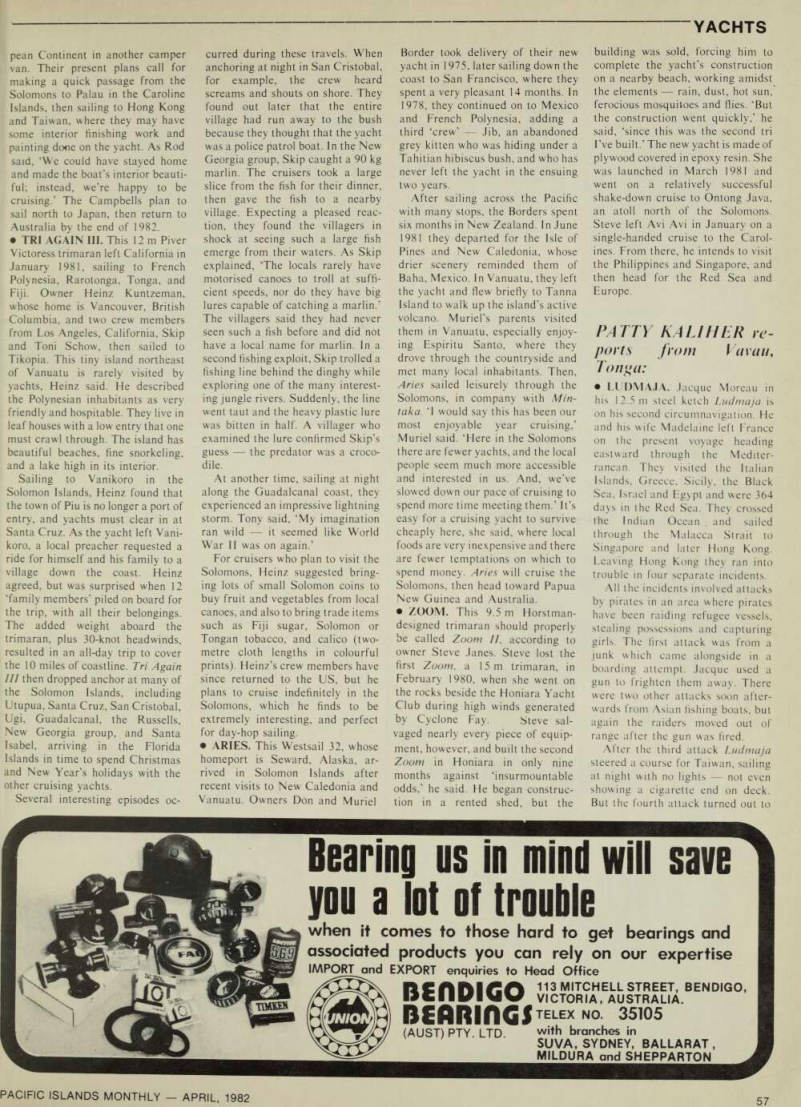
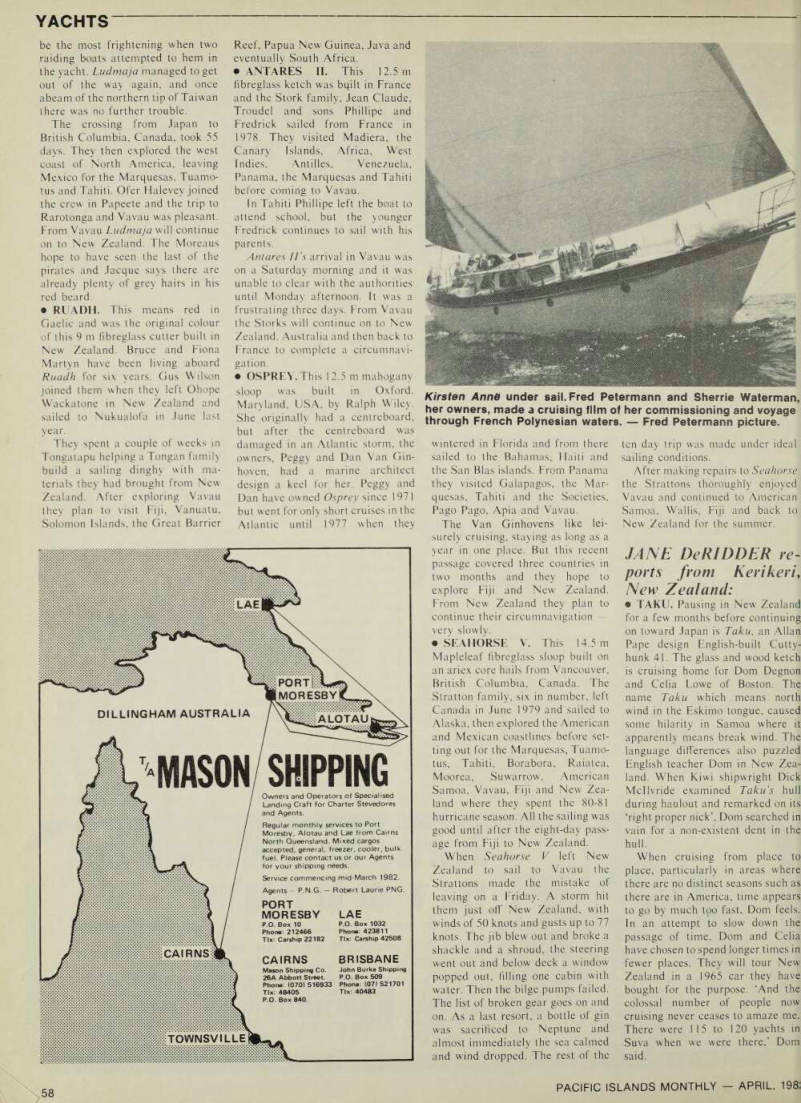
Marcia Davock
reports from Solomon
Islands:
• Gloria Maris. Delmer
(Stoney) and Joyce Stone have been moored at Avi Avi aboard their Chinese junk for the last two years.
The yacht is tucked into a corner near the Avi Avi Marina, a small shipyard and the bay’s only com mercial enterprise, owned by Moses Razak. When Joyce and Stoney arrived, few yachts had ever visited this protected anchorage and the marina business had only just com menced. The marina provides haul out facilities and a well-equipped machine shop. Stoney felt the bay would be an excellent place to work on the boat, to go diving and snorkeling, and to get to know the local people. ‘And ever since,’
Stoney said, ‘we’ve been happy with the choice.’
From this location, Joyce con ducts her ‘gunkholers’ net’ on the 20-metre amateur radio band for maritime mobiles and land-based stations. The net meets daily at 1000 GMT on 14.327 megahertz.
Joyce’s call sign is H44KR and Stoney’s is H44GM.
The Stones ordered their Chinese junk from Hong Kong, and picked it up in 1971. With a crew of seven, they sailed it back to their homeport, Guam, where they had lived for many years. In 1974 Stoney retired from his position as a supervisory fire-fighter for the US Navy. Soon afterwards Joyce left her position as a Navy librarian, and they began cruising in 1977. They sailed first to Palau, on the ‘slow boat to China’ or ‘3O tons of junk’, as they affectionately call their 15 m motorsailer, with its 2.5 m draft and 4.5 m beam. The boat has three masts, is junk-rigged, and is equipped with such comforts as an aft cockpit capable of seating a party of 20, a washer-dryer, a freezer, a microwave oven, and a photographic darkroom.
The Stones stayed 20 months in Palau, taking friends scuba diving to see the island’s rich marine life, and collecting shells, old bottles, glass, and wartime relics. ‘We investigated old caves with earthen ware pottery shards from early Palau inhabitants, we explored sunken ships and trekked through the jungle looking for old guns and communication station remains,’
Stoney said. They donated their
collection of artifacts to the Palau Museum. Joyce wrote an article on antique glass and the techniques of glass-making for the museum’s handbook.
They sailed to Papua New Guinea, where Stoney had been based in World War 11. In Madang, they enjoyed a seven-month stay, travelling along the PNG coast by motorcycle. They also set up a shell dredging apparatus on their dinghy to better examine and photograph the liny seashells that interest them.
Then they cruised New Britain and Bougainville Islands, and the West ern Solomons, arriving in Avi Avi in the Florida Island group two years ago.
• Koo-Ee-Lung. This 11.3 M
multi-chine steel cutter left its homeport of Metung, Victoria, Canada, in August 1979, with Allen Creighton and Dorothy Rogers aboard. They cruised the Australian east coast, then departed for New Zealand on Christmas Day 1979.
During the Tasman crossing, they experienced continuous headwinds, plus Cyclone Paul’s winds of 70 to 80 knots. Another cruising yacht with four people aboard was lost during this storm, Allen said. Koo ee-Lung took 21 days for the passage, tacking nearly 1850 miles to cover the rhumb line distance of about 1150 miles.
Allen and Dorothy spent the next 16 months in New Zealand, alter nating cruising with touring in an old van. They described NZ as a tourist paradise, the scenery magnificent and the people hospit able. In April last year they cruised to Fiji, experiencing frustrating calms, then another storm with estimated 80-knot winds. They spent four months cruising Fiji island groups, including an unusual trip through the southeastern river valleys of Viti Levu. ‘The river cruising was one of our highlights,’
Dorothy said, ‘although it’s not recommended to yachts drawing more than five feet.’ Later, they participated with 10 other yachts in the Coconut Cup Fun Race, a cruisers’ race from Malololailai, Fiji, to Port-Vila, Vanuatu, spon sored by the Fiji Musket Cove Yacht Club. There were prizes for each yacht in this relaxed race, which promises to become a popular annual event, Allen said.
After cosmopolitan Vila, Koo-ee- Lung visited the outer islands of Vanuatu, then cruised in company with Shearwater to islands in the Solomons. In Utupua, they had the opportunity, with Shearwater’s help, to successfully pull two cruis ing yachts off an interior reef on which they had run aground simul taneously while motoring directly into the sunlight. Thereafter, Koo ee-Lung and Shearwater called at several out-of-the-way Solomon
Islands, and participated in local sing-sings, bazaars, and dances. As Allen said, ‘The more remote the island, the more fascinating our experiences were.’ Future plans call for returning to Malaita, visiting islands in the Solomons Western Province, then continuing to Papua New Guinea, where Allen was stationed during World War 11.
Eventually they will cruise leisurely back down the Australian east coast, arriving home to the Gipps land Lakes district ‘in a few years’. • CHUKLVN. This Brandlmyer 12.5 m ketch, constructed of ply wood sheathed in fibreglass, was built by owners Carl and Lynne Turnau in Vancouver, British Col umbia. The Turnaus’ first cruise in 1975-1977, took them down the American coast to Mexico, then to Costa Rica, French Polynesia, Hawaii, and back to Vancouver.
Departing on her second voyage in August 1979, Chuklyn returned to Polynesia and proceeded west wards, stopping at major island groups enroute to New Zealand. In NZ the yacht was caught in Keri keri flooding, along with Bokonon and Mintaka (PIM Jul ’Bl p 67).
Departing NZ in May 1981, the Turnaus hove to two days later in a storm with gusts to 70 knots and high seas. They arrived safely in New Caledonia, then cruised Vanu atu and portions of Solomon Islands. A highlight of their recent cruising included an idyllic anchor age on Hiu Island (Banks Islands, Vanuatu), where they were the first yacht to arrive since 1975. But their most unusual experience was visit ing the agricultural fair at Norsup Bay (Malakula, Vanuatu), when members of the Big and Small Namba tribes came down from the bush country to display their pigs, cows, giant yams and taro, and to discuss farming methods and par ticularly limber conservation tech
niques. The Nambas arrived wear ing their traditional dress penis wrappers, elaborate headdresses, and exotic paint and body adorn ments prepared for the dancing and string band contests that fol lowed the fair. In addition to the usual ukeleles and guitars, one of the most interesting band instru ments was a ‘washtub bass’ made from a sturdy cardboard box rimmed in metal strips, with a long string to pluck. As Lynne said, ‘We were only a handful of yachties among a couple hundred very colorfully dressed bush-dwellers, who performed their traditional songs and dances. It was an exotic experience we'll never forget.’ The Turnaus plan more cruising in the Solomons and Papua New Guinea, and then a visit to Australia. • MASSEQUI. Rod and Chris Campbell, whose homeport is Port Stephens, New South Wales, left Australia in November 1981, bound for Japan. The Campbells sold their home insulation business, which had expanded to the point where they found themselves commuting between Newcastle and Sydney, and often working 16-hour days.
They bought their Adams 14 m multi-chine steel cutter in October 1980 after previously owning two smaller yachts. The first was a 7.5 m sloop, on which they spent their first cruise to Queensland in 1974, ‘ex periencing terrible blows, a knock down, and lots of lime hove-to,’ Rod said. The second boat was a 10 m fibreglass sloop which they fitted out and later sold in NSW.
The Campbells, who are in their early 30s, are confirmed travellers.
They have backpacked most of Indonesia, Southeast Asia, and Japan; they spent several months touring the US in a camper van (‘the beautiful national parks were the totally unexpected highlight of all our travels,' Chris said); then they toured London and the Euro
Showing her colours, Gloria Maris lies at anchor. - Roderica Laymon picture.
pean Continent in another camper van. Their present plans call for making a quick passage from the Solomons to Palau in the Caroline Islands, then sailing to Hong Kong and Taiwan, where they may have some interior finishing work and painting done on the yacht. As Rod said, ‘We could have stayed home and made the boat’s interior beauti ful; instead, we’re happy to be cruising.’ The Campbells plan to sail north to Japan, then return to Australia by the end of 1982. • TRI AGAIN 111. This 12 m Piver Victoress trimaran left California in January 1981, sailing to French Polynesia, Rarotonga, Tonga, and Fiji. Owner Heinz Kuntzeman, whose home is Vancouver, British Columbia, and two crew members from Los Angeles, California, Skip and Toni Schow, then sailed to Tikopia. This tiny island northeast of Vanuatu is rarely visited by yachts, Heinz said. He described the Polynesian inhabitants as very friendly and hospitable. They live in leaf houses with a low entry that one must crawl through. The island has beautiful beaches, fine snorkeling, and a lake high in its interior.
Sailing to Vanikoro in the Solomon Islands, Heinz found that the town of Piu is no longer a port of entry, and yachts must clear in at Santa Cruz. As the yacht left Vani koro, a local preacher requested a ride for himself and his family to a village down the coast. Heinz agreed, but was surprised when 12 ‘family members’ piled on board for the trip, with all their belongings.
The added weight aboard the trimaran, plus 30-knot headwinds, resulted in an all-day trip to cover the 10 miles of coastline. Tri Again 111 then dropped anchor at many of the Solomon Islands, including Utupua, Santa Cruz, San Cristobal, Ugi, Guadalcanal, the Russells, New Georgia group, and Santa Isabel, arriving in the Florida Islands in time to spend Christmas and New Year’s holidays with the other cruising yachts.
Several interesting episodes oc
curred during these travels. When anchoring at night in San Cristobal, for example, the crew heard screams and shouts on shore. They found out later that the entire village had run away to the bush because they thought that the yacht was a police patrol boat. In the New Georgia group. Skip caught a 90 kg marlin. The cruisers took a large slice from the fish for their dinner, then gave the fish to a nearby village. Expecting a pleased reac tion, they found the villagers in shock at seeing such a large fish emerge from their waters. As Skip explained, ‘The locals rarely have motorised canoes to troll at suffi cient speeds, nor do they have big lures capable of catching a marlin.’
The villagers said they had never seen such a fish before and did not have a local name for marlin. In a second fishing exploit. Skip trolled a fishing line behind the dinghy while exploring one of the many interest ing jungle rivers. Suddenly, the line went taut and the heavy plastic lure was bitten in half. A villager who examined the lure confirmed Skip’s guess the predator was a croco dile.
At another time, sailing at night along the Guadalcanal coast, they experienced an impressive lightning storm. Tony said, ‘My imagination ran wild it seemed like World War II was on again.’
For cruisers who plan to visit the Solomons, Heinz suggested bring ing lots of small Solomon coins to buy fruit and vegetables from local canoes, and also to bring trade items such as Fiji sugar, Solomon or Tongan tobacco, and calico (two metre cloth lengths in colourful prints). Heinz’s crew members have since returned to the US, but he plans to cruise indefinitely in the Solomons, which he finds to be extremely interesting, and perfect for day-hop sailing. • ARIES. This Westsail 32, whose homeport is Seward, Alaska, ar rived in Solomon Islands after recent visits to New Caledonia and Vanuatu. Owners Don and Muriel
Border took delivery of their new yacht in 1975, later sailing down the coast to San Francisco, where they spent a very pleasant 14 months. In 1978, they continued on to Mexico and French Polynesia, adding a third ‘crew’ Jib, an abandoned grey kitten who was hiding under a Tahitian hibiscus bush, and who has never left the yacht in the ensuing two years.
After sailing across the Pacific with many stops, the Borders spent six months in New Zealand. In June 1981 they departed for the Isle of Pines and New Caledonia, whose drier scenery reminded them of Baha, Mexico. In Vanuatu, they left the yacht and flew briefly to Tanna Island to walk up the island’s active volcano. Muriel’s parents visited them in Vanuatu, especially enjoy ing Espiritu Santo, where they drove through the countryside and met many local inhabitants. Then, Aries sailed leisurely through the Solomons, in company with Min taka. ‘I would say this has been our most enjoyable year cruising,’
Muriel said. 'Here in the Solomons there are fewer yachts, and the local people seem much more accessible and interested in us. And, we’ve slowed down our pace of cruising to spend more time meeting them.’ It’s easy for a cruising yacht to survive cheaply here, she said, where local foods are very inexpensive and there are fewer temptations on which to spend money. Aries will cruise the Solomons, then head toward Papua New Guinea and Australia. • ZOOM. This 9.5 m Horstman designed trimaran should properly be called Zoom 11. according to owner Steve Janes. Steve lost the first Zoom, a 15 m trimaran, in February 1980, when she went on the rocks beside the Honiara Yacht Club during high winds generated by Cyclone Fay. Steve sal vaged nearly every piece of equip ment, however, and built the second Zoom in Honiara in only nine months against ‘insurmountable odds,’ he said. He began construc tion in a rented shed, but the
building was sold, forcing him to complete the yacht’s construction on a nearby beach, working amidst the elements rain, dust, hot sun, ferocious mosquitoes and flies. 'But the construction went quickly,’ he said, 'since this was the second tri I’ve built.’ The new yacht is made of plywood covered in epoxy resin. She was launched in March 1981 and went on a relatively successful shake-down cruise to Ontong Java, an atoll north of the Solomons.
Steve left Avi Avi in January on a single-handed cruise to the Carol ines. From there, he intends to visit the Philippines and Singapore, and then head for the Red Sea and Europe.
Patty Kali Her Re
ports from V avail,
Tonga:
• Ll DMAJA. Jacque Moreau in his 12.5 m steel ketch Ludmaja is on his second circumnavigation. He and his wife Madelaine left France on the present voyage heading eastward through the Mediter ranean. They visited the Italian Islands, Greece, Sicily, the Black Sea, Israel and Egypt and were 364 days in the Red Sea. They crossed the Indian Ocean . and sailed through the Malacca Strait to Singapore and later Hong Kong.
Leaving Hong Kong they ran into trouble in four separate incidents.
All the incidents involved attacks by pirates in an area where pirates have been raiding refugee vessels, stealing possessions and capturing girls. The first attack was from a junk which came alongside in a boarding attempt. Jacquc used a gun to frighten them away. There were two other attacks soon after wards from Asian fishing boats, but again the raiders moved out of range after the gun was fired.
After the third attack Ludmaja steered a course for Taiwan, sailing at night with no lights not even showing a cigarette end on deck.
But the fourth attack turned out to
be the most frightening when two raiding boats attempted to hem in the yacht. Ludmaja managed to get out of the way again, and once abeam of the northern tip of Taiwan there was no further trouble.
The crossing from Japan to British Columbia, Canada, took 55 days. They then explored the west coast of North America, leaving Mexico for the Marquesas, Tuamo tus and Tahiti. Ofer Halevey joined the crew in Papeete and the trip to Rarotonga and Vavau was pleasant.
From Vavau Ludmaja will continue on to New Zealand. The Moreaus hope to have seen the last of the pirates and Jacque says there are already plenty of grey hairs in his red beard. • RUADH. This means red in Gaelic and was the original colour of this 9 m fibreglass cutter built in New Zealand. Bruce and Fiona Martyn have been living aboard Ruadh for six years. Gus Wilson joined them when they left Ohope Wackalone in New Zealand and sailed to Nukualofa in June last year.
They spent a couple of weeks in Tongalapu helping a Tongan family build a sailing dinghy with ma terials they had brought from New Zealand. After exploring Vavau they plan to visit Fiji, Vanuatu, Solomon Islands, the Great Barrier
Reef, Papua New Guinea, Java and eventually South Africa. • ANTARES 11. This 12.5 m fibreglass ketch was bqilt in France and the Stork family, Jean Claude, Troudel and sons Phillipe and Fredrick sailed from France in 1978. They visited Madiera, the Canary Islands, Africa, West Indies, Antilles, Venezuela, Panama, the Marquesas and Tahiti before coming to Vavau.
In Tahiti Phillipe left the boat to attend school, but the younger Fredrick continues to sail with his parents.
Ant ares ITs arrival in Vavau was on a Saturday morning and it was unable to clear with the authorities until Monday afternoon. It was a frustrating three days. From Vavau the Storks will continue on to New Zealand. Australia and then back to France to complete a circumnavi
gation.
• OSPREY. This 12.5 m mahogany sloop was built in Oxford.
Maryland, USA, by Ralph Wiley.
She originally had a centreboard, but after the centreboard was damaged in an Atlantic storm, the owners. Peggy and Dan Van Gin hoven, had a marine architect design a keel for her. Peggy and Dan have owned Osprey since 1971 but went for only short cruises in the Atlantic until 1977 when they
wintered in Florida and from there sailed to the Bahamas, Haiti and the San Bias islands. From Panama they visited Galapagos, the Mar quesas, Tahiti and the Societies, Pago Pago, Apia and Vavau.
The Van Ginhovens like lei surely cruising, staying as long as a year in one place. But this recent passage covered three countries in two months and they hope to explore Fiji and New Zealand.
From New Zealand they plan to continue their circumnavigation
very slowly.
• Seahorse V. This 14.5 M
Mapleleaf fibreglass sloop built on an ariex core hails from Vancouver, British Columbia, Canada. The Stratton family, six in number, left Canada in June 1979 and sailed to Alaska, then explored the American and Mexican coastlines before set ting out for the Marquesas, Tuamo tus, Tahiti, Borabora, Raiatea, Moorea, Suwarrow, American Samoa, Vavau, Fiji and New Zea land where they spent the 80-81 hurricane season. All the sailing was good until after the eight-day pass age from Fiji to New Zealand.
When Seahorse V left New Zealand to sail to Vavau the Strattons made the mistake of leaving on a Friday. A storm hit them just off New Zealand, with winds of 50 knots and gusts up to 77 knots. The jib blew out and broke a shackle and a shroud, the steering went out and below deck a window popped out, filling one cabin with water. Then the bilge pumps failed.
The list of broken gear goes on and on. As a last resort, a bottle of gin was sacrificed to Neptune and almost immediately the sea calmed and wind dropped. The rest of the
ten day trip was made under ideal
sailing conditions.
After making repairs to Seahorse
the Strattons thoroughly enjoyed
Vavau and continued to American Samoa, Wallis, Fiji and back to New Zealand for the summer.
Jane Deridder Re
ports from Kerikeri ,
New Zealand:
• TAKU. Pausing in New Zealand for a few months before continuing on toward Japan is Taku, an Allan
Pape design English-built Cutty
hunk 41. The glass and wood ketch is cruising home for Dom Degnon and Celia Lowe of Boston. The name Taku which means north wind in the Eskimo tongue, caused some hilarity in Samoa where it apparently means break wind. The language differences also puzzled English teacher Dom in New Zea land. When Kiwi shipwright Dick Mcllvride examined Taku’s hull during haulout and remarked on its ‘right proper nick’, Dom searched in vain for a non-existent dent in the hull.
When cruising from place to place, particularly in areas where there are no distinct seasons such as there are in America, time appears to go by much tpo fast, Dom feels.
In an attempt to slow down the passage of time, Dom and Celia have chosen to spend longer times in fewer places. They will tour New Zealand in a 1965 car they have bought for the purpose. ‘And the colossal number of people now cruising never ceases to amaze me.
There were 115 to 120 yachts in Suva when we were there,’ Dom said.
Kirsten Anne under sail. Fred Petermann and Sherrie Waterman, her owners, made a cruising film of her commissioning and voyage through French Polynesian waters. - Fred Petermann picture.
• Kirsten Anne. Fred
Petermann and Sherrie Waterman designed the layout and interior details for the luxuriously appointed and equipped Transpo 49 yacht Kirsten Anne. Petermann person
ally supervised the building in
Taiwan, and the commissioning was done in USA at Dana Point, Cali fornia. Petermann, a Los Angeles film director and commercial cine matographer, with Sherrie his as sistant, made a movie of the com missioning and voyage of the Kirsten Anne through the Marquesas, Tahiti and Moorea.
From New Zealand, Sherrie and Fred flew back to California to
organise the editing and marketing
of their cruising film. While cruis ing, even when they are not filming,
they are always thinking of subject
matter for future films, Sherrie said. • NERISSA. As a lad, Chip Jordan lived and cruised on his family’s John Alden yawl, Enchanta, for five years. Now, with his wife Martha, Chip is cruising the Pacific on his own 12 m one-off Bill Garden de sign ketch, Nerissa. Chip’s elder brother is also a seafarer. He only recently sold his steel schooner, Albatross, in Samoa. Now the youngest Jordan brother will join Nerissa for the cruise home to San Francisco via Hong Kong and/or
Japan. Chip will probably swallow
the anchor for a while to go to law school. When Martha returns from visiting her family in Alabama she will find the 1968-built Nerissa has a new iroko-kauri cabin sole, newly painted and varnished interior join ery, a solid fuel Dickenson heater, and a below decks shower pan, among other improvements. • KORAL 11. Marek and Jolanta Jarechi, originally from Katowice, Poland, call Koral II ‘part of a
natural progression’. During their
15 years in Canada, they have owned half a dozen vessels of increasing length beginning with a 4.5 m sailing boat. Now they are sailing in Koral 11, a red-hulled 10 m steel vessel of Van De Staadl design. They sailed direct from Victoria in Canada to the Mar quesas, covering the voyage of more than 4000 miles in 37 days. With them was their son Tom, now in his ninth year of schooling and continu
ing to study by British Columbia
correspondence lessons.
Unlike many of the cruising fleet, they do not carry ham radio. Merek, who worked for many years with the Ministry of the Environment in Vic toria, values simplicity and indepen dence. He says that to make amateur radio contacts while cruis
ing is ‘like swimming and always
being tied to the shore’. Though the Jarechi family plans to be back in Victoria for Tom’s next school year
(Sept ’B3) they are already planning
their next boat and their next blue water voyage. • SUMITRA. The 11 m cutter Sumitra (goddess of friendship in Sanscrit), Dick and Heimke Webb’s home for the past several years, spent some weeks in the Bay of Islands, New Zealand. Dick and Heimke built the glass sandwich airex foam core cutter on their property on Vancouver Island, Canada, beginning by clearing the land to build the shed. Their book shop, the Blue Heron in Comox, British Columbia, funded the oper ation. Sumitra, an Endurance 35 designed by Peter Ibold, was the winner of the 1971 cruising design award and features such attractions as inside steering.
The Webbs say ‘lt’s always the people who make it hard to leave a place. We were adopted by a Ton gan family. Same thing in Raiatea and in Rarotonga. That’s what cruising is all about the people.’
The Webbs have left Sumitra temporarily to enjoy a camping and hiking holiday in New Zealand. • ALRISHA. Alrisha was the star which was on the horizon the hour Gene Kozier was born. Besides being his birth star, it is the name of Kozier’s Fraser 40, a Vancouver registered 12 m cutter. The Fraser 40 original concept was dreamed up by five pilots sailing back from the Victoria-Maui Race. Vancouverites Joanne and Gene Kozier (picture p6l) built the vessel themselves in their spare time eight or more hours a day on top of their jobs.
They launched her before she was completed, then, frustrated to dis cover ‘the tool I always wanted was always at home’, Gene moved her back home again for another six months. Alrisha’s anchor is a 15 kg Bruce anchor. The anchor, with its unusual configuration, was devel oped for North Sea oil rigs. Bruce anchors are widely used now by
fishermen, and increasingly by
cruising yachtsmen attracted by the tremendous holding power for light weight.
PAUL RYSAVYreports
from Rarotonga, Cook
Islands:
• REMEMBER. A 20.5 m Van Der Meer-designed ketch arrived in Rarotonga in November. She is a charter vessel registered in Jersey, England, and owned by a British firm, Smile Charters. Skipper of this luxurious vessel is Belgian Hugo Premer, and his sole crew is Annie Trayaud, from France. The chef, who is usually on board, was to join the couple in a few months.
Remember arrived here from Borabora with a group of American passengers, and the ketch seemed likely to remain berthed in Avatiu harbour until mid-December, ’Bl.
She was then to sail to New Zealand
for the hurricane season and continue on in 82 to Australia, Thailand, Singapore, the Seychelles 7“ . r and South Africa, picking up charters on the way. • VELEDA. A London-registered ketch measuring 19.5 m on deck was also berthed in Avatiu harbour in mid-November. She is owned by a German businessman who spends approximately eight weeks a year on the boat. His paid crew consists of skipper Andrew Pack, Martin Brooke, Maureen Kroeger and Mary von Quere. The ketch was built in 1935, and her age is apparent through a number antique items on board, such as a bathtub and brass taps. Skipper Andrew Pack is taking Veleda around the world, and since leaving England in 1979, the ketch has visited
Germany, the Mediterranean, the Caribbean (for a year and a half), Venezuela, Colombia, Panama, the Galapagos, the Marquesas, Tuamotus, the Societies, and Rarotonga. From here Veleda made directly for Auckland where she will be put on the slips for some repairs. After the hurricane season, the itinerary includes Fiji, Papua New Guinea, Indonesia, the Red Sea, Cairo, the Mediterranean and then either England or Germany.
The skipper and crew expect to be sailing for another two years at least.
Gene and Joanne Kozier in New Zealand after sailing their Fraser 40 cutter Alrisha from
Canada. - Jane DeRidder pic
ture.
Advertisements & other items, pp. 56-60 (1 item)
Timken
o
PUTYOUR
FOOT DOWN.
DEMAND
TIMKEN
BEARINGS!
TIMKEN
WGISTCftEO I« API MAS*
If you’re hard headed about the bearings you use . . . put your foot down!
Demand Timken " tapered roller bearings, and you’ll get the brand with proven quality, durability and performance.
The brand that’s given you a long run for your money, wherever it’s used.
On top of all this, you’ll benefit from our consistent supply, delivery, and sales and service engineering assistance available from Australian Timken and Authorized Timken" Bearing Distributors throughout the Pacific.
Another way of looking at it is that you’re not going to put your foot in it when you put your foot down and demand Timken bearings.
TIMKEN
REGISTERED TRADEMARK
TAPERED ROLLER BEARINGS
Authorised Timken 1 - Bearing Distributors in the Pacific are: O.F. Nelson and Co. Ltd., APIA; Bearing Service Company Ltd., AUCKLAND; Kidd Garrett Ltd., AUCKLAND; United Enterprises Ltd., HONIARA; Sunbeam Transport Ltd., LAUTOKA; Nelle Cie SATMA, NOUMEA; Pacific Distributions; PAPEETE; P.N.G, Bearing Service, PORT MORESBY; Socametra, PORT VILA; Burns Philp (South Sea) Company Ltd., SUVA.
HOLT 0676ATX
r s 8r wm
Bearing us in mind will save
yen a let nf trouble
when it comes to those hard to get bearings and associated products you can rely on our expertise IMPORT EXPORT enquiries to Head Office
113 MITCHELL STREET, BENDIGO,
VICTORIA, AUSTRALIA.
B£flRIOG5 TELEX NO. 35105
(AUST) PTY LTD with branches in
SUVA, SYDNEY, BALLARAT,
MILDURA and SHEPPARTON
LAE
PORTfx***
MORESBY
DILLINGHAM AUSTRALIA
ALOTAU
MASON/SHIPPING
PORT
MORESBY
P.O. Box 10 Phone: 212466 Tlx: Carship 22182
LAE
P.O. Box 1032 Phono: 423811 Tlx: Carship 42508
CAIRNS
BRISBANE
CAIRNS
John Burke Shipping P.O. Box 509 Mason Shipping Co. 26A Abbott Street.
Phono: (070) 516933 Phone; (07) 521701 Tlx: 40483 Tlx: 48405 P.O. Box 840
TOWNSVILLE
LOCAL AGENTS AND
REPRESENTATION
428 George St., Sydney.
Cables: Henco Sydney.
G.P.O. Box 3949.
Telephone: 232 5377.
PAPUA NEW GUINEA
RABAUL: M. & C. Seeto, P.O, Box 131, Rabaul.
Telephone 92 2919.
MADANG: W. Double, P.O. Box 22, Madang.
Telephone 82 2696.
FIJI
K. Witherington Ltd., P.O. Box 293, Suva.
Telephone 22 356.
For specialised and
personalised buying
service throughout
the Pacific Islands
and the East.
Resident Agents in other Pacific Territories.
VANUATU
John Lum & Associates, P.O. Box 65, Santo.
Telephone 329.
SOLOMON ISLANDS
Mr. Tom Lo, P.O. Box 327, Honiara.
Telephone 399
STI PACIFIC ISLANDS
C TRANSPORT LINE
M.V. SIRIUS
1 O US) N is
and VO
TAHITI SAMOA
xoc
Qeqeral Steamship Qorpora tiori m,
General Agents 400 California Street, San Francisco, CA, USA PAPEETE: Agence Maritime Internationale, Tahiti PAGO PAGO: Polynesia Shipping Services, Inc.
APIA: Burns Philp (South Sea) Company, Ltd.
In our 87th Year Selling ‘Service’ to the Pacific Islands
Nelson & Robertson
Pty. Ltd.
o6E/?^ O 'O z H O A rm a V A/ Cy
.RABAUL
SAV.s.
MADANG
,*.V;
LAE
I •V»V~ •%•**.*.*•’.*.•*
KIETA
••• ..‘i V* •• • •v. ■ •. •••7 rv.:-.
BRISBANE
SYDNEY
•••. r**
(Established 1895)
Plantation House, 197 Clarence Street, Sydney.
Cables: ‘IVAN’, Sydney, Brisbane.
Telex: AA22381, Sydney.
Phone: 29 2871 • •if.
LAUTOKA
For Indents '
from Australia,
New Zealand and Overseas
Foodstuffs
Softgoods
Hardware
Machinery
Travel
Insurance
Canned Fish
Jute Goods
Real Estate
*•:• f>... .. .. ; •
BRANCH OFFICES:
Nelson & Robertson Pty. Ltd., P.O. Box 575, Brisbane, Qld., Australia. 2216966 P.O. Box 2092, Govt. Bldg., Suva, Fiji. 22430 P.O. Box 258, Lautoka, Fiji. 62101 P.O. Box 2420, CPO Auckland 1, New Zealand. 774141 t)C * • •*,* ••• B:: •v.-r.* •••*.•; V.v:;:*-
.■v‘::PAPUA NEW GUINEA REPRESENTATIVES:
ni Pty. Ltd., Rabaul, P.N.G, 922911 : Box 1406, Lae, P.N.G. 422366 . Box 711, Madang, P.N.G. 822066 P. 6. Box 253, Kieta, P.N.G. 956185 ■SM
Shipping
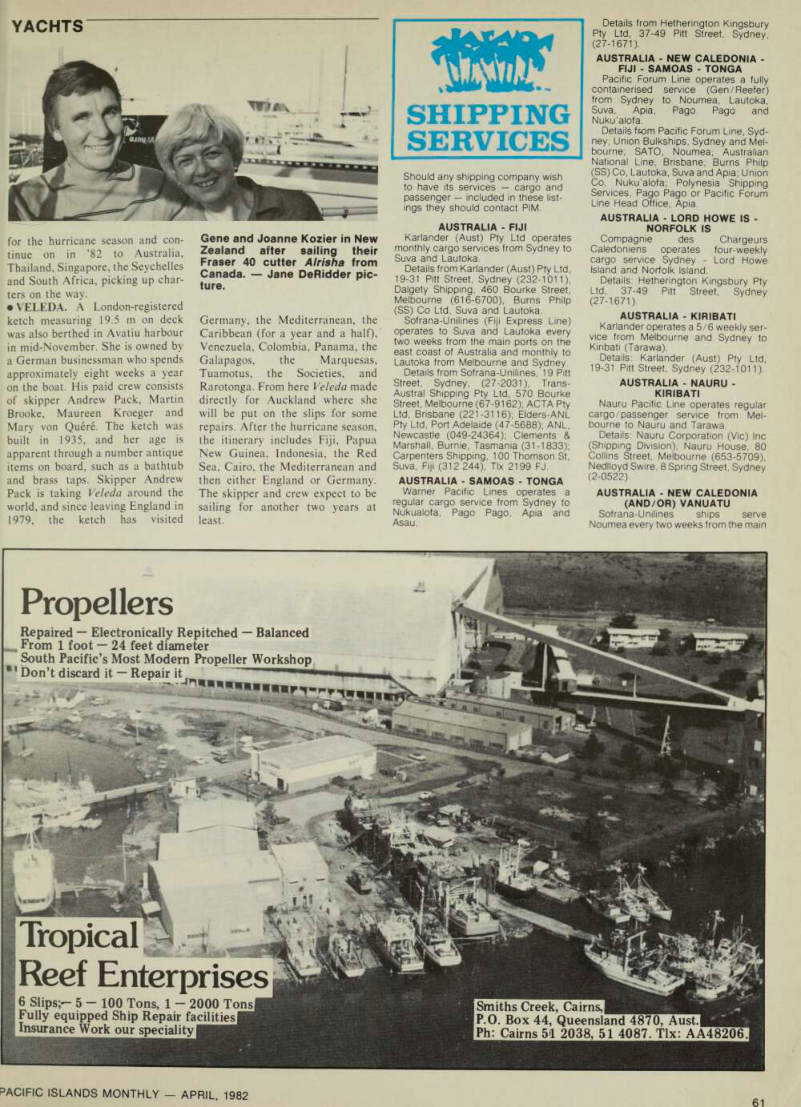

Services
Should any shipping company wish to have its services cargo and passenger included in these list ings they should contact PIM.
Australia - Fiji
Karlander (Aust) Pty Ltd operates monthly cargo services from Sydney to Suva and Lautoka.
Details from Karlander (Aust) Pty Ltd, 19-31 Pitt Street, Sydney (232-1011), Dalgety Shipping, 460 Bourke Street, Melbourne (616-6700), Burns Philp (SS) Co Ltd, Suva and Lautoka.
Sofrana-Unilines (Fiji Express Line) operates to Suva and Lautoka every two weeks from the main ports on the east coast of Australia and monthly to Lautoka from Melbourne and Sydney.
Details from Sofrana-Unilines, 19 Pitt Street, Sydney, (27-2031), Trans- Austral Shipping Pty Ltd, 570 Bourke Street, Melbourne (67-9162); ACTA Pty Ltd, Brisbane (221-3116); Elders-ANL Pty Ltd, Port Adelaide (47-5688); ANL, Newcastle (049-24364); Clements & Marshall, Burnie, Tasmania (31-1833); Carpenters Shipping, 100 Thomson St, Suva, Fiji (312 244), Tlx 2199 FJ.
Australia - Samoas - Tonga
Warner Pacific Lines operates a regular cargo service from Sydney to Nukualofa, Pago Pago, Apia and Asau.
Details from Hetherington Kingsbury Pty Ltd, 37-49 Pitt Street, Sydney, (27-1671).
Australia - New Caledonia -
Fiji - Samoas - Tonga
Pacific Forum Line operates a fully containerised service (Gen /Reefer) from Sydney to Noumea, Lautoka, Suva, Apia, Pago Pago and Nukualofa.
Details from Pacific Forum Line, Syd ney; Union Bulkships, Sydney and Mel bourne; SATO, Noumea; Australian National Line, Brisbane; Burns Philp (SS) Co, Lautoka, Suva and Apia; Union Co, Nuku’alofa; Polynesia Shipping Services, Pago Pago or Pacific Forum Line Head Office, Apia.
Australia - Lord Howe Is -
Norfolk Is
Compagnie des Chargeurs Caledonians operates four-weekly cargo service Sydney - Lord Howe Island and Norfolk Island.
Details: Hetherington Kingsbury Pty Ltd, 37-49 Pitt Street, Sydney (27-1671).
Australia - Kiribati
Karlander operates a 5/6 weekly ser vice from Melbourne and Sydney to Kiribati (Tarawa).
Details: Karlander (Aust) Pty Ltd, 19-31 Pitt Street, Sydney (232-1011).
Australia - Nauru -
Kiribati
Nauru Pacific Line operates regular cargo/passenger service from Mel bourne to Nauru and Tarawa, Details: Nauru Corporation (Vic) Inc (Shipping Division), Nauru House, 80 Collins Street, Melbourne (653-5709), Nedlloyd Swire, 8 Spring Street, Sydney (2-0522),
Australia - New Caledonia
(And/Or) Vanuatu
Sofrana-Unilines ships serve Noumea every two weeks from the main
ports along the east Australian coast.
Details from Sofrana-Unilines, 19 Pitt Street, Sydney (27-2031), Trans- Austral Shipping Pty Ltd, 570 Bourke Street, Melbourne (67-9162), ACTA Pty Ltd, Brisbane (221-3116), Elders-ANL Pty Ltd, Port Adelaide (47-5688), ANL, Newcastle (049-24364), Clements & Marshall, Burnie, Tasmania (31-1833).
Compagnie des Chargeurs Cale doniens operates a three-weekly con tainerised cargo service from Sydney to Noumea.
Details Hetherington Kingsbury Pty Ltd, 37-49 Pitt Street, Sydney (27-1671).
Compagnie Generate Maritime operates a monthly service from Syd ney to Noumea. Port Vila and Santo, for containerised and break bulk cargo.
Details Compagnie Generate Mari time, 12 Castlereagh Street, Sydney (231-3700).
Australia - Nz - Fiji -
Hawaii - Us
P & O liners call at Auckland, Suva, Pago Pago and Honolulu on eastbound and westbound voyages between Syd ney and the US.
Details from P & O Booking Centre, World Travel Headquarters Pty Ltd, 33 Bligh Street, Sydney (231-6655).
AUSTRALIA - NZ - FIJI - TONGA -
Vanuatu - Noumea -Solomons -
Samoas - Tahiti - South East
Asia - Japan
Sitmar Cruises operates a year-round cruise programme to include most of the above countries.
Details from Sitmar Cruises, 47 Elizabeth Street, Sydney (232-7511).
AUSTRALIA - NZ - FIJI - TONGA
Vanuatu - Noumea-Solomons -
Samoas - Tahiti
P & O liners call at Auckland, Bay of Islands. Honiara, Lautoka, Noumea, Nukualofa, Pago Pago, Papeete, Port
Moresby, Santo, Savusavu, Suva, Vavau and Vila on cruises from Aus tralia.
Details from P & O Booking Centre, World Travel Headquarters Pty Ltd, 33 Bligh Street, Sydney (231-6655).
Pacific Forum Line operates con tainerized and general cargo service from Australia and NZ to Fiji, Apia, Pago Paqo, Tonga and other South Pacific ports.
Details from Polynesia Shipping Ser vices Inc, PO Box 1478, Pago Pago 96799.
Australia - New Zealand -
Pacific Islands - South East
Asia-China
Minghua Cruises operates regular cruise services from Sydney to Hawaii and most Pacific ports, with several cruises to South East Asia, including Japan, China and Hong Kong, Details Minghua Cruises, 7 Bridge Street, Sydney, NSW 2000, Burns Philp Travel offices in Melbourne (62-0151), Brisbane (31 -0391), Darwin (81 -2871), Auckland NZ (31544); National Bank Travel in Adelaide (51-0321) and Perth (320-9365).
Australia - Tuvalu
Karlander operates a three monthly service from Sydney and Melbourne to Tuvalu (Funafuti).
Details from Karlander (Aust) Pty Ltd, 19-31 Pitt Street, Sydney (232-1011).
Australia - Png
Karlander New Guinea Line’s cargo vessels call at Melbourne, Sydney, Port Moresby, Lae, Madang, Wewak, Manus, Kimbe, Rabaul, Popondetta.
Details from Karlander (Aust) Pty Ltd, 19-31 Pitt Street, Sydney (232-1011), Dalgety Shipping, 460 Bourke Street, Melbourne (616-6700).
Australia - Png - Solomons
A consortium of Conpac, NGAL/PNGL have three container ves sels operating on a 28 day turn-around
from Melbourne, Sydney and Brisbane to Port Moresby, Lae, Rabaul, Kavieng, Wewak, Madang, Kieta and Honiara.
Details from Burns. Philp & Co. Ltd. 51 Pitt Street, Sydney (2-0547) and Interocean Swire, 8 Spring Street, Syd ney. (2-0522).
New Guinea Express Lines operates a fortnightly container service from Mel bourne, Sydney, Brisbane to Port Moresby, Lae, Alotau, Rabaul, Honiara.
Details from New Guinea Express Lines, PO Box R 73, Royal Exchange, Sydney (241-3991) MacArthur Ship ping Agency Co, 39 Creek Street, Bris bane (229-3777), New Guinea Express Lines, 327 Collins Street, Melbourne (61-3053), Niugini Express Lines, Port Moresby (21-4572), Lae (42-1536), Rabtrad Niugini Pty Ltd, Rabaul (92-2911), Alotau Stevedoring & Trans port, Alotau (61-1318) and Island Co operative Shipping Federation, Honiara (808).
Sofrana-Unilines (PNG Line) operates a monthly service to Port Moresby, Lae, Rabaul, Kieta, Honiara from main ports on the east coast of Australia.
Details from Sofrana-Unilines, 19 Pitt Street, Sydney (27-2031); Trans- Austral Shipping Pty Ltd, 570 Bourke Street, Melbourne (67-9162); ACTA Pty Ltd, Brisbane (221-3116); Elders ANL Pty Ltd, Port Adelaide (47-5688).
Australia - Tahiti
Compagnie Generate Maritime operates a monthly service from Syd ney to Papeete for containerised and break-bulk cargo.
Details Compagnie Generate Mari time, 12 Castlereagh Street, Sydney (231-3700).
Australia - Tahiti - Us
Karlander operates a monthly cargo service from Melbourne and Sydney to Papeete, US west coast.
Details: Karlander (Aust) Pty Ltd, 19-31 Pitt Street, Sydney (232-1011).
Australia - W. Samoa
Compagnie Generate Maritime operates a monthly service from Syd ney to Apia.
Details Compagnie Generate Mari time, 12 Castlereagh Street, Sydney (231-3700).
AUSTRALIA - NZ - TAHITI - CHILE Kapal Pacifico (KP) Pty Ltd offers a bi-monthly service from Geelong, East Australia to New Zealand ports Tauranga and Whangarei, Papeete and ports on the west coast of South America.
Details; Kapal Pacifco (KP) Pty Ltd, 4th Floor, 36 York Street, Sydney (233-8515) Tlx 71875; Beaufort Ship ping Agency Co, 2 Castlereagh Street, Sydney (239-1022); Universal Shipping Agency, 85 Fort Street, Auckland, NZ (30-930) Tlx 21517; 1 B Taylor Y Cia Ltd in Chile.
Far East - Fiji - New
Zealand
New Zealand Unit Express (NZUE) operates a monthly palletised cargo service from Manila, Keelung, Kaoshiung and Hong Kong to Lautoka, Suva and thence to NZ.
Details from Carpenters Shipping, 100 Thomson Street, Suva (312-244), Burns Philp, Suva (311-777), P & O S.N. Co, Wellington (736-477) or Nedlloyd Swire Pty Ltd, Sydney (20-522).
Nedlloyd operates bi-weekly cargo service with four ships from Sourabaya, Jakarta, Bangkok, Port Kelang and Singapore to Suva and NZ ports.
Details from Nedlloyd (Aust) Pty Ltd, 8 Spring St, Sydney (27 3801), Burns Philp (SS) Co Ltd, Suva and Lautoka.
Far East - Mid-S. Pacific
China Navigation’s New Guinea Pacific Line operates a regular con tainer service from Hong Kong, Taiwan,
Manila, Port Kelang and Singapore to Port Moresby, Lae, Rabaul and Honiara monthly and to Wewak, Madang and Kieta every three months. Cargo from the same Far Eastern ports to the South Pacific ports of Noumea, Santo, Vila, Papeete, Pago Pago, Apia, Rarotonga and Tarawa will be shipped via Japan on the monthly Bali Hai service.
Details from Steamships Trading Co., Port Moresby (21-2000).
Kyowa Shipping Ltd, operates monthly services from Japan to Guam, Saipan, Solomons, New Caledonia, Fiji, Western and American Samoa, Tahiti, Cook Is., Tonga and Vanuatu.
Details: Hetherington Kingsbury Pty Ltd, 37-49 Pitt Street, Sydney (27-1671); Carpenters Shipping, Suva (312-244), Tlx FJ2199.
Japan - Fiji - New Zealand
Kyowa Shipping Co Ltd operates a monthly service from main ports of Japan to Suva and Lautoka and thence to island ports and NZ.
Details from Carpenters Shipping. 100 Thompson St, Suva (312-244), Tlx FJ2199.
Japan - Micronesia
The NYK Shipping Line operates a monthly cargo service from Japan to Micronesia, calling at Kobe, Nagoya, Yokohama, Saipan, Guam, Truk, Ponape and Majuro, returning via Kobe, Nagoya and Yokohama.
Details from Burns, Philp & Co Ltd, 7 Bridge Street, Sydney (2-0547).
Japan - Png
Mitsui O.S.K. Lines operates a monthly service from main ports Japan and Port Moresby, Rabaul, Lae, Madang, Kieta and Kimbe.
Details from Robert-Laurie (PNG) Pty Ltd, Port Moresby (21-2466/ 21-1898).
New Caledonia - Fiji - West
Coast North America
PAD Line operates an approx. 3weekly ro-ro service from Noumea and Suva to Honolulu and West Coast USA and Canadian ports.
Details from Sofrana-Unilines SA, BP 1602, Noumea (27-51 -91), Tlx NMO4B; Carpenters Shipping, 100 Thomson St., Suva (312-244), Tlx FJ2199.
Png - Inter - Mainport
Papua New Guinea Line offers scheduled 10/20-day coastal liner ser vices linking all PNG major ports with containerisation, reefer, heavy lift and transhipment facilities.
Details from PNG Line, Box 543, Port Moresby. PNG, (21-1174), Tlx 22269.
Png - North Australia
Papua New Guinea Line offers a 60-day service from Port Moresby. Lae and Vanimo to Darwin with through bills of lading from West Coast North American ports. Inducement calls at Weipa and Gove.
Details from PNG Shipping Corpor ation, Box 543, Port Moresby, PNG (21-1174), Tlx PNG 22269.
Png - Kiribati - Solomons -
West Coast Usa
Papua New Guinea Line offers a 60-day service from Port Moresby, Lae, Rabaul and Kieta to San Francisco and Los Angeles with inducement at Van couver and stop-off calls at Tarawa and Honiara. Through bills from all PNG mainports and mini-bridge services to other US and Canadian destinations.
Details from PNG Shipping Corpor ation, Box 543, Port Moresby, PNG (21 -1174), Tlx PNG 22269; or from TFC Shipping, 100 California St, San Fran cisco, CA, USA (415 398-1604), Tlx
340958 Gts Ur Sfo.
Png - Uk/Continent
The Bank Line operates regular cargo service from Port Moresby, Oro Bay, Kieta, Rabaul, Kimbe, Madang and Lae to Hull, Hamburg, Rotterdam, Antwerp and Le Havre.
Details from The Bank Line (A’asia) Pty Ltd, 51 Pitt Street, Sydney
(27-2041); Burns Philp (PNG) Ltd, PNG ports.
Solomons - Uk/Continent
The Bank Line operates regular cargo service from Honiara to Hull, Hamburg, Rotterdam, Antwerp and Le Havre.
Details from The Bank Line (A’asia) Pty Ltd, 51 Pitt Street, Sydney (27-2041); Tradco Shipping (588).
NZ - COOK IS - NIUE -
Tahiti
Shipping Corporation of NZ Ltd operates cargo services based on pallets and similar units from Auckland to Niue, Cook Islands and Tahiti.
Details from the Shipping Corp of NZ Ltd, PC Box 3420, Auckland (797-210), Waterfront Commission, PC Box 61, Rarotonga; Cook Islands; Niue Govt Offices, Niue Island Compagnie Maritime Polynesienne, B‘P’ 368, Papeete, Tahiti.
Nz - Fiji
Reef operates a regular 18-day ser vice from Auckland to Suva and Lau toka.
Details from Reef Shipping Agencies, PO Box 3382, Auckland. NZ (77-1221-3); M.V. Fijian Shipping Agencies Ltd, Private Bag, Suva, Fiji (31 1056).
Pacific Line with one ship operates fortnightly ro-ro cargo service New Zealand, Lautoka, Suva.
Details: Sofrana Unilines, 18 Cus toms Street, Auckland (773-279) PO Box 3614, Telex: NZ2313; Carpenters Shipping, 100 Thomson Street, Suva (312244), Tlx. 2199 FJ, NZ - FIJI - NORTH AMERICA (WC) Blue Star Line Ltd Pacific Coast con tainer services. Only direct service to and from New Zealand. Blue Star ves sels call at Suva and Honolulu on NZ US-West Coast voyages.
Details from Blueport ACT (NZ) Ltd, PO Box 192, Wellington (739-029) , Burns Philp (SS) Co Ltd, GPO Box 355, Suva, Fiji (311-777). Tlx. FJ2168 Burship.
NZ - FIJI - SAMOAS - TONGA Pacific Forum Line operates a fully containerised three-weekly service (Gen/Reefer) from Auckland to Lau toka, Suva, Apia, Pago Pago and Nukualofa.
Details from Pacific Forum Line, Auckland; Union Co, Auckland, Lau toka, Suva, Apia and Nuku’alofa; Polynesia Shipping Services, Pago Pago or Pacific Forum Line Head Office, Apia.
Nz - Tonga - Samoas
Warner Pacific Line operates a regular cargo service from Timaru, Onehunga and Westport to Nukualofa, Vavau and Apia with regular calls to Haapai and Pago Pago.
Details from McKay Shipping Ltd, PO Box 1372, Auckland, NZ; Warner Paci fic Line, Box 93, Nukualofa, Tonga and Neiafu, Vavau, Tonga; Polynesia Ship ping Services, Box 1478, Pago Pago, American Samoa 96799, and Mealelei (Western Samoa) Ltd, Box 4171, Apia, W. Samoa.
NZ - N. CALEDONIA - FIJI -
Solomons - Png
Pacific Forum Line operates a fully containerised service (Gen /Reefer) from Lyttelton, Napier, Auckland to Suva, Lautoka, Honiara, Kieta, Lae and Port Moresby.
Details from Pacific Forum Line, Auckland; Shipping Corporation of NZ, Auckland, Lyttelton, Napier; Union Co, Auckland, Suva, Lautoka; Steamships Trading Co, Kieta, Lae, Port Moresby; Sullivans (SI) Ltd, Honiara or Pacific Forum Line Head Office, Apia, NZ - N. CALEDONIA - VANUATU -
Png - Solomons
Sofrana Unilines with three ships operates to Vila and Santo, to Honiara and Papua New Guinea and to Norfolk Island and Noumea.
Details from Sofrana Unilines, 18 Customs Street, Auckland (773-279), PO Box 3614, Telex NZ2313.
Nz - Tahiti
Compagnie Tahitienne Maritime SA with one ship operates monthly service New Zealand - Papeete.
Details from Sofrana Unilines, PO Box 3614, 18 Customs St, Auckland (773-279), Tlx NZ2313,
Nz - Tonga - Samoas
Warner Pacific Line services Auckland - Nuku’alofa/Vavau/Apia/ Pago Pago fortnightly carrying general and freezer cargoes.
Details from McKay Shipping Ltd, Downtown House, 21 Queen St, Auckland, PO Box 1372 (30-299), Cables MACSHIP, Telex NZ2554; Warner Pacific Line, Box 93, Nukualofa, Tonga; Mealelei (Western Samoa) Ltd, Box 4171, Apia, Western Samoa; Polynesia Shipping Services, Box 1478, Pago Pago, American Samoa, 96799.
Nz - Central Pacific
Kyowa Shipping Ltd operates a monthly cargo service from Auckland and Mt Maunganui to Noumea, Vila, Santo, Guam, Majuro, Nauru and Tarawa.
Details from McKay Shipping Ltd, PO Box 1372, Auckland (9-30229); Tlx 2554 NZ.
Europe - Tahiti -
New Caledonia
Compagnie Generate Maritime operates services from Europe and Mediterranean ports to Papeete and Noumea using three ro-ro and multi purpose vessels thus ensuring a bi monthly sailing to and from.
Details Compagnie Generate Mari time, 12 Castlereagh Street. Sydney (231 -3700).
Europe-Tahiti-New
Caledonia - New Zealand -
Solomons - Png -Europe
Polish Ocean Lines offers regular monthly sailings for containerised and breakbulk cargo from Hamburg, Ant werp, Dunkirk and Rouen to Papeete, Noumea, New Zealand, Honiara, Lae, returning to Europe via Suez. Other ports in the South Pacific can be served with inducement.
Details from Sotama, BP 9170, Papeete (27805), Tlx. 296; SATO, BP C 2, Noumea (272094), Tlx. 163 NM SATO; Union Steamship Co of NZ, PO Box 50, Apia, Tlx. 25; Williams and Gosling, PO Box 79, Suva (312633), Tlx. 2163; Warner Pacific Line, PO Box 93, Nukualofa (21089), Tlx. 66219; Universal Shipping Agencies, PO Box 2282, Auckland (30930), Tlx. 21517.
EUROPE - TAHITI - W. SAMOA -
Fiji - N. Caledonia
Nedlloyd offers regular cargo ser vices from Northern Europe and UK to Papeete, Apia, Fiji and New Caledonia.
Details Nedlloyd (Aust) Pty Ltd, 8 Spring Street, Sydney (27-3801); Car penters Shipping, 100 Thomson St, Suva (312 244), Tlx 2199 FJ.
EUROPE - TAHITI - W. SAMOA - TONGA - FIJI - SOLOMONS - PNG -
Vanuatu
Columbus Line Reederei GMBH operates regular services from Ham burg, Hull, Rotterdam, Antwerp, Dunkirk, Le Havre, to Papeete, Apia, Suva, Lautoka, Noumea, Port Moresby, Lae, Honiara, Kieta, Rabaul, Lae, and return to Europe.
Details from Columbus Overseas Services Pty Ltd, 333 George Street, Sydney (290-2966), Columbus Mari time Services, 17 Albert Street, Auckland (77-3460); Carpenters Ship ping, 100 Thomson St, Suva (312 244), Tlx 2199 FJ.
Uk - N. Continent - Fiji
The Bank Line operates a regular cargo service from Hull, Hamburg,
Bremen, Antwerp, Rotterdam and Le Havre to Suva and Lautoka.
Details from The Bank Line (A’asia) Pty Ltd, 51 Pitt Street, Sydney (27-2041); Burns Philp (South Sea) Co Ltd, Suva and Lautoka.
Uk/N. Continent - Png -
Solomons
The Bank Line operates a regular cargo service from Hull, Hamburg, Bremen, Antwerp, Rotterdam and Le Havre to Port Moresby, Lae, Madang, Kimbe, Rabaul, Kieta and Honiara and on inducement to Yandina.
Details from The Bank Line (A’asia) Pty Ltd, 51 Pitt Street, Sydney (27-2041); Burns Philp (PNG) Ltd, PNG ports; Tradco Shipping (588).
Uk/N. Continent - Tahiti -
N. Caledonia
The Bank Line operates a regular cargo service from Hull, Hamburg, Bremen, Antwerp, Rotterdam and Le Havre to Papeete and Noumea.
Details from The Bank Line (A’asia) Pty Ltd, 51 Pitt Street, Sydney (27-2041); Ets A M Fare UTE, Papeete; Ets Ballande, Noumea.
US - FIJI - TAHITI - NZ -
Australia
The Bank Savill Line Ltd. operates regular cargo services from US Gull ports to Australia and NZ. Calls at Suva Lautoka and Papeete on demand.
Details from The Bank and Savill Line Ltd, 51 Pitt Street, Sydney (27-2041) or Orient Shipping Services, 32 Bridge Street, Sydney (241-2753).
Us - Hawaii - Kiribati -
Micronesia
Philippines, Micronesia & Orient Navigation Co (PM&O Lines) operates regular container service on self sustained ship with ro-ro capabilities from Oakland, Portland and Honolulu to Tarawa, Ebeye, Majuro, Kosrae, Ponape, Truk, Saipan, Yap and Koror.
Details for Micronesia can be obtained from Larry Guerrero, PM&O Owners Rep, PO Box 803, Saipan, Ml 96950, Cable COMMONTIME, Tlx 783605; PM80; PM&O Lines, 181 Fremont St, San Francisco, California 94105, Cable PMONAV.
Us - Hawaii - Nauru -
Micronesia
Nauru Pacific Line operates regular conventional/container and passenger service from San Francisco and Honolulu to Majuro, Ponape, Truk and Saipan. Cargo is accepted for Nauru and Kosrai with transhipment at Majuro and Ponape.
Details from Nauru Corporation (Vic) Inc (Shipping Division), Nauru House, 80 Collins Street, Melbourne (653-5709); North American Maritime Agencies, 100 California St., San Fran cisco, California 9411.
Us - Noumea - Fiji
PAD Line operates an approx 3-weekly roro service from West Coast USA and Canada to Noumea and Suva.
Details from Sofrana-Unilines SA, BP 1602, Noumea (27-51 -91), Tlx NMO4B; Carpenters Shipping 100 Thomson St, Suva (31-2244), Tlx FJ2199; Trans- Austral Shipping, Box R 232 PC, Royal Exchange, NSW (27-2441), Tlx AA21204.
Us - Tahiti - Samoa
Pacific Islands Transport operates a five weekly cargo service from North America west coast ports to Papeete, Pago Pago, Apia.
Details from Polynesia Shipping Ser vices Inc, PO Box 1478 Paqo Paqo 96799.
Polynesia Line operates container and general cargo service from US west coast ports to Papeete and Pago Pago.
Details from Polynesia Shipping Ser vices Inc., PO Box 1478, Pago Paqo 96799.
US - TAHITI - SAMOA - NZ - AUST Farrell Lines Inc, operate a fast regular lash/container cargo service from west coast ports Canada/USA to Papeete and Pago Pago thence to NZ and Australia.
Details Wilh Wilhelmson Agency, Sydney, Melbourne and Brisbane, Tlx AA20136, Cable FARSHIPS Sydney; Dalgety (NZ) Ltd, Auckland and Wellington, Tlx NZ2445, Cable DALSHIP Auckland; Compagnie Mari time Polynesienne, Immeuble Franco Oceanienne, PC Box 368, Papeete, Tahiti, Tel 26393, Tlx 258. FP ANSB Taporo, Cable OCEAN Papeete; Kneubuhl Maritime Service, PO Box 39, Pago Pago, Telephone 633-5121; Tlx 782505,
Advertisements & other items, pp. 61-64 (1 item)
Reef Enterprises
Propellers
Repaired Electronically Repitched Balanced From 1 foot 24 feet diameter South Pacific’s Most Modern Propeller Workshop Don’t discard it Repair it Ihm -I
Tropical ;
Reef Enterprises
6 Slips;- 5 - 100 Tons, 1 - 2000 Tons Fully equipped Ship Repair facilitiesM Insurance Work our speciality HHHH kit *** a * m Smiths Creek, Cairns,BHßßl P.O. Box 44, Queensland 4870, AustßH Ph: Cairns 51 2038, 51 4087. Tlx: AA48206
PACIFIC
FORUM LIME
*>• ' m ?■<*** 4 .L ■ -
I J I '’"l\
Regular and Reliable Container and Roll - ON - OFF Services
owned by the people
of the Forum Nations
MV FUA KAVENGA
MV FORUM SAMOA
MV FORUM NEW ZEALAND
With our head office in Apia, our regional offices in Suva, Auckland, and Sydney, and our network of agents, we cover the South Pacific to ensure your goods get to you or to your buyer on time.
We tranship also, to or from almost anywhere in the world.
NOMINATE PERFORMANCE: NOMINATE PFL
Agents in: Australia, New Zealand, Fiji, Tonga, Western Samoa, American Samoa, New Caledonia, Papua New Guinea, Solomon Is, Kiribati, Tuvalu, Vanuatu.
HONGKONG
Only our Dragon Boat
visits more ports,
more often,
in the South Pacific.
The New Guinea Pacific Line offers the quality handling you're used to, through its exclusive containerised service to Papua New Guinea and the Solomon Islands.
Rely on us all the way. • Fast transit times to all ports. • A guaranteed schedule every 30 days, thanks to berths in Papua New Guinea and Honiara reserved for N.G.P.L. use. • Safe, secure transport of goods in containers, both L.C.L., and F.C.L. no more damage or pilferage of cargo. • A wide coverage of all ports with the monthly container service from Hong Kong, Singapore, Taiwan, the Philippines, Malaysia and Bangkok to all Papua New Guinea ports and Honiara.
For further details on our reliable Dragon Boat service contact:
HONG KONG
Swire Shipping (Agencies) Ltd.
Telephone: 5-264311
PAPUA NEW GUINEA
Steamship Trading Co., Ltd.
Port Moresby Telephone; 212000
NEW GUINEA
PACIFIC UNE
SINGAPORE
Straits Shipping Pte. Ltd.
Telephone: 436071 CD O CM CL §
New Braemaiigg
solar/electric.
Everything you want
from solar in one single
arge-capacity
water heater.
274 litre capacity Braecore VE (Vitreous enamel) lined mains pressure cylinder Urethane insulation Aluminium casewall Anode Element Matt black aluminium absorber Fibreglass insulation Combined Sun-Sponge® collector area 3.26m 2 Braemar’s put all the best solar ideas together to bring you one of the most energy-efficient, economical water heaters under the sun!
New Sun-Sponge® Solar Energy Collectors The more efficient the energy collector, the more efficient the solar water heating system-because you’re able to use more of that free energy from the sun. Braemar’s new collector soaks up and absorbs solar energy so efficiently we call it the Sun-Sponge® Big Family-Size Capacity 274 litre capacity means you’ve full mains pressure hot water for your whole family in your kitchen, your bathroom, your laundry.
Braemar is Built to Braemar uses the strongest, most durable materials so your water heater will last and last.
The cylinder is steel.
There’s nothing stronger.
The casing is aluminium, to stand up to all weathers.
And the lining is Braecore VE because it can cope with the kind of hard water copper just can’t handle.
Extra Insulation for More Efficiency Urethane insulation is injected around the cylinder to minimise heat loss and improve the efficiency of the system even further.
For further information about the new Braemar Solaline water heater, contact the sole Fijian Agents: S. E. Tatham (Fiji) Ltd. 17 Nukuwatu Street, Lami: Suva.
Telephone 361388
Braemai
MEMBER COMPANY OF
NATIONAL CONSOLIDATED LIMITE
ENERGY-EFFICIEN'
AND BUILT TO LAS'
BBB2S
Deaths
of Islands People
Dr Shiv Kumar In Western Germany in February, after a short illness.
Dr Kumar was the deputy superintendent of an 800-bed hospital near Dusseldorf.
Born and educated in Fiji, he obtained a BSc degree from an Indian university. In 1962 he left Fiji to study medicine at Wurzberg University, Germany, and became a specialist in internal medicine.
He was a younger brother of Jai Narayan, principal of Indian College, Suva. He is survived by his German-born wife and two children.
Toluono Lama In New Zealand in February.
A former MP from Palauli, Western Samoa, Toluono Lama was considered to have been Prime Minister Tupuola Efi’s ‘right-hand’ adviser on Samoan affairs. He was the Pulenu’u Committee chairman at the time he became ill and was taken to New Zealand for treatment.
Jack Fenton In Savusavu, Fiji, on December 19, as a result of a road accident, aged 77.
An active member of the community, Jack Fenton was a foundation member of the Planters’ Club and was presi dent for two years. His integrity was reflected in the fact that over the years he was either trustee or executor for many wills. He was also a foundation member of the board of governors of the Savusavu Sec ondary School.
He is survived by his wife, daughter and grandchildren and great grandchildren.
Oscar Clark In New Zealand on August 11, 1981, aged 54.
Oscar Clark was the assistant postmaster on Pitcairn Island from 1950, becoming postmas ter in 1960. He held this position until 1978 when his wife’s ill-health made it necess ary for them to go to New Zealand.
Maximus (Max) Joseph
Bay
In Auckland in February, aged 74.
Max Bay was born in Auck land, but spent almost 32 years in Fiji as a school-teacher, education officer, and finally deputy director of education.
He taught at a number of provincial schools before be coming principal of Nasinu Training College, near Suva.
Perhaps his finest achievement in education was at Ratu Kadavulevu School, where he was principal from 1953 to 1957.
The school, commonly known as RKS, had run down and morale was low among both staff and pupils. By setting a fine example he soon had a dedicated staff following his efforts, and when he went on to higher things RKS had re gained all the respect it had previously enjoyed.
Max Bay brought a common sense approach to education.
For him, it was not education for its own sake, but something to be applied to the needs of the pupil and the country.
He was equally well known in sporting circles. He had rep resented New Zealand at hockey before he went to Fiji, where he applied his ability both as player and adminis trator to the welfare of the game.
So well did he develop the game in Fiji that a team he managed in New Zealand won all its matches except one.
He was also a first class lawn bowler. He returned to Fiji some time after he retired to New Zealand, to manage Fiji’s bowling team at a major over seas tournament.
Leonard Elwyn Christian On Pitcairn on September 27, 1981, aged 72.
A great-great-great-grandson
of Fletcher Christian, Elwyn
Christian was given some medi cal training by a visiting doctor in 1937 and became recognised as the ‘lsland’s doctor’ until an officially registered nurse, Evelyn Totenhoffer, arrived in 1944 to take over his responsi bilities.
He did a short course in dentistry in Fiji which enabled him to do fillings, extractions and even make dentures, and he was officially appointed ‘den tist’, a post from which he resigned in 1978.
For many years he supervised the building of the long boats and built several dug-out-type canoes for fishing. He was also the first person on Pitcairn island to have his own diesel generator and a Mini-Moke. He was a church deacon, and secretary to the Sabbath School.
Erwin D. Canham On Guam on January 4, aged 77.
A former editor of The Christian Science Monitor, and resident commissioner for the Northern Marianas, Erwin Canham died after unspecified abdominal surgery.
In an obituary notice, the newspaper Pacific Daily News wrote of the ‘respect’ in which Mr Canham was held by Micronesian leaders.
Finau Manukla In Sydney on January 14, following a car accident, aged 30.
Tongan-born Finau Manukia was to have been married two days after he died.
Archie Pickering
In New Zealand on December 24, 1981.
A retired sea captain. Mr
Pickering, of Mavera, Cook Islands, was the harbourmaster with the Waterfront Com mission.
Sister Marie-Th6rdse In Auckland on December 26, 1981.
From the order of St Joseph of Cluny, Sister Marie-Therese spent 15 years in service in the Cook Islands.
G. Ross Simpson In Kuaotunu. New Zealand, on November 2, aged 76.
Mr Simpson had 32 years service with Burns Philp (SS) Co Ltd in Fiji as shipping manager, and then manager of the company’s Suva branch, until his retirement in 1967.
Lt-Gen Sir Edmund
Herring
In Melbourne, Australia, on January 5. aged 89.
In the Pacific War, Sir Edmund commanded the First Australian Corps and New Guinea Force between October 1942 and August 1943.
A long-serving Lieutenant- Governor of Victoria in the postwar period. Sir Edmund was given a slate funeral in Melbourne on January 11.
Graham Douglas Laing
On Norfolk Island in January, from a heart attack.
Known as ’Hippo’, Graham Laing was born in New Zealand but spent most of his life on Norfolk. He joined the Austra lian army and went overseas during World War 11, spending four years in a German prison camp.
He married Frances Snell in 1950, and spent many years farming at Anson Bay before moving to Ball Bay.
Advertisers Index
Amatil 30 Asia Tonga Trading 66 Australian Timken 56 Asia Seafood Company 66 Aarque Systems 47 Bendigo Bearings 57 Bankline 48 Braemar Appliances 64 Clark Bobcat 42 Citizen Watches 52, 66 China Navigation 63 Carptrac 10 Department of Trade 36 Dezurik of Australia 31 Dorf Industries 16 General Steamships 59 Honda IFC Henry Cumines 59 J & S Fibreglass 20 Karlander 54 Komatsu 34 Liapari 46
Matsushita 12 MacQuarrie Industries 37 Mason Shipping 58
Mbt 37
Nelson & Robertson 60 NZ Dairy Board IBC Pacific Forum Line 62 Papua Hotel 49 Primary F.nergy 54 Pioneer 4 QBE Insurance 44 Rheem Australia 24 Robert Bruderer 66 Reynold Australia 28 Sonar Ship Brokerage 66 Solarex 22 Shorts Aviation 40 Toyota OBC Tropical Reef Enterprises 61 Teac Corporation 8 Video Recorder Centre 28 Waterwheel Exports 33
Advertisements & other items, pp. 66-68 (2 items)
Produce
W0(§1
0.5. CITIZEN,
College. Grade. Mok, 38, Ev cel lend health, seeJcS ariployrrv on lsta Reply: Pacrfe) P.O. 137G8, Pot+loM Oregon T/2s,
WANTED
7 Waterfront Holiday Village f, J/
LAND SITES (
For approx. 30 Holiday Bungalows each. Only isolated areas in beautiful totally natural environment are of interest. No roads, no electricity required. Total value of project to the local tourist economy is in excess of $6,000,000 per annum.
All South Pacific areas are of interest ■ except Vanuatu. For further details contact; Robert Bruderer, P.O. Box 149, Broad way, NSW. Australia, or phone Sydney 569 3500, Australia.
&B±>
BUYING OR SELLING
LIST WITH US FOR:
COMMERCIAL SHIPS
FISHING VESSELS
YACHTS
TRAWLERS
WORK BOATS
Sonar Ships Brokerage
BOX 1811 CAIRNS, OLD.
AUSTRALIA
PH: (070) 515371
Produce
BECHE DE-ME ’ "
FISH MAW,
SHARK FINS, etc.
tf\recf
r <-* -i For details please write to;
ASIA SEAFOOD Co.
353 A Circuit Rd., Block 64, Republic of Singapore 1337. - Cable'- Seawave
Require
I CITIZEN W
AUSTRALIA PTY. LTD.
SI i 122 Old Pittwater Road, Brookvale,NSW. 2100 Telephone: 939 7077 P.O. Box 218, Brookvale,
NSW. 2100.
II Cables: CITIZEN,
Sydney.
Telex: AA26633 &
REQUIRE
DRIED SHARK FINS
FOR PRICES AND
INFORMATION ETC.,
PLEASE WRITE TO:
S. DADDOW,
ASIA TONGA TRADING,
7 KASAI ROAD,
REPUBLIC OF SINGAPORE,
2880.
CABLE; "ASIATONGA"
«2 fß: •' 4 * Kt*l(« tisaraar* i*im& »Jt«T9 £211? sirs is M«K 9JI AMrVfin Kill creaH nonfat
*•'-' l flr| «lmiik
AfJCaa
coMPim HM
A.uu
M
HtTP
Wat Ir tedmiik VTII'i *nciwr
Lili3J /instant
JT*** I S®dwhole
r G
jggn»
ff New j instant B : fi «d whole B %hor f B«n 2eala n “
bu oreamery
L Anchor; SUfc
butter
s wh Anrhoi
BfMAIVO
i I !
Cl iQr Anchors
milk
aC.
IhMMFP I ''-
S&) sew Zsetand <SSSnw butter v li ; : |/ ' *-**£* stock potation S<) *l» ||»H«*
CHEESE
f Oj- 't or r«(i <£ - * : vv> % vV
hyCfe .
( * ♦ y 7 t ’ ; Enquiries to: < . , New Ze&lhrvJ Dairy,Board, PO Box 417, Wellington, New Zealand. V 'f' •' J: telek: N 23348 DAPMARK Telephone: 724-399. ' ' '• '
c NZ3348 DAPMARK Telephone: 724-399,
. ■•-■■. - ■\* Xu*:* - Y.-Sk- /'■ . r ■ , •" , '
to v°\ 9PC S Hi
TOYOTA
i SE fl ; t?
PAPUA NEW GUINEA;
ELA MOTORS.
Scratchley Rd., Badili, P.O. Box 675, Port Moresby.
NORTHERN MARIANAS
& U.S.T.T.: MICROL
CORPORATION,
P.O. Box 267, Saipan.
FIJI:
AUTOMOTIVE
SUPPLIES COMPANY,
G.P.O. Box 355, Suva.
AMERICAN SAMOA:
BURNS PHILP
(SOUTHSEA) CO., LTD.,
P.O. Box 129, Pago Pago.
WESTERN SAMOA:
BURNS PHILP
(SOUTHSEA) CO., LTD.,
P.O. Box 188, Apia.
TONGA: BURNS PHILP
(SOUTHSEA) CO., LTD.,
P.O. Box 55, Nuku’alofa.
GUAM: ATKINS, KROLL
(GUAM) LTD., P.O. Box
6428, Tamuning.
VANUATU:
VANUATU MOTORS,
P.O. Box 18, Port Vila.
SOLOMON:
MENDANA
ENTERPRISES (S.L) LTD.,
G.P.O. Box 174, Honiara.
TAHITI: NIPPON
AUTOMOTO, B.P. 342,
Papeete.
COOK ISLANDS:
COOK ISLANDS
TRADING
CORPORATION LTD.,
P.O. Box 92, Rarotonga.
NAURU:
NAURU COOPERATIVE
SOCIETY.
KIRIBATI:
TARAWA MOTORS, Box 36,
Bairiki, Tarawa, Kiribati.
NORFOLK ISLAND:
BORRY’S RENTAL CARS,
MOUNT PITT
(ENTERPRISES) LTD.,
P.O. Box 169.
NEW CALEDONIA:
SERVICE IMPORTATION
AUTOMOBILE DU
PACIFIQUE, Rond-Point du Pacifique (Station Total) B.P. 438, Noumea.
TOYOTA
SERVICE
TOYOTA
The Toyota range includes: COROLLA, STARLET, CORONA, CRESSIDA. HI-LUX, STOUT, HI ACE, DYNA, COASTER and LAND CRUISER