Pacific Island Monthly

ME' nnit»«
Ussi.7S
A “ s ' A 51.50
Nzsi.So
j fsi so
H Us$L 95
Asi.7S
1. A 51.75
Cfpi9O
Nzs2.Oo
Nzsi.So
NPPk Island A 51.50 Papua N«W Guinea K 1.50 Solomons 551.50 Tahiti CFPI9O Tonga :& P 1.50 Tuvalu 1 A 51.75
Usa U 552.25
USTT & Guam US$l.95 Vanuatu A 51.50 Western Samoa T 1.60 'Recommended retail price only.
Registered by Australia Post Publication No. NBPI2IO
Fhe Satelliii
Devolution
yttisidjiAj^iuu
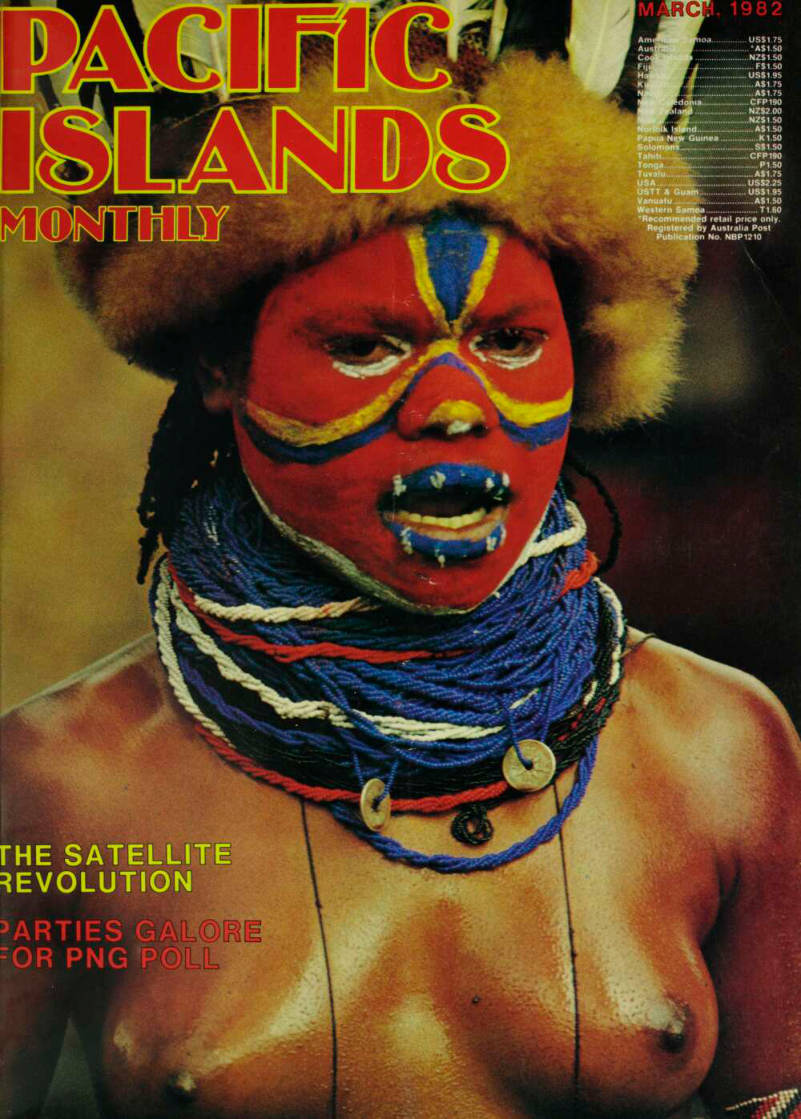
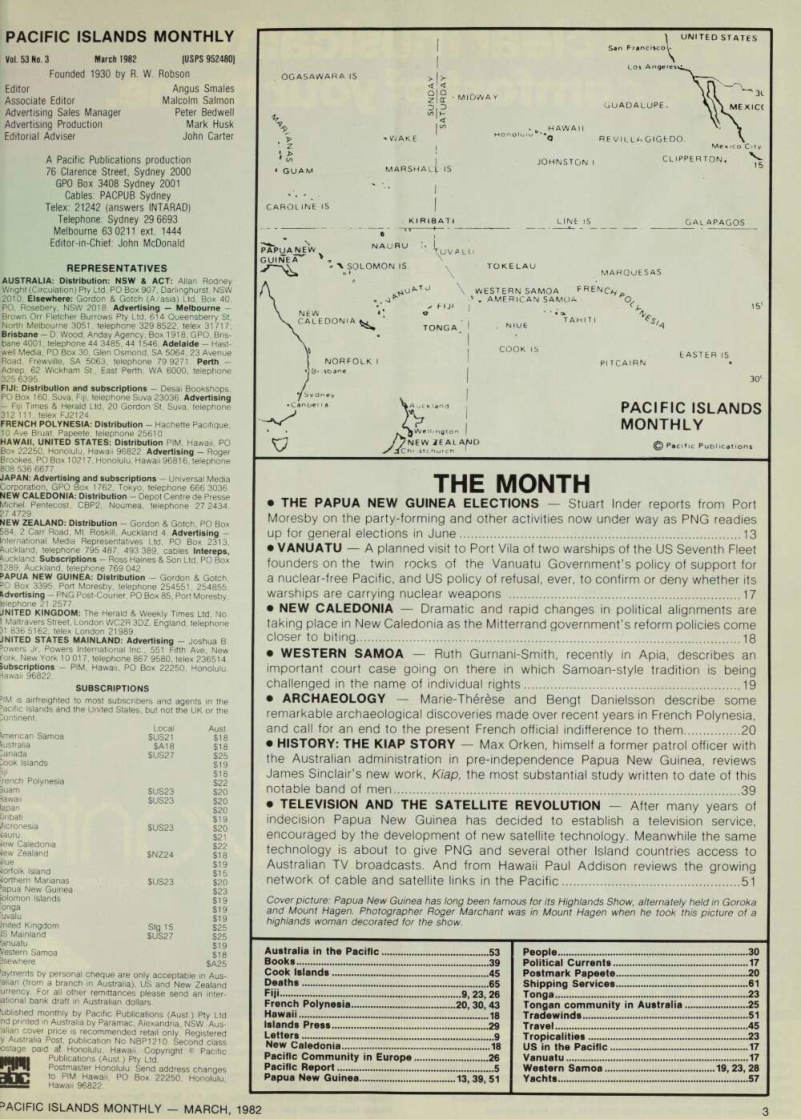
Cover picture: Papua New Guinea has long been famous for its Highlands Show, alternately held in Goroka and Mount Hagen. Photographer Roger Merchant was in Mount Hagen when he took this picture of a highlands woman decorated for the show.
Advertisements & other items, p. 2 (1 item)
Fun-Function VTR Goes Portable
HITACHI
VIDEO
ms
miLEM
iLight & Compact Easier to carry, easier to find space for.
Creative Freedom Use a Hitachi home video camera to make your own shows.
Reliability Hitachi is famous for it.
TheVT-6500 is built to last.
K Fine Slow Motion Dial-adjustable slow motion control.
Visual Search Find scenes quickly and easily.
Low Power Consumption Amazingly low 5.5 W power consumption saves electricity.
Pulse Control Editing Insert new scenes with no distortion.
Still Picture/Frame Advance Study your form in detail.
Preset Programming
Leave for 3 weeks, still record 8 programs.
Sound-on-Sound Add your own sound, without erasing previous sound. - - % - - Remote Control Thin, hand-size, 13-mode remote control unit.
Fun-Function VTR Goes Portable
The VT-6500 Portable Video System. Smaller. Lighter. Really portable.
And it’s got all the features you’d find on larger, heavier units.
Because at Hitachi, we’ve put our know-how in electronic integration to work on our video cassette recorders. So less size doesn’t mean less features.
The recorder and tuner/timer are separate units. Take the recorder and one of our compact cameras along with you to get all the fun on tape. When you get back home, you've got the full-function convenience of a large-sized VTR.
Performance and reliability are also up to Hitachi’s remarkably high standards.
The VT-6500 from Hitachi. The greatest little thing in VTRs yet,
VTTU6S
A-V6O
VK
CBOO
VK-C6OO
r~ r- VT 5500 c AS* f ' m •AUSTRALIA Hitach, Sales Australia Pty , ltd , 153 Keys Road, Moorabb.n, V.ctor.a 3189 Phone (555) 8722 »NEW ZEALAND AWA New Zealand Limited, W.-neera Drive P O Box Porirua Phone PRO 75-069 -PAPUA NEW GUINEA. S O Svensson (N G.) Ltd .P O Box 705, Port Moresby Phone; 21-2111 •FIJI ISLANDS AWA New Zealand Limited 47 Pip, Phone 312070 • NEW CALEDONIA; Caldis, B P Ml. Noumea Phone; 26.23,50 •TAHITI. Ets Chene Alain, PO Box 272, Papeete Phone 2 f Centre Ltd , P O Box 465, Honiara Phone 416 )68 -SOLOMON ISLANDS: Technique Radios
0 HITACHI
Pacific Islands Monthly
Vol. 53 No. 3
March 1982
(Usps 952480)
Representatives
AUSTRALIA; Distribution: NSW & ACT: Allan Rodney Wright (Circulation) Pty Ltd, PO Box 907, Darlmghurst, NSW 2010 Elsewhere: Gordon & Gotch (A/asia) Ltd, Box 40, PO, Rosebery, NSW 2018. Advertising Melbourne Brown Orr Fletcher Burrows Pty Ltd, 614 Queensberry St.
North Melbourne 3051, telephone 329 8522, telex 31717; Brisbane D. Wood, Anday Agency, Box 1918, GPO, Bris bane 4001, telephone 44 3485, 44 1546, Adelaide Hast well Media, PO Box 30, Glen Osmond, SA 5064, 23 Avenue Road, Frewville, SA 5063, telephone 79 9271 Perth - Adrep, 62 Wickham St., East Perth, WA 6000, telephone 325 6395.
FIJI; Distribution and subscriptions Desai Bookshops, PO Box 160, Suva, Fiji, telephone Suva 23036, Advertising Fiji Times & Herald Ltd, 20 Gordon St, Suva, telephone 312 111, telex FJ2124 FRENCH POLYNESIA: Distribution Hachette Pacifique, 10 Ave Bruat, Papeete, telephone 25610 HAWAII, UNITED STATES: Distribution PIM, Hawaii, PO Box 22250, Honolulu, Hawaii 96822 Advertising Roger Brookes, PO Box 10217, Honolulu, Hawaii 96816, telephone 808 536 6677.
JAPAN; Advertising and subscriptions Universal Media Corporation, GPO Box 1762, Tokyo, telephone 666 3036 NEW CALEDONIA; Distribution Depot Centre de Presse Michel Pentecost, CBP2, Noumea, telephone 27 2434 27 4729 NEW ZEALAND: Distribution Gordon & Gotch, PO Box 584, 2 Carr Road, Mt. Roskill, Auckland 4 Advertising International Media Representatives Ltd, PO Box 2313, Auckland, telephone 795 487; 493 389, cables Intereps, Auckland Subscriptions - Ross Haines & Son Ltd, PO Box 1289, Auckland, telephone 769 042 f*APUA NEW GUINEA: Distribution Gordon & Gotch, p O Box 3395, Port Moresby, telephone 254551, 254855 Advertising - PNG Post-Courier, PO Box 85, Port Moresby telephone 21 2577.
JNITED KINGDOM; The Herald & Weekly Times Ltd, No.
I Maltravers Street, London WC2R 3DZ, England, telephone 31 836 5162, telex London 21989.
JNITED STATES MAINLAND; Advertising Joshua B s owers Jr, Powers International Inc., 551 Fifth Ave, New fork, New York 10 017, telephone 867 9580, telex 236514 subscriptions - PIM, Hawaii, PO Box 22250, Honolulu, Hawaii 96822.
Subscriptions
3 IM is airfreighted to most subscribers and agents in the Pacific Islands and the United States, but not the UK or the Continent.
’ayments by personal cheque are only acceptable in Aus ■alian (from a branch in Australia), US and New Zealand urrency. For all other remittances please send an inter ational bank draft in Australian dollars 'ublished monthly by Pacific Publications (Aust.) Pty Ltd nd printed in Australia by Paramac, Alexandria, NSW. Aus alian cover price is recommended retail only Registered y Australia Post, publication No NBPI2IO. Second class ostage paid at Honolulu, Hawaii Copyright e Pacific
Publications (Aust.) Pty Ltd.
Postmaster Honolulu: Send address changes to PIM Hawaii, PO Box 22250, Honolulu Hawaii 96822.
Local Aust \mencan Samoa $US21 $18 Australia $A18 $18 Canada $US27 $25 k>ok Islands $19 : iji $18 ■rench Polynesia $22 5uam $US23 $20 Hawaii
Sus23
$20 lapan $20 Cinbati $19 /licronesia $US23 $20 Jauru $21 Jew Caledonia $22 Jew Zealand
Snz24
$18 Jiue $19 Jorfolk Island $15 Jorthern Marianas
Sus23
$20 *apua New Guinea $23 lolomon Islands $19 bnga $19 ‘uvalu $19 Jnited Kingdom Stg 15 $25 JS Mainland
Sus27
$25 'anuatu $19 Vestern Samoa $18 ilsewhere $A25
The Month
• THE PAPUA NEW GUINEA ELECTIONS Stuart Inder reports from Port Moresby on the party-forming and other activities now under way as PNG readies up for general elections in June 13 • VANUATU A planned visit to Port Vila of two warships of the US Seventh Fleet founders on the twin rocks of the Vanuatu Government’s policy of support for a nuclear-free Pacific, and US policy of refusal, ever, to confirm or deny whether its warships are carrying nuclear weapons 17 • NEW CALEDONIA Dramatic and rapid changes in political alignments are taking place in New Caledonia as the Mitterrand government’s reform policies come closer to biting 18 • WESTERN SAMOA Ruth Gurnani-Smith, recently in Apia, describes an important court case going on there in which Samoan-style tradition is being challenged in the name of individual rights 19 • ARCHAEOLOGY Marie-Therese and Bengt Danielsson describe some remarkable archaeological discoveries made over recent years in French Polynesia, and call for an end to the present French official indifference to them 20 • HISTORY: THE KIAP STORY Max Orken, himself a former patrol officer with the Australian administration in pre-independence Papua New Guinea, reviews James Sinclair’s new work, Kiap, the most substantial study written to date of this notable band of men 39 • TELEVISION AND THE SATELLITE REVOLUTION After many years of indecision Papua New Guinea has decided to establish a television service, encouraged by the development of new satellite technology. Meanwhile the same technology is about to give PNG and several other Island countries access to Australian TV broadcasts. And from Hawaii Paul Addison reviews the growing network of cable and satellite links in the Pacific 51
Australia in the Pacific 53 Books 39 Cook Islands 45 Deaths 65 Fiji 9, 23, 26 French Polynesia 20, 30, 43 Hawaii is Islands Press 29 Letters 9 New Caledonia 18 Pacific Community in Europe 26 Pacific Report 5 Papua New Guinea 13, 39, 51
People 30 Political Currents 17 Postmark Papeete 20 Shipping Services 61 Tonga 23 Tongan community in Australia 25 Tradewinds 51 Travel 45 Tropicalities 23 US in the Pacific 17 Vanuatu 17 Western Samoa 19, 23, 28 Yachts 57
Advertisements & other items, pp. 3-4 (2 items)
Founded 1930 by R. W. Robson
Editor Angus Smales Associate Editor Malcolm Salmon Advertising Sales Manager Peter Bedwell Advertising Production Mark Husk Editorial Adviser John Carter A Pacific Publications production 76 Clarence Street, Sydney 2000 GPO Box 3408 Sydney 2001 Cables: PACPUB Sydney Telex: 21242 (answers INTARAD) Telephone: Sydney 29 6693 Melbourne 63 0211 ext. 1444 Editor-in-Chief: John McDonald
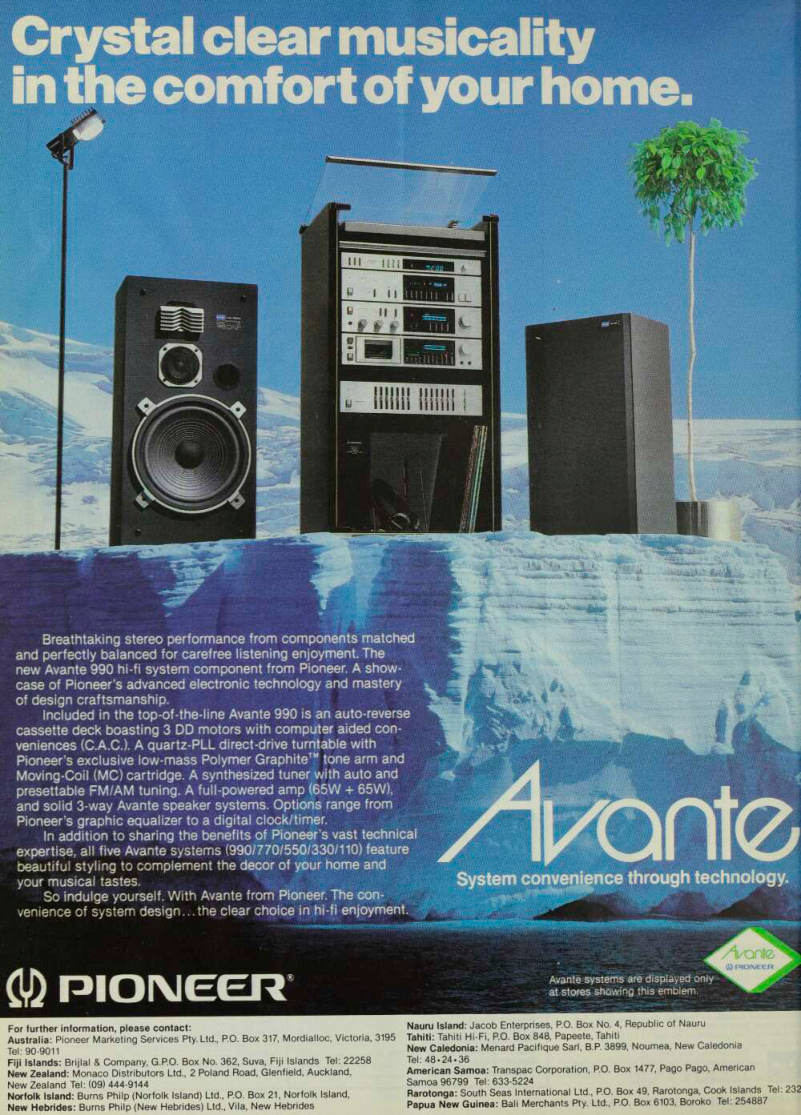
Crystal clear musicality
in the comfort of your home.
t -if- ■ ■ m wvmm % o
sill!! Illlll! I
% m Breathtaking stereo performance from components matched and perfectly balanced for carefree listening enjoyment. The new Avante 990 hi-fi system component from Pioneer. A showcase of Pioneer’s advanced electronic technology and mastery of design craftsmanship.
Included in the top-of-the-line Avante 990 is an auto-reverse cassette deck boasting 3 DD motors with computer aided conveniences (C.A.C.). A quartz-PLL direct-drive turntable with Pioneer’s exclusive low-mass Polymer Graphite™ tone arm and Moving-Coil (MC) cartridge. A synthesized tuner with auto and presettable FM/AM tuning. A full-powered amp (65W + 65W), and solid 3-way Avante speaker systems. Options range from Pioneer’s graphic equalizer to a digital clock/timer.
In addition to sharing the benefits of Pioneer’s vast technical expertise, all five Avante systems (990/770/550/330/110) feature beautiful styling to complement the decor of your home and your musical tastes.
So indulge yourself. With Avante from Pioneer. The convenience of system design...the clear choice in hi-fi enjoyment.
System convenience through technology.
(H) PIONEER
Avante systems are displayed only at stores showing this emblem.
For further information, please contact: Australia: Pioneer Marketing Services Pty. Ltd., P.O. Box 317, Mordialloc, Victoria, 3195 Tel: 90-9011 Fiji Islands: Brijlal & Company, G.P.O. Box No. 362, Suva, Fiji Islands Tel: 22258 New Zealand: Monaco Distributors Ltd., 2 Poland Road, Glenfield, Auckland, New Zealand Tel: (09) 444-9144 Norfolk Island: Burns Philp (Norfolk Island) Ltd., P.O. Box 21, Norfolk Island, New Hebrides: Burns Philp (New Hebrides) Ltd., Vila, New Hebrides Nauru Island: Jacob Enterprises, P.O. Box No. 4, Republic of Nauru Tahiti: Tahiti Hi-Fi, P.O. Box 848, Papeete, Tahiti New Caledonia: Menard Pacifique Sari, B.P. 3899, Noumea, New Caledonia Tel: 48-24.36 American Samoa: Transpac Corporation, P.O. Box 1477, Pago Pago, American Samoa 96799 Tel: 633-5224 Rarotonga: South Seas International Ltd., P.O. Box 49, Rarotonga, Cook Islands Tel. 232 Papua New Guinea: Bali Merchants Pty. Ltd., P.O. Box 6103, Boroko Tel: 254887
Pacific Report

‘It’S March 11 In Paris’ Mara
Fiji Prime Minister Ratu Sir Kamisese Mara announced in February that March 11 has been set as the date for a meeting in Paris between President Mitterrand and a delegation from the South Pacific Forum to discuss the future of France’s Pacific territories (PIM Jan p 6). The delegation, which will be led by Ratu Mara, will include Papua New Guinea’s Foreign Minister Noel Levi, and Tonga’s High Commissioner in London. Earlier, it was understood that Tonga’s Minister for Foreign Affairs and Defence Crown Prince Tupouto’a would be representing that country. The 1982 budget of the South Pacific Bureau of Economic Co operation includes a sum equivalent to SUSSO 000 earmarked to pay for the mission, which was decided upon at the last meeting of the South Pacific Forum in Port-Vila in August.
Vital Fisheries Talks In Nauru
Representatives of seven states from the North and South Pacific were meeting in Nauru in February to plan an Inter-Pacific Islands Fishing Agreement designed to strengthen the bargaining position of Island states in dealings with major fishing nations. It was hoped that the agreement would also eventually regulate the issuing of licences to foreign fishing companies. Taking part in the talks were the Northern Pacific states of the Federated States of Micronesia, Marshall Islands, and Palau, and, from the South Pacific, Kiribati, Nauru, Papua New Guinea, and Solomon Islands.
Menguy Trip To Solomons Put Off
The Solomon Islands Government in January postponed indefinitely a planned visit to Honiara by French Ambassador designate Marc Menguy. Mr Menguy was to have gone to Solomon Islands to present his credentials, but, according to a Solomon’s government statement, ‘the climate of strong anti nuclear feeling in the Solomons made it inadvisable that he should some at that time. The French Embassy in Port-Vila, where Mr Menguy is resident ambassador, confirmed the postponement and said that a further attempt at presentation of credentials would be made ‘when the climate is back to normal’. lan Mclntyre in Port-Vila.
PORT DUES FOR CRUISING YACHTS IN VANUATU Sruising yachts are to be included for the first time under new egislation on port dues adopted by the government of Vanuatu, fhe dues are 9 Vatu per registered tonne up from 8 Vatu ar a minimum charge of 3000 Vatu for vessels under a net displacement of 333 tonnes. (One hundred Vatu are worth about 5A1.) Announcing the new charges, Vanuatu’s Director of Ports and Marine, Captain Robin Bibby, said that they were not designed to frighten away cruising yachts, which are always very welcome in Vanuatu waters. The intention was rather to act ealistically in the present economic conditions, and recoup some Df the operating costs involved in processing arriving vessels for Dorts, customs and immigration facilities. At present cruising yachts arriving in Port-Vila are encouraged to anchor off the quarantine buoy. A customs launch takes out immigration and Dort officials who board and process them, before directing them :o a safe anchorage. lan Mclntyre in Port-Viia.
Frade Union Meeting For Noumea?
Fhe recently formed Pacific Trade Union Forum is planning a meeting to be held in New Caledonia within the next couple of months. It is expected that the conference will call for ndependence for New Caledonia, and will press for a ban on nuclear weapons testing in the Pacific. The meeting is expected o bring together unionists from Australia, New Zealand, Japan, -iji, Guam, Hawaii, Kiribati, Palau, Papua New Guinea, Solomon slands, Tahiti and Vanuatu. Boycotts on trade with Australia (for ts role in producing nuclear fuel), and France (because of its luclear weapons testing programme), are to be considered by he meeting.
WE RE NOT SO DUMB’ MAMALONI TO ‘SPIES’
Solomon Islands Prime Minister Solomon Mamaloni has warned against other countries attempting to interfere with the nation’s domestic politics. Speaking in parliament, Mr Mamaloni said his government would not allow sovereign Solomon Islands to
become a puppet of other countries, Australia or New Zealand, or even the United States or the Soviet Union. He said: This nation’s intelligence service is not as dumb as our overseas friends may think. We are fully aware of those foreign secret services employed here to sabotage our political stability.’ He added that his country was out to rock the diplomatic boat a little.
He said he believed that up to now there had been too much ‘sugar diplomacy’, with everybody trying to appear ‘good members of the club’.
Storm In The Norfolk Teacup
The larger Island countries don’t have a monopoly of political turmoil; Norfolk Island, population about 1700, went to the polls on January 27 to elect its nine-member assembly. But what followed the election threatens to split the island community. Six of the successful candidates, including only one member of the old assembly, formed a bloc, the island’s first political party, voted the former Chief Minister David Buffett (who had headed the poll with 311 first-preference votes) out of his job, and chose the executive before the first meeting of the assembly 14 days later. All this was done in secret, charge the bloc’s critics and supporters of David Buffett. Declared allies in the bloc are Ed Howard, one of the four re-elected, John Brown, Bernie Christian-Bailey and Greg Quintal, along with two ‘independents’, Bill Sanders and Chloe Gray. The six held a meeting to which the three others, Mr Buffett, Alice Buffett (re-elected) and Gilbert Jackson (re-elected) were not invited. When the nine members met as the assembly, the three ‘outsiders’ were presented with a fait accompli in the shape of the new executive elected as follows: Assembly President, David Buffett. Deputy Assembly President, Bill Sanders. Executive Member for Administration, Education and Health, David Buffett. Executive Member for Planning, Tourism and the Environment, John Brown. Executive Member for Finance and Commerce, Ed Howard. The position of chief minister was seen to have been abolished. Instead, by rotation, each executive member will preside at a meeting, a decision described by ex-Chief Minister Buffett as doing a ‘great disservice to the Norfolk Island community’. He also said the bloc had removed areas of significant authority from his portfolio, quoting finance (held by Mr Howard) as an example. American-born Mr Howard is regarded as leader of the bloc by its opponents. They protest at the bloc’s treatment of the ‘outsiders’ who shared more than 57 percent of the first preference votes. They believe, however, that all is not lost, that, before the next meeting of the assembly the two independents, Bill Sanders and Chloe Gray, may ‘cross the floor’. A Special Correspondent on Norfolk Island.
The Commonwealth Of Guam?
In a referendum, voters in the ‘unincorporated’ American territory of Guam have chosen commonwealth status (like that of the Northern Marianas) over five other options. In a poll in which only 38 percent of registered voters turned out, they were asked to consider six options: independence, free association, common wealth status, statehood, incorporated territory status, or the territory’s status to remain unchanged. On the 10 000 votes cast, 48 percent favoured commonwealth status, and 25 percent statehood.
SEVEN DIE IN CRASH OF HISTORIC DC4 A French fleet air arm DC4 on a night training flight crashed 35 kilometres north of Noumea in January, killing all seven crewmen aboard. The aircraft burst into flames on impact, and the dead men were burnt beyond recognition. The World War 11-vintage plane was well known in the Pacific, having flown to a large number of Island countries over the years. Originally, the plane was a gift from the then US President Harry S. Truman to France’s General Charles de Gaulle. President Truman presented the General with the plane at the end of World War 11.
Asian Students Back Suva Meeting
A novel and significant feature of a recent conference for a nuclear-free and independent Pacific organised by the University of the South Pacific Students’ Association in Suva was that it was sponsored by the powerful Asian Students’ Association, which has chapters in 15 countries, from the Middle East to the shores of the Pacific. The coupling of the anti-nuclear and pro independence themes at the conference, which to some may seem unwarranted, has actually been made necessary by the refusal of the USA and France to grant independence to their last colonies on the grounds that they are unwilling to give up their military bases in Micronesia and Polynesia. The fact that the
world is thus confronted by two aspects of the same issue was strongly emphasised by Barak Sope, Vanuatu’s secretary of foreign affairs. He said that his country condemned any kind of nuclear activity in the region, whether it was testing, dumping of waste, or the transport of nuclear arms. ‘Throughout the Pacific the oppression of indigenous people is linked directly to the nuclear industry,’ he said. He urged Pacific Rim countries to recognise the total unacceptability of any policies of outside powers which could prejudice the environmental safety or integrity of the area. Marie-ThSrese Danielsson.
Probe Into Brych Trust Fund
Two members of the Auckland police fraud squad flew to the Cook Islands in February to investigate alleged irregularities in the medical trust fund set up five years ago when cancer therapist Milan Brych began working there. New Zealand press sources suggested that the ‘irregularities’ involve the alleged use of trust funds to pay legal costs for Mr Brych in New Zealand.
Seven Lost In Sir Garrick Sinking
Seven people died and eight survived following the sinking in the Gulf of Papua on January 29 of the 350-tonne passenger-freight barge Sir Garrick. Two, skipper Captain Ishia John, and third engineer Jerry Inia, are believed to have gone down with the barge when she succumbed to 80-knot winds 10 nautical miles southeast of Cape Suckling. Bosun David Amery, engineer Peter Alson, and cook Kusa Mundi are believed to have died of exposure or immersion while adrift in life jackets, and chief engineer Peter Walsh while adrift in an inflatable life raft. The other person who died was Norma John, 35-year-old Australian wife of the barge’s skipper. Eight people survived a long swim through shark-infested waters to the nearest island. Among them was Mr Walsh’s five-year-old son Kerry, who was half-carried and half-dragged by his adult companions to the shore.
Vatu Debut In March
Vanuatu plans the introduction of its own uniform new currency, the Vatu, in the third or fourth week of March. The Vatu will replace the present French-issued notes and coins, and Australian notes and coins.
N-Free Pacific March In Port-Vila
A demonstration in support of a nuclear-free Pacific was held in Port-Vila on January 23. A petition presented to French Ambassador Marc Menguy protested against French nuclear testing, and accused France of seeking to become ‘sole owner’ of the Pacific through its claims to 200-nautical-mile economic zones around its Pacific territories.
Three Die In Fiji Cyclone
Cyclone Hettie, which struck Fiji at the end of January, claimed at least three lives: Permal Reddy, 19, of Wilevu, near Labasa, drowned after diving into the swollen Wailevu River for a swim. A Fiji Electricity Authority linesman, Tili lliate, 31, died in Labasa Hospital after being electrocuted and falling from a power pole.
At Nadi, Josai Bose, 36, a labourer at the Vaturu Dam site, was swept away by floodwaters at Natawa village.
Sir John Guise Bows Out
The ‘father figure’ of Papua New Guinea politics, Sir John Guise, announced his retirement from public life in February. The immediate result of his move is that his Milne Bay parliamentary seat will be up for grabs in the June elections. Sir John, 67, was the first governor-general of independent PNG, and has the longest record of parliamentary service of any politician in the country. He was the country’s first deputy chief minister in pre independence ‘self-government’ days working with Chief Minister Michael Somare and has held practically every sort of ministerial post over the years. While he said in his retirement statement that he was ‘going to grow vegetables in my wife’s village in Milne Bay’, few observers expect the colourful ‘Papa Doc’ to disappear completely from the public eye.
Trade Union Lessons From Denmark
Bent Pihl, of Denmark, an expert in workers’ education, is in Fiji on a two-year contract to conduct seminars, workshops and courses for trade union officials. The project, which will also cover Western Samoa, Vanuatu, Kiribati, Solomon Islands and Tuvalu, has a two-year budget of SUS72B 775 financed by the Danish International Development Agency. Sponsors are the Danish Government and the International Labor Organisation.
Palau-Philippines Link Sought
The Senate of the Palau National Congress has passed a resolution requesting President Marcos of the Philippines to ‘give serious consideration’ to Air Nauru’s petition for landing rights in
Manila. Koror, Palau’s capital, is only two hours flying time from Manila, and the Palauans, according to Senator Abel Suzuki, would appreciate the opportunity to travel more cheaply to the Philippines for holidays, business and shopping. Alternatively, Palau would support a Manila-Koror service by Philippine Air Lines.
Fiji’S Big Public Works Plans
Fiji’s Public Works Department is spending nearly SFSO million on three schemes for the greater Suva area, a trunk sewer network and sewage treatment facilities ($l7 million-plus), a water treatment plant ($7 334 200), and the upgrading and sealing of Queens Road between Korotogo and Pacific Harbour (66 kilometres), costing $2l million. Completion of the road is scheduled for the end of 1984.
All-Weather’ Road Links For Png
The Asian Development Bank has approved the provision of technical assistance to Papua New Guinea for studies to upgrade to ‘all-weather transport’ three important road links. They are: Popondetta-Oro Bay Road (56 kilometres), Lae-Munum section (31 km) of the Highlands Road, and the Waterais-Lanu section (31 km) of the Lae-Madang Road.
Fiji Timber To Vanuatu And Italy?
The Fiji Pine Commission has sent a trial shipment of timber to Vanuatu worth SF4O 000. The commission hopes to establish a permanent market in Vanuatu for Fiji pine. Fiji also has a potential market for its timbers in Italy but, according to Fiji Conservator of Forests, Konusi Yabaki, who recently returned from trade talks there, Fiji timber prices are too high compared with the African product. Fiji could make a bid for the Italian market through the University of Florence, which has asked for some samples.
Fiji’S New Seismological Gear
Aided by a grant from Japan of SF32B 102, the Fiji Government has established three unmanned seismological stations, one on Vanua Levu, another at Taveuni Island and the third at Gau Island. A new centre at which seismological information will be analysed has been opened at Nabua, near Suva.
MARIANAS: THE GOVERNING COUSINS . . .
Republican Pedro Pangelinan Tenorio has been sworn in as governor of the Commonwealth of the Northern Marianas, succeeding Carlos S. Camacho. The new governor’s cousin, Pedro Agulto Tenorio, is the new lieutenant-governor. The gubernatorial election followed a long legal wrangle over Camacho’s right to contest the position for the Democratic Party (PIM Oct ’Bl p 6).
Bp To Go Back To Sea?
Burns Philp & Co Ltd, Sydney, is exploring the possibility of re entering the shipping industry with a new line, exclusively serving the Pacific. Plans are still a long way from realisation, but the word is that the line, if it should come into being, would be complementary to, rather than in competition with, the Pacific Forum Line.
Tuvalu Adds To Diplomatic Links
Tuvalu established diplomatic relations with Bangladesh in December, and the Netherlands in February. The country now has diplomatic relations with 16 countries.
Severe Flooding On Tongatapu
Several villages on the northwest coast of Tongatapu, Tonga, were evacuated in February following the worst floods to strike the area in 20 years.
N.Z. Diplomat’S ‘Tri’ Rescued By French
Seven people were rescued from a crippled trimaran 290 kilometres southwest of Noumea in February. A French naval patrol boat, La Dunkerquoise, took the stricken 14-metre Cynsan in tow for Noumea after it had lost its rudder following two tropical cyclones. The trimaran’s owner, New Zealand diplomat Geoffrey Matthews, was sailing her back to New Zealand following a tour of duty with the New Zealand High Commission in Suva. Others on board were his wife and daughter, and four friends.
Fiji Warning On Condoms
Fiji’s Ministry of Health in February issued a directive to stop the issuing of the Tahiti brand of condoms following complaints about their effectiveness. The complaints were made in a letter to The Fiji Times in which the (unnamed) correspondent claimed he (or she) had tested several of the condoms and found them unreliable. The writer claimed they ‘burst open at a very early stage’. Condoms of this brand were given to the Health Department as a gift by the International Planned Parenthood Federation in January, 1981.
Advertisements & other items, pp. 6-8 (1 item)
Datsun Forklift
NISSAN
fIHI
msm M JU Li / in . - •<f 11
Si SB
3.5-ton Pneumatic/Cushion/Turbo-charger 4.0-ton Pneumatic/ Cushion/Turbo-charger 4.0-ton Heavy Duty Pneumatic/ Cushion/Turbo-charger The difference will amaze you. These monocoque body heavyweights are tough on big jobs, maneuverable enough for small aisles and easy on operators.
New Datsun Forklift FO3 Series models excel in any role. Even many reserved for smaller lift capacity forklifts.
Smart 3/3.5/3.5-ton heavy-duty cushion tire and provide optimum tight-space handling. Rugged, fuelefficient gasoline engines or a turbo-charged diesel engine assure high torque, gradeability and speed.
Total toughness reduces downtime. Maintenance is minimal. Single-lever tilt/lift control, power steering and wide-angle visibility keep operator fatigue low.
Built to give owners and operators more in return. 3.5/4/4-ton heavy-duty pneumatic tire models The versatile Datsun Forklift FO3 Series.
DATSUN FORKLIFT
NISSAN MOTOR CO., LTD. 17-1, Ginza 6-Chome, Chuo-ku Tokyo 04. Japan Auckland Nissan Motor Co., (Australia) Pty. Ltdl Loadlift Equipment Limited 2Maunce Road, Penrose, Auckland 6, New Zealand 358-5444 Boroko Motors Ltd. P.O. Box 1259 industrial Machinery Division Suite I,6th Floor, 100 Will.am Street, Sydney, N.S.W. 2000, Australia Tel. 358 5444 boroK Boroko, Via Port Moresby, Papua New Guinea Tel; 255255, 255347
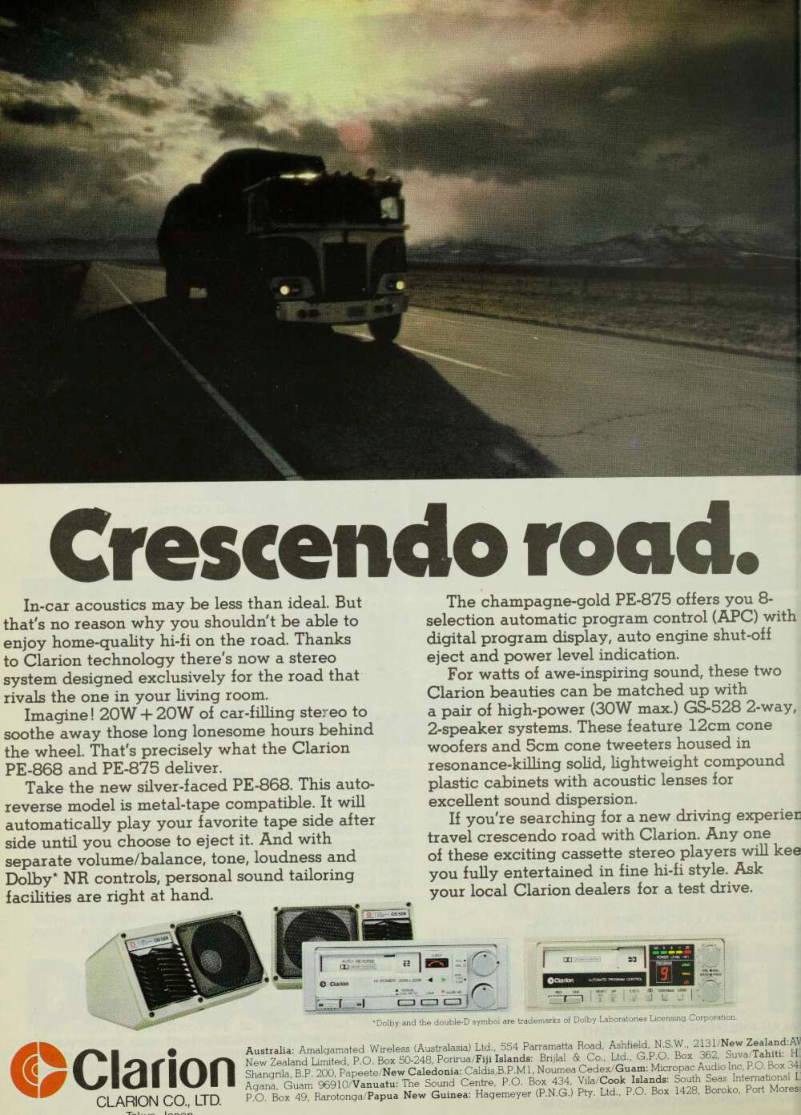
Crescendo rood.
In-car acoustics may be less than ideal. But that's no reason why you shouldn't be able to enjoy home-quality hi-fi on the road. Thanks to Clarion technology there's now a stereo system designed exclusively for the road that rivals the one in your living room.
Imagine! 20 W-4-20W of car-filling stereo to soothe away those long lonesome hours behind the wheel. That's precisely what the Clarion PE-868 and PE-875 deliver.
Take the new silver-faced PE-868. This autoreverse model is metal-tape compatible. It will automatically play your favorite tape side after side until you choose to eject it. And with separate volume/balance, tone, loudness and Dolby* NR controls, personal sound tailoring facihties are right at hand.
The champagne-gold PE-875 offers you 8selection automatic program control (APC) with digital program display, auto engine shut-off eject and power level indication.
For watts of awe-inspiring sound, these two Clarion beauties can be matched up with a pair of high-power (SOW max.) GS-528 2-way, 2-speaker systems. These feature 12cm cone woofers and scm cone tweeters housed in
resonance-killing solid, lightweight compound
plastic cabinets with acoustic lenses for excellent sound dispersion.
If you're searching for a new driving experieE travel crescendo road with Clarion. Any one of these exciting cassette stereo players will kee you fully entertained in fine hi-fi style. Ask your local Clarion dealers for a test drive.
G Clarion r ooa I BESTt UP I EJECT m OOP“" ““ -
11111 * J L J I
•Dolby and the double-D symbol are trademarks of Dolby Laboratories Licensing Corporation.
Q Clarion
CLARION CO., LTD.
Australia; Amalgamated Wireless (Australasia) Ltd. 554 Parramatta Road, AsMield, p 362 ' "suWTahili PT New Zealand Limited, P.O. Box 50-248, Porirua/Fiji Islands: Bnjlal & Co., Ltd., G.P.O. Box 362, buva/lahitr .
Shangrila B.P. 200, Papeete/New Caledonia: Caldis.B.P.Ml, Noumea Cedex/Guam; Micropac Audio Inc m Box 3 Aoana Guam 96910/Vanuatu; The Sound Centre, P.O. Box 434, Vila/Cook Islands: Souft Seas International U pS Box 4a RVr™/Papua New Guinea: Hagemeyer (P.N.G.) Pty. Ltd., P.O. Box 1428, Boroko, Port Merest
Letters
Pro and con on Fiji in the Sinai
N. W. Lalokalo s letter (P1M Jan pi 0) contains the claim that my letter (PIM Oct ’81 p7) ‘suffers from several errors and misconceptions which should not go uncorrected’. I suggest that this statement applies to his letter rather than mine.
First, my letter was written at a time when only Fiji, Colombia and Uruguay had definitely agreed to participate in the US sponsored Sinai peace-keeping force. I know that other countries have since agreed to participate, but the point is that they have done so only after extremely cautious nego tiations. The Fiji Government, in contrast, agreed to the pro posal immediately, and signed a long-term military agreement.
At least the European countries concerned have tan gible reasons to be interested in political stability in the Middle East. Most bear a measure of historical responsibility for cre ating the political problems there in the first place. Some are military allies of the US, and all have economic interests in the area.
Fiji, a liny nation on a world scale, has no such interests, either political or economic.
Second, the only understand able reasons put forward by the Fiji Government for its involve ment are purely mercenary: 1) lo provide employment for inemployed youth, and 2) to jam about $US5 million. Both •easons lack credibility. Most people who have been engaged n the Middle East have been Public servants or regular ioldiers. As for the few recruits form the unemployed, offering obless young men six months werseas, risking life and limb or a few dollars, cannot be iefended as a reasonable 'em ployment policy’. As for the $5 million, Fijian scrub-cutters on
contract in New Zealand have earned more than that for Fiji in the last four years.
Third, the Sinai force issue would not have been in the headlines in Fiji, criticised by the Pacific Council of Churches and by university students, and debated in the Fiji Parliament, if it were not ‘controversial’. Mr Lalakolo is therefore barking up the wrong tree in asking that 1 give readers an example of an ‘uncontroversial’ peace-keeping force. This was never part of my argument.
Fourth, Mr Lalokalo has not advanced any argument to change my view that the deaths of Fijian soldiers that have so far occurred in the Middle East were unnecessary. His claim that the people of Fiji are ‘quite content with the expressed ap preciation and admiration of Lebanese, Palestinians and Israelis’ is odd. It is indeed hard to believe that there could be unanimity between sworn en-, emies about the presence of Fijian soldiers. If he is saying that the sole reason for sending Fijian troops to the Middle East is so that Fiji can earn some international admiration, he must place small value on human life.
Mr Lalokalo goes on to extol Fijian military sacrifices over seas in the past. In my view, the only justified Fijian military involvements overseas were in the Solomons and Bougainville in World War 11, and in Zimbabwe. In the first instance they fought to defend Fiji and other Pacific Island countries from Japanese aggression, and in the second they went to assist in the holding of democratic elections.
As for the rest, it is mis guided patriotism and a harm ful delusion to believe that dying overseas in any conflict that may come along is a romantic and distinguished way of terminating the lives of representatives of Fijian man hood.
Has Mr Lalokalo been read ing too many American comics a type of reading material which actively fosters such no tions, and which is widely consumed in Fiji?
Fifth, it is news to me that Fiji refused Vanuatu’s request because the ‘dispute was civil and not military’.
So far as I can remember, the
rebels in Santo were armed, as I saw for myself on television, and declared that they were going to fight. Mr Lalokalo adds insult to injury when he refers to the commendable intervention of Papua New Guinea troops in Santo as ‘a comic opera’. How does he think the situation should have been handled?
No amount of dismissive comments from Mr Lalokalo and his type can disguise the fact that the Fiji Government prefers to answer the call from distant foreign countries, rather than from a neighbour. A splen did opportunity to put into practice ‘the Pacific Way’ that Fiji’s leaders are fond of preach ing to the Pacific was here passed up.
Mr Lalokalo says ‘a com monly held principle in Fiji is that a person who does not pay tax to the Fiji Government has no right to criticise its policies’.
Asa Fijian. I know that no such principle exists in the laws of Fiji. The only relevant prin ciple that I know is that regard ing ‘freedom of conscience and expression’ which is guaranteed under Chapter 11, Section 3, of the Constitution, the supreme law of Fiji, ‘to every person’, regardless of ‘race, place of origin, political opinion, colour, creed or sex’. Would Mr Lalokalo care to explain more fully his ‘commonly held prin ciple’?
There is a common Fijian expression for this kind of disputation veiba vakanako - meaning ‘lawyer-like argu ments from the bush’.
I. M. Nakauvadra
Wellington New Zealand This letter cut for length.
Editor.
PFL man replies
to a critic The letter from Kevin B.
Judkins, Second Officer of MT Pacific Voyager (PIM Dec ’Bl p 9), calls for a reply.
I’m afraid Mr Judkins is unaware of the present position of the Pacific Forum Line (PFL). There is no denying that for the first three years of our existence PFL had a chequered career.
But for the past 12 months, with the infusion of new blood at directorial and managerial levels, there has been a corn
plete change of direction. Sev eral points need to be made: • Mr Judkins’ claim that the Marama made a handsome profit is totally incorrect. • A service from Sydney with Fua Kavenga to mid- Pacific Island nations runs regu larly, giving an average voyage time of 27 days. • To the same area from New Zealand with our vessel Forum Samoa the average voy age time is 21 days. • From New Zealand to the Central Pacific, Papua New Guinea area, our vessel Forum New Zealand has an average voyage time of 32 days.
Mr Judkins’ comments relat ing to the reliability of our service are totally unjustified, particularly when our record over the past 12 months is taken into consideration.
The PFL’s financial position for the 12 months ended December, 1981, will show that a significant reduction in the 1980 loss will be achieved.
The Line’s financial and man agement team has new been consolidated in Auckland, New Zealand, and we can confid ently express the view that PFL in 1982 will continue the im provement achieved in 1981.
Critics of our Line would be well advised to look at us in our present condition, andmot judge us by the situation as it was in our formative years.
W. J. Maclennan
Assistant General Manager (Operations) Pacific Forum Line (NZ) Ltd Auckland New Zealand
Hawk-eyed but
friendly . . .
As a very regular visitor to the Pacific region approximately every six weeks I feel that I am fairly well au fait with what is going on on a ‘need-to-know basis. However, PIM is at least the 40 percent contributory factor to my keeping abreast of local events and trends. It is a constant source of usefulness to myself and my colleagues, and is also enjoyable to read, par ticularly for those, like me, who are at present confined to snow bound Britain.
Having got the pleasantries over let us do to you what is frequently done to our publica tions. In your January edition.
on page 25, you have an article on Papeete’s Hotel Stuart head lined ‘Hotel links lazy-lagoon past, jet-age present’. There is a photograph on page 27 illustrat ing this article which is claimed to have been taken ‘about 1930’. Assuming you don’t mean 1930 hours local time, that car parked on the foreshore looks very advanced technology for 1930 AD in fact, is it not one of the 1970 models Alfa Sud or Giulia?
In seriousness don’t bother replying please I’m only trying to prove that PIM is properly read and appreciated here. Please keep up the stan dard par excellence. 1 must also use the cost of a stamp to agree with Frank Lewis from Rabaul (PIM Jan p 8). Yes, a bit too much yachtie stuff — it’s not that they cannot get adequate PR coverage (as if they need it!) elsewhere.
Peter Walters
British Aerospace Hatfield Herts England Thanks. We’re checking the age of that photograph with author John B. Hart. Editor.
Disappointment on
book review Upon reading back in March last year the book review ‘Encyclopaedia in three (unmalching) volumes’ (PIM Mar ’Bl p 47), I immediately ordered the three books con cerned; Man’s Conquest of the Pacific: The Prehistory of Southeast Asia and Oceania: The Prehistory of Polynesia; and Exploring the Visual Art of Oceania, Australia,
Melanesia, Micronesia, and Polynesia.
Only The Prehistory of Polynesia was available. The other two were pronounced ‘out of print’. My bookseller is trying to locale these other books, but to date without success.
I realise that such books would have a limited appeal, and that no great numbers would be printed. 1 am sure that many of your reviews send people for pen and paper to write off to their booksellers, so could you please be sure to give early reviews of books of this type, which are available only in limited quantities. No doubt there are many, like me, who depend on your reviews to know what’s ‘on’ in the Pacific. I feel that travel and adventure books, generally being in large editions, could wait a little longer for review with no loss to anyone.
Perhaps representatives of publishing houses and book sellers reading this could re member that the Pacific is a vast area, and communication is still quite slow in remote areas.
So we need lime, and often we really need the books reviewed because we are in remote places, and no library is avail able to us.
John Mckenna
Our Lady of the Rosary Community Gizo Solomon Islands
USA: ‘Coloniser’
charge disputed
An article discussing Micronesia in the June, 1981, issue of PIM (p 57) intrigued me. One Juan R. Fernandez, apparently a Puerto Rican, evaluates US policies towards this Pacific group. Never hav ing had the opportunity to visit any part of Micronesia, 1 do not offer any expert advice on that area. 1 am, however, concerned at the following statement made by the writer; ‘lt is indeed ironic that as decolonisation is coming to an end, the United States is being increasingly perceived as the last great coloniser.’ Just where this gentleman obtains his information puzzles me.
I would suggest that he get out a map of the world and
study it a bit. If he is of the opinion that the citizens of Poland, Hungary, Bulgaria, Romania, Czechoslovakia, Latvia, Lithuania, Estonia and the Ukraine are not currently being subjected to ‘colonisation’
I suggest that he ask them if he ever gets the chance.
Further, what about Afghani stan, Angola, Mozambique, and his own Caribbean neighbour of Cuba and Grenada?
Colonisation might be sub ject to different interpretations in the minds of different people, but please do not forget that the direction of most of the ‘boat people’ of the world is towards the United States. 1 am sure that the constant influx of all these persecuted people is add ing to the cultural richness of our own country, but let us not forget that they are coming to freedom, and not fleeing from it.
As to Puerto Rico’s own status, undoubtedly there is room for improvement in the political situation. However, within the past week I have seen a UPI report from San Juan that last year’s election indi cated that 47 percent of the people there decided that they preferred Statehood, and 47 percent preferred to continue with the present status as a Commonwealth. Only six per cent indicated a preference for independence.
Urban D. Kapler
Phoenix Ariz
Usa
Angry words from
a ‘kiap-baiter’
It is beyond my comprehension how anyone at all could try to glorify the so-called ‘legendary kiaps’ and their postwar activi ties in Papua New Guinea, as is done in a recent ‘ad’ in PIM. If we examine the facts, the ‘legendary kiaps’ can only go into the history books as a near total disgrace to the white race in general and to Australia in particular.
With a few very rare excep tions, the ‘legendary kiaps’ were known from Kavieng to Daru as the most arrogant, incompetent and ignorant ‘olmasta’ who ever set foot in PNG, many of them being or becoming chronic al
coholics, while others dis tinguished themselves as sex maniacs or sometimes they were both. Testimony to these facts can today be seen in any part of PNG where hundreds of half-Australians roam the streets, belonging neither to him nor to her. Cases in which such ‘legendary kiaps’ fathered four or five and more illegit imate children, and looked after none, are not uncommon in the annals of PNG’s colonial his tory.
By independence in 1975, there was very little the ‘legend ary kiaps’ in PNG could be given credit for, which was not there before their, arrival or which had been established exclusively for their own benefit and the benefit of their white masters, particularly in PNG’s vast rural areas.
Meteoric rises were not un common in PNG’s kiap dynasty in which it only seemed to matter who knew whom. For mer bank employee dropouts could be seen as ‘military intel ligence advisers’; former farmhands advanced to the post of district commissioner. In one case a former Snowy Mountains labourer was to be seen acting as minister for mines and en ergy in the newly established Somare government after serving his time as a ‘legendary kiap’ in the Luiu-Aitape areas.
As already mentioned, there were the rare exceptidps, and some kiaps may have left their positive marks in PNG like John Pasquarelli and the re markable lodge he built on the upper Sepik. But here again, Pasquarelli did not build the lodge as a ‘kiap’.
All major towns and villages were already established long before the ‘legendary kiaps ever set foot in PNG and the addition of numerous clubs< hotels, kiap and white masU accommodation and busines enterprises, can hardly be con sidered as advantages and im provements for PNG’s native and particularly the rura population, most of which i even today still at the sam stage as 50 years ago. Thi acquisition of steel axes an shotguns has hardly made muc difference.
So much for Australia' ‘legendary kiaps’ and the;
doubtful reign in PNG. The Australian taxpayer still today has to pay hundreds of millions of dollars to keep PNG on its feet. Most obviously, if the ‘legendary kiaps’ and their col onial administrative bosses had done what they were supposed to do, the Australian taxpayers’ yearly burden of more than $2OO million to PNG would not be necessary today, seven years after PNG gained its indepen dence.
This letter may be considered what was once known in PNG as ‘kiap-baiting’, but it may also add to so-called contemporary history by showing the other side of the coin one view of what kiaps were all about in the eyes of the PNG ‘native’.
Kessua Tamai
Proserpine Qld Australia
Pacific-Caribbean
ties stronger
A little publicised but significant feature of the 1981 Commonwealth Heads of Gov ernment Meeting (CHOGM) in Melbourne (PIM Nov ’Bl pl 1) was the forging of closer links between island countries of the Pacific and the Caribbean.
With nine Pacific Island members and 10 Caribbean, they comprise almost half the membership of the 40-odd strong Commonwealth. They come even closer to being half if ‘Special members’ of the Commonwealth, Tuvalu and Nauru, are counted.
The Melbourne meeting saw the Pacific and Caribbean groupings getting together in caucus to discuss their prob lems, particularly before the ‘Problems of Small Island States’ session on the second last day of CHOGM.
The daily newspaper The Australian heralded the session with the headline ‘Unhappy Islanders to Push Issues’, and in a short report noted that ‘small island nations plan a united front to swing the conference back to issues that worry them’.
They were, the paper said, ‘upset at being virtually ignored during the proceedings, being upstaged by larger nations and emphasis on the North-South dialogue’.
Topics discussed at the
special session included the failure of the International Monetary Fund to provide effective finance for small states, transport, communi cations, and the need for greater access to overseas markets.
The session passed without attracting much attention. The agenda was in fact shared with another item, ‘Financial and Economic Issues’. Fiji’s Prime Minister Ratu Sir Kamisese Mara probably summed up Island states’ reactions when he was quoted in the press next day saying: ‘CHOGM is full of good philosophies and intentions, but very little real action’.
What seems certain is that, come next CHOGM, Island representatives from the Pacific and the Caribbean will be getting together again in an effort to make a greater impact on proceedings than they man aged in Melbourne.
Max Quanchi
Frankston Vic Australia
US policy: Review
missed the point
It seems to me that Stuart Inder’s review of John Dorrance’s Oceania and the United States (PIM Oct ’Bl p 29) fails to come to grips with the issues. Dorrance is part of the US foreign policy establish ment and one can expect from his writing a best-case scenario for US policies.
Dorrance’s words describing US interests and goals in Oceania seem reserved, hu mane, and reasonable to be sure. Yet, these are almost the same words used in public to describe US policy in Southeast Asia while sustaining a military invasion of the area. At present, the Soviet Union puts such words to use in rationalising its attack in Afghanistan. It is not enough to consider words, one must consult history and care fully question each precept.
Historically, the only difference between the US and other powers in the Pacific has been its ability to overcome or outlast all France excepted.
The peoples of the Pacific (especially Indians, Eskimos, Aleuts, Polynesians, Micro nesians, Okinawans, and Fili pinos) have had to pay a steep
price as the US fought its way to the lop of the heap. Thus, when Dorrance states (p 33) that, in part, US strategic/ security interests derive from its presence in the Pacific, one should remember how that came to be, and the cost of it already to the peoples of the Pacific.
In the next paragraph Dorrance lists US objectives, the last one of which reads, ‘preservation of a friendly and stable political environment supportive of the [listed] inter ests’. Just how insidious this can be is evidenced in the US support, both militarily and at the United Nations, for Indonesia’s brutal invasion of East Timor.
Dorrance writes about ‘inter nationally recognized rights of navigation .. . and innocent passage through territorial waters’, and US access to seabed resources. The impli cations here for small, es pecially island nations, are om inous. They are the words of a policy that allows Dorrance to write with confidence (p5B) that such states, ‘have little hope of being other than international economic wards'.One might probe further and ask: recog nised by whom, under what conditions, and for whose benefit?
Had US policy been as reasonable as Dorrance would have the world believe, the negotiations at the Law of the Sea Conference would have been less acrimonious. The new US administration at one stage broke off the talks enraged over the few concessions won by Third World nations. Further, recent US action against Libya
over differing views of these rights of navigation reveals a US willingness to take by force what can’t be won with words.
Stuart Inder forgot the re porter’s scepticism which re fuses to allow others, such as the US and the Soviet Union, to define issues and concepts.
David Paul
Belmont Mass
Usa
Tm Jesus’ claim
brings protest
I would like to record through your columns my objection to a story in the January 24, 1982, issue of the Sunday Sun, pub lished in Suva, which makes a great fuss of a man, P.P. de Saint Clair, who claims to be Jesus Christ.
Such a story is offensive to believing Christians such as myself.
It cheapens the faith of Christians. If we expect our Lord Jesus Christ to come to earth to take away all his good people who have been worship ping him all along (and leave the odd ones for Satan and his deputy P.P. de Saint Clair) we expect him to come from Heaven, and not some tiny village in southern France like that inhabited by the wicked claimant Saint Clair.
Semi Goneyali
Tailevu Fiji
Support for SPC
SPEC merger
I am in total agreement with Papua New Guinea’s call for a single organisation of South Pacific countries which ‘would mean the effective amalga mation of the South Pacific Bureau of Economic Co operation and the South Pacific Commission’ (PIM Dec ’Bl pl 4).
I am also glad to note that incoming SPC Secretary- General Francis Bugotu is in favour of the merger.
What surprised me was that SPEC Director-General Dr Gabriel Gris has defended the continued existence of the two bodies.
R. Muniappan
University of Guam Guam
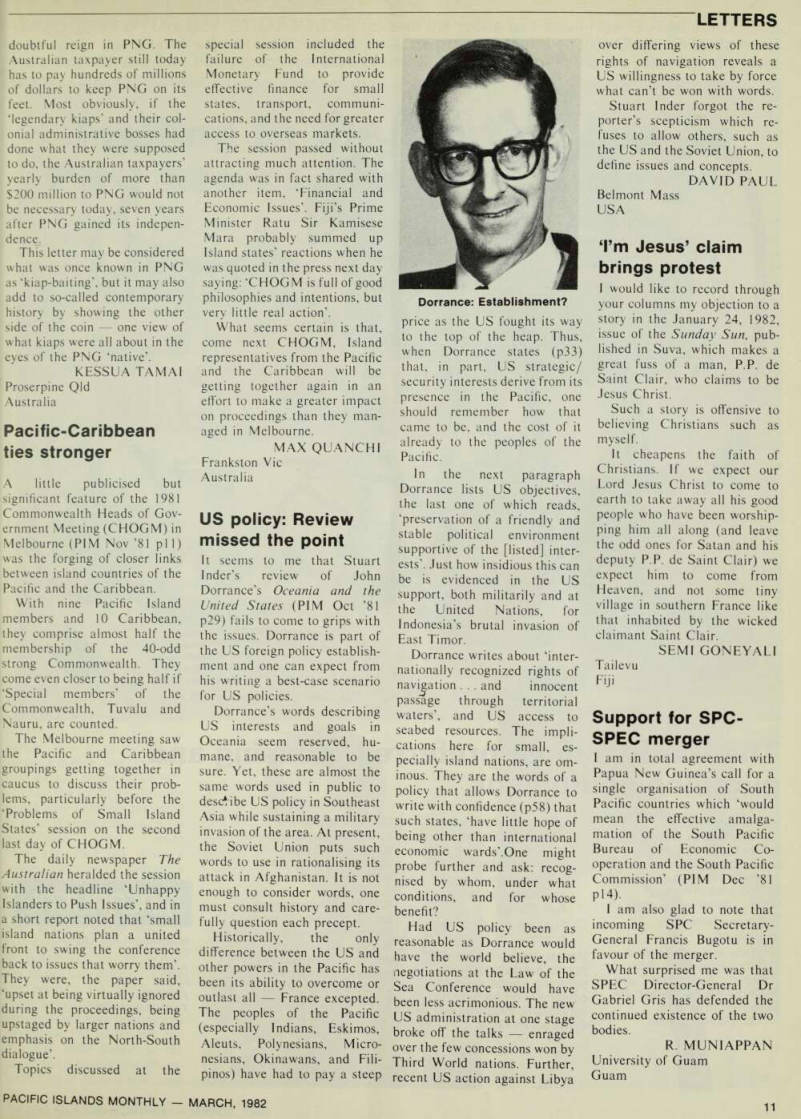
Dorrance: Establishment?
Advertisements & other items, pp. 9-12 (2 items)
9
"ADIPIC ISLANDS MONTHLY MARCH, 1982
11.. A. C. Neumann
PORT MOlll
* Right in business cej * A tradition,
comfort aniftpii.—
food * All rpoms airconditioned * Restaurant * Bai * Banquet hall
11.. A. c. NEUMANN
manager Phone 21-^ rt
. » as sf n r, „ I v
The World’s most preferred greasing and
pumping equipment
Macnaught Pty. Ltd. manufactures in Australia a quality range of greasing and pumping equipment currently exported to over 60 countries including U.S.A., Japan and Europe.
The range principally consists of; □ Hand and air-operated lubrication units, “Minilube”, “Super-lube” and “Power-lube”, which are designed to fit oil companies’ grease cans/drums or can be supplied with their own container for filling from a bulk supply of grease. □ Hand and air-operated grease guns (cartridge or bulk filled). □ Fuel, oil and all purpose pumps.
Macnaught lubricators and pumps are suitable for servicing a wide variety of equipment primarily in the agricultural, industrial and construction fields.
Macnaught offers a 12-month guarantee with each product plus immediate spare parts availability.
With rapidly expanding export activities to meet international demands Macnaught will welcome enquiries from suitably equipped companies with the potential to become future agents or distributors.
macmuGhb
Macnaught Pty Ltd PO Box 90 Arncliffe
N.S.W. 2205
AUSTRALIA
Telex AA21492
PNG begins run-up to June poll

Jostling at the starting line as PNG begins run-up to June poll
Writing from Port Moresby, STUART INDER reviews the scene as Papua New Guinea’s politicians gear up for the country’s general elections in June. He predicts that Sir Julius Chan will fail to retain the prime ministership, but is much less sure of who will succeed him in the top job when the post election dust has settled.
Glaimi Warena, the big man from Imbonggu in the Papua New Guinea Southern High lands, was in full voice in the daily adjournment debate in the national parliament in Port Moresby in February. It was only the first day of the final sittings of parliament before the general election is held in June and already the house was dangerously close to being with out a quorum. But Warena battled on although few were there to listen to him. ‘Our country is too small, and there are too many bosses’, he shouted in Pidgin. ‘We are a land of copy-cats. When some body sets up a trade store, thousands of other people start trade stores all over the area.
When they run out of money and start planting coffee, every one starts planting coffee. When someone wants to play cards, everyone wants to play cards.
When somebody wants to go courting women, everybody wants to do the same. When somebody throws a beer party, everybody else follows. Mr Somare started the Pangu Party and now everyone in this country is starting their own parties. How many parties are we going to have, and how many men want to become leaders?’
Those few left in the chamber would have probably preferred to hear Warena enlarge on his observation that when Imbonggu men go courting women, everybody in Imbonggu goes courting women. But he proceeded instead to launch into an attack on the evils of PNG political parties which he said were ‘doing nothing to help the people, because certain par ties do not have policies to help the people’. He added that there were instances in which members had been fighting and struggling for leadership and this had been unfair to the community. He particularly at tacked what he saw as a trend
among public servants to resign their jobs so that they could stand for parliament or estab lish political parties.
I suspect there are a great many other Glaimi Warenas out in the electorates, wonder ing aloud where the party system is taking PNG, and probably already convinced that the thing has got out of hand.
There are at present eight political parties, including one in embryo, lined up to fight the election. One or two of them may not even last longer than the closing date for nominations on March 17, and it is possible that new ones may have been launched by then.
Here in Port Moresby party politics is already emerging as an election issue in itself. Are parties of any real value in this country other than as a vehicle for some few leaders to wield personal political power? Do parties in this country achieve real change? The questions are being asked, and there is a feeling of frustration that par
ties have failed as a unifying force.
No single party directs PNG, and none ever has. The present Chan government is an uneasy alliance between four parties and some independents. The parties in the alliance are the Peoples Progress Party, the National Party, the Papua Besena and the Melanesian Alliance (which itself absorbed another group, the Mataungan Association). In equally uneasy opposition for their leaders never know who will be joining the government forces at any time there are the United Party and the Pangu Party.
And adding to these now in the line-up of new factions are the Papuan Action Parly and Ted Diro’s Independent Group.
The Independent Group is not formally a party although former PNG Defence Force Commander Brigadier-General Ted Diro, who leads it, does not hide a belief that it will form itself into a party once its members are in parliament.
The Papuan Action Group is
the invention of Dr Reuben Taureka and Gavera Rea, for mer long-standing Pangu people who have held ministerial office and who apparently want to ride what they hope will be a wave of electoral support for candidates representing provinces on the Papuan side of PNG. Papuans are strong in the national public service, many of them in key positions, and many of them feel that Papuans have lacked the opportunity for the political leadership which has come the way of the New Guineans.
PNG’s two prime ministers since independence, Michael Somare and Sir Julius Chan, have both come from the New Guinea side.
The Independent Group of
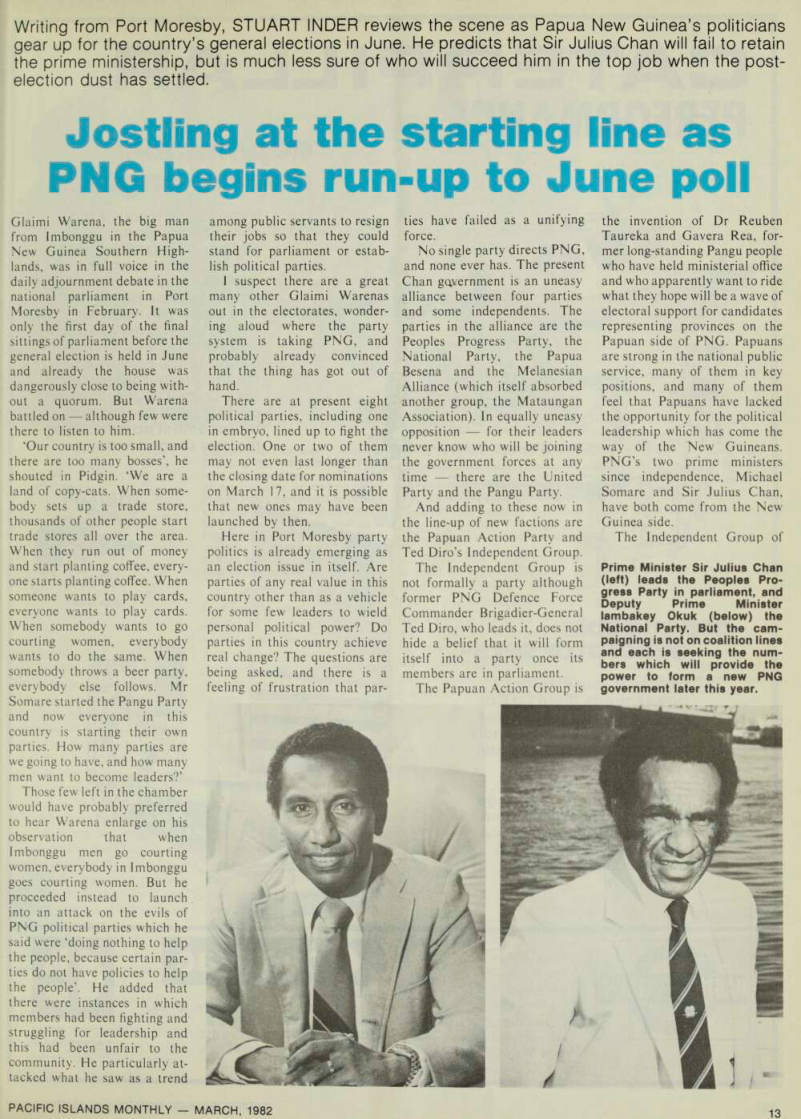
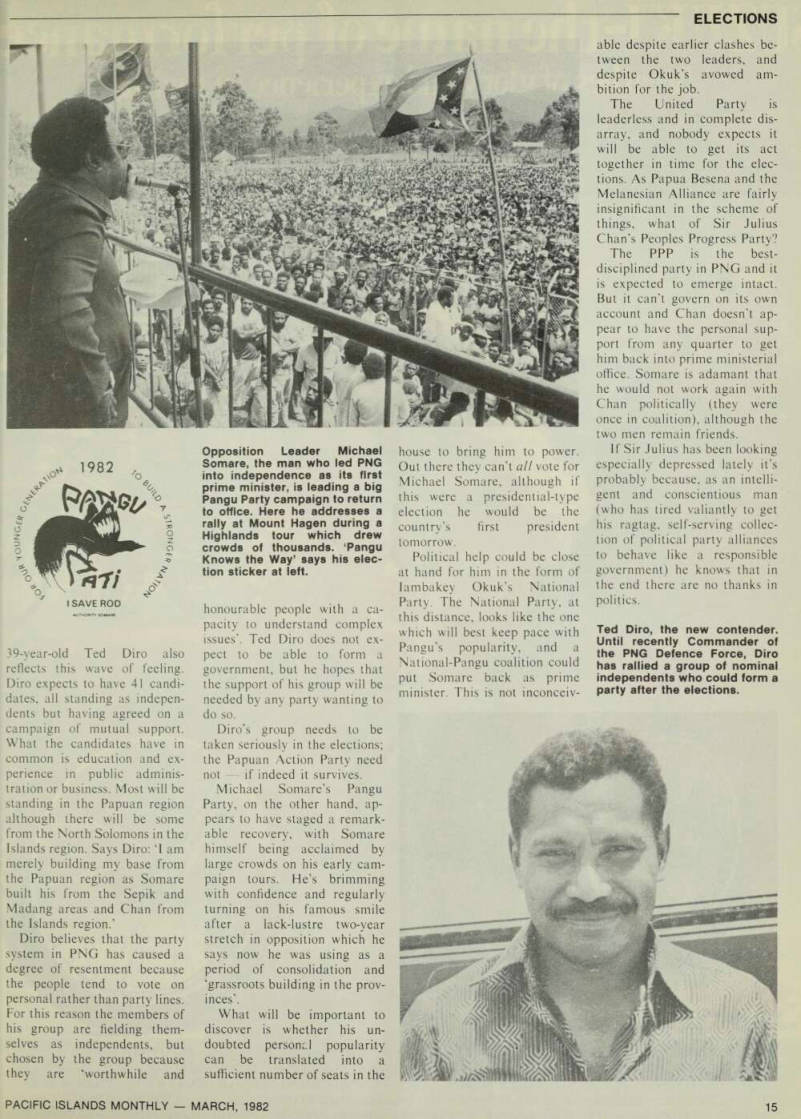
Prime Minister Sir Julius Chan (left) leads the Peoples Pro gress Party in parliament, and Deputy Prime Minister lambakey Okuk (below) the National Party. But the cam paigning is not on coalition lines and each is seeking the num bers which will provide the power to form a new PNG government later this year.
39-year-old Ted Diro also reflects this wave of feeling.
Diro expects to have 41 candidates, all standing as independents but having agreed on a campaign of mutual support.
What the candidates have in common is education and experience in public administration or business. Most will be standing in the Papuan region although there will be some from the North Solomons in the Islands region. Says Diro: T am merely building my base from the Papuan region as Somare built his from the Sepik and Madang areas and Chan from the Islands region.’
Diro believes that the party system in PNG has caused a degree of resentment because the people tend to vote on personal rather than party lines.
For this reason the members of his group are fielding themselves as independents, but chosen by the group because they are ‘worthwhile and
honourable people with a ca pacity to understand complex issues’. Ted Diro does not ex pect to be able to form a government, but he hopes that the support of his group will be needed by any party wanting to do so.
Diro’s group needs to be taken seriously in the elections; the Papuan Action Party need not if indeed it survives.
Michael Somare’s Pangu Party, on the other hand, ap pears to have staged a remark able recovery, with Somare himself being acclaimed by large crowds on his early cam paign tours. He’s brimming with confidence and regularly turning on his famous smile after a lack-lustre two-year stretch in opposition which he says now he was using as a period of consolidation and ‘grassroots building in the prov inces’.
What will be important to discover is whether his un doubted personal popularity can be translated into a sufficient number of seats in the
house to bring him to power.
Out there they can’t all vote for Michael Somare, although if this were a presidential-type election he would be the country’s first president tomorrow.
Political help could be close at hand for him in the form of lambakey Okuk’s National Party. The National Party, at this distance, looks like the one which will best keep pace with Pangu’s popularity, and a National-Pangu coalition could put Somare back as prime minister. This is not inconceiv
able despite earlier clashes be tween the two leaders, and despite Okuk’s avowed am bition for the job.
The United Party is leaderless and in complete dis array, and nobody expects it will be able to get its act together in time for the elec tions. As Papua Besena and the Melanesian Alliance are fairly insignificant in the scheme of things, what of Sir Julius Chan's Peoples Progress Party?
The PPP is the best disciplined party in PNG and it is expected to emerge intact.
But it can’t govern on its own account and Chan doesn’t ap pear to have the personal sup port from any quarter to get him back into prime ministerial office. Somare is adamant that he would not work again with Chan politically (they were once in coalition), although the two men remain friends.
If Sir Julius has been looking especially depressed lately it’s probably because, as an intelli gent and conscientious man (who has tired valiantly to get his ragtag, self-serving collec tion of political party alliances to behave like a responsible government) he knows that in the end there are no thanks in politics.
Opposition Leader Michael Somare, the man who led PNG into independence as its first prime minister, is leading a big Pangu Party campaign to return to office. Here he addresses a rally at Mount Hagen during a Highlands tour which drew crowds of thousands. Pangu Knows the Way’ says his elec tion sticker at left.
Ted Diro, the new contender.
Until recently Commander of the PNG Defence Force, Diro has rallied a group of nominal independents who could form a party after the elections.
Advertisements & other items, pp. 14-16 (1 item)
Performance
dependable
marine engines
When fishing is your living, you know you need dependable gear working with minimum downtime and your engines have to deliver reliable power when and where you need it.
CATERPILLAR offers you a comprehensive selection of performance proven Cat Marine Diesel Engines from 85hp up to IOOOhp, backed by after sales service and replacement parts facilities that are second to none. □ & m a . a a d ' m m ■iWA nr
HASTINGS DURING
YOUR
CATERPILLAR
DEALER
dependable
generator sets
Whatever your electric power needs, there’s a Catbuilt generator set to meet them. Caterpillar generators feature adjustment free fuel systems, large capacity radiators, heavy duty air cleaners and quick-change fuel and oil filters to ensure dependable performance throughout the islands, in all kinds of tropical conditions.
LAE:
Milford Haven Road, Telephone 42 2355.
PORT MORESBY;
Telephone 256650.
BOUGAINVILLE:
Itakara Industrial Park, Arawa Telephone 959077 Caterpillar, Cat and
carptrac
SUVA: Carpenter Street, Raiwai.
Private Mail Bag, GPO Suva, Fiji. Ph. 381622.
Telex FJ2190 Cables CARPTRAC.
LAUTOKA: Veitari. Telephone 61877.
LABASA: Vulovi. Telephone 81868.
Trademarks of Caterpillar Tractor Co. 8A10452
WZUKI-the name or performance
Breathes of glory and experience in raring.
Watch it feeling over on-roads and boldly crossing off-roads.
Presenting SUZUKI s motorcycles that blends superb performance with elegant modernistic styling.
Seen strikingly alive in SUZUKI’s motorcycles is SUZUKI’s technology and experience originally incorporated in the champion machine which has claimed a variety of race titles.
These climaxing technological innovations are apt to attract motorbike fans worldover.
r Jt
f % \ : f •m c w f * > \ - £ s*;v T ; Vr I >
SUZUKI MOTOR CO, LTD
Suzuki 300Takatsuka, Hamamatsu, Japan SOLOMON ISLANDS SOLOMON ISLAND SERVICE STATION LTD. NEW CALEDONIA STE. SUPERCAL PAPUA NEW GUINEA HI SPEED )lESEL SERVICE PTY LTD. VANUATU HENRI LEROUX NIUE ISLAND BURNS PHILP (SOUTH SEA) CO., LTD. PON APE LEO ITSCHEIT TAHITI NIPPON AUTOMOTO ELLICE ISLAND TUVALU COOPERATIVE WHOLESALE SOCIETY LTD. GUAM & SAIPAN SLAND CYCLERY. INC. NORFOLK MARTIN’S AGENCIES LTD. SAMOA PACIFIC PRODUCTS, INC. KIRIBATI GILBERT ISLANDS '©OPERATIVE FEDERATION LIMITED TONGA PACIFIC PRODUCTS INC. NAURU EQUAPAC MOTORS FIJINIRANJANS AUTOPORT LTD.
warships
Political
Currents
Are There ‘Nukes’ Aboard?
Vanuatu says ‘no’ to visit of U.S. warships
A David and Goliath-type con frontation with far-reaching im plications occurred in February when the Vanuatu Government informed the United States Government that the visit of two US warships to Port-Vila would ‘not be acceptable to Vanuatu’.
The reason; the US, in ac cordance with long-standing policy, would neither confirm nor deny whether the vessels were carrying nuclear weapons.
A statement issued by the Vanuatu Ministry of Foreign Affairs on February 5 said; ‘Two United States Navy ships were supposed to be making a goodwill visit to Vanuatu tomorrow. However, the Ministry of Foreign Affairs wishes to announce that the proposed visit to Port-Vila of the USS Marvin Shields and the USS Robert E. Peary will not now take place. ‘Earlier, the Ministry of Foreign Affairs had granted diplomatic clearance to the said United States ships, but the clearance was dependent on the absence of nuclear arms aboard these vessels. This is in conformity with the present government policy on the Pacific as a nuclear-free zone. ‘Yesterday, a statement from the American Embassy in Suva indicated that it is the policy of the Government of the United States of America neither to confirm nor deny the presence of nuclear weapons on American vessels. ‘However, the Vanuatu Gov ernment would find it extremely difficult to entertain such a policy, while maintaining its strong position on the nuclear free Pacific zone. ‘Therefore, the Government has informed the American authorities that the presence of their vessels here will not be acceptable to Vanuatu. ‘The Vanuatu Government has consistently supported the concept of the Pacific as a nuclear-free zone, and its views on the issue have been generally
made known in international and regional meetings, and will continue to be made known.’
Ironically enough, at the time of the Santo secession in 1980, a Vanuatu Government spokes man issued a public invitation to the US Navy to patrol the country’s waters on a regular basis. Nothing, however, came of his proposal.
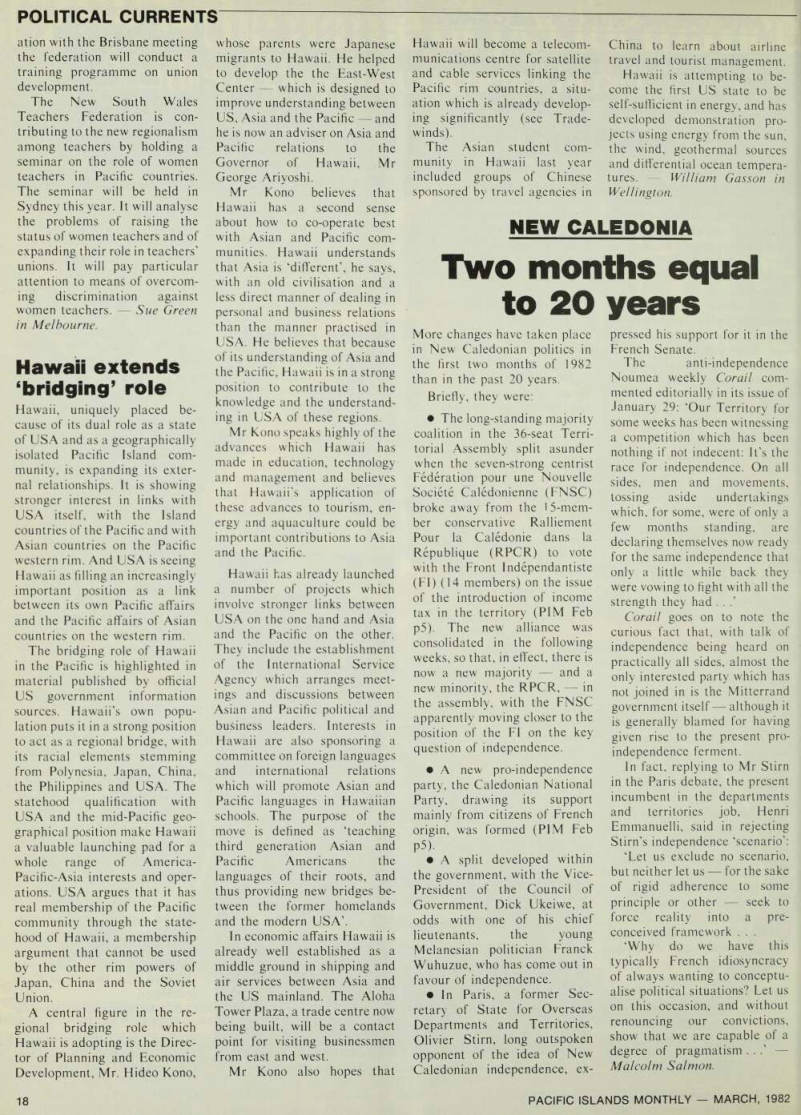
The Marvin Shields and Robert E. Peary were ac companying the Seventh Fleet flagship USS Blue Ridge on a voyage to Australia for a six day goodwill and rest and rec reation visit. They later took part in ‘Sea Eagle’ exercises with the Australian Navy and Air Force.
The Robert E. Peary (homeported in Pearl Harbor) and the Marvin Shields (homeported in San Diego) are fast frigates designed as modern ocean-going escorts capable of speeds of more than 27 knots, with a cruising radius of more than 6500 kilometres.
Both ships are with the US Destroyer Squadron 35, Naval Surface Force, US Pacific Fleet.
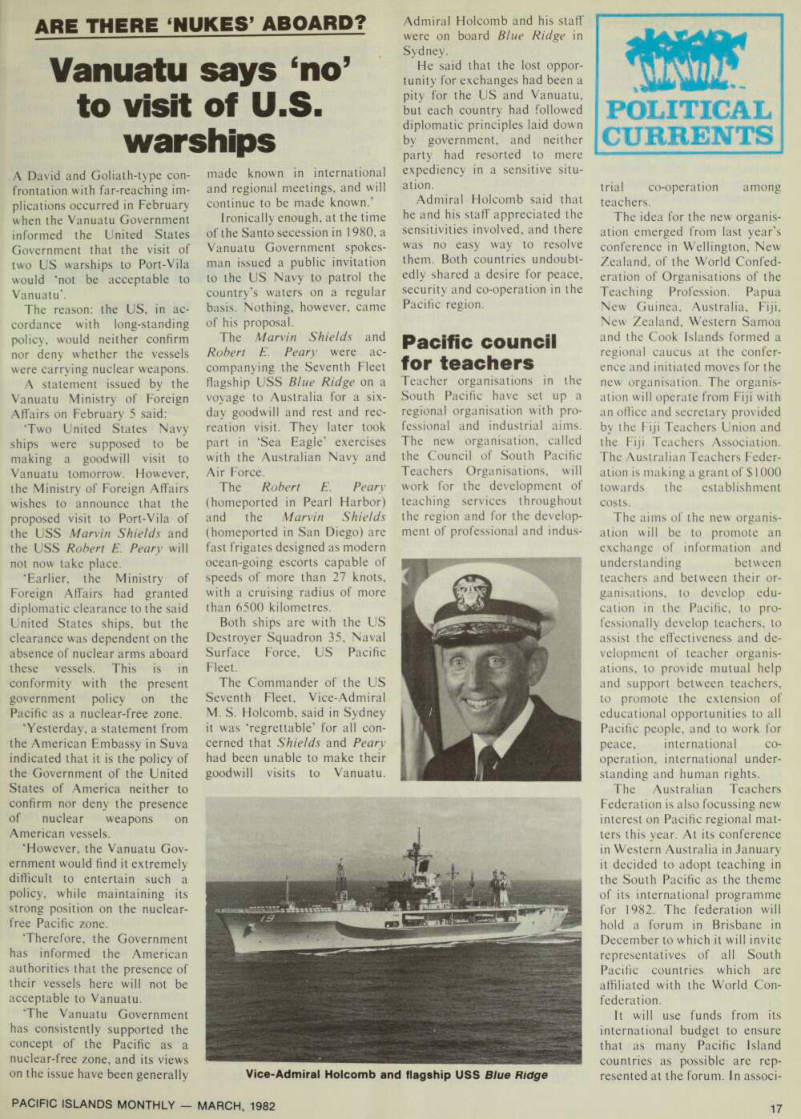
The Commander of the US Seventh Fleet, Vice-Admiral M. S. Holcomb, said in Sydney it was ‘regrettable’ for all con cerned that Shields and Peary had been unable to make their goodwill visits to Vanuatu.
Admiral Holcomb and his staff were on board Blue Ridge in Sydney.
He said that the lost oppor tunity for exchanges had been a pity for the US and Vanuatu, but each country had followed diplomatic principles laid down by government, and neither party had resorted to mere expediency in a sensitive situ ation.
Admiral Holcomb said that he and his staff appreciated the sensitivities involved, and there was no easy way to resolve them. Both countries undoubt edly shared a desire for peace, security and co-operation in the Pacific region.
Pacific council
for teachers
Teacher organisations in the South Pacific have set up a regional organisation with pro fessional and industrial aims.
The new organisation, called the Council of South Pacific Teachers Organisations, will work for the development of teaching services throughout the region and for the develop ment of professional and indus-
trial co-operation among teachers.
The idea for the new organis ation emerged from last year’s conference in Wellington, New Zealand, of the World Confed eration of Organisations of the Teaching Profession. Papua New Guinea, Australia, Fiji, New Zealand, Western Samoa and the Cook Islands formed a regional caucus at the confer ence and initiated moves for the new organisation. The organis ation will operate from Fiji with an office and secretary provided by the Fiji Teachers Union and the Fiji Teachers Association.
The Australian Teachers Feder ation is making a grant of $ 1000 towards the establishment costs.
The aims of the new organis ation will be to promote an exchange of information and understanding between teachers and between their or ganisations, to develop edu cation in the Pacific, to pro fessionally develop teachers, to assist the effectiveness and de velopment of teacher organis ations, to provide mutual help and support between teachers, to promote the extension of educational opportunities to all Pacific people, and to work for peace, international co operation, international under standing and human rights.
The Australian Teachers Federation is also focussing new interest on Pacific regional mat ters this year. At its conference in Western Australia in January it decided to adopt teaching in the South Pacific as the theme of its international programme for 1982. The federation will hold a forum in Brisbane in December to which it will invite representatives of all South Pacific countries which are affiliated with the World Con federation.
It will use funds from its international budget to ensure that as many Pacific Island countries as possible are rep resented at the forum. In associ
Vice-Admiral Holcomb and flagship USS Blue Ridge
ation with the Brisbane meeting the federation will conduct a training programme on union development.
The New South Wales Teachers Federation is con tributing to the new regionalism among teachers by holding a seminar on the role of women teachers in Pacific countries.
The seminar will be held in Sydney this year. It will analyse the problems of raising the status of women teachers and of expanding their role in teachers’ unions. It will pay particular attention to means of overcom ing discrimination against women teachers. Sue Green in Melbourne.
Hawaii extends
‘bridging’ role
Hawaii, uniquely placed be cause of its dual role as a state of USA and as a geographically isolated Pacific Island com munity, is expanding its exter nal relationships. It is showing stronger interest in links with USA itself, with the Island countries of the Pacific and with Asian countries on the Pacific western rim. And USA is seeing Hawaii as filling an increasingly important position as a link between its own Pacific affairs and the Pacific affairs of Asian countries on the western rim.
The bridging role of Hawaii in the Pacific is highlighted in material published by official US government information sources. Hawaii’s own popu lation puts it in a strong position to act as a regional bridge, with its racial elements stemming from Polynesia, Japan, China, the Philippines and USA. The statehood qualification with USA and the mid-Pacific geo graphical position make Hawaii a valuable launching pad for a whole range of America- Pacific-Asia interests and oper ations. USA argues that it has real membership of the Pacific community through the state hood of Hawaii, a membership argument that cannot be used by the other rim powers of Japan, China and the Soviet Union.
A central figure in the re gional bridging role which Hawaii is adopting is the Direc tor of Planning and Economic Development, Mr. Hideo Kono,
whose parents were Japanese migrants to Hawaii. He helped to develop the the East-West Center which is designed to improve understanding between US, Asia and the Pacific and he is now an adviser on Asia and Pacific relations to the Governor of Hawaii, Mr George Ariyoshi.
Mr Kono believes that Hawaii has a second sense about how to co-operate best with Asian and Pacific com munities. Hawaii understands that Asia is ‘different’, he says, with an old civilisation and a less direct manner of dealing in personal and business relations than the manner practised in USA. He believes that because of its understanding of Asia and the Pacific, Hawaii is in a strong position to contribute to the knowledge and the understand ing in USA of these regions.
Mr Kono speaks highly of the advances which Hawaii has made in education, technology and management and believes that Hawaii’s application of these advances to tourism, en ergy and aquaculture could be important contributions to Asia and the Pacific.
Hawaii has already launched a number of projects which involve stronger links between USA on the one hand and Asia and the Pacific on the other.
They include the establishment of the International Service Agency which arranges meet ings and discussions between Asian and Pacific political and business leaders. Interests in Hawaii are also sponsoring a committee on foreign languages and international relations which will promote Asian and Pacific languages in Hawaiian schools. The purpose of the move is defined as ‘teaching third generation Asian and Pacific Americans the languages of their roots, and thus providing new bridges be tween the former homelands and the modern USA’.
In economic affairs Hawaii is already well established as a middle ground in shipping and air services between Asia and the US mainland. The Aloha Tower Plaza, a trade centre now being built, will be a contact point for visiting businessmen from east and west.
Mr Kono also hopes that
Hawaii will become a telecom munications centre for satellite and cable services linking the Pacific rim countries, a situ ation which is already develop ing significantly (see Trade winds).
The Asian student com munity in Hawaii last year included groups of Chinese sponsored by travel agencies in
China to learn about airline travel and tourist management.
Hawaii is attempting to be come the first US state to be self-sufficient in energy, and has developed demonstration pro jects using energy from the sun, the wind, geothermal sources and differential ocean tempera
tures.
William Gasson in
Wellington.
Two months equal
New Caledonia
Two months equal to 20 years
More changes have taken place in New Caledonian politics in the first two months of 1982 than in the past 20 years.
Briefly, they were; • The long-standing majority coalition in the 36-seat Terri torial Assembly split asunder when the seven-strong centrist Federation pour une Nouvelle Societe Caledonienne (FNSC) broke away from the 15-mem ber conservative Ralliement Pour la Caledonie dans la Republique (RPCR) to vote with the Front Independantiste (FI) (14 members) on the issue of the introduction of income tax in the territory (PIM Feb p 5). The new alliance was consolidated in the following weeks, so that, in effect, there is now a new majority and a new minority, the RPCR, in the assembly, with the FNSC apparently moving closer to the position of the FI on the key question of independence. • A new pro-independence party, the Caledonian National Party, drawing its support mainly from citizens of French origin, was formed (PIM Feb p 5). • A split developed within the government, with the Vice- President of the Council of Government, Dick Ukeiwe, at odds with one of his chief lieutenants, the young Melanesian politician Franck Wuhuzue, who has come out in favour of independence. • In Paris, a former Sec retary of State for Overseas Departments and Territories, Olivier Stirn, long outspoken opponent of the idea of New Caledonian independence, ex
pressed his support for it in the French Senate.
The anti-independence Noumea weekly Corail com mented editorially in its issue of January 29: ‘Our Territory for some weeks has been witnessing a competition which has been nothing if not indecent: It’s the race for independence. On all sides, men and movements, tossing aside undertakings which, for some, were of only a few months standing, are declaring themselves now ready for the same independence that only a little while back they were vowing to fight with all the strength they had . . .’
Corail goes on to note the curious fact that, with talk of independence being heard on practically all sides, almost the only interested party which has not joined in is the Mitterrand government itself although it is generally blamed for having given rise to the present pro independence ferment.
In fact, replying to Mr Stirn in the Paris debate, the present incumbent in the departments and territories job, Henri Emmanuelli, said in rejecting Stirn’s independence ‘scenario’: ‘Let us exclude no scenario, but neither let us for the sake of rigid adherence to some principle or other seek to force reality into a pre conceived framework . . . ‘Why do we have this typically French idiosyncracy of always wanting to conceptu alise political situations? Let us on this occasion, and without renouncing our convictions, show that we are capable of a degree of pragmatism ..-
Malcolm Salmon.
by conflict
W. Samoa troubled by conflict in voting rights
Western Samoa, proud of a constitution which at tempted to retain the old with the new, has problems.
When Western Samoa became independent in 1962 it was the first of the new Pacific Island countries to take such a step and prided itself on producing a modern national constitution which also incorporated tra ditional systems of government and social control. Now, 20 years later, fundamental conflicts have arisen within the written law and there are growing pressures to resolve them.
The conflict which is causing the greatest controversy at pres ent is a human rights issue in which freedoms conferred by the constitution appear to clash with restrictions on voting defined in the Electoral Act.
The Electoral Act has estab lished two separate electoral rolls, one of which is the matai roll. Each of 45 constituencies elects one holder of a matai title to a seat in the single-chamber national parliament. Any regis tered holder of a matai title may stand for election, and voting is restricted to the matai them selves. Wives and descendants of matai do not have a vote as it is considered under Samoan tra dition that all adults within a family have had their say in the initial election of their own matai.
This has been criticised as a simplistic attitude which over looks complex relationships be tween families and which ignores the fact that, because matai are elected for life, many young adults had no say in the choice.
The other electoral roll for parliament is the individual voters roll which was devised to give voting rights to citizens of Western Samoa of part- European or part-Chinese de scent who were not, at the time of independence, affiliated di rectly with any matai title. Men and women in this category who were over the age of 21 and were registered to vote on November 30, 1963, or whose father (not mother) was or would have been
eligible to vote at that time may register as individual voters.
These voters are represented from among themselves by two members in parliament. At the time of independence the num ber was five, but this has since been reduced.
Against this background of voting qualifications contained in the Electoral Act, the consti tution of Western Samoa con tains a much wider definition of individual rights. The argument today is that the individual rights should also apply to voting rights, and this has been put forward in a number of recent court cases involving electoral registration. Section 2 of article 15 in the consititution defines individual rights as follows: ‘Except as expressly author ised under the provision of this constitution, no law and no executive or administrative ac tion of the state shall, either expressly or in its practised application, subject any person or persons to any disability or restriction or confer on any person or persons any privilege or advantage on grounds only of descent, sex, language, religion, political or other opinion, social origin, place of birth, family status, or any of them.’
The Registrar of Voters and Electors, Martin Kleis, was quoted recently as saying, T don’t know now who to register and who not to register. Either the law is stupid or I’m stupid, and I like to think that I’m not stupid’. These comments fol lowed a court decision in mid- January allowing the registration as individual voters of two per sons whose applications Kleis had rejected, Edward Stevenson and Esau Roberts.
The two complaints were almost identical, and the Stevenson case will serve to illustrate. Edward Stevenson was under 21 on November 30, 1963 and his father had taken a matai title in 1951 which later
disqualified him and his children from voting as individual voters.
However Edward’s older brother had already attained voting age by the specified date and was duly registered as an individual voter. Stevensons’s counsel main tained that in article 15 of the constitution, ‘place of birth’ should be interpreted as ‘time of birth’, and that when Stevenson’s father took a title in 1951 he did not know that a law would come into effect in 1963 that would affect his children’s electoral rights.
In another application the court upheld the registrar’s ac tion in removng the name of Gina Moors from the individual voters roll. Mrs Moors lost all voting rights when her husband took a matai title she was no longer entitled to an individual vote because she had become affiliated with a matai family, and she could not exercise a matai vote because she was within the direct family of a matai and was not herself a matai. It was reported that the registrar had told her that if she still wanted a vote, she should take a title herself. (There are a few female niatai, but this is not common).
Her counsel, Ae’au S. Epati, argued that it is discriminatory ‘to distinguish between those married to matai and those not married to matai and that such discrimination is in violation of article 15 of the constitution. He submitted that Mrs Moors was discriminated against by virtue of legislation which in its correct context was unreasonable.
At a public meeting in January sponsored by Speak Out Samoa (SOS), Ae’au explained the legal position and read the relevant passages from the con stitution and the Electoral Act.
Some 35 individual voters and observers attended the meeting and took part in the discussion.
The Moors case is being taken to the Supreme Court on appeal, based on grounds that the Elec toral Act is unconstitutional.
If the appeal succeeds either the Electoral Act or the consti tution will have to be changed.
Even if the appeal fails the present law will continue to be challenged by others. Ae’au says he would like to see Samoa introduce a system of voting for all adults, although this would be
contrary to the matai system and would run contrary to Samoan tradition. The meeting generally supported his views, and there are indications that there is majority support throughout the country.
All the pressure on the matai system in not, however, from outside. Each year large num bers of new titles are created and old titles are split and awarded to a number of people, eroding their value and the respect they can command. This practice is par ticularly prevalent in election years when a greater number of registered title-holders means a greater number of votes for those who confer the titles. If this cancerous growth continues, the whole things is bound to fall under its own weight.
One speaker at the SOS meeting claimed that the entire matai system could be con sidered unconstitutional under the terms of article 15 of the constitution. The point is illus trated by a recent case in which a man was banished from the village of Faleletai by the local matai council because he re fused to attend church or give money to the church. The man took legal action against the matai, arguing that he would be no belter a person for going to church and that he had the right of free choice in the matter as guaranteed by the constitution.
He won his case and the matai council was fined. According to traditional law, the matai were within their rights in making such a demand and in taking punitive action when their de mand was refused. The court’s decision has set a precedent that undermines traditional authority enormously.
One of the apparent problems in this constitutional conflict is that the authors of the consti tution wrote into the preamble general phrases about protecting and preserving Samoan custom and tradition without anywhere detailing what they meant. Had they defined the traditional law that was to be upheld, the fundamental conflict with indi vidual rights would have been obvious and could have been resolved at the time. The only legal way to resolve the problem now is to rewrite the constitution.
Ruth Gurnani-Smith
a 1000-year-old
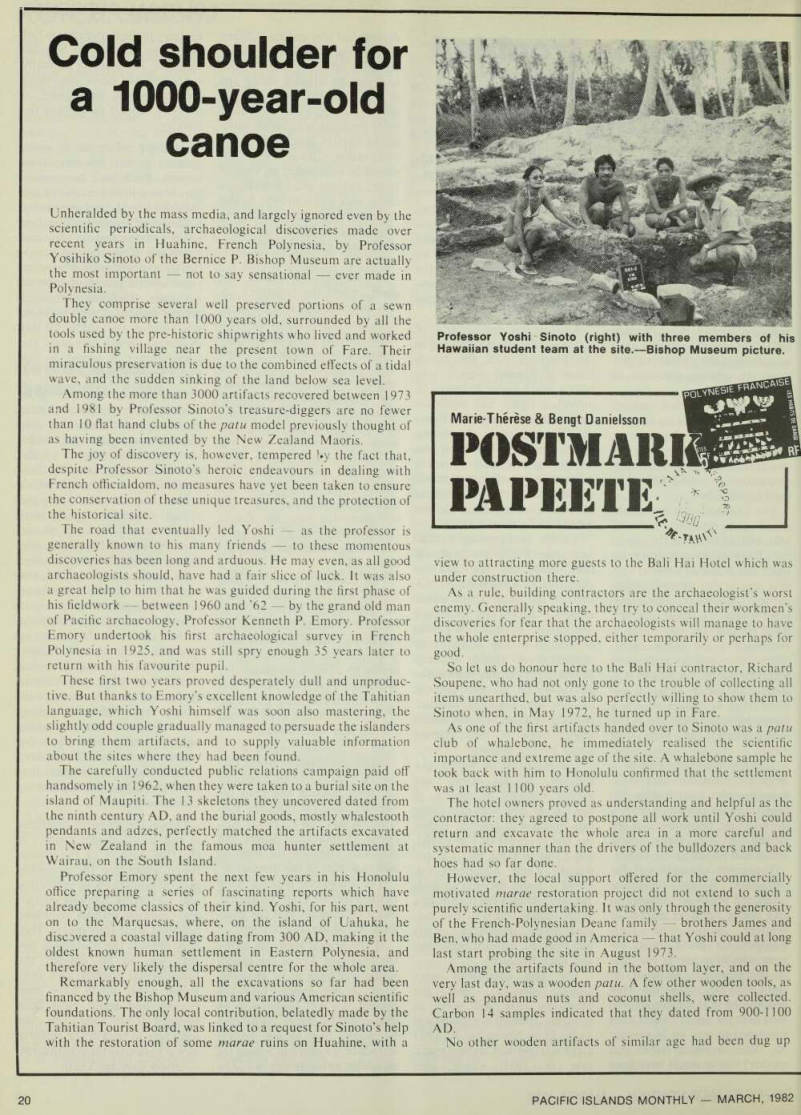
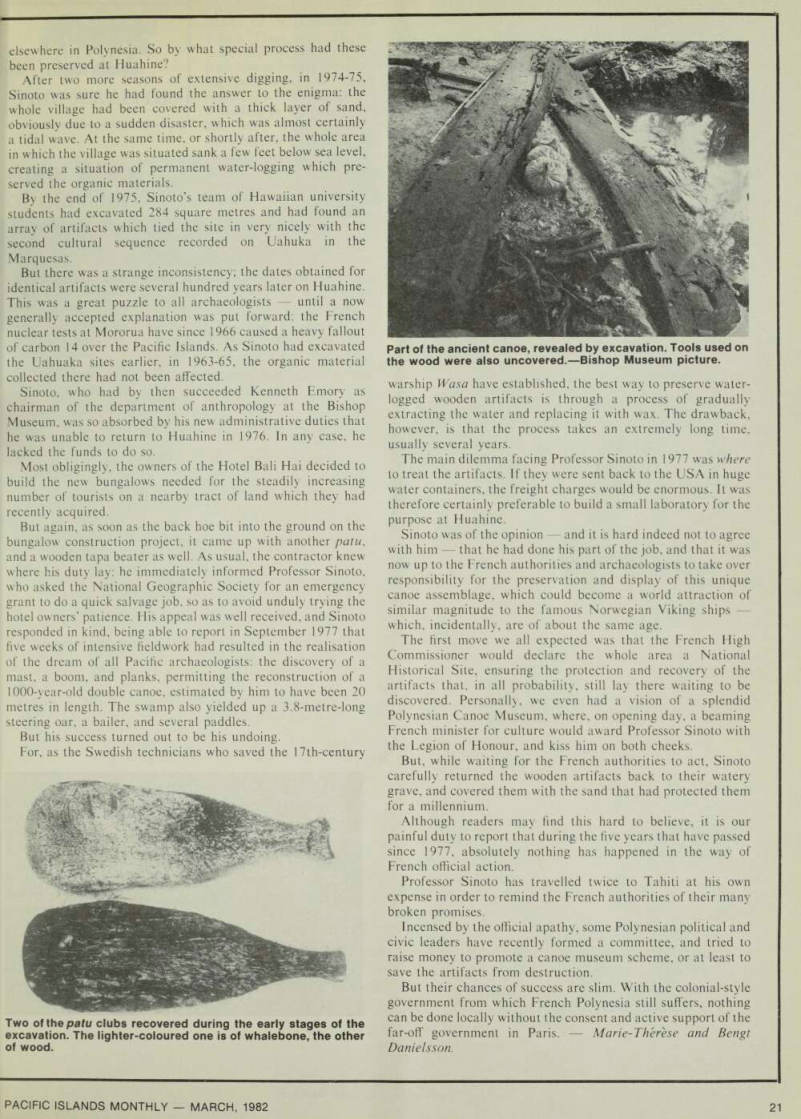
Cold shoulder for a 1000-year-old canoe
Unheralded by the mass media, and largely ignored even by the scientific periodicals, archaeological discoveries made over recent years in Huahine, French Polynesia, by Professor Yosihiko Sinoto of the Bernice P. Bishop Museum are actually the most important not to say sensational ever made in Polynesia.
They comprise several well preserved portions of a sewn double canoe more than 1000 years old, surrounded by all the tools used by the pre-historic shipwrights who lived and worked in a fishing village near the present town of Fare. Their miraculous preservation is due to the combined effects of a tidal wave, and the sudden sinking of the land below sea level.
Among the more than 3000 artifacts recovered between 1973 and 1981 by Professor Sinoto’s treasure-diggers are no fewer than 10 flat hand clubs of the patu model previously thought of as having been invented by the New Zealand Maoris.
The joy of discovery is, however, tempered Uy the fact that, despite Professor Sinoto’s heroic endeavours in dealing with French officialdom, no measures have yet been taken to ensure the conservation of these unique treasures, and the protection of the historical site.
The road that eventually led Yoshi as the professor is generally known to his many friends to these momentous discoveries has been long and arduous. He may even, as all good archaeologists should, have had a fair slice of luck. It was also a great help to him that he was guided during the first phase of his fieldwork between 1960 and ’62 by the grand old man of Pacific archaeology, Professor Kenneth P. Emory. Professor Emory undertook his first archaeological survey in French Polynesia in 1925, and was still spry enough 35 years later to return with his favourite pupil.
These first two years proved desperately dull and unproduc tive. But thanks to Emory’s excellent knowledge of the Tahitian language, which Yoshi himself was soon also mastering, the slightly odd couple gradually managed to persuade the islanders to bring them artifacts, and to supply valuable information about the sites where they had been found.
The carefully conducted public relations campaign paid off handsomely in 1962, when they were taken to a burial site on the island of Maupiti. The 13 skeletons they uncovered dated from the ninth century AD, and the burial goods, mostly whalestooth pendants and adzes, perfectly matched the artifacts excavated in New Zealand in the famous moa hunter settlement at Wairau, on the South Island.
Professor Emory spent the next few years in his Honolulu office preparing a series of fascinating reports which have already become classics of their kind. Yoshi, for his part, went on to the Marquesas, where, on the island of Uahuka, he discovered a coastal village dating from 300 AD, making it the oldest known human settlement in Eastern Polynesia, and therefore very likely the dispersal centre for the whole area.
Remarkably enough, all the excavations so far had been financed by the Bishop Museum and various American scientific foundations. The only local contribution, belatedly made by the Tahitian Tourist Board, was linked to a request for Sinoto’s help with the restoration of some marae ruins on Huahine, with a
view to attracting more guests to the Bali Hai Hotel which was under construction there.
As a rule, building contractors are the archaeologist’s worst enemy. Generally speaking, they try to conceal their workmen’s discoveries for fear that the archaeologists will manage to have the whole enterprise stopped, either temporarily or perhaps for good.
So let us do honour here to the Bali Hai contractor. Richard Soupene, who had not only gone to the trouble of collecting all items unearthed, but was also perfectly willing to show them to Sinoto when, in May 1972, he turned up in Fare.
As one of the first artifacts handed over to Sinoto was a patu club of whalebone, he immediately realised the scientific importance and extreme age of the site. A whalebone sample he took back with him to Honolulu confirmed that the settlement was at least 1100 years old.
The hotel owners proved as understanding and helpful as the contractor: they agreed to postpone all work until Yoshi could return and excavate the whole area in a more careful and systematic manner than the drivers of the bulldozers and back hoes had so far done.
However, the local support offered for the commercially motivated marae restoration project did not extend to such a purely scientific undertaking. It was only through the generosity of the French-Polynesian Deane family brothers James and Ben, who had made good in America that Yoshi could at long last start probing the site in August 1973.
Among the artifacts found in the bottom layer, and on the very last day, was a wooden patu. A few other wooden tools, as well as pandanus nuts and coconut shells, were collected.
Carbon 14 samples indicated that they dated from 900-1100 AD.
No other wooden artifacts of similar age had been dug up
Professor Yoshi Sinoto (right) with three members of his Hawaiian student team at the site. —Bishop Museum picture.
elsewhere in Polynesia. So by what special process had these been preserved at Huahine?
After two more seasons of extensive digging, in 1974-75, Sinoto was sure he had found the answer to the enigma: the whole village had been covered with a thick layer of sand, obviously due to a sudden disaster, which was almost certainly a tidal wave. At the same time, or shortly after, the whole area in which the village was situated sank a few feet below sea level, creating a situation of permanent water-logging which pre served the organic materials.
By the end of 1975, Sinoto’s team of Hawaiian university students had excavated 284 square metres and had found an array of artifacts which tied the site in very nicely with the second cultural sequence recorded on Uahuka in the Marquesas.
But there was a strange inconsistency; the dates obtained for identical artifacts were several hundred years later on Huahine.
This was a great puzzle to all archaeologists until a now generally accepted explanation was put forward; the French nuclear tests at Mororua have since 1966 caused a heavy fallout of carbon 14 over the Pacific Islands. As Sinoto had excavated the Uahuaka sites earlier, in 1963-65, the organic material collected there had not been affected.
Sinoto, who had by then succeeded Kenneth Emory as chairman of the department of anthropology at the Bishop Museum, was so absorbed by his new administrative duties that he was unable to return to Huahine in 1976. In any case, he lacked the funds to do so.
Most obligingly, the owners of the Hotel Bali Hai decided to build the new bungalows needed for the steadily increasing number of tourists on a nearby tract of land which they had recently acquired.
But again, as soon as the back hoe bit into the ground on the bungalow construction project, it came up with another patu , and a wooden tapa beater as well. As usual, the contractor knew where his duty lay: he immediately informed Professor Sinoto, who asked the National Geographic Society for an emergency grant to do a quick salvage job, so as to avoid unduly trying the hotel owners’ patience. His appeal was well received, and Sinoto responded in kind, being able to report in September 1977 that five weeks of intensive fieldwork had resulted in the realisation of the dream of all Pacific archaeologists: the discovery of a mast, a boom, and planks, permitting the reconstruction of a 1000-year-old double canoe, estimated by him to have been 20 metres in length. The swamp also yielded up a 3.8-metre-long steering oar, a bailer, and several paddles.
But his success turned out to be his undoing.
For, as the Swedish technicians who saved the 17th-century
warship Wasa have established, the best way to preserve water logged wooden artifacts is through a process of gradually extracting the water and replacing it with wax. The drawback, however, is that the process takes an extremely long time, usually several years.
The main dilemma facing Professor Sinoto in 1977 was where to treat the artifacts. If they were sent back to the USA in huge water containers, the freight charges would be enormous. It was therefore certainly preferable to build a small laboratory for the purpose at Huahine.
Sinoto was of the opinion — and it is hard indeed not to agree with him — that he had done his part of the job, and that it was now up to the French authorities and archaeologists to take over responsibility for the preservation and display of this unique canoe assemblage, which could become a world attraction of similar magnitude to the famous Norwegian Viking ships — which, incidentally, are of about the same age.
The first move we all expected was that the French High Commissioner would declare the whole area a National Historical Site, ensuring the protection and recovery of the artifacts that, in all probability, still lay there waiting to be discovered. Personally, we even had a vision of a splendid Polynesian Canoe Museum, where, on opening day, a beaming French minister for culture would award Professor Sinoto with the Legion of Honour, and kiss him on both cheeks.
But, while waiting for the French authorities to act, Sinoto carefully returned the wooden artifacts back to their watery grave, and covered them with the sand that had protected them for a millennium.
Although readers may find this hard to believe, it is our painful duty to report that during the five years that have passed since 1977, absolutely nothing has happened in the way of French official action.
Professor Sinoto has travelled twice to Tahiti at his own expense in order to remind the French authorities of their many broken promises.
Incensed by the official apathy, some Polynesian political and civic leaders have recently formed a committee, and tried to raise money to promote a canoe museum scheme, or at least to save the artifacts from destruction.
But their chances of success are slim. With the colonial-style government from which French Polynesia still suffers, nothing can be done locally without the consent and active support of the
far-off government in Paris.
Marie-Therese and Bengt
Danielsson.
Two of the patu clubs recovered during the early stages of the excavation. The lighter-coloured one is of whalebone, the other of wood.
Part of the ancient canoe, revealed by excavation. Tools used on the wood were also uncovered.—Bishop Museum picture.
Advertisements & other items, p. 22 (1 item)
A roomful of musk doesn’t
mmps ' AL. . tw&t > , - r k Mi ■ rn ~...
SB Technics Stereo iP3i : c m
CZ7SS3 '
I* m * Technics ho? ***C» o‘»c -S 44***e* •♦if/Cve ►C%y-ffi »«00
BiOQ
ST-CCM
SU-CO4
RS-MO 7
1-5
A roomful of musk doesn’t
hove to moon a roomful of machinery.
As you can see, the turntable in our Concise 4 System is hardly bigger than an LP.
But don’t let its size stop you taking it seriously. The SL-5 is a direct-drive unit with the latest record playing design. The arm moves straight across the record the way grooves are cut. Handling, by the way, is dead easy. Put a record on the mat. Shut the lid. Press “start”.
The SU-CO4 New Class A amp powering the Concise 4 has state-of-the-art electronics for a roomfitling 30 watts per channel of clean, clear sound. The matching ST-CO 4 tuner has six AM and six FM presets plus “autoscan” tuning.
And the RS-MO 7 cassette deck, with softtouch controls and an auto tape selector, including metal, puts high performance at your fingertips.
The SB-F 2 speakers employ the linear phase design developed by Technics. They work so well, you’d swear you were listening to much bigger units.
But don’t take our word for all this. Take yourself along to hear the Concise 4. And prove to yourself that a roomful of music doesn’t have to mean a roomful of machinery.
T mi 'x'.'. Mb ■ W
mcs
Apia: State
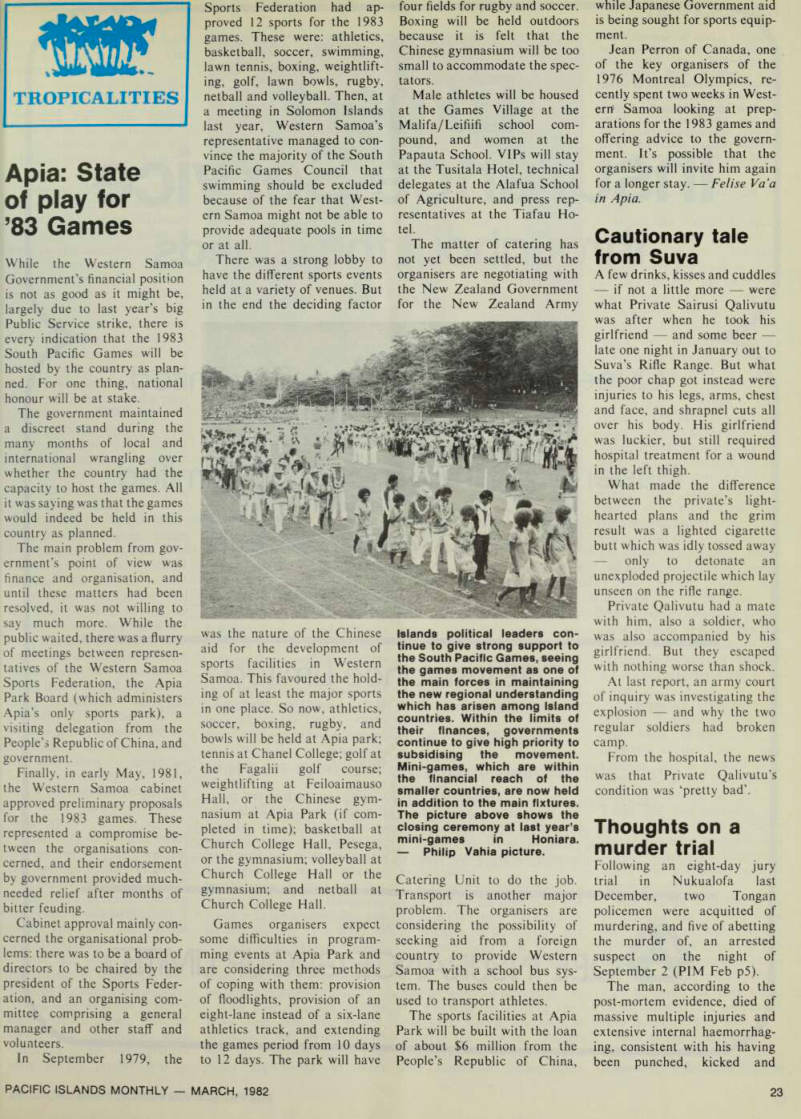

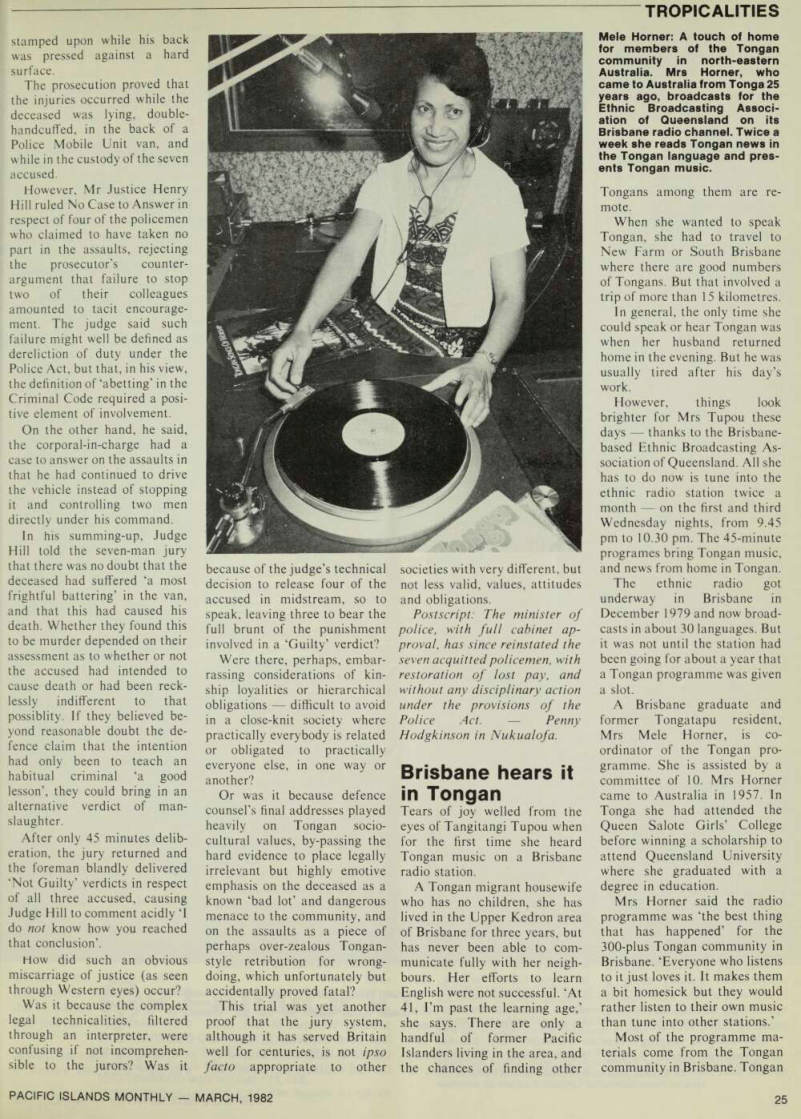
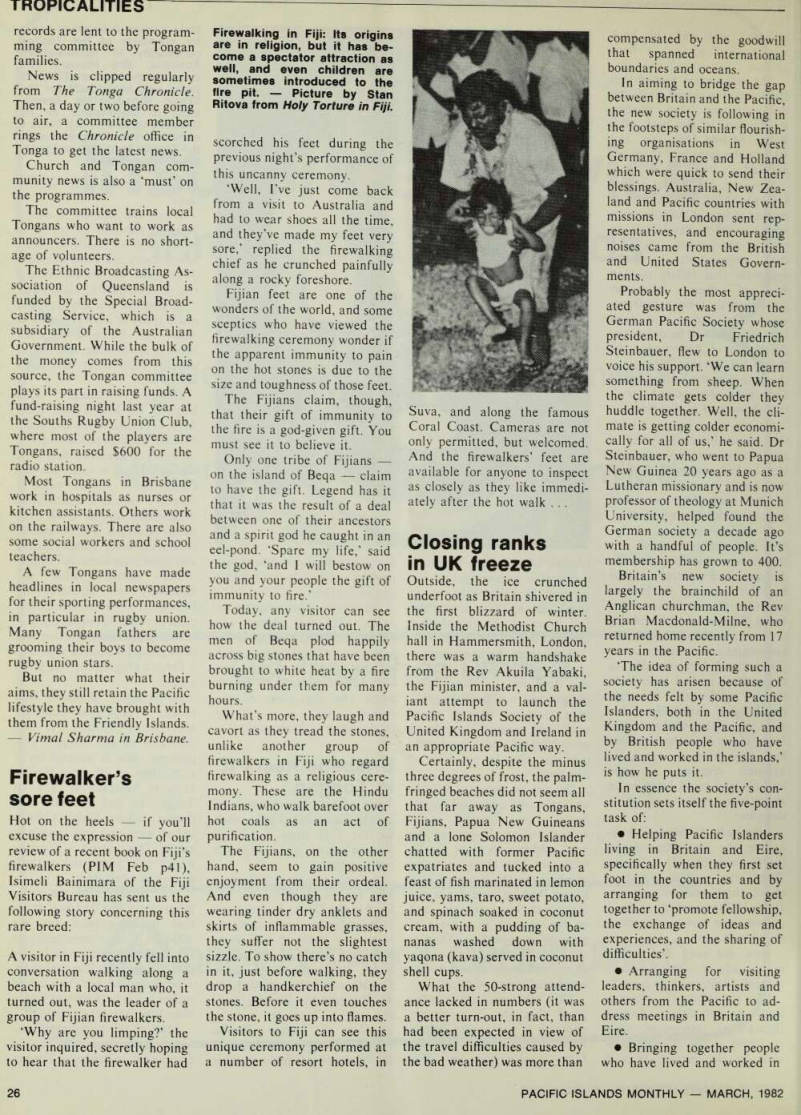
Tropicalities
of play for
’83 Games
While the Western Samoa Government’s financial position is not as good as it might be, largely due to last year’s big Public Service strike, there is every indication that the 1983 South Pacific Games will be hosted by the country as plan ned. For one thing, national honour will be at stake.
The government maintained a discreet stand during the many months of local and international wrangling over whether the country had the capacity to host the games. All it was saying was that the games would indeed be held in this country as planned.
The main problem from gov ernment’s point of view was finance and organisation, and until these matters had been resolved, it was not willing to say much more. While the public waited, there was a flurry of meetings between represen tatives of the Western Samoa Sports Federation, the Apia Park Board (which administers Apia’s only sports park), a visiting delegation from the People’s Republic of China, and government.
Finally, in early May, 1981, the Western Samoa cabinet approved preliminary proposals for the 1983 games. These represented a compromise be tween the organisations con cerned, and their endorsement by government provided much needed relief after months of bitter feuding.
Cabinet approval mainly con cerned the organisational prob lems: there was to be a board of directors to be chaired by the president of the Sports Feder ation, and an organising com mittee comprising a general manager and other staff and volunteers.
In September 1979, the
Sports Federation had ap proved 12 sports for the 1983 games. These were: athletics, basketball, soccer, swimming, lawn tennis, boxing, weightlift ing, golf, lawn bowls, rugby, netball and volleyball. Then, at a meeting in Solomon Islands last year, Western Samoa’s representative managed to con vince the majority of the South Pacific Games Council that swimming should be excluded because of the fear that West ern Samoa might not be able to provide adequate pools in time or at all.
There was a strong lobby to have the different sports events held at a variety of venues. But in the end the deciding factor
was the nature of the Chinese aid for the development of sports facilities in Western Samoa. This favoured the hold ing of at least the major sports in one place. So now, athletics, soccer, boxing, rugby, and bowls will be held at Apia park; tennis at Chanel College; golf at the Fagalii golf course; weightlifting at Feiloaimauso Hall, or the Chinese gym nasium at Apia Park (if com pleted in time); basketball at Church College Hall, Pesega, or the gymnasium; volleyball at Church College Hall or the gymnasium; and netball at Church College Hall.
Games organisers expect some difficulties in program ming events at Apia Park and are considering three methods of coping with them; provision of floodlights, provision of an eight-lane instead of a six-lane athletics track, and extending the games period from 10 days to 12 days. The park will have
four fields for rugby and soccer.
Boxing will be held outdoors because it is felt that the Chinese gymnasium will be too small to accommodate the spec tators.
Male athletes will be housed at the Games Village at the Malifa/Leifiifi school com pound, and women at the Papauta School. VIPs will stay at the Tusitala Hotel, technical delegates at the Alafua School of Agriculture, and press rep resentatives at the Tiafau Ho tel.
The matter of catering has not yet been settled, but the organisers are negotiating with the New Zealand Government for the New Zealand Army
Catering Unit to do the job.
Transport is another major problem. The organisers are considering the possibility of seeking aid from a foreign country to provide Western Samoa with a school bus sys tem. The buses could then be used to transport athletes.
The sports facilities at Apia Park will be built with the loan of about $6 million from the People’s Republic of China,
while Japanese Government aid is being sought for sports equip ment.
Jean Perron of Canada, one of the key organisers of the 1976 Montreal Olympics, re cently spent two weeks in West ern Samoa looking at prep arations for the 1983 games and offering advice to the govern ment. It’s possible that the organisers will invite him again
for a longer stay.
Felise Va'a
in Apia.
Cautionary tale
from Suva
A few drinks, kisses and cuddles if not a little more were what Private Sairusi Qalivutu was after when he took his girlfriend and some beer late one night in January out to Suva’s Rifle Range. But what the poor chap got instead were injuries to his legs, arms, chest and face, and shrapnel cuts all over his body. His girlfriend was luckier, but still required hospital treatment for a wound in the left thigh.
What made the difference between the private’s light hearted plans and the grim result was a lighted cigarette butt which was idly tossed away only to detonate an unexploded projectile which lay unseen on the rifle range.
Private Qalivutu had a mate with him, also a soldier, who was also accompanied by his girlfriend. But they escaped with nothing worse than shock.
At last report, an army court of inquiry was investigating the explosion and why the two regular soldiers had broken camp.
From the hospital, the news was that Private Qalivutu’s condition was ‘pretty bad’.
Thoughts on a
murder trial
Following an eight-day jury trial in Nukualofa last December, two Tongan policemen were acquitted of murdering, and five of abetting the murder of, an arrested suspect on the night of September 2 (PIM Feb p 5).
The man, according to the post-mortem evidence, died of massive multiple injuries and extensive internal haemorrhag ing, consistent with his having been punched, kicked and
Islands political leaders con tinue to give strong support to the South Pacific Games, seeing the games movement as one of the main forces in maintaining the new regional understanding which has arisen among Island countries. Within the limits of their finances, governments continue to give high priority to subsidising the movement.
Mini-games, which are within the financial reach of the smaller countries, are now held in addition to the main fixtures.
The picture above shows the closing ceremony at last year’s mini-games in Honiara. -Philip Vahia picture.
stamped upon while his back was pressed against a hard surface.
The prosecution proved that the injuries occurred while the deceased was lying, double handcuffed, in the back of a Police Mobile Unit van, and while in the custody of the seven accused.
However, Mr Justice Henry Hill ruled No Case to Answer in respect of four of the policemen who claimed to have taken no part in the assaults, rejecting the prosecutor’s counter argument that failure to stop two of their colleagues amounted to tacit encourage ment. The judge said such failure might well be defined as dereliction of duty under the Police Act, but that, in his view, the definition of ‘abetting’ in the Criminal Code required a posi tive element of involvement.
On the other hand, he said, the corporal-in-charge had a case to answer on the assaults in that he had continued to drive the vehicle instead of stopping it and controlling two men directly under his command.
In his summing-up, Judge Hill told the seven-man jury that there was no doubt that the deceased had suffered ‘a most frightful battering’ in the van, and that this had caused his death. Whether they found this to be murder depended on their assessment as to whether or not the accused had intended to cause death or had been reck lessly indifferent to that possiblity. If they believed be yond reasonable doubt the de fence claim that the intention had only been to teach an habitual criminal ‘a good lesson’, they could bring in an alternative verdict of man slaughter.
After only 45 minutes delib eration, the jury returned and the foreman blandly delivered ‘Not Guilty’ verdicts in respect of all three accused, causing Judge Hill to comment acidly T do not know how you reached that conclusion’.
How did such an obvious miscarriage of justice (as seen through Western eyes) occur?
Was it because the complex legal technicalities, filtered through an interpreter, were confusing if not incomprehen sible to the jurors? Was it
because of the judge’s technical decision to release four of the accused in midstream, so to speak, leaving three to bear the full brunt of the punishment involved in a ‘Guilty’ verdict?
Were there, perhaps, embar rassing considerations of kin ship loyalities or hierarchical obligations difficult to avoid in a close-knit society where practically everybody is related or obligated to practically everyone else, in one way or another?
Or was it because defence counsel’s final addresses played heavily on Tongan socio cultural values, by-passing the hard evidence to place legally irrelevant but highly emotive emphasis on the deceased as a known ‘bad lot’ and dangerous menace to the community, and on the assaults as a piece of perhaps over-zealous Tongan style retribution for wrong doing, which unfortunately but accidentally proved fatal?
This trial was yet another proof that the jury system, although it has served Britain well for centuries, is not ipso facto appropriate to other
societies with very different, but not less valid, values, attitudes and obligations.
Postscript: The minister of police, with full cabinet ap proval, has since reinstated the seven acquitted policemen, with restoration of lost pay, and without any disciplinary action under the provisions of the
Police Act.
Penny
Hodgkinson in Nukualofa.
Brisbane hears it
in Tongan
Tears of joy welled from the eyes of Tangitangi Tupou when for the first time she heard Tongan music on a Brisbane radio station.
A Tongan migrant housewife who has no children, she has lived in the Upper Kedron area of Brisbane for three years, but has never been able to com municate fully with her neigh bours. Her efforts to learn English were not successful. ‘At 41, I’m past the learning age,’ she says. There are only a handful of former Pacific Islanders living in the area, and the chances of finding other
Tongans among them are re mote.
When she wanted to speak Tongan, she had to travel to New Farm or South Brisbane where there are good numbers of Tongans. But that involved a trip of more than 15 kilometres.
In general, the only time she could speak or hear Tongan was when her husband returned home in the evening. But he was usually tired after his day’s work.
However, things look brighter for Mrs Tupou these days thanks to the Brisbane based Ethnic Broadcasting As sociation of Queensland. All she has to do now is tune into the ethnic radio station twice a month on the first and third Wednesday nights, from 9.45 pm to 10.30 pm. The 45-minute programes bring Tongan music, and news from home in Tongan.
The ethnic radio got underway in Brisbane in December 1979 and now broad casts in about 30 languages. But it was not until the station had been going for about a year that a Tongan programme was given a slot.
A Brisbane graduate and former Tongatapu resident, Mrs Mele Horner, is co ordinator of the Tongan pro gramme. She is assisted by a committee of 10. Mrs Horner came to Australia in 1957. In Tonga she had attended the Queen Salote Girls’ College before winning a scholarship to attend Queensland University where she graduated with a degree in education.
Mrs Horner said the radio programme was ‘the best thing that has happened’ for the 300-plus Tongan community in Brisbane. ‘Everyone who listens to it just loves it. It makes them a bit homesick but they would rather listen to their own music than tune into other stations.’
Most of the programme ma terials come from the Tongan community in Brisbane. Tongan
Mele Horner: A touch of home for members of the Tongan community in north-eastern Australia. Mrs Horner, who came to Australia from Tonga 25 years ago, broadcasts for the Ethnic Broadcasting Associ ation of Queensland on its Brisbane radio channel. Twice a week she reads Tongan news in the Tongan language and pres ents Tongan music.
records are lent to the program ming committee by Tongan families.
News is clipped regularly from The Tonga Chronicle.
Then, a day or two before going to air, a committee member rings the Chronicle office in Tonga to get the latest news.
Church and Tongan com munity news is also a ‘must’ on the programmes.
The committee trains local Tongans who want to work as announcers. There is no short age of volunteers.
The Ethnic Broadcasting As sociation of Queensland is funded by the Special Broad casting Service, which is a subsidiary of the Australian Government. While the bulk of the money comes from this source, the Tongan committee plays its part in raising funds. A fund-raising night last year at the Souths Rugby Union Club, where most of the players are Tongans, raised $6OO for the radio station.
Most Tongans in Brisbane work in hospitals as nurses or kitchen assistants. Others work on the railways. There are also some social workers and school teachers.
A few Tongans have made headlines in local newspapers for their sporting performances, in particular in rugby union.
Many Tongan fathers are grooming their boys to become rugby union stars.
But no matter what their aims, they still retain the Pacific lifestyle they have brought with them from the Friendly Islands.
Vimal Sharma in Brisbane.
Firewalker’s
sore feet
Hot on the heels if you’ll excuse the expression of our review of a recent book on Fiji’s firewalkers (PIM Feb p4l), Isimeli Bainimara of the Fiji Visitors Bureau has sent us the following story concerning this rare breed: A visitor in Fiji recently fell into conversation walking along a beach with a local man who, it turned out, was the leader of a group of Fijian firewalkers. ‘Why are you limping?’ the visitor inquired, secretly hoping to hear that the firewalker had
scorched his feet during the previous night’s performance of this uncanny ceremony. ‘Well, I’ve just come back from a visit to Australia and had to wear shoes all the time, and they’ve made my feet very sore,’ replied the firewalking chief as he crunched painfully along a rocky foreshore.
Fijian feet are one of the wonders of the world, and some sceptics who have viewed the firewalking ceremony wonder if the apparent immunity to pain on the hot stones is due to the size and toughness of those feet.
The Fijians claim, though, that their gift of immunity to the fire is a god-given gift. You must see it to believe it.
Only one tribe of Fijians on the island of Beqa claim to have the gift. Legend has it that it was the result of a deal between one of their ancestors and a spirit god he caught in an eel-pond. ‘Spare my life,’ said the god, ‘and I will bestow on you and your people the gift of immunity to fire.’
Today, any visitor can see how the deal turned out. The men of Beqa plod happily across big stones that have been brought to white heat by a fire burning under them for many hours.
What’s more, they laugh and cavort as they tread the stones, unlike another group of firewalkers in Fiji who regard firewalking as a religious cere mony. These are the Hindu Indians, who walk barefoot over hot coals as an act of purification.
The Fijians, on the other hand, seem to gain positive enjoyment from their ordeal.
And even though they are wearing tinder dry anklets and skirts of inflammable grasses, they suffer not the slightest sizzle. To show there’s no catch in it, just before walking, they drop a handkerchief on the stones. Before it even touches the stone, it goes up into flames.
Visitors to Fiji can see this unique ceremony performed at a number of resort hotels, in
Suva, and along the famous Coral Coast. Cameras are not only permitted, but welcomed.
And the firewalkers’ feet are available for anyone to inspect as closely as they like immedi ately after the hot walk . . .
Closing ranks
in UK freeze
Outside, the ice crunched underfoot as Britain shivered in the first blizzard of winter.
Inside the Methodist Church hall in Hammersmith, London, there was a warm handshake from the Rev Akuila Yabaki, the Fijian minister, and a val iant attempt to launch the Pacific Islands Society of the United Kingdom and Ireland in an appropriate Pacific way.
Certainly, despite the minus three degrees of frost, the palm fringed beaches did not seem all that far away as Tongans, Fijians, Papua New Guineans and a lone Solomon Islander chatted with former Pacific expatriates and tucked into a feast of fish marinated in lemon juice, yams, taro, sweet potato, and spinach soaked in coconut cream, with a pudding of ba nanas washed down with yaqona (kava) served in coconut shell cups.
What the 50-strong attend ance lacked in numbers (it was a better turn-out, in fact, than had been expected in view of the travel difficulties caused by the bad weather) was more than
compensated by the goodwill that spanned international boundaries and oceans.
In aiming to bridge the gap between Britain and the Pacific, the new society is following in the footsteps of similar flourish ing organisations in West Germany, France and Holland which were quick to send their blessings. Australia, New Zea land and Pacific countries with missions in London sent rep resentatives, and encouraging noises came from the British and United States Govern ments.
Probably the most appreci ated gesture was from the German Pacific Society whose president, Dr Friedrich Steinbauer, flew to London to voice his support. ‘We can learn something from sheep. When the climate gets colder they huddle together. Well, the cli mate is getting colder economi cally for all of us,’ he said. Dr Steinbauer, who went to Papua New Guinea 20 years ago as a Lutheran missionary and is now professor of theology at Munich University, helped found the German society a decade ago with a handful of people. It’s membership has grown to 400.
Britain’s new society is largely the brainchild of an Anglican churchman, the Rev Brian Macdonald-Milne, who returned home recently from 17 years in the Pacific. ‘The idea of forming such a society has arisen because of the needs felt by some Pacific Islanders, both in the United Kingdom and the Pacific, and by British people who have lived and worked in the islands,’ is how he puts it.
In essence the society’s con stitution sets itself the five-point task of: • Helping Pacific Islanders living in Britain and Eire, specifically when they first set foot in the countries and by arranging for them to get together to ‘promote fellowship, the exchange of ideas and experiences, and the sharing of difficulties’. • Arranging for visiting leaders, thinkers, artists and others from the Pacific to ad dress meetings in Britain and Eire. • Bringing together people who have lived and worked in
Firewalking in Fiji: Its origins are in religion, but it has be come a spectator attraction as well, and even children are sometimes introduced to the
fire pit. - Picture by Stan
Ritova from Holy Torture in Fiji.
the Pacific and who retain an interest in the area. • Encouraging an interest in the Pacific and providing up-to date information of the islands. • Co-operating with similar bodies in other countries, and with governments, churches and other organisations in the Pacific.
To emphasise its multi nationalism, the society is invit ing representatives of both Polynesia and Melanesia to become its first patrons.
Equally, the ethnic diversity is reflected in its governing council. The first elected presi dent is John Smith, 53-year-old former governor of the Gilbert and Ellice Islands and also a former financial secretary to Solomon Islands. He will have as his vice-president the Rev Aquila Yabaki, on loan in London from the Fiji Methodist Church. And one member of the council is Princess Pilolevu, daughter of the King of Tonga, who is married to a diplomat of the Tongan High Commission in London.
Only, Fiji, Tonga and PNG have diplomatic missions in London, and Nauru has an office. Visitors from the smaller island countries have nowhere to turn in difficulties.
There are about 120 Pacific students in Britain, with Fiji having the biggest contingent of about 30. Pacific High Com missions have occasionally ‘res cued’ nationals of other countries faced with the de moralising problems of accom modation and money.
Outside the official channels and commercial firms, the Pacific committee of the British Council of Churches in the missionary field, and the quasi official Voluntary Service Over seas are among the most active operators. The VSO has about 140 volunteers, ranging from doctors to agriculturalists, working in the Pacific.
Other bodies such as the 113-year-old Royal Common wealth Society are equally anxious to further links. The RCS is pioneering a scheme with Kiribati for corporate membership, enabling the country’s nationals to use its club facilities automatically when they visit London.
The Pacific Islands Society
doesn’t mean to cut across the work of these bodies, but in stead to co-ordinate and comp lement their activities.
It is appealing to govern ments, churches, firms and other organisations in the Pacific to keep it informed of intending visitors to Britain so that they can be welcomed in the right style, and build a closer and deeper relationship among people living at opposite
ends of the earth.
Tom
Hughes in London.
Cultural Centre
opens in Apia
Western Samoa’s long-awaited Robert Louis Stevenson Mu seum and Samoan Cultural Centre, Vailima, owned and operated by the Congregational Church of Jesus, were officially opened in December.
Visitors first enter the Stevenson museum where they view pictures and other mementoes of the famous author, including a number of mementoes of German times.
Then they go into a fale where Samoan women will be seen preparing fine mats and siapo.
They then enter a second fale where craftsmen will be at work building canoes, carving statues, and so on.
The next fale is the res taurant where tourists will be served Samoan food, prepared nearby. Delicacies such as poi will be available.
At about midday each day, tourists will be treated to Samoan entertainment, pro vided by local groups. ‘We expect to earn millions for the country from this pro ject,’ said the chairman of the scheme, Aumua loane.
The church has already con ducted a Vigorous publicity campaign overseas and locally to attract tourists to the centre. ‘We are working very closely with the hotels and airlines,’
Aumua said.
The project is expected to profit locals with at least 30 jobs. There will be need for clerks, caterers, grounds people, handicraftsmen, entertainers, tour guides, and so on.
The buildings were built by traditional craftsmen from Falelatai.
Advertisements & other items, pp. 24-28 (1 item)
Expert
Insurance Service
throughout the islands
i
Queensland Insurance (Fiji) Limited
Head Office. 34 Usher St . SUVA General Manager L G Liddell A A l l. Assistant Managers R Jackson. Vijay Lai Phone 23851 LAUTOKA OFFICE Burns Philp Bldg . Naviti St District Manager J Dalton. Phone: 60642
Queensland Insurance (PNG) Limited
PAPUA NEW GUINEA
Head Office. B N G Building, Musgrave St PORT MORESBY General Manager J M Dawe Phone 212144 LAE 4th St & Coronation Drive District Manager C D Hillier Phone: 423873 MOUNT HAGEN Hagen Drive District Manager G. W Jack Phone. 521002 ARAWA Chebu St District Manager. J Longbut Phone 951555 VIADANG Kasagten St District Manager N D Ramage Phone 822020 RABAUL WirrawaySt District Manager W F Tinker Phone 921014
QBE Insurance Limited
VANUATU PORT VILA Rue de Pans .Suite 19. Oceania Bldg Manager I R Martin.
Phone 2299 SANTO Burns Philp ( Vanuatu) Ltd Phone 230
PACIFIC AGENCIES
NEW CALEDONIA Ste W A Johnston. S A R L 5 Rue Anatole France. NOUMEA Phone 272083 TAHITI Arthur Chung Immeuble B I S . Front de Mer. PAPEETE Phone 2 86 19 NIUE Burns Philp (South Sea) Company Ltd NORFOLK ISLAND Burns Philp ('N I) Company Ltd Phone 2191 SAMOA APIA Burns Philp (South Sea) Company Ltd Phone 22611 TONGA Bums Philp (South Sea) Company Ltd NUKU ALOFA Phone 21500 HAAPAI VAVAU
MEMBERS OF THE
INSURANCE GROUP LIMITED
Reach out and the
The Spectrum 50 matched-
component system finally puts a
richer musical life within reach of the most restrictive hi-fi budgets.
Each Spectrum 50 component is a star in a perfectly harmonizing audio galactic system. The brainchild of some of the hi-fi world’s most dedicated engineers.
Reach out, and your journey to music’s realm of inner space can
begin now!
<l4 f i: & •' r :J> . ir
a mm
mm \ 9
‘•ill •-
js:::
Spectrum 50
KA-50 Stereo Integrated Amplifier KT-30 FM-AM Stereo Tuner KX-50 Metal-Tape Stereo Cassette Deck with Dolby" NR
KD-40R
Direct-Drive Auto-Return Turntable
LS-110F
55W 3-way Speaker System
SRC-5
Audio Rack with glass door and casters GE-90 Stereo Graphic Equalizer (option) 'TM Dolby Licensing Corp.
TRIO-KENWOOD CORPORATION
Shionogi Shibuya Building, 17-5, 2-chome, Shibuya, Shibuya-ku, Tokyo 150, Japan
TRIO-KENWOOD (AUSTRALIA) PTY. LTD.
4E Woodcock Place, Lane Cove, N.S.W. 2066, Australia. Tel: 428-1455 NEW ZEALAND JOHN GILBERT & CO,, LTD, Auckland Tel, 30-839 FIJI PEPE’S DUTY FREE CENTRE LTD. Tel. 26187 PAPUA NEW GUINEA S O. SVENSSON (N.G.) LTD. Port Moresby Tel. 42-4467 SOLOMON ISLANDS TECHNIQUE RADIOS CENTRE LTD. Honiara Tel 416 NEW CALEDONIA HI-FI VOX Noumea Tel. 27-2466 VANUATU FUNG CHOI LUEN. Port-Vila Tel. 2556
TAHITI MAISON AURORE Papeete Tel. 29703
AMERICAN SAMOA ISLAND PACIFIC AGENCIES, INC, Pago Pago Tel. 633-4687
REPUBLIC OF NAURU NAURU CO-OPERATIVE SOCIETY
MARIANA ISLANDS J.C. TENORIO ENTERPRISE Saipan Tel. 6444
TRADE MARK
CAUTIONARY
NOTICE
IN NAURU
Notice is hereby given that Matsushita Electric Industrial Co. Ltd. a corporation duly organised and existing under the laws of Japan of 1006 Oaza Kadoma, Kadoma-shi, Osaka Prefecture.
Japan, Manufacturers, are the sole proprietors in Nauru and elsewhere of the following trade marks;
National
used in respect of: machines and machine tools: motors; scientific nautical, surveying and electrical apparatus and instruments (including wireless), photographic, cinematographic, optical, weighing, measuring, signalling, checking (supervision), lifesaving and teaching apparatus and instruments; coin or counter-freed apparatus; talking machines; fireextinguishing apparatus; installations for lighting, heating, steam generating, cooking, refrigerating, drying, ventilating, water supply and sanitary purposes.
Panasonic
PAN A
used in respect of: machines and machine tools; motors: scientific, nautical, surveying and electrical apparatus and instruments (including wireless), weighing, measuring, signalling, checking (supervision), life-saving and teaching apparatus and instruments; coin or counter-freed apparatus: talking machines, cash registers; calculating machines: fire-extinguishing apparatus; installations for lighting, heating, steam generating, cooking, refrigerating, drying, ventilating, water supply and sanitary purposes.
The said proprietor claims all rights in respect of the above trade marks and will take all necessary legal steps against any person or company infringing their said rights.
DAVIES & COLLISON
One Little Collins Street,
Melbourne, Victoria 3000,
Australia
Islands
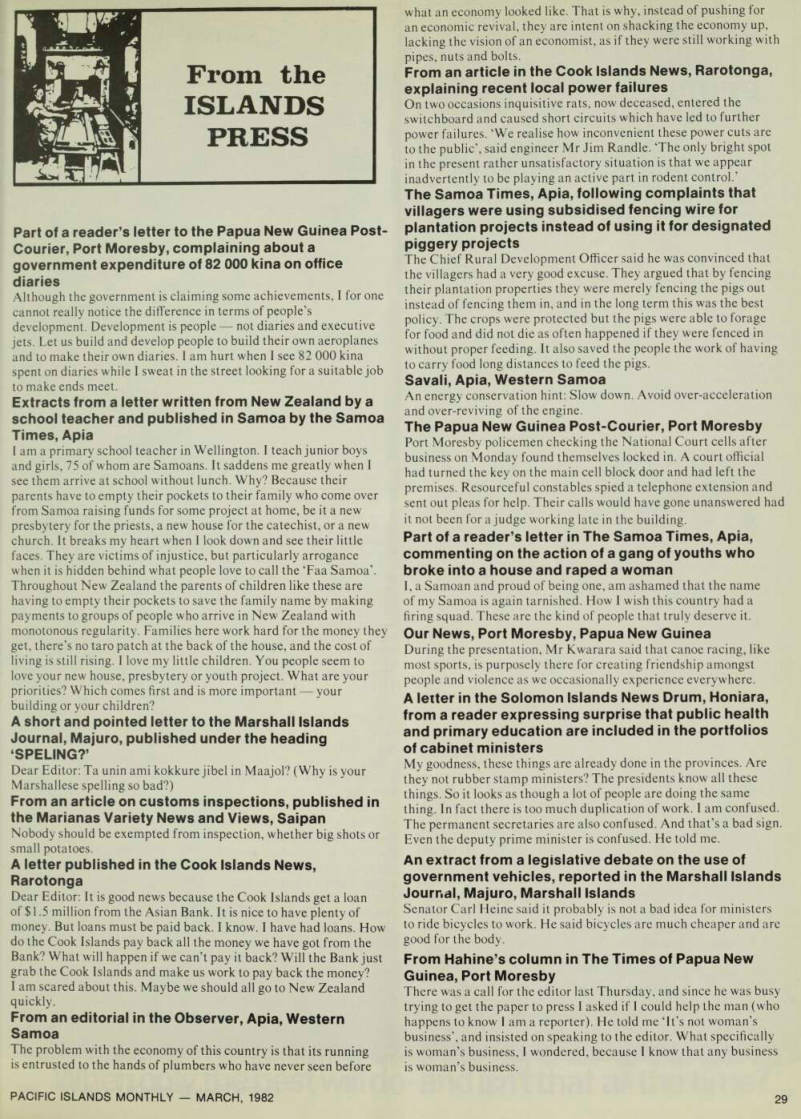
From the
Press
Part of a reader’s letter to the Papua New Guinea Post- Courier, Port Moresby, complaining about a government expenditure of 82 000 kina on office diaries Although the government is claiming some achievements, I for one cannot really notice the difference in terms of people’s development. Development is people not diaries and executive jets. Let us build and develop people to build their own aeroplanes and to make their own diaries. I am hurt when I see 82 000 kina spent on diaries while I sweat in the street looking for a suitable job to make ends meet.
Extracts from a letter written from New Zealand by a school teacher and published in Samoa by the Samoa
Times, Apia
I am a primary school teacher in Wellington. I teach junior boys and girls, 75 of whom are Samoans. It saddens me greatly when I see them arrive at school without lunch. Why? Because their parents have to empty their pockets to their family who come over from Samoa raising funds for some project at home, be it a new presbytery for the priests, a new house for the catechist, or a new church. It breaks my heart when I look down and see their little faces. They are victims of injustice, but particularly arrogance when it is hidden behind what people love to call the ‘Faa Samoa’.
Throughout New Zealand the parents of children like these are having to empty their pockets to save the family name by making payments to groups of people who arrive in New Zealand with monotonous regularity. Families here work hard for the money they get, there’s no taro patch at the back of the house, and the cost of living is still rising. I love my little children. You people seem to love your new house, presbytery or youth project. What are your priorities? Which comes first and is more important your building or your children?
A short and pointed letter to the Marshall Islands
Journal, Majuro, published under the heading
‘Speling?’
Dear Editor: Ta unin ami kokkure jibel in Maajol? (Why is your Marshallese spelling so bad?) From an article on customs inspections, published in the Marianas Variety News and Views, Saipan Nobody should be exempted from inspection, whether big shots or small potatoes.
A letter published in the Cook Islands News,
Rarotonga
Dear Editor: It is good news because the Cook Islands get a loan of $1.5 million from the Asian Bank. It is nice to have plenty of money. But loans must be paid back. 1 know. I have had loans. How do the Cook Islands pay back all the money we have got from the Bank? What will happen if we can’t pay it back? Will the Bank just grab the Cook Islands and make us work to pay back the money?
I am scared about this. Maybe we should all go to New Zealand quickly.
From an editorial in the Observer, Apia, Western Samoa The problem with the economy of this country is that its running is entrusted to the hands of plumbers who have never seen before
what an economy looked like. That is why, instead of pushing for an economic revival, they are intent on shacking the economy up, lacking the vision of an economist, as if they were still working with pipes, nuts and bolts.
From an article in the Cook Islands News, Rarotonga, explaining recent local power failures On two occasions inquisitive rats, now deceased, entered the switchboard and caused short circuits which have led to further power failures. ‘We realise how inconvenient these power cuts are to the public’, said engineer Mr Jim Randle. The only bright spot in the present rather unsatisfactory situation is that we appear inadvertently to be playing an active part in rodent control.’
The Samoa Times, Apia, following complaints that villagers were using subsidised fencing wire for plantation projects instead of using it for designated
piggery projects
The Chief Rural Development Officer said he was convinced that the villagers had a very good excuse. They argued that by fencing their plantation properties they were merely fencing the pigs out instead of fencing them in, and in the long term this was the best policy. The crops were protected but the pigs were able to forage for food and did not die as often happened if they were fenced in without proper feeding. It also saved the people the work of having to carry food long distances to feed the pigs.
Savali, Apia, Western Samoa An energy conservation hint: Slow down. Avoid over-acceleration and over-reviving of the engine.
The Papua New Guinea Post-Courier, Port Moresby Port Moresby policemen checking the National Court cells after business on Monday found themselves locked in. A court official had turned the key on the main cell block door and had left the premises. Resourceful constables spied a telephone extension and sent out pleas for help. Their calls would have gone unanswered had it not been for a judge working late in the building.
Part of a reader’s letter in The Samoa Times, Apia, commenting on the action of a gang of youths who broke into a house and raped a woman I, a Samoan and proud of being one, am ashamed that the name of my Samoa is again tarnished. How I wish this country had a firing squad. These are the kind of people that truly deserve it.
Our News, Port Moresby, Papua New Guinea During the presentation, Mr Kwarara said that canoe racing, like most sports, is purposely there for creating friendship amongst people and violence as we occasionally experience everywhere.
A letter in the Solomon Islands News Drum, Honiara, from a reader expressing surprise that public health and primary education are included in the portfolios of cabinet ministers My goodness, these things are already done in the provinces. Are they not rubber stamp ministers? The presidents know all these things. So it looks as though a lot of people are doing the same thing. In fact there is too much duplication of work. I am confused.
The permanent secretaries are also confused. And that’s a bad sign.
Even the deputy prime minister is confused. He told me.
An extract from a legislative debate on the use of government vehicles, reported in the Marshall Islands Journal, Majuro, Marshall Islands Senator Carl Heine said it probably is not a bad idea for ministers to ride bicycles to work. He said bicycles are much cheaper and are good for the body.
From Hahine’s column in The Times of Papua New Guinea, Port Moresby There was a call for the editor last Thursday, and since he was busy trying to get the paper to press I asked if I could help the man (who happens to know I am a reporter). He told me ‘lt’s not woman’s business’, and insisted on speaking to the editor. What specifically is woman’s business, I wondered, because I know that any business is woman’s business.
People
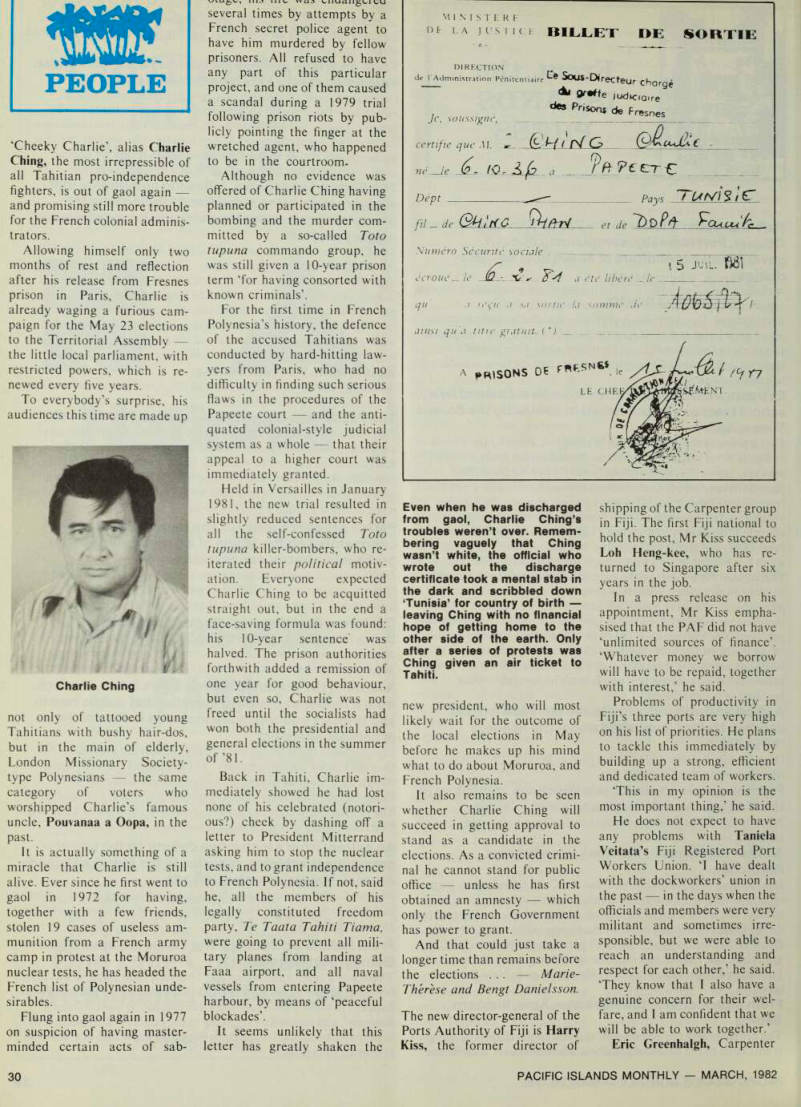
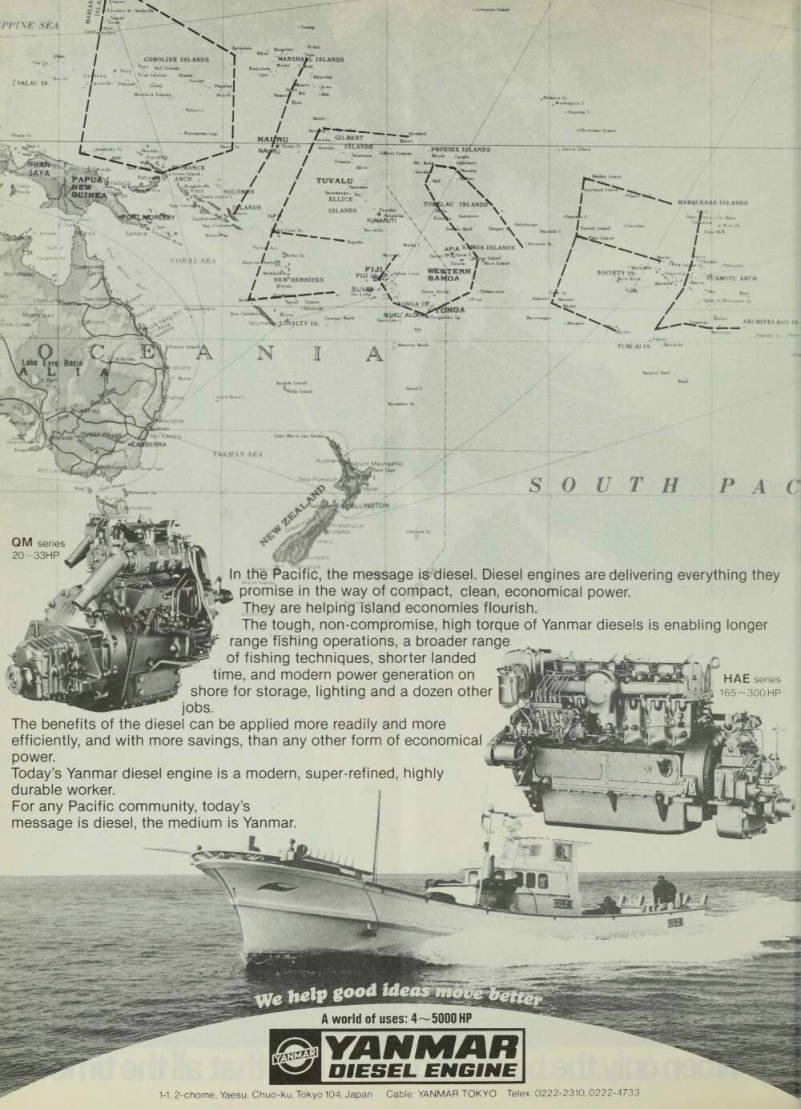
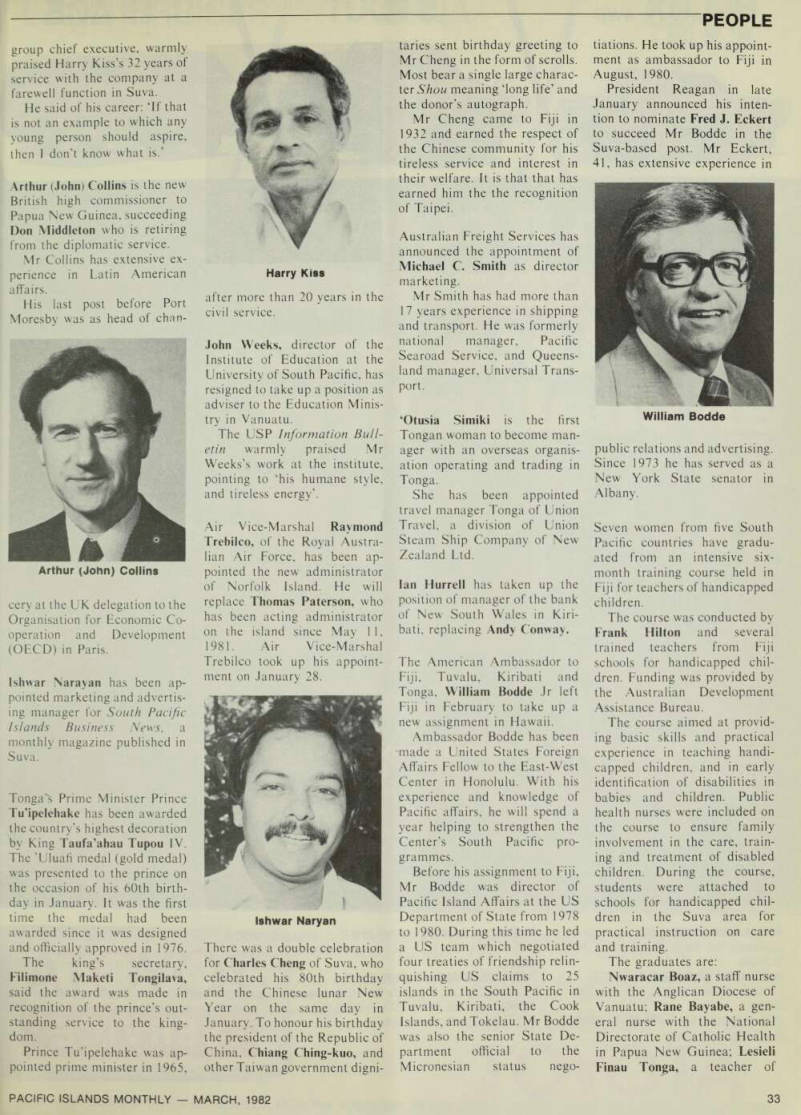
‘Cheeky Charlie’, alias Charlie Ching, the most irrepressible of all Tahitian pro-independence fighters, is out of gaol again and promising still more trouble for the French colonial adminis trators.
Allowing himself only two months of rest and reflection after his release from Fresnes prison in Paris, Charlie is already waging a furious cam paign for the May 23 elections to the Territorial Assembly the little local parliament, with restricted powers, which is re newed every five years.
To everybody’s surprise, his audiences this time are made up
not only of tattooed young Tahitians with bushy hair-dos, but in the main of elderly, London Missionary Society type Polynesians the same category of voters who worshipped Charlie’s famous uncle, Pouvanaa a Oopa, in the past.
It is actually something of a miracle that Charlie is still alive. Ever since he first went to gaol in 1972 for having, together with a few friends, stolen 19 cases of useless am munition from a French army camp in protest at the Moruroa nuclear tests, he has headed the French list of Polynesian unde sirables.
Flung into gaol again in 1977 on suspicion of having master minded certain acts of sab
mu miw viivao.ii£V^l several times by attempts by a French secret police agent to have him murdered by fellow prisoners. All refused to have any part of this particular project, and one of them caused a scandal during a 1979 trial following prison riots by pub licly pointing the finger at the wretched agent, who happened to be in the courtroom.
Although no evidence was offered of Charlie Ching having planned or participated in the bombing and the murder com mitted by a so-called Toto tupuna commando group, he was still given a 10-year prison term ‘for having consorted with known criminals’.
For the first time in French Polynesia’s history, the defence of the accused Tahitians was conducted by hard-hitting law yers from Paris, who had no difficulty in finding such serious flaws in the procedures of the Papeete court and the anti quated colonial-style judicial system as a whole that their appeal to a higher court was immediately granted.
Held in Versailles in January 1981, the new trial resulted in slightly reduced sentences for all the self-confessed Toto tupuna killer-bombers, who re iterated their political motiv ation. Everyone expected Charlie Ching to be acquitted straight out, but in the end a face-saving formula was found; his 10-year sentence was halved. The prison authorities forthwith added a remission of one year for good behaviour, but even so, Charlie was not freed until the socialists had won both the presidential and general elections in the summer of ’Bl.
Back in Tahiti, Charlie im mediately showed he had lost none of his celebrated (notori ous?) cheek by dashing off a letter to President Mitterrand asking him to stop the nuclear tests, and to grant independence to French Polynesia. If not, said he, all the members of his legally constituted freedom party, Te Taata Tahiti Tiama, were going to prevent all mili tary planes from landing at Faaa airport, and all naval vessels from entering Papeete harbour, by means of ‘peaceful blockades’.
It seems unlikely that this letter has greatly shaken the
new president, who will most likely wait for the outcome of the local elections in May before he makes up his mind what to do about Moruroa, and French Polynesia.
It also remains to be seen whether Charlie Ching will succeed in getting approval to stand as a candidate in the elections. As a convicted crimi nal he cannot stand for public office unless he has first obtained an amnesty which only the French Government has power to grant.
And that could just take a longer time than remains before the elections ... Marie- Th'erese and Bengt Danielsson.
The new director-general of the Ports Authority of Fiji is Harry Kiss, the former director of
shipping of the Carpenter group in Fiji. The first Fiji national to hold the post, Mr Kiss succeeds Loh Heng-kee, who has re turned to Singapore after six years in the job.
In a press release on his appointment, Mr Kiss empha sised that the PAF did not have ‘unlimited sources of finance’. ‘Whatever money we borrow will have to be repaid, together with interest,’ he said.
Problems of productivity in Fiji’s three ports are very high on his list of priorities. He plans to tackle this immediately by building up a strong, efficient and dedicated team of workers. ‘This in my opinion is the most important thing,’ he said.
He does not expect to have any problems with Taniela Veitata’s Fiji Registered Port Workers Union. T have dealt with the dockworkers’ union in the past in the days when the officials and members were very militant and sometimes irre sponsible, but we were able to reach an understanding and respect for each other,’ he said. ‘They know that I also have a genuine concern for their wel fare, and I am confident that we will be able to work together.’
Eric Greenhalgh, Carpenter
Charlie Ching
Even when he was discharged from gaol, Charlie Ching’s troubles weren’t over. Remem bering vaguely that Ching wasn’t white, the official who wrote out the discharge certificate took a mental stab in the dark and scribbled down ‘Tunisia’ for country of birth leaving Ching with no financial hope of getting home to the other side of the earth. Only after a series of protests was Ching given an air ticket to Tahiti.
group chief executive, warmly praised Harry Kiss’s 32 years of service with the company at a farewell function in Suva.
He said of his career: ‘lf that is not an example to which any young person should aspire, then I don't know what is.’
Arthur (John) Collins is the new British high commissioner to Papua New Guinea, succeeding Don Middleton who is retiring from the diplomatic service.
Mr Collins has extensive ex perience in Latin American affairs.
His last post before Port Moresby was as head of chan-
eery at the UK delegation to the Organisation for Economic Co operation and Development (OECD) in Paris.
Ishwar Narayan has been ap pointed marketing and advertis ing manager for South Pacific Islands Business News, a monthly magazine published in Suva.
Tonga’s Prime Minister Prince Tu’ipelehake has been awarded the country’s highest decoration by King Taufa'ahau Tupou IV.
The ’Uluafi medal (gold medal) was presented to the prince on the occasion of his 60th birth day in January. It was the first time the medal had been awarded since it was designed and officially approved in 1976.
The king’s secretary, Filimone Maketi Tongilava, said the award was made in recognition of the prince’s out standing service to the king dom.
Prince Tu’ipelehake was ap pointed prime minister in 1965,
after more than 20 years in the civil service.
John Weeks, director of the Institute of Education at the University of South Pacific, has resigned to lake up a position as adviser to the Education Minis try in Vanuatu.
The USP Information Bull etin warmly praised Mr Weeks’s work at the institute, pointing to ‘his humane style, and tireless energy’.
Air Vice-Marshal Raymond Trebilco, of the Royal Austra lian Air Force, has been ap pointed the new administrator of Norfolk Island. He will replace Thomas Paterson, who has been acting administrator on the island since May 11, 1981. Air Vice-Marshal Trebilco took up his appoint ment on January 28.
There was a double celebration for Charles Cheng of Suva, who celebrated his 80th birthday and the Chinese lunar New Year on the same day in January. To honour his birthday the president of the Republic of China, Chiang Ching-kuo, and other Taiwan government digni
taries sent birthday greeting to Mr Cheng in the form of scrolls.
Most bear a single large charac ter Shou meaning ‘long life’ and the donor’s autograph.
Mr Cheng came to Fiji in 1932 and earned the respect of the Chinese community for his tireless service and interest in their welfare. It is that that has earned him the the recognition of Taipei.
Australian Freight Services has announced the appointment of Michael C. Smith as director marketing.
Mr Smith has had more than 17 years experience in shipping and transport. He was formerly national manager, Pacific Searoad Service, and Queens land manager. Universal Trans port. ‘Otusia Simiki is the first Tongan woman to become man ager with an overseas organis ation operating and trading in Tonga.
She has been appointed travel manager Tonga of Union Travel, a division of Union Steam Ship Company of New Zealand Ltd. lan Hurrell has taken up the position of manager of the bank of New South Wales in Kiri bati, replacing Andy Conway.
The American Ambassador to Fiji, Tuvalu, Kiribati and Tonga, William Bodde Jr left Fiji in February to take up a new assignment in Hawaii.
Ambassador Bodde has been made a United States Foreign Affairs Fellow to the East-West Center in Honolulu. With his experience and knowledge of Pacific affairs, he will spend a year helping to strengthen the Center’s South Pacific pro grammes.
Before his assignment to Fiji, Mr Bodde was director of Pacific Island Affairs at the US Department of State from 1978 to 1980. During this time he led a US team which negotiated four treaties of friendship relin quishing US claims to 25 islands in the South Pacific in Tuvalu, Kiribati, the Cook Islands, and Tokelau. Mr Bodde was also the senior State De partment official to the Micronesian status nego
tiations. He took up his appoint ment as ambassador to Fiji in August, 1980.
President Reagan in late January announced his inten tion to nominate Fred J. Eckert to succeed Mr Bodde in the Suva-based post. Mr Eckert, 41, has extensive experience in
public relations and advertising.
Since 1973 he has served as a New York State senator in Albany.
Seven women from five South Pacific countries have gradu ated from an intensive six month training course held in Fiji for teachers of handicapped children.
The course was conducted by Frank Hilton and several trained teachers from Fiji schools for handicapped chil dren. Funding was provided by the Australian Development Assistance Bureau.
The course aimed at provid ing basic skills and practical experience in teaching handi capped children, and in early identification of disabilities in babies and children. Public health nurses were included on the course to ensure family involvement in the care, train ing and treatment of disabled children. During the course, students were attached to schools for handicapped chil dren in the Suva area for practical instruction on care and training.
The graduates are: Nwaracar Boaz, a staff nurse with the Anglican Diocese of Vanuatu; Rane Bayabe, a gen eral nurse with the National Directorate of Catholic Health in Papua New Guinea; Lesieli Finau Tonga, a teacher of
Arthur (John) Collins
Harry Kiss
Ishwar Naryan
William Bodde
handicapped children at the OTA (Red Cross) Centre for Handicapped Children in Tonga; Sisilia Vaea, a teacher of handicapped children at the OTA (Red Cross) Centre for Handicapped Children in Tonga; Kalonikakala Makaafi, a public health nurse with the Ministry of Health in Nukualofa, Tonga; Sune Rongoronga Rusia, of Tuvalu, and Helen Mailagu Gauwane, of Solomon Islands.
"Ofa Tuionetoa, assistant sec retary in the Tongan prime minister’s office, has won a Fulbright Award for an eight month study period at Cali fornia Stale University, Chico.
He left in January to do a course in public administration.
New Zealand-trained Tongan lawyer Laki Niu resigned from the civil service post of crown prosecutor at the end of December 1981, and has set up in private practice in Nukualofa as barrister and solicitor.
His move from public to
private sector is important in the Tongan context. Previously, business firms and private cli ents have had to rely mainly on local practitioners who qualify by attending one class a week for two years and then sitting for an examination set by the chief justice, who is also the class tutor.
The alternative, for those who could afford it, was to import qualified expertise from New Zealand as and when needed.
Since the day he first put up his shingle, Mr Niu has been inunduated with more work than he can comfortably handle alone, and he is considering taking on a young local prac titioner as articled assistant. His main problem, as a ‘one-up’ in his field, is the ethical one of client conflict. ‘l’m frequently being asked to represent both sides in a legal argument,’ he says. ‘So 1 have to follow the time-honoured principle of firsl-come-first served. Obviously, we really need at least two private prac
tices with fully-qualified princi pals, and it is to be hoped that will come before long, now I’ve broken the ice.’
Meanwhile, he plans to con centrate mainly on solicitor services, leaving most of the court work to ‘my Tongan brothers in law who depend on it for their bread and butter’.
Penny Hodgkinson in Nukualofa.
Audeh Soussou arrived in Apia in January to take up his post as deputy resident representative in the United Nations Develop ment Programme office for Samoa, Cook Islands, Niue and Tokelau. Mr Soussou, who is Lebanese, has been with the UN for 21 years.
His immediate superior. Roy D. Morey, preceded him by a few months in arriving in Apia (PIM Dec ’Bl p4O).
Samoan author Albert Wendt is taking lime out from writing novels to work on a television documentary.
Its subject is the Samoan
community in New Zealand, and the way its members are adapting to life there.
Wendt says the focus will be on people in the Auckland area, particularly Ponsonby, Grey Lynn. Otara, and Mangere.
The theme we'll take is the way the traditional Samoan institutions our people brought with them have helped them survive and adapt to New Zealand life,' he says. ‘A common argument is that migrants should leave their traditional lifestyles behind them if they want to adapt properly. But our matai system, church, and close-knit families have all helped our people fit in here and develop a very strong sub-culture at the same time.’
Wendt will be frontman in the documentary, which will be produced by George Andrews of
Tvnz.
Dames & Moore, the US-based engineering and environmental consultancy firm, has appointed William M. Greenslade regional manager of its Pacific, Far East,
and Australian operations. Mr Greenslade, who will be based in the firm’s Honolulu office, is a partner of Dames & Moore and a specialist in hydrogeology and environmental engineering.
He holds an MS in hydrology and a BS in geological engineer ing from the Mackay School of Mines at the University of Nevada.
Graham McHugh, 45, has succeeded Jack White as Aus tralia’s trade commissioner to Fiji and the Pacific Islands.
Adelaide-born Mr McHugh has a background of 17 years in international trade and has served with Australian trade missions in Indonesia, Bahrain and Chile.
Mr McHugh said on taking up his appointment in January that trade and investment relations between Australia. Fiji and the South Pacific region in general were bound to be greatly stimu lated by the benefits of the recently negotiated South Pacific Area Regional Trade and Economic Co-operation Agreement (SPARTECA).
There would also be benefits from such Australian schemes for the region as government financial support for joint ven ture projects involving Austra lian and Pacific investors.
He regards the SPARTECA agreement as the prime vehicle to promote a significant in crease in the volume of Pacific Island products exported to Australia under duty-free and concessional admission arrange ments.
Mr McHugh predicted that the new investment support scheme, for which final guide lines had not yet been decided by the Australian Government, would lead to a boost of Austra lian investment in the Pacific Islands over the next five years.
Funded by the Australian De velopment Assistance Bureau, it would supply capital and expertise to joint ventures in Fiji and other countries in the region.
Three medical doctors joined Tonga’s Ministry of Health in January after graduating from the Fiji School of Medicine.
They are Dr Sione Talia’uli Afeaki, 23, of Haveluoto; Dr ’Etika ’Akau’ola, 23, of
Kanckupolu, and Dr Seini Motuliki Fakatava, 29, of Halaleva. Kolofo’ou.
They all have diplomas in surgery and medicine and have been appointed as medical officers.
Joining the ministry at the same lime is Lesieli Funaki, of Kolomotu’a, who graduated from FSM as a physiotherapist.
Lesieli has been appointed as sistant physiotherapist.
Young Benjamin Ravulolo Lomaloma wanted to be a motor mechanic but he listened to his father’s advice and ended up being a top ‘mechanic’ of hu man beings.
And after 39 years of service in Fiji’s medical field, Dr Lomaloma has retired with his last posting being that of Medi cal Superintendent of Lautoka Hospital. ‘I always wanted to be a mechanic,’ he said.
“1 saw people fiddling around with cars and whirr, off they would go. ‘But my old man wanted me to take up medicine and I did not want to disappoint him so I took it up. ‘I have never regretted that decision because being a doctor is very rewarding work.’
Firoz Shaheem in The Fiji Times.
William Sharpe-Dunn reports on a number of recent personnel changes affecting Catholic Church activities in the Pacific: The Most Reverend Peter Kurongku, 51, is the new Cath olic archbishop of Port Moresby. He succeeds Arch bishop Herman To Paivu who
died in March last year (PIM May ’Bl pB2).
Born at Tonnui in southern Bougainville, Peter was or phaned at the age of six. His early education was interrupted by the war, like that of so many others.
After deciding to study for the priesthood, among his early teachers were two Australian priests, Frs James Hannan and Frank McGuire, both from Mel bourne. The archbishop-elect did all his studies in the then Territory, and was ordained (by Bishop Leo LeMay) on December 21,1966.
In 1971, he became vicar general of Bougainville diocese.
Nominated as the first Catholic Melanesian bishop for the newly independent Solomon Islands, he was consecrated as auxiliary bishop of Honiara on March 25, 1979.
The appointment was an nounced by newly appointed Pro-Nuncio, Archbishop Francesco de Nittis, in the PNG national capital.
In Sydney, veteran missioner Fr Wally Fingleton described the new archbishop as ‘a pas toral man’, with ‘a simple lifestyle'.
The Most Reverend Michel Calvet, SM, is the new arch bishop of Noumea. At 37, he is the youngest prelate in the South Pacific.
Monsignor Calvet came to the Pacific after his ordination in 1973. He was installed as assistant bishop of Noumea on November 4, 1979.
He succeeds Monsignor Eugene Klein, MSC, who was once bishop of Bereina in Papua New Guinea.
Observers have noted that Mgr Calvet’s three administrat ive predecessors are still alive.
This is considered to be a unique feature of Christian Pacific history. Preceding Mgr Klein were Mgr Michel Darmancier, SM, (of Wallis- Futuna), and Mgr Pierre Mar tin, SM, a former prisoner in Dachau. Both men now live in retirement in France.
The Very Reverend Patrick Hurley, CSsR, 69, is the ‘sur prise’ choice as first auxiliary bishop of the Catholic diocese of Samoa and Tokelau.
Born in Wellington, New Zealand, bishop-elect Hurley was educated in his own country and in Australia, where he joined the Redemptorist Fathers (CSsR) in 1932. Or dained in March, 1938, he was missioned to the Philippines, after working in Australia. Dur ing the war he was a prisoner of the Japanese.
He led the first Redemptorist mission team to the South Pacific in the early ’7os, and lived at Safotu, Savaii. Western Samoa.
In his new position he assists Pio Cardinal Taofinu’u, SM.
Fr Hurley’s appointment at ‘7O years young’ is seen also as a special tribute to New Zea land’s overseas missionary efforts. Appropriately, the con secration ceremony in Samoa will lake place on St Patrick’s Day, March 17, the bishop elect’s patronal day.
Brother Penehe Patelihio from tiny Tokelau has made his vows as a Divine Word missionary. A former student of Chanel Col lege, Apia, Pene hopes to work in Latin America.
He is the first Polynesian to join the worldwide mission so ciety, in which more than 50 nationalities are represented.
The Society of the Divine Word (SVD), as well as missionary work, undertakes ex tensive studies in anthropology, ethnology, and linguistics.
Brother Pene will continue his studies in Melbourne this year, until his first mission appointment.
The Reverend Father Wallace Cornell, SDB, of Victoria, Aus tralia, has been appointed to head the Salesian Foundation in Western Samoa. The Salesians are an international group of priests and brothers engaged in youth work.
Fr Cornell was the leader (Provincial) in Australia for two terms, six years in all.
In Samoa, the five Salesians teach and run a parish.
Italian, Indian, Irish, Maltese and Australian Salesians make up the staffs.
The first Samoan-born aspir ants to the Salesians are ex pected to start training this year.
Graham McHugh
Advertisements & other items, pp. 31-38 (2 items)
When only the best will do-and isn't that all the time?
f L m s .
When only the best will do-and isn't that all the time? .•'jM
PPINE SEA
7 ' / r Unv it' NA /%» Pap r
TUVALU
I#'*’* SOLOMON
•» v/- ANOS /
i«>r«By JSrj*j^»T*
QUINEA
/ A~___ /
FIJI.* w
hji "** MC
ERN I
A / 7
SAMOA
<S VJ c lake Basin D sSL, s o I T !
P *r QM series 20-33 HP **/ 1 c m In the Pacific, the message is diesel. Diesel engines are delivering everything they promise in the way of compact, clean, economical power, ly They are helping island economies flourish.
The tough, non-compromise, high torque of Yanmar diesels is enabling longer range fishing operations, a broader range of fishing techniques, shorter landed time, and modern power generation on shore for storage, lighting and a dozen other jobs.
The benefits of the diesel can be applied more readily and more efficiently, and with more savings, than any other form of economical power.
Today’s Yanmar diesel engine is a modern, super-refined, highly durable worker.
For any Pacific community, today’s message is diesel, the medium is Yanmar. I fl c HAE series 165-300 HP m u I JB m m t i 'j i i i i ' A world of uses: 4 —5000 HP
fmYAMMAR
tSaOi DIESEL ENGINE
1-1,2-chome, Yaesu, Chuo-ku, Tokyo 104, Japan Cable: YANMAR TOKYO Telex: 0222-2310,0222-4733
nruuA 4WD
OI VU I
• ; w
tot
Tov
comes
hnessT, v
a takes on
r 7 mrm i V
TOYOTA
LAND CRUISER (Station Wagon)
5- *: * m & > P -’ar ■*>
PAPUA NEW GUINEA: ELA MOTORS.
Scratchley Rd., Badili, P.O. Box 675, Port Moresby.
NORTHERN MARIANAS & U.S.T.T.:
MICROL CORPORATION, P.O. Box 267,
Saipan.
FIJI: AUTOMOTIVE SUPPLIES COMPANY,
G.P.O. Box 355, Suva.
AMERICAN SAMOA: BURNS PHILP
(SOUTHSEA) CO., LTD., P.O. Box 129, Pago Pago.
WESTERN SAMOA: BURNS PHILP
(SOUTHSEA) CO., LTD.. P.O. Box 188, Apia.
TONGA: BURNS PHILP (SOUTHSEA) CO.,
LTD., P.O. Box 55, Nuku’alofa.
TOYOTA
SERVICE
f LAND CRUISER
DYNA
HEAVY DUTY
TRUCK
Toyota commercial vehicles are
a very special breed apart, unrivaled
for their toughness and sure handling
on or off the road. Built tough to stand up to the most difficult loads.
Built also to take the punishment
of bad weather, and beaten up
road surfaces. Like the new 4WD
i Toyota Land Cruiser Station
Wagon. And because you’re
behind the wheel of a Toyota
you sure of fantastic
♦ reliability andbackup sefviCe
I when you need it. ,
Toyota, the tough breed.
• f • < :0 f" 4 - A V.
I li ' % I * - v . v ; r 0 * * & v *
AM: ATKINS, KROLL (GUAM) LTD., P.O,
c 6428, Tamuning.
YUATU: VANUATU MOTORS, P.O. Box
Port Vila.
LOMON: MENDANA ENTERPRISES
) LTD., G.P.O. Box 174, Honiara.
HITT: NIPPON AUTOMOTO, B.P. 342,
•eete.
COOK ISLANDS: COOK ISLANDS
TRADING CORPORATION LTD., P.O. Box
92, Rarotonga.
NAURU: NAURU COOPERATIVE SOCIETY.
KIRIBATI: TARAWA MOTORS, Box 36,
Bairiki, Tarawa, Kiribati. ? Toyota range includes: COROLLA, STARLET, CORONA, CRESSIDA, HI-LUX.
NORFOLK ISLAND: BORRY’S RENTAL
CARS, MOUNT PITT (ENTERPRISES) LTD.,
P.O. Box 169.
NEW CALEDONIA: SERVICE
IMPORTATION AUTOMOBILE DU
PACIFIQUE, Rond-Point du Pacifique (Station Total) B.P. 438, Noumea.
TOYOTA
STOUT. HI ACE. DYNA CDARTFR anti I AMH r.RI lIRFR
New you can watch liveTV
throughout the South
Recent technological developments have now made it possible for residents in satellite T.V. coverage areas to receive live T.V. by installing a low cost private satellite earth station developed and manufactured by Australian Microwave Systems Pty Ltd.
Many residents living in outback areas of Australia, outside normal broadcast T.V. areas, are already receiving live educational, entertainment, sport and news programmes using Australian Microwave Systems satellite earth stations.
For details of live satellite T.V. programmes available in your area, plus full details of Australian Microwave Systems T.V. receive only earth satellite stations, please send SAI.OO to:
AUSTRALIAN
MICROWAVE
SYSTEMS
P.O. Box X 2279, Perth, W.Aust. 6001. 8126
Scott Carpenter
and JVC.
Both explorers.
Both dedicated to —
iiil
Wm wm msm - m * Z~> US* Scott Carpenter. An explorer who has spent his professional career on the cutting edge of innovation. One of the original US astronauts and an aquanaut. The only man to penetrate both inner and outer space.
JVC, too, has always been identified with innovation. Like Scott, we have spent years opening up new worlds. New worlds of home entertainment. We originated VMS. the most widely used home video system. We make versatile equipment like the HR-2200 portable video cassette recorder and the GX-68 video camera.
Take a look and see if you don V agree that JVC products are out of this world.
Innovation
jyc • h sv m I
JVC
36
PACIFIC ISLANDS MONfHLY MARCH, 1982
PEOPLE
The kiap story told with 'an
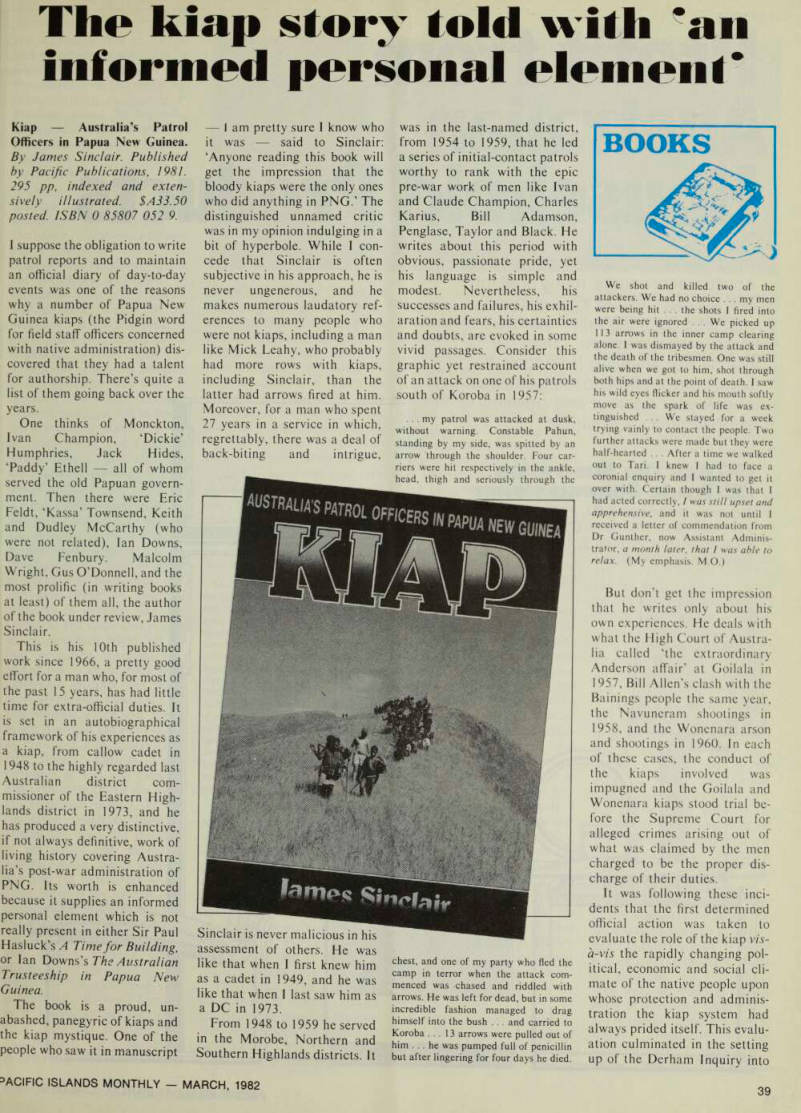

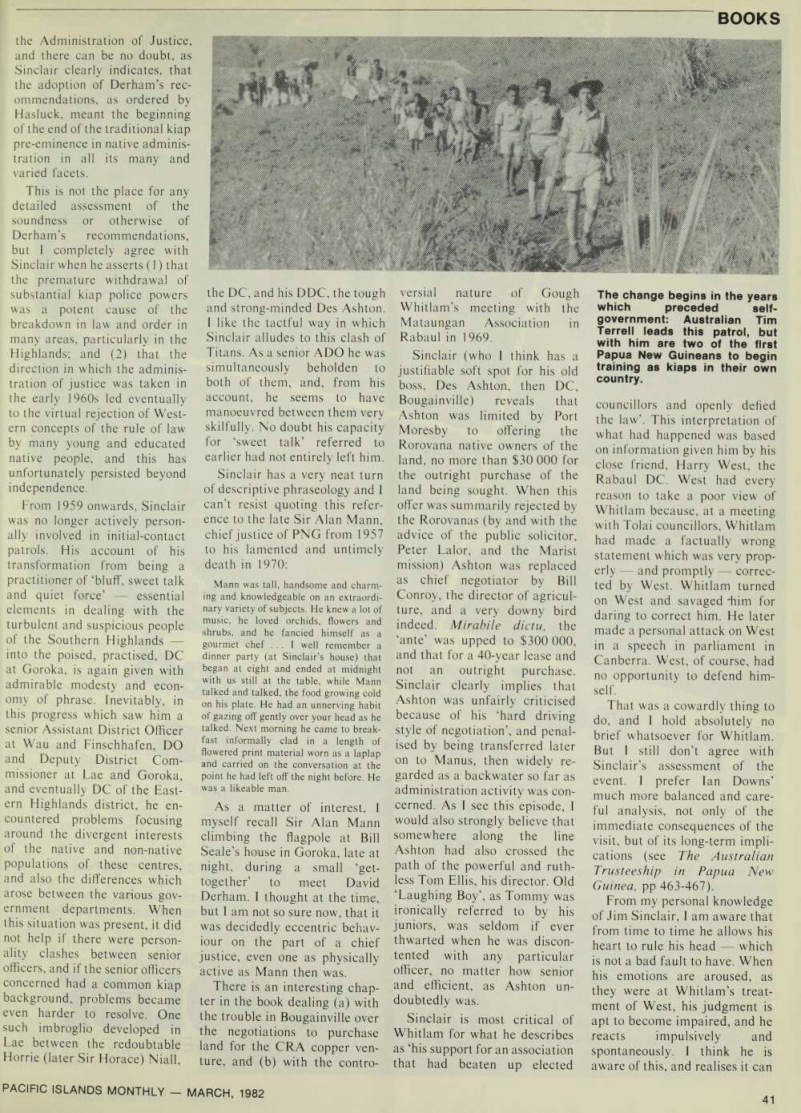

Books
The kiap story told with 'an informed personal element'
Kiap Australia’s Patrol Officers in Papua New Guinea.
By James Sinclair. Published by Pacific Publications, 1981. 295 pp, indexed and exten sively illustrated. SAS 3.50 posted. ISBN 0 85807 052 9.
I suppose the obligation to write patrol reports and to maintain an official diary of day-to-day events was one of the reasons why a number of Papua New Guinea kiaps (the Pidgin word for field staff officers concerned with native administration) dis covered that they had a talent for authorship. There’s quite a list of them going back over the years.
One thinks of Monckton, Ivan Champion, ‘Dickie’
Humphries, Jack Hides, ‘Paddy’ Ethel! all of whom served the old Papuan govern ment. Then there were Eric Feldt, ‘Kassa’ Townsend, Keith and Dudley McCarthy (who were not related), lan Downs, Dave Fenbury. Malcolm Wright, Gus O’Donnell, and the most prolific (in writing books at least) of them all, the author of the book under review, James Sinclair.
This is his 10th published work since 1966, a pretty good effort for a man who, for most of the past 15 years, has had little time for extra-official duties. It is set in an autobiographical framework of his experiences as a kiap, from callow cadet in 1948 to the highly regarded last Australian district com missioner of the Eastern High lands district in 1973, and he has produced a very distinctive, if not always definitive, work of living history covering Austra lia’s post-war administration of PNG. Its worth is enhanced because it supplies an informed personal element which is not really present in either Sir Paul Hasluck’s A Time for Building, or lan Downs’s The Australian Trusteeship in Papua New Guinea.
The book is a proud, un abashed, panegyric of kiaps and the kiap mystique. One of the people who saw it in manuscript
1 am pretty sure I know who it was said to Sinclair; ‘Anyone reading this book will get the impression that the bloody kiaps were the only ones who did anything in PNG.’ The distinguished unnamed critic was in my opinion indulging in a bit of hyperbole. While I con cede that Sinclair is often subjective in his approach, he is never ungenerous, and he makes numerous laudatory ref erences to many people who were not kiaps, including a man like Mick Leahy, who probably had more rows with kiaps, including Sinclair, than the latter had arrows fired at him.
Moreover, for a man who spent 27 years in a service in which, regrettably, there was a deal of back-biting and intrigue,
Sinclair is never malicious in his assessment of others. He was like that when I first knew him as a cadet in 1949, and he was like that when I last saw him as a DC in 1973.
From 1948 to 1959 he served in the Morobe, Northern and Southern Highlands districts. It
was in the last-named district, from 1954 to 1959, that he led a series of initial-contact patrols worthy to rank with the epic pre-war work of men like Ivan and Claude Champion, Charles Karius, Bill Adamson, Penglase, Taylor and Black. He writes about this period with obvious, passionate pride, yet his language is simple and modest. Nevertheless, his successes and failures, his exhil aration and fears, his certainties and doubts, are evoked in some vivid passages. Consider this graphic yet restrained account of an attack on one of his patrols south of Koroba in 1957: ... my patrol was attacked at dusk, without warning. Constable Pahun, standing by my side, was spitted by an arrow through the shoulder. Four car riers were hit respectively in the ankle, head, thigh and seriously through the
chest, and one of my party who fled the camp in terror when the attack com menced was chased and riddled with arrows. He was left for dead, but in some incredible fashion managed to drag himself into the bush . . . and carried to Koroba ... 13 arrows were pulled out of him ... he was pumped full of penicillin but after lingering for four days he died.
We shot and killed two of the attackers. We had no choice . . . my men were being hit . . . the shots I fired into the air were ignored . . . We picked up 113 arrows in the inner camp clearing alone. I was dismayed by the attack and the death of the tribesmen. One was still alive when we got to him, shot through both hips and at the point of death. I saw his wild eyes flicker and his mouth softly move as the spark of life was ex tinguished . . . We stayed for a week trying vainly to contact the people. Two further attacks were made but they were half-hearted . . . After a time we walked out to Tari. I knew I had to face a coronial enquiry and I wanted to get it over with. Certain though I was that I had acted correctly, I was still upset and apprehensive, and it was not until I received a letter of commendation from Dr Gunther, now Assistant Adminis trator, a month later, that I was able to relax. (My emphasis. M. 0.) But don’t get the impression that he writes only about his own experiences. He deals with what the High Court of Austra lia called ‘the extraordinary Anderson affair’ at Goilala in 1957, Bill Allen’s clash with the Bainings people the same year, the Navuneram shootings in 1958, and the Wonenara arson and shootings in 1960. In each of these cases, the conduct of the kiaps involved was impugned and the Goilala and Wonenara kiaps stood trial be fore the Supreme Court for alleged crimes arising out of what was claimed by the men charged to be the proper dis charge of their duties.
It was following these inci dents that the first determined official action was taken to evaluate the role of the kiap vis a-vis the rapidly changing pol itical, economic and social cli mate of the native people upon whose protection and adminis tration the kiap system had always prided itself. This evalu ation culminated in the setting up of the Derham Inquiry into
the Administration of Justice, and there can be no doubt, as Sinclair clearly indicates, that the adoption of Derham’s rec ommendations, as ordered by Hasluck, meant the beginning of the end of the traditional kiap pre-eminence in native adminis tration in all its many and varied facets.
This is not the place for any detailed assessment of the soundness or otherwise of Derham’s recommendations, but 1 completely agree with Sinclair when he asserts (1) that the premature withdrawal of substantial kiap police powers was a potent cause of the breakdown in law and order in many areas, particularly in the Highlands; and (2) that the direction in which the adminis tration of justice was taken in
the early 1960 s led eventually
to the virtual rejection of West ern concepts of the rule of law by many young and educated native people, and this has unfortunately persisted beyond independence From 1959 onwards, Sinclair was no longer actively person ally involved in initial-contact patrols. His account of his transformation from being a practitioner of ‘bluff, sweet talk and quiet force’ essential elements in dealing with the turbulent and suspicious people of the Southern Highlands into the poised, practised, DC at Goroka, is again given with admirable modesty and econ omy of phrase. Inevitably, in this progress which saw him a senior Assistant District Officer at Wau and Finschhafen, DO and Deputy District Com missioner at Lae and Goroka, and eventually DC of the East ern Highlands district, he en countered problems focusing around the divergent interests of the native and non-native populations of these centres, and also the differences which arose between the various gov ernment departments. When this situation was present, it did not help if there were person ality clashes between senior officers, and if the senior officers concerned had a common kiap background, problems became even harder to resolve. One
such imbroglio developed in
Lae between the redoubtable Horrie (later Sir Horace) Niall,
the DC, and his DDC, the tough and strong-minded Des Ashton. 1 like the tactful way in which Sinclair alludes to this clash of Titans. As a senior ADO he was simultaneously beholden to both of them, and, from his account, he seems to have manoeuvred between them very skilfully. No doubt his capacity for ‘sweet talk’ referred to earlier had not entirely left him.
Sinclair has a very neat turn of descriptive phraseology and I can’t resist quoting this refer ence to the late Sir Alan Mann, chief justice of PNG from 1957 to his lamented and untimely death in 1970; Mann was tall, handsome and charm ing and knowledgeable on an extraordi nary variety of subjects. He knew a lot of music, he loved orchids, flowers and shrubs, and he fancied himself as a gourmet chef ... I well remember a dinner party (at Sinclair’s house) that began at eight and ended at midnight with us still at the table, while Mann talked and talked, the food growing cold on his plate. He had an unnerving habit of gazing off gently over your head as he talked. Next morning he came to break fast informally clad in a length of flowered print material worn as a laplap and carried on the conversation at the point he had left off the night before. He was a likeable man.
As a matter of interest, I myself recall Sir Alan Mann climbing the flagpole at Bill Seale’s house in Goroka, late at night, during a small ‘get together’ to meet David Derham. I thought at the time, but I am not so sure now, that it was decidedly eccentric behav iour on the part of a chief justice, even one as physically active as Mann then was.
There is an interesting chap ter in the book dealing (a) with the trouble in Bougainville over the negotiations to purchase land for the CRA copper ven ture, and (b) with the contro
versial nature of Gough Whitlam’s meeting with the Mataungan Association in Rabaul in 1969.
Sinclair (who I think has a justifiable soft spot for his old boss, Des Ashton, then DC, Bougainville) reveals that Ashton was limited by Port Moresby to offering the Rorovana native owners of the land, no more than $3O 000 for the outright purchase of the land being sought. When this offer was summarily rejected by the Rorovanas (by and with the advice of the public solicitor, Peter Lalor, and the Marist mission) Ashton was replaced as chief negotiator by Bill Conroy, the director of agricul ture, and a very downy bird indeed. Mirabile dictu, the ‘ante’ was upped to $3OO 000, and that for a 40-year lease and not an outright purchase.
Sinclair clearly implies that Ashton was unfairly criticised because of his ‘hard driving style of negotiation’, and penal ised by being transferred later on to Manus, then widely re garded as a backwater so far as administration activity was con cerned. As I see this episode, I would also strongly believe that somewhere along the line Ashton had also crossed the path of the powerful and ruth less Tom Ellis, his director. Old ‘Laughing Boy’, as Tommy was ironically referred to by his juniors, was seldom if ever thwarted when he was discon tented with any particular officer, no matter how senior and efficient, as Ashton un
doubtedly was.
Sinclair is most critical of Whitlam for what he describes as ‘his support for an association that had beaten up elected
councillors and openly defied the law’. This interpretation of what had happened was based on information given him by his close friend, Harry West, the Rabaul DC. West had every reason to lake a poor view of Whitlam because, at a meeting with Tolai councillors, Whitlam had made a factually wrong statement which was very prop erly and promptly correc ted by West. Whitlam turned on West and savaged Tiim for daring to correct him. He later made a personal attack on West in a speech in parliament in Canberra. West, of course, had no opportunity to defend him self.
That was a cowardly thing to do, and I hold absolutely no brief whatsoever for Whitlam.
But I still don’t agree with Sinclair’s assessment of the event. I prefer lan Downs’ much more balanced and care ful analysis, not only of the immediate consequences of the visit, but of its long-term impli cations (see The Australian Trusteeship in Papua New Guinea, pp 463-467).
From my personal knowledge of Jim Sinclair, I am aware that from time to time he allows his heart to rule his head which is not a bad fault to have. When his emotions are aroused, as they were at Whitlam’s treat ment of West, his judgment is apt to become impaired, and he reacts impulsively and spontaneously. I think he is aware of this, and realises it can
The change begins in the years which preceded self government: Australian Tim Terrell leads this patrol, but with him are two of the first Papua New Guineans to begin training as kiaps in their own country.
sometimes gel him into trouble, as he relates when writing about the letter he sent to the PNG newspaper the Post-Courier, using his official title as DDC Eastern Highlands, in con nection with the abolition of the Department of District Admin istration. As he himself admits, he might well have got into real bother had not Tom Ellis, who always looked after his own, shielded him from official wrath.
This is an important book, written with honesty and feel ing. It is the personal testament of a man who from early youth had only one career in mind to become a kiap in PNG. It wasn’t a case of ‘roses all the way’ for Jim Sinclair, particu larly in the early days of his service, when he had to cope with a number of personal and emotional problems. In the ranks of the kiaps, his repu tation is second to none. Indeed, all who had anything to do with him, in particular the many thousands of native people to whom he gave his best energies and the best years of his life, honour and respect him as a man who upheld the best tra ditions of the kiap system.
A brief word is warranted on the technical aspects of the book. Wholly set up and printed in Australia, it is handsomely and securely bound, clearly printed, and has a comprehen sive and accurate index. There are over 200 excellent black and white photographs, many of them from Sinclair’s own cam era. (He is, by the way, a photographer of international stature, particularly in the field of colour photography.) Finally, 1 commend the per son who so very imaginatively designed the book’s end-papers which incorporate a Patrol Report jacket, a 1959 memor andum from Alan Roberts (then director of native affairs) commenting on the report, fac similes of a headtax receipt issued by the same Robbie as an ADO in 1936, portion of a village census book compiled pre-war by Home Niall (also as an ADO), and a certificate issued by the Lutheran Mission to one of its native evangelists.
It is undoubtedly one of the best produced books I have seen for
years.
Max Orken.
Advertisements & other items, pp. 39-42 (2 items)
39
'ACIFIC ISLANDS MONTHLY MARCH, 1982
Australian
Profit from
Household Products
Australia makes a vast range of consumer products, manyofwhich sell successfully in international markets. So most likely Australia can supply whatever your customer wants. For anything from tools to toys, from furniture to refrigerators, check your nearest and quickest supplier first Australia. the Australian iSSl Trade Commissioner Noumea: Phone 27 2414. 27 2426.
Port Moresby: Phone 25 9333.
Honolulu: Phone (808) 524 5050.
Suva: Phone 31 2844.
TPS
FoT*ss>X*s>s mum
1 - 7% \ \ mam i (*y*> r. sion A ct. 1977) And if you’re between the ages of 19-34 and meet the minimum requirements of 173 cm tall, 67kg in weight and have a chest measurement of 91 cm at least, you may apply to become a Police Officer, For those that possess the right physical and mental requirements, a good work record and a satisfactory educationa background the Police offer you a worthwhile and rewarding career with thorough training, the opportunity for promotion and excellent starting salary with superannuation benefits, generous leave WWf ... ir- imitv (including sick leave with pay), free uniform, SERVING THE COMMUNITY but above all we offer job security, satisfaction and comradeship in a necessary job helping society.
If you’re interested, we would like to talk it over with you. Call at your nearest Police \A/P WANT THF REST Station for further details WC vvaain i inl um-w E
SERVING THE COMMUNITY
NZ POLICE
Tahiti, as the early
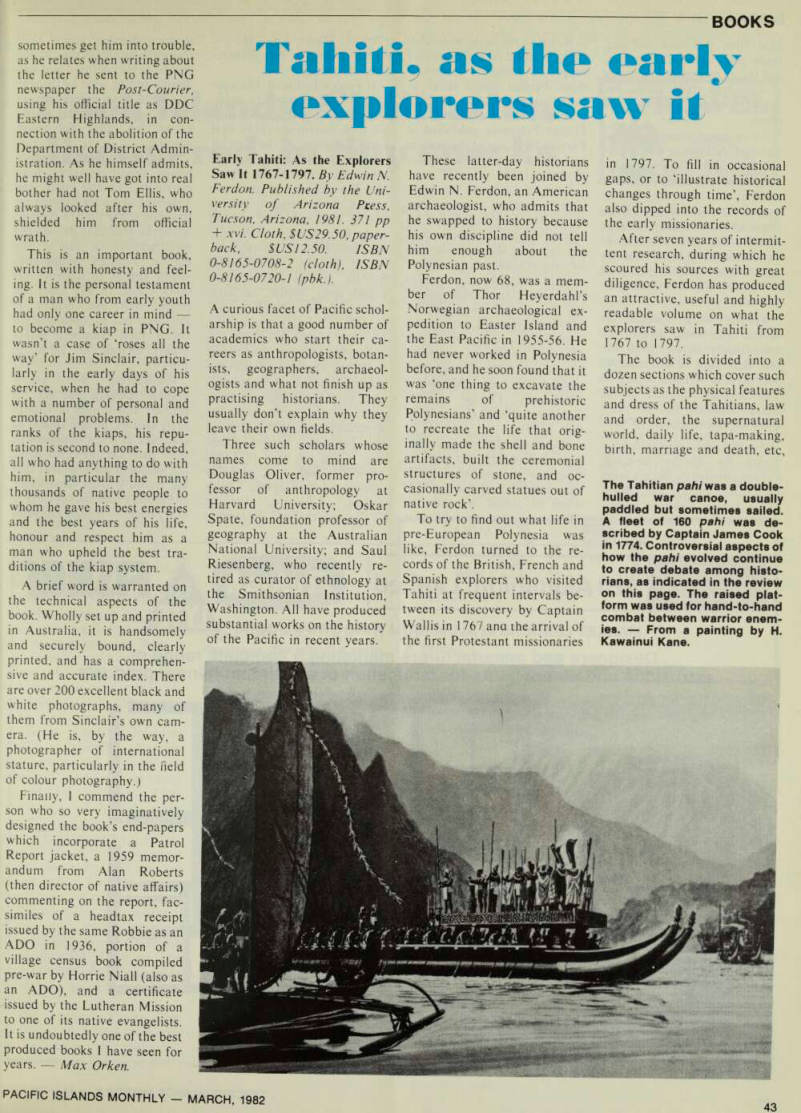

explorers saw it
Early Tahiti: As the Explorers Saw It 1767-1797. By Edwin N.
Ferdon. Published by the Uni versity of Arizona Pcess, Tucson, Arizona, 1981. 371 pp + xvi. Cloth, 5U529.50, paper back, 5U512.50. ISBN 0-8165-0708-2 (cloth), ISBN 0-8 / 65-0720-1 (pbk.).
A curious facet of Pacific schol arship is that a good number of academics who start their ca reers as anthropologists, botan ists, geographers, archaeol ogists and what not finish up as practising historians. They usually don’t explain why they leave their own fields.
Three such scholars whose names come to mind are Douglas Oliver, former pro fessor of anthropology at Harvard University; Oskar Spate, foundation professor of geography at the Australian National University; and Saul Riesenberg, who recently re tired as curator of ethnology at the Smithsonian Institution, Washington. All have produced substantial works on the history of the Pacific in recent years.
These latter-day historians have recently been joined by Edwin N. Ferdon, an American archaeologist, who admits that he swapped to history because his own discipline did not tell him enough about the Polynesian past.
Ferdon, now 68, was a mem ber of Thor Heyerdahl’s Norwegian archaeological ex pedition to Easter Island and the East Pacific in 1955-56. He had never worked in Polynesia before, and he soon found that it was ‘one thing to excavate the remains of prehistoric Polynesians’ and ‘quite another to recreate the life that orig inally made the shell and bone artifacts, built the ceremonial structures of stone, and oc casionally carved statues out of native rock’.
To try to find out what life in pre-European Polynesia was like, Ferdon turned to the re cords of the British, French and Spanish explorers who visited Tahiti at frequent intervals be tween its discovery by Captain Wallis in 1767 ana ihe arrival of the first Protestant missionaries
in 1797. To fill in occasional gaps, or to ‘illustrate historical changes through time’, Ferdon also dipped into the records of the early missionaries.
After seven years of intermit tent research, during which he scoured his sources with great diligence, Ferdon has produced an attractive, useful and highly readable volume on what the explorers saw in Tahiti from 1767 to 1797.
The book is divided into a dozen sections which cover such subjects as the physical features and dress of the Tahitians, law and order, the supernatural world, daily life, tapa-making, birth, marriage and death, etc,
The Tahitian pahi was a double hulled war canoe, usually paddled but sometimes sailed.
A fleet of 160 pahi was de scribed by Captain James Cook in 1774. Controversial aspects of how the pahi evolved continue to create debate among histo rians, as indicated in the review on this page. The raised plat form was used for hand-to-hand combat between warrior enem ies. - From a painting by H.
Kawainui Kane.
food from the land and sea, trade and transport, warfare, and the effects on the Tahitians of European trade goods, im ported plants, animals and ideas.
As an introduction to ancient Tahitian culture, or as an easy way to track down scattered references on many different subjects, Ferdon’s work can be warmly recommended. Even those who are already familiar with the literature he cites will be stimulated by his discussions on various subjects, if not always convinced by his con clusions.
Ferdon’s work, however, has several unfortunate defects. All undoubtedly derive from the fact that most of his research was done in Arizona where he was associate director of the State Museum for 17 years until his retirement in 1978.
As Arizona is scarcely a centre for Pacific research, Ferdon apparently did not learn until it was 100 late that Oliver, in his Ancient Tahitian Society (published in 1975), was aiming
to do much the same as Ferdon himself, based on a much wider range of research materials.
Also, Ferdon seems never to have learned of the massive bibliography of Tahiti and French Polynesia published in Paris in 1967; nor of the present reviewer’s The Lost Caravel (Sydney, 1975).
Lack of access to the bibli ography meant, among other things, that Ferdon did all of his research in blissful ignorance of the fact that the most compre hensive account of early Tahiti is that contained in the so-called journal of James Morrison of the Bounty , published in 1935.
Moreover, through missing this item, Ferdon never learned that Morrison’s work was the princi pal source of the ethnographic appendix in James Wilson’s A Missionary Voyage to the Southern Pacific Ocean (Lon don, 1799).
As a result of these omissions, Ferdon constantly attributes in formation to the missionaries who arrived in Tahiti in 1797 when its author was actually Morrison, who was there in
1789-91. Where dates are im portant, Ferdon’s work is there fore misleading.
If Ferdon had read The Lost Caravel before going to press, he might not have glossed over his own statement (p 19) that some Tahitians at the time of contact had white skins, that others were said to be almost like Europeans, and that two women were singled out as having blue eyes and reddish curly hair. Ferdon might also have found a satisfactory expla nation for the ‘sophisticated’
Society Islands sailing craft called pahi, which, he says, ‘seems to have suddenly ap peared in Tahitian waters fully blown or nearly so’ (p 236).
Finally, Ferdon sometimes falls into the trap of drawing positive conclusions from nega tive evidence. Thus, because none of the early explorers described cock-fighting among the Tahitians, Ferdon claims that it did not exist in Tahiti anciently and was probably introduced by Captain Cook’s sailors. Likewise, because Wallis was the only explorer to
mention hearing conch shell trumpets, he thinks that Wallis was probably confused and was ‘simply adding what he thought he should have heard because conch shell trumpets were known for other Polynesian islands’.
Research into later literature would almost certainly have convinced Ferdon that the Tahitians were cock-fighting en thusiasts at the time of contact; while the fact that pu (conch) was recorded in one of the earliest Tahitian vocabularies would appear to disprove his other claim. In any case, one might well ask: where in Polynesia had Europeans heard conch shell trumpets before Wallis arrived in Tahiti in 1767?
Considering that ethno graphic research was not the primary aim of most of Tahiti’s early visitors, no one should be surprised at a few omissions on their part. On the other hand, the wealth of material that they did record is truly remarkable, as Ferdon’s book makes clear on
every page.
Robert Langdon.
Advertisements & other items, p. 44 (1 item)
Iafkher
movo
AHI Aluminium Limited
Rylock
MARKET LEADERS IN ALUMINIUM WINDOWS & DOORS
IAFKHer
iTiTV
Designers and manufacturers marketing a complete range of extrusions and components for fabrication of aluminium joinery products. *v m WV t m \
FOR FURTHER INFORMATION CONTACT
AHI ALUMINIUM FRANCHISING COMPANY
P O. BOX 18299, AUCKLAND, NEW ZEALAND TELEPHONE 580 704 CABLES: AHIAL TELEX: 2222
discovered, in tiny specks
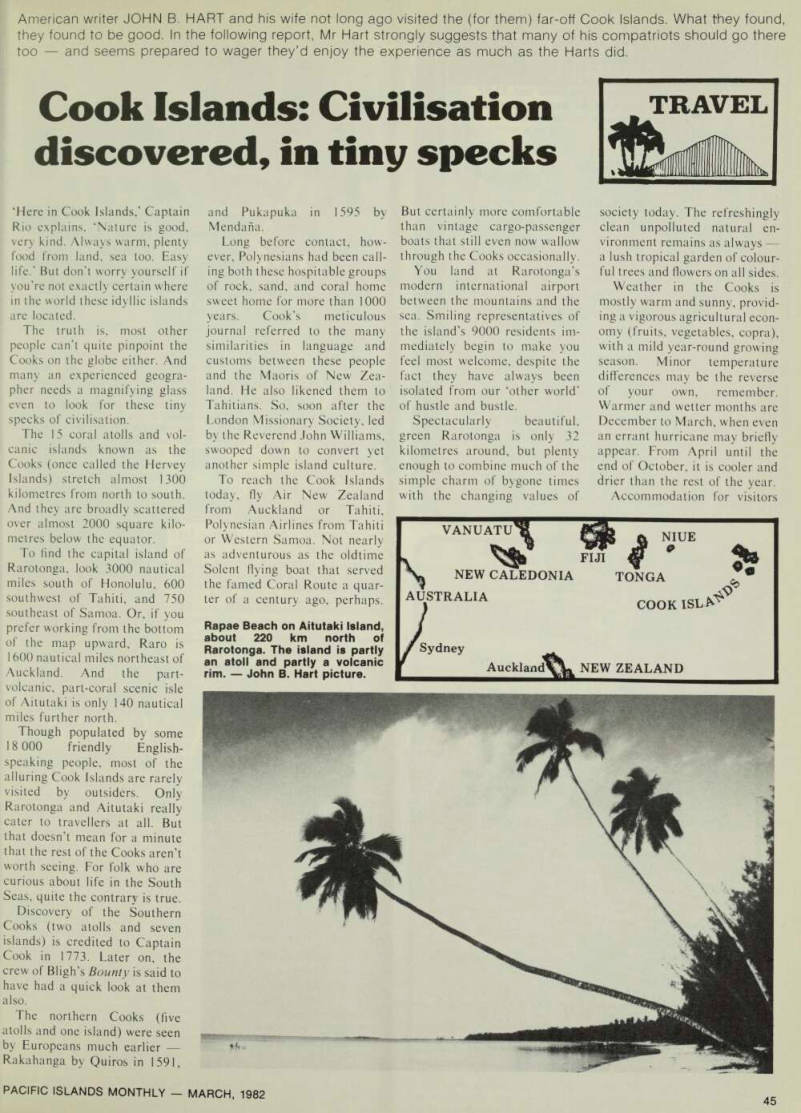


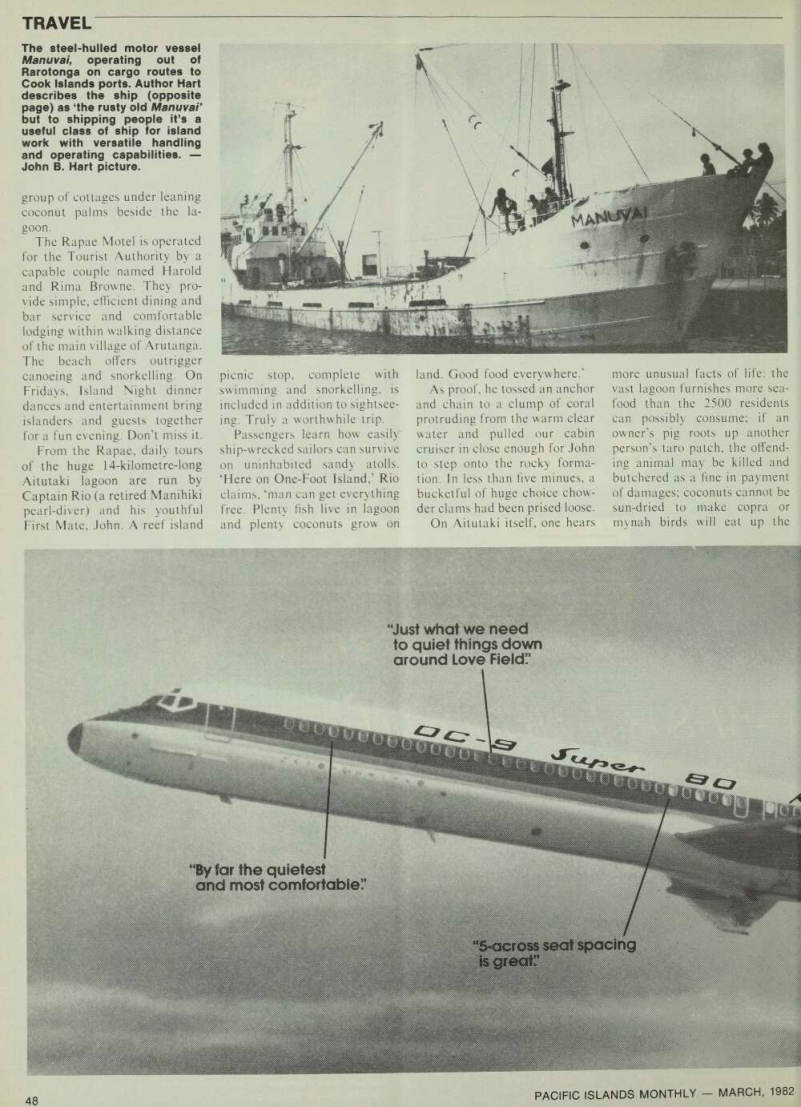
Travel
Cook Islands: Civilisation discovered, in tiny specks
American writer JOHN B. HART and his wife not long ago visited the (for them) far-off Cook Islands. What they found, they found to be good. In the following report, Mr Hart strongly suggests that many of his compatriots should go there too and seems prepared to wager they’d enjoy the experience as much as the Harts did.
‘Here in Cook Islands,’ Captain Rio explains, ‘Nature is good, very kind. Always warm, plenty food from land, sea too. Easy life.' But don't worry yourself if you’re not exactly certain where in the world these idyllic islands are located.
The truth is, most other people can't quite pinpoint the Cooks on the globe either. And many an experienced geogra pher needs a magnifying glass even to look for these tiny specks of civilisation.
The 15 coral atolls and vol canic islands known as the Cooks (once called the Hervey Islands) stretch almost 1300 kilometres from north to south.
And they are broadly scattered over almost 2000 square kilo metres below the equator.
To find the capital island of Rarotonga, look 3000 nautical miles south of Honolulu, 600 southwest of Tahiti, and 750 southeast of Samoa. Or, if you prefer working from the bottom of the map upward, Raro is 1600 nautical miles northeast of Auckland. And the part volcanic, part-coral scenic isle of Aitutaki is only 140 nautical miles further north.
Though populated by some 18 000 friendly English speaking people, most of the alluring Cook Islands are rarely visited by outsiders. Only Rarotonga and Aitutaki really cater to travellers at all. But that doesn’t mean for a minute that the rest of the Cooks aren’t worth seeing. For folk who are curious about life in the South Seas, quite the contrary is true.
Discovery of the Southern Cooks (two atolls and seven islands) is credited to Captain Cook in 1773. Later on, the crew of Bligh’s Bounty is said to have had a quick look at them also.
The northern Cooks (five atolls and one island) were seen by Europeans much earlier Rakahanga by Quiros in 1591,
and Pukapuka in 1595 by Mendana.
Long before contact, how ever, Polynesians had been call ing both these hospitable groups of rock, sand, and coral home sweet home for more than 1000 years. Cook’s meticulous journal referred to the many similarities in language and customs between these people and the Maoris of New Zea land. He also likened them to Tahitians. So, soon after the London Missionary Society, led by the Reverend John Williams, swooped down to convert yet another simple island culture.
To reach the Cook Islands today, fly Air New Zealand from Auckland or Tahiti, Polynesian Airlines from Tahiti or Western Samoa. Not nearly as adventurous as the oldtime Solent flying boat that served the famed Coral Route a quar ter of a century ago, perhaps.
But certainly more comfortable than vintage cargo-passenger boats that still even now wallow through the Cooks occasionally.
You land at Rarotonga’s modern international airport between the mountains and the sea. Smiling representatives of the island's 9000 residents im mediately begin to make you feel most welcome, despite the fact they have always been isolated from our ‘other world’ of hustle and bustle.
Spectacularly beautiful, green Rarotonga is only 32 kilometres around, but plenty enough to combine much of the simple charm of bygone times with the changing values of
society today. The refreshingly clean unpolluted natural en vironment remains as always a lush tropical garden of colour ful trees and flowers on all sides.
Weather in the Cooks is mostly warm and sunny, provid ing a vigorous agricultural econ omy (fruits, vegetables, copra), with a mild year-round growing season. Minor temperature differences may be the reverse of your own, remember.
Warmer and wetter months are December to March, when even an errant hurricane may briefly appear. From April until the end of October, it is cooler and drier than the rest of the year.
Accommodation for visitors
Rapae Beach on Aitutaki Island, about 220 km north of Rarotonga. The island is partly an atoll and partly a volcanic rim. - John B. Hart picture.
to Rarotonga ranges from de lightful housekeeping units like Alex and Metua Moreland’s Orange Grove Fodge, or Colin and Shirley McNeil’s Little Polynesian, to moderately priced larger places like the lively Tamure Resort and the swinging Beach Hotel, up to the expensive new Rarotonga Hotel a world-class complex of 100 air-conditioned rooms stun ningly situated.
When my wife and I arrived, islanders Don and Mii O'Bryan kindly offered us a ride into town where we rented a shiny small car. After recommending a new five-store shopping centre nearby, and pointing out an infamous watering hole (shades of Quinn’s Hut in old Papeete) known as the Banana Court, Mii introduced us to the oceanfront Kii Kii Motel close in to Avarua village.
And, thanks be to Tangaroa, Don mentioned the unique trop ical atmosphere of ‘a first-class little steak house and bar’ hidden away in the village of Titikaveka. Known as the Vai Ma, it’s run by a congenial Aussie, Dave Rose, and his pretty Polynesian bride, Diana.
One’s fondest memory of Rarotonga will always be the unfailing courtesy of everybody one meets. And you’ll recall many other unexpected pleasures besides.
For one, the a capella singing at the lovely and historic Christian church was as ‘heavenly’ as Judge J.J.
MacCauley had told us it would be. For another, the lovely
lagoon and peaceful islets off Muri Beach at Ngatangiia vil lage were even more pictur esque than we were told by our friends, the Symes, at their Muri Era store. From right here the legendary ‘Great Canoe Fleet’ sailed ages ago, migrat ing southwestward to populate New Zealand.
Also worthy of mention is the mysterious inland stone-paved Road of Toi which is, according to local artist Rick Welland and his wife Gwen, ‘an intriguing reminder of a much earlier culture’.
Our first island-hopping ex perience was to Aitutaki with Cook Island Airways, a 70minute flight. Slick, twin engined, nine-seal Britten- Norman Islanders make two round trips every day but Sunday to this dramatic emer ald island with its turquoise lagoon.
Bernie French, the govern ment’s deputy chief adminis trative officer, was waiting alongside the paved airstrip which runs through a beautiful nine-hole golf course. His charming wife Anna presented the passengers with sweet smelling flower leis. Then John Baxter’s new tour bus whisked everyone awa> to an attractive
Short-field aircraft have revol utionised contact between Islands communities. Here’s a welcome for the pilot of a Cook Island Airways flight into Mauke Island. The aircraft is a Britten- Norman Islander, a widely-used type in today’s air feeder ser vices throughout the Pacific. - John B. Hart picture.
group of cottages under leaning coconut palms beside the la goon.
The Rapae Motel is operated for the Tourist Authority by a capable couple named Harold and Rima Browne. They pro vide simple, efficient dining and bar service and comfortable lodging within walking distance of the main village of Arutanga.
The beach offers outrigger canoeing and snorkelling. On Fridays, Island Night dinner dances and entertainment bring islanders and guests together for a fun evening. Don’t miss it.
From the Rapae, daily tours of the huge 14-kilometre-long Aitutaki lagoon are run by Captain Rio (a retired Manihiki pearl-diver) and his youthful First Mate, John. A reef island
picnic stop, complete with swimming and snorkelling, is included in addition to sightsee ing. Truly a worthwhile trip.
Passengers learn how easily ship-wrecked sailors can survive on uninhabited sandy atolls. ‘Here on One-Foot Island,’ Rio claims, ‘man can get everything free. Plenty fish live in lagoon and plenty coconuts grow on
land. Good food everywhere.' As proof, he tossed an anchor and chain to a clump of coral protruding from the warm clear water and pulled our cabin cruiser in close enough for John to step onto the rocky forma tion. In less than five minues, a bucketful of huge choice chow der clams had been prised loose.
On Aitutaki itself, one hears
more unusual facts of life: the vast lagoon furnishes more sea food than the 2500 residents can possibly consume; if an owner’s pig roots up another person’s taro patch, the offend ing animal may be killed and butchered as a fine in payment of damages; coconuts cannot be sun-dried to make copra or mynah birds will eat up the
The steel-hulled motor vessel Manuvai, operating out of Rarotonga on cargo routes to Cook Islands ports. Author Hart describes the ship (opposite page) as ‘the rusty old Manuvai ’ but to shipping people it’s a useful class of ship for island work with versatile handling
and operating capabilities. -
John B. Hart picture.
whole crop, so the oil must be extracted in iron ovens fuelled with coconut husks.
Cook Islands Airways and Air Rarotonga both offer ser vice to most islands in the southern Group. They use grassy airstrips levelled by the residents themselves on Aliu, Mauke, Miliaro, and Mangaiia.
Also, local inter-island trading vessels make overnight trips to these same outliers. Since none supply regular rooms for visi tors yet. the Tourist Board on Ram recommends guest houses to stay in.
There’s no scheduled service to atolls in the Northern Group now. But plans are pending for Cook Islands Airways to use a 3000-metre runway on Penrhyn Island constructed by US troops during World War 11.
For the adventurous it’s poss ible to book an economical freighter voyage to remote northern villages aboard Cap tain Don Silk’s rusty old Manuvai. Other than by private yachts (a few are usually moored in Raro’s Avatiu harbor) such a copra schooner is
the only transport available to places like Palmerston, Suwarrow, Pukapuka, Penrhyn, Manihiki and Rakahanga.
Deck passengers provide their own food and bedding, while cabin customers eat with the crew. Again, the Tourist Board can suggest guest houses should you wish to leave the ship overnight once in a while during its long three-to-four week trading trip.
The Cook Islands govern themselves under an easy-going democratic system in free as sociation with New Zealand.
The Prime Minister, Sir Thomas Davis, is a noted intel lectual who holds medical de grees from universities in both New Zealand and Australia, and from Harvard in the USA.
In 1971, after 20 years of service as a medical officer with America’s space programme, he returned to enter politics on the very island where he was born. In a few short years he rose to the top of his new profession, and has since been knighted by the Queen.
A ‘must-read’ book about
Davis’s earlier life is Doctor To The Islands. Extremely well written by Lydia Davis, it has become a blue-water classic among cruising yachtsmen.
To enrol at Harvard, mariner Tom and his young family sailed their own 14-metre ketch all the way across the Pacific from New Zealand to Peru, through the Roaring Forties in wintertime. They then shaped a course northward to Boston along the west coast of South
America, through the Panama Canal, and up the Atlantic side of the United States.
The accompanying list of worthwhile (though not easy to find) books about the Cooks, might be of value to interested readers. So, instead of merely wondering in which part of what ocean the tiny islands may be found, learning more about them might encourage you to ‘see things for yourself some day just as we did.
Book Author Publisher Date An Island To Oneself Neale Collins of Auckland 1975 Isles of The Frigate Bird Syme Michael Joseph of London 1975 The Book of Puka- Puka Frisbie Century Co of New York 1929 Sisters In The Sun Pcrcival Robert Hale, Ltd, London 1973 The Lagoon is Lonely Now Syme Millwood Press, Wellington 1978 Today Is Forever Hillas Doubleday & Co, New York 1964 Island Of Desire Frisbie Doubleday & Co, New York 1944 Doctor To The Islands Davis Little Brown & Co, Boston 1954 National Geographic.
Usa
Shadbolt Volume 132, No 2, August 1967
Advertisements & other items, pp. 46-50 (2 items)
stfPsssSgJ^S^sgs
FORESTMIL
PORTABLE
SAWMILL
New features include two speed power feed, 67 HP turbo charged diesel engine, DC electric raising and lowering with remote control switch"/ ■; - —i -w m. il Forestmil produces any size accurate timber ready to use up to 12" x 9"‘x 24'.
Purchase price and operating cost of Forestmil is less than other sawing equipment with similar production capacity.
Forestmil reduces timber waste and also reduces log transport cost. Timber is sawn direct from the log in the forest.
Forestmil can be moved to a new location in one hour.
Forestmil will saw hardwood or softwood from logs of any diameter.
Over 1000 Forestmils are sawing timber in 23 countries.
Forestmil has been manufactured for 18 years.
For literature and prices please contact the manufacturers.
MacQuarrie Industries Pty.Ltd.
P.O. Box 20, Coburg 3058, Victoria, Australia.
Phone: 350-3411 Telex 33729. Cables: Macbound, Melbourne.
C-!
'tractor 3 -
ca,ionS "
the big"®"
PM*
P OVNtB
1982!
P or
SSL' 6
ab'gg, 6 '' u t! in ati° n th f&llditio n jX*° ,e * ore ">Z> on tr f^„ rp are Not in canting 3esc«t ■£> *>*& rftot, end
stfPsssSgJ^S^sgs
tn“ re, Sl'«>°^ facte o"-; i „n,po" - tr ac.ors •*e&v.ss. f o cuse s SS^*"^>B° W V '" , ‘ nstto'- - P.V ML^ BV - 5P ,A2.00 *** iSXN 200 V
•»°ssu£*"~
p\tA
<» V' V 103 S - ■•" Ti M| M *r::ii ji;i i ■
/ Heard It AH
There’s still a few surprises left from high fidelity components. Like the M-808 mini system from AIWA, With 50 big Watts per channel of superb music repro duction, in a delightfully compact (and visually
stunning) package.
Along with an ultra-low distortion “PLUS A class” power amplifier and AlWA’s exclusive “Dynamic Super Loudness” bass enhancement system, the M-808 features one-touch PLL synthesizer tuning and a metal- AIWA CO., LTD. 11-9, Ueno 1-chome, Taito-ku, Tokyo, Japan Al WA for craftsmanship
AIWA
capable cassette deck equipped with new Dolby* C-type noise reduction. Plus a wide selection of user options that include a multi-function digital timer (shown), auto-loading direct drive turntable, sevenband graphic equalizer and a deluxe infrared wireless remote control unit.
Heard any good ones lately? Maybe you should eavesdrop on the M-808.
Slightly smaller. But you’d never know it from its sound. •Dolby ana the double D symbol are trademarks ol Dolby Laboralor.es I .censing Corporation Australia AIWA Australia Pty., Ltd.. P.O. Box 339, Rockdale N.S.W., Australia 2216 Tel: 597-2388/2808 Cook Islands Island Merchants Ltd., P.O. Box 69, Rarotonga, Cook Islands Fiji D. Ranchhod & Company, Corner or Vidilo St. & Vitoqo PDE PO Box 18 Lautoka. Fiji Tel; 60227 3! T I H S? d Bros - Duty Free Centre - 1 90 Renwick Road. Suva Fiji Tel: 24350 Guani Micropac Audio, Inc., P.O. Box 3478, Agana, Guam 96910 Tel: 472-8091 New Caledonia hifivox; 79 Rue de Sebastopol, B.P. 1458, Noumea, New Caledonia Tel: 27 24 66 et 28 29 31 New Zealand Miles & Carlaw Ltd., Air New Zealand House 1 Queen Street, Auckland New Zealand Tel: 797-880 P.N.G. Oceania Indent Agency (P.N.G.) Pty., Ltd., Box 5518, Boroko, Port Moresby, P.N.G. Tel; PM 256406 Solomon Islands Harvest Pacific Ltd., G.P.O. 517, Honiara, Solomon Islands Tel: 718 Tahiti Fare Hi-Fi Stereo, Rue de Marechal Foch, P.O. Box 269, Papeete Tahiti R C,6604A Vanuatu (New Hebrides) The Sound Centre Ltd., P.O. Box 434, Vila Vanuatu (New Hebrides) Tel: 2035
‘Just what we need to quiet things down around Love Field” ms ■ :S- ' ‘By far the quietest and most comfortable!’
“5-across seat spacing
isgreatr
;■ \-vv#' v
Fan mail to the new Super 80.
The world’s first New Generation Jet is earning a warm welcome wherever it flies. The quotes at left are written reactions from first-time flyers on the new Super 80.
Their enthusiasm is not surprising - to us or to the 10 “I’m very Impressed ... airlines on four continents flying the Super 80. After all, , clean, quiet, roomy” this jetliner has seats as wide as those on jumbo jets.
And four out of five seats are beside a window or on the aisle. The cabin’s extra length and concealed overhead storage racks add to the aura of spacious comfort.
Inside the cabin, engine sound is just a soft hum. Outside, the Super 80 is only half as loud during take-off and landing as comparably-sized jetliners. It’s the quietest, most fuel-efficient twinjet in service today.
Come aboard a new Super 80 the first chance you get. And discover a plane ride worth writing home about.
“Engines seem only to whisper”
Super 80
/wcooyv/v£LL Q
DOUGLAS
Throughout the Pacific-
we’re your kind of people
When you fly in the Pacific, you’ll feel at home with Air New Zealand.
Fly with us to Australia,Cook Islands, Fiji, Hong Kong, Honolulu, Japan, Los Angeles, New Caledonia, Norfolk Island, Singapore, Tahiti, Tonga, Western Samoa and, naturally, throughout jISL I*If” tlplll 7FSH.3HD New Zealand. T 5” " ff
w ANZ 80/18
The Pacific’s Number One
Travel
Australian TV in Islands, and PNG

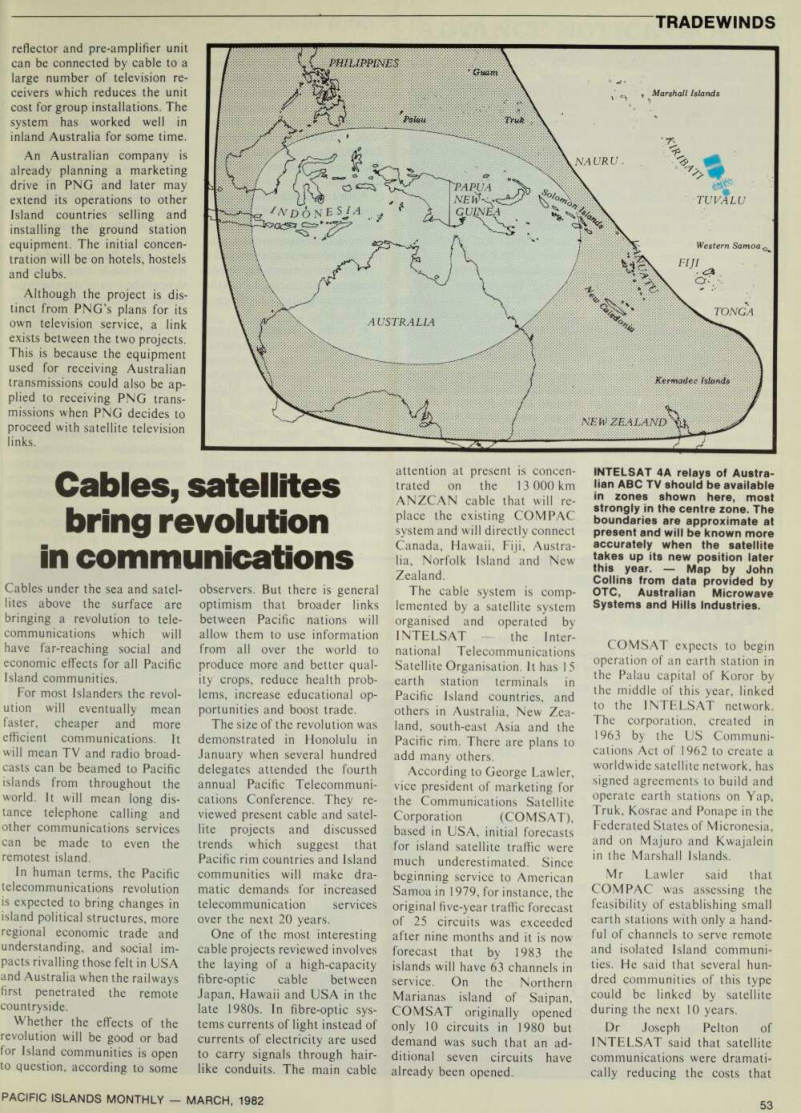
Trade
Winds
to get its own
Feasibility studies of the financial, technical, program ming and management require ments for a broadcast television service in Papua New Guinea are to be discussed by the PNG government in March. The gov ernment decided in principle late last year to proceed with the introduction of television, but how it will be done, how it will be paid for and what sort of material will be shown is still very much in the planning stage.
The general plan is to go ahead as soon as possible with two pilot broadcast television services, one in Port Moresby and one in Lae. Media Minister Clement Poye believes the two pilot services can be operating within two years. This will then provide a shakedown period for programming and production, a breathing space for major plan
ning, and an opportunity for viewers and community organ isations to suggest how the main project should develop.
The main project will be to establish a national television service using a communications satellite stationary above the earth. It will receive signals from a ground station and beam them down again so that they will be available throughout PNG. The PNG government has already signed a memor andum of understanding with Australia which will give it the right to lease channels in the Australian satellite AUSSAT due to go into service in 1985.
However, other satellite and transmission options are avail able to PNG, and wide investi gations and negotiations are likely before the final decisions are taken.
The government has com missioned a feasibility study,
and the first reports are ex pected to be discussed by cabi net in March. There has already been some controversy over the feasibility study for which the National Broadcasting Com mission and the Public Utilities Department are paying more than $2O 000 in fees and ex penses. The men behind the survey are an Australian public relations consultant Mr Joe Joel who earlier had an office in Port Moresby and a Swiss engineer, Mr Ueli Herren.
Mr Joel is the brother of Sir Asher Joel who operates a television service in the north ern Australian mining centre of Mount Isa and he has had his own links with television ser vices and television advertising.
Several years ago he attempted unsuccessfully to negotiate a television service for Papua New Guinea in which Austra lian Consolidated Press of Syd ney would have been one of the principals. There has been some political criticism of his role in the present series of feasibility studies on the grounds that he could represent specific inter ests. However, Mr Joel told a newspaper interviewer in Port Moresby that he was committed only to producing a workable line of approach for Papua New Guinea. His studies were purely recommendations, he said, and the decisions were for cabinet to make. Mr Joel is reporting on the programming and manage ment aspects of a television service, and Mr Herren on the technical and financial aspects.
The present line of inquiry is believed to rely heavily on the eventual availability of the AUSSAT channels, but already some technical agencies have begun lobbying for alternative systems which they say would be cheaper and which would use satellite facilities which could become available earlier.
The Australian government itself has been criticised at home for agreeing to make AUSSAT channels available to PNG. The criticism is based on suggestions that Australia itself will need all the channels.
However, the signing of the
memorandum of agreement has assured PNG of access to AUSSAT, although not until 1985. Three channels in the satellite would be available to PNG. The rentals would cost several million dollars a year, but it is politically possible that Australia would consider a sub sidy to reduce the costs.
Japan and Indonesia are two other countries which could be in a position to make satellite channels available to PNG. It is understood that the feasibility studies are considering the possibility that manufacturing countries such as Australia and Japan, and possibly Indonesia, would be prepared to offer a satellite rental subsidy if the PNG television system was willing to accept trade and
product advertising.
TV from outside
also available
While Papua New Guinea steps up planning for a television service of its own, there haas been another development which in a few months will give PNG and several other Island countries the opportunity to receive some Australian tele vision services for up to 17 hours a day.
The development is the repo
sitioning later this year of the satellite INTELSAT 4A which is already carrying the east coast and west coast trans missions of the Australian Broadcasting Commission tele vision service. This is the government-owned service which is known as Channel Two in Australian state capital cit ies. INTELSAT 4A has been beaming the programmes back to earth for some time to provide a service for the remote areas of inland Australia.
When the satellite is repo sitioned later this year its area of coverage what is known as the footprint will change.
The new area is expected to take in Papua New Guinea, Solomon Islands, Vanuatu, New Caledonia, the Kermadec Islands, Palau, part of the Federated States of Micronesia and part of Indonesia, in ad dition to Australia itself. It may also take in Nauru, although this is uncertain at present.
To receive the programmes in the footprint area it is necessary to instal what technicians call a ‘mini ground station’ in addition to a normal television receiver.
The ground station consists of a large metallic reflector and a pre-amplifier unit. The total cost is expected to be about $4OOO installed, but one
reflector and pre-amplifier unit can be connected by cable to a large number of television re ceivers which reduces the unit cost for group installations. The system has worked well in inland Australia for some time.
An Australian company is already planning a marketing drive in PNG and later may extend its operations to other Island countries selling and installing the ground station equipment. The initial concen tration will be on hotels, hostels and clubs.
Although the project is dis tinct from PNG’s plans for its own television service, a link exists between the two projects.
This is because the equipment used for receiving Australian transmissions could also be ap plied to receiving PNG trans missions when PNG decides to proceed with satellite television links.
INTELSAT 4A relays of Austra lian ABC TV should be available in zones shown here, most strongly in the centre zone. The boundaries are approximate at present and will be known more accurately when the satellite takes up its new position later
this year. - Map by John
Collins from data provided by OTC, Australian Microwave Systems and Hills Industries.
The PNG picture
After flirting for more than a decade with the possibility of introducing television services, Papua New Guinea has now decided to go ahead. Pilot schemes will be established in the two main cities of Port Moresby and Lae while the government prepares for a network of national coverage which has become possible through statellite technology.
Meanwhile an Australian company, Australian Micro wave Systems, has begun selling equipment which will allow private buyers in PNG and some other Pacific countries to receive direct broadcasts of Australian non-commerical television. The signal path will be through a satellite carrying the Australian Broadcasting Commission’s east coast and west coast services with a total programme time approaching 17 hours a day. The service will become available later this year when an existing satellite, INTELSAT 4A, is repositioned over the Pacific.
On these pages PIM writers describe events in the PNG move towards a television service, and outline the satellite facilities which can distribute a domestic television service or bring in services from other countries. And from Hawaii, Paul Addison, who recently attended the fourth annual Pacific Telecommunications Conference, reports on the general telecom revolution which is affecting almost every Island community in the Pacific.
Advertisements & other items, p. 52 (1 item)
Cycles
'n
EEffl
THE HEAUNG PACIFIC
THE FIRST BICYCLE DESIGNED AND BUILT FOR THE PACIFIC.
The new Healing “Pacific” is now available.
It’s the first bicycle designed expressly for the special conditions of the islands of the Pacific. Produced in New Zealand, in one of the world’s most modern cycle factories, the Healing Pacific has been built strong, to last long.
All tubing, rims and other components are heavy-duty specification, engineered to handle all conditions. A special feature is the extra-strong double-bar design.
Tyres are heavy duty balloon style, suitable for sealed and unsealed roads. The full sized wheels (26 x 2 x IV4) keep going, whether the going’s hard or soft. They handle bumpy roads with ease, and the heavy duty spokes stand up to the demands of heavy duty service.
Standard features on the Healing Pacific include rear coaster brake, full length mudguards, safety reflector pedals, two red rear reflectors and warning bell.
The saddle is the broad, well-sprung, comfortable roadster style.
The Healing Pacific has been built to deliver maximum quality and value for money. The high gloss black paintwork is a special formulation, developed by Healing technology, to withstand the wide range of Pacific climatic conditions.
Invest in a Healing Pacific, and you’ll have low cost, economical, long-life transport. The first bicycle designed and built for the Pacific.
HEALING
CYCLES
PRODUCTS OF HEALING TECHNOLOGY
TRADE ENQUIRIES TO:
HEAUNG INDUSTRIES LTD.
PRIVATE BAG, ROSEBANK, AUCKLAND 7, N.Z.
I 1
Cables, satellites
bring revolution in communications
Cables under the sea and satel lites above the surface are bringing a revolution to tele communications which will have far-reaching social and economic effects for all Pacific Island communities.
For most Islanders the revol ution will eventually mean faster, cheaper and more efficient communications. It will mean TV and radio broad casts can be beamed to Pacific islands from throughout the world. It will mean long dis tance telephone calling and other communications services can be made to even the remotest island.
In human terms, the Pacific telecommunications revolution is expected to bring changes in island political structures, more regional economic trade and understanding, and social im pacts rivalling those felt in USA and Australia when the railways first penetrated the remote countryside.
Whether the effects of the revolution will be good or bad for Island communities is open to question, according to some
observers. But there is general optimism that broader links between Pacific nations will allow them to use information from all over the world to produce more and better qual ity crops, reduce health prob lems, increase educational op portunities and boost trade.
The size of the revolution was demonstrated in Honolulu in January when several hundred delegates attended the fourth annual Pacific Telecommuni cations Conference. They re viewed present cable and satel lite projects and discussed trends which suggest that Pacific rim countries and Island communities will make dra matic demands for increased telecommunication services over the next 20 years.
One of the most interesting cable projects reviewed involves the laying of a high-capacity fibre-optic cable between Japan, Hawaii and USA in the late 1980 s. In fibre-optic sys tems currents of light instead of currents of electricity are used to carry signals through hair like conduits. The main cable
attention at present is concentrated on the 13 000 km ANZCAN cable that will re- . • . rsw/m/ir' place the existing COMPAC system and will directly connect Canada, Hawaii, Fiji, Australia, Norfolk Island and New y , .
The cable system is complemented by a satellite system organised and operated by INTELSAT the International Telecommunications Satellite Organisation. It has 15 earth station terminals in Pacific Island countries, and others in Australia, New Zealand, south-east Asia and the Pacific rim. There are plans to add many others.
According to George Lawler, vice president of marketing for the Communications Satellite Corporation (COMSAT), based in USA, initial forecasts for island satellite traffic were much underestimated. Since beginning service to American Samoa in 1979, for instance, the original five-year traffic forecast of 25 circuits was exceeded after nine months and it is now forecast that by 1983 the islands will have 63 channels in service. On the Northern Marianas island of Saipan, COMSAT originally opened only 10 circuits in 1980 but demand was such that an additional seven circuits have already been opened.
rnyc T COMSAT expects to begin °P eratl , on of an earlb s j allon ' n tbe Pa l a “ ca JP ltal of Ko \ or , b V the ™ ,dd *® * h “ l,nk< : d If! the INTELSAT network, “'''’TT.’c c L ealed ln 1963 b > A the r Commum cal'°ns Act of 1962 t 0 create a worldw,de satellite ha j Slgned a B ree menls to build and operate earth stations on Yap, I rak - Ko f ae and Pona P e in the Federated Slates of Micronesia, and °" Ma J ur ° f" d Kwajalem ln lhe Marsha " lslands - Mr Lawler said that COMPAC was assessing the feasibility of establishing small earth stations with only a hand ful of channels to serve remote and isolated Island communi ties - He said lhat several hun dred communities of this type could be linked by satellite during the next 10 years, Dr Joseph Pelton of INTELSAT said that satellite communications were dramati cally reducing the costs that
Pacific Island communities were paying for their place in today’s world community. He said that soon after Tonga opened its satellite earth station it was able to negotiate better prices for its exports and lower prices for its imports because of a better continuous awareness of world trends. He said that the University of the South Pacific in Fiji was using satellite com munications for tutorials to distant students and the cost per student was five times less than for resident students.
Professor William H. Melody of Simon Fraser University in Canada expressed some reser vations to the conference about the benefits of the telecommuni cations revolution. He said that the social and cultural risks of the change were high. Professor Melody told delegates: ‘We are well aware that virtually all technologies have unintended harmful effects. The great plans and promises surrounding the green revolution in agriculture introducing into developing countries the technology of American farming, including
equipment, pesticides, ferti lisers, education, and infor mation have floundered, for the most part, as the longer term social and human conse quences have begun to work themselves out. Should we ex pect anything different from the communications revolution?’
Many, apparently, think so.
Telecommunications experts cite the success of the exper imental ATS-1 satellite in the Pacific that has been used widely by the University of the South Pacific and the Depart ment of the Interior Satellite Project (DISP) for medical consulting, experiments, and talks between members of re gional organisations.
ATS stands for Applied Technology Satellite, but the satellite is better known in the Pacific as PEACESAT Pan- Pacific Education And Com munication Experiments by Satellite. The application of ATS-1 to its present role stems largely from the work of Dr John Bystrom of the University of Hawaii, and the satellite's main terminals are at the Uni
versity of Hawaii, the Univer sity of the South Pacific in Fiji, the University of Guam, the Wellington Polytechnic in New Zealand, the University of Syd ney in Australia, the Papua New Guinea University of Technology and the South Pacific Commission in New Caledonia.
With the proliferation of sat ellite facilities for external links, the main problem now facing Island communities is to provide adequate internal links.
Here are some of the broad themes which emerged from the telecommunications conference in Honolulu; • Pacific Islanders them selves, rather than external powers, will need to exercise more control over communi cation networks. Prime Minis ter Sir Thomas Davis of the Cook Islands told the confer ence: The development of many small countries has been delayed by the inappropriate manner in which communi cations have been introduced, usually by outside interests try ing to do things in a way that
might work well in large affluent countries but that are inappropriate in small undevel oped countries like ours.’
A US-funded research pro gramme has suggested that Pacific Islands could develop their own integrated communi cations system using a new satellite, but the chief barriers would be raising $lOO million to build and launch the satellite and establishing a management formula. • The Reagan adminis tration in USA is not prepared to bear the cost of developing a Pacific-dedicated telecommuni cations system, but believes the private sector can be induced to invest in such a system.
According to Bernard J.
Wunder, assistant secretary for communications and infor mation of the US Department of Commerce, ‘there is a grow ing body of evidence than demonstrates telecommuni cations systems can generate respectable rates of return on investment, even in developing countries’. • International corporations
can be expected to compete more fiercely for Pacific island telecommunications business in the future. Western Union Tele graph, for instance, whose ser vices have been confined pri marily to the North American continent, intends to offer a ‘broad range of basic services between the US and all countries’, Thomas Mathai, a company vice president, said.
These would include telegram, telex, private wire, mailgrams, money order, telephone and news services. Western Union has three satellites in orbit over USA and will launch two more this year. • The flow of communi cations data across inter national borders will be a con tinuing source of controversy, at least for the next decade.
Speakers told the conference there was already confusion and uncertainty because institutions created by new technologies were threatening established in stitutions which had not yet developed effective tools to meet their telecommunications needs. Belinda Canton and Herbert Dordick of the Univer sity of Southern California in USA said that so much infor mation was now travelling back and forth across the Pacific that what they called ‘elite groups’ were now facing a crisis of authority. They said these elite groups felt they had to find ways of reacting to the flow of
information.
Paul Addison
in Honolulu.
Ansett regional
feelers extend
The arrangement under which the Australian company Ansett Transport Industries is manag ing Polynesian Airlines of West ern Samoa (PIM Feb p5l) may lead to an Ansett shareholding in the operation. This became evident in February as the two parties continued a series of negotiations which will alter the company structure of Polynesian along lines which have not yet been announced.
There were two other devel opments in February which point to the increasing involve ment of the Ansett group in Pacific regional aviation.
One was confirmation from Fiji that Ansett had made an
informal approach to take up a shareholding in Air Pacific. An involvement of up to 40 per cent was suggested, and the immedi ate reaction at ministerial level was described as ‘not unsympa thetic to the approach’. How ever, no firm decision is possible until the Fiji government, which owns the airline, discusses its attitude to releasing some of its equity. The airline’s financial problems suggest that some form of re-organisation must face the government in its airline policies.
The other development affecting Ansetl in the Pacific was an approach by the Cook Islands government for an Aus tralian airline operator to de velop services into the Cook Islands from regional countries.
Qantas, Trans Australia Air lines and Ansett were each suggested, but a deal with Ansett is seen as the most logical. Ansett has already re sponded to the invitation by holding preliminary talks on tourism and landing rights. Air New Zealand has long been the major force in regional aviation serving the Cook Islands, but the airline has been forced into a series of economies because of heavy operational losses. This is believed to be one of the major factors which prompted the Cook Islands government to approach Australian operators for a new-look series of air links.
The new developments affecting Ansett in the Pacific follow the formation last year of Air Vanuatu in which Ansett has a 40 per cent shareholding.
If Ansett can integrate a route structure (with or without equity) involving Vanuatu, Western Samoa, Fiji and the Cook Islands it will have estab lished a very firm base indeed.
New Caledonia is also not out of the question through Ansett’s Air Vanuatu link. Air Vanuatu flights already land in New Caledonia on the service be tween Australia and Vanuatu, but at present the stops are for fuelling only and do not include traffic rights. Mr Bryan Grey from Ansett’s head office in Melbourne has already ap proached New Caledonia officials for traffic rights, pre sumably on behalf of the Air Vanuatu operation, but little progress has been made. In any
event, air traffic rights to New Caledonia require approval from the government in France because of the New Caledonia territorial structure.
In Western Samoa, Ansett has already established its man agement structure on behalf of Polynesian Airlines and has appointed Mr Patrick Giles as general manager. The manage ment agreement came into effect on February 1 and will operate for five years.
A statement from the chair man of the airline, Mr E Annandale, said that nego tiations for the new company structure of the airline as distinct from the management structure were continuing.
Two separate companies would probably be formed, and there would be a concentrated pro gramme of training for Samoan staff.
Although the nature of the two proposed companies has not been defined, there is a general belief in the airline industry that one of the companies will be a nominal policy body de signed to protect the long-term
interests of Western Samoa as an airline operator in its own right and the other will be an operating company. Ansett could well have a majority interest in the operating com pany.
Bougainville is
down by 68%
Profit from Bougainville Cop per Ltd’s go'd and copper mine in Papua New Guinea fell by 68 percent for the year ended last December, the directors re ported in February. The princi pal shareholders in the mine are the Australian-based mining group CRA (54 percent) and the PNG government (23 per cent).
CRA is already going through a lean period because of reduced earnings from its other mines, and the drop will be a significant blow to the PNG government which is fairly heavily stretched financially and which relies strongly on the mine for budget revenue. Tax, royalties and di rect earnings as well as profit
dividends all affect the govern ment’s revenue when the mine has a below-average year.
The profit from the mine was K 22.8 million, compared with K 71.5 million the previous year.
The annual dividend dropped from 16 toea a share to five toea.
A major factor which de pressed earnings from the mine was a world-wide drop in copper and gold prices. To some extent the mine fared slightly better than would have been expected because there was an unexpectedly higher grade of ore during part of the year. This was only a minor development, however, and generally the grades of ore will gradually decrease as the Bougainville open pit becomes deeper in future years. The higher rate of recovery resulted in an in creased volume of sales for the year, but the depressed prices were the over-riding element in the company’s result.
Meanwhile, a domestic politi cal situation is delaying talks which should have been held last year to re-examine the agreement under which the
mine operates in PNG.
Bougainville Copper Ltd and the PNG government are sup posed to meet every seven years to discuss the practical oper ation of the agreement and to thrash out revisions which either party may propose.
The latest series of talks began last year as scheduled but had to be adjourned be cause of lobbying by the North Solomons provincial govern ment the provincial auth ority on Bougainville Island where the mine is situated. The provincial government receives revenue from the mine, but only through the national govern ment which reserves sole rights to collect and allocate revenue generated by the mine.
The provincial government is lobbying for a greater share of the money, but has failed to reach agreement with the national government. This has halted the scheduled review of the mining agreement because of uncertainties involved, and there is no indication of when the negotiations are likely to resume.
Advertisements & other items, pp. 54-56 (1 item)
Propellors
Repaired Electronically Repitched Balanced From 1 foot 24 feet diameter South Pacific’s Most Modern Propellor Workshop Don’t discard it Repair it V..
Tropical
Reef En
Enterprises
6 Slips;- 5 - 100 Tons, 1 - 2000 Tons Fully equipped Ship Repair facilities!!
Insurance Work our speciality■■■ / I « I
I ADVANCE NOTICE OF SALE
T.S.M.V. ELIZABETH E
FEATURES OF THE VESSEL
INCLUDE:
VOLT 3 PHASE POWER
"-'■tSgSiiiilili 2 X BV7I G M ACCOMMODATION FOR 24 PASSENGERS IN AIR CONDITIONED CABINS
ACCOMMODATION FOR 8 CREW
SURVEY FOR 72 DAY PASSENGERS
The above 34 metre vessel is to be sold immediately following delivery of a new vessel currently under construction.
Approximate delivery date is February 1983.
The vessel is in immaculate condition and will be sold with a current survey certificate.
SALE PRICE ON APPLICATION AM telephone enquiries to 808 EVETTS: 079 574281 or JOHN EVETTS; 079 551433 or by writing to ELIZABETH E CORAL CRUISES 102 Goldsmith Street, MACKAY 4740. Queensland, Australia.
OmJL I
r f : :n 4HH
vessels presently II operating between WESTERN SAMOA* -4Land AMERICAN (EASTERN) SAMOA carrying passengers 1 and freight are now offered for sale i *
M.U “ANTONIO” MODEL D 343 TWINSCREW
M.V. “HAMUTANA” MODEL D 343 TWINSCREW
M.V. “LAITITI AE MAIN!” MODEL D 3406 TWINSCREW \
PRICE TO BE NEGOTIATED
All enquiries to : Inter-island Shipping Company Limited/
(A.H, STEFFANY),
P.O. Box 507, Pago Pago, American Samoa 96799 Phone: Business - 633 5728 Home - 633 4327> ...K-
FOR SALE
w fw % 4 -;w IF lip Hi • fc ' - • '/ Construction : Steel, Built: Japan 1967.| Engine : Cummins NT 855 270 h.p. with electric or air start and' with a 6Kva 240 V cruising alternator.
Length : 110 feet. Speed: BVi knots using 12 gallons fuel per hour.
Gross Tonnage : 145. Fuel capacity: approx 20,000 gallons Auxiliaries : One Kubota with air compressor and 2" bilge pump and| fire hose; one Kubota with 2" main hold bilge pump and| fuel transfer pumps; one Kubota with 3Kva 240 M\ generator; one 3cyl Perkins with 6 Kva 240 V generator.|
LIAPARI LIMITED
-(INCORPORATED IN SOLOMON ISLANDS),
GENERAL TRADERS & SHIPOWNERS^,
LIAPARI ESTATE, VELLA LAVELLA, SOLOMON ISLANDS**
Vessel has two 3 ton fully insulated cargo holds, one with a 240 V, 2 h.p. \ freezer unit. There is one main cargo hold approx. 100 m 3. She carriesf " approx 2,000 bags of copra. She is currently under survey until 11 /8/82J Price on application to the above address. Vessel could be surveyed for||| up to 100-120 passengers but presently only for 30 as engaged in fueT
j freighting.
Yachts
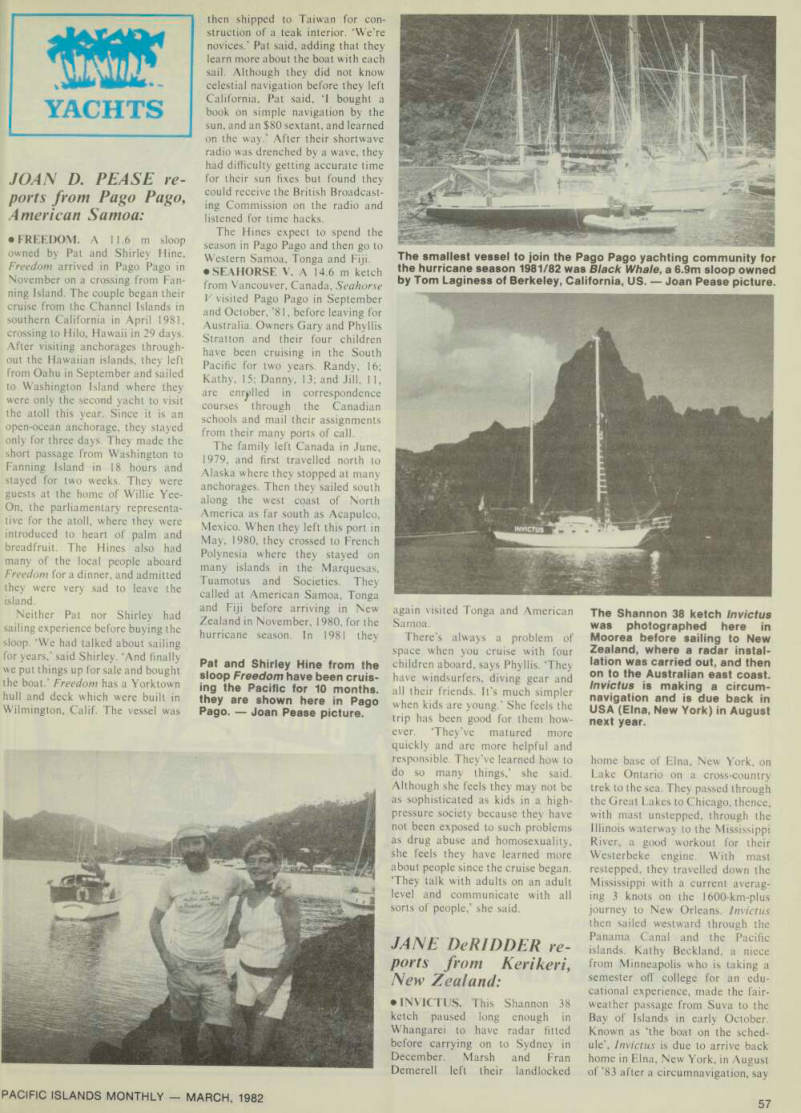
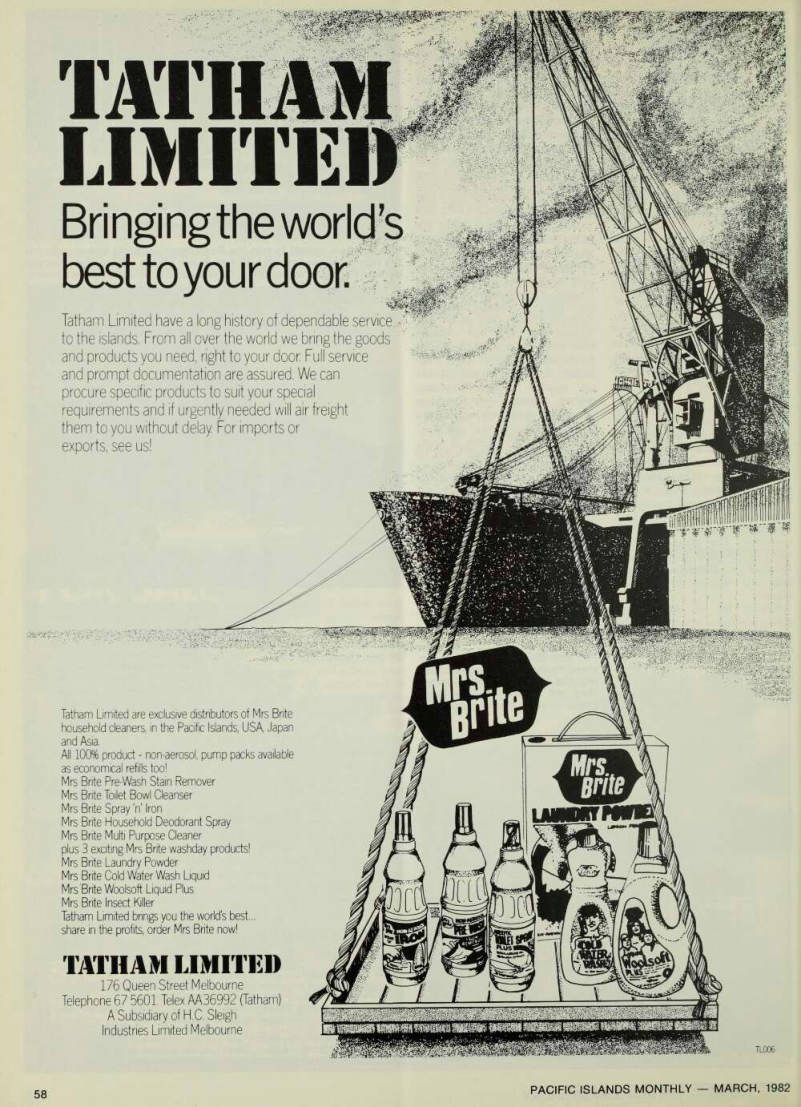
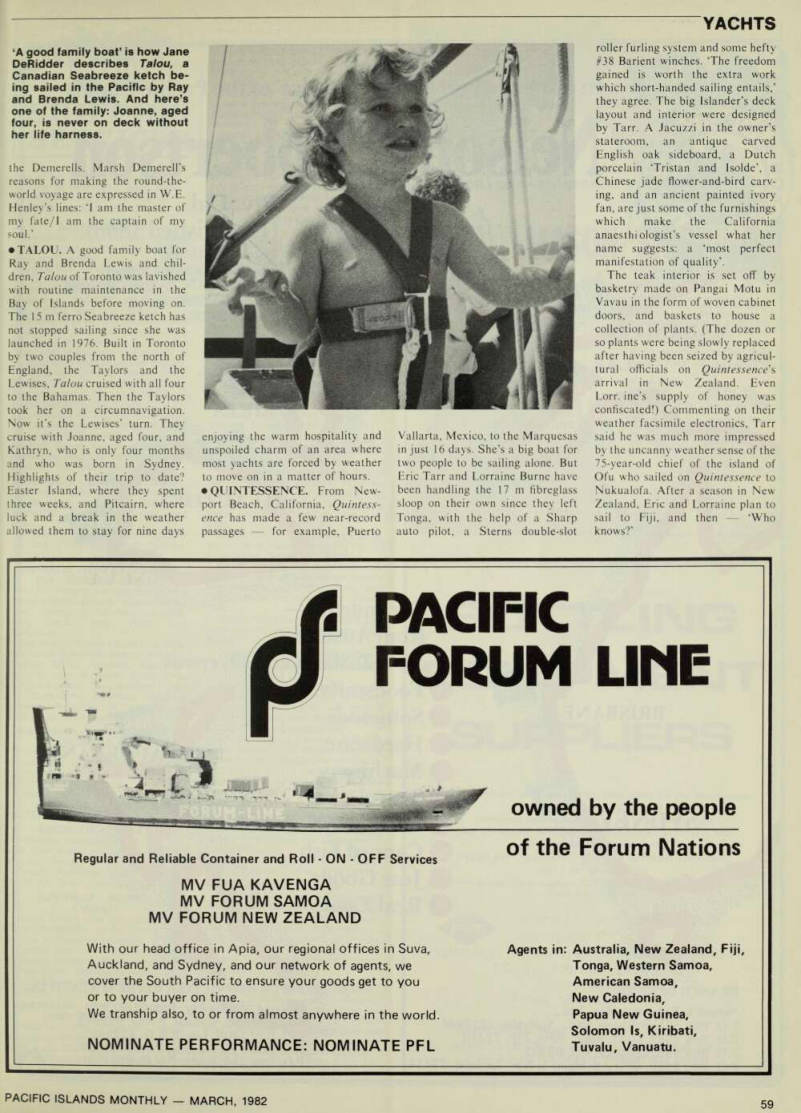
Joan D. Pease Re
ports from Pago Pago ,
American Samoa:
• FREEDOM. A 11.6 m sloop owned by Pat and Shirley Hine, Freedom arrived in Pago Pago in November on a crossing from Fan ning Island. The couple began their cruise from the Channel Islands in southern California in April 1981, crossing to Hilo, Hawaii in 29 days.
After visiting anchorages through out the Hawaiian islands, they left from Oahu in September and sailed to Washington Island where they were only the second yacht to visit the atoll this year. Since it is an
open-ocean anchorage, they stayed
only for three days. They made the short passage from Washington to Fanning Island in 18 hours and stayed for two weeks. They were guests at the home of Willie Yee- On, the parliamentary representa tive for the atoll, where they were introduced to heart of palm and breadfruit. The Hines also had many of the local people aboard Freedom for a dinner, and admitted they were very sad to leave the island.
Neither Pat nor Shirley had sailing experience before buying the sloop. ‘We had talked about sailing for years,’ said Shirley. ‘And finally we put things up for sale and bought the boat.’ Freedom has a Yorktown hull and deck which were built in Wilmington, Calif. The vessel was
then shipped to Taiwan for con struction of a teak interior. ‘We’re novices.’ Pat said, adding that they learn more about the boat with each sail. Although they did not know celestial navigation before they left California, Pat said, ‘I bought a book on simple navigation by the sun, and an $BO sextant, and learned on the way.’ After their shortwave radio was drenched by a wave, they had difficulty getting accurate time for their sun fixes but found they could receive the British Broadcast ing Commission on the radio and listened for time hacks.
The Hines expect to spend the season in Pago Pago and then go to Western Samoa, Tonga and Fiji. • SEAHORSE V. A 14.6 m ketch from Vancouver, Canada, Seahorse V visited Pago Pago in September and October, ’Bl, before leaving for Australia. Owners Gary and Phyllis Stratton and their four children have been cruising in the South Pacific for two years. Randy, 16; Kathy, 15; Danny, 13; and Jill, 11,
are enrolled in correspondence
courses through the Canadian schools and mail their assignments from their many ports of call.
The family left Canada in June, 1979, and first travelled north to Alaska where they stopped at many anchorages. Then they sailed south along the west coast of North America as far south as Acapulco, Mexico. When they left this port in
May, 1980, they crossed to French
Polynesia where they stayed on many islands in the Marquesas, Tuamotus and Societies. They called at American Samoa, Tonga and Fiji before arriving in New Zealand in November, 1980, for the hurricane season. In 1981 they
again visited Tonga and American Samoa.
There’s always a problem of space when you cruise with four children aboard, says Phyllis. They have windsurfers, diving gear and all their friends. It’s much simpler when kids are young.’ She feels the trip has been good for them how ever. ‘They’ve matured more quickly and are more helpful and responsible. They’ve learned how to do so many things,’ she said.
Although she feels they may not be as sophisticated as kids in a high pressure society because they have not been exposed to such problems as drug abuse and homosexuality, she feels they have learned more about people since the cruise began. ‘They talk with adults on an adult level and communicate with all sorts of people,’ she said.
Jane Deridder Re
ports from Kerikeri ,
New Zealand:
• INVICTUS. This Shannon 38 ketch paused long enough in Whangarei to have radar fitted before carrying on to Sydney in December. Marsh and Fran Demerell left their landlocked
home base of Elna, New York, on Lake Ontario on a cross-country trek to the sea. They passed through the Great Lakes to Chicago, thence, with mast unstepped, through the Illinois waterway to the Mississippi River, a good workout for their Westerbeke engine. With mast restepped, they travelled down the Mississippi with a current averag ing 3 knots on the 1600-km-plus journey to New Orleans. Invictus then sailed westward through the Panama Canal and the Pacific islands. Kathy Beckland. a niece from Minneapolis who is taking a semester off college for an edu cational experience, made the fair weather passage from Suva to the Bay of Islands in early October.
Known as ‘the boat on the sched ule’, Invictus is due to arrive back home in Elna, New York, in August of ’B3 after a circumnavigation, say
Pat and Shirley Mine from the sloop Freedom have been cruis ing the Pacific for 10 months, they are shown here in Pago
Pago. - Joan Pease picture.
The smallest vessel to join the Pago Pago yachting community for the hurricane season 1981/82 was Black Whale, a 6.9m sloop owned by Tom Laginess of Berkeley, California, US. - Joan Pease picture.
The Shannon 38 ketch Invictus was photographed here in Moorea before sailing to New Zealand, where a radar instal lation was carried out, and then on to the Australian east coast.
Invictus is making a circum navigation and is due back in USA (Elna, New York) in August next year.
the Demerells. Marsh Demerell’s reasons for making the round-the world voyage are expressed in W.E.
Henley’s lines: ‘I am the master of my fate/I am the captain of my soul.’ • TALOU. A good family boat for Ray and Brenda Lewis and chil dren, Talou of Toronto was lavished with routine maintenance in the Bay of Islands before moving on.
The 15 m ferro Seabreeze ketch has not stopped sailing since she was launched in 1976. Built in Toronto by two couples from the north of England, the Taylors and the Lewises, Talou cruised with all four to the Bahamas. Then the Taylors took her on a circumnavigation.
Now it’s the Lewises’ turn. They cruise with Joanne, aged four, and Kathryn, who is only four months and who was born in Sydney.
Highlights of their trip to date?
Easter Island, where they spent three weeks, and Pitcairn, where luck and a break in the weather allowed them to stay for nine days
enjoying the warm hospitality and unspoiled charm of an area where most yachts are forced by weather to move on in a matter of hours.
• Quintessence. From New
port Beach, California, Quintess ence has made a few near-record passages for example, Puerto
Vallarta, Mexico, to the Marquesas in just 16 days. She’s a big boat for two people to be sailing alone. But Eric Tarr and Lorraine Burne have been handling the 17 m fibreglass sloop on their own since they left Tonga, with the help of a Sharp auto pilot, a Sterns double-slot
roller furling system and some hefty #3B Barient winches. The freedom gained is worth the extra work which short-handed sailing entails,’ they agree. The big Islander’s deck layout and interior were designed by Tarr. A Jacuzzi in the owner’s stateroom, an antique carved English oak sideboard, a Dutch porcelain Tristan and Isolde’, a Chinese jade flower-and-bird carv ing, and an ancient painted ivory fan, are just some of the furnishings which make the California anaesthiologist’s vessel what her name suggests: a ‘most perfect manifestation of quality’.
The teak interior is set off by basketry made on Pangai Motu in Vavau in the form of woven cabinet doors, and baskets to house a collection of plants. (The dozen or so plants were being slowly replaced after having been seized by agricul tural officials on Quintessence's arrival in New Zealand. Even Lorr. ine’s supply of honey was confiscated!) Commenting on their weather facsimile electronics, Tarr said he was much more impressed by the uncanny weather sense of the 75-year-old chief of the island of Ofu who sailed on Quintessence to Nukualofa. After a season in New Zealand, Eric and Lorraine plan to sail to Fiji, and then ‘Who knows?’
‘A good family boat’ is how Jane DeRidder describes Talou, a Canadian Seabreeze ketch be ing sailed in the Pacific by Ray and Brenda Lewis. And here’s one of the family: Joanne, aged four, is never on deck without her life harness.
Advertisements & other items, pp. 58-60 (1 item)
Tat Ham
LIMITGI
Bringing the world's
best to your door.
Tatham Limited have a long history of dependable service to the islands. From all over the world we bring the goods and products you need, right to your door Full service and prompt documentation are assured. We can procure specific products to suit your special requirements and if urgently needed will air freight them to you without delay. For imports or exports, see us!
Tatham Limited are exclusive distnbutors of Mrs Brite household cleaners, in the Pacific Islands, USA Japan and Asia.
All 100% product - non-aerosol, pump packs available as economical refills too!
Mrs Bnte Pre-Wash Stain Remover Mrs Brite Toilet Bowl Cleanser Mrs Bnte Spray ‘n’ Iron Mrs Bnte Household Deodorant Spray Mrs Brite Multi Purpose Cleaner plus 3 exciting Mrs Brite washday products!
Mrs Brite Laundry Powder Mrs Brite Cold Water Wash Liquid Mrs Bnte Woolsoft Liquid Plus Mrs Brite Insect Killer Tatham Limited bnngs you the world’s bestshare in the profits, order Mrs Brite now!
TATHAM LIMITED
176 Queen Street Melbourne Telephone 67 5601. Telex AA36992 (Tatham) A Subsidiary of H.C. Sleigh Industries Limited Melbourne ' w a
PACIFIC
FORUM LINE
- » » Regular and Reliable Container and Roll - ON - OFF Services
owned by the people
of the Forum Nations
MV FUA KAVENGA
MV FORUM SAMOA
MV FORUM NEW ZEALAND
With our head office in Apia, our regional offices in Suva, Auckland, and Sydney, and our network of agents, we cover the South Pacific to ensure your goods get to you or to your buyer on time.
We tranship also, to or from almost anywhere in the world.
NOMINATE PERFORMANCE: NOMINATE PFL
Agents in: Australia, New Zealand, Fiji, Tonga, Western Samoa, American Samoa, New Caledonia, Papua New Guinea, Solomon Is, Kiribati, Tuvalu, Vanuatu.
In our 87th Year Selling ‘Service’ to the Pacific Islands
Nelson & Robertson
2: o V. rV
MADANG
LAE
• • • •«• f • •• • •
RABAUL
■• V•• • >.» • • ••• •
BRISBANE
SYDNEY
Pty. Ltd.
(Established 1895)
Plantation House, 197 Clarence Street, Sydney.
Cables: ‘IVAN’, Sydney, Brisbane.
Telex: AA22381, Sydney.
Phone: 29 2871
KIETA
LAUTOKA
SUVA
For Indents
from Australia,
New Zealand and Overseas Foodstuffs
Softgoods
Hardware
Machinery
Travel Insurance Canned Fish
Jute Goods
Real Estate • *
BRANCH OFFICES:
Nelson & Robertson Pty. Ltd., P.O. Box 575, Brisbane, Qld., Australia. 2216966 P.O. Box 2092, Govt. Bldg., Suva, Fiji. 22430 P.O. Box 258, Lautoka, Fiji. 62101 P.O. Box 2420, CPO Auckland 1, New Zealand. 774141 uc ND
.-: ! ::PAPUA NEW GUINEA REPRESENTATIVES:
Trii Pty. Ltd., P.O. Box 291 Rabaul, P.N.G. 922911 i. Box 1406, Lae, P.N.G. 422366 .0. Box 711, Madang, P.N.G. 8220^ P.O. Box 253, Kieta, P.N.G. 956 1 05
Services
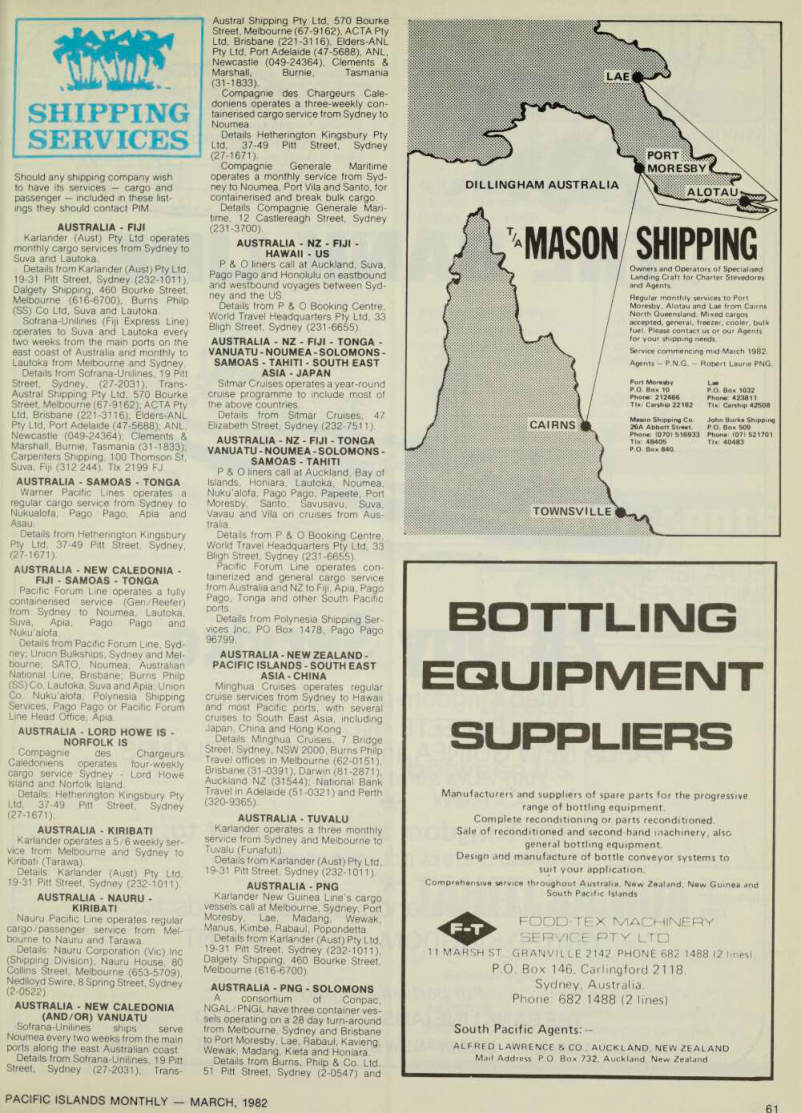
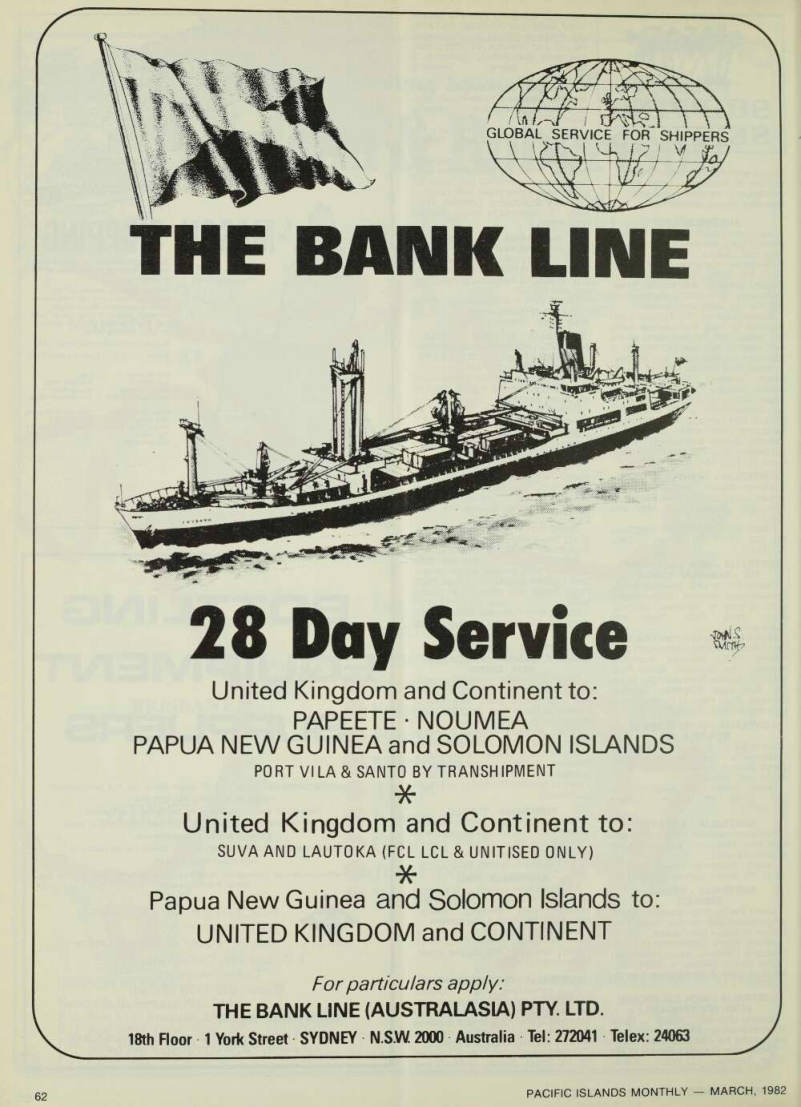
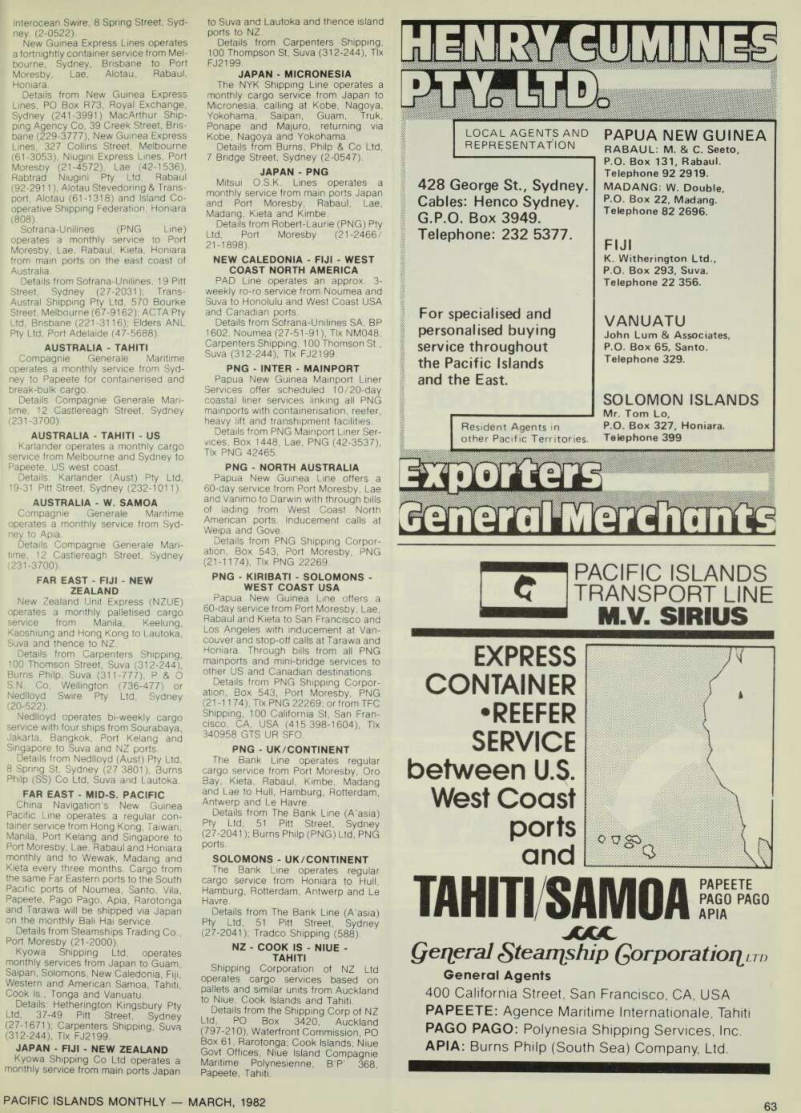
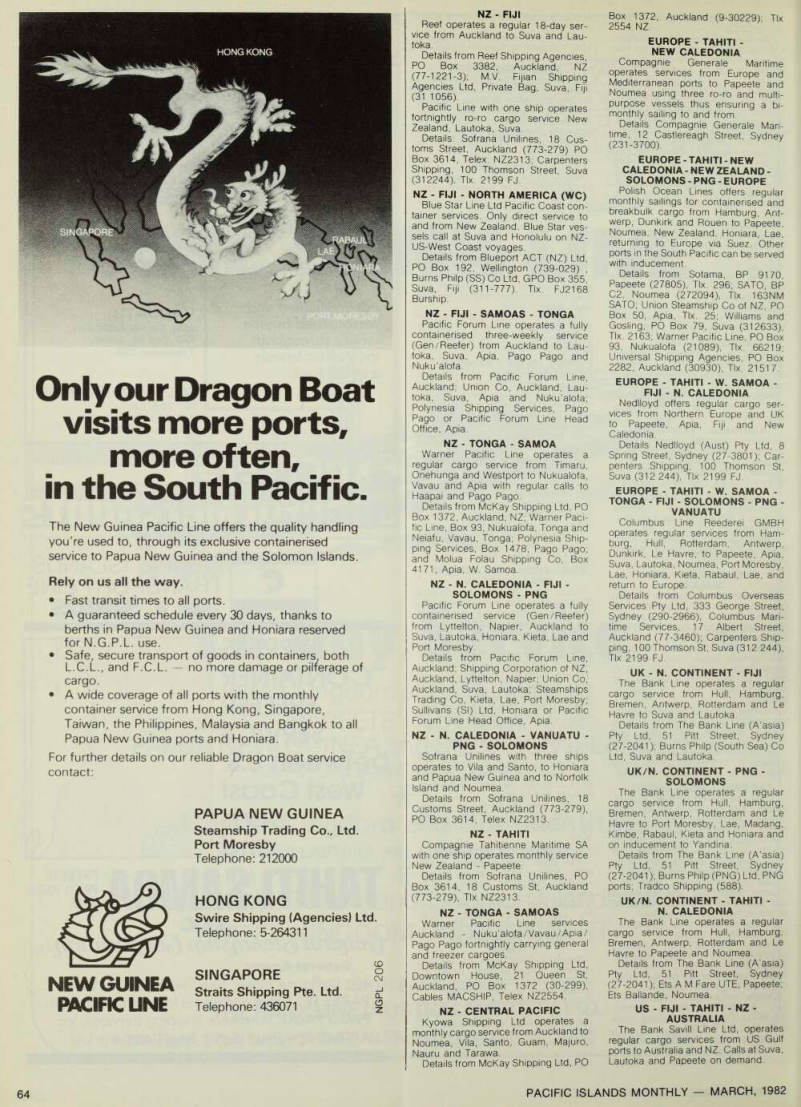
Shipping
Should any shipping company wish to have its services cargo and passenger included in these list ings they should contact PIM.
Australia - Fiji
Karlander (Aust) Pty Ltd operates monthly cargo services from Sydney to Suva and Lautoka.
Details from Karlander (Aust) Pty Ltd, 19-31 Pitt Street, Sydney (232-1011), Dalgety Shipping, 460 Bourke Street, Melbourne (616-6700), Burns Philp (SS) Co Ltd, Suva and Lautoka.
Sofrana-Unilines (Fiji Express Line) operates to Suva and Lautoka every two weeks from the main ports on the east coast of Australia and monthly to Lautoka from Melbourne and Sydney.
Details from Sofrana-Unilines, 19 Pitt Street, Sydney, (27-2031), Trans- Austral Shipping Pty Ltd, 570 Bourke Street, Melbourne (67-9162); ACTA Pty Ltd, Brisbane (221-3116); Elders-ANL Pty Ltd, Port Adelaide (47-5688); ANL, Newcastle (049-24364); Clements & Marshall, Burnie, Tasmania (31-1833); Carpenters Shipping, 100 Thomson St, Suva, Fiji (312 244), Tlx 2199 FJ,
Australia - Samoas - Tonga
Warner Pacific Lines operates a regular cargo service from Sydney to Nukualofa, Pago Pago, Apia and Asau.
Details from Hetherington Kingsbury Pty Ltd, 37-49 Pitt Street, Sydney, (27-1671).
Australia - New Caledonia -
Fiji - Samoas - Tonga
Pacific Forum Line operates a fully containerised service (Gen/Reefer) from Sydney to Noumea, Lautoka, Suva, Apia, Pago Pago and Nuku'alofa.
Details from Pacific Forum Line, Syd ney; Union Bulkships, Sydney and Mel bourne; SATO, Noumea; Australian National Line, Brisbane; Burns Philp (SS) Co. Lautoka, Suva and Apia; Union Co, Nuku’alofa; Polynesia Shipping Services, Pago Pago or Pacific Forum Line Head Office, Apia.
Australia - Lord Howe Is -
Norfolk Is
Compagnie des Chargeurs Caledonians operates four-weekly cargo service Sydney - Lord Howe Island and Norfolk Island.
Details: Hetherington Kingsbury Pty Ltd, 37-49 Pitt Street, Sydney (27-1671).
Australia - Kiribati
Karlander operates a 5/6 weekly ser vice from Melbourne and Sydney to Kiribati (Tarawa).
Details: Karlander (Aust) Pty Ltd, 19-31 Pitt Street, Sydney (232-1011).
Australia - Nauru -
Kiribati
Nauru Pacific Line operates regular cargo/passenger service from Mel bourne to Nauru and Tarawa.
Details: Nauru Corporation (Vic) Inc (Shipping Division), Nauru House, 80 Collins Street, Melbourne (653-5709), Nedlloyd Swire, 8 Spring Street, Sydney (2-0522).
Australia - New Caledonia
(And/Or) Vanuatu
Sofrana-Unilines ships serve Noumea every two weeks from the main ports along the east Australian coast.
Details from Sofrana-Unilines, 19 Pitt Street. Sydney (27-2031), Trans-
Austral Shipping Pty Ltd, 570 Bourke Street, Melbourne (67-9162), ACTA Pty Ltd, Brisbane (221-3116), Elders-ANL Pty Ltd, Port Adelaide (47-5688), ANL, Newcastle (049-24364), Clements & Marshall, Burnie, Tasmania (31-1833).
Compagnie des Chargeurs Cale doniens operates a three-weekly con tainerised cargo service from Sydney to Noumea.
Details Hetherington Kingsbury Pty Ltd, 37-49 Pitt Street, Sydney (27-1671).
Compagnie Generate Maritime operates a monthly service from Syd ney to Noumea, Port Vila and Santo, for containerised and break bulk cargo.
Details Compagnie Generate Mari time, 12 Castlereagh Street, Sydney (231-3700).
Australia - Nz - Fiji -
Hawaii - Us
P & O liners call at Auckland, Suva, Pago Pago and Honolulu on eastbound and westbound voyages between Syd ney and the US.
Details from P & O Booking Centre, World Travel Headquarters Pty Ltd, 33 Bligh Street, Sydney (231-6655).
AUSTRALIA - NZ - FIJI - TONGA -
Vanuatu - Noumea - Solomons -
Samoas - Tahiti - South East
Asia - Japan
Sitmar Cruises operates a year-round cruise programme to include most of the above countries.
Details from Sitmar Cruises, 47 Elizabeth Street, Sydney (232-7511).
AUSTRALIA - NZ - FIJI - TONGA
Vanuatu - Noumea - Solomons -
Samoas - Tahiti
P & O liners call at Auckland, Bay of Islands, Honiara, Lautoka, Noumea, Nuku’alofa, Pago Pago, Papeete, Port Moresby, Santo, Savusavu, Suva, Vavau and Vila on cruises from Aus tralia.
Details from P & O Booking Centre, World Travel Headquarters Pty Ltd, 33 Bligh Street. Sydney (231 -6655), Pacific Forum Line operates con tainerized and general cargo service from Australia and NZ to Fiji, Apia, Pago Pago, Tonga and other South Pacific ports.
Details from Polynesia Shipping Ser vices Jnc, PC Box 1478, Pago Pago 96799.
Australia - New Zealand -
Pacific Islands - South East
Asia-China
Minghua Cruises operates regular cruise services from Sydney to Hawaii and most Pacific ports, with several cruises to South East Asia, including Japan, China and Hong Kong.
Details Minghua Cruises, 7 Bridge Street, Sydney, NSW 2000, Burns Philp Travel offices in Melbourne (62-0151), Brisbane (31 -0391), Darwin (81 -2871).
Auckland NZ (31544); National Bank Travel in Adelaide (51 -0321) and Perth (320-9365).
Australia - Tuvalu
Karlander operates a three monthly service from Sydney and Melbourne to Tuvalu (Funafuti).
Details from Karlander (Aust) Pty Ltd, 19-31 Pitt Street, Sydney (232-1011).
Australia - Png
Karlander New Guinea Line’s cargo vessels call at Melbourne, Sydney, Port Moresby, Lae, Madang, Wewak, Manus, Kimbe, Rabaul, Popondetta.
Details from Karlander (Aust) Pty Ltd, 19-31 Pitt Street, Sydney (232-1011), Dalgety Shipping, 460 Bourke Street!
Melbourne (616-6700).
Australia - Png - Solomons
A consortium of Conpac, NGAL/PNGL have three container ves sels operating on a 28 day turn-around from Melbourne, Sydney and Brisbane to Port Moresby, Lae, Rabaul. Kavieng, Wewak, Madang, Kieta and Honiara.
Details from Burns, Philp & Co. Ltd. 51 Pitt Street, Sydney (2-0547) and
Interocean Swire, 8 Spring Street, Syd ney. (2-0522).
New Guinea Express Lines operates a fortnightly container service from Mel bourne, Sydney, Brisbane to Port Moresby, Lae, Alotau, Rabaul, Honiara.
Details from New Guinea Express Lines, PO Box R 73, Royal Exchange, Sydney (241-3991) MacArthur Ship ping Agency Co, 39 Creek Street, Bris bane (229-3777), New Guinea Express Lines, 327 Collins Street, Melbourne (61-3053), Niugini Express Lines, Port Moresby (21-4572), Lae (42-1536), Rabtrad Niugini Pty Ltd, Rabaul (92-2911), Alotau Stevedoring & Trans port, Alotau (61-1318) and Island Co operative Shipping Federation, Honiara (808).
Sofrana-Unilines (PNG Line) operates a monthly service to Port Moresby, Lae, Rabaul, Kieta, Honiara from mam ports on the east coast of Australia.
Details from Sofrana-Unilines, 19 Pitt Street, Sydney (27-2031); Trans- Austral Shipping Pty Ltd, 570 Bourke Street, Melbourne (67-9162); ACTA Pty Ltd, Brisbane (221-3116); Elders ANL Pty Ltd, Port Adelaide (47-5688).
Australia - Tahiti
Compagnie Generale Maritime operates a monthly service from Syd ney to Papeete for containerised and break-bulk cargo.
Details Compagnie Generale Mari time, 12 Castlereagh Street, Sydney (231-3700).
Australia - Tahiti - Us
Karlander operates a monthly cargo service from Melbourne and Sydney to Papeete, US west coast.
Details: Karlander (Aust) Pty Ltd, 19-31 Pitt Street, Sydney (232-1011).
Australia - W. Samoa
Compagnie Generale Maritime operates a monthly service from Syd ney to Apia.
Details Compagnie Generale Mari time, 12 Castlereagh Street, Sydney (231-3700).
Far East - Fiji - New
Zealand
New Zealand Unit Express (NZUE) operates a monthly palletised cargo service from Manila, Keelung, Kaoshiung and Hong Kong to Lautoka, Suva and thence to NZ Details from Carpenters Shipping, 100 Thomson Street, Suva (312-244), Burns Philp, Suva (311-777), P & O S.N Co, Wellington (736-477) or Nedlloyd Swire Pty Ltd, Sydney (20-522).
Nedlloyd operates bi-weekly cargo service with four ships from Sourabaya, Jakarta, Bangkok, Port Kelang and Singapore to Suva and NZ ports.
Details from Nedlloyd (Aust) Pty Ltd, 8 Spring St, Sydney (27 3801), Burns Philp (SS) Co Ltd, Suva and Lautoka.
Far East - Mid-S. Pacific
China Navigation’s New Guinea Pacific Line operates a regular con tainer service from Hong Kong, Taiwan, Manila, Port Kelang and Singapore to Port Moresby, Lae, Rabaul and Honiara monthly and to Wewak, Madang and Kieta every three months. Cargo from the same Far Eastern ports to the South Pacific ports of Noumea, Santo, Vila, Papeete, Pago Pago, Apia, Rarotonga and Tarawa will be shipped via Japan on the monthly Bali Hai service.
Details from Steamships Trading Co Port Moresby (21-2000).
Kyowa Shipping Ltd, operates monthly services from Japan to Guam, Saipan, Solomons. New Caledonia, Fiji, Western and American Samoa, Tahiti, Cook Is., Tonga and Vanuatu.
Details: Hetherington Kingsbury Pty Ltd, 37-49 Pitt Street, Sydney (27-1671); Carpenters Shipping, Suva (312-244), Tlx FJ2199.
Japan - Fiji - New Zealand
Kyowa Shipping Co Ltd operates a monthly service from main ports Japan
to Suva and Lautoka and thence island ports to NZ.
Details from Carpenters Shipping, 100 Thompson St, Suva (312-244), Tlx FJ2199
Japan - Micronesia
The NYK Shipping Line operates a monthly cargo service from Japan to Micronesia, calling at Kobe, Nagoya, Yokohama, Saipan, Guam, Truk, Ponape and Majuro, returning via Kobe, Nagoya and Yokohama.
Details from Burns, Philp & Co Ltd, 7 Bridge Street, Sydney (2-0547).
Japan - Png
Mitsui O.S.K. Lines operates a monthly service from main ports Japan and Port Moresby, Rabaul, Lae, Madang, Kieta and Kimbe.
Details from Robert-Laurie (PNG) Pty Ltd, Port Moresby (21-2466/ 21-1898).
New Caledonia - Fiji - West
Coast North America
PAD Line operates an approx. 3weekly ro-ro service from Noumea and Suva to Honolulu and West Coast USA and Canadian ports.
Details from Sofrana-Unilines SA, BP 1602, Noumea (27-51 -91), Tlx NMO4B: Carpenters Shipping, 100 Thomson St., Suva (312-244), Tlx FJ2199.
Png - Inter - Mainport
Papua New Guinea Mainport Liner Services offer scheduled 10/20-day coastal liner services linking all PNG mainports with containerisation, reefer, heavy lift and transhipment facilities.
Details from PNG Mainport Liner Ser vices, Box 1448, Lae, PNG (42-3537), Tlx PNG 42465.
Png - North Australia
Papua New Guinea Line offers a 60-day service from Port Moresby, Lae and Vanimo to Darwin with through bills of lading from West Coast North American ports. Inducement calls at Weipa and Gove.
Details from PNG Shipping Corpor ation, Box 543, Port Moresby, PNG (21-1174), Tlx PNG 22269.
Png - Kiribati - Solomons -
West Coast Usa
Papua New Guinea Line offers a 60-day service from Port Moresby, Lae, Rabaul and Kieta to San Francisco and Los Angeles with inducement at Van couver and stop-off calls at Tarawa and Honiara. Through bills from all PNG mainports and mini-bridge services to other US and Canadian destinations.
Details from PNG Shipping Corpor ation, Box 543, Port Moresby, PNG (21 -11 74), Tlx PNG 22269; or from TFC Shipping, 100 California St, San Fran cisco, CA, USA (415 398-1604), Tlx
340958 Gts Ur Sfo.
Png - Uk/Continent
The Bank Line operates regular cargo service from Port Moresby, Oro Bay, Kieta, Rabaul, Kimbe, Madang and Lae to Hull, Hamburg, Rotterdam, Antwerp and Le Havre.
Details from The Bank Line (A’asia) Pty Ltd, 51 Pitt Street, Sydney (27-2041); Burns Philp (PNG) Ltd, PNG ports.
Solomons - Uk/Continent
The Bank Line operates regular cargo service from Honiara to Hull, Hamburg, Rotterdam, Antwerp and Le Havre.
Details from The Bank Line (A’asia) Pty Ltd, 51 Pitt Street, Sydney (27-2041); Tradco Shipping (588).
NZ - COOK IS - NIUE -
Tahiti
Shipping Corporation of NZ Ltd operates cargo services based on pallets and similar units from Auckland to Niue, Cook Islands and Tahiti.
Details from the Shipping Corp of NZ Ltd, PC Box 3420, Auckland (797-210), Waterfront Commission, PO Box 61, Rarotonga; Cook Islands; Niue Govt Offices, Niue Island Compagnie Maritime Polynesienne, B'P' 368, Papeete, Tahiti.
Nz - Fiji
Reef operates a regular 18-day ser vice from Auckland to Suva and Lau toka.
Details from Reef Shipping Agencies, PO Box 3382, Auckland, NZ (77-1221-3); M.V. Fijian Shipping Agencies Ltd, Private Bag, Suva, Fiji (31 1056).
Pacific Line with one ship operates fortnightly ro-ro cargo service New Zealand, Lautoka, Suva.
Details: Sofrana Unilines, 18 Cus toms Street, Auckland (773-279) PO Box 3614, Telex; NZ2313; Carpenters Shipping, 100 Thomson Street, Suva (312244), Tlx. 2199 FJ.
NZ - FIJI - NORTH AMERICA (WC) Blue Star Line Ltd Pacific Coast con tainer services. Only direct service to and from New Zealand. Blue Star ves sels call at Suva and Honolulu on NZ US-West Coast voyages.
Details from Blueport ACT (NZ) Ltd, PO Box 192, Wellington (739-029) , Burns Philp (SS) Co Ltd, GPO Box 355, Suva, Fiji (311-777). Tlx. FJ2168 Burship.
NZ - FIJI - SAMOAS - TONGA Pacific Forum Line operates a fully containerised three-weekly service (Gen/Reefer) from Auckland to Lau toka, Suva, Apia, Pago Pago and Nuku’alofa.
Details from Pacific Forum Line, Auckland; Union Co, Auckland, Lau toka, Suva, Apia and Nuku’alofa; Polynesia Shipping Services, Pago Pago or Pacific Forum Line Head Office, Apia.
Nz - Tonga - Samoa
Warner Pacific Line operates a regular cargo service from Timaru, Onehunga and Westport to Nukualofa, Vavau and Apia with regular calls to Haapai and Pago Pago.
Details from McKay Shipping Ltd. PO Box 1372, Auckland, NZ; Warner Paci fic Line, Box 93, Nukualofa, Tonga and Neiafu, Vavau, Tonga; Polynesia Ship ping Services, Box 1478, Pago Pago; and Molua Folau Shipping Co, Box 4171, Apia, W. Samoa.
NZ - N. CALEDONIA - FIJI -
Solomons - Png
Pacific Forum Line operates a fully containerised service (Gen/Reefer) from Lyttelton, Napier, Auckland to Suva, Lautoka, Honiara, Kieta, Lae and Port Moresby.
Details from Pacific Forum Line, Auckland; Shipping Corporation of NZ, Auckland, Lyttelton, Napier; Union Co, Auckland, Suva, Lautoka; Steamships Trading Co, Kieta, Lae, Port Moresby; Sullivans (SI) Ltd, Honiara or Pacific Forum Line Head Office, Apia.
NZ - N. CALEDONIA - VANUATU -
Png - Solomons
Sofrana Unilines with three ships operates to Vila and Santo, to Honiara and Papua New Guinea and to Norfolk Island and Noumea.
Details from Sofrana Unilines, 18 Customs Street, Auckland (773-279), PO Box 3614, Telex NZ2313.
Nz - Tahiti
Compagnie Tahitienne Maritime SA with one ship operates monthly service New Zealand - Papeete.
Details from Sofrana Unilines, PO Box 3614, 18 Customs St, Auckland (773-279), Tlx NZ2313.
Nz - Tonga - Samoas
Warner Pacific Line services Auckland - Nuku’alofa/Vavau/Apia/ Pago Pago fortnightly carrying general and freezer cargoes.
Details from McKay Shipping Ltd, Downtown House, 21 Queen St, Auckland, PO Box 1372 (30-299), Cables MACSHIP, Telex NZ2554.
Nz - Central Pacific
Kyowa Shipping Ltd operates a monthly cargo service from Auckland to Noumea, Vila, Santo, Guam, Majuro, Nauru and Tarawa.
Details from McKay Shipping Ltd, PO
Box 1372, Auckland (9-30229) Tlx 2554 NZ.
Europe - Tahiti -
New Caledonia
Compagnie Generale Maritime operates services from Europe and Mediterranean ports to Papeete and Noumea using three ro-ro and multi purpose vessels thus ensuring a bi monthly sailing to and from.
Details Compagnie Generale Mari time, 12 Castlereagh Street, Sydney (231-3700).
Europe-Tahiti-New
Caledonia - New Zealand -
Solomons - Png - Europe
Polish Ocean Lines offers regular monthly sailings for containerised and breakbulk cargo from Hamburg, Ant werp, Dunkirk and Rouen to Papeete, Noumea, New Zealand, Honiara, Lae, returning to Europe via Suez. Other ports in the South Pacific can be served with inducement.
Details from Sotama, BP 9170, Papeete (27805), Tlx. 296; SATO, BP 02, Noumea (272094), Tlx. 163 NM SATO; Union Steamship Co of NZ, PO Box 50. Apia, Tlx. 25; Williams and Gosling, PO Box 79, Suva (312633), Tlx. 2163; Warner Pacific Line, PO Box 93, Nukualofa (21089), Tlx. 66219; Universal Shipping Agencies, PO Box 2282, Auckland (30930), Tlx. 21517.
EUROPE - TAHITI - W. SAMOA -
Fiji - N. Caledonia
Nedlloyd offers regular cargo ser vices from Northern Europe and UK to Papeete, Apia, Fiji and New Caledonia.
Details Nedlloyd (Aust) Pty Ltd, 8 Spring Street, Sydney (27-3801); Car penters Shipping, 100 Thomson St, Suva (312 244), Tlx 2199 FJ.
EUROPE - TAHITI - W. SAMOA - TONGA - FIJI - SOLOMONS - PNG -
Vanuatu
Columbus Line Reederei GMBH operates regular services from Ham burg, Hull, Rotterdam, Antwerp, Dunkirk, Le Havre, to Papeete, Apia, Suva, Lautoka, Noumea, Port Moresby, Lae, Honiara, Kieta, Rabaul, Lae, and return to Europe.
Details from Columbus Overseas Services Pty Ltd, 333 George Street, Sydney (290-2966), Columbus Mari time Services, 17 Albert Street, Auckland (77-3460); Carpenters Ship ping, 100 Thomson St, Suva (312 244), Tlx 2199 FJ.
Uk - N. Continent - Fiji
The Bank Line operates a regular cargo service from Hull, Hamburg, Bremen, Antwerp, Rotterdam and Le Havre to Suva and Lautoka.
Details from The Bank Line (A’asia) Pty Ltd, 51 Pitt Street, Sydney (27-2041); Burns Philp (South Sea) Co Ltd, Suva and Lautoka.
Uk/N. Continent - Png -
Solomons
The Bank Line operates a regular cargo service from Hull, Hamburg, Bremen, Antwerp, Rotterdam and Le Havre to Port Moresby, Lae, Madang, Kimbe, Rabaul, Kieta and Honiara and on inducement to Yandina.
Details from The Bank Line (A’asia) Pty Ltd, 51 Pitt Street, Sydney (27-2041); Burns Philp (PNG) Ltd, PNG ports; Tradco Shipping (588).
Uk/N. Continent - Tahiti -
N. Caledonia
The Bank Line operates a regular cargo service from Hull, Hamburg, Bremen, Antwerp, Rotterdam and Le Havre to Papeete and Noumea.
Details from The Bank Line (A’asia) Pty Ltd, 51 Pitt Street, Sydney (27-2041); Ets A M Fare UTE, Papeete; Ets Ballande, Noumea.
US - FIJI - TAHITI - NZ -
Australia
The Bank Savill Line Ltd, operates regular cargo services from US Gulf ports to Australia and NZ. Calls at Suva, Lautoka and Papeete on demand.
Details from The Bank and Savill Line Ltd, 51 Pitt Street, Sydney (27-2041) or Orient Shipping Services, 32 Bridge Street. Sydney (241-2753).
Us - Hawaii - Kiribati -
Micronesia
Philippines, Micronesia & Orient Navigation Co (PM&O Lines) operates regular container service on self sustained ship with ro-ro capabilities from Oakland, Portland and Honolulu to Tarawa, Ebeye, Majuro, Kosrae, Ponape, Truk, Saipan, Yap and Koror.
Details for Micronesia can be obtained from Larry Guerrero, PM&O Owners Rep,*PO Box 803, Saipan, Ml 96950, Cable COMMONTIME, Tlx 783605; PM80; PM&O Lines, 181 Fremont St, San Francisco, California 94105, Cable PMONAV
Us - Hawaii - Nauru -
Micronesia
Nauru Pacific Line operates regular conventional/container and passenger service from San Francisco and Honolulu to Majuro, Ponape, Truk and Saipan. Cargo is accepted for Nauru and Kosrai with transhipment at Majuro and Ponape.
Details from Nauru Corporation (Vic) Inc (Shipping Division), Nauru House, 80 Collins Street, Melbourne (653-5709); North American Maritime Agencies, 100 California St., San Fran cisco, California 9411.
Us - Noumea - Fiji
PAD Line operates an approx 3-weekly roro service from West Coast USA and Canada to Noumea and Suva.
Details from Sofrana-Unilines SA, BP 1602, Noumea (27-51-91), Tlx NMO4B; Carpenters Shipping, 100 Thomson St, Suva (31-2244), Tlx FJ2199; Trans- Austral Shipping, Box R 232 PO. Royal Exchange, NSW (27-2441). Tlx AA21204.
Us - Tahiti - Samoa
Pacific Islands Transport operates a five weekly cargo service from North America west coast ports to Papeete, Pago Pago, Apia Details from Polynesia Shipping Ser vices Inc, PO Box 1478 Pago Pago 96799.
Polynesia Line operates container and general cargo service from US west coast ports to Papeete and Pago Pago.
Details from Polynesia Shipping Ser vices Inc., PO Box 1478, Pago Pago 96799 US - TAHITI - SAMOA - NZ - AUST Farrell Lines Inc, operate a fast
regular lash/container cargo service from west coast ports Canada/USA to Papeete and Pago Pago thence to NZ and Australia Details Wilh Wilhelmson Agency, Sydney, Melbourne and Brisbane, Tlx AA20136. Cable FARSHIPS Sydney; Dalgety (NZ) Ltd, Auckland and Wellington, Tlx NZ2445, Cable DALSHIP Auckland; Compagnie Mari time Polynesienne, Immeuble Franco Oceanienne, PO Box 368, Papeete, Tahiti. Tel 26393, Tlx 258 FP ANSB Taporo, Cable OCEAN Papeete; Kneubuhl Maritime Service, PO Box 39.
Pago Pago, Telephone 633-5121; Tlx 782505.
Advertisements & other items, pp. 61-64 (1 item)
Mason Shipping
LAE
PORT m**
MORESBY
DILLINGHAM AUSTRALIA
ALOTAU
MASON SHIPPING
Port Moresby P O Box 10 Phona: 212466 Tlx: Carship 22182 Lae P.O. Box 1032 Phona: 423811 Tlx: Carship 42508 Mason Shipping Co. 26A Abbott Streat.
Phona: (0701 516933 Tlx: 48405 P.O. Box 840 John Burka Shipping P.O. Box 509 Phone; (07) 521701 Tlx: 40483
CAIRNS
TOWNSVILLE
BOTTLING
EQUIPMENT
SUPPLIERS
Manufacturers and suppliers of spare parts for the progressive range of bottling equipment.
Complete reconditioning or parts reconditioned.
Sale of reconditioned and second-hand machinery, also general bottling equipment.
Design and manufacture of bottle conveyor systems to suit your application.
Comprehensive service throughout Australia, New Zealand, New Guinea and South Pacific Islands <*►
FOOD-TEX MACHINERY
SERVICE PTY LTD.
1 1 MARSH ST , GRANVILLE 2142 PHONE 682 1488 (2 lines) P.O. Box 146, Carlingford 2118.
Sydney, Australia.
Phone: 682 1488 (2 lines) South Pacific Agents: ALFRED LAWRENCE & CO , AUCKLAND, NEW ZEALAND Mail Address P.O. Box 732, Auckland. New Zealand
THE
LINE
28 Day Service
United Kingdom and Continent to:
PAPEETE • NOUMEA
PAPUA NEW GUINEA and SOLOMON ISLANDS
PORT VILA & SANTO BY TRANSHIPMENT
United Kingdom and Continent to: SUVA AND LAUTOKA (FCL LCL & UNITISED ONLY) * Papua New Guinea and Solomon Islands to:
UNITED KINGDOM and CONTINENT
For particulars apply:
THE BANK LINE (AUSTRALASIA) PTY. LTD.
18th Root 1 York Street SYDNEY NSW 2000 Australia Tel: 272041 Telex: 24063
Lfl ! R rt B}
jr Li Uo L3U izJo
LOCAL AGENTS AND
REPRESENTATION
428 George St., Sydney.
Cables: Henco Sydney.
G.P.O. Box 3949.
Telephone: 232 5377.
For specialised and
personalised buying
service throughout
the Pacific Islands and the East.
Resident Agents in other Pacific Territories.
PAPUA NEW GUINEA
RABAUL: M. & C. Seeto, P.O. Box 131, Rabaul.
Telephone 92 2919.
MADANG: W. Double, P.O. Box 22, Madang.
Telephone 82 2696.
FIJI
K. Witherington Ltd., P.O. Box 293, Suva.
Telephone 22 356.
VANUATU
John Lum & Associates, P.O. Box 65, Santo.
Telephone 329.
SOLOMON ISLANDS
Mr. Tom Lo, P.O. Box 327, Honiara.
Telephone 399
ÜBGOQaCB
PACIFIC ISLANDS
C TRANSPORT LINE
■" M.V. SIRIUS
■ o uso- \ and Q \|
TAHITI SAMOA r™°
xcc
QeqeraJ Steanjship Qorporatioii m
General Agents 400 California Street, San Francisco, CA, USA PAPEETE: Agence Maritime Internationale, Tahiti PAGO PAGO: Polynesia Shipping Services, Inc.
APIA: Burns Philp (South Sea) Company, Ltd.
Only our Dragon Boat
visits more ports,
more often,
in the South Pacific.
The New Guinea Pacific Line offers the quality handling you're used to, through its exclusive containerised service to Papua New Guinea and the Solomon Islands.
Rely on us all the way. • Fast transit times to all ports. • A guaranteed schedule every 30 days, thanks to berths in Papua New Guinea and Honiara reserved for N.G.P.L. use. • Safe, secure transport of goods in containers, both L.C.L., and F.C.L. no more damage or pilferage of cargo. • A wide coverage of all ports with the monthly container service from Hong Kong, Singapore, Taiwan, the Philippines, Malaysia and Bangkok to all Papua New Guinea ports and Honiara.
For further details on our reliable Dragon Boat service contact:
PAPUA NEW GUINEA
Steamship Trading Co., Ltd.
Port Moresby Telephone: 212000
HONG KONG
Swire Shipping (Agencies) Ltd.
Telephone: 5-264311 CD O C\J
NEW GUINEA
PACIFIC UNE
SINGAPORE
Straits Shipping Pte. Ltd.
Telephone: 436071 Cl 0 Z
Deaths
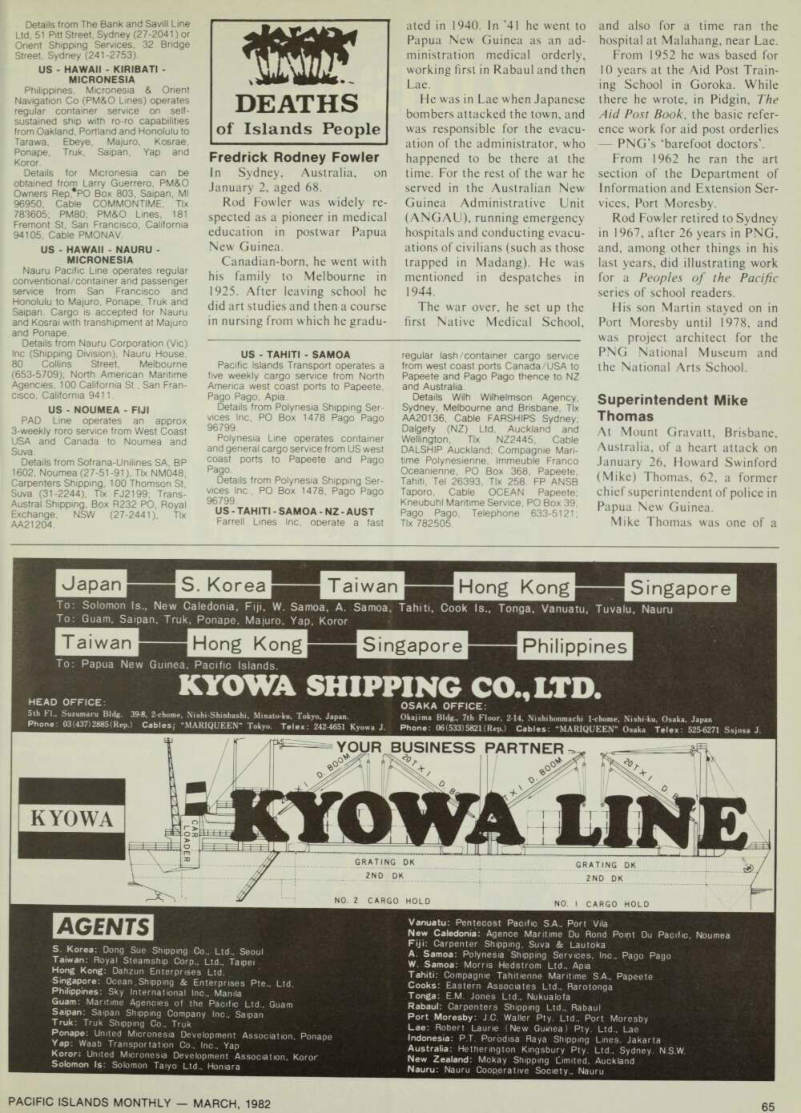
of Islands People
Fredrick Rodney Fowler In Sydney, Australia, on January 2, aged 68.
Rod Fowler was widely re spected as a pioneer in medical education in postwar Papua New Guinea.
Canadian-born, he went with his family to Melbourne in 1925. After leaving school he did art studies and then a course in nursing from which he gradu
ated in 1940. In ’4l he went to Papua New Guinea as an ad ministration medical orderly, working first in Rabaul and then Lae.
He was in Lae when Japanese bombers attacked the town, and was responsible for the evacu ation of the administrator, who happened to be there at the lime. For the rest of the war he served in the Australian New Guinea Administrative Unit (ANGAU), running emergency hospitals and conducting evacu ations of civilians (such as those trapped in Madang). He was mentioned in despatches in 1944.
The war over, he set up the first Native Medical School,
and also for a time ran the hospital at Malahang, near Lae.
From 1952 he was based for 10 years at the Aid Post Train ing School in Goroka. While there he wrote, in Pidgin, The Aid Post Book, the basic refer ence work for aid post orderlies PNG’s ‘barefoot doctors’.
From 1962 he ran the art section of the Department of Information and Extension Ser vices, Port Moresby.
Rod Fowler retired to Sydney in 1967, after 26 years in PNG, and, among other things in his last years, did illustrating work for a Peoples of the Pacific series of school readers.
His son Martin stayed on in Port Moresby until 1978, and was project architect for the PNG National Museum and the National Arts School.
Superintendent Mike
Thomas At Mount Gravatl, Brisbane, Australia, of a heart attack on January 26, Howard Swinford (Mike) Thomas, 62, a former chief superintendent of police in Papua New Guinea.
Mike Thomas was one of a
number of experienced police brought from Britain to PNG in the early 19505, and he served in Madang and in the newly opening Highlands region.
He became widely known in the 1960 s when he conducted a series of nationally-broadcast radio programmes teaching Melanesian Pidgin to English speakers. His bright presen tation, coupled with colourful translations of well-known stories, soon drew a huge listen ing audience. His spoken trans lations of ‘Little Red Riding Hood’ and ‘The Three Little Pigs’ became so popular that they were issued as records and sold widely. (But the advertis ing for the records misfired on one occasion when a letter was received which said ‘We are having a feast in the village next week. 1 have enclosed the money and please send the three pigs as soon as possible’.) Superintendent Thomas left PNG in 1970 and became a lecturer at the Queensland Police Academy, but ill-health forced him to retire early. He took a quieter job as a civilian employee at the Mount Gravatt police station and was doing the daily banking when he col lapsed and died.
Su’a Aloese In Apia, in January, aged 72.
A former member of the Western Samoa parliament, Su’a Aloese represented Faasaleleaga constituency No 3 from 1967-73. He was educated at Malifa School, and became a trader in 1932. In 1956 he joined the Agricultural Depart ment where he worked until 1966.
While in parliament, he was a member of the Bills Committee, and attended several overseas conferences.
Vili (Willie) Matamua In Auckland, New Zealand, in January, aged 51.
A prominent member of the Samoan community, Mr Matamua came to New Zea land from Samoa in 1953. He became a chief orator and lay preacher at the Pitt Street Methodist Church where he was a trustee.
Mrs Nenkatamma Reddy In Auckland, New Zealand, on November 5, 1981, of septi caemia, aged 63.
Mrs Reddy was the wife of Jai Ram Reddy, opposition leader in the Fiji Parliament.
She scratched her hand while walking in dense bush and was admitted to Lautoka Hospital when it became infected. Mrs Reddy later developed septi caemia and was flown urgently to Auckland.
Patrick John In Vanuatu, on January 13, aged 12, from a shark attack.
Patrick John, of Liro village, Paama Island, was swimming with a group of children when a shark attacked, severing both his legs.
William Henry (Bill)
Johns On the Queensland Gold Coast, Australia, late in January, William Henry (Bill) Johns, 69, a former general manager of South Pacific Brewery Ltd in Papua New Guinea, and one of PNG’s best-known business men.
Bill Johns was born in the Australian mining city of Broken Hill, and was one of the many Australians who went to the PNG goldfields in the early 19305. He became a sectional manager for Bulolo Gold Dredging Ltd until the Pacific War ended production there, and he spent the war as a lieutenant in the Australian New Guinea Administrative Unit (ANGAU). He returned to Broken Hill for several years after the war, then managed a Burns Philp subsidiary com pany in Port Moresby, and was appointed general manager of South Pacific Brewery in 1957, a position he held for more than 15 years.
He formed a number of successful companies of his own, was active in community affairs, and was awarded an OBE for community service.
Advertisements & other items, pp. 65-66 (1 item)
Kyowa Shipping Co., Ltd.
Japan
S. Korea
T aiwan
Hong Kong
Singapore
To: Solomon Is., New Caledonia. Fiji. W. Samoa, A. Samoa, Tahiti, Cook Is.. Tonga. Vanuatu. Tuvalu. Nauru To: Guam, Saipan, Truk, Ponape, Majuro, Yap, Koror
T aiwan
Hong Kong
Singapore
Philippines
To: Papua New Guinea. Pacific Islands.
KYOWA SHIPPING CO., LTD.
HEAD OFFICE:
sth FI., Suzumaru Bldg. 39-8, 2-chome. Nishi-Shinbashi. Minato-ku. Tokyo. Japan.
Phone; 03(437)2885(Rep.) Cables; "MARIQUEEN” Tokyo. Telex: 242-4651 Kyow
OSAKA OFFICE:
Okajima Bldg., 7th Floor, 2-14, Nishihonmachi 1-chome. Nishi-ku. Osaka. Japan Phone: 06(533)5821 (Rep.) Cables; -MARIQUEEN” Osaka Telex: 525-6271 Ssjosa J
YOUR BUSINESS PARTNER
i
KYOWA
AGENTS
S. Korea: Dong Sue Shipping Co.. Ltd., Seoul Taiwan: Royal Steamship Corp., Ltd., Taipei Hong Kong: Dahzun Enterprises Ltd.
Singapore: Ocean. Shipping & Enterprises Pte.. Ltd.
Philippines: Sky International Inc., Manila Guam; Maritime Agencies of the Pacific Ltd., Guam Saipan; Saipan Shipping Company Inc.. Saipan Truk: Truk Shipping Co.. Truk Ponape: United Micronesia Development Association. Ponape Yap: Waab Transportation Co.. Inc.. Yap Koror; United Micronesia Development Association. Koror Solomon Is: Solomon Tatyo Ltd.. Honiara Vanuatu; Pentecost Pacific S.A., Port Vila New Caledonia: Agence Maritime Du Rond Point Du Pacific, Noumea Fiji: Carpenter Shipping, Suva & Lautoka A. Samoa: Polynesia Shipping Services. Inc., Pago Pago W. Samoa: Morris Hedstrom Ltd., Apia Tahiti: Compagme Tahitienne Maritime S.A.. Papeete Cooks: Eastern Associates Ltd., Rarotonga Tonga: E.M. Jones Ltd.. Nukualofa Rabaul: Carpenters Shipping Ltd.. Rabaul Port Moresby: J.C. Waller Pty. Ltd.. Port Moresby Lae: Robert Laurie (New Gumea) Pty. Ltd.. Lae Indonesia: P.T. Porbdisa Raya Shipping Lines. Jakarta Australia: Hethenngton Kingsbury Pty. Ltd.. Sydney. N.S.W.
New Zealand: Mckay Shipping Limited. Auckland Nauru: Nauru Cooperative Society., Nauru
HBHHH WANTED
PLANTATION ADVISORS
■ FOR VANUATU
Working advisors needed for the improvement of ni - Vanuatu operated plantations. Qualifications required include:—A sound practical knowledge of coconuts, cocoa and cattle, experience in practical plantation management and farm mechanics.
This is a challenging position requiring extensive farmer contact, training and touring on outer islands.
"For further details contact:
Director of Agriculture,
P.O. Box 129, Port Vila, V anuatu.
WANTED
7 Waterfront Holiday Village /£,
LAND SITES (
For approx. 30 Holiday Bungalows each. Only isolated areas in beautiful totally natural environment are of interest. No roads, no electricity required. Total value of project to the local tourist economy is in excess of $6,000,000 per annum.
All South Pacific areas are of interest - except Vanuatu. For further details contact: Robert Bruderer, P.O. Box 149, Broad way, NSW. Australia, or phone Sydney 569 3500, Australia.
p Produce *
BECHE-DE-MEfifi|
FISH MAW,
SHARK FINS, etc.
For details please write to:
ASIA SEAFOOD Co.
353 A Circuit Rd., Block 64, Republic of Singapore 1337. - Cable: Seawave
REQUIRE
DRIED SHARK FINS
FOR PRICES AND
INFORMATION ETC.,
PLEASE WRITE TO:
S. DADDOW,
ASIA TONGA TRADING,
7 KASAI ROAD,
REPUBLIC OF SINGAPORE,
2880.
CABLE: "ASIATONGA"
Advertisers Index
AHI Aluminium 44 Amatil 31 Asia Tonga Trading 66 Asia Seafood Co. 66 Australian Microwave Systems 36 Aiwa 47 Air New Zealand 50 Bankline 62 China Navigation Corporation 64 Carptrac 14 Clarion Shoji 8 Davies & Collison 28 Department of T rade 40 Elizabeth E. Coral Cruises 55 Foodtex 61 General Steamship Corporation 63 Healing Industries 52 Hitachi IFC Henry Cumines 63 Inter Island Shipping 55 Kyowa Shipping 65 Liapari Limited 56 McNaught 12 Matsushita 22 MacQuarrie Industries 46 McDonnell Douglas 48 49 Mason Shipping 61 NZ Dairy Board IBC NZ Police 42 Nelson & Robertson 60 Nissan 6 Pacific Forum 59 Pioneer 4 Papua Hotel 53 QBE Insurance 24 Suzuki 16 Sonar Ship Brokerage 66 Sony Corporation OBC S.E. Tatham 58 Toyota 34-35 Trio Kenwood 27 Tropical Reef Enterprises 54 Victor Company of Japan 38 Video Recorder Centre 66 Yanmar Diesel 32
Advertisements & other items, pp. 66-68 (1 item)
>V)
BUYING OR SELLING
LIST WITH US FOR:
COMMERCIAL SHIPS
FISHING VESSELS
YACHTS
TRAWLERS
WORK BOATS
Sonar Ships Brokerage
BOX 1811 CAIRNS, OLD.
AUSTRALIA
PH: (070) 515371
SONY
VIDEO RECORDERS
VIDEO MOVIES
VIDEO ACCESSORIES
-JVC *4,
AKAI
V gg
INTERCAPE- VIDEO RECORDER CEIMTRE
19-21 Lonsdale Street. Melbourne, Victoria 3000 Telephone: (03) 633 086, 633 196
KP-5020PSE KP-7220PSE
0 m n ' *-'.' I .‘a* ’i.*
i nil
■Mr 1 f ULL cre a ■ &-J!F * non fat dried milk
Anchor
m i ?/*•
p ULL OP&
VI!
Ir k*i milk a r 6 ' Ancnor instant ii:
aw™! a***
f>ufl?
iatlL !
V -T A vJ« '
,P*'. %t *i \ S\
New • {^jj
Cr ?l New Zealand
b cr e arrie ry i N " butted H instant ■ : r i*d whol* I W
OBUC
Anchor, •i
09MAYW
n*««M Anchor s - e* «=. ♦Of*: . ♦ .
■ -r^r:T'.
milk
Übj-Pciiircaed
® ‘SSMT «
v TfSfffg vS^-T^c <1 4 111
STOCK ROTATION
») «1» Hill* l iOP 0 CMtrSE
w« CREAMER*
W BUTTER
S^.«Bsi
w or ♦ * ** i .s?o Cl- •I ♦ 0 I 1 > <• 5 18/; i et: ki i it kfIZC 919
No one comes closer.
OF
AOs
m ❖ V V - \b A o I *
The world’s smallest hi-fi.
Sony Walkman n.
Ever since Sony first created the Walkman, the world has discovered a new kind of music happiness. Now comes the Walkman lE. We made it the world’s smallest by making it almost the same size as the cassette itself. You’ll find it’s the lightest hi-fi in the world. Even better, you’ll enjoy sound that’s pure high fidelity, like no other. This is your life, your music. Enjoy it all with a Walkman Z. It’s an original from Sony.
wniKman
WALKMAN is a trademark of Sony Corporation.
Walkman is guaranteed worldwide for 90 days under Sony's International Warranty System. * c WM-2