approach to big trade display
pp. 58-63 · Read in the full issue
Islanders’ new “get up and go” approach to big trade display
“Millionaire’s salad for export to Australia.”
When this item from Kiriba ti was noted among the dozens of commodities and wares coming for a September Paci fic Islands trade display in Sydney, it was like a declara tion: a declaration of the Is lands’ growing determination to sell anything they can in the competitive markets of the de veloped world.
These are the markets, of course, in which the island countries have taken such a caning with commodity prices.
But the most harmful events still do some good somewhere, and the collapsed commodity markets appear to have shar pened up the generally easy going approach to marketing in all the Islands.
Besides millionaire’s salad from the “heart” of the coco nut palm it gets its name from the fact that removal of the part that’s eaten kills the tree the goods being offered to Australian buyers indicate how the Islands are making better use of the scarce re sources, local skills and va rious aid schemes and joint ventures to find new markets and to find products fre quently foreign to their islands for those markets.
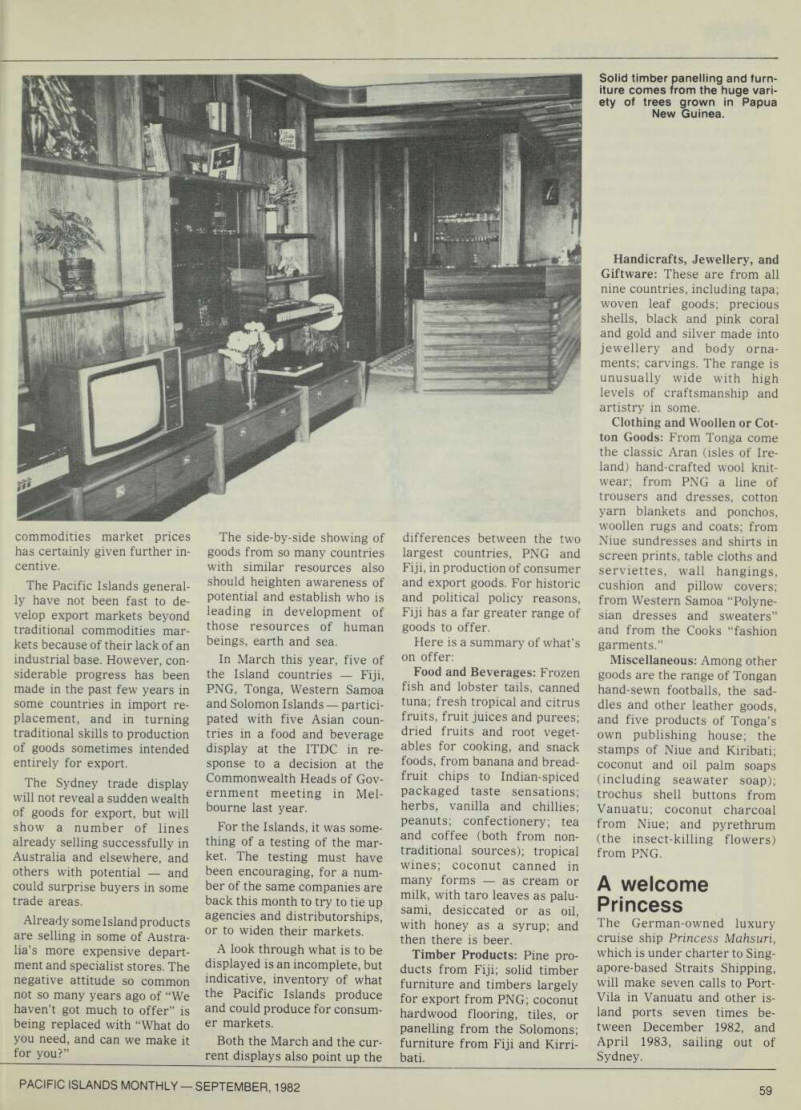
A look at a few says a lot: • Handmade leather sad dles (for horses) and fine hand-crafted wool sweaters from Tonga. • High quality coconut hardwood for the building trade from Solomon Islands. • Fresh flowers from Vanuatu. • Tropical wines from Western Samoa. • Office and domestic furn iture and panelling, all of solid
timber, and stationery, from Papua New Guinea. • Spicy snack foods from Fiji based on Indian traditional ingredients, which have poten tial to capture some of the Australian pub and club market. • Honey and coconut cream syrup from Niue and Western Samoa, a substitute for maple syrup.
The nine countries Cook Islands, Fiji, Kiribati, Niue, Papua New Guinea, Solomon Islands, Tonga, Vanuatu and Western Samoa are presen ting their commodities and wares at the International Trade Development Centre (ITDC) from 28-30 September.
The display was a proposal of the Australian Government financed trade commission of the South Pacific Bureau for Economic Co-operation (SPEC); the organisation is by the Aus-tralian Department of Trade and Resources which runs the ITDC to promote im ports from developing coun tries, using Australian De velopment Assistance funds; and the selection and arran ging of goods is by each coun try with assistance from ITDC staff.
However, there is more to this event than that.
It is the culmination so far of efforts made by so many Is lands businessmen, of exhorta tions by Islands politicians, of financing by aid donor coun tries and joint-venture part ners, and of the lowering of trade barriers through agree ments like SPARTECA, giving Pacific Island countries duty free entry to Australia and New Zealand for most exports.
The rather desperate econo mic situation created in most Pacific Island countries by the
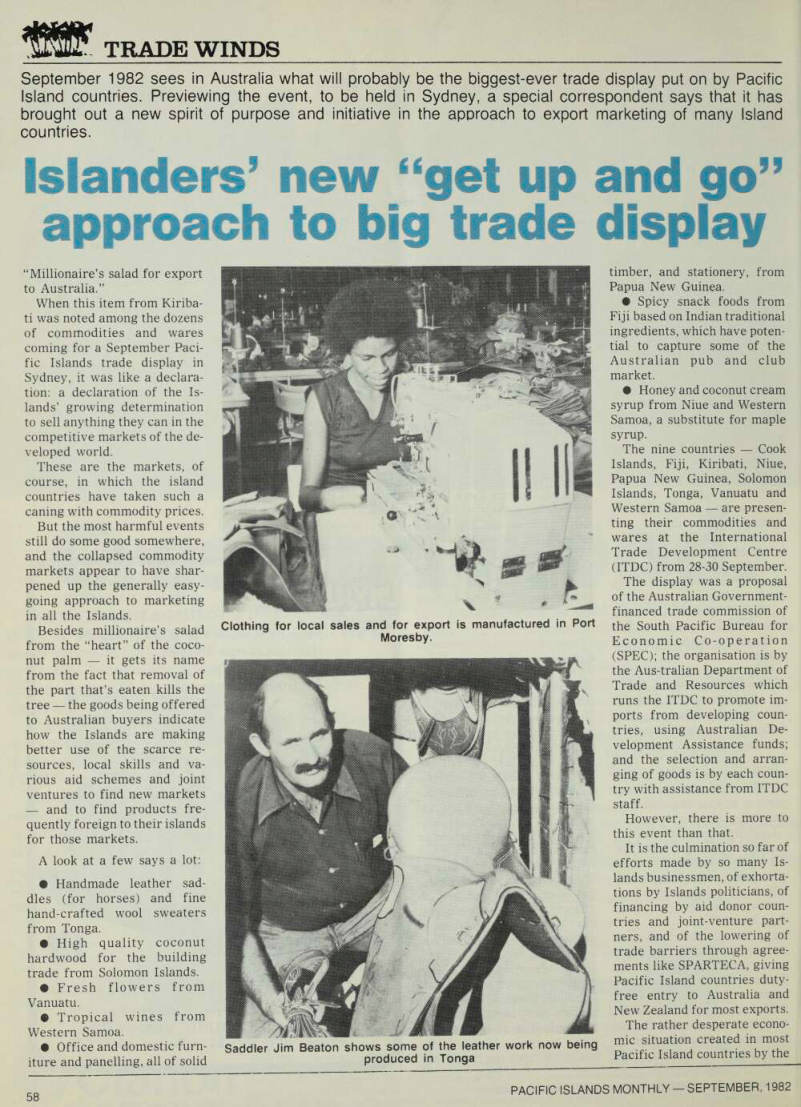
Clothing for local sales and for export is manufactured in Port Moresby.
Saddler Jim Beaton shows some of the leather work now being produced in Tonga
commodities market prices has certainly given further in centive.
The Pacific Islands general ly have not been fast to de velop export markets beyond traditional commodities mar kets because of their lack of an industrial base. However, con siderable progress has been made in the past few years in some countries in import re placement, and in turning traditional skills to production of goods sometimes intended entirely for export.
The Sydney trade display will not reveal a sudden wealth of goods for export, but will show a number of lines already selling successfully in Australia and elsewhere, and others with potential and could surprise buyers in some trade areas.
Already some Island products are selling in some of Austra lia’s more expensive depart ment and specialist stores. The negative attitude so common not so many years ago of “We haven’t got much to offer” is being replaced with “What do you need, and can we make it for you?”
The side-by-side showing of goods from so many countries with similar resources also should heighten awareness of potential and establish who is leading in development of those resources of human beings, earth and sea.
In March this year, five of the Island countries Fiji, PNG, Tonga, Western Samoa and Solomon Islands partici pated with five Asian coun tries in a food and beverage display at the ITDC in re sponse to a decision at the Commonwealth Heads of Gov ernment meeting in Mel bourne last year.
For the Islands, it was some thing of a testing of the mar ket. The testing must have been encouraging, for a num ber of the same companies are back this month to try to tie up agencies and distributorships, or to widen their markets.
A look through what is to be displayed is an incomplete, but indicative, inventory of what the Pacific Islands produce and could produce for consum er markets.
Both the March and the cur rent displays also point up the
differences between the two largest countries, PNG and Fiji, in production of consumer and export goods. For historic and political policy reasons, Fiji has a far greater range of goods to offer.
Here is a summary of what’s on offer: Food and Beverages: Frozen fish and lobster tails, canned tuna; fresh tropical and citrus fruits, fruit juices and purees; dried fruits and root veget ables for cooking, and snack foods, from banana and bread fruit chips to Indian-spiced packaged taste sensations; herbs, vanilla and chillies; peanuts; confectionery; tea and coffee (both from non traditional sources); tropical wines; coconut canned in many forms as cream or milk, with taro leaves as palu sami, desiccated or as oil, with honey as a syrup; and then there is beer.
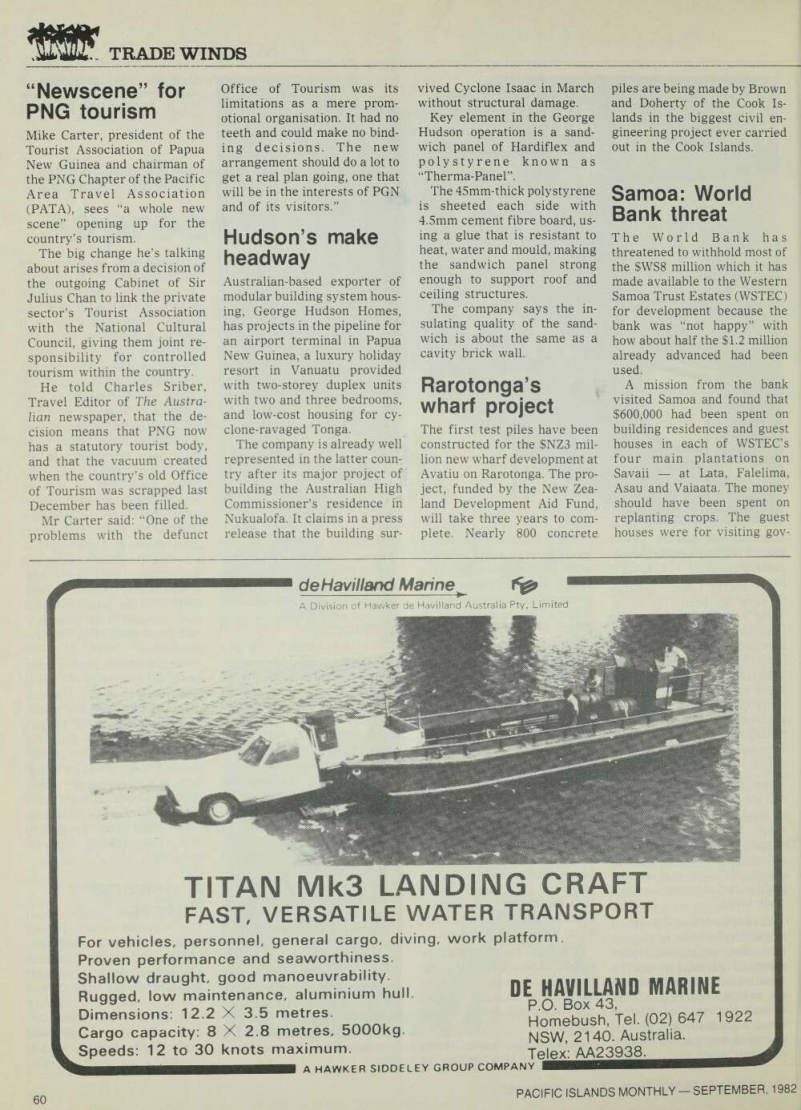
Timber Products: Pine pro ducts from Fiji; solid timber furniture and timbers largely for export from PNG; coconut hardwood flooring, tiles, or panelling from the Solomons; furniture from Fiji and Kirri bati.
Handicrafts, Jewellery, and Giftware: These are from all nine countries, including tapa; woven leaf goods; precious shells, black and pink coral and gold and silver made into jewellery and body orna ments; carvings. The range is unusually wide with high levels of craftsmanship and artistry in some.
Clothing and Woollen or Cot ton Goods: From Tonga come the classic Aran (isles of Ire land) hand-crafted wool knit wear; from PNG a line of trousers and dresses, cotton yarn blankets and ponchos, woollen rugs and coats; from Niue sundresses and shirts in screen prints, table cloths and serviettes, wall hangings, cushion and pillow covers; from Western Samoa “Polyne sian dresses and sweaters” and from the Cooks “fashion garments.”
Miscellaneous: Among other goods are the range of Tongan hand-sewn footballs, the sad dles and other leather goods, and five products of Tonga’s own publishing house; the stamps of Niue and Kiribati; coconut and oil palm soaps (including seawater soap); trochus shell buttons from Vanuatu; coconut charcoal from Niue; and pyrethrum (the insect-killing flowers) from PNG.
A welcome
Princess
The German-owned luxury cruise ship Princess Mahsuri, which is under charter to Sing apore-based Straits Shipping, will make seven calls to Port- Vila in Vanuatu and other is land ports seven times be tween December 1982, and April 1983, sailing out of Sydney.
Solid timber panelling and furn iture comes from the huge vari ety of trees grown in Papua New Guinea.
“Newscene” for
PNG tourism
Mike Carter, president of the Tourist Association of Papua New Guinea and chairman of the PNG Chapter of the Pacific Area Travel Association (PATA), sees “a whole new scene” opening up for the country’s tourism.
The big change he’s talking about arises from a decision of the outgoing Cabinet of Sir Julius Chan to link the private sector’s Tourist Association with the National Cultural Council, giving them joint re sponsibility for controlled tourism within the country.
He told Charles Sriber, Travel Editor of The Austra lian newspaper, that the de cision means that PNG now has a statutory tourist body, and that the vacuum created when the country’s old Office of Tourism was scrapped last December has been filled.
Mr Carter said: “One of the problems with the defunct
Office of Tourism was its limitations as a mere prom otional organisation. It had no teeth and could make no bind ing decisions. The new arrangement should do a lot to get a real plan going, one that will be in the interests of PGN and of its visitors.”
Hudson’s make
headway
Australian-based exporter of modular building system hous ing, George Hudson Homes, has projects in the pipeline for an airport terminal in Papua New Guinea, a luxury holiday resort in Vanuatu provided with two-storey duplex units with two and three bedrooms, and low-cost housing for cy clone-ravaged Tonga.
The company is already well represented in the latter coun try after its major project of building the Australian High Commissioner’s residence in Nukualofa. It claims in a press release that the building sur
vived Cyclone Isaac in March without structural damage.
Key element in the George Hudson operation is a sand wich panel of Hardiflex and polystyrene known as “Therma-Panel”.
The 45mm-thick polystyrene is sheeted each side with 4.5 mm cement fibre board, us ing a glue that is resistant to heat, water and mould, making the sandwich panel strong enough to support roof and ceiling structures.
The company says the in sulating quality of the sand wich is about the same as a cavity brick wall.
Rarotonga’s
wharf project
The first test piles have been constructed for the SNZ3 mil lion new wharf development at Avatiu on Rarotonga. The pro ject, funded by the New Zea land Development Aid Fund, will take three years to com plete. Nearly 800 concrete
piles are being made by Brown and Doherty of the Cook Is lands in the biggest civil en gineering project ever carried out in the Cook Islands.
Samoa: World
Bank threat
The World Bank has threatened to withhold most of the SWSB million which it has made available to the Western Samoa Trust Estates (WSTEC) for development because the bank was “not happy” with how about half the $1.2 million already advanced had been used.
A mission from the bank visited Samoa and found that $600,000 had been spent on building residences and guest houses in each of WSTEC’s four main plantations on Savaii at Lata, Falelima, Asau and Vaiaata. The money should have been spent on replanting crops. The guest houses were for visiting gov
ernment officials and their guests.
The Australian Government had offered aid to build the premises, but because the then government failed to supply Australia with the information it requested and went ahead with the project, Australia re fused to pay for the buildings.
The World Bank asked for revised plans for the planting of up to 120 hectares with cocoa before the year’s end, and warned that, if develop ment was not satisfactory, aid would be cut off.
Atiu relieved
by Maverick
The cruising American yacht Maverick, skippered by Michael Needham, sailed to the rescue of the hungry peo ple of Atiu, Cook Islands, re cently. Maverick was anchored at Avatiu on Raro tonga when word arrived that the Atiuans’ larder was nearly empty, and no ships were sche duled to call there. Prime Minister Sir Tom Davis, a yachtie from way back, had the answer. “See Michael Needham of the Maverick,” he said.
Michael obliged. Maverick sailed to Atiu with a load of food, and then, at Atiu, took on board bags of taro, cartons of pineapples and other produce destined for New Zealand but marooned because of the lack of shipping. When Maverick dropped anchor at Avatiu, the cargo the first from Atiu was discharged. It turned the scales at two tonnes.
Air Pacific
as courier
Air Pacific has started a new door-to-door courier service for Fiji and international deliv ery of documents and films.
Labasa, Nadi and Suva are the primary pickup points in Fiji.
In Fiji itself or to Australia and New Zealand the service undertakes to make delivery in 24 hours. The overseas sec tion of the service is linked with the Australian-based transport giant Thomas Nationwide Transport (TNT).
Oz aid for
Fiji
Australia has offered almost SAIO million in aid for Fiji for this financial year, the great est part, $8 million, going to wards projects nearing com pletion, including the Yalavou beef scheme, Australia’s lar gest aid project in Fiji, and the Monasavu hydro-electricity scheme.
New Zealand has announced aid for Fiji of SNZ4 million.
New service for
Majuro
The Philippines, Micronesia and Orient Navigation Co. will call at Majuro, capital of the Marshall Islands, every 28 days on an eastbound route, primarily to uplift coconut oil from the Tobolar plant. The Nauru Pacific Line also calls for coconut oil.
Suva port’s
big upgrade
Port facilities in Fiji’s capital Suva are to be upgraded at a cost of more than SFIO million.
Contractors are a Fiji com pany, Reddy Fletcher contrac tors.
Cheap bed lure
in Tahiti
From August 4 Air Pacific and Qantas jointly introduced a $lO accommodation stopover package in Tahiti.
The package provides up to two nights’ accommodation at $lO per night at the Tahiti Holiday Inn for passengers on Air Pacific flights out of Fiji who are awaiting connecting flights with Qantas to Los Angeles.
The package is designed to encourage those flying to the United States to fly through Tahiti instead of Hawaii. • • • Two Suva firms, Lalato and Company and Central Pharma cy, and the New Zealand firm of John Heald and Sons, are partners in a new company, Pablo, which has opened a plastic goods factory in Nasi nu, near Suva. • • • Canada is financing a mussel culture project for Western Samoa’s fisheries. Mussel spat is being imported from the Philippines and, if experi ments are successful, it will become a project for women’s committees in the villages.
Fiji is increasing its exports to Japan, adding Cheddar cheese to the list, which also includes tinned catfood. A large fish canning factory at Levuka, Fi ji’s old capital, in which the Fiji Government and Japanese interests are partners, is a big supplier to the animal food market. • • • Tuvalu has drawn up a Rural Small Projects Programme to be submitted to Australia under the bilateral aid agree ment. Under the agreement Australia will provide up to a maximum of $lO,OOO for each project. A similar scheme is being discussed with the New Zealand Government. West Germany has also given $5OOO for a water and sanitation im provement project.
Taveuni’s into
coffee
A Fiji coffee project costing about SFI million to establish has been officially opened on the island of Taveuni. The group of companies behind the project expect to have about 250,000 trees producing a crop of 500,000 tonnes by 1987.
Japan aids
Kiribati
Japan has granted Kiribati 500 million yen (about SA2 million) for a fisheries promotion pro ject, according to an official Japanese news release.
This follows a request from Kiribati for a fisheries re search and training vessel, fishing tackle and refrigerat ing and ice-making equipment to develop a fisheries industry now that the reserves of phos phate ore have been depleted.
The government of Kiribati had formulated a fisheries promotion project as part of its fourth national develop ment plan, with the object of training fishermen and secur ing the means of distributing marine products, the news re
lease said.
Williarn Gasson,
in Wellington
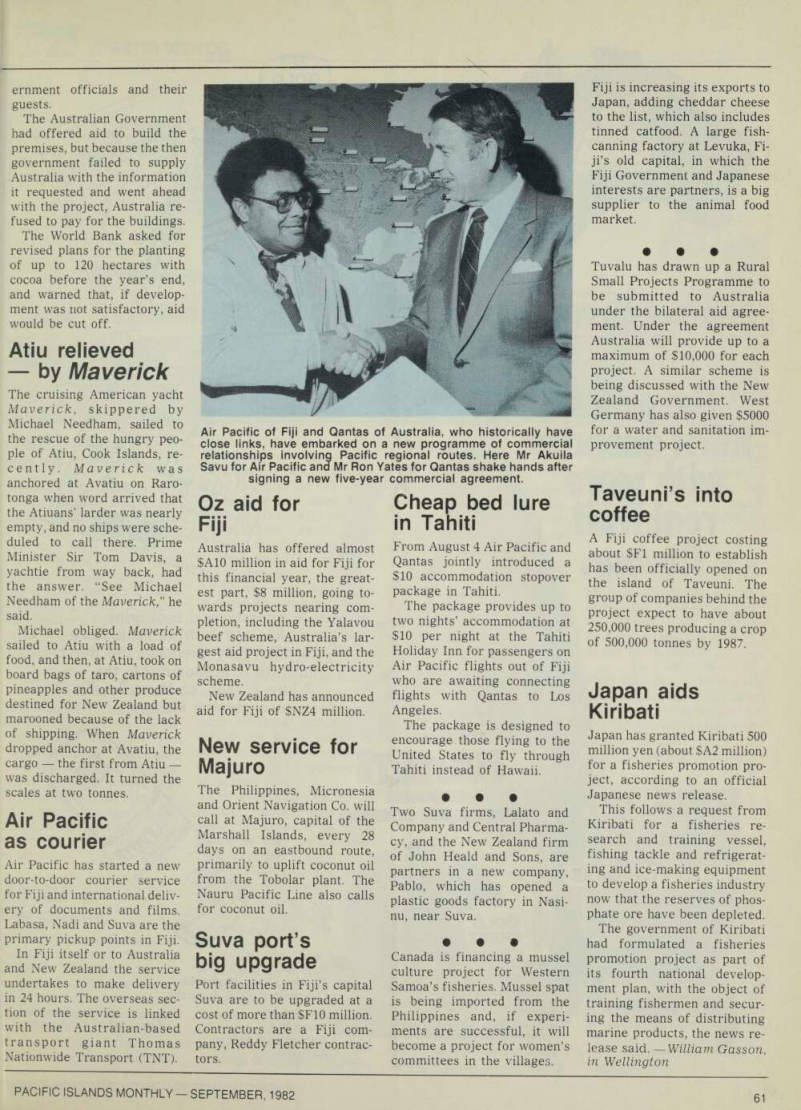
Air Pacific of Fiji and Qantas of Australia, who historically have close links, have embarked on a new programme of commercial relationships involving Pacific regional routes. Here Mr Akuila Savu for Air Pacific ana Mr Ron Yates for Qantas shake hands after signing a new five-year commercial agreement.
Cattle, water
aid to Vanuatu
An agreement signed in Port- Vila in June provides for Au stralian aid to the tune of $A500,000 in improving Vanuatu’s main cattle-breed ing station, and its rural water supplies. Signing for Vanuatu was Minister for Lands Sethy Regevanu, and for Australia that country’s High Commis sioner to Vanuatu, Michael Ovington. • • • Sten Munch-Petersen, a fisher ies scientist from the Danish Institute of Fisheries and Marine Research, is engaged on a two-year study of tuna resources in Fiji waters. The European Economic Commun ity is sponsoring the project.
Mr Munch-Petersen is at the University of the South Pacific in Suva.
AESOP off
the ground
The New Australian Executive Service Overseas Program (AESOP), which will provide volunteer Australian execu tives, managers and techni cians for developing countries, has reported a “most enthu siastic response” from the ASEAN region, Papua New
Guinea and the South Pacific.
In the three months since the scheme became operation al, 67 requests for aid under the scheme have come from Malaysia (5), Niue (1), the Phil ippines (38), Papua New Guinea (18), Solomon Islands (2), Thailand (1), Tonga (1), and Turkey (1).
They covered a wide range of enterprises including furni ture-making, engineering, business administration, advertising and agriculture.
Of the 67 applicants, two have been rejected as falling outside AESOP guidelines, two have been accepted and volun teers allocated, and further details are being sought to allow formal consideration of the remaining 63 expressions of interest.
The executive director of AESOP, Rod Cheatley, said many Australians of high calibre already had offered their experience and exper tise. He said a register of skills was being developed so that AESOP’s foreign represent atives could be advised of the services available. • • • The Vanuatu Commodities Marketing Board reports im proved production and quality of copra since the board was established in April. The docks at Port-Vila and Santo had received 4136 tonnes in June.
Future of
Fentress
The U.S. Trust Territory Gov ernment has given the Mar shall Islands the freighter Fen tress, a well-known cargo car rier in Micronesia, and the republic’s government has formed a company, Marshall Islands Maritime Company Inc. to run the ship. The gov ernment is the sole stockhold er. It is planned to put the ship into service between Hono lulu, Tahiti, the Samoas and the Marshalls. The govern ment will eventually be ac quired by private interests. • • • Qantas, Australia’s flag car rier, has exercised its right to a share of the air traffic be tween Sydney and Port-Vila.
One of the two flights by Air Vanuatu (Ansett Airlines and Vanuatu Government) be tween Sydney and the Vanuatu capital each week becomes a Qantas flight with a Qantas flight number. • • • German shipping consultant Captain Jorg Wagener, 42, has arrived in Apia to take over as new general manager of Samoa Shipping Services, succeeding Captain Rasmus Sieg, who has returned to Hamburg. Captain Wagener, who is on a two-year assign ment, comes to Western
Samoa from the Philippines where he was employed by the United Nations to design a container terminal. He has worked as a shipping consul tant in various countries in cluding Kiribati. • • • The prospects of profitable fishing for deep-water shrimps in Papua New Guinea waters are being investigated by Michael King, a marine biologist from the University of the South Pacific. • • • Fiji’s Ministry of Health and the World Health Organisation have signed an agreement for a $F155,000 health programme concentrated on mothers, chil dren, and family planning.
Utrik to go
solar
The council on Utrik Atoll in the Marshall Islands plans to spend SU.S. 100,000 it has re ceived from the United States as radiation compensation on the installation of a solar powered electricity generat ing system. The U.S. National Aeronautics and Space Administration has agreed to share with the council the cost of installing a 16 kW system which will provide power for lighting, refrigeration and some community washing machines.
Air Niugini’s new Canadian manufactured Dash-7 aircraft have been going through political as well as technical considerations at they take over many internal routes in Papua New Guinea. The newly-returned Prime Minister Michael Somare at first threatened to sell them on the grounds that they had been bought for political grandstanding by tne previous government. But the deal was too big to reverse and no immediate change is likely. One of the new aircraft is shown here at Rabaul Airport. - Stuart Inder picture.