Changing face
pp. 24-25 · Read in the full issue
of Tahiti’s
Tiurai
Since 1881, the big annual event in French Polynesia has been the TIURAI which is simply the Tahitian way of pronouncing the English word July. Officially, as everybody knows, this festival commemorates the glorious day in 1789 when the hated symbol of the despotic rule of Louis XVI, the Bastille prison, was destroyed by the people of Paris.
But to ascribe the fervour with which the Tahitians participate in the three-week festival to any revolutionary or republican sentiments would be a gross mistake. In fact, throughout the reign of Napoleon 111, from 1852 to 1870, the Tahitians celebrated with equal zest, every year, on August 15, the French Emperor’s birthday. But whatever the pretext for the carousing, there was always up to 1963 a common denominator: the Tahitians themselves were the main organis ers, actors and beneficiaries of the annual affairs.
What has changed since that year, when General de Gaulle made his fateful decision to use French Polynesia for nuclear bomb tests, is the general character of the TIURAI festival. It has become a more and more commercially orientated show for the enjoyment of the 25,000 Frenchmen who since that time have come to live and work in the islands, and the 10,000 foreign tourists who flock to Papeete on this occasion in the hope of catching a glimpse of the real South Seas that enchanted Cook, Melville and Gauguin.
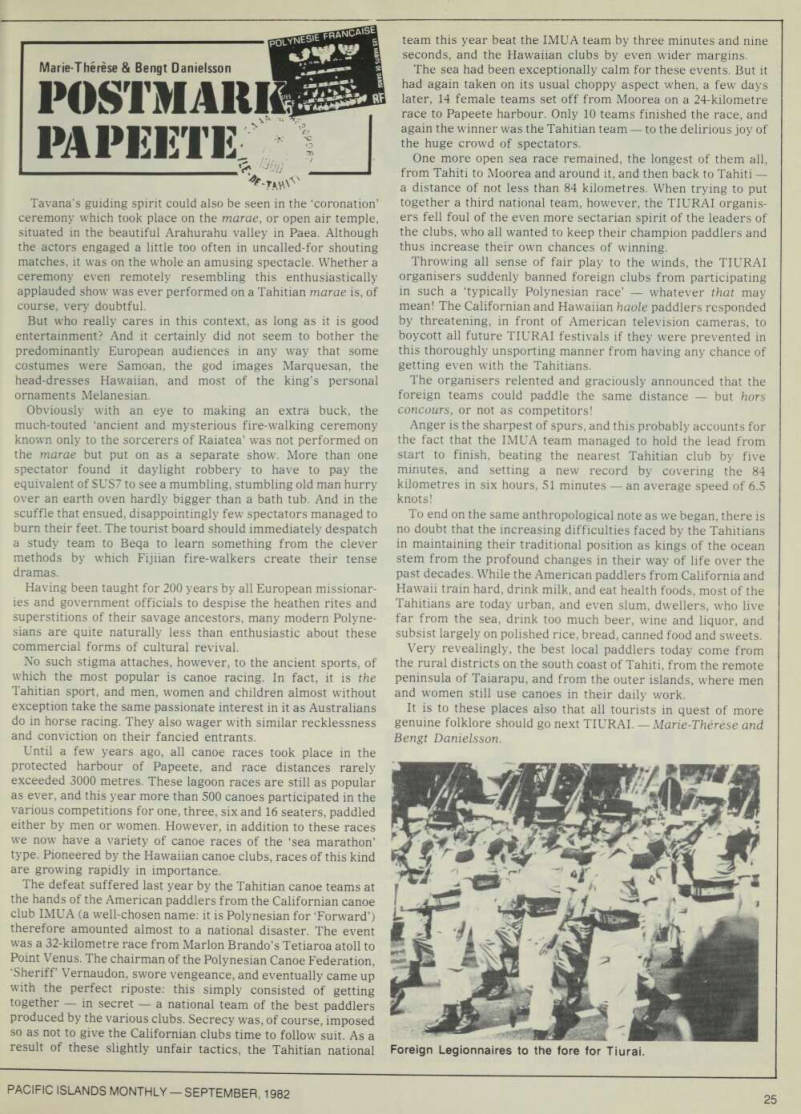
The dominant role played by the French armed forces in the territory nowadays was strongly evident in the big parade that opened the 1982 TIURAI festival early in the morning of July 14, Bastille Day itself. To begin with, the admiral in charge of the nuclear testing made the 3000 or so Tahitians who were to march past the official grandstand wait for 40 minutes while first of all he himself was made a commandeur de la legion d'honneur, and then while he, with much ceremony, distributed medals to no fewer than 34 worthy officers and men.
When the parade at long last got under way, it was spearheaded by 700 troops and policemen (representing a tenth of the total garrison), while a military press officer with an unpleasant metallic voice told us all about the glorious feats of arms of the French colonial regiments represented. (All this was as nothing, however, to the mental suffering inflicted upon those who followed the ceremony on radio or TV, for the commentator was, as usual, a Frenchman who knew nothing about local customs and traditions, and who mispro nounced all Polynesian names and words in the most atrocious manner.) The smartly dressed groups of Polynesians who followed, in only slightly less military order, provided a sure guide to the activities and interests that are officially encouraged and approved of; thus, the local churches and missions were out in strength, there were canoe-paddlers, footballers, volley ball players, archers, as well as singers, dancers and craftsmen. On the other hand, no political, ecological or philanthropic association was represented that is, if we exclude from these categories a group of police-dog trainers, who are doing a roaring trade among the new French settlers, all scared to death of the activities of the numerous Tahitian youth gangs.
The flooding of the country with French settlers and army personnel since 1963 is constantly presented as a great blessing to the natives who, by selling goods and services to these eager
customers, have supposedly achieved the highest standard of living in the Pacific. Even if the true picture is considerably less glossy, it is an undisputed fact that the whole island economy has been totally transformed in less than a genera tion.
Before this enforced prosperity hit the Tahitians, they were all free, independent planters and fishermen who could easily and did spend weeks and months composing songs, rehearsing dances and making costumes in preparation for the TIURAI, and then remain in town for the duration of the festival.
Today, practically all adult Tahitians, both men and women, regularly work for wages. Their employers, of course, refuse to give them leave of two or three months, however patriotic the cause may be. This is why there have emerged groups of professional dancers and singers who perform all year round in the big hotels and restaurants, when they are not on extended tours of America, Europe, Japan, or the Arab countries.
Fortunately, all Polynesians can still sing and dance, and they do so with the wonderful grace, zest and humour for which they have become famous throughout the world. When it comes to other aspects of their ancestral culture, however, there has been a complete break with the past, and the present generations either know nothing, or have totally erroneous ideas, about them, If Tahiti is to compete successfully with Hawaii in the Polynesian entertainment field and this is the avowed aim of the local tourist board we had therefore better follow the example of Waikiki and Laie and hire anthropologists with university degrees, and imaginative showmen, to train truly profesional native performers.
A first timid step in this direction was taken this year by calling in High Chief Tavana Anderson from Honolulu to help with the tattooing ceremony and the re-enactment of a ‘Tahitian coronation’. Tavana promptly imported two tattooing masters from Samoa who set to work on Tahitian volunteers, surrounded by ever-growing crowds of paying spectators.
However, it remains a mystery to us why these fine craftsmen were not allowed to use any Samoan designs, but had to work solely from poor copies of the splendid pictures of tattooed Marquesans which illustrate the classical accounts by Karl von den Steinen and Willowdean Handy.
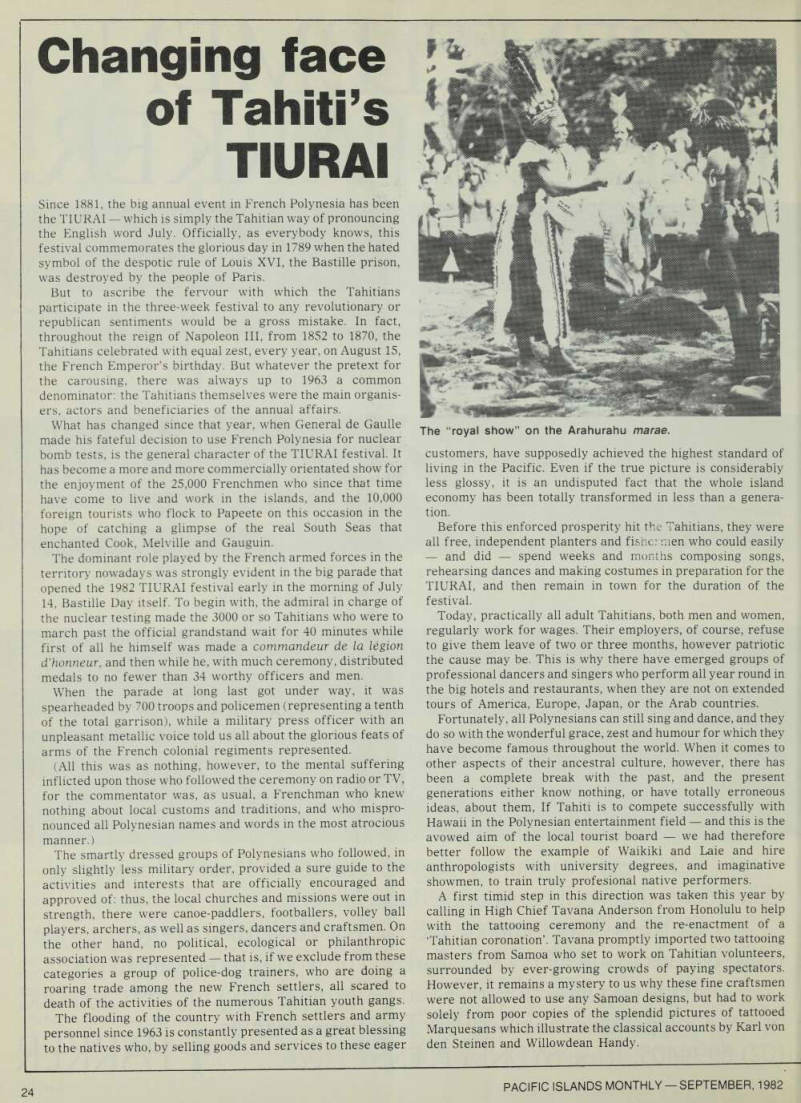
The “royal show” on the Arahurahu marae.
Tavana’s guiding spirit could also be seen in the ‘coronation’ ceremony which took place on the marae, or open air temple, situated in the beautiful Arahurahu valley in Paea. Although the actors engaged a little too often in uncalled-for shouting matches, it was on the whole an amusing spectacle. Whether a ceremony even remotely resembling this enthusiastically applauded show was ever performed on a Tahitian marae is, of course, very doubtful.
But who really cares in this context, as long as it is good entertainment? And it certainly did not seem to bother the predominantly European audiences in any way that some costumes were Samoan, the god images Marquesan, the head-dresses Hawaiian, and most of the king’s personal ornaments Melanesian.
Obviously with an eye to making an extra buck, the much-touted ‘ancient and mysterious fire-walking ceremony known only to the sorcerers of Raiatea’ was not performed on the marae but put on as a separate show. More than one spectator found it daylight robbery to have to pay the equivalent of SUS 7 to see a mumbling, stumbling old man hurry over an earth oven hardly bigger than a bath tub. And in the scuffle that ensued, disappointingly few spectators managed to burn their feet. The tourist board should immediately despatch a study team to Beqa to learn something from the clever methods by which Fijiian fire-walkers create their tense dramas.
Having been taught for 200 years by all European missionar ies and government officials to despise the heathen rites and superstitions of their savage ancestors, many modern Polyne sians are quite naturally less than enthusiastic about these commercial forms of cultural revival.
No such stigma attaches, however, to the ancient sports, of which the most popular is canoe racing. In fact, it is the Tahitian sport, and men, women and children almost without exception take the same passionate interest in it as Australians do in horse racing. They also wager with similar recklessness and conviction on their fancied entrants.
Until a few years ago, all canoe races took place in the protected harbour of Papeete, and race distances rarely exceeded 3000 metres. These lagoon races are still as popular as ever, and this year more than 500 canoes participated in the various competitions for one, three, six and 16 seaters, paddled either by men or women. However, in addition to these races we now have a variety of canoe races of the ‘sea marathon’ type. Pioneered by the Hawaiian canoe clubs, races of this kind are growing rapidly in importance.
The defeat suffered last year by the Tahitian canoe teams at the hands of the American paddlers from the Californian canoe club IMUA (a well-chosen name: it is Polynesian for ‘Forward’) therefore amounted almost to a national disaster. The event was a 32-kilometre race from Marlon Brando’s Tetiaroa atoll to Point Venus. The chairman of the Polynesian Canoe Federation, ‘Sheriff’ Vernaudon, swore vengeance, and eventually came up with the perfect riposte: this simply consisted of getting together in secret a national team of the best paddlers produced by the various clubs. Secrecy was, of course, imposed so as not to give the Californian clubs time to follow suit. As a result of these slightly unfair tactics, the Tahitian national
team this year beat the IMUA team by three minutes and nine seconds, and the Hawaiian clubs by even wider margins.
The sea had been exceptionally calm for these events. But it had again taken on its usual choppy aspect when, a few days later, 14 female teams set off from Moorea on a 24-kilometre race to Papeete harbour. Only 10 teams finished the race, and again the winner was the Tahitian team to the delirious joy of the huge crowd of spectators.
One more open sea race remained, the longest of them all, from Tahiti to Moorea and around it, and then back to Tahiti a distance of not less than 84 kilometres. When trying to put together a third national team, however, the TIURAI organis ers fell foul of the even more sectarian spirit of the leaders of the clubs, who all wanted to keep their champion paddlers and thus increase their own chances of winning.
Throwing all sense of fair play to the winds, the TIURAI organisers suddenly banned foreign clubs from participating in such a ‘typically Polynesian race’ whatever that may mean! The Californian and Hawaiian haole paddlers responded by threatening, in front of American television cameras, to boycott all future TIURAI festivals if they were prevented in this thoroughly unsporting manner from having any chance of getting even with the Tahitians.
The organisers relented and graciously announced that the foreign teams could paddle the same distance but hors concours, or not as competitors!
Anger is the sharpest of spurs, and this probably accounts for the fact that the IMUA team managed to hold the lead from start to finish, beating the nearest Tahitian club by five minutes, and setting a new record by covering the 84 kilometres in six hours, 51 minutes an average speed of 6.5 knots!
To end on the same anthropological note as we began, there is no doubt that the increasing difficulties faced by the Tahitians in maintaining their traditional position as kings of the ocean stem from the profound changes in their way of life over the past decades. While the American paddlers from California and Hawaii train hard, drink milk, and eat health foods, most of the Tahitians are today urban, and even slum, dwellers, who live far from the sea, drink too much beer, wine and liquor, and subsist largely on polished rice, bread, canned food and sweets.
Very revealingly, the best local paddlers today come from the rural districts on the south coast of Tahiti, from the remote peninsula of Taiarapu, and from the outer islands, where men and women still use canoes in their daily work.
It is to these places also that all tourists in quest of more
genuine folklore should go next TIURAI.
Marie-Thérèse and
Bengt Danielsson.
Foreign Legionnaires to the fore for Tiurai.