bankruptcy
pp. 27-30 · Read in the full issue
Political Currents
Before Vanuatu
Final bankruptcy of plans for pro-French majority
HOWARD VAN TREASE this month concludes his three-part series of analyses of a number of confidential reports to Paris by successive French Resident Commissioners in Port-Vila, New Heb rides/Vanuatu. The reports, inadvertently left be hind by French diplomatic personnel in the flurry of their departure on Vanuatu’s accession to independence in 1980, cover the period 1969 up to the eve of independence.
The most difficult task facing French officials was getting the various parties on which they were working to put aside their rivalries and differences and agree to a common strategy.
For the time being the agree ment between parties on a concerted strategy is still hypothetical, despite the in tervention of the French Re sidency. (Gauger, September 1975.) Even with the French Resi dent Commissioner’s direct in volvement, dbtaining unity among the “moderate” parties proved difficult.
MANH leaders, temporarily in Port Vila, remained elusive faced by our reprimands, in spite of the warning I gave them that they would receive no help from the Residency if they did not agree to an “en tente” with UCNH. (Gauger, October 1975.) One of the key issues was persuading the various parties to limit the number of candi dates to constituencies where they had a chance of winning, and to prevent vote-splitting in others.
Reports from delegates and from the Police Station made one fear a resounding defeat of the moderates in North Efate.
Individual talks with the lead ers of the MANH finally shook their pride. They agreed finally in the last week of October during an ultimate interven tion on my part in Santo to withdraw six candidates from MANH and Nagriamel as well as related independents.
Among these are Bouletare on Pentecost and Ruru Gratiana on Malekula, which will give Vincent Boulekone and Father Leymang a better chance. At the same time the Residency obtained the resignation of Lionel Michel, French candi date of the National Party, thus ensuring the election of a French UCNH in the town.
These are no small advan tages. (Gauger, October 1975.) In addition, despite the cool ing of relations, the French Residency still maintained contact with Jimmy Stevens, though with little success. The French Resident Commission
er intervened personally to get Nagriamel support: Despite assurances which he gave to me during my visit to Santo, Jimmy Stevens has done nothing yet or would do nothing towards withdrawing the Ambrym and Epi-Paama candidates. (Gauger, October 1975.) The difficulty which the French Residency encoun tered in its attempted man ipulation of the “moderate” parties shows the degree to which they had overestimated their ability to create a loyalty to France, even among their supporters, when local issues were at stake.
The French Residency, however, carried its manipula tion of political events even further to the extent that French officials attempted to buy votes by authorising di rect aid and assistance to va rious key constituencies.
According to instructions re ceived in the course of a tour of South Pentecost, I have been able to organise certain road jobs in the Melsisi region with the help of the High Commis sioner and the armed forces of
New Caledonia. This should draw a few hesitant voters towards Vincent Boulekone.
On his side, the French District Agent of Santo has been able to proceed to clear rocks from many roads in Maewo and the Banks Islands out of private funds, thus being able at the most opportune moment to keep old promises. On October 14 I handed over publicly to various families and Melane sian communities of Santo, land titles representing more than 3000 hectares bought back by the State from SFNH. (Gauger, October 1977.) However, despite this wheeling and dealing, the National Party won 55 per cent of the Melanesian vote in the 1975 election, and proved that ni-Vanuatu minds were not as easily moulded or bought as the French had thought.
The effect of the defeat in the 1975 Representative Assembly election brought French Residency officials to the conclusion that more di rect support was necessary for the so-called “moderate” par ties and in particular the UCNH if a French political
victory was to be achieved.
It remains certain the UCNH is our surest and princi pal ally and it can play a major role in the political life of the Archipelago if it is given the means. Started from nothing, based on good will, it managed to lead an intense electoral battle confronted by 50 years of one-way political and reli gious indoctrination. The re sult was unexpected. It could even improve if that party had the means to pay at least two permanent officials who could take over from those who, to day, leave their professional occupation to fulfil a deserving job in difficult conditions. (Gauger, May 1976.) Unfortunately, we do not have the full set of monthly reports from that time on wards. Thus it is not possible to confirm for certain whether the French Government sup ported UCNH financially, though given their record of direct involvement in politics, it can be assumed that they did.
French Residency officials, however, again misjudged their ability to manipulate the political situation and control the ni-Vanuatu involved.
Rather than rallying behind France and her policies in the years following the 1975 elec tion, French-educated ni- Vanuatu became less and less willing to allow themselves to be used by the French Govern ment. In May 1977 the French Resident Commissioner com mented: The French-trained primary teachers, whom I had the in tention of relying on as the basis for a new political elite, are disengaging themselves from the worn-out political parties and seem disoriented.
They do not want to associate themselves with either the TAN-UNION or the Federa tion. Nor do they want to join up with the Vanuaaku Party, which retains the image of the party of independence. I am striving to mobilise them under three themes: defence of bi-lingualism, defence of democracy, defence of French influences. But the response remains modest and I have not
been able until now to identify, even among two or three of them, any inclination to step forward. (Gauger, May 1977.) Vincent Boulekone struck an even harder blow when in September of 1978 he with drew from the UCNH to form his own party. In a letter to the President of the UCNH he gave among his reasons: I want to work with my compatriots and not be a tool at their disposal.
I realise that the members of the UCNH do not support the aspirations of Melanesians who are seeking to work and discuss with their brothers who are not members of the Government Party or the Assembly (i.e. Vanuaaku mem bers).
I want to preserve the liberty of children to learn their lan guage and their culture before learning French or English. (Annex 2, September 1978.) We witness therefore, by the late 19705, the almost total bankruptcy of French policy in Vanuatu. The election in November 1979 in which the Vanuaaka Party polled 62 per cent of the vote was a clear statement that the French had failed to create a francophone majority in Vanuatu.
But even more revealing are the above words of one of the country’s most highly-edu cated and respected French speaking ni-Vanuatu. He and others had come to realise that they were being used, that divisions were being created between them and their fellow ni-Vanuatu, and that in the process their identity as Melanesians was being ruth lessly undermined.
Unfortunately for Vanuatu, the French Residency did not give up the battle and con tinued its campaign to disrupt the orderly progression to wards independence, despite the rejection of their policy even by French-speaking ni- Vanuatu.
After the November 1979 elections they attempted to force the new government to make changes in the constitu tion which they had accepted only a few months earlier. In a last desperate attempt to
maintain a dominant position in that part of the group where their interests were mainly concentrated and which had the greatest economic poten tial Santo and the neighbor ing islands the French Gov ernment actively supported a rebellion aimed at retaining French political control. They failed again, but the deep wounds created by the armed rebellion and the measures re quired to put it down are still not healed.
The many difficulties en countered by the Vanuatu Government in finalising its aid agreement with France can only lead one to the conclusion that French Government poli cy towards Vanuatu has not changed much since independ ence, though they have found it necessary to alter their tac tics. It is clear that the French now intend to use aid as the lever to force the Vanuatu Government to follow policies acceptable to France. Back in 1969, the French Resident Commissioner alluded to the strategy which would be fol lowed should France be forced
to accept independence; We have kept in reserve an alternative, fall-back solution which would involve independ ence tempered inescapably by co-operation agreements with France. (Mouradian, October 1968).
In reply to a question in the French National Assembly re cently regarding the size of France’s aid contribution to Vanuatu the third largest provided by the French Gov ernment to former dependen cies Minister of Foreign Affairs Claude Cheysson stated plainly that it was in tended to assist France in maintaining her position and influence in the South Pacific.
If France can silence the Vanuatu Government through aid on the issue of continued colonial domination of other Pacific people, then it will have won a great victory, since it is obvious that Vanuatu’s independence has done much to stimulate and encourage the independence movements in New Caledonia and Tahiti.
The real issue is, of course, nuclear testing. Without nuc
lear weapons, France ceases to have significant influence and power in the world and, with out colonies in the Pacific, France has no testing ground for developing these weapons.
The two issues are irrevocably linked. It is significant that one of the demands which the Vanuatu Government was forced to agree to as part of the final aid agreement with France was not to interfere in the “internal affairs” of France. What this means is that Vanuatu will be under constant pressure not to inter fere in New Caledonia, since the French Government re gards all their Pacific territor ies as part of France.
Another important aspect of France’s strategy to maintain her power and influence in the Pacific is to resist any changes in Vanuatu Government policy relating to the teaching of French language and culture.
It is not by chance that French aid money to Vanuatu for education is earmarked speci fically for the support of French schools and is control led in the Ministry of Educa tion by a French expatriate.
Another pillar of France’s influence in Vanuatu is her business interests. The French Government is concerned that, for example, the land holdings of the SFNH and PRNH planta tions should not be threatened.
In the first round of aid negotiations in 1980, one of the demands made was that French companies should be given automatic leases on their former registered titles which would be uncon stitutional. This was duly re jected by the Vanuatu Govern ment. They also demanded that French nationals be allowed to hold dual citizen ship, which would have made it possible for long-time French residents in Vanuatu to remain in the country to carry on their various business en terprises and political activi ties. This, too, was rejected by the Vanuatu Government.
The official documents re ferred to in this paper, usually quoting the most senior French officials in the coun try, confirm what many ni-
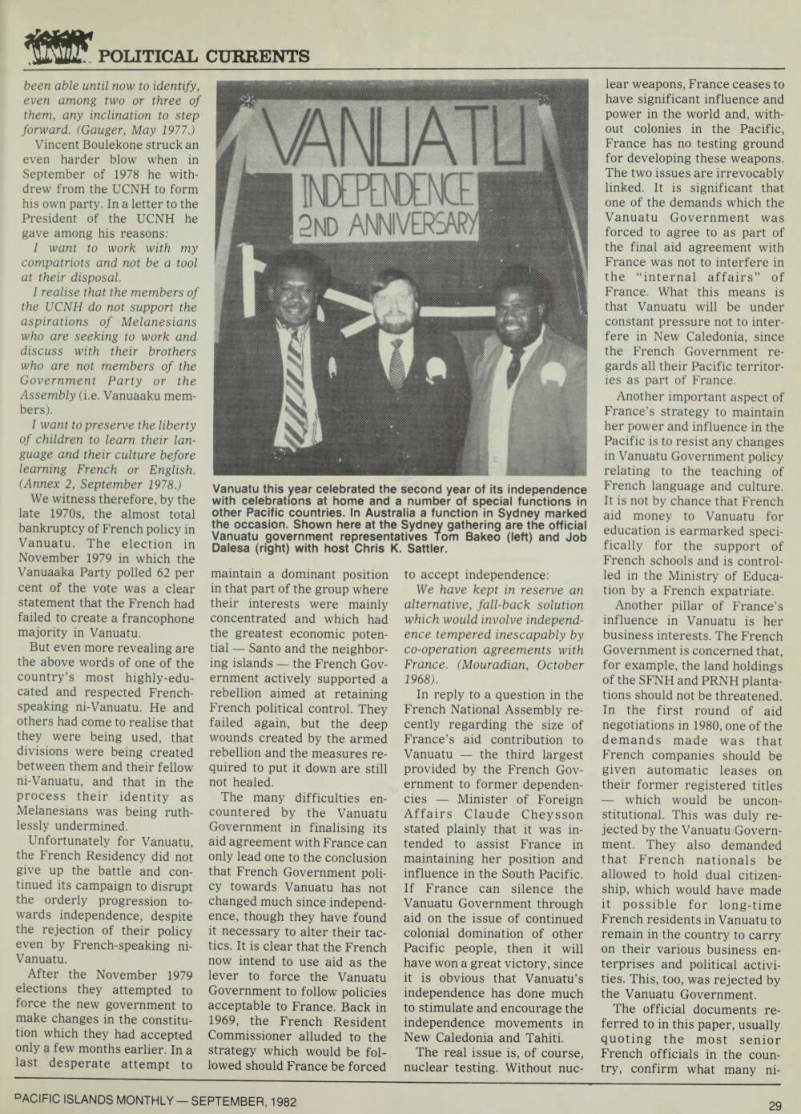
Vanuatu this year celebrated the second year of its independence with celebrations at home and a number of special functions in other Pacific countries. In Australia a function in Sydney marked the occasion. Shown here at the Sydney gathering are the official Vanuatu government representatives tom Bakeo (left) and Job Dalesa (right) with host Chris K. Sattler.
Vanuatu had long suspected: in Vanuatu, despite the re straining effect of Great Bri tain one of France’s closest allies in Europe the French Government used Vanuatu and its people without any concern for their welfare as pawns to achieve its ambition for power and influence in the Pacific.
Moreover, it is important to remember that French offi cials in Vanuatu prior to inde pendence were under the dire ction of the Governor (later High Commissioner) in Noumea, who for most of the colonial era co-ordinated poli cy for all French territories in the Pacific.
One must conclude, there fore, that the policies followed by French officials in Vanuatu reflect the overall strategy of the French Government: to ap ply whatever techniques would achieve their goal of maintaining New Caledonia, Wallis/Futuna and Tahiti, as colonies of France forever.