Clubs, rocks, tear gas - and the
pp. 19-22 · Read in the full issue

New Caledonia
Clubs, rocks, tear gas - and the freeing of a murder suspect
HELEN FRASER in Noumea reports on the latest events in the long ordeal of New Caledonia: the day of violence on July 22, and the controversial release on bail of Dominique Canon, suspected killer of the leading pro-independence figure, Pierre Declercq.
As New Caledonia continued to hold the attention of the Pacific in August, High Commissioner Christian Nucci took off on a series of visits to nefghboring countries during which he sought to explain to their governments French plans for reform in the territory. Among countries he visited were Fiji, Vanuatu, Australia and New Zealand.
As he travelled, shock waves from the outburst of violence in Noumea on July 22 were still being felt throughout New Caledonia.
On that day 60 young men, armed with clubs and wearing crash helmets, invaded the Territorial Assembly chamber
shouting “resign, resign”, and assaulting politicians from the Front Independantiste (FI) and the Federation pour une Nouvelle Societe Caledonienne (FNSC). The assembly at the time was debating France’s contentious land reform program, The “commandos” (as the French call them) were quick ly joined by more than 50 supporters from the public gallery. In the ensuing vio lence three Independantiste politicians were injured, chairs were thrown, windows broken, desks overturned and a TV camera smashed, Twenty minutes later, after police had arrested seven com
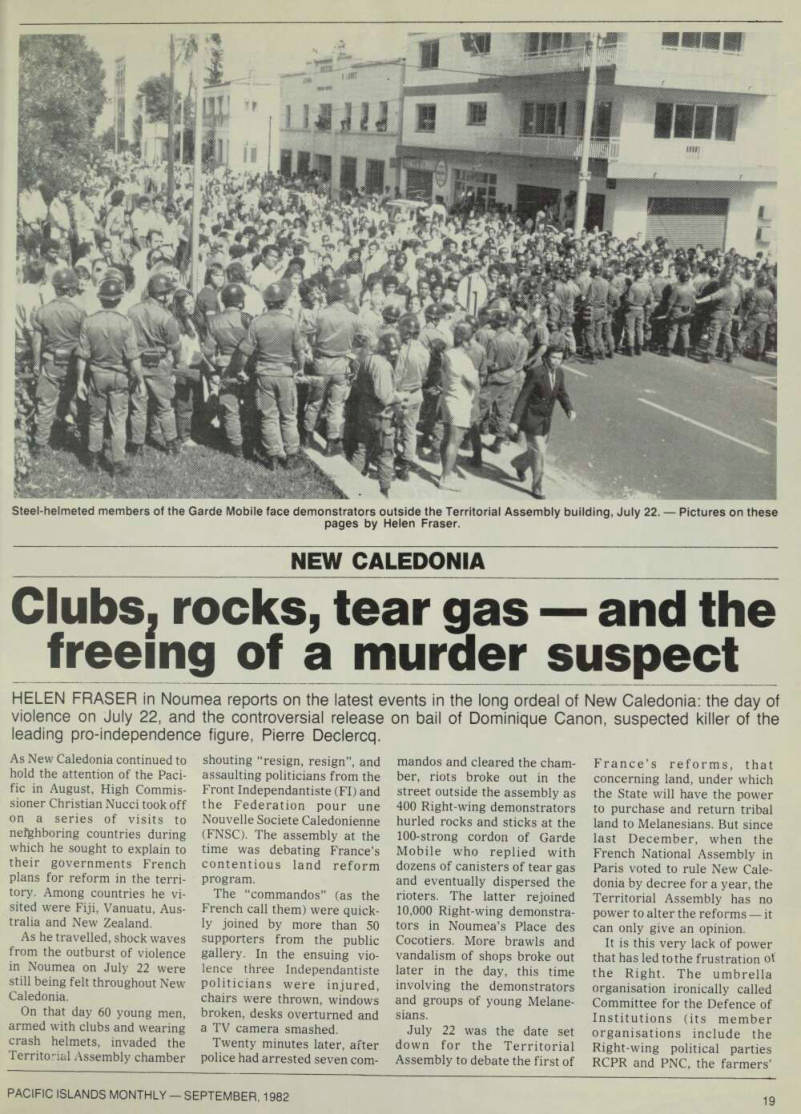
mandos and cleared the cham ber, riots broke out in the street outside the assembly as 400 Right-wing demonstrators hurled rocks and sticks at the 100-strong cordon of Garde Mobile who replied with dozens of canisters of tear gas and eventually dispersed the rioters. The latter rejoined 10,000 Right-wing demonstra tors in Noumea’s Place des Cocotiers. More brawls and vandalism of shops broke out later in the day, this time involving the demonstrators and groups of young Melane sians.
July 22 was the date set down for the Territorial Assembly to debate the first of
France’s reforms, that concerning land, under which the State will have the power to purchase and return tribal land to Melanesians. But since last December, when the French National Assembly in Paris voted to rule New Cale donia by decree for a year, the Territorial Assembly has no power to alter the reforms it can only give an opinion.
It is this very lack of power that has led to the frustration of the Right. The umbrella organisation ironically called Committee for the Defence of Institutions (its member organisations include the Right-wing political parties RCPR and PNC, the farmers’
Steel-helmeted members of the Garde Mobile face demonstrators outside the Territorial Assembly building, July 22. - Pictures on these pages by Helen Fraser.
body RURALE, and the Domi nique Canon Support Commit tee) called a general strike for July 22 in protest against the reforms, and to repeat their demand for new elections to the Territorial Assembly (PIM Aug. p!7).
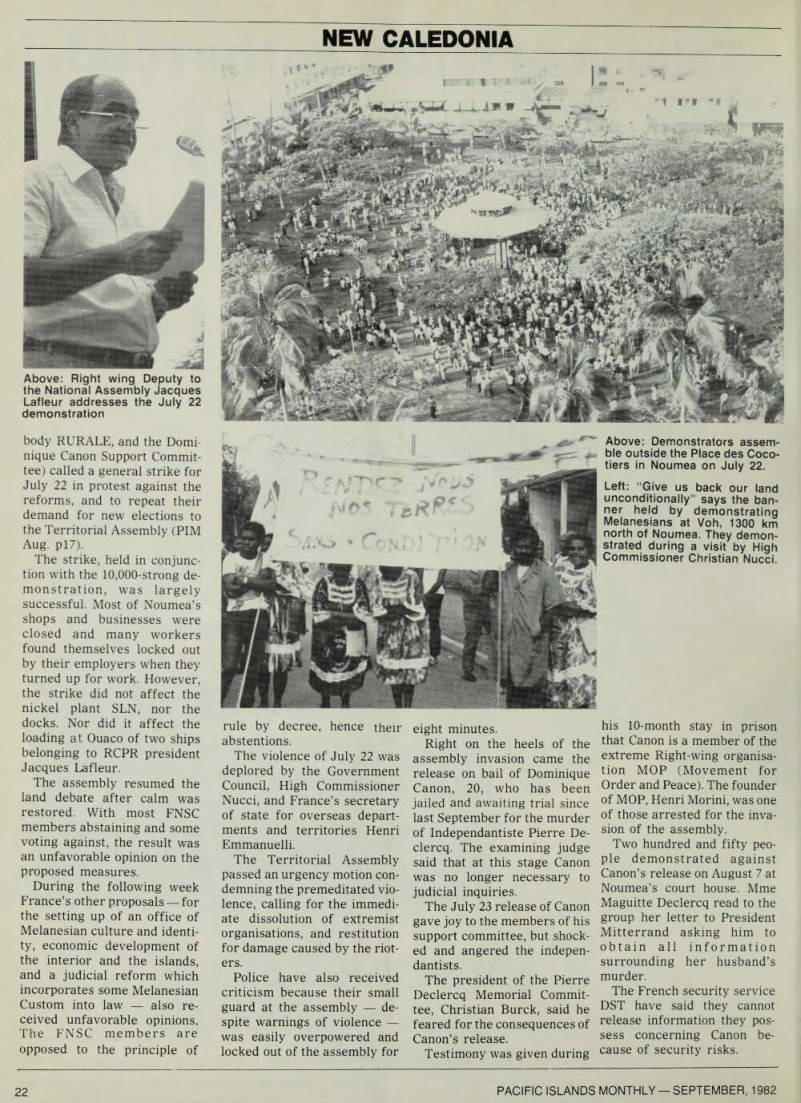
The strike, held in conjunc tion with the 10,000-strong de monstration, was largely successful. Most of Noumea’s shops and businesses were closed and many workers found themselves locked out by their employers when they turned up for work. However, the strike did not affect the nickel plant SEN, nor the docks. Nor did it affect the loading at Ouaco of two ships belonging to RCPR president Jacques Lafleur.
The assembly resumed the land debate after calm was restored. With most FNSC members abstaining and some voting against, the result was an unfavorable opinion on the proposed measures.
During the following week France’s other proposals for the setting up of an office of Melanesian culture and identi ty, economic development of the interior and the islands, and a judicial reform which incorporates some Melanesian Custom into law also re ceived unfavorable opinions.
The FNSC members are opposed to the principle of
rule by decree, hence their abstentions.
The violence of July 22 was deplored by the Government Council, High Commissioner Nucci, and France’s secretary of state for overseas depart ments and territories Henri Emmanuelli.
The Territorial Assembly passed an urgency motion con demning the premeditated vio lence, calling for the immedi ate dissolution of extremist organisations, and restitution for damage caused by the riot ers.
Police have also received criticism because their small guard at the assembly de spite warnings of violence was easily overpowered and locked out of the assembly for
eight minutes.
Right on the heels of the assembly invasion came the release on bail of Dominique Canon, 20, who has been jailed and awaiting trial since last September for the murder of Independantiste Pierre Declercq. The examining judge said that at this stage Canon was no longer necessary to judicial inquiries.
The July 23 release of Canon gave joy to the members of his support committee, but shocked and angered the independantists.
The president of the Pierre Declercq Memorial Committee, Christian Burck, said he feared for the consequences of Canon’s release.
Testimony was given during
his 10-month stay in prison that Canon is a member of the extreme Right-wing organisa tion MOP (Movement for Order and Peace). The founder of MoP > Henri Morini, was one °f those arrested for the inva s*on °f the assembly, Two hundred and fifty peo- P^ e demonstrated against Canon s release on August 7 at Noumea’s court house. Mme Maguitte Declercq read to the § rou P her letter to President Mitterrand asking him to obtain all information surrounding her husband’s mu rder.
The French security service have said they cannot re l ease information they pos sess concerning Canon be cause °f security risks.
Above: Right wing Deputy to the National Assembly Jacques Lafleur addresses the July 22 demonstration
Above: Demonstrators assem ble outside the Place des Coco tiers in Noumea on July 22.
Left: “Give us back our land unconditionally” says the ban ner held by demonstrating Melanesians at Voh, 1300 km north of Noumea. They demon strated during a visit by High Commissioner Christian Nucci.