most mud-slinging
pp. 10-13 · Read in the full issue

Fiji’s poll of records: Most voters, most bitterness, most mud-slinging
Fiji’s general election, the fourth since independence came in 1970, was won by the ruling Alliance Party with its majority cut to four. It was an election calling for many superlatives the biggest turn-out of voters, the bitterest, fought on racial levels, and the dirtiest, indicating that Fiji’s politicians in some respects have little to learn from their counterparts in the so-called developed countries. Below, ROBERT KEITH-REID, Fiji’s leading political commentator, tells the story.
Tense times lie ahead for the Parliament of Fiji. After years of relatively soft, unchal lenged living, the ruling Alliance Party faces an Opposition with a strength and collection of talent sufficient to keep government ministers on their toes, clutching ner vously at their portfolio pap ers, for the next five years.
The July election saw the Alliance retain power, but only just. It had its majority in the 52-seat House of Representa tives slashed from 20 to four, winning 28 seats against 36 in September, 1977. The National Federation Party (NFP), sup ported by most of the coun try’s Indian community, won 22 seats. Its small Fijian part ner, the Western United Front (WUF), picked up two as a present from the NFP, making for an Opposition side of 24.
A four-seat majority is suffi cient for the Fijian-dominated Alliance to control parliament, but, as a winning score, it is not really a convincing one.
But for some miscalcula
tions, the NFP could have won the election, getting 27 or 28 seats. In three vital constituen cies, the total vote in favor of the Alliance carried a margin of only 2000 votes.
A week before seven days of polling began on July 10, with each voter casting four votes, to elect one communal and three cross-voting, or national, MPs, the Alliance was in a critical position. It had had its credibility ripped apart by re velations that it had hired fore ign consultants to devise a campaign strategy for it.
Months of careful planning and preparation to convince 292,000 registered voters they should “keep Fiji in safe hands” seemed to be cascading down the drain as the NFP flourished, with gleeful hor ror, copies of the report, pre pared by a team led by an Australian business consul tant, Alan Carroll, and flooded the country with about 300 copies of an Australian Broad casting Commission Four Cor
ners current affairs television programme. This claimed that the report was evidence of sinister foreign interest in Fi ji’s affairs, business interests who wanted to see the Alliance remain in power.
The contents of the report suggested that, to beat the NFP, the Alliance should smear the character of the Opposition Leader, Mr Jai Ram Reddy, and the WUF leader, Ratu Osea Gavidi; ex ploit racial and religious ten sions; buy off or threaten other opponents, and use other curious techniques such as “stroking” and “toe-cutting” in its endeavours to do down the
Nfp.
Alliance leader and Prime Minister Ratu Sir Kamisese Mara admitted the existence of the report but angrily re futed claims that it had been used. It was repugnant to all that he personally, and the Alliance, stood for, he said.
A lot of people were shocked by what they read in Fiji’s daily newspapers about the
Carroll report. The showing of the Four Corners programme, arranged country-wide in cine mas and on video-TV sets, made them more uneasy.
But the NFP went overboard with its efforts to convince the electorate of the wickedness of the Alliance, and the impact backfired on it badly.
Seizing on particular com ment in the Four Corners show that Ratu Mara was the descendant of chiefs who “clubbed and ate thir way to power” in bad, old cannibal days the Alliance ham mered into Fijian minds the belief that their traditions and chiefs had been insulted in a manner never to be forgotten or forgiven.
The insult had come from “racist” foreigners,and, by spreading it around the coun try on video screens, the NFP was associating itself fully with it, thundered the Alliance in a series of newspaper advertisements.
Voting statistics worked out after the election showed how well the counter-attack had worked for the Alliance, although they cannot be said to have been soley affected by it.
The Alliance won all 12 Fi jian communal seats, includ ing one regained from the WUF leader, Gavidi, and the three communal seats re served for General (non-Fijian and non-Indian) voters. It took all the cross-voting (national) seats for constituencies hav ing Fijian majorities in them, plus two for constituencies with small Indian majorities.
The NFP easily won all the 12 Indian communal seats and with two exceptions it took cross-voting seats for consti-
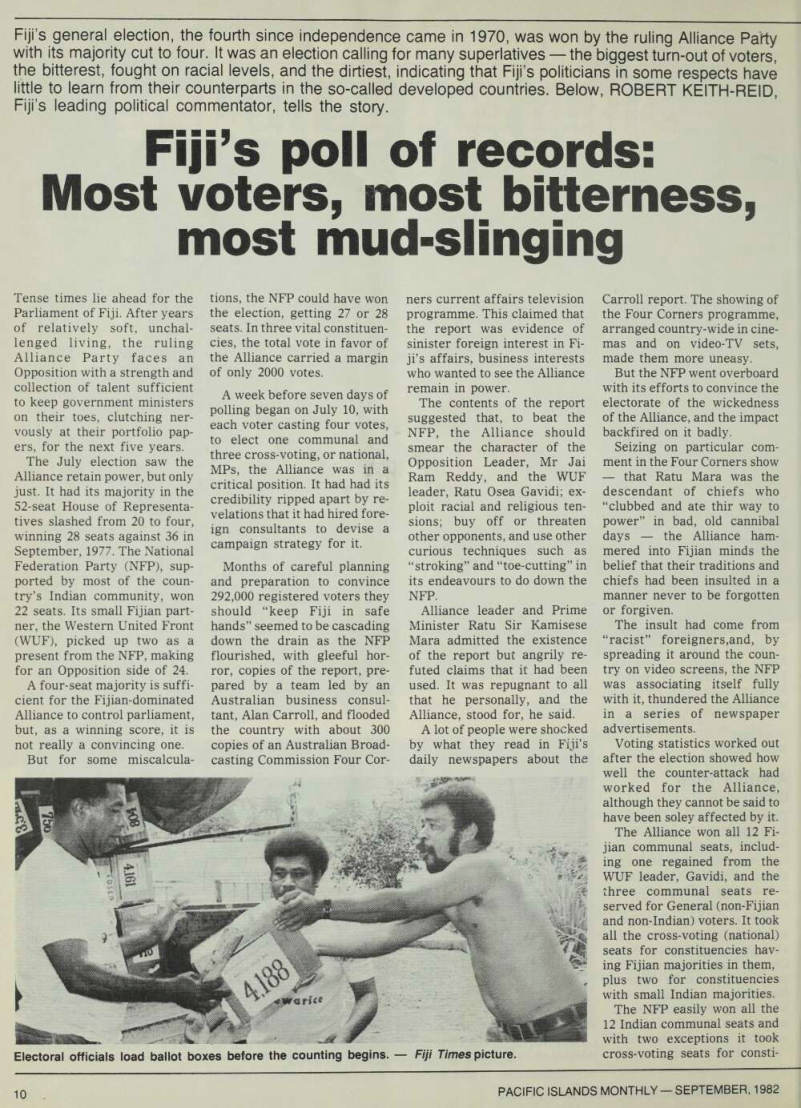
Electoral officials load ballot boxes before the counting begins. — Fiji Times picture.
tuencies having Indian majori ties.
Voters turn-out was about 86 per cent by far the greatest proportion in the history of the country’s general elections, and a clear reflection of the feelings stirred up by an over long and notably acrimonious campaign.
The Alliance got 86 per cent of the Fijian communal vote; WUF got seven percent and the NFP only 0.8 per cent.
On the other hand, the NFP won 84 per cent of the Indian communal vote. The Alliance got just over 15 per cent.
Curiously, in winning 28 seats, the Alliance took 51.8 per cent of the total vote while, in the second election of 1977, having narrowly lost an elec tion six months earlier, it got only 44 per cent of the total vote in winning 36 seats.
Jai Ram Reddy, who before the count had been aggressive ly predicting a win for his party, by 30 seats, quickly capitulated with the complaint that voting had been entirely racial.
At a press conference two days after the election, Ratu Mara agreed, saying: “I feel sure it will be a long time before we achieve a multi racial Fiji.”
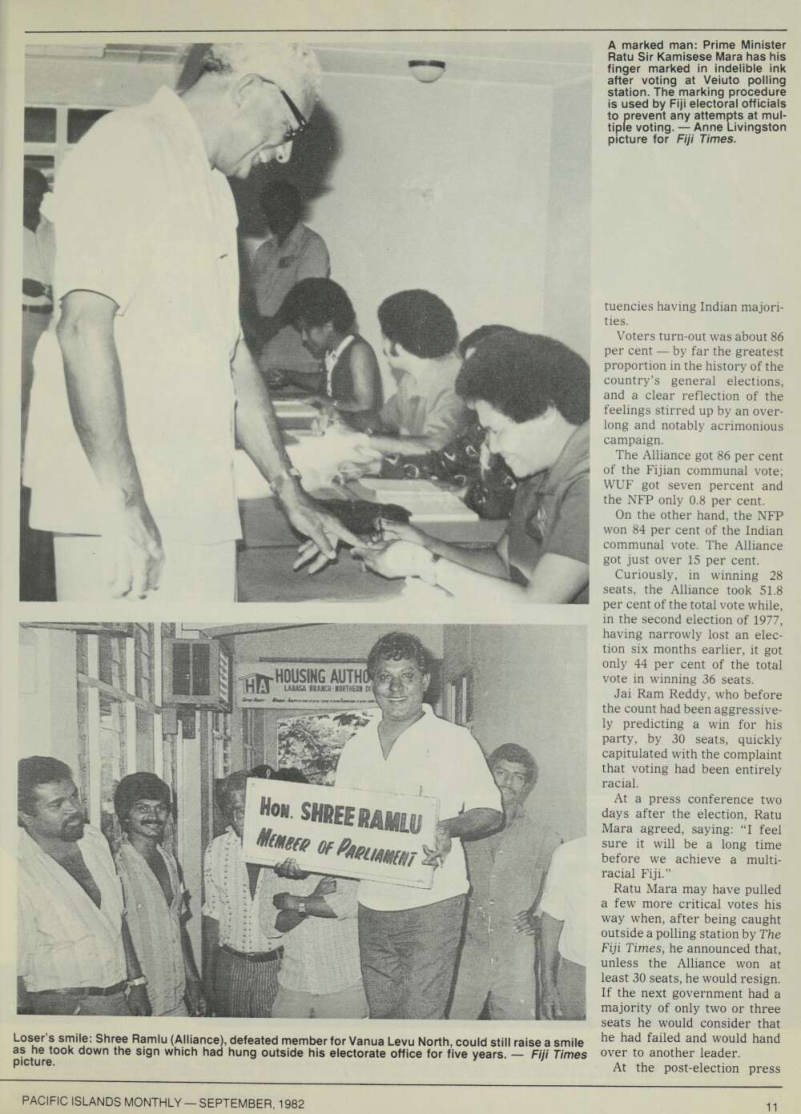
Ratu Mara may have pulled a few more critical votes his way when, after being caught outside a polling station by The Fiji Times, he announced that, unless the Alliance won at least 30 seats, he would resign.
If the next government had a majority of only two or three seats he would consider that he had failed and would hand over to another leader.
At the post-election press
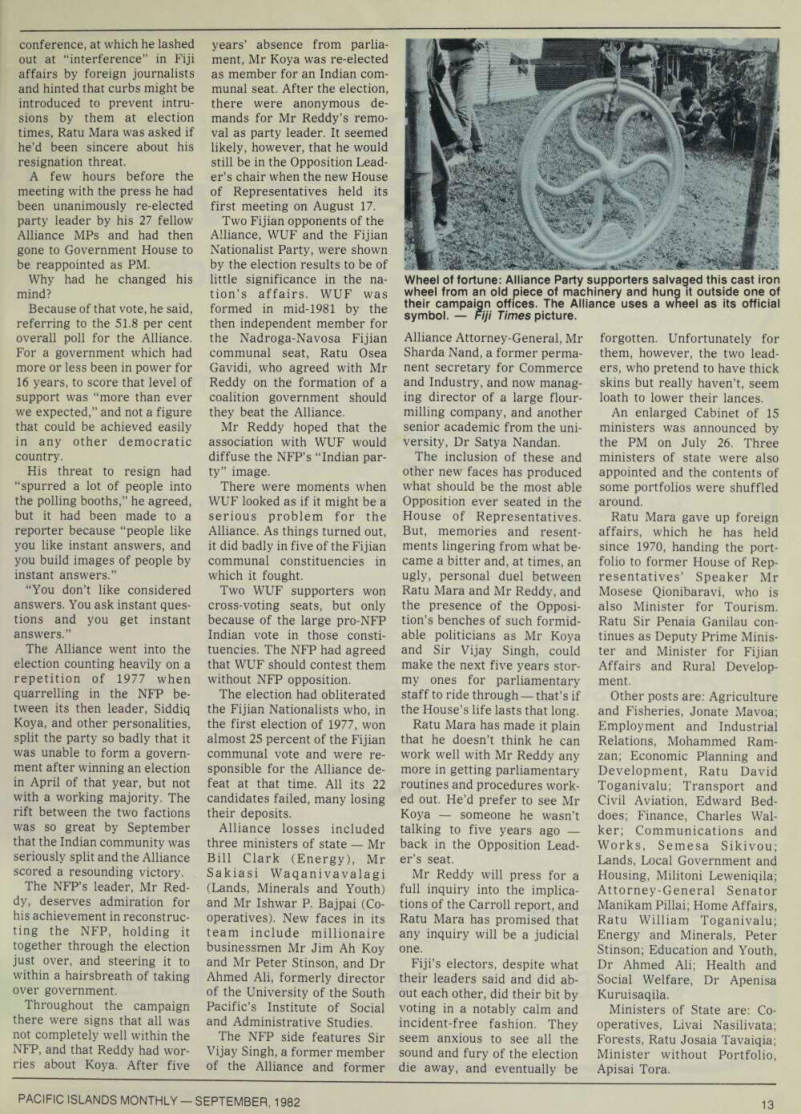
Loser's smile: Shree Ramlu (Alliance), defeated member for Vanua Levu North, could still raise a smile as he took down the sign which had hung outside his electorate office for five years. - Fiji Times picture.
A marked man: Prime Minister Ratu Sir Kamisese Mara has his finger marked in indelible ink after voting at Veiuto polling station. The marking procedure is used by Fiji electoral officials to prevent any attempts at mul
tiple voting. - Anne Livingston
picture for Fiji Times.
conference, at which he lashed out at “interference” in Fiji affairs by foreign journalists and hinted that curbs might be introduced to prevent intru sions by them at election times, Ratu Mara was asked if he’d been sincere about his resignation threat.
A few hours before the meeting with the press he had been unanimously re-elected party leader by his 27 fellow Alliance MPs and had then gone to Government House to be reappointed as PM.
Why had he changed his mind?
Because of that vote, he said, referring to the 51.8 per cent overall poll for the Alliance.
For a government which had more or less been in power for 16 years, to score that level of support was “more than ever we expected,” and not a figure that could be achieved easily in any other democratic country.
His threat to resign had “spurred a lot of people into the polling booths,” he agreed, but it had been made to a reporter because “people like you like instant answers, and you build images of people by instant answers.”
“You don’t like considered answers. You ask instant ques tions and you get instant answers.”
The Alliance went into the election counting heavily on a repetition of 1977 when quarrelling in the NFP be tween its then leader, Siddiq Koya, and other personalities, split the party so badly that it was unable to form a govern ment after winning an election in April of that year, but not with a working majority. The rift between the two factions was so great by September that the Indian community was seriously split and the Alliance scored a resounding victory.
The NFP’s leader, Mr Red dy, deserves admiration for his achievement in reconstruc ting the NFP, holding it together through the election just over, and steering it to within a hairsbreath of taking over government.
Throughout the campaign there were signs that all was not completely well within the NFP, and that Reddy had wor ries about Koya. After five
years’ absence from parlia ment, Mr Koya was re-elected as member for an Indian com munal seat. After the election, there were anonymous de mands for Mr Reddy’s remo val as party leader. It seemed likely, however, that he would still be in the Opposition Lead er’s chair when the new House of Representatives held its first meeting on August 17.
Two Fijian opponents of the Alliance, WUF and the Fijian Nationalist Party, were shown by the election results to be of little significance in the na tion’s affairs. WUF was formed in mid-1981 by the then independent member for the Nadroga-Navosa Fijian communal seat, Ratu Osea Gavidi, who agreed with Mr Reddy on the formation of a coalition government should they beat the Alliance.
Mr Reddy hoped that the association with WUF would diffuse the NFP’s “Indian par ty” image.
There were moments when WUF looked as if it might be a serious problem for the Alliance. As things turned out, it did badly in five of the Fijian communal constituencies in which it fought.
Two WUF supporters won cross-voting seats, but only because of the large pro-NFP Indian vote in those consti tuencies. The NFP had agreed that WUF should contest them without NFP opposition.
The election had obliterated the Fijian Nationalists who, in the first election of 1977, won almost 25 percent of the Fijian communal vote and were re sponsible for the Alliance de feat at that time. All its 22 candidates failed, many losing their deposits.
Alliance losses included three ministers of state Mr Bill Clark (Energy), Mr Sakiasi Waqanivavalagi (Lands, Minerals and Youth) and Mr Ishwar P. Bajpai (Co operatives). New faces in its team include millionaire businessmen Mr Jim Ah Koy and Mr Peter Stinson, and Dr Ahmed Ali, formerly director of the University of the South Pacific’s Institute of Social and Administrative Studies.
The NFP side features Sir Vijay Singh, a former member of the Alliance and former
Alliance Attorney-General, Mr Sharda Nand, a former perma nent secretary for Commerce and Industry, and now manag ing director of a large flour milling company, and another senior academic from the uni versity, Dr Satya Nandan.
The inclusion of these and other new faces has produced what should be the most able Opposition ever seated in the House of Representatives.
But, memories and resent ments lingering from what be came a bitter and, at times, an ugly, personal duel between Ratu Mara and Mr Reddy, and the presence of the Opposi tion’s benches of such formid able politicians as Mr Koya and Sir Vijay Singh, could make the next five years stor my ones for parliamentary staff to ride through that’s if the House’s life lasts that long.
Ratu Mara has made it plain that he doesn’t think he can work well with Mr Reddy any more in getting parliamentary routines and procedures work ed out. He’d prefer to see Mr Koya someone he wasn’t talking to five years ago back in the Opposition Lead er’s seat.
Mr Reddy will press for a full inquiry into the implica tions of the Carroll report, and Ratu Mara has promised that any inquiry will be a judicial one.
Fiji’s electors, despite what their leaders said and did ab out each other, did their bit by voting in a notably calm and incident-free fashion. They seem anxious to see all the sound and fury of the election die away, and eventually be
forgotten. Unfortunately for them, however, the two lead ers, who pretend to have thick skins but really haven’t, seem loath to lower their lances.
An enlarged Cabinet of 15 ministers was announced by the PM on July 26. Three ministers of state were also appointed and the contents of some portfolios were shuffled around.
Ratu Mara gave up foreign affairs, which he has held since 1970, handing the port folio to former House of Rep resentatives’ Speaker Mr Mosese Qionibaravi, who is also Minister for Tourism.
Ratu Sir Penaia Ganilau con tinues as Deputy Prime Minis ter and Minister for Fijian Affairs and Rural Develop ment.
Other posts are: Agriculture and Fisheries, donate Mavoa; Employment and Industrial Relations, Mohammed Ram zan; Economic Planning and Development, Ratu David Toganivalu; Transport and Civil Aviation, Edward Bed does; Finance, Charles Wal ker; Communications and Works, Semesa Sikivou; Lands, Local Government and Housing, Militoni Leweniqila; Attorney-General Senator Manikam Pillai; Home Affairs, Ratu William Toganivalu; Energy and Minerals, Peter Stinson; Education and Youth, Dr Ahmed Ali; Health and Social Welfare, Dr Apenisa Kuruisaqila.
Ministers of State are: Co operatives, Livai Nasilivata; Forests, Ratu Josaia Tavaiqia; Minister without Portfolio, Apisai Tora.
Wheel of fortune: Alliance Party supporters salvaged this cast iron wheel from an old piece of machinery and hung it outside one of their campaign offices. The Alliance uses a wheel as its official symbol. - Fiji Times picture.