after a bitter PNG campaign
pp. 15-17 · Read in the full issue
“The Chief” regains his leadership after a bitter PNG campaign
Michael Somare the man they call “The Chief” is back as Prime Minister of Papua New Guinea. True to his prediction he survived two weeks of bitter political fighting in the wake of a general election to emerge early in August with the numbers to form a government. ANGUS SMALES tells the story:
The July count in the Papua New Guinea general election left Mr Michael Somare’s Pan gu Party with the biggest col lection of seats of any party, but too few to form a govern ment without aid. Somare, the man who led PNG to independ ence in a 1975 but who lost his national leadership in a par liamentary vote in 1980, set out to organise the extra sup port he needed. He won after an intense campaign which was marked by bitter ex changes and fluctuating loyal ties. Under the PNG con stitutional system in which parliament directly votes for its prime minister he was re turned by 66 votes to 40. The man he defeated in the formal ballot was his former ally Father John Momis, represen ting the disrupted Chan coali tion.
Sir Julius Chan himself, for mer leader of the coalition and prime minister, did not figure in the vote. He valiantly fought a rearguard action for some days after the election count, and then with tacit support of his Peoples Progress Party he withdrew from the running.
Effective leadership was be coming impossible in the atmosphere of dissent, he said.
The former deputy prime minister, Mr lambakey Okuk, did not get a chance to figure in the fight because he had lost his parliamentary seat. Mr Ted Diro, entering parliament for the first time after a milit ary career which led him to command the PNG Defence Force, took over the National Party leadership from Mr Okuk and became leader of the Opposition. He was criticised in some quarters for pushing too hard, but his opposition leadership is a rare achieve ment for a first-term-in-office man. He could well have been deputy prime minister under
Somare had he played his cards differently.
Mr Paias Wingti, a low key but effective and solid Somare man, went in as deputy prime minister and Mr Dennis Young as Speaker of Parliament. Mr Young, a naturalised PNG citizen, came to PNG 16 years ago and was born in England.
He is the second naturalised citizen to hold the position since Independence. The other was Australian born Mr Barry Holloway who is now a mem ber of the Somare ministry.
Towards the end of July
after the general success of the Pangu vote had been con firmed, intense lobbying be gan in the campaign to form a government. Sir Julius Chan and Michael Somare both appeared to have strong chances, with Ted Diro being seen in the role of a king maker. Sir Julius stressed that the coalition was still united, Sir Julius and Somare each issued figures claiming a majority of supporters but the figures they quoted added up to 15 more than the membership of parliament.
By the end of July it became apparent that there were strains in the Chan coalition group, largely centred on the leadership issue. Sir Julius was seen as the natural leader by seniority and because he was still prime minister, but Diro provided a challenge be cause he led the biggest party grouping. Somare at this stage was making little comment ex cept to say he was confident of mustering the numbers to govern.
July ended with three dramatic developments. The first was when the five-mem ber-strong United Party announced that although it was technically part of the coali tion group it had been holding secret talks with Somare and had decided to join forces with the Somare Pangu Party. With candor if not with grace the United Party leader, Mr Roy Evara, said “We are not in terested in mere numbers we want to be in government for the next five years.”
The second development was when the Melanesian Alliance, led by Father John Momis, said it intended to throw its eight supporters be hind Somare.
And the final development was an announcement by Sir Julius that he was pulling out of the controversy over leadership of the coalition. “I have no wish to hang on to leadership of a coalition which is so split by dissent that it cannot say who its leader is,” he said.
In the final run up to the formation of a government there was yet another surprise Father Momis relinquished his plan to join forces with the Somare group and became the coalition group’s nomination for prime minister.
Michael Somare went back to office with no trouble soon
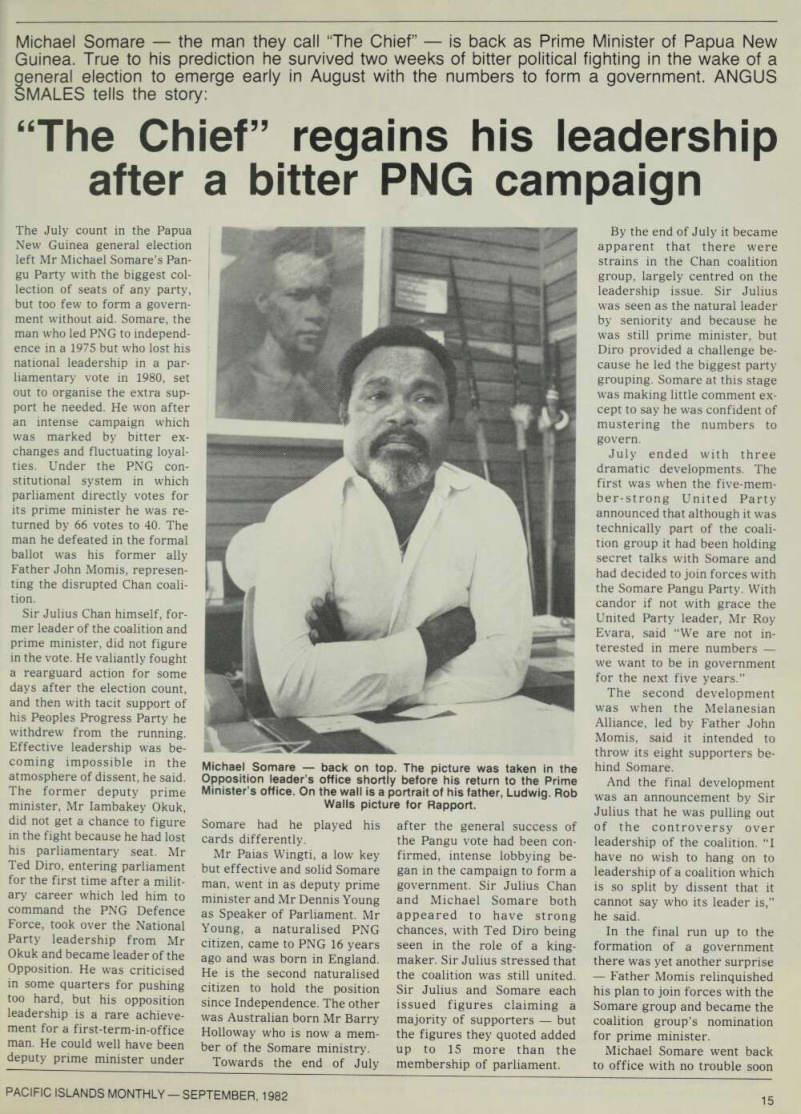
Michael Somare - back on top. The picture was taken in the Opposition leader’s office shortly before his return to the Prime Minister’s office. On the wall is a portrait of his father, Ludwig. Rob Walls picture for Rapport.
afterwards. Three days later the opposition came to grips with its leadership problem and voted on the issue. Ted Diro defeated Sir Julius Chan by 19 votes to 18 to become opposition leader, and Sir Julius then deferred to Father Momis who was confirmed as deputy opposition leader.
The Governor General, Sir Tore Lokoloko, formally addressed parliament on the aims of the new Somare gov ernment. He told the official opening of the new parliament that measures similar to those used in wartime were needed to restore the country’s de velopment targets and nation al priorities in health, educa tion, agriculture, housing and industry.
Members of the new So mare ministry are: Michael Somare, Prime Minister; Paias Wingti, Deputy Prime Minister, National Plan ning and Development, Prim ary Industry; Rabbie Namaliu, Foreign Affairs and Trade; Phillip Bouraga, Finance; Karl Stack, Commerce and Indus try; Francis Didman, Minerals and Energy; Matthew Ben dumb, Transport and Civil Aviation; Barry Holloway, Education; Tony Siaguru, Pub lic Service; Roy Evara, Home Affairs; Bebes Korowaro, Lands; Kala Swokim, Urban Development; John Nilkare, Decentralisation; Epel Tito, Defence; Sir Pita Lus, Par liamentary Services; Kaspar Angua, Labour and Employ ment; Michael Pondros, Public Utilities; Martin Tovadek, Health; Pundia Range, Cor rectional Services and Liquor Licensing; MacKenzie Jovoka, Culture and Tourism; Tony Bais, Justice; Tom Awasa, Re ligion, Youth and Recreation; John Giheno, Police; Halalu Mai, Environment and Con servation; Lukas Waka, Forests; Boyamo Sali, Media; Pato Kakarya, Works and Supply.
Eleven members of the new Cabinet are entering Parlia ment for the first time, although some of the newcom ers particularly Tony Siaguru, Rabbie Namaliu, Phil lip Bouraga and John Nilkare should be of particular value because of their senior
public service experience. The only survivors of Mr Somare’s “old guard” when he first led PNG are Barry Holloway and Sir Pita Lus.
Mr Somare was three days behind schedule in naming his Cabinet and he freely admitted that the delay was caused be cause he was running into what he called “regional prob lems.” This is a particularly sensitive issue in PNG where the country’s clearly-defined regions tacitly demand equal representation in Cabinet. The upshot was that Mr Somare was to some extent obliged to appoint a bigger Cabinet than he would have liked. To do otherwise would have been to invite early dissent and electo rate dissatisfactions. He had already campaigned on the basis that Pangu would cut administrative waste, and no doubt felt some embarrass ment in naming a Cabinet which, in terms of numbers, was right on the constitutional limit.
He was quick to assure Parliament that he would re view his team within three months and hoped to “effec tively reduce” the numbers.
Mr Somare said he realised he had selected a big Cabinet at a time when the country was facing economic hardship, and he was aware that critics would see his action as con trary to his stated policies.
However he believed it would have been premature to re duce the numbers immediate ly because no information was available on the areas where savings could best be made.
It is hard to escape the conclusion that Mr Somare has merely deferred a difficult de cision, particularly as he also told Parliament that he would be failing in his duty to the constitution if he didn’t spread regional representation as widely as possible. If there is no wastage in his Cabinet in the first three months, he is going to find extreme political difficulty in shedding some of his ministers.
An editorial in the Papua New Guinea Post-Courier, published in Port Moresby, was critical of the size of the Cabinet in political and practi cal terms and accused Mr So
mare of having made obvious and unnecessary concessions to regional jealousies. The editorial suggested that Mr Somare was well aware that the ministry was too big to be compatible with a policy of national belt tightening. “The anachronistic tradition of sharing the ministries among the regions must be aban doned,” the editorial said.
But from his newly influen tial position as Leader of the Opposition, Mr Ted Diro alleged that regional jealousies were far from
soothed anyway. Mr Diro’s claim was that a nucleus of four men from the East Sepik region now had a firm grip on PNG’s national affairs because of the strength and integration of their portfolios. He named the four as Mr Somare, leading the National Executive Coun cil; Mr Siaguru, controlling the public service; Sir Pita Lus, controlling the parliamentary legislative programme; and Mr Bais, heading the country’s judicial arm. Mr Diro said the situation confirmed a view held by many that Mr Somare was effectively becoming a dictator, and that the Sepik people through their bloc in Parliament were in a position to control national manage ment. Mr Somare later denied the allegations, saying that he
and all his ministers were sub ject to the democratic check and balance which PNG had built into its constitution. (The East Sepik, Mr Somare’s home area, is in the north-west of the PNG mainland).
The new Somare govern ment appears to have entered its stewardship in an atmos phere of some bitterness and a measure of recrimination. The spirit of national crusade and cross-party links which marked every facet of PNG politics in the days of self government and independence is no longer there. This was perhaps inevitable as national management became a task rather than a target, and as a growing corps of new politi cians split and rejoined and split again in the contest for the top. The climate of today’s PNG economy an economy affected by outside forces as much as by internal politics is another factor which has clouded the political atmos phere.
Outside the immediate areas of political factionalism there’s a general feeling that Mr Somare will bring back something of the spirit which marked his first term of office, and which could do much to remove the divisive ness which has become appa rent in PNG affairs. Sir Julius Chan was a direct-minded and capable Prime Minister who dissipated much of his effectiveness in a never-en ding battle to hold his govern ment together. Michael So mare gives the impression of being neither more nor less capable, but he goes back to office with one big advantage he has done it all before.
When he lost office he de scribed his introduction to the Opposition ranks as “the start of a rest before I think things over and come back again.”
Not all his supporters be lieved he could make the comeback, but even before the election it was apparent that his position was strengthen ing. His present intention is to retire in 1987, the year of the next general election. He will then be 52 years of age and will have been in Parliament continuously for 19 years.
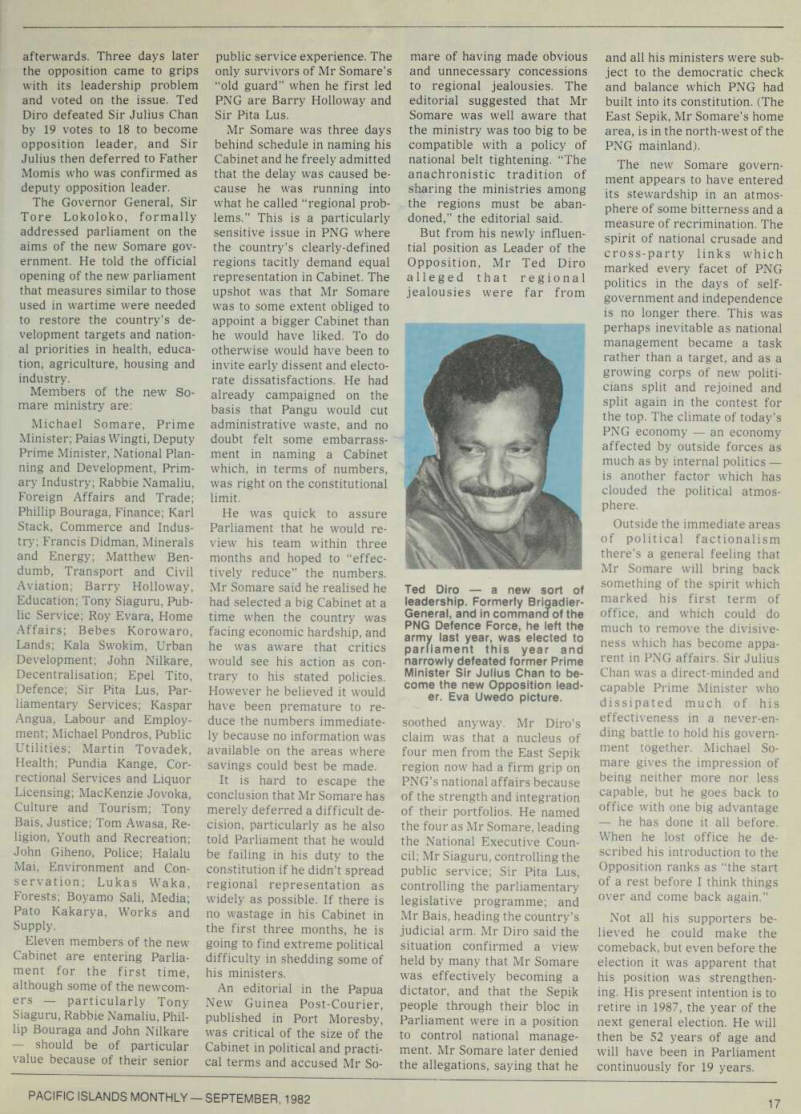
Ted Diro - a new sort of leadership. Formerly Brigadier- General, and in command of the PNG Defence Force, he left the army last year, was elected to parliament this year and narrowly defeated former Prime Minister Sir Julius Chan to be come the new Opposition lead er. Eva Uwedo picture.