Milne Bay,
pp. 7-9 · Read in the full issue
Letters
Remembering Milne Bay, 40 years on
Forty years ago, from August 24 to September 7, 1942, a handful of Australian militia men, together with a small force of AIF, probably changed the outcome of World War 2 at the battle of Milne Bay.
There is a tale worth telling of the aftermath of that vic tory. It concerns the reluct ance of General MacArthur and his staff to give credit for the victory to Australian troops.
A Captain R. E. G. Cunning ham arrived at Milne Bay with an AIF unit late in 1943. Half way along Turnbull Field he noted a piece of tin nailed to a coconut tree stump bearing the message “This marks the spot of the first land defeat of the Japanese army in the Pacific.” “In memory of the Australian men who lost their lives in this action.”
Some time later Cunning ham found that the sign had gone souvenired undoubted ly by U.S. troops who had arrived about the same time as Cunningham’s unit.
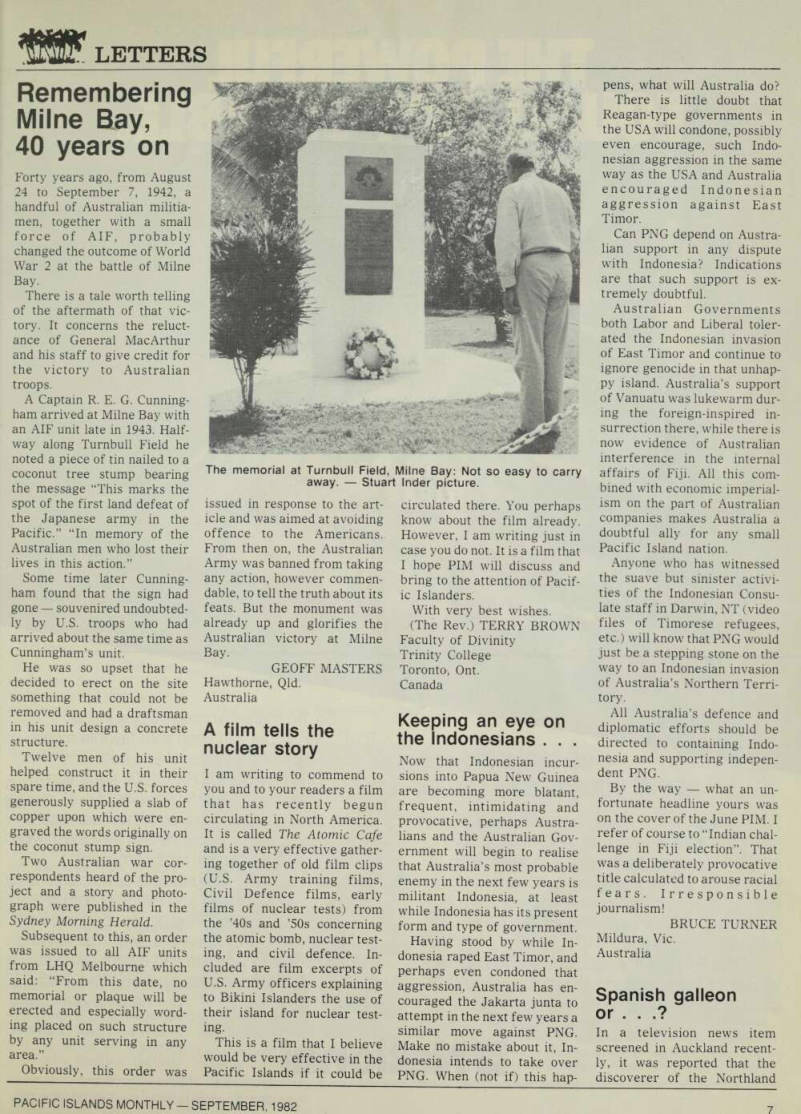
He was so upset that he decided to erect on the site something that could not be removed and had a draftsman in his unit design a concrete structure.
Twelve men of his unit helped construct it in their spare time, and the U.S. forces generously supplied a slab of copper upon which were en graved the words originally on the coconut stump sign.
Two Australian war cor respondents heard of the pro ject and a story and photo graph were published in the Sydney Morning Herald.
Subsequent to this, an order was issued to all AIF units from LHQ Melbourne which said: “From this date, no memorial or plaque will be erected and especially word ing placed on such structure by any unit serving in any area.”
Obviously, this order was
issued in response to the art icle and was aimed at avoiding offence to the Americans.
From then on, the Australian Army was banned from taking any action, however commen dable, to tell the truth about its feats. But the monument was already up and glorifies the Australian victory at Milne Bay.
Geoff Masters
Hawthorne, Qld.
Australia
A film tells the
nuclear story
I am writing to commend to you and to your readers a film that has recently begun circulating in North America.
It is called The Atomic Cafe and is a very effective gather ing together of old film clips (U.S. Army training films, Civil Defence films, early films of nuclear tests) from the ’4os and ’sos concerning the atomic bomb, nuclear test ing, and civil defence. In cluded are film excerpts of U.S. Army officers explaining to Bikini Islanders the use of their island for nuclear test ing.
This is a film that I believe would be very effective in the Pacific Islands if it could be
circulated there. You perhaps know about the film already.
However, I am writing just in case you do not. It is a film that I hope PIM will discuss and bring to the attention of Pacif ic Islanders.
With very best wishes.
(The Rev.) Terry Brown
Faculty of Divinity Trinity College Toronto, Ont.
Canada
Keeping an eye on
the Indonesians . . .
Now that Indonesian incur sions into Papua New Guinea are becoming more blatant, frequent, intimidating and provocative, perhaps Austra lians and the Australian Gov ernment will begin to realise that Australia’s most probable enemy in the next few years is militant Indonesia, at least while Indonesia has its present form and type of government.
Having stood by while In donesia raped East Timor, and perhaps even condoned that aggression, Australia has en couraged the Jakarta junta to attempt in the next few years a similar move against PNG.
Make no mistake about it, In donesia intends to take over PNG. When (not if) this hap
pens, what will Australia do?
There is little doubt that Reagan-type governments in the USA will condone, possibly even encourage, such Indo nesian aggression in the same way as the USA and Australia encouraged Indonesian aggression against East Timor.
Can PNG depend on Austra lian support in any dispute with Indonesia? Indications are that such support is ex tremely doubtful.
Australian Governments both Labor and Liberal toler ated the Indonesian invasion of East Timor and continue to ignore genocide in that unhap py island. Australia’s support of Vanuatu was lukewarm dur ing the foreign-inspired in surrection there, while there is now evidence of Australian interference in the internal affairs of Fiji. All this com bined with economic imperial ism on the part of Australian companies makes Australia a doubtful ally for any small Pacific Island nation.
Anyone who has witnessed the suave but sinister activi ties of the Indonesian Consu late staff in Darwin, NT (video files of Timorese refugees, etc.) will know that PNG would just be a stepping stone on the way to an Indonesian invasion of Australia’s Northern Terri tory.
All Australia’s defence and diplomatic efforts should be directed to containing Indo nesia and supporting indepen dent PNG.
By the way what an un fortunate headline yours was on the cover of the June PIM. I refer of course to “Indian chal lenge in Fiji election”. That was a deliberately provocative title calculated to arouse racial fears. Irresponsible journalism!
Bruce Turner
Mildura, Vic.
Australia
Spanish galleon
or . . .?
In a television news item screened in Auckland recent ly, it was reported that the discoverer of the Northland
The memorial at Turnbull Field, Milne Bay: Not so easy to carry away. - Stuart Inder picture.
“sunken galleon” (PIM Jul.
P 27) has received from Spain confirmation of his identifi cation of the wreck ... it appears that he sent a sketch of the “galleon” to a Spanish marine expert who thinks it is the wreck of the San Lesme.
Needless to say, I am still doubtful. There have been no press releases on the iden tification of the wreck, nor is there any news of Robert Langdon having visited it. The discoverer of the “galleon” appeared to believe that Mr Langdon would be on the first plane once he’d heard about the wreck.
As an archaeologist and wri ter specialising in classical Maori culture, I am very in terested in cultural diffusion and, naturally, view with the utmost suspicion any claims in support of Spanish exploration within Eastern Polynesia and, more specifically, New Zea land. Hopefully PIM will be cautious in its coverage of the San Lesme discovery. Over the past few weeks there has been another controversy, revol ving around the discovery in Tahiti of a canoe that some enthusiasts believe is made of New Zealand totara thus proving evidence of a return voyage to Tahiti by classic Maori navigators. However, Professor Sinoto of Bishop Museum denied that the wood was totara.
Alan Taylor
Auckland New Zealand
Another Kiap
bash
Three cheers for the “Legen dary Kiaps” and Bert E. Wes ton (PIM Jun. P 8). In his long and impressive list of Kiap- Mates he only seems to have forgotten Errol Flynn. That is surprising indeed.
Bert E. Weston describes efficiently his own pre-war activities in Papua New Guinea from “Recruiter” (in more simple terms “Black birder”) to heroic shoot-outs with unruly Kanakas who did not want to work for a stick of tobacco, or to be separated from their families. The only
comment that’s called for is that nobody ever asked Mr Weston or his Kiap-Mates to come to PNG in the first place.
Kessua Tamai (PIM Mar.
P 10) dared to make reference to the number of half-castes roaming the PNG towns and villages. Congratulations to Kessua Tamai for having the guts to pick up this sad chapter of Australian colonial admin istration of PNG, which Bert E. Weston considers to be a normal part of colonisation.
The latest figures received for New Britain alone record no fewer than 3700 half-castes, whose proud Kiap fathers were in a hurry to get home to Australia, and let their offspring and their mothers fight for themselves, with the children now belonging neith er to one nor the other.
Vitaliz Paingame
Cairns, Qld.
Australia This letter cut for length.
Editor.
Meet the Campes
of Saint Michel
I would not like to appear from my last letter (PIM Apr. P 9) some sort of “yachtie-basher”, and, in fact, am happy to write today about the yacht Saint Michel and her crew (men tioned earlier in your yachts section).
Our family met the wonder
ful Campes when they called in Cairns for an overhaul of Saint Michel after a long cruise around the world.
They certainly could not be classified as the “leisure class”, nor among the inex perienced sailors criticised by your correspondents Frank Lewsi, Dr Patil, etc.
Joachim, from Hamburg, is not only a qualified skipper but a professional cameraman, under contract for several video films. Some of them he shot recently during a seven months stay in Papua New Guinea.
As an “old hand” from the former Territory, I saw too many film-makers and report ers passing far too quickly through one of the toughest and most complex countries in the world. I include some French media “tourists” in this category.
Marie, the “Mate”, inci dentally she will never for give me is the grand daughter of the famous French poet, academician, diplomat, etc. Paul Claudel. She also controls the children Sylves tre, Barthelemy, Loetitia and Calixte, deckhands and stu dents, who find themselves in the hands of a sucession of international teachers from one port to another.
They stayed three days in our home, and showed clearly that their long voyage had not
affected their European man ners or their general knowl edge on the contrary. Their travels only seem to have in creased their fluency in Eng lish, French and German.
We were sorry, and so were many of our friends, to see the Saint Michel sail away to the north towards Darwin, In donesia, and, eventually, the
Usa.
Bon voyage, Joachim, Marie, et les infants.
J. Huon De Navrancourt
Atherton, Qld.
Australia
‘D-Notices’ PIM
accused
The famous “D-Notice sys tem”, under which editors sup press readers’ letters and other material which appear to criticise the status quo or, in general, come too close to the truth, appears to have arrived in the offices of that once widely respected and popular magazine, Pacific Islands Monthly.
Is this Australia’s version of true journalistic profession alism?
Manfred Eiserman
Cairns, Qld.
Australia This letter cut for length. We wish Mr Eiserman would be more specific in his accu sations about “D-Notices”.
Editor.
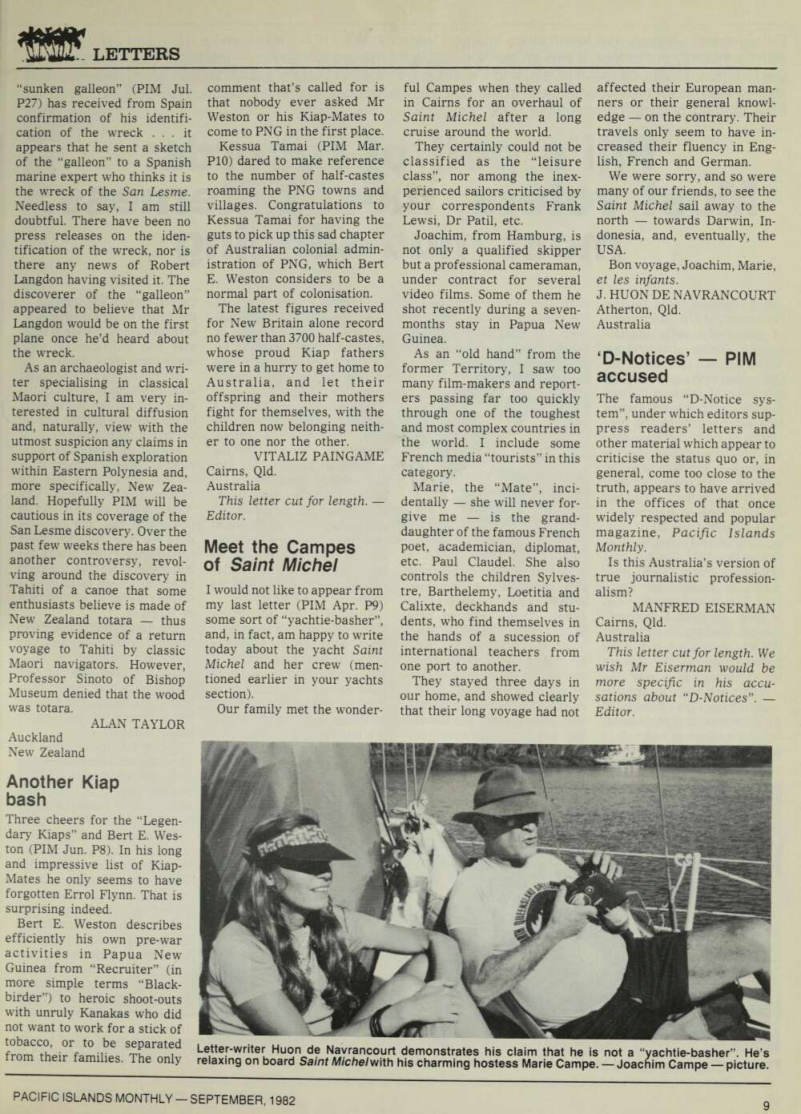
Letter-writer Huon de Navrancourt demonstrates his claim that he is not a “yachtie-basher”. He’s relaxing on board Saint Michel with his charming hostess Marie Campe.-Joachim Campe - picture.