The true story of the most
pp. 55-57 · Read in the full issue
Yesterday
The true story of the most romantic wedding ring in the world
Renowned Pacific scholar Professor HARRY MAUDE here tells a story in which his historical knowledge and personal experience are inseparably intertwined. It is the story of the remarkable relationship between his wife HONOR, himself, and the old wedding ring which was used at all marriage ceremonies held on Pitcairn Island for the first four decades of its history . . .
Wedding rings, through the sentimental associations which grow around them love, loyalty, trust, happiness are usually the most precious per sonal possessions we own. I know mine has never been off my finger since the day when it was first put there 53 years ago, nor has my wife Honor’s; and they symbolise for us the event ful but happy passage of our years together.
But our wedding rings are of interest only to ourselves, and it was not until we went to live on Pitcairn Island in 1940 that we read in Rosalind Young’s his tory how the islanders had once possessed a ring unique of its kind: one with which everyone in the community had been married for the first four dec ades of Pitcairn history.
Belonging to Midshipman Edward Young, it was the only ring the nine mutineers pos sessed and, according to tra dition, after their landing in 1790 Fletcher Christian had used a Church of England Prayer Book and this ring to marry each of them to their Tahitian consorts: himself to Mauatua; Young to Teraura; John Adams to Obuarei; Brown to Teatuahitea; McCoy to Teio; Martin to Tehuteatuaonoa; Mills to Vahineatua; Quintal to Tevarua, and Williams to Fahotu. Actually there were 15 marriages during the mutineer era, for Quintal and Williams lost their wives and married again, while Young and Adams married three times.
Even these were not the only weddings performed with this communal ring, for when Cap tain Beechey visited Pitcairn in 1825 in H.M.S Blossom he found that all the Europeans bad died by 1800 with the exception of John Adams, who bad been converted it was »aid through a dream and was now bringing up the first
generation of island-born Pitcairners on the Bible and Prayer book, with such effect that their simplicity and piety, their unaffected friendliness and their anxiety to please captured the hearts of all who visited the island after Captain Folger’s discovery of the little community in 1808. And we are told that when marrying them Adams was using ‘a ring for such occasions, which has united every couple on the island since its first settlement’.
The ring, therefore, must have not only witnessed the wild scenes, the anarchy, conflicts and murders of the first decade, but also shared in the hopes and fears of these innocent children of Pitcairn’s Golden Age, when placed on the fingers of Elizabeth Mills, Katherine and Sarah McCoy, Sarah Quintal, Dinah and Hannah Adams, as over the years they came of age
and fell in love with the island boys they had grown up with.
The widowed Teraura, now called Susan, married Thursday October Christian, the first child to be born on the island; while Dorothy Young married John Buffett and Rachel Adams married John Evans, both men who had landed in 1823 to join the settlement.
Rachel alone wore ‘a ring formed of the outer circle of a limpet shell’, possibly because her father never really approved of her match. We are left, therefore, with 23 possible mar riages performed with Edward Young’s ring by the time of Beechey’s visit, when the naval captain married him legally, at his earnest request, to his third wife Teio, or Mary, who had been blind and bed-ridden for several years.
At this point the historic ring disappeared. It is conjectured
that Mary kept it, for she was the first to be legally married, and, blind as she was, that she eventually lost it through fissures in the rough-hewn floor ing of their house.
Soon after our arrival Robert Young lent us a small plot of land on the site of the Adams home and alongside their graves, so that Honor could grow vegetables for our small son. She had no sieve to make fine soil to cover her carrot seed but picked up handfuls of earth and rubbed them between the palms of her hands; and one evening just before sunset the
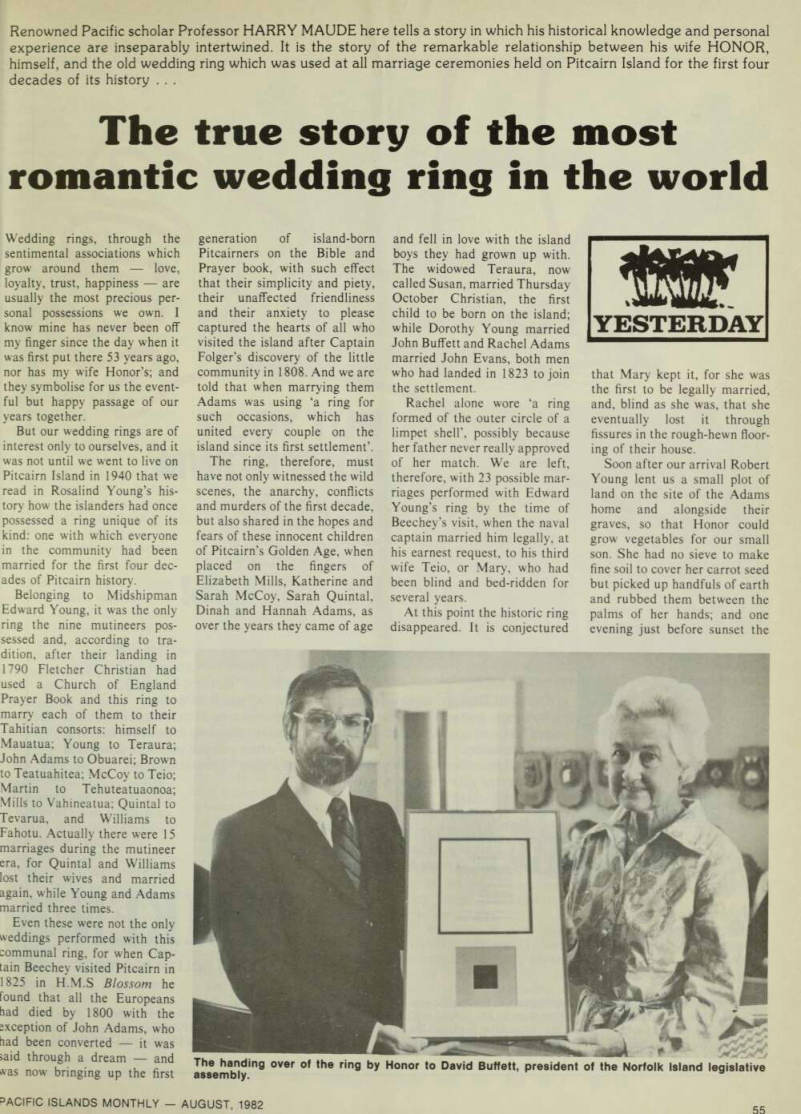
The handing over of the ring by Honor to David Buffett, president of the Norfolk Island legislative assembly.
miracle happened: there, in her hand, covered with earth, lay a ring.
She took it home and washed it carefully, with some excite ment, for she realised full well what it might be though, to avoid what I thought would be inevitable disappointment, I had pronounced it to be a curtain ring.
Gradually the gold showed; then a crown and the letters G.R., which seemed to indicate that it had been made in the reign of one of the early Georges; and finally the word ‘pure’: so there was no doubt about what she had found, either in the islanders’ minds or our own..
Honor said at once that the ring belonged to Pitcairn, but the community felt that as she had found it she should keep it.
So she agreed to take it, not for herself or for sale but to ensure its preservation for all time. The island Magistrate, Andrew Young, and the owner of the land on which it was found, both signed certificates of authenticity concerning the dis covery.
It was worn on Honor’s finger for some years, leading R. W.
Robson of Pacific Islands Monthly to write that I was ‘the only man in civilisation who can claim that he has a wife who is married to a Pacific island. She bears upon her hand the wedding-ring in proof. Later, from fear of loss, it was de posited on loan in the Auckland Museum.
For 40 years we wondered where the ring could best find a permanent home where it would be treasured for its associations.
Pitcairn’s prior claim gradually faded as the reduction of the population seemed to presage an eventual abandonment of the island for the third time in its two-century history. In any case there was nowhere safe to put it there, and no one to see it now that shipping calls had fallen to a trickle.
Dismissing the large metro politan museums we were inally left with Norfolk, where he entire Pitcairn population of i 94 had settled in 1856, though 13 had eventually returned. But vould the old families still
recognise its historical significance after 125 years of separation from their home land?
We need not have worried for the Norfolk islanders were plan ning a museum and we received a warm invitation from the Hon David Buffett, president of the legislative assembly and the Museum Trust, to visit the island and see for ourselves. On our arrival the ring was given an enthusiastic welcome and the Bounty families proved not only as friendly and kind as their Pitcairn cousins but very inter ested and well versed in their history.
On May 3, 1982, at a cere mony at the legislative as sembly committee rooms in the old Barracks on Quality Row at Kingston, chaired by David Buffett and attended by the administrator, the museum
trustee, the president of the historical society and represen tatives of all the old Pitcairn lineages, Christian, Adams, McCoy, Quintal, Buffett, Evans and Nobbs (only the Youngs were missing, for their male line on Norfolk had died out), the historic and now literally price less Bounty wedding ring was handed over, mounted on velvet and in a frame setting out the story of its significance and finding, with the separately framed certificates.
It was one of the most memorable meetings I have ever attended. As the Norfolk Islander remarked in its verbatim record ‘the emotion of the moment could be sensed by all’: a quiet pride, even nostal gia, as we spoke of their old home and the dramatic story of their past, and a feeling of togetherness that day as a
unique community. Perhaps they were pleased too that others should value this symbol of their common heritage and keep it in trust until it could be restored to them as a pledge that their unity, which was so marked a feature of Pitcairn history, would continue in their new heartland on Norfolk.
Probably old ‘Ma’ Adams summed it up best when she remarked that ‘there was plenty of feeling about’.
After the function was over 1 stole back to the empty room to say goodbye to what is surely the most romantic Wedding Ring in the world, which on my wife’s finger had formed part of our own lives for so long, and I felt that it too was happy to be back among the descendants of the people to whom it had for so long been a token of love and fidelity.
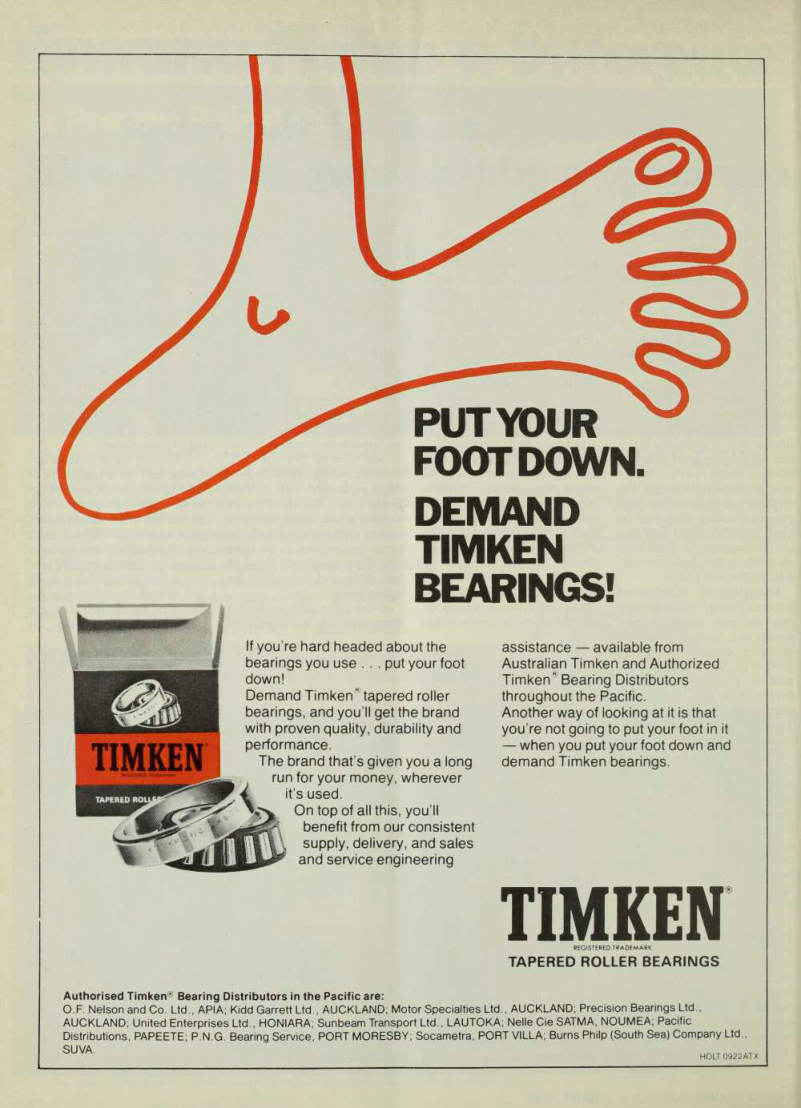
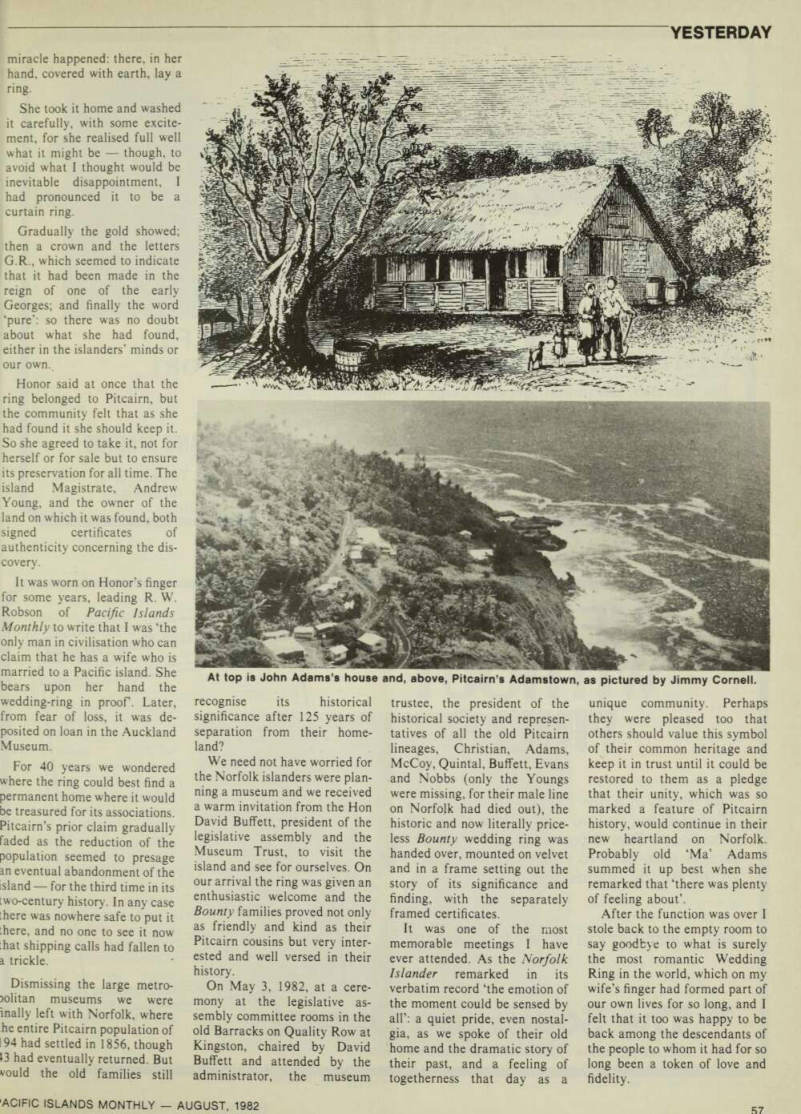
At top is John Adams’s house and, above, Pitcairn’s Adamstown, as pictured by Jimmy Cornell.