A meeting on ‘Pacific Resources’
pp. 59-63 · Read in the full issue

Trade
Winds
A meeting on ‘Pacific Resources’ hears a clear voice from the Islands
In June, in his capacity as Leader of the Opposition in the National Parliament of Papua New Guinea, MICHAEL SOMARE was invited to give the*keynote address at the opening of a major international convention in Sydney. Theme of the convention, organised by the Sydney Chamber of Commerce, was the development of the Pacific’s resources. A slightly shortened version of Mr Somare’s speech, which was notable for its often pungent presentation of the Pacific Islanders’ viewpoint, appears below.
My intent is to speak to you of the position and interest of the Pacific Island nations, which of course includes my own Papua New Guinea.
In many ways PNG’s re lationship with Australia epit omises the wide range of experi ence the Pacific Island nations have had with the outside world over the last hundred years. At the beginning, when (thank goodness) we were finally dis covered, our many cultures excited, surprised and fasci nated a handful of explorers and others. From this exotic identity we then slipped into a more mundane one of providing the wherewithal to keep a dual economy running only ab ruptly to swing to the sublimer end of the range to assume the role of Angels Fuzzy Wuzzy ones, it is true but neverthe less Angels. And now we are an independent country, still only seven years old, but back to a more mundane status again, with our feet very firmly on the ground . . .
We Pacific Islanders want to be full members of the market place, we do not want the role of colourful beggar. It is true that we have been accused of talking most about self-sufficiency when we have our hands open for aid. Unfortunately, aid must still be an element in our economies. But with ouside help we can progressively diminish that dependence, and believe me that is as healthy for us as it is a saving for the aid countries.
PNG, for example, has in real terms cut down her annual untied grant from Australia by a half since our independence in 1975. The smaller Pacific Island nations without PNGs natural resources have a much tougher time of it Western Samoa, for example, with its great dependence on copra ex ports but a co-operative, not exploitive, approach to trade
and investment will help us through Unfortunately, the hypocrisy we are accused of is sometimes as much evident in the people we deal with internationally. I can go to any small PNG island, surrounded by fish-filled waters, and the villagers are eating canned fish with their meal. The fish may be our fish, but they have been canned abroad. The boats that catch the fish, more often illegally than legally, are not our boats, and the fishermen manning the boats are not our men. We are lucky if our input into the whole process is a seaman swabbing the deck of one of the boats.
Yet the biggest culprits in such exploitation seem the loudest in making statements about technology transfer. I can tell you, ladies and gentlemen, that with all the promises PNG has received about technology transfer in the fishing indus tries, the most impressive we have managed to achieve so far, and it was only a temporary one,
was the capture of the Danica.
Unfortunately our navy is smaller than America’s, and the technology had to be returned.
PNG is fortunate in pos session of mineral resources, but there are other sides to the picture. Just the other day there was a photograph on the front page of our local newspaper of a large ship unloading modular house kits for erection at the Ok Tedi site. On the same page were headlines announcing the retrenchment of over 400 workers from two of our main timber companies. The reason: an insufficient domestic market.
Our Forests Minister investi gated the matter: according to him, when calling for tenders for house timbers, Ok Tedi officials had laid down unpre cedented specifications, thus dissuading the domestic com panies from even bothering to tender.
The economic situation, bad for everyone at the moment, is especially bad for the Island countries with their lack of
diversification and dependence on primary product exports.
The islands stand in great need of increased external invest ment: they need the expertise and technology transfer to help them with import substitution, they would like to benefit from the rolling transfer of some of the intensive labour industries of their industrially advanced neighbours, and they would appreciate systems of tax credits by the latter to encour age investments. To attract trade-oriented investments and small-scale industries for dom estic or pan-island consumption, most island governments offer, or can be persuaded to offer, tax incentives as well as secure investment climates .. .
Yet despite our needs, we do not seek external investment at all costs and with no qualification. Economic growth we have to look for and enable, but not as an end in itself.
Perhaps we Pacific Islanders are naive about these matters, but it seems to us too often the accompaniment of growth else where in the Third World is growing poverty, growing un employment, growing disparity in distribution of benefits and wealth, and above all growing disenchantment of a nation’s youth. We seek to maintain control over our future and destiny. We are interested in development, not envelopment.
That means we seek training and demand participation in the enterprises established in our countries. Growth we want as a
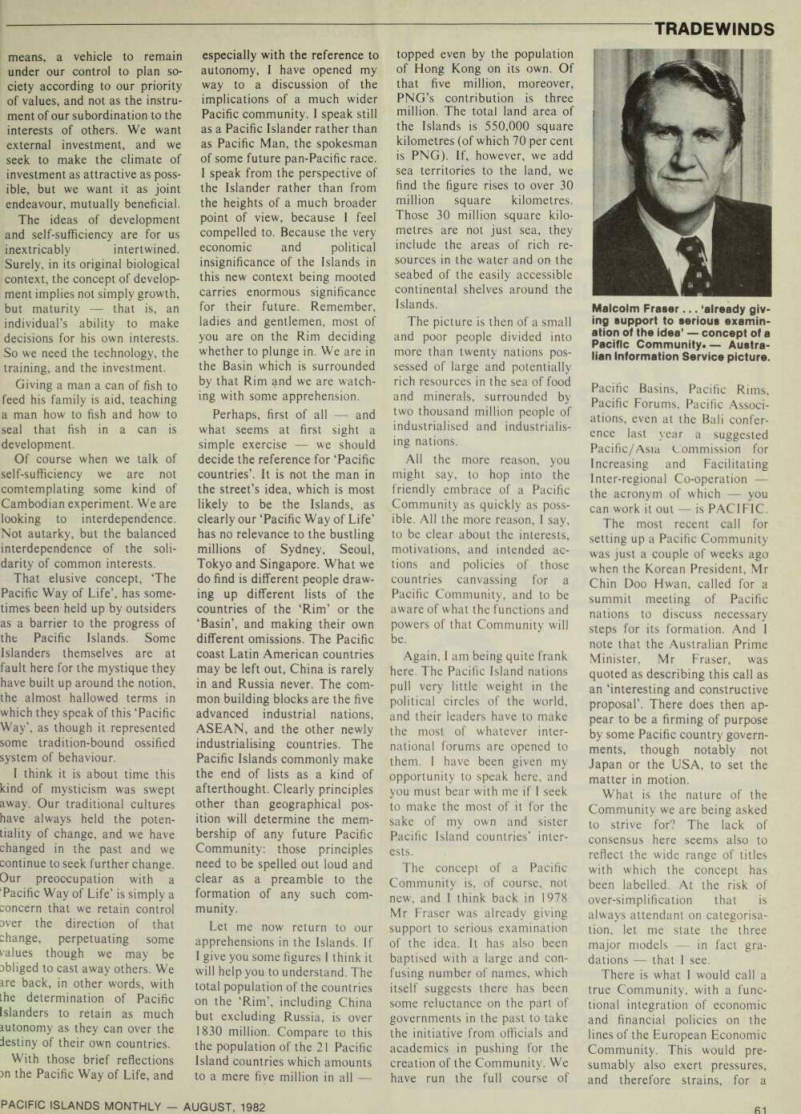
‘We do not want the role of colourful beggar’ ... Mr Somare in Sydney,— Identity Studio picture.
means, a vehicle to remain under our control to plan so ciety according to our priority of values, and not as the instru ment of our subordination to the interests of others. We want external investment, and we seek to make the climate of investment as attractive as poss ible, but we want it as joint endeavour, mutually beneficial.
The ideas of development and self-sufficiency are for us inextricably intertwined.
Surely, in its original biological context, the concept of develop ment implies not simply growth, but maturity that is, an individual’s ability to make decisions for his own interests.
So we need the technology, the training, and the investment.
Giving a man a can of fish to feed his family is aid, teaching a man how to fish and how to seal that fish in a can is development.
Of course when we talk of self-sufficiency we are not comtemplating some kind of Cambodian experiment. We are looking to interdependence.
Not autarky, but the balanced interdependence of the soli darity of common interests.
That elusive concept, ‘The Pacific Way of Life’, has some times been held up by outsiders as a barrier to the progress of the Pacific Islands. Some Islanders themselves are at fault here for the mystique they have built up around the notion, the almost hallowed terms in which they speak of this ‘Pacific Way’, as though it represented some tradition-bound ossified system of behaviour.
I think it is about time this kind of mysticism was swept away. Our traditional cultures have always held the poten tiality of change, and we have changed in the past and we continue to seek further change.
Our preoccupation with a Pacific Way of Life’ is simply a concern that we retain control aver the direction of that change, perpetuating some values though we may be abliged to cast away others. We are back, in other words, with the determination of Pacific Islanders to retain as much autonomy as they can over the destiny of their own countries.
With those brief reflections an the Pacific Way of Life, and
especially with the reference to autonomy, I have opened my way to a discussion of the implications of a much wider Pacific community. I speak still as a Pacific Islander rather than as Pacific Man, the spokesman of some future pan-Pacific race.
I speak from the perspective of the Islander rather than from the heights of a much broader point of view, because I feel compelled to. Because the very economic and political insignificance of the Islands in this new context being mooted carries enormous significance for their future. Remember, ladies and gentlemen, most of you are on the Rim deciding whether to plunge in. We are in the Basin which is surrounded by that Rim and we are watch ing with some apprehension.
Perhaps, first of all and what seems at first sight a simple exercise we should decide the reference for ‘Pacific countries’. It is not the man in the street’s idea, which is most likely to be the Islands, as clearly our ‘Pacific Way of Life’ has no relevance to the bustling millions of Sydney, Seoul, Tokyo and Singapore. What we do find is different people draw ing up different lists of the countries of the ‘Rim’ or the ‘Basin’, and making their own different omissions. The Pacific coast Latin American countries may be left out, China is rarely in and Russia never. The com mon building blocks are the five advanced industrial nations, ASEAN, and the other newly industrialising countries. The Pacific Islands commonly make the end of lists as a kind of
afterthought. Clearly principles
other than geographical pos ition will determine the mem bership of any future Pacific Community: those principles need to be spelled out loud and clear as a preamble to the formation of any such com munity.
Let me now return to our apprehensions in the Islands. If I give you some figures I think it will help you to understand. The total population of the countries on the ‘Rim’, including China but excluding Russia, is over 1830 million. Compare to this the population of the 21 Pacific Island countries which amounts to a mere five million in all
topped even by the population of Hong Kong on its own. Of that five million, moreover, PNG’s contribution is three million. The total land area of the Islands is 550,000 square kilometres (of which 70 per cent is PNG). If, however, we add sea territories to the land, we find the figure rises to over 30 million square kilometres.
Those 30 million square kilo metres are not just sea, they include the areas of rich re sources in the water and on the seabed of the easily accessible continental shelves around the Islands.
The picture is then of a small and poor people divided into more than twenty nations pos sessed of large and potentially rich resources in the sea of food and minerals, surrounded by two thousand million people of industrialised and industrialis ing nations.
All the more reason, you might say, to hop into the friendly embrace of a Pacific Community as quickly as poss ible. All the more reason, I say, to be clear about the interests, motivations, and intended ac tions and policies of those countries canvassing for a Pacific Community, and to be aware of what the functions and powers of that Community will be.
Again, I am being quite frank here. The Pacific Island nations pull very little weight in the political circles of the world, and their leaders have to make the most of whatever inter national forums are opened to them. I have been given my opportunity to speak here, and you must bear with me if I seek to make the most of it for the sake of my own and sister Pacific Island countries’ inter ests.
The concept of a Pacific Community is, of course, not new, and I think back in 1978 Mr Fraser was already giving support to serious examination of the idea. It has also been baptised with a large and con fusing number of names, which itself suggests there has been some reluctance on the part of governments in the past to take the initiative from officials and academics in pushing for the creation of the Community. We have run the full course of
Pacific Basins, Pacific Rims, Pacific Forums, Pacific Associ ations, even at the Bali confer ence last year a suggested Pacific/Asia Commission for Increasing and Facilitating
Inter-regional Co-operation
the acronym of which you can work it out is PACIFIC.
The most recent call for setting up a Pacific Community was just a couple of weeks ago when the Korean President, Mr Chin Doo Hwan, called for a summit meeting of Pacific nations to discuss necessary steps for its formation. And I note that the Australian Prime Minister, Mr Fraser, was quoted as describing this call as an ‘interesting and constructive proposal’. There does then ap pear to be a firming of purpose by some Pacific country govern ments, though notably not Japan or the USA, to set the matter in motion.
What is the nature of the Community we are being asked to strive for? The lack of consensus here seems also to reflect the wide range of titles with which the concept has been labelled. At the risk of over-simplification that is always attendant on categorisa tion, let me state the three major models in fact gra dations that 1 see.
There is what I would call a true Community, with a func tional integration of economic and financial policies on the lines of the European Economic Community. This would pre sumably also exert pressures, and therefore strains, for a
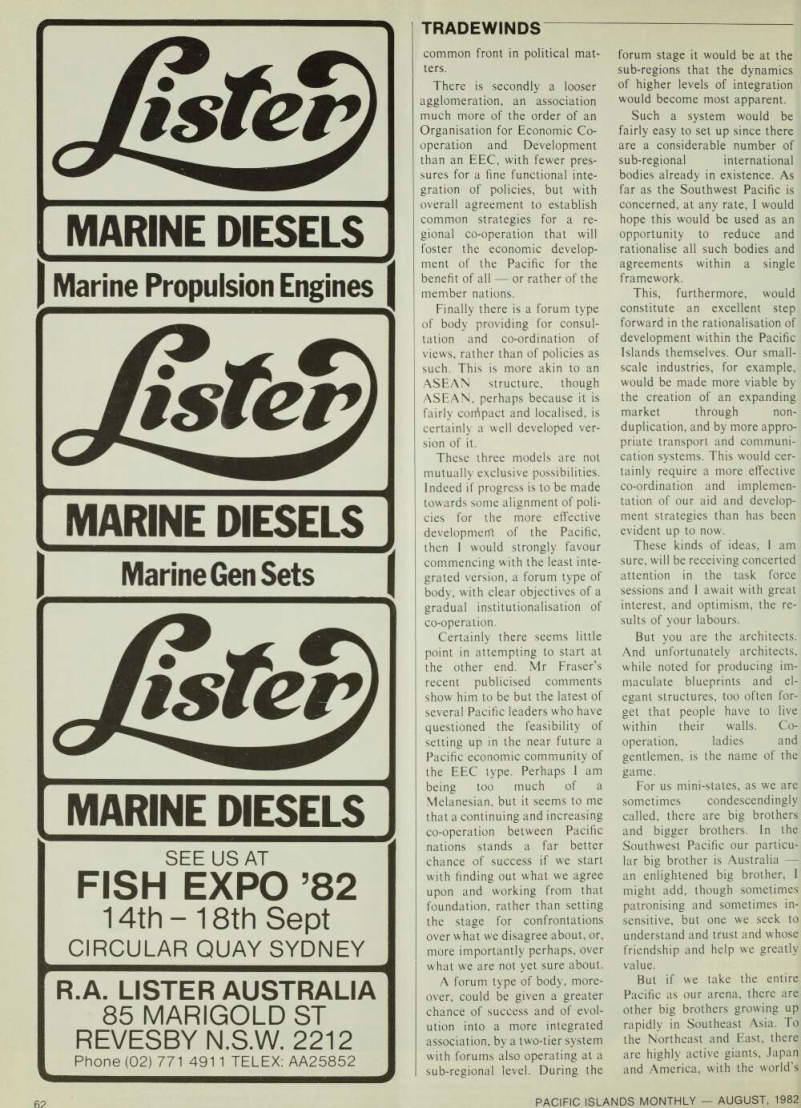
Malcolm Fraser... ‘already giv ing support to serious examin ation of the idea’ - concept of a Pacific Community. - Austra lian Information Service picture.
common front in political mat ters.
There is secondly a looser agglomeration, an association much more of the order of an Organisation for Economic Co operation and Development than an EEC, with fewer pres sures for a fine functional inte gration of policies, but with overall agreement to establish common strategies for a re gional co-operation that will foster the economic develop ment of the Pacific for the benefit of all or rather of the member nations.
Finally there is a forum type of body providing for consul tation and co-ordination of views, rather than of policies as such. This is more akin to an ASEAN structure, though ASEAN, perhaps because it is fairly corfipact and localised, is certainly a well developed ver sion of it.
These three models are not mutually exclusive possibilities.
Indeed if progress is to be made towards some alignment of poli cies for the more effective development of the Pacific, then I would strongly favour commencing with the least inte grated version, a forum type of body, with clear objectives of a gradual institutionalisation of co-operation.
Certainly there seems little point in attempting to start at the other end. Mr Fraser’s recent publicised comments show him to be but the latest of several Pacific leaders who have questioned the feasibility of setting up in the near future a Pacific economic community of the EEC type. Perhaps I am being too much of a Melanesian, but it seems to me that a continuing and increasing co-operation between Pacific nations stands a far better chance of success if we start with finding out what we agree upon and working from that foundation, rather than setting the stage for confrontations over what we disagree about, or, more importantly perhaps, over what we are not yet sure about.
A forum type of body, more over, could be given a greater chance of success and of evol ution into a more integrated association, by a two-tier system with forums also operating at a sub-regional level. During the
forum stage it would be at the sub-regions that the dynamics of higher levels of integration would become most apparent.
Such a system would be fairly easy to set up since there are a considerable number of sub-regional international bodies already in existence. As far as the Southwest Pacific is concerned, at any rate, I would hope this would be used as an opportunity to reduce and rationalise all such bodies and agreements within a single framework.
This, furthermore, would constitute an excellent step forward in the rationalisation of development within the Pacific Islands themselves. Our small scale industries, for example, would be made more viable by the creation of an expanding market through non duplication, and by more appro priate transport and communi cation systems. This would cer tainly require a more effective co-ordination and implemen tation of our aid and develop ment strategies than has been evident up to now.
These kinds of ideas, I am sure, will be receiving concerted attention in the task force sessions and I await with great interest, and optimism, the re sults of your labours.
But you are the architects.
And unfortunately architects, while noted for producing im maculate blueprints and el egant structures, too often for get that people have to live within their walls. Co operation, ladies and gentlemen, is the name of the game.
For us mini-states, as we are sometimes condescendingly called, there are big brothers and bigger brothers. In the Southwest Pacific our particu lar big brother is Australia an enlightened big brother, I might add, though sometimes patronising and sometimes in sensitive, but one we seek to understand and trust and whose friendship and help we greatly value.
But if we take the entire Pacific as our arena, there are other big brothers growing up rapidly in Southeast Asia. To the Northeast and East, there are highly active giants, Japan and America, with the world’s
largest economies. And there are giants, threatening and un fathomable, Russia and China, to the North.
In being invited into such a community of these advanced industrialised and industrialis ing countries of the Pacific Rim, I sometimes cannot help won dering whether, in the language of The Godfather , we are not being made an offer we can’t refuse. We certainly cannot afford to be left out of co operation because we are small enough to be ignored if we don’t co-operate.
So we ‘mini-states’ have to give hard thought to how real are these concepts of co operative endeavours. You can not blame us for our suspicions, for some of our experiences, with, for example, aggressive marauding foreign fishing fleets, threats to dump nuclear wastes in our waters, nuclear bomb testing, and widespread transfer-pricing by multi national corporations, hardly put our fears to rest. So while we welcome Pacific co operation and being part of it, we also wonder whether some of our big colleagues in the Community-to-be are not simply girding themselves up for a 21 st-century ‘Scramble for the Pacific’ in this case for maritime resources not land.
Nor should you forget that, traditionally, weak countries surrounded by powerful ones survive by playing their big neighbours off against each other. Poland is not the only country in the past to have disappeared through lack of finesse in such a strategy.
We could argue that the 30 million square kilometres of Pacific Ocean and seabed re sources to which we Pacific Island nations possess an unde niable right are more likely to be successfully denied us by the industrial nations in co operation for a carve-up, than if they were squabbling amongst themselves and endeavouring to utilise our friendship and inter ests to boost the ethical content of their own stands.
That I agree, ladies and gentlemen, is a fairly frank statement of one position we could take. But I do have a responsibility to act in the interests of a younger gener
ation of Islands people who will seek to reap their heritage when, for example, the state of Fiji is 40 years old, not 12, and when PNG is 27 years old and not 7.
I am not being unrealistic I do fully recognise that co operation does not mean sacrificing self-interest. But it does mean stating your self interest so that fair accommo dation and compromise can be made between those who are co operating.
We have a fine relationship with Australia though we want a better one. We look to her leadership irt many areas.
But Australia too has her big brother America. Not that Australia is always ready to dance to America’s tune, as for example in the public support the Australian Government gave PNG over the Danica affair.
Yet we are not blind to the fact that Australia’s wider econ omic and strategic interests are served by identifying with much of America’s policy. We therefore become worried when, in the context of a call for a Pacific Community of Nations, we read such a docu ment as that proposing an Organisation for Pacific Trade and Development, or OPTAD.
This document was co authored by an Australian pro fessor under contract to the US committee on foreign relations.
The OPTAD proposal was en dorsed in the official Crawford- Okita report Australia, Japan and Western Pacific Economic Relations pres ented to the Australian and Japanese Governments.
What are we mini-states to make of such statements as the following? ‘lf such an organisation de velops, the United States has a strong interest in playing a leading role in specifying the purpose and shape of any new regional economic association in order that it encompasses US economic and political interests in the future of the region and is consistent with American glo bal economic commitments and responsibilities.’
And again: ‘The conclusion is that there may well be consider able merit in these proposals from the viewpoint of advanc
ing United States global econ omic interests and responsi bilities and political-military in terest in Asia. The general shape of the new regional econ omic organisation is defined more carefully with those objec tives in mind.’
These I assure you are only representative of numerous other like statements of US self interest.
As I have said, self-interest must be a recognised motiv ation in co-operation. But if a ‘Community of the Pacific’ is to
be brought into being, are such self-interests to be made fully evident? Or are we Pacific Islands states simply to receive an offer we can’t refuse? When all the artificial cream of rhet oric, conferences and cocktails in coconuts is removed, what we want to know is: 1. Will there be any cake; and, 2. If there is, how is the cake to be divided up?
The realities of co-operation lie not in designing such a cake, but in determining the mixture and the share-out. ..