Fishing, culture,
p. 53 · Read in the full issue
and survival
Words of the Lagoon. By R. E.
Johannes. Published by the University of California Press, Berkeley, 1981. ISBN 0520 0329 7. Details of price un available.
There are, says Dr R. E. Johannes in Words of the Lagoon, two reasons why Pacific islanders need to retain their traditional knowledge of fishing. First, ‘a culture is defined in part by the special ised knowledge it possesses. The extent to which this knowledge is retained is one measure of the strength of that culture’.
Second, the world economy
looks like faltering and Pacific islanders, ‘at the end of a long and expensive supply line that delivers much of what they once obtained within their own islands’, may have to achieve a greater self-sufficiency. Such an achievement will hinge largely on the extent to which tra ditional knowledge has been retained and is melded with modern technology.
This book has the sub-title ‘Fishing and Marine Lore in the Palau District of Micronesia’, but it is more than that: it offers a carefully considered and well substantiated prescription for optimisation of marine re-
sources everywhere in the Pacific. ‘Optimum’, in this con text, means most favourable conditions for growth, repro duction, etc. Its antithesis is the finite despoliation which foreign fishing vessels and, in some cases, local fishermen are inflicting on many parts of the Pacific Ocean.
Almost 20 years ago, as assistant to the staff economist of the then US Trust Territory of the Pacific Islands, I reported to the US Government that ‘it is well within the realm of possi bility that even extensive re settlement of people from atolls and low-lying islands on arable tracts of unoccupied land on islands like Babelthuap, Rota, Ponape and Kusaie will not accommodate everyone in a few decades from now .. . Emi gration may be necessary . . . ultimate Micronesian nation hood will only be achieved if the people make the best possible use of their land and other resources’. Foremost among those resources are those of the sea, and the late George Taggart, that incomparable Yankee explorer and seafarer who was my boss, had pointed out what the author of this book now states unequivocally: there is no inhabited island in Oceania where seafood is as plentiful as it was before West ern contact, and in many islands the decline of local tradition and the population growth have caused a serious deterioration of fishing.
Dr Johannes writes about the many kinds of fish and other maritime life of the Palauan waters, their reproduction, feeding, travel, and the tra
ditional techniques used by the local people to catch them.
Everyone with some knowledge of the Pacific has heard of the ‘rising’ of palolo in Samoa and Fiji, of anchovy-type fish in Papua New Guinea, etc, but how many people (and this includes biologists) are aware of, let alone understand, the lunar spawning cycles of say, the 45 species of fish known to one of the author’s Palauan informants? How many people know enough about seabirds as fish-finders? According to the author, to-day’s American and Japanese skipjack fishermen with electronic equipment have scarcely improved on the Palauan’s traditional technique.
Most of the information in this book of more than 200 pages has come from islanders, with its commendably jargon free recording by Johannes, a marine biologist, now making their knowledge available to Pacific islanders everywhere.
Words of the Lagoon proves, if such proof is still needed, that the traditional knowledge and experience of the ‘primitive’ peoples of the Pacific need to be taken heed of, that modern Western technolgy is not the beginning and end when the planners and advisers of govern ments in our part of the world do their stuff. As Johannes puts it, ‘Traditional knowledge must be sought to complement scien tists’ meagre store of relevant biological information’.
Dr Johanne’s book amply rewards the patience and hos pitality of his Palauan hosts, but their real reward will only come if Pacific governments learn a
lesson from it.
Harry H.
Jackman.
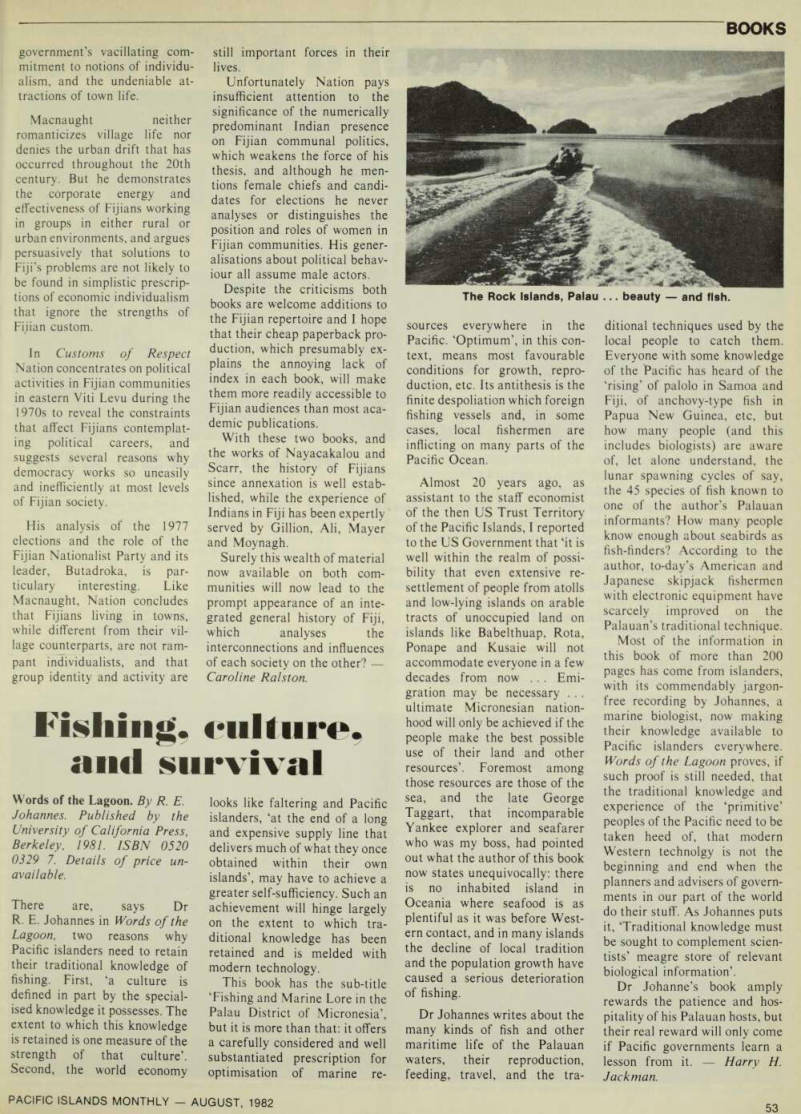
The Rock Islands, Palau ... beauty - and fish.