The fruitful roving
pp. 35-36 · Read in the full issue
of Barak Sope
Vanuatu’s Roving Ambassador Barak Sope’s extensive tour around some of the world’s capitals recently may attract a lot of grist to his country’s mill, especially from France, Japan, South Korea and China, countries eager to extend help ing hands to the South Pacific Islands.
His most important call, how ever, was on French President Mitterrand, to whom he pre sented his credentials and
did some fence-mending, re pairing the damage inflicted by the francophone secessionists at the time of Vanuatu indepen dence. In this he was aided by the president, who matched Mr Sope’s diplomatic word flow with statements like: ‘You have chosen a road to development that respects the aspirations of the communities of which Vanuatu is composed.’
Mr Sope had told the presi dent: ‘France has played a very
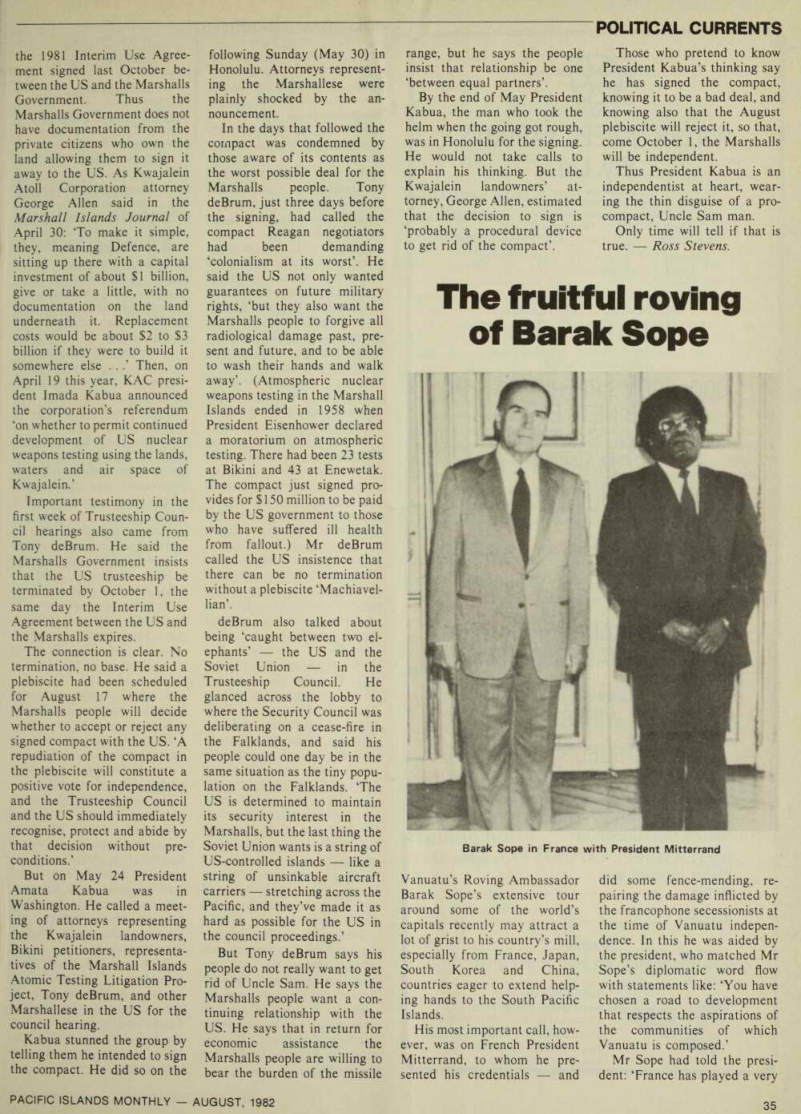
Barak Sope in France with President Mitterrand
important role in creating the new nation of Vanuatu. My people are grateful for this and have accepted the era before independence as part of our history.’ Which is another way of saying ‘Let bygones be by gones’.
His final words were real fence-menders. ‘Vanuatu has the will and strong desire to develop closer and deeper re lations with France,’ said the ambassador. ‘ln the years to come, my government and people will continue to look to France for support and co operation in the fields of edu cation, health and economic development. With deeper understanding, co-operation and friendship between our two peoples, France will always be assured that, far away in the South Pacific, Vanuatu is a friend and partner.’
President Mitterrand assured Mr Sope that ‘the difficulties which surrounded your ac cession to independence and strained the relations between our two countries have been overcome’. He added: ‘France and Vanuatu now know that, henceforth, they may agree with each other, understand each other and work together as demonstrated by the co operation agreements recently signed between our two countries.’
The president also stressed that Vanuatu was acquiring (through membership of the Agency for Cultural and Tech nical Co-operation and ac cession to the Lome Conven tion) the ‘means necessary to enable itself to develop and conduct a foreign policy free from all forms of influence, whether imposed or endured, in the fulfilment of your difficult but challenging goals, goals calling for all the courage and vision of your young nation.
France is ready to lend a hand and it has the resources in the Pacific to do this’.
During his stay in Paris Mr Sope had talks with government officials about the new co operation agreement between France and Vanuatu, and the need for a ‘genuine’ pension scheme for Ni-Vanuatu living in New Caledonia. If they return to Vanuatu they forfeit the pension.
Mr Sope asked that such funds should be transferred to Vanuatu for those who had forfeited them. This will be discussed by the French govern ment’s aid negotiation team due in Vanuatu in October.
Another subject for dis cussion by the joint committee in November will be the ques tion of the agreement by France and Britain to pay for damage caused by the 1980 rebellion.
At the headquarters of the European Economic Com munity in Brussels, Mr Sope discussed aid to Vanuatu, and was told that the EEC will open an office in Port-Vila by the end of the year.
In Peking the ambassador was told the Chinese would welcome a cultural exchange programme. And China was also interested in Vanuatu’s timber.
On his return home in early June Mr Sope said that China was so short of timber that the government was discouraging people from using wooden coffins.
Mr Sope pushed in Tokyo for an improvement in the balance of trade, pointing out that the balance was very much in Japan’s favour. The reply was that Japan was interested in Vanuatu’s meat and fish ex ports. He was given two assur ances aid would be given when Vanuatu asked for it and specified what the aid was for, and that Japan supported Vanuatu’s nuclear-free Pacific policy.
South Korea promised to strengthen trading relations and expressed interest in Vanuatu’s timber, fish and minerals.
On his way through Europe Mr Sope visited Switzerland and paved the way for future diplomatic links. He also visited Cameroun in Africa and dis covered a fellow-feeling that both countries were bilingual, and that Cameroun was the sole link in Africa between the French-speaking and English speaking nations.
Back in Port-Vila, Mr Sope commented: ‘On the same basis, we in Vanuatu have the same advantage over our other Pacific neighbours. We will be the link between Tahiti and New Caledonia, when they are independent.’