drug-runners’
pp. 37-41 · Read in the full issue

Tropicalities
Islands as
staging posts
There is increasing evidence of small Pacific islands being used as ‘staging posts’ by traffickers sending drugs to Australia and New Zealand from Asia, ac cording to a South Pacific Commission expert.
The SPC’s adviser on en vironmental health and food hygiene, Eric Dunn, said in creased control and surveillance of illicit drugs in the Western industrialised nations had en couraged the growth of traffick ing in populous regions of the South Pacific.
In an article in the SPC Monthly News of Activities, Mr Dunn claims traffickers were opening up new drug routes via the islands.
He repeated his warning in a June telephone interview from Noumea with The Sydney Morning Herald. ‘There is no doubt that some South Pacific countries are be ing used as transit points,’ he said.
An increasingly competitive international airline network made most of the islands access ible by air, and the resulting tourist trade had simplified drug trafficking.
Criminals were travelling easily through the Pacific by posing as tourists, said Mr Dunn.
By using a system of forged passports and overlapping cour iers, they gave no indication that they had visited drug producing areas of Asia particularly the ‘Golden Tri angle’ where most of the illegal drugs originated. ‘ln addition to traffic in drugs by air, consignments are often shipped by roundabout routes though the islands on small vessels,’ he said.
Although there is at present very little drug abuse on the islands, Mr Dunn said increas
ing two-way tourism meant more Pacific Islanders were visiting metropolitan areas of New Zealand and Australia where the level of abuse was rising.
Criminals were also taking advantage of the lack of exper tise amongst customs officials on the islands. ‘They know that the enforce ment officers of some Pacific island countries lack training and experience in the specialist field of drug identification and concealment, and they take advantage of this,’ said Mr Dunn. ‘lt is clear that such illegal activities can only be success fully combated if the prevent ative authorities remain one jump ahead of the traffickers. ‘This requires sound up-to date knowledge of drug identification, the techniques used to avoid detection and, above all, constant vigilance by the officers responsible for sur veillance of our sea and air ports. ‘Over the past couple of years, customs officers have seized drugs and couriers in places such as Fiji and the Solomon Islands and even here in Noumea.’
Mr Dunn said the difficulties had been highlighted at the 1977 regional seminar for heads of customs.
The seminar strongly rec ommended that the SPC ar range expert technical training on drug surveillance for police and customs officers in the region.
Three such courses have already been held, with funds from the UN division of nar cotic drugs, the UN fund for drug abuse and control, the Commonwealth fund for techni cal co-operation and the Gov ernments of Australia and New Zealand.
A fourth course, planned for late this year, is in jeopardy however, because of a lack of funds.
Each course cost about $35 000 to run.
But Mr Dunn said he had difficulty raising the money because the courses were financed externally not through the SPC’s annual budget provisions.
Although the costs were shared jointly by the organis ations and governments listed
above, Mr Dunn agreed that Australia and New Zealand benefited most in the long run. ‘Australia and New Zealand, I suppose are the main beneficiaries because they are the targets for the drugs, but the islands also worry because of the possibility of drugs get ting into their societies.’
Caroline and
Guillermo...
An unidentified ‘South Pacific island’ was the scene of a secret June holiday for Princess Caroline of Monaco and Argen tine tennis star Guillermo Vilas.
Their whirlwind affair began when Caroline saw the 29-year old Vilas play in the Monaco tennis tournament, according to Paris Match magazine. She was smitten and they rendezvoused in his Paris flat two days later.
Vilas, who reportedly gave up sex for a year to improve his tennis, and Caroline flew by private plane to the island hideaway.
Photographs in Paris Match show the couple swimming together and embracing on the beach.
The 25-year-old princess has emerged into public life only recently following her divorce from French playboy Philippe Junot, 42, in 1980.
She has been seen regularly with 32-year-old Robertino Rossellini, son of the famous Italian movie director.
Vilas, who quit Wimbledon because of the Falklands war, is engaged to French beauty Gabriela Blondeau.
She is said to have moved out of his house.
Question: Can any PIM reader tell us which islarid it was?
Arguing hotly
in Hawaii...
Arguments about the merits of traditional societies and cul tures as against ‘modernisation’ are common throughout the Pacific. But seldom are they carried on with such vigour as happened recently in Hawaii.
In his column in Honolulu’s Sunday Star-Bulletin & Adver tiser Sammy Amalu wrote: ‘Well, we Hawaiians are get ting all stirred up and restless of late, doing all sorts of weird things like publishing outrage
ously expensive books and devoting tons of government paper to outline our own cul tural needs as if we were the only ones in the world with cultural needs.
The only trouble is that the only culture the Hawaiian ever had was a neolithic one, far better dead than revived, you can believe me. I do not mean to disparage the ancient life of my Hawaiian forefathers, but aside from feather making and poetry with a smidgen or two of the terpsichorean art, it did not have too much and was cer tainly not one of man’s highest attainments. ‘I, of course, have always been an advocate of human sacrifice as a means of control ing population, but it does have its social drawbacks and never was really too popular a pastime among my ancestors, especially not among those who were being sacrificed. ‘And no matter what you may think of the American missionaries and what they did here in Hawaii, you must admit that they did free the ordinary Hawaiian from what was little more than plain old slavery. The chiefs and princes had every thing going for them in the old culture, but Joe Blow had a hard time of it. The missionaries gave him back his manhood and freed him from his bondage to his superiors. ‘Anyway, that is the culture that some would now have us revive and recall. And the Office of Hawaiian Affairs has written a whole report of its plans to bring back all that bosh and nonsense.’
He returned to the attack in his next column, arguing that the Office of Hawaiian Affairs (OHA) had achieved nothing, was divisive, and was ‘trying to secede from the island com munity’.
But the newspaper’s editors were not letting Sammy Amalu have it all his own way. In a counter-blast in the same issue, Peter K. Apo, an OHA trustee, wrote: ‘The only claim that Sam Amalu has to Hawaiian ances try is that he is very good at throwing spears. Without fan fare, his latest poison-tipped missiles came hurling through the front doors of the Office of Hawaiian Affairs . . . ‘Mr Amalu charges that
OHA is leading a “separatist” movement doomed to alienate the Hawaiian people from the rest of society.
“Where have you been all these years, Sam? We are already alienated and have been ever since the overthrow of Queen Lili’uokalani. Alienated from our ancestral lands, alien ated from our culture, alienated from every important political and economic decision-making process that went into the shaping of modern Hawaii to the exclusion of the Hawaiian. ‘lf it upsets you that we make waves from time to time, we suggest you get a surfboard.
Since you don’t seem to know much about modern Hawaii politics, here’s the scene: It’s kind of like trying to catch a New York subway during rush hour; without the little nudging and elbowing, you get left behind. It’s the American way . .. ‘To set the record straight Sam, OHA is aware that it owes its existence to the goodwill of all the people of Hawaii. We are not stupid enough to think that we can win our political and economic battles alone. We actively seek the support of the entire community and under stand the meaning of compro mise. ‘We do not seek to secede from the Union or as you suggest from the rest of Hawaii society. We seek to sit in council as full and equal partners. Our job is to end the alienation, not encourage it. ‘Yes, we Want a hand in the shaping of Hawaii’s future. Yes, we want to intensify the re trieval of our culture. Yes, we want better educational and employment opportunties for our people. ‘These are not questions of ethnicity. These are questions of every man’s right to pursue his full potential regardless of ancestry . ..’
Psst! Did Incas
reach Oz first?
In these days when coffee table books proliferate like rabbits, one sometimes wonders whether the planet earth won’t suddenly wobble out of orbit under the sheer weight of their ever-increasing volume.
Coffee table books tend to be produced with the greatest flair by the multi-national publishing houses, or, at least, by those American publishing organis ations that have branches throughout the English speaking world.
They are invariably hand somely produced volumes with numerous colour illustrations, and you frequently learn about them from a fistful of brochures that arrive unsolicited in your mail box. ‘Dear Reader,’ one of the brochures is bound to say cajolingly, ‘What a wonderful way to collect 10 magnificent volumes on (say) Better Ways of Growing Garden Vegetables.
We would like to send you, at no cost to yourself, a beautifully bound, lavishly illustrated vol ume, How to Grow Lyrical Leeks with Liquid Manure.
Examine your introductory vol ume, then if you decide to keep it, we will send you further exciting volumes . . .’
After a great deal more blarney of this sort, you come to a section of small print which tells you what you will have to pay for your ‘incredible vol umes’.
These few thoughts on coffee table books have been inspired by a recent fistful of blurb material on a series of volumes called The Seafarers. The first volume is entitled The Pacific Navigators, and the literature entreats you to accept this ‘handsomely bound, leather look volume’ to find out, for example, what was the real story behind the discovery of Australia. ‘What are the facts that are never taught in schools?’ it quizzes you mysteri ously.
Would-be takers are also titillated by such questions as: ‘Were the Incas the first to arrive in Australia? Was Cap tain James Cook the first European to land in Australia?
Or was it the famous Dutch explorer Van Diemen (in 1642)?’
As the Dutchman Dirck Hartog is known to have landed on the West Australian coast in 1616 and to have left an inscribed pewter plate (now in an Amsterdam museum) as a record of his visit, the questions about the priority of Cook or
Van Diemen suggest that either the blurb writers ha e not read The Pacific Navigate rs or that its authors are not very well informed.
As for whether the Incas reached Australia first, the question is utterly absurd when you recall that the Aborigines are thought to have made it some 40 000 years ago.
In short, the blurb writers, at least, don’t exactly inspire you to invest in The Pacific Navi gators, nor, for that matter, in the 19 other extant or projected volumes in The Seafarers series. The publishers, if you’re still interested, are Time-Life
Books.
Robert Langdon.
Antics of a
young Turk
Maybe his English isn’t as good as he thinks it is, but the writer of the following letter certainly deserves full marks for cheek.
It appeared exactly as below in the Tahiti daily La Depeche de Tahiti on June 26.
Dear La Depeche de Tahiti': I am language and literature teacher on Turkish. I am get ting curious your country. I want to travel to your country.
But your country is very far from Turkey.
I am 34 years old and bachelor. I work in brigh school in Istanbul. I know only English and Turkish. I want to correspond with girls (between 23-28 years old) about social and cultural subjects.
And I want to marry a Tahitian girl. (between 23-28 years old). Would you mind publishing my address in your magazine? I am very humanist and honest. I am scientist on Turkish. If you send pictorial
guides, pictures, magazines, books, calendars touristic catalogues. .. etc. to me I’ll be very glad. I’ll look forward to my letter answers from you !
Best regard to you ! Friendly shake hands ! Yours sincerely !
Long live our friendship !
Sender:
Irfan Gungor (Mr.)
Atparari Cad. No : 8/11 Fatih - Istanbul - TURKEY
Yet again, a
Bounty film!
No, not again!
Following Dr Norman Douglas’ survey of the history of film-making on the Bounty mutiny (PIM Jul pi 1), and the abandonment of the Dino de Laurentiis project to make yet another Bounty film, we thought we’d be hearing no more about the subject for a while. But this was not to be.
An item by G. Hoepper in the Cook Islands News of June 19 said: ‘Film directors and producers have been coming to look over Rarotonga in increasing num bers lately, to see how we fit as a filming location. ‘Leaving Rarotonga Wednesday for Tahiti were two such people after having spent three days here looking us over. ‘Mr Alan Bridges, a film director, and Mr Bernard Williams, a film producer, are planning a six-hour television spectacular drama based on the mutiny on the Bounty. ‘Mr Bridges said that his impressions of Rarotonga were favourable as a location be cause we had the infrastructure required by film crews such as accommodation, government departments, and communi cations to keep the crew in
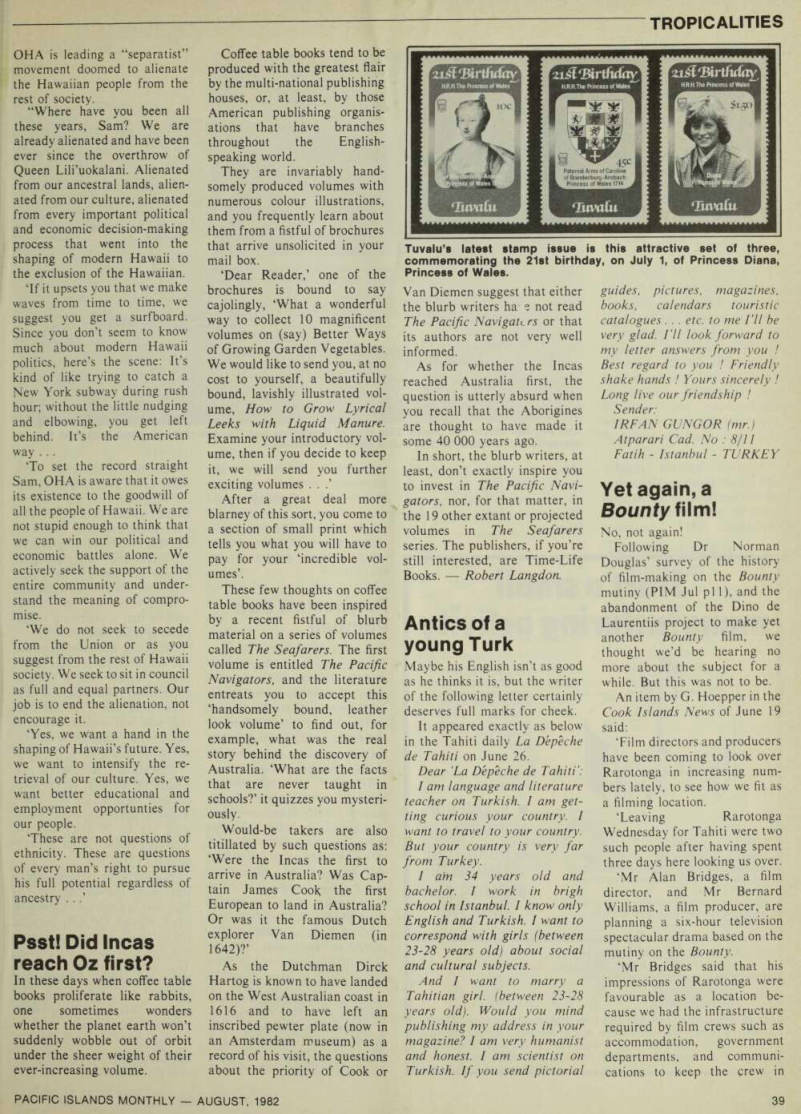
Tuvalu’s latest stamp issue is this attractive set of three, commemorating the 21st birthday, on July 1, of Princess Diana, Princess of Wales.
touch with outside develop ments. ‘As for his production coming to Rarotonga, however, Mr Bridges said ‘the only drawback that we can see at the present time is the close proximity of the reef which could hinder filming of certain scenes’. ‘Before coming to Rarotonga the two men had been to Fiji, and while in Tahiti they will be looking at some of their outer islands also as likely film lo cations. ‘Although the impression gained by talking to Mr Bridges was that, because of the reef, the chances were, not very high for his particular production coming to Rarotonga, the point of interest for us here in Rarotonga is that more and more film people are coming to look us over. ‘By the way don’t write the film industry oflf as a waste of time. ‘Minister Vincent Ingram told Cook Islands News that the forthcoming Anglo- Japanese production of Merry Christmas, Mr Lawrence
should gross the Cook Islands nearly $5OO 000 in service charges, hotels, food, etc. And that’s good news in anybody’s language.’
Merry Christmas, Mr Lawrence, a joint Japanese- British-New Zealand pro duction, was due to start shoot ing in August. The film deals with events in a Japanese POW camp in Java during World War 11.
Polynesia’s own
Pompeii
Following the article by Marie- Therese and Bengt Danielsson on the remarkable archaeol ogical discoveries being made by Professor Yosihiko Sinoto on Huahine, French Polynesia (PIM Mar p2oj, further infor mation has come in the publi cation Polynesian Pompeii, a collection of informative articles and excellent photo graphs on the Huahine exca vations and related subjects.
Polynesian Pompeii was funded by Pacific Resources Inc (PRI), an independent Honolulu based energy company.
Reproduced here is an article from the collection. It is en titled Polynesian Pompeii’ Re vealed in Accidental Archae ological Discovery.
From beneath five layers of earth, archaeologists are un covering what they describe as a ‘Polynesian Pompeii’, rich with artefacts that reveal more about the roots of the Polynesian people.
The rich discoveries were made at an archaeological site on Huahine, in the Society Islands northwest of Tahiti. The excavations are being filmed by Sanford H. Low, a television producer and anthropologist.
Low is developing a documen tary film on the navigational achievements of the Poly nesians that is receiving major funding from PRI.
Mounting evidence from the site indicates that a single act of nature wiped out a village community that existed be tween 850 and 1100 AD and that was both socially sophisti cated and remarkable in its navigational ability. ‘Scientists discovered a wealth of material at Pompeii because an eruption of Mount Vesuvius covered the entire city with ash in 79 AD,’ says Dr Yosihiko Sinoto, chief archae ologist at Huahine. ‘Similarly, we believe a great tidal wave demolished the vil lage that had existed on this site since around 850 AD, burying the artefacts beneath a protec tive layer of sand and water.
The wooden items survived intact for more than 1000 years because the air-breathing or ganisms that cause decay could not live in the mud.’
Workers constructing Huahine’s Bali Hai hotel acci dentally unearthed the first
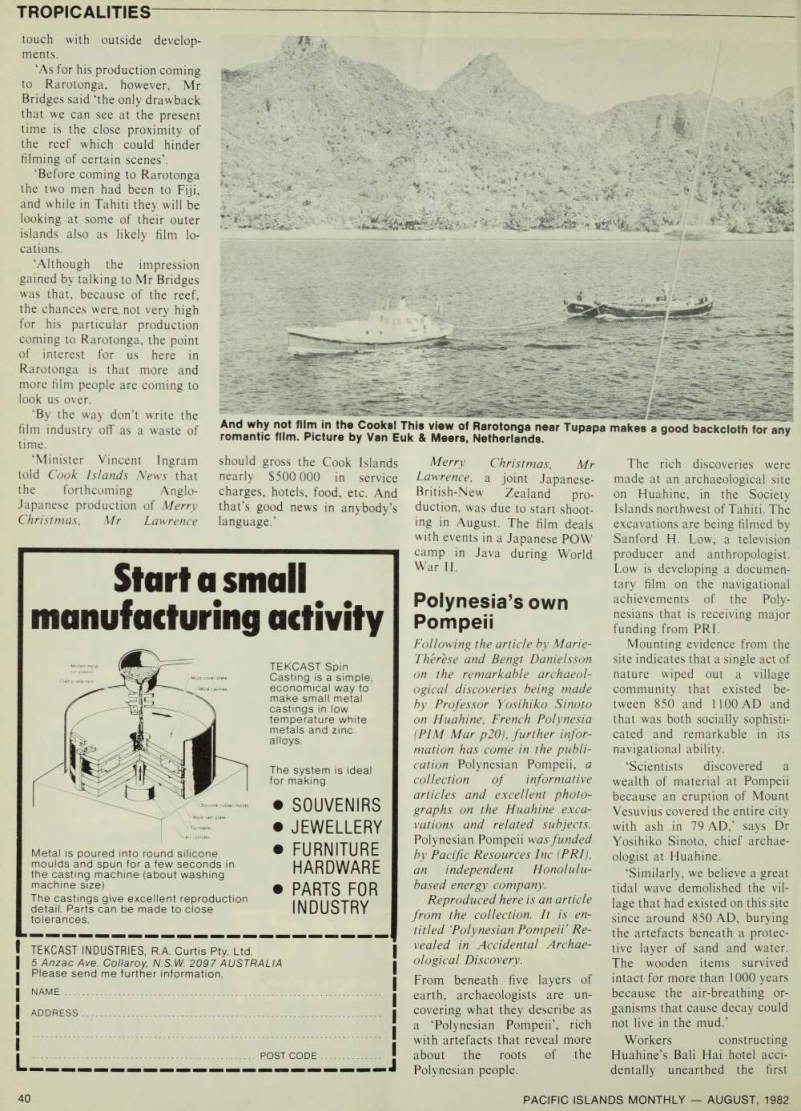
And why not film in the Cooksl This view of Rarotonga near Tupapa makes a good backcloth for any romantic film. Picture by Van Euk & Meers, Netherlands.
artefacts in 1972. It was not until late in 1981, however, that the most significant find two planks from an ancient voyag ing canoe were removed. ‘These planks are the oldest parts of this type of vessel discovered,’ says Sinoto. ‘lt is increasingly apparent that long before Columbus embarked for America, skilful sailors used stars, winds and currents in navigation. They explored, settled and regularly travelled a part of the Pacific larger than Europe and North America combined.’
The material culture rep resented in the Huahine exca vations gives further support to a hypothesis of the sequential settlement of Polynesia. Early Polynesians migrated from Tonga and Samoa in Western Polynesia, east to the Marquesas and the Society Islands, and subsequently to Hawaii and New Zealand.
There was possibly an initial contact with Hawaii from the Marquesas, with the major con tact later from the Society Islands.
The excavations have been supported by funds from a number of sources, including the Ben and Jim Deane families of California, the Association pour les Fouilles Archeologiques Nationales, Paris, the territorial govern ment of French Polynesia, the National Geographic Society, and the Bernice P. Bishop Museum in Honolulu.
Low, who produced and wrote several programmes for the Odyssey series on US public television, is seeking additional funding for the film documen tary, tentatively titled The Navigators. He is researching and writing a script and plans to complete the film by early 1983.
Sinoto, head of the Depart ment of Anthropology at the Bishop Museum, and a recog nised expert on Polynesian ar chaeology, has supervised the recovery of wooden bowls, hand clubs, adze handles, house posts and a variety of other perish able wooden items that nor mally do not survive in archae ological sites.
Canoe bailers, spreaders, paddles, outriggers and a mast accompanied the discovery of the broad planks, which Sinoto
says indicate a voyaging canoe 18 to 24 metres long, similar in design to a catamaran.
First uncovered in 1977, the planks were reburied until Sinoto was able to prepare a method of conservation to pro tect them from rapid disinte gration in the air. The boards, measuring about seven metres in length, are now submerged in a special liquid that will restore them from their current sponge like consistency. The process will lake 12 to 18 months.
The excavations are also re vealing the foundations for stor age houses, work areas, fire pits and an ancient marae, or temple site. Each element adds to the historical picture Sinoto and his team are piecing together.
The storage buildings, for instance, reveal that an abun dance of food enabled certain villagers to specialise in non food-producing tasks, leading to development of crafts and other activities beyond those required for survival.
Tn order for such a flowering of culture to occur,’ says Sinoto, ‘the ancient Tahitians first had to develop the technical skill to extract a surplus of food from their environment. This pro vided time and wherewithal for some to become skilled craftsmen, artists and poli ticians.’
In addition, the quantity of certain types of artefacts, par ticularly graters and scrapers made of pearl shell, indicates a society involved in manufactur ing for trade.
This sophistication, coupled with the growing legend of their navigational prowess, indicates significant accomplishments by a people whose true capabilities
continue to be revealed by the Huahine expeditions.
Art foundation
in Port-Viia
The Michoutouchkine Pilioko Foundation established in Port- Vila aims ‘to restore among the people of the islands of the South Pacific an interest in traditional art forms, and to reinstate their original import ance within the context of their culture’.
Greeting the event, Vanuatu Prime Minister Walter Lini wrote: ‘For many years we have been fortunate to have in Vanuatu Aloi Pilioko and Nicolai Michoutouchkine, both having done much for the preservation and promotion of Melanesian artistic tradition. ‘Consequently, I take not a little pleasure in confirming that my Government, and I personally, give the Michoutouchkine Pilioko Foun dation entire support and patronage in its endeavour.’
Aims of the foundations in detail are:
1) To restore among the people of the islands of the South Pacific an interest in traditional art forms and to reinstate their original import ance within the context of their culture. 2) To create a centre where inspiration can be discovered from South Pacific traditions and to translate this inspiration into living arts and crafts. 3) To enlarge and enrich the original collection of 700 artefacts donated by Nicolai Michoutouchkine and Aloi Pilioko. This collection has been exhibited in Sweden, France USSR and Poland. 4) To establish links in tra ditional art between Vanuatu and other South Pacific islands. 5) To complement existing institutions presenting tra ditional art and custom and to work jointly with those fostering the development of Pacific art and culture. 6) To develop facilities to accommodate working crafts men, scholars or guests of the foundation.
Tonga-Japan
friendship
A Japan-Tonga Friendship As sociation was founded at a ceremony in Tokyo earlier this year. Tonga’s King Taufa’ahau Tupou IV was present at the founding ceremony.
Professor Shinya Amemiya of Komozawa University is chief director of the association.
He said such an association should have been established long ago since Tonga is one of the most pro-Japanese countries in the South Pacific.
Huahine, where archaeologists have unearthed Polynesia’s own Pompeii. - Picture by Ken McGregor.
Nicolai Michoutouchkine (left) and Aloi Pilioko (right) at the Kabuki Gallery in Sydney a few years ago when they held a joint exhibition of their work. Here gallery manager Robert Hall displays a tapestry which reflects Pilioko’s kinship with the Islands. - Australian Information Service picture.