Marshalls: A roundabout
pp. 33-35 · Read in the full issue
Micronesia Negotiations (2)
Marshalls: A roundabout road to independence?
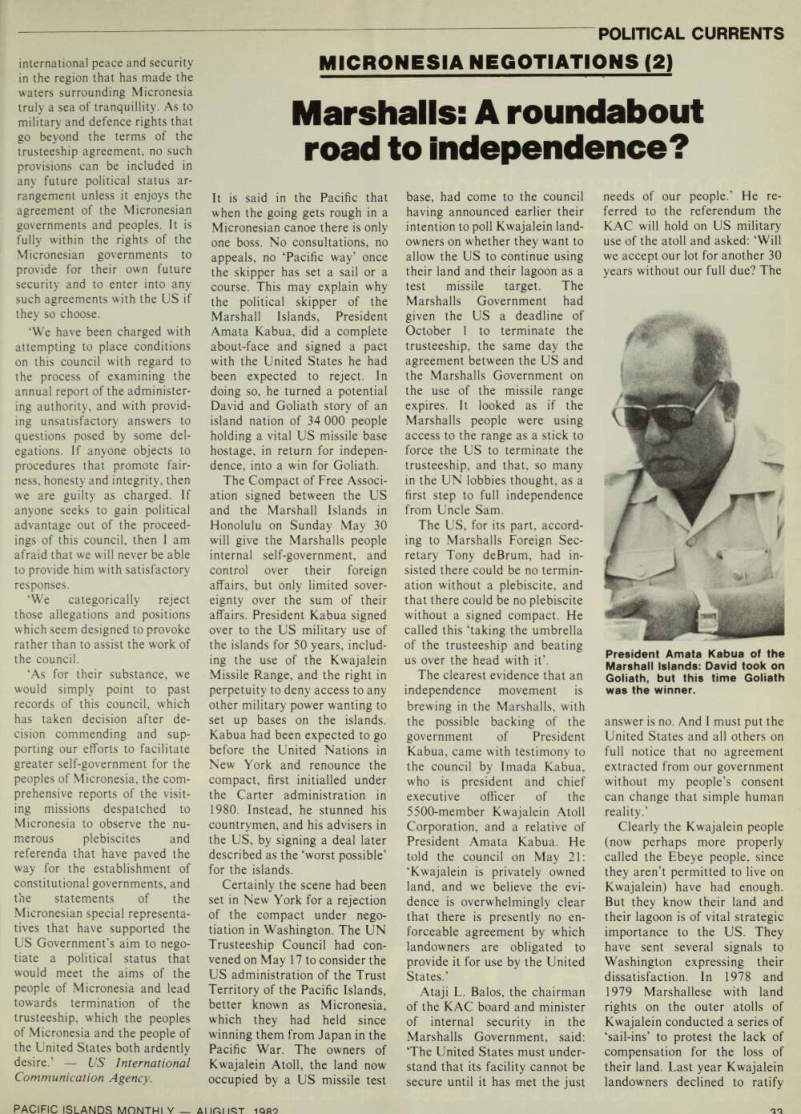
It is said in the Pacific that when the going gets rough in a Micronesian canoe there is only one boss. No consultations, no appeals, no ‘Pacific way’ once the skipper has set a sail or a course. This may explain why the political skipper of the Marshall Islands, President Amata Kabua, did a complete about-face and signed a pact with the United States he had been expected to reject. In doing so, he turned a potential David and Goliath story of an island nation of 34 000 people holding a vital US missile base hostage, in return for indepen dence, into a win for Goliath.
The Compact of Free Associ ation signed between the US and the Marshall Islands in Honolulu on Sunday May 30 will give the Marshalls people internal self-government, and control over their foreign affairs, but only limited sover eignty over the sum of their affairs. President Kabua signed over to the US military use of the islands for 50 years, includ ing the use of the Kwajalein Missile Range, and the right in perpetuity to deny access to any other military power wanting to set up bases on the islands.
Kabua had been expected to go before the United Nations in New York and renounce the compact, first initialled under the Carter administration in 1980. Instead, he stunned his countrymen, and his advisers in the US, by signing a deal later described as the ‘worst possible’ for the islands.
Certainly the scene had been set in New York for a rejection of the compact under nego tiation in Washington. The UN Trusteeship Council had con vened on May 17 to consider the US administration of the Trust Territory of the Pacific Islands, better known as Micronesia, which they had held since winning them from Japan in the Pacific War. The owners of Kwajalein Atoll, the land now occupied by a US missile test
base, had come to the council having announced earlier their intention to poll Kwajalein land owners on whether they want to allow the US to continue using their land and their lagoon as a test missile target. The Marshalls Government had given the US a deadline of October 1 to terminate the trusteeship, the same day the agreement between the US and the Marshalls Government on the use of the missile range expires. It looked as if the Marshalls people were using access to the range as a stick to force the US to terminate the trusteeship, and that, so many in the UN lobbies thought, as a first step to full independence from Uncle Sam.
The US, for its part, accord ing to Marshalls Foreign Sec retary Tony deßrum, had in sisted there could be no termin ation without a plebiscite, and that there could be no plebiscite without a signed compact. He called this ‘taking the umbrella of the trusteeship and beating us over the head with it’.
The clearest evidence that an independence movement is brewing in the Marshalls, with the possible backing of the government of President Kabua, came with testimony to the council by Imada Kabua, who is president and chief executive officer of the 5500-member Kwajalein Atoll Corporation, and a relative of President Amata Kabua. He told the council on May 21: ‘Kwajalein is privately owned land, and we believe the evi dence is overwhelmingly clear that there is presently no en forceable agreement by which landowners are obligated to provide it for use by the United States.’
Ataji L. Bales, the chairman of the KAC board and minister of internal security in the Marshalls Government, said: ‘The United States must under stand that its facility cannot be secure until it has met the just
needs of our people.’ He re ferred to the referendum the KAC will hold on US military use of the atoll and asked: ‘Will we accept our lot for another 30 years without our full due? The
answer is no. And I must put the United States and all others on full notice that no agreement extracted from our government without my people’s consent can change that simple human reality.’
Clearly the Kwajalein people (now perhaps more properly called the Ebeye people, since they aren’t permitted to live on Kwajalein) have had enough.
But they know their land and their lagoon is of vital strategic importance to the US. They have sent several signals to Washington expressing their dissatisfaction. In 1978 and 1979 Marshallese with land rights on the outer atolls of Kwajalein conducted a series of ‘sail-ins’ to protest the lack of compensation for the loss of their land. Last year Kwajalein landowners declined to ratify
President Amata Kabua of the Marshall Islands: David took on Goliath, but this time Goliath was the winner.
the 1981 Interim Use Agree ment signed last October be tween the US and the Marshalls Government. Thus the Marshalls Government does not have documentation from the private citizens who own the land allowing them to sign it away to the US. As Kwajalein Atoll Corporation attorney George Allen said in the Marshall Islands Journal of April 30: ‘To make it simple, they, meaning Defence, are sitting up there with a capital investment of about $1 billion, give or take a little, with no documentation on the land underneath it. Replacement costs would be about $2 to $3 billion if they were to build it somewhere else ...’ Then, on April 19 this year, KAC presi dent Imada Kabua announced the corporation’s referendum ‘on whether to permit continued development of US nuclear weapons testing using the lands, waters and air space of Kwajalein,’
Important testimony in the first week of Trusteeship Coun cil hearings also came from Tony deßrum. He said the Marshalls Government insists that the US trusteeship be terminated by October 1, the same day the Interim Use Agreement between the US and the Marshalls expires.
The connection is clear. No termination, no base. He said a plebiscite had been scheduled for August 17 where the Marshalls people will decide whether to accept or reject any signed compact with the US. ‘A repudiation of the compact in the plebiscite will constitute a positive vote for independence, and the Trusteeship Council and the US should immediately recognise, protect and abide by that decision without pre conditions.’
But on May 24 President Amata Kabua was in Washington. He called a meet ing of attorneys representing the Kwajalein landowners, Bikini petitioners, representa tives of the Marshall Islands Atomic Testing Litigation Pro ject, Tony deßrum, and other Marshallese in the US for the council hearing.
Kabua stunned the group by telling them he intended to sign the compact. He did so on the
following Sunday (May 30) in Honolulu. Attorneys represent ing the Marshallese were plainly shocked by the an nouncement.
In the days that followed the compact was condemned by those aware of its contents as the worst possible deal for the Marshalls people. Tony deßrum, just three days before the signing, had called the compact Reagan negotiators had been demanding ‘colonialism at its worst’. He said the US not only wanted guarantees on future military rights, ‘but they also want the Marshalls people to forgive all radiological damage past, pre sent and future, and to be able to wash their hands and walk away’. (Atmospheric nuclear weapons testing in the Marshall Islands ended in 1958 when President Eisenhower declared a moratorium on atmospheric testing. There had been 23 tests at Bikini and 43 at Enewetak.
The compact just signed pro vides for $ 150 million to be paid by the US government to those who have suffered ill health from fallout.) Mr deßrum called the US insistence that there can be no termination without a plebiscite ‘Machiavel lian’. deßrum also talked about being ‘caught between two el ephants’ the US and the Soviet Union in the Trusteeship Council. He glanced across the lobby to where the Security Council was deliberating on a cease-fire in the Falklands, and said his people could one day be in the same situation as the tiny popu lation on the Falklands. The US is determined to maintain its security interest in the Marshalls, but the last thing the Soviet Union wants is a string of US-controlled islands like a string of unsinkable aircraft carriers stretching across the Pacific, and they’ve made it as hard as possible for the US in the council proceedings.’
But Tony deßrum says his people do not really want to get rid of Uncle Sam. He says the Marshalls people want a con tinuing relationship with the US. He says that in return for economic assistance the Marshalls people are willing to bear the burden of the missile
range, but he says the people insist that relationship be one ‘between equal partners’.
By the end of May President Kabua, the man who took the helm when the going got rough, was in Honolulu for the signing.
He would not take calls to explain his thinking. But the Kwajalein landowners’ at torney, George Allen, estimated that the decision to sign is ‘probably a procedural device to get rid of the compact’.
Those who pretend to know President Kabua’s thinking say he has signed the compact, knowing it to be a bad deal, and knowing also that the August plebiscite will reject it, so that, come October 1, the Marshalls will be independent.
Thus President Kabua is an independentist at heart, wear ing the thin disguise of a pro compact, Uncle Sam man.
Only time will tell if that is
true.
Ross Stevens.