Somare’s Pangu Party
pp. 11-15 · Read in the full issue
Png General Election
Somare’s Pangu Party heads for top again
The newly-elected Papua New Guinea parliament will meet for the first time on August 3 with Michael Somare confident his Pangu Party will form the government.
Somare prime minister at independence in 1975 and in opposition since 1980 had a numbers victory in the general election just ended. But because of fluid political affiliations and because parliament itself elects the prime minister, the shape of government depends heavily on the lobbying which follows the elections. ANGUS SMALES describes here how July became a month of intense political activity with the parties jockeying for position as they prepared for the first sitting of the new parliament.
With good communications be tween tally rooms across the country and with a first-past the-post voting system, Papua New Guinea was not long in doubt about the personal for tunes of its politicians and aspiring politicians once count ing night came round late in June in the 1982 general elec tion. But setting up the new government was another story altogether, and nearly a month after counting night the games of power were still being played out in preparation for the in auguration of parliament on August 3.
There were four months of obvious campaigning and four
weeks of voting, but it took a mere four hours of counting to substantially establish the pos itions of 1122 candidates who stood for 108 seats in the PNG National Parliament. (There are actually 109 seats, but one has yet to be decided in a by election because of the death of one of the candidates.) Despite the quickly-known results from the electorates, the formation of a government was delayed during a period of intense political lobbying.
Leaders lobbied and members traded personal opportunities on the road to forming PNG’s third government since inde pendence in 1975. This was not unexpected, and is a facet of PNG national politics. Al though party affiliations are often declared before election, many members leave their op tions open or even change their affiliation if they can see im-
proved personal opportunities.
Except for hard-core leaders this attitude is widespread and adds to the uncertainty of political party strengths. The situation is encouraged by the practice under the PNG consti tution in which parliament itself elects its prime minister. This leaves an element of uncer tainty about party strengths right up to the time parliament sits, and brings a high degree of post-election negotiation into the process of selecting a prime
minister and establishing a gov ernment.
Towards the end of July the man in the strongest position appeared to be Michael Somare, the independence Prime Minister who has been in opposition since 1980. He was being hard-pushed by the nego tiations of the Chan coalition government, which broke up for the election but came together again for the pre-parliament lobby campaigns.
Seven major groups went into
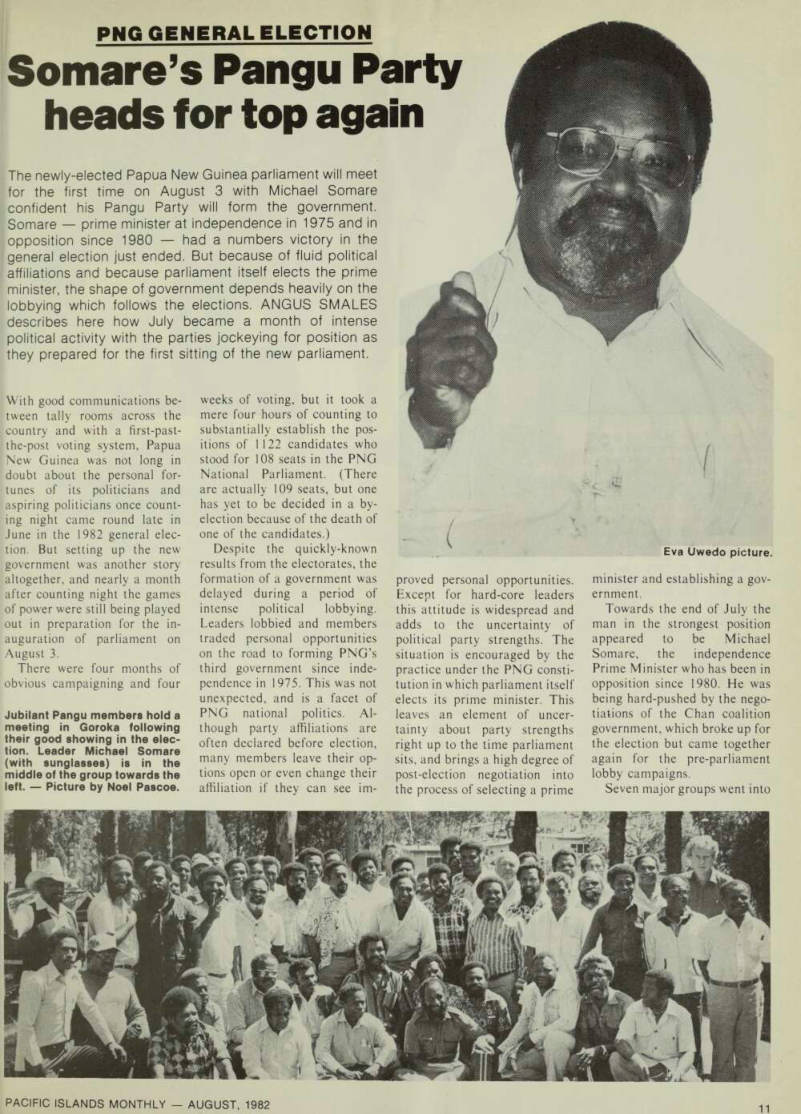
Jubilant Pangu members hold a meeting in Goroka following their good showing in the elec tion. Leader Michael Somare (with sunglasses) is in the middle of the group towards the left. - Picture by Noel Pascoe.
Eva Uwedo picture.
the elections. Five of them had made up the Chan coalition government. They were the Peoples Progress Party, led by Sir Julius Chan, 21 seats; the National Party, Deputy Prime Minister lambakey Okuk, 19; United Party, Roy Evara, 16; Papua Besena, Galeva Kwarara, 9; Melanesian Al liance, Father John Momis, 7.
Mr Somare’s Pangu Party with 33 seats was the biggest single faction to face the voters. The
remaining faction was a group of linked independents led by Mr Ted Diro, who as a Brigadier-General had been Commander of the Papua New Guinea Defence Force until retiring last year.
Within a few days of count ing night, here are the main developments in the election: • Mr Somare’s confirmed candidates easily won the elec tion, but they needed a small measure of extra support to obtain the numbers necessary to form government. • The flamboyant and con troversial lambakey Okuk, Deputy Prime Minister and leader of the National Party, was out of parliament. He had set his heart on being Prime Minister and had not hesitated to say so. ‘Things won’t be the same without me around,’ he said when he conceded defeat. • Ebia Olewale, a Pangu Party founder and strong man, a former Deputy Prime Minis ter, and always a part of Michael Somare’s strength, lost his seat despite the success of the party. • Twelve ministers nearly half the cabinet lost their seats, and more than a third of the total membership of parlia ment went the same way. The Speaker, MrSevese Morea, was one of the defeated candidates. • Ted Diro himself and his carefully-selected team of inde pendents achieved outstanding
success and made an early entry into the power lobbying with the intention of seeing Diro as Prime Minister despite his lack of parliamentary experience.
Based on known or likely affiliations, and before the period of intense power-broking began, the electorate results were: Pangu Party 41 National Party 14 Diro Independents 11 Peoples Progress Party 10 Melanesian Alliance 8 United Parly 6
Independent/uncommilted... 5
Papua Besena 3 Deferred election 1 Total membership 109 A series of swift develop ments followed the counting.
The first major one was when the defeated National Party leader, lambakey Okuk, handed over leadership to Ted Diro. There was initial criticism of what was seen as a high handed action, but party officials later claimed there had been consultation, and the re sult was that Diro, before even being sworn into parliament, found himself at the head of a significant faction of 25 mem bers his own supporters and the National Party. ■ Somare, who could see gov ernment just in his grasp particularly if he exercised his persuasive ‘compromise’ strate gies made an attempt to call an early meeting of parliament.
He hoped to tie the whole thing up while enthusiasm continued high and before there was too much regrouping and analysis.
He could well have succeeded, but the constitution prevented an early silting of parliament.
Diro meanwhile was surpris ing many people with the strength in which he pursued the goal of becoming Prime Minister, relying heavily on the previous coalition government factions. Many observers fell he would have been better situated if he had refused the National Party affiliation and had offered his numbers to Somare in exchange for the possible pos ition of Deputy Prime Minister.
Throughout the lobbying Prime Minister Sir Julius Chan kept up a low key image, never conceding defeat and claiming that ultimately he would have the support for government.
Eventually his coalition came together again as the nucleus of a new bid for government, and strengthened by the Diro inde pendents. The sensitive issue of whether Diro or Chan would lead the group was unresolved at the time the alliance was announced.
As the first sitting of parlia ment approached the members were polarising into two camps one supporting Somare and one supporting Chan and Diro. •Somare claimed that his return to government was merely a formality and that he had been
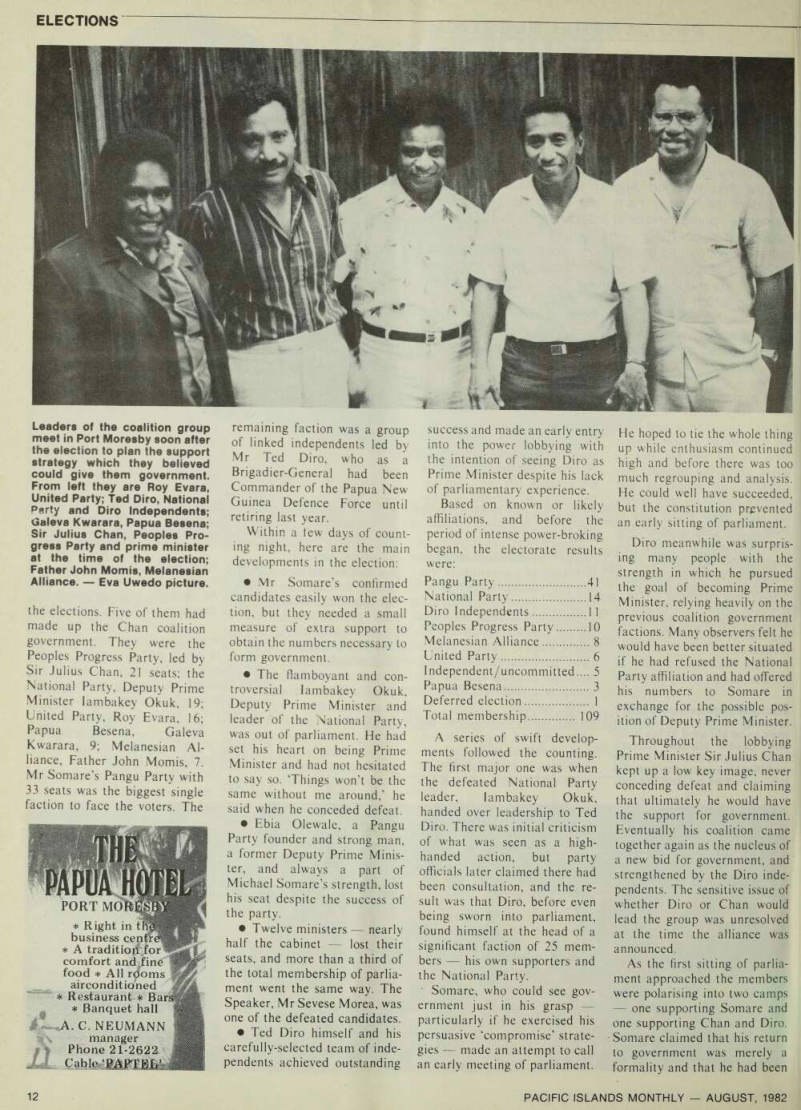
Leaders of the coalition group meet in Port Moresby soon after the election to plan the support strategy which they believed could give them government.
From left they are Roy Evara, United Party; Ted Diro, National Party and Diro Independents; Galeva Kwarara, Papua Besena; Sir Julius Chan, Peoples Pro gress Party and prime minister at the time of the election; Father John Momis, Melanesian
Alliance. - Eva Uwedo picture.
able to muster 60 confirmed supporters. He issued a list of the 60 names to support his claim. The coalition group re sponded with a claim that some names on the Somare list were not committed. They claimed to have ‘55 or more supporters’, sufficient to form the new gov ernment.
There was an outbreak of rioting in parts of the PNG Highlands after the election ended. Some of it was blamed on the lifting of alcohol restric tions which had applied during the election. Several groups however said they were protest ing at the defeat of lambakey Okuk, a Highlander they re garded as their champion. No Highlander has yet held the position of Prime Minister. Mr
Okuk commented drily Tf they had wanted me to stay in parliament, they should have voted for me’.
The heavy turnover of candi dates is partly due to the notorious fickleness of PNG politics, but there is also some concern that first-past-the-post voting is distorting the results.
In some electorates, with large numbers of candidates, as little as seven percent of the total vote has been sufficient to return a candidate.
The election also gave rise to claims of electoral malpractice in 30 electorates, and com plaints have been made formally to the Court of Dis puted Returns. Normally one judge would be responsible for conducting the Court of Dis puted Returns, but the large number of applications has ex ceeded the capacity of the legal system. The Chief Justice, Sir Buri Kidu, is investigating the possibility of referring the ap plications to circuit courts. In the 1977 election in PNG nine results were challenged in court, and five by-elections were ordered.
Confident in his belief that he has the support to form the new government, Mr Somare told journalists that he saw his first task as ‘pulling the economy back into gear’. He accused the Chan government of having allowed the economy to slip and of wasting government funds.
He believed it would take him 18 months to re-establish sound policies.
Mr Somare said he planned to sell the Grumman Gulfstream aircraft which the previous government had bought for VIP transport. He said he would get rid of other wasteful spending which had developed in Cabinet and at the top levels of administration. He conceded that the low current value of commodity crops pro duced by PNG, particularly cocoa and coffee, was a major ingredient in the country’s pres ent financial trouble. He be lieved however that better financial management by the government and greater empha sis on rural stabilisation schemes would minimise the problems.
Commenting on the events
which led to his losing office early in 1980, Mr Somare said he realised now that he had isolated himself excessively from people who should have been his partners in decision making. The degree of consul tation he had extended had not been as great as it should have been. He said his realisation of this situation should now make him a more efficient national leader. There will be plenty of consultation from now on’ he said.
The 12 members of Cabinet who lost their seats made up nearly half the total member ship of Cabinet. The jubilant Pangu Party claimed this showed the extreme depth of dissatisfaction which the gov ernment coalition had gener ated. But impartial observers were more inclined to see the result as yet another demonstra tion of the extreme electoral fickleness which has marked PNG national politics since their inception. The fickleness is seen as a symptom of political immaturity which is fast disap pearing, but which is still a significant factor. A member of parliament who becomes promi nently involved in national man agement, particularly as a Cabi net minister, runs a real risk of alienating his own electorate on the grounds that he is not totally involved in local issues. Despite the increasing sophistication of political practice in PNG there is still a widespread belief among voters in remote rural areas that parliament automati cally implements electorate re quests submitted by members.
This means that if an electorate doesn’t get what it wants from parliament, there is an assump tion that the local member isn’t doing his job.
Another factor in the defeat of many members was the first past-the-post voting system which has replaced PNG’s earlier system of ‘opional pref erential’.
The biggest Cabinet name to fall this time was that of lambakey Okuk. In addition to his leadership of the National Party and his position as Deputy Prime Minister, he also held the portfolio of Transport and Civil Aviation. The National Party’s deputy leader, Thomas Kavali, was also a
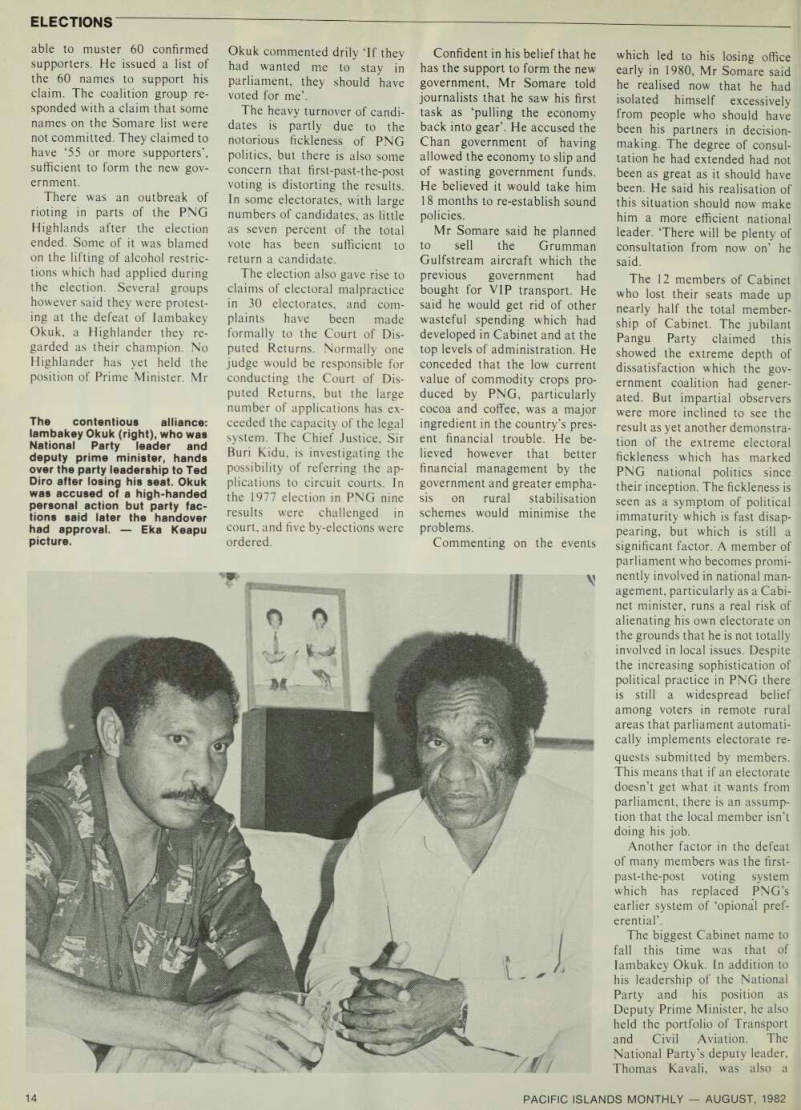
The contentious alliance: lambakey Okuk (right), who was National Party leader and deputy prime minister, hands over the party leadership to Ted Diro after losing his seat. Okuk was accused of a high-handed personal action but party fac tions said later the handover
had approval. - Eka Keapu
picture.
Cabinet casualty. He had been Lands Minister. The ten other ministers who were not returned by their electorates were Silas Atopare (Goroka), Works and Supply; Yano Belo (Erave- Kagua), Environment and Con servation; Angmai Bilas (Madang Province), Public Utilities; Goasa Damena (Jimi), Urban Development; Wesani Iwoksim (Telefomin), Youth and Recreation; Wiwa Korowi (Southern Highlands), Min erals and Energy; Akepa Miakwe (Unggai-Bena), Cor rective Institutions and Liquor Licensing; Gerega Pepena (Abau), Defence; Clement Poye (Sinasina), Media; Zibang Zurenuoc (Finschhafen), Home Affairs.
The defeated Cabinet minis ters were from the National Party, the PPP and Papua Besena.
More than ever before in a PNG election the members who are entering parliament for the first time include men who have already made names for them selves in fields outside politics.
The obvious man in this category is Ted Diro, the newly named parliamentary leader of the National Party who was Commander of the PNG De fence Force until last year.
Others include: Tony Siaguru (Moresby Northeast), a Pangu man who is a close associate of Michael Somare and who became one of the most influential of the younger PNG public servants during the first Somare govern ment. He is 35, educated in Australia and USA and was Secretary for Foreign Affairs for six years during which time he represented PNG on many overseas missions.
Phillip Bouraga (National Capital), another Pangu man who had a prominent and im portant career in the public service, but who resigned as Police Commissioner earlier this year after a controversy involving the Police Minister, Warren Dutton of the PPP.
Before that Bouraga had been a district commissioner and Sec retary of the Department of the Priifie Minister.
John Nilkare (Chimbu Prov ince) is the man who unseated Deputy Prime Minister Okuk.
Nilkare, Pangu, has been oper-
ating a business advisory ser vice in Port Moresby and has associations with investment in terests. Earlier he was a public servant who had been a magis trate and who became the PNG Liquor Licensing Com missioner.
Tony Ferapo (Gulf), a Diro Independent who served for three years as PNG Ambassa dor to Japan before entering private enterprise as a real estate developer.
Rabbie Namaliu (Kokopo) Pangu, is a former private secretary to Michael Somare.
He held the position during the important formative period im mediately before independence.
He was a lecturer at the Univer sity of PNG and later became the Public Services Com mission Chairman.
Jack Genia (Abau), a Diro Independent who was formerly PNG Secretary for Lands.
There are six whites in the new parliament two more than in the outgoing parlia ment. Their backgrounds are
Australian, English and North American, but all six are natu ralised PNG citizens as re quired under the constitution.
They include the veteran poli tician Barry Holloway who served a term as Speaker and who was one of the Pangu strong men associated with the early moves towards home rule in PNG. He had an overwhelm ing victory for Pangu against 13 other candidates in the Eastern Highlands electorate. Three of the other whites voted into the parliament are also Pangu sup porters: Karl Stack (West Sepik), a former Mines Minis ter under Michael Somare; English-born Dennis Young (Milne Bay), making a come back; and Harry Humphreys (Talasea), also making a come back. Humphreys was also born in England, but came to PNG 30 years ago on the delivery voyage of a coastal ship and has lived since then on the island of New Britain.
The two other naturalised citizens who won seats are Warren Dutton (North Fly) who has long been a central figure in the PPP and was Police Minister in the Chan Govern ment, and Neville Bourne (Menyamya) who is a National Party backbencher.
Seventeen women stood for election, but all were defeated.
For the first time since indepen dence and earlier there are now no women in the PNG parliament. Three of the de feated women were sitting members, and they included the Papua separatist leader Josephine Abaijah, founder of the Papua Besena party. Miss Abaijah had been in parliament for 10 years and was a highly controversial politican during the move to independence. She created wide interest in 1975 when she held a dawn ceremony outside Port Moresby in which she purported to declare the independence of Papua from Australia and from New Guinea. A few days later formal independence came to a unified Papua New Guinea, against the wishes of Papua Besena. The two other women who lost their seats were Mrs Nahau Rooney (Manus) and Mrs Walyato Clowes (Middle Fly). In 1979 Mrs Rooney, then Justice Min ister in the Somare government, was gaoled for allegedly inter fering with the impartiality of the courts. Somare released her from gaol, triggering a controversy which became one of the ingredients in his 1980 fall from office in a parliamen tary no-confidence vote.
One of the women who con tested the election was an Aus tralian who became naturalised in PNG after many years of residence. She is Mrs Laura Martin of Wewak who was making her second attempt to enter parliament but finished third from among ten candi dates.
Sir John Guise, who in 1977 stepped down from the position of Governor-General to re-enter politics, will not be a member of the new parliament but it’s by his own choice. Sir John, now the longest-serving politician in PNG, decided not to recontest his Milne Bay electorate.
Another veteran member, Sir Tei Abal, lost the seat of Wabang which he had held since well before independence.
He was once the leader of the old United Party when it was the biggest party in parliament, but was the victim of increasing dissent in the party and in his electorate. A total of 22 candi dates stood for the seat, and Albert Kipilan won it for the
Ppp.
Double tragedy; James Yanepa wipes tears from his eyes at Goroka Airport. His own at tempt to enter parliament as a National Party candidate failed, and lambakey Okuk (behind him), leader of the party, lost his seat. - Picture by Noel Pascoe.