Strait pearl
pp. 7-9 · Read in the full issue

Letters
The Torres Strait pearl conspiracy
I find it strange that in all their discussion of Torres Strait Islands affairs Messrs Singe and Jones, and Ms Sharp (PIM Jun, Sep, and Dec ’81) did not see fit to elaborate a little on the key circumstance which has caused the massive unemployment, and the social and economic prob lems, faced by Torres Strait Islanders over the past 25 years.
This circumstance was the sharp downturn in 1958 of their pearling industry their tra ditional and only means of support.
Just at the moment the pearl ing industry suddenly collapsed great hopes were abroad for the future of the industry: pearl cultivation on a 50/50 joint venture basis with the Japanese in association with US, English, Chinese and Australian inves tors ventures approved by the Japanese Government, but excluding the participation of the Torres Strait Islanders who, nevertheless, possessed traditional rights as producers of the pearlshell.
The big question is: Were the inroads made by the cultivated pearl designed as a means of counteracting the sharp downturn in pearling, or on the contrary, was the sharp downturn deliberately created to pave the way for the inroads of the cultivated pearl?
To push along the new pros pect of economic recovery in the pearling industry, represen tations were made to influence the then reluctant Australian Government to help the estab lishment of these new joint ventures. As part of their lobby ing, the joint-venture promoters gave the Australian Govern ment undertakings that they would train Torres Strait
Islanders in the techniques and methods of pearl cultivation so that they would become as well established in this method as they had been in the pro duction of their own pearls.
But, now that 25 years have passed, it is quite obvious that this new pearl development has totally failed to deliver the promised goods, and to help the economic recovery of the Torres Strait people. None has been trained in the techniques of cultivated pearl production, or become established in the pro duction of his own pearls.
True, some labouring jobs were given to the Islanders, and two or three pearling boats survivors of the Islanders’ 18-boat pearling fleet con tinued for a while to dispose of their shells to the pearl com panies.
But, in general, these benefits meant precious little in view of the large number of unem ployed divers and crews and, more particularly, in view of the millions of dollars being made from their traditional pearlshell resource. Nor should we forget the infrastructure and services provided by the Australian tax payer, the Islanders’ cheap labour, the stable Australian political-economic conditions, and the ideal ecological con ditions of the Torres Strait for pearl cultivation.
In fact, after all is said and done, the waters and natural resources of the Torres Strait have become a major extension of the Japanese pearl farms, managed and controlled by Japanese for their own benefit and under the rules and regu lations of a Japanese law. They are taking out annually pearls valued conservatively at SASOO million. This is the correct evaluation, and not the one given in export declarations.
According to many ‘authori tative’ explanations of the 19605, the downturn in the pearling industry was caused by a whim of fashion a growing public preference for the cheap plastic button. This case has never, absolutely never, been proven.
In September 1960, I in formed the Queensland Gov ernment that the Australian pearling industry had been the victim of a grand manipulation, and that the downturn in the pearling industry was purposely created and executed according
to a master plan aimed at tfte elimination of Australians as possible competitors in the pro duction of cultivated pearls.
The plan has worked.
It must be said that the Torres Strait Islanders have themselves been partly to blame, for they were and still are placid and indifferent to the cause of their plight. But this is understandable as they were under the guidance of ‘protectors’ and a government who themselves could not see the real motivations of the Japanese and other inter national operators, and them selves fell victim to their con spiracy of intrigue, secrecy and silence.
I was forced to leave Thurs day Island in 1964, but have always kept myself informed of developments in the Torres Strait.
So far, despite the many efforts to establish some kind of alternative industry, and the $6 500 000 spent by the Austra lian Government on experimen tal turtle and crocodile farming, the past, present and future of the Torres Strait Islanders always was and always will be their fabulous resource of mother-of-pearl shell: the Great Australian Pearl Oyster.
It is now time they gave practical consideration to a return to pearling and becoming part of the pearling industry themselves, by adopting a con structive and positive approach.
All the essentials are there except one. That is the determi nation to do it, the will to work for it and not keep depending on the dope. It is their country and the future of their children and their children’s children.
In the past the Islanders have demonstrated the desire to stand on their own feet, and their demand for recognition.
They had one bright and glori ous moment when in August, 1971, they kicked the Japanese pearlers out of the Kuri Bay pearl farm, fed to the back teeth with being treated as inferiors.
This, in the circumstances, was an act of heroism and of great significance in the history of the pearl. It must never be forgot ten despite the fact that at the time it was treated as a riotous act, and the culprits were duly punished under Aus tralian law.
There is still time for these
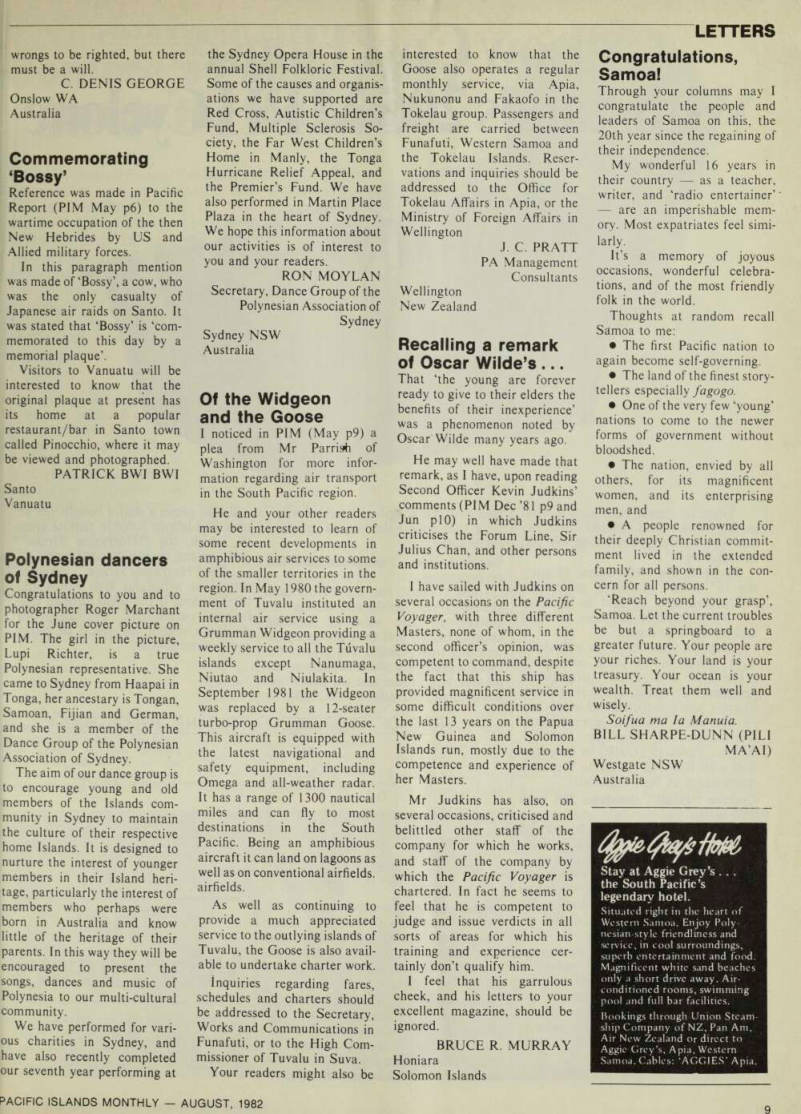
The new divers of the deep In the Torres Strait Islands - wet suits and scuba gear, but what future exists for them? Much of the live shell they recover today is raw material for the cultured pearl farms - Picture from Roderick Hulsbergin’s The Last Paradise, published by Eyes and Hands.
wrongs to be righted, but there must be a will.
C. Denis George
Onslow WA Australia
Commemorating
‘Bossy’
Reference was made in Pacific Report (PIM May p 6) to the wartime occupation of the then New Hebrides by US and Allied military forces.
In this paragraph mention was made of ‘Bossy’, a cow, who was the only casualty of Japanese air raids on Santo. It was stated that ‘Bossy’ is ‘com memorated to this day by a memorial plaque’.
Visitors to Vanuatu will be interested to know that the original plaque at present has its home at a popular restaurant/bar in Santo town called Pinocchio, where it may be viewed and photographed.
Patrick Bwi Bwi
Santo Vanuatu
Polynesian dancers
of Sydney
Congratulations to you and to photographer Roger Marchant for the June cover picture on PIM. The girl in the picture, Lupi Richter, is a true Polynesian representative. She came to Sydney from Haapai in Tonga, her ancestary is Tongan, Samoan, Fijian and German, and she is a member of the Dance Group of the Polynesian Association of Sydney.
The aim of our dance group is to encourage young and old members of the Islands com munity in Sydney to maintain the culture of their respective home Islands. It is designed to nurture the interest of younger members in their Island heri tage, particularly the interest of members who perhaps were born in Australia and know little of the heritage of their parents. In this way they will be encouraged to present the songs, dances and music of Polynesia to our multi-cultural community.
We have performed for vari ous charities in Sydney, and have also recently completed our seventh year performing at
the Sydney Opera House in the annual Shell Folkloric Festival.
Some of the causes and organis ations we have supported are Red Cross, Autistic Children’s Fund, Multiple Sclerosis So ciety, the Far West Children’s Home in Manly, the Tonga Hurricane Relief Appeal, and the Premier’s Fund. We have also performed in Martin Place Plaza in the heart of Sydney.
We hope this information about our activities is of interest to you and your readers.
Ron Moylan
Secretary, Dance Group of the Polynesian Association of Sydney Sydney NSW Australia Of the Widgeon and the Goose I noticed in PIM (May p 9) a plea from Mr Parrish of Washington for more infor mation regarding air transport in the South Pacific region.
He and your other readers may be interested to learn of some recent developments in amphibious air services to some of the smaller territories in the region. In May 1980 the govern ment of Tuvalu instituted an internal air service using a Grumman Widgeon providing a weekly service to all the Tuvalu islands except Nanumaga, Niutao and Niulakita. In September 1981 the Widgeon was replaced by a 12-seater turbo-prop Grumman Goose.
This aircraft is equipped with the latest navigational and safety equipment, including Omega and all-weather radar.
It has a range of 1300 nautical miles and can fly to most destinations in the South Pacific. Being an amphibious aircraft it can land on lagoons as well as on conventional airfields, airfields.
As well as continuing to provide a much appreciated service to the outlying islands of Tuvalu, the Goose is also avail able to undertake charter work. inquiries regarding fares, schedules and charters should be addressed to the Secretary, Works and Communications in Funafuti, or to the High Com missioner of Tuvalu in Suva.
Your readers might also be
interested to know that the Goose also operates a regular monthly service, via Apia, Nukunonu and Fakaofo in the Tokelau group. Passengers and freight are carried between Funafuti, Western Samoa and the Tokelau Islands. Reser vations and inquiries should be addressed to the Office for Tokelau Affairs in Apia, or the Ministry of Foreign Affairs in Wellington
J. C. Pratt
PA Management Consultants Wellington New Zealand Recalling a remark of Oscar Wilde’s ...
That ‘the young are forever ready to give to their elders the benefits of their inexperience’ was a phenomenon noted by Oscar Wilde many years ago.
He may well have made that remark, as I have, upon reading Second Officer Kevin Judkins’ comments (PIM Dec ’Bl p 9 and Jun plO) in which Judkins criticises the Forum Line, Sir Julius Chan, and other persons and institutions.
I have sailed with Judkins on several occasions on the Pacific Voyager, with three different Masters, none of whom, in the second officer’s opinion, was competent to command, despite the fact that this ship has provided magnificent service in some difficult conditions over the last 13 years on the Papua New Guinea and Solomon Islands run, mostly due to the competence and experience of her Masters.
Mr Judkins has also, on several occasions, criticised and belittled other staff of the company for which he works, and staff of the company by which the Pacific Voyager is chartered. In fact he seems to feel that he is competent to judge and issue verdicts in all sorts of areas for which his training and experience cer tainly don’t qualify him.
I feel that his garrulous cheek, and his letters to your excellent magazine, should be ignored.
Bruce R. Murray
Honiara Solomon Islands
Congratulations,
Samoa!
Through your columns may I congratulate the people and leaders of Samoa on this, the 20th year since the regaining of their independence.
My wonderful 16 years in their country as a teacher, writer, and ‘radio entertainer’ are an imperishable mem ory. Most expatriates feel simi larly.
It’s a memory of joyous occasions, wonderful celebra tions, and of the most friendly folk in the world.
Thoughts at random recall Samoa to me: • The first Pacific nation to again become self-governing. • The land of the finest story tellers especially fagogo. • One of the very few ‘young’ nations to come to the newer forms of government without bloodshed. • The nation, envied by all others, for its magnificent women, and its enterprising men, and • A people renowned for their deeply Christian commit ment lived in the extended family, and shown in the con cern for all persons. ‘Reach beyond your grasp’, Samoa. Let the current troubles be but a springboard to a greater future. Your people are your riches. Your land is your treasury. Your ocean is your wealth. Treat them well and wisely.
Soifua ma la Manuia.
Bill Sharpe-DuÑ (Pili
Ma'ai)
Westgate NSW Australia