drama and change
p. 17 · Read in the full issue
New Caledonia’s season of drama and change
New Caledonia moved into a new phase of its history on June 18 with the formation of a government council with a majority of members belonging to the Front Independantiste (FI). Despite repeated calls from Rightwing groups for a show of force against the new government, this dramatic change has largely been ac cepted.
With a charge of ‘resistance to evolution and progress in New Caledonia’, the Centrist Federation pour une Nouvelle Societe Caledonienne (FNSC) teamed up with the independentists to censure the Ralliement Pour la Caledonie dans la Republique (RPCR) government of Dick Ukeiwe.
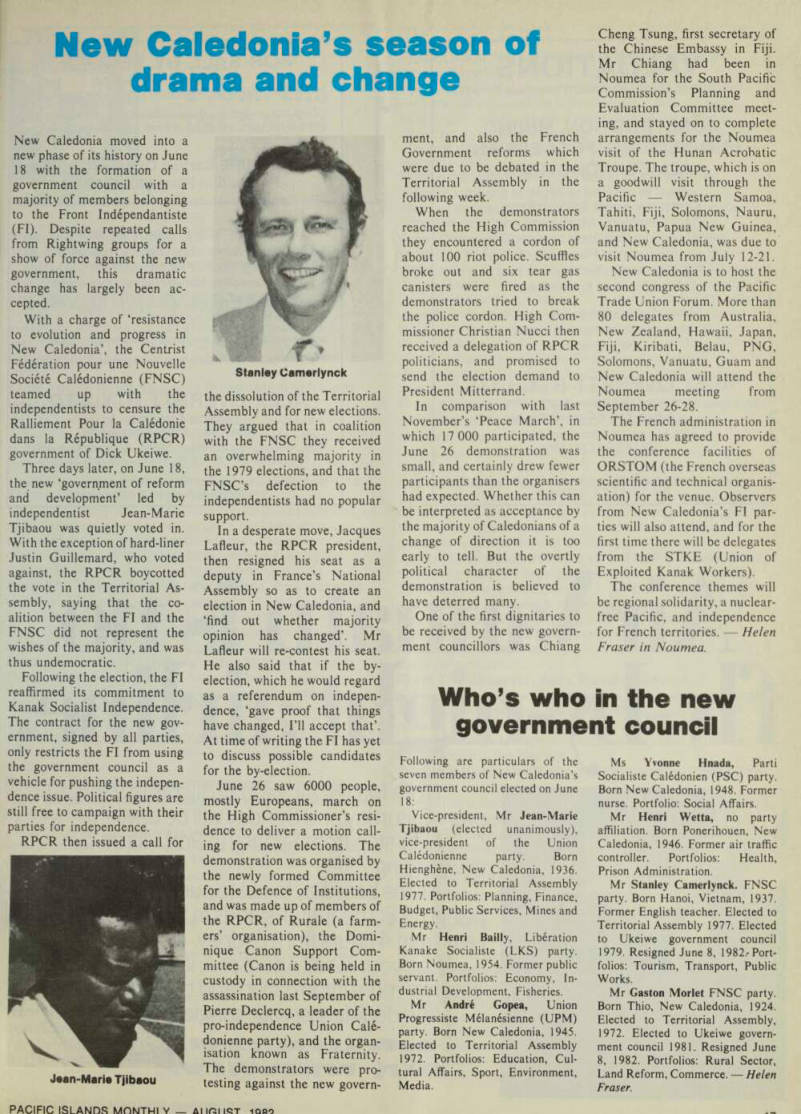
Three days later, on June 18, the new ‘government of reform and development’ led by independentist Jean-Marie Tjibaou was quietly voted in.
With the exception of hard-liner Justin Guillemard, who voted against, the RPCR boycotted the vote in the Territorial As sembly, saying that the co alition between the FI and the FNSC did not represent the wishes of the majority, and was thus undemocratic.
Following the election, the FI reaffirmed its commitment to Kanak Socialist Independence.
The contract for the new gov ernment, signed by all parties, only restricts the FI from using the government council as a vehicle for pushing the indepen dence issue. Political figures are still free to campaign with their parties for independence.
RPCR then issued a call for
the dissolution of the Territorial Assembly and for new elections.
They argued that in coalition with the FNSC they received an overwhelming majority in the 1979 elections, and that the FNSC’s defection to the independentists had no popular support.
In a desperate move, Jacques Lafleur, the RPCR president, then resigned his seat as a deputy in France’s National Assembly so as to create an election in New Caledonia, and ‘find out whether majority opinion has changed’. Mr Lafleur will re-contest his seat.
He also said that if the by election, which he would regard as a referendum on indepen dence, ‘gave proof that things have changed, I’ll accept that’.
At time of writing the FI has yet to discuss possible candidates for the by-election.
June 26 saw 6000 people, mostly Europeans, march on the High Commissioner’s resi dence to deliver a motion call ing for new elections. The demonstration was organised by the newly formed Committee for the Defence of Institutions, and was made up of members of the RPCR, of Rurale (a farm ers’ organisation), the Domi nique Canon Support Com mittee (Canon is being held in custody in connection with the assassination last September of Pierre Declercq, a leader of the pro-independence Union Cale donienne party), and the organ isation known as Fraternity.
The demonstrators were pro testing against the new govern
ment, and also the French Government reforms which were due to be debated in the Territorial Assembly in the following week.
When the demonstrators reached the High Commission they encountered a cordon of about 100 riot police. Scuffles broke out and six tear gas canisters were fired as the demonstrators tried to break the police cordon. High Com missioner Christian Nucci then received a delegation of RPCR politicians, and promised to send the election demand to President Mitterrand.
In comparison with last November’s ‘Peace March’, in which 17 000 participated, the June 26 demonstration was small, and certainly drew fewer participants than the organisers had expected. Whether this can be interpreted as acceptance by the majority of Caledonians of a change of direction it is too early to tell. But the overtly political character of the demonstration is believed to have deterred many.
One of the first dignitaries to be received by the new govern ment councillors was Chiang
Cheng Tsung, first secretary of the Chinese Embassy in Fiji.
Mr Chiang had been in Noumea for the South Pacific Commission’s Planning and Evaluation Committee meet ing, and stayed on to complete arrangements for the Noumea visit of the Hunan Acrobatic Troupe. The troupe, which is on a goodwill visit through the Pacific Western Samoa, Tahiti, Fiji, Solomons, Nauru, Vanuatu, Papua New Guinea, and New Caledonia, was due to visit Noumea from July 12-21.
New Caledonia is to host the second congress of the Pacific Trade Union Forum. More than 80 delegates from Australia, New Zealand, Hawaii, Japan, Fiji, Kiribati, Belau, PNG, Solomons, Vanuatu, Guam and New Caledonia will attend the Noumea meeting from September 26-28.
The French administration in Noumea has agreed to provide the conference facilities of ORSTOM (the French overseas scientific and technical organis ation) for the venue. Observers from New Caledonia’s FI par ties will also attend, and for the first time there will be delegates from the STKE (Union of Exploited Kanak Workers).
The conference themes will be regional solidarity, a nuclear free Pacific, and independence
for French territories.
Helen
Fraser in Noumea.
Jean-Marie Tjibaou
Stanley Camerlynck