A monumental
pp. 25-69 · Read in the full issue
Tropicalities
Pouvanaa: A monumental blunder?
Like most great men, Pouvanaa a Oopa, the indomitable Polynesian freedom fighter who died in 1977, is more honoured and praised today than during his lifetime especially by his one-time adversaries, detractors and tormentors. Some of them are even claiming that they were always pouvanistes at heart, and are now trying to push aside his old and faithful companions, who fought at his side and shared his prison cells.
Inevitably, this belated adu lation was bound to express itself one day in the erection of a huge monument to Pouvanaa. The only surprising thing really is that we have had to wait so long.
But in the month of May this year, such a monument was at last installed in the park outside the Territorial Assembly build ing in Papeete. The main insti gator of the scheme was in fact the only political leader who could truly claim to be Pouvanaa’s spiritual heir John Teariki, who courageously con tinued the struggle against French colonial rule and nuclear tests when the 65-year-old metua (father) was sentenced to an eight-year prison term on trumped-up charges, coupled with a 15-year banishment from the islands.
May 10, the date chosen for the unveiling of the four-metre high stone monument, costing three million francs, also seemed appropriate, since Pouvanaa was bom on that day in 1895. But some of Teariki’s political op ponents, of course, decried the whole scheme as a propaganda stunt to help him in the terri torial elections on May 23.
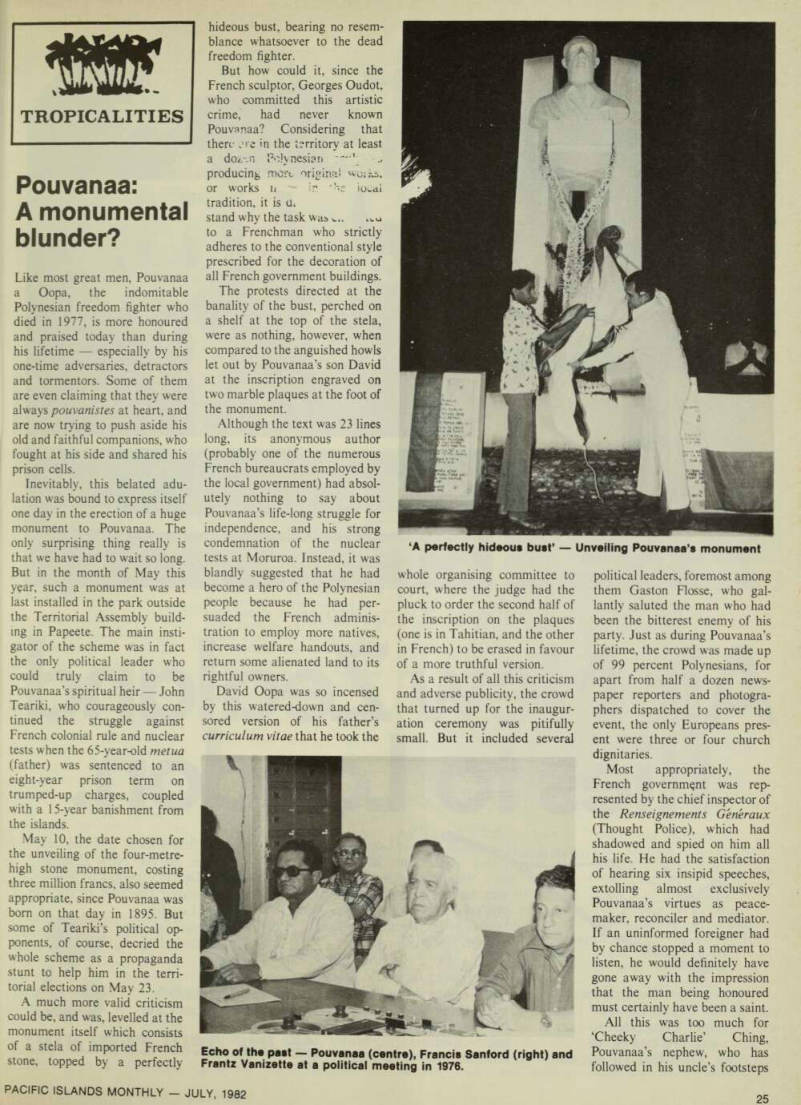
A much more valid criticism could be, and was, levelled at the monument itself which consists of a stela of imported French stone, topped by a perfectly
hideous bust, bearing no resem blance whatsoever to the dead freedom fighter.
But how could it, since the French sculptor, Georges Oudot, who committed this artistic crime, had never known Pouvanaa? Considering that there ere in the territory at least a doznn Polynesian — 1 producing mcix original woiks. or works n ir * v «e local tradition, it is a* stand why the task wa:> u. to a Frenchman who strictly adheres to the conventional style prescribed for the decoration of all French government buildings.
The protests directed at the banality of the bust, perched on a shelf at the top of the stela, were as nothing, however, when compared to the anguished howls let out by Pouvanaa’s son David at the inscription engraved on two marble plaques at the foot of the monument.
Although the text was 23 lines long, its anonymous author (probably one of the numerous French bureaucrats employed by the local government) had absol utely nothing to say about Pouvanaa’s life-long struggle for independence, and his strong condemnation of the nuclear tests at Moruroa. Instead, it was blandly suggested that he had become a hero of the Polynesian people because he had per suaded the French adminis tration to employ more natives, increase welfare handouts, and return some alienated land to its rightful owners.
David Oopa was so incensed by this watered-down and cen sored version of his father’s curriculum vitae that he took the
whole organising committee to court, where the judge had the pluck to order the second half of the inscription on the plaques (one is in Tahitian, and the other in French) to be erased in favour of a more truthful version.
As a result of all this criticism and adverse publicity, the crowd that turned up for the inaugur ation ceremony was pitifully small. But it included several
political leaders, foremost among them Gaston Flosse, who gal lantly saluted the man who had been the bitterest enemy of his party. Just as during Pouvanaa’s lifetime, the crowd was made up of 99 percent Polynesians, for apart from half a dozen news paper reporters and photogra phers dispatched to cover the event, the only Europeans pres ent were three or four church dignitaries.
Most appropriately, the French government was rep resented by the chief inspector of the Renseignements Generaux (Thought Police), which had shadowed and spied on him all his life. He had the satisfaction of hearing six insipid speeches, extolling almost exclusively Pouvanaa’s virtues as peace maker, reconciler and mediator.
If an uninformed foreigner had by chance stopped a moment to listen, he would definitely have gone away with the impression that the man being honoured must certainly have been a saint.
All this was too much for ‘Cheeky Charlie’ Ching, Pouvanaa’s nephew, who has followed in his uncle’s footsteps
Echo of the past Pouvanaa (centre), Francis Sanford (right) and Frantz Vanizette at a political meeting in 1976.
‘A perfectly hideout butt’ Unveiling Pouvanaa’s monument
and already served two long prison terms for alleged subvers ive activities. (PIM Mar p3O).
Speaking on radio and TV in the name of the Taata Tahiti Tiama independence party, he proposed in an election campaign speech that the misleading text on the marble plaques should be re placed by the following more adequate homage; In sad remembrance of the fate suffered by Pouvanaa a Oopa at the hands of the French colonialists, and in happy remembrance of his heroic struggle for his Polynesian people.
He became our most illustri ous political prisoner, and the first bomb victim, for he was sentenced, on fabricated charges, and sent into exile for eight years, because he opposed the Satanic nuclear tests which are still killing us all.
May those who today pay honour to our dead metua remember that during his life time he fought constantly for the independence of Polynesia.
Marie-Therese and Bengt Danielsson in Papeete.
Has NZ found
a caravel?
During a recent search for a missing fisherman off the rugged northwest coast of New Zea land’s North Island, what is believed to be a well-preserved wreck of a 16th-century Portuguese or Spanish caravel was sighted by a helicopter pilot.
Described as ‘historically im portant’ by its discoverer the wreck is to be privately surveyed and possibly salvaged early next year. The success of the licensed marine survey is critical to government involvement in re covery of the vessel. It appears government authorities are not wholly convinced of a pre- Tasman dating for the partially uncovered wreck.
In a short, dramatic television documentary screened in April, claims were made by commen tators on the ‘caravel’ that its discovery could substantially alter New Zealand’s historical record. It could also help to resolve, it was thought, mysteries relating to the finding of, for example, a well-preserved Spanish helmet in Wellington
harbour some years ago, and the discovery of an ancient Tamil ship’s bell, and a strange Asian stone bird called by Maori Korotangi. Perhaps more significantly, it has been sug gested that the wreck may possibly be ‘the lost caravel’ of Robert Langdon’s book of that name. This remarkable, work is a classic of maritime research.
Implied in the ‘Langdon Con nection’ is that the discovery of the wreck may considerably alter the Maori historical and cultural record, the suggestion being that the crew of the vessel got safely ashore from the wreck, settled among the Te Rarawa tribe and influenced, through inter marriage and contact, the indi genous Maori culture. However, given the violent reception of
Abel Tasman and his men in 1642 at Murderers Bay, it is in fact highly unlikely that the ‘caravel’ crew would have sur vived confrontation with north ern Maori warriors, who were noted well into the 19th century for their savagery.
Although the Tamil Bell, Spanish helmet and Korotangi bird were shown in the documen tary (along with a graphic illus tration of a Portuguese caravel) there were no film clips of the wreck itself only an aerial panorama of the windswept northern coast and surging
rollers and breakers, dramati cally crashing over the resting place of the mysterious wreck.
First sighted in the shifting sands of the Dargaville coast by Noel Hilliam, the ‘caravel’ wreck lies off a 100-kilometre stretch of beach where nearly 150 other wrecks have been recorded, most of them 19th-century coastal traders. In his description of the ‘caravel’, Mr Hilliam said that from the shape of the hull and bow sections of the wreck, he knew it was not a modern vessel: it had a distinctive beak-head shape of prow and a well-forward
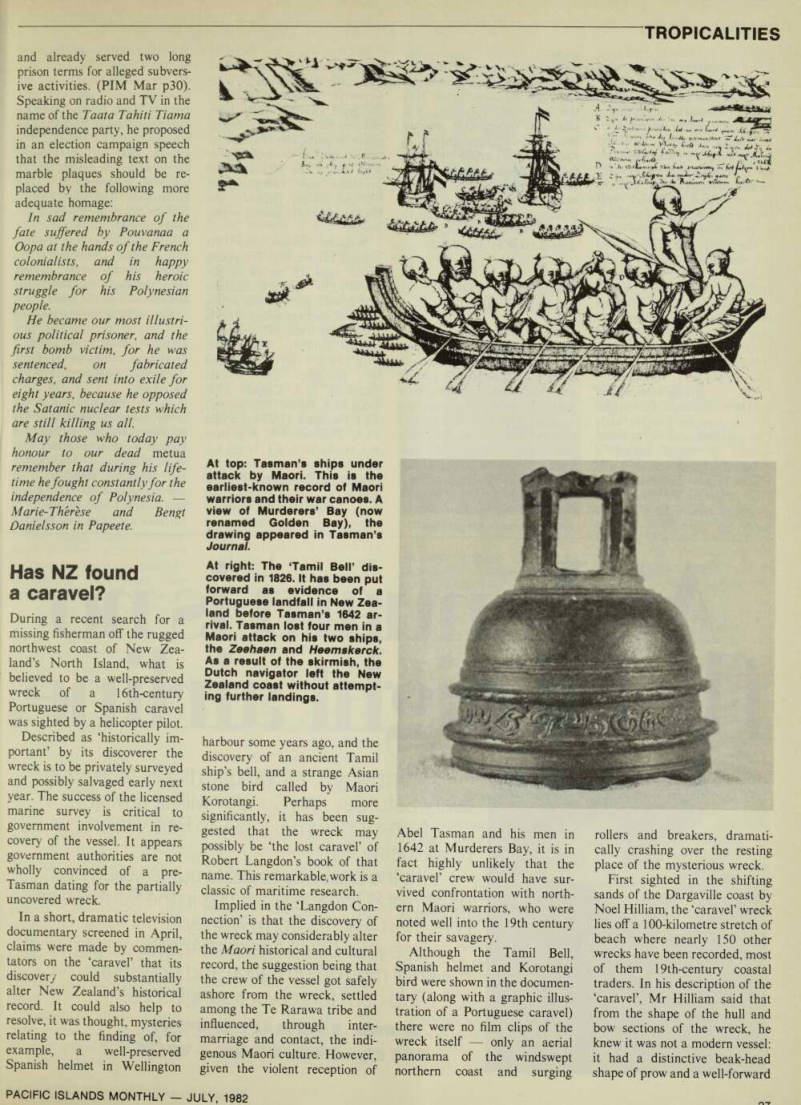
At top: Tasman’s ships under attack by Maori. This is the earliest-known record of Maori warriors and their war canoes. A view of Murderers’ Bay (now renamed Golden Bay), the drawing appeared in Tasman’s Journal.
At right: The ‘Tamil Bell’ dis covered in 1826. It has been put forward as evidence of a Portuguese landfall in New Zea land before Tasman’s 1642 ar rival. Tasman lost four men in a Maori attack on his two ships, the Zeehaen and Heemskerck.
As a result of the skirmish, the Dutch navigator left the New Zealand coast without attempt ing further landings.
mast stub. Additionally, the ship had a stepdown and what ap pears to be a square stem. He estimated that the wreck has a beam of about 10 metres and a length of about 30 metres.
Relating the possibility of the wreck being a Portuguese cara vel to several theories on early Pacific navigation, Mr Hilliam also connected the wreck with Maori myth, and the discovery of an unusual ring and stone caim in the region. Mr Hilliam, and the members of the Dargaville museum trust, anticipate difficulties in recovery of the ‘caravel’. The coast is wild and treacherous, with a driving four knot rip that slants a powerful swell into a towering sandstone cliff line. Beyond the breakers, rips run at nine to 10 knots.
Like the driving tidal rips of the Dargaville coast, the impulse to speculate on possible early European influence on the devel opment of Maori culture is powerful and well known in research into the cultures of other Polynesians. Should any advanced knowledge of navi gation for example be dis
covered among Tongans or Tahitians, there is inevitably a claim to alien or European contact in the distant past. That the indigenous Polynesian was capable of independent observa tion and discovery seems, to some ‘experts’, unrealistic, even naive. Whether or not this initial cultural arrogance will escalate or diminish in the salvaging and preservation of New Zealand’s ‘caravel’ remains to be seen
Alan Taylor in Auckland.
Samoa’s youth
suicide wave
In the 1920 s the famous anthro pologist Margaret Mead, in her classic Coming of Age in Samoa, painted a rosy picture of young Samoans who were carefree and devoid of problems associated with growing up. She painted a picture of a sexually permissive society (since con tradicted by many Samoans) whose value-free attitudes towards sex produced healthy, mentally robust Samoan young sters.
But that was in the 19205. If Margaret Mead were alive today, she would probably have to rewrite her book to allow for the great changes which have affected Samoan society, and its youth in particular. Especially, she would have to come to grips with one of the biggest social problems now characterising Samoan society, namely, the high suicide rate among young people.
Western Samoa has the highest suicide rate for young males aged 15 to 24 in the world. The Western Samoan rate is 94.8 per 100 000 young males of that age group. This is triple the rate of the next highest country, Switzerland, with 32.6 per 100 000, followed by Hungary 29.3, West Germany 23.8, Canada 22.5, USA 21.8, Japan 19.2, Norway 18.1, Denmark 12.2, Venezuela 11.6, Thailand 9.9, Argentina 9.3, Netherlands 8.1, Israel 6.3, Italy 4.8, Peru 4.4, Greece 3.4, Spain 2.2, Philippines 2.1 and Egypt 0.2. These figures come from World Health Organis ation statistics for 1980.
Yet the trend continues, with no end in sight. The persistence of the problem led to the establishment in June 1981 of a Suicide Study Group made up of representatives from the Fel lowship of Churches, the Health and Justice Depart ments and the Young Men’s Christian Association. The group, chaired by Chief Justice R.B. St John, immediately de cided to carry out a survey of suicides utilising both Health and Justice Department re cords. Approximately a year later, the study was completed and released to the press.
The group is now carrying out the second part of its pro gramme consisting of a public awareness campaign to bring the problem to the notice of the public.
In its research, the study group searched back into the suicide records of the 19605. No records were kept before that time, perhaps an indication of the negligible significance of the problem then. The group was satisfied that before 1970 suicides averaged five or six a
year. There were also six suicides in 1970. But from then on, the number grew progress ively greater. There were nine suicides in 1971, 10 in 1972 and 1973 and nine again in 1974.
In 1975, the key year to the Study Group, suicides jumped to 11 and then doubled to 23 in 1976 continuing ever upwards: 27 in 1977, 19 in 1978, 31 in 1979, 40 in 1980 and 42 in 1981. A member of the group, Dennis Oliver, thinks the 1978 figure would probably be higher, but for inefficient record-keeping. In the space of seven years, the suicide rate has increased 400 percent, exclud ing failed attempts.
What has puzzled the group is why the suicide rate suddenly jumped beginning in 1975.
Also, why is it that most of the suicides are occurring not in urban areas but in the villages?
Further, of the 243 suicides recorded by the Coroner’s Court for the period 1966 to 1981, only 99 villages were affected. The other 261 villages in Western Samoa had no suicides.
The study found that the most suicides occurred, since 1975, in the male age group 15 to 24. In most years they comprise 50 percent or more of all suicides. They are closely followed by males in the 25 to 34 age bracket and since 1979 there has been an upswing in the number of female suicides.
For the period 1970 to 1981, the events which precipitated the suicide were scolding (40 percent of all suicides), argu ment 18 percent, under influence of alcohol 13 percent, refused request seven, escape from prison six, relief from illness five, felt unloved four, mental patient three, ashamed of sexual adventure, and suicide pact, two percent each.
Fifty-five percent of the suicides followed conflict with parents, 20 percent with spouses, 11 percent with sib lings, five percent with other relatives, three percent boy/girl friend, and other, smaller per centages followed conflict with others.
Since 1970, the most com mon means of suicide was paraquat poison (111), followed by hanging (49), shooting (48)
and other methods. The in creased use of paraquat has led to much public concern here about the easy availability of the poison and moves are under way to restrict its sale and use.
Why the high suicide rate?
The study group is most careful not to give a position, preferring that the problem be given a public airing, and encouraging public participation in reducing it. But probably it is a reflection of the rapid technological pro gress resulting in rapid econ omic development. Cultural values, however, are slow in adapting, leading to a clash between the future-oriented young people, and past-oriented older folk. Young people are taking out their dissatisfaction through suicide, and until old and young are prepared to compromise suicide is likely to remain a grave social problem.
Felise Va’a in Apia.
Marianas’ German
days recalled
Elfriede Craddock has created a little masterpiece on Saipan. Her exhibition of the German years (1899-1914) in the Marianas at the Commonwealth Insular Arts Council is just right. She has combined the photograph and artefact with the written word to catch the spirit of the times.
Her exhibition depicts the daily round of activities on the islands, the buildings (govern ment offices, schools, and houses), the stamps, the coins, the ships, and the German officials. One special feature was the presentation of the dress styles of the time lavalava (Carolinian), mestiza (Cham orro), and dirndl (German).
Artefacts from daily life in clude a pot, pounder, and the wheel of a carabao cart.
Craddock directed the effort to seek documentation and photo graphic information from sources in Spain, Finland, Germany, the Philippines, Guam and Saipan. A number of inter views were conducted with resi dents who had lived through the German years.
To better remember ‘The German Interlude’ and the exhi bition itself, Craddock prepared a booklet Life in the Northern
Mariana Islands during the German Administration (1899-1914). This is a factual account of the German years with reproductions of many of the photographs found in the exhibition. It contains a short chronology of the Marianas, one of world events during the German administration, and a bibliography of sources. The booklet is a fine complement to the exhibition.
Today Elfriede Craddock is living in New York. She will be missed, but the exhibition and the booklet remain to remind us of her dedication to the people of
the Commonwealth.
(Fr)
Thomas B. McGrath, SJ, in Guam.
Vavau: Help for
handicapped
Disabled persons around the world were the focus of the United Nations in 1981, but in Vavau, Tonga, this is the year for the handicapped.
Children suffering from such problems as deafness, cerebral palsy, blindness, epilepsy and cretinism, who have tradition
ally been kept at home, now have an opportunity to attend classes for the first time in Vavau.
Students ranging in age from three to 31 years receive in struction four days a week through the efforts of the Tonga Red Cross of Vavau in class rooms donated by the Sacred Heart Convent in Neiafu.
The ’Ofa. Tui. ’Amanaki.
Centre (0.T.A.) is based on a school for the handicapped which was established in Nukualofa six years ago. (The English translation of the name is ‘Love. Faith. Hope.’) The Nukualofa centre has developed rapidly and has a paid staff of nine instructors and a fulltime salaried adminis trator, Nanasi Vaea. The Vavau school has just begun and no staff members receive salaries.
Yet according to Donna Lu’isa Score, Tongan Red Cross field representative and a United States Peace Corps vol unteer, support for the school from members of the com munity has been tremendous. ‘Our head teacher Palu Tu’i’onetoa lives 13 miles from Neiafu, and she leaves her family for four days a week to live in town so she can run the school,’ Lu’isa said.
One of the biggest problems faced by the O.T.A governing board is transport for the students, but bus drivers have taken the youngsters as passen gers without charge. ‘Ma’afu Tupou, the governor of Vavau, wrote a letter to owners of public transport ask ing for this donation,’ Lu’isa said.
O.T.A. students and staff received a boost the week after Cyclone Isaac when Her Maj esty Halaevalu Mata’aho, Queen of the Kingdom of Tonga and President of Tonga Red Cross, visited the school and sang and joked with the children. Lu’isa said Her Maj esty is keenly interested in the programme and pleased to see it has become a community effort at the village level.
The O.T.A. centre began on a shoestring and continues to op erate in that way. Standing beside a large Red Cross banner on the days cruise ships called at Neiafu, Lu’isa collected $260 for the programme. From
Recalling the German times
this amount, $6O went for supplies and $5O was placed into a petty cash fund to buy snacks for the children.
A fund-raising dance at the Paradise International Hotel, Neiafu, in February brought in $4BO and was the first time the O.T.A. students had a chance to demonstrate their singing ability when they performed a song written especially for the Centre.
Whereas the classroom space, most transport, baked goods and some supplies have been donated, the needs of the children are numerous, and Lu’isa sees this as the critical problem. ‘We have several students with partial hearing who are deaf-mutes, but with hearing aids they could be taught to speak and they could hear,’ she said. ‘Right now we have one aid on loan from Nukualofa. The first day I tried it on one of the deaf teenage girls she was angry because she did not like the noises she heard, but now she is beginning to talk for the first
time,’ she added.
The cost of hearing aids and necessary batteries cannot be covered by the current budget.
Neither can the expense of wheelchairs which according to Lu’isa are desperately needed. ‘We have a number of poten tial students who can’t make it to the school because they are unable to walk and are too large to be physically carried,’ Lu’isa said.
In addition to the head teacher Palu Tu’i’onetoa, three other teachers (Malia Lutu Vai, Lamona Fenukitau and Fatafehi Moala’eua) have been donating their services since the school opened in January 11.
Hinemoa Lolohea, ’Elati Finau, Latu Veleika, Seini Ngase’eata and Sanilaiti ’Ala are now fulltime volunteers also. ‘The program couldn’t exist without the donation of time by these people,’ Lu’isa said. ‘lt’s a sacrifice on their part, and it’s sacrifices such as this which keep the Centre going,’ she added. ‘We’re still working at a base level,’ Lu’isa explained. ‘We
need such things as blunt edged scissors, paper, pencils, crayons many things which can’t be bought here in Neiafu,’ she said.
In assessing priority needs for handicapped persons in Vavau, Lu’isa listed; hearing aids and batteries, wheelchairs, special wheelchairs for victims of cer ebral palsy, durable educational toys, recreational equipment for developing co-ordination, and musical instruments.
Donations to the ’Ofa. Tui. ’Amanaki. Centre of Vavau can be sent to: Tonga Red Cross Vavau, Neiafu, Vavau, Tonga, South Pacific. All contributions should be marked ‘gift’ and ‘O.T.A.’ should be written on
the envelope or inside.
Joan
D. Pease in Neiafu.
Pacific languages
mapped
Part one of a two-volume atlas mapping the more than 2000 languages and dialects of the Pacific area has been completed in Australia.
The atlas is a joint project
involving the Australian Acad emy of Humanities, the Japan Academy and the Australian National University (ANU), Canberra. The first part of the Language Atlas of the Pacific Area comprises 24 multi coloured plates plus text cover ing Papua New Guinea and its surrounding region.
Part two to have 23 plates will cover the Japan area, Taiwan, the Philippines, and mainland and insular Southeast Asia.
According to the ANU Re porter the atlas project grew out of 25 years of extensive re search in the area. Much of the work was carried out through the Department of Linguistics in the Research School of Pacific Studies at the ANU with results published through its Pacific Linguistics publica tion. Professor Stephen Wurm, professor of linguistics at the ANU, and joint general editor of the atlas, said the volume was the only up-to-date, complete publication mapping the languages of the area.
Continued on Page 68
Lord Howe has
a centenary
A re-enactment of the April 1882 landing of the New South Wales Government team who conducted the first government survey of Lord Howe Island was staged by the islanders to com memorate the centenary of this event. Representatives from the various government depart ments involved in the original survey were on hand to mark the centenary. Represented were: the Department of Mines, the Department of Trigonometrical Survey, the Botanic Gardens, and the Aus tralian Museum. The chief pho tographer from the Govern ment Printing Office was pres ent. Also there was the historian of the Burns Philp company.
Descendants of the 46 1882 inhabitants of Lord Howe Island greeted the landing party. Their parts were played by longtime residents. All tak ing part in the re-enactment wore period costumes. The parts of Nathan Chase Thompson and family to whom
so many of the present-day inhabitants are related were acted by Nathan’s grandson Paul Thompson and his wife and children. A Channel 9 television team was on hand to make a documentary of the centenary festivities which in cluded a picnic, 1882-style, a concert, and a retaking of the 19 views contained in the 1882 report by the government print ing office photographer.
Jim Dorman, curator of the Lord Howe Island Museum and his committee arranged to re publish the 1882 report. The “Report of the Present and Future Prospects of Lord Howe Island” by the Honourable J.
Bowie Wilson (Thomas Richard, Government Printer, 1882) is on sale for SAIS. In addition, as a collector’s item, a limited red leather-bound edition of the report signed by Premier Neville Wran, and the ex-governor of NSW, Sir Roden Cutler, is being sold at $lOO a copy. Proceeds of its sale will go to the Lord Howe Island Mu seum. The original 19 glass plates were used to reproduce the photographs.
It was following the Honour able J. Bowie Wilson’s far sighted recommendations ac companying the 1882 report that the present government policy of preservation and re straint was instigated, the result of which has been the retention of Lord Howe Island’s unique
and unspoiled character.
Jane
DeRidder.
NZ radio to cut
Islands service?
New Zealand’s Minister of Foreign Affairs Warren Cooper favours ending his country’s shortwave broadcasts to the Pacific as a cost-cutting exer cise.
The government has called on all its departments to cut costs by three percent and Mr Cooper has apparently eyed the SNZ2OO 000 spent annually on keeping the South Pacific abreast of events in New Zea land. He pointed to that sum when talking to journalists and to ‘a couple of archaic transmit ters’ that might need to be replaced for $6 million.
According to Mr Cooper,
who became foreign minister late last year: ‘We haven’t had many reports coming back say ing that the radio programmes going up (from New Zealand) are putting New Zealand as a nation in the best possible light.’
When journalists asked him whether he was criticising Radio New Zealand’s news services, Mr Cooper said: ‘lt’s a logical response to some of the programmes coming out which are pretty pessimistic and don’t show New Zealand in the best light possible.’
Reaction to that news was prompt.
Mr Cooper preferred propa ganda, said The Star in Christchurch in an editorial. ‘ln other words, don’t tell the Pacific about New Zealand the way it is but rather the way the Government wants people to believe it is.’
The Auckland Star also weighed in with adverse edi torial comment.
The opposition Labour Party’s shadow minister on broadcasting Jonathan Hunt said it would be disastrous to cut the air link with the South Pacific people.
Australian-sourced pro grammes were giving Australia a high profile with the right type of news so the area would not go without a service, he said.
So are a lot of other countries giving the Pacific islanders a variety of services and these range from the Russians, Germans, French and Japanese to the Chinese and Latin Americans.
Amidst that cacophony of sound on the radio waves, New Zealand’s voice from its two US-made World War II 7.5 kilo Watt transmitters is puny.
William Gas son in
Wellington.
Five years to a
malaria vaccine?
Two British scientists believe they may be within five years of a commercially available vac cine against malaria.
Researchers in different parts of the world have for years been working to produce a vaccine for this disease which causes a million deaths a year and is at present overcoming attempts to control it.
Two scientists from the Wellcome Research Laboratories at Beckenham, near London, recently reported to Nature magazine that they had identified two proteins as sociated with malaria in mice and had successfully purified them. They had then been used to immunise mice against ma laria.
In tests, groups of mice immunised with one of the two proteins all survived after being injected with the malaria para site. But the untreated control groups were wiped out by the disease.
One of the two men involved, Dr Anthony Holder, has confirmed that since their re port, published last November, they had succeeded in identify ing a protein from the malaria parasite. Following this major development, they were now in the process of purifying the protein in order to produce sufficient for tests on monkeys.
It is hoped the first tests will be carried out within the next 12 months.
Monkeys are in many ways good models of the human and for obvious reasons it is not possible at this stage to try a possible vaccine on volunteer humans.
If the protein just identified proves to be successful in trig gering the body’s natural de fences against the human ma laria parasite, efforts will be made to use genetic-engineering techniques to produce it in bulk for use as a vaccine. Genes coating this particular protein will be isolated and transferred to bacteria which will produce the protein in volume.
Dr Holder is quietly optimis tic that he and his colleague, Dr Robert Freeman, are on the road to a malaria vaccine. He said: ‘Assuming there are no snags then one can consider a time scale of five years before a commercially available vaccine will be produced.’
At least 500 million people in some 60 countries are at risk each year from the anopheles mosquito and its deadly malaria parasites. There is alarm at the resurgence of malaria in many countries where eradication programmes have taken place.
John F. Webb, Science
Correspondent, LPS.