May 23 poll
pp. 22-23 · Read in the full issue
Wrecks, safe returns in May 23 poll
‘Our canoe is caught in a raging storm. But we have faced other tempests in the past, and we shall pull through this one too, and eventually reach our destination.’
This was how French Polynesia’s Vice-President of the Council of Government Francis Sanford (who can best be described as a prime minister for local affairs, kept on a leash by the French High Commissioner) described the position of his coalition government in a campaign speech a few weeks before the May 23 territorial elections.
It was an apt metaphor from the leader of a seafaring people.
But perhaps it should be explained, for the benefit of the uninitiated, that the canoe that Francis Sanford has been steering for the past five years, like the ancient taurua canoes, has two hulls. One represents his own Ea api party, mostly favoured by part-Europeans, and the other John Teariki’s Here aia party, supported by a basically Polynesian electorate.
It is with some sadness that we record in similar allegorical Polynesian vein that instead of reaching harbour safely, the coalition canoe broke asunder in the pre-electoral storms.
While Teariki and his crew managed to stabilise their hull and sail to safety, the Ea api hull proved rotten and worm-eaten, and eventually limped into harbour totally swamped and with only one man on board Francis Sanford himself. On his arrival ashore he found his first lieutenant Emile Vernaudon, who had abandoned his captain at the height of the storm, together with several former members of his crew.
Expressed in the officially sanctioned European language of figures and statistics, all this means that the 60 000 of the 85 000 registered voters in French Polynesia who went to the polls on May 23 to elect the 30 members of the Territorial Assembly (there were 398 candidates!) from five constituencies cast enough votes 15.8 percent of the total for Teariki’s party to return him and his five companions.
But the voters showed their strong disapproval of Francis Sanford’s leadership by giving his party only a pitiful 2929 votes. The magnitude of the defeat is clearly demonstrated if the Ea api vote is expressed as a percentage of the total votes cast: 4.4 percent! This gave a seat in the assembly to only the bearer of the first name on the Ea api list, none other than Francis Sanford. In the previous assembly, his party had controlled seven seats.
Another notable victim of the various electoral shipwrecks was the long-time speaker of the Territorial Assembly, Frantz Vanizette, whom we should perhaps call a ‘stowaway’ on the Autonomist double-canoe, since he had been regularly elected with the help of his friends Teariki and Sanford. Up to election day he had been the only Frenchman to sit in the assembly. He was accepted there as more or less a permanent fixture because of his fine grasp of parliamentary procedure, and his excellent contacts in the ministries in Paris.
But, with a notable lack of appreciation of what his status really was, he decided for the purposes of this election to form a new party, together with a part-Polynesian government employee Maco (Marc) Tevane, whom Francis Sanford had made his trusted councillor for cultural affairs back in 1977. For reasons that are quite unfathomable, Vanizette and Tevane
chose to call themselves Social Democrats, and stood candidates in several constituencies. They polled a wretched 2.8 percent of the vote, leaving Vanizette without a seat in the assembly.
We only mention this minor disaster at all because it tellingly gives the lie to the shining image of Maco Tevane assiduously cultivated by French officialdom. This highly unrepresentative figure has been the perennial representative of French Polynesia at international conferences and seminars throughout the Pacific. His function was to serve as living proof that the Polynesians run the show in the territory ...
So much for the losers. Let us now move on to the winners.
Foremost among them is Gaston Flosse and his Tahoeraa Huiraatira party, which can best be described as a sleek, high powered, cabin cruiser, manned by a crew of smart young men dedicated to various forms of free enterprise. This party, which is affiliated with the French RPR Gaullist party of Jacques Chirac and therefore appeals strongly to the 10 000-odd French expatriate voters, won 13 seats. This was four more than it held in the previous assembly, but still three short of an absolute majority. It secured 17 787 votes, 29.3 percent of the total.
The most brilliant performance, however, was turned on by the small la mana te nunaa outrigger canoe. Its achievement in winning three seats in the assembly in which it has never before been represented crowned years of hard, slogging work by its young and dedicated members among the most destitute and miserable Polynesians. The party is socialist (but has no affiliation with the party of President Mitterrand), pro independence, and anti-nuclear.
They would have won a fourth seat if the Polynesians who favour independence had all voted for la mana instead of wasting about 2000 votes on the eight other pro-independence candidates, some of whom are pure mavericks.
As usual, the French authorities found the necessary legalistic means to disqualify the number one activist and freedom fighter, Charlie Ching, and his place at the head of his party’s list was taken at the last minute by his wife.
The total number of votes cast in favour of pro-independence candidates la mana, plus the eight smaller groups was 9202, which corresponds to 15 percent of the total.
We should also note that four other small craft, among them a junk Arthur Chung’s Taatira party, backed by an overwhelmingly Chinese electorate also crossed the finishing line.
Francis Sanford’s crushing defeat was easy to predict as we ourselves did in our letter in PIM (Jun p 7).
It must in the first place be ascribed to his meek acceptance, while in power, of French colonial rule and the abominable nuclear tests.
It must be stressed that during the previous 15 years he had gained the status of a national hero in the freedom struggle, almost on a par with Pouvanaa a Oopa, who was honoured two weeks before the elections by a huge monument erected in the park outside the Territorial Assembly building. (See our separate account in Tropicalities, this issue.) But Francis Sanford has lately been outflanked both on his Left by the la Mana party, and on his Right by Gaston Flosse,
who wants complete internal self-government on the Cook Islands model, and threatens to oppose further nuclear testing if there are more ugly accidents at Moruroa.
The irony of it all is that Francis Sanford has actually not given up his old anti-colonial and anti-nuclear stand.
What has happened is simply that as the holder of the highest local office he was gradually bogged down by the mass of urgent social and economic problems that cropped up daily, and that always had to be solved somehow and always, of course, only on a temporary basis.
In addition, the poor vice-president was burdened with an endless succession of ceremonial tasks; cutting gaily coloured ribbons at the opening of new schools, bridges and roads; crowning beauty queens; entertaining French ministers and their wives; and eating, eating, eating, as the guest of honour of the hundreds of clubs and associations that now exist in the territory.
This problem, of course, is faced by prime ministers the world over. They usually solve it by delegating responsibility to bright and knowledgeable cabinet ministers, departmental heads, and secretaries.
But unfortunately for Francis Sanford, most of his techno crats were provided by the French Government, and were much more inclined to take orders from the High Commissioner than from him.
Even worse, the few the constitution allowed him to choose for himself were either pompous pseudo-intellectuals, expatriate fortune-hunters, or worthless hangers-on who produced a series of wild economic schemes which invariably collapsed if they ever got off the ground at all.
The worst scandal involved two convicted French criminals who, posing as industrialists, managed to obtain 60 million francs from French Polynesian government funds to launch an unworkable textile mill equipped with discarded and rusty machinery picked up from a garbage dump in Paris. They were later responsible for the kidnapping and brutal murder of the wealthy young businessman Olivier Breaud (PIM May ’BO pi 7, Jun ’BO p!9).
The whole affair proved so embarrassing to the French administration and the Sanford government that the two killers, who are perfectly willing to tell the full story, have (for this very reason) not yet been brought to trial.
What finally sealed Sanford’s fate, however, was the defection, less than two months before the elections, of his own party secretary, the ‘Sherilf Emile Vernaudon. Vernaudon managed to persuade enough Ea api officials and members to
follow his example, and, with the help of these other renegades, formed a new party, Aia api.
To top it all, after winning three seats, Vernaudon allied himself with Sanford’s arch-rival Gaston Flosse, who thereby gained at long last a precarious majority in the assembly. As the last bitter pill for Francis Sanford to swallow, Vernaudon was rewarded for his switch of allegiance with the post of speaker of the new assembly.
At a press conference held immediately after he had been assured of Vernaudon’s support, Gaston Flosse announced that as vice-president and new majority leader, he considered that the most pressing task was to negotiate a complete revision of the existing constitution with the socialist government in Paris.
His aim, he said, was to give French Polynesia full internal self government by July.
Next, Flosse can be expected to see to it that the impartial committee of inquiry into the extent of the radio-active pollution of French Polynesia which is to include Australian, New Zealand, and Japanese radiobiologists set up at his own suggestion by unanimous decision of the old assembly on December 21, 1981, will at long last begin its work.
While the opposition members will give support to these two measures, the new assembly will be sharply divided on economic issues. For while the new majority is entirely in favour of free enterprise, and economic development along Western, capital istic lines, the main opposition parties. Here aia and la mana are likely to make common cause in favour of an economy based on small, family-oriented production units, on either a socialist or co-operative model, managed solely for the good of the Polynesians themselves.
Since we are a husband and wife team, may we be permitted a final comment on the lopsided composition of the electoral lists.
Of the 398 candidates presented by about 30 different parties and groups, fewer than 20 were women, and only one, representing Tahoeraa Huiraatira, was elected.
We must therefore conclude that the numerous highly publicised regional conferences which are regularly organised to promote the status of Pacific women the last one was held in Papeete in July, 1981 have had no impact whatsoever on the all-male political leaders of French Polynesia.
Will the new majority be more eager to do women justice, and help them to secure equal representation in all political bodies?
After all, women represent 50 percent of the voters.
Marie-Therese and Bengt Danielsson.
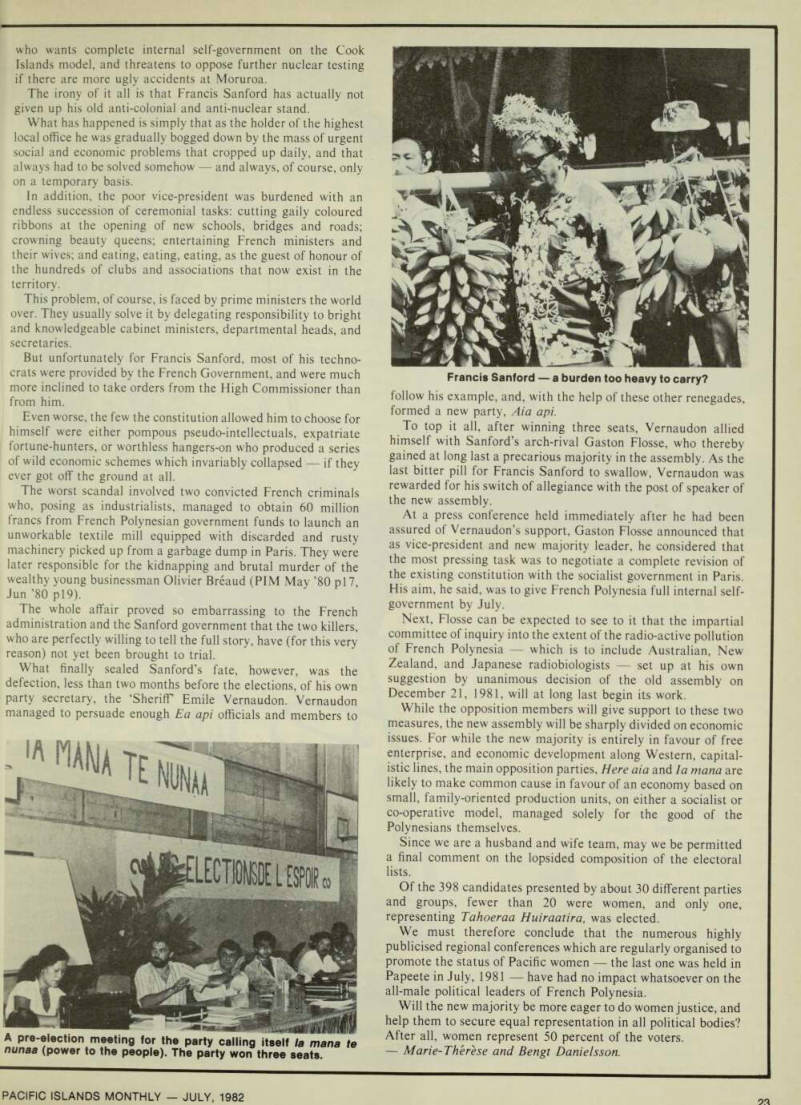
A pre-election meeting for the party calling itself la mana te nunaa (power to the people). The party won three seats.
Francis Sanford a burden too heavy to carry?