French plan to hang around forever
pp. 31-35 · Read in the full issue

Political
Currents
Political Dynamite In A Vila Carport
Before Vanuatu: Anatomy of the French plan to hang around forever
PIM May (p 33) carried ex tracts from a confidential report to Paris made in October 1969 by the then French Resident Commissioner in the New Hebrides, Jacques Mouradian.
In it Mr Mouradian made clear France’s intention to ‘stay’ in the New Hebrides, acting on the express instructions of Gen eral de Gaulle.
He also described the con trary intentions of France’s British partners in the condo minium, who wanted to lead the country to independence, and the means being employed by France to foil this British plan.
These included vigorous ex pansion of the French schools system to build ‘our new clien tele of New Hebrideans undergoing Gallicisation by way of education’; rapid and generous expansion of French health services; payment of very high salaries to New Hebrideans in French employ; strong opposition to any inte gration (as desired by the British) of the various separate French and British administrat ive services in the country; and efforts by all means to delay the participation of New Hebrideans in local political life.
Mr Mouradian also described French mistrust of the activity of international organisations such as the United Nations in the New Hebrides, and their consequent grudging accept ance of the South Pacific Com mission as a ‘lesser evil’ in this connection.
Finally, the Resident Com missioner outlined what he called a ‘fallback’ French pos ition in the event that indepen dence could not, despite the very best efforts of the French, be prevented: the French would agree to it, but on condition that it would be ‘tempered inescapably by co-operation agreements with France’.
Now Howard Van
TREASE, director of the Uni versity of the South Pacific
Centre in Port-Vila, carries the story further with more analysis of other similar confidential French reports.
In the first of three articles he examines French official atti tudes to the land problem in the New Hebrides, and the relation ship of this problem to that of political independence. • • • Perhaps the only positive thing to come out of the French government’s attempt to block the independence of Vanuatu in July 1980 was that when the decision was finally made to leave in the last days before July 30, the staff in the French Residency were ill-prepared to make their exit. As a result, chaos reigned as staff furiously burned mountains of paper and documents (PIM Apr pi 3).
When time ran out they dumped a large pile of seem ingly unimportant files in the Residency carport.
Among the rubbish, however, was a small collection of monthly confidential reports of the French Resident Com missioner to the Ministry of Overseas Departments and Territories in Paris concerning the state of affairs in the New Hebrides (now Vanuatu).
Each month the French Resi dent Commissioner provided his superiors with a synthesis of the events and developments in the archipelago under the head ings: etat d’esprit des popu lations (state of mind of the population), vie politique (pol itical life), vie economique (economic life), vie sociale (social life) and vie adminis trative (administrative life).
While not a complete set, the reports provide an illuminating insight into the attitudes and policies of the French Govern ment prior to independence, a knowledge of which makes it easier to understand the basis of some of the problems Vanuatu faces today, and the policy the
French Government is at pres ent following.
The italicised quotations which follow are at times rather long. It was felt, however, that it was better simply to allow the French Resident Com missioners to speak for them selves. Copies of these reports are now held in many countries.
Given the principle embodied in the Protocol of 1914, which required the agreements of both metropolitan governments in order to make any change in the system, the French indeed might eventually have suc ceeded in their plan to implant themselves permanently in Vanuatu. They were prepared to spend more money than the British on building up their system of education and social services, and in the end this would have had the desired effect of creating the depen dence on and loyalty to France which could have enabled them to stay.
What they didn’t expect, but what soon came to be a far greater threat to their plans than British attempts to keep pace, was opposition by ni- Vanuatu to the condominium system itself. The focal point of this opposition was the land problem, which began to itensify in the mid-1960s in the form of a semi-cult movement called Nagriamel, led by Jimmy Moli Stevens, but later evolved into a nationalist move ment with the clear goal of achieving full independence.
French officials were ex tremely frightened of Jimmy Stevens when confrontations between his followers and European (primarily French) plantation owners first began in the late 19605.
Whatever the future of the movement shall be, a string of claims has emerged and we have to consider it. It is urgent to find a solution to the land litigations if we want to prevent them from growing into dis putes which would diminish
our influence just at the mo ment when it is increasing. (Mouradian, August 1968.) French officials realised that since the vast majority of alien ated land in Vanuatu was held or claimed by French nationals and companies, they were in deed the most vulnerable to attacks from ni-Vanuatu push ing for reform.
The French pressed their British partners to join them in taking firm action against Stevens, which led eventually to his arrest and imprisonment in 1968. During his period in prison, however, French Resi dency officials were able to have regular contact and discussions with him, which led them to the conclusion that he and his movement could be contained.
His theme is as follows: Melanesians never sold land to Europeans. Owing to this he categorically refuses to recog nise any registration of unde veloped land which might have been approved by the Joint Court... He accepts only the old agreements valid for the right to use the land which according to Melanesian cus tom are the only rights recog nised; the ownership rights re main theirs... He abstains from claiming developed par cels since, in this case, the occupation rights have been used... He does not at all intend to prevent the economic development of this country by the settlers or the companies, but when he refers to occu pation of undeveloped land or the cultivation of fallow par cels, the right to use the land must be subjected to new agree
ments and must not be based on permanent ownership, which to him and his kind is an alien way of thinking. (Mouradian, May 1968.) From the above it can be seen that the French had achieved a certain understanding of the land problem in Vanuatu.
Moreover, although they never admitted it publicly, they came to accept that indeed ownership of a large percentage of the land claimed or registered in the names of French nationals and companies especially the Societe Francaise des Nouvelles-Hebrides (SFNH) was not based on sound titles.
Originally, the Company prided themselves on pos sessing 800 000 ha. This enor mous figure leaves no doubt as to the way that land was acquired, and the large areas returned subsequently leave a bad feeling about the legit imacy (moral if not legal) of the 180 000 hectares remain ing. (Mouradian, May 1968.) The problem they faced was to defuse a situation which was severely threatening their long term position in Vanuatu.
While the French Residency recognised the danger of al lowing the problem of alienated land to get out of hand, they opposed any change in the 1914 Protocol which would have brought into question the status of registered titles.
While showing itself open to progressive solutions, the French Residency has not lessened its vehement defence of the unimpeachability of judgments of the Joint Court.
It refused to agree to the creation of a commission which would have acted as a kind of popular tribunal of appeal from its judgments. (Mouradian, October 1969.) They realised, however, that some concessions were necess ary in order to prevent the land problem from threatening their long-term plan of implantation.
The strategy they adopted in the late 1960 s was to attempt to deal with each individual ni- Vanuatu challenge, rather than allow a general review of land through a land commission, which they feared might lead to pressure to change the whole system. Many registered titles
included vast amounts of uncleared bush land, in addition to developed plantation areas, and the French calculated that by giving up ‘dark bush’ they could satisfy ni-Vanuatu de mands and at the same time retain their economic base.
Since Jimmy Stevens’ main aim was to halt the expansion of European plantations into unde veloped bush areas, which he argued belonged to ni-Vanuatu by right and was needed for their future development, the French plan to hand back or transfer title to large sections of ‘dark bush’ was not an unintel ligent response to adopt.
Authorities in Paris -eventu ally agreed to French Resi dency proposals to hand back undeveloped land. Beginning in 1973, and continuing off and on throughout the 19705, both registered land and land under application for registration by the Joint Court totalling nearly 250 000 hectares (nearly 25% of the land area of Vanuatu) was handed back to ni-Vanuatu.
The French Government was able to hand back land of its own, but in the case of SFNH, it agreed to purchase the land from the company first. The
largest blocks of land returned were on Santo and Malekula, but the programme also in cluded transfers on Epi, Pentecost, Maewo, Ambrym and Nguna.
The French Residency clearly intended the policy of returning land for political pur poses careful consideration was given to which individuals or communities were to be given titles.
For the time being it seems impossible to insure an overall settlement of these disputes. In these circumstances the French Residency tries to settle dis putes case by case, sparing at the same time the interest and peace of mind of our nationals, as well as the aspirations of the natives it appears advisable to satisfy. (Langlois, August 1973.) Undermining National (now Vanuaaku) Party influence was one of the primary uses of the policy.
We can expect some reac tions when our nuclear tests are resumed and no doubt when newkmd claims come up. That is why I feel that the National Party should be tackled and announcements should be made
to the native owners of Malekula and Santo of a forthcoming restitution of the first land bought by the State from SFNH. (Langlois, January 1973.) However, wnile this had the effect of buying off Jimmy Stevens, it came too late to stop the development of the nationalist movement.
By early 1971, prior to the establishment of the New Hebrides Cultural Association, the then French Resident Com missioner had come to realise that it was inevitable that Melanesians would soon be come involved in politics. There were in fact proposals by French expatriates that efforts should be made to recruit Melanesians into the political game in order to control them.
Certain Europeans, such as M. Delacroix, think that it is time to organise young Melanesians into political groupings which would permit the inevitable evolution of their behaviour to be guided. I fear that they (Europeans like Delacroix) delude themselves with illusions and I rather believe that these political regroupings which will cer-
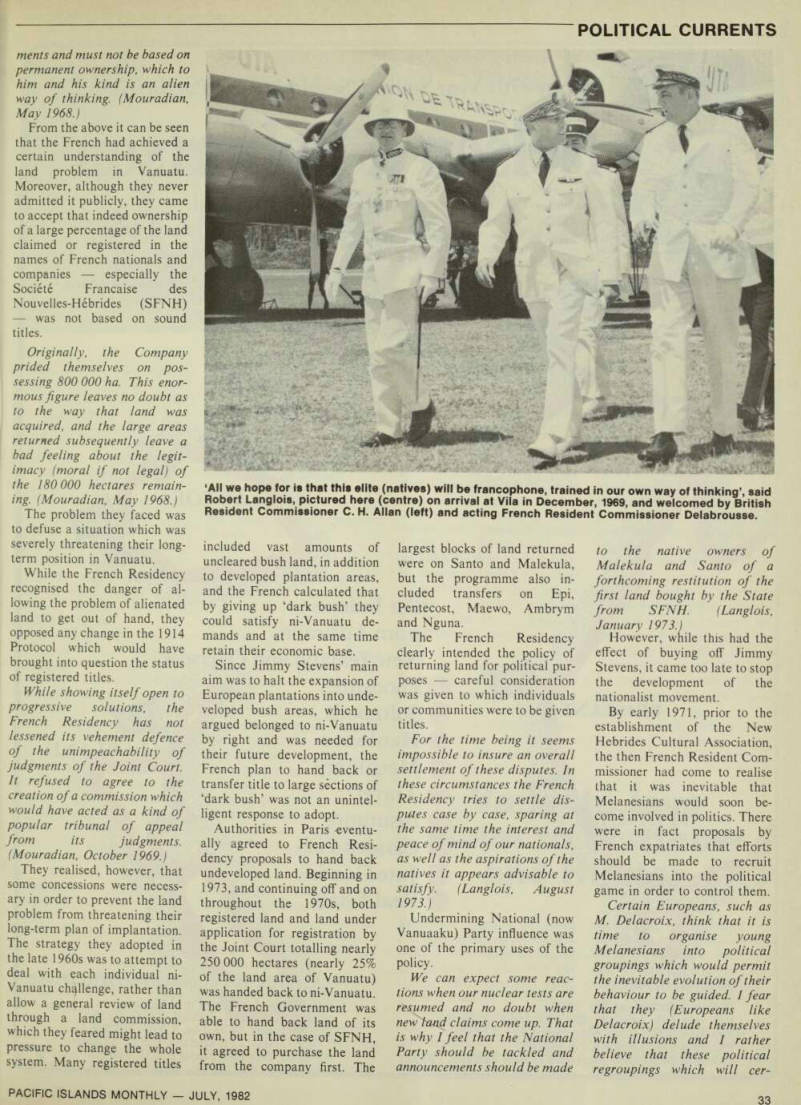
‘All we hope for is that this elite (natives) will be francophone, trained in our own way of thinking’, said Robert Langlois, pictured here (centre) on arrival at Vila in December, 1969, and welcomed by British Resident Commissioner C. H. Allan (left) and acting French Resident Commissioner Delabrousse.
tainly take place will be undertaken by the natives themselves, as soon as a small thinking elite, capable of rep resenting the masses, will have been formed. All we hope for is that this elite will be francophone, trained in our own way of thinking. (Langlois, January 1971.) The above comment by the then French Resident Com missioner, R. Langlois, recog nised the inevitable awakening of Melanesians to the reality of life in the condominium, and that they would in the long run want to develop their own political strategies.
Following the demonstration in August 1971 of primarily anglophone Melanesians linked to the New Hebrides Cultural Association in support of a joint regulation to limit land sub division in the group, Langlois noted: Although the demonstration held for about two hours by just a few dozen natives was absolutely calm, its impact on the Europeans was gripping.
Unable to believe that natives could adopt an attitude that had not been dictated to them, the European population pinned this fear down to the activity of the British Resi dency. the Presbyterian Mission, the Anglicans, etc.. .
It is evident that the British were delighted to see an awak ening of civic consciousness in the natives, who wished to have their say in the settlement of affairs bearing on general inter ests. It is nonetheless certain that this awakening has been spontaneous, its occurrence
having been hastened by the attitudes of the Europeans, yet it had been lying in wait for a coherent and organised move ment. (Langlois, August 1971.) This realistic attitude on the part of Langlois, however, was not adopted by subsequent French Resident Com missioners, who found it difficult to attribute the politi cal activities in the 1970 s of the New Hebrides National Party, and later the Vanuaaku Party, to a Melanesian desire for reform.
Their inability to accept the notion that ni-Vanuatu them selves possessed a desire for political change and indepen dence which had not been planted by outsiders, reveals the disdain in which French officials held Melanesians, and the ex tent to which they were willing to disregard the feelings of colonised people in the pursuit of their own national interests.
French officials possessed an outdated 19th-century belief in the ‘superiority’ of French cul ture, and believed that Melanesians could be enticed into a state of perpetual colonial domination and subservience.
All that was needed, they be lieved, was time for their poli cies to take effect.
The discontent is undeniable, tensions between groups are a threat which must be con trolled as much as possible.
The success of our policy being first and foremost a question of time, time to train our elite, to
rally various sectors of the population around us, to estab lish the local structures we propose. To have our position damaged by movements against which we are unpre pared or could not contain, would be unfortunate. (Langlois, July 1972).
By the mid-19705, however, French officials were learning under the impact of political developments that their pos ition was not as secure as they had hoped. Despite the fact that hundreds of thousands of hec tares of formerly French-held land had been transferred to ni-Vanuatu ownership, Mela nesian discontent and protest was increasing. What they had failed to recognise was that land was not the key issue, but merely the catalyst for the nationalist movement. The real issue was political power independence.
The constant theme running throughout the French Resi dent Commissioners’ reports is that political agitation by pri marily English-speaking Mela nesians was planned and orches trated by the British Residency, and that the notion of indepen dence was the result of radical ideas implanted in the minds of young ni-Vanuatu studying abroad. The French Resident Commissioner noted in 1972 that: From correspondence re ceived in Port-Vila, it would appear that Anglophone students from outside and es pecially in Suva find sympath etic ears and precise advice for their complaints which accord
ing to some should result in violent action. Out of all these young natives’ claims, the one concerning political status is evidently most energetically brandished, but without a doubt, the restitution of land is a firmer claim and it upholds the whole objection to the condominium regime . . . The return of these young men will be spread over a period of a few years only, after which a reg ular influx of them will swell their ranks. We have enough time left for manoeuvring wherever possible, and we must speed up the settlement of pending lawsuits involving the French State and the SFNH. (Langlois, August 1972.) The French Government used the argument of British Residency plotting and foreign influence throughout the 1970 s to rationalise their own actions.
They blatantly attempted to manipulate and control political developments and the Melanesians involved on the pretext that the British and others were doing the same. It is significant to note, however, that the French Resident Com missioners’ reports never specify incidents in which the British Residency was supposed to have taken an active role.
One can only assume that it was impossible for French officials to imagine that the British were not involved in manipulation of the situation to the same intense degree as they were .. .
Next month: Political ma nipulation, and the politics of land: Stevens, Oliver, Peacock.
The ‘absolutely calm’ demon stration led by Anglican Father John Bani (centre) in August, 1971.