Bligh, Christian, and HMS Bounty
pp. 11-14 · Read in the full issue
The perennial cinematic voyage of Bligh, Christian, and HMS Bounty
Dr NORMAN DOUGLAS, a lecturer in Pacific Studies at the University of New South Wales, Sydney, Australia, has been studying the history of the various films made over the past 60-odd years telling the story of the Bounty mutiny. He turns up evidence that Australian film-makers were easily the earliest in the field, producing the first film on the subject in 1916.
British film director David Lean and his producer Dino de Laurentiis have finally aban doned plans for a two-part remake of the story of the Bounty mutiny (PIM Jun p 24).
Film buffs who have been following the details of this production in the pages of PIM and elsewhere were doubtless able to recall two previous versions of the Bligh-Christian confrontation: the classic 1935 version with Charles Laughton and Clark Gable, and the 1962 version with Trevor Howard and Marlon Brando. The latter, while giving a huge boost to Tahiti’s pre-nuclear economy, also came unintentionally close to self-parody. The American films, both inspired by the novels of Charles Nordhoff and James Norman Hall, are well known. Less well known is the fact that the story of the Pacific’s best-known mutiny has been filmed five times twice by Australians.
In 1916, 20 years before MGM re-created Captain William Bligh in the image of Charles Laughton, an Austra lian film-maker produced the first film of the Bounty story. It had the double distinction of being the first cinematic version of the mutiny and the first Australian dramatic film in which extensive Pacific Islands locations were used.
Without so much as Nordhoff and Hall’s novel to guide him,
producer-director Raymond
Longford began his work like most good students of Pacific history at Sydney’s Mitchell Library. There, in the interests Df historical accuracy, he exam ined records which dealt with the mutiny and the subsequent developments on Pitcairn Island.
Longford’s output until that time had not been particularly impressive, consisting as it did }f routine melodrama and mock ;xotica such as A Maori Maid’s Love. Clearly, the film of the
Bounty mutiny was conceived on a far grander scale. Indeed, the Melbourne Argus of December 2, 1916, announced it to be ‘probably the most costly production yet made in Australia’.
But such an ambitious work could not be based solely on library research and filmed en tirely in Sydney, for, however attractive the beaches at Bondi and Cronulla may have been, they paled in comparison with the settings against which the drama had been originally en acted.
Consequently, Longford, whose later work was to win him deserved praise for its attention to authenticity and detail, de spatched an expedition to
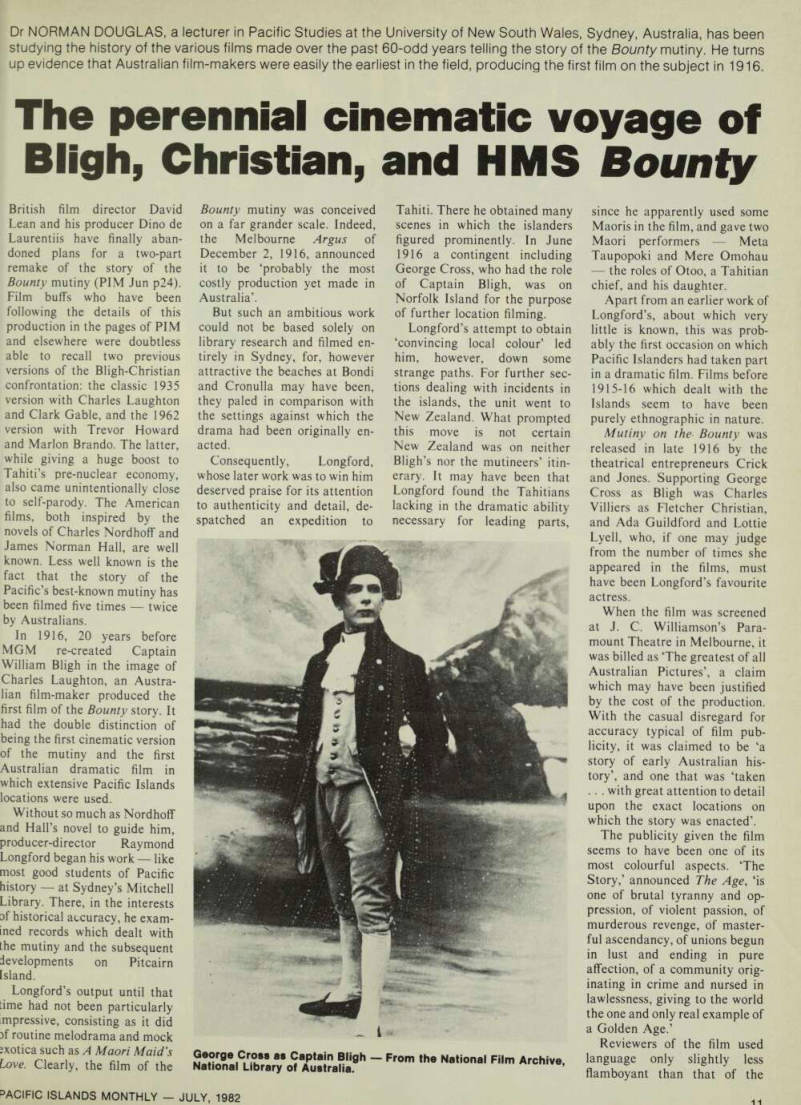
Tahiti. There he obtained many scenes in which the islanders figured prominently. In June 1916 a contingent including George Cross, who had the role of Captain Bligh, was on Norfolk Island for the purpose of further location filming.
Longford’s attempt to obtain ‘convincing local colour’ led him, however, down some strange paths. For further sec tions dealing with incidents in the islands, the unit went to New Zealand. What prompted this move is not certain New Zealand was on neither Bligh’s nor the mutineers’ itin erary. It may have been that Longford found the Tahitians lacking in the dramatic ability necessary for leading parts,
since he apparently used some Maoris in the film, and gave two Maori performers Meta Taupopoki and Mere Omohau the roles of Otoo, a Tahitian chief, and his daughter.
Apart from an earlier work of Longford’s, about which very little is known, this was prob ably the first occasion on which Pacific Islanders had taken part in a dramatic film. Films before 1915-16 which dealt with the Islands seem to have been purely ethnographic in nature.
Mutiny on the Bounty was released in late 1916 by the theatrical entrepreneurs Crick and Jones. Supporting George Cross as Bligh was Charles Villiers as Fletcher Christian, and Ada Guildford and Lottie Lyell, who, if one may judge from the number of times she appeared in the films, must have been Longford’s favourite actress.
When the film was screened at J. C. Williamson’s Para mount Theatre in Melbourne, it was billed as The greatest of all Australian Pictures’, a claim which may have been justified by the cost of the production.
With the casual disregard for accuracy typical of film pub licity, it was claimed to be ‘a story of early Australian his tory’, and one that was ‘taken .. . with great attention to detail upon the exact locations on which the story was enacted’.
The publicity given the film seems to have been one of its most colourful aspects. ‘The Story,’ announced The Age, ‘is one of brutal tyranny and op pression, of violent passion, of murderous revenge, of master ful ascendancy, of unions begun in lust and ending in pure affection, of a community orig inating in crime and nursed in lawlessness, giving to the world the one and only real example of a Golden Age.’
Reviewers of the film used language only slightly less flamboyant than that of the
George Cross as Captain Bligh -From the National Film Archive, National Library of Australia.
publicity men. The Winner as sured its readers that, in its ‘arresting presentment of an historic happening,’ the film would appeal ‘to those who look beyond the meretricious sparkle of screen sensation allied to mawkish sentimentalism’.
In the manner of all works aspiring to epic qualities, Mu tiny of The Bounty provided a moral. Tagged on to the film was a scene showing descend ants of Fletcher Christian en listing in Sydney to fight for King and Country in the Great War, presumably as atonement for the sins of their forefather.
Despite the expense of pro duction, the excesses of the publicity writers and the gener ally favourable reviews, the film was apparently something less than a success. By the fourth day of its one-week run at the Paramount the billing had changed, and Mutiny was being advertised as the support to an American melodrama called The Love Mask.
Raymond Longford eventu ally gained a place in the Australian cinema’s sparsely populated Hall of Fame with his versions of those classic Austra lian ‘folk’ pieces, The Senti mental Bloke and On Our Selection. The merits of his Mutiny of The Bounty can no longer be assessed, since there is
evidently no print of the film extant. In the early years of film production in Australia, the requirements of posterity were not seriously considered, and many pioneer works were lost or destroyed through negligence or sheer indifference.
The adventures of Bligh and his recalcitrant crew were for gotten, so far as film men were concerned, for 16 years. In 1932 another Australian producer, Charles Chauvel, revived the Bounty story. Nordhoff and Hall had already begun the research for their fictionalised account, but its publication lay a year in the future. If Chauvel was aware either of their labours or Longford’s earlier work, he gave no indication of it. Indeed, he wrote as though his discovery had been acciden tal: ‘With a globe-trotting com panion I was tracing through the map of the world in an attempt to discover a place where a movie camera had never been and where a story was perhaps lying untouched.’
Chauvel’s attempts to find an out-of-the-way locale for a film led him to consider Tristan da Cunha, Juan Fernandez and Easter Island. Finally, he ‘stumbled upon Pitcairn Island’. His first serious intro duction to the Bounty story took place when he came across
Bligh’s log of the Providence on a Queensland cattle station owned by the Bligh-Nuttings, descendants of the long suffering captain.
The log of the Providence contained references to the Bounty mutiny. Chauvel, with an eye for the exotic and dramatic, found his interest aroused. Like his predecessor, Longford, he headed for the Mitchell Library and spent a year’s research going through Bligh’s log of the Bounty , the Journal of James Morrison and other relevant documents.
A new production company, Expeditionary Films, was formed, and under its auspices Chauvel and his crew left for the Islands on April 14, 1932.
Chauvel attempted to keep his exact motives and destination as secret as possible, apparently fearing that an American com pany would rush in before him.
He had shortly before spent some time in the United States and had first-hand knowledge of the facilities and throat-cutting techniques of Hollywood film producers. When he departed for the Islands, even his camera man, Tasman Higgins, was al legedly unaware of the scene of their operation.
In New Zealand, a few months later, with a sizeable amount of exposed film in the
can, Chauvel was less reticent about disclosing information.
He had been, he informed the press, at Pitcairn Island, and had nothing but praise for the islanders’ magnificent seaman ship and the great assistance they had given him. Chauvel’s own experience on Pitcairn had been dramatic enough. A severe earthquake had rocked the island during his stay, and members of the film crew had been nearly drowned when at tempting to land in a whaleboat.
Having given the newsmen a taste of his activities, Chauvel announced his departure for Tahiti and further filming there.
When he returned to Sydney late in August 1932, after having travelled some 24 000 kilometres in ‘little known parts of the Pacific Ocean’, Chauvel’s bashfulness about his travels of the previous months had disap peared. It was the belief of his company, he said, that Austra lian history was too much neglected and attempts would be made to fill in the gaps.
Every effort had been made to present a faithful picture of the wanderings of the Bounty mu tineers before they reached Pitcairn Island. He had fol lowed the route of the Bounty and had seen the remains lying in the clear water at Pitcairn.
At Tahiti, he had filmed native dances with natives specially chosen for the occasion, as a knowledge of primitive dances was rapidly dying out.
But Chauvel, in his enthusi asm, had reckoned without the eternal bugbear of film pro ducers both foreign and dom estic the Australian censor.
While he filmed interiors at Cinesound’s studios, and a few other scenes on a ship in Sydney Harbour, the film censor, W.
Cresswell O’Reilly, inspected the Tahitian footage and found it not to his taste. He, therefore, denied it right of entry, almost in its entirety.
Claiming that the decision was unfair, Chauvel pointed out that the sequences had been viewed out of context, and in any event some of the material would be discarded during the editing of the completed film.
Moreover, he argued, a recently released American film had shown African natives in a similar state of nudity. While in Tahiti, his company had been warmly congratulated by both
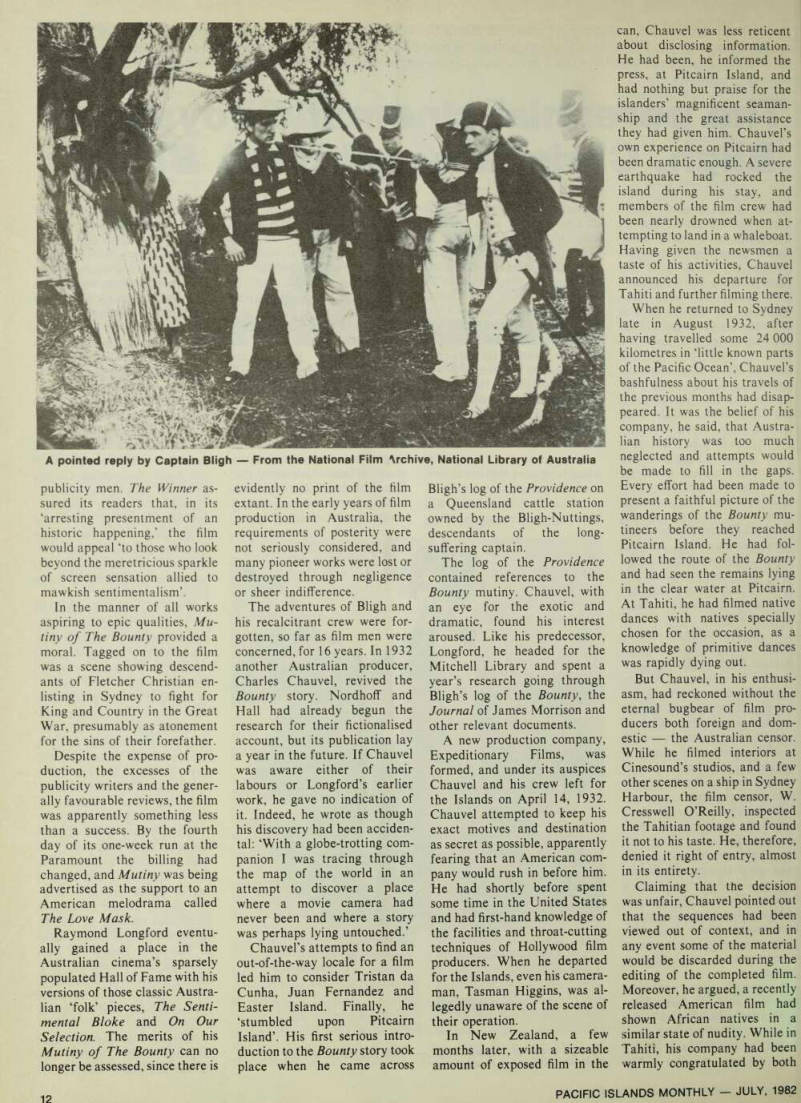
A pointed reply by Captain Bligh From the National Film Archive, National Library of Australia
the administration and the missionaries for attempting to reproduce the Tahitian dances faithfully, instead of making up travesties of them. The film, tentatively entitled The Mutiny of the Bounty, would, Chauvel claimed, have ‘a strong histori cal and ethnographical inter est’. It was not his intention to ‘introduce any suggestion of an improper element’.
The censor, apparently less concerned with the merits of history and ethnography than with the possible titillation of the cinema public by the sight of bouncing, brown breasts, was unimpressed by these claims.
To add to Chauvel’s dismay, he also ordered a cut in one of the episodes filmed in Sydney be fore allowing the film to be exported.
Chauvel carried his protest to the Commonwealth Appeal Board, which passed everything in the completed film save one sequence of native dancing.
Still dissatisfied with the de cision, Chauvel threatened to take the matter before the Minister for Customs and, if necessary, distribute the film for export only, thereby denying Australians the opportunity to witness the filling of the gaps in their history .. .
He had previously argued that the removal of the scenes of Tahitian dancing would ‘seriously affect the dramatic value of the story’. He now insisted that the sequence was ‘the pivot of the whole film’, and, if deleted, the film would
be spoilt. Finally, in March 1933, after some months of pleading, protesting and threat ening, the film was passed in a form acceptable to both Chauvel and the censor.
A press conference and luncheon to launch the film, which now bore the title In the Wake of the Bounty, was held and attended by various digni taries, including the imperial apologist and writer on Pacific affairs, C. Brunsdon Fletcher.
Fletcher spoke with his charac teristic irrelevance on the ‘es sential soundness and solidarity of the British Empire’ and concluded with the observation that the film’s producers ‘had done something decisive and valuable to make their country known elsewhere’.
Once again the publicity men trotted out their purplest prose.
The film, said its advertising, offered definite proof that ‘truth is stranger than fiction’, and audiences were invited to wit ness ‘the charm of the exotic when the sirens of the islands woo these sea-faring adven turers with the beauty of their native dances that will set your pulses tingling too. And then the dreadful aftermath of all their revelry!’
Viewed ioaay, In the Wake of the Bounty seems a curious mixture of documentary and melodrama, travelogue and tedious romance. Excellently photographed scenes of the islands are in complete contrast with static interiors, the unaffected behaviour of the Tahitians and Pitcairn Islanders with the generally stiff perform ances of the principals, and the adequate dialogue with an in congruous musical score.
Reviewers of the time were not slow to point out the incongruities in the work, while admitting that the film ‘indi cates what a fruitful field there is for film production in the Pacific’. Unfortunately, few Australian producers seem to have heeded the indication.
Most of the critics paid scant attention to what may ulti mately have been Chauvel’s most important contribution to the film world.
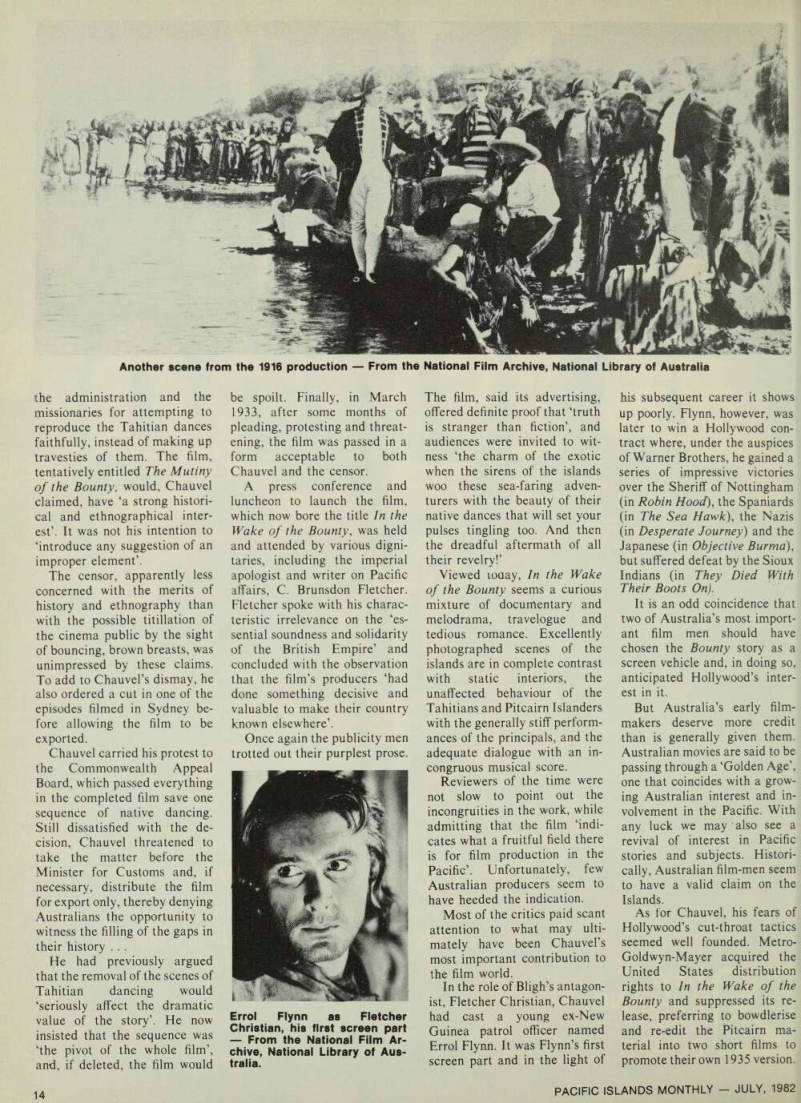
In the role of Bligh’s antagon ist, Fletcher Christian, Chauvel had cast a young ex-New Guinea patrol officer named Errol Flynn. It was Flynn’s first screen part and in the light of
his subsequent career it shows up poorly. Flynn, however, was later to win a Hollywood con tract where, under the auspices of Warner Brothers, he gained a series of impressive victories over the Sheriff of Nottingham (in Robin Hood), the Spaniards (in The Sea Hawk), the Nazis (in Desperate Journey) and the Japanese (in Objective Burma), but suffered defeat by the Sioux Indians (in They Died With Their Boots On).
It is an odd coincidence that two of Australia’s most import ant film men should have chosen the Bounty story as a screen vehicle and, in doing so, anticipated Hollywood’s inter est in it.
But Australia’s early film makers deserve more credit than is generally given them.
Australian movies are said to be passing through a ‘Golden Age’, one that coincides with a grow ing Australian interest and in volvement in the Pacific. With any luck we may also see a revival of interest in Pacific stories and subjects. Histori cally, Australian film-men seem to have a valid claim on the Islands.
As for Chauvel, his fears of Hollywood’s cut-throat tactics seemed well founded. Metro- Goldwyn-Mayer acquired the United States distribution rights to In the Wake of the Bounty and suppressed its re lease, preferring to bowdlerise and re-edit the Pitcairn ma terial into two short films to promote their own 1935 version.
Another scene from the 1916 production From the National Film Archive, National Library of Australia
Errol Flynn as Fletcher Christian, his first screen part - From the National Film Ar chive, National Library of Aus tralia.