Setting the record straight on
pp. 15-18 · Read in the full issue

Interview With Jonathon Fifi'i
Setting the record straight on ‘Marching Rule’ and a 1927 murder
JONATHON FIFI’I, veteran Solomon Islands patriot and politician from the Kwaio hill country of central Malaita, was recently in Canberra where he spoke with BARRY SHINEBERG about his role in Solomon Islands independence movements. Since 1962 Mr Fifi’i has worked with anthropologist, ROGER KEESING, now at the Australian National University, on studies of the customs of the Kwaio people. Mr Fifi’i has just finished compiling a Kwaio language dictionary, and is now writing his autobiography. His interview with Barry Shineberg, which appears below, sheds fascinating new light on the (misnamed) ‘Marching Rule’ movement, and the 1927 killing of British District Commissioner
W.R. Bell
Barry Shineberg: You were a small boy of six when the punitive expedition of 1927 in central Malatia avenged the death of District Officer W.R.
Belli and firmly established Pax Britannica in Solomon Islands.
You were educated in a Seventh-day Adventist mission in Malaita. You witnessed the flight of the British administra tor and teachers in the face of the Japanese invasion in 1942.
You came to know and work with the Americans during the war in the Pacific. You were a key figure in Maasina Rule, which set up its own adminis tration in Malaita in 1946 in opposition to the British admin istration. You were charged, together with eight other Maasina Rule leaders, with sedition and sentenced to six years imprisonment. After three years you were pardoned and served in a newly estab lished regional council of Malaita. In the ’7os, you served as a member of the Governing and Legislative Councils of the Solomon Islands, participated in constitutional discussions in London prior to independence in 1978, and served as a mem ber of parliament until 1980.
Since that time you have been working on questions of land, language and education.
Which of these events stand out for you as being the most important?
Jonathon Fifi’i: Most of the things you have mentioned were important for me. Perhaps I could pick out two things. First, the war which came to us in 1942. Before then, my people worked on plantations. There were rules that we couldn’t
enter the houses of white men.
We were treated as if we were nothing at all. People were whipped around their backs. If a white man killed a Melanesian we felt he would not go to court, but if a Melanesian killed a white man he’d be taken to court and he’d be sentenced perhaps to five years. We worked hard in plantations for only five or 10 shillings a month.
Then there was the war. I was at school then and all my teachers went back to Austra lia. A lot of Americans came, and Australians too. Most of the blacks who came were really better than us. They wore long pants, shirts, neck-ties and so on. Before that, we never wore long trousers, shirts, or anything like that. So we saw something different between ourselves and other black people.
We said what we were going to do then. We were treated like this because we were frightened of the white man. When a white man came we had to carry him from the ship to the shore and if he went back to the ship we’d have to carry him there. And we couldn’t take part in any white man’s discussion— sit down in a chair with him as we are doing now. So that’s what it was like and we just hated it.
With the American army and the marines it was different. We sat down with them, ate and talked with them, and then in 1944 and 1945 we came back home. 8.5.: Was there any difference between the black and white Americans?
J.F.: No, no difference be tween white and black. They had the same jobs, they sat
down together, they were equal. 8.5.: Your work for the Americans how was it organ ised?
J.F.: I worked in a gang of 24 people from Kwaio. The district constable recruited us and he called us in front of him to decide who was going to be in charge of the gang. Anything the Americans wanted they talked to me. I interpreted for them. The Americans didn’t know any pidgin at all. That’s why the constable chose me to be in charge of the gang
because I could speak English. 8.5.: Where did you work? In Honiara?
J.F.: No, in Lungga and Tenaru. 8.5.: What work did you do?
J.F.: We carried dead people to the cemetery. Second, we had to make small paths through the bush for the scouts.
We carried ammunition and equipment for the army. Some times we unloaded ships. 8.5.: The second point that you wish to comment on?
J.F.: Now I’d like to say one thing about Maasina Rule. The white man didn’t understand it
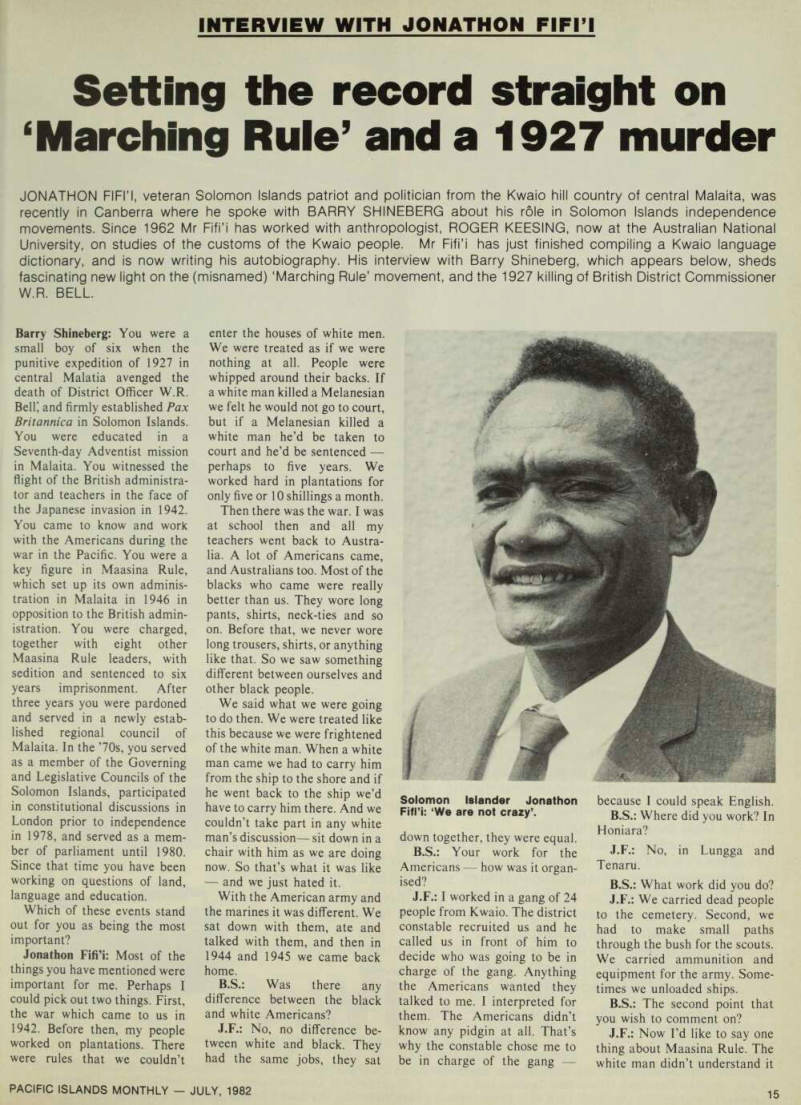
Solomon Islander Jonathon Fifl’i: ‘We are not crazy’.
and used different words to talk about it. I was very angry when I heard a district officer calling it Marching Rule. We say Maasina. It means brother hood. It’s a word from the Are- Are language (in southern Malaita).
We didn’t use the word Marching Rule. You know, it’s not useful for us to have this word Marching. It can’t be used for an idea to be introduced to others. What are we going to do by marching? Nothing at all.
We are not crazy. Our idea was that we should work together like brothers sit down and talk with the government like other black people from other countries. 8.5.: I have here a report from PIM, November 1947, quoting the Secretary of the Melanesian Mission, Major H.S. Robinson, after his return to Australia from a tour of the Solomon Islands. He said: ‘When we steamed ... along the northwest coast of Malaita, we were interested to see a line of 43 native houses (we counted them) all sited and completed with military precision a very neat and workmanlike job and all empty. They had been erected by followers of the Marching Rule cult in the belief that cargoes of goods were coming to them from across the sea, and these were to be the store-houses for the goods.’ Would you like to com ment on that report?
J.F.: Most of the people who talked and wrote about March ing Rule didn’t ask us what we were doing. It’s true we came down to the coast, cleared ground and built houses. We wanted to show the government what we could do. The houses were there for people to come down to and stay there, and to hold meetings in. We’d stay there for two or three days until our food was finished and the we’d go home. We’d arrange to come back eight days later to talk and discuss at other meet ings. 8.5.: The question of cargo?
J.F.: I get very angry when I hear about this cargo. The only cargo we know is the cargo that’s imported by ship from Australia. The Malaita was one of them. The cargo would be unloaded at Makabo, Gavuto and Tulagi. I was there and saw it being unloaded. People said
we were coming down to the coast to wait for cargo? What kind of cargo? This is something we can’t make any sense of. We are not a crazy, lunatic people.
You can’t expect the whole of Malaitian people to be lunatics.
We didn’t expect other people to feed us. This is not our way.
We have our own gardens. Our idea in Maasina Rule was to show that we could do some thing ourselves, that we can organise our own lives, that we are prepared to govern our selves. 8.5.: Maasina wasn’t the first organised movement of the Solomons Island people to ex press their dissatisfaction with the Administration, was it? I’m thinking of the Chair and Rule movement in Ysabel, in 1939, formed with the aid of the Anglican priest, the Rev R.P. Fallows. People came and joined in from other islands too.
What is meant by Rule?
J.F.: Rule is the meeting of people to discuss the work to be done. At the time, I was a cook
boy in Tulagi. I could see that Mr Fallows was treating people very well. He was talking about the same thing as them the government was treating the Melanesian people very badly.
His name was Mama Fellows.
They didn’t organise it well and it failed, and also it was based on the white man. All the government had to do was to send him out of the country. It wasn’t people from the country trying things. 8.5.: The Administration commented favourably on cer tain aspects of Maasina Rule.
But what caused them to bring charges against you?
J.F.: We didn’t pay taxes to the government. We didn’t know what the British were doing with the money we paid them. We collected the taxes and kept the money to use ourselves. We stopped people working in the plantations where the work was terrible.
The government said to let them go. We said we are the boss now. We must approve their going to work on plan tations. 8.5.: You were charged with sedition. Did that surprise you?
J.F.: Yes, we were very sur prised. We did not intend to overthrow the government. So we wondered why we were charged with sedition. We ex pected the government to sit down with us and ask us what we wanted.
8.5.: How many of you were charged?
J.F.: There were nine of us six of us are still alive. 8.5.: One for each of the nine regions of Malaita involved in Maasina Rule?
J.F.: We should have been 10.
But the other headman he was an ex-government headman became frightened when the government started to arrest us. 8.5.: What happened to Maasina Rule when you people were arrested?
J.F.: Other people took over our jobs. They worked in different ways. They stayed in the bush and never saw the government officers. 8.5.: What kind of legal defence did you have at your trial? Did you have good law yers?
J.F.: We said we wanted to hire a lawyer. They said no. We only had one lawyer appointed by the government. 8.5.: You were sentenced to six years imprisonment, but only served three years. What was it like in gaol? Why were you freed?
J.F.: We were in Honiara first, then we went to Gizo in western Solomon Islands. We dug drains, built houses. Mr Gregory Smith came from Eng land to see us. He had been a Resident Commissioner in Nigeria and Kenya and asked us what we wanted. We said we wanted self-government and in-
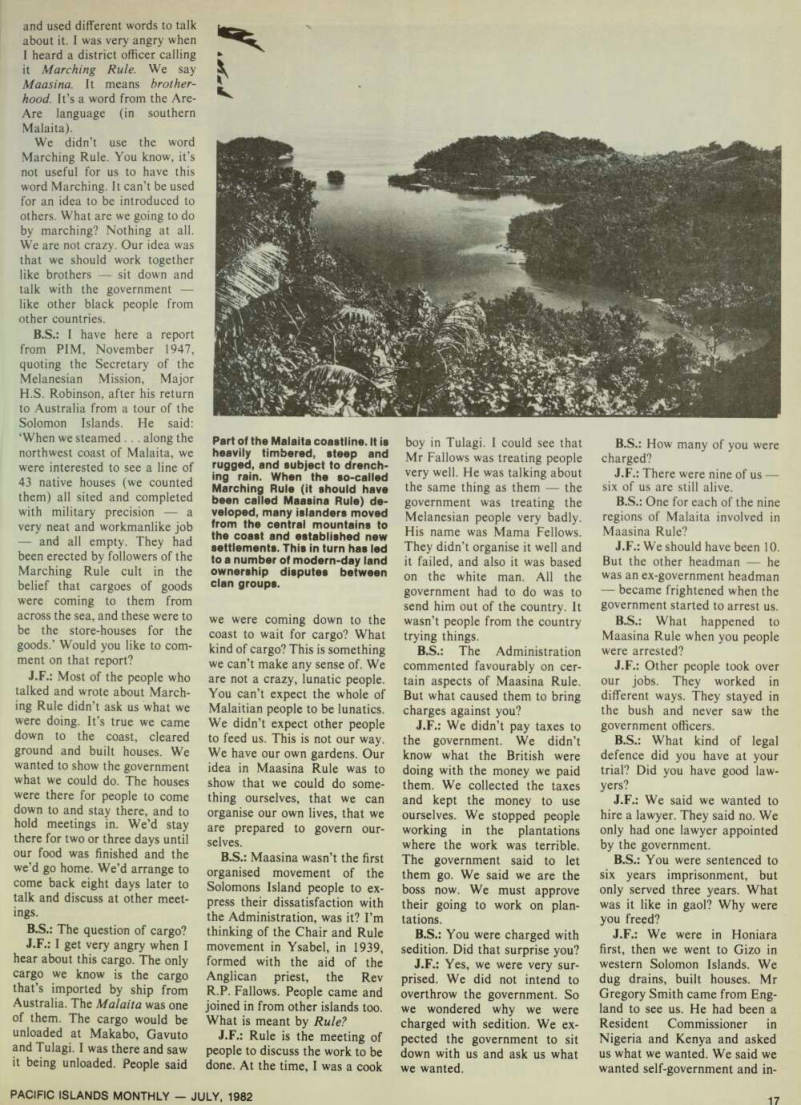
Part of the Malaita coastline. It is heavily timbered, steep and rugged, and subject to drench ing rain. When the so-called Marching Rule (it should have been called Maasina Rule) de veloped, many islanders moved from the central mountains to the coast and established new settlements. This in turn has led to a number of modern-day land
ownership disputes between
clan groups.
dependence. We were released from prison in 1950 after our talks with Mr Gregory Smith. 8.5.: Were you completely free freed unconditionally?
J.F.: They got us some papers to sign. We had to carry a paper for one year and promise not to break any laws, and we had to report what we were going to say to the people. 8.5.: What did you gain as the result of Maasina Rule?
J.F.: We formed a regional council for Malaita. Other parts of the Solomon Islands had theirs too. We were concerned with agriculture; we set up customs courts, and so on. I was elected to be a council member.
I was a judge in the customs court for four years. People asked me to write about their customs and about their land and to work out genealogies. I didn’t know much about this.
Anyway, I wrote about it, and helped people talk about cus toms. I’m still doing that. 8.5.: I have read that you were a member of the Solomon Islands delegation to London to discuss constitutional matters with the British before obtain ing your independence in 1978.
What did you think of London?
J.F.: I liked London because they showed respect for old places, as we do at home. I saw some very old houses and fences. I was very interested to look at old weapons because at home we have our old weapons too. What was very surprising was to meet beggars in the streets asking you for three, four or five pence. I was sur
prised.
8.5.: Why?
J.F.: This didn’t happen at home. It’s impossible for me to ask for money from other people. 8.5.: I would like to ask you about the killing of District Commissioner Bell in 1927 on the coast of Kwaio. After the killing there was a terrible punitive expedition there to avenge his death which is de scribed in the recent book by R.M. Keesing and P. Corris, Lightning Meets the West Wind: the Malaita Massacre, published by Oxford University Press. I have the impression that after this, all movements against the British adminis tration tended to be peaceful.
Would you comment on the killings?
J.F.: The reason why they
killed Mr Bell. Mr Bell was not very fair and not very close to the people. He roused the people. He used bad words ‘bastard’ for example when he talked to the people and when he held court. For example, if people were too shy and talked slowly, he would say: ‘You bastard, you must talk.’
He let his headman strike and whip people when they were out on patrol. 8.5.: You must have been very young then a boy of six or so. You would have heard about the matter from others, wouldn’t you? Bell and his party were killed while collecting taxes, weren’t they?
J.F.: Yes. 8.5.: 1 believe that Bell had
opposed the imposition of taxes on the people, that he had succeeded in postponing the tax for two years from 1921 to 1923 in Malaita. And then he managed to have the tax re duced from £1 to 5/-. In other parts of the Solomons people were paying £l. Taxes were said to be one of the main complaints against the British during the ’2os and ’3os be cause the people felt that the administration was not doing anything for the people in return for the taxes they col lected. Do you think that opposition to the taxes played any part in the killings?
J.F.; Mr Bell trying to stop the tax? I didn’t hear that. But I knew many people who had been in court because of the tax.
Basil (Basiana) only had four shillings. He came to Mr Bell and said: ‘Mr Bell, will you accept four shillings.’ Mr Bell said: ‘You bastard. I cannot allow you to only pay four shillings.’ Basil said; ‘How can I get another shilling. There’s no one to give it to me.' But Mr Bell said: ‘You have to go back home now to-night and find another shilling. Then you come back.’ Basil went back home and got here in the evening. He didn’t know where he was going to get the shilling. So he took a shell, inherited from an ances tor from five generations back, and he looked at the shell and said; ‘I have to break the shell now.’ And he broke it and tried to grind one piece so that it would be equal with a shilling.
He ground it all the night. He took it down to Mr Bell and said; ‘Mr Bell, I can find one more shilling. I have been working on it for one whole night so it can be added to the four shillings to make five. You like the four shillings because you accept the head of your king, but this is from my ancestors inherited from four or five generations. Now accept it.’
Mr Bell laughed and swore at him and said: ‘Basil, you bas tard. You must not do this next time. OK, I’ll accept it, but don’t do it next time.”
So, from that the problems arose the killings because Basil was a very powerful fight ing man. 8.5.: He was one of the men involved in killing Bell?
J.F.: He was the organiser of the killings.
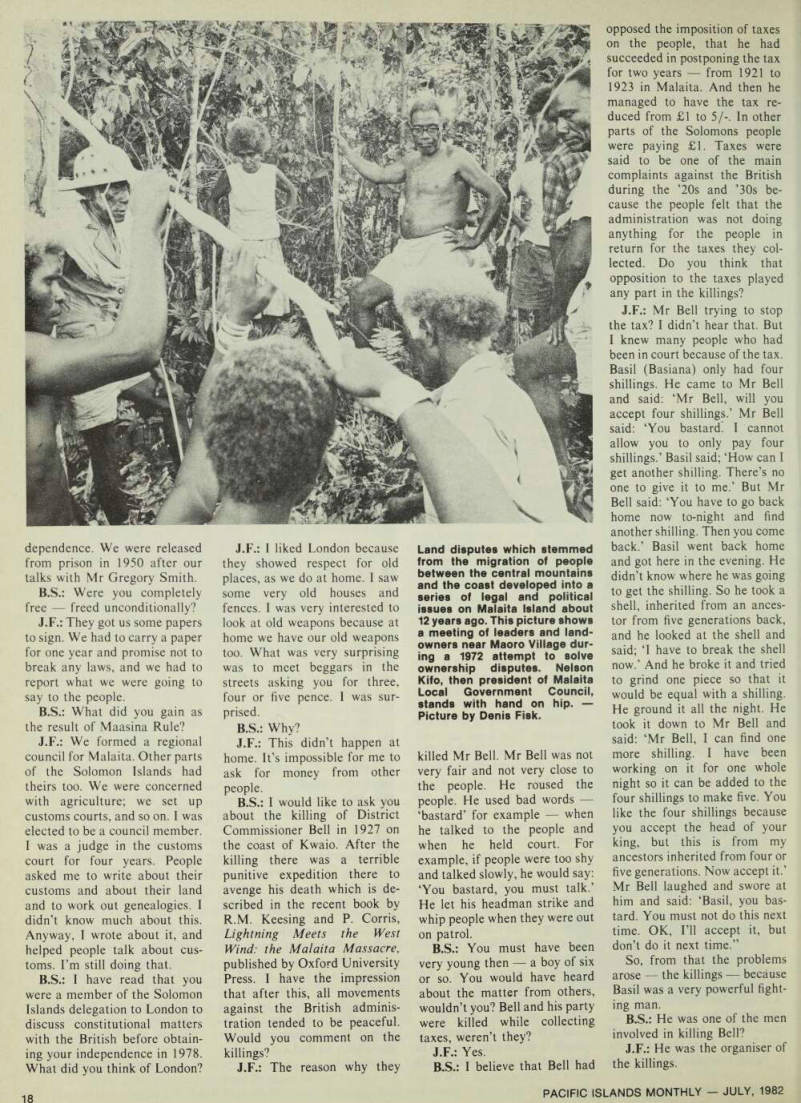
Land disputes which stemmed from the migration of people between the central mountains and the coast developed into a series of legal and political issues on Malaita Island about 12 years ago. This picture shows a meeting of leaders and land owners near Maoro Village dur ing a 1972 attempt to solve
ownership disputes. Nelson
Kifo, then president of Malaita Local Government Council, stands with hand on hip.
Picture by Denis Fisk.