Letters
pp. 7-10 · Read in the full issue

The 30 lies of 30 Jours
PIM (Oct ’81 p5) reported the imminent launching of 30 Jours, a French/English lang uage magazine directed at the Pacific. After some delays, the magazine finally made its ap pearance in February 1982, and has appeared regularly since.
It should be noted first of all that 30 Jours has signally failed to deliver on its promise of bilingualism. The magazine is to all intents and purposes French. The only ‘bilingual’ thing about it is that its major articles are accompanied by small panels carrying short summaries of their content in ‘English’ of unfailing quaintness.
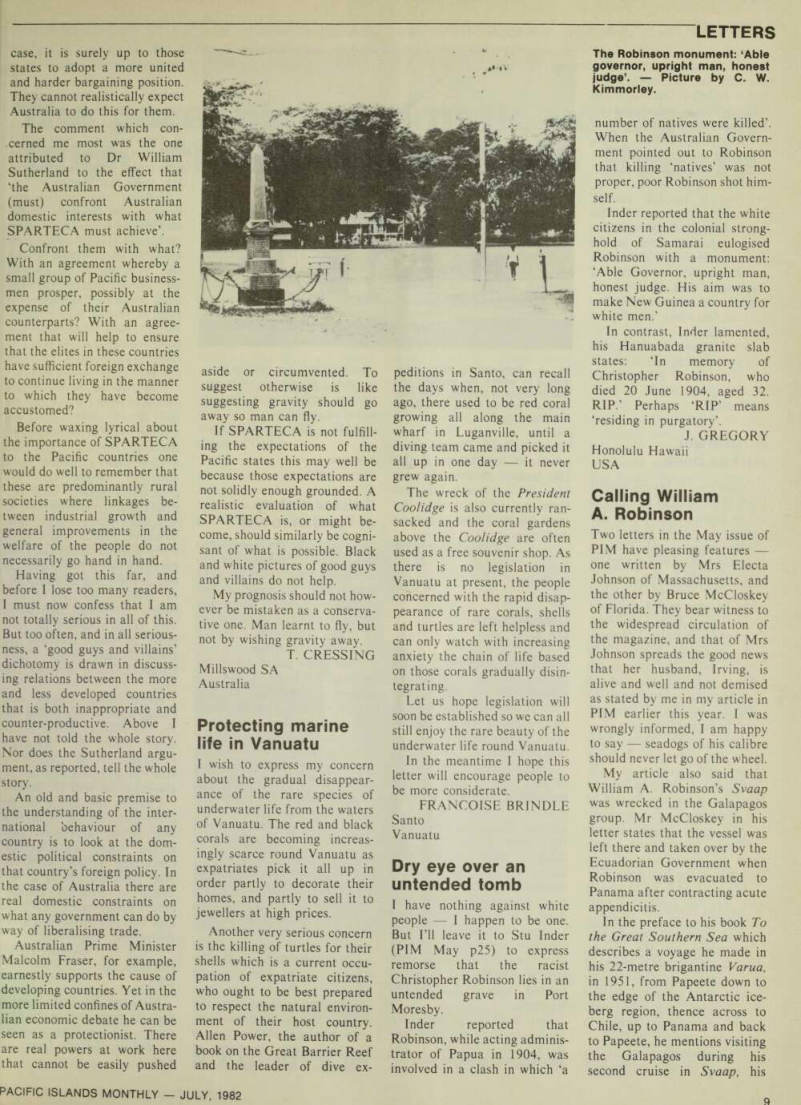
Rather garish in appearance, with colour splashed through out and relatively little advertis ing, 30 Jours is evidently not to be taken too seriously. Its April :over picture and story reflected its editors’ intense ;xcitement at certain genetic nutations being observed in •ome children in the Laulasi islands in the Solomons: they ire being born with fair hair . . .
But its lightweight editorial ipproach is perhaps still better lemonstrated in an article in its Vlay issue attacking PIM.
Seizing on the pretext of the criticism directed at PIM by he (now unseated) council of government of French (PIM Jun p7) — ‘a lard blow for PIM just when t’s looking for its second wind’, iccording to 30 Jours — the irticle launches into a descrip ion of PIM’s ‘woes’ that is an bsolute model of irresponsible, catty journalism.
A sample: ‘Starting off as [uite a small magazine, the
publishers of PIM, the Herald & Weekly Times Ltd, have over the years built it up into an authoritative regional publica tion.’
False. The H&WT acquired Pacific Publications, publishers of PIM, only in 1974, when the magazine had been in existence for 44 years.
Another: ‘The H&WT lost more than $l6O 000 in 1981.’
Not only false, but a real howler. The H&WT, the largest media group in Australia, of which Pacific Publications is a small subsidiary, regularly ap pears in the 30s bracket in lists of Australia’s 100 largest com panies. Its profits last year were SA4O million before-tax, and $26 million after-tax. A painful ‘loss’!
Yet another: ‘H&WT closed down its Sydney subsidiary, Pacific Publications ...’
False. Pacific Publications remains in existence in Sydney.
And again; ‘Malcolm Salmon, PlM’s editor . ..’
False again. Angus Smales is editor of the magazine, of which Salmon is associate editor. 30 Jours does not fail to vent a touch of McCarthyite spleen by recalling in an aside that Salmon once wrote for news papers on the Left of Australian politics. Many people who know
a little about recent Australian political history will recall that Salmon, as a speaker and writer, was among the most influential critics of Australia’s involvement in the Vietnam war, and that his translation of a French history of Vietnam was long a prescribed text in Australian universities. Those who, like the present writer, observed Salmon’s work at this time, regarded it as a thoroughly honourable episode in the life of a thoroughly honourable man. But about all this 30 Jours neither knows or cares. ..
But there’s more: ‘Salmon is practically the only survivor of the original team that built up PlM’s reputation.’
False again. Though getting on, Salmon is not yet as old as Methuselah: he joined PIM only m 1976, 46 years after the founding of the magazine.
After this grand display of crazy non-marksmanship, the writer turns the scattergun on PlM’s Tahiti correspondent Bengt Danielsson. (By now fam iliar with the general level of 30 Jours I could not for a moment be persuaded that it was chiv-
airy, and not a crusty brand of old-fashioned French sexism, that led the writer to ignore Bengt Danielsson’s fellow correspondent, his wife Marie- Therese, in the tirade.) Bengt Danielsson duly abused, the French Polynesian criticism of PIM is then joyfully reproduced in extenso.
Those who have not by now become bored with the whole affair may consult PIM June for the criticism and the Danielssons’ reply to it, which is fully supported by the man at the eye of the storm, the archaeologist Professor Sinoto.
It is perhaps natural that the editors of 30 Jours should display a morbid interest in the ‘woes’ real or imagined of various publications. After all, they themselves are the traumatised survivors of the wreck of the ultra-conservative Noumea daily France Australe which foundered early in 1980 when its backers in the nickel company SEN wearied of pick ing up the tab for its recurring and mounting losses.
Perhaps it’s time that the various financial backers of 30 Jours (said to include the French Government itself) had a close look at how their money is being spent.
P. Warbeck
Sydney NSW Australia
Hard talking
On Sparteca
It was galling to read the criticisms of Australia and its behaviour in the item Thrust and parry in the SPARTECA debate’ (PIM Apr p 49). Austra lia was cast as the villain of the piece, the hapless South Pacific forum countries again falling prey to its neo-colonialist de signs.
SPARTECA is not some thing that was unilaterally im posed on the Pacific states. It is surely not an agreement that had outlived its usefulness, hav ing been in operation for little more than a year. If SPAR TECA does not achieve what the Pacific states had hoped for, why did they become a party to it in the first place?
The observation that not all the Forum countries signed the agreement immediately sug gests there was some original dissatisfaction. If that was the
Mum looks happy, the child looks sick and the magazine certainly is ...
case, it is surely up to those states to adopt a more united and harder bargaining position.
They cannot realistically expect Australia to do this for them.
The comment which con cerned me most was the one attributed to Dr William Sutherland to the effect that ‘the Australian Government (must) confront Australian domestic interests with what SPARTECA must achieve’.
Confront them with what?
With an agreement whereby a small group of Pacific business men prosper, possibly at the expense of their Australian counterparts? With an agree ment that will help to ensure that the elites in these countries have sufficient foreign exchange to continue living in the manner to which they have become accustomed?
Before waxing lyrical about the importance of SPARTECA to the Pacific countries one would do well to remember that these are predominantly rural societies where linkages be tween industrial growth and general improvements in the welfare of the people do not necessarily go hand in hand.
Having got this far, and before I lose too many readers, I must now confess that I am not totally serious in all of this.
But too often, and in all serious ness, a ‘good guys and villains’ dichotomy is drawn in discuss ing relations between the more and less developed countries that is both inappropriate and counter-productive. Above I have not told the whole story.
Nor does the Sutherland argu ment, as reported, tell the whole story.
An old and basic premise to the understanding of the inter national behaviour of any country is to look at the dom estic political constraints on that country’s foreign policy. In the case of Australia there are real domestic constraints on what any government can do by way of liberalising trade.
Australian Prime Minister Malcolm Fraser, for example, earnestly supports the cause of developing countries. Yet in the more limited confines of Austra lian economic debate he can be seen as a protectionist. There are real powers at work here that cannot be easily pushed
aside or circumvented. To suggest otherwise is like suggesting gravity should go away so man can fly.
If SPARTECA is not fulfill ing the expectations of the Pacific states this may well be because those expectations are not solidly enough grounded. A realistic evaluation of what SPARTECA is, or might be come, should similarly be cogni sant of what is possible. Black and white pictures of good guys and villains do not help.
My prognosis should not how ever be mistaken as a conserva tive one. Man learnt to fly, but not by wishing gravity away.
T. Cressing
Millswood SA Australia
Protecting marine
life in Vanuatu
I wish to express my concern about the gradual disappear ance of the rare species of underwater life from the waters of Vanuatu. The red and black corals are becoming increas ingly scarce round Vanuatu as expatriates pick it all up in order partly to decorate their homes, and partly to sell it to jewellers at high prices.
Another very serious concern is the killing of turtles for their shells which is a current occu pation of expatriate citizens, who ought to be best prepared to respect the natural environ ment of their host country.
Allen Power, the author of a book on the Great Barrier Reef and the leader of dive ex
peditions in Santo, can recall the days when, not very long ago, there used to be red coral growing all along the main wharf in Luganville, until a diving team came and picked it all up in one day it never grew again.
The wreck of the President Coolidge is also currently ran sacked and the coral gardens above the Coolidge are often used as a free souvenir shop. As there is no legislation in Vanuatu at present, the people concerned with the rapid disap pearance of rare corals, shells and turtles are left helpless and can only watch with increasing anxiety the chain of life based on those corals gradually disin tegrating.
Let us hope legislation will soon be established so we can all still enjoy the rare beauty of the underwater life round Vanuatu.
In the meantime I hope this letter will encourage people to be more considerate.
Francoise Brindle
Santo Vanuatu
Dry eye over an
untended tomb
I have nothing against white people I happen to be one.
But I’ll leave it to Stu Inder (PIM May p 25) to express remorse that the racist Christopher Robinson lies in an untended grave in Port
Moresby.
Inder reported that Robinson, while acting adminis trator of Papua in 1904, was involved in a clash in which ‘a
number of natives were killed’.
When the Australian Govern ment pointed out to Robinson that killing ‘natives’ was not proper, poor Robinson shot him self.
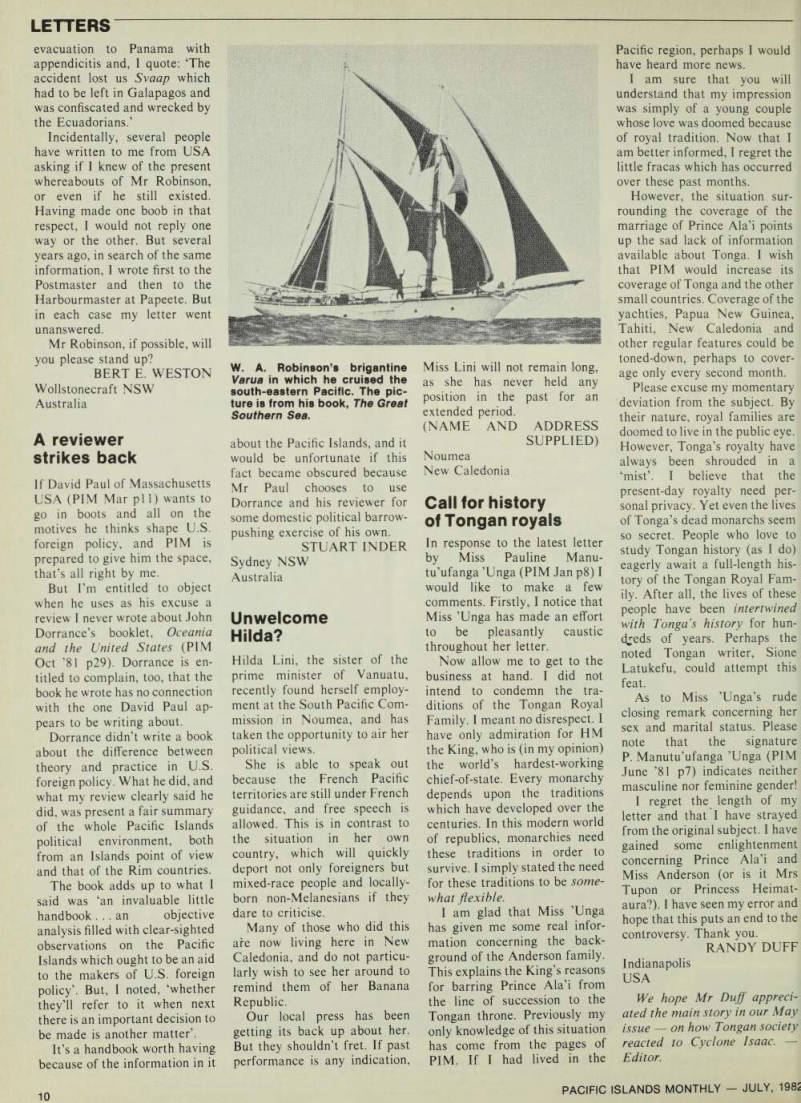
Inder reported that the white citizens in the colonial strong hold of Samarai eulogised Robinson with a monument: ‘Able Governor, upright man, honest judge. His aim was to make New Guinea a country for white men.’
In contrast, Inder lamented, his Hanuabada granite slab states: ‘ln memory of Christopher Robinson, who died 20 June 1904, aged 32.
RIP.’ Perhaps ‘RIP’ means ‘residing in purgatory’.
J. Gregory
Honolulu Hawaii
Usa
Calling William
A. Robinson
Two letters in the May issue of PIM have pleasing features one written by Mrs Electa Johnson of Massachusetts, and the other by Bruce McCloskey of Florida. They bear witness to the widespread circulation of the magazine, and that of Mrs Johnson spreads the good news that her husband, Irving, is alive and well and not demised as stated by me in my article in PIM earlier this year. I was wrongly informed, I am happy to say seadogs of his calibre should never let go of the wheel.
My article also said that William A. Robinson’s Svaap was wrecked in the Galapagos group. Mr McCloskey in his letter states that the vessel was left there and taken over by the Ecuadorian Government when Robinson was evacuated to Panama after contracting acute appendicitis.
In the preface to his book To the Great Southern Sea which describes a voyage he made in his 22-metre brigantine Varua, in 1951, from Papeete down to the edge of the Antarctic ice berg region, thence across to Chile, up to Panama and back to Papeete, he mentions visiting the Galapagos during his second cruise in Svaap, his
The Robinson monument: ‘Able governor, upright man, honest judge’. Picture by C. W.
Kimmorley.
evacuation to Panama with appendicitis and, I quote: The accident lost us Svaap which had to be left in Galapagos and was confiscated and wrecked by the Ecuadorians.’
Incidentally, several people have written to me from USA asking if I knew of the present whereabouts of Mr Robinson, or even if he still existed.
Having made one boob in that respect, I would not reply one way or the other. But several years ago, in search of the same information, I wrote first to the Postmaster and then to the Harbourmaster at Papeete. But in each case my letter went unanswered.
Mr Robinson, if possible, will you please stand up?
Bert E. Weston
Wollstonecraft NSW Australia
A reviewer
strikes back
If David Paul of Massachusetts USA (PIM Mar p 11) wants to go in boots and all on the motives he thinks shape U.S. foreign policy, and PIM is prepared to give him the space, that’s all right by me.
But I’m entitled to object when he uses as his excuse a review I never wrote about John Dorrance’s booklet, Oceania and the United States (PIM Oct ’Bl p 29). Dorrance is en titled to complain, too, that the book he wrote has no connection with the one David Paul ap pears to be writing about.
Dorrance didn’t write a book about the difference between theory and practice in U.S. foreign policy. What he did, and what my review clearly said he did, was present a fair summary of the whole Pacific Islands political environment, both from an Islands point of view and that of the Rim countries.
The book adds up to what I said was ‘an invaluable little handbook ... an objective analysis filled with clear-sighted observations on the Pacific Islands which ought to be an aid to the makers of U.S. foreign policy’. But, 1 noted, ‘whether they’ll refer to it when next there is an important decision to be made is another matter’.
It’s a handbook worth having because of the information in it
about the Pacific Islands, and it would be unfortunate if this fact became obscured because Mr Paul chooses to use Dorrance and his reviewer for some domestic political barrow pushing exercise of his own.
Stuart Inder
Sydney NSW Australia
Unwelcome
Hilda?
Hilda Lini, the sister of the prime minister of Vanuatu, recently found herself employ ment at the South Pacific Com mission in Noumea, and has taken the opportunity to air her political views.
She is able to speak out because the French Pacific territories are still under French guidance, and free speech is allowed. This is in contrast to the situation in her own country, which will quickly deport not only foreigners but mixed-race people and locally born non-Melanesians if they dare to criticise.
Many of those who did this are now living here in New Caledonia, and do not particu larly wish to see her around to remind them of her Banana Republic.
Our local press has been getting its back up about her.
But they shouldn’t fret. If past performance is any indication,
Miss Lini will not remain long, as she has never held any position in the past for an extended period.
(Name And Address
Supplied)
Noumea New Caledonia
Call for history
of Tongan royals
In response to the latest letter by Miss Pauline Manu tu’ufanga ’Unga (PIM Jan p 8) I would like to make a few comments. Firstly, I notice that Miss ’Unga has made an effort to be pleasantly caustic throughout her letter.
Now allow me to get to the business at hand. I did not intend to condemn the tra ditions of the Tongan Royal Family. I meant no disrespect. I have only admiration for HM the King, who is (in my opinion) the world’s hardest-working chief-of-state. Every monarchy depends upon the traditions which have developed over the centuries. In this modern world of republics, monarchies need these traditions in order to survive. I simply stated the need for these traditions to be some
what flexible.
I am glad that Miss ’Unga has given me some real infor mation concerning the back ground of the Anderson family.
This explains the King’s reasons for barring Prince Ala’i from the line of succession to the Tongan throne. Previously my only knowledge of this situation has come from the pages of PIM. If I had lived in the
Pacific region, perhaps I would have heard more news.
I am sure that you will understand that my impression was simply of a young couple whose love was doomed because of royal tradition. Now that I am better informed, I regret the little fracas which has occurred over these past months.
However, the situation sur rounding the coverage of the marriage of Prince Ala’i points up the sad lack of information available about Tonga. I wish that PIM would increase its coverage of Tonga and the other small countries. Coverage of the yachties, Papua New Guinea, Tahiti, New Caledonia and other regular features could be toned-down, perhaps to cover age only every second month.
Please excuse my momentary deviation from the subject. By their nature, royal families are doomed to live in the public eye.
However, Tonga’s royalty have always been shrouded in a ‘mist’. I believe that the present-day royalty need per sonal privacy. Yet even the lives of Tonga’s dead monarchs seem so secret. People who love to study Tongan history (as I do) eagerly await a full-length his tory of the Tongan Royal Fam ily. After all, the lives of these people have been intertwined with Tonga’s history for hun dreds of years. Perhaps the noted Tongan writer, Sione Latukefu, could attempt this feat.
As to Miss ’Unga’s rude closing remark concerning her sex and marital status. Please note that the signature P. Manutu’ufanga ’Unga (PIM June ’Bl p 7) indicates neither masculine nor feminine gender!
I regret the length of my letter and that I have strayed from the original subject. I have gained some enlightenment concerning Prince Ala’i and Miss Anderson (or is it Mrs Tupon or Princess Heimat aura?). I have seen my error and hope that this puts an end to the controversy. Thank you.
Randy Duff
Indianapolis
Usa
We hope Mr Duff appreci ated the main story in our May issue on how Tongan society reacted to Cyclone Isaac.
Editor.
W. A. Robinson’s brigantine Varua in which he cruised the south-eastern Pacific. The pic ture is from his book, The Great Southern Sea.