The high cost of vehicle imports:
pp. 49-53 · Read in the full issue
Trade
Winds
The high cost of vehicle imports: Is part of the answer spelt FAF?
With the cry ‘Do the countries of the South Pacific want to make the rich countries richer still?’, DANIEL TARDIEU points to the heavy financial burden of vehicle imports to the Island countries, and advances what he sees as part of the solution: he says that the French Government, as part of its aid programme, should sponsor the manufacture in the Islands of a remarkable Citrden product, the vehicle known as FAF.
Standing at their own particular crossroads of history, most South Pacific countries have chosen a different path from that marked out for them by their former colonisers.
But certain essential needs remain, having permeated the ways of the local societies during the colonial period. One such is the use of motor vehicles for the transport of passengers and goods. In many of these societies the motor vehicle has become, as elsewhere in the world, a kind of ‘second home’ for many people.
The family dog is at home in the family car. He seems un aware of any difference between the house to which he is at tached and the car in which he travels; he deals with strangers who approach the car in exactly the same manner as if they were approaching the house.
No propaganda in favour of public transport, however ag gressive, will overcome this fact: the automobile is a four wheeled ‘home’ in which a couple’s intimacy is protected, and family life may continue undisturbed.
The trap in all this for the Island countries is that in their import statistics the sums ap pearing under the heading ‘im port of vehicles’ are assuming catastrophic proportions. Partly as a result of this, most of the small nations in the Pacific region are suffering chronic balance of payments deficits.
Imported cars are becoming dearer and dearer. Manufac tured in industrialised countries, they are designed for and sold to well-heeled people.
In the process of design and manufacture, the level of con sumer earnings is taken care fully into account.
None of this has the slightest relationship to the financial situation of most Pacific Islanders. An American,
European, or Japanese buys a car at a price measured in terms of his salary over a number of months. For most Islanders, the same price must be calculated in terms of years of work.
This situation is creating a sense of frustration, especially among young people. Buying a motor vehicle, symbol of one’s personal emancipation, be comes a goal only to be achieved by going to live else where in Australia or New Zealand perhaps. How resent ful must such young folk feel when they see the smart businessman, or the prominent politician, gliding through the streets of the towns and villages of the region in their luxurious cars!
It is with these thoughts in mind that I wish to introduce to PIM readers the vehicle known as the FAF (from the French
words Facile a faire, or ‘Easy to make’). It seems to me that the FAF really does have something to offer the Pacific Island countries in their grappling with the phenomenon of the auto mobile.
The FAF is a development of a vehicle produced by French manufacturer Citroen. More than six million of them have been built since the engineers at Citroen first designed and per fected the model.
At about the end of 1935 Citroen’s research division near Paris was in a state of ferment.
The most recent design specifications for a new model received from the company’s director-general Pierre Boulanger had bowled the en gineers over. The specifications said in part: ‘Design a vehicle capable of carrying two farmworkers and 50 kilograms
of potatoes 60 kilometres in an hour for a fuel consumption of three litres . . . We are talking about something like an um brella on four wheels . .
The specifications also said that the vehicle must be capable of negotiating the worst possible roads, and of being driven by the rawest beginner.
By 1937 a prototype had been produced. But it failed to de liver the necessary results.
Two years later, 50 modified vehicles came off the Citroen production line. But war came and they were destroyed all except one.
With the end of the war, Citroen engineers were back on the job, polishing up the pro ject; in 1948 the first Citroen ‘2 cv’ (2 hp) left the factory.
High quality mechanical work, robustness, no-frills these were the outstanding fea tures of the Citroen ‘2 cv’.
The new vehicle was soon chalking up remarkable feats: the high altitude record for a motor vehicle (5420 metres up Mount Chacaltaya in Chile); a round-the-world tour of 140 000 kilometres with two youngsters in charge. During the latter journey, the sump cracked on a desert stretch, oil was lost, and the ‘2 cv’ travelled 300 kilo metres with the broken sump stuffed with bananas.
With such technical achieve ments under their belt, the Citroen engineers decided to design a ‘2 cv’ Facile a faire, which could be built in countries without an engineer
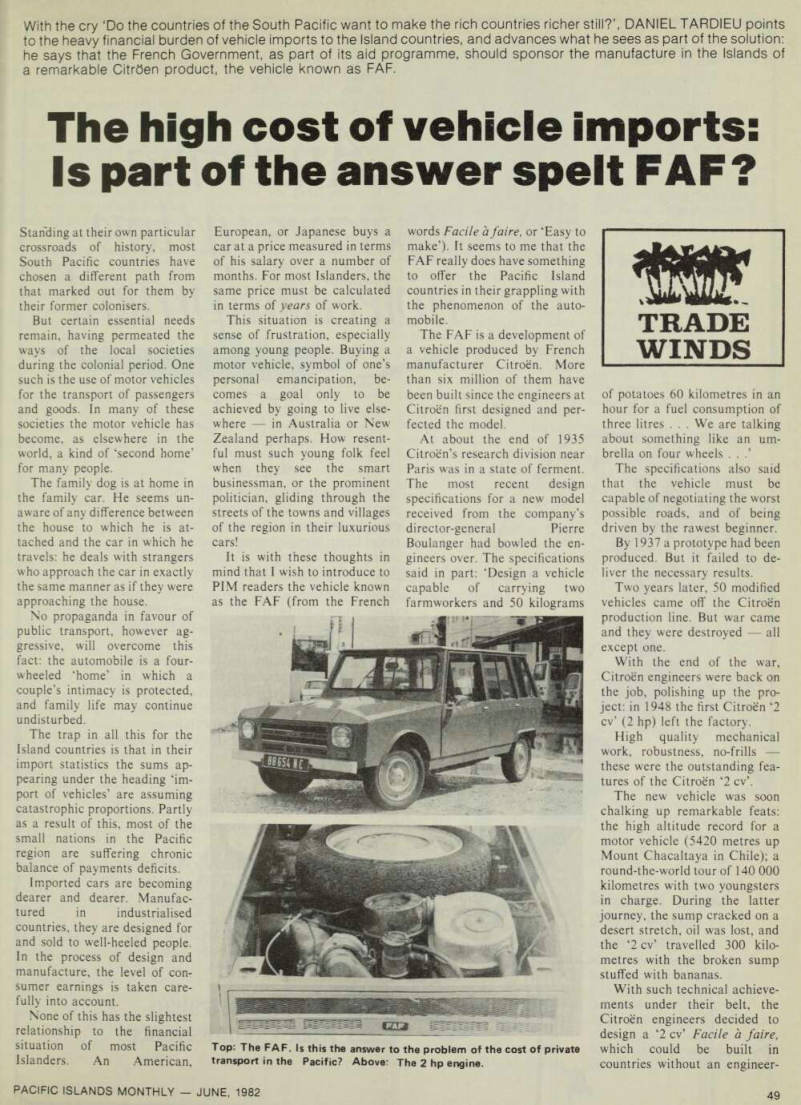
Top: The FAF. Is this the answer to the problem of the cost of private transport in the Pacific? Above: The 2 hp engine.
ing industry capable of building or even assembling conven tional-type automobiles.
Forty countries expressed in terest in the project, and today the FAF is built in these countries without there being any need to set up specialised enterprises for the purpose.
The FAF could be built in the Pacific Islands; a few advanced tools would be required, with a small number of mechanical specialists training groups of local people on the spot to build a vehicle of low cost, low fuel consumption, sturdy, easy for practically anyone to maintain and repair, with cheap and readily available spare parts.
If one Pacific Island country set up such a project it would soon find it profitable, with added value arising from such components as could be manu factured on the spot tyres, for example, or electrical parts.
Body panels could be imported from Australia, with chassis, engine, and suspension arriving in assembled form from France.
The suspension of the FAF is remarkable, offering unrivalled comfort. It is based on exactly the same principles as the suspension fitted to luxury Cit roen models such as the Pallas CX, and others.
The FAF can go anywhere coconut plantations would hold no terrors for it. It comes in front-wheel-drive models, and also four-wheel-drive, and the former can be readily converted to the latter.
It is available in small-lorry form, as an ambulance, or as a military liaison vehicle (several armies are using them), and, of course, as a passenger touring car. The latter model is much appreciated in Tahiti.
Mechanical specifications of the FAF are: Flat 2 engine, 602 cc, air-cooled. Top speed, 100 km/h (can be sustained over long distances). Fuel con sumption: 6 L/100 km. Storage capacity of lorry version, 2.27 3 (80.4 cu. ft.) In the context of the much discussed North-South dia logue, France could well finance the creation of a FAF manufacturing enterprise in the South Pacific. Such an under taking would provide consider able employment, and could greatly lessen the heavy
financial burden of motor ve hicle imports borne at present by the countries of the region.
The different FAF models could meet many private and commercial needs, the four wheel-drive version providing light-transport access to other wise inaccessible places.
Those who have respons ibility for the development of their countries must admit that it is time something was done to put an end to the financial haemorrhage caused by the automobile lobby to the benefit of rich countries, which show scant concern for the genuine needs of the Islanders.
Ina Of Usa
sets up in Vila
INA, the Insurance Company of North America group, has opened its own office in Port- Vila. The company has run operations associated with the New Hebrides/Vanuatu since 1973, writing business through brokers, and covering all classes of insurance, both onshore and offshore.
Oz OKs Nauru
property deal
The Australian Government has given approval in terms of its foreign investment policy to a proposal for the Nauru Phos phate Royalties Trust (NPRT) to acquire a property at 86-88 Collins Street, Melbourne, for future redevelopment and re tention as a long-term invest ment. Approval was given on the basis of the investment being structured so as to ensure that it will be possible for Australia to impose and collect all tax and charges at normal rates. NPRT already owns Nauru House,which is adjacent.
Japan-Solomons
accord on ships
Solomon Islands Government has signed a contract with the Overseas Shipbuilding Co operation Centre of Japan for two new ships of 105 tonnes each for inter-island operations.
The Japanese Government is footing the bill as it did for several other ships, including two inter-island and three fish ing vessels already in service in the Solomons.
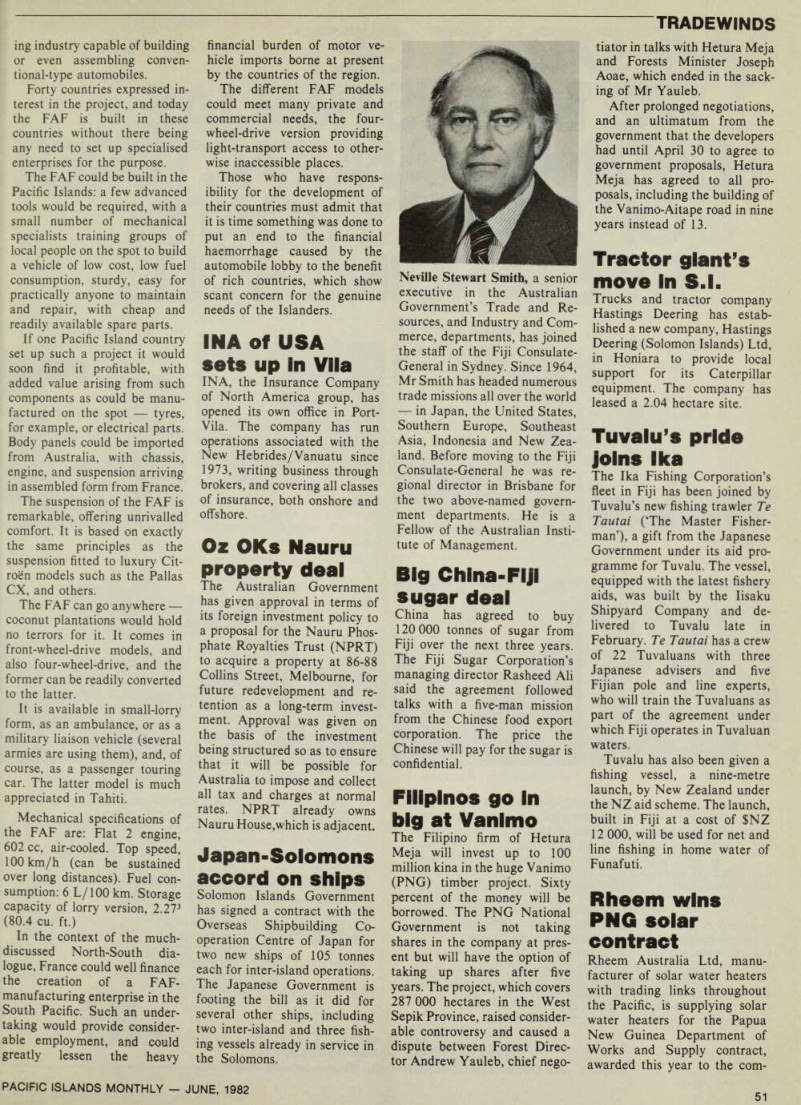
Neville Stewart Smith, a senior executive in the Australian Government’s Trade and Re sources, and Industry and Com merce, departments, has joined the staff of the Fiji Consulate- General in Sydney. Since 1964, Mr Smith has headed numerous trade missions all over the world in Japan, the United States, Southern Europe, Southeast Asia, Indonesia and New Zea land. Before moving to the Fiji Consulate-General he was re gional director in Brisbane for the two above-named govern ment departments. He is a Fellow of the Australian Insti tute of Management.
Big China-Fiji
sugar deal
China has agreed to buy 120 000 tonnes of sugar from Fiji over the next three years.
The Fiji Sugar Corporation’s managing director Rasheed Ali said the agreement followed talks with a five-man mission from the Chinese food export corporation. The price the Chinese will pay for the sugar is confidential.
Filipinos go in
big at Vanimo
The Filipino firm of Hetura Meja will invest up to 100 million kina in the huge Vanimo (PNG) timber project. Sixty percent of the money will be borrowed. The PNG National Government is not taking shares in the company at pres ent but will have the option of taking up shares after five years. The project, which covers 287 000 hectares in the West Sepik Province, raised consider able controversy and caused a dispute between Forest Direc tor Andrew Yauleb, chief nego
tiator in talks with Hetura Meja and Forests Minister Joseph Aoae, which ended in the sack ing of Mr Yauleb.
After prolonged negotiations, and an ultimatum from the government that the developers had until April 30 to agree to government proposals, Hetura Meja has agreed to all pro posals, including the building of the Vanimo-Aitape road in nine years instead of 13.
Tractor giant’s
move In S.l.
Trucks and tractor company Hastings Deering has estab lished a new company, Hastings Deering (Solomon Islands) Ltd, in Honiara to provide local support for its Caterpillar equipment. The company has leased a 2.04 hectare site.
Tuvalu’s pride
Joins Ika
The Ika Fishing Corporation’s fleet in Fiji has been joined by Tuvalu’s new fishing trawler Te Tautai (‘The Master Fisher man’), a gift from the Japanese Government under its aid pro gramme for Tuvalu. The vessel, equipped with the latest fishery aids, was built by the lisaku Shipyard Company and de livered to Tuvalu late in February. Te Tautai has a crew of 22 Tuvaluans with three Japanese advisers and five Fijian pole and line experts, who will train the Tuvaluans as part of the agreement under which Fiji operates in Tuvaluan waters.
Tuvalu has also been given a fishing vessel, a nine-metre launch, by New Zealand under the NZ aid scheme. The launch, built in Fiji at a cost of SNZ 12 000, will be used for net and line fishing in home water of Funafuti.
Rheem wins
PNG solar
contract
Rheem Australia Ltd, manu facturer of solar water heaters with trading links throughout the Pacific, is supplying solar water heaters for the Papua New Guinea Department of Works and Supply contract, awarded this year to the com
pany’s agent Steamships Trad ing Company against compe tition from other Australian and New Zealand manufacturers.
Under tne contract Rfieem will conduct training courses on installation procedure, fault finding and general servicing for the heaters for the depart ment, and for National Housing Commission staff and Port Moresby, Lae, Kieta, Madang and Rabaul.
The heaters the company is supplying under the contract are ‘Hiline’ models, with stor age capacities of 300 and 200 litres.
They are close-coupled models with the solar collector panels and water storage cylin der integrated together on the roof.
Bids for PNG
rice project
Trans-agri, a major rice pro ducer in the Philippines, has made a bid for the job of developing a 50 000-hectare pilot rice project in Rigo, in Papua New Guinea’s Central
Province. Trans-agri’s proposals submitted to Provincial Govern ment Primary Industry Minis ter Mairi Mehutu include a financial analysis, organisation of worker and managerial train ing, engineering, marketing and pricing.
Mr Mehutu said South Korean and Thai companies would be invited to compete with Trans-agri for the tender.
Bumper bananas
on Aitutaki
Banana growers on Aitutaki in the Cook Islands created a record last year for banana exports 250 800 Kilograms.
But they are worried about their citrus exports. Because of the non-arrival of ships to take their fruit on several occasions, it has had to be eaten locally to prevent it going to waste.
NZ-Vanuatu
trade set-up
As from March 1 responsibility for New Zealand’s trade pro motion activities in Vanuatu
moved from Suva-based trade commissioner lan Stockwell to the newly appointed trade com missioner in Noumea, Richard Grant. Mr Grant is assisted by a marketing office, Albert Caradant.
Oz aid for
Raro’s Kia Ora
The Australian Development Assistance Bureau has made a grant of SAISO 000 towards the cost of modernising the Kia Orana citrus juice factory on Rarotonga in the Cook Islands.
Sparteca Ups
Fiji exports
Since SPARTECA started on January 1, 1981, Fiji’s exports to New Zealand have increased substantially.
The new trade in items which before were normally subject to customs duty and/or import licensing reached SNZ'/z million in 1981. The main items were matches (SNZI3O 000), sugar confectionery (SNZIO9 300), canned tuna (SNZBO 300).
Other significant new export products were paint (SNZ29 200) and nails
(Snz36 8000).
SPARTECA’s improved ac cess to the New Zealand market also assisted existing export items. Exports of sawn coniferous timber increased significantly to SNZI.S4 million, veneer and plywood exports reached a level of SNZ46O 900 and preserved gin ger exports were worth
Snz4Ob 600.
Two other new items, with duty-free entry, were creamed coconut (SNZI7 800) and ap parel (SNZ9 800).
Trade chief’s
term ends
The Trade Commissioner for the South Pacific in Sydney, Ron Hegerhorst is returning to Canberra at the end of the three-year contract with the South Pacific Bureau for Econ omic Co-operation, He will re turn to a position with the Australian Development Assist ance Bureau of the Department of Foreign Affairs.