Vila in ’38, shipboard politics,
pp. 43-46 · Read in the full issue

Yesterday
Vila in ’38, shipboard politics, and a scary look at Malekula
In the third of the four-part series of extracts from E. A. HARVEY’S diary of a 1938 trip through the New Hebrides on the inter-island trading vessel Mirani, he returns to Port-Vila from Tanna, and then sets out on a long watery trek through the northern islands of the group.
Back in Vila I stayed with Maurice in his weatherboard cottage and wandered around during his working hours. ‘Main Street’ is on the harbour fore shore. With a few exceptions the buildings face the water.
The biggest are certainly the cavernous SCF (Societe Commerciale Fran9aise) and the even more cavernous Burns Philp South Sea store. One could buy just everything there.
It was a fascinating place.
There were a few crummy little joints facing inwards, in cluding the Club, which wasn’t that small. At the Club, so Maurice said, plantations had been gambled away.
At the western end of Main Street was Madame Reids, a restaurant - cum - cafe - cum meeting - place - for - all - and - sundry. Its terrace almost hung over salt water. The lawn outside went down to high tide.
Here Vila whiles away the late afternoon. Here I was to pour a great quantity of queer drinks down my throat. In the heat, the effect was negligible. This is probably the reason why people in the tropics drink too much.
Up from the harbour, little side streets climb steeply to a higher level, where fine villas are found. Here live the British and French oligarchy. Their villas are almost concealed by the tropical lushness of growth which seems to be endlessly in flower. Pawpaw trees grew hap hazardly everywhere, dropping their fruit on the ground to rot.
I was given apples to eat that were imported from Australia and not in the best condition, to boot. How very odd!
I dined, of course, at Madame Reids with the Mirani lot and some from the Polynesian. We were served by Doy, a mournful Tonkinese, who had done 12 years for the murder of his family. Everyone
is chaffing Doy and asking him when he is going to cut off a solitary five-inch hair growing from his chin. Doy informs us that the good God gave it to him, and the only time he cut it off he became sick.
At dinner-time we were served by Lucy. She is a Kanaka girl who wears a very dashing bodice. She has her leg pulled unmercifully. The drill is to look coyly at Lucy I managed it rather well over my glasses. Lucy has to drop the plates and slouch behind a screen to giggle until we are compelled to say Qa va Lucy, viens id’. Lucy speaks French, Tonkinese and, of course, Biche le Mer (today’s Bislama) fluently. She is barefoot.
Charles reckons there would be no shoes on the island to fit her.
I visited the English Hos pital, located on its island. It was a large wooden building surrounded by lawns and shady trees. On its wide verandahs the native sick lay on mattresses placed upon the floor. Admit tedly the floors were cleaner than the Mirani’s decks. I was shown the nursery with its new born. The babies were in cribs and under mosquito netting.
The netting was very holey and looked very grey to me. I am told a lot of Frenchwomen prefer the English hospital for their confinement, because the French hospital is a military establishment, where they do not give anaesthetics for a mere childbirth. The English Sisters are a cheerful, dedicated lot. I asked one about germs. She laughed and said: ‘The Trade Winds blow them in and blow them out again.’
The little town is a hazardous place to navigate at night.
Street lighting is almost non existent and when the moon is new or passing out, pitch black ness reigns. Literally you have
to grope your way along. If native women are advancing down the road towards you, the effect is most disconcerting. All you see are the pale ‘Mother Hubbards’ bearing down on you. The occupants of the dresses have melted into the darkness.
I must not forget the Cala boose, the gaol. It seemed to be a shed right on the street. The door was open and a prisoner leaned against the jamb, survey ing the scene in a bored way.
The sentry was absent, doubt less momentarily. Seeing my interest, the prisoner showed me his gleaming white teeth in a wide friendly smile. I am sure it would not have occurred to him to attempt to escape. What on earth for? Port-Vila does have its charms.
At 9 am one morning we are off again. The ship hugs the west coast and in due course reaches Port Havannah. The ‘Port’ is an enormously long harbour caused by a tiny island called Deception hugging the northwest coast of Vate (Efate).
Here is the best hurricane anchorage in the group, and here we stayed some hours, watering. Long troughs carried spring water to the shore. Here it was loaded on the surfboats and towed to the ship. Seventy tons of it were for the boilers.
The Mirani is starting to simmer again. Maurice and Co start to complain loudly about the food it really is bad. Sam is ordered to go to the Trade Room: ‘You catchem two tin, no more, Pate de Foie Gras. Carry me come!’ None is sent to the captain’s table. Bit mean! We drink good wine from the Trade Room. The others in the saloon swig lime juice. The other day the cook sent in pork chops, almost cold. They were three inches thick with five inches of fat. An uproar followed. The
pork was consigned to the deep.
The skipper waded through his and left the saloon in annoy ance.
My friends tried to tell me the politics of it all. The only market for the New Hebs copra is France hence the presence of the SCF, I gathered. The voices went on: BP Sydney, BP Vila, BP London, SCF Vila, SCF Paris. I was starting to nod. Paris my memory turned over to my own student days there . . . Jerking myself awake I said: ‘Ah, a most complicated business.’ ‘You’ve no idea,’ said Charles. How right he was.
The most extraordinary jealousies go on. The ship’s various ports of call are deter mined by SCF’s head super cargo. He tells the captain where to go. The captain is new, promoted from the main BP line, where he was a third mate, to command of the Mirani.
Doubtless he had been told the modus operandi but just couldn’t believe it. He wanted to run the ship naturally, one would think, but not this ship.
The Trade Room told me darkly that he made such a mess of the providoring he had to hand that chore over to the wireless oper ator. Previously the SCF did the providoring without any trouble. It is claimed the cap tain interferes in the engine room, bringing upon his head the wrath of the chief, who has seen three captains come and go. He takes charge of the boat’s crews from the SCF and places them in the charge of BP’s supercargo, the inexperi
enced La Fleur, ignoring the SCF’s long experience in the group. So matters are becoming lively. Neither the mate, the chief engineer nor the supercargoes know where the ship is going next. At the last minute they have to sort the mail and trade.
The captain is not a bad chap.
Unfortunately he seems unable to handle men. One day he asked the supercargoes to speak English at the SCF table, re minding them they were on a British ship. The term ‘British ship’ is just not allowed to die.
To make matters worse 80 per cent of the Mirani s clientele in the group are French. It is getting late. Bing has just caught one fine fella fish, all of 12 pounds. So ends another day.
The payments and credits of the Trade Room and its clients are very complicated. Payment is sometimes made in produce, such as copra, sandalwood and cocoa. I recall an island chief coming alongside with a hun dred pounds of shillings in a sack. Paper money is very scarce, chiefly because it rots so easily in this climate, or is eaten by God knows what bugs. The island people will not accept paper money. Amazingly, sov ereigns were plentiful.
While we are on the subject of money the New Hebs native is the most honest person alive.
If you are burdened down, pardon me, with a sack full of sovereigns, you could hand it over to a boy to mind: T will be back in three months,’ you say.
Upon recovering your sack there will be no need to count the sovereigns they will all be there.
After the ship had drunk her fill we proceed to N’guna. Like the previous anchorage, this one is formed by a channel between Efate and N’guna and some smaller islands. The glass is falling steadily and it is blowing like one thing. Happily the sun is out. It is a Sunday and no work is done because of the presence of missionaries.
I went ashore with Maurice and Marc Grand visiting a
charming Frenchwoman,
Madame Perronnier, in her spacious bungalow. We had drinks and a terrific lunch followed by the usual siesta.
Madame Perronnier is a fine type of Frenchwoman, hospit able, warm-hearted and keen in business. At times she must make trips in cutters that take a bit of nerve. Madame’s lunch was a miracle of cooking. From the moment the Mirani hove into sight she started to prepare for us. How we ate! My word, and how we slept afterwards.
Madame informed us that the Mirani blew off steam with a fearful noise during the after noon. She laughed and said: Tt is easy, I think, to see you are seamen, for not one of you stirred.’
From Madame’s verandah one looks through spreading trees, bougainvillea and hibis cus, to the narrow beach, and, some seventy-five yards out, to the Mirani. From the ship, Madame’s house is sheltered by trees, and behind, and rising swiftly, are the grass-clad slopes of an extinct volcano.
At dinner that evening, Madame gave us ‘millionaire’s salad’ - so called because it is made from the palm trunk, and entails the sacrifice of a tree. A coconut palm takes nine years to bear coconuts. Its value is estimated at 10 shillings a year, hence the name. I was not enamoured of it.
I am afraid I had too much to eat and drink, thus making the trip back to the ship unpleasant.
The surfboat rolled itself silly.
We arrived at the island of Emae at 6 am the next day. I was awakened by the wild rolling of the vessel and the sound of crockery being smashed in the pantry next door. During the night Maurice had been almost pitched from his bunk and a large bottle of iodine had been broken in the chief’s cabin, which smells hor ribly; Bing was flooded out, Sparks received a nasty cut on the forehead and the Trade Room is a shambles. All had been quiet with me. The second mate said he had to lead the ship off a couple of points. We are now in the quiet lee of Emai, pronounced ‘My’. The island is composed of three cones which slope easily down to salt water.
It looks like minced spinach against a grey angry sky and a grey sea. A man and his wife are the only whites there.
The day becomes fine and
blustery and we are off to Tongoa, two hours steam away.
Once out of the lee of Emai the ship rolled abominably in a beam sea. 1 am feeling dis tinctly seedy. To the forrard lies a semi-circle of grey misty sentinels. The glass is still very bad. We arrive at Tongoa.
It seemed a strange misty island. The copra boats landed heavily on steeply shelving black sand. There are only two white men on the island, the missionary and another chap with a shy half-caste wife. They met us on the beach. We were conducted to the village, seem ingly on the mountain top. The going was a bit stiff, though a tropical extravaganza. The chief had been blackbirded to Queensland in the bad old days.
He was a dear old chap with an innate courtesy. He arranged dancing for us in the communal house. Girls with white make up smeared over their faces danced a sort of quadrille. A ukelele seemed a bit out of place, flowers were thrown all over us, and the onlookers clapped rhythmically. The
dancers hissed through their clenched teeth, but smiling nonetheless. Their eyes were gleaming with pleasure. The chief told us the island was over-populated. We were very sad to leave, Returning to the beach we found that one of the boats had capsized in about eight feet of water. It was got topside again with g rea t difficulty and excite ment ¥T How different the village was t 0 the anchorage. Its thatched l" uts w f re P ictures fl“e and well formed oddly enough it reminded me of the classical of Poussin. In this peaceful scene there was no hint eav y seas fo at sur " rounded them.
The Mirani steamed up the coast of Epi. Isle Epi de Tasiko is a large island lying due north of Efate. We worked up the south-west coast to Diamond Bay. I was ashore for a short while. The surf and trees meet as usual, and behind is a wide, grassed road, cool trees and plantations. I shared the road
with pigs, cows, horses, ducks, fowls and turkeys strolling around. I would have loved a long walk, but had to return.
The skipper wanted to spend the night at a safer anchorage.
We went another seven miles or so to Bute-Bute, where the launch and surfboats were dropped in a heavy swell.
Mirani continued on to Revolian Bay.
We left Epi and, steaming on a north-easterly course, soon fetched up at the thriving and independent island of Paama. It is small and mountainous and has the reputation in the group of being the home of ‘bush lawyers’. I am told the chief is a strong-minded person. ‘Him savvee.’ Here I managed a jolly good walk accompanied by the mate and a crowd of delighted piccaninnies. The kids shinned up trees and procured coconuts and bananas for us. How mar vellous they were. I had a feeling we were equal under Heaven. The ship had a good haul of copra here and big business in the Trade Room that evening.
Opposite and some miles away lies Ambrym with its active volcano, shimmering grey and cloud-topped. At its base can be seen a fine line of white, no more than a gossamer
thread. The mate tells me that means a tremendous surf is running, so the ship will make for Malekula instead. In the meantime there is a dense swarm of canoes round the Mirani.
We got away at 8 pm for Southwest Bay, which we ex pect to reach at 7 pm tomorrow.
Malekula deserves special mention. With Espiritu Santo, it is one of the two giants of the archipelago. Malekula is prob ably the least known of the islands, perhaps because the villagers in its mountainous hinterland practise cannibal ism.
Southwest Bay is a vast, desolate green arc. There is only one planter here. Soon a few ‘Man Malekula’ come alongside in the catamarans. Our boys look on silently. I noticed the distinctive structure of the canoes, which vary from island to island. If one is found at sea, recognition of its birthplace would be instant.
The high islands of the New Hebrides rise from the sea as shimmering opalescent shapes.
As one gets nearer, their jungles take on the appearance of minced spinach. Often they are lost and found in violet grey mists, reminiscent of the Scottish Isles after which they
were named. They all seem to emanate a feeling of friendli ness. Not so Malekula. I was glad to leave the anchorage.
Mirani backtracked along the south coast to the Maskelynes and Sakau.
Far away and ethereal in the noonday light lay Epi, Paama and, behind, the cone of Lopevi.
A cloud formation gave Lopevi a snow-capped appearance.
Some of us went ashore at Toman to buy masks. I found the experience a bit unnerving.
We were met by men at the jungle edge who did not seem at all friendly, but were curious.
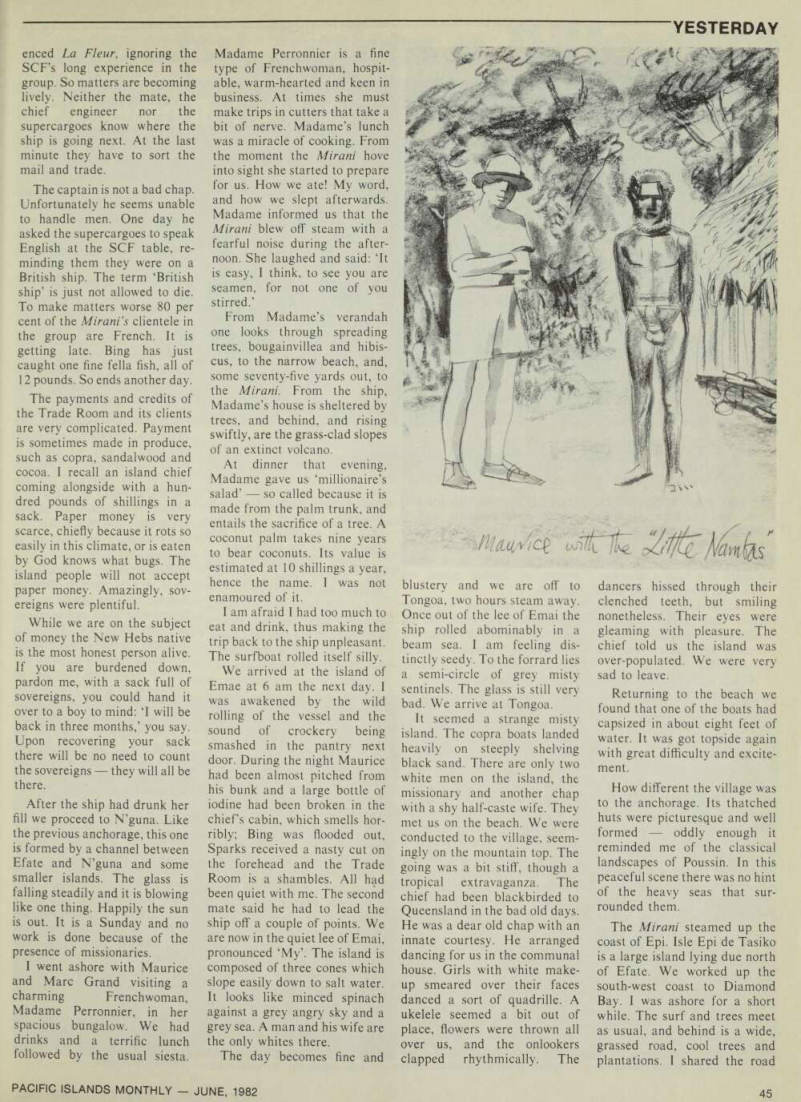
They were quite naked except for a penis sheaf which was held upright and attached to a band around the waist. This caused the testicles to protrude for ward. Some carried spears.
These were the ‘Little Nambas’.
We were taken to a village about half a mile inland where purchases were made after a good deal of haggling. It so happens that Maurice had false teeth. He gave some ‘Man Toman’ a toothy smile, then covering his mouth with the palm of one hand succeeded in getting rid of his upper teeth.
He then favoured them with a bare-gummed grimace. This caused a sensation they shrank back in astonishment
and fear. Maurice put his hand over his mouth again and, hey presto! there were his teeth again. We had the strange feeling they would like to detain us, but not after this display of magic. The supercargoes, who seem to know everything, told me that the village we had visited murdered a missionary before the war, 1912 or there abouts, and the French had sent in a gunboat to destroy the village. Dear me, the bad old days.
That evening finds Mirani at Port Sandwich. It is perhaps the finest harbour in the group, and certainly the unhealthiest.
There are three anchorages here, the inner, the outer and the hurricane anchorage. We are lying in the outer and hope to avoid the mosquitoes.
The dense vegetation of Malekula appears hot and deso late from the ship, but ashore it is perfectly delightful. One can gaze at the reef and the sea from the shade of giant and decorative banyan trees, among green lilies and cool grass.
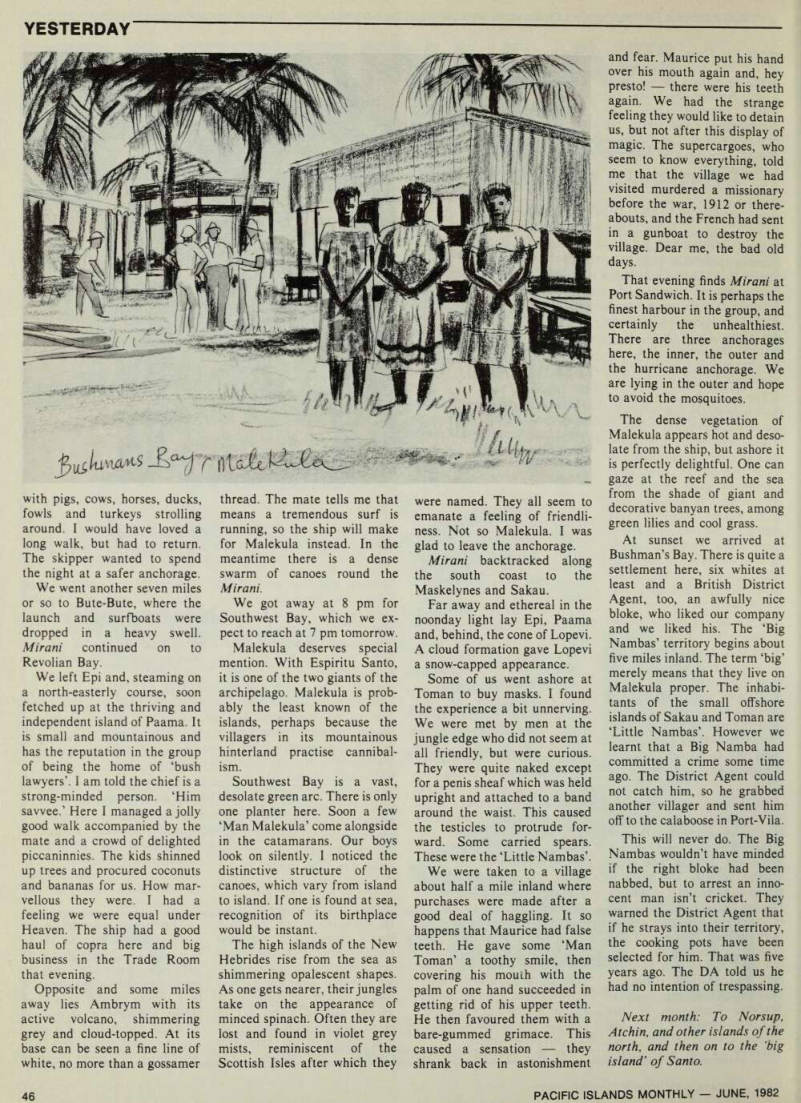
At sunset we arrived at Bushman’s Bay. There is quite a settlement here, six whites at least and a British District Agent, too, an awfully nice bloke, who liked our company and we liked his. The ‘Big Nambas’ territory begins about five miles inland. The term ‘big’ merely means that they live on Malekula proper. The inhabi tants of the small offshore islands of Sakau and Toman are ‘Little Nambas’. However we learnt that a Big Namba had committed a crime some time ago. The District Agent could not catch him, so he grabbed another villager and sent him off to the calaboose in Port-Vila.
This will never do. The Big Nambas wouldn’t have minded if the right bloke had been nabbed, but to arrest an inno cent man isn’t cricket. They warned the District Agent that if he strays into their territory, the cooking pots have been selected for him. That was five years ago. The DA told us he had no intention of trespassing.
Next month: To Norsup, Atchin, and other islands of the north, and then on to the ‘big island’ of Santo.