The fury of Isaac
pp. 55-61 · Read in the full issue


Yachts
The fury of Isaac and the fate of Kirsten (and friends)
Joan D. Pease Re
ports from Neiafu ,
Vavau, Tonga:
March 2 began as the day Stan and I were to photograph Her Majesty the Queen of Tonga. It ended as the night we lost Kirsten in Cyclone Isaac and most yachts in the Vavau cruising fleet were swept on to Neiafu’s rocky shore. (See Patty Kaliher’s earlier report), PIM Yachts May.) When we heard the report of Isaac that morning on the ham radio, the cyclone was reported at 16°30 / S and 170°W. It was moving south at five knots with winds of 50 knots at the centre.
All flights in Tonga were can celled, so the Queen would not be visiting the centre for handicapped children as planned. Stan and I decided to spend the day aboard even though winds were not strong in the afternoon.
At 5 pm we began to prepare for heavy winds. Down came the two canvas sun awnings, the Tongan
courtesy flag, the dipole antenna for
the ham radio and the wind vane.
We were prepared to encounter winds up to 60 knots as we had last year in Moorea, and since the rain had not begun, securing the boat was not difficult. Knowing we’d be in for a hard night, we decided on an early dinner. By 6 pm it was too windy to sit in the cockpit, so we had dinner below.
After the meal, we turned on the VHF radio to channel 16 so we :ould be in contact with other yachts in the harbour.
The South Pacific Yacht Charter company was using channel 22 for ;he two charter parties who were jccupying boats, but Don Coleman, SPYC manager, was also monitor ng 16 on a portable set. The issumption was that we could offer issistance to each other if anchors )egan to drag. In the tropical lepression last year, Stan and )thers in the anchorage had set or eset five anchors; we all wanted to >e prepared.
When Stan called for check-ins )ver the VHF radio, he got re iponses from Redhawk, Panache, leeway and Elysium. ‘Aren’t we a :osy bunch,’ Stan commented. Not or long.
Soon Robert Earl from Leeway, a Cascade 36 from San Francisco, :ame on the radio with the cyclone’s )osition as reported on WWV Radio fom Hawaii. ‘lt’s 18° south and
173° west,’ he said. At that point his father had not returned from town and would be unable to row against the wind. Young Robert was to spend the night alone fighting against Isaac and not winning.
Also fighting alone was Phil Howe, skipper of Redhawk, a 12.8 m ketch from San Francisco.
But with its 100 hp engine, the ketch could motor against the wind.
Phil battled through the night until he ran out of diesel and beached the vessel in sand. She was righted in the high tide the following morning.
This all happened in the early hours of Wednesday. When Robert gave Isaac’s position at 7 pm we all still assumed we were in for gale force winds. This was reinforced when we listened to Radio Tonga news at 8 pm. Haapai and Tonga tapu were put on cyclone alert and gale warnings were issued for Vavau. ‘Looks like it’s going to pass south of us,’ Tony Barra from Panache , said over VHF. Although we wanted to believe the weather report, intuition told me it would be more than a gale.
At 8.30 pm Stan took the out board engine off the Avon inflatable dinghy and tied on a second painter. ‘What if we need the dinghy to help someone,’ I pondered. Thirty min utes later it was clear we couldn’t have boarded the Avon without risk
of capsizing.
‘You’ve got to go to sleep. I’ll need you later and want you rested,’
Stan said.
So I crawled into the forepeak bunk determined to at least relax.
Even that was impossible. When I wasn’t hearing anxious voices over the VHF, I was jolted by the pull of the anchor chain against the sampson post.
I got up at 10 pm when I heard a new voice on the radio. It was Donna Lu’isa Score, a Peace Corps volunteer. She and Jonathan McCain, another volunteer, had gone aboard Tukilik, a 12 m ketch. ‘We’re dragging. What do we do?’ she asked.
Tukilik’s owner Jim Thomson was in Canada on personal business and had carefully checked his mooring several times before leav ing Vavau. Calm voices instructed Lu’isa and Jonathan to drop the spare anchor with as much chain as possible.
In less that 20 minutes they reported the anchor was holding, and we were relieved. ‘l’m not vexy good with radios,’ Lu’isa said.
‘Neither are we,’ Tony reassured her.
I started to mark down the barometer readings. At 8.45 pm it had been 29.68. Then I wrote: 29.56; 29.48; 29.42; 29.34. Every time I checked I hoped it would stabilize or start to rise. It only continued to drop faster. Stan decided to try to sleep at 11 pm. ‘lt will pass over at about 2 am,’ he had said earlier. I sat in the cockpit trying to get bearings. Power was off in town and the roaring wind and blasting rain made visibility nearly impossible.
Soon I could see we were drag ging; chain was working its way out from around coral heads. Stan jumped up and switched on the controls, and I started the engine.
He went on the foredeck to drop the 35# Danforth anchor and yelled back instructions for me on the engine controls, ‘Forward. Neutral.
Reverse.’ I was surprised I could hear him in the howling wind.
The 16 hp Volvo engine made no headway against the wind, but it did give us steerage. I used my back to hold the tiller as far over as possible.
It took all the strength I had, and I was thankful we’d had a hearty dinner.
But I knew at that point we were going to lose Kirsten. If the anchor held she’d probably be bashed by another boat.
Around midnight Stan took over
the helm, and I stood around feeling helpless. At 12.07 I wrote down the barometer reading: 29.19, the lowest I’d ever seen the needle.
At 12.10 we began to drag rapidly. Stan went forward to let out more scope, but it was too late.
Kirsten was racing towards shore.
Stan announced over channel 16 at 12.15 that we were on the rocks and abandoning ship.
I had been angry but not fright ened while at the tiller. I was furious because I knew our boat couldn’t be saved. But now I was scared. Any minute another boat could smash into us. How would we get to shore?
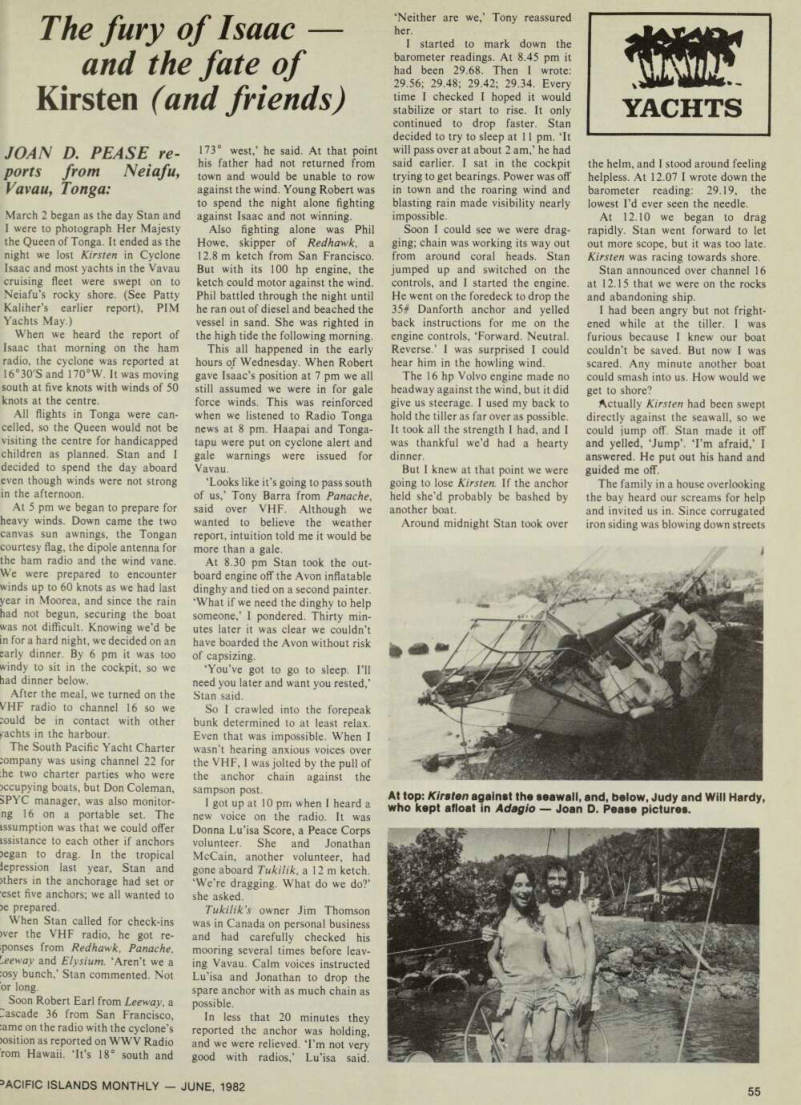
Actually Kirsten had been swept directly against the seawall, so we could jump off. Stan made it off and yelled, ‘Jump’. ‘l’m afraid,’ I answered. He put out his hand and guided me off.
The family in a house overlooking the bay heard our screams for help and invited us in. Since corrugated iron siding was blowing down streets
At top: Kirsten against the seawall, and, below, Judy and Will Hardy, who kept afloat in Adagio - Joan D. Pease pictures.
:and houses were falling over, we 'were happy to have a roof over our (heads.
But that didn’t last for long. The (family had attached guy lines to the iroof supports and tied them to a large, heavy safe. In one loud blast, the roof blew away, and we all ran for shelter in another room.
Our host finally decided the safest place was behind the counters of his small general store. Stan stretched out on the concrete floor hoping to get some sleep so we could work on Kirsten in the morning.
I was given a large plastic bag stuffed with skeins of yarn. It made a good pillow, but I couldn’t sleep for thoughts of Kirsten. The sound 3f the wind was like the noise of a
freight train running by.
Daylight took so long in coming, sut by 6.15 Stan and I started down ;he steps to assess the damage. I was ■elieved no boats had fallen on top )f Kirsten.
Then Stan moaned, ‘No. Oh no.’
Je was looking up the beach at the levastation. Yachts, like so many alien dominoes, were scattered up he shore. Out of a fleet of 20, only our vessels remained afloat.
Through the night I had assumed ve were the only boat to drag, now inly two private yachts remained in he water.
Quickly our priorities changed. I /ent aboard to look for money and he camera. The boat was a hambles below. Floorboards were p and goods had been tossed round, so I couldn’t find our assports, money or camera but did lanage to put on a pair of jeans ver the underwear I’d escaped in.
We started up the beach calling t each boat for survivors. First ■eeway then Tukilik, next ’lysium. No answers.
Gene and Richard Panter from 'air Seas, a 14.9 m ketch, were aving coffee on the front porch of
leir Tongan friend’s home.
‘We fought until 4:30 am,’ Gene lid, ‘and then we were washed up n the rocks.’ His son Richard had
cut his foot severely and needed medical attention. ‘Have you seen anyone else?’ I asked. They hadn’t so we continued to the home of Robyn and Don Coleman of SPYC.
Others had gathered in the kitchen of their house. The roof had blown off the living room early in the evening. Robert Earl from Leeway was there and uninjured.
Helen and Elmer Olson from Elysium, a 15.2 m ketch from Portland, Oregon, greeted us with hugs. They were OK, but their ferro-cement yacht was badly holed. Lu’isa and Jonathan had not been injured on Tukilik.
Robyn Coleman, a registered nurse, was treating an injured couple who had chartered one of the SYPC yachts which dragged its mooring. When we arrived Robyn had already sutured the man’s foot and was tending to the woman who was critically injured when she was swept off the deck and crushed between two boats. While we were there transport was arranged, and the woman was put on a door, an improvised stretcher, to be taken to
hospital.
We’d accounted for Fair Seas, Leeway, Tukilik and Elysium and could see Redhawk on the shore across the bay.
Now our worry was for Will and Judy Hardy on Adagio, a 9.1 m
sloop from Columbus, Mississippi,
because Judy was due to have a baby in two months. At the Paradise International Hotel we learned that Adagio was still afloat. As we looked down the hill we could see Judy huddled in a corner of the cockpit in her life preserver. Will was slowly letting out line as it chafed, and still was not sure they’d make it. Their dinghy had sunk, so he couldn’t get a line to a nearby mooring. Later in the morning he swam out with the line and they remained unscratched.
After reserving a room at the Vavau Guest House, we started back to our boat and encountered
Robyn Coleman who reported the injured woman needed donations of Type A positive blood. Since that is our type we continued on to the hospital where we were surprised to see so few injured persons and overjoyed to learn there were no deaths.
David McLean and his wife Hainite were also there, and David became another donor. Hearing of our loss they invited us to stay at their home while we worked on the boat. After Stan gave blood (I declined for medical reasons), we returned to the boat where I was finally able to uncover the camera from the muddy debris below deck.
After a thorough shower in fresh water, the dependable Nikonos and its flash attachment were back in operation.
We soon learned about the other yachts. Two of the SYPC boats did not drag from their moorings; the others were swept on the shore.
Swirl, a 9.1 m sloop, had left the main harbour before dark to escape the pile-up of boats. Shane Finneran and Tina Gaudette lost their Avon dinghy and an anchor, but rode out the storm. The following week they recovered both items.
Panache, a Catalina 30 sloop from Los Angeles, was on the sand, but owners Tony Barra and Jennifer Guilbert were on the ham radio at 8 am that morning sending out news of the disaster. For many days Tony had the only operating radio in all of Vavau, and he played a valuable role in getting messages out to concerned relatives around the world even before he refloated his boat three days after the storm.
Arminel H., a 21.3 m timber ketch, was thrown against a steep cliff on a rocky shore. Skipper Larry Conway had climbed the mast to get ashore. The 70-year-old ketch, which weighed 70 tonnes, proved to be the most difficult to get righted and moved in the following weeks because of its massive weight.
Elefant, a fibreglass yacht of German registry, was also on the
rocks. Her owners had built the vessel and were prepared to com plete the repairs in Vavau.
Aquavit, a small sloop from San Diego, California, had dragged from its mooring early in the evening. The owners had left the vessel in Neiafu several months before, and no one was aboard.
Fair Seas, from Los Angeles, suffered massive water damage.
Ballast fell out of the keel causing
difficulty in the refloating operation.
Leeway, an 11 m fibreglass sloop, was righted two weeks after Isaac
and moved to a sandy beach for repairs.
Elysium , built of ferro-cement by her owners, was righted four days after the cyclone and repairs are underway.
Tukilik was righted the week after Isaac struck, and owner Jim Thomson returned from Canada with materials for the repair oper ation.
Kirsten , 9.8 m Colin Archer type double-ender, was righted on March 17. Stan had built the vessel in ferro-cement over a five-year period in Alameda, California. We had moved aboard in 1975 and the following year sailed from San Francisco to Sydney, Australia, by way of French Polynesia and the Cook Islands. We recommenced cruising in 1980 and had called at New Zealand, French Polynesia and American Samoa before arriv ing in Vavau last December.
When we assessed the damage to the hull, we felt we could not trust her integrity at sea after repairs.
With the help of many local famil ies we were able to off-load gear, most of which was damaged.
Teisina and Seketi Fuko, whose home looked down on the seawall, allowed us to store our goods in their house. This was valuable assistance which helped us save many items.
Their three sons and Tei’s mother Mele brightened our days as we cleaned, sorted and packed our belongings for shipment to the United States.
After long days of work we could return to the McLean home for
quiet evenings with a happy couple.
We lived with them for a month, and their kindness was a comfort during a trying time in our lives.
Kirsten was sold in Neiafu and will sail again within the Vavau group.
I only wish we’d had her at sea, far from land, during Cyclone Isaac.
Don Travers Re
ports from Tubuai,
Austral Islands , French
Polynesia:
• ENDYMION. A 15.5 m steel sloop arrived at Tubuai late in
February with Australian owner/
builder Bob Wilson, his son Dallas, crew of Mike Williams (USA), and Dallas’ wife Glendor, of Grenada, in the Caribbean, Glendor’s 10-year-old daughter Debbie, Dallas’ and Glendor’s one-year-old son Jethro, another child on the way, and Norma Francis, also of Grenada.
Endymion is completing a cir
cumnavigation commenced at Syd
ney via Cape of Good Hope. Lots of time was spent in Grenada and Venezuela, Panama, Galapagos,
Marquesas, Rangiroa, Tahiti,
Moorea.
They left Tubuai at the end of February, bound direct for Auck land, and hoped to reach Sydney before the end of April. (Don Travers adds in a later note: Endymion left four days before the big hurricane I’ve heard about that hit Tonga (Cyclone Isaac). Depend ing on where they were and the continuing track of the storm, I imagine they could have had a very rough time. We became close friends with these folk during their visit here. Could you ask your readers in New Zealand or else where for any news of them?)
• Double Bullet. A 20 M
sloop-rigged racing catamaran ar
rived from New Zealand in early March with owner/designer/ builder Bob Hand of California and crew of Paul Pollock, Jeb Baker, (all of USA), and Lars Landfald (Norway). Double Bullet is strictly a racing machine, 10 m wide with a 21 m mast, weighing seven-and-a half tonnes. Each hull is of cold moulded cedar four layers of three metres length, and only one metre wide at the widest part.
Spartan living spaces are found only in the hulls, the super-structure consisting of netting and all held
together by box spares of graphite
fibres and epoxy, aluminium spares and stainless and titanium fittings.
Power is super-long shaft, centre moulded 35 hp outboard.
Double Bullet completed the Transpec from California to Hawaii in nine days 10 hours, including five
480-kilometre-plus days before los
ing the second rudder. From Hawaii they sailed to Palmyra, Pago Pago, Suva, and New Zealand.
Total sailing time California- New Zealand was 31 x h days.
I was fortunate to be able to sail with them from Tubuai to Tahiti.
Less than two days, quite an experience! From Tahiti Double Bullet sailed for California via Hawaii. • TALOU. A 15 m ferro-cement ketch from Toronto, Canada, with Ray and Brenda Lewis, arrived from Raivavae at night to permit emergency medical evacuation by air for their nine-months old baby Kathryn, suffering from peritonitis.
Also on board is the couple’s four year-old daughter Joanne, and crew Doug Miles from Melbourne, Aus tralia.
Talou left Tubuai shortly after arrival for Tahiti, with Ray, Doug and Joanne aboard to join Brenda and the baby. They are heading for Vancouver via Hawaii after leaving Canada’s east coast three years ago, cruising North Atlantic, West Indies, Panama, Galapagos, Pit cairn, Gambiers, Tuamotus, Societies, Tonga, Fiji, Australia, New Zealand, Raivavae. A local friend, Gilda Viriamu, ac companied them on the Raivavae- Tubuai sail. (Jane Deßidder has subsequently reported the sad news of the death of baby Kathryn in Papeete.)
Jane Deridder Re
ports from Kerikeri ,
New Zealand:
• SOFIA. The well known Baltic Trader Sofia a 37 m topsail schooner, capsized and sank off New Zealand’s North Cape at about 1.30 in the morning of February 23 in heavy seas and winds of 30 to 40 knots. According to her captain, American Evan Logan, Sofia had been taking water faster than the pumps could cope when she was swamped by two massive seas, and rolled. An Auck land girl, 20-year-old Julie May Osborne of Remuera, apparently
went down with the ship. The 16 surviving crew members, 10 Zealanders, five Americans and one Briton, spent five days in two life rafts, one of which was damaged in launching, before they were rescued by the refrigerated cargo ship,
Vasiliy Perov.
For the past 12 years a communally owned blue water cruising vessel, Sofia was on her second visit to New Zealand. She was to have been featured in the making of Savage Island, a film depicting the adventures of notori ous pirate and trader Bully Hayes, who operated in the Pacific in the latter half of the 19th century. Sofia was sailing north along New Zea land’s west coast en route from New Plymouth to Auckland when she foundered.
Using two paddles and two more improvised from a plastic bucket, the 12 men and four women man aged to get within three kilometres of Cape Reinga before being swept more than 50 kilometres offshore by wind and current. Several fishing boats and commercial vessels
passed by without seeing their
flares. Captain Logan says that they managed to attract the attention of the Russian ship with a flashlight and their last two remaining flares.
Though suffering from dehydration, exposure and salt water sores, the young people kept in amazingly
high spirits. Logan said, ‘We always
knew we would be rescued.’ • KIRIWINA. Long-time sailor Ross Ewens, Perth education officer, first went to sea at 15 on a tops’l schooner. In 1981 Ross and his wife Barbara sailed their own 10.4 m cruising/racing yacht Kiri wina from their home in Perth, 4800 kilometres along the challeng ing South Australian coast, then on up as far as Mackay in Queensland before making a 16-day crossing to New Zealand. As Ross says: ‘The weather can be bad around the Southern Ocean. We would hole up waiting for a low to pass by, then catch its tail end to move on the next port.’ After Kiriwina’s year long shakedown cruise, Barbara realised that the cruising life did not suit her. ‘lt was too indolent.’ So she and Ross became wardens at the Kerikeri Youth Hostel, hoping to add a new dimension to the place by making their yacht available to hostelers. ‘lnstead of us doing a world cruise, young people from all over the world will be able to cruise with us in the Bay of Islands on Kiriwina. ’ The musical word ‘Kiriwina’ is the name of the principal island in the Trobriand Group where Ross spent some time in the navy, and where his brother in-law served with the Papuan medical service. Kiriwina is a
Sparkmans and Stephens-designed
Double Bullet underway off Tubuai and bound for Tahiti with, left to right, Hanel, Debbie Yee, Paul Pollock, Lars Landfald and Jeb Baker - Don Travers picture.
racing sloop some of whose sister ships have been winners in both the Sydney-Hobart and the Parmelia
(Plymouth to Fremantle) yacht
races. • DOUMAR. Another vessel to sail south of Australia west to east is the British Golden Hind 31 Doumar.
Neville de Villiers was senior part ner in a medical practice in Loughborough near Nottingham when he decided he wanted to have a look at the rest of the world. So, single-handling his 9.4 m plywood sloop Doumar, and carrying with him for company his guitar, a present from his patients, de Villiers set off from Plymouth to Le Havre, then journeyed through the French canals to Marseilles. He explored Malta and the Greek islands before carrying on through the Suez to Aden, Sri Lanka, Singapore, Christmas Island, thenceto Bun burry on the Australian west coast.
Here Jenny de Villiers and the two children aged one and three jumbo jetted in to join her husband. Jenny and the children took the train to Sydney while Neville continued on south of Australia in his plywood cruising yacht. Neville says the Great Australian Bight didn’t live up to its bad reputation though there were plenty of sperm whales about. But in Bass Strait he experi enced Force 10 winds for five days.
The trim tab on the rudder broke,
necessitating hand-steering to Syd
ney. Since Doumar s arrival in New Zealand a year ago, Dr de Villiers has been practising medicine, first in Whangarei, and now in Kaeo, a small Northland community.
Though Doumar’s sailing is limited to Northland’s east coast for the time being, plans are afoot to resume blue water cruising next year. • TUFFIE. Circumnavigators Red (Rosco) and Ruth Brooks, long-time ocean wanderers on their 10.6 m ketch Tuffie, sailed from Whangarei to Bundaberg in mid- April, thence through the Great Barrier Reef and on to Darwin to complete the paperwork which will enable them to visit Bali. • KITTY OF LEIGH. Retired Bexhill schoolmaster Denis Brooke left the UK on his Laurent Giles
designed Westerly 33 ketch Kitty of
Leigh, in August 1980. T just set off to potter for three years or so, to see the rest of the world before senility set in ..Travelling always with a crew of two or three, with to date no
major mishaps or really bad
weather, it has obviously been a
happy retirement experience. Com
menting on the Pacific Islands, Denis remarked, ‘How beautiful!
And how expensive!’ Denis will
pause to experience his first winter in two years with friends in the Bay of Plenty after which ‘my plans are fluid’. • FFROG. Jamie Clarke and his sister Jan from Cirencester, Gloucestershire, bought the beamy 14 m wooden yacht Sirene in Spain, renamed her Ffrog, and with two other young people and a collection of several hundred frogs set off on a proposed two-year eastward cir cumnavigation. After their two crew members left Ffrog in Singapore, Jan and Jamie sailed alone through the Philippines, the Carolines and the Marshalls to Fiji where June Batty of Toronto joined Ffrog. During a refit in Whangarei, Jamie, now the only remaining original crew member, recounted some of their adventures like nearly being arrested by a gunboat in the Red Sea, and driving off a middle-of-the-night boarding party in Borneo with a head of anger and a winch handle. Ffrog’s next ports of call will be in Fiji and Tonga. The rounding of the Horn has been postponed for a year at least.
Jane Deridder Re
ports from Lord Howe
Island , Australia:
• HIPPO. If Easter Islanders should see the colourful sail of a windsurfer plying their shores, it could well be Roger von Bergen, a young Swiss from Geneva who plans to make the voyage to Easter Island direct from New Zealand with the windsurfer on the deck of his 10 m sloop Hippo. Roger, co designer, builder and captain of the cold-moulded ply vessel, with his parrot Cristobal obtained in the Panama Canal Zone, has spent four years in the Pacific already. An interesting recent addition to the blue African mahogany sloop is a wind generator mounted on the pulpit which Roger says produces one amp in winds of 8 to 10 knots and three amps with 12 to 15 knots of wind. When we spoke to Roger he was looking for a crew member to accompany him on the 6000 kilo metre non-stop voyage. • ARD RICH. Mike Davidson, associate editor of Australian Boat ing magazine, arrive in Opua in mid-March from Sydney via Lord Howe Island. Mike mentioned that a levy of $5O is now being charged yachts visiting Lord Howe Island.
Ard Righ, his Duncanson 10.6 m sloop had to cope with a wet windward slog from Lord Howe Island with northeast to southeast winds of 20 to 30 and higher all the way. Mike will continue his voyag
ing through Tonga, Fiji, Vanuatu
and New Caledonia, writing cruis ing pieces for his magazine as he goes. About single-handling he says, ‘l’ve had enough of that!’ • MOONPENNY. John and Ken Wood of Kerikeri, known to many overseas cruising yachtsmen be cause of the welcome, help and hospitality extended to them by the Wood family, have themselves set off on a blue water cruise in the 10 m sloop Moonpenny which John describes as ‘a prototype we hope of many more to come’. The unique cruising yacht was designed by Michel Deßidder using ideas evolved during 17 years of practical cruising on Magic Dragon. John and his son Ken assisted Deßidder in building Moonpenny because of their interest in his methods. With winds of three to 15 knots from abaft the beam, Magic Dragon and Moonpenny were able to keep within sight of each other for the entire six-day crossing from the Three Kings Islands. John talks of the satisfaction of watching each other’s boats at close quarters, and of the economy of using one engine between two boats. ‘Having long been involved with towing other boats, it was a change to be on the
receiving end. Magic Dragon only
lost half a knot and we shared the fuel bill.’ Moonpenny’s maiden voyage to Lord Howe Island ended with a 21st birthday landfall for crew member Jeannie Skinner, also of Kerikeri. As for Lord Howe Island, John reckons the Kentia palms alone are worth coming thousands of miles to see. • TALOU. (See PIM Mar p 59.) While Canadian yacht Talou was en route to Tahiti from New
Zealand, Kathryn, baby daughter
of Ray and Brenda Lewis of Toronto, was taken seriously ill. The Lewises put in to Raivavae where there is a small hospital. When it
became apparent that further medi cal aid was required, Brenda flew with the little girl to Papeete from Tubuai. Kathryn Lewis died from peritonitis. Ray sailed to Papeete to rejoin his wife and four-year-old daughter Joanne.
The cruising community extend their deepest sympathy to the Lewis family in their tragic loss. When I visited the 15 m ketch Talou in the Bay of Islands, I was struck by the warmth and contentment of this seafaring family group, and by their enthusiasm for cruising as a way of life. • SPINDRIFT. The 11 m engine less gaff cutter Spindrift arrived at Lord Howe Island with six people aboard just in time for the April 4 centenary celebration. Owner Philip Rose-Taylor of Brixham, Devon, had the ‘old-timer’ designed and built in steel to his own specifications. She was launched in Melbourne in 1976. During the building of Spindrift Rose-Taylor was sailing on the 45 m auxiliary schooner Wongala out of Mel bourne supplying explosives to min ing camps in Australia and New Zealand. Though Philip describes Spindrift as ‘not close winded’, they made Tasmania-Fiji in just 19 days, and took only 28 days from New Zealand to Tahiti, a time he hopes to better this time round. No stranger to old-fashioned sailing rigs, Philip served for three years as mate on the 17th century replica of Nonsuch (built for the 300th anniversary of the founding of the Hudson Bay Company). He also sailed on the Golden Hind replica (used in the making of the movie Shogun ) and on the Beaver replica (an East Indiaman present at the Boston Tea Party). More recently he was rigging consultant and bosun on the Bounty replica in Whang arei.
Ffrog in full sail off Kerikeri - Jane DeRidder picture