mystery drama
pp. 39-40 · Read in the full issue
Books
Milan Brych: A modern mystery drama
Milan Brych the Cancer Man.
By Frank Quill. Published by The Publishers House Pty Ltd, 1981. 281 pp. Paperback
5A4.50. Isbn 0 949783 00 5.
In view of the nature of his activities, and the emotions aroused by the universal dread of cancer, the name of Milan Brych will long be remembered in New Zealand, Australia and the Cook Islands.
Around this enigmatic man there has built up a small mountain of expressions of adu lation, scorn, praise, criticism, 100 per cent belief in his claims and profound scepticism about them. As with anyone who claims to have found a cure for cancer, the controversy that has swirled around Brych has pro duced medical experts to con demn his work out of hand, and numbers of non-medical sup porters who see him as a man unjustly and cruelly persecuted.
The unfortunate bystanders to these medical confrontations are always the patients, who have sought relief as a last resort, only to find themselves drawn into a maelstrom of claim and counter-claim.
Frank Quill, a Melbourne journalist, has written a defence of Milan Brych. He makes it quite clear that he accepts as incontrovertible fact that Brych was able to achieve cures for cancer victims by the methods he had developed methods which, on unwarranted grounds, were not welcomed by the conservative medical com munity.
Quill documents a number of instances where Brych’s patients did experience re missions but unfortunately he does not provide any evi dence of the long-term survival rates of these people.
This, of course, was one of the principal areas of doubt ex pressed by medical men about Brych’s work, as he was either unwilling or unable to make available for study his patients’ medical histories.
While Quill makes much of
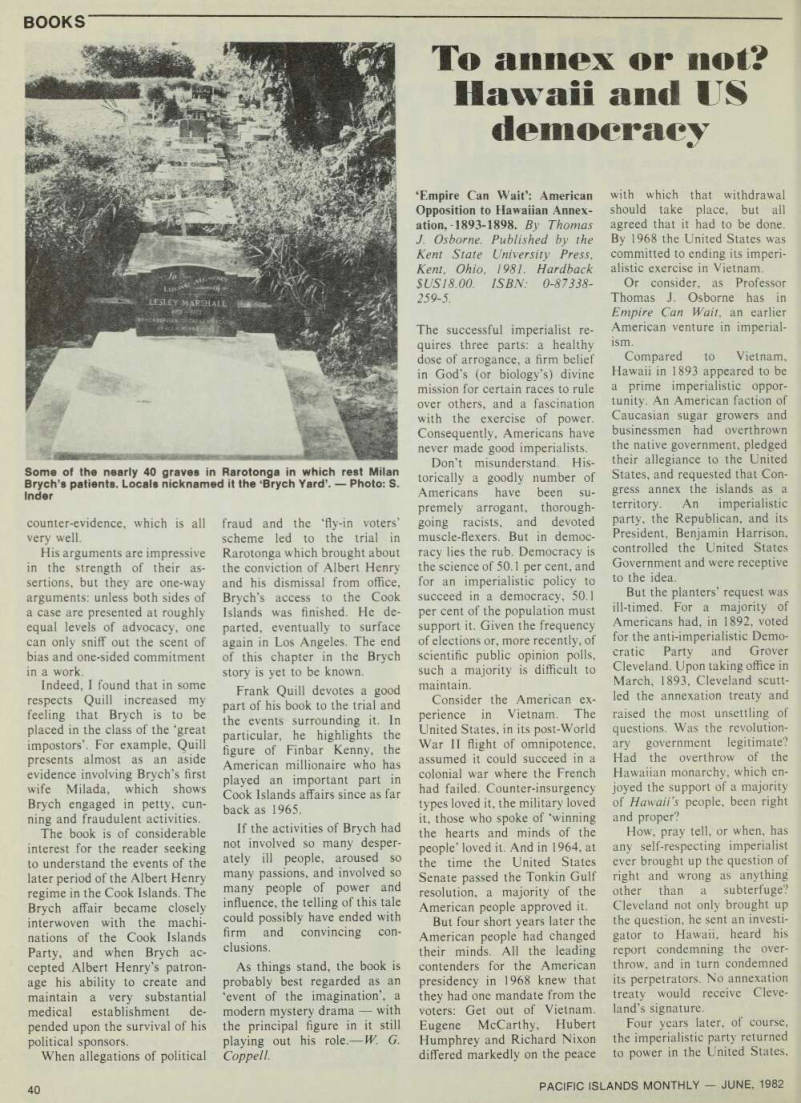
the experiences of remission, he makes little reference to those who travelled to Rarotonga seeking last-ditch help from Brych, and who now lie in Rarotonga’s graveyard or who, having experienced a brief remission, left Rarotonga to die in their homelands.
I visited Rarotonga during the period of Brych’s activities there, and I found that, con trary to Quill’s assertions, many of my friends, both Maori and Papa’a, were uneasy about what was happening at the Cancer Clinic, and told of friendships made with cancer patients and their families, and of the heart* breaking disappointments ex perienced by many of them.
To a large extent. Quill’s story concentrates on the way in which in his opinion Brych was hounded from pillar to post by medical men, admin istrators, and politicians in New Zealand and Australia.
Much of the argument about Brych turns on the question of the medical qualifications he claimed to have earned in his native Czechoslovakia.
Brych had made his way to New Zealand, obtained work as a technician in the central laboratory of the Auckland Hospital, and later applied for medical registration on the basis of those medical qualifica tions, and the work he had carried out for the hospital.
Registration was granted, and there is no doubting that he was able to establish a substan
tial reputation as a cancer therapist.
However, the publicity at tracted by Brych brought him very much to the notice of the medical profession, and inquir ies were set in motion as to his claims of university medical training. These led to first-hand contacts with the relevant Czechoslovak authorities.
The upshot was that the New Zealand Medical Council deregistered Brych. He moved to Rarotonga where he was welcomed by the then Premier Albert Henry who, it seems, saw Brych’s presence as a means of ensuring the establish ment of an institute devoted to the study of traditional Cook Islands medicine a project dear to his heart.
Quill sees that there was a concerted and premeditated attack on Brych by an unholy alliance of the New Zealand medical profession, Czecho slovak Government officials,
Australian politicians and sundry others.
In particular he mounts a vituperative onslaught on a cer tain Professor Scott, who visited Czechoslovakia on behalf of the New Zealand medical authorities in an effort to deter mine the truth or otherwise of Brych’s claim to professional medical training.
It was largely as a result of Scott’s investigations that Brych-was cast out of the New Zealand medical fold. Quill questions the professor’s mo tives, and produces a litany of
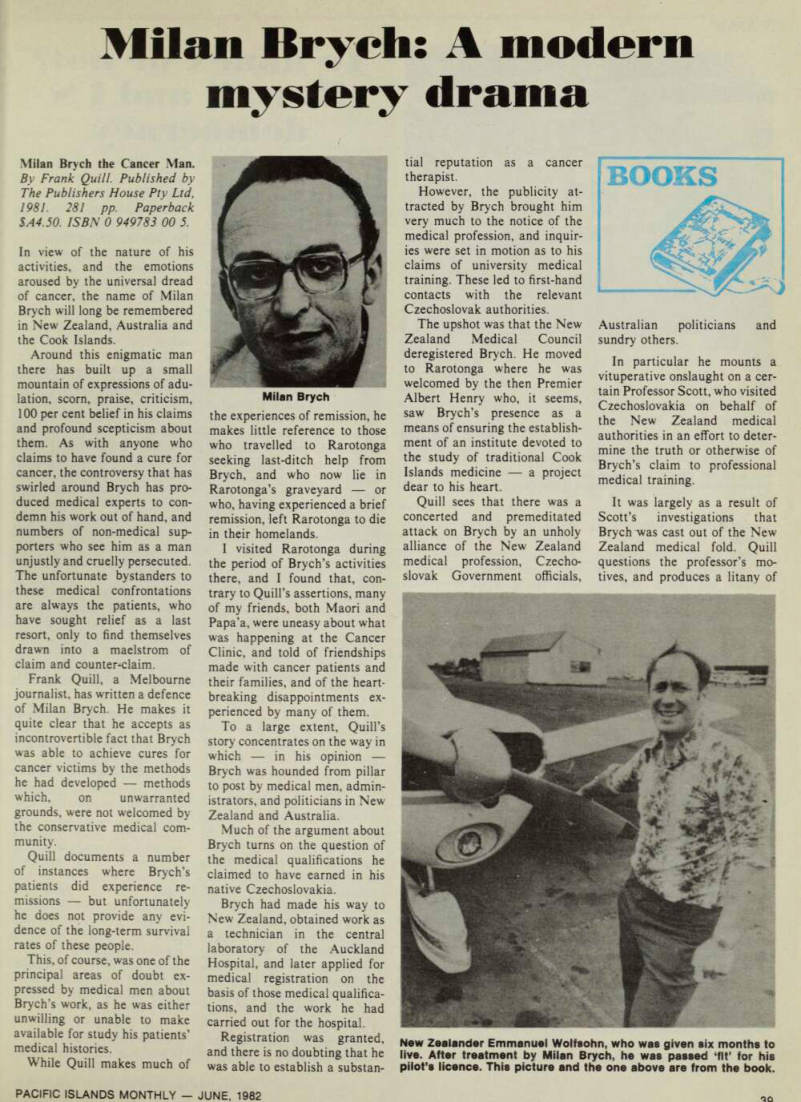
Milan Brych
New Zealander Emmanuel Wolfsohn, who was given six months to live. After treatment by Milan Brych, he was passed ‘fit’ for his pilot’s licence. This picture and the one above are from the book.
counter-evidence, which is all very well.
His arguments are impressive in the strength of their as sertions, but they are one-way arguments: unless both sides of a case are presented at roughly equal levels of advocacy, one can only sniff out the scent of bias and one-sided commitment in a work.
Indeed, I found that in some respects Quill increased my feeling that Brych is to be placed in the class of the ‘great impostors’. For example, Quill presents almost as an aside evidence involving Brych’s first wife Milada, which shows Brych engaged in petty, cun ning and fraudulent activities.
The book is of considerable interest for the reader seeking to understand the events of the later period of the Albert Henry regime in the Cook Islands. The Brych affair became closely interwoven with the machi nations of the Cook Islands Party, and when Brych ac cepted Albert Henry’s patron age his ability to create and maintain a very substantial medical establishment de pended upon the survival of his political sponsors.
When allegations of political
fraud and the ‘fly-in voters’ scheme led to the trial in Rarotonga which brought about the conviction of Albert Henry and his dismissal from office, Brych’s access to the Cook Islands was finished. He de parted, eventually to surface again in Los Angeles. The end of this chapter in the Brych story is yet to be known.
Frank Quill devotes a good part of his book to the trial and the events surrounding it. In particular, he highlights the figure of Finbar Kenny, the American millionaire who has played an important part in Cook Islands affairs since as far back as 1965.
If the activities of Brych had not involved so many desper ately ill people, aroused so many passions, and involved so many people of power and influence, the telling of this tale could possibly have ended with firm and convincing con clusions.
As things stand, the book is probably best regarded as an ‘event of the imagination’, a modern mystery drama with the principal figure in it still
playing out his role.
W G.
Coppell.
Some of the nearly 40 graves in Rarotonga in which rest Milan Brych’s patients. Locals nicknamed it the ‘Brych Yard’. - Photo: S.
Inder