democracy
pp. 40-41 · Read in the full issue
To annex or not?
Hawaii and US democracy
‘Empire Can Wait’: American Opposition to Hawaiian Annex ation, 1893-1898. By Thomas J. Osborne. Published by the Kent State University Press, Kent, Ohio, 1981. Hardback
Sus 18.00. Isbn: 0-87338-
259-5.
The successful imperialist re quires three parts: a healthy dose of arrogance, a firm belief in God’s (or biology’s) divine mission for certain races to rule over others, and a fascination with the exercise of power.
Consequently, Americans have never made good imperialists.
Don’t misunderstand His torically a goodly number of Americans have been su premely arrogant, thorough going racists, and devoted muscle-flexers. But in democ racy lies the rub. Democracy is the science of 50.1 per cent, and for an imperialistic policy to succeed in a democracy, 50.1 per cent of the population must support it. Given the frequency of elections or, more recently, of scientific public opinion polls, such a majority is difficult to maintain.
Consider the American ex perience in Vietnam. The United States, in its post-World War II flight of omnipotence, assumed it could succeed in a colonial war where the French had failed. Counter-insurgency types loved it, the military loved it, those who spoke of ‘winning the hearts and minds of the people’ loved it. And in 1964, at the time the United States Senate passed the Tonkin Gulf resolution, a majority of the American people approved it.
But four short years later the American people had changed their minds. All the leading contenders for the American presidency in 1968 knew that they had one mandate from the voters: Get out of Vietnam.
Eugene McCarthy, Hubert Humphrey and Richard Nixon differed markedly on the peace
with which that withdrawal should take place, but all agreed that it had to be done.
By 1968 the United States was committed to ending its imperi alistic exercise in Vietnam.
Or consider, as Professor Thomas J. Osborne has in Empire Can Wait, an earlier American venture in imperial ism.
Compared to Vietnam, Hawaii in 1893 appeared to be a prime imperialistic oppor tunity. An American faction of Caucasian sugar growers and businessmen had overthrown the native government, pledged their allegiance to the United States, and requested that Con gress annex the islands as a territory. An imperialistic party, the Republican, and its President, Benjamin Harrison, controlled the United States Government and were receptive to the idea.
But the planters’ request was ill-timed. For a majority of Americans had, in 1892, voted for the anti-imperialistic Demo cratic Party and Grover Cleveland. Upon taking office in March, 1893, Cleveland scutt led the annexation treaty and raised the most unsettling of questions. Was the revolution ary government legitimate?
Had the overthrow of the Hawaiian monarchy, which en joyed the support of a majority of Hawaii’s people, been right and proper?
How, pray tell, or when, has any self-respecting imperialist ever brought up the question of right and wrong as anything other than a subterfuge?
Cleveland not only brought up the question, he sent an investi gator to Hawaii, heard his report condemning the over throw, and in turn condemned its perpetrators. No annexation treaty would receive Cleve land’s signature.
Four years later, of course, the imperialistic party returned to power in the United States,
another treaty was introduced, and, in the imperialistic passion which accompanied America’s seizure of the Philippines, Hawaii was annexed.
Professor Osborne looks closely at the congressional debates on Hawaii’s annex ation, and he concludes that anti-annexationists were princi pally motivated by ethical con siderations based on democratic principle. Anti-annexationists argued repeatedly that the rev olutionary government was fraudulent. It represented Caucasian sugar interests, not the will of the Hawaiian people.
The planters continued to rule Hawaii well into the 20th century. But it was the impera tives of democracy that ulti
mately defeated them. In the early 1950 s a coalition of labour, World War II veterans, and Democratic Party stalwarts gained control of the territory and, in the early 19605, of the new American state.
Osborne writes drab aca demic prose. Yet Empire Can Wait provides a case study in democracy as an obstacle to imperialism. Critics of the United States have accused the North American behemoth, with some accuracy, of the most cunning economic and cultural imperialism. As imperialists in the traditional mode, however, wherein the European powers have excelled, the American democrats, to their credit, come up wanting.— Dan Boylan.
Slnahoiida
Lily and
the witeh
Sinabouda Lily. By Robin Anderson. Pictures by Jennifer Allen. Published by Oxford University Press, Melbourne.
Hardback 5A6.95. ISBN 0 19 554201 0.
The Pacific Islands are such a treasure trove of myths and legends that it is surprising that there have been few efforts to make use of them for general publication to a children’s audi ence outside the confines of the Islands. It is therefore pleasing to review a small book which addresses this task.
Robin Anderson tells the tale of Sinabouda Lily, a little girl
from Kwato Island, Papua New Guinea, and her adventures with a wicked witch, one Siawakelakela Tanotano, from the island of Bonarurahilihili.
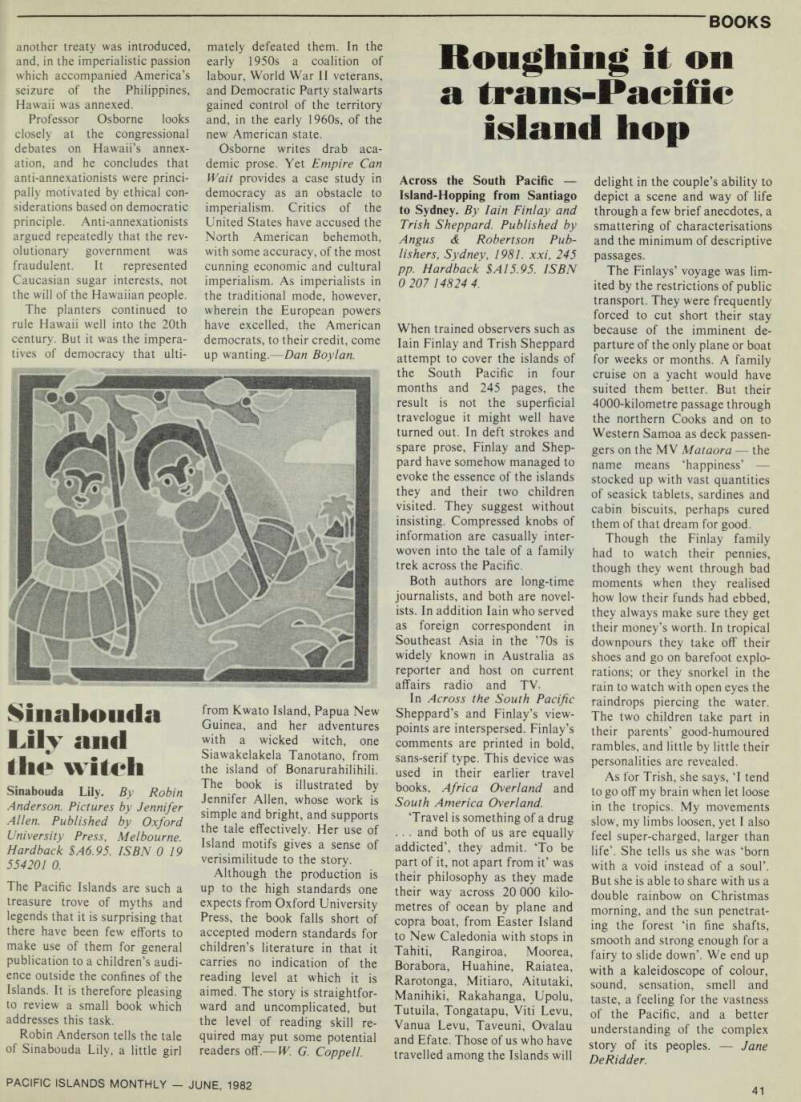
The book is illustrated by Jennifer Allen, whose work is simple and bright, and supports the tale effectively. Her use of Island motifs gives a sense of verisimilitude to the story.
Although the production is up to the high standards one expects from Oxford University Press, the book falls short of accepted modern standards for children’s literature in that it carries no indication of the reading level at which it is aimed. The story is straightfor ward and uncomplicated, but the level of reading skill re quired may put some potential readers off. — W. G. Coppell.