Tourist challenge for
p. 37 · Read in the full issue
the goers of Gizo
An enterprising, unconven tional young Solomon Islands couple are putting the Western Province island of Gizo on the map as a tourist resort.
Charlie and Brenda Panakera are transforming and revitalis ing the island’s only hotel in Gizo town and are also planning a thatched bungalow style resort on the island.
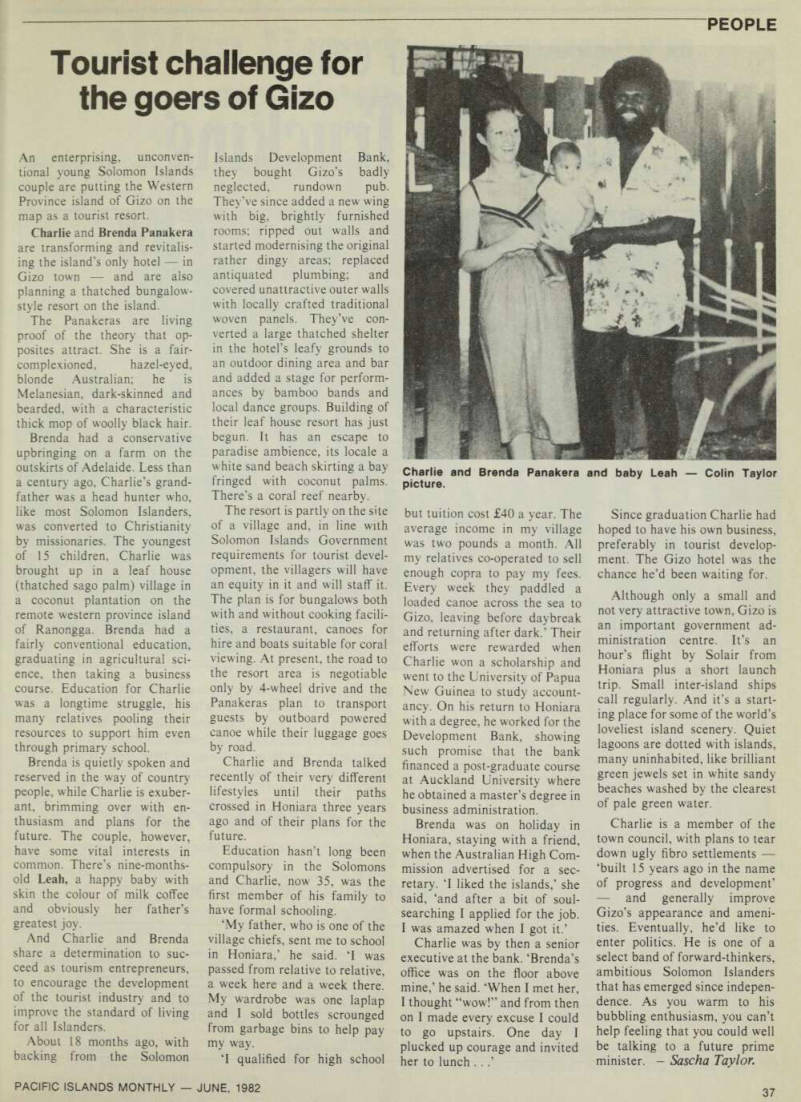
The Panakeras are living proof of the theory that op posites attract. She is a fair complexioned, hazel-eyed, blonde Australian; he is Melanesian, dark-skinned and bearded, with a characteristic thick mop of woolly black hair.
Brenda had a conservative upbringing on a farm on the outskirts of Adelaide. Less than a century ago, Charlie’s grand father was a head hunter who, like most Solomon Islanders, was converted to Christianity by missionaries. The youngest of 15 children, Charlie was brought up in a leaf house (thatched sago palm) village in a coconut plantation on the remote western province island of Ranongga. Brenda had a fairly conventional education, graduating in agricultural sci ence, then taking a business course. Education for Charlie was a longtime struggle, his many relatives pooling their resources to support him even through primary school.
Brenda is quietly spoken and reserved in the way of country people, while Charlie is exuber ant, brimming over with en thusiasm and plans for the future. The couple, however, have some vital interests in common. There’s nine-months old Leah, a happy baby with skin the colour of milk coffee and obviously her father’s greatest joy.
And Charlie and Brenda share a determination to suc ceed as tourism entrepreneurs, to encourage the development of the tourist industry and to improve the standard of living for all Islanders.
About 18 months ago, with backing from the Solomon
Islands Development Bank, they bought Gizo’s badly neglected, rundown pub.
They’ve since added a new wing with big, brightly furnished rooms; ripped out walls and started modernising the original rather dingy areas; replaced antiquated plumbing; and covered unattractive outer walls with locally crafted traditional woven panels. They’ve con verted a large thatched shelter in the hotel’s leafy grounds to an outdoor dining area and bar and added a stage for perform ances by bamboo bands and local dance groups. Building of their leaf house resort has just begun. It has an escape to paradise ambience, its locale a white sand beach skirting a bay fringed with coconut palms.
There’s a coral reef nearby.
The resort is partly on the site of a village and, in line with Solomon Islands Government requirements for tourist devel opment, the villagers will have an equity in it and will staff it.
The plan is for bungalows both with and without cooking facili ties, a restaurant, canoes for hire and boats suitable for coral viewing. At present, the road to the resort area is negotiable only by 4-wheel drive and the Panakeras plan to transport guests by outboard powered canoe while their luggage goes by road.
Charlie and Brenda talked recently of their very different lifestyles until their paths crossed in Honiara three years ago and of their plans for the future.
Education hasn’t long been compulsory in the Solomons and Charlie, now 35, was the first member of his family to have formal schooling. ‘My father, who is one of the village chiefs, sent me to school in Honiara,’ he said. T was passed from relative to relative, a week here and a week there.
My wardrobe was one laplap and I sold bottles scrounged from garbage bins to help pay my way.
T qualified for high school
but tuition cost £4O a year. The average income in my village was two pounds a month. All my relatives co-operated to sell enough copra to pay my fees.
Every week they paddled a loaded canoe across the sea to Gizo, leaving before daybreak and returning after dark.’ Their efforts were rewarded when Charlie won a scholarship and went to the University of Papua New Guinea to study account ancy. On his return to Honiara with a degree, he worked for the Development Bank, showing such promise that the bank financed a post-graduate course at Auckland University where he obtained a master’s degree in business administration.
Brenda was on holiday in Honiara, staying with a friend, when the Australian High Com mission advertised for a sec retary. T liked the islands,’ she said, ‘and after a bit of soul searching I applied for the job.
I was amazed when I got it.’
Charlie was by then a senior executive at the bank. ‘Brenda’s office was on the floor above mine,’ he said. ‘When I met her, I thought “wow!” and from then on I made every excuse I could to go upstairs. One day I plucked up courage and invited her to lunch . ..’
Since graduation Charlie had hoped to have his own business, preferably in tourist develop ment. The Gizo hotel was the chance he’d been waiting for.
Although only a small and not very attractive town, Gizo is an important government ad ministration centre. It’s an hour’s flight by Solair from Honiara plus a short launch trip. Small inter-island ships call regularly. And it’s a start ing place for some of the world’s loveliest island scenery. Quiet lagoons are dotted with islands, many uninhabited, like brilliant green jewels set in white sandy beaches washed by the clearest of pale green water.
Charlie is a member of the town council, with plans to tear down ugly fibre settlements ‘built 15 years ago in the name of progress and development’ and generally improve Gizo’s appearance and ameni ties. Eventually, he’d like to enter politics. He is one of a select band of forward-thinkers, ambitious Solomon Islanders that has emerged since indepen dence. As you warm to his bubbling enthusiasm, you can’t help feeling that you could well be talking to a future prime minister. - Sascha Taylor.
Charlie and Brenda Panakera and baby Leah - Colin Taylor picture.