People
pp. 33-36 · Read in the full issue
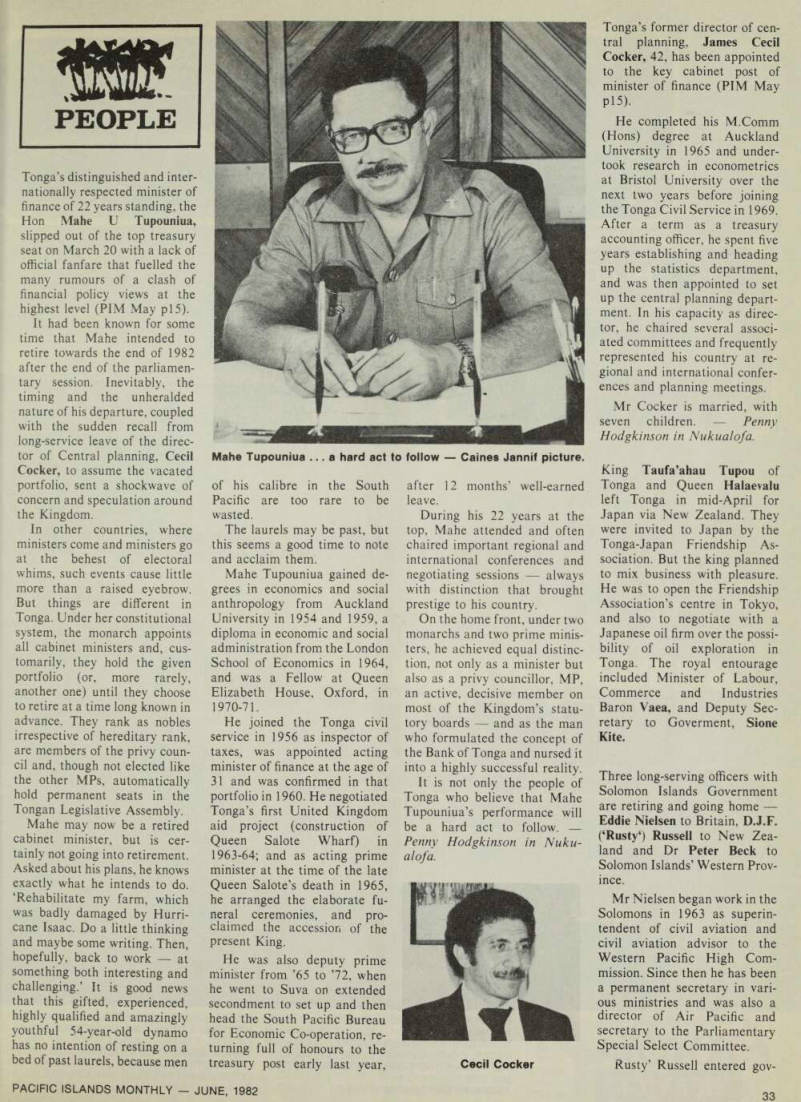


Tonga’s distinguished and inter nationally respected minister of finance of 22 years standing, the Hon Mahe U Tupouniua, slipped out of the top treasury seat on March 20 with a lack of official fanfare that fuelled the many rumours of a clash of financial policy views at the highest level (PIM May pls).
It had been known for some time that Mahe intended to retire towards the end of 1982 after the end of the parliamen tary session. Inevitably, the timing and the unheralded nature of his departure, coupled with the sudden recall from long-service leave of the direc tor of Central planning, Cecil Cocker, to assume the vacated portfolio, sent a shockwave of concern and speculation around the Kingdom.
In other countries, where ministers come and ministers go at the behest of electoral whims, such events cause little more than a raised eyebrow.
But things are different in Tonga. Under her constitutional system, the monarch appoints all cabinet ministers and, cus tomarily, they hold the given portfolio (or, more rarely, another one) until they choose to retire at a time long known in advance. They rank as nobles irrespective of hereditary rank, are members of the privy coun cil and, though not elected like the other MPs, automatically hold permanent seats in the Tongan Legislative Assembly.
Mahe may now be a retired cabinet minister, but is cer tainly not going into retirement.
Asked about his plans, he knows exactly what he intends to do. ‘Rehabilitate my farm, which was badly damaged by Hurri cane Isaac. Do a little thinking and maybe some writing. Then, hopefully, back to work at something both interesting and challenging.’ It is good news that this gifted, experienced, highly qualified and amazingly youthful 54-year-old dynamo has no intention of resting on a bed of past laurels, because men
of his calibre in the South Pacific are too rare to be wasted.
The laurels may be past, but this seems a good time to note and acclaim them.
Mahe Tupouniua gained de grees in economics and social anthropology from Auckland University in 1954 and 1959, a diploma in economic and social administration from the London School of Economics in 1964, and was a Fellow at Queen Elizabeth House, Oxford, in 1970-71.
He joined the Tonga civil service in 1956 as inspector of taxes, was appointed acting minister of finance at the age of 31 and was confirmed in that portfolio in 1960. He negotiated Tonga’s first United Kingdom aid project (construction of Queen Salote Wharf) in 1963-64; and as acting prime minister at the time of the late Queen Salote’s death in 1965, he arranged the elaborate fu neral ceremonies, and pro claimed the accession of the present King.
He was also deputy prime minister from ’65 to ’72, when he went to Suva on extended secondment to set up and then head the South Pacific Bureau for Economic Co-operation, re turning full of honours to the treasury post early last year,
after 12 months’ well-earned leave.
During his 22 years at the top, Mahe attended and often chaired important regional and international conferences and negotiating sessions always with distinction that brought prestige to his country.
On the home front, under two monarchs and two prime minis ters, he achieved equal distinc tion, not only as a minister but also as a privy councillor, MP, an active, decisive member on most of the Kingdom’s statu tory boards and as the man who formulated the concept of the Bank of Tonga and nursed it into a highly successful reality.
It is not only the people of Tonga who believe that Mahe Tupouniua’s performance will be a hard act to follow.
Penny Hodgkinson in Nuku alofa.
Tonga’s former director of cen tral planning, James Cecil Cocker, 42, has been appointed to the key cabinet post of minister of finance (PIM May pl 5).
He completed his M.Comm (Hons) degree at Auckland University in 1965 and under took research in econometrics at Bristol University over the next two years before joining the Tonga Civil Service in 1969.
After a term as a treasury accounting officer, he spent five years establishing and heading up the statistics department, and was then appointed to set up the central planning depart ment. In his capacity as direc tor, he chaired several associ ated committees and frequently represented his country at re gional and international confer ences and planning meetings.
Mr Cocker is married, with seven children. Penny Hodgkinson in Nukualofa.
King Taufa’ahau Tupou of Tonga and Queen Halaevalu left Tonga in mid-April for Japan via New Zealand. They were invited to Japan by the Tonga-Japan Friendship As sociation. But the king planned to mix business with pleasure.
He was to open the Friendship Association’s centre in Tokyo, and also to negotiate with a Japanese oil firm over the possi bility of oil exploration in Tonga. The royal entourage included Minister of Labour, Commerce and Industries Baron Vaea, and Deputy Sec retary to Goverment, Sione Kite.
Three long-serving officers with Solomon Islands Government are retiring and going home Eddie Nielsen to Britain, D.J.F. (‘Rusty 4 ) Russell to New Zea land and Dr Peter Beck to Solomon Islands’ Western Prov ince.
Mr Nielsen began work in the Solomons in 1963 as superin tendent of civil aviation and civil aviation advisor to the Western Pacific High Com mission. Since then he has been a permanent secretary in vari ous ministries and was also a director of Air Pacific and secretary to the Parliamentary Special Select Committee.
Rusty’ Russell entered gov
Mahe Tupouniua . . . a hard act to follow - Caines Jannif picture.
Cecil Cocker
ernment service in 1966 as an administrative officer, serving in the Eastern District, and then became commissioner of lands.
He has also been permanent secretary to the ministry of natural resources, and later pemanent secretary to the min istry of agriculture and lands.
Dr Beck, who hails from Ranongga Island, began a medical career with the Solomon Islands Government after graduating from the Fiji School of Medicine where he was top student in 1955, win ning three gold medals for medicine and obstetrics. He became assistant medical prac titioner for the government the following year and then steadily advanced, with the help of a diploma in public health from Otago University, to the pos ition of medical superintendent, then to chief medical officer, followed by stints as permanent secretary to the ministry of transport and communications (hardly horses for courses); and, lastly, permanent secretary of Malaita provincial affairs.
R.M.G. Varley, director of civil aviation in Fiji since the Civil Aviation Authority was created in 1979, has resigned. His successor is Jone Koroitamana, a former air traffic controller.
Air Pacific’s general manager marketing, Del Mannering, has announced a number of major changes within his department.
Mr Mannering said that the changes were part of a re organisational programme to solidify the marketing arm of the airline before he leaves at the end of the year on the expiry of his contract.
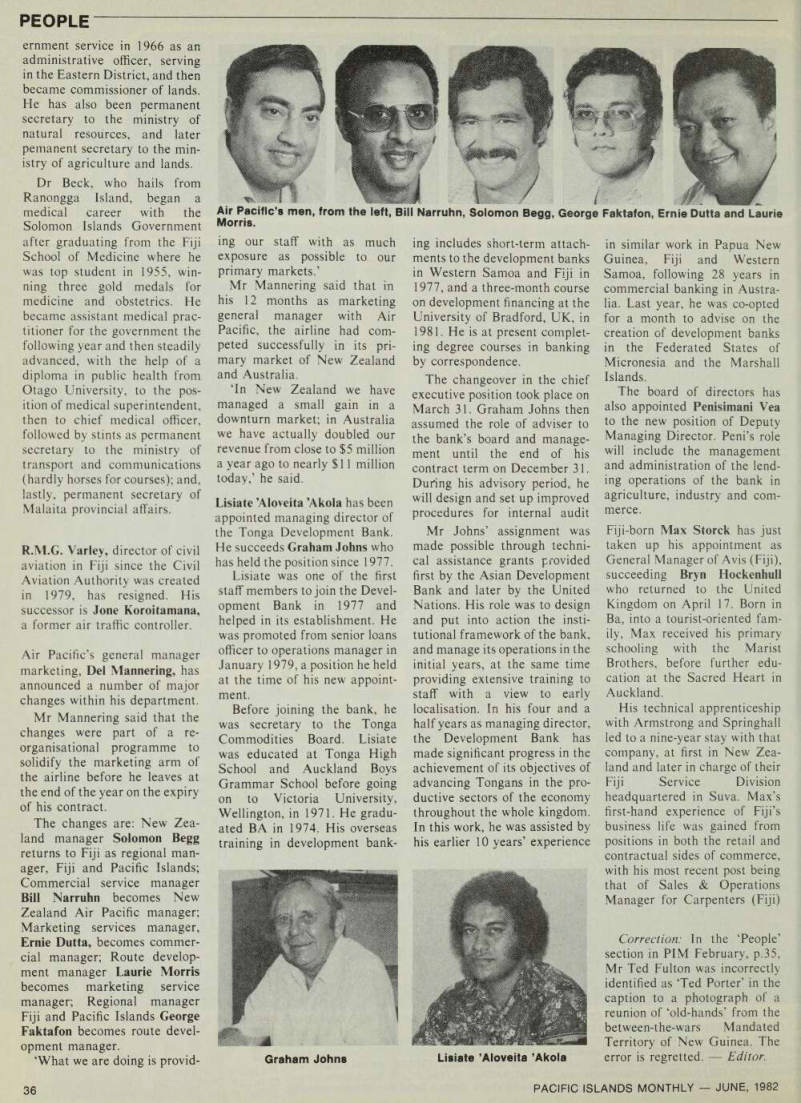
The changes are: New Zea land manager Solomon Begg returns to Fiji as regional man ager, Fiji and Pacific Islands; Commercial service manager Bill Narruhn becomes New Zealand Air Pacific manager; Marketing services manager, Ernie Dutta, becomes commer cial manager; Route develop ment manager Laurie Morris becomes marketing service manager; Regional manager Fiji and Pacific Islands George Faktafon becomes route devel opment manager. ‘What we are doing is provid-
ing our staff with as much exposure as possible to our primary markets.’
Mr Mannering said that in his 12 months as marketing general manager with Air Pacific, the airline had com peted successfully in its pri mary market of New Zealand and Australia. ‘ln New Zealand we have managed a small gain in a downturn market; in Australia we have actually doubled our revenue from close to $5 million a year ago to nearly $ll million today,’ he said.
Lisiate ’Aloveita ’Akola has been appointed managing director of the Tonga Development Bank.
He succeeds Graham Johns who has held the position since 1977.
Lisiate was one of the first staff members to join the Devel opment Bank in 1977 and helped in its establishment. He was promoted from senior loans officer to operations manager in January 1979, a position he held at the time of his new appoint ment.
Before joining the bank, he was secretary to the Tonga Commodities Board. Lisiate was educated at Tonga High School and Auckland Boys Grammar School before going on to Victoria University, Wellington, in 1971. He gradu ated BA in 1974. His overseas training in development bank-
ing includes short-term attach ments to the development banks in Western Samoa and Fiji in 1977, and a three-month course on development financing at the University of Bradford, UK, in 1981. He is at present complet ing degree courses in banking by correspondence.
The changeover in the chief executive position took place on March 31. Graham Johns then assumed the role of adviser to the bank’s board and manage ment until the end of his contract term on December 31.
During his advisory period, he will design and set up improved procedures for internal audit Mr Johns’ assignment was made possible through techni cal assistance grants provided first by the Asian Development Bank and later by the United Nations. His role was to design and put into action the insti tutional framework of the bank, and manage its operations in the initial years, at the same time providing extensive training to staff with a view to early localisation. In his four and a half years as managing director, the Development Bank has made significant progress in the achievement of its objectives of advancing Tongans in the pro ductive sectors of the economy throughout the whole kingdom.
In this work, he was assisted by his earlier 10 years’ experience
in similar work in Papua New Guinea, Fiji and Western Samoa, following 28 years in commercial banking in Austra lia. Last year, he was co-opted for a month to advise on the creation of development banks in the Federated States of Micronesia and the Marshall Islands.
The board of directors has also appointed Penisimani Vea to the new position of Deputy Managing Director. Peni’s role will include the management and administration of the lend ing operations of the bank in agriculture, industry and com merce.
Fiji-born Max Storck has just taken up his appointment as General Manager of Avis (Fiji), succeeding Bryn Hockenhull who returned to the United Kingdom on April 17. Born in Ba, into a tourist-oriented fam ily, Max received his primary schooling with the Marist Brothers, before further edu cation at the Sacred Heart in Auckland.
His technical apprenticeship with Armstrong and Springhall led to a nine-year stay with that company, at first in New Zea land and later in charge of their Fiji Service Division headquartered in Suva. Max’s first-hand experience of Fiji’s business life was gained from positions in both the retail and contractual sides of commerce, with his most recent post being that of Sales & Operations Manager for Carpenters (Fiji) Correction: In the ‘People’ section in PIM February, p. 35, Mr Ted Fulton was incorrectly identified as ‘Ted Porter’ in the caption to a photograph of a reunion of ‘old-hands’ from the between-the-wars Mandated Territory of New Guinea. The error is regretted. Editor.
Graham Johns
Air Pacific’s men, from the left, Bill Narruhn, Solomon Begg, George Faktafon, Ernie Dutta and Laurie Morris.
Lisiate ’Aloveita ’Akola