Cameras roll
pp. 23-27 · Read in the full issue
Tropicalities
Cameras roll on Islands themes
Three films of great interest were screened at the conference on ‘Australia and the South Pacific’ held in Canberra in February (PIM Apr pi 1).
First there was Sons for the Return Home, based on the novel by Albert Wendt, who was recently appointed pro fessor of English at the Univer sity of the South Pacific.
The novel is evidently based largely on his own experiences; he describes himself as ‘a Samoan with dash of German’, and he received most of his secondary and tertiary edu cation in New Zealand.
The film follows the novel fairly faithfully as it portrays the dilemmas, frustrations and
traumas experienced by a West ern Samoan migrant family in New Zealand in their quest for financial gain to provide a higher education for the younger son.
Central to the story are the barriers erected, partly de molished, re-erected, occasion ally breached, but never quite cleared encountered as the Samoan university student de velops an intense love-hate re lationship with his European girlfriend. For them the chances of establishing a lasting relationship are destroyed by the prejudices expressed, and the stereotyped views held, by most of the Samoans and New Zealanders with whom they come in contact.
Unfortunately, the film itself at times falls into the trap of presenting the very stereotypes it sets out to attack. The Samoan mother’s role is over played, the girl’s mother is too much the docile New Zealand middle-class housewife, and her father too patently the alcoholic tycoon.
There are also several scenes which essentially do not support the film’s theme, and would better have ended up ‘on the cutting-room floor’. This is es
pecially true of the scene in which the Samoan savagely beats up a European in a pub toilet. Such material can only reinforce the unwarranted view held by many New Zealanders that Pacific Islanders are nat urally violent people.
The end of the film has the Samoan returning again to New Zealand after a ‘return home’ that brought him only despair, confusion and a sense of anomie. As Wendt says in the novel: ‘All around him were people migrating to New Zea land. Silently they sat, trying to overcome their fears of the present of the plane explod ing into flames and hurtling down into the unforgiving solid ity of earth or into the sea, into a horrible oblivion. And more distressing, fears of what lay ahead a wilderness of cold, unknown cities in a country which they heard God had forsaken.’
The New Zealand Film Com mission has presented a notable film. Directed by Paul Maun der, it has Fiona Lindsay and Uelese Petaia in the main roles.
They portray with great under standing the passions and bewil derment felt by the two young people concerned.
The film was shot on location, and people familiar with the Western Samoan and New Zea land environments will find in it much to stir memories, and, especially to pose again ques tions about race relations which are of great significance in both countries.
The second film screened at the conference addresses the perennial problem of the histo rian; the need to examine both sides of past situations of conflict. In the case of the film Angels of War three scholars from the Australian National University Andrew Pike, Hank Nelson and Gavan Daws have sought to present as pects of Allied and Japanese involvement with the indigen ous peoples of Papua New
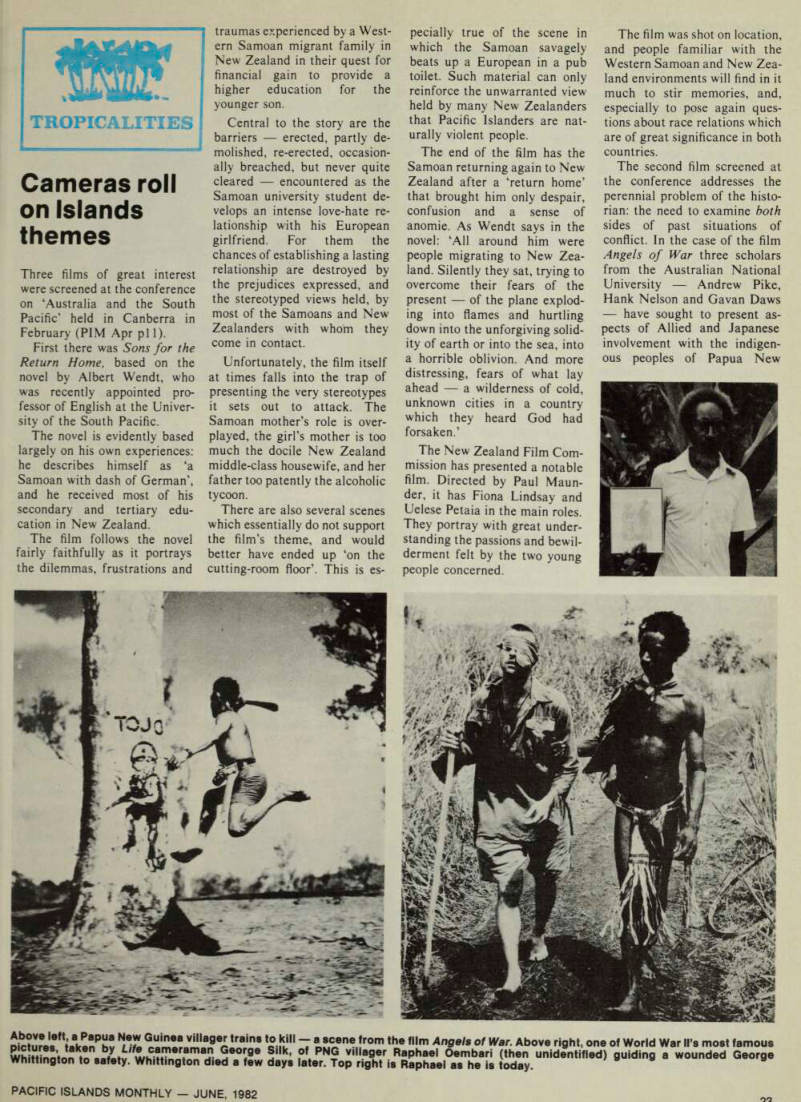
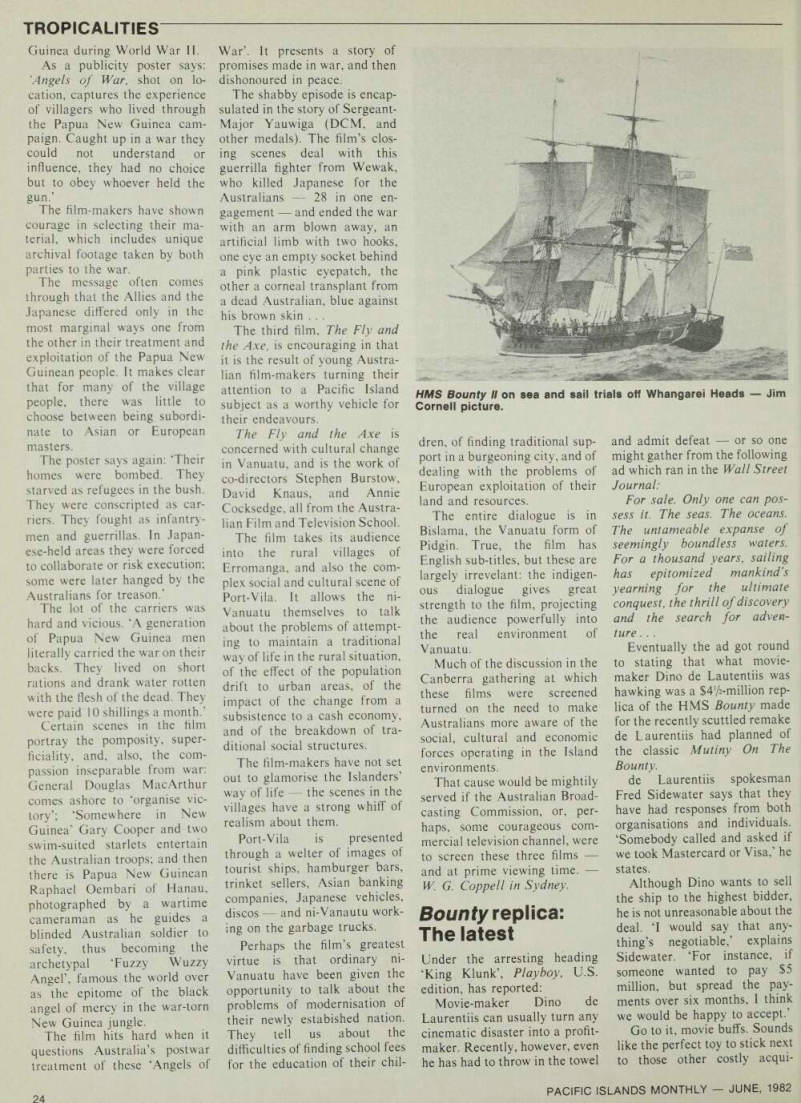
Above left, a Papua New Guinea villager trains to kill a scene from the film Angels of World War ll's most famous pictures, taken by Life cameraman George Silk, of PNG villager Raphael Oembari (then unidentifled) guiding a wounded George Whittington to safety. Whittington died a few days later. Top right is Raphael as he is today.
Guinea during World War 11.
As a publicity poster says: ‘Angels of War, shot on lo cation, captures the experience of villagers who lived through the Papua New Guinea cam paign. Caught up in a war they could not understand or influence, they had no choice but to obey whoever held the gun.’
The film-makers have shown courage in selecting their ma terial, which includes unique archival footage taken by both parties to the war.
The message often comes through that the Allies and the Japanese differed only in the most marginal ways one from the other in their treatment and exploitation of the Papua New Guinean people. It makes clear that for many of the village people, there was little to choose between being subordi nate to Asian or European masters.
The poster says again: ‘Their homes were bombed. They starved as refugees in the bush.
They were conscripted as car riers. They fought as infantry men and guerrillas. In Japan ese-held areas they were forced to collaborate or risk execution; some were later hanged by the Australians for treason.’
The lot of the carriers was hard and vicious. ‘A generation of Papua New Guinea men literally carried the war on their backs. They lived on short rations and drank water rotten with the flesh of the dead. They were paid 10 shillings a month.’
Certain scenes in the film portray the pomposity, super ficiality, and, also, the com
passion inseparable from war:
General Douglas MacArthur comes ashore to ‘organise vic tory’; ‘Somewhere in New Guinea’ Gary Cooper and two swim-suited starlets entertain the Australian troops; and then there is Papua New Guinean Raphael Oembari of Hanau, photographed by a wartime cameraman as he guides a blinded Australian soldier to safety, thus becoming the archetypal ‘Fuzzy Wuzzy Angel’, famous the world over as the epitome of the black angel of mercy in the war-torn New Guinea jungle.
The film hits hard when it questions Australia’s postwar treatment of these ‘Angels of
War’. It presents a story of promises made in war, and then dishonoured in peace.
The shabby episode is encap sulated in the story of Sergeant- Major Yauwiga (DCM, and other medals). The film’s clos ing scenes deal with this guerrilla fighter from Wewak, who killed Japanese for the Australians 28 in one en gagement and ended the war with an arm blown away, an artificial limb with two hooks, one eye an empty socket behind a pink plastic eyepatch, the other a corneal transplant from a dead Australian, blue against his brown skin . . .
The third film. The Fly and the Axe, is encouraging in that it is the result of young Austra lian film-makers turning their attention to a Pacific Island subject as a worthy vehicle for their endeavours.
The Fly and the Axe is concerned with cultural change in Vanuatu, and is the work of co-directors Stephen Burstow, David Knaus, and Annie Cocksedge, all from the Austra lian Film and Television School.
The film takes its audience into the rural villages of Erromanga, and also the com plex social and cultural scene of Port-Vila. It allows the ni- Vanuatu themselves to talk about the problems of attempt ing to maintain a traditional way of life in the rural situation, of the effect of the population drift to urban areas, of the impact of the change from a subsistence to a cash economy, and of the breakdown of tra ditional social structures.
The film-makers have not set out to glamorise the Islanders’ way of life the scenes in the villages have a strong whiff of realism about them.
Port-Vila is presented through a welter of images of tourist ships, hamburger bars, trinket sellers, Asian banking companies, Japanese vehicles, discos and ni-Vanautu work ing on the garbage trucks.
Perhaps the film’s greatest virtue is that ordinary ni- Vanuatu have been given the opportunity to talk about the problems of modernisation of their newly estabished nation.
They tell us about the difficulties of finding school fees for the education of their chil-
dren, of finding traditional sup port in a burgeoning city, and of dealing with the problems of European exploitation of their land and resources.
The entire dialogue is in Bislama, the Vanuatu form of Pidgin. True, the film has English sub-titles, but these are largely irrevelant: the indigen ous dialogue gives great strength to the film, projecting the audience powerfully into the real environment of Vanuatu.
Much of the discussion in the Canberra gathering at which these films were screened turned on the need to make Australians more aware of the social, cultural and economic forces operating in the Island environments.
That cause would be mightily served if the Australian Broad casting Commission, or, per haps, some courageous com mercial television channel, were to screen these three films and at prime viewing time.
W. G. Coppell in Sydney.
Bounty replica;
The latest
Under the arresting heading ‘King Klunk’, Playboy, U.S. edition, has reported: Movie-maker Dino de Laurentiis can usually turn any cinematic disaster into a profit maker. Recently, however, even he has had to throw in the towel
and admit defeat or so one might gather from the following ad which ran in the Wall Street Journal: For sale. Only one can pos sess it. The seas. The oceans.
The untameable expanse of seemingly boundless waters.
For a thousand years, sailing has epitomized mankind’s yearning for the ultimate conquest, the thrill of discovery and the search for adven ture . . .
Eventually the ad got round to stating that what movie maker Dino de Lautentiis was hawking was a s4‘/2-million rep lica of the HMS Bounty made for the recently scuttled remake de Laurentiis had planned of the classic Mutiny On The Bounty. de Laurentiis spokesman Fred Sidewater says that they have had responses from both organisations and individuals. ‘Somebody called and asked if we took Mastercard or Visa,’ he states.
Although Dino wants to sell the ship to the highest bidder, he is not unreasonable about the deal. ‘I would say that any thing’s negotiable,’ explains Sidewater. ‘For instance, if someone wanted to pay $5 million, but spread the pay ments over six months, I think we would be happy to accept.’
Go to it, movie buffs. Sounds like the perfect toy to stick next to those other costly acqui
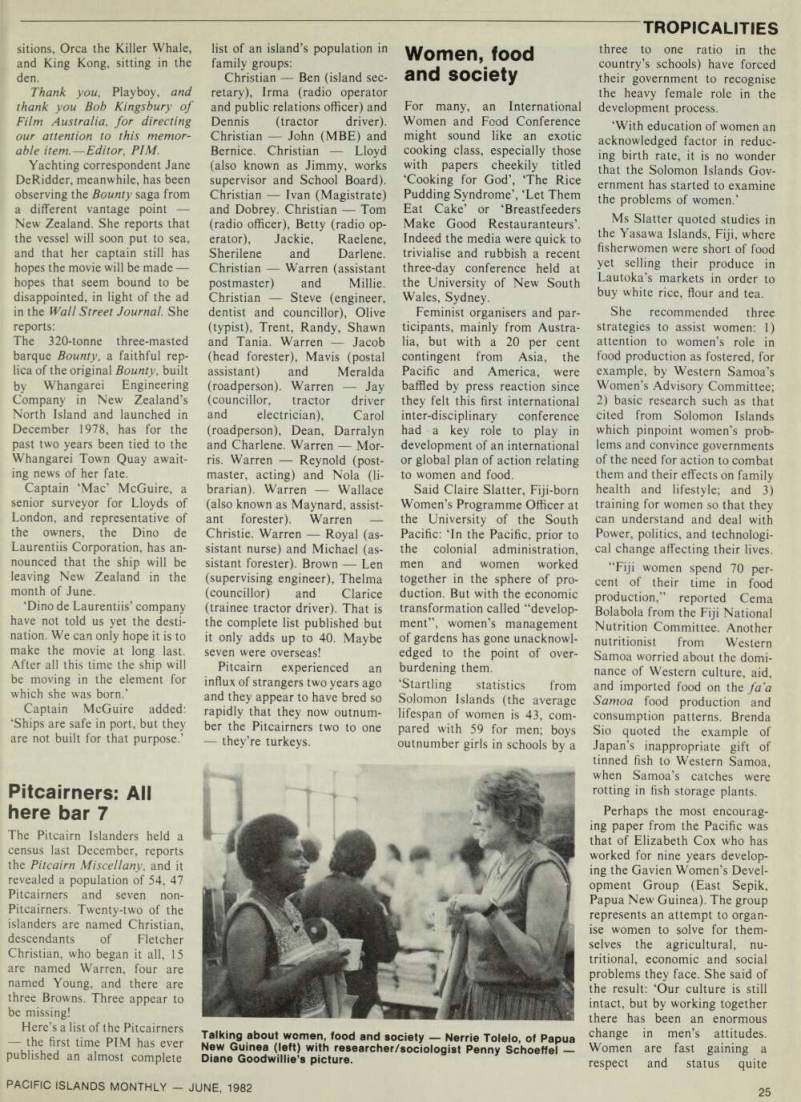
HMS Bounty II on sea and sail trials off Whangarei Heads Jim Cornell picture.
sitions, Orca the Killer Whale, and King Kong, sitting in the den.
Thank you, Playboy, and thank you Bob Kingsbury of Film Australia, for directing our attention to this memor able item. — Editor, PIM.
Yachting correspondent Jane Deßidder, meanwhile, has been observing the Bounty saga from a different vantage point New Zealand. She reports that the vessel will soon put to sea, and that her captain still has hopes the movie will be made hopes that seem bound to be disappointed, in light of the ad in the Wall Street Journal. She reports: The 320-tonne three-masted barque Bounty, a faithful rep lica of the original Bounty, built by Whangarei Engineering Company in New Zealand’s North Island and launched in December 1978, has for the past two years been tied to the Whangarei Town Quay await ing news of her fate.
Captain ‘Mac’ McGuire, a senior surveyor for Lloyds of London, and representative of the owners, the Dino de Laurentiis Corporation, has an nounced that the ship will be leaving New Zealand in the month of June. ‘Dino de Laurentiis’ company have not told us yet the desti nation. We can only hope it is to make the movie at long last.
After all this time the ship will be moving in the element for which she was born.’
Captain McGuire added; ‘Ships are safe in port, but they are not built for that purpose.’
Pitcairners: All
here bar 7
The Pitcairn Islanders held a census last December, reports the Pitcairn Miscellany, and it revealed a population of 54, 47 Pitcairners and seven non- Pitcairners. Twenty-two of the islanders are named Christian, descendants of Fletcher Christian, who began it all, 15 are named Warren, four are named Young, and there are three Browns. Three appear to be missing!
Here’s a list of the Pitcairners the first time PIM has ever published an almost complete
list of an island’s population in family groups: Christian Ben (island sec retary), Irma (radio operator and public relations officer) and Dennis (tractor driver).
Christian John (MBE) and Bernice. Christian Lloyd (also known as Jimmy, works supervisor and School Board).
Christian Ivan (Magistrate) and Dobrey. Christian Tom (radio officer), Betty (radio op erator), Jackie, Raelene, Sherilene and Darlene.
Christian Warren (assistant postmaster) and Millie.
Christian Steve (engineer, dentist and councillor), Olive (typist), Trent, Randy, Shawn and Tania. Warren Jacob (head forester), Mavis (postal assistant) and Meralda (roadperson). Warren Jay (councillor, tractor driver and electrician), Carol (roadperson), Dean, Darralyn and Charlene. Warren Mor ris. Warren Reynold (post master, acting) and Nola (li brarian). Warren Wallace (also known as Maynard, assist ant forester). Warren Christie. Warren Royal (as sistant nurse) and Michael (as sistant forester). Brown Len (supervising engineer), Thelma (councillor) and Clarice (trainee tractor driver). That is the complete list published but it only adds up to 40. Maybe seven were overseas!
Pitcairn experienced an influx of strangers two years ago and they appear to have bred so rapidly that they now outnum ber the Pitcairners two to one they’re turkeys.
Women, food
and society
For many, an International Women and Food Conference might sound like an exotic cooking class, especially those with papers cheekily titled ‘Cooking for God’, ‘The Rice Pudding Syndrome’, ‘Let Them Eat Cake’ or ‘Breastfeeders Make Good Restauranteurs’, Indeed the media were quick to trivialise and rubbish a recent three-day conference held at the University of New South Wales, Sydney.
Feminist organisers and par ticipants, mainly from Austra lia, but with a 20 per cent contingent from Asia, the Pacific and America, were baffled by press reaction since they felt this first international inter-disciplinary conference had a key role to play in development of an international or global plan of action relating to women and food.
Said Claire Slatter, Fiji-born Women’s Programme Officer at the University of the South Pacific: ‘ln the Pacific, prior to the colonial administration, men and women worked together in the sphere of pro duction. But with the economic transformation called “develop ment’’, women’s management of gardens has gone unacknowl edged to the point of over burdening them. ‘Startling statistics from Solomon Islands (the average lifespan of women is 43, com pared with 59 for men; boys outnumber girls in schools by a
three to one ratio in the country’s schools) have forced their government to recognise the heavy female role in the development process. ‘With education of women an acknowledged factor in reduc ing birth rate, it is no wonder that the Solomon Islands Gov ernment has started to examine the problems of women.’
Ms Slatter quoted studies in the Yasawa Islands, Fiji, where fisherwomen were short of food yet selling their produce in Lautoka’s markets in order to buy white rice, flour and tea.
She recommended three strategies to assist women: 1) attention to women’s role in food production as fostered, for example, by Western Samoa’s Women’s Advisory Committee; 2) basic research such as that cited from Solomon Islands which pinpoint women’s prob lems and convince governments of the need for action to combat them and their effects on family health and lifestyle; and 3) training for women so that they can understand and deal with Power, politics, and technologi cal change affecting their lives.
“Fiji women spend 70 per cent of their time in food production,’’ reported Cema Bolabola from the Fiji National Nutrition Committee. Another nutritionist from Western Samoa worried about the domi nance of Western culture, aid, and imported food on the fa’a Samoa food production and consumption patterns. Brenda Sio quoted the example of Japan’s inappropriate gift of tinned fish to Western Samoa, when Samoa’s catches were rotting in fish storage plants.
Perhaps the most encourag ing paper from the Pacific was that of Elizabeth Cox who has worked for nine years develop ing the Gavien Women’s Devel opment Group (East Sepik, Papua New Guinea). The group represents an attempt to organ ise women to solve for them selves the agricultural, nu tritional, economic and social problems they face. She said of the result: ‘Our culture is still intact, but by working together there has been an enormous change in men’s attitudes.
Women are fast gaining a respect and status quite
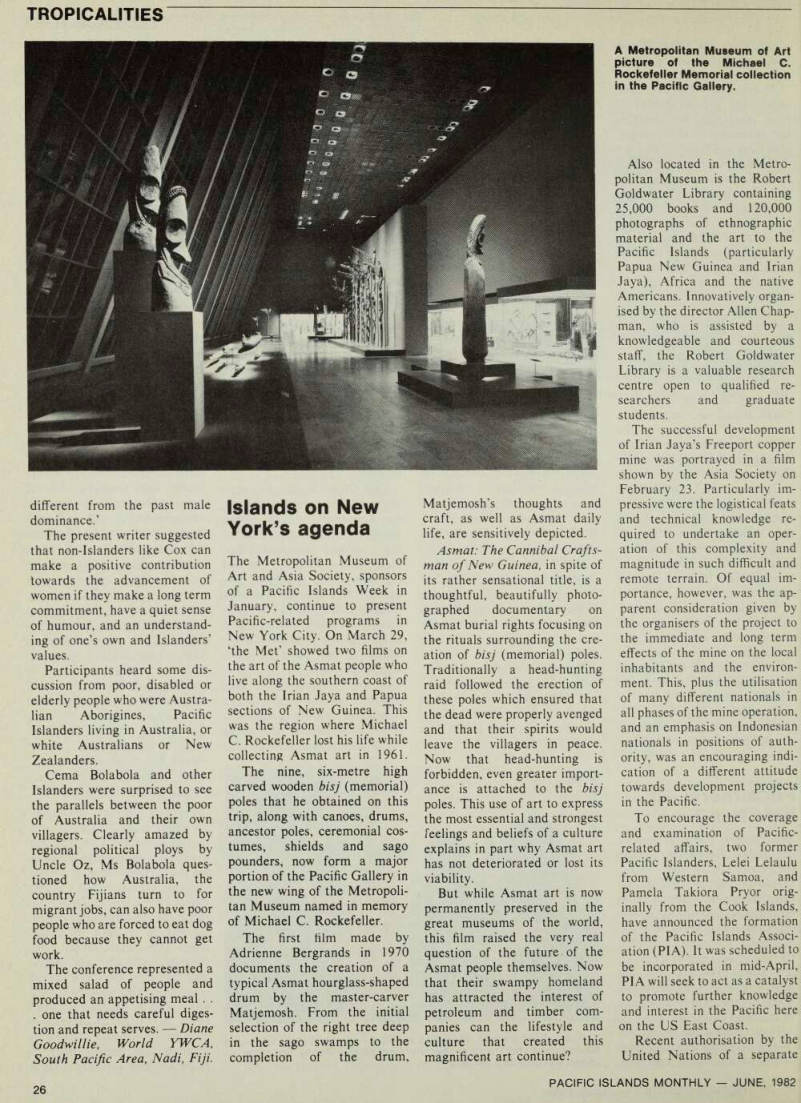
Talking about women, food and society Nerrie Tolelo, of Papua New Guinea (left) with researcher/sociologist Penny Schoeffel Diane Goodwillie’s picture.
different from the past male dominance.’
The present writer suggested that non-islanders like Cox can make a positive contribution towards the advancement of women if they make a long term commitment, have a quiet sense of humour, and an understand ing of one’s own and Islanders’ values.
Participants heard some dis cussion from poor, disabled or elderly people who were Austra lian Aborigines, Pacific Islanders living in Australia, or white Australians or New Zealanders.
Cema Bolabola and other Islanders were surprised to see the parallels between the poor of Australia and their own villagers. Clearly amazed by regional political ploys by Uncle Oz, Ms Bolabola ques tioned how Australia, the country Fijians turn to for migrant jobs, can also have poor people who are forced to eat dog food because they cannot get work.
The conference represented a mixed salad of people and produced an appetising meal . . . one that needs careful diges tion and repeat serves. Diane Goodwillie, World YWCA, South Pacific Area, Nadi, Fiji.
Islands on New
York’s agenda
The Metropolitan Museum of Art and Asia Society, sponsors of a Pacific Islands Week in January, continue to present Pacific-related programs in New York City. On March 29, ‘the Met’ showed two films on the art of the Asmat people who live along the southern coast of both the Irian Jaya and Papua sections of New Guinea. This was the region where Michael C. Rockefeller lost his life while collecting Asmat art in 1961.
The nine, six-metre high carved wooden bisj (memorial) poles that he obtained on this trip, along with canoes, drums, ancestor poles, ceremonial cos tumes, shields and sago pounders, now form a major portion of the Pacific Gallery in the new wing of the Metropoli tan Museum named in memory of Michael C. Rockefeller.
The first film made by Adrienne Bergrands in 1970 documents the creation of a typical Asmat hourglass-shaped drum by the master-carver Matjemosh. From the initial selection of the right tree deep in the sago swamps to the completion of the drum,
Matjemosh’s thoughts and craft, as well as Asmat daily life, are sensitively depicted.
Asmat: The Cannibal Crafts man of New Guinea, in spite of its rather sensational title, is a thoughtful, beautifully photo graphed documentary on Asmat burial rights focusing on the rituals surrounding the cre ation of bisj (memorial) poles.
Traditionally a head-hunting raid followed the erection of these poles which ensured that the dead were properly avenged and that their spirits would leave the villagers in peace.
Now that head-hunting is forbidden, even greater import ance is attached to the bisj poles. This use of art to express the most essential and strongest feelings and beliefs of a culture explains in part why Asmat art has not deteriorated or lost its viability.
But while Asmat art is now permanently preserved in the great museums of the world, this film raised the very real question of the future of the Asmat people themselves. Now that their swampy homeland has attracted the interest of petroleum and timber com panies can the lifestyle and culture that created this magnificent art continue?
Also located in the Metro politan Museum is the Robert Goldwater Library containing 25,000 books and 120,000 photographs of ethnographic material and the art to the Pacific Islands (particularly Papua New Guinea and Irian Jaya), Africa and the native Americans. Innovatively organ ised by the director Allen Chap man, who is assisted by a knowledgeable and courteous staff, the Robert Goldwater Library is a valuable research centre open to qualified re searchers and graduate students.
The successful development of Irian Jaya’s Freeport copper mine was portrayed in a film shown by the Asia Society on February 23. Particularly im pressive were the logistical feats and technical knowledge re quired to undertake an oper ation of this complexity and magnitude in such difficult and remote terrain. Of equal im portance, however, was the ap parent consideration given by the organisers of the project to the immediate and long term effects of the mine on the local inhabitants and the environ ment. This, plus the utilisation of many different nationals in all phases of the mine operation, and an emphasis on Indonesian nationals in positions of auth ority, was an encouraging indi cation of a different attitude towards development projects in the Pacific.
To encourage the coverage and examination of Pacific related affairs, two former Pacific Islanders, Lelei Lelaulu from Western Samoa, and Pamela Takiora Pryor orig inally from the Cook Islands, have announced the formation of the Pacific Islands Associ ation (PIA). It was scheduled to be incorporated in mid-April, PIA will seek to act as a catalyst to promote further knowledge and interest in the Pacific here on the US East Coast.
Recent authorisation by the United Nations of a separate
A Metropolitan Museum of Art picture of the Michael C.
Rockefeller Memorial collection in the Pacific Gallery.
Pacific Islands radio section which will broadcast directly to the Pacific by satellite is another indication of the grow ing consideration given the Pacific Islands by the rest of the world. With a potential 27 votes in the UN, and the increased power projected by a 200-mile boundary under the proposed Law of the Sea Treaty, Pacific countries are becoming increas ingly important as components of the world’s political scene, in addition to their strategic and economic assets. —Caroline Yacoe in New York.
Madang’s German
cartridge cache
Recent excavations in the town of Madang, on Papua New Guinea’s north coast, have un covered an interesting cache of relics dating from the pre- World War I German colonial administraton.
Madang, known as Friedrich Wilhelmshafen in those times, was established in the early 1890 s. From 1892-96 it was the capital of the German Protec torate in New Guinea, then called Kaiser Wilhelmsland.
Today it is a busy commercial centre and popular tourist re sort, as well as being the provincial capital.
An alert youngster, noticing an odd-shaped cartridge case in some disturbed earth near what was the town centre in German times, returned with a metal detector to uncover nearly 500 others like it. Upon examination they proved to be 11 mm (.433 inch) rifle cartridges of a type issued to indigenous police for use in their Model 1871 Mauser carbines and rifles.
The cartridges are brass, bottle-shaped and measure ap proximately 58 mm in length.
Originally they were filled with 77 grains of black powder which fired their blunt-nosed lead bullets at a speed of 1430 feet per second. This is far short of the 3250 fps developed in the Colt AR-15 rifle which Papua New Guinea’s Mobile Police squads are issued with today!
Most of the shells were thickly encrusted with sediment and many were badly corroded but those that were cleaned revealed dates of manufacture ranging from 1879-88.
Why so many should have been found together remains a mystery, but one possible expla nation is that they were ex pended during target practice and returned to stores for audit purposes. They may have been deliberately dumped when ac counted for, or otherwise aban doned at the time of the Austra lian military occupation which took place in September, 1914.
R. J. Giddings.
‘Cobra’ fungus
draws crowds
A fungus sprouting through discarded copies of The Fiji Times in a garden shed at the home of Mr Shiu Nath, of Narere, Nasinu, Fiji, has brought large crowds of Hindu worshippers to the scene.
The fungus is shaped like the head of a cobra, the sacred snake revered by Hindus as a protector of the God, Shiva.
They believe that a cobra coils itself around the neck of Shiva to protect him. Mr Nath’s daughter-in-law, Mrs Urmila Wati Nand, was clearing the shed when she noticed the cobra image protruding from a heap of newspapers. When the news of the peculiar growth spread, Hindu devotees crowded to the spot and accorded it special honours, some of the people garlanding it with flowers.
The Fiji Times, wondering, probably, whether its beneficent influence had produced the phenomenon, invited microbiologist Dr Phillip Whitney and marine biologist Dr Uday Raj, both of the University of the South Pacific, to examine it.
Pronounced Dr Whitney: ‘lt is a fungus called Polypor, suggesting the many pores from which spores of the fungus are produced. It is similar in nature to mushrooms, except that mushrooms have gills from which spores are produced. This particular one has grown from a root or a piece of rotting wood on which the fungus is growing.
It could alter its shape at a later stage or just dry up and harden in its present form.’
Dr Raj commented: ‘Of significance is its peculiar shape, and this has, perhaps, misled the people into relating it with Lord Shiva.’