The four snowy-haired weapons
p. 21 · Read in the full issue
of the Pacific Peacemaker
When the controversial ketch Pacific Peacemaker eventually joins an international peace armada on the west coast of the USA during August to oppose deployment of the Ohio, first of the gigantic Trident-class sub marines, the most potent ‘weapons’ on board could well be four snowy-haired young sters, who are far from pushovers when it comes to nuclear debate.
If you ask nine-year-old Scott Ethell or his sister Kate about the Trident, they’ll retort: ‘At $3OOO million each they’re equal to all the US federal funds spent in a year on edu cation.’ Sisters Lee, five, and Nina, three, also seem well informed.
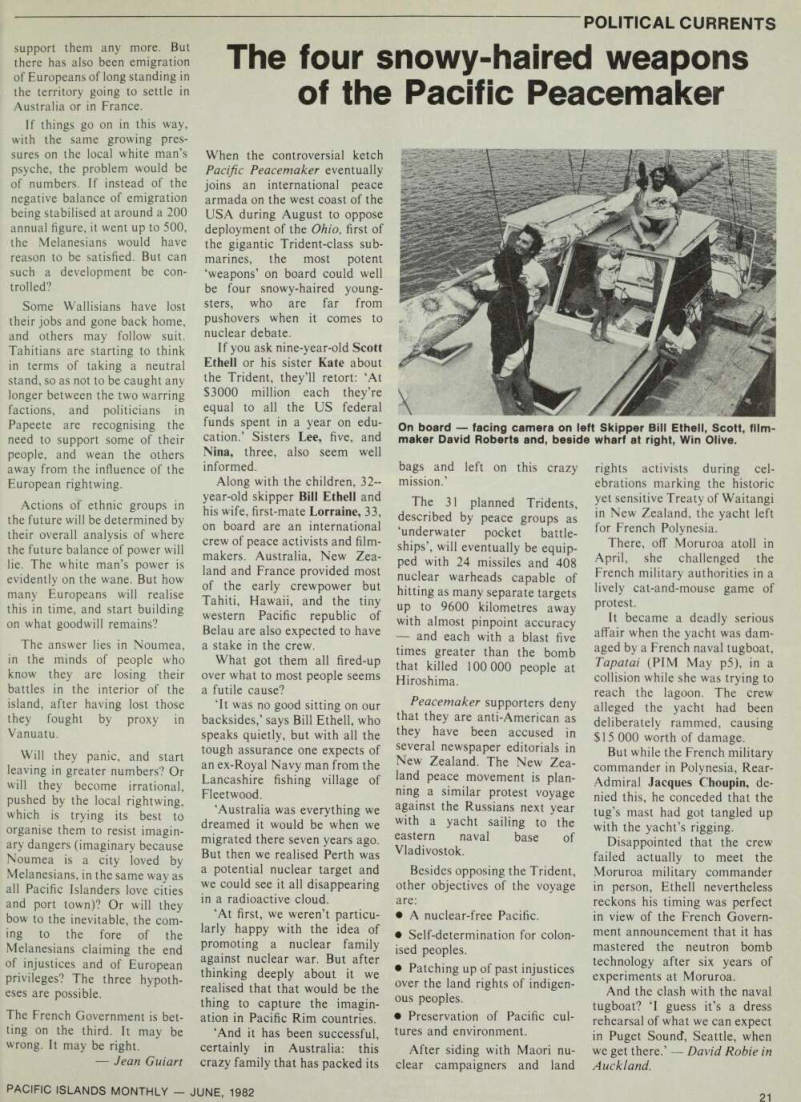
Along with the children, 32year-old skipper Bill Ethell and his wife, first-mate Lorraine, 33, on board are an international crew of peace activists and film makers. Australia, New Zea land and France provided most of the early crewpower but Tahiti, Hawaii, and the tiny western Pacific republic of Belau are also expected to have a stake in the crew.
What got them all fired-up over what to most people seems a futile cause? ‘lt was no good sitting on our backsides,’ says Bill Ethell, who speaks quietly, but with all the tough assurance one expects of an ex-Royal Navy man from the Lancashire fishing village of Fleetwood. ‘Australia was everything we dreamed it would be when we migrated there seven years ago.
But then we realised Perth was a potential nuclear target and we could see it all disappearing in a radioactive cloud. ‘At first, we weren’t particu larly happy with the idea of promoting a nuclear family against nuclear war. But after thinking deeply about it we realised that that would be the thing to capture the imagin ation in Pacific Rim countries. ‘And it has been successful, certainly in Australia: this crazy family that has packed its
bags and left on this crazy mission.’
The 31 planned Tridents, described by peace groups as ‘underwater pocket battle ships’, will eventually be equip ped with 24 missiles and 408 nuclear warheads capable of hitting as many separate targets up to 9600 kilometres away with almost pinpoint accuracy and each with a blast five times greater than the bomb that killed 100 000 people at Hiroshima.
Peacemaker supporters deny that they are anti-American as they have been accused in several newspaper editorials in New Zealand. The New Zea land peace movement is plan ning a similar protest voyage against the Russians next year with a yacht sailing to the eastern naval base of Vladivostok.
Besides opposing the Trident, other objectives of the voyage are: • A nuclear-free Pacific. • Self-determination for colon ised peoples. • Patching up of past injustices over the land rights of indigen ous peoples. • Preservation of Pacific cul tures and environment.
After siding with Maori nu clear campaigners and land
rights activists during cel ebrations marking the historic yet sensitive Treaty of Waitangi in New Zealand, the yacht left for French Polynesia.
There, off Moruroa atoll in April, she challenged the French military authorities in a lively cat-and-mouse game of protest.
It became a deadly serious affair when the yacht was dam aged by a French naval tugboat, Tapatai (PIM May p 5), in a collision while she was trying to reach the lagoon. The crew alleged the yacht had been deliberately rammed, causing $l5 000 worth of damage.
But while the French military commander in Polynesia, Rear- Admiral Jacques Choupin, de nied this, he conceded that the tug’s mast had got tangled up with the yacht’s rigging.
Disappointed that the crew failed actually to meet the Moruroa military commander in person, Ethell nevertheless reckons his timing was perfect in view of the French Govern ment announcement that it has mastered the neutron bomb technology after six years of experiments at Moruroa.
And the clash with the naval tugboat? T guess it’s a dress rehearsal of what we can expect in Puget Sound’, Seattle, when
we get there.’
David Robie in
Auckland.
On board facing camera on left Skipper Bill Ethell, Scott, film maker David Roberts and, beside wharf at right, Win Olive.