change not
pp. 28-29 · Read in the full issue
French winds of change not for Tahiti
The question we heard most often during a recent trip through the Western Pacific, Australia and New Zealand, concerned the reforms launched by President Mitterrand and his men since they took over the reins of government 13 months ago. We should therefore like to devote our June chronicle to this subject.
Let us say right away that, paradoxically enough, the changes so far have been much more important and far-reaching in metropolitan France than in her remaining overseas territories.
To begin with, the new prime minister immediately sent a bill to parliament doing away with the whole rigidly centralised form of government devised by Napoleon, which permitted him and all succeeding French rulers, be they kings, emperors or presidents to regulate the lives of their subjects in the minutest detail through the agency of uniformed, gold-braided prefets or pro-consuls, who acted solely on orders from Paris. To most Frenchmen it seemed a most revolutionary, if not sacrilegious, act to do away, at one stroke of the pen, with this long-standing apparatus. But when they discovered that the extensive powers enjoyed by the prefets were to be turned over to elected regional assemblies, almost comparable to the state legislatures in Australia, all political parties enthusiastically approved the bold reform.
Since the main argument in favour of the new legislation was that decisions directly concerning the provinces should be made by local residents, and not by anonymous bureaucrats in Paris, it should, of course, apply with even greater force to such an overseas territory as French Polynesia, located at the other end of the world.
This is also what a long succession of Polynesian leaders have
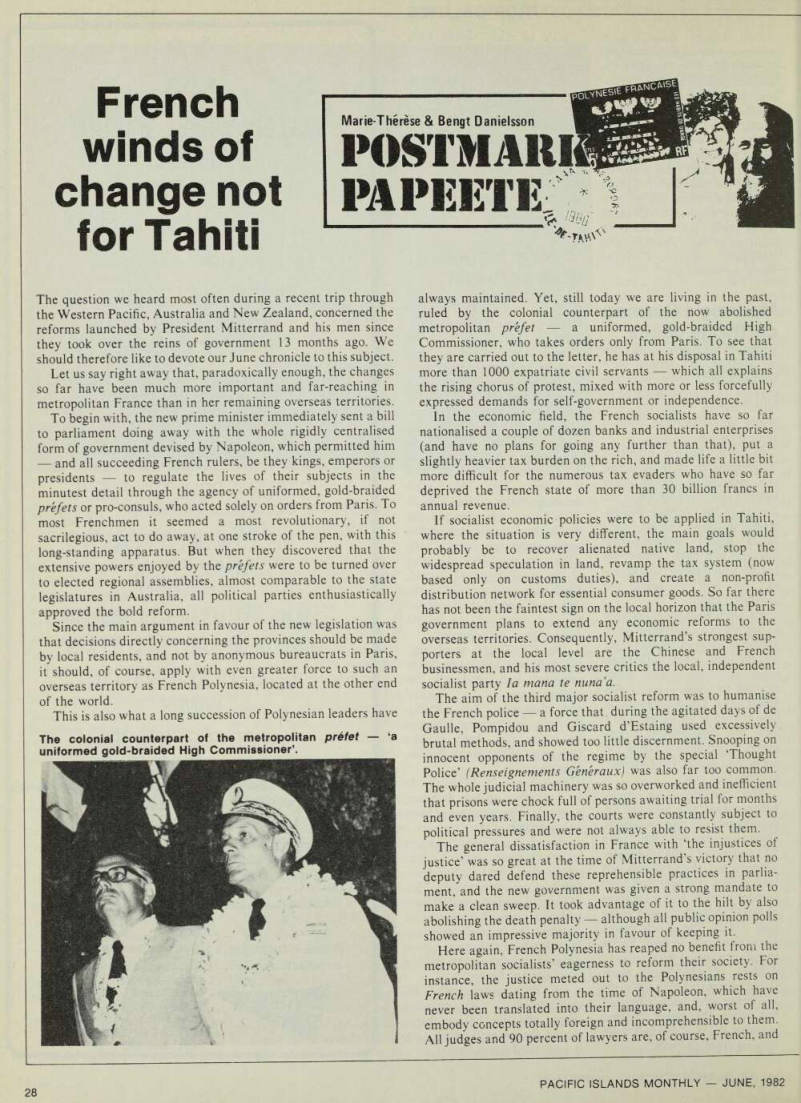
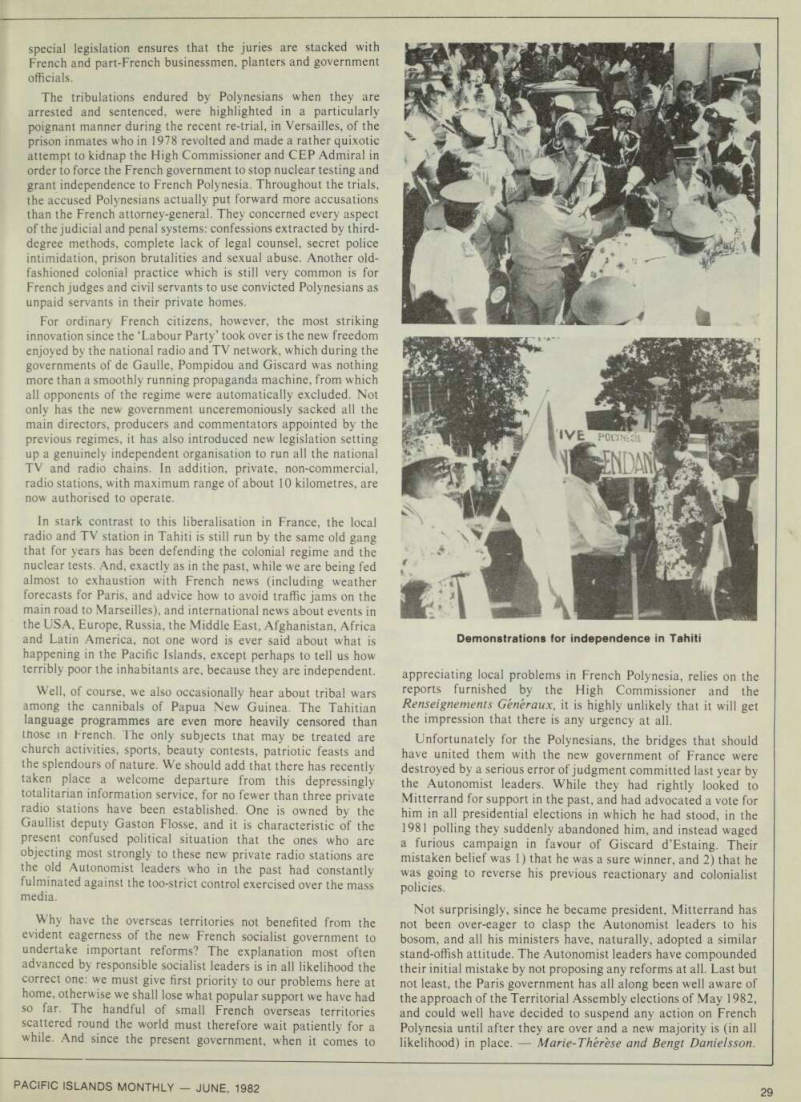
always maintained. Yet, still today we are living in the past, ruled by the colonial counterpart of the now abolished metropolitan pr'efet a uniformed, gold-braided High Commissioner, who takes orders only from Paris. To see that they are carried out to the letter, he has at his disposal in Tahiti more than 1000 expatriate civil servants which all explains the rising chorus of protest, mixed with more or less forcefully expressed demands for self-government or independence.
In the economic field, the French socialists have so far nationalised a couple of dozen banks and industrial enterprises (and have no plans for going any further than that), put a slightly heavier tax burden on the rich, and made life a little bit more difficult for the numerous tax evaders who have so far deprived the French state of more than 30 billion francs in annual revenue.
If socialist economic policies were to be applied in Tahiti, where the situation is very different, the main goals would probably be to recover alienated native land, stop the widespread speculation in land, revamp the tax system (now based only on customs duties), and create a non-profit distribution network for essential consumer goods. So far there has not been the faintest sign on the local horizon that the Paris government plans to extend any economic reforms to the overseas territories. Consequently, Mitterrand’s strongest sup porters at the local level are the Chinese and French businessmen, and his most severe critics the local, independent socialist party la mana te nuna’a.
The aim of the third major socialist reform was to humanise the French police a force that during the agitated days of de Gaulle, Pompidou and Giscard d’Estaing used excessively brutal methods, and showed too little discernment. Snooping on innocent opponents of the regime by the special ‘Thought Police’ (Renseignements Generaux) was also far too common.
The whole judicial machinery was so overworked and inefficient that prisons were chock full of persons awaiting trial for months and even years. Finally, the courts were constantly subject to political pressures and were not always able to resist them.
The general dissatisfaction in France with ‘the injustices of justice’ was so great at the time of Mitterrand’s victory that no deputy dared defend these reprehensible practices in parlia ment, and the new government was given a strong mandate to make a clean sweep. It took advantage of it to the hilt by also abolishing the death penalty although all public opinion polls showed an impressive majority in favour of keeping it.
Here again, French Polynesia has reaped no benefit from the metropolitan socialists’ eagerness to reform their society. For instance, the justice meted out to the Polynesians rests on French laws dating from the time of Napoleon, which have never been translated into their language, and, worst of all, embody concepts totally foreign and incomprehensible to them.
All judges and 90 percent of lawyers are, of course, French, and
The colonial counterpart of the metropolitan préfel - 'a uniformed gold-braided High Commissioner’.
special legislation ensures that the juries are stacked with French and part-French businessmen, planters and government officials.
The tribulations endured by Polynesians when they are arrested and sentenced, were highlighted in a particularly poignant manner during the recent re-trial, in Versailles, of the prison inmates who in 1978 revolted and made a rather quixotic attempt to kidnap the High Commissioner and CEP Admiral in order to force the French government to stop nuclear testing and grant independence to French Polynesia. Throughout the trials, the accused Polynesians actually put forward more accusations than the French attorney-general. They concerned every aspect of the judicial and penal systems: confessions extracted by third degree methods, complete lack of legal counsel, secret police intimidation, prison brutalities and sexual abuse. Another old fashioned colonial practice which is still very common is for French judges and civil servants to use convicted Polynesians as unpaid servants in their private homes.
For ordinary French citizens, however, the most striking innovation since the ‘Labour Party’ took over is the new freedom enjoyed by the national radio and TV network, which during the governments of de Gaulle, Pompidou and Giscard was nothing more than a smoothly running propaganda machine, from which all opponents of the regime were automatically excluded. Not only has the new government unceremoniously sacked all the main directors, producers and commentators appointed by the previous regimes, it has also introduced new legislation setting up a genuinely independent organisation to run all the national TV and radio chains. In addition, private, non-commercial, radio stations, with maximum range of about 10 kilometres, are now authorised to operate.
In stark contrast to this liberalisation in France, the local radio and TV station in Tahiti is still run by the same old gang that for years has been defending the colonial regime and the nuclear tests. And, exactly as in the past, while we are being fed almost to exhaustion with French news (including weather forecasts for Paris, and advice how to avoid traffic jams on the main road to Marseilles), and international news about events in the USA, Europe, Russia, the Middle East, Afghanistan, Africa and Latin America, not one word is ever said about what is happening in the Pacific Islands, except perhaps to tell us how terribly poor the inhabitants are, because they are independent.
Well, of course, we also occasionally hear about tribal wars among the cannibals of Papua New Guinea. The Tahitian language programmes are even more heavily censored than those in French. The only subjects that may be treated are church activities, sports, beauty contests, patriotic feasts and the splendours of nature. We should add that there has recently taken place a welcome departure from this depressingly totalitarian information service, for no fewer than three private radio stations have been established. One is owned by the Gaullist deputy Gaston Flosse, and it is characteristic of the present confused political situation that the ones who are objecting most strongly to these new private radio stations are the old Autonomist leaders who in the past had constantly fulminated against the too-strict control exercised over the mass media.
Why have the overseas territories not benefited from the evident eagerness of the new French socialist government to undertake important reforms? The explanation most often advanced by responsible socialist leaders is in all likelihood the correct one: we must give first priority to our problems here at home, otherwise we shall lose what popular support we have had so far. The handful of small French overseas territories scattered round the world must therefore wait patiently for a while. And since the present government, when it comes to
appreciating local problems in French Polynesia, relies on the reports furnished by the High Commissioner and the Renseignements Generaux, it is highly unlikely that it will get the impression that there is any urgency at all.
Unfortunately for the Polynesians, the bridges that should have united them with the new government of France were destroyed by a serious error of judgment committed last year by the Autonomist leaders. While they had rightly looked to Mitterrand for support in the past, and had advocated a vote for him in all presidential elections in which he had stood, in the 1981 polling they suddenly abandoned him, and instead waged a furious campaign in favour of Giscard d’Estaing. Their mistaken belief was 1) that he was a sure winner, and 2) that he was going to reverse his previous reactionary and colonialist policies.
Not surprisingly, since he became president, Mitterrand has not been over-eager to clasp the Autonomist leaders to his bosom, and all his ministers have, naturally, adopted a similar stand-offish attitude. The Autonomist leaders have compounded their initial mistake by not proposing any reforms at all. Last but not least, the Paris government has all along been well aware of the approach of the Territorial Assembly elections of May 1982, and could well have decided to suspend any action on French Polynesia until after they are over and a new majority is (in all likelihood) in place. Marie-Therese and Bengt Danielsson.
Demonstrations for independence in Tahiti