Seven-nation Nauru Agreement
pp. 51-54 · Read in the full issue

Trade
Winds
Seven-nation Nauru Agreement shows its teeth in Danica seizure
A Special PIM Correspondent in Rabaul, Papua New Guinea, provides a full rundown on the recent dramatic seizure by PNG authorities of the US superseiner Danica, for illegal fishing in PNG’s 200-mile economic zone.
The prosecution in March of the US-registered, 1500-ton superseiner Danica for illegally fishing in Papua New Guinea’s 200-mile economic zone was the direct outcome of a new inter national fishing agreement signed by seven Island states in February (PIM Mar p 5).
The prosecution and its after math successfully demon strated to the US that the South Pacific is serious in its new ‘get tough’ approach to those caught pirating its economic resources.
The Danica affair began on February 10 with the arrest of the Danica by PNG defence forces while 35 miles inside the 200-mile zone. The ship had been spotted earlier by a PNG Government aircraft, the Gruman Gulfstream G 2 Kumul I, on a surveillance flight.
Danica was brought to the nearest port, Rabaul, while PNG Government officials de cided whether or not to pros ecute the captain for illegal fishing. If the ship had been Korean or Taiwanese there would not have been second thoughts. But the United States refuses to recognise the 200-mile jurisdiction when fish ing for highly migratory species, and says Pacific countries have no jurisdiction beyond 12 miles.
It was unfortunate for the Danica that while she was being escorted into port, PNG’s Min ister for Foreign Affairs and Trade, Noel Levi, was leading a PNG fisheries delegation to Nauru for the signing of the Agreement to Co-ordinate the Exploitation of Common Fisheries Resources.
This agreement is a pact aimed specifically at preventing distant water fishing nations from playing one Island group off against another.
It is a ‘get tough’ pact which will strengthen the Islanders’ bargaining position in dealing with fishing agreements by
regulating the issuing of fishing licences to foreign companies.
Under its terms, the Islands will swap details of fishing arrangements, including licence fees, before any agreements are signed. The Nauru Agreement, as it has already become known, is the result of Island anger at seeing their most important resource stolen from under their noses by distant water nations.
Nauru signatories besides PNG were Solomon Islands, Nauru, Kiribati, the Federated States of Micronesia, Belau and Marshall Islands.
Becuase the Micronesian states technically are still under the control of the United States as administering power of the UN Trust Territory of the Pacific Islands, US officials sought to be admitted to the Nauru ceremony but were rebuffed at the door an incident which toughened PNG’s resolve to move against the Danica as an example to others that there was a new feeling of solidarity in the Islands.
On his return to Port Moresby Foreign Affairs Minis
ter Levi said PNG had a firm policy on illegal fishing and those who flouted it would have to take the consequences. He remarked in a personal aside that ‘it would be a good thing for us’ if charges were laid and the owners penalised.
Prime Minister Sir Julius Chan, who had been following the situation closely, said PNG was not going to be cheated of fish ‘by unscrupulous inter national operators’.
Up to this time, American Embassy officials in Port Moresby had taken the not unreasonable view that the de tention of the Danica was an embarrassment to all parties, and that PNG would probably look the other way while Danica sailed off into the sunset. It now began to appear that PNG was serious.
Any doubts were dissolved when the Danica's captain was charged in Rabaul with illegal fishing, and fined by a magis trate K5OO (about SA6SO), and his ship ordered confiscated with its catch intact.
Now began weeks of nego tiations with embassy officials,
the ship’s owners (the Z Corpor ation) and the American Tuna Boat Association (represented personally by president August Felandro). At the PNG end, the prime minister’s department, the department of foreign affairs and trade and the depart ment of primary industry were all involved.
The scenario of the dis cussions would make a three-act play, with all the ingredients of drama and comedy.
At various stages Prime Min ister Chan, Foreign Affairs Minister Levi and Primary In dustry Minister Paul Torato got cold feet, but never all three at the one time.
One of the complicating fac tors was that the US Govern ment might have been forced by
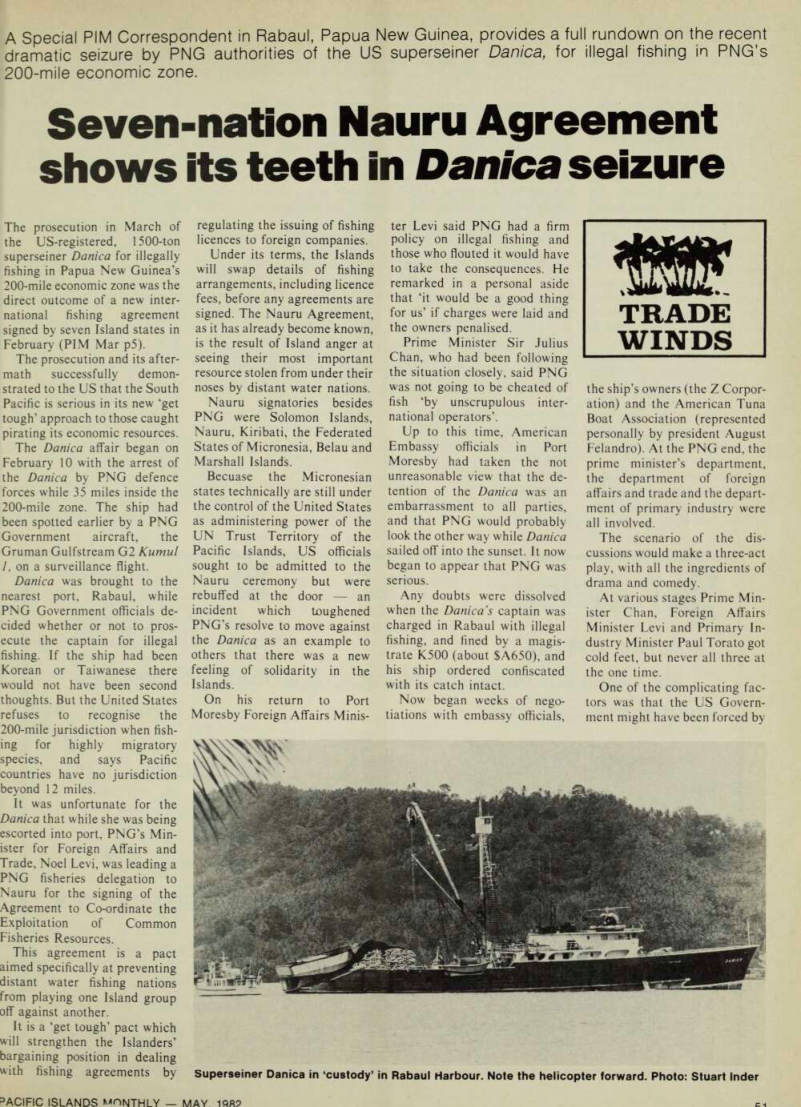
Superseiner Danica in ‘custody’ in Rabaul riarbour. Note the helicopter forward. Photo: Stuart Inder
rules of its own making to put an embargo on trade between PNG and the US.
Another was that the PNG Government is a four-party coalition, and there is not the Cabinet discipline that is found in many other Westminster type governments. Sir Julius couldn’t always get the act together so his Government could speak as one firm voice.
But the final result was along the lines he was aiming for.
Danica was released to its owners for K2OO 000, and the American Tuna Boat Associ ation entered into an agreement with PNG for its members to pay licence fees in future.
Sir Julius saw it as the victory it was, despite the views of the local press who considered it a ‘sell-out’ to release the Danica at a fraction of its value, and appeared to consider the licens ing agreement as a temporary, fairly hollow arrangement.
Sir Julius said the Danica affair would produce a message that should be heard ‘loud and clear at the Law of the Sea
Conference in New York’.
He said the affair had been of great service to PNG and other Pacific nations far more valuable than the release fee of K2OO 000 indicated. It showed that PNG would ‘not bow down to foreign interests, and that anybody caught poaching our fish will be prosecuted, regard less of their nationality’.
He added: ‘l’m sure the message will be received by foreign fishing companies. I am equally sure that in the not-too distant future we will look back on this episode as the turning point when PNG at last began to receive a just deal for the wealth that comes from our waters.’
This view was supported pub licly by the Australian Govern ment and by Fiji’s Prime Minis ter Ratu Sir Kamisese Mara significant support in Mara’s case because he had been a little toffee-nosed at not having been invited to sign the Nauru Agreement.
PNG’s action so close on the heels of the Nauru Agreement,
was the best advertisement the Islands could have that they do mean business.
And to underline the fact that it has every intention of follow ing through, PNG on March 11 officially opened a Surveillance Centre which will be engaged in policing PNG fishing grounds, as well as guarding the nation against smuggling and illegal immigration.
The centre is jointly operated by the department of defence, department of primary industry (fisheries division), department of transport and civil aviation (maritime division) and the bureau of customs. ‘Unlike the smaller Pacific nations,’ said Sir Julius in opening the centre, ‘PNG is fortunate to have the finances to effect some measure of deter rence. With this centre to co ordinate surveillance, we should at last be able to protect our resources effectively.”
Sir Julius made no effort to hide his delight that an inciden tal bonus of the Danica affair, which would carry over into the
Surveillance Centre’s activities, was the expanded use of the Kumul 1. His government has been under attack for wasting public funds in the purchase of the aircraft, which it uses for VIPs when commercial aircraft schedules are found to be unsat isfactory.
Kumul I was carrying mem bers of the PNG Defence Force’s operations branch when it sighted Danica , and at least three other unlicensed foreign fishing vessels the same week.
She will be used for similar operations by the Surveillance Centre.
The agreement with the Tuna Boat Association was signed on March 17 and expires on December 31 this year. This date was chosen because it is the expiry date of an earlier agreement the association has with the Micronesian states.
New agreements will thus all begin together on January 1 next.
Under the Micronesian agreement, covering an area of three million square miles, and
known as a regional licensing contract, the association pays the three Micronesian states involved a fee of SUSSO for each registered ton of boats fishing in those waters. In Micronesia’s case, this fee is divided between the three states so that each gets about $l6 per registered ton.
PNG is to be paid $35 per ton, which the association con siders to be a better deal than the Micronesians get. This, though, is a matter of how you do your arithmetic and how you cut the cake.
PNG could argue that its licensing fee should be divided between its maritime provinces and insist on them all getting $l6 too. Foreign Minister Levi went on record as saying after the negotiations that $BO might have been a more appropriate fee for PNG.
But the point is that renegotiation is no farther away than year’s end, and PNG has bought itself time to look at the whole question of fees more closely, in co-operation with its Nauru Agreement partners.
Footnote: The US tuna fleet covered by the association com prises 132 purse seiners, of which 22 are fishing in the Western and Central Pacific.
Of these only one third are fishing at the one time, while one third are in port and one third are either headed for port or for the fishing grounds.
Tonga: Industry
on the-up
Tonga’s manufacturing indus try food, leather goods, knitwear and wood products employing 747 men and 369 women, mainly on Tongalapu, produced goods valued at STB 086 000 in 1980, an in crease of 42.2 percent over the 1979 figure. • • • Lloyds Bank International Ltd, with the support of the United Kingdom Exports Credits Guarantee Department, has made an export credit of SUSIOO million available to Ok Tedi Mining Ltd. The credit is part of the financing needed for stage one of a SUSBSO million programme for the develop-
ment of the Ok Tedi mine near the Irian Jaya border.
Maiden plan
for Vanuatu
Vanuatu has adopted its first five-year development plan. The plan represents the first stage of a larger one designed to make the country economically self reliant in 10-15 years.
Total capital requirements assessed as necessary for the next five years are 11 billion vatu (the new national cur rency) which is the equivalent of $ AllO million. Of this sum 58 percent is allocated to the economic sector, 15 percent to the social sector, 24 percent for infrastructural works, and three percent for government ser vices.
Regional specialisation is projected, with coconut plan tations having priority in the north, coffee in the south, for estry and cattle in the central area, with industrial centres in Santo, Port-Vila and Tanna. lan Mclntyre in Port-Vila.
Tonga’s iSD is
underway
Tonga’s international sub scriber dialling system began operating in February.
Financed by the European Economic Community under its regional programme for the Pacific, the system is part of a wider project which includes the funding of the navigation
and communication equipment at Tonga's Fuaamolu airport (ST66O 000), and the Rural Development Centre ($1 150 000). The dialling sys tem equipment imported from Australia cost $336 000. • • • Burns Philp and Co of Sydney have formed a new company, Vanuatu Travel Services, to take over the general sales agency of Air Pacific in Vanuatu.
The company also made a present of one of its old inter island ships, Kathleen, to the Vanuatu Tourist Authority The ship will join two other wrecks, the three-masted barquentine Star of Russia and an ex-Qantas S-25 Sandringham flying boat, on the floor of Port-Vila harbour as an exploration site for scuba di vers.
Plans were afoot to have the words ‘Burns Philp are every where’ painted in very large letters on the side of Kathleen before she is committed to the depths. • • • Papua New Guinea-based Steamship Trading Company recorded an eight percent rise in earnings for the last six months of 1981. Pre-tax profit was down from $A4.56 million to $4.36 million on a 16 percent turnover of $75.58 million.
A lordly look
at the
problems of
Pitcairn
Development aid worth SAS million would gladden the hearts of the people of Pitcairn Island (population 50-plus). But Britain’s House of Lords was told at the end of February that all the islanders can expect are a modern communication sys tem, and a new longboat.
Pitcairn’s perilous position a shrinking population, only two or three supply ships a year, a dwindling labour force, a disintegrating jetty, landed on the Lords’ order paper through the efforts of New Zealander Glynn Christian, a direct de scendant of Fletcher Christian, who works in London as a foqd writer and broadcaster.
Mr Christian, who visited relatives on the island 18 months ago to research his book on Pitcairn, Fragile Paradise, due out in a few months, is campaigning for help for the islanders, who have made him their London representative.
Mr Christian lobbied the Lords; hence the debate, but he wasn’t satisfied.
A new longboat and a com munications system are only a drop in the ocean, he says. They need aid worth $5 million, to be spent on boats, a new jetty, better medical services, a radio telephone system and an air strip. The last item was sug gested a few months ago and, according to those who have studied the matter, including the island’s isolated position and its topography, an airstrip is a feasible proposition.
But the Lords were told that aid would be limited to a new boat and improved communi cations; and that the Pitcairners had reserves of $1,275 million.
Men from the Royal Engin eers were on the island in 1976 and they constructed a new jetty. But, reports Glynn Christian, it was sited in the wrong place and narrowed the bay entrance, creating a vicious whirlpool which is damaging the jetty and making longboat landings even more perilous than before.
Glynn Christian is hoping
Niufala Mane
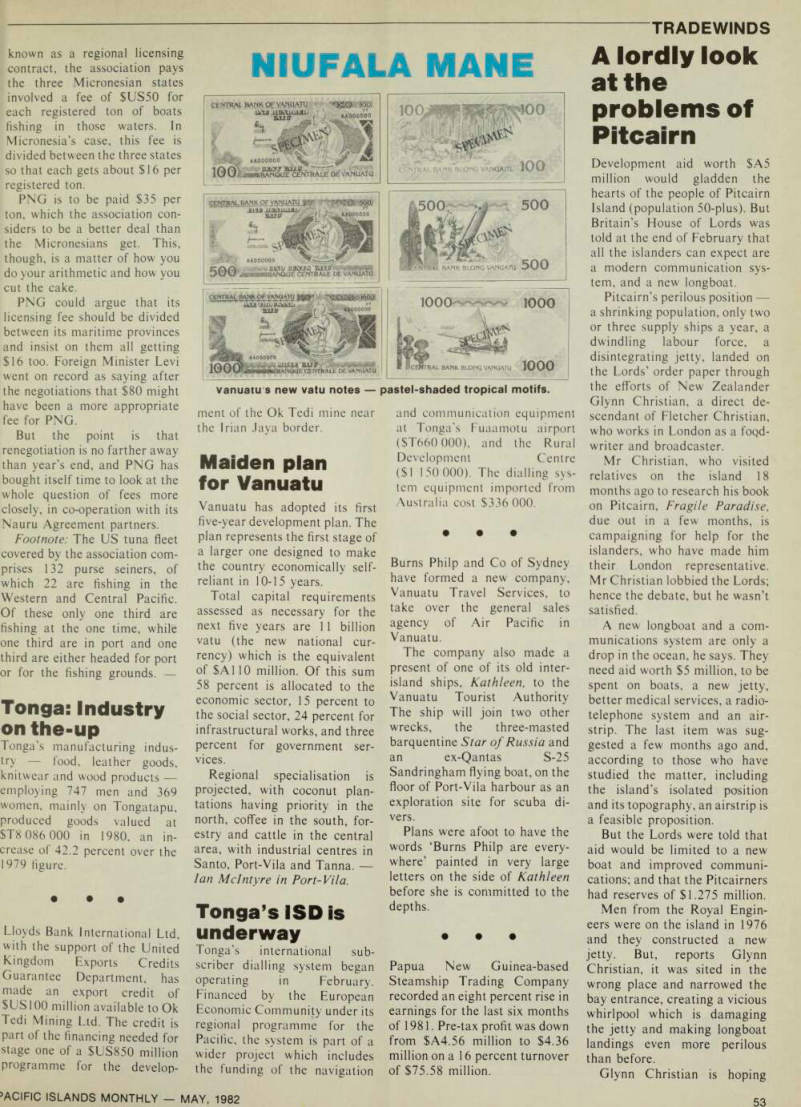
Vanuatu's new vatu notes-pastel-shaded tropical motifs.
that help might be engineered by the New Zealand-based Vol unteer Service Abroad.
Meanwhile, a new problem has arisen for the Pitcairners. A new Nationality Bill in Britain has taken away their British passports.
They’re waiting to hear what the British Government is going to do about it; whether they will become New Zealanders, or, perhaps, Fijians in whose orbit they circled for many years, governed from an office in Suva.
Meanwhile, they are still on the list of the United Nations’
Committee of 24 as a colony needing to be independent!
SWSIOO solar
heater
A solar healer costing SWSIOO has been devised and a proto type produced by the Western Samoa-based firm Oceania Ap propriate Technology Ltd in association with the University of Samoa. Managing director Clem Hibbot described the heater as a major breakthrough for the firm, which also makes building hardboard and furni ture from coconut husks. It is intended to market the heater under the name of ‘Samosolar Collector'. • • • Two German citizens, Bruno Schwegnarn and Heinz Bauer, have opened a restaurant at Antebuka in Kiribati. They have invested SA4SO 000 in the project. Built in traditional Gilbertese style, it is modelled on the lines of the maneaba, or meeting house, and is named the Maneaba Restaurant. • • • The Pacific Area Travel Associ ation (PATA) will hold its 1982 Marketing Workshop at the Lakeside International Hotel, Canberra, Australia, from June 10-13. lan L. Kennedy, director of the association’s South Pacific regional office, expects more than 250 people to attend. • • • Solomon Islands Parliament has approved a plan to build an
airstrip at North Choiseul in the Western district. The govern ment has also agreed to write off 55632 000 of debts of $l.B million owing by provinces. The remainder will be converted to 10-year loans. • • • Work will begin in Japan about the middle of this year on two new ships which Japan is giving to the Solomon Islands as part of its aid programme. The ships, intended for inter-island traffic, will be of 105 tonnes gross with a cruising speed of seven knots. • • • The Papua New Guinea Gov ernment is hoping to produce 40 000 tonnes of white sugar a year from its sugar mill com plex which is being built at a cost of about SABS million on part of the Gusap Downs cattle ranch in southern Madang Province, about 200 kilometres from Lae. The builders are Kawasaki Heavy Industries.
The complex is expected to be ready to take the first harvest of cane in July an antici pated 11 000 tonnes and maximum capacity is expected to be attained in about four years. Two main varieties of cane are being grown at Ramu.
They are Nagnar, an old Aus tralian variety, and Q9O, a variety developed in Queens land.
About a third of the cane will be harvested by hand and 1500 people are already at work.
Technical assistance is being given by the Queensland Insti tute of Technology which is training 15 technicians to work at the Ramu plant. • • • New Zealand and Papua New Guinea have signed a memor andum of understanding under which New Zealand will con tribute SNZ2 million in capital and technical assistance to com plete the Timber Industry Training College at Lae.
Officially opened in 1979, the college is the largest project in New Zealand’s bilateral aid programme in Papua New
Guinea.
Neville Peat
Wellington.
in