orders) in Sydney
p. 55 · Read in the full issue
Islands products win points (and orders) in Sydney
Manufacturers of food and as sociated products in Fiji, Papua New Guinea, Vanuatu, West ern Samoa, Tonga and Solomon Islands, along with firms from other parts of the Common wealth, showed their wares at a three-day trade fair mounted by the Australian Government de partment of trade and resources at the International Trade De velopment Centre in Sydney late in March.
The work of preparing the fair and its display stands was done by department personnel all the Islands had to do was to bring their goods and, at the end of the fair, they all agreed that it had been worthwhile.
Almost everything in the food and drink lines, even wine, was on display, the wide variety underlining the ability of the Islanders to diversify instead of relying on the coconut and banana closed markets for the Islands while the Australian National Country Party tail wags the Liberal Party dog in Australian federal politics.
Mrs F. W. S. Moore, at the Western Samoa stall, was en thusiastic about the enquiries received for bulk honey and a new Samoan product, wines semi-dry, sweet and Moselle type made from grapes, paw paw and passionfruit, which could appear on Australian restaurant wine-lists.
Papua New Guinea was satisfied with the reaction from visitors who showed great inter est in PNG tea and coffee, and Tonga expects some good or ders for desiccated coconut from its new factory at
Haveluluto, on Tongatapu,
built and equipped by Australia for $2.2 million.
Said Brian Doyle, of Tonga, to PIM: ‘We have been ex tremely pleased with the exhi bition’s facilities, and the great chance it has given us to contact the decision-makers, the chief executives and market man agers who have come to the fair.
They have given us some very good market information and
sufficient contacts to ensure we have some good marketing op portunities in Australia for Tongan products.’
One-man band Mariano Kelesi, ex-Solomon Islands MP and now in business with artefacts and coins, was sole representative for Solomon Islands. He had about 20 en couraging enquiries for Solomons artefacts, and seven firm orders by the end of the third day, and was also able to attract inquiries for other Solomons products.
Fiji was very well represented by 23 firms offering almost everything in the food market including Indian savouries and snacks, biscuits, curry powder, stainless kitchen utensils, canned chicken, safety matches, margarine, canned tuna, ginger, soap, plastic wares, tropical fruit juices, jams, jellies, noodles and sauce, not to mention lollipops made from pure, unrefined sugar.
With an order for 200 000 lollipops as a sample, to be followed, maybe, by an order for a container-load, to be sold in Australia, which has its own
sugar, places Fiji in a similar category to the expert salesman selling sand to the Saudi Arabians!
Ken Roberts, president of the Fiji Manufacturers’ Associ ation, told PIM they had viewed the fair as a toe-in-the-water operation, but it had become much more positive than they expected. They had received more than 50 serious market
inquiries at the stand and many inquiries for exotic foods which Fiji could supply, probably bet ter than anyone else.
There will be a follow-up fair in September, exclusively for the South Pacific Island mem bers of the South Pacific Bu reau for Economic Co operation (SPEC), and for any type of manufactured goods.
John Carter
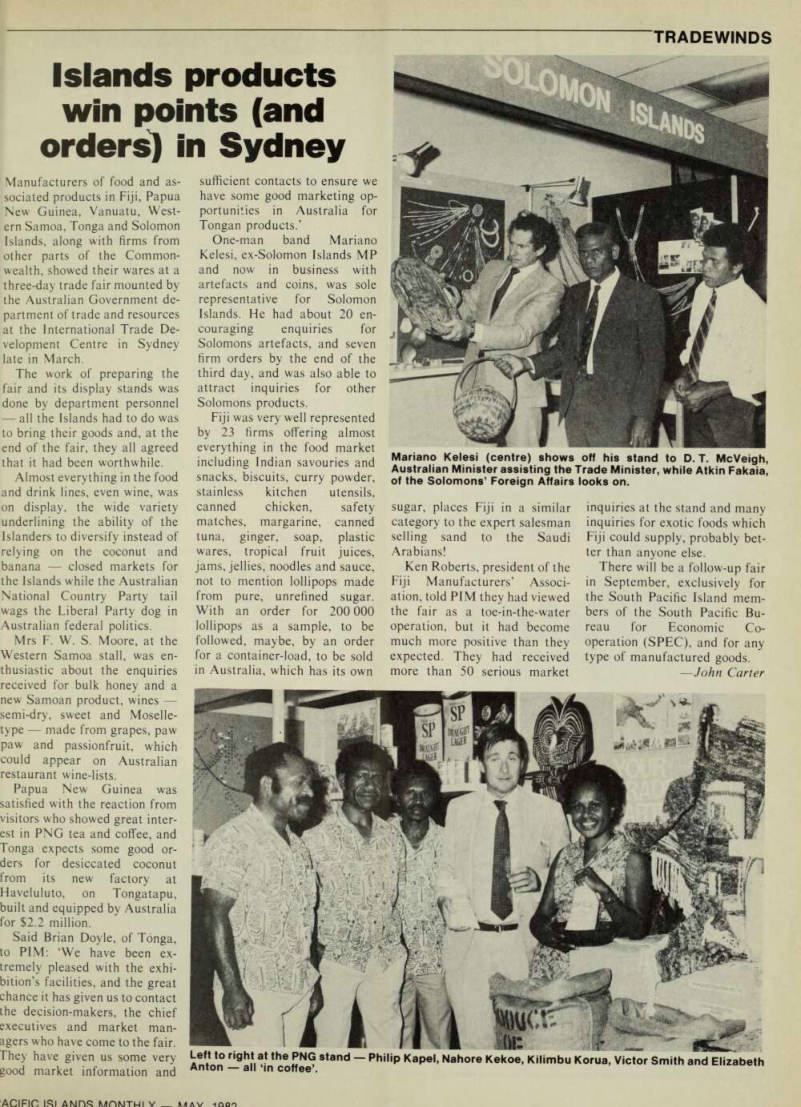
Mariano Kelesi (centre) shows off his stand to D. T. McVeigh, Australian Minister assisting the Trade Minister, while Atkin Fakaia, of the Solomons’ Foreign Affairs looks on.
Left to right at the PNG stand - Philip Kapel, Nahore Kekoe, Kilimbu Korua, Victor Smith and Elizabeth Anton - all ‘in coffee'.