Pacific regional
pp. 48-50 · Read in the full issue

France and Pacific regional security
DANIEL TARDIEU has closed his ‘Noumea Notebook’ and will henceforth share out his time between Sydney and French Polynesia as places of residence. In the article below he presents a controversial viewpoint on Australian policy towards the South Pacific, especially as it relates to New Caledonia.
The political future of the countries of the South Pacific has become a matter of active concern to Australian poli ticians, and more particularly to the Australian media.
But very few of the individ uals studying the subject ap pear to have discerned the fact that the politics of the South Pacific is characterised by a number of different trends. For example, the division between the Melanesian world, which is under Australian influence, and the Polynesians, is very real: it can for example be observed constantly at meetings of the South Pacific Commission and the South Pacific Forum.
Thus, we have the Prime Minister of the Cook Islands, Dr Sir Thomas Davis, saying that he considers ‘the French presence necessary for regional security’, and that ‘it is mean ingless to say you are opposed to nuclear testing’. The attitude of the Kingdom of Tonga is gener ally very close to that of the Cooks.
On the other hand, the pos itions of the Melanesian countries are becoming steadily more radical. Their attitudes are accompanied by acts of outright interference in the affairs of New Caledonia.
Australia is supporting Kanak socialist independence:
there is a certain contradiction in the stand adopted by Canberra officials who declare themselves in favour of New Caledonia’s independence. The independence option is not at all the one supported by the majority of the territory’s popu lation. The sole plan for inde pendence is that of the Indepen dence Front, which favours Kanak socialist independence.
Under this plan, inhabitants of New Caledonia who are not of Kanak origin will be re garded as foreigners, and al lowed to remain in the country for a period of three years.
However, these ‘foreigners’ represent more than 60 percent of the population. They include, apart from 20 000 Polynesians, Vietnamese, Indonesians, and people of mixed race, as well as Europeans, most of them from families that like Australians have been there for four or five generations.
What would happen if Kanak socialist independence were in fact declared? Such a possi bility is by no means to be ruled out in the medium term say, 1984-85. It would inevitably lead to a considerable human
exodus and in which direc tion? Naturally, to Australia.
Would Australia, looked upon for so many years with longing by New Caledonians as a land of refuge, dare to turn away men and women uprooted from their native land and forced into exile?
The programme of the main pro-independence party Union Caledonienne, recently re vealed in the Noumea weekly Corail , is a document of quite stunning naivete; it is devoid of any social or economic content.
The takeover of all land envis aged in it would drive away most farmers and cattlemen.
The economic consequences of the advent of independence in such conditions would be cata strophic, forcing the departure of all of those with the skills to keep the wheels of New Caledonia’s economy turning.
Without the financial assistance of France, at present worth SA2OO million a year, the country would sink into the direst poverty.
Advocating a policy presup poses that one has the means to carry it through.
Australia over recent years
has constantly proclaimed its desire for closer relationships with South Pacific countries. Its diplomatic and financial pres ence in the area attests to this desire, particularly in relation to South Pacific Forum and South Pacific Commission countries.. The same may be said for the recently concluded trade agreement known as SPARTECA, offering prefer ential treatment to these under-developed countries.
The 300 000 people in the French territories (French Polynesia, Wallis and Futuna, and New Caledonia) benefit from the civil expenditures of France in the South Pacific, which amount to more than SA4OO million a year. As a result their standard of living even if some people consider it artificial is very high, and simply cannot be compared with that in the independent countries. (A Melanesian policeman in Noumea gets a higher salary than Walter Lini.) As Sir Thomas Davis said recently: ‘Why throw away all these advantages and all that
security for the sake of a passport, or a seat in the UN?’
Other South Pacific countries have understood the situation.
Let us mention only the territories under American tu telage, which are very seldom talked about in Canberra: Guam, the Trust Territory, and American Samoa. Nor can one avoid mention of the countries living in Wellington’s shadow:
Niue, Tokelau and the Cooks.
It seems that an important question Australia should ask itself is whether one can remain friends with one’s neighbours if one buys nothing from them, and is concerned only with selling things to them if one engages in what might be called ‘unilateral trade’?
This in fact is the image projected at present by Austra
lia and New Zealand as well.
The freighters serving the Pacific Islands are fully loaded with goods when they leave Sydney or Auckland. But they go back empty. Vanuatu ex ports 65 percent of its produce to Europe 40 percent is taken by France and New Caledonia combined. New Caledonia ex ports nothing either to Australia or New Zealand, and yet it is a long-standing buyer from both.
Fiji is able to dispose of its surplus sugar thanks to the European Economic Com munity, and the same can be said for the Polynesian countries. Certainly the SPAR TECA is an important first step towards evening matters up.
But it won’t be tomorrow that Australia starts buying copra from Vanuatu, nickel and chro mite from New Caledonia, or sugar from Fiji.
Australia’s efforts in the fields of technical and financial aid are constantly growing. But they are not in the same league as those of France, which ‘mothers’ its brood of French Pacific territories in exactly the
A Noumea butcher’s shop owned by the Creugnet family, who have been present in New Caledonia for several generations. One bearer of the Creugnet name was a prominent supporter of the 1980 secessionist revolt on the Vanuatu island of Santo.
same way as it does the depart ments of metropolitan France.
These efforts will go on doubtless on a somewhat re duced scale should a given territory become independent.
Could Australia find the ma terial and financial means to match this kind of aid? Would it be able to absorb the thousands of families who would come seeking re f uge on its soil? After the ‘boat people’ of Indochina, will there be New Caledonian ‘boat people’ drifting off the coast of Australia?
Helping in the development of the (English-speaking) countries of the South Pacific is highly praiseworthy in itself.
But it is not enough, and, it seems, the present effort in this direction stems from a rather short-sighted and summary judgment.
Canberra must henceforth consider the effects of racially based political independence in New Caledonia, and particu larly its possible repercussions, which could well get out of control. Migration and financial aid are the first matters to be considered.
In the medium term, SPAR TECA should be extended to include other countries (with possible substantial effects on some sectors of Australian in dustry). To combat unemploy ment in the Islands, aid should be given in the planning of regional production through the export of technologies that can be assimilated in the countries concerned. There should be a serious effort to absorb food products from the Islands. This would be quite practicable in the case of crops out-of-season in Australia. During eastern Australia’s winter months, cer tain products could be obtained from sub-tropical countries.
Help should be given for the establishment of a development bank.
Military-strategic thinking has certainly developed in re cent years, but the notion of the importance of a physical pres ence in a given region retains its validity for example in terms of aid to the local populations, and maritime surveillance of economic zones. The Pacific is vast and empty.
The USSR has never suc ceeded in fully meeting the food
needs of its population. In order to cope with the shortage of protein, it has built a highly sophisticated fishing fleet, with floating factories that take thou sands of tonnes of fish out of many of the world’s oceans, but particularly in our part of the world, in the Roaring Fifties of the southern Pacific. Here they meet impossible seas, which test to the limit the endurance of both ships and crews.
Maintaining these ships and resting these crews is a very costly matter for the Soviet Union. Noumea is a port ad equately equipped to meet these needs of the Soviet fishing fleet ... Papeete too!
The French presence is necessary for regional security’
I take as my own the remark of the Cook Islands Prime Minister. Would Australia be ready to fill the military void left with the departure of 3500 members of the armed forces from Noumea, 14 000 from French Polynesia, and a fleet of patrol boats and military obser vation aircraft which keep watch over their economic zones? They are defensive mili tary means to be sure, but they are well equipped and effective.
An end to the French pres ence, which is so often de manded, would not necessarily mean an end to the under ground tests at Moruroa. This atoll is French property, having been sold to France by the Territorial Assembly of French Polynesia. It is part of French national soil. It is also an irreplaceable .source of finance for the people of French Polynesia.
The recent Canberra confer ence on Australia and the South Pacific (PIM Apr p 11) doesn’t appear to have taken note of such viewpoints as these.
It seems it is up to the conferees at similar gatherings in future to draw their infor mation from a wider spectrum of sources.
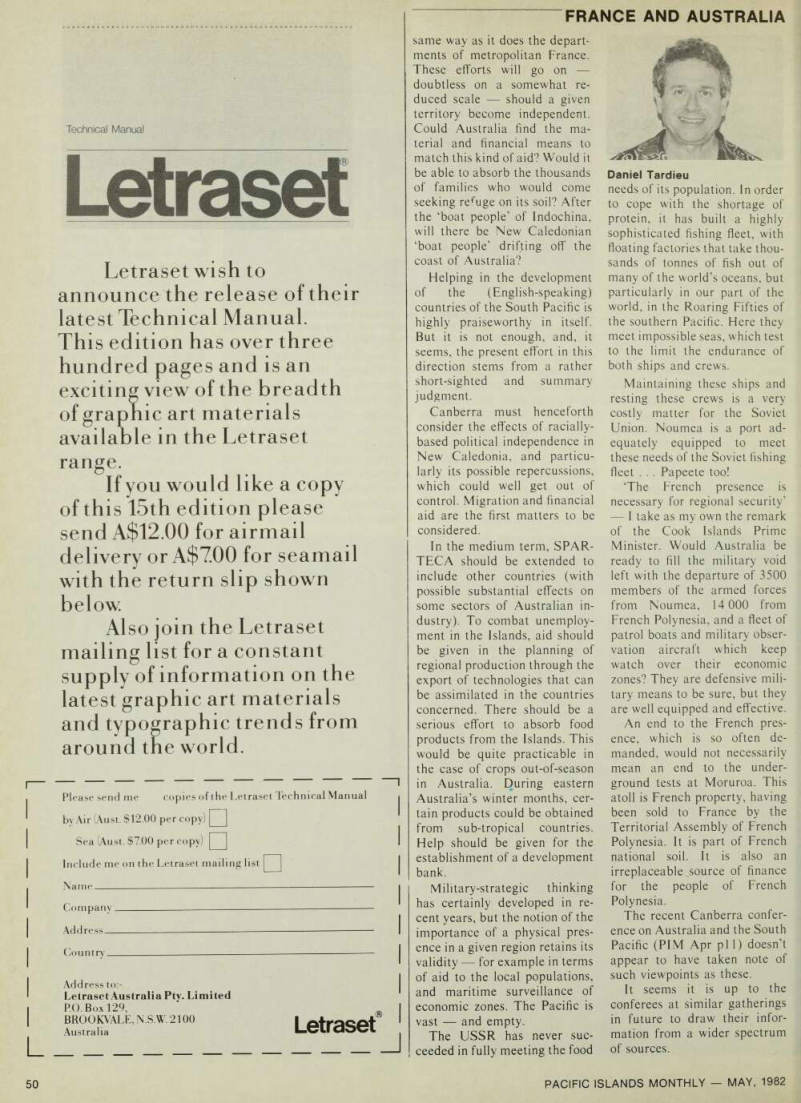
Daniel Tardieu