People
pp. 45-46 · Read in the full issue
Mr Talapusi lives with his wife Tausalaatoa and baby daughter in a small terrace house in north Sheffield.
Papua New Guinea’s first woman ombudsman, Jean Kekedo, began work at the beginning of March. Her ap pointment was announced by Sir Julius Chan, the prime minister.
Ms Kekedo, from Popondclla in the Northern Province, had worked in the prime minister’s department since 1977.
Deputy chief executive of the Carpenter group of companies in Fiji, Tom Copley, 60, will retire in May after nearly 30 years service. But he will retain a connection with the firm as consultant and adviser. Oper ations director Hugh Ragg is also resigning to live in New Zealand. Former executive di rector of administration. Jack Graham, will become chief gen eral manager and a director of W.R. Carpenter (South Pacific) Ltd, and the director directly responsible for Carpenter’s Shipping and Transport, Island Industries and Carptrac. Also appointed a director is Peter Chesterman, motor division gen eral manager.
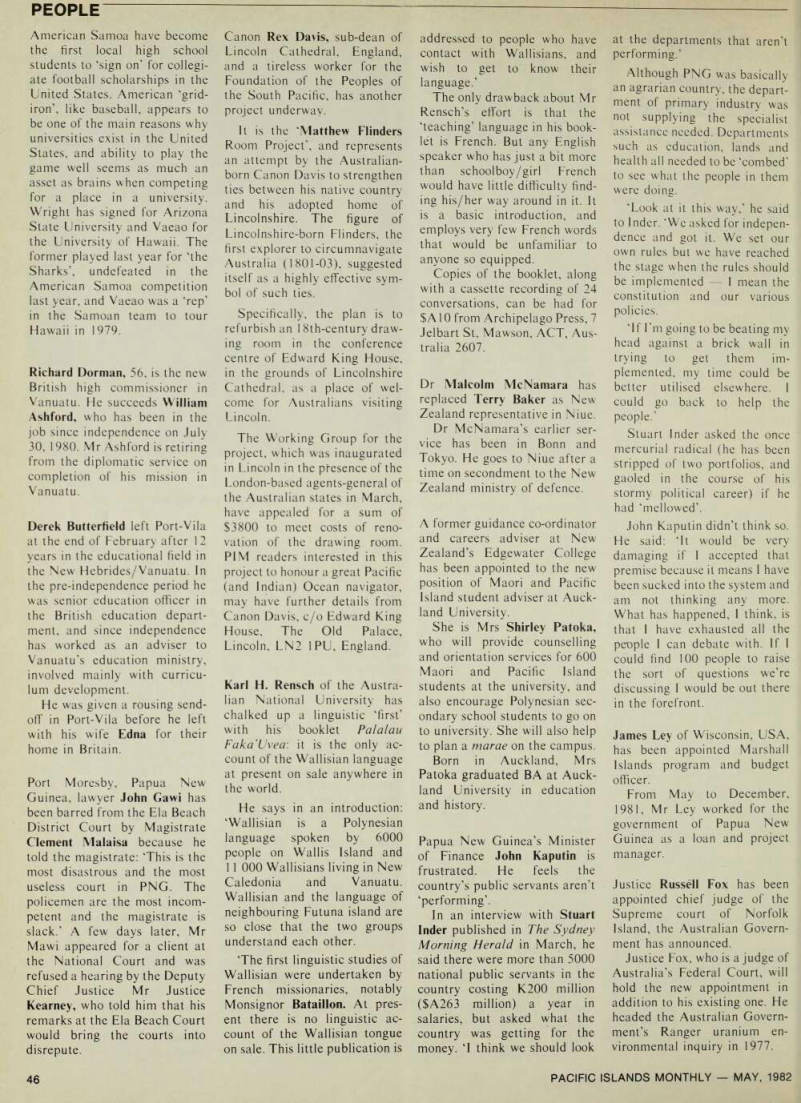
Mere Pulea Kite, prominent Fiji lawyer, had a thoughtful and original contribution to make to the February conference on Australia and the South Pacific in Canberra (PIM Apr pi 1).
Rounding off her paper on ‘Legal Obstacles to Develop ment in the Pacific’ she said: ‘The development of law in the Pacific is entrenched in foreign ideas and values. The latest decisions of the courts in England, Australia and New Zealand are either persuasive or binding on Pacific courts at national level . . . ‘lf any far-reaching change is to be made it would entail compromises between what is termed “Western law” and what is termed traditional and customary law. ‘Resistance from local “elites” and the commercial sectors is likely to be encoun tered, as the practice of custom ary law could undermine com mercial practice and remove protection from the legal pro fession . .. ‘Our dependency on foreign
A Samoan missionary is revers ing 150 years of British mission ary history by working in an impoverished inner-city area of Sheffield, England.
The Rev Faitala Talapusi, 30, who is a former captain of Western Samoa’s Rugby team and has a master’s degree from Yale University, USA, went to Sheffield after the United Re formed Church advertised in other countries for a minister to work in one of the poorer areas of the city. The church could not provide a British minister for the job.
In an interview with the London newspaper. The Guard ian, Mr Talapusi described his work as ‘challenging and difficult’ though, he said, it also brings him joy.
Mr Talapusi is particularly keen on youth work, and puts his physical fitness to good use by running in the evenings sometimes as far as 16 kilo metres so that he can talk to youngsters hanging about street corners and in parks.
Coming from a country where 80 percent of the popu lation are practising Christians to Sheffield where, in common with the rest of the country, 80 percent of the population will never set foot in a church, has provided him with some dis turbing revelations. ‘Basically, Britain is an irre ligious country, as far as I can see,’ he says. ‘Ten percent are Christians, and the problem that the church is facing is how to carry a cross with a message of love, especially where unem ployment is high. ‘The church is meant to bring hope and joy, but that’s hard for people who have no jobs.’
Mr Talapusi sees irony in the workings of the hand of God.
He says: ‘The missionaries told the people of Samoa in the old days “If you don’t work from nine to five you are a lazy person,” but now we don’t have work in Britain what is the church to say?’
legal development not only in the areas of family law, but in commercial law, contractual law, labour and trade union law will continue for a long time. ‘The complexities and re quirements that come with aid to the Pacific Islands in terms of contractual agreements and regulations perpetuate the de pendency of Pacific Islanders. ‘There is a certain type of “glamour” that tends to be attached to the more mechan ised and capital-intensive pro grammes which increases de pendency, as if Pacific Islanders have no values, no philosophy, no tradition and no culture . . .’
Renagi Lohia is to be the new Public Services Commission chairman in Papua New Guinea. He is also vice chancellor of the University of Papua New Guinea, a position he has held since 1977.
Mr Lohia will be replacing Israel Edoni, and his appoint ment will be confirmed on May 13. Mr Edoni resigned to con test a seat in the June national elections.
Solomon Islands Governor-
General Sir Baddeley Devesi has invested one of the country’s top religious leaders, the Rev Silas Eto, generally known as the Holy Mama, with the Solomon Islands medal.
Speaking at the ceremony, Sir Baddeley said: ‘You have created a unique family in the church whose villages around New Georgia such as Paradise, Sasavele, Jericho and Madou have grown into communities which set a good example for other groups in development.’
The 77-year-old Holy Mama, who has been ill for some time, thanked the governor-general for the medal, and recalled his relationship with government.
Just after World War II he was gaoled briefly by the col onial government for his re ligious activities. Butin 1960 he won government approval for the establishment of his church.
In the Solomons’ system of honours the Solomon Islands Medal ranks just above the
Qbe.
Two American Samoan students, Taleni Wright and Moamoa Vaeao, of the Samoana High School in
Mere Pulea Kite . . . ‘thoughtful and original’
American Samoa have become the first local high school students to ‘sign on’ for collegi ate football scholarships in the United States. American ‘grid iron’, like baseball, appears to be one of the main reasons why universities exist in the United States, and ability to play the game well seems as much an asset as brains when competing for a place in a university.
Wright has signed for Arizona Slate University and Vaeao for the University of Hawaii. The former played last year for ‘the Sharks’, undefeated in the American Samoa competition last year, and Vaeao was a Tep’ in the Samoan team to tour Hawaii in 1979.
Richard Dorman, 56, is the new British high commissioner in Vanuatu. He succeeds William Ashford, who has been in the job since independence on July 30, 1980. Mr Ashford is retiring from the diplomatic service on completion of his mission in Vanuatu.
Derek Butterfield left Port-Vila at the end of February after 12 years in the educational field in the New Hebrides/Vanualu. In the pre-independence period he was senior education officer in the British education depart ment, and since independence has worked as an adviser to Vanuatu’s education ministry, involved mainly with curricu lum development.
He was given a rousing send off in Port-Vila before he left with his wife Edna for their home in Britain.
Port Moresby, Papua New Guinea, lawyer John Gawi has been barred from the Ela Beach District Court by Magistrate Clement Malaisa because he told the magistrate: ‘This is the most disastrous and the most useless court in PNG. The policemen are the most incom petent and the magistrate is slack.’ A few days later, Mr Mawi appeared for a client at the National Court and was refused a hearing by the Deputy Chief Justice Mr Justice Kearney, who told him that his remarks at the Ela Beach Court would bring the courts into disrepute.
Canon Rex Davis, sub-dean of Lincoln Cathedral, England, and a tireless worker for the Foundation of the Peoples of the South Pacific, has another project underway.
It is the Matthew Flinders Room Project’, and represents an attempt by the Australian born Canon Davis to strengthen ties between his native country and his adopted home of Lincolnshire. The figure of Lincolnshire-born Flinders, the first explorer to circumnavigate Australia (1801-03), suggested itself as a highly effective sym bol of such ties.
Specifically, the plan is to refurbish an 18lh-cenlury draw ing room in the conference centre of Edward King House, in the grounds of Lincolnshire Cathedral, as a place of wel come for Australians visiting Lincoln.
The Working Group for the project, which was inaugurated in Lincoln in the presence of the London-based agents-general of the Australian stales in March, have appealed for a sum of $3BOO to meet costs of reno vation of the drawing room.
PIM readers interested in this project to honour a great Pacific (and Indian) Ocean navigator, may have further details from Canon Davis, c/o Edward King House, The Old Palace, Lincoln, LN2 IPU, England.
Karl H. Rensch of the Austra lian National University has chalked up a linguistic ‘first’ with his booklet Palalau Faka'Uvea : it is the only ac count of the Wallisian language at present on sale anywhere in the world.
He says in an introduction: ‘Wallisian is a Polynesian language spoken by 6000 people on Wallis Island and 11 000 Wallisians living in New Caledonia and Vanuatu.
Wallisian and the language of neighbouring Futuna island are so close that the two groups understand each other. ‘The first linguistic studies of Wallisian were undertaken by French missionaries, notably Monsignor Bataillon. At pres ent there is no linguistic ac count of the Wallisian tongue on sale. This little publication is
addressed to people who have contact with Wallisians, and wish to get to know their language.’
The only drawback about Mr Rensch’s effort is that the ‘teaching’ language in his book let is French. But any English speaker who has just a bit more than schoolboy/girl French would have little difficulty find ing his/her way around in it. It is a basic introduction, and employs very few French words that would be unfamiliar to anyone so equipped.
Copies of the booklet, along with a cassette recording of 24 conversations, can be had for SAIO from Archipelago Press, 7 Jelbart St, Mawson, ACT, Aus tralia 2607.
Dr Malcolm McNamara has replaced Terry Baker as New Zealand representative in Niue.
Dr McNamara’s earlier ser vice has been in Bonn and Tokyo. He goes to Niue after a time on secondment to the New Zealand ministry of defence.
A former guidance co-ordinator and careers adviser at New Zealand’s Edgewater College has been appointed to the new position of Maori and Pacific Island student adviser at Auck land University.
She is Mrs Shirley Patoka, who will provide counselling and orientation services for 600 Maori and Pacific Island students at the university, and also encourage Polynesian sec ondary school students to go on to university. She will also help to plan a marae on the campus.
Born in Auckland, Mrs Patoka graduated BA at Auck land University in education and history.
Papua New Guinea’s Minister of Finance John Kaputin is frustrated. He feels the
country’s public servants aren’t
‘performing’.
In an interview with Stuart Inder published in The Sydney Morning Herald in March, he said there were more than 5000 national public servants in the country costing K2OO million (5A263 million) a year in salaries, but asked what the country was getting for the money. T think we should look
at the departments that aren’t performing.’
Although PNG was basically an agrarian country, the depart ment of primary industry was not supplying the specialist assistance needed. Departments such as education, lands and health all needed to be ‘combed’ to see what the people in them were doing. ‘Look at it this way,’ he said to I nder. ‘We asked for indepen dence and got it. We set our own rules but we have reached the stage when the rules should be implemented I mean the constitution and our various policies. ‘lf I’m going to be beating my head against a brick wall in trying to get them im plemented, my time could be better utilised elsewhere. I could go back to help the people.’
Stuart Inder asked the once mercurial radical (he has been stripped of two portfolios, and gaoled in the course of his stormy political career) if he had ‘mellowed’.
John Kapulin didn’t think so.
He said: ‘lt would be very damaging if I accepted that premise because it means I have been sucked into the system and am not thinking any more.
What has happened, I think, is that 1 have exhausted all the people I can debate with. If I could find 100 people to raise the sort of questions we’re discussing I would be out there in the forefront.
James Ley of Wisconsin, USA, has been appointed Marshall Islands program and budget officer.
From May to December, 1981, Mr Ley worked for the government of Papua New Guinea as a loan and project manager.
Justice Russell Fox has been appointed chief judge of the Supreme court of Norfolk Island, the Australian Govern ment has announced.
Justice Fox, who is a judge of Australia’s Federal Court, will hold the new appointment in addition to his existing one. He headed the Australian Govern ment’s Ranger uranium en vironmental inquiry in 1977.