To Aneityum, Futuna - and to Tanna’s Mt Yasur volcano
pp. 41-44 · Read in the full issue

Tanna’s Mt Yasur volcano
Yesterday
In the second extract from E. A. HARVEY’S diary of a 1938 voyage in the inter-island trader Mirani, he tells of visits to Aneityum, Futuna, and Tanna. Last month’s instalment closed with Harvey and his friend Charles setting out on a 12-mile cross-country trek to White Sands on Tanna.
We climbed up and up and up through dense tropical growth and drenching rain. Soon we were wringing wet and panting.
Each crest seemed the last, but another always hove into sight.
We were walking up a track designed more for goats than men. I developed a most fright ful stitch . . . Then at long last we reached flat country, and, wonder of wonders, I found my second wind.
Charles becomes talkative. ‘The romance of the tropics, eh? Believe me when I get back to France, good food . . .’ He becomes speechless, recovers himself, and says: T will be what you call a sybarite, my word . . . ’ Charles is in his late 20s. He was born and educated in Madrid, and indeed looks more Spanish than French. He is tall, lean and brown, with flashing black eyes a most engaging bloke and a good companion.
Swinging along on our long march, Charles attempts to dispel the monotony by singing and whistling old Spanish airs.
Our Boy is hard on our heels and directs us from behind: ‘This way Master, that way Master,’ always on and on.
The rain mixes with our sweat.
I am astonished to hear a curious belching and grunting.
The sound seems to churn about in one’s belly. ‘You hear Mas ter,’ says our Boy, ‘big feller fire, him blow.’ ‘That’s the volcano,’ Charles informs me. ‘Chantreau’s place is not so far now. Don’t mind if you feel the house shake during the night.’
It is dark now, as dark as the inside of a cow, and at last we arrive at a house. Never did a wooden bungalow look so desir able and attractive.
Chantreau, the SCF agent, met us in dirty pyjamas, stained with pus from his chest. He was surprised to see me, and bade me welcome. He had little
English and seemed a bit shy.
Charles and I had a hot bath and a tremendous quantity of whisky and quinine. A Tonkinese cook was set to work.
How we enjoyed the fried eggs and curry and rice, and listen ing to our host complaining about the Tonkinese getting another woman in the family way! Dear me, we are back among human beings again. A short while ago I was beginning to wonder if that would ever happen.
Strange-looking beetles and butterflies crawled all over our food and us. I am afraid I was too drunk to care. The kerosene lamp lit up the writhing trunk of a huge banyan tree in a most
extraordinary way. To bed in someone else’s clothes, and so ends this day and a strange introduction to Tanna.
I awoke early, 5 am in fact. It is Thursday or Friday, the Bth or 9th, of December, 1938.
Who cares! I found Charles who was also up. Chantreau ap peared and informed us that both the Mirani and Polynesian are at anchor outside. Yester day the skipper did not know whether or not he would be here in the morning, hence our long trudge.
On that lovely still morning the two little ships were picked out by the sunlight with beauti ful clarity, they looked quite fairy-like. The morning had dispelled the strange atmo sphere of the night. Several times the house had shaken from the grunting of the vol cano from miles away. That, together with the whisky, was not conducive to a good night’s sleep.
Back on board the Mirani the Trade Room pulled our legs about the virtues of exercise, the need to keep fit, and so on.
The Mirani moved down to another anchorage at Resol ution Bay about three miles from White Sands. Here we had a good view of the volcano. Jets of steam were coming from many safety valves in the sides of the hills. It was like con cealed artillery, without the noise.
There was no time to go to shore again, I had no dry change, so I painted ‘the big feller, him blow’, from the ship.
Apart from anything else there were so many interesting things happening aboard. The horse was unloaded here. I bet it was pleased to be done with us.
Tanna women crowd Mirani’s decks while their menfolk haggle in the Trade Room. The younger women are very good looking, and they showed a wide-eyed interest in me. I was
most flattered. Surely these people still have one foot in the Garden of Eden.
Eventually we steamed across grey seas for the island of Aneilyum, the most southerly of the group, and seldom visited. We arrived off the lee shore at 8 pm. Word seeped down from the Bridge that the skipper intended to drift all night. I am terribly tired and can no longer keep awake. I left the others playing jack-pot and went to bed.
The utter strangeness of my situation is wearing off and the Mirani is beginning to feel like home. The supercargoes regard me as one of them and have briefed me on everyone from the Bridge to the Stokehole.
The captain is a thin man of about 40. He keeps very much to himself and appears to be disliked. Perhaps it is because he is almost as new as me, and a first command can be a nervy experience. No one would know better than the captain that his every move is under scrutiny.
The mate is a pathetic middle-aged Welshman. He is very stout, has a purple face and a pair of surprised blue eyes, completely framed by long black lashes. His hair is short, black and curly. He always wears khaki dungarees and a rose-coloured singlet. Upon his curly head reposes a straw picture hat with the brim turned up all round. His inno cent smile reveals very white teeth. The poor fellow seems to spend his time getting into rows with all and sundry.
His blue eyes move about quickly, his manner is nervous. ‘For God’s sake,’ someone will
say, ‘slop scratching your be hind Mr. Harvard.' He is re lated to an ex-husband of Mrs Wallis Simpson, so they say.
I am awake at 5 am as usual, and hear the anchor winches rattling away. Oongai appears with lea, bless him. He smiles and says ‘Port Patrick'. Port Patrick indeed. It appears to be. and is. just a few huts.
Ancilyum however is lovely. It is reminiscent of the Scottish highlands, a green mountainous island, revealing itself through a range of violet greys with driv ing mist in the glens. At limes there is a light horizontal rain.
A planter arrived alongside and informed us that the copra is not bagged. La Fleur and some of the boat’s crew are sent ashore to bag it. The planter is a quiet, lost-looking man. He was born on the island, and is the only while man living there.
He speaks the language like a native. He blames Christianity for the general lethargy of the natives. The people I met gave the missionaries a sorry name all over the archipelago.
The ship proceeded some 20 miles down the coast to Analdahal. Like Port Patrick, Analdahal is little more than a beach, and, some way out, a tremendous reef over which the surf thunders. We arc in the lagoon and under the Ice of a small low island. It is Sunday and everything is silent and still, as it is on any other day. I went ashore with Lcs Love (‘Sparks’), Maurice and Charles. We had a long hike through a dimmed and lovely forest. The walk over, it was good to go back on board again to a hearty meal, the inevitable jack-pot, and so to bed.
Most of the next day Mlrani loaded sandalwood and copra here. The chief engineer gave me a piece of sandalwood to make a walking slick.
The island once had a thriv ing population of 5000 souls, now shrunk to 170 and one while man. the aforementioned trader at Port Patrick. He is married to a Kanaka woman.
Never in my life have I seen anyone so ugly. Surely there would be some compensation.
She must be a very nice person.
At lourish in the afternoon we return to our first anchorage
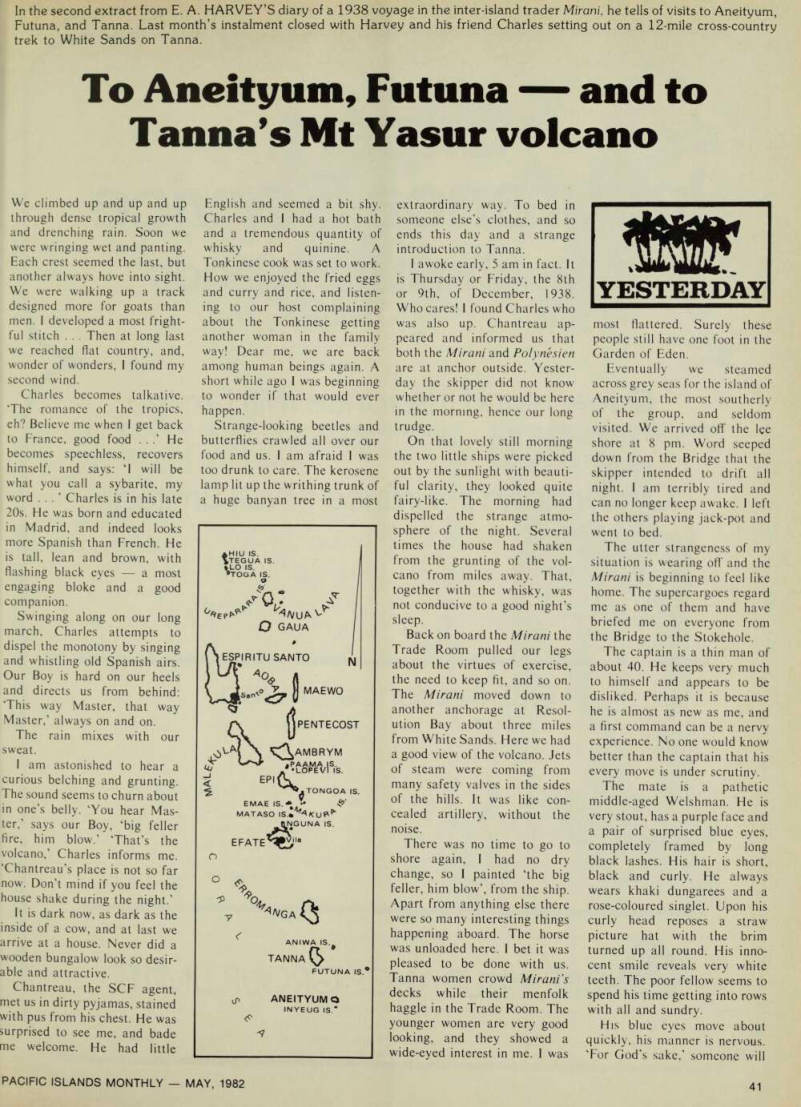
to pick up the bagged copra.
Ancilyum women crowd the decks in grass skirls and gaily coloured bodices. Like the women of Tanna they arc very comely. Maurice showed me how to lake photographs. The technique is to pick one out and peremptorily order her to take off her bodice. The woman obeys in a lit of giggling. La Fleur arrives on board as light as tight can be.
At 10 pm the ship gels underway for Futuna, northeast of Ancilyum and cast of Tanna.
Every lime we leave an island I feel a mood of melancholy creeping over me. I am sure it was due to the knowledge that I would never, never return. The human beings I met were so charming and led such strange lives. But for each it was to be just hail and farewell.
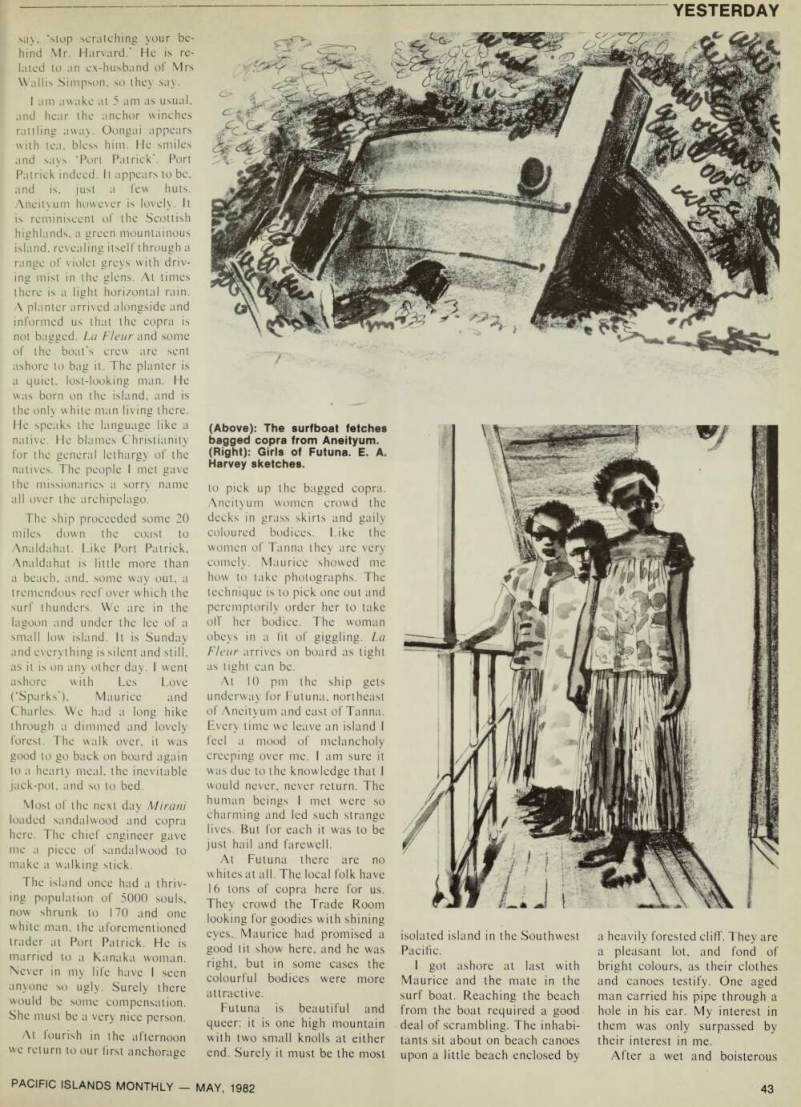
At Futuna there are no whiles at all. The local folk have 16 tons of copra here for us.
They crowd the Trade Room looking for goodies with shining eyes. Maurice had promised a good tit show here, and he was right, but in some cases the colourful bodices were more attractive.
Futuna is beautiful and queer: it is one high mountain with two small knolls at either end. Surely it must be the most
isolated island in the Southwest Pacific.
I got ashore at last with Maurice and the mate in the surf boat. Reaching the beach from the boat required a good deal of scrambling. The inhabi tants sit about on beach canoes upon a little beach enclosed by
a heavily forested cliff. They are a pleasant lot, and fond of bright colours, as their clothes and canoes testify. One aged man carried his pipe through a hole in his ear. My interest in them was only surpassed by their interest in me.
After a wet and boisterous
(Right): Girls of Futuna. E. A.
Harvey sketches.
(Above): The surfboat fetches bagged copra from Aneityum.
lime getting back to the Mirani with our bags of copra, we moved to an anchorage on the other side of the island. We were close by an impressive green cliff which towered over the ship. The anchor ran out to 25 fathoms without finding bot tom, so we had to leave it dangling. Once more the winches are getting the launch and surf boats over the side.
The ship is riding in still waters of peacock blue. Again the boats return laden with copra.
There is some more Trade Room gaff. We help ourselves to a most expensive French liqueur and all’s well with the world.
We leave for Tanna expect ing to be there before dark.
Midway there, we could see Tanna, Aneityum and Aniwa all faintly visible as flat opalescent patterns. Is not Ah-nee-wah a lovely name? It is the smallest of the southern group. I was sorry we did not go there.
The ship was due to leave Tanna again at 1 1 pm. Maurice and ‘Sparks’ were wondering whether if we anchored at six, we could reach the volcano )and be back by 11. The captain decided matters by delaying sailing time until midnight and letting ‘Sparks’ and the mate off
their watches to accompany us.
Some of the Mi rani’s crew asked if they could come too, including Willy, a Trade Room boy. We were all at the gang way ready to board the launch.
Willy as happy as child, when a message arrived from Charles, saying he wanted Willy in the Trade Room. Willy was speech less with disappointment. Then he smiled and said: ‘All right Master, me go.’ Poor fellow, his legs could scarcely carry him aft. I couldn’t have done that to him!
The launch picked its way through the reef with torch light. How marvellous the coral looked. We appeared to be floating over a city with streets and cathedrals all lit by tiny electric lights. Ashore we picked up Tanna guides and set off in single file through the tunnel and trench paths of the island. Occasionally we would pass through glades of gro tesque banyan trees. Our bob bing torchlight lent the scene a weird enchantment. Sometimes we would hear the volcano rumble and we would shout: ‘Where away, Mr Male?’ and the mate would yell; ‘On the port quarter lads,’ ‘There she blows, Mr Male’. A shouted bawdy conversation was carried on from the front to the rear of
the column. Everyone is laugh ing, and we are sweating streams. By this time we are all naked to the waist. Any malaria-laden mosquito trying his luck would be drowned.
Eventually we came to an open plain of ash and sand with a lowering sky overhead. Our footsteps made a strange thud ding sound. Soon we came to the slopes of the volcano. This was indeed a weird landscape.
How strange to come suddenly upon a place seemingly devoid of life. No birds, no animals, I doubt if even insects could live here. The grade became unbelievably sleep. At times we stopped, struggling for breath and our hearts pounding. For every three steps up we seemed to slide two down on hands and knees in warm ash. Getting to the lop became a fixed idea. We were blinded with sweat. Gone were the witticisms about pee ing down the crater.
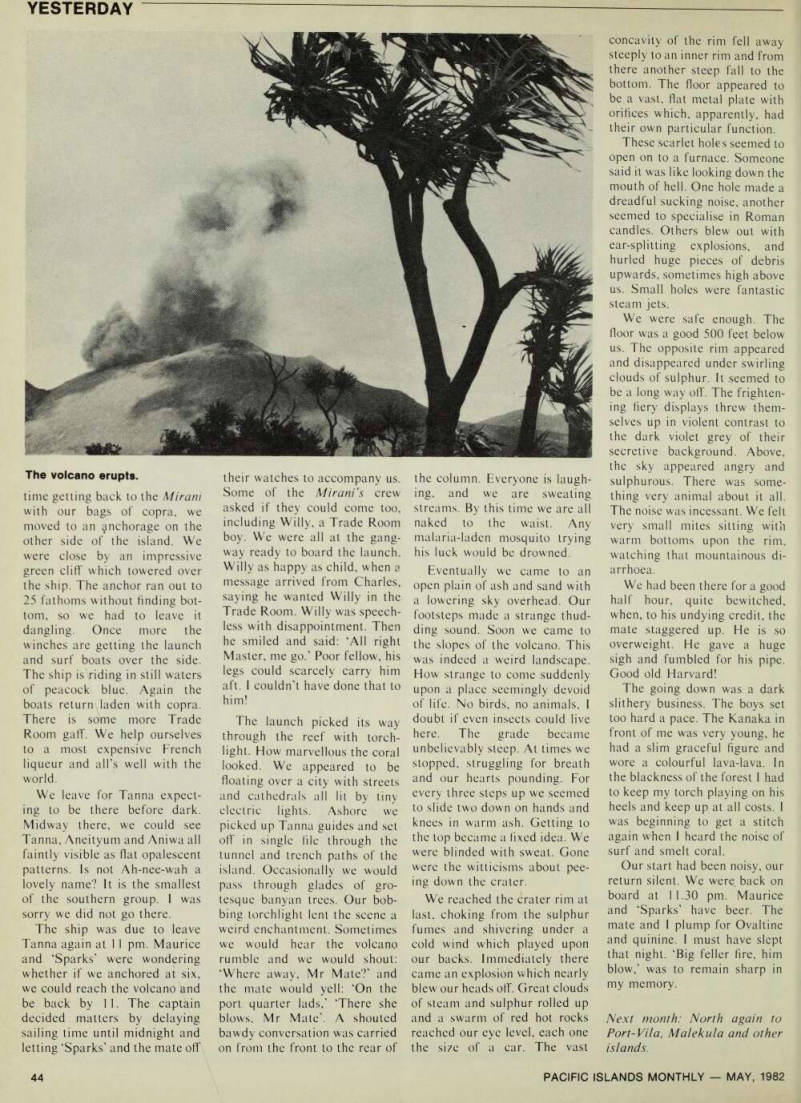
We reached the crater rim at last, choking from the sulphur fumes and shivering under a cold wind which played upon our backs. Immediately there came an explosion which nearly blew our heads off. Great clouds of steam and sulphur rolled up and a swarm of red hot rocks reached our eye level, each one the size of a car. The vast
concavity of the rim fell away steeply to an inner rim and from there another steep fall to the bottom. The floor appeared to be a vast, flat metal plate with orifices which, apparently, had their own particular function.
These scarlet holes seemed to open on to a furnace. Someone said it was like looking down the mouth of hell. One hole made a dreadful sucking noise, another seemed to specialise in Roman candles. Others blew out with ear-splitting explosions, and hurled huge pieces of debris upwards, sometimes high above us. Small holes were fantastic steam jets.
We were safe enough. The floor was a good 500 feet below us. The opposite rim appeared and disappeared under swirling clouds of sulphur. It seemed to be a long way off. The frighten ing fiery displays threw them selves up in violent contrast to the dark violet grey of their secretive background. Above, the sky appeared angry and sulphurous. There was some thing very animal about it all.
The noise was incessant. We felt very small mites sitting with warm bottoms upon the rim, watching that mountainous di arrhoea.
We had been there for a good half hour, quite bewitched, when, to his undying credit, the mate staggered up. He is so overweight. He gave a huge sigh and fumbled for his pipe.
Good old Harvard!
The going down was a dark slithery business. The boys set too hard a pace. The Kanaka in front of me was very young, he had a slim graceful figure and wore a colourful lava-lava. In the blackness of the forest I had to keep my torch playing on his heels and keep up at all costs. 1 was beginning to get a stitch again when I heard the noise of surf and smelt coral.
Our start had been noisy, our return silent. We were, back on board at 11.30 pm. Maurice and ‘Sparks’ have beer. The mate and I plump for Ovaltine and quinine. I must have slept that night. ‘Big feller fire, him blow,’ was to remain sharp in my memory.
Next month: North again to Port-Vila, Malekula and other islands.
The volcano erupts.