really thought
pp. 33-37 · Read in the full issue



New Hebrides: What Mr Mouradian really thought
Dossier Dossier Dossier
PIM has received from a re liable source translations of a number of confidential official French documents relating to the closing years of the Anglo- French condominium of the New Hebrides. They throw much light on the real as distinct from the publicly stated attitudes of the authors.
Published below is the first of these. It is a report written in October 1969 by the then French Resident Commissioner in Port-Vila, Jacques Mouradian, just before he was due to return to Paris. Sections summarised by the translator are printed in parentheses and in italics. Mr Mouradian’s re port was as follows; French policy: a) The policy of the government; This is quite clear. My instructions from General de Gaulle were: ‘We stay.’ b) The policy of the French Residency: Simply to implement those instructions.
British policy: a) The British Government’s policy: Britain is seeking more and more openly to lead this territory to indepen dence . . . London opposes the co-existence of two separate national education and health services, and extols integration both in these areas and in others where separate national ser vices continue (Judiciary and Police, for example). These efforts are directed towards creating unified structures which can easily be handed over to the New Hebridean ‘nation’, and at the same time thwart ‘French expansion .. .’ b) The policy of the British Residency: .. . Our intention to remain in the New Hebrides has been made clear. The British Resi dency has decided to give chase on our terms, and not allow us the advantage of going it alone. (Mr Mouradian says that French efforts are based on setting up a comprehensive network of island boarding
schools, 'and involve deter mined penetration of English speaking areas: this has had repercussions of the kind that led to the political eclipse of Pastor Murray’.} In parallel with these efforts, in order to implant ourselves, the French Residency has not allowed unified structures to be created which could undermine our influence. It has refused to agree to the integration of the police forces, to the unification of laws and legal procedures, and above all to the extension of local councils and their inte gration. (Mr Mouradian points out that in 1965 the British resi dency had advocated indepen dence, and that it ‘still retains the political initiative and has been able to force us to play the independence game’.} We have therefore kept in reserve an alternative, fallback solution which would involve independence, but tempered inescapably by co-operation agreements with France. We already have our education ser vice, we have dug a divide between the two medical ser vices, and we have deliberately rejected plans ... for a joint hospital.
Where political institutions are concerned, we have applied the brakes to the accelerating democratisation of the Advisory Council favoured by our part ners. The European members have been elected by the Elec toral College of the Chamber of Commerce where we hold a privileged position. As for the New Hebridean members, we have avoided universal suffrage by our proclaiming that we did not fear it. . .
All this means not only that we are here to stay but also that we now matter enough in the eyes of the people for them to want us to stay.
Despite obstinate attacks on the joint services, we have not relinquished a single one of them.
Relations Between the French Residency and the Melanesian Population: These remain linked to the land question ... I have also been at pains to isolate native land claims that seem likely to find a focus in the Nagriamel movement. With this in mind, I have attempted to complicate the problem to the maximum . . . I have sup ported the establishment here of American landowners whose presence means that we are no longer the only ones under attack. Alongside this, I have energetically supported the en try of French investors, notably by facilitating contact between Stephens, the president of Nagriamel, and Mr Leconte of New Caledonia. This policy of taming our principal detractor
has partially succeeded . . .
A further illustration of the impact of our efforts has been the material advantage of the French presence for the New Hebrideans. The highest salaries have been those paid by the French ... A knowledge of French is no longer merely access to the language of the ‘mastas’: it is also and above all the key to the best-paid jobs.
A dynamic, experienced and utterly loyal team of French district agents has enabled me to maintain contact with the people, such contact being in dispensable for the long-term continuance of our influence. (Mr Mouradian speaks of‘our need to concentrate on our new clientele of New Hebrideans undergoing Gallicisation by way of education’. Speaking of French civil servants working in the condominium service, Mr Mouradian says ‘they should be supported, even if that involves a degree of prejudice in their favour, because they represent our participation in the Joint Administration at the executive levels. If they are supported, they will support our efforts. If they are aban doned, they will be prey to the attacks of the British and we will then have only a nominal presence in the Condominium’.) Economy and Finance: (Speaking of the collapse of the internal air service Hebridair, Mr Mouradian expresses the hope that ‘UTA will find the energy (it has the means) to take over from the moribund concern and re-raise the French fiag, conspicuous by its absence in inter-island air traffic’.) The French Residency and International Organisations: More serious are the dangers which lie hidden in excessive recourse to these organisations. 1 have always distrusted them.
If the New Hebrides harbours only one United Nations expert (to be precise a WHO expert) I regard it as something to be proud of. As regards the South Pacific Commission, 1 regard it as a necessary evil... It enables us to avoid direct contact with the United Nations and for this reason alone would merit our support.
The Advisory Council in
Dossier Dossie? Dossier dossier Dossier Dossier Dossier D<
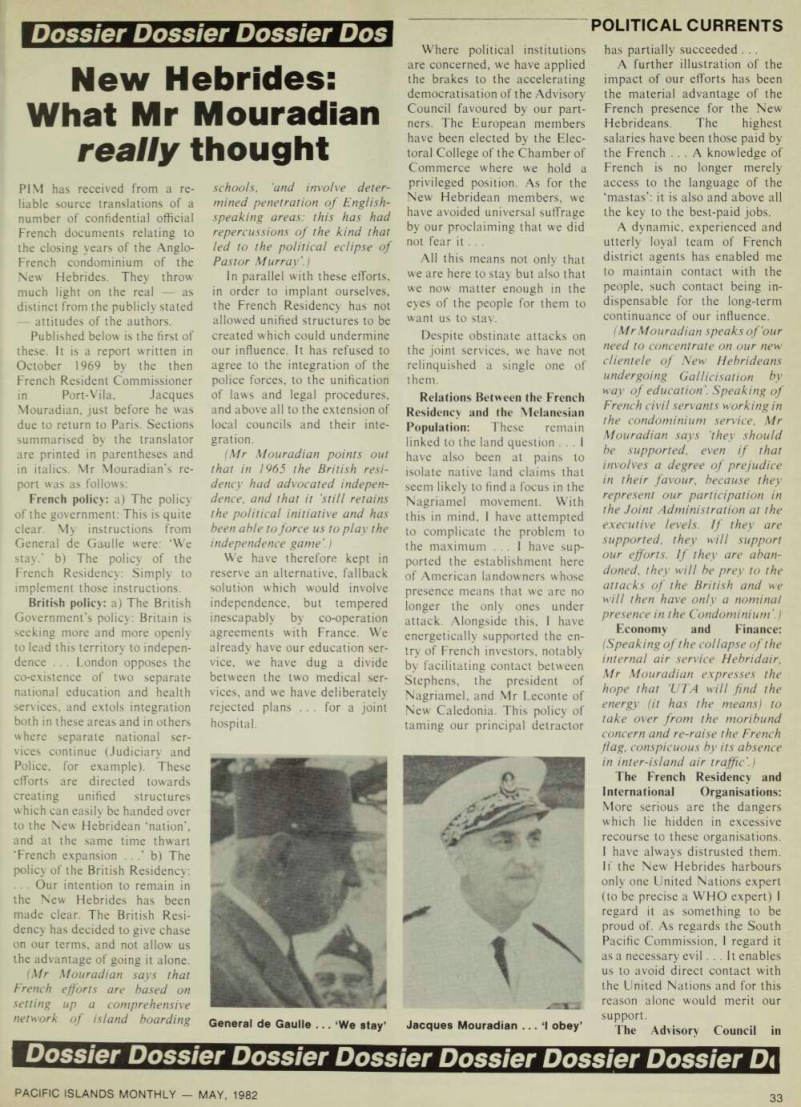
General de Gaulle . . . 'We stay’
Jacques Mouradian . . . ‘I obey’
1969: On the European side, the elected members are the most interesting because they are supposed to reflect public opinion ... I applaud the pres ence of Mr Delacroix, of whose ambition to lead an indigenous movement I am aware: every thing he touches ends in disas ter and I do not think he will fail to run true to form on this occasion. Meanwhile, he has provided us with a liberal ban ner which has been lacking among the French here, and by pulling the carpet from under the British he will bring them to positions closer to our own.
Mr Seagoe is a decided asset for us if we can continue to keep him in our camp. He has the ear of many New Hebrideans and represents those among the settlers who are cautiously pro gressive.
As for Archdeacon Rawcliffe, he is an Anglican Murray, given to the same demagogy and the same de nials. Obliged to come to terms with our education and to put up with our initiatives, he will become our accomplice willy nilly and will suffer the conse quences.
Moruroa ‘clean’
says French MP
There is ‘no radioactive con tamination problem at Mor uroa’, according to a statement made in March by French parliamentarian Louis Darinot.
Mr Darinot, chairman of the National Assembly’s defence commission, headed a working party which interviewed French scientists at Moruroa and later spent eight days in Australia for talks with Australian Foreign Minister Tony Street.
Mr Darinot conceded that ‘tiny coral atolls’ still bore traces of the effects of the 1981 storm which dispersed radioac tive waste into the ocean (PIM Jan p 6), and that notices saying ‘Non-decontaminated zone possible radiation dangers’ had been erected on them. But Moruroa, he said, was safe.
Mr Darinot said it was poss ible that tests would be held in future on Fangataufa Atoll, 150 kilometres to the south of Moruroa, but that Fangataufa ‘would never replace’ Moruroa.
Mr Darinot told Mr Street
that when he reported to French Defence Minister Charles Hernu he would ask him to permit Australian parliamen tarians to visit Moruroa. But, he added, ‘I would understand if this was refused’.
French do have
neutron bomb
The French Atomic Energy Agency announced in March that the most recent tests at Moruroa had ‘perfected and miniaturised’ the neutron bomb.
The announcement ended a long period of uncertainty as to whether France was in fact developing the weapon.
During the presidential elec tion campaign. President Mit terrand was cautious on the subject, saying that develop ment of the neutron bomb would imply ‘a change of strat
egy’. The ‘change’ has appar ently now been made.
The bomb kills a maximum number of people by its high radiation rate and destroys a minimum number of buildings because of its low blast effect.
Hawaii senator
raps N-policies
Hawaii Senator Spark Matsu naga has called for a drastic revision of US policy on nuclear issues in the Pacific, saying that the US must take much of the blame for the ‘nuclear-free Pacific’ movement, because it had ‘shown no sympathy for the motives of its supporters’.
Addressing a luncheon in Honolulu earlier this year, the senator said: ‘Why stir up a hornet’s nest in the Pacific at this moment? We should not even talk about new interim storage sites in the Pacific until
we develop standards for per manent disposal that we our
selves find acceptable . . .
‘Even the United States is only now beginning to discover how complex and uncertain are safety measures surrounding the production and containment of nuclear materials ... If we want to halt the “nuclear-free Pacific” which Ambassador Bodde (former US Ambassador in Suva and now at the East- West Center) correctly de scribes as the most serious threat to American interests in the Pacific, we need to address its roots, which are in the unanimous, Pacific Islands wide opposition to nuclear dumping or storage on islands
or on the seabed.’
Paul
Addison
in Honolulu.
Islands politics
under study
The first international confer ence of social scientists inter ested in Pacific politics took place at the Hawaii campus of Brigham Young University be tween February 4 and 6. Spon sored by the Institute for Polynesian Studies, the general theme was the Politics of Evolv ing Political Cultures in the Pacific Islands. Over 30 scholars attended, drawn from universities in Hawaii, the con tinental United Slates, Austra lia, New Zealand and Papua New Guinea. Also in attend ance were George Atkin, editor of Solomons Toktok and T.S.I. laone Taulapapa of the Pacific Islanders’ Educational Re source Centre in Auckland.
Papers given at the confer ence included four on American Micronesia, three on PNG, two on the Solomons, two on Vanuatu, and one each on New Caledonia, Western Samoa, Pacific Islanders in New Zea land, and Fiji Indians. The keynote address was given by Emeritus Professor Norman Meller of the University of Hawaii.
The success of the conference prompted suggestions for further meetings, possibly else where in the Pacific. The full proceedings are shortly to be published by the Institute for Polynesian Studies at Brigham
Young University.
(Dr)
James Jupp
in Canberra.
A deadly ‘mushroom’ over Moruroa Atoll in the days of the tests in the air. Shortly after this test, they went underground. But, are they any safer? The last atmospheric tests took place in 1975. The underground tests since then have given rise to new controversies, centring especially on claims that they are destroying the structure of the atoll.