at its modern history
pp. 38-39 · Read in the full issue
Books
Easter Island: A rare look at its modern history
The Modernization of Easter Island. By J. Douglas Porteous.
Western Geographical Series Volume 19. Published by the Department of Geography, University of Victoria, Victoria, British Columbia, Canada, 1981. SC4 (paperback). ISBN 0 919838 09 X.
The Modernization of Easter Island is the latest addition to the burgeoning bibliography on that windswept, iron-bound, near treeless, volcanic triangle in the empty reaches of the southeast Pacific. It is an excel lent book, and Professor Porteous makes the reviewer’s task easier by outlining clearly and concisely exactly what his intentions are and what issues he will be addressing. ‘The single-minded pursuit of Easter Island pre-history,’ he observes, ‘has resulted in an almost total neglect of the island’s modern development.’
While he does describe the nature of pre-contact society, he seeks principally to ‘fill a void', ‘to remedy the existing informational balance’. The re sult is a carefully organised, well-written, historico geographical account of the transformation of the cultural and physical landscape of Easter Island since the 1860 s.
Porteous emphasises four major themes: the geo-political history of the island culminat ing in its annexation by Chile in 1888; the assumption of effective control by foreign entrepreneurs; the ‘socio economic and cultural land
scape transformations resulting from the conversion of an autarkic sub-tropical island into an externally-oriented wool ex porting estate’; and the contem porary impact of government modernisation policies.
Cross-cutting these themes are a series of issues of Pan- Pacific importance; land tenure, labour hunger, demographic change, shifting European per ceptions of the Pacific, imperial policies, the character of com pany states, indigenous strategies of resistance and ac commodation, and the role of naval personnel as adminis trators.
Central to Porteous’ study is the ‘fatal impact’ theory. Not withstanding the fact that this theory has undergone consider able revision (see, for example, K. R. Howe’s perceptive analy sis ‘The Fate of the “Savage” in Pacific Historiography’, The New Zealand Journal of His tory, October 1977), it is difficult to deny just how fatal the impact was in the Easter Island case. Indeed, few Pacific Islands can have been so re duced by contact. ‘Since 1860,’
Porteous notes, ‘Easter Island has been depopulated by slavers, more than decimated by disease, treated as a geo political pawn, dominated by a succession of foreign entrepre neurs, neglected by Chile, and turned over first to sheep and then to tourists.’
As is well known the cata strophic depopulation of Easter Island or Rapanui began in 1862 when Peruvian vessels
transported about 1000 islanders away to work the Peruvian off-shore guano de posits. Roughly 90 percent of the labourers died, and those who were repatriated brought with them deadly contagions. ‘By the 1870 s the island was prostrate, its population shrunken to less than five per cent of its former proportions, its fields abandoned, its monu mental stonework overthrown or in decay. Into this vacuum penetrated Europeans, bringing with them varieties of animals and plants which were to com pletely transform the island’s economy, society, and polity.’
The first of the entrepre neurial freebooters was a French sea captain, Jean- Baptiste Onexime Dutrou- Bornier. His goals were ‘to find plantation workers for Tahiti and to convert most of (the) grassy island into a sheep ranch’. He purchased land on Easter Island in 1868, entered into partnership with the Branders, ‘a Tahiti-based fam ily of Scottish provenance,’ and deported Rapanui to Tahiti. His autocratic fiefdom was Hobbesian nasty, brutish, and shortlived. The islanders murdered him in 1877 in one of their periodic expressions of resistance. Eleven years later Captain Policarpo Toro Hurtado of the Chilean navy took formal possession of Easter Island.
One of the strengths of this account is that Porteous sets events on Easter Island in an extra-Pacific context. The
island’s annexation, he explains, ‘completed a decade of massive territorial gains’ during which the Chileans in a ‘domestic version of the winning of the American west’ defeated Indians to the south and mes tizo nations to the north. In this ‘heady era of national self congratulation’ the Chileans sought to forestall their rivals, protect their commerce, en hance their prestige, and gain a position of forward defence by acquiring a Pacific Island pos session.
The annexation process high lighted the ways in which per ceptions of Easter Island’s com mercial and geo-strategic im portance shifted over the dec ades. ‘During the long debate over Easter Island’s potentia for development severa diametrically opposed points o view emerged,’ Porteous writes ‘One body of opinion considere( the island a superb haven fo naval vessels; opponents state* that the island possessed n< natural harbours. Agrariai colonizers announced that thi whole island could be tilled, an* would become Chile’s tropica plantation base. Opponents ar gued that the island was arid.
While French maritime intei
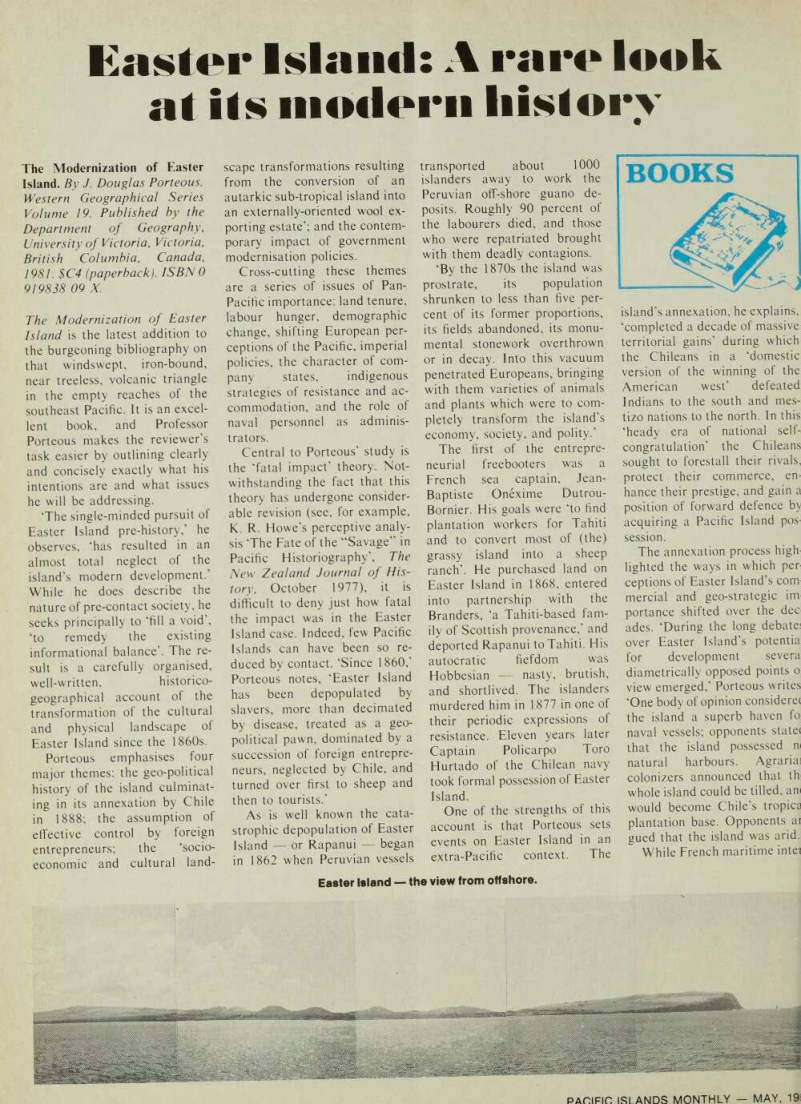
Easter Island-the view from offshore.
ests deemed the island worth less, Chilean imperialists were more than willing to be misled.
They imagined that they were acquiring a dependency of ‘ex ceptional fertility’, an agricul tural paradise which would command the sealanes of the eastern Pacific at a time when a Panamanian canal appeared in the offing. Chile, however, had become dangerously over extended. Toro’s attempt at colonisation was ‘an almost im mediate failure’. 'lnadequate supplies, lack of communi cation with the mainland, insufficient population num bers, and a general feeling of remoteness, the perennial prob lems of all small, isolated islands, were all raised to a higher power on Easter Island . ..’
In 1892 Toro ceded all his rights to Easter Island to the Chilean state and five years later Enrique Merlet, a Valparaiso business man, ac quired the Brander-Bornier holdings. ‘The whole of Easter Island was now under the con trol, by ownership or lease, of a single company dedicated to profitable sheep ranching.’
However, the precise location and extent of the Brander- Bornier hojdings was unclear.
'ln their crudity, vagueness, and dubious legality,’ Porteous notes, ‘the later Easter Island land sales illustrate in micro cosm the process by which Europeans the world over dispoiled native peoples of their land in return for a few . . . trinkets.’
In 1903 Williamson, Balfour and Co, an Anglo-Chilean ‘multinational’ made wealthy by a trade in nitrates, wheat, and wool, formed the Compania Explotadora de la Isla de Pascua (CEDIP) and brought out Merlet.
Under CEDIP control the island became one vast sheep walk with upwards of 50 000 sheep. ‘lt is instructive,’
Porteous writes, ‘to follow the course of late eighteenth cen tury sheep farming in Highland Scotland in some detail, for the cultural genocide it helped bring about in Scotland was to be repeated in Easter Island a century later, and by the same Lowlander entrepreneurs.’ ‘During the brutal period
known as the Highland clear ances, clansmen were forced from their houses, which were burnt before their eyes. There was no alternative employment, for a sheepmaster could “live and make rich in a desart {sic), with his sheep and a very few servants”.’
In the same way Easter Islanders became entirely be holden to CEDIP, prisoners in their own land. The company exercised ‘godlike power’ over the Rapanui and the island’s landscape was made over in the company’s own image. The meagre woodlands all but van ished, the grasslands were criss crossed with stone walls to regulate the movement of sheep, and the island was ‘neatly compartmentalized into two sections, a small fertile, government-owned area as a reserve for the natives (Hangaroa)’, with the remain der given over to livestock.
Williamson, Balfour and Co sold CEDIP in 1946 to another Anglo-Chilean firm, and in 1953 the Chilean navy took control of Easter Island. ‘From the point of view of the Rapanui, however, a typical Latin American coup had oc curred.’ They had merely sub stituted one set of rulers for another.
The island underwent another period of dramatic change in the 19605. The dec ade witnessed ‘the arrival of a large-scale Canadian medical expedition, an American military-scientific contingent, in-migration from Chile, and a scheduled air service to both Santiago and Papeete, Tahiti.
In half a decade the inhabitants of Easter Island, long accus tomed to being controlled by the company state run by CEDIP and its naval successor, were thrust willy-nilly into the commercial wage-earning, entrepreneurial ethos of the mid-twentieth century’.
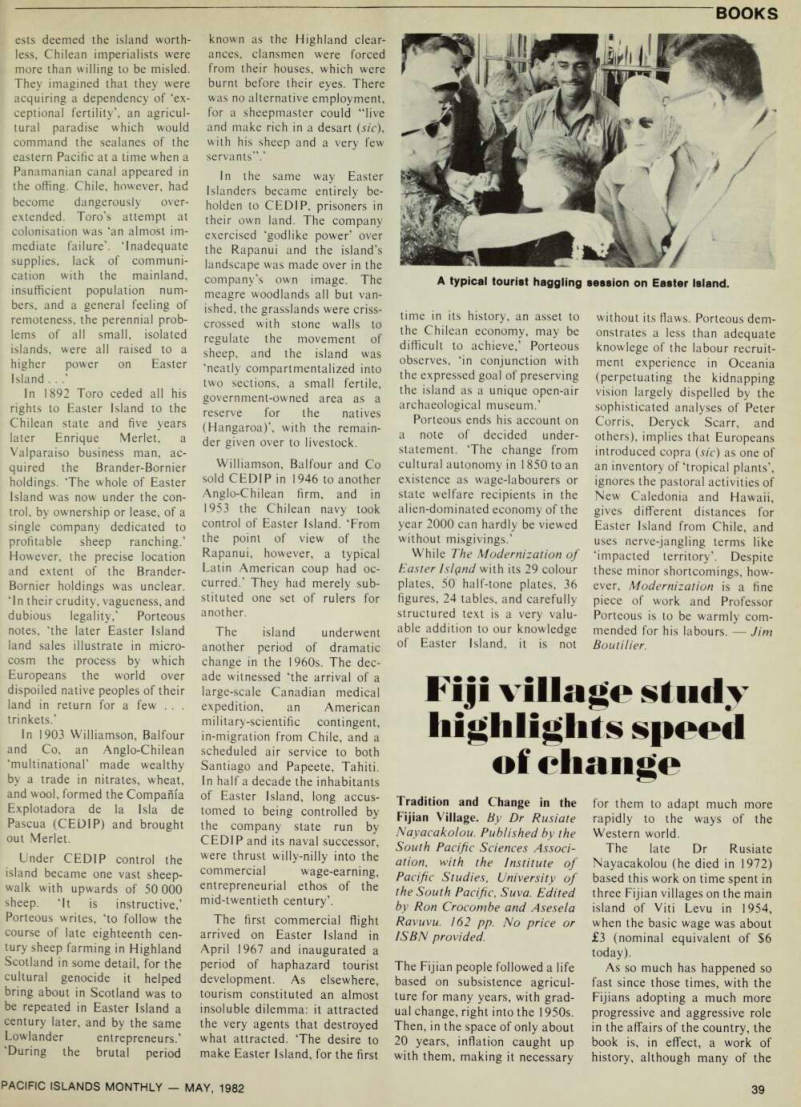
The first commercial flight arrived on Easter Island in April 1967 and inaugurated a period of haphazard tourist development. As elsewhere, tourism constituted an almost insoluble dilemma: it attracted the very agents that destroyed what attracted. ‘The desire to make Easter Island, for the first
time in its history, an asset to the Chilean economy, may be difficult to achieve,’ Porteous observes, ‘in conjunction with the expressed goal of preserving the island as a unique open-air archaeological museum.’
Porteous ends his account on a note of decided under statement. ‘The change from cultural autonomy in 1850 to an existence as wage-labourers or state welfare recipients in the alien-dominated economy of the year 2000 can hardly be viewed without misgivings.’
While The Modernization of Easter Island with its 29 colour plates, 50 half-tone plates, 36 figures, 24 tables, and carefully structured text is a very valu able addition to our knowledge of Easter Island, it is not
without its flaws. Porteous dem onstrates a less than adequate knowlege of the labour recruit ment experience in Oceania (perpetuating the kidnapping vision largely dispelled by the sophisticated analyses of Peter Corns, Deryck Scarr, and others), implies that Europeans introduced copra (sic) as one of an inventory of‘tropical plants’, ignores the pastoral activities of New Caledonia and Hawaii, gives different distances for Easter Island from Chile, and uses nerve-jangling terms like ‘impacted territory’. Despite these minor shortcomings, how ever, Modernization is a fine piece of work and Professor Porteous is to be warmly com
mended for his labours.
Jim
Boutilier.
A typical tourist haggling session on Easter Island.