talks under microscope
pp. 29-32 · Read in the full issue

Political
Currents
Micronesia: Memoranda put status talks under microscope
JOHN CARTER, RIM Editor through most of the decade of the ’7os and now the magazine’s Editorial Adviser, reviews four important ‘Memoranda’ prepared on the initiative of the Micronesian Seminar, Truk. Mr Carter has been following the ‘future political status talks’ between the Americans and Micronesians since their inception in 1967.
I got lost in the corridors of the Pentagon in August, 1968.
After five minutes of wander ing, I was hailed by a Pentagonese, who restored me to the main party. Said our host: ‘You weren’t lost. We were watching you all the time.’
And that about sums up the situation between the US nego tiating team and the Micronesians in the prolonged ‘manoeuvres’ over the Compact of Free Association. Over the years of discussions since 1967, it’s been ‘on’ and then ‘off 1 , and then ‘on’ again. At the time of writing, it’s ‘off (See ‘Pacific Report’ this issue), and once again the Micronesians are be wildered.
In an attempt to educate the Micronesians politically, to put them on more level terms with the United States team and to guide them through the US made maze, the Catholic Church in the Caroline and Marshall Islands is sponsoring a political education programme on the Compact of Free Associ ation through the Micronesian Seminar directed by Jesuit Father Francis Xavier Hezel. A long-time wielder of influence in Micronesia, Fr Hezel has en listed the aid of Jesuit lay- Brother Henry Schwalbenberg to make a study of the issues.
A series of memoranda on different aspects of the prob lem, to be published at inter vals, aims, through PIM and others, to attract views, advice and help certainly sympathy from a wide area, as well as to educate the villagers and, as Fr Hezel says ‘.. . to stimulate their informed and active par ticipation in the future plebi scite’. Four memoranda have been issued. One explores how the compact might radically change Micronesia’s economy by influencing migration pat terns. Another examines how US fiscal policy is weakening the bargaining position of the
Micronesian states (and that’s no accident). The third deals with the controversial issues surrounding the question of nuclear weapons in Micronesia, and the fourth examines the limitations the draft compact places on Micronesian self government. All are results of the efforts of Brother Schwalbenberg.
Introducing his first memor andum, Brother Schwalbenberg declares: ‘ln the current draft compact negotiations, Micronesia’s overwhelming economic dependency on the United States is clearly undermining Micronesia’s bar gaining position. Since Micronesia is so heavily depen dent on US economic aid, we must face the issue of neo colonialism. Is the US influenc ing the political choices of Micronesians to an excessive degree?’
The first paragraph of the memorandum proper answers the question. He says: ‘Micronesia’s economic future is determined largely by (1) its strategic position in the Pacific and (2) its generally limited economic potential. In its desire to share in the benefits of the modern world economy Micronesia has been able to financially utilise its strategic position to compensate for its limited economic potential. The United States has given generous economic aid and has, in effect, ensured that Micronesia would remain under US military control. What is
more important to the US, this aid has ensured that no other country would have military access to Micronesia’s land, waters, ports, or airfields.’
He adds: ‘American aid has been so generous that roughly 90 per cent of all economic activities in Micronesia depend on US financial assistance.’
Commenting on the first negotiations under the Reagan
administration, Schwalbenberg
defines the US position in October, 1981 as: ‘(1) the Trusteeship should be termin ated as soon as possible, (2) the line on expenditures should be held, and (3) the US needs to deny to other nations military access to Micronesian territory ‘for the longest period of time’.
The ‘longest period of time’ is a euphemism for a 100-year mili tary denial clause in the mili tary subsidiary agreements to the draft compact. ‘An important statement made by the American nego tiators, and overlooked by most observers, was: “Our commit ment goes further, however, than the agreement to deny military access to your territory for the longest possible period, we are pledged for that period to extend to you exactly the same defence commitment we have given to Australia and New Zealand under the ANZUS alliance.” ‘This statement represents a new conceptual framework for the negotiations. In the past Micronesians have obtained economic concessions from Americans by yielding military concessions. But in this new American scheme, Micronesians would grant an important military concession for a marginal military benefit US defence of Micronesia for 100 years instead of for 15 years renewable at the end of the 15 years.’
Schwalbenberg makes the point that if the Micronesians
agree to the 100-years term of military denial, it would com pletely undermine their future bargaining position as, at the end of the 15-year compact period and its renegotiation, the Micronesians would be without their most important bargaining chip military denial.
Then, he forecasts: ‘Without the bargaining chip of military denial, there would be no geo political restraint preventing the US from going back to pre- Kennedy spending levels, when the US practised a policy of benign neglect towards Micronesia. Only when the US needed to ensure its military control of the area did US expenditures for Micronesia rapidly expand.’
After stressing that early signing of the compact would bring, as the US has promised, an increase in US funding of SUS 46 million per annum and a cutback of aid if the Micronesians prove awkward Brother Schwalbenberg comes to a ‘conclusion’; ‘The United States is in the position of being able, for the first time, to break the link between mili tary concessions to the US in exchange for economic goods for the Micronesians that has characterised past negotiations.
The Americans are in a position to do this because of Micro nesia’s overwhelming depen dency on US cash. For the
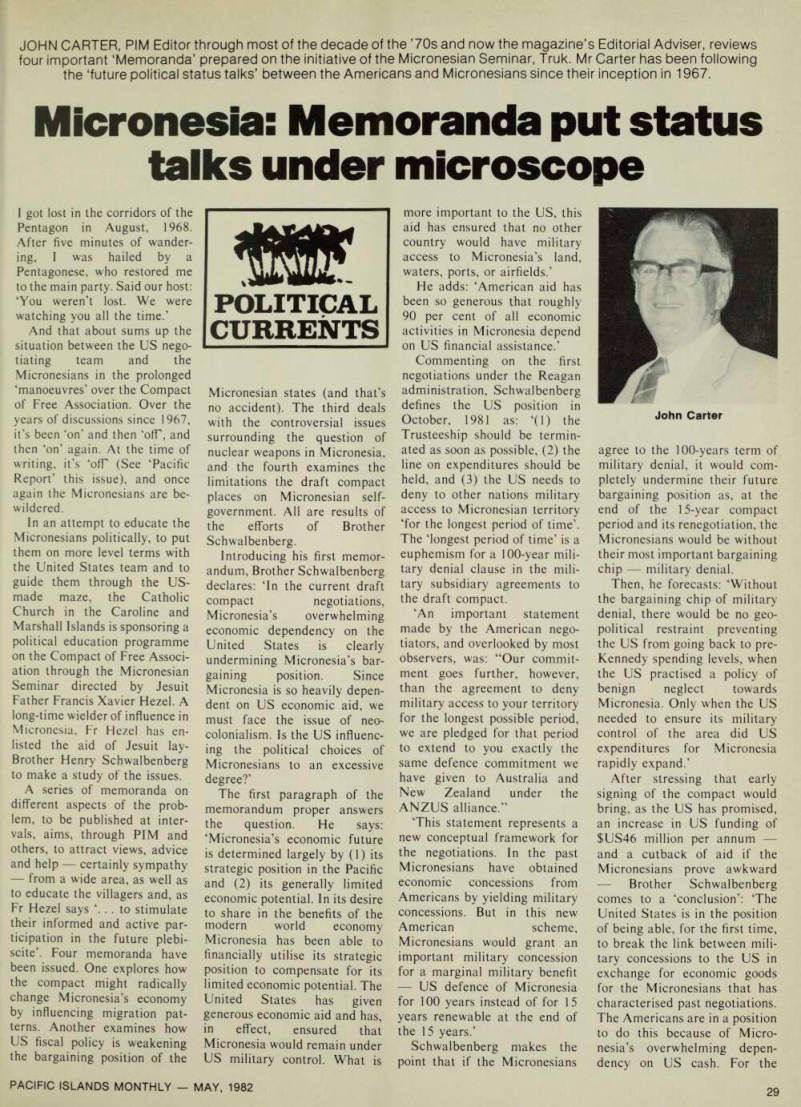
John Carter
present, the ability of Micrones ians to withstand American pressure will depend on the strength of their subsistence economy, since the subsistence economy’s ability to support people’s livelihoods is indepen dent of US influence. In the future, the ability of Micronesians to withstand American pressure will depend on their capacity to replace American grants with a diversified productive economy'.
But the Micronesians must know this. American Samoa and Guam have been wooed by the dollar for years and neglected developing a cash economy, something they wouldn't have been permitted to do had there been no stra tegic advantages for the US.
However, the Samoans now have a thriving fishing industry.
As Congress of Micronesia representative Sasauo Haruo of Truk said at the talks in 1975: ‘lt's obvious the intention is to continue to perpetuate and to limit our economic develop ment so we will continue to be dependent on US assistance.’ (PIM, Nov ’75, p3l).
Schwalbenberg’s second memo considers the effect on Micronesia of free migration into the US as allowed under the compact, and concludes that; ‘Free migration to the US could act as a needed safely valve relieving social tensions due to unemployment. On the other hand, free migration to the United Slates would create a brain drain from Micronesia to the US and Guam. A brain drain would perpetuate Micro nesia’s dependence on foreign skilled workers. It may also have a harmful effect on income distribution. And finally it could create a remittance economy in Micronesia’.
On that matter, people in American Samoa and Guam might have some advice to offer they have free migration to the US.
Nuclear weaponry raises its head in the third memorandum, which points to the many loop holes in the compact when it deals with the use and storage of nuclear weapons in Micro nesia and, particularly, in Palau.
According to section 314 of the draft compact, says Schwal-
benberg, the United States Government in carrying out its full authority in Micronesia for security and defence matters will abide by the following norms in the use and storage of technically advanced weapons and their related materials: • Use (314.a.1.) the US shall not ‘test by detonation or dispose of any nuclear weapon, nor test, dispose of, or discharge any toxic chemical or biological weapon’. • Related Materials (314.a.2.) the US shall not ‘test, dispose of, or discharge any other radioactive, toxic chemical or biological materials in an amount or manner which would be hazardous to public health or safety’. • Storage (314. b.) the US ‘shall not store in (Micronesia) any toxic chemical weapon, nor any radioactive materials nor any toxic chemical materials intended for weapons use’ ex cept in the case of ‘transit or overflight purposes, or during time of a national emergency declared by the President of the United States, a state of war declared by the Congress of the United States or as necessary to defend against an actual or impending armed attack on the United States (or Micronesia).’
Those norms, Schwalbenberg says, apply to all Micronesian territory including the seabed within 200 miles of Micronesian shores, but, he points out, it is important to note what was not said by section 314, which did not prevent the United States from launching nuclear weap ons against enemy targets from within Micronesian territory or ocean jurisdiction. It did not prevent the US from testing, disposing of, or discharging any other radioactive, toxic chemi
cals or biological materials. It simply required that it did not pose a hazard to public health or safety.
Finally the ‘Storage’ Sub section (314. b.) made no men tion of nuclear weapons. Toxic chemical materials intended for weapons use, as well as toxic chemical weapons, were forbid den. Radioactive materials in tended for weapons use were also forbidden; however, radio active weapons (nuclear weapons) were not mentioned.
Because of that omission, the Federated States of Micro nesia’s (FSM) Commission on Future Political Status and Transition was able to conclude that the storage provision did not prevent the US from storing nuclear weapons in Micronesia.
Schwalbenberg noted that eventual agreements with the FSM and the Marshall Islands, as with Palau, would state explicitly what was left vague in the draft compact. A qualified definition of testing would allow the US to service submarine based nuclear missiles and store them, but because the Palauan constitution banned the intro duction of nuclear weapons into Palau, the subsidiary agree ment would be put to a separate vote at the time of the plebiscite on the compact. Since the agreement would amend the Palauan constitution, it would require a three-fourths vote to pass.
Regarding the agreement with Palau, a section banned storage or disposal of radio active wastes in Palau’s terri tory or in the ocean surrounding it, with one important excep tion; highly radioactive matter may not be dumped into the 200 miles of ocean, but nothing was said about low-level waste.
The memorandum dealing with self-government revealed that the Micronesians were at a disadvantage. Their rights to self-government were qualified and internal decisions could be vetoed by the US if they were incompatible with US interests.
Brother Schwalbenberg quotes from a detailed review by Professor Roger S. Clark of Rutgers Law School of the draft compact, in which the professor said: ‘The “incompati bility exception” is likely, more over, to contain the seeds of
discontent. The United States prerogative to restrain the Micronesians from any activity the United Slates determines to be incompatible with its auth ority could lead to significant interference by the United States with Micronesian com mercial and cultural activities.
One can foresee situations where the United Slates, though exercising its powers under the rubric of security and defence, could overrule for “strategic” reasons proposed Micronesian agreements with states not con genial to the United States involving, for example, the con struction of a copra warehouse processing plant, or fishing rights. In this respect, the “incompatibility” provisions . . . may represent an attempt to do the well-nigh impossible: separate the questions of secur ity and defence from foreign affairs.’
Professor Clark also pointed out that the United States, by using its powers defined in the draft compact (section 331), could determine which of its defence treaties or security agreements applied to Micronesia, and whether the Micronesians might have trade or cultural relations with par ticular slates. That section, together with the incompati bility powers, were a significant infringement upon the Micronesians’ claims for self government. While the draft compact clearly supported Micronesian claims for self government in internal and foreign affairs as well as American claims in security and defence matters, it clearly assigned a higher importance to American claims over Micronesian claims should they come into conflict.
Brother Schwalbenberg gives his views on ‘The moral basis of the draft compact’ as his final point in the fourth memor andum. He says three central moral questions needed to be asked in evaluating the draft compact’s array of rights and
responsibilities.
‘First,’ he says, ‘does the United States have legitimate security interests in the Pacific that justify its need for military rights and privileges within Micronesia?’ If the answer is no, then it is impossible to morally
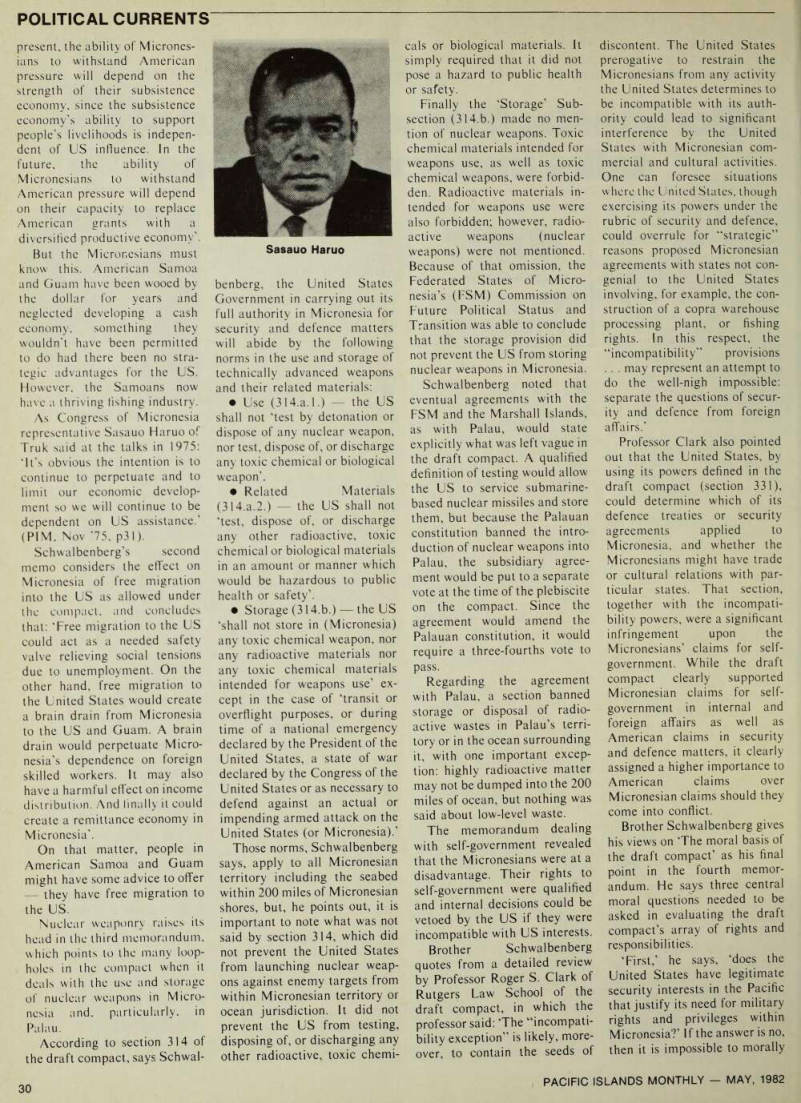
Sasauo Haruo
support this document. Yet recent events in Afghanistan and in Poland do show that the Soviet threat is a very real and dangerous force in our world. If the Soviet presence in the Pacific is a real threat not only to US interests but to the interests of the entire Pacific community, then it is possible to justify some US military pre rogatives in Micronesia even at the expense of some legitimate Micronesian claims. ‘Second, do Micronesians have the right to self government at this time? No one questions the fundamental right of Micronesians to self determination. but an individ ual or a society is entitled to rights only if that society can exercise them and carry out their corresponding responsi bilities. If Micronesia is not ready for self-government, then the United Nations Trusteeship should be continued. If Micronesia is almost, but not entirely, ready for self government, then some limi tations on its self-government would be justified. In that case, the draft compact requirements for US concurrence in develop ment plans and US auditing of aid would be reasonable. ‘Most fair observers, though not all, feel that the US does
have some legitimate security interests in Micronesia. Most fair observers, though again not all, also feel that Micronesia is ready for self-government, but with some auditing oversight by the US to ensure against waste and corruption. If we accept US security interests as well as Micronesian desires for self government as legitimate claims, then we hold at least the basic moral pre-conditions for supporting the draft Compact. ‘We now face a third and much more complicated ques tion. Micronesian claims for self-government and US claims for military prerogatives are also claims in conflict. The third question, assuming wc have no problems with the first two, is how do we balance these legit imate but conflicting claims?
The draft compact, through US “incompatibility powers” (sec tion 313), along with the US right to apply defence treaties unilaterally to Micronesia (sec tion 331), gives a higher value to US military claims than to Micronesian claims for self government. But to be lair, the United Stales is still concerned that its claims arc not fully satisfied in the draft compact.
The United Slates feels an urgent need to deny access to Micronesia to any of its polcn
tial enemies for the longest possible period of time. Hence, all the current clamour by Americans for 100 years of military denial instead ot merely the 15 years stipulated in the draft compact.’
Schwalbenberg sums up: ‘Clearly the draft compact favours the Americans at the expense of the Micronesians in the event of conflicting claims.
But does the draft compact give 100 much to the Americans? In any form of free association between America and Micronesia, Micronesia would be the weaker partner. How could free association be any different when roughly 90 per cent of all cash economic activi ties in Micronesia depend on US financial assistance? ‘Normally the claims of the weaker partner are protected from infringement by the stronger partner. Is it fair for the draft compact to favour the stronger partner the Americans in any serious conflict of interests? Or is this favouritism a necessary reflection of political and econ omic realities? More import antly, are enough of Micronesian legitimate claims for self-government protected from American infringement so that the local Micronesian gov
ernments can carry out their responsibilities to their people?
These questions are some of the ethical concerns which lie be neath the current debate on the draft Compact of Free Associ ation.' Brother Schwalbenberg ap pears to have done his home work well. The holes he has picked in the draft compact will need some filling, and it should be honest filling. One is left with the uncomfortable feeling that the United States is attempting to pull a fast one on the Micronesians. Now, as recorded in ‘Pacific Report’, the talks which resumed in Washington on February 8, have broken down. Marshall Islands Foreign Secretary Tony de Brum has accused the Reagan adminis tration of reneging on the de cisions made under President Carter.
That gives cause for disquiet.
Up to now, the US team hasn’t projected a very good image.
There were the CIA buggings of the Micronesian committee rooms in December, 1976.
Then, in the midst of the ensuing furore, the Congress of Micronesia secured a copy of the long-secret ‘Solomon Re port’ on Micronesia which had been prepared in 1963, and which was described by Congressman Sasauo Haruo as ‘an intelligence document on Micronesia and its leaders’.
Then, only recently, a certain Mr Sanders, an official in the US Interior Department in Washington, said that the trusteeship did not guarantee that the US must develop Micronesia to self-sufficiency.
Another official repudiated this statement. But it is not hard to imagine it being used for pur poses of a little arm-twisting in the present circumstances.
There’s one aspect that lends some strength to the American position. There’s a schizo phrenic vein m the US govern ment body. The State Depart ment and others want to do the right thing by the little people.
The Pentagon wants to ensure that never again can any of the islands of Micronesia be used as a base for aggression against the United States. This explains many apparent contradictions in the negotiations over the Compact of Free Association.
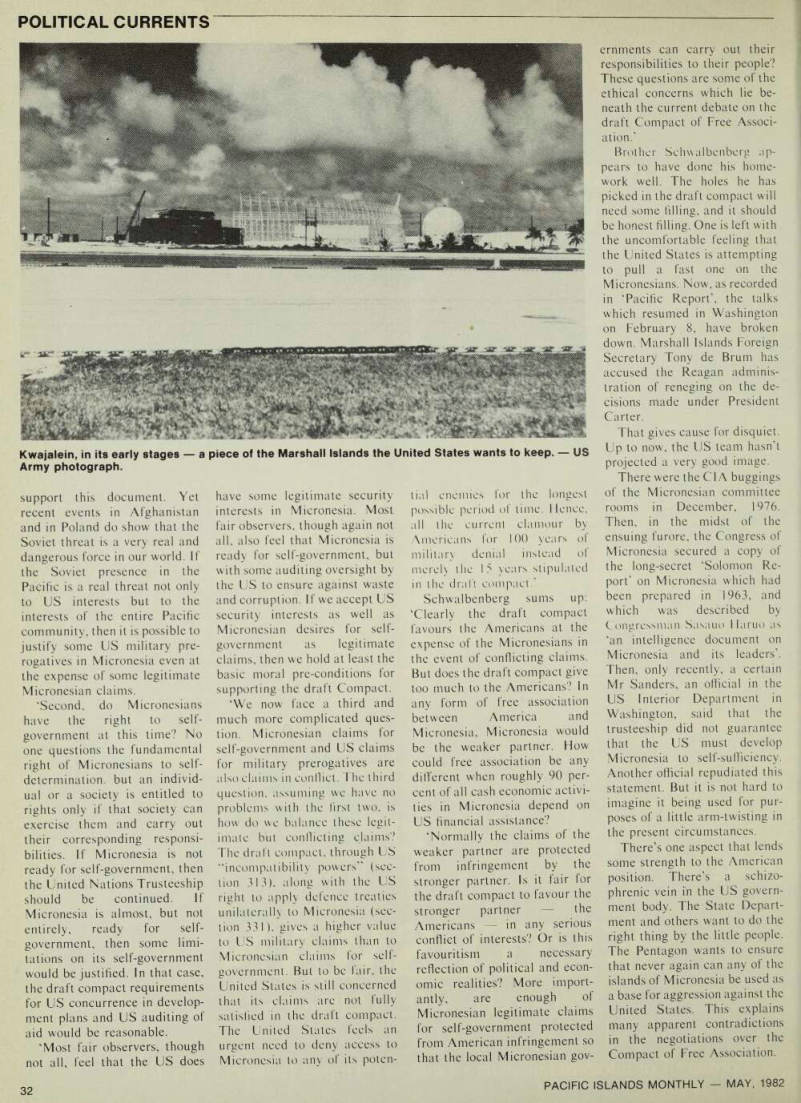
Kwajalein, in its early stages - a piece of the Marshall islands the United States wants to keep. - US Army photograph.