A forgotten
pp. 20-21 · Read in the full issue
Raoul Island: A forgotten history
Who would of their own free will choose to live on small, rugged Raoul Island in the Kermadec group? Not only is it an active volcano, it is also completely devoid of harbours and safe anchorages. To top it all, it sits in splendid isolation in the deep blue ocean half-way between New Zealand and Tonga.
The answer is: a surprisingly large number of Polynesians and Europeans, some of them women, who rarely died from natural causes unless murders and accidents are counted as such.
Thanks to the recent excavations by a New Zealand archaeologist, Athol Anderson, we now know for certain that as had long been suspected the first occupants of the island were Polynesians. The late Roger Duff in 1968 had described a dozen Polynesian stone adzes collected on Raoul by various people. But they had all been found on the surface, and could well have been dropped there in post-European times by some of the more recent Polynesian settlers.
During his diggings on Raoul Island in 1978, Athol Anderson discovered several adzes and one imitation whale tooth pendant in situ which are undoubtedly of Eastern Polynesian origin and, as carbon 14 samples show, date from around 1000 AD. Equally interesting is that dateable artefacts were found in all strata, indicating that the Polynesian occupancy lasted for 700 years that is, up to the 18th century, when a major volcanic eruption either killed or drove away the whole aboriginal population.
Raoul Island is therefore in all likelihood the Rangitahua Island of orthodox Maori tradition, where the Aetearoa canoe called on its way from the Society Islands to New Zealand.
Nobody laid eyes on Rangitahua again until the French explorer Bruni d’Entrecasteaux passed near it in 1793, and named it after his quartermaster, and the whole island group the Kermadec Islands after his second-in-command. (One of the ships of the First Fleet transporting female convicts to Australia, the Lady Penrhyn, had already five years before discovered the southern Kermadecs.) A British whaling captain who sighted Raoul Island in 1796, and was unaware of d’Entrecasteaux’s discovery, simply called it Sunday Island, a name which is still often used.
Having thus been placed on the map in an otherwise empty
corner of the Pacific, Raoul Island became a popular and convenient stopping place for the steadily increasing number of ships that from 1800 onwards hunted sperm whales in Australian and New Zealand waters. This prompted some sailors, both British and Maori, to jump ship and start growing potatoes, kumara, and yams, preparing smoked mutton bird flesh, drying fish, and raising goats and pigs for sale to passing whaling vessels. Some of them fetched women from Samoa to make their existence more bearable.
Most of these rough-and-ready ships’ victuallers left in 1848 when the volcano erupted and earth tremors became a daily occurrence. The rest went out of business and pulled up their stakes during the 1850 s when whaling activities declined. But before they did so, quite a number of them disappeared in circumstances which were never cleared up for the simple reason that there were no police on the island. The legacy left by these wild traders consisted mainly of goats and cats. The former could only destroy the low bushes that grew on the island, and had no impact on the dense rain forest that still covers the precipitous and ravined mountain slopes. The cats, on the other hand, have been responsible for the extermination of several species of small birds.
The whale-hunting vessels were followed by man-hunting ones. One of these, the Peruvian barque Rosa y Carmen, whose one-eyed pirate-captain had previously been engaged in the African slave trade, called at Raoul Island in 1863 in a desperate attempt to restore the health of 266 dysentery stricken men, women and children kidnapped from various Polynesian islands. From the evidence patiently gathered and skilfully presented by Professor Harry Maude in his latest book, Slavers In Paradise (reviewed PIM Jan p 44), it appears that about 80 died on the beach at West Bay, another 30 disappeared into the woods never to be seen again, and only 150 or so recovered sufficiently to be carried off by the blackbirders to a slightly slower death at sea or in Peru.
Next on the scene was a man whose name more than anybody else’s is associated with the island. He was the English schoolteacher, barkeeper, and ex-soldier from the Maori wars, Thomas Bell, who in November, 1878, landed at West Bay which, incidentally, is now called Denham Bay after the British Royal Navy captain who surveyed the Kermadecs in 1854.
Thomas Bell was accompanied by his wife Frederica, their six children (of whom the youngest was one year old), and a terrier.
To acquire the necessary strength for the tremendous task ahead of them they had a small supply of tinned food which all turned out to be rotten.
To nourish their souls, they had brought a violin, a Bible, and the complete works of Shakespeare.
After a year of incredible hardships (worst of all, they had no tea .. .), they concluded that they had settled in the wrong bay.
Undaunted, they carried their belongings, including two shacks, across the mountains and through the dense forests to the north coast, where there exists, high above the sea, a terrace with fertile soil, about five kilometres long and a kilometre wide.
There, they built a new home, laid out new vegetable gardens, worked, played, sang and read aloud to each other, year after year.
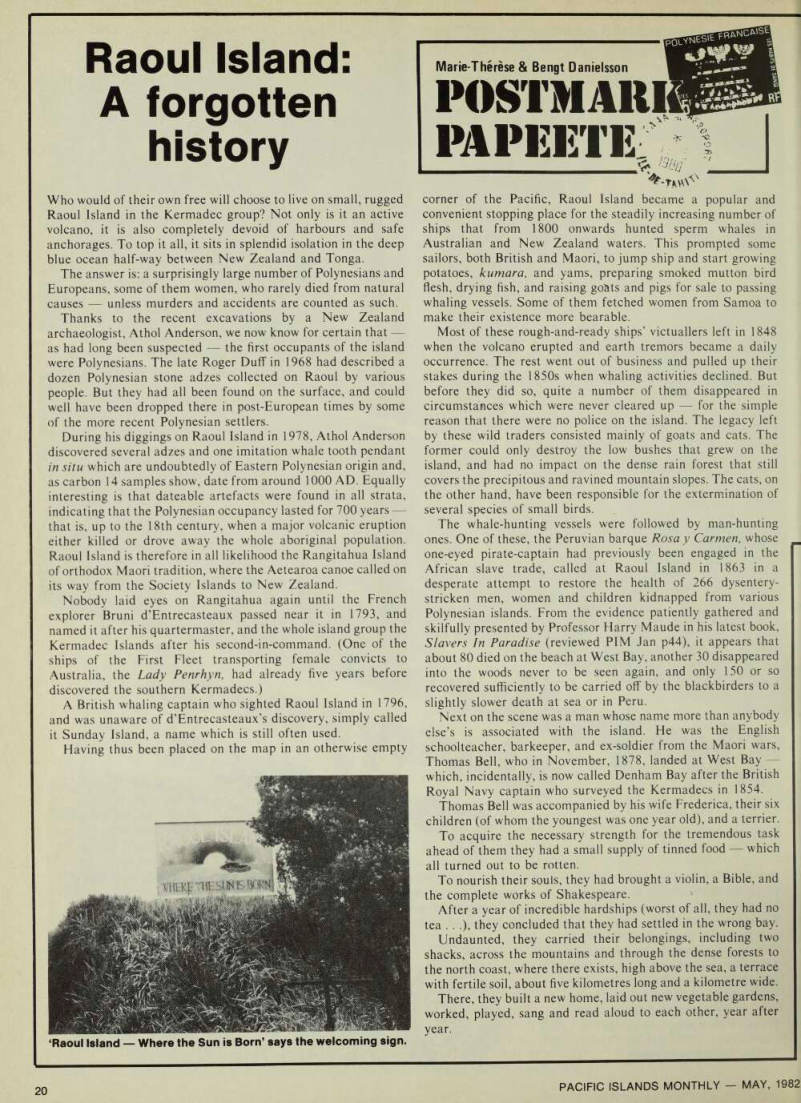
‘Raoul Island - Where the Sun is Born’ says the welcoming sign.
On the rare occasions when Thomas Bell managed to obtain passage on some ship bound for New Zealand, it was invariably in order to bring back more sheep, and he never stayed away longer than absolutely necessary.
The remarkable Bells had three more children, and seemed to be perfectly happy with their crowded solitude and strenuous life.
As the children grew up, however, they left their island home one after the other, eager to see the wonderful world they had only read about.
Their parents did not transfer their affections to the new settlers who arrived in the 1890 s, following New Zealand’s annexation of the Kermadecs. The government had taken this step due to its fear of German colonial expansion in the Pacific.
In fact, the Bells were furious when one day they discovered that a group of settlers had installed themselves in Denham Bay.
But, as it soon turned out, the newcomers, who had all expected to find a perfect South Sea paradise, totally lacked the stamina and determination of Thomas and Frederica Bell.
Within a year they had all given up the unequal battle against sore feet, boredom, tropical ulcers, claustrophobia and tummy aches.
Greatly relieved, the Bells continued their lonely life on what they called The Terrace’, until the outbreak of World War I when they were forcibly taken off the island by a New Zealand government vessel.
No attempts, however, were made to fortify Raoul Island, which was consequently used as a base in 1917 by the German raiding ship Wolf for its successful attacks on British naval and cargo ships crossing the Tasman Sea.
The present population of Raoul Island consists of five cheerful young New Zealand meteorologists whose daily reports greatly help the governments and ships’ captains in the Western
Pacific to foresee sudden changes in the weather the approach of hurricanes, for example.
Their offices and comfortable living quarters have been built on The Terrace’ where the Bells had their homestead. Its exact location can easily be determined by a double row of magnificent Norfolk pines, and the numerous huge orange trees that have grown up from the seeds given to the Bells at the turn of the century by the captain of the steamer Richmond. During one of its regular runs between Auckland, Samoa, Rarotonga and Tahiti, the vessel exhausted its supply of coal, and called at Raoul Island where the crew gathered firewood.
Finding the oranges exceptionally sweet and tasty, we saved some seeds which we have just planted in their Tahitian home soil.
Frankly, we had expected to find somewhere in the meteorological station a few historical mementoes books, pictures, or other objects left behind by the previous occupants.
But there was nothing.
The genial young New Zealanders manning the station did not even know the story of the indomitable Bells.
In truth, they can be excused. They have come out to Raoul Island on a brief, one-year assignment, and they are too busy to go delving into the past. How could they anyway in view of the fact that their small library squeezed in between a video cassette player and a cardboard box in the billiard room does not contain a single work on the history and geography of the Kermadecs?
This article should therefore be seen not only as an attempt to tell a little-known story which is in itself of great interest. It is also our means of thanking the whole five-man population of Raoul Island for the hospitality they showed us on our recent
visit on the Lindblad Explorer.
Marie-Thérèse and
Bengt Danielsson.