‘Hugo’s Folly’
pp. 23-26 · Read in the full issue
Tropicalities
towers over
Moresby
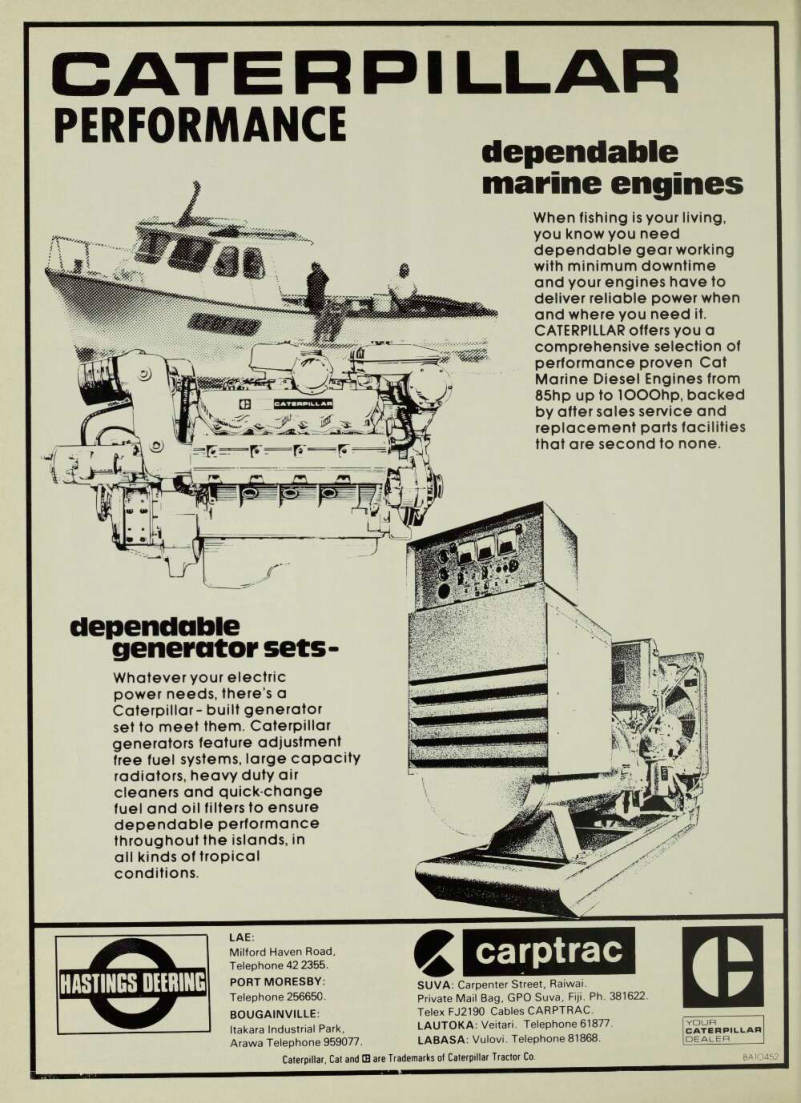
First occupants moved in March into Papua New Guinea’s tallest and grandest building the first multi storey luxury apartment block in the country.
Pacific View is the official name for the 15-floor, K 6 million (SAB million) block that commands breathtaking ocean views from the top of Port Moresby’s Three Mile Hill but locally it is known affectionately as Hugo’s Folly.
It’s the latest construction venture of German migrant Hugo Berghuser, 46, who came here 20 years ago as a carpenter on wages and who today* is worth more than SA2O million.
Hugo is confident that Pacific View is no folly. He began building it two years ago when he felt there was a demand for first-class home units with full security against break and en ter, which is not uncommon in Port Moresby. He wanted the building to be self-contained.
There are important com mercial and diplomatic staffs requiring this standard of ac commodation,’ Hugo says.
They haven’t been able to get it before.’
Pacific View contains base ment car parking (two spaces per unit), a ground floor of shops, restaurant, conference room, under-cover swimming pool, squash and tennis courts, 12 floors of apartments (64 three- and two-bedroom units and four large executive units) plus a penthouse with heliport above it. Hugo says his is the only government-approved heli port in the Pacific Islands.
A feature of the units is their large size l5 to 17 squares, with the executive units more than 30 squares.
All are fully tiled and car peted, with air-conditioning, en
suites, large fully equipped kitchens and laundries that include dishwashers and dryers.
The units have intercoms to the foyer where there is to be a 24-hour security guard with checks on the two lifts.
Hugo, a popular identity who has taken PNG citizenship, says he could not have financed his ‘Folly’ unless he had built it himself. And he describes him self as ‘being born a builder’.
He paid about $66 000 for the land and has employed only two expatriates on actual con struction a foreman and an engineer.
At the peak of construction he hired 250 workmen, but he’s down to 135 now that the finishing work is being done. He expects it will be completed by June. ‘They’re good men, good workers,’ says Hugo.
The building has been erected to earthquake-proof specifications, with fireproofed stair wells. And it has all gone up without the aid of cranes: everything has gone to the lop on a system of pulleys.
From the top there is a 360-degree view of sprawling Port Moresby, oceans and reefs.
Most of the units have views that take in half-a-dozen sub urbs along the coast, including the famous ‘canoe village’ of Koki, where the people live in houses over the sea.
Units range in price from S2OO 000 to $250 000, with executive apartments costing more but some will be available
for rent.
Stuart Inder in Port
Moresby.
Buyer gets his
‘girlies’ back
Two ‘girlie’ magazines seized by Customs from a Cook Islands businessman returning from American Samoa to Rarotonga must be returned to their owner, Cook Islands Chief Justice Sir Gaven Donne has ruled in the Cooks’ Supreme Court.
He was asked by Solicitor- General M. Mitchell for a declaration that the magazines, Penthouse and Club, were in decent documents and pro hibited imports.
Giving his reasons for refus ing the application, the chief justice said the legislative mess-
age contained in the Crimes Act, 1969, was clear. It recog nised the right of the individual to act in his own domain according to his conscience. He might indulge, if he chose, in the dubious pleasure of obtain ing, possessing and reading in decent documents. That was his own affair and his action in so doing could not be considered either immoral or mischievous.
Sir Gaven pointed out, how ever, that the relevant sub section of the act did not provide an avenue for the sale of such periodicals in Cook Islands shops.
The sub-section does not in my view,’ he said, ‘extend to protecting those who import such documents for distribu tion, exhibition or sale. The act of importing it for sale and distribution could at least be mischievous.’
‘Maori gentlemen
wearing dresses’
The trans-Tasman migration tide from New Zealand into Australia is carrying a few decidedly odd bodies with it.
The Sydney-based Australian weekly The National Times reported late in March: Citizens of East Sydney have been up in arms over increasing flocks of prostitutes peddling their wares in front of resi-
dences now inhabited by some of the community’s smarter members.
One ratepayer said at an angry meeting last week: The whole area is just one big brothel.’
However, despite the increas ing intensity of these public outcries, authorities shake their heads and say police are power less to do anything.
Sydney television viewers were also alarmed to hear one lady of the night discuss the situation in a disturbingly deep and gravelly voice.
Indeed, it appears there are whole streets of ladies whose voices all have a similar deep resonance.
There is even an entire block populated by Maori gentlemen wearing dresses.
Still, the customers must enjoy the challenge because the thoroughfares are choked all evening with prowling auto
Port Moresby’s Pacific Viewor ‘Hugo’s Folly’ - (above), and (right) the man responsible for it, Hugo Berghuser, relaxes on the roof of his creation. - Stuart Inder pictures.
mobiles and drivers shopping for a bargain.
A grave at
Hanuabada...
Moves have begun which may rescue from obscurity the grave of Australia’s most famous col onial administrator Sir Hubert Murray.
Sir Hubert, who was lieu tenant-governor of Papua from 1908 until his death in 1940, is buried in the old European cemetery at Hanuabada, not far from the Government House he had occupied for so many years.
But the historic cemetery, which is also the resting place of many other Australian pioneers of colonial times, was closed to burials in 1969 and has become overgrown and neglected.
Most people do not know of its existence, for there are no signs pointing to it, and no sign on the cemetery itself, which is hidden behind a screen of overgrown bushes in a little valley beyond Port Moresby’s Hanuabada village.
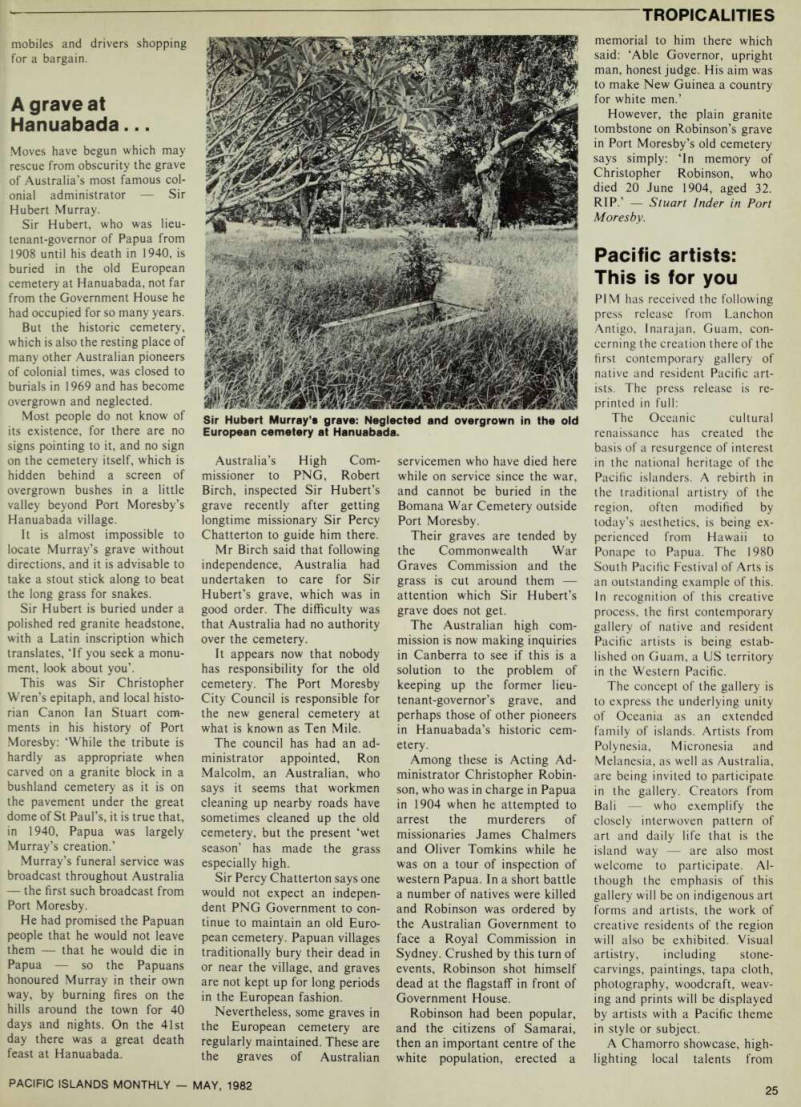
It is almost impossible to locate Murray’s grave without directions, and it is advisable to take a stout stick along to beat the long grass for snakes.
Sir Hubert is buried under a polished red granite headstone, with a Latin inscription which translates, ‘lf you seek a monu ment, look about you’.
This was Sir Christopher Wren’s epitaph, and local histo rian Canon lan Stuart com ments in his history of Port Moresby; ‘While the tribute is hardly as appropriate when carved on a granite block in a bushland cemetery as it is on the pavement under the great dome of St Paul’s, it is true that, in 1940, Papua was largely Murray’s creation.’
Murray’s funeral service was broadcast throughout Australia the first such broadcast from Port Moresby.
He had promised the Papuan people that he would not leave them that he would die in Papua so the Papuans honoured Murray in their own way, by burning fires on the hills around the town for 40 days and nights. On the 41st day there was a great death feast at Hanuabada.
Australia’s High Com missioner to PNG, Robert Birch, inspected Sir Hubert’s grave recently after getting longtime missionary Sir Percy Chatterton to guide him there.
Mr Birch said that following independence, Australia had undertaken to care for Sir Hubert’s grave, which was in good order. The difficulty was that Australia had no authority over the cemetery.
It appears now that nobody has responsibility for the old cemetery. The Port Moresby City Council is responsible for the new general cemetery at what is known as Ten Mile.
The council has had an ad ministrator appointed, Ron Malcolm, an Australian, who says it seems that workmen cleaning up nearby roads have sometimes cleaned up the old cemetery, but the present ‘wet season’ has made the grass especially high.
Sir Percy Chatterton says one would not expect an indepen dent PNG Government to con tinue to maintain an old Euro pean cemetery. Papuan villages traditionally bury their dead in or near the village, and graves are not kept up for long periods in the European fashion.
Nevertheless, some graves in the European cemetery are regularly maintained. These are the graves of Australian
servicemen who have died here while on service since the war, and cannot be buried in the Bomana War Cemetery outside Port Moresby.
Their graves are tended by the Commonwealth War Graves Commission and the grass is cut around them attention which Sir Hubert’s grave does not get.
The Australian high com mission is now making inquiries in Canberra to see if this is a solution to the problem of keeping up the former lieu tenant-governor’s grave, and perhaps those of other pioneers in Hanuabada’s historic cem etery.
Among these is Acting Ad ministrator Christopher Robin son, who was in charge in Papua in 1904 when he attempted to arrest the murderers of missionaries James Chalmers and Oliver Tomkins while he was on a tour of inspection of western Papua. In a short battle a number of natives were killed and Robinson was ordered by the Australian Government to face a Royal Commission in Sydney. Crushed by this turn of events, Robinson shot himself dead at the flagstaff in front of Government House.
Robinson had been popular, and the citizens of Samarai, then an important centre of the white population, erected a
memorial to him there which said: ‘Able Governor, upright man, honest judge. His aim was to make New Guinea a country for white men.’
However, the plain granite tombstone on Robinson’s grave in Port Moresby’s old cemetery says simply: ‘ln memory of Christopher Robinson, who died 20 June 1904, aged 32.
RIP.’ Stuart Inder in Port Moresby.
Pacific artists:
This is for you
PIM has received the following press release from Lanchon Antigo, Inarajan, Guam, con cerning the creation there of the first contemporary gallery of native and resident Pacific art ists. The press release is re printed in full: The Oceanic cultural renaissance has created the basis of a resurgence of interest in the national heritage of the Pacific islanders. A rebirth in the traditional artistry of the region, often modified by today’s aesthetics, is being ex perienced from Hawaii to Ponape to Papua. The 1980 South Pacific Festival of Arts is an outstanding example of this.
In recognition of this creative process, the first contemporary gallery of native and resident Pacific artists is being estab lished on Guam, a US territory in the Western Pacific.
The concept of the gallery is to express the underlying unity of Oceania as an extended family of islands. Artists from Polynesia, Micronesia and Melanesia, as well as Australia, are being invited to participate in the gallery. Creators from Bali who exemplify the closely interwoven pattern of art and daily life that is the island way are also most welcome to participate. Al though the emphasis of this gallery will be on indigenous art forms and artists, the work of creative residents of the region will also be exhibited. Visual artistry, including stone carvings, paintings, tapa cloth, photography, woodcraft, weav ing and prints will be displayed by artists with a Pacific theme in style or subject.
A Chamorro showcase, high lighting local talents from
Sir Hubert Murray’s grave: Neglected and overgrown in the old European cemetery at Hanuabada.
Guam, will be a regular feature of the gallery. An Artist-in- Residence programme will in vite distinguished, experienced Pacific artists to work at the gallery in a creative capacity.
Extensive media coverage plus an exhibition of the visiting artist’s work including that created in Guam during the residency will be an import ant part of the Artist-in- Residence program.
Lanchon Antigo, at Inarajan, Guam, will be the home of the gallery. At present, Lanchon Antigo is a reconstructed Chamorro village of bamboo and nipa-thatched huts built according to indigenous archi tectural designs. Guam crafts, such as weaving and cooking, are displayed there in accord ance with the island traditions.
Lanchon Antigo is one of the main cultural attractions for both visitors and residents on Guam. An extensive, major expansion plan is being im plemented at the site. Instead of a single village, a series of villages will be constructed, each cluster of huts represent ing one period of Guam’s devel opment through the centuries, from early contact days right down to modern limes. Pav ilions housing a restaurant, gift shop and the art gallery, plus a parking lot, will also be con structed. In addition, it should be noted that while tourism has gone down throughout the rest of the Pacific, it has steadily climbed upward in Guam, mak ing it an important international destination.
Since it is a goal of the gallery to attain the highest possible aesthetic standards, artists must submit their work to the curator of the gallery, as all proposed work is subject to review. Slides, photos and or samples plus resume and press clippings (no originals, please!) must be sent to: Curator, Lanchon Antigo, PO Box 0172, Inarajan, Guam 96916-0172,
Usa.
If you want your materials to be returned, include a stamped, self-addressed envelope with correct postage (if US postage is not available for the return envelope, enclose International Reply Coupons). Spin-off pro ducts from the art, such as
T-shirts and postcards, may also be submitted for review for sale in the gift shop.
Those artists whose work is accepted for exhibition will display their work on consign ment. Artists are responsible for the shipping, insuring and pric ing of their art. The gallery will simply charge an additional price of 33 percent to the amount suggested for sale by the artist. All artists who exhibit in the gallery will be eligible to take part in the Artist-in-Residence program.
The gallery of contemporary Pacific art is being established by the board of directors of Lanchon Anligo in collabor ation with E. Rampell.
Mr Rampell has travelled extensively throughout the Pacific since 1976. He has visited, lived and worked as a painter, writer, art dealer, car toonist, art teacher and beach
comber on over 30 islands and atolls, from Tahiti to Samoa to Hawaii to Micronesia. He will be acting as curator of the Pacific Gallery as an integral part of his National Endow ment for the Arts grant awarded through Guam’s Insu lar Arts Council, Office of the Governor.
While it is certainly to be hoped that the gallery will be profitable for all those participating in it, its funda mental ideal is to provide a focal point for the cultural Renaissance that is sweeping the far-flung shores of Oceania, keeping in mind that the highest purpose of art is to enlighten, and that Pacific means ‘peace’.
Wedding bells
and seafood
Specialised honeymoon fea-
lures such as wedding services in romantic South Pacific set tings are among the require ments Fiji has been asked to provide for its Japanese visitors.
The idea was contained in a suggestion made by the Fiji Embassy in Japan to the Fiji Visitors Bureau following a convention of the Japan Associ ation of Travel Agents held in Tokyo in December last year.
The bureau was assured by the embassy of a continued steady growth of Japanese tour ists to Fiji during the 1980 s.
But it said that certain con ditions in Fiji had not come up to Japanese expectations and that Fiji should look into these.
The wedding requirements were one of these. This would only be for ‘memory’ purposes as the real wedding would have taken place in Japan before the honeymooners left.
Facilities that did not come up to expectations of the Japanese visitors were hotel meals and shopping. This was also endorsed by an in-flight survey conducted by Air New Zealand on its Nadi-Narita service last year.
Shopping facilities in Fiji were not of high enough quality to attract the Japanese. Conse quently, a lot of the spending money goes back to Japan unused, the embassy reported.
On food, it said that there was a need to change menus and servings to suit Japanese tastes, and that there was need for more fresh seafood to be avail able on the menus.
There was also a need to develop ‘leisure facilities and human interest attractions,’ the
embassy said.
The Fiji
Times.
Anaconda II in
Sydney-Rio win
The inaugural Sydney-Rio yacht race (PIM Nov ’Bl p 75) was won on March 5 by the 23-metre Sydney sloop Bucca neer. It beat the 26-metre Adelaide ketch Anaconda II by only 6 hours, three minutes and 56 seconds a tiny fraction of the 39 days the two craft had been at sea. Both had rounded Cape Horn in fierce gales Buccaneer on February 17, and Anaconda II on February 19.
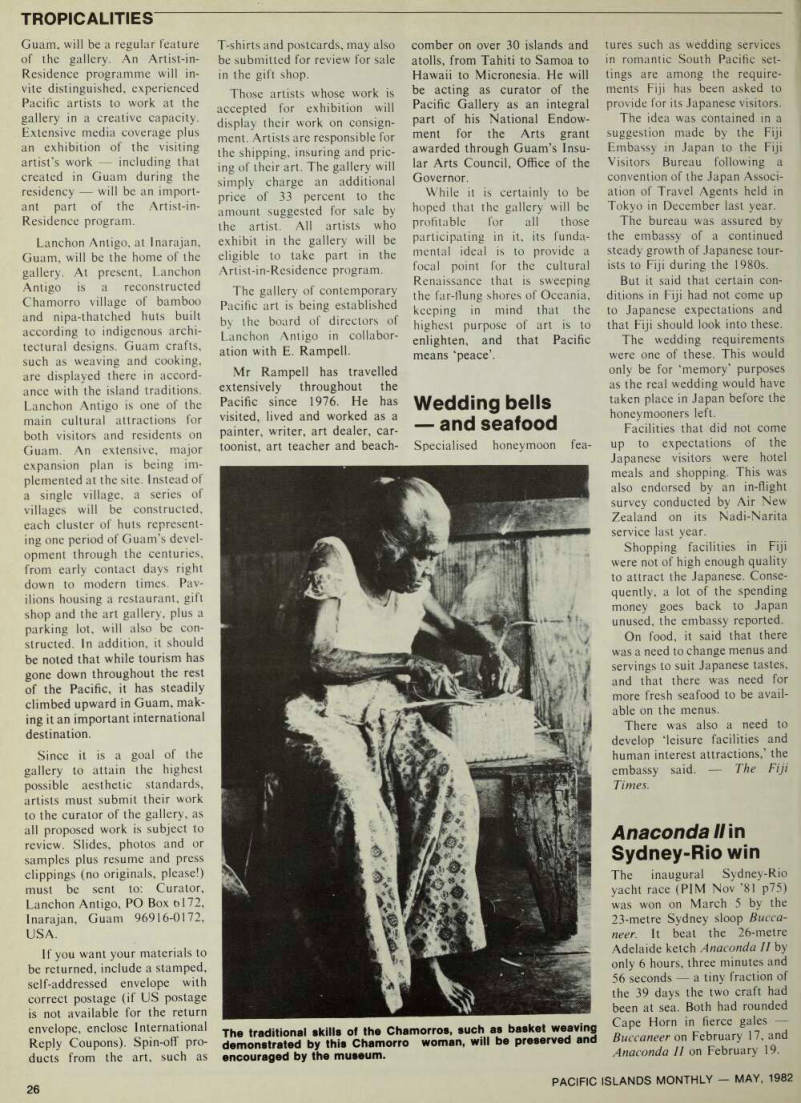
The traditional skills of the Chamorros, such as basket weaving demonstrated by this Chamorro woman, will be preserved and encouraged by the museum.