ASEAN and regional co-operation
pp. 17-18 · Read in the full issue
The New Pacific Wave
ASEAN and regional co-operation in the Pacific Islands
As part of the Hawaii-based East-West Center’s Pacific Island Development Program on ASEAN and its implications for the Pacific Islands, PAMELA TAKIORA INGRAM PRYOR* recently toured four of the five ASEAN countries to study the working of the organisation, and to discover how, if at all, the ASEAN example could help the goal of regional co-operation among Pacific Island countries.
Her report follows.
Although regional co-operation is fairly new in the Pacific Islands, at the political level Pacific Island leaders have been talking about it for the past 15 years or so, from time to time promoting a little co-operation with each other. At the grassroots village level in the Pacific, the concept is not understood by many people.
Yet, to some islanders, it is one of the most important issues in the contemporary Pacific.
Recently, the Pacific Islands Development Program of the East-West Center was asked by Pacific Island leaders to con duct a study of regional co operation, which was then in itiated under Professor Ron Crocombe, director of the Insti tute of Pacific Studies of the University of the South Pacific.
In order to have a basis from which to start to understand the potential for regional co operation in the Pacific Islands, Professor Crocombe felt that an analysis of the development of regional organisations in other regions was necessary. The As sociation of Southeast Asian Nations (ASEAN) was selected as one of the regional organis ations to be considered because it was fell that it has much relevance to the Pacific.
ASEAN is a political, econ omic and social organisation consisting of five member countries: Indonesia, Malaysia, the Philippines, Singapore and Thailand. It was established in 1967 by the foreign ministers of these countries.
At first the activity of the organisation was more or less confined to an annual meeting at which the foreign ministers got together to exchange ideas and establish contact. It was not until after the fall of Vietnam in 1975 that ASEAN suddenly took on a new dimension and a new role, motivated by the communist threat represented by Vietnam. Since then its role in regional and international politics has been of prime importance in the Asia-Pacific region. Its effectiveness in at tracting international attention was illustrated by the attend ance of US Secretary of Stale Alexander Haig at the last ASEAN ministers’ conference in Manila.
ASEAN was established by the so-called Bangkok Declar ation with the main goal of creating ‘a peaceful, prosperous and resilient community’. It has four objectives: 1) to accelerate economic, social and cultural development; 2) to promote regional peace and stability; 3) to promote collaboration and mutual assistance on matters of common interest, for example food, energy, etc; and 4) to maintain relationships with in ternational and regional organ isations.
The ASEAN region is significant for several reasons.
It has a population of more than 230 million people, which is approximately 8 percent of the world population. The region is rich in natural resources, ex porting 86 percent of the world’s natural rubber, 82 per cent of its palm oil, 80 percent of its copper and 71 percent of its tin. By comparison, the Pacific Islands region has a population of only about six million people, and, with the exception of Papua New Guinea and Fiji, the land
masses are very small and the natural resources very limited.
However, there is potential in ocean resources, both in terms of fisheries and minerals devel opment. The Pacific Islands are important strategically, as are the Southeast Asian countries.
During a recent visit to four of the five ASEAN countries, the writer had discussions with staff of the ASEAN secretariat, some of the national sec retariats, researchers, aca demics, and others with knowl edge of ASEAN and its devel opment. One of the basic ques tions posed was whether, in their opinion, ASEAN was meeting the objectives and serv ing the needs of the ASEAN countries. Most people agree that it has been worthwhile.
Although the objectives of ASEAN did not include politi cal co-operation, success has in fact been greatest in that area.
Regionally, it has created a very cohesive body: member countries consult each other on foreign policies, and inter nationally they have become influential. Recently ASEAN criticised the United States for not consulting them on its decision to sell arms and high technology to China. Presum ably, this will have some impact on US foreign policy in the region in future.
Most observers agree that ASEAN has been successful in social and cultural matters as well. People within each of the countries are now more aware of each other’s differences and similarities, and they interact constantly on a social basis.
There is great mobility within the region, and this has created many bonds between people.
Earlier points of conflict be tween nations have been re duced, and a real social and cultural affinity is emerging.
They have even started to work together in a military sense. For instance, Thailand and Malaysia conduct joint oper ations against the communist insurgencies on their common border.
Economically, however, most people feel that success has been liqiited. Although a trade agreement giving preferential treatment to different goods within the region has been concluded, the goods identified in the agreement are not the most important items traded in the region.
The ASEAN secretariat re cently moved into a new building built by Indonesia in Jakarta. The secretarial con sists of approximately eight professional staff and 30 sup port staff. Although this is a small staff, it is obvious from the size of the building that the secretarial plans to expand. As in the Pacific Islands, language is an issue. However, ASEAN has agreed to use English as the official language of the sec retarial, which helps communi cation. The secretariat is mostly concerned with preparing work ing papers and projects, and servicing meetings. It does not conduct research but asks other institutions to do it for them.
ASEAN also has nine com mittees whose work is co ordinated by the secretariat.
These are concerned with: In dustry, Minerals and Energy; Food, Agriculture and Forestry; Transport and Communi cations; Social Development; Science and Technology; Trade and Tourism; Finance and Banking; Budget; and Culture and Information.
One of the interesting and most important features of ASEAN is the role of the 33 non-governmental organis ations. Among these, the
* Pamela Takiora Ingram Pryor, a Cook Islander, is president of Pacific Planning and Research Corporation.
Hawaii. She is at present en gaged in tourism studies and aquaculture planning and re search.
ASEAN Chambers of Com merce and Industry has devel oped into a very powerful and effective organisation. Others include a bankers’ association, a petroleum organisation, a mo tion picture producers’ associ ation, a travel association, a women’s organisation, and many more. These bodies are especially important in arousing and maintaining an awareness of ASEAN, involving as they do people from so many different sectors.
Membership of ASEAN is limited to the five founding countries. Sri Lanka recently applied for membership but is unlikely to be accepted because people in ASEAN feel that it is outside the region unlike Brunei, for example, which is within the ASEAN region and will soon become independent.
There has also been some inter est expressed by Burma.
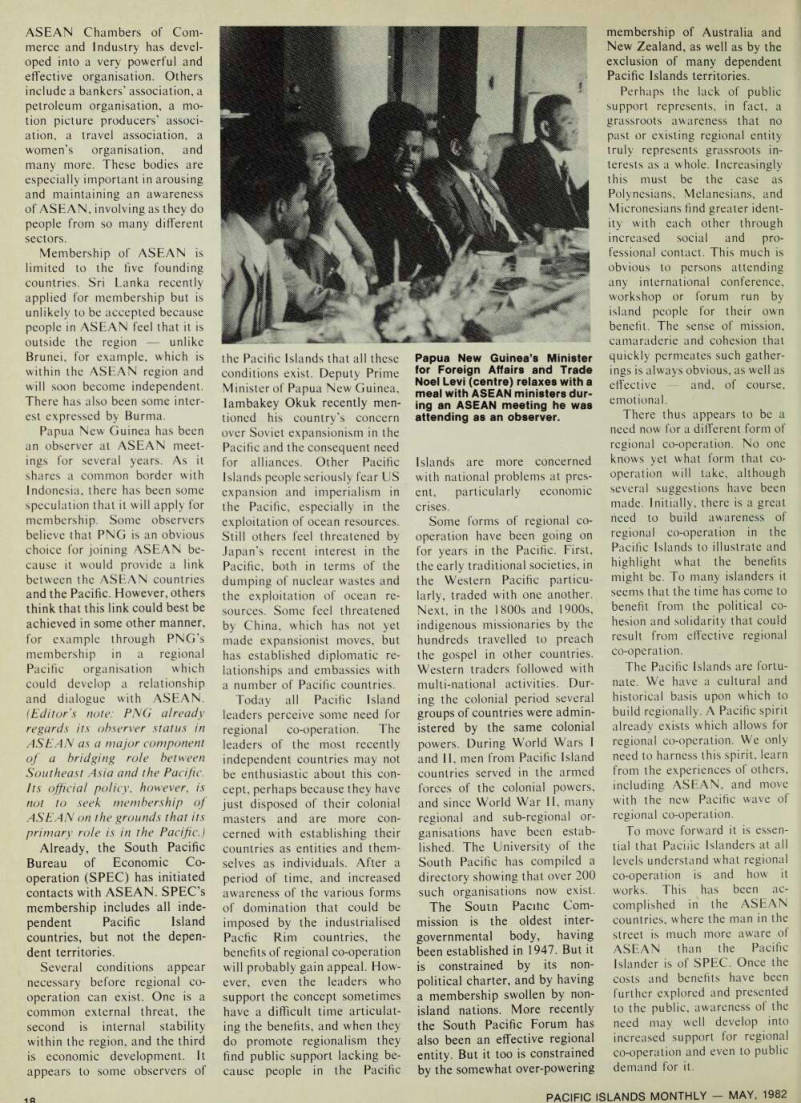
Papua New Guinea has been an observer at ASEAN meet ings for several years. As it shares a common border with Indonesia, there has been some speculation that it will apply for membership. Some observers believe that PNG is an obvious choice for joining ASEAN be cause it would provide a link between the ASEAN countries and the Pacific. However, others think that this link could best be achieved in some other manner, for example through PNG’s membership in a regional Pacific organisation which could develop a relationship and dialogue with ASEAN. (Editor's note: PNG already regards its observer status in ASEAN as a major component of a bridging role between Southeast Asia and the Pacific.
Its official policy, however, is not to seek membership of ASEAN on the grounds that its primary role is in the Pacific.) Already, the South Pacific Bureau of Economic Co operation (SPEC) has initiated contacts with ASEAN. SPEC’s membership includes all inde pendent Pacific Island countries, but not the depen dent territories.
Several conditions appear necessary before regional co operation can exist. One is a common external threat, the second is internal stability within the region, and the third is economic development. It appears to some observers of
the Pacific Islands that all these conditions exist. Deputy Prime Minister of Papua New Guinea, lambakey Okuk recently men tioned his country’s concern over Soviet expansionism in the Pacific and the consequent need for alliances. Other Pacific Islands people seriously fear US expansion and imperialism in the Pacific, especially in the exploitation of ocean resources.
Still others feel threatened by Japan’s recent interest in the Pacific, both in terms of the dumping of nuclear wastes and the exploitation of ocean re sources. Some feel threatened by China, which has not yet made expansionist moves, but has established diplomatic re lationships and embassies with a number of Pacific countries.
Today all Pacific Island leaders perceive some need for regional co-operation. The leaders of the most recently independent countries may not be enthusiastic about this con cept, perhaps because they have Just disposed of their colonial masters and are more con cerned with establishing their countries as entities and them selves as individuals. After a period of time, and increased awareness of the various forms of domination that could be imposed by the industrialised Pacfic Rim countries, the benefits of regional co-operation will probably gain appeal. How ever, even the leaders who support the concept sometimes have a difficult time articulat ing the benefits, and when they do promote regionalism they find public support lacking be cause people in the Pacific
Islands are more concerned with national problems at pres ent, particularly economic crises.
Some forms of regional co operation have been going on for years in the Pacific. First, the early traditional societies, in the Western Pacific particu larly, traded with one another.
Next, in the 1800 s and 1900 s, indigenous missionaries by the hundreds travelled to preach the gospel in other countries.
Western traders followed with multi-national activities. Dur ing the colonial period several groups of countries were admin istered by the same colonial powers. During World Wars I and 11, men from Pacific Island countries served in the armed forces of the colonial powers, and since World War 11, many regional and sub-regional or ganisations have been estab lished. The University of the South Pacific has compiled a directory showing that over 200 such organisations now exist.
The Soutn Pacific Com mission is the oldest inter governmental body, having been established in 1947. But it is constrained by its non political charter, and by having a membership swollen by non island nations. More recently the South Pacific Forum has also been an effective regional entity. But it too is constrained by the somewhat over-powering
membership of Australia and New Zealand, as well as by the exclusion of many dependent Pacific Islands territories.
Perhaps the lack of public support represents, in fact, a grassroots awareness that no past or existing regional entity truly represents grassroots in terests as a whole. Increasingly this must be the case as Polynesians, Melanesians, and Micronesians find greater ident ity with each other through increased social and pro fessional contact. This much is obvious to persons attending any international conference, workshop or forum run by island people for their own benefit. The sense of mission, camaraderie and cohesion that quickly permeates such gather ings is always obvious, as well as effective and, of course, emotional.
There thus appears to be a need now for a different form of regional co-operation. No one knows yet what form that co operation will take, although several suggestions have been made. Initially, there is a great need to build awareness of regional co-operation in the Pacific Islands to illustrate and highlight what the benefits might be. To many islanders it seems that the time has come to benefit from the political co hesion and solidarity that could result from effective regional co-operation.
The Pacific Islands are fortu nate. We have a cultural and historical basis upon which to build regionally. A Pacific spirit already exists which allows for regional co-operation. We only need to harness this spirit, learn from the experiences of others, including ASEAN, and move with the new Pacific wave of regional co-operation.
To move forward it is essen tial that Pacific Islanders at all levels understand what regional co-operation is and how it works. This has been ac complished in the ASEAN countries, where the man in the street is much more aware of ASEAN than the Pacific Islander is of SPEC. Once the costs and benefits have been further explored and presented to the public, awareness of the need may well develop into increased support for regional co-operation and even to public demand for it.
Papua New Guinea’s Minister for Foreign Affairs and Trade Noel Levi (centre) relaxes with a meal with ASEAN ministers dur ing an ASEAN meeting he was attending as an observer.