With a New Hebrides inter-island
pp. 51-54 · Read in the full issue
Yesterday
With a New Hebrides inter-island trader. Anno Domini 1938
Forty-four years ago, in 1938, a young Sydney art teacher, E. A. HARVEY, spent his Xmas-New Year holidays travelling through the New Hebrides as a passenger on a Burns Philp inter-island trading vessel. He recorded his experiences in a diary which he recently made available to PIM for publication. Following a brief introduction, the first of four extracts from Mr Harvey’s diary appears below.
During my teens I was trained in the profession, or if you wish, the calling, of art. Ini 935 I was appointed to the part-time teaching staff of the Art De partment, East Sydney Techni cal College. In those days the college year consisted of three terms ofll weeks, 14 weeks, and 12 weeks, with a week off in between. Thus the non-teaching year was of 17 weeks duration, 15 of those weeks coming over the Christmas and New Year break. For the students and part-time staff these 17 weeks were holiday time.
During one holiday my friend, Maurice Helsen, and I had taken a cruise on the SS Pierre Loti to Noumea and Port-Vila. Maurice never re covered: The South Seas had taken him over. He left his little business and got a job with Burns Philp, (South Sea) as a clerk, and was posted to Port-Vila. He was of Belgian origin, and of course bilingual.
Very soon he became a super cargo on a little inter-island trading vessel, the SS Mirani; during the Xmas-New Year break of 1938 the Mirani would be making one of her rare visits to the most southern and most northern islands in the New Hebrides archipelago.
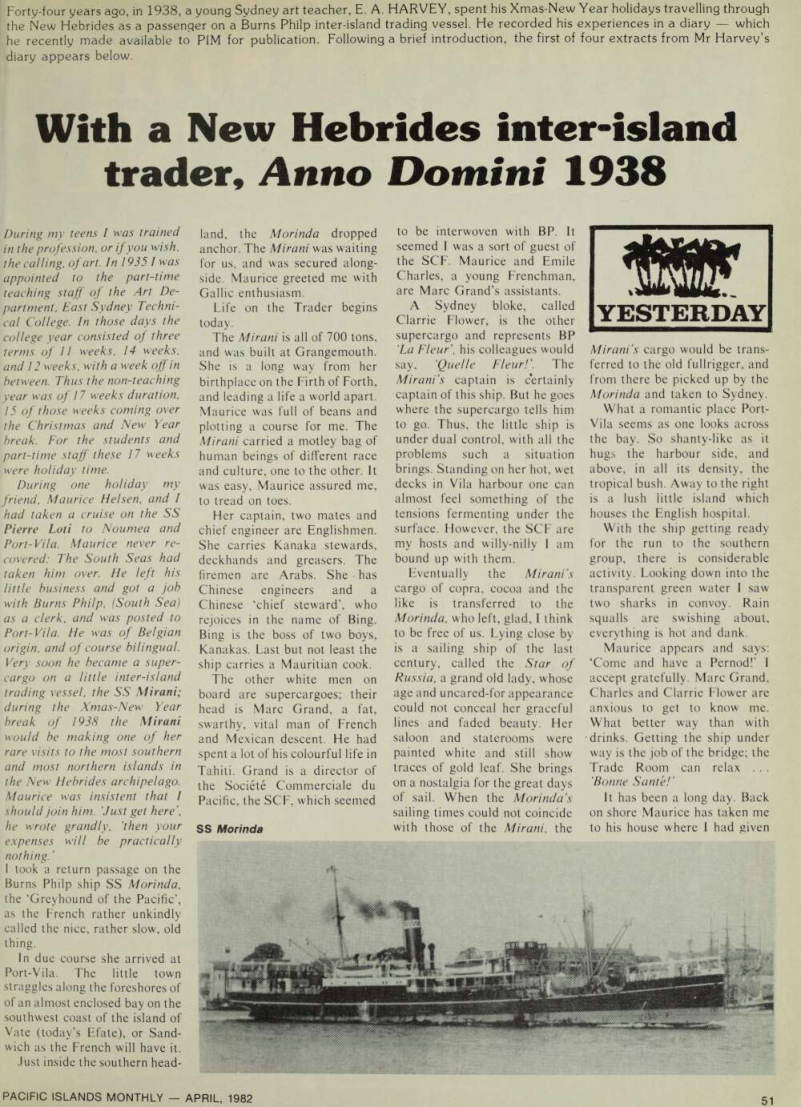
Maurice was insistent that I should join him. ‘Just get here’, he wrote grandly, ‘then your expenses will be practically nothing. ’ 1 took a return passage on the Burns Philp ship SS Morinda, the ‘Greyhound of the Pacific’, as the French rather unkindly called the nice, rather slow, old thing.
In due course she arrived at Port-Vila. The little town straggles along the foreshores of of an almost enclosed bay on the southwest coast of the island of Vate (today’s Efate), or Sand wich as the French will have it.
Just inside the southern head
land, the Morinda dropped anchor. The Mirani was waiting for us, and was secured along side. Maurice greeted me with Gallic enthusiasm.
Life on the Trader begins today.
The Mirani is all of 700 tons, and was built at Grangemouth.
She is a long way from her birthplace on the Firth of Forth, and leading a life a world apart.
Maurice was full of beans and plotting a course for me. The Mirani carried a motley bag of human beings of different race and culture, one to the other. It was easy, Maurice assured me, to tread on toes.
Her captain, two mates and chief engineer arc Englishmen.
She carries Kanaka stewards, deckhands and greasers. The firemen are Arabs. She has Chinese engineers and a Chinese ‘chief steward', who rejoices in the name of Bing.
Bing is the boss of two boys, Kanakas. Last but not least the ship carries a Mauritian cook.
The other white men on board are supercargoes; their head is Marc Grand, a fat, swarthy, vital man of French and Mexican descent. He had spent a lot of his colourful life in Tahiti. Grand is a director of the Societe Commerciale du Pacific, the SCF, which seemed
to be interwoven with BP. It seemed 1 was a sort of guest of the SCF. Maurice and Emile Charles, a young Frenchman, are Marc Grand’s assistants.
A Sydney bloke, called Clarrie Flower, is the other supercargo and represents BP La Fleur’, his colleagues would say, ‘Quelle Fleur!’. The Mi rani’s captain is certainly captain of this ship. But he goes where the supercargo tells him to go. Thus, the little ship is under dual control, with all the problems such a situation brings. Standing on her hot, wet decks in Vila harbour one can almost feel something of the tensions fermenting under the surface. However, the SCF are my hosts and willy-nilly I am bound up with them.
Eventually the Mi rani’s cargo of copra, cocoa and the like is transferred to the Morinda, who left, glad, I think to be free of us. Lying close by is a sailing ship of the last century, called the Star of Russia, a grand old lady, whose age and uncared-for appearance could not conceal her graceful lines and faded beauty. Her saloon and staterooms were painted white and still show traces of gold leaf. She brings on a nostalgia for the great days of sail. When the Morinda’s sailing times could not coincide with those of the Mirani, the
Mi rani’s cargo would be trans ferred to the old fullrigger, and from there be picked up by the Morinda and taken to Sydney.
What a romantic place Porl- Vila seems as one looks across the bay. So shanty-like as it hugs the harbour side, and above, in all its density, the tropical bush. Away to the right is a lush little island which houses the English hospital.
With the ship getting ready for the run to the southern group, there is considerable activity. Looking down into the transparent green water I saw two sharks in convoy. Rain squalls are swishing about, everything is hot and dank.
Maurice appears and says; ‘Come and have a Pernod!' 1 accept gratefully. Marc Grand, Charles and Clarrie Flower are anxious to get to know me.
What better way than with drinks. Getting the ship under way is the job of the bridge; the Trade Room can relax ...
'Bonne Santel’
It has been a long day. Back on shore Maurice has taken me to his house where I had given
SS Morinda
my head an awful swipe on a rafter and had bled like a pig.
Maurice had poured half a bottle of eau de Cologne over me. It was surprisingly painful.
Later, I had the gash attended to at the French hospital.
Back on the ship, I am watching the loading of a horse.
It is a rotten business. The horse was swum alongside a surfboat, half-strangled by the rope around its neck. Alongside, the hoist is fumbled around its belly. This is an idea of the second mate: they get it on the well deck at last, badly fright ened and plunging about be tween winches and scuppers, with the deck slippery with rain.
There is a wild scramble, the horse falls down. The excite ment of the Boys and everybody yelling out orders and rushing around does not help. Eventu ally they all calm down, includ ing the horse doubtless it discovers it is none the worse.
The Mirani is a dirty black and white, with green weed growing over her red Plimsoll.
Her black funnel has the checker pattern characteristic of BP ships. She has two hatches forrard in a longish well deck. Under the bridge is a narrow saloon running athwartships. Two state rooms open from the saloon, with a pantry and bathroom separat ing them.
I am installed in the star board stateroom. Outside my cabin the deck is only wide enough for one man to walk countless bare feet have worn a blackish groove in the deck, like a groove worn in the flagstones of an old church. I’m afraid laughter, blasphemy, and stink ing copra have accompanied the making of this one.
Past my cabin ports the deck turns quickly, and proceeds dirtily along between the mate’s quarters and the stokehole en trance, galley and engine room tunnel, then opens suddenly upon the aft hatch. Further aft is the sanctum sanctorum of the SCF, the Office. From the Office a dangerously steep com panionway leads to the Traderoom, situated between decks. Behind the Office is the housing of the steering engine; under the Office is the propel ler; the port side is a repeat of the starboard, with this excep-
tion, hard aport of the Office and steering engine is the Vir gin’s Retreat (whatever that means), to starboard there is a crude working bench for the engineers.
Hard afore and aft the Mirani looks what she is, a dirty South Sea Trader. But come up on her beam in a launch and she reveals unexpectedly long and graceful lines.
Her laughing, chocolate coloured crew, in their brightly coloured lavas, give her dignity and character. The officers loudly complain about the ship ‘What a blasted misfit’, they say. The chief engineer gloom ily predicts a bad end for the Mirani. He told me that a BP supercargo had vanished over board at sea a month or two back. What the chief has to say about the engine room won’t bear repeating. He wears a dirty singlet and dungarees and ap pears a mournful sort of man.
He is delighted to find that I knew his home town,
Southampton.
Two Japanese Sampans are close by. They are under arrest for poaching. One of their crew dives for beche-de-mer; the cheeky beggar wears only goggles and stays under quite a while.
We get under way at spm.
The Boys sing a Kanaka song: Doctor Stickarse belonga me, Lim Lim 80, Lim Lim 80, Me no catchem dysentery, Lim Lim 80, Lim Lim 80, Oh boy, Lim Lim 80, Lim Lim Bo to mas, Me Kai Kai S.C.f.
Lim Lim 80. and so endlessly and becoming very rowdy.
Everybody expects a hurri cane, and tea time finds the Mirani wallowing in heavy seas.
I am going to bed early to try to decide if I am going to be seasick. (I fell asleep instead.)
I awoke at 5 am after sleep ing like a log. The steward Oongai, hearing me staggering around the cabin, promptly appeared with a cup of tea.
Suddenly he remembered I don’t take sugar, so departed and brought me another cup.
Oongai is shy, polite and gentle.
He is all smiles and likes to please.
The movement of the ship is violent. Outside, the weather is a stinker. Great grey bearded seas go racing by. The rain has reduced visibility to a hundred yards or so. I was told the wireless aerial had carried away, and that Sparks was
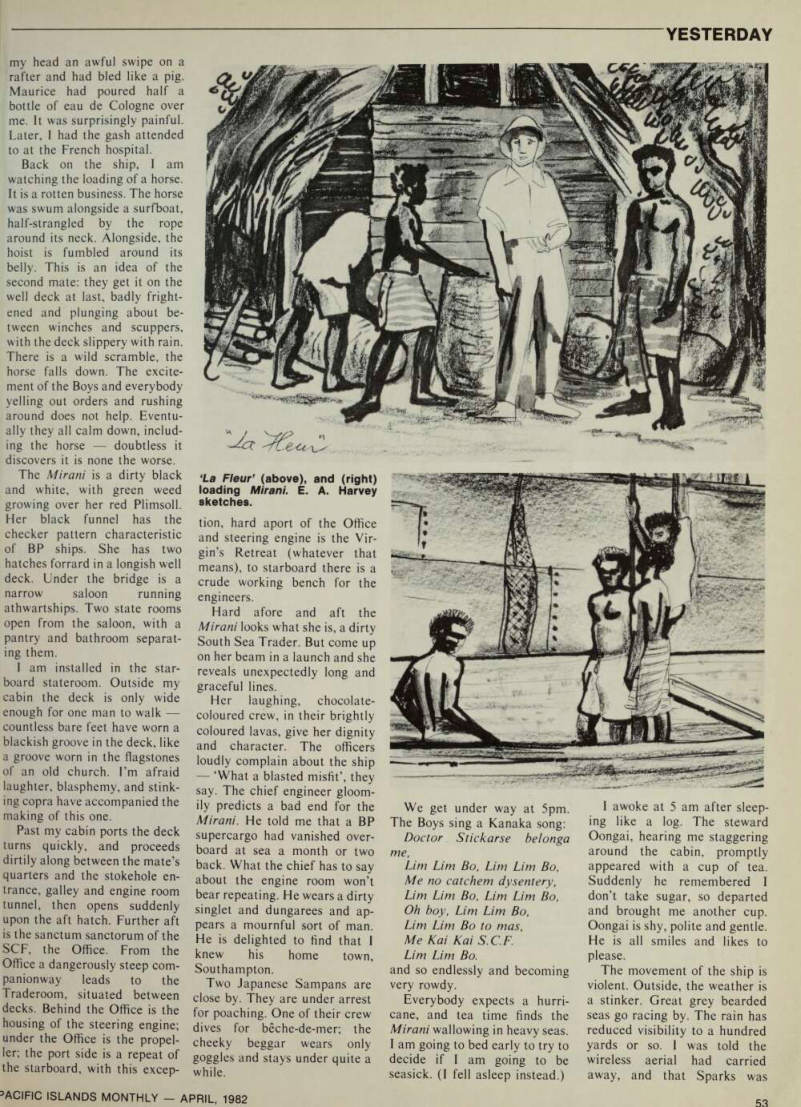
‘La Fleur ’ (above), and (right) loading Mirani. E. A. Harvey sketches.
seasick and in a foul temper. 1 had forgotten to introduce our wireless operator. He is an Australian and somewhat re served. Stamp collectors write to him from all over the world with self-addressed envelopes and money for New Hebrides stamps. The chief engineer is a little seasick, I am a little seedy.
Maurice and M’sieur Charles are in fine fettle.
A discussion took place over the probable course of the ship.
Mirani had overshot the island of Erromango in the dark. She is now turning broadside on and facing it. The poor little ship is rolling heavily and taking water. The glass is still falling.
At 11 am 1 ate a tremendous breakfast and fell much better.
Erromango is in sight close by.
Clouds of rain reduce visibility almost to zero. We have passed our anchorage in Dillons Bay and are now hove-to on the southern and lee shore. The supercargoes say the skipper is scared and mucking about. I am told it is his first command.
Obviously he will take extra care that nothing blots his copy book.
From the ship we see a grey sky and a grey sea and in between is Erromango green to the water’s edge. The ship is just turning round after reach ing the end of the lee shore. She is patrolling back again, the screw just turning. Everybody is waiting, but for how long? Mate doesn’t know ‘bloody skipper won’t confide,’ he complains.
The SCF chaps call the captain a taxi-driver; he calls them a pack of grocers.
The captain enters the Saloon and settles down with the maga zine Fix. He informs us nothing can be done until he gets weather reports. He does not think we can reach the island of Tanna, there is no shelter there.
The chief engineer is wailing about the water slip-slopping about in his cabin.
During the night Maurice had been soaked in his bunk. 1 was on the lee side and kept perfectly dry.
The second male came down from his watch and said he was too f frightened to go and look in his f cabin. He is a heavy, coarse, foul-mouthed man, a bully to those under him.
they say, and putting on a crawling manner to his betters.
Maurice tells me not to repeat anything 1 hear to the second mate, because it all goes straight back to the bridge. The second minds his Ps and Qs with Maurice. On the last trip he trod on Maurice’s bare feet while wearing heavy sea boots.
Maurice at once sent a pile driver into the pit of his stomach.
La Fleur produced a gramo phone and set it drooling away.
Time does begin to hang heavily. The wireless is still broken down. Sparks has every thing in bits. Each piece is labeled ‘ldeal’, a fact which seems to annoy him.
The Trade Room is a fearful place in this sea with the propeller shuddering just underneath. Erromango is still hard by. The skipper decides to try Tanna, some five hours steam away. They say the Mirani will do six knots if the crew put their shirts on the mast.
Tanna looms up and goes again through a grey mist of rain. At last we anchor at
Ouaisisi beside the Polyn'esien, a French copra ship of our own size, but very chic. One does not realise how tiring a plunging, rolling ship can be. How won derful to be still, or just to walk without making compensatory movements. Everyone is feeling fine. The ‘Bridge’ can relax. The supercargoes are in the Office and Traderoom they come into their own at an anchorage. ‘What have they got for whom, and what has whom got for them?’ 1 was anxious to go ashore.
Charles had to go through the books of the SCF Trading Station at White Sands and invited me to accompany him.
I accepted gladly. I got drawing materials together and we were pulled ashore in the boat. The Boys piggy-backed us to dry land. 1 wondered why the others weren’t coming, not realising in my innocence that the skipper had gone to Ouaisisi because of the storm. White Sands was a good 10 miles away. Thanks for coming,’ said Charles. • Next month: Touring the mystery islands of the south.